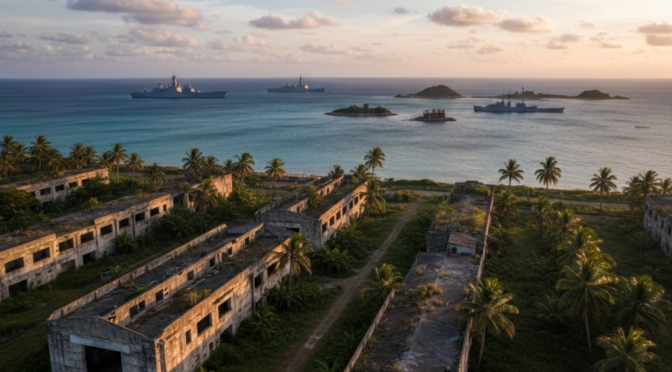
Executive Summary
The closure of United States military facilities in the Philippines in 1991–1992 represents a pivotal structural shift in the security architecture of Southeast Asia. For nearly a century, the presence of major US installations—specifically Clark Air Base and Naval Base Subic Bay—functioned as the primary deterrent against regional hegemony and served as the logistical backbone for American power projection across the Pacific and Indian Oceans.1 The withdrawal, precipitated by a combination of rising Filipino nationalism, the end of the Cold War, and the cataclysmic eruption of Mount Pinatubo, ended the era of permanent US basing and introduced a profound power vacuum in the South China Sea.1
Intelligence and national security analysis from the early 1990s indicates that the removal of this “security umbrella” fundamentally altered the risk calculus for the People’s Republic of China (PRC). Within months of the final US departure, Beijing enacted the 1992 Law of Territorial Waters, codified its expansive maritime claims, and began a “salami-slicing” strategy that culminated in the 1995 occupation of Mischief Reef.3 This report provides a comprehensive historical analysis of the US military presence, the socio-political and geological factors that led to its termination, and the subsequent strategic vulnerabilities that allowed for the contestation of Philippine territorial waters. It argues that the failure to replace the US deterrent with a credible Philippine external defense capability or a cohesive regional security framework directly facilitated the current maritime standoff in the West Philippine Sea.4
The Strategic Anchor: Historical Foundations of US Presence (1898–1946)
The genesis of the American military presence in the Philippines was rooted in the strategic imperatives of the late 19th century. Following the 1898 Treaty of Paris, which concluded the Spanish-American War, the United States acquired the archipelago as its primary colonial outpost in the Western Pacific.1 From a naval perspective, the crown jewel of this acquisition was Subic Bay. Spanish explorers and military authorities had long recognized the bay’s unique properties, including its deep-water harbor and sheltered anchorage, which made it far superior to the shallow and exposed facilities at Cavite.7 Under American administration, Subic Bay was transformed into a massive ship-repair and supply facility, eventually becoming the largest overseas military installation of the United States.1
Simultaneously, the development of Clark Air Base—initially established as Fort Stotsenburg in 1903—provided a land-based counterpart to the naval power centered at Subic.6 Located in the province of Pampanga, Clark benefited from its elevation and proximity to major transport hubs, evolving into the premier logistical and communications nexus for the US Air Force in Asia.2 These two facilities were geographically and operationally synergistic; an aviation fuel pipeline linked Subic and Clark, allowing the two bases to function as a singular, self-contained military ecosystem capable of sustaining theater-wide operations.1
| Period | Key Strategic Milestone | Operational Impact |
| 1898 | Treaty of Paris 1 | US acquires Philippines; Subic Bay becomes primary naval repair station.7 |
| 1903 | Establishment of Fort Stotsenburg 6 | Genesis of Clark Air Base as a cavalry post and later a premier air facility.8 |
| 1941–1945 | Japanese Occupation 1 | Bases fall to Japan; their subsequent liberation reinforces the strategic necessity of forward basing.7 |
| 1946 | Philippine Independence 6 | Sovereignty granted; US retains basing rights via the 1947 Military Bases Agreement.2 |
The post-World War II era saw the formalization of this presence through the 1947 Military Bases Agreement (MBA). This treaty, signed just one week after a mutual assistance accord, granted the United States a 99-year lease on 16 “active” bases and the right to use seven others as military necessity dictated.2 While the agreement was framed as a collective security measure, it was fundamentally asymmetrical. The US enjoyed full discretionary use of the facilities “rent-free,” providing instead varying levels of military and economic assistance that the Philippine government frequently critiqued as insufficient for the perceived loss of sovereignty.2
The Cold War Pillar: Regional Stability and Logistical Dominance
During the Cold War, the Philippine bases served as the “heart” of the US military position in the Pacific.1 The strategic role of these installations was defined by three primary objectives: the protection of the Philippine archipelago, the maintenance of a forward defense perimeter for the United States, and the provision of a logistical bridge to the Indian Ocean and the Persian Gulf.2
Subic Bay and the Seventh Fleet
Naval Base Subic Bay was indispensable for the readiness of the US Seventh Fleet. At its peak, the facility handled approximately 60 percent of all servicing and repair for the fleet, providing a capability equivalent to the major naval yards on the US East Coast.1 The base featured four floating drydocks capable of servicing all naval vessels except aircraft carriers, though the harbor itself was deep enough for carriers to maneuver and turn around.1
The logistical capacity of Subic was staggering. The Naval Supply Depot managed the largest volume of fuel oil of any navy facility in the world, while the Naval Magazine offered nearly 4 million cubic feet of ammunition storage.2 Furthermore, Subic’s water filtration system was so advanced that it not only supplied the base and the fleet but also provided potable water for the austere facilities at Diego Garcia in the Indian Ocean.1
Clark Air Base and the Thirteenth Air Force
Clark Air Base functioned as a massive logistical and communications hub for the Thirteenth Air Force. Its 8,000-foot runway was capable of accommodating any aircraft in the US inventory, supported by 3 million square feet of storage containing over 100,000 unique line items.2 In the event of a general conflict, Clark was tasked with supporting the Fifth Air Force in Japan, providing escorts for long-range bombers from Guam, and resupplying forward positions across Southeast Asia.2
The economic and social impact of these bases was equally profound. The installations were among the largest employers in the Philippines, providing high-paying jobs for over 140,000 skilled Filipino workmen and contributing an estimated 7 to 8 percent of the national GNP through direct spending and aid.1 However, this economic dependency was a double-edged sword, as the presence of a “suburban American community” and the associated sex work industry fueled nationalist resentment and social friction.1
The Crisis of Legitimacy: Marcos, Nationalism, and the 1987 Constitution
The decline of the US-Philippine basing relationship was inextricably linked to the domestic political turmoil of the Ferdinand Marcos era. Marcos had successfully leveraged the bases as a tool for political survival, extracting hundreds of millions of dollars in “compensation” that critics argued was used to sustain his dictatorship rather than modernize the nation’s infrastructure.1 By the mid-1980s, the US military presence was viewed by many Filipinos not as a security guarantee, but as a “vestige of colonialism” that provided a lifeline to a corrupt regime.1
The 1986 People Power Revolution and the subsequent administration of Corazon Aquino marked a radical shift in the legal and political landscape. The 1987 “Freedom Constitution” reflected the prevailing nationalist sentiment, specifically Article XVIII, Section 25, which stated that after the 1947 MBA expired in 1991, foreign military bases, troops, or facilities would not be allowed in the Philippines except under a treaty duly concurred in by the Senate and, if necessary, ratified by a national referendum.11
This constitutional hurdle set the stage for a period of intense and often acrimonious negotiations. The Philippine side, led by Foreign Secretary Raul Manglapus, sought significantly higher compensation—up to $825 million annually—while the US negotiators, led by Richard Armitage, were constrained by post-Cold War budget cuts and a growing perception in Washington that the strategic value of the bases was diminishing.11 The negotiations were further complicated by the perceived “arrogance” of the American team, which pushed even moderate Filipino politicians toward a more hardline anti-base stance.11
| Entity | Primary Motivation in 1991 Negotiations | Stated Goal |
| US Government | Regional stability and logistical continuity 2 | 10-year lease at $360 million/year 13 |
| Aquino Administration | Economic stability and preservation of alliance 3 | High compensation to justify presence to nationalists 11 |
| Nationalist Movement | Genuine sovereignty and end of colonial ties 10 | Complete withdrawal of all foreign troops 11 |
| Philippine Senate | Constitutional mandate and domestic political optics 11 | Rejection of any treaty viewed as “unequal” 10 |
The Geological Mandate: Mount Pinatubo and Operation Fiery Vigil
While political negotiations were at a stalemate, nature intervened to fundamentally alter the strategic calculus. In early June 1991, Mount Pinatubo, a volcano just 10 miles from Clark and 25 miles from Subic that had been dormant for over 500 years, began a series of massive eruptions.8 The disaster was the second-largest terrestrial eruption of the 20th century, ejecting 11 cubic kilometers of tephra and creating a cloud of ash hundreds of miles across.8
The impact on the US bases was catastrophic. On June 10, 1991, the evacuation of 15,000 personnel from Clark Air Base began, moving them to the relative (but temporary) safety of Subic Bay.8 The subsequent major eruption on June 15, combined with the arrival of Typhoon Yunya, created a “rain of mud” that caused the collapse of dozens of buildings across both installations.3 Clark was rendered completely inoperable, covered in a foot of volcanic ash.8
In the aftermath, US Secretary of the Air Force Donald Rice announced on July 12, 1991, that the Air Force would leave the Philippines for good.8 The cost of repairing the facility, combined with geological reports indicating the volcano could remain active for 25 years, made rebuilding untenable.13 Subic Bay, though less damaged and quickly resumed operations, lost its synergy with Clark and became a standalone outpost in an increasingly hostile political environment.1
The Legislative Rupture: The Vote of September 16, 1991
The final blow to the US military presence was delivered by the Philippine Senate. On September 16, 1991, despite intense personal lobbying from President Corazon Aquino—who led a rally of 100,000 people to support the bases—the Senate voted to reject the “Treaty of Friendship, Cooperation, and Security”.10 The vote was a narrow 12-11 rejection, led by a group of senators who would later be known as the “Magnificent 12”.11
The anti-base senators, including Jovito Salonga, Wigberto Tañada, and Joseph Estrada, argued that the treaty was a continuation of an “unequal relationship” and that the country’s soul could only be found by declaring an end to foreign military presence.10 Pro-base officials, such as Vice President Salvador Laurel, warned that the rejection would create a “dangerous security vacuum in Asia” and lead to economic collapse, but these concerns were outweighed by the fervor of the nationalist movement.11
The rejection ended nearly a century of US military service in the Philippines. On December 6, 1991, the Philippine government officially gave the US one year to complete its withdrawal from Subic Bay.14 On November 24, 1992, the American flag was lowered for the last time at Subic, and the final 1,400 US Marines departed, leaving behind only 28 members of the Joint Military Assistance Group attached to the US Embassy.3
The Emergent Power Vacuum and the 1992 China Pivot
The departure of US forces created an immediate and profound power vacuum in the South China Sea. During the Cold War, the US presence had effectively “frozen” maritime disputes, as the Seventh Fleet’s dominance made large-scale territorial expansion by any claimant state risky.2 However, as the US exited, the regional security architecture shifted from a US-anchored perimeter to a contested and anarchic maritime environment.3
Intelligence analysis from the period indicates that the PRC was uniquely prepared to exploit this withdrawal. In February 1992, less than three months after the US withdrawal notification, Beijing enacted the “Law on the Territorial Sea and the Contiguous Zone”.3 This law codified the PRC’s claim to the entire Spratly and Paracel island chains and authorized the use of military force to defend these claims against “intruders”.3
The Structural Vulnerability of the Philippines
The vacuum was most acutely felt by the Philippines, which had transitioned to a state of extreme vulnerability. For six decades, the Armed Forces of the Philippines (AFP) had been a “dependency” of the US military, receiving technical training and hardware specifically designed for internal counter-insurgency operations against Communist and Moro rebels.4 Consequently, the AFP in 1992 possessed almost no external defense capability.16
| Military Branch | External Defense Status (1992–1995) | Critical Deficiencies |
| Philippine Navy | Mostly 1940s-era LSTs and small patrol craft.18 | No modern frigates, corvettes, or submarines; no anti-ship missile capability.18 |
| Philippine Air Force | Aging F-5 fleet; many aircraft grounded for parts.20 | No modern radar systems; lacks maritime patrol and interceptor aircraft.20 |
| Philippine Army | Optimized for jungle warfare and counter-insurgency.4 | Lacks coastal defense systems and amphibious assault capability.5 |
This imbalance was exacerbated by the Philippine government’s decision to keep military budgets at a minimum following the US exit. Leaders in Manila operated under the assumption that no external enemy would menace the country until at least the end of the decade, a miscalculation that left the country’s maritime borders virtually undefended.5
The Mischief Reef Crisis: China’s First Major Move (1995)
The most significant consequence of the US withdrawal was the 1995 Mischief Reef incident. In January 1995, Filipino fishermen reported that they had been detained by PRC forces at Mischief Reef (known as Panganiban Reef in the Philippines), a feature located just 240km west of Palawan—deep within the Philippine Exclusive Economic Zone (EEZ).22
Philippine military reconnaissance flights subsequently confirmed that the PRC had constructed four structures on stilts above the reef, which were guarded by several armed naval vessels.22 This occupation was a “shock” to the capitals of Southeast Asia, as it marked the first time the PRC had directly confronted an ASEAN member state other than Vietnam and represented a significant “westward expansion” of Chinese installations toward the Philippine home islands.22
The Deception of “Shelters”
The PRC’s initial response to the crisis was a classic example of “gray zone” tactics. Beijing claimed the structures were merely “shelters for fishermen” and had been built by “low-level personnel acting without the knowledge and consent of the Chinese government”.22 However, intelligence reports indicated that the structures were actually the first stage of a long-term “leapfrogging” strategy designed to test the resolve of regional claimants and the United States.24
The Alliance Paralysis
The Mischief Reef crisis also highlighted the ambiguity of the 1951 US-Philippines Mutual Defense Treaty (MDT). At the time, the US Department of State maintained a policy of “no position” on the legal merits of the competing sovereignty claims in the South China Sea.25 US officials argued that the MDT only applied to “metropolitan territory” and “island territories under [Philippine] jurisdiction,” a definition that the US did not believe necessarily included the disputed Spratly Islands.26
This perceived lack of a US security guarantee emboldened Beijing and left President Fidel Ramos with no feasible military option.22 The Philippines responded by destroying Chinese survey markers on nearby reefs and detaining Chinese fishermen, but these actions could not reverse the fait accompli on Mischief Reef.22
The Failed Modernization and the 1997 Economic Collapse
In a desperate attempt to rectify its strategic weakness, the Philippine Congress passed the “AFP Modernization Act” (Republic Act 7898) in February 1995.16 The law authorized a 15-year program with an approved budget of 331 billion pesos (approx. $6.6 billion) to upgrade the military’s technology and equipment for territorial defense.5
However, the program was stillborn. The 1997 Asian Financial Crisis devastated the Philippine economy, forcing the government to divert funds away from military modernization to maintain social services and economic stability.4 Furthermore, a resurgence of internal threats—including the Abu Sayyaf Group and escalated conflicts with Moro insurgents—caused the army to once again pull resources away from the Navy and Air Force.4 By the time the modernization law expired in 2011, almost no significant progress had been made, leaving the Philippines as “Southeast Asia’s military laggard” at a time when Chinese aggression was reaching new heights.5
Diplomatic Stalemate: ASEAN and the DOC (1992–2002)
Throughout the 1990s, the Philippines sought to internationalize the South China Sea issue through the Association of Southeast Asian Nations (ASEAN). The 1992 Manila Declaration on the South China Sea was the organization’s first attempt to establish a norm-based framework for the dispute, calling for peaceful resolution and the exercise of restraint.29
However, ASEAN solidarity proved fragile. China consistently preferred bilateral negotiations, where its economic and military weight could be more effectively applied, and it successfully exploited the divergent interests of ASEAN member states.15 While a non-binding “Declaration on the Conduct of Parties” (DOC) was eventually signed in 2002, it fell far short of the legally binding “Code of Conduct” (COC) that Manila had sought.15 The DOC essentially “frozen” the diplomatic situation while allowing the PRC to continue its quiet expansion and militarization of the features it already occupied.29
Strategic Insights: The Cost of Disengagement
The historical data surrounding the US withdrawal from the Philippines and the subsequent Chinese encroachment suggests several high-order conclusions for national security and foreign policy analysts:
- Deterrence is Location-Dependent: The “Places, Not Bases” doctrine that followed the US exit from Subic Bay was insufficient to deter Chinese expansion.3 The permanent presence of the Seventh Fleet provided localized intelligence and a “ready-response” capability that could not be replicated by rotational visits or the “socialization” of China through diplomatic forums.30
- The “Internal Security Trap”: The Philippines’ inability to transition its military focus from counter-insurgency to territorial defense created a permanent state of vulnerability.4 The diversion of resources to fight domestic threats allowed external actors to solidify their maritime claims without significant cost.5
- Ambiguity Invites Contestation: The lack of clarity in the 1951 MDT regarding the Spratly Islands was a primary factor in the PRC’s decision to occupy Mischief Reef.24 Beijing’s “salami-slicing” strategy was specifically designed to operate below the threshold that would trigger a decisive US military response.24
- Economic Co-dependency as a Geopolitical Tool: The PRC’s use of its emergent economic power to disrupt ASEAN unity during the 1990s and 2000s demonstrated that diplomatic solutions are easily undermined when claimant states prioritize short-term trade benefits over long-term regional security norms.15
Conclusion: The Legacy of the 1991 Rupture
The US military withdrawal from the Philippines in 1992 was a watershed moment that ended nearly a century of strategic stability and initiated a multi-decade era of maritime contestation. The removal of the “security umbrella” anchored by Subic Bay and Clark Air Base exposed the profound internal weaknesses of the Philippine state and provided the People’s Republic of China with the opportunity to assert its expansive maritime claims.3
The Mischief Reef crisis of 1995 was the definitive signal that the “power vacuum” was no longer a theoretical concern but a geopolitical reality.3 The subsequent failure of Philippine modernization efforts and the fragmentation of the regional diplomatic response ensured that Beijing’s “westward expansion” would continue largely unchecked for years to come.5 For the national security community, the history of this transition serves as a stark reminder that strategic voids in contested regions are rarely left unfilled, and the cost of re-engaging to restore a lost balance of power is invariably higher than the cost of maintaining a credible presence.
Please share the link on Facebook, Forums, with colleagues, etc. Your support is much appreciated and if you have any feedback, please email us in**@*********ps.com. If you’d like to request a report or order a reprint, please click here for the corresponding page to open in new tab.
Sources Used
- Politics, Pinatubo and the Pentagon: The Closure of Subic Bay – ADST.org, accessed January 31, 2026, https://adst.org/2016/05/politics-pinatubo-pentagon-closure-subic-bay-philippines/
- The Key Role of U.S. Bases in the Philippines | The Heritage …, accessed January 31, 2026, https://www.heritage.org/report/the-key-role-us-bases-the-philippines
- There and Back and There Again: U.S. Military Bases in the …, accessed January 31, 2026, https://www.usni.org/magazines/proceedings/2024/may/there-and-back-and-there-again-us-military-bases-philippines
- Riding Unruly Waves: The Philippines’ Military Modernisation Effort …, accessed January 31, 2026, https://www.crisisgroup.org/rpt/asia-pacific/south-east-asia/philippines-china-united-states/349-riding-unruly-waves-philippines-military-modernisation-effort
- Defence Reform and Military Modernization in the Philippines in the perspective of the South China Sea Conflict, accessed January 31, 2026, https://www.press.uni.lodz.pl/index.php/wul/pl/catalog/download/1079/5569/3215?inline=1
- Who Holds Development Expertise and Who Development Serves: Examining Clark Air Base through Local Memory, accessed January 31, 2026, https://utsynergyjournal.org/2026/01/04/who-holds-development-expertise-and-who-development-serves-examining-clark-air-base-through-local-memory/
- U.S. Naval Base Subic Bay – Wikipedia, accessed January 31, 2026, https://en.wikipedia.org/wiki/U.S._Naval_Base_Subic_Bay
- AIR FORCE HISTORY: The Evacuation of Clark Air Force Base, accessed January 31, 2026, https://www.tinker.af.mil/News/Article-Display/Article/1218915/air-force-history-the-evacuation-of-clark-air-force-base/
- The Republic of the Philippines and U.S. Interests – EveryCRSReport.com, accessed January 31, 2026, https://www.everycrsreport.com/reports/RL33233.html
- The Historic Senate Vote of 16 September 1991: Looking Back and Looking Forward Twenty-Five Years After – Archīum Ateneo, accessed January 31, 2026, https://archium.ateneo.edu/cgi/viewcontent.cgi?article=4270&context=phstudies
- Bulatlat.com, accessed January 31, 2026, https://www.bulatlat.com/news/2-32/2-32-bases.html
- Opposition to EDCA goes to SC today – VERA Files, accessed January 31, 2026, https://verafiles.org/articles/opposition-to-edca-goes-to-sc-today
- US Military Told To Leave Philippines – CQ Almanac Online Edition, accessed January 31, 2026, https://library.cqpress.com/cqalmanac/cqal91-1111026
- Background Notes: Philippines 7/98 – State Department, accessed January 31, 2026, https://1997-2001.state.gov/background_notes/philippines_0798_bgn.html
- ASEAN, the Declaration on Conduct, and the South China Sea, accessed January 31, 2026, https://berkas.dpr.go.id/perpustakaan/sipinter/files/sipinter–733-20200729154528.pdf
- Assessment of the Armed Forces of the Philippines Modernization Program., accessed January 31, 2026, https://ntrl.ntis.gov/NTRL/dashboard/searchResults/titleDetail/ADA494077.xhtml
- An Assessment of the Armed Forces of the Philippines Modernization Program – DTIC, accessed January 31, 2026, https://apps.dtic.mil/sti/tr/pdf/ADA494077.pdf
- The Amphibious Warfare Capabilities of the Philippine Navy – Past, Present and Future, accessed January 31, 2026, http://maxdefense.blogspot.com/2015/02/the-amphibious-warfare-capabilities-of.html
- Naval News Report #2 – Philippine Navy, accessed January 31, 2026, https://philippinenavy.tripod.com/navy3.html
- Getting the Philippines Air Force Flying Again – The Heritage Foundation, accessed January 31, 2026, http://static.heritage.org/2012/pdf/bg2733.pdf
- List of equipment of the Philippine Air Force – Wikipedia, accessed January 31, 2026, https://en.wikipedia.org/wiki/List_of_equipment_of_the_Philippine_Air_Force
- China Occupies Mischief Reef In Latest Spratly Gambit – Durham University, accessed January 31, 2026, https://www.durham.ac.uk/media/durham-university/research-/research-centres/ibru-centre-for-borders-research/maps-and-databases/publications-database/boundary-amp-security-bulletins/bsb3-1_dzurek.pdf
- Incident at Mischief Reef: Implications for the Philippines, China, and the United States, accessed January 31, 2026, https://www.hsdl.org/c/view?docid=451792
- Once forgotten reefs… historical images in the scramble for the south China sea – OpenEdition Journals, accessed January 31, 2026, https://journals.openedition.org/cybergeo/5782
- Does the Revised U.S. South China Sea Policy Go Far Enough?, accessed January 31, 2026, https://digital-commons.usnwc.edu/cgi/viewcontent.cgi?article=2997&context=ils
- 353. Memorandum From the President’s Assistant for National Security Affairs (Scowcroft) to President Ford, Washington, undated. – Historical Documents – Office of the Historian, accessed January 31, 2026, https://history.state.gov/historicaldocuments/frus1969-76ve12/d353
- Mutual Defense Treaty Between the United States and the Republic of the Philippines; August 30, 1951 – Avalon Project, accessed January 31, 2026, https://avalon.law.yale.edu/20th_century/phil001.asp
- The Philippine military performs on array of traditional (internal security and external defense) and non-traditional – Brill, accessed January 31, 2026, https://brill.com/downloadpdf/journals/ppsj/25/1/article-p107_5.pdf
- Twenty Years of the Declaration on the Conduct of Parties in the South China Sea – World Scientific Publishing, accessed January 31, 2026, https://www.worldscientific.com/doi/pdf/10.1142/9789811296031_0001
- The South China Sea Dispute in Philippine Foreign Policy, accessed January 31, 2026, https://rsis.edu.sg/wp-content/uploads/2023/02/MN05-The-South-China-Sea-Dispute-in-Philippine-Foreign-Policy.pdf
- ASEAN’s ineffective Response to The South China Sea Disputes – Huskie Commons, accessed January 31, 2026, https://huskiecommons.lib.niu.edu/cgi/viewcontent.cgi?article=8650&context=allgraduate-thesesdissertations
- DECLARATION ON THE CONDUCT OF PARTIES IN THE SOUTH CHINA SEA – Asean, accessed January 31, 2026, https://asean.org/declaration-on-the-conduct-of-parties-in-the-south-china-sea-2/
- China-ASEAN RELATIONS: PERSPECTIVES, PROSPECTS AND IMPLICATIONS FOR US INTERESTS – The Web site cannot be found, accessed January 31, 2026, https://www.files.ethz.ch/isn/47068/China_ASEAN_Relations.pdf