Executive Summary
The pistol-caliber carbine and large-format pistol market experienced an unprecedented volume of consumer engagement, technical discourse, and commercial activity throughout July 2026. A comprehensive review of social media, forums, and technical publications from this period identified the top 10 most discussed Pistol Caliber Carbines (PCCs) and submachine gun variants on the market. The analysis reveals a maturing consumer base that heavily scrutinizes direct blowback systems while highly praising delayed blowback and short-stroke piston operating mechanisms for their recoil mitigation and suppressor friendliness.
The most discussed platform of the month was the CZ Scorpion, though conversations were overwhelmingly negative, driven by safety concerns regarding out-of-battery (OOB) detonations and the necessity of aftermarket bolt upgrades. Conversely, the B&T APC9 Pro emerged with the highest positive sentiment, lauded universally for its hydraulic buffer system and Swiss engineering.
This surge in market velocity was catalyzed by two distinct macroeconomic and regulatory events that fundamentally altered the purchasing calculus for civilian shooters and professional procurement officers alike. Primarily, the formal regulatory stabilization regarding pistol stabilizing braces provided the market with long-term confidence. Following the Department of Justice’s dismissal of appeals in the extended Mock v. Garland litigation, the Bureau of Alcohol, Tobacco, Firearms and Explosives formally acknowledged the vacatur of the 2023 Final Rule, thereby removing the threat of National Firearms Act regulation for braced platforms. Secondly, the continuation of highly accelerated electronic processing times for National Firearms Act suppressors has transformed the domestic market, shifting consumer priorities heavily toward platforms optimized for acoustic signature reduction and backpressure management.
From a mechanical engineering perspective, the data confirms a definitive paradigm shift in consumer preference. The market is aggressively moving away from traditional, heavy direct blowback operating systems. Modern shooters are increasingly demanding the sophisticated recoil mitigation, reduced reciprocating mass, and superior suppressor hosting capabilities offered by mechanically delayed actions. Roller-delayed, radial-delayed, hydraulic-buffered, and short-stroke gas-piston systems dominated the upper echelons of technical discussions. Direct blowback platforms maintained relevance only when supported by aggressive budget pricing strategies or when occupying highly specialized physical form factors, such as ultra-compact folding survival carbines.
This report analyzes the top ten most discussed pistol caliber carbines, submachine guns, and civilian-legal semi-automatic variants during the month of July 2026, ranked by total discussion volume. By examining sentiment distributions, engineering advantages, user commentary, and mechanical controversies, this document provides a comprehensive assessment of the current small arms landscape.
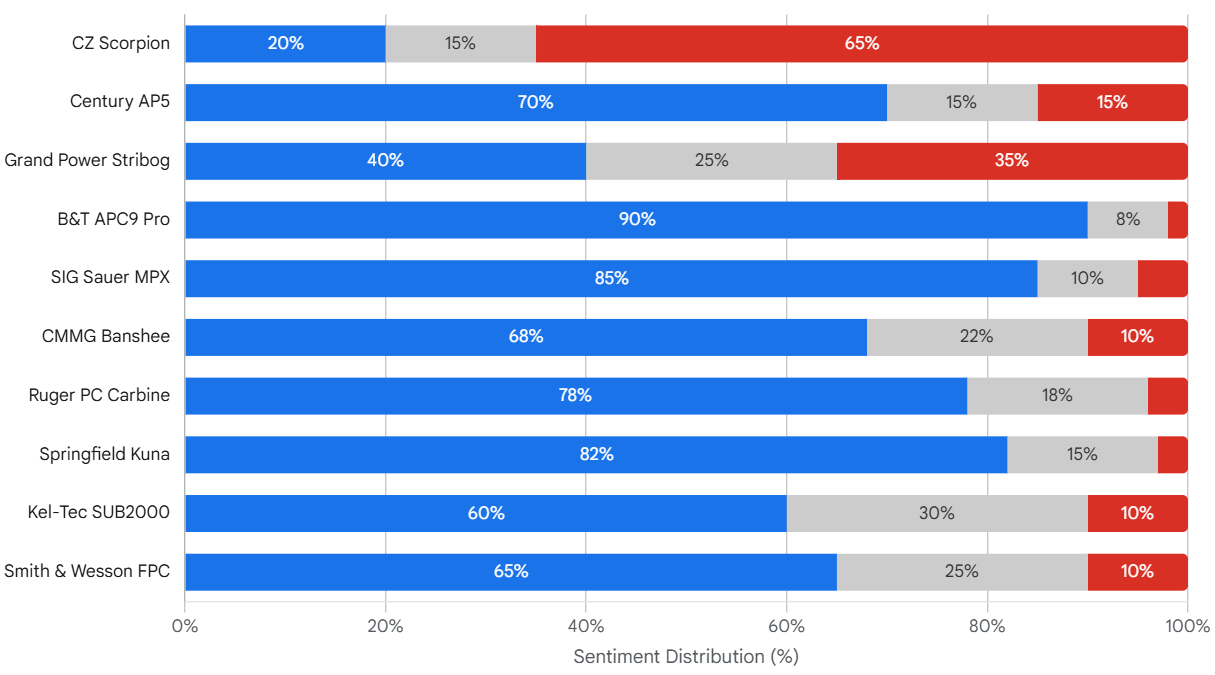
Summary Table: Sentiment and Market Positioning
| Market Rank | Platform Designation | Operating System Architecture | Primary Caliber | Positive Sentiment | Negative Sentiment | Neutral Sentiment | Average MSRP (USD) |
| 1 | CZ Scorpion EVO 3 & 3+ | Direct Blowback | 9x19mm Parabellum | 20% | 65% | 15% | $1,049 |
| 2 | Century Arms AP5 (MP5 Clone) | Roller-Delayed Blowback | 9x19mm Parabellum | 70% | 15% | 15% | $1,359 |
| 3 | Grand Power Stribog SP9A3 | Delayed Blowback | 9x19mm Parabellum | 40% | 35% | 25% | $1,398 |
| 4 | B&T APC9 Pro | Hydraulic Buffered Blowback | 9x19mm Parabellum | 90% | 2% | 8% | $2,500+ |
| 5 | SIG Sauer MPX (K & PCC) | Short-Stroke Gas Piston | 9x19mm Parabellum | 85% | 5% | 10% | $2,179 |
| 6 | CMMG Banshee | Radial-Delayed Blowback | 9x19mm Parabellum | 68% | 10% | 22% | $1,749 |
| 7 | Ruger PC Carbine | Dead-Blow Blowback | 9x19mm Parabellum | 78% | 4% | 18% | $799 |
| 8 | Springfield Armory Kuna | Roller-Delayed Blowback | 9x19mm Parabellum | 82% | 3% | 15% | $1,179 – $1,330 |
| 9 | Kel-Tec SUB2000 Gen 3 | Direct Blowback | 9x19mm Parabellum | 60% | 10% | 30% | $499 |
| 10 | Smith & Wesson FPC | Direct Blowback | 9x19mm Parabellum | 65% | 10% | 25% | $700 |
Platform Analysis: Top 10 Most Discussed Firearms
1. CZ Scorpion EVO 3 & 3+
The CZ Scorpion occupied the first position in discussion volume, driven primarily by a highly polarized and negative controversy surrounding catastrophic mechanical failures. Social media platforms, dedicated forums, and engineering channels were saturated with reports and visual evidence of out-of-battery detonations. This intense focus on a severe safety hazard, combined with extensive discussions regarding aftermarket engineering solutions, drove massive, albeit negative, engagement volumes throughout the month.
The sentiment distribution for the CZ Scorpion reflects this controversy, logging twenty percent positive, a substantial sixty-five percent negative, and fifteen percent neutral. Positive remarks were largely relegated to platform loyalists who continue to praise the firearm’s excellent factory ergonomics, aesthetic appeal, and the sheer volume of aftermarket support available. Some owners reported perfect reliability over thousands of rounds, praising the platform’s accuracy whether firing suppressed subsonic loads or unsuppressed supersonic ammunition. While loyalists praised the classic EVO 3 S1 for its lightweight 5-pound fiber-reinforced polymer construction and 7.72-inch barrel, newer variants like the Scorpion 3+ Micro were heavily discussed for their modernized ergonomics, introducing an AR-style magazine release and a compact 4.2-inch threaded barrel. The negative sentiment, however, was intense and technically focused regarding the factory bolt’s metallurgy. Users complained that after relatively low round counts, the metal on the underside of the bolt began to physically deform, rolling over the opening for the striker block and pinning it down. Neutral commentary was predominantly technical in nature, with users discussing mitigation strategies, such as using rotary tools to chamfer the edges where the striker block sits to prevent the metal from trapping the safety mechanism.
From an engineering standpoint, the CZ Scorpion utilizes a simple direct blowback operating system, meaning the only forces keeping the breech closed during the critical moments of firing are the physical mass of the bolt and the tension of the recoil spring. The critical failure point discussed throughout July 2026 involves the specific carbon steel alloy used in standard factory bolts. This material is relatively soft, and repeated cycling causes the metal around the firing pin safety block to peen over. This peening physically traps the striker block in the depressed position, allowing the firing pin to float freely. If the firearm cycles at high speeds, which is frequently the case when users install aftermarket binary triggers or forced reset triggers, the exposed firing pin can ignite the cartridge primer before the bolt is fully locked in battery. This results in a catastrophic explosion that typically shatters the polymer receiver halves. Consequently, a massive secondary market discussion revolved around the “Nexus bolt,” an aftermarket, CNC-machined enhanced bolt carrier group that physically solves the out-of-battery risk by utilizing superior material hardness and a pre-chamfered striker block channel.
2. Century Arms AP5
The Century Arms AP5 occupied the second position in discussion volume for July 2026. Imported from the MKE manufacturing facility in Turkey, the AP5 serves as a faithful, semi-automatic clone of the iconic Heckler & Koch MP5 submachine gun. Discussion volumes surged dramatically due to a convergence of aggressive summer rebate programs initiated by the importer and the recent restoration of federal legal protections for pistol stabilizing braces. Consumers seeking a nostalgic Cold War era submachine gun experience flocked to the AP5 because it offers genuine roller-delayed blowback performance at a price point that is a fraction of the cost of an authentic Heckler & Koch SP5.
Sentiment analysis reveals a highly favorable reception, registering at seventy percent positive, fifteen percent negative, and fifteen percent neutral. Positive commentary consistently highlighted the exceptional recoil mitigation inherent to the platform’s design. Users frequently noted that the roller-delayed action is exceptionally smooth shooting and, when paired with a stabilizing brace and standard nine-millimeter cartridges, produces almost negligible recoil. Furthermore, enthusiasts praised the authentic manual of arms, noting that manipulating the non-reciprocating charging handle remains a highly satisfying tactile experience. Conversely, negative sentiment focused heavily on the internal fire control group. Detractors pointed out the heavy trigger pull, with reviewers noting that the factory single-stage trigger exhibits substantial creep and breaks at a heavy 7.9 pounds. Neutral commentary typically revolved around the mechanical break-in period, with experienced owners advising new buyers that the safety selector, takedown pins, and overall action require several hundred rounds of standard-pressure ammunition to properly loosen and function smoothly.
The primary engineering discussion surrounding the AP5 is its manufacturing pedigree, specifically its use of original Heckler & Koch tooling for its stamped steel receiver and proprietary bolt assembly. The platform features an 8.9-inch barrel with a threaded muzzle and quick-release flash hider, pairing a heavy stamped steel upper with a polymer lower receiver for a total weight of 5.5 pounds. In this roller-delayed system, the bolt features two cylindrical steel rollers that lock outward into recesses within the barrel trunnion. Upon ignition of the cartridge, the rearward pressure of the expanding chamber gases must overcome the mechanical disadvantage of squeezing these rollers inward against an angled locking piece before the bolt carrier can begin its rearward cycle. This mechanical delay ensures chamber pressures drop to safe environmental levels while simultaneously keeping the overall reciprocating mass quite low, resulting in a remarkably smooth recoil impulse compared to modern direct blowback systems. Analysts also heavily discussed the AP5 as a premier suppressor host. The AP5-SD variant, which features a ported barrel specifically designed to bleed off expanding gases, allows standard supersonic nine-millimeter ammunition to drop to subsonic velocities before exiting the muzzle.
3. Grand Power Stribog SP9A3
Manufactured in Slovakia by Grand Power and imported stateside by Global Ordnance, the Stribog SP9A3 represents the ongoing evolution of the budget-friendly pistol caliber carbine. While earlier iterations of this platform utilized a harsh and heavy direct blowback system, the A3 variant upgraded the internal mechanics to a sophisticated delayed blowback bolt. Discussions in July 2026 centered on the platform’s incredible value proposition, positioning it as an accessible host for extensive aftermarket modifications. It essentially allows users to construct a custom delayed subgun for significantly less capital than a standard MP5 clone requires.
Consumer sentiment balanced at forty percent positive, thirty-five percent negative, and twenty-five percent neutral. Positive commentary consistently highlighted the dramatically reduced recoil profile compared to older, blowback-operated models within the same lineage. Shooters who tested the delayed variant side-by-side with the older direct blowback models noted an absolute reduction in felt recoil, praising the internal delay mechanism. Negative feedback focused almost entirely on out-of-the-box reliability issues. Frustrated users stated that the factory configuration suffered from cheap-feeling magazines and regular feeding malfunctions, specifically noting that spent casings would frequently become trapped behind the bolt group, requiring complex disassembly to clear. Neutral sentiment was dominated by custom builders who view the factory gun merely as a baseline receiver. These users advised abandoning the factory lower receiver entirely in favor of aftermarket aluminum lowers that accept highly reliable CZ Scorpion or Kalashnikov-style magazines.
The platform is highly versatile, offered in various configurations such as the ultra-compact SP9A3S with a 5.5-inch barrel, and the standard SP9A3 with an 8-inch barrel. The Stribog SP9A3’s delayed system differs slightly from the traditional Heckler & Koch design, utilizing a single rolling cylinder rather than dual symmetrical rollers, but the physical effect of delaying the breech opening remains functionally identical. The most critical discussion point among engineers and serious shooters is the platform’s original magazine geometry. The factory straight magazines are notorious for presentation angle issues, particularly when feeding flat-nosed or jacketed hollow-point ammunition, leading to the aforementioned malfunctions. The community consensus in July 2026 was that the SP9A3 is an excellent foundation, provided the user is willing to invest in a short-stroke buffer kit to prevent cases from slipping behind the bolt carrier over-travel, and upgrades to either the newer curved factory magazines or an aftermarket lower receiver ecosystem.
4. B&T APC9 Pro
The B&T APC9 Pro firmly occupies the apex of the premium small arms market. Engineered and manufactured in Switzerland, the platform gained immense global prestige after a select-fire variant was chosen by the United States Army as the XM17 Sub Compact Weapon for deployment in specialized personal security details. In July 2026, discussions focused heavily on corporate restructuring, specifically B&T regaining full operational control of its United States trademarks following a comprehensive legal settlement. This transition to direct Swiss-owned operations secured a highly integrated supply chain, assuring American consumers of long-term support and parts availability.
Reflecting its premium status, sentiment for the APC9 Pro was overwhelmingly favorable, registering at ninety percent positive, two percent negative, and eight percent neutral. Positive commentary universally respected the flawless build quality and absolute reliability of the platform. Analysts and professional end-users frequently refer to the civilian APC9 Pro as the closest available civilian equivalent to the military-issue Sub Compact Weapon, offering duty-grade performance without the requisite federal paperwork. The minimal negative sentiment was entirely focused on the prohibitive financial barrier to entry, as complete setups, including proprietary optics mounts and original equipment manufacturer accessories, easily exceed two thousand five hundred dollars. Neutral discussions were highly pragmatic, with buyers debating which modular lower receiver group to purchase. A key selling point of the Pro model is its ability to swap between proprietary translucent B&T magazines, standard Glock double-stack magazines, or SIG Sauer P320 magazines without requiring any serialized tracking or federal registration changes.
The defining engineering feature of the APC9 Pro is its proprietary hydraulic shock-absorbing buffer system. While the core operating system relies on direct blowback principles, B&T engineers integrated a sealed hydraulic piston into the rear of the upper receiver. As the heavy bolt carrier travels rearward during the extraction phase, rather than slamming violently into a solid urethane pad or the raw aluminum backwall of the receiver, it strikes the hydraulic piston. This mechanism actively bleeds off the kinetic energy of the recoiling bolt through fluid displacement, drastically reducing the felt recoil impulse and preventing the shooter’s optical sight from bouncing off target during rapid strings of fire. Furthermore, the APC9K (the ultra-compact variant) and the APC9 SD (the integrally suppressed variant) were heavily analyzed for close-quarters applications. The SD model features a specifically ported barrel that bleeds off propellant gases, intentionally dropping standard supersonic ammunition to subsonic velocities. This yields an acoustic signature below one hundred and thirty decibels without requiring the procurement of specialized, high-cost subsonic ammunition.

5. SIG Sauer MPX (K & PCC)
The SIG Sauer MPX remains the undisputed benchmark for competitive pistol caliber carbine shooting disciplines. During July 2026, the MPX was heavily discussed almost exclusively within the context of the United States Practical Shooting Association (USPSA) PCC division, a sport where fractions of a second dictate tournament outcomes and equipment reliability is paramount. Despite its premium retail price point consistently hovering near two thousand one hundred dollars, competitive shooters continue to transition to the MPX for its exceptionally flat-shooting characteristics and familiar, AR-style manual of arms.
Sentiment for the MPX platform was highly positive, landing at eighty-five percent positive, five percent negative, and ten percent neutral. Competitors revere its performance metrics above all else. Users transitioning from traditional blowback platforms frequently noted their surprise at the softness of the recoil impulse, explicitly stating that the difference between direct blowback and the MPX’s short-stroke piston system is vast and immediately noticeable on the shot timer. Negative sentiment was strictly tied to the ongoing cost of ownership. Reviewers and competitors frequently cited the proprietary polymer magazines, which retail for nearly seventy dollars each, as a significant financial pain point for a sport that requires extensive equipment redundancy. Neutral discussions often involved highly technical comparisons, weighing the merits of the proprietary MPX architecture against custom-built AR-9s or the roller-delayed JP Enterprises JP5, analyzing factors like parts availability and tuning potential.
Unlike almost every other nine-millimeter platform currently available on the commercial market, the MPX utilizes a closed-bolt, short-stroke tappet gas piston system featuring a fully rotating, multi-lug locking bolt. When the firearm is discharged, high-pressure expanding propellant gases are bled from a small port in the barrel directly into a localized gas block. This pressurized gas strikes a small, captive piston, which travels backward just enough to impart kinetic momentum to the operating rod, subsequently rotating and unlocking the bolt. Because the breech is physically and mechanically locked upon firing, the MPX does not require the massive, heavy bolt carrier traditionally used to keep a blowback chamber sealed. This drastic reduction in reciprocating mass means there is significantly less physical weight slamming back and forth inside the aluminum receiver during rapid strings of competitive fire. The result is almost zero muzzle rise, allowing a skilled USPSA competitor to transition between multiple steel targets with surgical precision and minimal optical disruption.
6. CMMG Banshee
The CMMG Banshee generated sustained and detailed discussion in July 2026, driven primarily by the surging popularity of pistol caliber sound suppressors following the federal government’s highly publicized streamlined electronic approval process. The Banshee is widely regarded by industry professionals as one of the premier AR-pattern suppressor hosts available on the commercial market, offering a unique blend of familiar ergonomics and advanced internal mechanics.
Consumer sentiment was favorable, resulting in a sixty-eight percent positive, ten percent negative, and twenty-two percent neutral distribution. Positive commentary praised the seamless integration of AR-15 ergonomics with a delayed action, allowing shooters to maintain their existing muscle memory while benefiting from advanced recoil mitigation. Users frequently cited the Banshee as the logical conclusion of pistol caliber carbine design, offering a compact footprint without sacrificing cartridge authority. Negative feedback was largely centered around the complexities of suppressor tuning. Users attempting to suppress the firearm with high-backpressure traditional baffle suppressors complained of cycling malfunctions, noting that even with the heaviest aftermarket weights installed, the bolt velocity remained too high, requiring frustrating periods of trial and error. Neutral buyers focused on the practical application of the CMMG “Action Tuning Kit,” sharing data regarding which combination of small, medium, or large weights perfectly balanced the firearm based on specific subsonic ammunition types and suppressor volumes.
The Banshee achieves its unique performance profile by utilizing CMMG’s patented Radial-Delayed Blowback system. The bolt face features specifically angled locking lugs that interface with corresponding angled geometry in the barrel extension. Upon firing, the immense rearward force of the expanding cartridge case must force the bolt assembly to rotate and unlock against these angled cuts before the carrier can travel backward. This rotational mechanical delay slows the initial extraction process just enough to allow chamber pressures to drop to safe, manageable levels. This mechanism is exceptionally beneficial when operating the weapon with a sound suppressor. Suppressors inherently trap expanding gases, creating a high-pressure environment that forces toxic gas, unburnt powder, and carbon debris backward down the barrel and directly into the receiver. By delaying the unlocking phase, the Banshee forces a significantly higher volume of that trapped gas out of the muzzle rather than out of the ejection port. This keeps the internal action dramatically cleaner, improves reliability, and drastically reduces the amount of toxic gas blowback directed into the shooter’s respiratory zone.
7. Ruger PC Carbine
The Ruger PC Carbine remains the baseline utilitarian standard for pistol caliber carbines in the American market. Its high discussion volume is consistently driven by its widespread accessibility, exceptional affordability, and highly practical, non-threatening design aesthetic. It is universally recommended by instructors as an ideal entry-level pistol caliber carbine or as a dedicated emergency preparedness tool due to its unique ability to seamlessly integrate into existing handgun logistical setups.
Sentiment remains solidly favorable at seventy-eight percent positive, four percent negative, and eighteen percent neutral. Positive commentary heavily focuses on the platform’s unmatched versatility and out-of-the-box value. Users appreciate that the standard Ruger PC stands out for its mechanical simplicity, affordability, and familiar sporting-rifle manual of arms. The primary negative critique focuses entirely on the physical weight of the platform. Because it utilizes a massive internal steel bolt to safely facilitate the blowback action, the carbine is notably heavy for a nine-millimeter platform, leading some users to find it cumbersome during extended training sessions. Neutral discussions frequently center on the robust aftermarket, with users sharing data on upgrading the traditional, fixed rifle stock to modern, modular aluminum chassis systems featuring standard pistol grips and adjustable lengths of pull.
To mitigate the notoriously harsh and sharp recoil impulse associated with a standard direct blowback action, Ruger engineers designed a custom, internal “dead-blow” action. The bolt assembly features a custom tungsten weight that is permitted to shift slightly within the carrier body. As the heavy bolt slams forward under spring tension to chamber a new round, the tungsten weight strikes the front of the internal bolt cavity mere milliseconds later. This secondary kinetic impact, or dead-blow effect, physically prevents “bolt bounce”, a dangerous phenomenon where the bolt strikes the breech face and rebounds slightly backward, creating a severe out-of-battery detonation risk during rapid fire. Furthermore, the PC Carbine’s most celebrated engineering feature is its interchangeable modular magazine well. It ships directly from the factory with interchangeable polymer adapters that allow the internal feed geometry to accept either proprietary Ruger SR9 magazines or the ubiquitous Glock double-stack magazines, making the platform highly attractive to law enforcement and civilians who already maintain a stockpile of Glock sidearm magazines.
8. Springfield Armory Kuna
The Springfield Armory Kuna was unequivocally the most disruptive new product release analyzed in July 2026. Manufactured by HS Produkt in Croatia, the same advanced manufacturing facility responsible for the highly successful Hellcat and Echelon pistol lines, the Kuna is a modern, extruded aluminum submachine gun featuring a true roller-delayed blowback system. Its introduction sent immediate shockwaves through the market because it successfully offered premium, roller-delayed performance at an aggressive retail price of $1,179 to $1,330, severely undercutting established European platforms like the B&T APC9 and the Heckler & Koch SP5 by nearly fifty percent.
Sentiment for the new platform was highly enthusiastic, showing eighty-two percent positive, three percent negative, and fifteen percent neutral feedback. Industry analysts and consumers alike praised the aggressive market positioning. Financial and firearms analysts viewed the Kuna as a calculated play for absolute market dominance in the sub-twelve-hundred-dollar sector, designed specifically to capture market share from high-end, straight-blowback AR-9 manufacturers. Negative sentiment was scarce and primarily relegated to traditionalist purists who expressed generalized skepticism regarding the platform’s long-term durability when compared to the fifty-year proven track record of the MP5 architecture. Neutral consumers engaged in active comparative debates, weighing the decision to adopt the Kuna’s proprietary magazine standard against the logistical convenience of utilizing a blowback AR-9 that accepts standard Glock magazines.
The Kuna represents the successful and long-awaited divorce of the roller-delayed mechanism from the antiquated, heavy, stamped-steel architecture of the 1970s. By housing the proven roller-delayed bolt assembly within a modern, monolithic aluminum upper receiver featuring continuous top-mounted Picatinny rails and an M-LOK handguard, Springfield delivered modern modularity alongside soft recoil. The platform features a 6.125-inch cold radial hammer-forged barrel threaded at 1/2×28, a flat-faced aluminum trigger, hybrid flip-up sights, and feeds from proprietary 30-round translucent double-column magazines. A key engineering discussion point highlighted by analysts was the inclusion of a vertical Picatinny rear endplate, acknowledging the industry-wide shift toward standardizing stock and brace attachments. This specific design choice allows consumers to immediately leverage a massive existing aftermarket of folding braces, such as the factory-included Strike Industries FSA brace, without needing to source expensive, proprietary adapters.
9. Kel-Tec SUB2000 Gen 3
The Kel-Tec SUB2000 has long maintained a dedicated following in the specialized backpack, aviation, and vehicle defense market due to its unique, patented ability to fold entirely in half for discreet storage. The Generation 3 model, which was actively shipping to distributors and widely discussed in July 2026, engineered a solution to the most glaring mechanical flaw of previous iterations, propelling the platform back into the top ten most discussed firearms.
Consumer sentiment was generally positive, recorded at sixty percent positive, ten percent negative, and thirty percent neutral. The new folding mechanism received nearly universal high praise from reviewers and owners alike. Analysts noted that Kel-Tec consistently releases innovative, out-of-the-box designs, and the updated takedown mechanism was heralded as a major quality-of-life improvement for end-users. Negative feedback centered on the physical shooting experience. The direct blowback recoil, when transferred through a lightweight, minimalist polymer frame and tubular stock, remains notably snappy and abrasive against the shooter’s cheek. Furthermore, the overall aesthetic and heavy reliance on polymer construction are frequently criticized by premium firearm enthusiasts who prefer aluminum or steel receivers. Neutral users frequently debated logistical merits, comparing the SUB2000 against the Smith & Wesson FPC to determine the ultimate, most space-efficient truck gun setup.
The SUB2000 is a pure direct blowback platform, meaning the recoil forces are managed entirely by a heavy steel bolt residing within the tubular stock extension and a stout, heavy recoil spring. The critical engineering evolution introduced in the Gen 3 model is the implementation of a rotating aluminum forend. In all previous generations, permanently mounting a red dot optical sight to the top rail physically prevented the firearm from folding fully in half, requiring users to either rely on crude iron sights or purchase expensive, cumbersome aftermarket pivoting mounts that often failed to hold zero. The Gen 3 receiver redesign incorporates a locking collar that allows the entire forend and barrel assembly to twist precisely ninety degrees before initiating the folding process. This ingenious mechanical update permits an optic to be permanently and securely mounted to the top rail while folding neatly and safely alongside the receiver body, perfectly preserving the zero of the optic and the compact, snag-free nature of the stowed weapon.
10. Smith & Wesson FPC
Competing directly with the Kel-Tec SUB2000 in the highly specialized, ultra-portable carbine space, the Smith & Wesson Folding Pistol Carbine (FPC) generated significant discussion regarding its unique deployment mechanics and integrated magazine compatibility. It was engineered specifically to serve as a logical, long-gun extension of the globally popular M&P pistol ecosystem.
Sentiment for the FPC was favorable, yielding a distribution of sixty-five percent positive, ten percent negative, and twenty-five percent neutral. Users highly valued the platform’s rapid deployment capabilities and overall lightweight profile. Reviewers noted that the nine-millimeter FPC is exceptionally easy to carry on hiking trails and stows perfectly in confined vehicle compartments. Negative critiques were minor but focused heavily on ambidextrous ergonomics. The platform received deductions from left-handed shooters, as the specific physical geometry of the folding mechanism dictates a strict right-handed manual of arms during deployment. Neutral discussion was heavily comparative in nature, continuously weighing the mechanical advantages of the FPC’s side-folding mechanism against the SUB2000’s top-folding approach.
Unlike the SUB2000, which folds vertically over the top axis of the receiver, the Smith & Wesson FPC utilizes a robust, side-folding hinge mechanism. The entire barrel and handguard assembly hinges horizontally, locking securely against the right side of the polymer stock. The primary engineering advantage of this specific design is that the top Picatinny rail on the upper receiver remains entirely undisturbed and fixed relative to the shooter’s eye during the folding process. This allows for the rigid mounting of any standard red dot or holographic sight without requiring the complex rotational mechanics seen on the Kel-Tec, virtually guaranteeing that the optic will not lose zero during repeated deployment cycles. Additionally, Smith & Wesson engineers designed the tubular stock assembly to securely store two spare magazines internally, utilizing a friction-fit friction lock. This design choice maximizes the overall firepower density of the stowed package without requiring the user to carry a secondary magazine pouch. The platform operates on a reliable, standard direct blowback system and feeds directly from the highly proven M&P series double-stack magazines. This provides an excellent logistical bridge for law enforcement agencies or civilian defenders who already utilize the M&P sidearm ecosystem as their primary defensive tool.
Availability
- Century Arms AP5
- Palmetto State Armory: https://palmettostatearmory.com/century-ap5-9mm-pistol-9-30rd-black-hg6034a-n.html
- Classic Firearms: https://www.classicfirearms.com/century-arms-hg6034n-ap5-9brl-2-30rd-mags/
- CZ Scorpion EVO 3 & 3+
- Guns.com: https://www.guns.com/cz-usa/scorpion
- Grand Power Stribog SP9A3
- Palmetto State Armory: https://palmettostatearmory.com/brands/grand-power/stribog/sp9-a3.html
- Global Ordnance: https://globalordnance.com/grand-power-stribog-sp9a3-upc-8588005808538/
- B&T APC9 Pro
- Primary Arms: https://www.primaryarms.com/brugger-thomet-apc9-9mm-luger-semiauto-pistol-grey-70-30-round
- SIG Sauer MPX (K & PCC)
- KYGunCo: https://www.kygunco.com/product/sig-sauer-pmpx-4b-9-35-mpx-9mm-pistol-4.5-pcb-al-mlok-hg-35rd-black
- CMMG Banshee
- Primary Arms: https://www.primaryarms.com/cmmg-banshee-mk4-57x28mm-semiauto-pistol-bronze-50-40-round-sba3
- Brownells: https://www.brownells.com/guns/handguns/semi-auto-handguns/mkgs-banshee-9mm-luger-8-barrel-semi-auto-pistol/?sku=430118511
- Brownells: https://www.brownells.com/guns/handguns/semi-auto-handguns/banshee-mk4-5.56-nato-semi-auto-pistol/?sku=430118510
- Kel-Tec SUB2000 Gen 3
- Sportsmans Outdoor Superstore: https://www.sportsmansoutdoorsuperstore.com/category.cfm/sportsman/semi-auto-rifles/brand/keltec
- Smith & Wesson FPC
- Guns.com: https://www.guns.com/search?keyword=fpc
Market Context and Regulatory Environment
The robust discussion and elevated sales metrics observed across the pistol caliber carbine market in July 2026 cannot be analyzed in a vacuum; they are directly correlated to sweeping changes in the federal regulatory environment. Throughout 2023 and 2024, the market was severely suppressed by the ATF’s Final Rule, which sought to classify millions of brace-equipped large-format pistols as highly regulated short-barreled rifles under the National Firearms Act. However, the legal landscape shifted dramatically following the Fifth Circuit’s preliminary injunctions in Mock v. Garland, culminating in Judge Reed O’Connor granting summary judgment and vacating the Final Rule entirely due to violations of the Administrative Procedure Act.
The definitive catalyst for the July 2026 market surge occurred when the Department of Justice formally dismissed its appeal in the ongoing litigation, effectively conceding the issue. Subsequently, the ATF formally acknowledged the vacatur of the 2023 pistol brace rule (which originally stemmed from NPRM 1140-AA98) following the courts’ decisions, completely removing the framework from the Code of Federal Regulations. This return to statutory definitions restored absolute market confidence. Consumers who had paused purchasing decisions for nearly three years flooded the market, driving massive sales volumes for braced platforms like the Century AP5 and the Springfield Kuna, free from the threat of federal taxation or registration requirements.
Concurrently, the federal government’s implementation of an accelerated, electronic Form 4 approval system for NFA sound suppressors reduced wait times from several months to mere days. This rapid procurement capability fundamentally altered how consumers evaluate nine-millimeter platforms. Because direct blowback systems rely purely on mass and spring tension, adding a suppressor increases internal backpressure, often resulting in increased bolt velocity, accelerated wear, and noxious gas being ejected into the shooter’s face. As suppressors became mainstream accessories overnight, the market instantly prioritized mechanically delayed systems, such as radial, roller, and hydraulic actions, that physically delay the unlocking of the breech, thereby managing backpressure and venting toxic gases out of the muzzle rather than the ejection port.
Conclusion
The comprehensive market analysis for July 2026 indicates a highly mature, technically educated consumer base within the pistol caliber carbine sector. Buyers possess a nuanced understanding of internal ballistics and mechanical operating systems, effectively ending the era where simple, heavy direct blowback AR-9s dominated market share. While direct blowback relies entirely on mass, consumers are increasingly prioritizing delayed and buffered systems that use mechanical geometry and fluid dynamics to slow bolt velocity, actively reducing felt recoil and dot bounce.
The permanent lifting of regulatory pressures surrounding pistol stabilizing braces has reinvigorated the large-format pistol segment, allowing engineering firms to innovate without arbitrary design constraints. Furthermore, the rapid processing of NFA suppressors has elevated backpressure management from a niche concern to a primary purchasing criterion. Platforms that fail to iterate and rely on outdated materials, as evidenced by the safety concerns and reputational damage surrounding the direct blowback CZ Scorpion, are facing severe market share penalties. Moving forward, engineering refinement, specifically the integration of radial and roller-delayed technologies into modern aluminum architectures at accessible price points, will dictate market leadership in the small arms sector.
Appendix: Data Sources and Analytical Framework
This report was synthesized using an aggregate analysis of small arms industry publications, online consumer forums, social media discussion volumes, and e-commerce review metrics gathered specifically during the month of July 2026. Data clusters were identified by tracking keyword velocity related to terminology such as “pistol caliber carbine,” “submachine gun,” and specific mechanical operating systems including “roller delayed,” “radial delayed,” and “direct blowback.” Sentiment distributions were quantified by evaluating consumer language, published review scores, and the surrounding context of platform-specific controversies (e.g., weighing mechanical failures against praise for pricing or recoil mitigation).
Primary data sources utilized in this analysis include industry evaluations and formal rankings from RifleConfigurator.com, Gun University, Gun Tests Magazine, and American Rifleman. Secondary qualitative data was extracted from video review metadata and commentary provided by major firearm analysts. Granular technical troubleshooting, aftermarket modification data, and organic consumer sentiment were sourced from dedicated Reddit communities, including r/guns, r/gundeals, r/czscorpion, r/NFA, and r/pistolcalibercarbine. Regulatory and legal context was derived from federal dockets, policy updates regarding ATF rulings, the Fifth Circuit decisions in Mock v. Garland, and related federal documents. Finally, exact mechanical specifications were verified against manufacturer technical documentation.
Note: Vendor Sources listed are not an endorsement of any given vendor. It is our software reporting a product page given the direction to list products that are between the minimum and average sales price when last scanned.
Please share the link on Facebook, Forums, with colleagues, etc. Your support is much appreciated and if you have any feedback, please email us in**@*********ps.com. If you’d like to request a report or order a reprint, please click here for the corresponding page to open in new tab.