1.0 Executive Summary
The rapid militarization of the space domain has fundamentally altered the calculus of global strategic stability. Throughout the period spanning 2024 to 2026, the Russian Federation has aggressively expanded its counterspace capabilities, transitioning from experimental testing phases to the operational deployment of offensive systems across multiple orbital regimes. This report provides an exhaustive analysis of Russia’s space warfare strategy, detailing the integration of kinetic interceptors, non-kinetic jamming platforms, sophisticated cyber operations, and directed-energy weapons into a cohesive doctrine of asymmetric warfare.
Driven by the imperative to counter Western aerospace superiority, Moscow views the space domain as a critical theater of armed struggle.1 The Russian strategy relies heavily on cost-imposition tactics, leveraging the asymmetric vulnerability of the United States and its European allies, who depend heavily on complex space architectures for civilian infrastructure and military operations.1 Russian military planners calculate that threatening these critical orbital nodes will deter Western intervention in regional conflicts and provide a decisive tactical advantage in multi-domain operations.3
Key developments documented in recent intelligence assessments include the maturation of the Nivelir co-orbital anti-satellite program. This program has successfully demonstrated rendezvous and proximity operations in Low Earth Orbit and is currently executing an unprecedented expansion into Geostationary Earth Orbit.5 Simultaneously, the deployment of advanced signals intelligence platforms, such as the Luch satellite series, has exposed severe vulnerabilities in the unencrypted command links of European commercial and military satellites.7 On the terrestrial front, Russian military intelligence has intensified cyber operations against satellite ground stations and critical infrastructure, demonstrating a holistic approach to degrading space capabilities from the ground up.8
Furthermore, the defense and intelligence communities remain highly concerned about the potential deployment of a nuclear anti-satellite weapon. The anomalous behavior of Cosmos 2553, a Russian satellite parked in a high-radiation orbit, suggests ongoing research into high-altitude nuclear detonations capable of indiscriminately destroying low earth constellations.1 While Moscow persistently denies these allegations, the strategic logic aligns with Russia’s high risk tolerance and its willingness to accept self-inflicted damage to achieve strategic disruption.1 This report systematically unpacks these programs, analyzing their technical parameters, doctrinal foundations, and broader geopolitical implications for the 2026 threat landscape.
2.0 Strategic Doctrine and the Asymmetric Imperative
2.1 Asymmetric Response to Western Aerospace Superiority
Russian military doctrine has long recognized the conventional overmatch of the United States and its NATO allies, particularly concerning aerospace projection and precision-strike capabilities. To neutralize this structural advantage, the Russian Ministry of Defense has institutionalized an “asymmetric response” strategy.2 This doctrine, articulated by Russian leadership as early as the mid-2000s, posits that rather than matching Western military investments dollar-for-dollar or platform-for-platform, Russia can achieve strategic parity by targeting the critical enablers of Western military power.3 Foremost among these enablers is the orbital architecture that provides global navigation, secure communications, early warning detection, and intelligence, surveillance, and reconnaissance capabilities.2
The contemporary battlefield is almost entirely dependent on space-based assets.2 Russian analysts assess that the military framework of the United States, which relies heavily on network-centric warfare, is structurally fragile precisely because it relies on a continuous and uninterrupted flow of data originating from space.3 By developing systems capable of blinding, jamming, or physically destroying these satellites, Russia aims to paralyze Western command and control networks at their highest node. This asymmetric approach allows Moscow to punch above its economic weight, utilizing relatively inexpensive electronic warfare systems and co-orbital interceptors to hold multi-billion-dollar space architectures at severe risk.3 The overarching objective is not necessarily to control space, but to deny its use to adversaries who rely on it for operational success.
2.2 Escalation Thresholds, Risk Tolerance, and the Culture of Sacrifice
The space domain is characterized by a severe lack of established legal frameworks, operational norms, and clearly defined thresholds for military escalation.1 Unlike the terrestrial domains of land, sea, and air, where centuries of customary international law and state practice dictate behavior, the operational rules of space remain highly ambiguous. Russian strategic culture actively exploits this ambiguity. Operating on the assumption of inherent Western hostility, Moscow maintains a preference for preemptive action in high-stakes scenarios.1 In a confrontation with the United States, actions that Western operational perspectives consider routine or benign could easily be perceived by Russia as aggressive, escalatory, or preparatory for a first strike, thereby triggering a disproportionate response.1
A core tenet of Russian deterrence is the concept of calibrated escalation, often characterized by Western analysts as an “escalate to de-escalate” posture. This involves the deliberate infliction of unacceptable damage to coerce an adversary into capitulation.1 In the context of space warfare, this doctrine suggests that Russia might initiate attacks on commercial or military satellites early in a regional conflict to demonstrate absolute resolve and impose immediate, highly visible costs. The calculus is that the West will back down rather than risk the total degradation of the orbital environment.1
Furthermore, Russian leaders exhibit a distinct “culture of suffering” that differentiates their strategic calculus from that of Western policymakers.1 Moscow demonstrates a remarkably high tolerance for risk and a willingness to accept significant collateral damage to its own assets if it achieves a broader strategic objective.1 Because Russia’s domestic economy and military operations are comparatively less dependent on advanced, proliferated space networks than those of the United States, Russian planners calculate they can endure the degradation of the space domain more effectively than their adversaries.1 This asymmetric vulnerability significantly emboldens Russia to pursue highly destabilizing counterspace capabilities.
2.3 Integration of Space into Multi-Domain Armed Struggle
Russia does not view space warfare in isolation. Instead, counterspace operations are tightly integrated into a broader multi-domain concept of armed struggle.1 This integration involves synchronizing kinetic and non-kinetic effects across the space, cyber, electromagnetic, and terrestrial domains to achieve synergistic tactical outcomes.13 For example, a modern Russian offensive operation might involve the simultaneous jamming of Global Positioning System signals on the battlefield, cyber operations directed against satellite ground control stations in allied territory, and the physical maneuvering of inspector satellites to blind the optical sensors of overhead reconnaissance platforms.8
This holistic, multi-vector approach severely complicates adversary attribution and defense. By utilizing dual-use technologies, such as satellites designated for civil space situational awareness that can covertly function as kinetic interceptors, Russia maintains a persistent veil of plausible deniability.5 The strategic objective is to create a complex threat environment that overwhelms adversary decision-making cycles, degrades the operational effectiveness of terrestrial forces, and blurs the lines between peacetime competition and active armed conflict.2
3.0 Organizational Architecture: The Russian Space Forces and Command Structure
3.1 Bureaucratic Evolution of the Russian Space Forces
The execution of Russia’s space warfare strategy is entirely dependent on its organizational military architecture. The Russian Space Forces possess a complex bureaucratic history, having been formed, dissolved, and reformed multiple times since the collapse of the Soviet Union.18 Originally established as an independent branch in 1992 alongside the creation of the modern Russian Armed Forces, the Space Forces were later absorbed into the Strategic Missile Forces in 1997.18 They were reconstituted as an independent entity in 2001, only to be dissolved again in 2011 to form the Aerospace Defence Forces.18
A pivotal organizational shift occurred on August 1, 2015, with the creation of the Russian Aerospace Forces, commonly known by the Russian acronym VKS.18 This new super-branch permanently merged the Russian Air Force with the Aerospace Defence Forces, re-establishing the Space Forces as one of its three primary sub-branches.18 Currently operating under the supreme command of Colonel General Viktor Afzalov, with the specific Space Forces portfolio managed by Commander Aleksandr Golovko, this consolidation reflects a deep doctrinal recognition that air and space constitute a single, contiguous operational environment.18 By unifying command and control under the VKS umbrella, the Russian military aims to streamline the coordination of air defense, missile defense, and offensive counterspace operations, ensuring that actions in orbit directly support objectives in the atmosphere and on the ground.4
3.2 Budgetary Prioritization Amidst Wartime Economic Constraints
The ongoing war of attrition in Ukraine has imposed severe strain on the Russian economy and its broader military-industrial base.20 Facing massive equipment losses, personnel casualties, and the burden of sustaining a protracted conflict, the Russian government has been forced to carefully reallocate national resources.20 In early 2026, sources close to the Russian Finance Ministry revealed preparations for a ten percent reduction across all non-sensitive government spending in order to build budget reserves against fluctuating global energy revenues and the compounding effects of Western sanctions.21
However, intelligence analysis indicates that politically sensitive military spending, particularly funding allocated for advanced strategic programs and space operations, remains entirely shielded from these austerity measures.21 The Kremlin continues to prioritize the modernization of its nuclear triad and its counterspace arsenals above domestic economic concerns.20 While the civilian Russian space agency, Roscosmos, struggles with a depleted workforce, an inability to access advanced Western microelectronics, and severe domestic inflation, the military space program is sustained at all costs.23 To circumvent sanctions and supply chain disruptions, the Russian military-industrial complex has increasingly shifted toward integrating consumer-grade electronics into short-lived, rapidly deployable military satellites.23 This strategy prioritizes the sheer quantity and immediate tactical utility of orbital platforms over long-term platform longevity, ensuring that the armed forces maintain continuous communication and intelligence capabilities despite international embargoes.23
3.3 Doctrinal Shifts and the Integration of Unmanned Systems Forces
The adaptation of the Russian military structure extends beyond the traditional confines of the Space Forces. Observing the profound operational impact of drone warfare and deep electronic integration in the Ukraine theater, the Russian Ministry of Defense announced the creation of the Unmanned Systems Forces.24 Initiated by Defense Minister Andrei Belousov, this new branch is expected to reach full operational capacity by the end of 2026.24 The military command plans to create the 50th Unmanned Systems Brigade, absorbing experienced drone operators from existing Aerospace Forces units.26
This new branch is designed to synchronize operations across aerial, ground, and maritime unmanned platforms, shifting away from isolated tactical deployments toward coordinated, multi-domain robotic warfare.24 The establishment of the Unmanned Systems Forces directly complements the mission of the Aerospace Forces. Modern unmanned aerial vehicles require robust, unjammable satellite navigation and high-bandwidth communication links to function effectively.2 As Russia integrates advanced artificial intelligence into frontline systems like the Svod target detection network, the reliance on secure space-based data relays will only increase.26 Consequently, the defense of Russian orbital assets and the active degradation of adversary space networks becomes even more critical to the success of terrestrial unmanned operations, further elevating the strategic importance of the Space Forces within the Russian military hierarchy.
4.0 Co-Orbital and Kinetic Anti-Satellite Capabilities
4.1 The Nivelir Program and Low Earth Orbit Proximity Operations
Russia’s most actively demonstrated and rapidly evolving offensive space capability is the Nivelir program.5 Publicly characterized by the Russian Ministry of Defense as an experimental space domain awareness and satellite inspection initiative, rigorous analysis of orbital telemetry confirms that Nivelir is a highly sophisticated co-orbital anti-satellite weapons program.5 The system relies on a deceptive “nesting doll” architecture, where a larger primary satellite covertly releases smaller sub-satellites or high-velocity projectiles capable of kinetic interception and destruction.5
The program began in deep secrecy between 2013 and 2014 with the launches of Cosmos 2491 and Cosmos 2499, which were initially disguised as routine communications payloads before initiating sudden, highly precise rendezvous and proximity operations.5 The explicitly offensive nature of the program was unequivocally demonstrated during events in 2017 and 2020. In October 2017, the Cosmos 2521 satellite released a sub-satellite, designated Cosmos 2523, at a relative velocity of 27 meters per second, indicating a projectile test.5 Far more alarmingly, in July 2020, the Cosmos 2543 satellite observed the highly classified United States intelligence satellite USA 245 before discharging a projectile into space at a velocity ranging between 140 and 186 meters per second.5 This action was highly indicative of a live orbital weapons test simulating a kinetic kill.5
Since these early tests, Russia has increasingly utilized Nivelir assets to actively stalk foreign military satellites in Low Earth Orbit. In August 2022, Cosmos 2558 was injected directly into the exact orbital plane of the classified United States imagery satellite USA 326, eventually maneuvering to a distance of within 58 kilometers of the American asset.5 Similarly, in September 2025, Cosmos 2588 adjusted its orbit to remain coplanar with the United States satellite USA 338, maintaining a threatening proximity of less than 100 kilometers every four days.5 These operations serve a dual operational purpose. They gather vital intelligence on the technical specifications and operational patterns of adversary satellites while simultaneously demonstrating the capability to execute a kinetic kill at a moment’s notice.27
4.2 Cosmos 2589 and the Geostationary Threat Vector
The most critical escalation in the Nivelir program occurred in late 2025 and early 2026, marking Russia’s aggressive expansion of kinetic co-orbital capabilities into Geostationary Earth Orbit.5 The geostationary belt, located approximately 36,000 kilometers above the Earth’s equator, is home to the world’s most vital early warning, secure military communications, and commercial broadcasting satellites. Historically, this orbital regime was considered a strategic sanctuary due to the immense technical difficulty and fuel requirements necessary to reach and maneuver within it.29
In June 2025, Russia launched Cosmos 2589 and its associated sub-satellite Cosmos 2590 into a highly elliptical orbit.5 Initial telemetry showed the two objects conducting complex proximity operations, passing within one kilometer of each other to test rendezvous parameters.5 However, on November 19, 2025, Cosmos 2589 initiated a sustained and highly deliberate sequence of maneuvers to circularize its orbit.6 By constantly lowering its apogee and raising its perigee, the satellite dramatically reduced its orbital eccentricity from 0.364 down to 0.231 by early 2026.6
Tracking data from March 2026 confirms that Cosmos 2589 is steadily inching toward the geostationary belt, conducting precise in-track maneuvers every twelve hours.6 Orbital projections indicate that the satellite will fully circularize and integrate into the geostationary belt by April 21, 2026.5 Once positioned in this vital operational area, Cosmos 2589 will possess the capability to patrol the geostationary ring, conduct close-range inspections of highly classified NATO communication nodes, and potentially execute kinetic intercept missions.5 This development functionally eliminates the concept of sanctuary in deep space, requiring a complete recalculation of Western defensive postures.
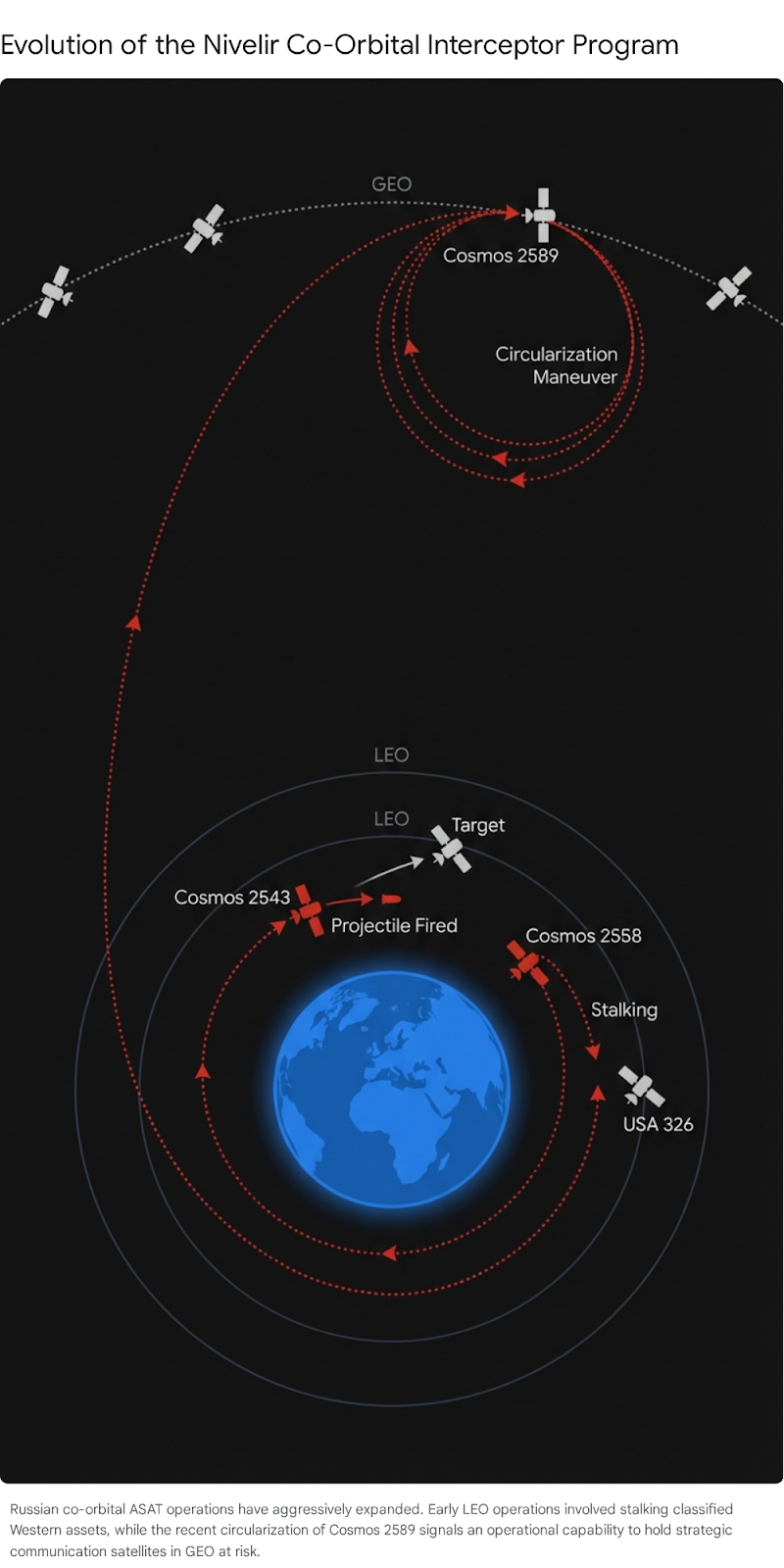
To clearly understand the scope of this threat, the following table summarizes the key assets associated with the Nivelir program and their respective operational histories based on available tracking data.
| Satellite Designation | Launch Year | Target Orbit | Notable Activity and Threat Profile |
| Cosmos 2543 | 2019 | LEO | Released sub-projectile at 140 to 186 m/s after observing USA 245; clear kinetic interceptor capability.5 |
| Cosmos 2558 | 2022 | LEO | Matched the exact orbital plane of USA 326, closing to 58 kilometers to conduct sustained inspector operations.5 |
| Cosmos 2588 | 2025 | LEO | Maintained coplanar orbit with USA 338 at a distance of under 100 kilometers.5 |
| Cosmos 2589 | 2025 | GEO | Circularizing orbit, eccentricity dropped to 0.231. Expected GEO arrival April 2026, enabling deep space ASAT operations.5 |
| Cosmos 2590 | 2025 | HEO | Sub-satellite of 2589, conducted proximity operations prior to 2589’s orbital circularization.5 |
4.3 Burevestnik and Direct-Ascent Systems
Complementing the Nivelir program is the Burevestnik project, an additional co-orbital anti-satellite program heavily supported by the Nivelir surveillance network.1 While the specific technical parameters regarding Burevestnik remain highly classified and largely obscured from open-source reporting, intelligence assessments suggest it involves a class of interceptors designed to physically crash into target satellites or utilize directed energy to permanently disable their core functions.32
Furthermore, Russia retains a formidable and fully operational direct-ascent anti-satellite capability. In November 2021, the Russian military utilized the A-325 Nudol ground-to-space missile system to completely obliterate a defunct Soviet satellite situated in low earth orbit.1 The resulting kinetic explosion created a massive, highly dangerous cloud of over 1,500 pieces of trackable orbital debris, forcing astronauts aboard the International Space Station to take emergency shelter to avoid catastrophic collision.29 This test served as a stark geopolitical warning to the United States and NATO prior to the invasion of Ukraine, graphically demonstrating Russia’s willingness to pollute the orbital environment to deny its use to adversaries.5 While DA-ASAT testing has temporarily paused to avoid further debris generation that threatens Russia’s own operational assets, the Nudol system remains fully operational and highly lethal.1
5.0 Non-Kinetic Arsenal: Electronic Warfare and Directed Energy
5.1 GPS Spoofing, Downlink Degradation, and the Syrian Proving Ground
Russia operates what is widely considered the most aggressive and pervasive electronic warfare apparatus currently fielded by any global military.34 Non-kinetic effects, particularly the systematic jamming and spoofing of satellite navigation signals, form the absolute backbone of Russian operational-level space warfare.35 By overwhelming the inherently weak downlink signals emitted from Global Navigation Satellite Systems, Russian electronic warfare units can render precision-guided munitions entirely ineffective, disrupt communication logistics, and paralyze adversary command structures.34
This capability was extensively tested and refined during Russian operations in Syria. General Raymond A. Thomas III, the former commander of United States Special Operations Command, characterized the electronic environment in Syria as the most aggressive on the planet, noting that Russian units were actively disabling allied aircraft systems and communication links daily.34 In the Syrian theater, Russian forces routinely jammed the encrypted M-Code signals of the United States GPS constellation, significantly degrading the targeting accuracy of sophisticated Western weaponry such as Joint Direct Attack Munitions and High Mobility Artillery Rocket Systems.34
In the context of the ongoing Ukraine conflict, the use of electronic warfare has reached unprecedented levels of intensity and geographic scope. Russian mobile systems are deployed to systematically jam the GPS signals required by Ukrainian unmanned aerial vehicles, forcing them off course, disrupting their targeting data, or causing them to crash entirely.36 Furthermore, this intense electromagnetic interference consistently spills over into civilian airspace. Widespread GPS anomalies and complete signal losses are routinely reported by commercial aviation across Central Europe and the Baltic region, highlighting the indiscriminate and far-reaching nature of Russian electronic attacks.16
5.2 Directed Energy Facilities: The Peresvet and Kalina Complexes
To neutralize foreign optical reconnaissance satellites without generating the politically sensitive orbital debris associated with kinetic missiles, the Russian Ministry of Defense has invested heavily in the development of ground-based directed energy weapons.37 The most prominent operational system is the Peresvet mobile laser dazzler, which the Russian military began deploying to five strategic missile divisions in 2018.16 Peresvet is specifically designed to temporarily blind the sensitive optical sensors of overhead intelligence satellites, effectively masking the ground movement of Russian mobile intercontinental ballistic missiles during times of heightened tension.16
However, intelligence and satellite imagery indicate that Russia is currently constructing a far more devastating and permanent directed energy facility known as Kalina.38 Located at the Krona space surveillance complex near Zelenchukskaya in the northern Caucasus region, Kalina is explicitly designed for high-intensity electro-optical warfare.38 Unlike the Peresvet system, which temporarily dazzles sensors with lower power emissions, financial and procurement documents reveal that the Kalina complex generates laser pulses intense enough to inflict permanent structural damage, irrevocably blinding the optical payloads of adversary satellites.38
The Krona complex provides the perfect geographical and technical foundation for the Kalina system. The facility houses the advanced 40Zh6 radar system and the 30Zh6 lidar installation, situated atop Mount Chapal at an altitude of two kilometers.38 The radar system tracks the precise trajectory of incoming satellites in low earth orbit, handing the exact coordinates over to a 1.3-meter narrow-angle telescope equipped with highly advanced adaptive optics.38 These adaptive optics are crucial, as they actively mitigate atmospheric distortion, allowing the Kalina laser to maintain a tightly focused, high-energy beam over hundreds of kilometers through the atmosphere, ensuring maximum destructive energy delivery to the target.37 Satellite imagery from late 2025 and early 2026 confirms that construction of the Kalina facility is rapidly accelerating, indicating a high operational priority within the Russian defense establishment.38
The following table details the operational directed energy and space tracking facilities deployed by the Russian Federation to blind or monitor foreign orbital assets.
| Facility / System | Location and Platform | System Modality | Target Effect and Capability |
| Peresvet | Mobile Platforms at Strategic Missile Bases | Laser Dazzler | Temporary blinding of optical sensors to mask the deployment of ground forces and ICBMs.16 |
| Kalina | Zelenchukskaya (Krona Complex) | High-Power Laser | Permanent destruction and blinding of optical satellite components via intense laser pulses.38 |
| Krona Radar (40Zh6) | Zelenchukskaya Base | UHF/SHF Radar | Precision tracking and trajectory calculation required for laser targeting and early warning.38 |
| Krona Lidar (30Zh6) | Mount Chapal (2,000 meters) | Lidar and Adaptive Optics | High-resolution imaging and atmospheric distortion mitigation for precise laser guidance.38 |
6.0 Terrestrial Cyber Operations Against Space Ground Segments
6.1 The Viasat Attack and Ukrainian Cyber Resilience
A satellite is only as secure and effective as the ground station controlling it. Recognizing this fundamental architecture, the Russian Main Intelligence Directorate has aggressively targeted the terrestrial segments of Western space infrastructure through sustained cyber warfare.8 The initial assault of the 2022 full-scale invasion of Ukraine was not a kinetic artillery strike, but a massive cyberattack attributed to Russian state actors directed against the commercial Viasat satellite network.36 By exploiting a known vulnerability in the ground-based virtual private network, Russian hackers deployed wiper malware to tens of thousands of satellite modems, effectively blinding the Ukrainian military’s command and control apparatus in the crucial opening hours of the conflict.36
This aggressive posture has necessitated rapid adaptation by the Ukrainian military. Confronted with escalating cyber and space threats, Kyiv is actively establishing centralized structures to defend against multi-domain attacks. In October 2025, the Ukrainian parliament approved legislation to establish an independent Cyber Force, tasked with uniting offensive and defensive cyber capabilities.41 This is coupled with ongoing efforts to create a dedicated Space Force by the end of 2025, formalizing the defense of the digital and orbital domains as critical warfighting priorities.41
6.2 GRU Unit 74455 and the Targeting of Western Infrastructure
The cyber campaign targeting space infrastructure and critical utilities has only escalated in sophistication globally. The notorious GRU Unit 74455, commonly tracked by cybersecurity firms as Sandworm, APT44, or Seashell Blizzard, has conducted a relentless, multi-year campaign targeting Western critical infrastructure.8 Threat intelligence published by major technology providers indicates that from 2021 through 2026, Sandworm systematically exploited misconfigured customer network edge devices, enterprise routers, and VPN concentrators to gain initial access to energy providers and communication hubs across Europe and North America.42 This tactic relies heavily on exploiting vulnerabilities in WatchGuard, Atlassian, and Veeam software architectures.42
In late December 2025, Sandworm executed a highly disruptive attack against the Polish power grid, demonstrating the very real threat to terrestrial infrastructure.9 By infiltrating the digital systems of Poland’s national electricity operator and a major combined heat and power plant, the hackers synchronized the sudden disconnection of numerous solar stations, deploying a novel data-wiping malware known as DynoWiper.9 While Polish authorities managed to stabilize the grid before a total, catastrophic blackout occurred, the attack clearly demonstrated Sandworm’s capability to bridge the gap between digital infiltration and physical infrastructure disruption.9 These exact cyber capabilities are actively directed against the server infrastructure that manages commercial satellite constellations, presenting a profound and continuous threat to global space operations.8
7.0 Orbital Espionage and Sabotage: The Luch SIGINT Campaign
7.1 Proximity Operations Against European Geostationary Assets
Alongside the kinetic threat posed by the Nivelir program, Russia conducts extensive orbital espionage utilizing highly secretive signals intelligence platforms located deep in space.7 The Luch spacecraft series, comprising the Luch-1 satellite launched in 2014 and the more advanced Luch-2 launched in 2023, represents the vanguard of Russian intelligence gathering in Geostationary Earth Orbit.7 Since its deployment, the Luch-2 satellite alone has engaged in aggressive proximity operations against at least seventeen critical European commercial and military satellites.7
Tracking data provided by commercial space situational awareness firms, such as the French company Aldoria, demonstrates that Luch-2 routinely maneuvers to within twenty to two hundred kilometers of sensitive Western assets, lingering in these specific positions for weeks or months at a time.7 Targeted platforms include major European telecommunications hubs such as Intelsat 39, Eutelsat 3C, Eutelsat 9B, SES-5, and Astra 4A.45 These massive geostationary satellites provide vital bandwidth for civilian television broadcasting, secure government communications, and military data relays across Europe, Africa, and the Middle East.45
By precisely maneuvering the Luch spacecraft, Russian military operators position the satellite directly within the narrow data transmission cones bridging the target satellite and its terrestrial ground station.7 This exact spatial positioning allows the Russian platform to act as a silent man-in-the-middle, intercepting the data streams intended for the European satellites without triggering standard interference alarms.30
7.2 Vulnerabilities of Legacy Unencrypted Command Links
The physical proximity of the Luch satellites exposes a catastrophic vulnerability within the Western space architecture. Many of the legacy satellites currently operating in the geostationary belt were designed and launched decades ago, prior to the normalization of great power competition and active hostilities in space.7 Consequently, these older platforms often rely on unencrypted, rudimentary command links for basic station-keeping and telemetry operations.7
European intelligence officials assess with high confidence that the Luch satellites are actively recording and analyzing these unencrypted command sequences.7 If Russian intelligence successfully reverse-engineers the command protocols, they possess the capability to execute a “functional kill” without firing a single kinetic weapon or laser.7 By mimicking a legitimate European ground station, Russian operators could transmit forged commands directly to the targeted satellites.7
The consequences of such a hijack are severe and highly destabilizing. Malicious commands could instruct a satellite to continuously fire its onboard thrusters, rapidly depleting its finite fuel reserves and effectively terminating its operational lifespan.7 Alternatively, the satellite could be commanded to drastically alter its trajectory, drifting out of its designated orbital slot to sever communications across entire continents, or in the most extreme scenario, directed to burn its engines to deorbit entirely, resulting in its destruction.7 This capability aligns perfectly with the Russian doctrine of hybrid warfare and sabotage, allowing Moscow to hold critical European infrastructure hostage under the threshold of overt armed conflict.47 To mitigate this existential threat, European satellite operators and military agencies are racing to integrate secure optical laser communications and modernized encryption, but billions of dollars of legacy systems remain dangerously exposed.45
8.0 The Nuclear Anti-Satellite Threat and Strategic Instability
8.1 Cosmos 2553 and High-Altitude Nuclear Detonation Risks
The most destabilizing development in global space security is the highly assessed Russian effort to field a space-based nuclear anti-satellite weapon.1 Throughout 2024 and 2025, United States intelligence agencies and congressional leaders raised urgent, unprecedented alarms regarding a highly classified Russian program explicitly designed to station a nuclear device in orbit.49 If detonated, an orbital nuclear weapon would not only physically destroy satellites caught in the immediate thermal and radiation blast radius but would also generate a massive electromagnetic pulse capable of frying unprotected circuitry.29
Furthermore, a high-altitude nuclear detonation would pump immense volumes of high-energy electrons directly into the Earth’s magnetic field, artificially amplifying the Van Allen radiation belts.29 This severe radiation environment would persist for months or even years, indiscriminately degrading the microelectronics of any satellite traversing the affected orbital regimes.29 The primary target of such a weapon would undoubtedly be proliferated low earth orbit constellations, such as the massive SpaceX Starlink network, which has proven absolutely vital to Ukrainian military communications, drone warfare, and artillery targeting.6 A single, well-placed nuclear detonation could theoretically cripple the entire architecture of global satellite internet, rendering low earth orbit entirely uninhabitable for commercial and military operations.50
Open-source intelligence has heavily scrutinized the Cosmos 2553 satellite as a primary component or experimental precursor to this nuclear program.10 Launched in February 2022, merely weeks prior to the full-scale invasion of Ukraine, Cosmos 2553 was placed into a highly unusual orbit at an altitude of approximately two thousand kilometers.10 This specific region is widely considered a “graveyard” orbit, intentionally avoided by commercial operators due to naturally high levels of cosmic radiation that degrade solar panels and onboard computers.10
The Russian government asserts that the satellite is designed purely for scientific research to test electronic components in harsh radiation environments.10 However, Western aerospace analysts calculate that the radiation levels at this specific altitude are insufficient to effectively conduct the type of accelerated electronics testing claimed by Moscow, rendering the official justification highly implausible.50 In late 2024 and early 2025, doppler radar tracking by commercial firms detected anomalous behavioral patterns, indicating that Cosmos 2553 was spinning uncontrollably.10 This suggests the platform is potentially suffering a critical malfunction, or serving as a dead-weight mock-up to test orbital injection parameters for heavier payloads.10 Despite its current operational status, the platform’s existence confirms Moscow’s deep, ongoing interest in utilizing the high-altitude radiation belts for strategic military purposes.1
8.2 Arms Control Evasion and Diplomatic Obfuscation
The deployment of a live nuclear weapon in orbit constitutes a flagrant, undeniable violation of the 1967 Outer Space Treaty, the foundational legal framework of global space governance, which explicitly prohibits the stationing of weapons of mass destruction in outer space.50 In direct response to the intelligence disclosures regarding the Russian program, the United States and Japan drafted a United Nations Security Council resolution in April 2024 seeking to unequivocally reaffirm the Outer Space Treaty’s ban on orbital nuclear weapons.14
The Russian Federation, utilizing its status as a permanent member, summarily vetoed the resolution.14 Moscow utilized the diplomatic forum to deflect the accusations, insisting that it strictly adheres to international law while simultaneously promoting its own alternative treaty, jointly drafted with China, which ostensibly bans all weapons in space.11 Western diplomats and military planners consistently reject the Sino-Russian proposal because it deliberately lacks verifiable enforcement mechanisms and conveniently ignores terrestrial-based counterspace systems, such as direct-ascent missiles and ground-based directed-energy weapons, in which Russia and China currently hold distinct operational advantages.14
Russian President Vladimir Putin and Defense Minister Sergei Shoigu have publicly denied the existence of the nuclear anti-satellite program, claiming Russia only possesses capabilities already fielded by the United States.11 Russian officials frequently label the accusations as a fabricated psychological operation designed by Washington to force Congress to approve massive military aid packages for Ukraine.11 However, this diplomatic obfuscation aligns perfectly with the Kremlin’s established pattern of plausible deniability, directly mirroring previous strategic denials of state-sponsored cyber operations, foreign election interference, and the deployment of chemical weapons against political dissidents.13 By refusing to engage in meaningful, verifiable arms control dialogue, Russia ensures the space domain remains unstable, utilizing the looming threat of an orbital nuclear detonation as the ultimate lever of strategic blackmail against the West.50
9.0 Geopolitical Implications and Multi-Theater Escalation
9.1 Space Support for Proxy Warfare in the Middle East
Russia’s space warfare strategy is not confined merely to deterring the United States or blinding European infrastructure; it actively facilitates geopolitical instability and proxy warfare across the globe.54 The integration of space-based intelligence into regional conflicts is highly evident in the ongoing tensions in the Middle East. Intelligence reports from early 2026 indicate that the Russian government is actively providing high-resolution satellite imagery and highly sensitive targeting intelligence to the Islamic Republic of Iran.54
This intelligence sharing directly supports Iranian ballistic missile and drone strikes against United States military bases, command and control infrastructure, and naval assets operating in the region.54 Iran historically lacks access to continuous, high-fidelity satellite imagery, relying heavily on commercially available data that is often delayed, degraded, or censored over active conflict zones.54 Recognizing this intelligence pipeline, commercial providers like Planet Labs enacted policies in March 2026 subjecting all new imagery collected over the Gulf States to a mandatory 96-hour delay.54 By supplying real-time orbital intelligence that circumvents these commercial delays, Russia significantly enhances the lethality of its regional proxies, imposing direct costs on the United States military without triggering a direct, overt military confrontation. This highly transactional relationship underscores how space superiority is leveraged to achieve asymmetric geopolitical outcomes far beyond the immediate battlefield of Eastern Europe.54
9.2 The Culture of Suffering and Mutual Vulnerability
Ultimately, the effectiveness of Russia’s counterspace strategy hinges on the psychological dimension of deterrence and mutual vulnerability. The fundamental asymmetry in space is not purely technological; it is deeply economic and structural.1 The modern Western economy cannot function without satellite navigation for logistics, timing data for global financial transactions, and high-bandwidth global communications.14 Conversely, the heavily sanctioned Russian economy, which is increasingly geared entirely toward domestic wartime production, is significantly less reliant on commercial space architectures for its daily function.1
If a conventional conflict escalated to the point of widespread orbital destruction, whether through the physical collision of Nivelir kinetic interceptors, the detonation of a nuclear device, or the intentional creation of massive, cascading debris fields via direct-ascent missiles, the economic damage inflicted upon the United States and Europe would be catastrophic.29 While Russia would undoubtedly lose its own satellite networks in such a scenario, the Kremlin calculates that it can endure this loss more readily than the West due to its higher threshold for societal and economic pain.1 This perceived immunity grants Russian military planners a dangerous freedom of action, driving the development and deployment of inherently destabilizing systems. As long as Moscow genuinely believes that threatening the orbital commons yields a net strategic benefit, the aggressive proliferation of Russian counterspace capabilities will continue unchecked.1
10.0 Conclusions
The extensive evidence compiled from technical telemetry, shifts in military doctrine, and operational deployments presents a stark and unequivocal reality: the Russian Federation considers the space domain an active theater of combat and is rapidly preparing the capabilities necessary to dominate or completely deny it to adversaries. The assessment indicates the following core conclusions regarding the future trajectory of Russian space warfare strategy:
First, the historical concept of orbital sanctuary is entirely obsolete. The Nivelir program’s successful circularization of the Cosmos 2589 satellite into the geostationary belt demonstrates that Russia can now project kinetic force against the highest-value, most heavily protected communication and early warning satellites operated by the United States and NATO.5 Western defensive postures must adapt to a new reality where supposedly benign inspector satellites possess the capability to transition into offensive weapons instantaneously, regardless of their altitude.
Second, non-kinetic and cyber operations represent the most immediate, persistent threat to daily operations. The seamless integration of Sandworm’s terrestrial cyber attacks with the orbital espionage conducted by the Luch satellite series highlights a highly sophisticated, multi-domain approach to sabotage.7 Legacy satellites relying on unencrypted command links are highly vulnerable to hijacking and functional kills. This necessitates rapid, massive investment in optical laser communications and resilient encryption protocols across all commercial and military platforms to secure the data supply chain.7
Third, the threat of an orbital nuclear detonation remains a highly viable, terrifying component of Russian strategic deterrence. While the exact operational status of the program remains highly classified, and current test beds like Cosmos 2553 appear non-functional, the strategic logic underpinning the capability is entirely consistent with Moscow’s high risk tolerance and overarching doctrine of asymmetric cost-imposition.1
Finally, diplomatic efforts to establish new norms of behavior or revive the Outer Space Treaty are highly unlikely to succeed in the near term. Russia views the ambiguity of space law as a tactical advantage, utilizing diplomatic forums to obfuscate its actions while actively developing weapon systems that violate the spirit and letter of international agreements.50 Countering the Russian space threat will require the West to rapidly proliferate redundant satellite constellations, drastically harden terrestrial control nodes against cyber intrusion, and develop credible, resilient deterrent architectures capable of convincing Moscow that escalation in space will yield no strategic victory.
Please share the link on Facebook, Forums, with colleagues, etc. Your support is much appreciated and if you have any feedback, please email us in**@*********ps.com. If you’d like to request a report or order a reprint, please click here for the corresponding page to open in new tab.
Sources Used
- Countering Russian escalation in space | Atlantic Council, accessed March 15, 2026, https://www.atlanticcouncil.org/wp-content/uploads/2026/01/countering-russian-escalation-in-space.pdf
- Russia’s Approach to Anti-satellite Weapons and Systems – EU Non-Proliferation and Disarmament Consortium, accessed March 15, 2026, https://www.nonproliferation.eu/wp-content/uploads/2020/01/Bulletin-PISM-no-159-1405-14-November-2019-Sub.-Russian-ASAT-Themati….pdf
- Russian Military Thought: Concepts and Elements – Army University Press, accessed March 15, 2026, https://www.armyupress.army.mil/Portals/7/Hot-Spots/docs/Russia/Mitre-Thomas.pdf
- The Russian Rhetoric: Missile Defense for Me, but Not for Thee – Center for Global Security Research, accessed March 15, 2026, https://cgsr.llnl.gov/sites/cgsr/files/2025-06/Russian-Rhetoric-Missile-Defense-Me-Not-Thee.pdf
- The successful development of Russia’s … – The Space Review, accessed March 15, 2026, https://www.thespacereview.com/article/5138/1
- Issue 137 – ISR University, accessed March 15, 2026, https://isruniversity.com/2026/01/19/issue-137/
- Russia ‘intercepts Europe’s key satellites’ placing NATO satellite at risk – SatNews, accessed March 15, 2026, https://satnews.com/2026/02/04/russia-intercepts-europes-key-satellites-placing-nato-satellite-at-risk/
- Amazon Threat Intelligence identifies Russian cyber threat group targeting Western critical infrastructure | AWS Security Blog, accessed March 15, 2026, https://aws.amazon.com/blogs/security/amazon-threat-intelligence-identifies-russian-cyber-threat-group-targeting-western-critical-infrastructure/
- Russian Sandworm Hackers Blamed for Cyberattack on Polish Power Grid – SecurityWeek, accessed March 15, 2026, https://www.securityweek.com/russian-sandworm-hackers-blamed-for-cyberattack-on-polish-power-grid/
- Russian satellite at centre of nuclear weapons allegations is spinning out of control, analysts say | Russia | The Guardian, accessed March 15, 2026, https://www.theguardian.com/world/2025/apr/26/russia-satellite-space-nuclear-weapons-allegations-spinning
- Putin denies U.S. claims that Russia intends to deploy nuclear weapons in space – PBS, accessed March 15, 2026, https://www.pbs.org/newshour/world/putin-denies-u-s-claims-that-russia-intends-to-deploy-nuclear-weapons-in-space
- The Void Above – Marine Corps University, accessed March 15, 2026, https://www.usmcu.edu/Outreach/Marine-Corps-University-Press/MCU-Journal/JAMS-vol-15-no-1/The-Void-Above/
- Annual Threat Assessment of the U.S. Intelligence Community – DNI.gov, accessed March 15, 2026, https://www.dni.gov/files/ODNI/documents/assessments/ATA-2025-Unclassified-Report.pdf
- Is There a Path to Counter Russia’s Space Weapons? – CSIS, accessed March 15, 2026, https://www.csis.org/analysis/there-path-counter-russias-space-weapons
- Preparing for Russia’s New Generation Warfare in Europe – Recorded Future, accessed March 15, 2026, https://www.recordedfuture.com/research/preparing-for-russias-new-generation-warfare-in-europe
- Space Threat Fact Sheet, accessed March 15, 2026, https://www.spaceforce.mil/About-Us/Fact-Sheets/Fact-Sheet-Display/Article/4297159/space-threat-fact-sheet/
- Learning the lessons from Ukraine’s fight against Russian cyber warfare – Atlantic Council, accessed March 15, 2026, https://www.atlanticcouncil.org/blogs/ukrainealert/learning-the-lessons-from-ukraines-fight-against-russian-cyber-warfare/
- Russian Space Forces – Wikipedia, accessed March 15, 2026, https://en.wikipedia.org/wiki/Russian_Space_Forces
- Russian Air Force – Wikipedia, accessed March 15, 2026, https://en.wikipedia.org/wiki/Russian_Air_Force
- Russia – The Heritage Foundation, accessed March 15, 2026, https://www.heritage.org/sites/default/files/2026-03/2026_IndexOfUSMilitaryStrength_ASSESSMENT_THREATS_RUSSIA.pdf
- Russia prepares 10% cut to ‘non-sensitive’ spending in 2026, sources say, accessed March 15, 2026, https://m.economictimes.com/news/international/world-news/russia-prepares-10-cut-to-non-sensitive-spending-in-2026-sources-say/articleshow/129472331.cms
- For Putin, Increasing Russia’s Nuclear Threat Matters More Than the Triad’s Modernization, accessed March 15, 2026, https://carnegieendowment.org/russia-eurasia/politika/2026/02/russia-nuclear-modernization-priorities
- Russia’s Space Program After 2024 – Foreign Policy Research Institute, accessed March 15, 2026, https://www.fpri.org/article/2024/07/russias-space-program-after-2024/
- Russian General: Drones Won’t Replace Aerospace Forces, accessed March 15, 2026, https://voennoedelo.com/en/posts/id13423-russian-general-drones-won-t-replace-aerospace-forces
- Russian military launches recruitment drive for drone units – FDD’s Long War Journal, accessed March 15, 2026, https://www.longwarjournal.org/archives/2026/01/russian-military-launches-recruitment-drive-for-drone-units.php
- Russian Offensive Campaign Assessment, January 22, 2026 | ISW, accessed March 15, 2026, https://understandingwar.org/research/russia-ukraine/russian-offensive-campaign-assessment-january-22-2026/
- Russian Satellites Suspected of Intercepting European Communications Over Three Years, accessed March 15, 2026, https://www.chosun.com/english/world-en/2026/02/04/CU7YEQGVPRHJJBJYPJNGKVPHNI/
- 2025 Global Counterspace Capabilities Report – Secure World Foundation, accessed March 15, 2026, https://www.swfound.org/publications-and-reports/2025-global-counterspace-capabilities-report
- U.S. Warns of New Russian ASAT Program | Arms Control Association, accessed March 15, 2026, https://www.armscontrol.org/act/2024-03/news/us-warns-new-russian-asat-program
- Russian Luch satellites target European vital connectivity – Telecoms Tech News, accessed March 15, 2026, https://www.telecomstechnews.com/news/russian-luch-satellites-target-european-vital-connectivity/
- COSMOS 2589 Satellite details 2025-131A NORAD 64467 – N2YO.com, accessed March 15, 2026, https://www.n2yo.com/satellite/?s=64467
- The Russians are Coming! – Open Canada, accessed March 15, 2026, https://opencanada.org/the-russians-are-coming/
- A Crowded Orbit and the Rising Threat of Anti-Satellite Weapons to Global Stability, accessed March 15, 2026, https://moderndiplomacy.eu/2025/12/02/a-crowded-orbit-and-the-rising-threat-of-anti-satellite-weapons-to-global-stability/
- Russian Electronic Warfare: From History to Modern Battlefield, accessed March 15, 2026, https://irregularwarfare.org/articles/russian-electronic-warfare-from-history-to-modern-battlefield/
- Space Threat Assessment 2025 – CSIS, accessed March 15, 2026, https://www.csis.org/analysis/space-threat-assessment-2025
- Extending the Battlespace to Space – CSIS, accessed March 15, 2026, https://www.csis.org/analysis/chapter-8-extending-battlespace-space
- Satellites spot construction of Russian anti-satellite laser facility: report – Space, accessed March 15, 2026, https://www.space.com/russia-anti-satellite-laser-facility-satellite-photos
- Kalina: a Russian ground-based laser to dazzle imaging satellites – The Space Review, accessed March 15, 2026, https://www.thespacereview.com/article/4416/1
- Satellites spot construction of Russian anti-satellite laser facility: report, accessed March 15, 2026, https://www.missiledefenseadvocacy.org/threat-news/satellites-spot-construction-of-russian-anti-satellite-laser-facility-report/
- Krona space object recognition station – Wikipedia, accessed March 15, 2026, https://en.wikipedia.org/wiki/Krona_space_object_recognition_station
- Unpacking Ukraine’s Future Cyber and Space Forces – CSIS, accessed March 15, 2026, https://www.csis.org/analysis/unpacking-ukraines-future-cyber-and-space-forces
- Amazon Exposes Years-Long GRU Cyber Campaign Targeting Energy and Cloud Infrastructure – The Hacker News, accessed March 15, 2026, https://thehackernews.com/2025/12/amazon-exposes-years-long-gru-cyber.html
- Russia forged new cyber weapons to attack Ukraine. Now they’re going international, accessed March 15, 2026, https://kyivindependent.com/russia-forged-new-cyber-weapons-to-attack-ukraine-now-theyre-going-international/
- How Russia Is Intercepting Communications from European Satellites – RAND, accessed March 15, 2026, https://www.rand.org/pubs/commentary/2026/03/how-russia-is-intercepting-communications-from-european.html
- Russian Satellite Activity Exposes Gaps in Satellite Communications Security – Military.com, accessed March 15, 2026, https://www.military.com/feature/2026/02/09/russian-satellite-activity-exposes-gaps-satellite-communications-security.html
- Russian spy satellites tap into Europe’s orbiting assets – The New Voice of Ukraine, accessed March 15, 2026, https://english.nv.ua/nation/european-satellites-compromised-by-russian-espionage-in-orbit-50580884.html
- Media: Russia may have intercepted communications from 10 key European satellites, accessed March 15, 2026, https://www.eurointegration.com.ua/eng/news/2026/02/4/7230451/
- When Sabotage Goes Orbital: Rethinking the Russian Space Threat, accessed March 15, 2026, https://kcsi.uk/kcsi-insights/when-sabotage-goes-orbital-rethinking-the-russian-space-threat
- Experts react: What to know about Russia’s apparent plans for a space-based nuclear weapon – Atlantic Council, accessed March 15, 2026, https://www.atlanticcouncil.org/blogs/new-atlanticist/experts-react-what-to-know-about-russias-apparent-plans-for-a-space-based-nuclear-weapon/
- Russian Nuclear Weapons in Space? – Stiftung Wissenschaft und Politik, accessed March 15, 2026, https://www.swp-berlin.org/10.18449/2025C21/
- FAQ: What We Know About Russia’s Alleged Nuclear Anti-Satellite Weapon, accessed March 15, 2026, https://www.swfound.org/publications-and-reports/faq-what-we-know-about-russias-alleged-nuclear-anti-satellite-weapon
- Nuclear Notebook: Russian nuclear forces, 2024 – Federation of American Scientists, accessed March 15, 2026, https://fas.org/publication/russia-nuclear-notebook-2024/
- Russia’s Alleged Nuclear Anti-Satellite Weapon: International Law and Political Rhetoric, accessed March 15, 2026, https://lieber.westpoint.edu/russias-nuclear-anti-satellite-weapon-international-law/
- Russian Offensive Campaign Assessment, March 6, 2026 | ISW, accessed March 15, 2026, https://understandingwar.org/research/russia-ukraine/russian-offensive-campaign-assessment-march-6-2026/