Executive Summary (BLUF)
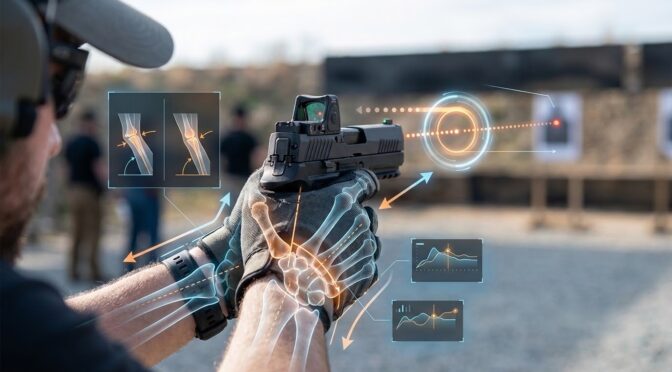
The integration of Miniaturized Red Dot Sights (MRDS) into law enforcement duty handguns has initiated a paradigm shift in modern firearms training and procurement. As municipal, state, and federal agencies transition from traditional iron sights to optic-equipped platforms, the human-machine interface, specifically the biomechanics of the pistol grip, has emerged as the critical variable dictating operational success and lethal force proficiency. This analysis demonstrates that a handgun’s grip angle, predominantly ranging between the 18-degree and 22-degree spectrums, fundamentally alters the kinematic chain of the shooter’s upper extremities. These geometric variations directly influence the Natural Point of Aim (NPOA), the degree of ulnar deviation required for sight alignment, and the operator’s ability to seamlessly track a red dot through the recoil cycle.
Biometric data and open-source intelligence indicate that while an 18-degree grip angle generally aligns with the biologically neutral resting posture of the human wrist, a 22-degree angle forces a pre-tensioned, locked-wrist state. While this locked state can theoretically assist in recoil mitigation through rigid skeletal alignment, it introduces significant physiological challenges in first-shot acquisition times for optic-equipped pistols if the operator’s neuromotor pathways are not strictly conditioned to that specific, steeper geometry. Furthermore, biomechanical studies reveal that excessive wrist deviation substantially degrades maximum grip strength and index finger trigger pull force, directly impacting an officer’s lethal force capabilities under acute physiological stress.
For law enforcement command staff, procurement officers, and defense contractors, the selection of a duty weapon can no longer be based solely on mechanical reliability, brand legacy, or unit cost. Procurement frameworks must now be driven by ergonomic compatibility, biometric data, and modularity to ensure peak performance across a diverse demographic of law enforcement personnel. This comprehensive report synthesizes clinical kinesiology, operational field studies, and federal procurement specifications to provide an objective, data-driven framework for modern duty handgun evaluation.
1.0 Introduction: The Evolution of Handgun Ergonomics in Law Enforcement
Historically, the procurement of law enforcement sidearms was heavily weighted toward mechanical reliability, ballistic terminal performance, and administrative cost-effectiveness. The anatomical compatibility between the firearm and the human operator was often treated as a secondary or even tertiary consideration, leading to the adoption of rigid, “one-size-fits-all” platforms. However, the contemporary operational environment demands a higher degree of precision, speed, and cognitive efficiency, prompting a rigorous reevaluation of duty pistol ergonomics within the defense and law enforcement sectors.
1.1 The Shift from Universal Frames to Biometric Modularity
The widespread adoption of polymer-framed, striker-fired pistols in the late 20th and early 21st centuries introduced varying grip geometries into the law enforcement sector.1 Prior to this era, the prevailing duty weapons were heavy, steel-framed double-action revolvers or early semi-automatic pistols that relied on weight to absorb recoil.2 As agencies transitioned to lighter polymer frames, the human body was forced to absorb a greater percentage of the recoil impulse. Consequently, the specific angles and contours of the pistol grip became paramount in determining how efficiently that kinetic energy was transferred into the shooter’s skeletal structure.
The most notable divergence in modern pistol geometries is the grip angle,defined in firearms engineering as the specific geometric space and angle where the frame and grip meet, relative to the perpendicular axis of the bore.1 The industry standard has largely bifurcated into two dominant architectural camps: the 18-degree grip angle, popularized by John Moses Browning’s iconic 1911 architecture and utilized in modern platforms like the SIG Sauer P320 and Smith & Wesson M&P; and the 22-degree grip angle, which remains the defining hallmark of the Glock ecosystem.4
1.2 The Catalyst of the Miniaturized Red Dot Sight (MRDS)
Simultaneously, the tactical landscape is experiencing a massive, industry-wide migration toward pistol-mounted optics. Unlike traditional iron sights, which allow for peripheral visual micro-corrections during the presentation stroke out of the duty holster, red dot sights operate on a single focal plane and feature a highly restrictive “eye box”.7 If the pistol is not presented with absolute kinematic precision and optimal wrist alignment, the red dot remains hidden outside the optic window, critically delaying first-shot acquisition and leaving the officer vulnerable during a lethal force encounter.7
Consequently, the biomechanical interaction between the operator’s wrist and the pistol’s grip angle is no longer a matter of mere comfort; it has become the primary physical determinant of visual tracking efficiency, target discrimination, and rapid target engagement. This report explores the physiological mechanics behind these interactions, analyzing how specific angles optimize or degrade human performance under stress.
2.0 Biomechanical Foundations of the Pistol Grip
To accurately evaluate the operational impact of grip angle, it is necessary to establish the biomechanical foundation of how the human body interacts with a handgun. The human operator does not merely hold a firearm; rather, the body becomes a dynamic mechanical extension of the weapon system, required to stabilize, aim, and absorb violent kinetic forces repeatedly.
2.1 Kinematic Modeling of the Human-Machine Interface
When a handgun is discharged, the rapid expansion of propellant gases drives the slide rearward at high velocity, generating an impulsive torque reaction force that translates directly into the operator’s hand.10 In advanced biomechanical engineering and ergonomic studies, the human operator resisting this dynamic force is modeled as a single-degree-of-freedom dynamic mechanical system.10 Within this kinetic model, the hand, wrist, and arm function collectively as mass, spring, and damping elements that react to external loads.10
The efficiency of this biological shock-absorption system is highly dependent on skeletal posture and joint alignment. Research evaluating human responses to torque reaction forces,such as those produced by pistol-grip power tools,demonstrates that operator stiffness (the biological ability to resist displacement caused by external torque) changes significantly based on the geometric positioning of the arm and hand.10 For example, biomechanical modeling indicates that mean operator stiffness decreases substantially, dropping from 1721 N/m to 1195 N/m, as the horizontal distance of the work location extends outward from the body.10
In the context of a modern isosceles shooting stance,the dominant doctrine in contemporary law enforcement training,the arms are pushed forward toward the target. In this extended posture, the skeletal structure relies heavily on the rigid locking of the wrist and elbow joints to maintain stability and damp the recoil impulse.12 Any ergonomic inefficiency in the pistol grip that prevents the optimal locking of these joints will inherently degrade the “spring and damper” efficiency of the operator’s arms, leading to excessive muzzle flip and prolonged recovery times.
2.2 Wrist Posture: Radial Deviation, Ulnar Deviation, and Flexion Metrics
The human wrist is a complex biological hinge that operates with specific degrees of freedom: flexion and extension (pitch), and radial and ulnar deviation (yaw).13 A critical finding in clinical ergonomic research is that maximum grip strength and muscular endurance are achieved only when the wrist is held in a neutral, self-selected position.14 Clinical studies have precisely quantified this optimal resting position for maximum force generation as being approximately 35 degrees of extension and 7 degrees of ulnar deviation.14
Any forced deviation from this biologically optimal angle results in an immediate, measurable degradation of force generation capabilities. When the wrist is forced into extreme extension, or conversely, deviated into a completely neutral radio-ulnar alignment, total grip strength can be reduced to two-thirds or even three-fourths of its maximum physiological potential.14
In the application of a duty pistol, the grip angle of the firearm acts as a rigid mechanical constraint. It dictates the exact degree of flexion and ulnar deviation the wrist must adopt to align the sights with the operator’s eye.2 If a handgun’s specific geometry forces the operator’s wrist out of its optimal power band, the operator must artificially compensate by increasing absolute grip pressure. This overcompensation accelerates muscular fatigue, degrades fine motor control in the extremities, and ultimately compromises trigger discipline.
2.3 The Impact of Grip Angle on Muscular Tension and Trigger Force
The kinematic alignment dictated by the pistol’s grip angle does not solely affect recoil management; it directly impacts the biomechanical efficiency of the index finger during the critical act of the trigger press. Forensic, biomechanical, and kinesiological investigations into maximum trigger pull forces have revealed alarming operational vulnerabilities directly related to acute wrist posture.16
A quantitative biometric study assessing the effect of wrist angle on maximum index finger force found that trigger pull force is highly dependent on both wrist flexion and the specific nature of the finger grip.16 The study discovered that when the wrist is forced into severe flexion angles,specifically greater than 60 degrees,the maximum trigger pull force generation drops precipitously. Male subjects experienced a 50 percent reduction in maximum trigger force, while female subjects experienced a 38 percent reduction compared to a neutral or extended wrist posture.16
Under these sub-optimal postural conditions, the maximum force output plummeted to shockingly low levels: below 22.9 Newtons (5.1 lbs) for males and 19.0 Newtons (4.5 lbs) for females.16 Furthermore, when an operator cannot establish a firm, optimized grip on the frame, maximum index finger force can drop to less than 30 percent of its peak capacity.16
These metrics possess grave implications for law enforcement procurement. Standard law enforcement duty pistols frequently feature trigger pull weights ranging from 5.5 lbs (in standard striker-fired platforms) to upwards of 12 lbs (in double-action/single-action variants).17 If an agency procures a handgun with a grip angle that forces severe wrist flexion or unnatural ulnar deviation, they are biologically preventing certain officers,particularly females or males with lower baseline grip strength,from generating sufficient mechanical leverage to reliably discharge their weapon under dynamic stress.16
2.4 The Kinetic Chain: Elbow Positioning and Recoil Pathways
Recoil management is not localized entirely in the hands; it travels through the entire kinetic chain of the upper body. Traditional shooting techniques often advocated for elbows to be slightly bent and pointing downwards.19 While this is a relaxed posture that reduces ambient muscle fatigue during extended range sessions, biomechanical analysis reveals that this downward-pointing elbow position allows the linear force of the recoil to travel directly back, acting as a fulcrum that pushes the forearms,and consequently the pistol,violently upwards.19
Modern biomechanical approaches to pistol shooting suggest pointing the elbows outward.19 This subtle rotation of the humerus and radius/ulna changes the physiological pathway of the recoil forces. With elbows flared out, the structure of the arms forms a more rigid, linear channel. This directs the kinetic energy back along the arms and diffuses it partially into the denser musculature of the torso.19 This linear pathway distributes energy more evenly, substantially reducing muzzle rise and facilitating faster split times.19 However, achieving this outward elbow rotation is directly influenced by the grip angle of the pistol. If the grip angle requires extreme downward wrist torquing (as seen in steeper grip angles), achieving the optimal outward elbow flare becomes biomechanically contradictory, forcing the operator to choose between sight alignment and optimal skeletal shock absorption.
3.0 Geometric Architecture: 18-Degree vs. 22-Degree Grip Angles
The ongoing debate within the tactical community regarding the “optimal” pistol grip angle is fundamentally a debate over how the human musculoskeletal system should optimally interface with the recoil impulse and the visual horizon. The two dominant architectural profiles in the law enforcement market,the 18-degree and 22-degree angles,require entirely different physiological adaptations from the human operator.
3.1 The 18-Degree Standard: Natural Point of Aim and Ergonomic Neutrality
The 18-degree grip angle, famously engineered by John Moses Browning for the M1911 pistol, is widely considered the gold standard for “natural pointability” in the United States.4 Modern striker-fired duty platforms that utilize this approximate angle include the SIG Sauer P320, the Smith & Wesson M&P series, and aftermarket hybrid frames like the Lone Wolf Timberwolf.5
The superiority of the 18-degree angle in terms of innate human ergonomics is not merely subjective preference; it is rooted in extensive kinesiological research. When Smith & Wesson engineers utilized medical sensor arrays to wire six different hand and arm muscle groups to computers, they recorded the exact muscular interplay required to point and fire various designs.15 Their multi-million-dollar computational analysis of web angle, angle of grasp, and trigger reach concluded definitively that the 18-degree angle was the most biologically natural and “pointable” angle for the human hand.15
Biomechanically, the 18-degree angle aligns intimately with the wrist’s natural resting posture when the arm is punched out forward. When an operator closes their eyes, drives the gun out to full extension, and opens their eyes, a pistol with an 18-degree grip angle will almost universally present the sights parallel to the horizon.5 This angle minimizes the need for forced ulnar deviation or aggressive downward wrist flexion to acquire the sights.4 By allowing the wrist to remain in a neutral state, the 18-degree angle reduces long-term wrist strain, decreases the risk of overuse injuries (such as ulnar nerve compression or shooter’s elbow), and promotes a highly consistent linear trigger finger alignment without demanding conscious joint manipulation.2
3.2 The 22-Degree Standard: Pre-Tensioned Forward Lock
In stark contrast, the 22-degree grip angle (sometimes measured as 22.5 degrees) is the defining characteristic of the Glock family of pistols, currently the most prolific duty weapon in American law enforcement.4 When an operator accustomed to a neutral wrist position extends a 22-degree pistol, the geometric rake of the grip forces the muzzle to point noticeably upward.5 To correct this upward trajectory and align the sights with the target, the shooter must consciously apply a downward torque, forcing the wrist into a steeper degree of flexion and ulnar deviation.2
Critics of this design argue that this downward torque is fundamentally unnatural, placing the wrist out of its optimal power band and potentially misaligning the natural pull of the trigger finger.2 Because the wrist must be torqued downward, the structural mechanics of the flexor tendons are altered, which can lead to accuracy degradation for shooters who lack the grip strength to power through the mechanical disadvantage.
However, proponents of the 22-degree angle argue that this specific geometry creates a distinct biomechanical advantage for recoil management when properly utilized. By intentionally forcing the wrist into a state of pre-tensioned, forward-locked flexion, the skeletal structure is essentially pre-loaded against the upward flip of the muzzle.4 This locked joint state utilizes the limits of the wrist’s range of motion. Because the wrist is already maxed out in its downward flexion, the kinetic energy of the recoil impulse has less room to pivot the wrist upward. Instead, the energy is forced to travel rearward linearly into the radius and ulna.15 For highly trained operators who possess the muscular endurance to maintain this aggressive posture, the 22-degree angle can result in incredibly fast split times and aggressive recoil mitigation.
The caveat is that this posture requires specific, dedicated conditioning of the neuromotor pathways to override the body’s natural resting state.24 It is a learned physical skill, rather than an innate physiological advantage.
3.3 Comparative Analysis: Impact on the Kinematic Chain
The kinetic and physiological differences between these two angles manifest distinctly during dynamic shooting arrays, particularly when shooting with a single hand, transitioning between multiple targets, or shooting on the move. The following table provides a comprehensive comparative breakdown of the physiological and operational impacts of the two primary grip angles.
| Biomechanical / Operational Metric | 18-Degree Grip Angle (e.g., 1911, SIG P320, M&P) | 22-Degree Grip Angle (e.g., Glock) |
| Wrist Posture at Full Extension | Neutral / Biologically relaxed and aligned. | Pre-tensioned / Forced downward flexion and ulnar deviation. |
| Natural Point of Aim (NPOA) | Aligns parallel to the visual horizon naturally upon extension. | Tends to index high; requires active downward muscular torque to align. |
| Muscular Strain and Fatigue | Lower; utilizes the wrist’s optimal power band for grip strength. | Higher; relies on active, continuous muscle engagement to maintain the wrist lock. |
| Recoil Kinematics | Recoil is absorbed smoothly through muscular extension and contraction. | Recoil is countered aggressively by a hard skeletal lock-out. |
| Trigger Finger Alignment | Facilitates a natural, linear straight-back pull. | Requires physiological adaptation due to the torquing of the wrist joint. |
| One-Handed Operation | Excellent natural pointability; lower perceived “jump” under recoil. | Recoil can feel sharper; requires intense grip pressure to prevent muzzle flip. |
| Training Curve for Novices | Shallower; relies on innate human proprioception and pointing instincts. | Steeper; requires overriding natural biomechanics through thousands of repetitions. |
The data suggests that neither angle is inherently “defective,” but they demand entirely different systemic approaches to training and human optimization. However, when evaluating a broad demographic of police recruits,who possess varying levels of baseline grip strength, hand sizes, and physiological conditioning,the 18-degree angle presents a much more forgiving biomechanical baseline. It is less likely to induce ulnar wrist pain, less likely to degrade trigger finger leverage, and allows officers to achieve acceptable proficiency in a shorter training window.22
4.0 Visual Tracking and the Miniaturized Red Dot Sight (MRDS) Paradigm
The historical biomechanical debate over grip angle has been radically amplified by the contemporary transition from iron sights to Miniaturized Red Dot Sights (MRDS). The implementation of optical tracking systems on duty pistols is arguably the most significant advancement in law enforcement small arms lethality in a century. However, this optical advantage exposes and magnifies the absolute slightest flaws in an operator’s grip mechanics and presentation stroke.
4.1 Cognitive Processing and Threat-Focused Sighting
Under acute sympathetic nervous system arousal (the physiological “fight-or-flight” response triggered during a lethal force encounter), human biology undergoes severe alterations. The body experiences auditory exclusion, loss of fine motor skills, and most importantly, visual tunneling and target fixation.26
Traditional iron sights require a complex, cognitively demanding three-point visual alignment: the shooter must align the rear sight, the front sight, and the target.26 Under stress, human physiology dictates that visual focus naturally and instinctively converges on the immediate threat. Forcing the human eye to pull focus away from the deadly threat and physically re-accommodate focus back onto a tiny front sight blade contradicts millions of years of innate biological survival mechanisms.8
The MRDS resolves this biological conflict by operating entirely on a single focal plane. The operator remains 100% target-focused, while the optic projects a collimated red dot into their line of sight, superimposing the aiming point onto the threat.8 Eye-tracking studies comparing elite tactical officers to rookie officers during dynamic force-on-force scenarios reveal the profound impact of this setup. Elite officers maintained their foveal (central) vision locked onto the location where the suspect’s weapon was being produced, while simultaneously presenting their firearm. In contrast, rookies looked away from the rapidly evolving threat, driving their eyes down toward their gun’s front sight.29 The elite officers utilizing threat-focused tracking achieved significantly higher accuracy and made vastly superior lethal force decisions.29
This threat-focused methodology significantly enhances situational awareness, allowing officers to constantly evaluate a suspect’s actions. This expanded visual awareness directly reduces the likelihood of “mistake of fact” shootings, where benign objects (e.g., cell phones) are misidentified as weapons due to focal tunneling.30
4.2 First-Shot Acquisition and the “Eye Box” Phenomenon
While the visual and cognitive benefits of the MRDS are profound, the physical challenge lies entirely in the initial presentation of the firearm from the holster to the visual plane. Because the window of a pistol optic is remarkably small (forming what is known as the “eye box”), the alignment of the barrel relative to the operator’s eye must be virtually perfect upon full extension.7
With traditional iron sights, an operator’s peripheral vision picks up the front and rear sights as the weapon enters the lower field of view during the draw stroke. This allows the brain to make subconscious micro-corrections to pitch and yaw before the gun reaches full extension.7 An MRDS offers no such peripheral feedback. If the gun is presented with an incorrect grip angle, the glass of the optic is simply empty, and the operator is forced into a frantic, circular “fishing” motion to locate the dot.7
This phenomenon is where the physics of the grip angle absolutely dictate performance. First-shot acquisition time is inextricably linked to the weapon’s Natural Point of Aim (NPOA). If an officer’s proprioceptive baseline is calibrated to a neutral 18-degree grip angle, drawing a 22-degree pistol will reliably result in the muzzle pointing slightly upward upon extension.5 Because the MRDS window is incredibly unforgiving, the red dot will remain trapped above the visible frame of the glass.9 The officer subsequently loses critical fractions of a second dropping the muzzle to locate the aiming point.9 Therefore, transitioning an agency to red dot sights without carefully evaluating how the procured pistol’s grip angle meshes with the human wrist’s natural extension can artificially inflate first-shot acquisition times and temporarily degrade officer confidence.32
4.3 Recoil Recovery: Tracking the Optic Arc
Beyond the critical first shot, the ability to visually track the red dot during the recoil cycle is paramount for rapid follow-up shots. Upon discharge, the slide reciprocates violently and the muzzle rises, causing the red dot to briefly exit the top of the optic window and return as the slide resets. Visually, the operator perceives this rapid mechanical movement as an arced line or oval.9
The geometry of the grip and the biomechanical application of wrist pressure dictate the exact shape, height, and duration of this visual arc. If the grip angle facilitates a locked, straight path of kinetic resistance (as optimized by a properly pre-tensioned wrist), the dot lifts vertically and returns linearly, allowing the operator to track it seamlessly.9 If the grip angle forces unnatural wrist compensation, or if the operator lacks the baseline grip strength to manage the specific geometry, the recoil path will deviate radially or ulnarly. This lateral movement causes the dot to trace an unpredictable, diagonal, or circular path, frequently leaving the window entirely.
A weak or geometrically misaligned grip prolongs the appearance of the arc because the hands physically take longer to recover the muzzle back to a level plane with the ground, directly inflating split times between sequential shots.9 Mastery of the red dot is less about visual acuity and more about building an unyielding, biomechanically sound grip structure that forces the weapon to return to absolute zero predictably.34
5.0 Empirical Data Synthesis: Performance Metrics and Case Studies
Despite the initial biomechanical learning curve associated with the presentation of the optic-equipped pistol, empirical data overwhelmingly demonstrates that once the grip geometry is mastered, MRDS systems yield vastly superior accuracy metrics compared to iron sights.
5.1 The Norwich University Comparative Pistol Project
A foundational academic study regarding optic efficacy was the Comparative Pistol Project conducted at Norwich University. Researchers evaluated 27 students with mixed experience levels, dividing them into cohorts firing Glock 19 pistols equipped with traditional iron sights versus identical pistols equipped with Trijicon RMR red dot optics.8
The study utilized standard International Defensive Pistol Association (IDPA) silhouette targets across various stages of dynamic and time-constrained fire. The results indicated a statistically significant difference in hit percentages, heavily favoring the MRDS cohort.35
Table: Norwich University Comparative Pistol Project – Hit Percentages
| Stage of Fire (Y-Axis) | Iron Sights Hit Percentage (X-Axis) | Red Dot Sights (MRDS) Hit Percentage (X-Axis) | Performance Delta |
| Stage 1: 15-Yard Slow Fire (Precision Focus) | 75% | 98% | +23% (MRDS Advantage) |
| Stage 2: 5-Yard Rapid Fire (Time-Constrained) | 95% | 99% | +4% (MRDS Advantage) |
The data clearly illustrates that the single focal plane of the MRDS provides an immediate leap in lethal accuracy, particularly at extended distances (15 yards) where iron sight misalignment is exponentially magnified.
5.2 Sage Dynamics and NLEFIA Long-Term Field Data
The academic findings from Norwich University are heavily corroborated by extensive operational data. Sage Dynamics published a definitive 4-year white paper on MRDS for duty handguns, concluding that the technology significantly shortens the learning curve for mandated firearms training, increases hit probability, and allows officers to maintain proficiency with less complex optical aiming methods.8
Furthermore, a comprehensive 5-year national survey conducted by the National Law Enforcement Firearms Instructors Association (NLEFIA) evaluated actual officer-involved shootings (OIS) utilizing pistol-mounted red dots.30 The survey captured data from 35 duty incidents.37 The equipment breakdown heavily favored the 22-degree grip angle ecosystem, with Glock representing 77.1% of the use cases, followed by Smith & Wesson at 11.4%.30 The 9mm caliber dominated the engagements.30 Trijicon RMR/SRO optics were utilized in 60% of cases, with Holosun models accounting for approximately 25%.30
A critical finding of the NLEFIA survey regarding training implementation revealed a severe operational vulnerability: 20% of respondents indicated they received absolutely no formal agency training prior to carrying the RDS on duty.30 Of those who did receive training, nearly 40% had 10 hours or less.30
The juxtaposition of this data is profound. Even with a severe lack of formal transition training to overcome the biomechanical hurdles of the “eye box” presentation and grip angle adjustments, officers still reported massive operational advantages. The survey concluded that officers utilizing RDS maintained better visual threat tracking, which accelerated their cognitive response times to deadly force and resulted in marked improvements in overall hit ratios compared to historical iron-sight national averages.30 The data confirms that mitigating the biomechanical hurdles of grip angle and presentation through proper equipment selection unlocks a massive operational advantage, even when training hours are suboptimal.
6.0 Biometric Identification and “Smart Gun” Implementations
As law enforcement technology continues to evolve, the physical structure of the pistol grip is becoming a digital interface. The push for “Smart Guns”,firearms equipped with user-authentication technology to prevent unauthorized use,relies heavily on the ergonomics of the grip to function effectively.
6.1 Grip Pattern Recognition and Piezoresistive Arrays
While some modern smart gun prototypes, such as the Biofire system, utilize integrated optical facial recognition and capacitive fingerprint sensors on the grip 38, other advanced biometric verification models rely on dynamic grip-pattern recognition.39 These systems utilize high-resolution pressure sensors,such as an array of 44 x 44 piezoresistive elements embedded directly into the butt of the firearm,to measure the unique, individual pressure signature of the operator’s hand.39
The system’s verification algorithm creates a biometric baseline of the user’s specific grip geometry and pressure distribution.39 This creates a complex engineering challenge directly tied to grip angle. If a pistol’s grip angle forces an operator into an unnatural or inconsistent wrist posture, the pressure distribution across the piezoresistive array will fluctuate wildly from draw to draw. Inconsistent pressure mapping leads to high false-rejection rates, rendering the weapon inert during a critical incident.40 Therefore, for dynamic behavioral biometrics to function on a duty weapon, the firearm must possess a grip angle that naturally guides the operator’s hand into the exact same anatomical position with highly repeatable isometric tension every single time it is drawn from the holster.
7.0 Law Enforcement Procurement: Specifications and Ergonomic Scoring
The synthesis of biomechanical data, MRDS visual tracking requirements, and emerging biometric technologies leads directly to the realm of law enforcement procurement. The acquisition of a new fleet of duty pistols represents a multi-million-dollar commitment that dictates agency liability, training budgets, and officer survivability for decades. Modern procurement strategies must evolve beyond evaluating basic mechanical reliability to strictly quantifying ergonomic factors and human-machine compatibility.
7.1 Analysis of Federal Solicitations: FBI RFP and Army MHS
Recent large-scale federal solicitations highlight the defense industry’s aggressive shift toward mandating ergonomic modularity to account for biometric diversity in the workforce.
The Federal Bureau of Investigation’s seminal solicitation (RFP-OSCU-DSU1503) for a new 9mm duty pistol established highly specific baseline specifications that reshaped the industry.41 The RFP explicitly mandated that the duty pistol must feature a replaceable backstrap, grip panel, or chassis system capable of accommodating at least three vastly different hand sizes.41 Furthermore, it mandated that the removal of these grip components must not prevent the pistol from firing, driving the industry toward serialized internal fire control units rather than serialized exterior polymer frames.41 The FBI also strictly regulated dimensional metrics, capping the width of the duty pistol at 1.35 inches to ensure control for smaller-statured operators.41
Similarly, the United States Army’s Modular Handgun System (MHS) program, which ultimately resulted in the selection of the SIG Sauer P320 (designated the XM17/XM18), prioritized extreme grip modularity as a critical leap forward in combat lethality.42 During extensive operational testing at the Aberdeen Proving Ground, the military recorded overwhelmingly positive feedback, noting a 100-percent concurrence from testers that the modular system was a distinct upgrade over the legacy M9.43 The project manager for Soldier Weapons cited that the MHS was a “leap ahead in ergonomics” specifically because the modular grip frames allowed the weapon to fit the individual shooter’s hand perfectly, replacing the archaic “one-size-fits-all” philosophy.43 This geometric customizability was cited as a primary reason for improved confidence and accuracy, not only on the first shot but crucially on rapid subsequent shots during recoil recovery.43
7.2 Anthropometric Diversity: Hand Size and Baseline Grip Strength
The federal mandate for modularity is backed by stark anthropometric realities within the modern law enforcement population. A comprehensive occupational health and ergonomics study evaluating the baseline grip strength (GS) of 974 law enforcement officers across the United States found massive disparities in physical force capabilities.18
| Law Enforcement Demographic | Sample Size (n) | Mean Grip Strength | Operational Implications for Procurement |
| Male Officers | 756 | 49.53 kg (109.1 lbs) | Generally possess the baseline mechanical force required to overcome steep grip angles, lock the wrist out of a neutral state, and manipulate heavy double-action triggers. |
| Female Officers | 218 | 32.14 kg (70.8 lbs) | At significantly higher risk of performance degradation if forced into severe wrist flexion, given oversized grip circumferences, or issued high-poundage triggers. |
The data from this study indicates a critical operational liability: approximately 26% to 46% of male officers, and 5% to 39% of female officers, are identified as being at risk of degraded occupational performance based strictly on their measured grip strength.18
When officers with lower baseline grip strength are issued pistols with steep 22-degree grip angles or oversized grip circumferences, they are bio-mechanically forced to over-leverage their flexor tendons to establish control.16 As previously established, severe wrist flexion can drop maximum trigger pull force generation by nearly 50%.16 If a female officer with a baseline grip strength of 32 kg is subjected to this 50% mechanical disadvantage due to an incompatible grip angle, while simultaneously attempting to rapidly manipulate a 10-pound duty trigger under adrenal stress, her operational lethality is mathematically compromised before the weapon even clears the holster.16 The study concludes that avoiding the implementation of heavy equipment,specifically pistols with heavy trigger weights and incompatible ergonomics,is vital to improving officer safety.18
7.3 Formulating an Ergonomics-Driven Procurement Evaluation Matrix
To maximize department-wide lethal proficiency and mitigate catastrophic civil liability from missed shots, procurement officers must transition from evaluating handguns based on localized subjective preferences to objective, metrics-based trials. An effective, modernized evaluation protocol must include:
- Biometric Baseline Audits: Prior to drafting Request for Proposals (RFPs), agencies should conduct department-wide audits of hand size distribution and baseline grip strength using dynamometers to establish physical force thresholds.18
- Kinematic Presentation Testing: Using electronic shot timers and visual eye-tracking tools, agencies must measure the time-to-first-shot (presentation time) of a randomized cross-section of officers drawing from a Level III retention holster. They must test MRDS-equipped pistols featuring both 18-degree and 22-degree grip angles. This identifies which grip geometry requires the least conscious neuromotor compensation for the department’s specific baseline.
- Recoil Recovery Split Times: Agencies must track split times on multiple-target transition arrays to evaluate how effectively the combination of a specific grip angle and modular backstraps allows officers to manage the visual “arc” of the red dot.9
- Modularity Requirements: Solicitations must mandate independent modular grip core systems (such as serialized fire control units) or highly adaptive backstrap systems. This ensures armorers can alter the grip angle, palm swell, and trigger reach without compromising the structural integrity of the firearm.41
8.0 Conclusion and Strategic Recommendations
The biomechanics of duty pistol grips exert a profound, scientifically quantifiable impact on the combat efficacy, accuracy, and survivability of law enforcement personnel. The specific angle at which the human hand interfaces with the firearm dictates the baseline tension of the musculoskeletal system, the natural trajectory of the muzzle during the presentation stroke, and the mechanical leverage available to the trigger finger.
The accumulated biomechanical data indicates that a more neutral 18-degree grip angle aligns naturally with the relaxed biological resting state of the human wrist. This neutral geometry minimizes long-term musculoskeletal strain, maximizes available index finger force, and provides a highly forgiving platform for the immediate visual acquisition of optical sights. Conversely, a steeper 22-degree grip angle demands a pre-tensioned, locked wrist posture. While this locked state provides a highly rigid skeletal structure capable of aggressive, flat recoil management, it introduces a steep training curve and requires significant neuromotor conditioning to overcome the body’s natural pointing instincts to acquire a red dot sight efficiently.
As the law enforcement industry universally adopts Miniaturized Red Dot Sights, the historical tolerance for ergonomic misalignment has completely vanished. Because MRDS systems rely on a single focal plane and feature a narrow, unforgiving eye box, an incompatible grip angle immediately translates to lost fractions of a second during a lethal force encounter as the officer physically searches for the aiming point. Furthermore, comprehensive anthropometric data proves that uniform, non-modular grip structures disproportionately penalize female officers and those with lower baseline grip strength, artificially compromising overall departmental readiness and increasing civil liability.
It is imperative that law enforcement command staff, armorers, and procurement officers abandon legacy, subjective weapon selection processes. Future acquisitions must be dictated by rigorous, data-driven evaluations that prioritize absolute modularity, biometric compatibility across diverse demographics, and the seamless integration of modern optical systems with the natural kinematics of the human body.
Ronin’s Grips Analytics provides custom, agency-specific data on this topic. Contact us to commission a tailored internal audit or procurement forecast for your department.
Appendix: Methodology & Data Sources
This white paper was generated through a comprehensive Open-Source Intelligence (OSINT) collection and synthesis methodology, focusing strictly on biomechanical research, kinematic studies, and verified law enforcement procurement data.
The analytical framework prioritized peer-reviewed academic literature regarding musculoskeletal dynamics, kinetic modeling of human operator stiffness in power tool operations, and the physiological impacts of radial/ulnar deviation on force generation. Data regarding first-shot acquisition and red dot visual tracking was aggregated from empirical field studies, specifically the Norwich University Comparative Pistol Project and the National Law Enforcement Firearms Instructors Association (NLEFIA) 5-year survey on duty optics.
Law enforcement procurement metrics and compliance standards were derived from publicly available federal solicitations, specifically focusing on FBI RFP-OSCU-DSU1503 and the United States Army Modular Handgun System (MHS) program documentation. Anthropometric data regarding grip strength variations among law enforcement demographics was sourced from occupational health and applied ergonomics studies evaluating baseline force generation capabilities within the U.S. policing sector. All findings were cross-referenced across multiple disciplines to eliminate subjective bias, ensuring the synthesis of an objective, technically rigorous analysis of firearm ergonomics suitable for command-level decision-making.
Please share the link on Facebook, Forums, with colleagues, etc. Your support is much appreciated and if you have any feedback, please email us in**@*********ps.com. If you’d like to request a report or order a reprint, please click here for the corresponding page to open in new tab.
Sources Used
- All In The Grip: Angles, Contours & Texturing In Modern Handguns | An Official Journal Of The NRA – American Rifleman, accessed March 5, 2026, https://www.americanrifleman.org/content/all-in-the-grip-angles-contours-texturing-in-modern-handguns/
- Bad Trigger Alignment = Bad Grip Angle | The Armory Life Forum, accessed March 5, 2026, https://www.thearmorylife.com/forum/threads/bad-trigger-alignment-bad-grip-angle.9254/
- What Handguns Do Police Use in 2026? Top Duty Pistols – Alien Gear Holsters, accessed March 5, 2026, https://aliengearholsters.com/blogs/news/what-handguns-do-police-use
- How to Select Your Off-Duty Handgun – Police and Security News, accessed March 5, 2026, https://policeandsecuritynews.com/2025/02/10/how-to-select-your-off-duty-handgun/
- Who Cares About Pistol Grip Angle? – The Mag Life – GunMag Warehouse, accessed March 5, 2026, https://gunmagwarehouse.com/blog/who-cares-about-pistol-grip-angle/
- The Lone Wolf Timberwolf Pistol: Why Grip Angle Matters, accessed March 5, 2026, https://lonewolfdist.com/the-howl/the-lone-wolf-timberwolf-pistol-why-grip-angle-matters/
- Learning How to Master Red-Dot-Equipped Pistols – Recoil Magazine, accessed March 5, 2026, https://www.recoilweb.com/learning-how-to-master-red-dot-equipped-pistols-153252.html
- Miniaturized Red Dot Systems for Duty Handgun Use – Kentucky Tactical Officers Association, accessed March 5, 2026, http://www.kentuckytacticalofficersassociation.org/uploads/4/0/6/1/40615731/sage_dynamics_pistol_red_dot_white_paper.pdf
- These Mistakes Make Your Pistol Red Dot Sight Deadweight – Guerrilla Approach, accessed March 5, 2026, https://guerrillaapproach.com/pistol-rds/
- A single-degree-of-freedom dynamic model predicts the range of human responses to impulsive forces produced by power hand tools – Occupational Ergonomics and Biomechanics Laboratory, accessed March 5, 2026, https://ergo.wisc.edu/wp-content/uploads/sites/901/2020/05/Lin-et-al-2003.pdf
- (PDF) A Dynamic Biomechanical Model of the Hand and Arm in Pistol Grip Power Hand Tool Use – ResearchGate, accessed March 5, 2026, https://www.researchgate.net/publication/235662642_A_Dynamic_Biomechanical_Model_of_the_Hand_and_Arm_in_Pistol_Grip_Power_Hand_Tool_Use
- How to Grip a Pistol and Manage Recoil | SHOOT LIKE A BOSS – 1 – YouTube, accessed March 5, 2026, https://www.youtube.com/watch?v=X1E5HEEcsaU
- Computer Modelling of Wrist Biomechanics: Translation into Specific Tasks and Injuries, accessed March 5, 2026, https://pubmed.ncbi.nlm.nih.gov/30659546/
- The relationship between wrist position, grasp size, and grip strength – PubMed – NIH, accessed March 5, 2026, https://pubmed.ncbi.nlm.nih.gov/1538102/
- Grip Angle- Kinesiology Differences – Handgun Techniques – Brian Enos’s Forums, accessed March 5, 2026, https://forums.brianenos.com/topic/5435-grip-angle-kinesiology-differences/
- The effect of wrist angle and finger grip on maximum trigger pull force | GTD Scientific, accessed March 5, 2026, https://gtdscientific.com/wp-content/uploads/2025/03/The-effect-of-wrist-angle-and-finger-grip-on-maximum-trigger-pull-force.pdf
- Examining the impact of grip strength and officer gender on shooting performance – Carleton University, accessed March 5, 2026, https://carleton.ca/policeresearchlab/wp-content/uploads/Grip-performance.pdf
- Grip strength of law enforcement officers and its implications – PubMed, accessed March 5, 2026, https://pubmed.ncbi.nlm.nih.gov/39303364/
- Biomechanical Analysis of Arm Positioning for Pistol Recoil Management, accessed March 5, 2026, https://valortec.com/biomechanical-analysis-for-pistol-recoil-management/
- Sig Sauer P320C vs Glock 19: Clash of the Compact Titans – Gun University, accessed March 5, 2026, https://gununiversity.com/sig-sauer-p320c-vs-glock-19/
- Ergonomic firearm grip – US8151504B1 – Google Patents, accessed March 5, 2026, https://patents.google.com/patent/US8151504B1/en
- Ulnar wrist pain from grip angle? : r/USPSA – Reddit, accessed March 5, 2026, https://www.reddit.com/r/USPSA/comments/1fnwent/ulnar_wrist_pain_from_grip_angle/
- Grip Angle Between Platforms – Firearm Training – USCCA Community, accessed March 5, 2026, https://community.usconcealedcarry.com/t/grip-angle-between-platforms/51897
- Why does everyone complain about Glock’s “grip angle”? – Reddit, accessed March 5, 2026, https://www.reddit.com/r/Glocks/comments/1hyc6jk/why_does_everyone_complain_about_glocks_grip_angle/
- Your opinions needed. I think the Glock grip has the best angle since it cants the wrist down, at maximum tension to resist upward recoil. Why do many gun Youtubers say the 1911 angle is best? 1911 seems too relaxed and not at max cant angle for recoil. – Reddit, accessed March 5, 2026, https://www.reddit.com/r/Glocks/comments/1ht2vax/your_opinions_needed_i_think_the_glock_grip_has/
- Mastering Pistol Optics: Precision Under Pressure – Valortec Firearms Training, accessed March 5, 2026, https://valortec.com/mastering-pistol-optics-precision-under-pressure/
- Why a Red Dot Sight – Aimpoint Inc.’s Dealer Online Store, accessed March 5, 2026, https://b2b.aimpoint.us/why-a-red-dot-sight
- How a Red Dot Changes Your Shooting Technique – Firefield.com, accessed March 5, 2026, https://firefield.com/blogs/news/how-a-red-dot-changes-your-shooting-technique
- Red Dots – Are We Training to Use Them Best? – IALEFI, accessed March 5, 2026, https://www.ialefi.com/red-dots-are-we-training-to-use-them-best/
- Police survey finds pistol red dot sights boost accuracy but training lags – Police1, accessed March 5, 2026, https://www.police1.com/firearms-training/police-survey-finds-pistol-red-dot-sights-boost-accuracy-but-training-lags
- Pistol Mounted Optic Presentations – Gunsite Academy, accessed March 5, 2026, https://www.gunsite.com/pistol-mounted-optic-presentations/
- First RDS pistol: changing grip angle? | Primary & Secondary Forum, accessed March 5, 2026, https://primaryandsecondary.com/forum/index.php?threads/first-rds-pistol-changing-grip-angle.5299/
- Master Dot Tracking With Recoil – YouTube, accessed March 5, 2026, https://www.youtube.com/watch?v=Io1TlcufkwM
- The Essence of Mastering the Red Dot Presentation – Reflex Handgun, accessed March 5, 2026, https://reflexhandgun.com/2022/11/08/the-essence-of-mastering-the-red-dot-presentation/
- Red Dot Sights (RDS) for All Officers – The Bill Blackwood Law Enforcement Management Institute of Texas, accessed March 5, 2026, https://shsu-ir.tdl.org/bitstreams/4ca5ea4f-5ce7-4a58-9d4d-1227a244d2f4/download
- COMPARATIVE PISTOL PROJECT FINAL … – Soldier Systems, accessed March 5, 2026, https://soldiersystems.net/wp-content/uploads/2014/03/2011_Norwich_Study_RMRvIronSights.pdf
- The verdict on pistol red dot sights in law enforcement: Insights from a 5-year survey, accessed March 5, 2026, https://www.police1.com/police-products/tactical/optics/the-verdict-on-pistol-red-dot-sights-in-law-enforcement-insights-from-a-5-year-survey
- World’s First Biometric Smart Gun Aims to Reduce Accidental Shootings and Suicides, accessed March 5, 2026, https://www.youtube.com/watch?v=XdOQ1zcan9s
- (PDF) Biometric Verification Based on Grip-Pattern Recognition – ResearchGate, accessed March 5, 2026, https://www.researchgate.net/publication/2937421_Biometric_Verification_Based_on_Grip-Pattern_Recognition
- (PDF) Grip-Pattern Recognition for Smart Guns – ResearchGate, accessed March 5, 2026, https://www.researchgate.net/publication/2907567_Grip-Pattern_Recognition_for_Smart_Guns
- Baseline Specifications for Law Enforcement Service Pistols with Security Technology – Office of Justice Programs, accessed March 5, 2026, https://www.ojp.gov/pdffiles1/nij/250377.pdf
- XM17/XM18 Modular Handgun System (MHS), accessed March 5, 2026, https://www.dote.osd.mil/Portals/97/pub/reports/FY2017/army/2017mhs.pdf
- Army to Begin Fielding Modular Handguns in November – Fort Benning, accessed March 5, 2026, https://www.benning.army.mil/infantry/magazine/issues/2017/JUL-SEP/pdf/14)News2-MHS.pdf
- Grip strength of law enforcement officers and its implications – CDC Stacks, accessed March 5, 2026, https://stacks.cdc.gov/view/cdc/208435/cdc_208435_DS1.pdf
- Sig P320 VS Glock 19: Which One is Better? – Wright Leather Works® LLC, accessed March 5, 2026, https://www.wrightleatherworks.com/blogs/article/sig-p320-vs-glock-19-which-one-is-better