1. Executive Summary
The United States Department of Defense (DoD) is currently engaged in a historic capitalization of advanced robotics, autonomous systems, and collaborative combat platforms. This technological trajectory is defined by aggressive procurement strategies, headlined by the U.S. Air Force’s planned $8.9 billion investment in the Collaborative Combat Aircraft (CCA) program between fiscal years 2025 and 2029.1 Concurrently, the DoD has committed an initial $1 billion across fiscal years 2024 and 2025 for the Replicator initiative, a program spearheaded by the Defense Innovation Unit (DIU) intended to field thousands of autonomous systems to counter near-peer adversaries in the Indo-Pacific.2 Market analysis projects that global spending on Manned-Unmanned Teaming (MUM-T) will grow from approximately $5.0 billion in 2024 to $7.6 billion by 2027, reflecting a compound annual growth rate of 15.2%.5
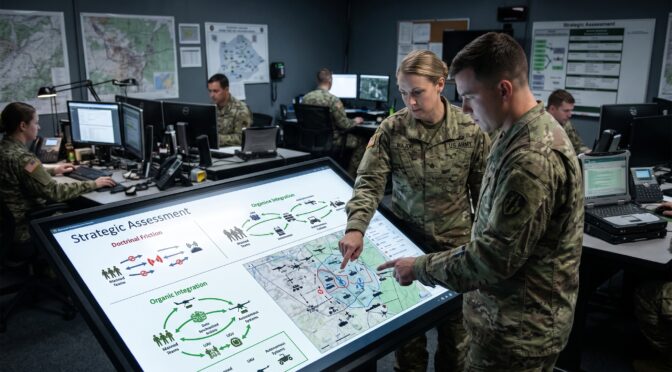
However, this procurement-centric approach masks a critical vulnerability: the doctrinal friction inherent in the operationalization of MUM-T. The prevailing tendency within American defense planning to fixate on the technological platforms—the drones themselves—has resulted in a severe underestimation of the systemic requirements necessary to design, build, operate, and evolve these systems within human formations. Currently, uncrewed platforms are frequently treated as “bolted-on” support tools, assigned to existing maneuver, fires, or aviation branches to augment legacy operational concepts.6 This structural paradigm places an unsustainable cognitive load on manned aircraft crews and infantry leaders, who are increasingly tasked with simultaneously managing dynamic tactical environments and supervising complex robotic swarms.7
This strategic assessment details the foundational changes required in operational planning, human factors engineering, force structure, and logistics to synthesize these forces effectively. The analysis indicates that true “drone dominance” requires transitioning away from treating uncrewed platforms as external enablers.9 Instead, military leadership must adopt a paradigm of organic integration, transforming autonomous systems into fundamental, inseparable components of the combined arms network, supported by re-engineered training pipelines, consumable logistics, and entirely new frameworks of human-machine command and control.
2. The Strategic Context of Manned-Unmanned Teaming
Manned-Unmanned Teaming represents a profound shift in military operations, characterized by the synchronized employment of human operators, manned combat aircraft, ground vehicles, and autonomous robotic systems to achieve enhanced situational understanding, increased lethality, and greater survivability.8 Rather than operating in isolated functional categories, MUM-T envisions a unified systems architecture where semi-autonomous or fully autonomous platforms perform complex tactical behaviors under the collaborative supervision of human warfighters.1
2.1 Defining the Integration Spectrum: Levels of Interoperability
The fundamental architecture of MUM-T relies on standardized communication protocols that dictate how human operators interface with uncrewed systems. The North Atlantic Treaty Organization (NATO) Standardization Agreement (STANAG) 4586 establishes the accepted doctrinal framework for this interaction, defining five distinct Levels of Interoperability (LOI).1 Understanding these levels is critical for defense planners, as true organic integration requires operating at the highest levels of the spectrum.
| Interoperability Level | Capability Description | Doctrinal Implication for Force Integration |
| LOI 1 | Indirect receipt of payload data. | The weakest level of interoperability. Manned forces receive data passively via secondary networks. Offers basic situational awareness but precludes dynamic tactical coordination.1 |
| LOI 2 | Direct receipt of payload data. | Manned platforms receive direct data streams from the uncrewed system. Reduces latency for the operator but does not provide the ability to command or retask the asset.8 |
| LOI 3 | Control of the UAS payload. | The human operator (e.g., a helicopter co-pilot or ground commander) assumes direct control of the uncrewed platform’s sensor suite, enabling rapid orientation on specific targets of opportunity.8 |
| LOI 4 | Control of the UAS flight path. | The human operator dictates the physical positioning and maneuvering of the uncrewed platform, which is crucial for establishing specific vantage points or ensuring safe positioning during kinetic engagements.14 |
| LOI 5 | Full autonomous launch and recovery. | The highest level of autonomy currently codified. Enables highly independent operations where systems manage their own lifecycles, requiring only supervisory intent from human operators.1 |
To fully realize the promise of multi-domain operations against highly contested anti-access/area denial (A2/AD) environments, military forces must transcend LOI 3 and move decisively toward LOI 4 and LOI 5.13 At these higher echelons, artificial intelligence manages the micro-behaviors of the uncrewed systems, allowing the human operator to focus on broader battle management.
2.2 The Fallacy of the “Bolted-On” Approach
While the technological acquisition of LOI 4 and LOI 5 systems is progressing, institutional integration remains hampered by legacy mindsets. The prevailing approach in many units is to treat drones as “bolted-on” support equipment. In this model, an uncrewed asset is attached to an existing formation—such as an infantry squad or an armored platoon—merely to help that unit perform its traditional role more effectively.6
This paradigm creates significant friction. When drones are treated merely as tools to extend legacy capabilities, they often lack the sophisticated software required to minimize human involvement. Consequently, operating the system demands more personnel and a vastly increased cognitive load.15 A rifleman or tank commander attempting to manually pilot a drone via a tablet while actively engaging in close combat becomes a vulnerability rather than an asset. As noted in military planning circles, treating drones as external enablers rather than integral parts of the formation prevents leaders from envisioning entirely new, drone-centric ways of operating.6 To leverage multi-domain synergy, leadership must mandate that uncrewed assets be designed as built-in nodes within a seamlessly connected sensor-to-shooter network, rather than as afterthoughts attached to existing platforms.10
2.3 The “Affordable Mass” Doctrine and Procurement Realities
The push toward organic integration is heavily influenced by the doctrine of “affordable mass.” The Air Force’s CCA program envisions purchasing approximately 1,000 collaborative drones to operate alongside manned fighters, aiming to achieve overwhelming numerical superiority at a fraction of the cost of acquiring additional F-35s or sixth-generation platforms.1 Unlike conventional uncrewed combat aerial vehicles (UCAVs), the CCA utilizes specialized AI autonomy packages to increase survivability while maintaining a lower unit cost.1
However, independent analyses of defense strategy indicate that popular commentary and internal planning often focus too heavily on the “procurement unit cost” of these assets.12 This metric provides an incomplete picture of the total resources required. Doctrinally, the DoD must reconcile the promise of affordable mass with the reality of total lifecycle costs, encompassing research, development, test, and evaluation (RDT&E), as well as Operations & Sustainment (O&S).12 Operating thousands of semi-autonomous systems imposes significant annual demands on logistics, spectrum management, and maintenance infrastructure, variables that are frequently underestimated in the initial procurement phase.
3. Human Factors Engineering and the Cognitive Topography of MUM-T
Perhaps the most severe oversight in the current implementation of MUM-T is the psychophysiological toll placed on human operators. The DoD envisions a future battlespace saturated with sensors, robotic wingmen, and constant streams of multi-domain information.7 However, human working memory possesses a strictly limited capacity. As task complexity increases through the management of autonomous systems, cognitive resource consumption spikes, leading directly to cognitive saturation.16
3.1 Task Saturation and the Threshold of Cognitive Collapse
The integration of uncrewed system data directly into a pilot’s cockpit or a ground commander’s tactical display threatens to drown the warfighter in visual and sensory inputs.8 Research clearly indicates that the accumulation of cognitive load during extended operations leads to a critical degradation in tactical decision-making.17
A comprehensive study involving 78 professional uncrewed aerial vehicle operators from both military and civilian sectors examined the effects of prolonged vigilance and cognitive load during simulated operational shifts lasting up to 12 hours.17 The researchers utilized the NASA-TLX questionnaire to assess subjective cognitive load, combined with continuous physiological monitoring of heart rate variability and electrodermal activity.17
The findings present a stark warning for MUM-T doctrine: the degradation in human decision-making is not a gradual, manageable decline. The research identified a critical cognitive load threshold at 73% of a human’s maximum capacity. Once this threshold is reached—typically after the sixth hour of continuous operational work—tactical decision quality suffers a non-linear, stepwise collapse.17
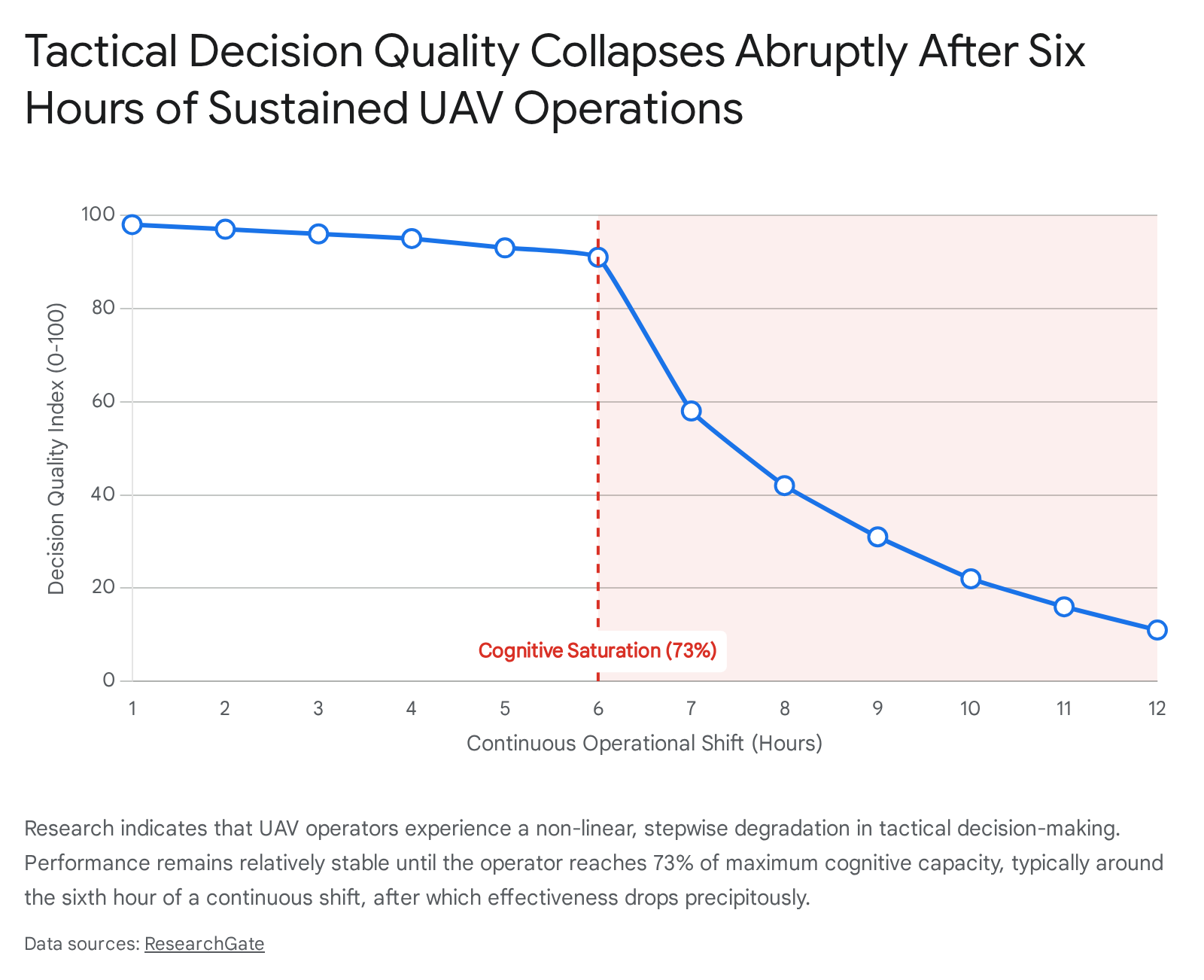
The implications of this finding are profound for force planning. If a manned aircraft pilot or an infantry squad leader is expected to manage robotic wingmen over extended engagements, their cognitive capacity will saturate rapidly. Without automated cognitive offloading, the human supervisor will abruptly lose the ability to make sound tactical judgments, transforming the technological advantage of the swarm into a liability.17
3.2 The Paradox of Situational Awareness
Within the aviation domain, the human-machine interface must balance two distinct and often competing types of situational awareness (SA). The U.S. Army Aeromedical Research Laboratory explicitly distinguishes between Battlefield/Target SA and Flying SA.8
MUM-T is inherently designed to enhance Battlefield SA. By receiving real-time data from uncrewed platforms deployed miles ahead of the manned formation, pilots and commanders gain an unprecedented understanding of ground movement, target disposition, and terrain layout before they ever enter the kinetic danger zone.8 However, this enhancement comes at the direct expense of Flying SA. Pilots managing remote platforms and attempting to interpret complex UAS sensor imagery become distracted from their primary responsibility: safely operating their own aircraft.8 As focus shifts to the tactical display generated by the robotic wingman, the pilot’s awareness of their own aircraft’s attitude, altitude, and physical environment diminishes proportionally.
3.3 Aeromedical Risks and Psychophysiological Monitoring
The cognitive demands of processing conflicting sensory information in a MUM-T environment introduce severe aeromedical risks. When the motion cues of the manned aerial platform conflict with the visual orientation data streaming from the uncrewed aircraft, pilots face a drastically heightened risk of Spatial Disorientation (SD) and motion sickness.8
To mitigate these risks, the military and scientific communities are actively developing real-time psychophysiological monitoring systems. Advanced human factors engineering seeks to design cockpits and command interfaces that dynamically adjust to the operator’s cognitive state.
| Monitoring Methodology | Application in MUM-T Environments | Doctrinal Relevance |
| Heart Rate Variability (HRV) | Utilizes specific indicators (e.g., pnni_20, rmssd, sdsd) to track cognitive resource allocation during complex tasks like simulated flight turns. Deep learning algorithms, such as the LSTM-Attention model, have achieved high accuracy (F1 score 0.9491) in recognizing varying cognitive loads.16 | Enables the system to detect unseen stress. If a pilot is task-saturated, the interface can autonomously hold back routine data updates. |
| Electroencephalogram (EEG) | Monitors brainwave activity using dry-electrode systems and Riemannian artifact subspace reconstruction (rASR) filters. Machine learning models, such as multinomial logistic regression, can detect pilot mental workload with 84.6% accuracy in real flight scenarios.18 | Provides a direct measurement of cognitive saturation, allowing for immediate automated interventions before tactical decision-making collapses. |
| Infrared Stress Monitoring Systems | Evaluates real-time crew workload non-invasively through psychophysiological biomarkers to identify stress levels and cognitive behavior patterns.8 | Validates interface design, ensuring that new MUM-T cockpits display essential data without exceeding fundamental human processing limits. |
Human factors research, such as the UK MOD’s “Cognitive Cockpit” project, indicates that managing spatial disorientation and task saturation requires real-time adaptive countermeasures. This includes automated “Safety Net” systems capable of temporarily overriding the authority of a partially disoriented pilot, taking over automatic control until the human operator regains full cognitive capacity.19 Future command-and-control software across all echelons must feature AI agents that triage incoming reports, summarizing or delaying routine updates while ensuring truly urgent warnings immediately cut through the digital noise.7
4. Organizational Friction and the Challenges of Force Structure
The integration of advanced robotic wingmen and ground drones forces a structural reckoning within military organizations. Merely possessing autonomous technology is insufficient if the organizational structure remains optimized solely for legacy models of warfare. The current force design faces significant internal friction regarding how best to assimilate these new assets.
4.1 The Limits of Functional Communities and the “Tank Pitfall”
When disruptive new technology is subordinated entirely to existing functional branches, its true transformational potential is often neutralized. Historical precedents provide stark warnings for current planners. Following World War I, the U.S. Army restricted the development of the tank to the purview of the infantry and cavalry branches.6 Consequently, tanks were developed solely to support infantry and cavalry objectives. Because there was no independent armor branch to champion the platform, no one developed tanks for specific, independent mechanized warfare—a phenomenon defense analysts refer to as the “Tank Pitfall”.6
Treating uncrewed systems solely as support tools to extend the traditional roles of maneuver, fires, or aviation branches risks repeating this precise historical failure.6 Drones represent a multi-faceted capability that inherently intersects multiple functions, including kinetic strike, electronic warfare, intelligence gathering, and logistics. Confining their development and deployment to existing “stovepipes” limits the military’s ability to envision entirely new, drone-centric operational concepts.
4.2 The Drone Corps Debate vs. The “Army Air Corps Pitfall”
To address the limitations of existing branches, some legislative and strategic proposals have advocated for the creation of a specialized “Drone Corps” to consolidate expertise and force generation.6 However, senior military leadership, including the Chief of Staff of the Army, has strongly resisted this approach, arguing that drones must be integrated into existing combined arms formations rather than consolidated into a separate, isolated agency.6
The resistance to a separate Drone Corps is rooted in another historical analogy: the “Army Air Corps Pitfall.” When aviation was established as a separate arm in the 1920s, the organization pursued its own strategic agenda, developing warfighting concepts that became increasingly unmoored from the realities of land power. This institutional separation led to catastrophic air-ground integration failures during the early stages of World War II.6 Creating a specialized Drone Corps before achieving a mature understanding of how these systems operate in large-scale combat risks a similar disconnect between the uncrewed operators and the wider combined arms team.6
4.3 The “Machine Gun Corps” Model: Transformation in Contact
To navigate between the extremes of the “Tank Pitfall” and the “Air Corps Pitfall,” modern military strategists advocate for a “transformation in contact” model.6 This approach involves creating provisional, deployable drone warfare formations under the direct control of operational divisions or corps—similar to the provisional 11th Air Assault Division, which was used to aggressively pioneer helicopter mobility concepts in the 1960s.6
A compelling historical template is the British Army’s Machine Gun Corps of World War I. Created in 1915 to rapidly generate tactical expertise and establish new doctrine for a disruptive technology, the corps was purposefully disbanded in the 1920s once that knowledge had been successfully inculcated across the entire force.6 By executing small, frequent acquisitions and deploying provisional drone units, the DoD can experiment aggressively across functional lines, generating new tactics and techniques without permanently siloing the expertise into a rigid, permanent branch structure.6
5. Doctrinal Shifts: Command, Control, and Custody
Effective organic integration of MUM-T requires standardizing the relationship between the human and the machine. As the technological capacity of the platforms evolves, the doctrinal definitions of command, control, and custody must evolve in tandem.
5.1 From Remote Control to Collaborative Supervision
The introduction of Collaborative Combat Aircraft (CCA) and advanced “loyal wingmen” requires a radical departure from traditional remote-control paradigms. In legacy uncrewed operations, human operators maintained a direct, one-to-one telemetry link, manually controlling the drone’s flight path or directing it along predefined, rigid waypoints.1
Under the emerging MUM-T doctrine, this linear control model is obsolete. The DoD envisions a networked environment where a human pilot in a manned fighter acts not as a joystick controller, but as a tactical battle manager. In this new paradigm, the human transmits high-level mission directives to an onboard artificial intelligence core. This AI autonomy package then self-coordinates a swarm of CCAs to execute specific tasks, such as forward sensing, electronic jamming, or kinetic strikes. The CCAs are expected to synchronize their movements and manage complex aerodynamic behaviors without continually seeking the human pilot’s input.12
This shifts the cognitive burden from direct manipulation to collaborative supervision. The pilot assigns high-level, dynamic objectives, while the autonomous systems execute the tactical maneuvers required to achieve those goals.12 This operating concept introduces the doctrinal framework of “custody,” wherein uncrewed assets fly under the tactical custody of a manned aircraft pilot, operating in a shared airspace and reacting dynamically to the human’s broad intent.12
5.2 Cultural Resistance: The Pilot vs. The Battle Manager
The transition from a direct operator to a collaborative supervisor generates profound cultural friction within the military establishment. Traditional fighter aviation culture is deeply rooted in manual airmanship, physical risk, and direct kinetic engagement.20 The U.S. Air Force has noted that its internal culture can assimilate a robotic aircraft as a subordinate “loyal wingman” far more readily than it can accept designs that completely “virtualize” cockpits or permit crews to manage robotic warplanes from remote, sanitized locations.20
Independent research by the Center for Strategic and Budgetary Assessments (CSBA) points out that military history is littered with uncrewed system programs that offered massive technological breakthroughs but ultimately failed due to internal organizational resistance.12 When the rate of technical evolution outpaces the rate of cultural assimilation, friction builds. Pilots and operators frequently express frustration when forced to abandon traditional airmanship for systems management roles, contributing to retention issues where highly talented personnel exit the service because the reality of their daily operations no longer matches the combat role they envisioned.20 Overcoming this resistance requires deliberate institutional leadership to reframe the pilot’s professional identity, elevating the role of the distributed battle manager to the same prestige as the traditional dogfighter.
5.3 Basing Doctrine and the Lifecycle Sustainment Dilemma
Doctrinal friction also extends to how and where these uncrewed assets are deployed. While the “affordable mass” concept emphasizes low procurement costs, the CSBA report highlights severe tensions regarding basing doctrine.12
Historical examples underscore the importance of realistic sustainment planning. During the Vietnam War, the U.S. military utilized the “Lightning Bug” uncrewed systems. However, alternative recovery methods, such as complex midair retrieval operations, ended up accounting for nearly half of the total operating cost of the platform.12 To avoid repeating this, current Air Force doctrine strongly prefers “runway-launchable” CCAs. However, this creates a strategic dilemma in the Indo-Pacific theater, where runway space is highly contested, geographically limited, and heavily targeted by adversary ballistic missile forces.12 The DoD must reconcile the desire for affordable, mass-produced drones with the immense logistical footprint required to base, launch, recover, and sustain thousands of platforms in austere environments. Furthermore, establishing the supply chain for 1,000 aircraft requires tapping into commercial markets and non-traditional defense firms, an area where the DoD has historically exhibited significant institutional shortcomings.12
6. Re-engineering Training Pipelines for Organic Integration
To bridge the gap between theoretical technological potential and operational reality, the DoD is fundamentally overhauling its training and experimentation pipelines to embed uncrewed systems into the DNA of its combat formations.
6.1 The Air Force Experimental Operations Unit (EOU)
To accelerate the fielding and doctrinal maturation of CCAs, the Air Force has established the Experimental Operations Unit (EOU) at Nellis Air Force Base.21 The EOU was designed to circumvent the historic problem of long, linear development sequences. Instead, the unit operates on a “force integration left” philosophy.21 This culture embeds operational warfighters side-by-side with industry vendors and acquisition personnel early in the software and hardware development cycle. By iterating operational concepts, tactics, and technical requirements simultaneously, the Air Force aims to compress traditional 10–15 year acquisition timelines down to a mere two to three years.21
A critical component of this accelerated pipeline is building human-machine trust. In a MUM-T environment, trust cannot be mandated by doctrine; it must be earned through repetition. The Air Force achieves this through a concept known as “sets and reps”—placing pilots in repeated virtual and live-flight scenarios where they can physically observe autonomous aircraft behaving predictably, reacting appropriately to threats, and staying within their assigned airspace blocks.21
Furthermore, the Air Force draws a sharp distinction between flight autonomy (basic safety-critical behaviors) and mission autonomy (complex tactical execution). In training, the EOU treats the AI system similarly to a student pilot: the autonomy package must master basic flight behaviors, such as holding position and avoiding traffic, before it is trusted to execute complex tactical maneuvers.21 Crucially, post-flight analysis is also evolving. Traditional, engineer-centric debriefs are inadequate for high-tempo operations. The Air Force is demanding that autonomy be “debriefable” in “pilot language.” The AI system must be capable of explaining what actions it took and the tactical rationale behind its decisions, providing transparency that accelerates pilot learning and cements trust.21
6.2 Ground Combat Synergies: Updating the Battle Drills
For ground combat forces, organic integration dictates that uncrewed systems become as fundamental to unit maneuvers as rifles, armored vehicles, and radios. The U.S. Army’s updated capstone operations manual, Field Manual 3-0, explicitly outlines new tactical imperatives, including the requirement to “protect against constant observation” and to “make contact with sensors, unmanned systems, or the smallest element possible”.9
These doctrinal updates reflect a “learn-by-doing” approach, leveraging real-world vignettes from conflicts like the Russo-Ukrainian War to inform future leader development.9 The Army’s Experimentation Force (EXFOR), utilizing integrated Robotics and Autonomous Systems (RAS) platoons, is pioneering the tactical implementation of Human-Machine Integration (HMI). Their operating philosophy is summarized as “no blood for first contact”—mandating the use of robotic systems to shape the initial engagement with the enemy before committing human soldiers.22
This doctrinal evolution requires that vehicle crews and infantry squads train with drones until their deployment becomes “second nature”.10 A deliberate defense plan must inherently assume the presence of constant aerial reconnaissance, and a standard breach mission should automatically incorporate UAV overwatch seamlessly into the battle drill.10 Ground leaders must be trained to trust real-time remote sensor feeds as implicitly as they trust their human scouts.10 To institutionalize this proficiency, military analysts suggest that UAV operations should eventually be integrated into formal military benchmarks, such as the testing protocols for the Expert Soldier and Infantry Badges.10
6.3 Restructuring Human Capital: The 15X MOS and AI Officers
The integration of drones at the tactical level requires specialized human capital that goes beyond the ability to simply fly a remote-controlled aircraft. To address this, the Army is restructuring its enlisted aviation career fields. The service is transitioning away from legacy, platform-specific maintainer roles—such as the 15W and 15J Military Occupational Specialties, which were heavily tied to aging platforms like the RQ-7 Shadow—toward a consolidated 15X Tactical Unmanned Aircraft System Specialist.23
The 15X MOS represents a paradigm shift from a mechanic to a holistic integration expert. Senior personnel in this MOS are not just operators; they are required to advise ground commanders on optimal UAS integration, airspace management, and payload employment techniques.23 Critically, they are trained to synchronize UAS frequency management against threat electronic warfare (EW).23 By establishing uniformed experts explicitly trained to manage the electromagnetic survivability of uncrewed systems, the Army ensures that drones are managed as complex combat nodes in a contested spectrum, rather than simple remote-controlled cameras.23
Concurrently, the Army has recognized the need for strategic management of autonomy algorithms, creating a new 49B Artificial Intelligence/Machine Learning officer area of concentration. These officers are tasked with integrating AI systems into combat operations and logistics networks to accelerate battlefield decision-making, ensuring that the software backend of MUM-T remains as lethal and reliable as the hardware.26
7. Decentralized Logistics and the Sustainment of Swarms
The logistical tail required to sustain widespread MUM-T operations presents one of the most significant, yet frequently overlooked, hurdles to force integration. Wargaming and operational analysis consistently highlight logistics as a primary point of failure in contested environments. As former Marine Corps Commandant General David Berger emphasized, if forces cannot communicate or sustain themselves, the technological superiority of their robotic wingmen or front-line troops becomes irrelevant.27
7.1 Autonomy in Expeditionary Logistics
Currently, the U.S. military lags in integrating robotics and autonomy into its logistical framework compared to its combat arms.27 Autonomy and artificial intelligence offer massive potential to improve operational efficiency through predictive logistics. AI systems can calculate sustainment requirements faster and more accurately than human planners, anticipating shortages of fuel, munitions, or batteries and deploying uncrewed resupply platforms to address them 24/7 without human intervention.27
Furthermore, autonomous logistics platforms offer a unique tactical advantage: they can serve as decoys. In an environment saturated with adversary sensors, moving supplies safely requires masking the true intent of the operation. By utilizing autonomous systems, forces can generate mass movements of uncrewed supply vehicles—for instance, launching 17 autonomous vehicles simultaneously on different routes to resupply a single position—overwhelming adversary targeting sensors and forcing them to expend expensive munitions on low-value automated supply trucks.27
7.2 Consumable Warfare: Overhauling Supply Discipline
Deploying drones organically at the tactical edge requires a fundamental shift in supply philosophy. Traditional military “command supply discipline” treats vehicles, aircraft, and advanced electronics as precious, highly accountable end-items. This rigid accountability is entirely incompatible with the high attrition rates expected in modern drone warfare.10
To achieve true organic integration, tactical UAVs must be viewed as expendable, consumable items. They must be managed, accounted for, and replenished much like artillery ammunition or small arms fire.10 Unit sustainment systems must be entirely restructured to provide a continuous, high-volume flow of easily replaceable assets, modular spare parts, and batteries. The maintenance footprint must expand to include dedicated, trained technicians embedded at lower echelons, capable of rapid field repairs. Furthermore, future combat vehicle designs must incorporate UAV control consoles and launch mechanisms as built-in, integral components of the chassis, rather than relying on disparate control systems bolted onto the exterior as an afterthought.10
8. Interoperability, Joint Experimentation, and Adversarial Context
Future conflicts will not be fought unilaterally, nor will they be fought within the isolated domains of single service branches. The successful execution of MUM-T requires seamless integration across joint services and international coalitions. The DoD is actively testing these integrations through massive-scale, multi-national exercises to identify friction points before they manifest in combat.
8.1 Insights from Joint Force Experimentation
The Army Futures Command’s Project Convergence is the premier proving ground for these concepts. During Project Convergence Capstone 4 and Capstone 5 at the National Training Center in California, U.S. forces, alongside coalition partners from the United Kingdom, Australia, Canada, New Zealand, France, and Japan, tested the integration of layered air and missile defense systems across a vast network of sensors and shooters.28
These live and simulated experiments focused heavily on data-driven decision making and expanding maneuver capabilities through technology like the Mission Command on the Move (MCOTM) architecture and M-SHORAD Human Machine Integration systems.28 The core lessons derived from these massive experiments were stark: achieving digital integration requires intense focus on interoperability and security first, and avoiding proprietary “vendor lock-in” is an absolute prerequisite for multi-national coordination.31
Similarly, massive air exercises such as Red Flag 25-2 and the upcoming Ramstein Flag 2025 are heavily emphasizing multi-domain integration and counter anti-access/area denial (A2/AD) tactics.32 Red Flag 25-2 saw massive allied participation, including the deployment of 430 personnel and 17 aircraft from the Royal Australian Air Force (RAAF), alongside assets from the Royal Saudi Air Force and the United Arab Emirates.32
As allies like Australia expand their F-35 fleets and develop their own loyal wingman platforms, such as the MQ-28 Ghost Bat, establishing shared doctrinal protocols is essential.34 Exercises like Ramstein Flag, which will integrate over 90 fighter jets across 12 allied operational air bases, are critical for testing the agile combat employment necessary to hand over the tactical custody of autonomous assets between different nations’ aircraft seamlessly in the heat of combat.33
| Experimentation Event | Primary Focus Area | Key Doctrinal Insight for MUM-T |
| Project Convergence Capstone 5 | Multi-national data-centric networking and Human Machine Integration (HMI). | Interoperability and security must override proprietary technology. Vendor lock-in critically degrades allied integration.28 |
| Red Flag 25-2 | Large-force combat integration, long-range strike, and electronic warfare. | The ability to adjust tactics on the fly and maintain precise communication across joint and coalition warriors is critical in a dynamic, drone-inclusive environment.32 |
| Ramstein Flag 2025 | Counter A2/AD, integrated air and missile defense, and agile combat employment. | Demonstrates the immense logistical and command challenge of coordinating autonomous and manned operations across 12 dispersed allied bases simultaneously.33 |
8.2 Adversarial Context: The Peer Threat
The urgency of resolving the doctrinal friction in MUM-T is driven directly by the rapid advancements of peer competitors. China’s People’s Liberation Army (PLA) is aggressively pursuing its own MUM-T capabilities and closely analyzing U.S. doctrinal developments.36 Open-source intelligence indicates that the PLA defense community considers the integration of autonomous systems into air operations a defining feature of future combat capability.36
Chinese aerospace engineering is already producing platforms designed for these roles. Uncrewed systems such as the stealthy Sky Hawk drone and the FH-97 are reportedly being developed with explicit MUM-T capabilities, featuring technology designed to facilitate communication and collaboration with manned aircraft across various stages of operations.38 Understanding the PLA’s technological advancements and their perspective on the man-machine relationship is critical for the DoD. It directly informs U.S. operational planning, guiding the development of counter-UAS tactics and electromagnetic warfare strategies explicitly designed to sever the data links connecting adversarial manned and uncrewed teams in future conflicts.36
9. Strategic Recommendations
The U.S. Department of Defense’s massive capital investments in uncrewed technology, artificial intelligence, and collaborative combat platforms represent a necessary and urgent pivot toward the realities of modern, decentralized warfare. However, treating these systems as mere technological injects—bolted onto legacy force structures as simple support tools—will inevitably result in task-saturated operators, degraded situational awareness, and stifled operational innovation. The true potential of Manned-Unmanned Teaming lies not in the technological platform itself, but in the organic, systemic integration of the asset into the cognitive, structural, and logistical fabric of the joint force.
To synchronize these forces effectively and resolve the prevailing doctrinal friction, DoD leadership must adopt the following foundational changes:
- Acknowledge and Engineer for Cognitive Limits: Leadership must abandon the implicit assumption that human operators can absorb infinite streams of digital data. Procurement requirements for UAS must mandate the inclusion of AI-driven dynamic decluttering interfaces and psychophysiological monitoring (such as EEG and HRV analysis) to prevent the abrupt, non-linear collapse of tactical decision-making when operators hit the 73% cognitive saturation threshold.
- Shift Doctrine from Direct Control to Collaborative Custody: Operational doctrine must officially transition the role of the pilot and the ground vehicle commander from a “remote controller” to a “battle manager.” This requires significant investment in AI mission autonomy packages capable of executing complex tactical behaviors independently, requiring only high-level objective inputs and supervisory intent from the human warfighter.
- Institutionalize “Transformation in Contact”: The DoD must actively avoid the “Tank Pitfall” of siloing drones into existing, rigid branches, and similarly reject the creation of an isolated “Drone Corps.” Instead, the military must utilize provisional drone formations at the division and corps levels to aggressively experiment with multi-domain synergy, continuously feeding tactical lessons learned back into capstone doctrine.
- Reclassify Tactical UAS as Consumable Munitions: To survive the high-attrition realities of peer conflict, the DoD must revise supply discipline doctrines to treat tactical uncrewed systems as expendable ammunition rather than serialized end-items. This will drastically reduce administrative burdens, optimize logistical pipelines, and force a reliance on scalable commercial supply chains rather than bespoke defense manufacturing.
- Prioritize Allied Interoperability Over Proprietary Systems: As demonstrated in Project Convergence and Red Flag exercises, open systems architectures are non-negotiable. The DoD must ruthlessly eliminate vendor lock-in to ensure that autonomous assets can be seamlessly handed off and commanded across joint services and international coalition partners in contested environments.
By aggressively addressing the human factors, logistical realities, and structural rigidities surrounding MUM-T, the Department of Defense can ensure that its technological investments translate directly into decisive, sustainable overmatch on the future battlefield.
Please share the link on Facebook, Forums, with colleagues, etc. Your support is much appreciated and if you have any feedback, please email us in**@*********ps.com. If you’d like to request a report or order a reprint, please click here for the corresponding page to open in new tab.
Sources Used
- Manned-unmanned teaming – Wikipedia, accessed April 24, 2026, https://en.wikipedia.org/wiki/Manned-unmanned_teaming
- Pentagon says $1 billion planned for first two years of Replicator – Defense News, accessed April 24, 2026, https://www.defensenews.com/pentagon/2024/03/11/pentagon-says-1-billion-planned-for-first-two-years-of-replicator/
- Hicks: DOD plans to invest about $1B into Replicator initiative in 2024-2025 time frame, accessed April 24, 2026, https://defensescoop.com/2024/03/11/replicator-funding-2024-2025-hicks/
- Replicator Initiative Continues Unmanned System Development | Federal Budget IQ, accessed April 24, 2026, https://federalbudgetiq.com/insights/replicator-initiative-continues-unmanned-system-development/
- Human–Machine Integration and Manned–Unmanned Teaming to Reshape Global Military Operations Through 2027 – Frost & Sullivan, accessed April 24, 2026, https://www.frost.com/news/press-releases/human-machine-integration-and-manned-unmanned-teaming-to-reshape-global-military-operations-through-2027/
- HOW TO TRANSFORM THE ARMY FOR DRONE WARFARE – War …, accessed April 24, 2026, https://warroom.armywarcollege.edu/articles/transform-for-drones/
- 571. The Fight for Bandwidth — Why the Future Warfighter Must See Less to Survive More, accessed April 24, 2026, https://madsciblog.t2com.army.mil/571-the-fight-for-bandwidth-why-the-future-warfighter-must-see-less-to-survive-more/
- Manned-Unmanned Teaming – Joint Air Power Competence Centre, accessed April 24, 2026, https://www.japcc.org/articles/manned-unmanned-teaming/
- Army adapts doctrine force-wide, integrating drone lessons to …, accessed April 24, 2026, https://www.army.mil/article/291361/army_adapts_doctrine_force_wide_integrating_drone_lessons_to_achieve_drone_dominance
- Steel and Silicon: The Case for Teaming Armored Formations with …, accessed April 24, 2026, https://mwi.westpoint.edu/steel-and-silicon-the-case-for-teaming-armored-formations-with-uavs/
- What is Manned-Unmanned Teaming (MUM-T)? – BAE Systems, accessed April 24, 2026, https://www.baesystems.com/en-us/definition/what-is-manned-unmanned-teaming
- READY PLAYER NONE? – CSBA, accessed April 24, 2026, https://csbaonline.org/uploads/documents/CSBA8400_(Ready_Player_None_Report)_web.pdf
- Kicking the Beehive – Army University Press, accessed April 24, 2026, https://www.armyupress.army.mil/Portals/7/PDF-UA-docs/Jaksha-UA.pdf
- Army Aviation Manned-Unmanned Teaming (MUM-T): Past, Present, and Future – CORE Scholar, accessed April 24, 2026, https://corescholar.libraries.wright.edu/cgi/viewcontent.cgi?article=1095&context=isap_2015
- Tactical UAS: Three-Tiered UAS Manning for Increased Lethality and Situational Awareness, accessed April 24, 2026, https://www.lineofdeparture.army.mil/Journals/Infantry/Infantry-Archive/Winter-2024-2025/Three-Tiered-UAS-Manning/
- Pilot turning behavior cognitive load analysis in simulated flight – PMC, accessed April 24, 2026, https://pmc.ncbi.nlm.nih.gov/articles/PMC11456565/
- (PDF) The impact of cognitive load on tactical decision-making of unmanned aerial vehicle operators during extended shifts – ResearchGate, accessed April 24, 2026, https://www.researchgate.net/publication/403899913_The_impact_of_cognitive_load_on_tactical_decision-making_of_unmanned_aerial_vehicle_operators_during_extended_shifts
- Monitoring pilots’ mental workload in real flight conditions using multinomial logistic regression with a ridge estimator – Frontiers, accessed April 24, 2026, https://www.frontiersin.org/journals/robotics-and-ai/articles/10.3389/frobt.2025.1441801/full
- From Safety Net to Augmented Cognition: Using Flexible Autonomy Levels for On-Line Cognitive Assistance and Automation, accessed April 24, 2026, https://www.faa.gov/sites/faa.gov/files/about/office_org/headquarters_offices/avs/MP-086-27.pdf
- Synchronizing Change and Air Force Culture: Modernization and the Dirty Secret of Aircrew Shortages – War on the Rocks, accessed April 24, 2026, https://warontherocks.com/synchronizing-change-and-air-force-culture-modernization-and-the-dirty-secret-of-aircrew-shortages/
- An Inside Look at the Air Force’s Robot Wingmen: Collaborative …, accessed April 24, 2026, https://www.autonomyglobal.co/an-inside-look-at-the-air-forces-robot-wingmen-collaborative-combat-aircraft/
- Human-Machine Integration: Tactical-Level Employment and the EXFOR RAS Platoon, accessed April 24, 2026, https://www.lineofdeparture.army.mil/Journals/Infantry/Infantry-Archive/Winter-2024-2025/Human-Machine-Integration/
- 10-15X. MOS 15X—Tactical Unmanned Aircraft System (TUAS …, accessed April 24, 2026, https://api.army.mil/e2/c/downloads/2026/01/13/fb3bc9a7/15x.pdf
- Unmanned Aircraft Systems Maintenance Training | American Civil Liberties Union, accessed April 24, 2026, https://www.aclu.org/documents/unmanned-aircraft-systems-maintenance-training
- Any updated information on 15W? : r/army – Reddit, accessed April 24, 2026, https://www.reddit.com/r/army/comments/1p2v7gv/any_updated_information_on_15w/
- Army creates new AI-focused career field for officers – Task & Purpose, accessed April 24, 2026, https://taskandpurpose.com/news/army-ai-career-field/
- JUST IN: U.S. ‘Way Behind’ Using Autonomy, Robotics for Logistics, accessed April 24, 2026, https://www.nationaldefensemagazine.org/articles/2025/8/21/us-must-use-autonomy-robotics-for-logistics
- Project Convergence Capstone 5 experiments at NTC | Article | The United States Army, accessed April 24, 2026, https://www.army.mil/article/284397/project_convergence_capstone_5_experiments_at_ntc
- Air Force, Army shaping the future of C2, together, accessed April 24, 2026, https://www.af.mil/News/Article-Display/Article/4155743/air-force-army-shaping-the-future-of-c2-together/
- Project Convergence Capstone 4 Works to Integrate Joint, Multinational Defense Systems, accessed April 24, 2026, https://www.dodmantech.mil/News/News-Display/Article/3692664/project-convergence-capstone-4-works-to-integrate-joint-multinational-defense-s/
- Achieving digital integration across allies: Lessons learned from Project Convergence, accessed April 24, 2026, https://defensescoop.com/2024/06/12/achieving-digital-integration-across-allies-lessons-learned-project-convergence/
- Red Flag 25-2 Expands International Collaboration and Multi-Domain Integration > Air Combat Command > Article Display, accessed April 24, 2026, https://www.acc.af.mil/News/Article-Display/Article/4134356/red-flag-25-2-expands-international-collaboration-and-multi-domain-integration/
- ‘Better never stops’: Commanders preview NATO’s next large-scale, live-fly exercise, accessed April 24, 2026, https://defensescoop.com/2025/03/24/nato-ramstein-flag-2025-exercise-plans/
- RAAF flies Red Flag over Nevada | Defence, accessed April 24, 2026, https://www.defence.gov.au/news-events/news/2025-02-11/raaf-flies-red-flag-over-nevada
- Red Flag 2025: Delivering Excellence Through Global Defense Collaboration, accessed April 24, 2026, https://www.sktcorp.com/red-flag-2025/
- The People’s Liberation Army’s Approach to Manned-Unmanned Teaming – RAND, accessed April 24, 2026, https://www.rand.org/content/dam/rand/pubs/research_reports/RRA3900/RRA3906-1/RAND_RRA3906-1.summary.pdf
- The People’s Liberation Army’s Approach to Manned-Unmanned Teaming: Theory and Practice – RAND, accessed April 24, 2026, https://www.rand.org/content/dam/rand/pubs/research_reports/RRA3900/RRA3906-1/RAND_RRA3906-1.pdf
- MANNED–UNMANNED TEAMING: CHANGING PARADIGMS OF AIR WARFARE – CAPSS India, accessed April 24, 2026, https://capssindia.org/wp-content/uploads/2025/09/8-RK-Ranjan.pdf