1. Executive Summary
The modernization of the United States military is increasingly defined by a pivot toward unmanned systems, autonomy, and the algorithmic orchestration of forces. As peer competitors accelerate their own investments in asymmetric and autonomous capabilities, the United States has initiated historic funding measures to field attritable, autonomous platforms at scale. However, strategic analysis indicates a critical vulnerability in this modernization trajectory: a systemic fixation on the acquisition of the physical platforms themselves, often at the expense of the digital, regulatory, and cryptographic connective tissue required to operate them within a multi-national coalition.
The Department of Defense (DoD) is actively pursuing an operational doctrine that relies on Combined Joint All-Domain Command and Control (CJADC2) to network sensors and shooters across all domains. Yet, warfare is inherently a coalition endeavor. If United States unmanned aerial systems (UAS) cannot seamlessly share targeting data, intelligence, surveillance, and reconnaissance (ISR) feeds, and command-and-control (C2) directives with allied partner networks, the sheer mass of deployed platforms will yield diminishing tactical returns. Operating an isolated fleet of drones, regardless of their individual technological sophistication, creates dangerous operational blind spots and fundamentally fractures the coalition battlefield.
This report analyzes the systemic hurdles to allied interoperability in unmanned systems operations. It identifies that acquiring physical capabilities frequently ignores profound integration barriers, specifically within cryptographic standards, cross-domain data sharing, and export control regulations like the International Traffic in Arms Regulations (ITAR) and the Missile Technology Control Regime (MTCR). To successfully enable unified warfighter operations, leadership must mandate integration frameworks that prioritize data-centric security architectures, Commercial Solutions for Classified (CSfC) encryption over legacy paradigms, and strict adherence to the Modular Open Systems Approach (MOSA). Failing to address these systemic requirements will result in a fragmented coalition battlefield, negating the strategic advantage of the DoD’s massive investments in drone technology and ceding decision dominance to adversaries capable of faster, multi-national data synthesis.
2. The Strategic Pivot Toward Autonomous Mass and “Commercial-First” Acquisition
The current fiscal and strategic environment reflects an unprecedented prioritization of unmanned systems and counter-unmanned aircraft systems (C-UAS). The budgetary proposals for the coming fiscal cycles illustrate a paradigm shift from exquisite, easily targeted legacy platforms toward distributed, attritable mass.
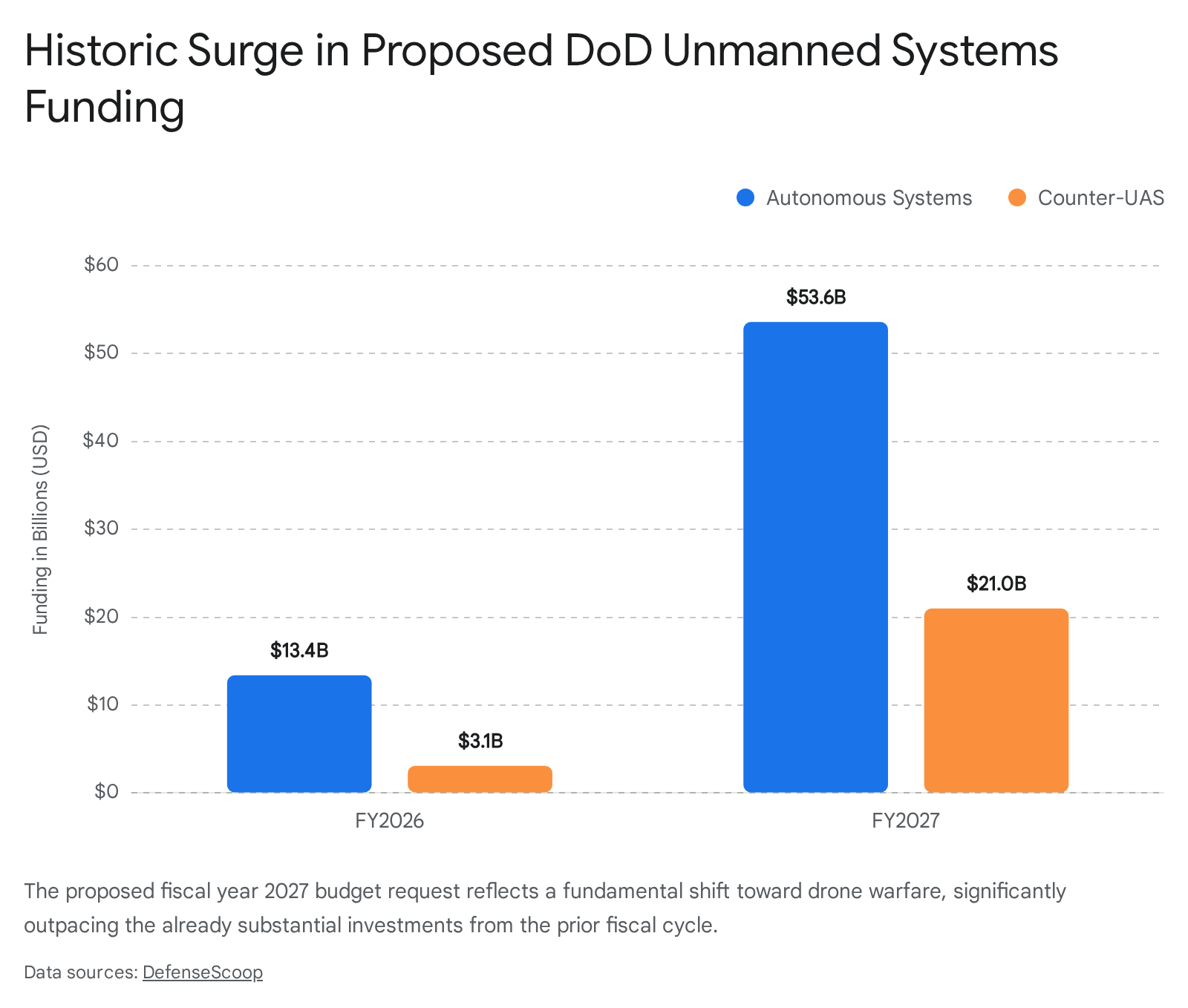
Recent budgetary requests for fiscal year 2027 seek to allocate more than $70 billion toward military drones and counter-drone weapon systems, representing the largest investment in drone warfare in United States history.1 Within this framework, approximately $53.6 billion is specifically requested for autonomy, drone platforms, collaborative combat aircraft, and contested logistics, while $21 billion is designated for munitions and counter-drone technologies.1 This marks an exponential increase from prior years, such as the fiscal year 2026 allocation, which sought $13.4 billion for autonomous systems and $3.1 billion for C-UAS capabilities.1
Complementing this baseline funding are rapid acquisition initiatives designed to circumvent traditional bureaucratic procurement delays. The Drone Dominance Program, launched by the War Department with a projected $1.1 billion investment across four phases, aims to rapidly field low-cost, weaponized one-way attack drones across combat units.2 Announced in February 2026, this program initiates “The Gauntlet” at Fort Benning, wherein military operators directly assess 25 competing vendors in operational conditions.2 By prioritizing battlefield-driven evaluation over traditional acquisition models, the Department expects to issue $150 million in prototype delivery orders rapidly, projecting the fielding of hundreds of thousands of combat-ready systems by 2027.2
This operationalizes priorities outlined in Secretary of War Pete Hegseth’s July 2025 memorandum, signaling a pivot toward attritable mass production.2 It echoes lessons drawn from the rapid defense technology ecosystem cultivated by Ukraine following the 2022 Russian invasion.3 Ukraine’s wartime transformation demonstrated that legacy military-industrial complexes, riddled with institutional inertia, are insufficient for modern survival.3 Instead, radical decentralization, bottom-up innovation, and the integration of commercial off-the-shelf (COTS) technologies through dedicated, parallel commercial-first budgets are vital.3
Concurrently, the Defense Innovation Unit’s (DIU) Replicator initiative serves as the strategic response to adversarial quantitative advantages, specifically Chinese military mass.4 Launched in August 2023, Replicator 1 targets the fielding of multiple thousands of all-domain attritable autonomous (ADA2) systems by August 2025.4 Selected systems include AeroVironment’s Switchblade 600, Anduril’s Altius-600 and Ghost-X, alongside software vendors tasked with enabling swarming navigation.4 The subsequent phase, Replicator 2, shifts focus to counter-small UAS (C-sUAS) systems for the protection of critical installations and force concentrations.4
However, the rapid acquisition of these platforms obscures deeper systemic vulnerabilities. As operationalized through initiatives like Replicator, autonomy solves the challenge of controlling mass numbers of systems simultaneously in anti-access/area-denial (A2/AD) contested environments without relying on vulnerable operator control links.7 Yet, the network backbone required to support hundreds of thousands of sensors transmitting data, and the interoperability necessary to fight jointly with allies, remains a critical work in progress.8 The logistical considerations for fueling, maintaining, mapping, and networking thousands of unmanned vehicles across distributed theaters like INDOPACOM will severely test the limits of current architectures.8 Procuring the hardware is ultimately the simplest phase; integrating these diverse assets into a cohesive, secure, multi-national network represents the actual operational bottleneck.
| Initiative / Program | Primary Objective | Key Timeline / Funding Milestone | Interoperability / Integration Hurdle |
| DoD FY2027 Budget Request | Maximize investment in autonomy, drone platforms, and C-UAS.1 | $70 billion total ($53.6B autonomy, $21B C-UAS).1 | Massive scale requires unprecedented data management and coalition networking. |
| Drone Dominance Program | Rapidly field low-cost, weaponized one-way attack drones.2 | $1.1B over four phases; hundreds of thousands of drones by 2027.2 | Accelerating procurement outpaces the development of common communication protocols. |
| Replicator 1 (ADA2) | Overcome adversarial mass with all-domain attritable autonomous systems.4 | Multiple thousands of systems fielded by August 2025.4 | High risk of operating isolated swarms without multi-national sensor fusion.8 |
| Replicator 2 (C-sUAS) | Defend critical infrastructure and force concentrations from sUAS.6 | Announced in 2024 to address immediate base defense gaps.4 | Requires integration with allied local warning and air defense architectures. |
3. The Baseline of Coalition Interoperability
Interoperability within a multi-national alliance is not merely a technical specification; it is a multi-layered strategic imperative. The expansion of NATO to 32 nations, coupled with the commitment of allied leaders to invest 5% of GDP annually on defense by June 2025, amplifies the need for seamless integration.9 The Defence Production Action Plan, agreed upon at the 2023 Vilnius Summit, and the NATO Industrial Capacity Expansion Pledge from the 2024 Washington Summit, underscore the commitment to harmonizing defense procurement.9
However, defining and measuring this interoperability remains complex. Andreas Tolk’s model of Coalition Interoperability outlines nine distinct layers required for success: (1) Physical Interoperability, (2) Protocol Interoperability, (3) Data/Object Model Interoperability, (4) Information Interoperability, (5) Knowledge/Awareness, (6) Aligned Procedures, (7) Aligned Operations, (8) Harmonized Strategy/Doctrines, and (9) Political Objectives.11 The technological challenges (layers 1-4) frequently yield to political and cultural hurdles, but without a unified technical foundation, the higher strategic layers cannot function.11
In the context of drone warfare, this means that a US-manufactured UAS must not only physically fly in allied airspace but must utilize compatible cryptographic protocols, share a standardized data object model for targeting, and feed information into an aligned operational picture. The lack of agreed formats for collection, management, and the communication of findings prevents allies from developing common interoperability measurement tools, often forcing ad-hoc procedural agility that increases mission risk.10 A core obstacle to overcoming these layers lies in the rigid cryptographic standards currently employed by the US military.
4. Cryptographic Standards and the Security-Interoperability Paradox
A foundational hurdle to allied interoperability in unmanned systems is the strict regime of cryptographic standards enforced by the United States. Achieving seamless data sharing with coalition partners presents a paradox: the systems must be secure enough to protect highly classified National Security Systems (NSS) data from advanced persistent cyber threats, yet accessible and agile enough to allow foreign partners to plug into the network at the tactical edge.
4.1 The Logistical Burden of Legacy NSA Type 1 Encryption
Historically, the DoD has relied heavily on National Security Agency (NSA) Type 1 encryption to protect data at rest and data in transit.13 Type 1 products are highly restricted, classified hardware devices (often referred to as HAIPE devices) designed to encrypt and decrypt sensitive national security information using Suite A algorithms.14 While they offer unparalleled security assurance, their integration into multi-national, distributed unmanned operations imposes massive logistical and operational burdens.
The deployment of Type 1 encryption on autonomous platforms or in distributed multi-national teams creates severe friction. These devices require stringent continuous physical control, specialized handling procedures, and extensive user training that cannot be rapidly imparted to coalition partners or integrated into their distinct C2 networks.15 Furthermore, Type 1 devices are expensive, bespoke, and often subject to rigid export restrictions, inherently limiting their distribution to foreign allies.17 In a highly dynamic, distributed drone swarming environment—where nodes are explicitly designed to be “attritable” and are therefore likely to be lost, jammed, or captured—embedding classified hardware creates an unacceptable operational risk.14 If a drone carrying a Type 1 device is compromised, the incident triggers catastrophic security protocols.
4.2 The Shift to Commercial Solutions for Classified (CSfC)
To overcome this paradox, a pivotal shift toward the NSA’s Commercial Solutions for Classified (CSfC) program is required.14 CSfC allows organizations to protect classified NSS data using layered Commercial Off-the-Shelf (COTS) technologies, moving away from exclusively developed, classified hardware.19 By mandating at least two independent, approved layers of encryption (such as MACsec and IPsec protocols), CSfC achieves robust security without the administrative paralyzation of Type 1 devices.17 If one layer is found to be vulnerable, the secondary layer maintains the integrity of the data.20
The adoption of CSfC fundamentally alters the interoperability landscape. It replaces bespoke hardware with software-driven, commercial standards that can be fielded in months rather than years.19 For example, commercial tactical networking devices—such as those utilizing Wave Relay mobile ad hoc networks (MANET)—have secured NSA CSfC approval, allowing non-ITAR networking solutions to handle classified data.13 This enables warfighters to maintain secure access to classified data even when operating alongside foreign partners on host-nation cellular (5G) or commercial satellite (Starlink) infrastructures, which are otherwise highly exposed domains.13 The encryption resides on software within handheld MANET devices or drone payloads, vastly reducing the size, weight, power, and cost constraints.17
| Cryptographic Characteristic | Legacy NSA Type 1 Encryption | Commercial Solutions for Classified (CSfC) |
| Technology Baseline | Bespoke, government-developed hardware (e.g., HAIPE devices) and Suite A algorithms.14 | Layered Commercial Off-the-Shelf (COTS) products utilizing commercial standards.14 |
| Accessibility & Export | Highly restricted; classified hardware generally inaccessible to standard foreign partner units.13 | Broader accessibility; utilizes non-ITAR commercial components enabling easier deployment with allies.13 |
| Cost & Development | Long development cycles; high Total Cost of Ownership (TCO).16 | Rapid technology adoption; mass-produced commercial scale lowers TCO.19 |
| Operational Risk | High risk of compromise if an attritable drone is captured; requires 24/7 physical control and guards.16 | Lower risk of ownership; hardware is unclassified, relying on layered software encryption ideal for high-risk edge operations.16 |
| Interoperability & Transport | Rigid architecture, often limited to dedicated, expensive SATCOM or MPLS links.16 | Highly flexible; functions over commercial 5G, Starlink, and varied third-party transport technologies.16 |
For DoD leadership, the imperative is clear: the integration of unmanned platforms into a multi-national network dictates that acquisition programs explicitly favor CSfC architectures over legacy Type 1 mandates. Without this cryptographic agility, allied forces will remain technologically locked out of the United States’ operational picture, forced to operate through slow, manual liaison channels.
5. Architectural Frameworks: CJADC2 and Cross-Domain Data Sharing
The modern battlefield is inherently multi-domain. Unmanned systems no longer operate in siloed environments; maritime surface drone operations interact with aerial ISR feeds, which are supported by space-based surveillance and ground-based tactical units.21 Operating across these spaces requires complex, cross-domain interoperability, which presents significant technical challenges regarding latency, data integrity, and cyber resilience.21
5.1 The Evolution of CJADC2
The DoD’s strategic approach to orchestrating this complexity is Combined Joint All-Domain Command and Control (CJADC2). Initiated in 2019, CJADC2 is not a single platform but a warfighting concept and a fusion of technologies, policies, tools, and talent designed to connect sensors and shooters across space, air, land, sea, and cyberspace via a unified network.24 The primary operational goal is to move away from the highly inefficient “swivel chair” model of analysis—where human operators must manually receive data from one isolated system, interpret it, and enter it into another—toward a fully integrated, automated data ecosystem that provides decision advantage.26
Recent milestones demonstrate tangible progress. Following a series of Global Information Dominance Experiments (GIDE), the Chief Digital and Artificial Intelligence Office (CDAO) successfully delivered a Minimum Viable Capability (MVC) for CJADC2.26 This iteration combines software applications, data integration, and cross-domain operational concepts that are characterized as low latency and highly reliable.25 Furthermore, initiatives like Project Olympus, led by the Joint Staff J-6, are actively forging digital pathways to implement mission partner environment architectures on live networks, supporting multi-national operations spanning multiple combatant commands.28
However, the Government Accountability Office (GAO) notes that the DoD has historically struggled to build a comprehensive framework to guide CJADC2 investments enterprise-wide.24 In the absence of strict, centralized direction, military departments continue to pursue C2 projects in isolation, risking duplication of effort and the creation of new, incompatible data silos.24
5.2 Transitioning to Data-Centric Security
A primary barrier to realizing CJADC2 with international partners is overly restrictive data classification.24 Historically, security was approached through network-centric models: building high, secure walls around specific, isolated networks (e.g., SIPRNet) and strictly controlling access to the network itself.28 This model fails catastrophically in a coalition environment where partners utilize disparate national networks and custom infrastructures that take weeks or months to specially bridge and configure.29
To achieve multi-national interoperability, the DoD is fundamentally transitioning to data-centric security.28 Rather than relying solely on network boundaries, data-centricity manages access at the individual data object level.28 Intelligence and ISR data are tagged with specific metadata that determines releaseability based on the attributes, nationality, and clearance of the end-user.28 This paradigm allows for agile and targeted access to critical information on an integrated network, effectively enabling greater information sharing by applying more granular, rather than broader, security controls.28
5.3 Cross Domain Solutions (CDS) as the Mission Enabler
Safely moving this data between domains, classification levels, and coalition networks requires robust Cross Domain Solutions (CDS). A CDS is far more than a simple firewall; it is a specialized device or collection of devices that mediate controlled access and the transfer of information across varying security boundaries.32 In the context of unmanned operations, a CDS enforces defined security policies to automatically and meticulously inspect, sanitize, and validate every single transaction.32
This allows vital information—such as real-time drone video feeds, cursor-on-target data, command and control instructions, and sensor cueing messages—to flow securely between highly classified networks (like a US Navy combat information center) and unclassified or coalition systems.32 Without integrated CDS, the vast streams of data generated by multi-national ISR platforms would remain trapped in isolated enclaves, creating dangerous operational blind spots and delaying the decision-making kill chain in highly contested environments.33 Tactical CDS variants (TACDS) guarantee the integrity of mission-critical data when transferred between US networks, Five Eyes (FVEY) coalition networks, and broader NATO partners, stimulating opportunities for real-time data convergence in multi-domain operations.32
6. The Material Solution: SABRE and the Mission Partner Environment
The conceptual shift toward data-centricity and CJADC2 requires a concrete material solution. The DoD is operationalizing this through the Mission Partner Environment (MPE), which acts as the United States’ primary contribution to federated mission networking.29 The MPE is designed to provide a connected operating environment for US forces and coalition partners, allowing them to exchange information seamlessly.29
The core software tool enabling the MPE is the Secret and Below Releasable Environment (SABRE).30 SABRE provides a globally connected, continuous collaboration environment that allows US Combatant Commands, select allies, and interagency partners to share tactical data using their own disparate networks.31 Hosted across geographically dispersed, government-owned/contractor-operated classified cloud production environments, SABRE liberates data from incompatible silos.29
SABRE leverages strict data-centric protocols, incorporating standards like ADatP-4774 (Confidentiality Metadata Label Syntax) and ADatP-4778 (Metadata Binding Mechanism) to ensure that information shared within chat environments or C2 applications is accurately tagged for releaseability.37 This ensures that when a US drone identifies a target, the intelligence can be instantly routed through SABRE to a partnered artillery unit whose network is authorized to view that specific classification of data, cutting the decision-making kill chain drastically.31
Recent tests, such as the Capstone 2025 event conducted by the US Air Force’s Battle Lab (ShOC-N), demonstrate SABRE’s potential. By integrating joint forces alongside Five Eyes partners (the UK and Canada), the experiment successfully assessed the interoperability of AI and machine learning tools, advancing cross-national technological collaboration in dynamic targeting scenarios.38
7. Navigating the Regulatory Labyrinth: Export Controls and Technology Transfer
While cryptographic architecture and data-centric software provide the technical means for interoperability, the policy frameworks governing the export and transfer of military technology frequently create profound procedural delays. The goal of integrating allied capabilities is consistently undermined by outdated export control systems originally designed to contain Cold War proliferation.
7.1 Reinterpreting the Missile Technology Control Regime (MTCR)
The Missile Technology Control Regime (MTCR) is a voluntary multilateral arrangement established in 1987 to limit the proliferation of delivery systems capable of carrying weapons of mass destruction.39 Under the MTCR Guidelines, “Category I” items are subject to a strong presumption of denial for export.39 Historically, the regime categorized complete unmanned aerial vehicle systems capable of a 300-kilometer range and a 500-kilogram payload directly alongside ballistic missiles and space launch vehicles.39 Furthermore, “range” under these regulations is rigidly defined as the maximum distance an aircraft can travel in one direction under perfect, fuel-efficient flight conditions, completely independent of operational reality, payloads, or telemetry limits.42
This categorization severely hindered the United States’ ability to export capable, long-endurance drones to allied nations. By enforcing an even higher bar than the MTCR Guidelines required, the US unintentionally ceded global drone market share to nations operating outside the regime’s strict interpretations, such as China and Turkey, fracturing the technological baseline of the broader NATO alliance.40
Recognizing this strategic failure, the US Department of State implemented a crucial policy shift in September 2025.43 The update explicitly reinterprets MTCR rules, directing that requests to export military UAS will now be reviewed under policies similar to those for crewed fighter aircraft, rather than as missile systems.41 This fast-track framework reduces bureaucratic friction, streamlines Foreign Military Sales (FMS) approval, and signals a shift toward faster capability adoption by trusted allies.41 Faster exports open the door for adjacent innovations—secure communications, counter-UAS systems, and swarming software—which are prerequisites for achieving platform interoperability across NATO and the Indo-Pacific.44
7.2 ITAR Constraints and the Algorithmic Classification Trap
The International Traffic in Arms Regulations (ITAR) similarly governs the export of defense-related technologies.45 Drone technologies intended for military use reliably fall under the US Munitions List (USML) Categories IV, VIII, or XII, depending on their capability.42 While exporting the physical airframe presents known regulatory challenges, a unique and severe bottleneck emerges regarding artificial intelligence (AI) and autonomous software.
As the DoD aggressively pursues collaborative combat aircraft and autonomous swarming logic to fulfill Replicator’s mandate, the algorithms driving these systems are heavily scrutinized. If an AI layer provides capabilities such as target identification, weapons guidance, electronic-warfare countermeasure optimization, or autonomous strike authorization, the Directorate of Defense Trade Controls (DDTC) views the algorithm as fundamentally inseparable from the defense article itself.46 Thus, the software—even if derived from commercial origins—becomes ITAR-controlled technical data.
Furnishing assistance to foreign persons in designing or optimizing these targeting algorithms triggers severe defense-service exposure.46 This creates an intractable bottleneck in multi-national drone operations. If an allied nation purchases an American drone platform but cannot access, update, or integrate its underlying autonomy software with their indigenous C2 systems due to ITAR technical data constraints, the platform remains functionally isolated. Prototyping and program calendars shrink significantly when engineers must treat ITAR as a design constraint rather than a post-design hurdle, requiring secure data flows and centralized U.S. fabrication footprints.47
7.3 The AUKUS Exemption Framework
To mitigate these regulatory choke points among the closest allies, the US implementation of the ITAR § 126.7 Exemption for the AUKUS partnership (Australia, the United Kingdom, and the United States) represents a landmark legislative shift.48 Effective September 1, 2025, this exemption grants the UK and Australia a privileged status comparable to Canada, officially recognizing their export control systems as comparable to those of the United States.50
This significantly reduces the requirement to obtain individual DDTC licenses for defense trade among Authorized Users.48 By removing restrictions on transfers, the exemption theoretically allows for deep defense industrial integration and co-development of advanced UAS capabilities.50 However, aerospace industry analysis warns that the operational success of this exemption depends entirely on its administrative implementation.51 Current treaty exemptions are often ignored by industry due to disproportionate administrative burdens; if the scope of Congress’s intent is unnecessarily narrowed by legacy bureaucratic reflexes, the friction will persist.51 Expanding such streamlined, reciprocal regulatory models beyond AUKUS to the broader NATO alliance is critical to meet the operational timelines demanded by the Drone Dominance Program.
| Export Control Framework | Historical Constraint on Interoperability | Recent Modernization / Reform | Strategic Impact on Allied Drone Operations |
| MTCR Category I | Drones with >300km range / >500kg payload treated as ballistic missiles, causing presumptive denial of export.39 | Sept 2025: Policy reinterpreted to review UAS exports similarly to crewed fighter aircraft.41 | Streamlines FMS approvals, allowing allies faster access to US platforms, reducing reliance on adversarial suppliers.41 |
| ITAR (USML Categories IV, VIII, XII) | AI algorithms for autonomous targeting/swarming classified as restricted technical data, limiting co-development.46 | N/A (Remains a significant bottleneck requiring case-by-case review).46 | Prevents allies from modifying US drone software to interface with indigenous C2 systems, maintaining silos.46 |
| AUKUS ITAR Exemption (§ 126.7) | UK and Australia faced standard, slow DDTC licensing requirements for basic defense trade.50 | Sept 2025: Grants UK/Australia comparable status to Canada, eliminating many license requirements for Authorized Users.48 | Enables frictionless co-development of advanced drone tech and immediate sharing of technical data among the trilateral partnership.50 |
8. Tactical Integration Frameworks: Bridging the “Day Zero” Gap
The strategic alignment of cryptographic policies and export control reform must eventually translate into tangible, tactical capability at the edge. “Day Zero” interoperability refers to the capability of multi-national systems to function seamlessly in a coalition operation from the very first moment of deployment, without requiring extensive in-theater retrofitting.53 Achieving this requires robust, pre-established integration frameworks.
8.1 Federated Mission Networking (FMN)
NATO’s broad approach to Day Zero interoperability is rooted in Federated Mission Networking (FMN).54 Evolving from the Afghanistan Mission Network (AMN)—which was initially built to unify disparate national communication systems into a single operational picture within a specific theater—FMN establishes standardized operating procedures and capability baselines for future coalition warfare.54
FMN dictates that participating nations confirm their communication systems comply with NATO security and interoperability principles prior to allocation.56 It relies heavily on standardization across modelling and simulation, utilizing protocols like the High Level Architecture (HLA) and Command and Control Systems – Simulation Systems Interoperation (C2SIM).53 However, the adoption of FMN faces severe technical, logistical, and bureaucratic challenges.57 The slow pace of allied defense procurement often prevents the rapid adoption of innovative technology required to meet FMN baselines.57 Furthermore, the continuous need for rigorous Federated Service Management and Control (FSMC) to align IT components across borders means that FMN is often too cumbersome for rapid, tactical deployments involving newly acquired commercial drone tech.58
8.2 The Mission Partner Kit (MPK) Paradigm
While strategic networks like FMN mature at the enterprise level, tactical units require immediate solutions. The development of the Mission Partner Kit (MPK) by the US Army’s 2nd Cavalry Regiment (2CR) provides a highly effective blueprint for rapid, tactical-level interoperability.59 Informed directly by the rapid assimilation of commercial technologies in the Ukraine conflict, the MPK addresses the severe delays and operational risks caused by the fundamental incompatibility of partner radio networks and C2 systems.59
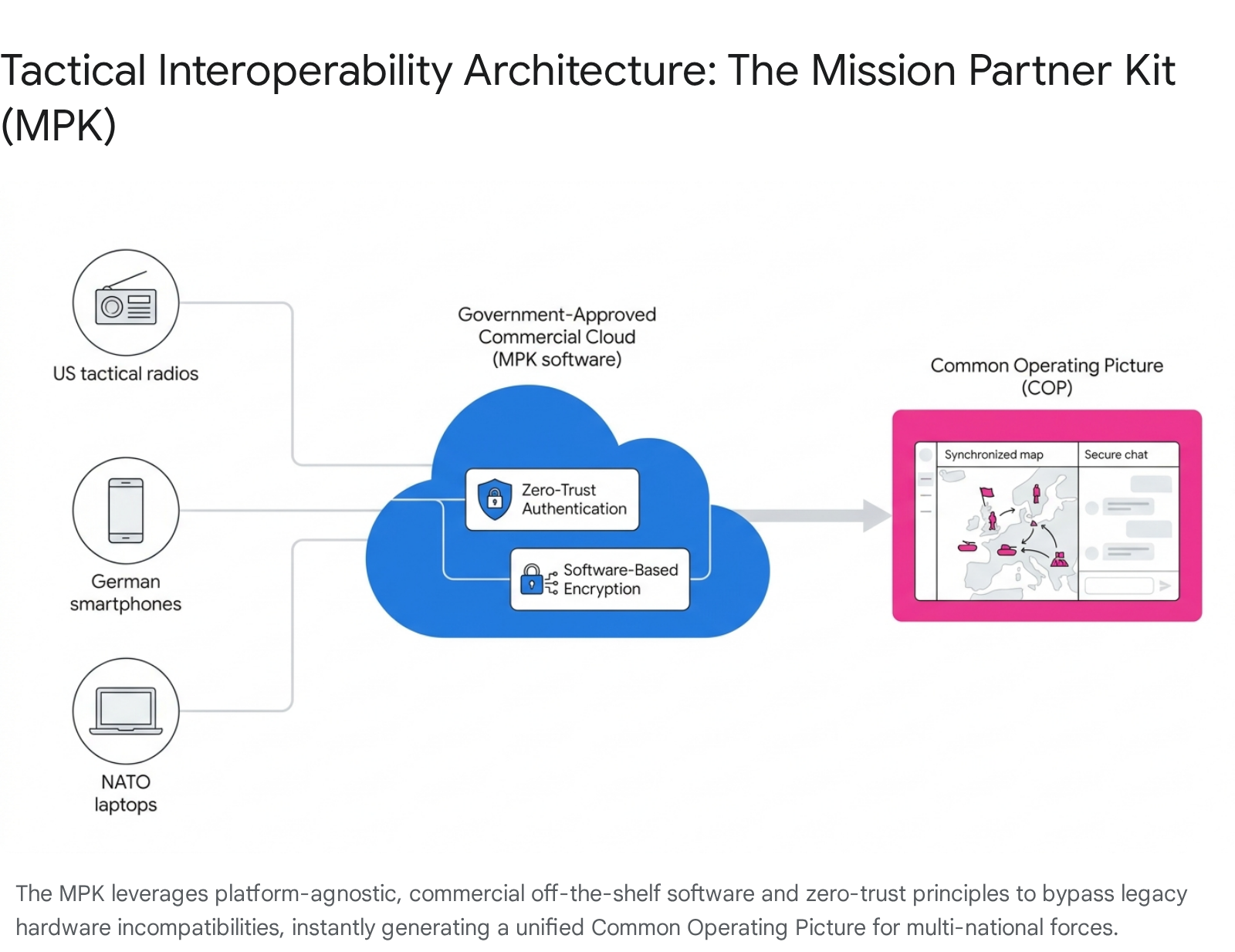
The MPK is entirely software-centric and platform-agnostic, leveraging COTS applications built upon the Army’s Nett Warrior foundation.59 Hosted in government-approved commercial clouds and secured via zero-trust cybersecurity principles and software-based encryption, it completely circumvents the need for specialized, ITAR-restricted hardware encryption devices.59
By allowing multinational partners to access applications via simple quick response (QR) codes on any mobile device—or by allowing US units to issue pre-loaded commercial smartphones to allies lacking compatible tech—the MPK instantly brings allied forces onto a synchronized Common Operating Picture (COP).59 Tested successfully during major NATO exercises like Griffin Shock 23 and Saber Strike 24, the MPK allowed German battalion leaders to report operational data and checkpoint crossings to US headquarters in real-time, completely bypassing traditional technical and cryptographic barriers that historically plagued joint exercises.59
9. Platform Standardization: STANAG 4586 and the Modular Open Systems Approach (MOSA)
To ensure that the physical drone platforms acquired by the DoD can integrate into these tactical and strategic networks, strict adherence to engineering standards is required. The aerospace market’s gradual transition from closed, proprietary, monolithic systems to open architectures is vital for multi-domain operations.61
9.1 NATO STANAG 4586
For unmanned aerial vehicles specifically, interoperability relies heavily on standardization agreements. STANAG 4586 establishes the standard interfaces for UAV Control Systems (UCS) within NATO.61 It defines critical architectural elements, specifically the Vehicle Specific Module (VSM) and the Data Link Interface (DLI).62 The DLI provides a common set of messages and formats to enable communication between a variety of air vehicles and compliant control systems.64 Ensuring compliance with STANAG 4586 means that a control station operated by one NATO nation can effectively communicate with, task, and operate a drone manufactured by another, breaking down the siloed procurement models of the past.61
9.2 The Modular Open Systems Approach (MOSA)
This philosophy of open architecture is broadly encapsulated in the DoD’s mandate for a Modular Open Systems Approach (MOSA).65 Mandated by Title 10 U.S.C. 4401(b) for all major defense acquisition programs, MOSA dictates that systems be designed using modular interfaces between major components.66 By adhering to widely supported, consensus-based standards—such as Open Mission Systems (OMS) for aviation, the Future Airborne Capability Environment (FACE) for software, and the C5ISR/EW Modular Open Suite of Standards (CMOSS)—MOSA ensures that sensors, communications payloads, and flight control software are severable.66
| MOSA Standard Profile | Primary Application / Domain | Strategic Benefit for Drone Interoperability |
| OMS (Open Mission Systems) | Military aviation weapons systems, services, and subsystems.67 | Allows rapid integration of allied or third-party targeting algorithms into US drone avionics without OEM interference. |
| FACE (Future Airborne Capability Environment) | Aircraft systems software architecture.67 | Ensures flight control and autonomous software is portable across different multi-national hardware platforms. |
| CMOSS (C5ISR/EW Modular Open Suite of Standards) | Broad electronic hardware, integrating FACE, VPX, and VICTORY.67 | Standardizes the physical and digital interfaces for intelligence and electronic warfare payloads, simplifying coalition upgrades. |
| MORA (Modular Open RF Architecture) | Maximizing radio frequency capabilities and flexibility.67 | Enables agile integration of various allied communication links (e.g., MANET radios) into a single UAS platform. |
Embracing MOSA prevents vendor lock-in, reduces total lifecycle costs, and facilitates continuous technology refresh.65 Crucially for interoperability, a MOSA-compliant drone allows the Department of Defense to strip out a proprietary US communications module and replace it with an allied nation’s sovereign radio system, or upgrade a targeting sensor without requiring a total system redesign.68 The operational flexibility to configure available assets to meet rapidly changing, multi-national operational requirements is a direct result of strict MOSA enforcement.68
10. Strategic Directives for Department of Defense Leadership
The tendency of American defense planning to fixate on the technological specifications of the platform itself—speed, payload capacity, and autonomous swarming capability—ignores the stark reality that a drone is only as lethal and effective as the network it inhabits. The Department of Defense cannot achieve unified warfighter operations within a multi-national coalition through raw procurement scale alone; it requires deliberate, mandated integration frameworks established and enforced from the highest levels of leadership.
The planned expenditure of over $70 billion on drone warfare, alongside rapid procurement mechanisms like the Drone Dominance Program and Replicator, represents a decisive commitment to modernizing the force.1 However, as the logistical and procedural friction of previous INDOPACOM experiments demonstrates, pushing programs rapidly through the acquisition system is vastly easier than employing them effectively alongside allies in combat.8
To overcome the systemic hurdles of cryptographic standards, cross-domain data sharing, and export control friction, DoD leadership must aggressively pursue the following strategic directives:
1. Mandate Data-Centric Security Across All Acquisitions: The era of network-centric “high castle wall” security is incompatible with coalition warfare. Leadership must ensure that all newly acquired unmanned systems and C2 software integrate natively with data-centric models like SABRE and the Mission Partner Environment (MPE).28 The ability to apply zero-trust authentication and tag individual ISR data objects for releaseability must be written into the base requirements of the Replicator initiative.4 Without this, the United States will field hundreds of thousands of drones that are technically incapable of sharing sensor data with the allies fighting alongside them.
2. Default to Commercial Solutions for Classified (CSfC): To ensure allied forces can plug into the tactical network, leadership must shift away from the reflexive use of highly restrictive, bespoke Type 1 encryption hardware for attritable edge devices.14 Embracing CSfC frameworks that utilize dual-layered software encryption (such as MACsec and IPsec) allows for the deployment of advanced MANET networks on commercial hardware.13 This provides the agility required to securely connect disparate forces in contested environments without the untenable logistical burdens and export restrictions of legacy classified equipment.14
3. Standardize Joint Interoperability Frameworks: Agreements such as the US/UK Joint Declaration of Intent to establish common data standards for C-UAS technologies, driven by Joint Interagency Task Force 401 (JIATF-401), must become the default operational standard rather than exceptional milestones.70 The integration of diverse capabilities is heavily hindered by incompatible data formats; by mandating that vendors comply with joint data standards to participate in defense marketplaces, the DoD forces the industry to build interoperability natively.70 Furthermore, compliance with NATO STANAG 4586 for control system interfaces must be rigorously enforced to prevent closed, proprietary ecosystems from fracturing the alliance.61
4. Fully Operationalize MOSA Requirements: The Modular Open Systems Approach must transition from a theoretical preference to an absolute contractual necessity in all drone procurements.66 Leadership must utilize legal frameworks and acquisition strategies to ensure that all drone platforms utilize severable, modular architectures with open interfaces like FACE and CMOSS.65 This allows for the rapid integration of third-party software—including allied targeting algorithms or sovereign communications protocols—without requiring total system redesigns by the original manufacturer.68
5. Aggressively Pursue Export Control Modernization: While the recent MTCR reinterpretation and the AUKUS ITAR exemptions are vital steps forward, they must be rigorously implemented and expanded.40 Leadership must work closely with the Directorate of Defense Trade Controls (DDTC) to establish clearer guidelines for the export of AI-driven autonomy software.46 If the algorithmic layers of drones remain trapped behind impenetrable ITAR defense-service firewalls, true collaborative swarming and co-development with coalition partners will remain impossible.46
The defining metric of success for the United States’ unmanned systems strategy will not be the raw number of attritable platforms fielded by 2027. Rather, success will be measured by the speed, security, and interoperability of the network connecting them. It will be defined by the latency with which a US autonomous sensor can detect a threat, process the targeting data through a Cross Domain Solution, navigate ITAR releaseability protocols via SABRE, and securely transmit firing coordinates to an allied strike asset. By pivoting strategic focus from the platform to the network—enforcing data-centric architectures, prioritizing CSfC and MOSA frameworks, and dismantling antiquated export constraints—the Department of Defense can ensure that its massive investments yield a truly unified, interoperable, and overwhelmingly lethal coalition force.
Please share the link on Facebook, Forums, with colleagues, etc. Your support is much appreciated and if you have any feedback, please email us in**@*********ps.com. If you’d like to request a report or order a reprint, please click here for the corresponding page to open in new tab.
Sources Used
- DOD moves to make its largest-ever investment in drones and anti-drone weapons, accessed April 24, 2026, https://defensescoop.com/2026/04/21/dod-plans-largest-ever-investment-drones-anti-drone-weapons/
- Drone Dominance Program Begins With 25 U.S. and Allied Vendors, accessed April 24, 2026, https://botsanddrones.co/news/f/drone-dominance-program-begins-with-25-us-and-allied-vendors
- Unleashing U.S. Military Drone Dominance: What the United States Can Learn from Ukraine, accessed April 24, 2026, https://www.csis.org/analysis/unleashing-us-military-drone-dominance-what-united-states-can-learn-ukraine
- Deep Dive: Pentagon’s Replicator Initiative Raises Questions | Inkstick, accessed April 24, 2026, https://inkstickmedia.com/deep-dive-pentagons-replicator-initiative-raises-questions/
- Is Replicator Replicable? | The Belfer Center for Science and International Affairs, accessed April 24, 2026, https://www.belfercenter.org/research-analysis/replicator-replicable
- Fact Sheet: DoD Strategy for Countering Unmanned Systems – Department of War, accessed April 24, 2026, https://media.defense.gov/2024/Dec/05/2003599149/-1/-1/0/FACT-SHEET-STRATEGY-FOR-COUNTERING-UNMANNED-SYSTEMS.PDF
- Replicator: A Bold New Path for DoD | Center for Security and Emerging Technology %, accessed April 24, 2026, https://cset.georgetown.edu/article/replicator-a-bold-new-path-for-dod/
- Replicator Initiative Continues Unmanned System Development | Federal Budget IQ, accessed April 24, 2026, https://federalbudgetiq.com/insights/replicator-initiative-continues-unmanned-system-development/
- NATO’s role in defence industry production, accessed April 24, 2026, https://www.nato.int/en/what-we-do/deterrence-and-defence/natos-role-in-defence-industry-production
- Measuring Interoperability Within NATO: Adapted Off-the-Shelf Tool or Bespoke Solution?, accessed April 24, 2026, https://publications.armywarcollege.edu/News/Display/Article/4129346/measuring-interoperability-within-nato-adapted-off-the-shelf-tool-or-bespoke-so/
- Air Defense Integration and Interoperability Challenges within the NATO Alliance – DTIC, accessed April 24, 2026, https://apps.dtic.mil/sti/pdfs/AD1162310.pdf
- Interoperability: Winning Happens in the Off-Season – The Imperative for Warfighting Success in a Coalition Warfighter Exercise | Small Wars Journal by Arizona State University, accessed April 24, 2026, https://smallwarsjournal.com/2025/11/19/interoperability-warfighter-exercises/
- NSA Approves Wave Relay Devices for Securing Classified Information, accessed April 24, 2026, https://www.afcea.org/signal-media/cyber-edge/nsa-approves-wave-relay-devices-securing-classified-information
- UXS Authentication and Key Exchange Requirements for Multidomain Operation and Joint Interoperability – DTIC, accessed April 24, 2026, https://apps.dtic.mil/sti/trecms/pdf/AD1185016.pdf
- COMMERCIAL SOLUTIONS for CLASSIFIED (CSfC) Data-at-Rest Capability Package 5.1.0 Draft 1.0 – National Security Agency, accessed April 24, 2026, https://www.nsa.gov/Portals/75/(U)%20Data-at-Rest%20CP%20v5_1%20Draft%201_0.pdf?ver=5imAoljF7WynEopBPpKOxQ%3D%3D
- Sponsored: NSA Type 1 Products vs. Commercial Solutions for Classified (CSfC), accessed April 24, 2026, https://www.afcea.org/signal-media/cyber/sponsored-nsa-type-1-products-vs-commercial-solutions-classified-csfc
- Wave Relay Devices Receive NSA Approval for Classified Communications | UST, accessed April 24, 2026, https://www.unmannedsystemstechnology.com/2025/06/wave-relay-devices-receive-nsa-approval-for-classified-communications/
- Commercial Solutions for Classified Program (CSfC) – National Security Agency, accessed April 24, 2026, https://www.nsa.gov/resources/Commercial-Solutions-for-Classified-Program/
- Commercial Solutions for Classified Program – Overview – National Security Agency, accessed April 24, 2026, https://www.nsa.gov/Resources/Commercial-Solutions-for-Classified-Program/Overview/
- CSfC vs Type 1 Encryption: An Overview – Crystal Group, accessed April 24, 2026, https://www.crystalrugged.com/knowledge/csfc-vs-type-1-encryption/
- Cross-Platform Drone Training: Prepare Now for Multi-Domain Operations, accessed April 24, 2026, https://www.autonomyglobal.co/cross-platform-drone-training-prepare-now-for-multi-domain-operations/
- Multi-Domain Situational Awareness | L3Harris® Fast. Forward., accessed April 24, 2026, https://www.l3harris.com/all-capabilities/multi-domain-situational-awareness
- From Silos to Systems: Why America’s Transportation Future Demands a Cross Domain Digital Infrastructure Strategy | Commercial UAV News, accessed April 24, 2026, https://www.commercialuavnews.com/from-silos-to-systems-cross-domain-digital-infrastructure-transportation
- Defense Dept. Still Lacks Unified CJADC2 Framework, GAO Finds, accessed April 24, 2026, https://www.nationaldefensemagazine.org/articles/2025/4/8/defense-dept-still-lacks-unified-cjadc2-framework-gao-finds
- Pentagon Delivers ‘Minimum Viable’ CJADC2 Capabilities – MeriTalk, accessed April 24, 2026, https://www.meritalk.com/articles/pentagon-delivers-minimum-viable-cjadc2-capabilities/
- GAO-25-106454, DEFENSE COMMAND AND CONTROL : Further Progress Hinges on Establishing a Comprehensive Framework, accessed April 24, 2026, https://files.gao.gov/reports/GAO-25-106454/index.html
- Hicks Announces Delivery of Initial CJADC2 Capability – Department of War, accessed April 24, 2026, https://www.war.gov/News/News-Stories/Article/Article/3683482/hicks-announces-delivery-of-initial-cjadc2-capability/
- Project Olympus Forges Critical Digital Pathways to Enable …, accessed April 24, 2026, https://www.war.gov/News/News-Stories/Article/Article/3981139/project-olympus-forges-critical-digital-pathways-to-enable-interoperability/
- Data-Centricity for Global Mission Collaboration – Booz Allen, accessed April 24, 2026, https://www.boozallen.com/insights/jadc2/going-data-centric-for-global-mission-collaboration.html
- Modernizing DOD–Coalition Information Sharing for JADC2 Warfare – SAIC, accessed April 24, 2026, https://www.saic.com/perspectives/jadc2/modernizing-dod-coalition-information-sharing-for-jadc2-warfare
- Mission Partner Environment Cuts Decision Making, Kill Chain – Department of War, accessed April 24, 2026, https://www.war.gov/News/News-Stories/Article/Article/2854238/mission-partner-environment-cuts-decision-making-kill-chain/
- FAQ For Cross Domain Solutions – General Dynamics Mission Systems, accessed April 24, 2026, https://gdmissionsystems.com/cross-domain-solutions/faqs
- Cross Domain Solutions: DoD-Approved CDS, TACDS & Hardware Suppliers, accessed April 24, 2026, https://www.defenseadvancement.com/suppliers/cross-domain-solutions/
- How to Secure ISR Data Sharing for Multi-Domain Operations – Everfox, accessed April 24, 2026, https://www.everfox.com/blog/cross-domain-solutions/how-to-secure-isr-data-sharing-for-multi-domain-operations
- SABRE military software tool approaching initial operational capability – DefenseScoop, accessed April 24, 2026, https://defensescoop.com/2022/04/27/sabre-military-software-tool-approaching-initial-operational-capability%EF%BF%BC/
- Secret and Below Releasable Environment (SABRE) IT Integration Service Request For Information (RFI) – SAM.gov, accessed April 24, 2026, https://sam.gov/opp/10eba1801c234ced888af0265b6abd0f/view
- Secret and Below Releasable Environment (SABRE) – NCSI, accessed April 24, 2026, https://www.ncsi.com/wp-content/uploads/2021/02/Mr.-Grasse-.pdf
- Capstone 2025: Advancing AI for C2, dynamic targeting, coalition integration – USAF, accessed April 24, 2026, https://www.af.mil/News/Article-Display/Article/4363112/capstone-2025-advancing-ai-for-c2-dynamic-targeting-coalition-integration/
- MTCR Guidelines, accessed April 24, 2026, https://www.mtcr.info/en/mtcr-guidelines
- Missile Technology Control Regime Reform: Key Changes and Next …, accessed April 24, 2026, https://aerospace.csis.org/missile-technology-control-regime-reform-key-changes-and-next-steps/
- U.S. Reinterprets MTCR Rules to Fast Track Drone Sales | Arms Control Association, accessed April 24, 2026, https://www.armscontrol.org/act/2025-10/news/us-reinterprets-mtcr-rules-fast-track-drone-sales
- UAVs and ITAR: Why Range Matters – Wiggin and Dana LLP, accessed April 24, 2026, https://www.wiggin.com/publication/uavs-and-itar-why-range-matters/
- U.S. Department of State Eases Military Drone Export Review Policy | Blank Rome LLP, accessed April 24, 2026, https://www.blankrome.com/publications/us-department-state-eases-military-drone-export-review-policy
- Drone Export Policy Reset: Faster Allies’ Adoption – eMerge Americas, accessed April 24, 2026, https://emergeamericas.com/us-drone-export-policy-reset-2025/
- Drone Guidance – UTA Faculty & Staff Resources, accessed April 24, 2026, https://resources.uta.edu/research/regulatory-services/export-control/drone-guidance.php
- ITAR & AI-Enabled Defense Technologies: Autonomous Systems, Targeting Algorithms, and the New Export-Control Frontier – International Law Services, accessed April 24, 2026, https://frilinglaw.com/tr/blog/itar-ai-defense-technologies
- ITAR Certified UAV and Drone Manufacturing | Protolabs, accessed April 24, 2026, https://www.protolabs.com/resources/blog/how-to-accelerate-defense-uav-prototyping-under-itar-constraints/
- ITAR § 126.7 Exemption for Australia and the UK – DDTC, accessed April 24, 2026, https://www.pmddtc.state.gov/ddtc_public?id=ddtc_kb_article_page&sys_id=aed45e8b9702b2d067b1791ad053af7b
- International Traffic in Arms Regulations: Exemption for Defense Trade and Cooperation Among Australia, the United Kingdom, and the United States – Federal Register, accessed April 24, 2026, https://www.federalregister.gov/documents/2025/12/30/2025-23998/international-traffic-in-arms-regulations-exemption-for-defense-trade-and-cooperation-among
- On the third AUKUS anniversary, a toast to ITAR reform and a call to keep going, accessed April 24, 2026, https://www.atlanticcouncil.org/blogs/new-atlanticist/on-the-third-aukus-anniversary-a-toast-to-itar-reform-and-a-call-to-keep-going/
- Aerospace Industries Association Comments On The Proposed Rule Entitled “International Traffic in Arms Regulations: Exemption, accessed April 24, 2026, https://www.aia-aerospace.org/wp-content/uploads/AIA_AUKUS-ITAR-Exemption-Comments-5.31.2024-FINAL-1.pdf
- Unmanned Aircraft Vehicles and Systems | FIU Export Control, accessed April 24, 2026, https://exportcontrol.fiu.edu/export/topics/unmanned-and-autonomous-vehicles/
- Advancing Modelling and Simulation in NATO Federated Mission Networking, accessed April 24, 2026, https://www.sto.nato.int/document/advancing-modelling-and-simulation-in-nato-federated-mission-networking/
- History of Federated Mission Networking (FMN) Development – Base Camp Connect, accessed April 24, 2026, https://basecampconnect.com/history-federated-mission-networking-fmn/
- Federated Mission Network Preparing for Sweden – Issuu, accessed April 24, 2026, https://issuu.com/globalmediapartners/docs/nitech8/s/17732020
- Ensuring Cyber Resilience in NATO’s Command, Control and Communication Systems, accessed April 24, 2026, https://www.chathamhouse.org/2020/07/ensuring-cyber-resilience-natos-command-control-and-communication-systems-0/3-nuclear
- Overcoming the Challenges of Federated Mission Networking – Base Camp Connect, accessed April 24, 2026, https://basecampconnect.com/overcoming-the-challenges-of-federated-mission-networking/
- Mission Networks Require Service Management – AFCEA International, accessed April 24, 2026, https://www.afcea.org/signal-media/cyber-edge/mission-networks-require-service-management
- Mission Partner Kit: Advancing Multinational Interoperability with …, accessed April 24, 2026, https://www.army.mil/article/283999/mission_partner_kit_advancing_multinational_interoperability_with_nato_allies
- Mission Partner Kit: Advancing Multinational Interoperability with NATO Allies, accessed April 24, 2026, https://www.lineofdeparture.army.mil/Journals/Infantry/Infantry-Archive/Spring-2025/Mission-Partner-Kit/
- Interoperability and STANAG 4586 In Flight Control Systems By UAV Navigation-Grupo Oesía, accessed April 24, 2026, https://www.uavnavigation.com/company/blog/interoperability-and-stanag-4586-flight-control-systems-uav-navigation-grupo-oesia
- STANAG 4586–Standard Interfaces of UCS for NATO UAV Interoperability, accessed April 24, 2026, https://publications.sto.nato.int/publications/STO%20Educational%20Notes/STO-EN-SCI-271/EN-SCI-271-03.pdf
- STANAG 4586: UAV Control System Standards | PDF | Unmanned Aerial Vehicle – Scribd, accessed April 24, 2026, https://www.scribd.com/document/814956193/4586eed3draft
- nato unclassified – InnUVative Systems, accessed April 24, 2026, http://www.innuvativesystems.com/STANAG4586Eed02a2_PubliclyReleased.pdf
- MOSA | NAVAIR, accessed April 24, 2026, https://www.navair.navy.mil/MOSA
- Modular Open Systems Approach (MOSA) – Defense Standardization Program, accessed April 24, 2026, https://www.dsp.dla.mil/Programs/MOSA/
- What is MOSA? – BAE Systems, accessed April 24, 2026, https://www.baesystems.com/en-us/definition/what-is-mosa
- Modular Open Systems Approach – DoW Research & Engineering, OUSW(R&E), accessed April 24, 2026, https://www.cto.mil/sea/mosa/
- Modular open systems: The future of flight for the U.S. Army | Collins Aerospace – RTX, accessed April 24, 2026, https://www.rtx.com/collinsaerospace/news/stories/2024/10/modular-open-systems-the-future-of-flight-for-the-us-army
- US, UK set joint counter-drone technology standards | Article | The United States Army, accessed April 24, 2026, https://www.army.mil/article/290973/us_uk_set_joint_counter_drone_technology_standards
- JIATF 401 Publishes New Guidance for Physical Protection of Critical Infrastructure, accessed April 24, 2026, https://www.war.gov/News/Releases/Release/Article/4394552/jiatf-401-publishes-new-guidance-for-physical-protection-of-critical-infrastruc/