Executive Summary
The character of modern warfare has undergone a structural transformation, driven by the rapid maturation and proliferation of unmanned aerial systems. By 2026, the military drone sector is no longer a niche domain reserved for high-end intelligence, surveillance, and reconnaissance operations. Instead, it has evolved into a central pillar of global defense strategy, fundamentally altering the economics of combat, force generation, and deterrence. World military expenditure reached $2.7 trillion in 2024, representing a 9.4 percent year-on-year increase, with an estimated global military burden of 2.5 percent of world gross domestic product.1 Within this expanding financial envelope, the global drone market is forecast to reach $209.91 billion by 2025 and continue its upward trajectory, fueled by urgent procurement signals and shifting tactical doctrines.1
This report provides an objective analysis of the top ten nations leading the military application of drone technology in 2026. The ranking methodology departs from traditional assessments that prioritize exquisite, high-cost platforms. Instead, it embraces a multidimensional framework that weighs theoretical doctrine, research and development investment, and demonstrated battlefield outcomes. As recent conflicts in Eastern Europe and the Middle East have proven, a higher unit cost does not equate to superior capability. Operational success is increasingly dictated by cost-imposition ratios, replacement speed, and the ability to field attritable mass alongside intelligent, autonomous swarms.
The United States retains the top position through sheer investment scale and its recent operational successes in Operation Epic Fury, leveraging both high-end platforms and low-cost swarm technologies.4 Ukraine occupies the second position, having practically rewritten the doctrine of unmanned warfare through its mastery of attrition economics and high-volume interceptor production.6 Russia and China follow closely, leveraging massive industrial capacity and rapid physical integration of artificial intelligence.8 Iran, despite recent strategic setbacks, remains a critical force due to its pioneering of low-cost, highly effective loitering munitions.10 The latter half of the ranking includes Turkey, South Korea, India, Taiwan, and Poland, each demonstrating highly specialized approaches to unmanned systems, ranging from drone training initiatives for half a million troops to sophisticated multi-layered anti-drone defense networks.12
The analysis underscores a critical strategic reality, which is that the exposed human warfighter is operating at a growing economic disadvantage relative to low-cost, rapidly replaceable machine systems.15 Future military dominance will belong to nations that can successfully integrate advanced artificial intelligence, secure robust supply chains, and master the brutal economics of sustained attrition.
1.0 Theoretical Frameworks of Modern Drone Warfare
To accurately assess and rank national drone capabilities, it is necessary to establish the theoretical frameworks governing modern unmanned combat. The proliferation of cheap, precise drones has challenged traditional principles of force concentration and maneuverability, requiring a reassessment of how militaries achieve mass and saturation effects.16 The fundamentals of land warfare rely on holding and occupying territory, an endeavor that centers of gravity traditionally placed on armies and capitals.17 However, the methods of protecting or attacking these centers have fundamentally shifted.
1.1 Attrition Economics and the Cost-Imposition Asymmetry
Recent global conflicts have demonstrated a structural inversion in the economics of warfare. Historically, military effectiveness was closely tied to platform sophistication and the extensive training of the human operator. In 2026, the battlefield is increasingly governed by logistics, replacement dynamics, and cost asymmetry.15
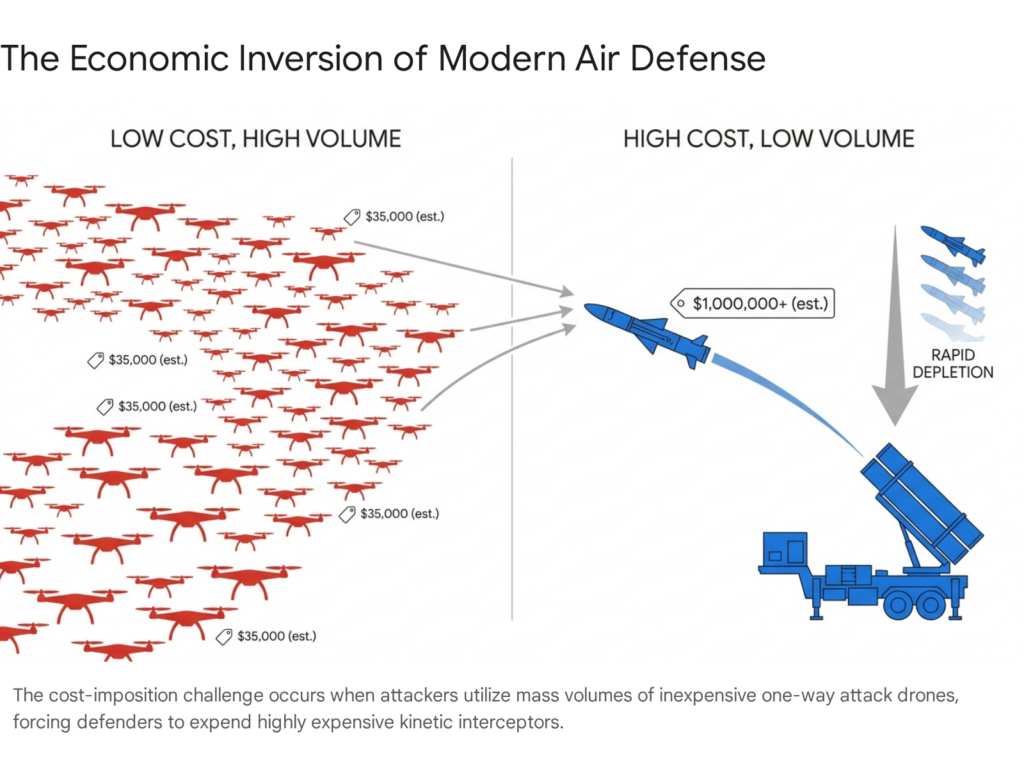
The concept of attrition economics centers on the cost-exchange ratio between an offensive weapon and the defensive countermeasure required to defeat it. In several recent theaters, low-cost unmanned aerial systems have successfully targeted air defense networks worth millions of dollars, creating an unsustainable cost-imposition challenge for advanced military forces.6 The production cost of an Iranian Shahed-136 one-way attack drone is estimated at $20,000 to $35,000.6 When defending nations utilize traditional kinetic interceptors, such as the Patriot missile system which costs over $1 million per shot, the economic advantage shifts decisively to the attacker.6 This asymmetry is a deliberate strategy. By launching large numbers of inexpensive drones alongside more advanced weapons, attackers force defenders to expend costly interceptors and draw down stockpiles that cannot be replenished quickly.18
This dynamic is further explained by Jevons’s Paradox, which posits that as technological progress increases the efficiency with which a resource is used, the rate of consumption of that resource rises due to increasing demand.16 In military terms, as precision strike capabilities become cheaper and more efficient through drone technology, their usage proliferates exponentially, demanding an unprecedented mass of production. Simultaneously, the Red Queen Effect dictates that adversaries must constantly adapt just to maintain parity, leading to rapid cycles of countermeasure and counter-countermeasure development.16 Lanchester’s Laws and Hughes’s Salvo Equations further illustrate how numerical superiority in a salvo of autonomous weapons will predictably overwhelm a technologically superior but numerically inferior defense system.16 In environments characterized by sustained attrition, the human warfighter becomes economically non-viable in the highest-attrition exposure layers, accelerating the push toward attritable unmanned platforms.15
1.2 Intelligentized Warfare and Artificial Intelligence Integration
While attrition economics favors cheap mass, the concept of intelligentized warfare focuses on maximizing the effectiveness of those assets through artificial intelligence and autonomous networking. Intelligentized warfare is a concept deeply embedded in modern defense white papers, envisioning combat where artificial intelligence enables machine-speed decision-making, target recognition, and swarm coordination.19
The integration of artificial intelligence addresses the primary vulnerabilities of remotely piloted systems, specifically their reliance on continuous data links and global navigation satellite systems. In heavily contested electronic warfare environments, traditional command links are routinely jammed. Next-generation platforms mitigate this through onboard edge computing, visual terrain navigation, and algorithmic swarm logic.20 Furthermore, artificial intelligence enables the shift from a single-operator paradigm to a framework where one soldier manages a coordinated swarm of hundreds of autonomous vehicles.19 This intelligent synergy allows platforms to split into sub-swarms, dynamically assign targets, and maintain formation without human intervention, thereby exponentially increasing the lethality of a strike package.21
2.0 Evaluation Methodology
The ranking of the top ten nations in military drone usage relies on a strict methodology designed to look past pure procurement numbers and theoretical unit costs. Better capability is evaluated as a judgment based on total system cost relative to targets destroyed, overall effectiveness, resilience in contested environments, and the ability to scale operations rapidly under pressure. The evaluation utilizes three primary dimensions.
The first dimension is the Theoretical Foundation and Doctrine of the assessed nation. This evaluates how deeply a nation has integrated unmanned systems into its core military strategy, assessing whether drones are treated as auxiliary assets or as central components of combined arms operations and force structure.
The second dimension is the Investment in Research and Development. This metric analyzes capital expenditure and institutional focus on next-generation capabilities, specifically artificial intelligence, swarm networking, domestic industrial base expansion, and the development of cost-effective platforms designed for mass production.
The third dimension relies on Demonstrated Operational Outcomes. This measures actual battlefield performance utilizing open-source intelligence. Key metrics include verified kill-to-loss ratios, success in cost-imposition strategies, and the ability to rapidly iterate countermeasures in response to adversary adaptations in active theaters of conflict.
The detailed data points for these criteria were sourced from national defense budgets, operational reports from conflicts such as the war in Ukraine and Operation Epic Fury, and authoritative defense industry analysis updated through April 2026. A detailed breakdown of the source parameters and analytical frameworks is located in the Appendix of this report.
3.0 Summary Ranking of the Top 10 Nations
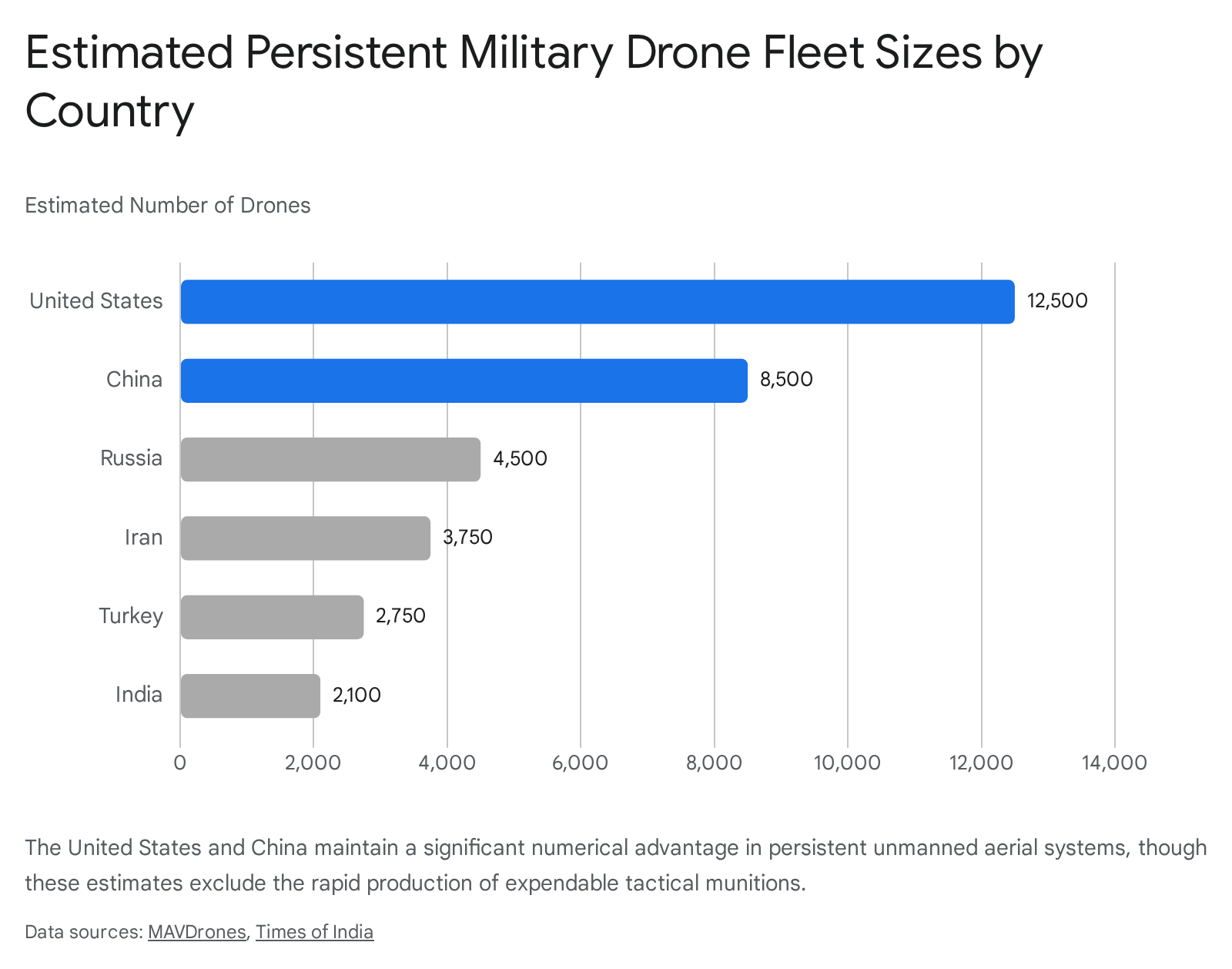
The following table summarizes the top ten countries leading the global application of military drone technology, highlighting their estimated inventory scale and primary doctrinal focus. These estimates account for persistent operational fleets but do not fully capture the rapid churn rate of highly expendable tactical munitions utilized on active frontlines.
| Rank | Country | Estimated Unmanned Fleet Size | Primary Doctrinal Focus | Key Platforms and Initiatives |
| 1 | United States | 12,000 to 13,000 | High-end ISR, Attritable Mass, AI Integration | MQ-9A Reaper, Switchblade 600, LUCAS, Replicator |
| 2 | Ukraine | 1,500 to 2,000 (Excludes millions of expendables) | Attrition Economics, High-Volume Domestic Production | Magura-7, Interceptor Drones, FPV Dominance |
| 3 | Russia | 4,000 to 5,000 | Mass Scale, Deep Strike, Decoy Operations | Shahed/Geran-2, Lancet-3, Molniya |
| 4 | China | 8,000 to 9,000 | Export Dominance, Intelligentized Warfare | Wing Loong II/III, Swarm AI |
| 5 | Islamic Republic of Iran | 3,500 to 4,000 | Asymmetric Cost-Imposition, Regional Proliferation | Shahed 131/136 |
| 6 | Turkey | 2,500 to 3,000 | Cost-Effective Strike, GNSS-Denied Swarms | Baykar K2, STM Kargu, TB2/TB3 |
| 7 | South Korea | 800 to 1,000 (Targeting 60,000) | Mass Infantry Training, Border Surveillance | 500k Drone Warrior Initiative, LIG Nex1 Swarms |
| 8 | India | 2,000 to 2,200 | Border Monitoring, Collaborative Swarms | Shield AI V-BAT, Sheshnaag-150 |
| 9 | Taiwan (ROC) | Rapidly Growing | Multi-Layered Defense, Porcupine Strategy | T-Dome Network, Chien Hsiang |
| 10 | Poland | 1,000 to 1,200 | Eastern Border Security, Rapid Procurement | EU SAFE Anti-Drone Wall |
4.0 Detailed Country Analysis and Justification
4.1 United States
The United States secures the top ranking through an unmatched combination of legacy high-end platforms, massive capital allocation for future autonomy, and recent operational validation of its shifting doctrines. Recognizing the need to balance exquisite platforms with attritable mass, the Department of Defense requested a $13.4 billion autonomy line in its fiscal year 2026 budget.1 This funding includes $9.4 billion specifically allocated for unmanned and remotely operated aerial vehicles, alongside a $3.1 billion request for counter-unmanned aircraft system efforts.1 Furthermore, the United States Army allocated $803.9 million in the 2026 fiscal year to institutionalize small drones as standard equipment across its formations, allocating $747.9 million for procurement and $56 million for research and development.1 The Replicator initiative, designed to field large numbers of low-cost drones, received a $300 million reprogramming request in fiscal year 2023, $200 million in appropriations for 2024, and a $500 million request for 2025, although fielding thousands of systems has faced operational delays, resulting in only hundreds deployed by summer 2025.1
The United States continues to operate the world’s largest and most advanced legacy drone fleet, counting approximately 12,000 to 13,000 active persistent platforms.22 This fleet is anchored by systems like the General Atomics MQ-9A Reaper. The Reaper boasts an endurance of over 27 hours, a 50,000-foot operational altitude, and a payload capacity of 3,850 pounds, making it a premier intelligence collection and precision strike asset.24 It carries a fault-tolerant flight control system and is powered by a Honeywell TPE331-10 turboprop engine, delivering high performance and reliability.25 However, the cost dynamics of modern warfare have forced an evolution. During the 2026 Operation Epic Fury against Iran, the United States lost over a dozen MQ-9 Reapers, valued at $16 million each, highlighting the vulnerability of high-value assets in contested airspace.6
In response to these vulnerabilities, the United States demonstrated a profound strategic pivot during the same conflict. United States Central Command integrated hundreds of Low-cost Uncrewed Combat Attack Systems into offensive operations.5 These platforms, featuring autonomy, anti-jamming capabilities, and a unit cost under $55,000, proved highly effective in saturating enemy defenses.5 The success of Operation Epic Fury, which saw over 13,000 targets struck in just 38 days, relied heavily on this layered approach of high-end command platforms and low-cost attritable swarms.4 Additionally, the United States Army recently placed a $186 million order for AeroVironment’s Switchblade 600 Block 2 loitering munitions.27 This next-generation munition, capable of autonomous target recognition and boasting an extended endurance of over 50 minutes and a range exceeding 110 kilometers, confirms a firm commitment to long-range, anti-armor precision at the tactical edge.27
4.2 Ukraine
Ukraine ranks second due to its unprecedented role as the global laboratory for modern drone warfare. Lacking the massive defense budgets of global superpowers, Ukraine has achieved remarkable success through ruthless innovation and a mastery of attrition economics. The Ukrainian government allocated approximately $2.6 billion for drone procurement in 2025, aiming to purchase 4.5 million first-person view drones, an increase from 1.5 million purchased in 2024, with 96 percent sourced directly from domestic manufacturers.1 This massive domestic production scale ensures that the nation maintains operational persistence despite extreme battlefield attrition.
The operational outcomes are staggering. In March 2026, the Ukrainian armed forces reported that drones accounted for 96 percent of all Russian casualties, with a monthly total exceeding 35,000 casualties.29 The strategic integration of drones has allowed Ukraine to maintain a 1:5 kill-to-loss ratio against Russian forces, inflicting roughly 150 to 157 casualties per square kilometer captured by the adversary.7 The sheer volume of drone strikes, which constitute an estimated 80 to 90 percent of all successful target destructions, demonstrates a complete doctrinal shift toward unmanned mass.7
Ukraine has also excelled in developing low-cost countermeasures against asymmetric threats. Facing saturation attacks from Russian Shahed drones, Ukraine produced over 100,000 interceptor drones in 2025.6 Costing only $3,000 to $5,000 apiece, these interceptors rely on the tactic of manually ramming incoming threats, a method that accounts for downing one in three Russian aerial targets and vastly improving the economic exchange ratio compared to firing million-dollar Patriot missiles.6 The ingenuity of Ukrainian operators extends into the maritime and ground domains. Networked unmanned ground vehicles have transitioned from experimentation to active fielding for logistics and fire support missions, while AI-powered Magura-7 surface drones equipped with air-to-air missiles successfully recorded the world’s first shootdown of fighter aircraft, downing two Russian Sukhoi Su-30 jets over Novorossiysk and Crimea in May 2025.6 Ukraine’s decentralized communications model, utilizing dispersed radio nodes, further protects these operations from electronic jamming.30 This relentless, cost-effective innovation secures Ukraine’s position at the forefront of applied unmanned warfare.
4.3 Russia
Russia commands the third position driven by its immense industrial capacity, its deep integration of drone logistics, and its commitment to large-scale, deep-strike drone operations. While initially reliant on imports, Russia has aggressively localized its production capabilities, most notably at the Alabuga Special Economic Zone in the Republic of Tatarstan.9 This facility has undergone rapid expansion, featuring domed structures of 2,200 square meters and 900 square meters constructed specifically to shield manufacturing activities.32 This localized capacity is central to the domestic manufacturing of the Geran-2, a variant of the Iranian Shahed-136, enabling Russia to produce over 6,000 one-way attack drones in 2024, with goals to increase production significantly through 2025.9
Russia’s operational strategy heavily emphasizes cost-imposition and the exhaustion of adversary defenses. To maximize the economic drain on Ukrainian air defense systems, Russia has evolved its tactics to include a high percentage of decoys.33 Systems like the polystyrene and plywood Gerbera and Parodya decoys cost approximately $10,000 each and currently represent roughly 40 percent of all Russian drone launches.33 By mixing these decoys with armed Geran-2s in synchronized waves, Russian forces force defenders to expend scarce and expensive interceptors, acting as combat reconnaissance to pave the way for subsequent ballistic and cruise missile strikes.33 In April 2026, Russia launched a coordinated strike involving 324 drones and multiple Iskander-M ballistic missiles, underscoring this saturation strategy.35
On the tactical front, Russia has utilized the ZALA Lancet-3 loitering munition against high-value targets, requiring specialized operators and target designation from reconnaissance assets.36 However, the Lancet highlights the constraints of modern drone economics. Its $35,000 unit cost and the requirement for highly specialized operators have limited its scalable deployment compared to cheaper alternatives.31 Consequently, Russian forces have increasingly pivoted to cheaper alternatives like the Molniya strike drone to maintain mass on the frontlines.31 Despite challenges in high-tech component acquisition and personnel generation, Russia’s sheer volume of production and brutal application of attrition warfare keep it firmly near the top of the global hierarchy.
4.4 China
China ranks fourth, combining vast manufacturing supremacy with a highly focused strategy on intelligentized warfare and export dominance. Chinese policymakers approach artificial intelligence not merely as an auxiliary tool but as a general-purpose technology meant for deep physical integration across all military and civilian platforms.8 The nation operates a massive fleet of 8,000 to 9,000 estimated persistent drones.22 While open-source analysis suggests China maintains a cautious posture regarding achieving short-term overall parity with the United States in frontier artificial intelligence models, its military is aggressively testing autonomous swarm capabilities, demonstrating exercises where a single soldier manages 200 autonomous vehicles simultaneously.8 Furthermore, the Chinese navy has integrated artificial intelligence algorithms into guided-missile frigates like the Qinzhou to illuminate blind spots during air defense engagements.19
China’s influence is profoundly felt through its export of the Wing Loong series, developed by the Aviation Industry Corporation of China and the Chengdu Aircraft Design Institute.37 The Wing Loong II, a medium-altitude long-endurance platform with satellite link capability, has seen extensive use globally and has recently been deployed by the Chinese Coast Guard for maritime patrols.38 This deployment marks a critical escalation in projecting state power and utilizing advanced surveillance platforms for paramilitary operations in contested waters around Taiwan.39
The scope of China’s strategic ambitions was firmly underscored by a monumental $5 billion agreement signed in 2026 with Saudi Arabia’s General Authority for Military Industries.40 This deal establishes a full assembly line in Jeddah capable of producing 48 Wing Loong-3 unmanned combat aerial vehicles annually, shifting Riyadh’s procurement strategy amid regional conflict.40 The Wing Loong-3 is a massive platform capable of flying 10,000 kilometers with a maximum take-off weight of 6,200 kilograms, integrating intelligent recognition systems capable of locking onto targets in 0.3 seconds.41 This industrial partnership represents a significant transfer of technology, comprehensive training pipelines, and a calculated move by Beijing to embed its aerospace manufacturing capabilities within the strategic infrastructure of key regional powers, effectively altering the drone power balance in the Middle East.43
4.5 Islamic Republic of Iran
Iran occupies the fifth position, recognized primarily as the architect of the low-cost, high-impact drone warfare model that currently defines global conflict. The cornerstone of Iran’s influence is the Shahed series of loitering munitions, particularly the Shahed-136 and Shahed-131.9 Produced at an estimated unit cost of $20,000 to $35,000, these platforms lack the exquisite sensors and survivability of Western systems, but they compensate through sheer volume, simple pre-programmed navigation, and undeniable cost-effectiveness.6 The Shahed-136, carrying a 50-kilogram warhead, has forced militaries globally to rethink air defense architecture.33
Iran’s strategic doctrine leverages these platforms to project power asymmetrically, creating severe sustainment crises for adversaries forced to intercept them with multimillion-dollar munitions.18 This approach proved highly disruptive globally, fueled by extensive proliferation and technology transfers to state and non-state actors alike, including large-scale technology transfers to Russia for domestic Geran-2 production.9
However, Iran’s ranking reflects a recent and severe degradation of its domestic capabilities. During the 2026 Operation Epic Fury, coordinated strikes shattered Iran’s defense industrial base.4 Open-source reports indicate that over 10,200 total air sorties systematically dismantled more than two-thirds of Iran’s drone and missile production facilities.4 The campaign involved strikes on over 1,450 defense and industrial base targets and approximately 800 attack drone targets.4 Furthermore, United States and allied integrated air defense systems successfully intercepted over 1,000 incoming attack drones and 700 ballistic missiles during the 38-day conflict, achieving interception rates between 80 percent and 90 percent.4 While Iran’s theoretical model of attrition warfare remains highly influential, its physical capacity to generate and deploy mass has been critically compromised, halting its upward momentum in the global rankings.
4.6 Turkey
Turkey secures the sixth spot by successfully merging cost-effective manufacturing with cutting-edge artificial intelligence, creating highly exportable platforms that have proven decisive in multiple theaters. Operating a fleet of 2,500 to 3,000 drones, Turkish defense contractors, notably Baykar and STM, have pioneered the development of autonomous systems designed to operate in highly contested environments.22
In early 2026, STM announced the successful execution of Turkey’s first live-fire drone swarm attack using 20 KARGU rotary-wing loitering munitions.21 The KARGU swarm operated autonomously, utilizing distributed intelligence to navigate, split into sub-swarms, and strike targets simultaneously without reliance on global navigation satellite systems.21 The system features electronic warfare resistance and mission continuity algorithms despite attrition.21
Concurrently, Baykar unveiled the K2 Kamikaze unmanned aerial vehicle, a fixed-wing loitering munition with a range exceeding 2,000 kilometers, a 200-kilogram warhead, and a maximum take-off weight of 800 kilograms.20 During multi-sortie tests over the Gulf of Saros in March 2026, a swarm of five K2 platforms demonstrated advanced artificial intelligence synergy, executing complex formation flights alongside an AKINCI unmanned combat aerial vehicle.49 The K2 embodies Turkey’s strategic intent, which is to field high-impact platforms that deliver cruise missile-like effects at a fraction of the cost, utilizing terrain-referenced visual navigation to bypass severe electronic warfare jamming.20 Supported by the continued global demand for systems like the Bayraktar TB2 and the recent successful operational demonstration of the Bayraktar TB3 aboard the TCG ANADOLU during NATO’s Steadfast Dart 2026 exercise, Turkey maintains a highly robust and innovative drone industrial base.52
4.7 South Korea
South Korea is ranked seventh, driven by an urgent national mandate to integrate unmanned mass into its ground forces to counter regional asymmetric threats. Facing demographic challenges and a rapidly evolving threat landscape, the Ministry of National Defense approved a $44.7 billion defense budget, or 65.86 trillion Korean Won, for 2026, heavily emphasizing force modernization and the three-axis defense system.54
The cornerstone of South Korea’s strategy is the initiative to foster 500,000 drone warriors.14 This policy aims to embed drone operating skills across all ranks, ensuring that piloting an unmanned system becomes as routine as handling a standard-issue K2 rifle.56 To achieve this, the defense ministry expanded its training budget to $22 million, or 33 billion Korean Won, in 2026, facilitating the rapid procurement of 11,000 to 17,000 commercial training drones, with a goal of acquiring 60,000 units by 2029.55 The Republic of Korea Army’s 36th Infantry Division in Wonju serves as the central test bed for these pilot programs.14
Beyond mass infantry training, South Korean defense contractors are developing highly sophisticated platforms to enhance intelligence and strike capabilities. At the 2026 Drone Show Korea, LIG Nex1 showcased advanced artificial intelligence-driven swarm drones, the Block-I small unmanned aerial vehicle response system, and autonomous surface vehicles like the Sea Sword.59 The Block-I system acts as a soft-kill jammer capable of emitting signals to deviate paths or induce crashes of enemy drones.61 South Korea’s ranking reflects its aggressive, society-wide integration of drone technology, prioritizing rapid commercial acquisition to build an immediate, scalable capability.14
4.8 India
India holds the eighth position, characterized by a rapid acceleration in domestic innovation and the strategic procurement of advanced autonomous systems to secure its contested borders. Operating a fleet of 2,000 to 2,200 systems, the Indian military has recognized the necessity of bridging the capability gap with regional competitors by prioritizing cross-service integration and asymmetric tools.22 The Indian armed forces have integrated artificial intelligence across command-and-control systems, predictive maintenance, and targeting, ensuring that ultimate command responsibility remains with humans.62
The Indian Army has aggressively expanded its tactical footprint, establishing 19 dedicated drone training centers in 2026 and inaugurating a state-of-the-art laboratory at the Madras Regimental Centre.64 Operationally, India has demonstrated a commitment to kinetic and non-kinetic measures. Following the Pahalgam terror attack in 2025, India launched Operation Sindoor, a tri-services mission employing indigenous unmanned aerial systems to execute precision strikes on nine terrorist camps and neutralize enemy radar units.65 Additionally, India has advanced its collaborative swarm technology. In early 2026, startup Newspace Research Technologies successfully flight-tested the Sheshnaag-150, a long-range collaborative attack swarming system.66 Designed for saturation attacks, the Sheshnaag-150 boasts an operational range of over 1,000 kilometers, a five-hour endurance, and the ability to autonomously identify and engage targets with a 25 to 40 kilogram warhead, signifying a major leap in indigenous software development.66
Furthermore, India has bolstered its intelligence and surveillance capabilities through strategic international partnerships. In January 2026, India selected Shield AI to supply the Indian Army with V-BAT unmanned aircraft systems, uniquely integrating Shield AI’s Hivemind autonomy software.67 This allows Indian forces to deploy long-endurance platforms in contested environments without relying on runways or continuous communication links, essential for intelligence, surveillance, and reconnaissance operations in challenging terrains like the Himalayas.67
4.9 Taiwan (Republic of China)
Taiwan occupies the ninth rank, driven by an existential imperative to develop an asymmetric porcupine strategy against the overwhelming numerical superiority of the People’s Liberation Army. Recognizing that traditional air defense missiles could be rapidly depleted by millions of low-cost Chinese drone swarms, Taiwan is heavily investing in affordable interception methods and counter-drone measures.12
Central to this defense posture is the development of the T-Dome, a $32 billion integrated, multi-layered air defense network inspired by Israel’s Iron Dome and the United States’ Golden Dome.12 First announced in October 2025, the T-Dome aims to unify various defense assets, including incoming United States-supplied systems and domestic interception units, to detect, track, and intercept missiles, aircraft, and drones across multiple altitudes while ignoring harmless decoys.12
In the offensive and deterrent domain, the National Chung-Shan Institute of Science and Technology has developed the Chien Hsiang anti-radiation loitering munition.71 Measuring 1.2 meters long with a 2-meter wingspan, the Chien Hsiang has a loiter time of 100 hours, a top speed of 185 kilometers per hour, and a range of 1,000 kilometers.71 It is specifically designed to autonomously hunt and destroy enemy radar installations using an anti-radiation seeker, providing a critical deterrent capability against adversary air defense networks.71 The institute is also planning to develop low-cost munitions domestically to counter enemy rockets, with test flights expected soon.68 Taiwan’s approach illustrates how smaller nations must prioritize specialized, defensive unmanned integration over broad force projection.
4.10 Poland
Poland rounds out the top ten, distinguished by its massive and rapid capital deployment to secure its eastern borders following incursions by Russian unmanned systems.73 Operating a fleet of 1,000 to 1,200 systems, Poland does not possess the massive indigenous drone manufacturing base of a nation like Turkey, but its strategic positioning, integration with NATO standards, and purchasing power make it a formidable actor.22
In early 2026, the Polish government announced the allocation of a massive $51.6 billion loan via the European Union’s Security Action for Europe program, dedicating a significant portion to defense modernization between 2026 and 2030.13 The centerpiece of this effort is the San program, which aims to establish a comprehensive anti-drone wall along its borders to intercept cross-border drone activity.13 Utilizing the Kongsberg-PGZ consortium, Poland plans to deploy a dozen anti-drone batteries rapidly, with the first units scheduled to enter service as early as 2026 and the final battery expected by 2027.13 Poland is also balancing its maritime capabilities, evaluating the procurement of Swedish Saab A26 submarines under the Orka program, though debate continues over the exclusion of cruise missile armaments in favor of classical torpedo configurations.76 Poland’s ranking underscores the critical importance of massive, rapid procurement and the implementation of robust defensive drone architectures in high-threat geopolitical environments.
5.0 Global Industrial Base and Vendor Ecosystem
The capabilities demonstrated by the top ten nations are underpinned by a robust and highly competitive global industrial base. The ecosystem includes legacy defense contractors transitioning to autonomy, alongside agile technology firms specializing in artificial intelligence and edge computing. The market dynamics reflect a shift toward companies that can produce scalable, interoperable, and attritable systems.
The following table summarizes key vendors, their flagship products, and their production availability status based on current market intelligence.
| Vendor | Flagship Platform | Primary Function | Production and Stock Status | Vendor Official URL |
| General Atomics | MQ-9A Reaper / SkyGuardian | High-altitude long-endurance intelligence and strike | In active production; 575 units built as of 2026. | ga-asi.com |
| AeroVironment | Switchblade 600 Block 2 | Precision tactical loitering munition | In active production; fulfilling $186M US Army order. | avinc.com |
| Baykar | Bayraktar TB2 / K2 Kamikaze / AKINCI | Medium-altitude strike and AI swarm munitions | In active mass production; extensive export fulfillment. | baykartech.com |
| Shield AI | V-BAT (with Hivemind autonomy) | Vertical takeoff, GNSS-denied reconnaissance | In active production; deployed by Indian Army and Netherlands Navy. | shield.ai |
| STM | KARGU Rotary-Wing UAV | Precision attack and autonomous swarm operations | In active production; exported to over 15 countries. | stm.com.tr |
| LIG Nex1 | Sea Sword / Block-I Jammer | Unmanned surface operations and counter-drone systems | In active production; integrated into South Korean defense infrastructure. | lignex1.com |
Note: Vendor apparel and civilian merchandise availability varies independently of military hardware. For example, the Baykar store lists the Bayraktar KIZILELMA Patch and AKINCI Pin as out of stock, while the TB2 Pin remains available, but this does not reflect the robust production lines of their actual combat aircraft.77
The financial markets further validate the immense growth in this sector. Major public defense companies involved in unmanned systems carry massive market capitalizations, indicating strong institutional confidence. Airbus SE leads with a market capitalization of approximately $176.48 billion, followed by Lockheed Martin at $140.17 billion, and Northrop Grumman at nearly $100.05 billion.79 Pure-play drone operators and specialized defense technology firms also show robust valuations, with Kratos Defense and Security Solutions valued at nearly $15.42 billion and AeroVironment at $11.82 billion.79 The inclusion of these companies in thematic exchange-traded funds, such as the ARK Autonomous Technology and Robotics ETF, signals ongoing interest in scalable, artificial intelligence-enabled uncrewed systems.80
6.0 Strategic Conclusions and Future Outlook
The landscape of military drone application in 2026 confirms a definitive shift away from a paradigm dominated solely by high-cost, multi-role platforms. While systems like the MQ-9 Reaper maintain utility in permissive environments, maritime surveillance, or specialized command roles, the vanguard of modern warfare belongs to attritable mass, intelligent swarms, and brutal cost-imposition strategies.
Nations that fail to adapt their procurement structures will find their expensive interceptor magazines rapidly depleted by swarms of low-cost munitions. Future tactical overmatch will require a delicate balance. Militaries must maintain high-end platforms for coordination while rapidly generating massive volumes of inexpensive, artificial intelligence-enabled tactical drones. Furthermore, as global navigation satellite systems become increasingly contested through spoofing and jamming, the integration of edge-computing, artificial intelligence, and visual terrain navigation will be the defining technical differentiator between operational success and catastrophic failure.
The rapid industrial expansion seen in countries like China, Russia, and Turkey, contrasted with the agile, decentralized innovation in Ukraine and the massive scale adjustments in the United States and South Korea, sets the stage for a highly volatile and technologically accelerated future. The economic logic of the battlefield has permanently changed, dictating that victory relies not just on who has the best technology, but who can produce good enough technology in overwhelming quantities.
7.0 Appendix: Methodology Documentation
The research methodology utilized for this report relied on a qualitative and quantitative synthesis of open-source intelligence and authoritative defense industry reporting updated through April 2026.
The analytical process involved aggregating data from major defense budgets, specialized market research forecasts, and combat outcome reports from recent conflicts, including the war in Ukraine and Operation Epic Fury. Fleet size estimations were derived from compiled defense analyses and triangulated against known production capacities of major manufacturing hubs, such as the Alabuga Special Economic Zone in Russia and Aviation Industry Corporation of China facilities.9
To establish the rankings, data points were categorized into three primary dimensions: Theoretical Foundation, Research and Development Investment, and Demonstrated Outcomes. Countries were evaluated not merely on gross spending, but on the efficiency of their capital deployment regarding cost-imposition economics. Success was measured by a nation’s ability to inflict disproportionate costs on adversaries, maintain high kill-to-loss ratios through unmanned systems, and successfully integrate autonomous networking software into their tactical doctrine.
All vendor status updates and product availabilities were verified against contemporary defense procurement announcements and open-source validation to ensure that listed products are actively deployed or in stated production pipelines. Stock valuations and market capitalizations were sourced from public financial indices relevant to aerospace and defense equities in 2026.
Please share the link on Facebook, Forums, with colleagues, etc. Your support is much appreciated and if you have any feedback, please email us in**@*********ps.com. If you’d like to request a report or order a reprint, please click here for the corresponding page to open in new tab.
Sources Used
- Military Drones Report 2026 [Free PDF] | StartUs Insights, accessed April 18, 2026, https://www.startus-insights.com/innovators-guide/military-drones-report/
- Global Ai In Drone Market Research Report: Forecast (2026-2032) – MarkNtel Advisors, accessed April 18, 2026, https://www.marknteladvisors.com/research-library/ai-in-drone-market.html
- Why 2026 will be a big year for drones | VettaFi, accessed April 18, 2026, https://www.vettafi.com/insights/indexing-article-why-2026-will-be-a-big-year-for-drones
- Peace Through Strength: Operation Epic Fury Crushes Iranian Threat as Ceasefire Takes Hold – The White House, accessed April 18, 2026, https://www.whitehouse.gov/releases/2026/04/peace-through-strength-operation-epic-fury-crushes-iranian-threat-as-ceasefire-takes-hold/
- Centcom commander says ‘hundreds’ of U.S. drones are involved in Iran war, accessed April 18, 2026, https://defensescoop.com/2026/04/07/us-launches-more-attack-drones-iran-epic-fury-adm-cooper-centcom/
- Monthly Drone Report – March 2026 | SOF News, accessed April 18, 2026, https://sof.news/drones/march-2026/
- 1:5 kill ratio: Ukraine inflicts heavy Russian losses using drones, says Finnish president, accessed April 18, 2026, https://breakingdefense.com/2026/04/15-kill-ratio-ukraine-inflicts-heavy-russian-losses-using-drones-says-finnish-president/
- Competing AI strategies for the US and China | Brookings, accessed April 18, 2026, https://www.brookings.edu/articles/competing-ai-strategies-for-the-us-and-china/
- Russia doubles down on the Shahed – The International Institute for Strategic Studies, accessed April 18, 2026, https://www.iiss.org/online-analysis/military-balance/2025/04/russia-doubles-down-on-the-shahed/
- Asymmetric Warfare and the Rise of Low-Tech Defense: Lessons …, accessed April 18, 2026, https://atlasinstitute.org/asymmetric-warfare-and-the-rise-of-low-tech-defense-lessons-and-opportunities-for-europe-to-enhance-strategic-autonomy/
- Epic Fury Reveals Vulnerabilities in the Axis Behind Iran, accessed April 18, 2026, https://jinsa.org/jinsa_report/epic-fury-reveals-vulnerabilities-in-the-axis-behind-iran/
- The Perfect Swarm: Taiwan’s T-Dome in the Era of Drone Warfare – Small Wars Journal, accessed April 18, 2026, https://smallwarsjournal.com/2026/03/17/taiwan-t-dome-drone-warfare/
- Poland picks Kongsberg-PGZ consortium to build anti-drone ‘wall’ – Defense News, accessed April 18, 2026, https://www.defensenews.com/global/europe/2026/02/02/poland-picks-kongsberg-pgz-consortium-to-build-anti-drone-wall/
- S. Korean military to boost unmanned capabilities by training 500000 ‘drone warriors’, accessed April 18, 2026, https://www.koreaherald.com/article/10568760
- The End of the Exposed Warfighter—Cost Asymmetry and Attrition Economics in Modern Combat – Preprints.org, accessed April 18, 2026, https://www.preprints.org/manuscript/202601.0190
- Drones and the Changing Character of War – USAWC Press, accessed April 18, 2026, https://press.armywarcollege.edu/cgi/viewcontent.cgi?article=3369&context=parameters
- Drones Are Game-Changing, But They Are Not the Answer to the Inherent Challenges of Land War, accessed April 18, 2026, https://smallwarsjournal.com/2025/08/06/drones-are-game-changing/
- The dangerous economics of drone warfare – Resilience Media, accessed April 18, 2026, https://resiliencemedia.co/the-dangerous-economics-of-drone-warfare/
- Outpaced by the US, China’s military places selective bets on artificial intelligence, accessed April 18, 2026, https://www.defensenews.com/global/asia-pacific/2026/04/07/outpaced-by-the-us-chinas-military-places-selective-bets-on-artificial-intelligence/
- Turkey’s Baykar tests swarm behavior of its K2 one-way attack drone – Defense News, accessed April 18, 2026, https://www.defensenews.com/global/europe/2026/03/16/turkeys-baykar-tests-swarm-behavior-of-its-k2-one-way-attack-drone/
- Türkiye Just Launched Its First Live-Fire KARGU Drone Swarm – YouTube, accessed April 18, 2026, https://www.youtube.com/shorts/2ssthO09Nzk
- 10 Countries Leading The Way In Military Drones – Mavdrones, accessed April 18, 2026, https://www.mavdrones.com/top-10-country-leading-military-drones-drone-news/
- Top 10 countries with most military drones in the world – The Times of India, accessed April 18, 2026, https://timesofindia.indiatimes.com/world/top-10-countries-with-most-military-drones-in-the-world/articleshow/113983550.cms
- Top 10 Most Advanced Military Drones in the World Right Now – insideFPV, accessed April 18, 2026, https://insidefpv.com/blogs/blogs/top-10-most-advanced-military-drones-in-the-world-right-now
- MQ-9A Reaper (Predator B) | General Atomics Aeronautical Systems Inc., accessed April 18, 2026, https://www.ga-asi.com/remotely-piloted-aircraft/mq-9a
- MQ-9 Reaper > Air Force > Fact Sheet Display, accessed April 18, 2026, https://www.af.mil/About-Us/Fact-Sheets/Display/Article/104470/mq-9-reaper/
- AV Receives $186 Million U.S. Army Delivery Order for Next-Generation Switchblade Systems – Investor Relations | AeroVironment, Inc., accessed April 18, 2026, https://investor.avinc.com/news-releases/news-release-details/av-receives-186-million-us-army-delivery-order-next-generation
- Switchblade 600 Block 2 – AeroVironment, Inc., accessed April 18, 2026, https://www.avinc.com/lms/switchblade-600-block2
- Russia suffers ‘record’ soldier casualties as Ukraine ups drone production, accessed April 18, 2026, https://www.aljazeera.com/news/2026/4/10/ukraine-says-russia-suffers-record-losses-of-soldiers
- Technological Evolution on the Battlefield – CSIS, accessed April 18, 2026, https://www.csis.org/analysis/chapter-9-technological-evolution-battlefield
- Russian Force Generation and Technological Adaptations Update July 25, 2025, accessed April 18, 2026, https://understandingwar.org/research/russia-ukraine/russian-force-generation-and-technological-adaptations-update-july-25-2025/
- A Closer Look at the Yelabuga UAV Factory – Beyond Parallel – CSIS, accessed April 18, 2026, https://beyondparallel.csis.org/a-closer-look-at-the-yelabuga-uav-factory/
- Shahed is evolving threat that will keep haunting Ukraine. And rest of us, accessed April 18, 2026, https://kyivindependent.com/the-shahed-is-an-evolving-threat-that-will-keep-haunting-ukraine-and-the-rest-of-us/
- Russian Offensive Campaign Assessment, April 16, 2026, accessed April 18, 2026, https://understandingwar.org/research/russia-ukraine/russian-offensive-campaign-assessment-april-16-2026/
- Russian Offensive Campaign Assessment, April 15, 2026, accessed April 18, 2026, https://understandingwar.org/research/russia-ukraine/russian-offensive-campaign-assessment-april-15-2026/
- ZALA Lancet – Wikipedia, accessed April 18, 2026, https://en.wikipedia.org/wiki/ZALA_Lancet
- CAIG Wing Loong – Wikipedia, accessed April 18, 2026, https://en.wikipedia.org/wiki/CAIG_Wing_Loong
- CAIG Wing Loong II – Wikipedia, accessed April 18, 2026, https://en.wikipedia.org/wiki/CAIG_Wing_Loong_II
- China Deploys Wing Loong II Drones for Coast Guard Patrols Around Taiwan, accessed April 18, 2026, https://www.armyrecognition.com/news/navy-news/2026/china-deploys-wing-loong-ii-drones-for-coast-guard-patrols-around-taiwan
- Saudi Arabia Signs $5B Deal for Chinese Wing Loong-3 Drones – House of Saud, accessed April 18, 2026, https://houseofsaud.com/saudi-arabia-china-5-billion-wing-loong-3-drone-factory-jeddah/
- Rs 459667500000: Bad news for US as Saudi Arabia inks deal with… for drones amid Iran war tensions, advanced UAV capable of… – News24, accessed April 18, 2026, https://news24online.com/world/rs-459667500000-bad-news-for-us-as-saudi-arabia-inks-deal-with-china-for-drones-amid-iran-war-tensions-advanced-uav-capable-of-lightning-fast-attacks/768177/
- Chengdu Wing Loong-3 – Wikipedia, accessed April 18, 2026, https://en.wikipedia.org/wiki/Chengdu_Wing_Loong-3
- China–Saudi $5 Billion Wing Loong-3 Drone Factory Deal Signals Major Shift in Middle East Military Power Balance – Defence Security Asia, accessed April 18, 2026, https://defencesecurityasia.com/en/china-saudi-5-billion-wing-loong-3-drone-factory-middle-east-uav-power-balance/
- U.S. military to continue dispatching counter-drone capabilities to the Middle East | DefenseScoop, accessed April 18, 2026, https://defensescoop.com/2026/04/10/drone-defense-middle-east-centcom-jiatf-401/
- Background on Iran and Operation Epic Fury – Republican Policy Committee |, accessed April 18, 2026, https://republicanpolicy.house.gov/sites/evo-subsites/republicanpolicy.house.gov/files/evo-media-document/rpc-iran-operation-epic-fury-memo.pdf
- The proliferation of AI-enabled military technology in the Middle East, accessed April 18, 2026, https://www.iiss.org/online-analysis/charting-middle-east/2026/04/the-proliferation-of-ai-enabled-military-technology-in-the-middle-east/
- STM – KARGU Combat Proven Rotary Wing Loitering Munition System, accessed April 18, 2026, https://www.stm.com.tr/en/kargu-autonomous-tactical-multi-rotor-attack-uav
- Baykar Unveils K2: A Cruise Missile That Costs Like A Drone, accessed April 18, 2026, https://dronexl.co/2026/03/22/baykar-k2-cruise-missile-drone/
- K2 KAMIKAZE UAV TAKES THE FIELD – Baykar, accessed April 18, 2026, https://baykartech.com/en/press/k2-kamikaze-uav-takes-the-field/
- Baykar’s K2 Kamikaze UAV Completes Swarm Test with AKINCI – TURDEF, accessed April 18, 2026, https://turdef.com/article/baykar-s-k2-kamikaze-uav-completes-swarm-test-with-akinci
- Baykar’s K2 Kamikaze UAV completes autonomous swarm flight tests, accessed April 18, 2026, https://www.airforce-technology.com/news/baykar-k2-kamikaze-uav-flight/
- Turkey’s first tech company to develop indigenous UAVs – BAYKAR Technology, accessed April 18, 2026, https://baykartech.com/en/
- Unmanned Aerial Vehicle Systems – BAYKAR Technology, accessed April 18, 2026, https://baykartech.com/en/unmanned-aerial-vehicle-systems/
- Military’s 2026 plan features 3-axis system, 500K war drones – Korea.net, accessed April 18, 2026, https://www.korea.net/NewsFocus/policies/view?articleId=284412
- South Korea approves defense budget increase – The Defence Blog, accessed April 18, 2026, https://defence-blog.com/south-korea-approves-defense-budget-increase/
- South Korea expands drone training to equip every squad by 2029 – CHOSUNBIZ, accessed April 18, 2026, https://biz.chosun.com/en/en-policy/2026/04/16/HPSAW77X7ZCBXC3VFZ4COON53E/
- South Korea to Train 500000 ‘Drone Warriors’ as Military Expands Unmanned Capabilities, accessed April 18, 2026, http://koreabizwire.com/south-korea-to-train-500000-drone-warriors-as-military-expands-unmanned-capabilities/332147
- South Korea to Acquire 11,000 Drones for Military Training – GuruFocus, accessed April 18, 2026, https://www.gurufocus.com/news/8791422/south-korea-to-acquire-11000-drones-for-military-training?mobile=true%3Fmobile%3Dtrue&mobile=true%3Fmobile%3Dtrue%3Fmobile%3Dtrue&mobile=true&mobile=true
- Unmanned Systems & Future Warfare – LIG Defense&Aerospace, accessed April 18, 2026, https://www.ligdefenseaerospace.com/eng/business/unmnFtrwList.do
- LIG Nex1 Unveils AI Swarm Drone at DSK 2026 – Businesskorea, accessed April 18, 2026, https://www.businesskorea.co.kr/news/articleView.html?idxno=263808
- News – LIG Defense&Aerospace, accessed April 18, 2026, https://www.ligdefenseaerospace.com/eng/news/nex1newsNewView.do?bbs_no=7104
- AI in Modern Warfare: India’s Strategic Challenges and Opportunities, accessed April 18, 2026, https://www.orfonline.org/english/expert-speak/ai-in-modern-warfare-india-s-strategic-challenges-and-opportunities
- India’s Approach to Military AI – CSDR, accessed April 18, 2026, https://csdronline.com/wp-content/uploads/2026/02/CSDR_Feb-26_Indias-Approach-to-Military-AI-1.pdf
- Indian Army Soars into the Future: Every Soldier to be a Drone Operator by 2027, accessed April 18, 2026, https://markets.financialcontent.com/wral/article/tokenring-2025-11-5-indian-army-soars-into-the-future-every-soldier-to-be-a-drone-operator-by-2027
- Operation Sindoor: The Emergence of India’s Drone Doctrine, accessed April 18, 2026, https://www.dronefederation.in/media-hub/operation-sindoor-the-emergence-of-india’s-drone-doctrine
- India’s Own Long-Range Swarming Killer Drone Flies – Livefist, accessed April 18, 2026, https://www.livefistdefence.com/indian-own-long-range-swarming-killer-drone-flies/
- Shield AI selected to provide V-BAT unmanned aircraft systems and Hivemind autonomy software to the Indian Army, accessed April 18, 2026, https://shield.ai/shield-ai-selected-to-provide-v-bat-unmanned-aircraft-systems-and-hivemind-autonomy-software-to-the-indian-army/
- NCSIST plans low-cost munitions to counter China’s potential attack – OCAC.R.O.C.(TAIWAN) – News, accessed April 18, 2026, https://www.ocac.gov.tw/OCAC/Pages/Detail.aspx?nodeid=329&pid=84595313
- T-Dome: political instrument or operational solution? | Taiwan Security and Diplomacy Program | Foundation for Strategic Research | FRS, accessed April 18, 2026, https://www.frstrategie.org/en/programs/taiwan-security-and-diplomacy-program/t-dome-political-instrument-or-operational-solution-2026
- to enhance Taiwan’s multi-layer air defense capabilities – OCAC.R.O.C.(TAIWAN) – News, accessed April 18, 2026, https://www.ocac.gov.tw/OCAC/Pages/Detail.aspx?nodeid=329&pid=80273032
- NCSIST Chien Hsiang – Wikipedia, accessed April 18, 2026, https://en.wikipedia.org/wiki/NCSIST_Chien_Hsiang
- Loitering munition – Wikipedia, accessed April 18, 2026, https://en.wikipedia.org/wiki/Loitering_munition
- Poland signs contract for anti-drone system in wake of Russian incursions, accessed April 18, 2026, https://www.globaldefensecorp.com/2026/02/03/poland-signs-contract-for-anti-drone-system-in-wake-of-russian-incursions/
- A major anti-drone program is being introduced in the [Polish] military. : r/europe – Reddit, accessed April 18, 2026, https://www.reddit.com/r/europe/comments/1qkwa56/a_major_antidrone_program_is_being_introduced_in/
- Poland unveils detailed defense spending for $51B in EU SAFE loans, accessed April 18, 2026, https://breakingdefense.com/2026/02/poland-unveils-detailed-defense-spending-for-51b-in-eu-safe-loans/
- Poland Expresses Concern Over Lack of Cruise Missiles on Future Orka Submarines, accessed April 18, 2026, https://militarnyi.com/en/news/poland-concern-cruise-missiles-submarines/
- Bayraktar Kızılelma – Wikipedia, accessed April 18, 2026, https://en.wikipedia.org/wiki/Bayraktar_K%C4%B1z%C4%B1lelma
- BAYKAR Store | Products, accessed April 18, 2026, https://baykarmagaza.com/en/product/product-list/
- Top 10 Public Drone Companies in 2026 Ranked by Market Cap – FOREX.com, accessed April 18, 2026, https://www.forex.com/ie/news-and-analysis/top-10-public-drone-companies-in-2026-ranked-by-market-cap/
- Best Drone Stocks to Buy in 2026 and How to Invest | The Motley Fool, accessed April 18, 2026, https://www.fool.com/investing/stock-market/market-sectors/industrials/drone-stocks/
- What Is the Best Drone Stock to Buy in 2026? RCAT Stock, DPRO Stock or the Others? – TradingKey, accessed April 18, 2026, https://www.tradingkey.com/analysis/stocks/us-stocks/261694603-drone-stock-2026-rcat-dpro-tradingkey