Executive Summary
This intelligence assessment provides a detailed evaluation of the domestic environment within the Islamic Republic of Iran as of April 2026. Following a period of unprecedented internal and external shocks, including the June 2025 “12-Day War,” the nationwide economic protests beginning in December 2025, and the recent United States military campaign designated “Operation Epic Fury,” the Iranian state is experiencing acute systemic distress. The intelligence indicates a profound disconnect between the ruling clerico-military elite and the general populace. Public sentiment is characterized by overwhelming opposition to the theocratic system, a deep desire for democratic governance, and severe economic anxiety.
Despite this widespread discontent, a successful uprising has not materialized. The failure of the populace to overthrow the government is not due to a lack of popular will, but rather a combination of an extreme absence of organized leadership, a totalizing telecommunications blackout, and a willingness by the state security apparatus to deploy asymmetric, lethal force against unarmed civilians. Furthermore, while the Iranian diaspora actively advocates for regime collapse, the internal population harbors nuanced and often unfavorable views of the United States. Iranians inside the country are severely traumatized by foreign military intervention, fearing the destruction of their national infrastructure and the mass civilian casualties associated with kinetic warfare. The recent ascension of Mojtaba Khamenei to the position of Supreme Leader following the death of his father has triggered a new phase of unrest, fundamentally altering the ideological legitimacy of the regime and framing it strictly as a military autocracy.
1.0 The Strategic Environment and Macroeconomic Collapse
To understand the current psychological and political disposition of the Iranian people, it is necessary to analyze the cascading crises that have severely degraded the structural integrity of the Iranian state over the past year. The Iranian populace is currently navigating an environment defined by catastrophic economic collapse and the traumatic aftermath of successive military conflicts.
1.1 The Bifurcation of the Iranian Economy
The current wave of nationwide unrest, which is categorized as the largest and most sustained uprising since the 1979 Islamic Revolution, was initially triggered by severe economic grievances.1 Beginning in late December 2025, the national currency experienced a precipitous devaluation. The disparity between the official exchange rate and the black market rate expanded drastically, effectively wiping out the savings of the middle and lower classes.3
The Iranian economy has fundamentally bifurcated into a dual system. The formal economy, operating in depreciating rials, sustains the vast civilian bureaucracy and the general public, while a shadow economy, accessible only to regime insiders and the Islamic Revolutionary Guard Corps, operates through oil barter and hard currency.3 This structural inequality has generated immense resentment among the working class. The central budget can no longer transfer funds through normal channels due to international sanctions and the collapse of the formal banking sector. Consequently, the defense ministry has been forced to bypass the central bank entirely, selling crude oil directly to foreign customers to finance its operations and maintain its proxy networks.3
1.2 Hyperinflation and the Collapse of Civilian Purchasing Power
This currency collapse catalyzed hyperinflationary pressures on basic goods. Official inflation metrics from late 2025 indicated an inflation rate of approximately 48.6 percent, marking the highest reading since May 2023, though on-the-ground intelligence suggests the real market inflation rate for essential foodstuffs and medicine is significantly higher.4 Historical tracking indicates that the inflation rate in Iran averaged 16.62 percent from 1957 until 2025, demonstrating the unprecedented nature of the current economic crisis.4
The domestic economic crisis has been vastly exacerbated by the regime’s mismanagement of essential services. Ordinary Iranians face daily shortages of water, fuel, and electricity.1 Food prices have significantly outpaced wages, while fuel subsidies, originally intended to alleviate the cost of living for the poorest citizens, are routinely exploited by regime-connected middlemen for illegal export across the borders.3 This systemic corruption sparked the initial protests on December 28, 2025, when shopkeepers in Tehran’s Grand Bazaar shut down their businesses to protest the falling rial and worsening economic conditions, an action that quickly cascaded into demonstrations across 675 locations in all 31 provinces.1
1.3 The Impact of Kinetic Warfare and the United States Naval Blockade
The domestic economic crisis has been heavily compounded by foreign policy miscalculations, leading to what regional analysts describe as the regime’s “strategic vertigo”.5 A string of major military decisions backfired sequentially, culminating in the June 2025 “12-Day War” with Israel and the United States.5 This conflict resulted in the targeted destruction of Iranian military installations, nuclear facilities, and critical defense infrastructure, stripping the regime of its aura of invincibility.3
More recently, the United States launched “Operation Epic Fury” in March and April 2026. This operation was designed to decisively crush the Iranian security apparatus and dismantle the regime’s ballistic missile industrial base.7 According to the United States Department of War, over 80 percent of Iran’s missile facilities and solid rocket motor production capabilities were neutralized during these strikes.7 Furthermore, the Israel Defense Forces targeted over 400 military installations in western and central Iran, reportedly destroying approximately 75 percent of the country’s missile launchers.10
Concurrently, a United States naval blockade in the Arabian Sea and the Strait of Hormuz has severely restricted commercial shipping, placing an unprecedented stranglehold on the domestic economy.11 Although Iran announced an agreement to reopen the Strait of Hormuz on April 17, 2026, the United States explicitly stated that the naval blockade of Iranian ports would remain in place pending the completion of a final political deal.12 The combination of domestic mismanagement and the physical destruction of state assets has resulted in a scenario where President Masoud Pezeshkian was privately warned by the Iranian central bank that repairing the economy could take upwards of twelve years.14
| Macroeconomic Indicator | Statistical Reality (2024-2026) | Source Data |
| Official Inflation Rate (CPI) | 48.6 percent (October 2025 peak) | 4 |
| Unemployment Rate | 8.3 to 9.2 percent (rampant among youth and graduates) | 15 |
| GDP Growth | 3.7 percent (2024), contracting sharply in 2026 | 15 |
| Currency Disparity | 35-to-1 ratio between shadow market and official rate | 3 |
2.0 Domestic Public Sentiment and the Ideological Rupture
The Iranian population’s sentiment is characterized by a deep, unifying rejection of the current theocratic framework, paired with a desperate prioritization of basic security and economic survival. The ideological foundation of the state, rooted in the doctrine of Velayat-e Faqih, has lost nearly all resonance with the general public.
2.1 The Rejection of Theocratic and Military Governance
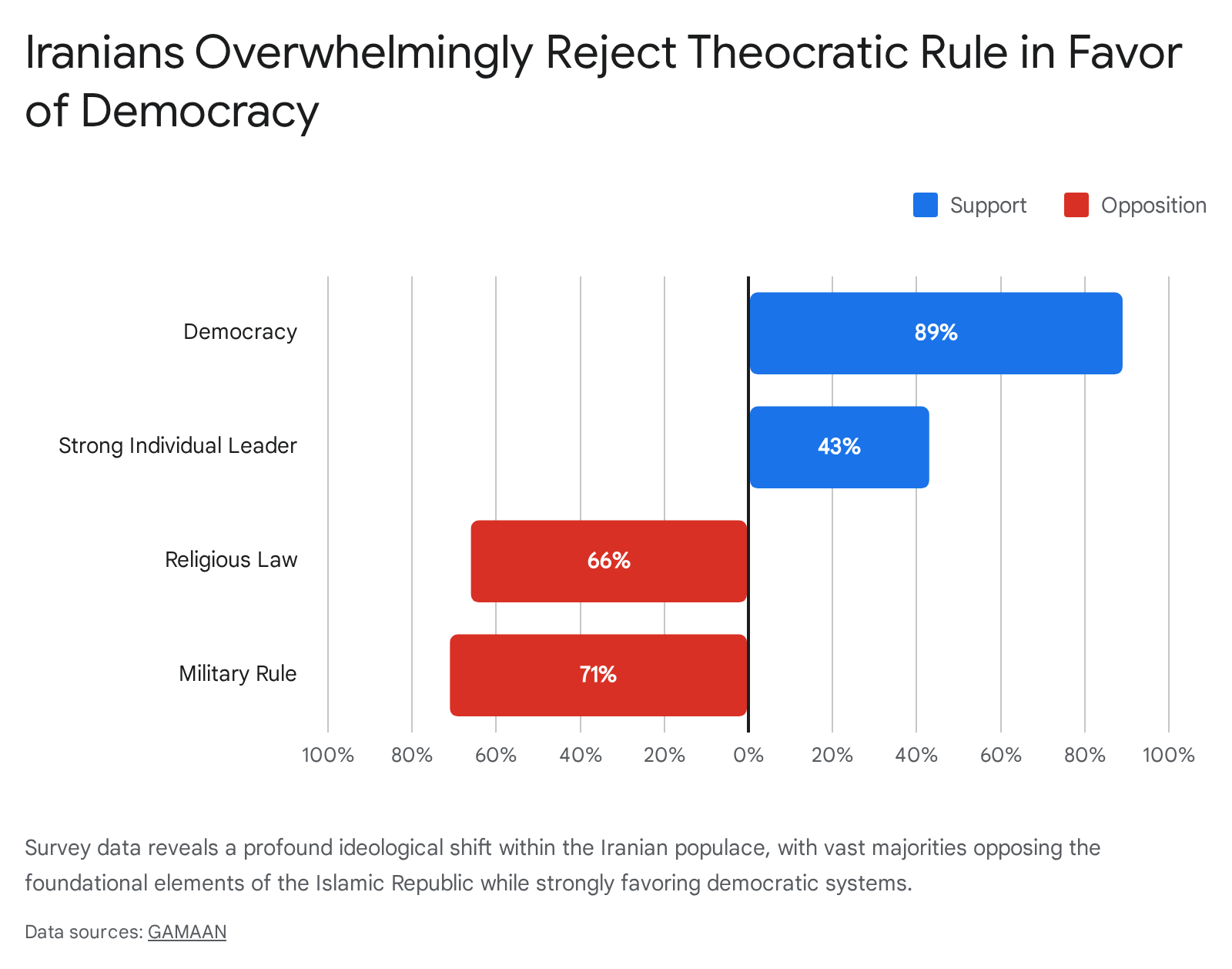
Extensive polling data from the Group for Analyzing and Measuring Attitudes in Iran and Stasis Consulting reveals a society that has fundamentally rejected the founding principles of the Islamic Republic. Based on a representative sample of literate adults, an overwhelming 89 percent of the Iranian population expressed support for a democratic political system.18 Conversely, governance based on religious law faces widespread opposition, with 66 percent of the population actively rejecting theocratic rule, and 71 percent opposing military governance.18
When surveyed on hypothetical political party preferences, Iranians predominantly favor platforms that prioritize individual freedoms and human rights (37 percent), followed closely by parties seeking social justice and workers’ rights (33 percent), and those emphasizing national pride and Iranian nationalism (26 percent).18 Support for parties focusing on environmentalism (10 percent) and free-market economics (9 percent) is notably highest among the educated youth.18 This data indicates that the population is not merely anti-regime, but possesses a coherent desire for a secular, rights-based republic.
2.2 The Prioritization of Economic Survival Over Democratic Ideals
However, the cascading crises of 2025 and 2026 have shifted immediate public priorities. While the desire for democracy remains the long-term goal, the daily reality of starvation and kinetic warfare has altered short-term focus. In recent surveys asking Iranians if they could change one thing about Iran, 48 percent of respondents prioritized making the country “more economically prosperous”.19 The desire for a “more safe and secure” environment rose significantly to 25 percent, up from 14 percent in March 2024.19
Strikingly, the demand for the country to be “more democratic and free” actually dropped from 13 percent in the aftermath of the 2022 protests to just 6 percent in late 2025.19 This statistical drop does not imply an abandonment of democratic ideals, rather, it reflects a society operating at the lowest levels of Maslow’s hierarchy of needs, where the immediate threats of starvation, hyperinflation, and foreign military strikes supersede high-level political aspirations. Furthermore, 49 percent of respondents stated that government officials appointed by President Pezeshkian simply do not care what average people think, indicating a complete loss of faith in the civilian reformist movement.19
2.3 Psychological Trauma and the Legacy of the 12-Day War
The psychological condition of the Iranian populace has been heavily battered by the 12-Day War in June 2025. Survey data collected shortly after the conflict reflects a highly traumatized society that blames its own government for its suffering. Approximately 44 percent of the population held the Islamic Republic responsible for initiating the war, while 33 percent blamed Israel, and 16 percent believed both sides were equally at fault.20 When assessing the outcome of the conflict, 51 percent believed that Israel was successful in achieving its objectives, compared to only 16 percent who believed the Islamic Republic was successful.20
The most prominent emotion experienced during the conflict was “anger at the Islamic Republic,” reported by 42 percent of the population, followed closely by “worry about the future” at 38 percent, and “anger at Israel” at 30 percent.20 Crucially, the data reveals a high degree of distress regarding the physical toll of the war. A significant 73 percent of respondents stated they were deeply upset by civilian casualties, 46 percent were distressed by direct attacks on Iranian territory, and 30 percent were upset by the killing of nuclear scientists.20 Furthermore, 63 percent of the population believed that the 12-Day War was fundamentally a conflict between the states of Israel and the Islamic Republic, and not a war involving the Iranian people.20 This highlights a critical nuance in public sentiment. While the populace overwhelmingly despises the regime, they do not view the destruction of their national infrastructure or the loss of civilian life as an acceptable cost for regime change.
3.0 The Divergence Between the Iranian Diaspora and the Internal Population
Intelligence assessments must carefully differentiate between the vocal Iranian diaspora living in exile and the internal population living under the daily threat of state violence. While both demographics largely share the ultimate goal of regime change, their strategic preferences and risk tolerances diverge significantly.
3.1 Diaspora Advocacy and the Restoration of Historical Identity
The Iranian diaspora, operating from safe havens in the West, frequently expresses sentiments that are heavily pro-Western and pro-Israel, a dynamic that often surprises external observers.21 Expatriates have been observed celebrating the degradation of the state’s ideological apparatus, viewing the recent military strikes as a necessary catalyst for liberation.21 The diaspora narrative frequently focuses on casting down the religious constraints of the 1979 Islamic Revolution and restoring the historical identity of ancient Persia, emphasizing religious tolerance and cultural openness.21
Polling conducted by the National Iranian American Council and YouGov in 2025 provides concrete data on these diaspora preferences. When asked what type of government would work best in Iran, a majority of Iranian Americans (55 percent) favored a parliamentary democracy or republic, while 17 percent supported a constitutional monarchy, likely indicating support for the exiled Crown Prince Reza Pahlavi.22 Only 6 percent preferred a reformed Islamic republic, and a mere 3 percent favored maintaining the current system.22
3.2 Internal Pragmatism and the Fear of State Collapse
This perspective is not universally shared with the same level of revolutionary enthusiasm by those living inside the country. Internal populations are subjected to the direct physical consequences of conflict and economic blockade. While one in six Iranians inside the country actively agree with calls for the Islamic Republic to be replaced with another form of government, the intensity of this opposition is tempered by the fear of state collapse and internal chaos.19
The internal population is acutely aware that a power vacuum could lead to a protracted civil war. Interestingly, GAMAAN polling indicates that about half of the internal population (43 percent) is open to authoritarian rule by a strong individual leader, a view that is more common among rural residents and people with lower levels of education.18 This suggests that a significant portion of the populace values order and stability above all else, fearing that the sudden collapse of the central government without a viable transitional authority would lead to warlordism and societal disintegration.5 Analysts note the danger of “anchoring bias,” warning that observers should not assume the Iranian regime is as fragile as the Russian Empire during World War I, the state remains remarkably institutionalized and capable of defending itself against internal rupture.23
3.3 Diaspora Perspectives on United States Military Action
Even within the diaspora, the prospect of direct military intervention generates deep apprehension. The NIAC survey revealed that Iranian Americans are evenly divided over the June 2025 United States airstrikes on Iran’s nuclear facilities, with 45 percent agreeing with the strikes and 44 percent disagreeing.22 Among those who opposed the strikes, 56 percent cited the fear of civilian casualties as their primary concern.22 This data underscores that while the diaspora is highly mobilized against the regime, there is no consensus on utilizing foreign military force to achieve political change, primarily due to the unavoidable toll on the civilian population.
4.0 Iranian Perspectives on the United States and Foreign Intervention
The relationship between the Iranian people and the United States is complex, shaped by decades of mutual antagonism, crippling economic sanctions, and the reality of recent direct military confrontations.
4.1 Historical Animosity and Public Opinion Polling
Polling data from early 2026 indicates that anti-American sentiment remains highly prevalent within the general Iranian population. According to Gallup tracking, 81 percent of Iranians hold an unfavorable view of the United States, representing the highest unfavorable reading since 1991.24 Conversely, the favorable rating sits at a marginal 13 percent, having never risen above 17 percent in the history of the survey.24 This deep-seated animosity is fueled by the long-standing economic sanctions that have devastated the civilian economy, alongside the historical narrative of foreign interference continuously propagated by the state educational apparatus.
4.2 Reactions to Operation Epic Fury
The initiation of Operation Epic Fury by the United States has introduced a highly volatile new dynamic. The operation specifically targeted the internal security apparatus, including Basij checkpoints and equipment in major cities like Tehran.25 The Israel Defense Forces similarly targeted facilities associated with the Islamic Republic’s internal security apparatus used to suppress dissent.25 In the immediate aftermath of these strikes, some internal factions expressed cautious optimism, viewing the degradation of the Basij as an opportunity to reclaim the streets and operate with less fear of immediate reprisal.25
However, this optimism is heavily constrained by the strategic realities of the United States naval blockade and the resulting destruction of the broader economy.12 The populace recognizes that even if the regime collapses under the weight of Operation Epic Fury, the country they inherit will be fundamentally broken and devoid of essential infrastructure. Furthermore, public statements from United States leadership regarding the permanent opening of the Strait of Hormuz and the enforcement of the blockade are viewed by many Iranians as violations of national sovereignty, regardless of their intense hatred for the ruling clerics.13
4.3 The Paradox of Pragmatic Exhaustion
Despite the overwhelmingly unfavorable views of the United States, a significant portion of the population recognizes that the regime’s belligerent foreign policy is the root cause of their isolation. The realization that the regime is an “empty shell” that spent billions of dollars on the Islamic Revolutionary Guard Corps and proxy groups across the Middle East while the domestic economy stagnated has generated immense resentment.5 Consequently, while Iranians may not favor the United States culturally or politically, there is a pragmatic subset of the population that views American military pressure as the only force capable of fracturing the IRGC’s absolute monopoly on violence. The populace is trapped in a paradox where their desired outcome, the removal of the theocracy, currently appears achievable only through the actions of a foreign power they deeply distrust.
5.0 The Mechanics of Regime Survival and Asymmetric Repression
Given the catastrophic state of the economy, the destruction of military infrastructure, and the overwhelming public desire for democratic transition, the central intelligence question remains, why have the Iranian people not successfully overthrown the government? The analysis indicates several primary factors, asymmetric lethality, the elite’s sunk cost fallacy, and a critical deficit in organizational leadership.
5.1 The Application of Maximum Violence and Lethal Force
The Islamic Republic is not a fragile dictatorship, it is a highly institutionalized, closed autocracy designed specifically to withstand internal rupture.23 The regime’s survival strategy relies on the unhesitating application of maximum violence against unarmed civilians. During the protest waves of January 2026, Supreme Leader Ali Khamenei and senior security officials issued direct orders to use live ammunition on demonstrators, initiating a campaign of brutal suppression.1
The scale of the resultant massacres is unprecedented in modern Iranian history. Intelligence confirms that security forces, including the IRGC, Basij paramilitaries, and plainclothes agents, positioned themselves on rooftops and utilized assault rifles and shotguns loaded with metal pellets to explicitly target the heads and torsos of protesters.27 The violence was particularly acute on January 8 and 9, 2026, when the death toll rose into the thousands, marking the deadliest period of repression documented by human rights researchers in decades.27
The application of this asymmetric lethality creates a paralyzing environment of terror. When a state demonstrates a willingness to slaughter tens of thousands of its own citizens without hesitation, the cost of participation in street protests becomes prohibitive for the average citizen.
| Source of Estimate | Reported Death Toll (Jan-Feb 2026) | Verification Methodology | Source Data |
| Official Iranian Government | 3,117 | State-controlled reporting via Supreme National Security Council | 28 |
| HRANA (Human Rights Activists) | 7,007 verified (6,488 protesters, 236 minors) | Grassroots network verification, with 11,000+ cases under investigation | 28 |
| UN Human Rights Experts | “Tens of thousands” | Independent diplomatic channels and special rapporteur assessments | 28 |
| Medical / Morgue Staff Leaks | 30,000 to over 36,500 | Morgue capacity tracking and hospital intake reports | 28 |
5.2 The Sunk Cost Fallacy and the Prioritization of Proxy Networks
Rather than realizing the major shift needed in domestic policy to address economic problems at home, the supreme leadership doubled down on old habits.5 The regime is effectively trapped in a “sunk cost fallacy.” Instead of reallocating funds to stabilize the rial or subsidize basic food commodities, the regime continues to pour vast sums of money into rebuilding its degraded proxy networks abroad.5 The state has calculated that conceding political space to domestic protesters is a greater threat to its survival than enduring international condemnation for mass killings.
5.3 The Critical Deficit in Organizational Leadership
A successful revolution requires more than widespread anger, it requires strategic coordination, a unifying leadership structure, and a viable transitional plan. The 2025-2026 uprising in Iran suffers from a severe leadership vacuum.29 While local neighborhood councils attempt to coordinate localized actions, there is an absolute absence of a popular national leadership capable of converting repeated protest waves into sustained political agency.29
The regime has spent decades systematically assassinating, imprisoning, or exiling any charismatic figures, journalists, and human rights defenders who could serve as a unifying opposition leader.2 Consequently, the protests operate horizontally. While this horizontal structure makes the movement difficult for the state to decapitate with a single arrest, it also prevents the protesters from executing complex, sustained campaigns or negotiating a transition of power.29 Information and outrage spread rapidly, but without centralized leadership, the mobilization erupts violently and dissipates quickly under the pressure of live fire, leaving the political status quo intact.29
5.4 Calibrated Concessions and Reputational Triage
While the security line is hardening, the regime simultaneously utilizes a parallel track of calibrated concessions to relieve social pressure without ceding political power. For example, during the height of the crackdowns, the cabinet moved to formalize a long-contested social issue by allowing law enforcement to issue motorcycle licenses for women.30 This action functioned as reputational triage, signaling a false sense of normalization and offering a non-political topic for public attention, all while conceding absolutely nothing regarding accountability for state violence or the right to protest.30 This dual approach attempts to deter collective mobilization through brute force while selectively relaxing certain daily controls to repackage the regime as adaptable.
6.0 Information Warfare and the Telecommunications Blackout
To prevent the localized neighborhood councils from coordinating a national strategy and to conceal the scale of the massacres, the Iranian state relies heavily on absolute information control. The digital siege is a core pillar of the regime’s domestic security apparatus.
6.1 The Disconnection of the National Information Network
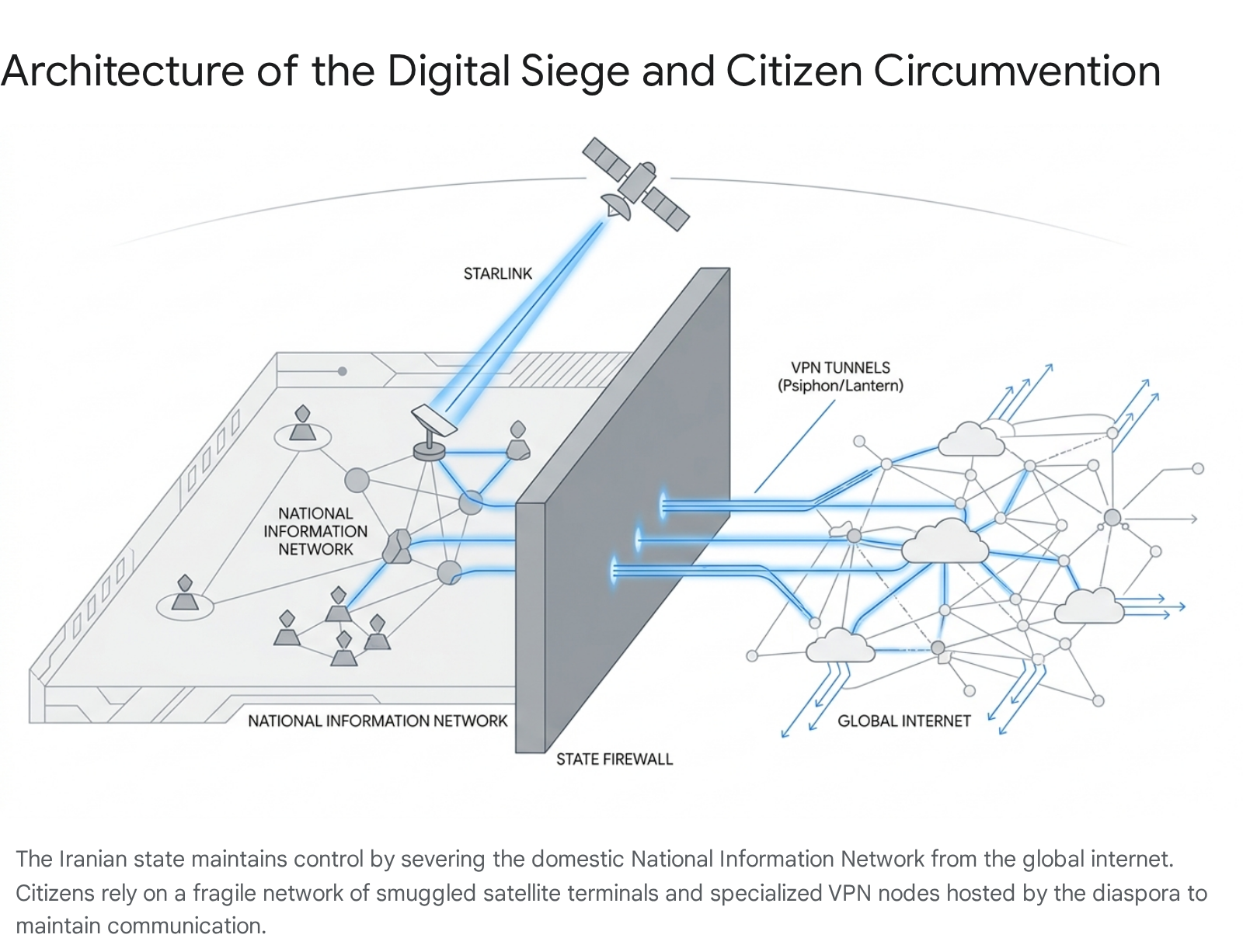
On January 8, 2026, the twelfth day of the protests, the Iranian authorities initiated the most sophisticated and severe internet blackout in the country’s history.31 The Ministry of Information and Communications Technology completely disconnected the National Information Network, severing both international connections and disrupting internal traffic within Iran.32 Cybersecurity experts reported widespread telephone and internet blackouts originating in Tehran and spreading to Isfahan, Shiraz, and Kermanshah.32
This blackout serves a dual purpose. Tactically, it prevents protesters from sharing staging locations, accessing independent news, or coordinating mass movements. Strategically, it provides a cloak of darkness under which the IRGC can conduct mass executions and arbitrary detentions without digital evidence reaching the international community.27 The economic cost of this blackout is staggering, costing the Iranian economy between 35.7 million and 80 million United States dollars per day, leading to an 80 percent drop in online sales and a reduction of 185 million financial transactions within a single month.32 The state’s willingness to inflict this level of economic self-harm underscores its prioritization of immediate regime survival over the long-term viability of the national economy.
6.2 The Black Market for Satellite Connectivity and Hardware Procurement
In response to the digital siege, the Iranian populace has increasingly turned to decentralized, open-source, and satellite-based circumvention tools. Satellite internet has become a critical lifeline for coordinating dissent and transmitting evidence of human rights abuses to the outside world. While the service provider SpaceX has waived subscription fees for Iranian users and activated free access in response to the crackdowns, the physical procurement of the terminal kits remains exceptionally difficult.33
The Iranian regime has classified the possession of satellite internet hardware as a severe national security threat. Individuals discovered using or distributing these terminals risk lengthy prison sentences, and human rights organizations have warned of the possibility of execution for users caught maintaining the network.33 Consequently, the hardware is smuggled across the border, creating a lucrative and highly dangerous black market. Following the escalation of war with the United States and the deployment of the naval blockade, the black market price for a single satellite terminal surged from approximately 700 United States dollars to as much as 4,000 United States dollars, placing it far beyond the reach of the average citizen.34
6.3 Virtual Private Networks and the Reliance on Diaspora Infrastructure
For the vast majority of Iranians who cannot afford or safely harbor satellite equipment, Virtual Private Networks remain the primary method of evading state censorship. However, the Iranian government utilizes highly aggressive Deep Packet Inspection, Domain Name System manipulation, and Server Name Identification blocking to sever connections to standard commercial VPN providers.35
Consequently, the populace relies heavily on specialized circumvention tools like Psiphon and Lantern, which disguise users’ data as different types of internet traffic to evade detection.36 The resilience of these networks is fundamentally dependent on the active participation of the Iranian diaspora. Thousands of expatriates run conduit applications on their personal devices, leaving unused phones or computers connected to home Wi-Fi networks to securely share part of their bandwidth.38 By doing so, they create small, fragile bridges that allow users inside Iran to connect to the global internet. As of early 2026, intelligence indicated that approximately 400,000 Iranians abroad were maintaining these nodes, serving as a critical digital lifeline for those trapped behind the state firewall.32
| Tool / Service | Technical Evasion Methodology | Current Procurement and Availability Status | Official Vendor Link |
| Starlink | Low Earth Orbit Satellite Internet | Hardware in stock globally; Black market access only in Iran at highly inflated prices | (https://www.starlink.com/) |
| Psiphon | Multi-protocol proxy network utilizing VPN, SSH, and HTTP | Software actively available for download; Relies heavily on diaspora conduit nodes | (https://psiphon.ca/) |
| Lantern | Peer-to-peer routing and disguised TLS traffic protocols | Software actively available for global download | (https://lantern.io/) |
7.0 The Succession Crisis and the Shift in State Identity
The Iranian political landscape experienced a seismic shift in early 2026. Following the death of Supreme Leader Ali Khamenei, the Assembly of Experts selected his son, Mojtaba Khamenei, as the next Supreme Leader on March 8, 2026.1 This transition represents the most vulnerable point in the history of the Islamic Republic and has fundamentally altered the domestic political calculus and the ideological foundation of the state.
7.1 The Elevation of Mojtaba Khamenei and the Hardline Consolidation
The rapid selection of Mojtaba Khamenei represents a decisive and uncompromising victory for the most extreme hardline factions within the IRGC and the Office of the Supreme Leader.10 Mojtaba, a cleric with deep, entrenched ties to the security apparatus and a documented history of orchestrating severe domestic crackdowns, is widely feared by the public.10 His ascension guarantees that the state will pursue domestic and foreign policies remarkably similar to, or potentially more aggressive than, those of his father.
7.2 The “Death to Mojtaba” Movement and the Loss of Ideological Legitimacy
The immediate public reaction to his appointment was explosive and highly telling of the current national mood. Despite the ongoing lethal crackdowns, internet blackouts, and the presence of heavily armed security forces, citizens defied curfews to gather in residential neighborhoods, chanting “Death to Mojtaba” from their rooftops.1
This specific chant is highly significant from an intelligence perspective. It signifies that the public views the transition not as a legitimate religious succession guided by Islamic jurisprudence, but as the naked establishment of a hereditary dictatorship. By installing the son of the former leader, the regime has stripped away its remaining theological veneer. It has exposed itself entirely as a military autocracy governed by the IRGC, utilizing the clerical establishment merely as a rubber stamp.5 This ideological collapse permanently alienates any remaining moderate or reformist factions within the political establishment, ensuring that future conflicts between the state and the populace will be defined solely by the application of physical force rather than political debate.
7.3 The Marginalization of the Civilian Government
Within this highly volatile environment, the civilian government led by President Masoud Pezeshkian has been entirely marginalized. Pezeshkian has publicly acknowledged the depth of the systemic failure and has occasionally attempted to strike a softer tone, noting in public statements that the government is obligated to listen to peaceful protesters and involve the people in decision-making.3 He has even signaled a conditional openness to diplomacy with the United States to alleviate the crushing economic sanctions, publishing open letters urging a move beyond political rhetoric.41
However, intelligence indicates that Pezeshkian wields no actual authority over the security apparatus, the national economy, or the direction of foreign policy. He has explicitly noted his own powerlessness in private, admitting that his attempts to negotiate or alter the state’s trajectory have been routinely overruled by the supreme leadership and the IRGC high command.3 The civilian government is currently utilized by the regime merely as a diplomatic facade for the international community and an administrative body tasked with managing the impossible logistics of a collapsed economy, while the true levers of power remain firmly and exclusively under the control of Mojtaba Khamenei and the military elite.
8.0 Strategic Outlook and Key Intelligence Takeaways
The intelligence assessment of the Iranian populace in April 2026 paints a picture of a society pushed to the absolute limits of human endurance. The Iranian people are locked in a sophisticated, highly lethal struggle against a heavily armed and deeply entrenched security state. The failure of the populace to topple the government is not indicative of support or complacency, rather, it is a testament to the ruthless efficiency of the IRGC’s domestic suppression tactics, the paralyzing effects of the telecommunications blackout, and the strategic disadvantage of a leaderless, horizontal protest movement facing coordinated military violence.
The installation of Mojtaba Khamenei has catalyzed a permanent ideological rupture, finalizing the transformation of the Islamic Republic into a hereditary military dictatorship devoid of popular legitimacy. While the populace overwhelmingly desires a transition to a secular democracy, they are simultaneously deeply fearful of the chaotic consequences of state collapse and hold highly unfavorable views of the foreign military interventions that have shattered their national infrastructure.
The regime currently survives solely through the application of brute force and the enforcement of digital darkness. However, the macroeconomic foundations required to sustain the patronage networks of the security apparatus have been decimated by the shadow economy, international blockades, and the systematic destruction of the defense industrial base. The state is operating in a condition of permanent emergency, generating cohesion solely through the suppression of an internal enemy. While the security forces remain coherent in the immediate term, the absolute alienation of the population and the mathematical impossibility of economic recovery suggest that the current paradigm is structurally unsustainable, leaving the state exceptionally vulnerable to any future catalyst that disrupts the IRGC’s chain of command.
Please share the link on Facebook, Forums, with colleagues, etc. Your support is much appreciated and if you have any feedback, please email us in**@*********ps.com. If you’d like to request a report or order a reprint, please click here for the corresponding page to open in new tab.
Sources Used
- 2025–2026 Iranian protests – Wikipedia, accessed April 19, 2026, https://en.wikipedia.org/wiki/2025%E2%80%932026_Iranian_protests
- Iran: Chokehold on Dissent – Human Rights Watch, accessed April 19, 2026, https://www.hrw.org/news/2024/01/11/iran-chokehold-dissent
- The Ayatollah’s Regime Is Crumbling | Hudson Institute, accessed April 19, 2026, https://www.hudson.org/foreign-policy/ayatollahs-regime-crumbling-michael-doran
- Iran Inflation Rate – Trading Economics, accessed April 19, 2026, https://tradingeconomics.com/iran/inflation-cpi
- Iran’s regime is suffering from strategic vertigo. Its next misstep may …, accessed April 19, 2026, https://www.atlanticcouncil.org/blogs/menasource/irans-regime-is-suffering-from-strategic-vertigo-its-next-misstep-may-be-its-last/
- Iran in the Aftermath of the Twelve-Day War – GIGA Hamburg, accessed April 19, 2026, https://www.giga-hamburg.de/en/publications/giga-focus/iran-in-the-aftermath-of-the-twelve-day-war
- Epic Fury Quelled for Now, Objectives Accomplished, U.S. Forces Remain Ready, accessed April 19, 2026, https://www.war.gov/News/News-Stories/Article/Article/4454276/epic-fury-quelled-for-now-objectives-accomplished-us-forces-remain-ready/
- Peace Through Strength: Operation Epic Fury Crushes Iranian Threat as Ceasefire Takes Hold – The White House, accessed April 19, 2026, https://www.whitehouse.gov/releases/2026/04/peace-through-strength-operation-epic-fury-crushes-iranian-threat-as-ceasefire-takes-hold/
- Operation Epic Fury – U.S. Central Command, accessed April 19, 2026, https://www.centcom.mil/OPERATIONS-AND-EXERCISES/EPIC-FURY/
- Iran Update Evening Special Report: March 8, 2026 | ISW, accessed April 19, 2026, https://understandingwar.org/research/middle-east/iran-update-evening-special-report-march-8-2026/
- The Iran Conflict | Ipsos, accessed April 19, 2026, https://www.ipsos.com/en/global-opinion-polls/the-iran-conflict
- The Strait of Hormuz is ‘open,’ but the US blockade remains in place. Here’s what that means., accessed April 19, 2026, https://www.atlanticcouncil.org/dispatches/the-strait-of-hormuz-is-open-but-the-us-blockade-remains-in-place-heres-what-that-means/
- Iran war updates: Trump voices optimism about deal; Tehran cautious, accessed April 19, 2026, https://www.aljazeera.com/news/liveblog/2026/4/17/iran-war-live-ceasefire-starts-in-lebanon-as-trump-says-tehran-deal-close
- Iran’s central bank warns economy may take 12 years to rebuild after war, accessed April 19, 2026, https://www.iranintl.com/en/202604139864
- Iran, Islamic Rep. – World Bank Open Data, accessed April 19, 2026, https://data.worldbank.org/country/iran-islamic-rep
- Iran – IMF DataMapper, accessed April 19, 2026, https://www.imf.org/external/datamapper/profile/IRN
- BTI 2024 Country Report – Iran, accessed April 19, 2026, https://bti-project.org/fileadmin/api/content/en/downloads/reports/country_report_2024_IRN.pdf
- Analytical Report on “Iranians’ Political Preferences in 2024 …, accessed April 19, 2026, https://gamaan.org/2025/08/20/analytical-report-on-iranians-political-preferences-in-2024/
- GAMAAN Survey of Iranians’ Political Preferences (Sept 2025, Post 12-Day War) : r/fivethirtyeight – Reddit, accessed April 19, 2026, https://www.reddit.com/r/fivethirtyeight/comments/1ri3x9f/gamaan_survey_of_iranians_political_preferences/
- GAMAAN-12-Day-War-Survey-Report-Nov-2025-Final-English.pdf, accessed April 19, 2026, https://gamaan.org/wp-content/uploads/2026/02/GAMAAN-12-Day-War-Survey-Report-Nov-2025-Final-English.pdf
- How Iran’s diaspora thinks differently than Iran’s regime – Mission Network News, accessed April 19, 2026, https://www.mnnonline.org/news/how-irans-diaspora-thinks-differently-than-irans-regime/
- 2025 National Survey – PAAIA, accessed April 19, 2026, https://paaia.org/wp-content/uploads/2025/11/2025-National-Survey-Final-Copy.pdf
- Regime Change in Iran, Underpants Gnomes, and the Phase II Problem – War on the Rocks, accessed April 19, 2026, https://warontherocks.com/regime-change-in-iran-underpants-gnomes-and-the-phase-ii-problem/
- Iran | Gallup Historical Trends, accessed April 19, 2026, https://news.gallup.com/poll/116236/iran.aspx
- Mass arrests, intensifying crackdown sweep Iran amid attacks, accessed April 19, 2026, https://www.iranintl.com/en/202603145682
- What They’re Saying About Operation Epic Fury—April 15, 2026, accessed April 19, 2026, https://www.unitedagainstnucleariran.com/press-releases/what-theyre-saying-about-operation-epic-fury-april-15-2026
- What happened at the protests in Iran? – Amnesty International, accessed April 19, 2026, https://www.amnesty.org/en/latest/campaigns/2026/01/what-happened-at-the-protests-in-iran/
- 2026 Iran massacres – Wikipedia, accessed April 19, 2026, https://en.wikipedia.org/wiki/2026_Iran_massacres
- In Iran Protests, Information Spreads Faster than Organization – Stimson Center, accessed April 19, 2026, https://www.stimson.org/2026/in-iran-protests-information-spreads-faster-than-organization/
- Iran’s Ruling System Tightens the Security Vise—While Letting Flashes Of “Permitted Criticism” Leak Through – NCRI, accessed April 19, 2026, https://www.ncr-iran.org/en/news/iran-protests/irans-ruling-system-tightens-the-security-vise-while-letting-flashes-of-permitted-criticism-leak-through/
- Iran’s Latest Internet Blackout Extends to Phones and Starlink – Georgia Tech, accessed April 19, 2026, https://www.gatech.edu/news/2026/01/16/irans-latest-internet-blackout-extends-phones-and-starlink
- 2026 Internet blackout in Iran – Wikipedia, accessed April 19, 2026, https://en.wikipedia.org/wiki/2026_Internet_blackout_in_Iran
- Iran: Free satellite internet access has been activated; however, individuals using Starlink may allegedly be subject to severe penalties, incl. the possibility of execution – Business and Human Rights Centre, accessed April 19, 2026, https://www.business-humanrights.org/en/latest-news/iran-free-satellite-internet-access-has-been-activated-however-individuals-using-starlink-may-be-subject-to-severe-penalties-incl-the-possibility-of-execution/
- Price of Musk’s Starlink kits in Iran soars as US threatens war – Al Arabiya, accessed April 19, 2026, https://english.alarabiya.net/News/middle-east/2026/02/23/price-of-musk-s-starlink-kits-in-iran-soars-as-us-threatens-war-
- Souped-up VPNs play ‘cat and mouse’ game with Iran censors – CP24, accessed April 19, 2026, https://www.cp24.com/news/world/2026/03/21/souped-up-vpns-play-cat-and-mouse-game-with-iran-censors/
- Iran’s January 2026 Internet Shutdown: Public Data, Censorship Methods, and Circumvention Techniques – arXiv, accessed April 19, 2026, https://arxiv.org/html/2603.28753v1
- How Iranians are communicating through internet blackout – The Japan Times, accessed April 19, 2026, https://www.japantimes.co.jp/news/2026/03/16/world/how-iran-internet-blackout/
- Volunteers abroad deploy tech to pierce Iran’s internet iron curtain | Iran International, accessed April 19, 2026, https://www.iranintl.com/en/202601240957
- CONTENTS – TopRankers, accessed April 19, 2026, https://cdn.toprankers.net.in/docs/weekly-current-affairs-8th-march-to-14th-march-2026-0294bc195378e.pdf
- Iranian president urges justice, warns of exploitation of protests to divide nation, accessed April 19, 2026, https://www.aa.com.tr/en/middle-east/iranian-president-urges-justice-warns-of-exploitation-of-protests-to-divide-nation/3816170
- Iran’s President Issues Open Letter to the American Public – YouTube, accessed April 19, 2026, https://www.youtube.com/watch?v=hB-DIM8mqpE
- Full text of Iranian President Masoud Pezeshkian’s letter to Americans | The Straits Times, accessed April 19, 2026, https://www.straitstimes.com/world/middle-east/full-text-of-iranian-president-masoud-pezeshkians-letter-to-americans