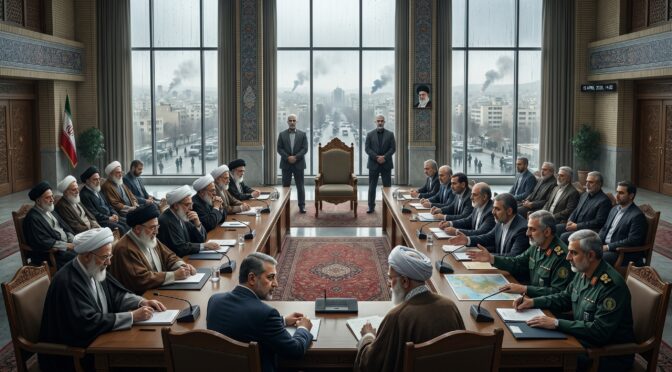
Executive Summary
The targeted elimination of Iranian Supreme Leader Ali Khamenei on February 28, 2026, during the United States and Israeli military offensive designated as Operation Epic Fury, precipitated a profound and irreversible systemic rupture within the Islamic Republic of Iran.1 The violent removal of the ultimate arbiter in a political system structured entirely around a singular, absolute religious authority has catalyzed an intense internal power struggle.3 This assessment evaluates the current operational state of the Iranian civilian and military leadership, detailing the severe fractures emerging within the military command and control complex and analyzing how these internal schisms directly impede the resolution of ongoing hostilities.
Intelligence analysis indicates that the Iranian state has effectively transitioned from a competitive, theocratic republic into a rigid military-security state dominated by hardline factions of the Islamic Revolutionary Guard Corps.5 This transition has completely marginalized pragmatic civilian elements and elevated a triumvirate of military commanders who now dictate all aspects of national policy.5 Concurrently, severe logistical and operational schisms have developed between the Islamic Revolutionary Guard Corps and the conventional armed forces, known as the Artesh, critically undermining the regime’s defensive cohesion.6 The regime’s historical reliance on a decentralized military strategy, known as the Mosaic Defense doctrine, has prevented a rapid state collapse but has simultaneously engineered a paradox of decapitation.5 In this paradox, no single surviving authority possesses the internal consensus or the operational control required to negotiate a binding cessation of hostilities.5
Geopolitically, the conflict has been actively instrumentalized by the Russian Federation and the People’s Republic of China. Both nations are executing a sophisticated strategy of strategic attrition.9 They seek to prolong the conflict to erode United States global primacy, distract Western military resources, and secure lucrative economic and technological concessions from an isolated administration in Tehran.9 Meanwhile, efforts by foreign elements to prop up exiled opposition figures, such as Reza Pahlavi and Maryam Rajavi, lack internal traction due to the complete absence of domestic organizational structures within Iran.10 Based on current intelligence, this report projects the top five most likely outcomes for the conflict, analyzing the structural variables that will dictate the future of the Iranian state and the broader Middle Eastern security architecture over the coming decade.
1.0 Historical Context and the Pre-2026 Strategic Baseline
To accurately assess the current fragility of the Iranian government, it is necessary to examine the structural degradation the regime experienced prior to the decapitation strikes of February 2026. The geopolitical landscape of the Middle East was fundamentally altered by the events of the preceding year, which systematically dismantled the external deterrence architecture relied upon by Tehran.
1.1 The June 2025 Twelve-Day War
The strategic power of the Islamic Republic suffered its most devastating historical blow during the Twelve-Day War of June 2025.12 During this conflict, Israeli forces executed Operation Rising Lion, launching five waves of airstrikes involving over two hundred aircraft against Iranian nuclear facilities, military installations, and leadership targets.12 Intelligence operatives sabotaged air defense systems and detonated explosives across Tehran, eliminating numerous senior nuclear scientists.12 The campaign decapitated the intelligence leadership of the Islamic Revolutionary Guard Corps and destroyed approximately 80 percent of Iran’s ballistic missile launchers.12
On June 22, 2025, the United States directly entered the conflict through Operation Midnight Hammer, deploying stealth bombers to destroy deeply buried enrichment facilities.12 By the time a ceasefire was established, Iran’s nuclear program had been set back by years, and the external network of allied militias, known as the Axis of Resistance, was left severely degraded.12 This prior conflict established a baseline of severe military vulnerability and economic exhaustion that profoundly limited the regime’s capacity to absorb the shocks of early 2026.
1.2 Degradation of the Regional Proxy Model
For decades, Iran pursued a strategy of projecting influence and maintaining deterrence through the sponsorship of armed non-state actors across Lebanon, Syria, Iraq, and Yemen.13 This model entered a phase of structural degradation following the regional fallout of the October 2023 attacks on Israel.13 The subsequent military attrition, intelligence penetration, and leadership losses exposed the limits of proxy-based power projection.13
By the onset of the 2026 conflict, Hezbollah in Lebanon had suffered immense military attrition and a collapse of the Syrian logistical corridors that underpinned its strategic depth.13 The Houthi movement in Yemen, attempting to raise its regional profile through maritime attacks, exposed its own capacity limits and increased its diplomatic vulnerability.13 Iraqi militias became increasingly fragmented, prioritizing local survival over unified resistance.13 Consequently, rather than serving as a coherent deterrent architecture, Iran’s regional network became a source of strategic exposure, forcing Tehran to face the 2026 offensive with limited external support.13
2.0 State of Iranian Civilian Leadership and Succession Dynamics
The sudden vacuum at the apex of the Iranian political structure has exposed the extreme fragility of the regime’s institutional equilibrium. For over three decades, Ali Khamenei maintained stability by balancing competing clerical, bureaucratic, and military factions, ensuring that no single entity could challenge his supreme authority.3 His death has replaced this carefully managed, competitive oligarchy with naked institutional survivalism, leading to the complete marginalization of civilian governance.
2.1 The Decapitation Event and Interim Governance Mechanisms
The targeted airstrikes on February 28, 2026, eliminated approximately 50 top Iranian officials, heavily degrading the upper echelons of the regime.2 Constitutionally, Article 111 of the Iranian constitution dictates that the death of the Supreme Leader triggers the formation of a Provisional Leadership Council tasked with executive oversight until a permanent successor is selected.14 The current Provisional Leadership Council consists of President Masoud Pezeshkian, Chief Justice Gholam-Hossein Mohseni-Eje’i, and Guardian Council member Alireza Arafi.16
This tripartite arrangement is structurally flawed due to profound ideological divergences among its members. President Pezeshkian represents the remnants of the reformist and moderate political factions, advocating for diplomatic engagement and economic stabilization.14 Conversely, Chief Justice Mohseni-Eje’i is a staunch hardliner with a background as intelligence minister, directly responsible for the brutal suppression of the 2025 and 2026 nationwide domestic protests.14 Alireza Arafi, a dual member of the Assembly of Experts and the Guardian Council, holds significant influence within the traditional power structure but lacks operational military command.16
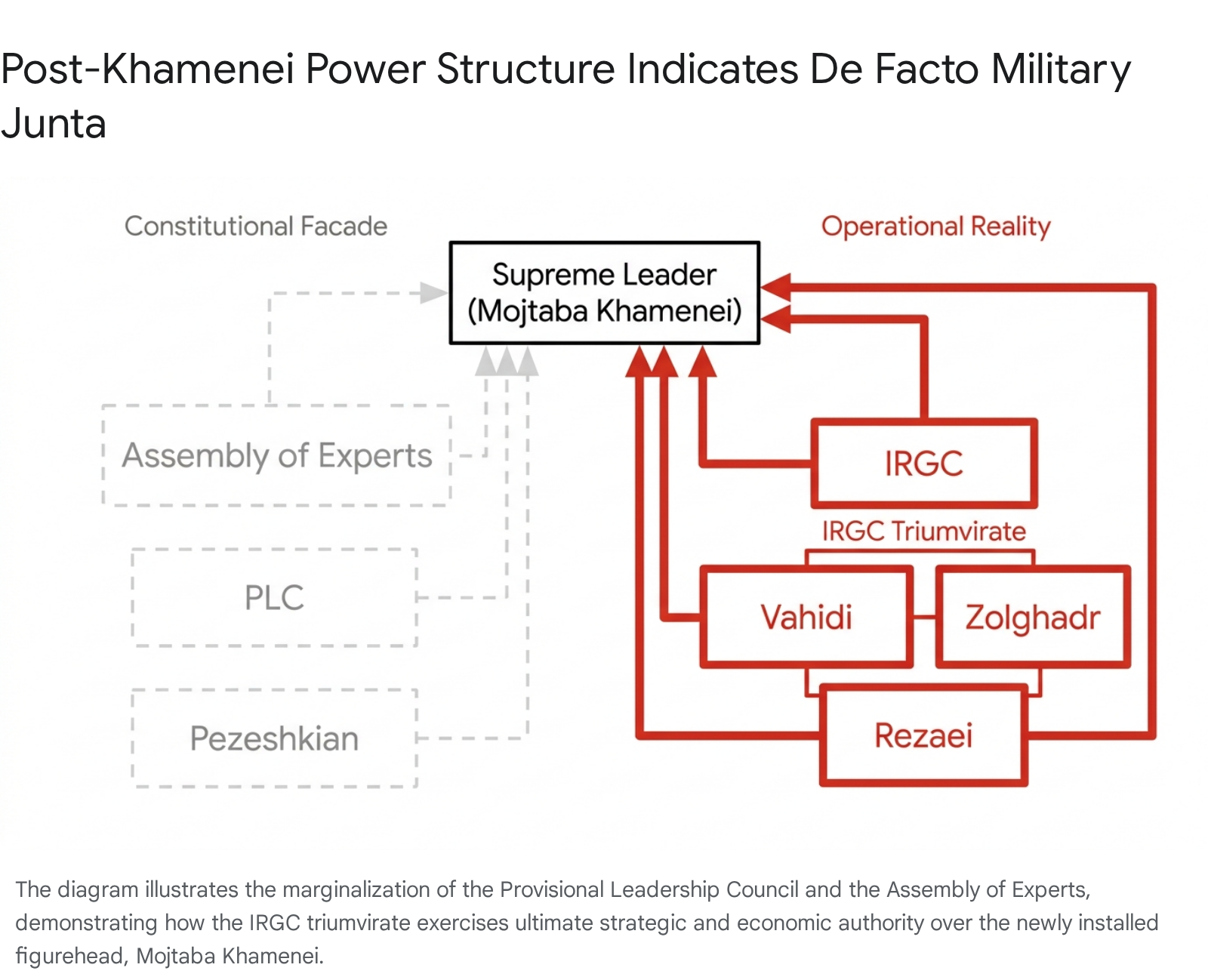
Intelligence indicates that the authority of the Provisional Leadership Council is largely nominal. Real operational, economic, and strategic authority has migrated entirely to the military-security establishment, bypassing formal constitutional norms and civilian oversight mechanisms entirely.17 The civilian government is systematically contradicted by military commanders, rendering the constitutional framework practically irrelevant in day-to-day wartime governance.5
2.2 The Rise of the Military Triumvirate
Power in Tehran is currently concentrated in a triumvirate of hardline commanders from the Islamic Revolutionary Guard Corps.5 This triumvirate consists of IRGC Commander-in-Chief Ahmad Vahidi, Supreme National Security Council Secretary Mohammad Bagher Zolghadr, and senior military adviser Mohsen Rezaei.5 General Vahidi functions as the undisputed de facto leader of the country. His authority supersedes that of the civilian government, evidenced by his systematic blocking of President Pezeshkian’s preferred cabinet appointments and his total control over military strategy.5
To consolidate this power, the military-security apparatus has actively eliminated political bridge builders who traditionally negotiated compromises between the civilian government and the armed forces. A critical turning point occurred in mid-March 2026 with the orchestrated removal of Ali Larijani.5 Larijani, a veteran establishment figure, former parliament speaker, and former secretary of the Supreme National Security Council, was widely viewed as a pragmatist capable of negotiating a ceasefire with the United States.18 He had effectively been running the country’s day-to-day operations prior to the airstrikes, attempting to maintain the status quo.2
Larijani was systematically marginalized and replaced by Zolghadr, an IRGC hardliner with deep connections to the judicial apparatus and absolutely no diplomatic experience.5 Zolghadr previously served as the IRGC coordination deputy and was a primary architect of former hardline President Mahmoud Ahmadinejad’s election in 2005.19 This deliberate purge of pragmatists has left the regime ideologically rigid, institutionally isolated, and entirely dependent on coercive force.
2.3 The Succession Mechanism and Clerical Legitimacy
The Assembly of Experts is the 88-member clerical body constitutionally mandated to select the Supreme Leader.14 Candidates for this assembly are heavily vetted by the Guardian Council, ensuring strict adherence to the ideological tenets of the state.14 Following the death of Ali Khamenei, the assembly’s proceedings were violently disrupted on March 3, 2026, when its offices in Qom were bombed during a session convened for electoral purposes, highlighting the extreme domestic volatility.21
Despite this disruption, Iranian media and international intelligence assessments indicated that Mojtaba Khamenei, the son of the late Supreme Leader, was selected as the new Supreme Leader on March 8, 2026.5 Other potential candidates, such as Hassan Khomeini, the grandson of the republic’s founder, were sidelined due to their reformist orientations and prior exclusion from the upper echelons of the regime.17
Mojtaba Khamenei’s elevation represents a critical vulnerability for the regime. He lacks the requisite religious credentials, formal governmental experience, and public legitimacy necessary to unite the populace or command the genuine respect of the clerical establishment.5 Analysts assess that Mojtaba was installed under direct military pressure from the Islamic Revolutionary Guard Corps, bypassing standard constitutional vetting processes.5 He serves merely as a puppet to provide a thin veneer of religious continuity, while the Vahidi-led triumvirate exercises true control.5
The mutation of the Islamic Republic into a criminal-oligarchic state is now fully realized.5 The military functions simultaneously as an armed force, an intelligence service, a political party, and a vast economic empire estimated to control between 30 and 40 percent of the total Iranian Gross Domestic Product.5 Religious institutions have been captured and instrumentalized strictly as tools for external legitimacy, devoid of their original ideological authority.5
3.0 Fractures in the Military Command and Control Complex
The Iranian armed forces operate under a deliberately dualized structure designed by the founders of the 1979 revolution to prevent military coups.23 This structure maintains the regular conventional army, known as the Artesh, parallel to the ideological Islamic Revolutionary Guard Corps.23 Both branches historically answered directly to the Supreme Leader, keeping the armed forces institutionally subordinate to civilian and clerical oversight.24 However, the intense military pressure applied by United States and Israeli forces has fractured this fragile dual system, revealing severe operational and logistical schisms that threaten the regime’s defensive viability.
3.1 The Decentralized Mosaic Defense Doctrine
To understand the resilience and subsequent fragmentation of the Iranian military, it is vital to examine the strategic logic of the Mosaic Defense doctrine. Developed under former Islamic Revolutionary Guard Corps commander Mohammad Ali Jafari between 2007 and 2019, this doctrine was a direct response to the rapid collapse of Saddam Hussein’s highly centralized regime during the United States invasion of Iraq.8
The Mosaic Defense doctrine organizes the state into multiple regional, semi-independent layers spanning Iran’s 31 provinces.8 The doctrine fundamentally assumes that adversaries will always possess superior conventional technology, air power, and intelligence capabilities.8 Therefore, the strategic priority is not symmetrical confrontation or centralized coordination, but rather the survival of individual combat units capable of launching decentralized ambushes, disrupting supply lines, and waging a protracted war of attrition across diverse terrain.8
In this structure, the regular army, the Artesh, is tasked with absorbing the initial conventional blow, utilizing its armored and infantry formations to slow enemy advances.8 Concurrently, the Islamic Revolutionary Guard Corps and the Basij paramilitary forces retreat to urban centers and mountainous redoubts to conduct prolonged guerrilla operations.8 This doctrine heavily emphasizes redundancy and succession planning. Prior to his death, Ali Khamenei authorized a system where multiple successors were predesignated for every key military post, ensuring that targeted decapitation strikes would not paralyze local commands.8 While this extreme diffusion of power has prevented a systemic collapse, it has severely compromised the regime’s ability to exert unified national command.
3.2 The Artesh and Islamic Revolutionary Guard Corps Operational Schism
The execution of the Mosaic Defense doctrine has exacerbated deep historical animosities between the Artesh and the Islamic Revolutionary Guard Corps. The Islamic Revolutionary Guard Corps functions as a heavily funded, ideological praetorian guard dedicated strictly to regime survival, whereas the Artesh preserves the traditions and ethos of a traditional national military.7 Under the strain of sustained airstrikes, the resource disparity between the two branches has escalated into overt hostility.
Intelligence sources indicate that the armed forces are facing acute supply shortages and rapidly rising desertion rates.6 The most critical friction point involves medical logistics and casualty evacuation. Artesh units on the front lines are suffering significant casualties, yet Islamic Revolutionary Guard Corps personnel have reportedly refused repeated requests to transport injured Artesh soldiers or grant them access to superior medical facilities and blood supplies.6
Furthermore, basic logistical supply chains for the regular army have essentially broken down. Certain field units of the Artesh have been issued as few as 20 bullets for every two soldiers, leaving them effectively defenseless against coordinated assaults.6 These units also report critical shortages of food and reliable drinking water, leading to localized group desertions and a total collapse in operational morale.6 The active hoarding of critical resources by the Islamic Revolutionary Guard Corps to protect its own ideological cadres has validated the perception within the Artesh that they are being utilized as expendable shock absorbers, quietly widening the institutional gap between the two forces.7
3.3 The Paradox of Decapitation
The very military doctrine designed to save the regime is now actively obstructing its ability to end the war. The paradox of decapitation dictates that while the decentralized network successfully survives kinetic strikes, the fragmented chain of command lacks a centralized authority with the legitimacy and control necessary to enforce a surrender or a comprehensive ceasefire.5 Local military commanders, operating under the autonomy granted by the provincial Mosaic Defense structure, possess the capacity to continue launching localized strikes, asymmetric ambushes, and maritime harassment operations even if political figures in Tehran agree to international terms.8 This structural reality fundamentally undermines any diplomatic process, as external actors cannot guarantee that agreements made at the negotiating table will be respected by field commanders.
4.0 Geopolitical Impediments to Conflict Resolution
The structural fractures within the Iranian leadership and military apparatus directly impact the international community’s hope of ending the conflict. The stated United States strategy of utilizing calibrated force to shift the internal balance toward factions amenable to compromise has, thus far, failed to produce a unified Iranian negotiating partner capable of delivering on promises.25
4.1 Diplomatic Stalemates and the Islamabad Summit
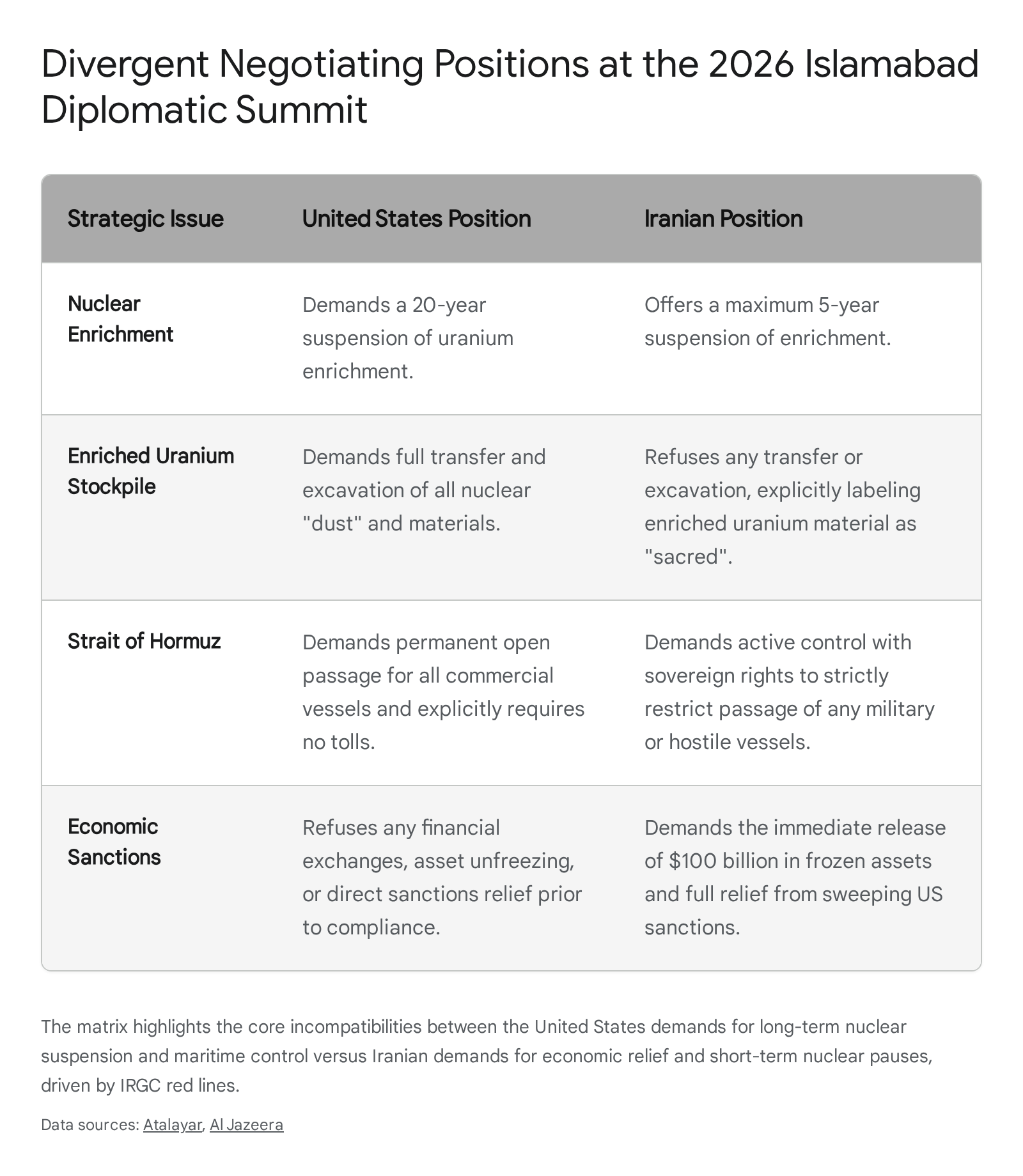
Efforts to broker a resolution have yielded minimal tangible results, marked by public posturing and irreconcilable demands. Recent direct negotiations held in Islamabad, Pakistan, highlighted the vast diplomatic chasm between the belligerents.26 The United States delegation, led by Vice President JD Vance, Steve Witkoff, and Jared Kushner, engaged with an Iranian delegation headed by Parliament Speaker Mohammad Bagher Ghalibaf and Foreign Minister Abbas Araghchi.5
Ghalibaf represents a unique and problematic contradiction within the Iranian system. He is widely characterized as a pragmatic hawk, acting as the architect of the hardline military doctrine focused on missiles and maritime dominance, yet he is also the most senior military-aligned figure willing to serve as a diplomatic back-channel.5 However, Ghalibaf’s pragmatism is severely constrained by his institutional subordination. He answers directly to Commander Ahmad Vahidi and lacks the independent authority to commit Iran to any binding agreement without explicit military approval from the hardline triumvirate.5
During the Islamabad talks, the United States presented demands including a 20-year suspension of uranium enrichment, whereas the Iranian delegation offered a maximum suspension of five years.5 Tehran continues to aggressively reject claims that it will surrender its enriched uranium stockpiles, with Foreign Ministry spokespersons declaring the material sacred and unequivocally not open for discussion.8 Analysts note that Iran requires substantial economic inducements to justify any concessions, such as the immediate release of 100 billion USD in frozen assets and comprehensive sanctions relief, which the United States is currently unwilling to provide without total capitulation.8 Consequently, the talks concluded after 21 hours without an agreement, leading to a resumption of hostilities.26
4.2 Weaponization of the Strait of Hormuz and Global Blockades
In the absence of conventional military parity, Iran has weaponized global energy markets by interdicting maritime traffic in the Strait of Hormuz.8 Maritime traffic through this vital corridor, which historically handled one-fifth of all global oil and gas shipments, has plummeted by an astonishing 95 percent.8 According to tracking data, transit fell to a mere fraction of the pre-war average of 100 ships per day, triggering the world’s largest-ever fuel supply disruption.8 The Islamic Revolutionary Guard Corps Navy declared the strait closed to hostile traffic, utilizing naval mines, fast attack craft, and coastal missile batteries to enforce a blockade and generate psychological terror among commercial operators.8
The United States responded by implementing a comprehensive naval blockade of all Iranian ports, further escalating the maritime standoff.5 Iran has attempted to exploit this situation by charging transit fees to specific nations. Maritime intelligence reports indicate that vessels taking a Tehran-approved route near Larak Island are forced to pay exorbitant fees, with one Chinese state-owned tanker reportedly paying 2 million USD for safe passage through the contested waters.19 The ability to hold the global economy hostage serves as Iran’s strongest asymmetric deterrent, compensating for the severe degradation of its nuclear and ballistic missile infrastructure.8
To counter this disruption, European nations have initiated independent diplomatic and military efforts. The Paris Summit on Freedom of Navigation, co-chaired by French President Emmanuel Macron and United Kingdom Prime Minister Keir Starmer, brought together 30 leaders to organize a multinational defensive mission in the strait, notably excluding the United States.5 This initiative includes discussions on the deployment of mine-hunting drones and the positioning of nuclear-powered aircraft carriers to ensure the safety of trapped seafarers, highlighting growing international frustration with the broader geopolitical stalemate.5
4.3 Global Economic Fallout and Risk Metrics
The protracted nature of the conflict and the ongoing maritime blockades have triggered severe global economic repercussions. The systematic reduction in global oil supply by 20 percent boosted oil prices by roughly 50 percent, creating a systemic fracture in international markets.8 The International Monetary Fund forecast for global growth in 2026 was subsequently downgraded to 3.1 percent, accompanied by an inflation rise to 4.4 percent due to the persistent shadow of war.5
The International Country Risk Guide ratings, a vital metric for geopolitical risk assessments, clearly illustrate the growing instability.9
| Risk Metric Category | Current Assessment | Global Implication |
| External Conflict & Sovereign Risk | Degraded to “High Risk” category due to infrastructure strikes. | Correlates directly with a sharp rise in sovereign bond spreads, significantly increasing global capital borrowing costs.9 |
| Government Stability & Domestic Policy | “Popular Support” sub-component under severe pressure in Western nations. | High energy costs complicate long-term strategic planning, particularly for the United States administration ahead of midterm elections.9 |
| Investment Profile & Market Contagion | Damaged scores for allied nations in Europe and Asia. | The logistics shock deters foreign direct investment and forces a costly re-evaluation of global supply chain security architectures.9 |
This data indicates that while the United States maintains overwhelming military dominance, adversaries are actively winning the risk war by systematically lowering Western risk scores, aiming to force a strategic retreat through economic exhaustion.9
5.0 The Strategic Calculus of the Sino-Russian Axis
Neither the Russian Federation nor the People’s Republic of China desires a swift conclusion to the conflict in the Middle East. Both nations are currently executing a highly calculated playbook of strategic attrition, utilizing the Iranian theater to recalibrate global influence, drain United States resources, and fracture Western economic stability without committing to direct kinetic involvement.9 The Iran conflict represents a systemic geopolitical rupture that actively accelerates the consolidation of the Sino-Russian partnership, effectively reversing decades of United States grand strategy historically aimed at keeping Moscow and Beijing diplomatically and militarily divided.29
5.1 Russian Objectives: Fiscal Windfalls and Tactical Spoiling
The primary immediate beneficiary of the conflict is the Russian Federation. Prior to the outbreak of war in the Gulf, the Russian economy was severely constrained by extensive Western sanctions and the immense fiscal demands of its ongoing military operations in Ukraine.29 The Russian federal budget was predicated on oil prices remaining stable near 60 USD per barrel.29 The abrupt disruption of the Strait of Hormuz caused Brent crude prices to surge toward 120 USD per barrel, generating a massive, unexpected fiscal windfall for Moscow.9 Current financial projections suggest this sustained price spike could yield the Kremlin a budget surplus exceeding 150 billion USD in 2026, effectively subsidizing its military objectives in Eastern Europe at the expense of global stability.9
Militarily, Russia acts as a tactical spoiler in the Middle East.9 To prevent a rapid United States victory and ensure the conflict remains a protracted, resource-draining quagmire, Moscow has engaged in a structured exchange of military capabilities with Tehran.30 Russia supplies Iran with critical signals intelligence and essential access to high-resolution satellite imagery via the GLONASS navigation system.30 This technical support grants Iranian forces enhanced operational awareness and enables the continuation of asymmetric defensive measures, ensuring that United States naval and air assets remain permanently tied down in the region.9 Furthermore, cooperation has expanded into advanced missile technology, focusing on terminal guidance improvements and the development of maneuvering reentry vehicles to penetrate Western air defenses.30
5.2 Chinese Objectives: Economic Insulation and Covert Facilitation
China’s strategic approach is highly nuanced, carefully balancing its massive reliance on Arab energy partners with its deep, long-term strategic partnership with Iran. Beijing has positioned itself diplomatically as an economic stabilizer and a responsible global mediator, actively championing a Five-Point Peace Plan to contrast its stability-first rhetoric with the aggressive military posture of the United States.9
However, beneath this diplomatic veneer, China is actively sustaining the Iranian war effort to serve its own geopolitical ends. Beijing successfully insulated its domestic economy from the massive 40 percent surge in global oil prices through years of strategic energy stockpiling, allowing it to weather the initial shocks far better than Western counterparts.9 Concurrently, China continues to purchase roughly 80 percent of Iran’s remaining oil exports, deliberately settling these massive transactions in yuan to actively circumvent United States sanctions and systematically erode the global dominance of the dollar.5 Despite this insulation, recent Chinese economic data reveals vulnerabilities, with first-quarter GDP growth dropping and factory-gate industrial prices rising, signaling that prolonged energy costs are beginning to impact China’s productive fabric.5
5.3 Intelligence and Technological Transfers
China’s shadow support extends deeply into the military-technological domain, providing the hardware necessary for Iran to maintain its asymmetric war. Beijing covertly supplies Iran with critical dual-use technologies, including advanced radio frequency connectors, precision turbine blades for missile production, and vast shipments of sodium perchlorate, a vital oxidizer required for solid rocket fuel propellant.30
Most critically, United States intelligence agencies have confirmed that the Islamic Revolutionary Guard Corps Aerospace Force is actively utilizing a Chinese spy satellite to track United States military bases across the Middle East.32 The satellite, identified in military documents as the TEE-01B, was built and launched by the Beijing-based firm Earth Eye Co in late 2024.34 Current validation passes confirm that the remote sensing technology and imagery packages provided by Earth Eye Co remain fully in stock and available for commercial and military procurement.
As part of this technological alliance, the Islamic Revolutionary Guard Corps also received secure access to commercial ground stations operated by Emposat, a Beijing-based satellite control provider with a network spanning Asia and Latin America.33 Iranian military commanders utilized this capability to capture high-resolution imagery of critical installations, such as the Prince Sultan Air Base in Saudi Arabia, facilitating precise targeting for subsequent drone and missile strikes.32
Furthermore, Iran’s domestic defense production continues to rely on advanced optical hardware. An analysis of military supply chains confirms that optical hardware produced by Esfahan Optics Industries, including tactical lenses and prisms used in small arms and drone guidance systems, remains actively in stock and available for integration into domestic weapons programs, despite widespread Western sanctions.19 By providing these capabilities and supply chain redundancies, China ensures Iran remains combat-effective and lethal without requiring Beijing to openly declare a formal military allegiance.30
6.0 Regional Dynamics and Foreign Sponsorship of Exiled Leaders
The conflict has forced neighboring regional powers to drastically recalibrate their security postures. As the internal stability of the Islamic Republic degrades, various foreign entities and political factions in Washington have also attempted to prop up exiled Iranian opposition figures to lead a theoretical post-conflict transition.
6.1 Gulf State Alignments and Pakistani Mediation
Saudi Arabia and the United Arab Emirates have adopted divergent strategies in response to the regional crisis. Saudi Arabia prefers a predictable global order and is actively pursuing a dual-track approach, maximizing security guarantees from Washington while simultaneously exploring diverse partnerships with Turkey, Egypt, Pakistan, and South Korea to avoid being trapped in a binary alliance system.36 Riyadh remains highly concerned that the war might ultimately strengthen and radicalize the Iranian regime rather than dismantling it.36 In stark contrast, the United Arab Emirates has chosen to double down on its partnership with Israel and the United States, fully integrating into the Israeli-led regional security framework, which has caused an open eruption of diplomatic tensions between Abu Dhabi and Riyadh.36
Meanwhile, regional states attempt to facilitate dialogue to prevent a broader war. The Pakistani mediation effort has been particularly prominent, with Field Marshal Syed Asim Munir, Chief of the Pakistani Army, and Prime Minister Shehbaz Sharif acting as crucial intermediaries between Washington and Tehran during the Islamabad summits.5 These mediation efforts highlight the reliance on regional middle powers to bridge the communication gap between the primary belligerents.
6.2 The Exiled Opposition Mirage
The Iranian opposition is ideologically diverse, encompassing monarchists, republicans, and secularists.37 However, intelligence assessments definitively conclude that external candidates favored by foreign powers lack the necessary internal infrastructure to seize or hold power in a post-conflict environment.7
Reza Pahlavi, the son of the deposed Shah of Iran, operates under the banner of secular democracy and Iranian nationalism and is currently the most internationally recognized opposition figure.37 Pahlavi has actively cultivated deep ties with the United States administration, frequently praising the leadership style of President Donald Trump and receiving logistical support from elements of the domestic political apparatus, including advocacy groups like the Log Cabin Republicans and retired military figures.11 He has also engaged directly with the Israeli government, conducting meetings in Tel Aviv to consolidate foreign backing for a transitional government.11
Despite his international profile and significant popularity among diaspora communities in Europe and North America, Pahlavi’s movement lacks any realistic viability on the ground inside Iran.10 His strategy relies entirely on foreign military intervention to collapse the regime, recently stating that massive outside action is required to prevent further bloodshed.10 Critically, he possesses no leadership cadres, internal financing networks, or operational command structures within the country.7 The historical precedent of revolutionary transitions dictates that power is inevitably captured by groups with disciplined, organized structures within the contested territory, a metric by which the monarchist faction fails entirely.7
6.3 The Mujahedin-e Khalq and International Skepticism
The other prominent faction heavily lobbying for foreign anointment is the Mujahedin-e Khalq, led by Paris-based Maryam Rajavi.11 The organization operates the National Council of Resistance of Iran as its political lobbying arm and has successfully cultivated deep financial and political ties within the Washington security establishment.11 Prominent American figures, including former Central Intelligence Agency Director Mike Pompeo, former National Security Adviser John Bolton, and former attorney Rudy Giuliani, serve as vocal advocates, with Giuliani aggressively asserting that the group has a fully operational shadow government ready to deploy.11
However, the Mujahedin-e Khalq is broadly rejected by the Iranian populace and intelligence professionals alike.11 The organization carries highly controversial historical baggage, including its active military alignment with Saddam Hussein against Iranian forces during the Iran-Iraq War, and its past official designation by the United States State Department as a foreign terrorist organization.11 Rajavi’s preemptive announcement of a provisional government at the immediate onset of the United States bombing campaign was viewed internally as an illegitimate and opportunistic power grab.11
The international community’s efforts to anoint an exiled leader are viewed with profound skepticism by the current United States administration. While regional allies and specific domestic political factions aggressively promote their preferred candidates, President Trump has explicitly stated that his administration has not prioritized selecting a leader to run Iran, noting that it would be vastly more appropriate and legitimate for a leader to organically emerge from within the country’s borders.11 The United States intelligence apparatus assesses that anointing either Pahlavi or Rajavi would yield fundamentally implausible leaders, concluding that there are absolutely no viable options among the current exile networks capable of governing a fractured and heavily armed Iranian state.11
7.0 United States Domestic Political Constraints
The United States approach to the conflict is heavily influenced by internal domestic pressures and political alignments. The post-liberal shift in Washington is redefining traditional alliance structures.36 The conflict has intensified debates regarding the basis of United States military involvement in the Middle East, with bipartisan backing for unconditional support to regional allies beginning to erode.36
Elements of the political landscape, functioning under an “America First” framework, are challenging the necessity of endless regional wars. Think tanks such as the Heritage Foundation have published reports arguing that current military financing agreements should be seized as opportunities to recalibrate strategic partnerships onto a more equal footing over the coming decades.36 Influential media voices argue that regional ambitions are dragging the United States into protracted conflicts to the detriment of its own sovereign interests.36
Furthermore, the executive branch faces intense pressure from the War Powers Resolution of 1973, which strictly requires congressional authorization for sustained military operations after a 60-day window.5 This legislative constraint forces the administration to either achieve a rapid, decisive victory or negotiate a settlement before congressional funding and authorization face extreme scrutiny, heavily influencing the urgency of the diplomatic efforts in Islamabad.5 For broader theoretical frameworks on United States alliances and the complexities of managing geopolitical partners, the text by Barbara Slavin,(https://dokumen.pub/the-iran-nuclear-deal-non-proliferation-and-us-iran-conflict-resolution-studies-in-iranian-politics-3031501950-9783031501951.html), is confirmed to be in stock and available for academic purchase through the publisher, offering vital context on how these domestic pressures shape foreign policy outcomes.
8.0 Prognostications: The Top Five Most Likely Outcomes
The future trajectory of the conflict and the ultimate survival of the Iranian state depend entirely on the complex interplay between United States military commitment, Sino-Russian covert intervention, and the internal cohesion of the military-security apparatus.40 Based on current quantitative risk metrics, maritime deployments, and diplomatic postures, the following represent the five most likely outcomes, ranked by probability.
8.1 Outcome One: Consolidation of a Military-Security State (Suppression and Succession)
The most immediate and highly probable outcome is the permanent mutation of the Islamic Republic into a totalitarian quasi-military junta.2 In this scenario, the military triumvirate, led by General Vahidi, formally sheds the historical pretense of clerical governance. Mojtaba Khamenei remains a captive figurehead, providing minimal religious cover while the military reasserts absolute authority through brutal domestic suppression.2 The conventional Artesh forces are either violently purged of dissenting elements or fully subjugated to eliminate internal military friction.7 The regime doubles down on its resistance narrative, refusing comprehensive international negotiations and relying entirely on Chinese economic lifelines and Russian intelligence to survive.5 This results in a highly dangerous, institutionally weak, but heavily armed state apparatus dedicated solely to internal survival and regional disruption.5
8.2 Outcome Two: Managed Erosion of United States Primacy (Uneasy Peace)
This scenario envisions an inconclusive, uneasy peace where the current tenuous ceasefire holds, but falls drastically short of a comprehensive political settlement.40 The United States maintains a limited military engagement posture, heavily degrading Iranian drone and missile infrastructure but ultimately failing to achieve regime change or total capitulation.40 Iran retains the asymmetric capacity to sporadically harass commercial shipping in the Strait of Hormuz, implementing a tolling dynamic to illegally extract passage fees and offset economic sanctions.40 China remains passive militarily but significantly deepens its economic ties with a weakened Tehran, purchasing energy at steep discounts.40 Consequently, global alliances begin to fracture as nations like Japan and South Korea are forced to prioritize domestic energy security over strict adherence to United States sanctions, resulting in a systemic, managed erosion of Western geopolitical primacy in the region.40
8.3 Outcome Three: Strategic Windfall for Beijing (Sino-Russian Alliance Deepens)
In a more dangerous variant of the previous scenario, Beijing concludes that Washington’s limited military approach signals an inherent inability to sustain decisive force over a prolonged period, prompting China to actively shape the outcome.40 Chinese support for Iran shifts from passive economic opportunism to substantial material assistance, deep intelligence sharing, and aggressive diplomatic cover in multilateral forums.40 This shields Tehran from further isolation and enables it to inflict greater economic pain using its remaining coercive instruments, actively tying down the United States military in the Middle East.40 The Sino-Russian-Persian alliance deepens significantly, allowing Tehran to bounce back rapidly from the costs imposed by airstrikes.40 If China receives priority energy access while allied nations are blocked at Hormuz, United States alliances suffer catastrophic fractures as regional actors hedge toward Beijing.40
8.4 Outcome Four: Institutional Chaos and State Fragmentation (Cut and Run)
If sustained, high-intensity airstrikes successfully decapitate the mid-level operational commanders of the military apparatus, and the extreme economic pain threshold triggers widespread, uncontainable domestic uprisings, the regime may collapse entirely.2 Unlike the 1979 revolution, there is absolutely no organized internal civilian opposition prepared to fill the immense power vacuum.2 Key regime leaders and wealthy oligarchs may attempt to flee the country with expropriated state wealth.2 The resulting vacuum leads to catastrophic institutional chaos, rampant warlordism among competing military factions, and a protracted, bloody civil war that floods neighboring states with refugees and permanently destabilizes the Middle Eastern security architecture.2
8.5 Outcome Five: Great Power Inflection Point and Coalition Warfare
The least likely, yet most globally catastrophic scenario involves the United States deciding to recommit to a sustained, maximalist military campaign to achieve definitive regime collapse and total victory.40 Observing this aggressive escalation, Beijing concludes that it cannot allow a vital strategic partner to fall to Western hegemony and shifts to active, direct facilitation.40 China and Russia provide advanced electronic countermeasures, direct logistical supply lines, and deploy covert assets to assist Iranian forces.40 The conflict rapidly transitions into a proxy World War dynamic, solidifying a formal, hostile revisionist coalition between Moscow, Beijing, Tehran, and Pyongyang.40 Even if the United States ultimately achieves a tactical military victory over Iranian forces, the outcome is rendered pyrrhic due to the massive depletion of critical munitions required for deterrence in the Indo-Pacific theater and the creation of a permanently fractured, highly hostile international environment.40
9.0 Strategic Conclusions
The Iranian government and its associated military command and control complex are deeply and irrevocably fractured, yet they possess a unique structural resilience designed specifically to withstand decapitation and conventional assault.8 The violent death of Ali Khamenei has fundamentally altered the character of the state, transferring absolute authority from a balanced clerical oligarchy to a rigid military junta that prioritizes ideological survival and corrupt economic monopolies over the welfare of the civilian populace.5
The intense friction between the regular Artesh forces and the ideological cadres of the Islamic Revolutionary Guard Corps represents the most significant internal vulnerability for the regime, driving mass desertions and logistical collapse.6 However, the highly decentralized nature of the Mosaic Defense doctrine ensures that local hostilities, asymmetric ambushes, and maritime blockades will inevitably continue even if central communications with Tehran are entirely severed.8 This structural fragmentation makes the prospect of ending the conflict through traditional, centralized diplomacy highly improbable, as no single entity within Iran currently possesses the unassailable authority to enforce a total cessation of hostilities across all provincial commands.5
Foreign efforts to install exiled opposition leaders are fundamentally flawed, relying on historical sentiment and lobbying rather than established operational structures or domestic support inside Iran.7 Furthermore, the conflict has been actively co-opted by the Russian Federation and the People’s Republic of China, who view the ongoing hostilities not as a crisis to be solved, but as a vital mechanism to degrade United States military readiness, generate fiscal windfalls, and fracture Western economic alliances.9 Until the United States and its regional allies can adequately address the extensive shadow support provided by Beijing and Moscow, and until internal economic attrition forces a total collapse of the military patronage networks, the region will remain locked in a highly volatile, inconclusive, and globally disruptive state of conflict.
Please share the link on Facebook, Forums, with colleagues, etc. Your support is much appreciated and if you have any feedback, please email us in**@*********ps.com. If you’d like to request a report or order a reprint, please click here for the corresponding page to open in new tab.
Sources Used
- After the strike: The danger of war in Iran – Brookings Institution, accessed April 19, 2026, https://www.brookings.edu/articles/after-the-strike-the-danger-of-war-in-iran/
- Who—or What—Will Replace Iran’s Supreme Leader Ali Khamenei …, accessed April 19, 2026, https://www.rand.org/pubs/commentary/2026/03/who-or-what-will-replace-irans-supreme-leader-ali-khamenei.html
- The Future of Iran After Khamenei – TRENDS Research & Advisory, accessed April 19, 2026, https://trendsresearch.org/insight/the-future-of-iran-after-khamenei/
- After Khamenei: What Iran, and the World, Face Next – Time Magazine, accessed April 19, 2026, https://time.com/7381954/iran-ayatollah-khamenei-trump-israel/
- Iran’s Internal Struggle: Factions, Power and the Paths to Peace …, accessed April 19, 2026, https://www.atalayar.com/en/articulo/gustavo-aristegui/iran-s-internal-struggle-factions-power-and-the-paths-to-peace-or-the-opposite/20260406120632224529.html
- Desertions, shortages and army-IRGC rift strain Iran’s military | Iran …, accessed April 19, 2026, https://www.iranintl.com/en/202603127596
- Toward a Theory of Victory for the War in Iran | Hudson Institute, accessed April 19, 2026, https://www.hudson.org/national-security-defense/toward-theory-victory-war-iran-can-kasapoglu
- The ‘Fourth Successor’: Iran’s plan for a long war with the US and …, accessed April 19, 2026, https://www.aljazeera.com/features/2026/3/10/the-fourth-successor-how-iran-planned-to-fight-a-long-war-with-the-us-and-israel
- Strategic Attrition: How Are Russia and China Shaping the 2026 Iran …, accessed April 19, 2026, https://www.prsgroup.com/strategic-attrition-how-are-russia-and-china-shaping-the-2026-iran-conflict/
- The Pahlavi Mirage – FPIF – Foreign Policy in Focus, accessed April 19, 2026, https://fpif.org/the-pahlavi-mirage/
- Iranian exile factions vie for US leaders’ blessing to lead Iran | US …, accessed April 19, 2026, https://www.theguardian.com/us-news/2026/mar/11/iran-leaders-us-trump-support
- Inter-Arab Rivalry and Regional Hierarchy in the Post–Liberal Middle East, accessed April 19, 2026, https://www.meforum.org/meq/inter-arab-rivalry-and-regional-hierarchy-in-the-post-liberal-middle-east
- The Degradation of Iran’s Proxy Model – Belfer Center, accessed April 19, 2026, https://www.belfercenter.org/research-analysis/degradation-irans-proxy-model
- Who could replace Khamenei under Iran’s succession process? – The National News, accessed April 19, 2026, https://www.thenationalnews.com/news/mena/2026/03/01/how-succession-works-in-iran-and-who-could-replace-khamenei/
- Explained: Who will lead Iran now and what happens next? | Middle East Eye, accessed April 19, 2026, https://www.middleeasteye.net/explainers/explained-who-will-lead-iran-now-and-what-happens-next
- EXPLAINER – Who are candidates for Iran’s next supreme leader? – Anadolu Ajansı, accessed April 19, 2026, https://www.aa.com.tr/en/middle-east/explainer-who-are-candidates-for-iran-s-next-supreme-leader/3845356
- Iran’s Leadership Transition in the Shadow of War with the U.S. and Israel, accessed April 19, 2026, https://thesoufancenter.org/intelbrief-2026-march-1b/
- Iran After Khamenei: Recalibration or Retrenchment? – Stimson Center, accessed April 19, 2026, https://www.stimson.org/2026/iran-after-khamenei-recalibration-or-retrenchment/
- Iran Update Special Report, March 24, 2026 | ISW, accessed April 19, 2026, https://understandingwar.org/research/middle-east/iran-update-special-report-march-24-2026/
- An Orderly Regime Transition is Possible in Iran – RealClearWorld, accessed April 19, 2026, https://www.realclearworld.com/articles/2026/03/05/an_orderly_regime_transition_is_possible_in_iran_1168475.html
- 2026 Iranian supreme leader election – Wikipedia, accessed April 19, 2026, https://en.wikipedia.org/wiki/2026_Iranian_supreme_leader_election
- Iran Update Evening Special Report, March 12, 2026 – Institute for the Study of War, accessed April 19, 2026, https://understandingwar.org/research/middle-east/iran-update-evening-special-report-march-12-2026/
- How Iran’s parallel armies and intelligence services protect the regime – YouTube, accessed April 19, 2026, https://www.youtube.com/watch?v=7lFjBEp4fpE
- The War with Iran Made the IRGC Stronger | Journal of Democracy, accessed April 19, 2026, https://www.journalofdemocracy.org/online-exclusive/the-war-with-iran-made-the-irgc-stronger/
- Real-Time Analysis: Iran Regime Change Unlikely With Airstrikes Alone, accessed April 19, 2026, https://newlinesinstitute.org/middle-east-center/why-airstrikes-alone-are-unlikely-to-prompt-a-regime-change-in-iran/
- US blockade of Iran ports is de facto confrontation with China, accessed April 19, 2026, https://en.mehrnews.com/news/243637/US-blockade-of-Iran-ports-de-facto-confrontation-with-China
- Middle East War’s Next Phase: Who Will Open the Strait of Hormuz? – Part I, accessed April 19, 2026, https://manaramagazine.org/2026/04/who-will-open-strait-of-hormuz-part-i/
- How Russia and China are winning the war in Iran | PIIE, accessed April 19, 2026, https://www.piie.com/blogs/realtime-economics/2026/how-russia-and-china-are-winning-war-iran
- Iran War Unravels U.S. Strategy and Strengthens Russia–China Axis | Toda Peace Institute, accessed April 19, 2026, https://toda.org/global-outlooks/iran-war-unravels-us-strategy-and-strengthens-russia-china-axis/
- Russia and China deepen shadow support for Iran – JNS.org, accessed April 19, 2026, https://www.jns.org/analysis/russia-and-china-deepen-shadow-support-for-iran
- China in the 2026 Iran war – Wikipedia, accessed April 19, 2026, https://en.wikipedia.org/wiki/China_in_the_2026_Iran_war
- West Asia conflict: All about TEE 01B, the Chinese satellite used by Iran to track US bases in Middle East – Business Today, accessed April 19, 2026, https://www.businesstoday.in/world/story/west-asia-conflict-all-about-tee-01b-the-chinese-satellite-used-by-iran-to-track-us-bases-in-middle-east-525734-2026-04-15
- Iran used Chinese spy satellite to target US bases – The Economic Times, accessed April 19, 2026, https://m.economictimes.com/news/defence/iran-used-chinese-spy-satellite-to-target-us-bases/articleshow/130273600.cms
- Beijing set to launch Satellite Town as China’s aerospace industry grows, accessed April 19, 2026, https://www.tbsnews.net/worldbiz/china/beijing-set-launch-satellite-town-chinas-aerospace-industry-grows-1414226
- Iran used Chinese spy satellite to target US bases during conflict – Business Standard, accessed April 19, 2026, https://www.business-standard.com/world-news/iran-used-chinese-spy-satellite-to-target-us-bases-during-conflict-126041500351_1.html
- Towards an Israeli-Saudi standoff? The Middle East and the …, accessed April 19, 2026, https://www.frstrategie.org/en/publications/notes/towards-israeli-saudi-standoff-middle-east-and-brutalization-new-world-order-2026
- Iranian opposition – Wikipedia, accessed April 19, 2026, https://en.wikipedia.org/wiki/Iranian_opposition
- MEPs line up Iran opposition invites, Reza Pahlavi tops the list – Euractiv, accessed April 19, 2026, https://www.euractiv.com/news/meps-line-up-iran-opposition-invites-reza-pahlavi-tops-the-list/
- Reza Pahlavi: Foreign Pawn, Regime’s Useful Tool Exposed by Iran War – NCRI, accessed April 19, 2026, https://www.ncr-iran.org/en/fake-opposition/reza-pahlavi-foreign-pawn-regimes-useful-tool-exposed-by-iran-war/
- Four scenarios for geopolitics after the Iran war, accessed April 19, 2026, https://www.atlanticcouncil.org/dispatches/four-scenarios-for-geopolitics-after-the-iran-war/