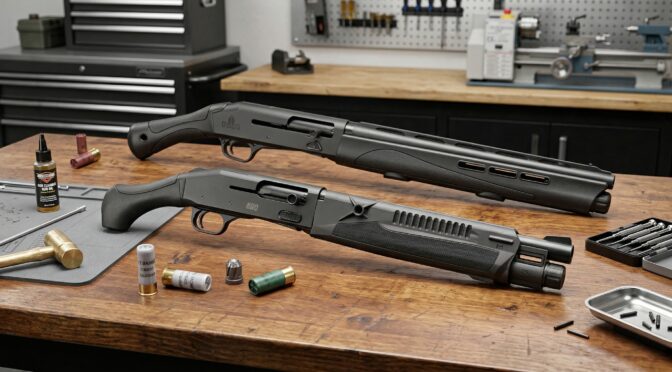
1. The Legal Architecture and Tactical Evolution of the Stockless Firearm
The contemporary landscape of defensive and tactical firearms has been heavily influenced by the intricate definitions established within the National Firearms Act of 1934 and the subsequent Gun Control Act of 1968. Within this comprehensive federal legal framework, a shotgun is distinctly defined as a weapon designed or redesigned, made or remade, and intended to be fired from the shoulder, utilizing the energy of an explosive to fire through a smooth bore either a number of ball shot or a single projectile for each single pull of the trigger.1 Consequently, any firearm that possesses a barrel shorter than eighteen inches or an overall length of less than twenty-six inches is federally classified as a Short Barreled Shotgun.1 This specific classification requires a specialized tax stamp, extensive background checks, and formal registration with the Bureau of Alcohol, Tobacco, Firearms and Explosives prior to transfer or possession.1
However, a highly specific convergence of engineering design and statutory interpretation has given rise to the “Other” firearm category, a segment sometimes referred to in administrative parlance as a Title 1 Firearm or a Pistol Grip Only platform.1 By engineering a smoothbore firearm that has never been equipped with a traditional shoulder stock directly from the factory floor, the legal classification of “shotgun” is entirely bypassed because the weapon was never designed to be fired from the shoulder.2 To avoid falling into the separate, highly regulated classification of an “Any Other Weapon” which also requires federal registration, firearms designers must ensure the weapon maintains an overall length explicitly exceeding twenty-six inches, as this dimension represents the federal threshold for concealability.1
This precise dimensional requirement has resulted in the development and widespread adoption of specialized rear grips, colloquially known as birdshead grips.5 These grips protrude horizontally from the rear of the receiver, extending the overall length of the firearm just enough to satisfy the twenty-six-inch legal threshold while maintaining an incredibly compact and highly maneuverable profile.5 Historically, this unique category of defensive tools was dominated almost exclusively by manual pump action designs, which required the operator to physically manipulate a sliding forend to cycle the action after every discharged shell.1 While manually operated actions are renowned for their mechanical reliability, pump action platforms in a stockless configuration presented significant operational challenges regarding recoil management and the distinct potential for short stroking the action under extreme psychological and physiological stress.1
The natural and necessary evolution of this concept has inevitably led to the integration of semi-automatic, auto-loading mechanisms.1 The introduction of self-loading actions into the “Other” firearm category represents a monumental shift in close quarters tactical capabilities.7 This technological advancement allows for rapid follow-up shots without the biomechanical disruption of manually manipulating a pump slide, thereby increasing the volume of accurate fire an operator can deliver in a compressed timeframe.7 At the absolute forefront of this technological shift are two highly advanced, distinctly engineered platforms: the Israel Weapon Industries Mafteah and the Mossberg 990 Aftershock.9 While both of these firearms share the exact same legal classification, the same twelve-gauge chambering, and highly similar compact dimensions, their internal operating systems represent entirely divergent philosophies of mechanical engineering.9 The Mafteah relies on an intricate inertia-driven, recoil-operated kinetic system 11, whereas the Mossberg 990 Aftershock utilizes a sophisticated, self-regulating, contained gas-operated piston system.3
2. Mechanical Engineering of Inertia-Operated Systems: The IWI Mafteah
The fundamental difference between these two compact platforms lies deep within their respective aluminum receivers and forward assemblies. The specific method by which a semi-automatic firearm harnesses the violent kinetic energy of a detonating twelve-gauge shotshell to extract a spent casing, cock the internal hammer, and feed a fresh round dictates every single aspect of the weapon’s reliability, required maintenance schedule, and perceived recoil profile. The Israel Weapon Industries Mafteah, named after the Hebrew word for “key” in a direct operational nod to the tactical concept of a ballistic breaching tool or master key, is a highly unique step forward in the stockless firearm market.13 It is officially designated as one of the very first firearms in its specific dimensional category to successfully utilize an inertia-driven, recoil-operated mechanism.5
In a traditional gas-operated system, expanding propellant gases are physically bled from the barrel to push a piston rearward. In stark contrast, an inertia-operated system utilizes the rearward kinetic momentum of the entire firearm itself.5 When a shotshell is fired from the Mafteah, the rapidly expanding combustion gases push the payload down the fourteen-inch, 4140 steel smoothbore barrel.12 Simultaneously, the entire firearm undergoes a violent rearward acceleration due to the fundamental physics of the conservation of momentum. Within the receiver, the rotary bolt head remains securely locked into the barrel extension.11 However, the bolt carrier, which is a significant, heavy mass of machined steel, effectively floats within the receiver tracks. As the firearm moves backward against the operator’s grip, this heavy bolt carrier attempts to remain stationary in physical space due to its own inherent inertia.11
This relative difference in physical motion between the rapidly accelerating receiver and the momentarily stationary bolt carrier causes a heavy, highly calibrated inertia spring located between the bolt head and the bolt carrier to compress violently.11 As the shotgun’s initial rearward movement reaches its peak and begins to slow against the operator’s hands, this tightly compressed inertia spring rapidly expands, throwing the bolt carrier forcefully to the rear of the receiver.11 This forceful rearward travel rotates and unlocks the bolt head, extracts the spent plastic casing from the three-inch chamber, ejects it forcefully through the side ejection port, and cocks the internal hammer mechanism.11 As the bolt group travels rearward, the action bars precisely time the shell stop to drop the next live shell onto the carrier.11 Finally, as the bolt reaches its maximum rearward travel, a separate action return spring pushes the entire assembly forward, forcing the carrier to raise the shell into position and stripping it directly into the chamber before rotating the bolt closed into the locked position.17
The engineering ingenuity of the Mafteah lies in its specific geometric packaging of these complex kinetic components. Many traditional inertia shotguns on the commercial market utilize an action return spring that is housed within a long aluminum tube extending deep into the shoulder stock.11 Because the Mafteah is legally mandated to remain a stockless “Other” firearm to avoid federal regulation, Israel Weapon Industries engineers had to completely redesign the internal architecture. They achieved this by wrapping the main recoil spring directly around the under-barrel magazine tube.13 This front-loaded spring design, which is highly reminiscent of the legendary operating systems found in the early twentieth-century Browning Auto-5 and Remington Model 11, allows the rear of the aluminum receiver to remain entirely flat and mechanically self-contained.6 This specific flat-backed receiver geometry perfectly accommodates the requisite birdshead pistol grip without the need for an obtrusive, protruding buffer tube.6
The primary, overwhelming advantage of the Mafteah’s inertia system is its unparalleled mechanical cleanliness and operational simplicity.10 Because absolutely no propellant gases are bled back into the receiver or the forend assembly to operate the action, the internal components remain exceptionally clean even after hundreds or thousands of rounds are fired in rapid succession.10 Carbon fouling acts as a highly abrasive grinding compound that can rapidly induce friction and sluggishness in gas-operated firearms, but in an inertia system, this fouling simply exits the muzzle directly behind the payload.10 This lack of a complex, heavy gas cylinder, gas piston, and fragile sealing rings also results in a significantly lighter overall firearm. Weighing only five pounds and eleven ounces when completely unloaded, the Mafteah possesses an incredibly thin, highly ergonomic forend that allows the operator to establish a tight, highly controlled grip extremely close to the bore axis.5
However, the strict laws of physics dictate an unavoidable trade-off for this mechanical simplicity. Because the inertia system relies entirely on the kinetic energy of the firearm moving backward, the system itself does not mechanically absorb or bleed off any of the primary recoil impulse.18 The operator physically feels the full, unmitigated force of the twelve-gauge detonation transferred directly into their hands and wrists.11 Furthermore, inertia systems require a specific, measurable threshold of recoil energy to fully compress the internal spring and cycle the action.11 While the Mafteah functions with absolute, proven reliability when feeding full-power magnum loads, standard defensive buckshot, and standard velocity birdshot, it can occasionally struggle to cycle ultra-light, reduced-recoil ammunition that drops below 1145 feet per second in velocity.10 If the recoil impulse is too weak, the inertia spring will simply not compress adequately, leading to a failure to eject or a failure to feed malfunction.11 The manufacturer specifically warns users that firing with unburned powder in the barrel or experiencing a squib load, which fails to cycle the action, requires immediate inspection to ensure a bullet or wad is not stuck in the bore, as a subsequent shot could cause the 4140 steel barrel to catastrophically explode.17
3. Thermodynamics and Mechanics of Gas-Operated Systems: The Mossberg 990 Aftershock
O.F. Mossberg and Sons essentially created the modern commercial market for the “Other” firearm category with the highly disruptive introduction of their pump action 590 Shockwave in 2017.1 The newly released 990 Aftershock represents their highly anticipated, technologically advanced entry into the semi-automatic segment of this specialized tactical market.1 Rather than utilizing the kinetic transfer of inertia, the 990 Aftershock harnesses the raw thermodynamic power of expanding propellant gases to autonomously operate its action.3
The mechanical heart of the 990 Aftershock is derived directly from Mossberg’s highly successful, competition-proven 940 Pro series of autoloading shotguns.1 When a twelve-gauge shell is fired in the Aftershock, the heavy lead payload travels down the interior of the cylinder bore barrel.20 Approximately halfway down the length of the barrel, a specific, highly calibrated volume of the high-pressure expanding combustion gas is bled off through precisely drilled ports located on the underside of the bore.21 These incandescent gases are directed violently downward into a gas cylinder that surrounds the external surface of the magazine tube, where they immediately impact against the face of a heavy metallic gas piston.22 The extreme atmospheric pressure forces the piston violently rearward, driving a pusher assembly and a pair of steel action bars backward along the outside of the magazine tube to unlock the bolt, eject the spent casing, and deeply compress the primary return spring.21
This contained gas-operated system provides two massive operational advantages over an inertia-driven platform within the context of a stockless firearm. First, it is significantly less sensitive to subtle ammunition variations and payload weights.25 Because the system actively taps high-pressure gas directly from the barrel behind the payload, it provides a forceful, positive mechanical stroke to the action bars regardless of the firearm’s total kinetic movement in space.22 This specific design allows the 990 Aftershock to reliably cycle a much wider spectrum of commercial ammunition, ranging from heavy three-inch magnum defensive loads down to significantly lighter, reduced-recoil tactical buckshot intended for sensitive environments.26
Second, the gas system fundamentally alters the perceived recoil profile of the firearm.7 By actively bleeding off a portion of the high-pressure gas and forcing it to perform mechanical work by pushing a heavy piston over a longer physical distance, the system effectively stretches the recoil impulse over a longer duration of time.7 Instead of a single, violent, instantaneous shockwave being transferred directly into the operator’s wrists and forearms, the recoil is delivered as a significantly smoother, longer push.7 This mechanical attenuation of the peak recoil force allows for significantly faster sight recovery, reduced operator fatigue, and noticeably faster follow-up shots during high-stress defensive engagements.7
The inherent disadvantage of any gas system, regardless of the manufacturer, is the unavoidable accumulation of carbon fouling.10 By purposefully tapping dirty, unburned powder, lead shavings, and hot combustion gases directly into the forend mechanics, the internal system will eventually become sluggish if it is not properly maintained.10 To effectively counteract this physical phenomenon, Mossberg engineers applied highly advanced metallurgical surface treatments to the internal components of the 990 Aftershock.15 Critical internal operating parts, including the entire gas piston assembly, the exterior surface of the magazine tube where the piston rides, the hammer, and the sear, are thoroughly coated in a specialized, highly durable nickel boron finish.15 Nickel boron creates a remarkably slick, self-lubricating metallic surface with an extremely low coefficient of friction.15 This advanced coating actively prevents hard carbon deposits from baking permanently onto the metal surfaces, allowing the firearm to run reliably for extended periods between deep cleanings and ensuring that any accumulated fouling can be easily wiped away with standard gun solvents without requiring aggressive scraping.15
Furthermore, the physical integration of this complex gas cylinder, piston, and pusher assembly around the magazine tube necessitates a thicker, noticeably bulkier forend compared to the ultra-slim profile of the Mafteah.5 The addition of these heavy steel mechanical components also increases the total weight of the firearm, bringing the 14.75-inch barreled version of the Aftershock to just over six pounds unloaded, and the 18.5-inch variant to 6.3 pounds.20 While this extra physical mass slightly reduces the overall portability and handling speed of the weapon in tight confines, it provides a secondary ballistic benefit by further absorbing kinetic recoil energy, making the heavier platform incredibly stable and controllable during rapid fire strings.8
4. Ergonomics, Control Integration, and Human Interface Design
The ultimate tactical effectiveness of a compact, stockless twelve-gauge firearm is heavily dependent on its specific ergonomic design. Firing a heavy payload without the biomechanical stabilization provided by a traditional shoulder stock requires specific, practiced physical techniques, and the firearm’s physical interface must facilitate these techniques flawlessly to ensure operator safety and accuracy.
4.1 Grip Geometry, Counter-Tension, and Forward Control
Both the IWI Mafteah and the Mossberg 990 Aftershock utilize highly specialized rear grips explicitly designed to extend the overall length past the twenty-six-inch federal requirement.12 The Mafteah features a sleek, reinforced polymer birdshead style grip that seamlessly blends into the rear of the receiver.12 This specific grip design maintains a relatively horizontal angle, which positions the operator’s wrist in a neutral, biomechanically relaxed state during operation.5 This neutral wrist angle is absolutely vital for long-term health and immediate control because it directs the severe recoil forces linearly backward and slightly upward, rather than driving the force directly downward into the delicate carpal bones of the wrist, effectively preventing repetitive strain injuries during extended training sessions.5 The Mafteah grip is also highly textured for grip retention and features built-in flush cup attachments for quick detach sling swivels, allowing the operator to utilize a modern single point sling for weapon retention and secondary outward stabilization.6
The Mossberg 990 Aftershock employs a proprietary grip design that departs slightly from the traditional, perfectly smooth birdshead profile found on earlier pump action models.32 The Aftershock grip is distinctly hooked at the rear and features a slightly flat-bottomed shape, incorporating an aggressive rubberized palm pad integrated directly into the upper curve of the polymer.29 This dense rubberized padding is explicitly designed to absorb high-frequency vibrations transferred through the receiver and to visibly minimize felt recoil during rapid engagements.15 The specifically hooked nature of the grip acts as a physical backstop, preventing the firearm from slipping rearward through the firing hand during the violent recoil stroke.34 A standard metal rear swivel stud port is securely molded into the base of the grip for traditional two-point sling attachment.15
To safely and accurately operate these stockless firearms, users must employ a rigorous push-pull isometric tension technique.26 The operator’s firing hand pulls the rear grip firmly backward toward the chest, while the support hand pushes the forend aggressively forward toward the target.26 This deliberate counter-tension effectively stabilizes the weapon in physical space, essentially locking it in place and preventing the muzzle from rising uncontrollably during the shot.26 To facilitate this critical technique and ensure absolute operator safety, both manufacturers have integrated heavy-duty nylon safety straps directly onto the bottom of their respective forends.15 These embossed straps lock the support hand firmly onto the polymer handguard, guaranteeing that the hand cannot inadvertently slide forward past the muzzle during rapid fire, a critical, life-saving safety feature on firearms with sub-fifteen-inch barrels.15
Both platforms also recognize the modern tactical necessity for electronic accessory integration. The Mafteah features extensive M-LOK slots milled directly into its polymer handguard at the three, six, and nine o’clock positions, allowing for the seamless, flush attachment of high-lumen tactical weapon lights or laser aiming modules without requiring bulky Picatinny rails.13 The 990 Aftershock accomplishes this exact same goal by integrating a specialized metal magazine tube extension fixture that incorporates multi-sided M-LOK compatible slots near the muzzle, providing immediate modularity for lights and lasers without requiring the user to purchase an aftermarket replacement forend.15
4.2 Action Manipulation, Safety Mechanisms, and Loading Enhancements
The physical manipulation of the bolt, the operation of the safety, and the emergency loading procedures present another area of significant engineering divergence between the two models. The IWI Mafteah utilizes a traditional, straightforward bottom loading gate and elevator system to feed the five-round magazine tube.17 However, its most unique external control feature is a fully reversible, heavily knurled charging handle attached directly to the bolt carrier.6 The operator can easily pull the charging handle free and insert it into a matching detent on the left side of the bolt carrier.6 This ambidextrous capability is a massive ergonomic advantage, specifically allowing right-handed shooters to maintain their dominant firing grip on the birdshead stock while using their non-dominant left hand to quickly cycle the action, clear complex malfunctions, or execute emergency port reloads directly into the open ejection port.5
The Mossberg 990 Aftershock, inheriting the refined competition pedigree of the 940 Pro series, features heavily upgraded, oversized controls installed straight from the factory.1 The external charging handle is significantly enlarged and aggressively knurled for positive traction, ensuring reliable operation even when the user is wearing heavy tactical gloves or working under wet, slick conditions.15 The bolt release button, located on the right side of the receiver just below the ejection port, is an oversized paddle-style mechanism that requires only a fast gross motor movement to activate, rather than a precise fine motor press with the fingertip.15
Furthermore, Mossberg engineers radically overhauled the entire loading port geometry on the underside of the 990 Aftershock receiver.32 The loading port is extensively enlarged and deeply beveled on the edges, eliminating sharp metallic corners that could snag fingers, tear gloves, or scrape thumb joints during rapid quad-loading techniques.32 The internal steel elevator is elongated and designed specifically to be pinch-free, ensuring that the user’s thumb is not painfully trapped against the magazine tube when pushing shells past the internal shell catch.15 An anodized, bright orange aluminum follower rests inside the magazine tube, providing an immediate visual and tactile indicator that the magazine is completely empty.15 These combined geometric enhancements allow the 990 Aftershock to be reloaded with exceptional speed and fluidity, a critical metric during high-stress defensive scenarios where the five-round capacity may quickly be depleted.1
The safety mechanisms of the two firearms also reflect different design philosophies. The Mafteah utilizes a standard cross-block, or cross-bolt, safety button located horizontally within the rear of the trigger guard.2 This traditional design requires the operator to push the button laterally with the index finger to disengage the safety prior to engaging the trigger.2 In contrast, the Mossberg 990 Aftershock proudly retains the brand’s legendary top tang safety placement.15 This oversized, highly ergonomic slider switch is positioned directly on the upper rear spine of the receiver, making it perfectly ambidextrous for both left and right-handed shooters.15 The tang safety allows the operator to instantly disengage the mechanism with a simple forward push of the firing thumb without ever altering their established grip on the birdshead stock, providing an incredibly fast and intuitive transition from a safe condition to an active firing posture.15
5. Electro-Optical Integration: Footprints and Co-Witnessing Dynamics
Historically, shotguns and smoothbore firearms relied almost exclusively on simple brass bead sights or elevated ventilated ribs to direct fire.2 However, the integration of Micro Red Dot Sights has completely revolutionized the tactical paradigm across all firearm platforms, allowing for rapid, threat-focused, both-eyes-open target acquisition.37 Because stockless “Other” firearms are held away from the face in a floating posture and not rigidly shouldered against the cheek, aligning a traditional bead sight perfectly with the eye can be exceedingly difficult in chaotic, low-light environments.10 The presence of an illuminated, parallax-free red dot drastically increases first-round hit probability and transition speed.39 Both Israel Weapon Industries and Mossberg have recognized this fundamental shift in tactical doctrine and engineered their aluminum receivers to seamlessly accept modern optics, but they utilize entirely different footprint standards to achieve this goal.
5.1 The Glock MOS Architecture on the IWI Mafteah
In a highly unorthodox but remarkably brilliant engineering decision, IWI machined the top of the aluminum receiver of the Mafteah to be perfectly compatible with the Glock Modular Optic System footprint.5 The Glock MOS system is arguably the most widely recognized and heavily supported optics mounting architecture in the modern commercial firearms industry.10 Rather than machining the receiver for one specific proprietary optic, the MOS cut is a standardized, elongated recessed pocket designed to accept a wide series of interchangeable steel adapter plates.10
By utilizing the familiar MOS architecture on a twelve-gauge platform, the Mafteah inherently gains immediate access to a massive existing ecosystem of mounting hardware.10 Operators can utilize standard Glock adapter plates, or source high-precision aftermarket plates from specialized companies like C&H Precision, to securely mount almost any optic currently on the market.10 Whether the user prefers the rugged, combat-proven durability of the Trijicon RMR footprint, the enclosed emitter design of the Aimpoint ACRO, or the expansive viewing window of a Holosun 507C, an MOS compatible plate exists to effortlessly facilitate the union.40
This specific, deeply milled receiver cut allows the optic to sit incredibly low relative to the bore axis.35 If an operator chooses to use traditional Picatinny rail sections to mount an optic, the combined height of the heavy rail and the optic mount significantly raises the line of sight, creating an uncomfortable offset.35 The deeply recessed MOS pocket drops the red dot housing down into the receiver, often allowing the projected reticle to co-witness perfectly with the Mafteah’s factory-installed front bead sight, which rests atop a raised, ventilated barrel rib.2 This co-witnessing capability provides a vital failsafe mechanical backup; if the optic’s battery dies or the glass shatters during a critical engagement, the operator can simply look through the optical window and utilize the front bead to direct accurate fire.2
5.2 The Shield RMSc Standard on the Mossberg 990 Aftershock SPX
Mossberg approached the complex optics integration challenge by utilizing precision direct-milling technology on their premium SPX variants.37 While the standard base model 990 Aftershock receiver is simply drilled and tapped with threaded holes to accept a standard Picatinny rail, the upgraded 990 Aftershock SPX models feature an aluminum receiver that is precision-cut directly from the factory with the Shield RMSc footprint.37
The Shield RMSc, or Reflex Mini Sight Compact, footprint was originally developed for subcompact concealed carry pistols, but due to its robust screw placement and recoil lugs, it has rapidly become a universal industry standard for low-profile, ruggedized optics.37 The immense mechanical advantage of direct-milling a specific footprint into the receiver is the total elimination of intermediary adapter plates.43 An optic utilizing the RMSc footprint, such as the Holosun 407K, the Sig Romeo Zero, or the Vortex Defender CCW, can be bolted directly into the aluminum receiver of the 990 Aftershock SPX.45
By eliminating the intermediary adapter plate from the equation, Mossberg effectively removes a potential point of mechanical failure.41 The severe, cyclic recoil forces generated by a semi-automatic twelve-gauge act aggressively upon the tiny, high-tensile mounting screws holding an optic in place, often causing them to shear or loosen over time.41 A direct-mount interface allows the optic housing to nestle deeply into precision-machined recoil lugs milled within the receiver itself, transferring the massive shear forces away from the delicate screws and directly into the solid mass of the aluminum frame, drastically improving the zero retention and long-term durability of the electronic sight.41
For tactical operators who prefer optics that do not utilize the specific RMSc footprint, Mossberg thoughtfully includes three specialized, low-profile adapter plates directly in the box with every SPX model.33 These plates adapt the factory RMSc cut to securely accommodate the popular Trijicon RMR, Docter/Noblex, and Leupold DeltaPoint Pro footprints, ensuring total versatility without requiring the user to purchase expensive aftermarket hardware.33 The SPX models are further enhanced by the inclusion of an LPA brand fiber optic front sight protected by robust steel wings.33 This bright red fiber optic gathers ambient light, providing an exceptionally visible aiming point that pairs seamlessly with the rapid target acquisition techniques facilitated by the red dot sight.33 In addition to traditional optics, Mossberg also offers a specific variant of the 14.75-inch Aftershock equipped with a factory-installed Crimson Trace Lasersaddle, which provides a highly visible five milliwatt green laser adjustable for windage and elevation, offering alternative aiming solutions for firing from the hip.15
6. Practical Utility and Ballistic Efficacy in Close-Quarters Environments
The true tactical value of the “Other” firearm category is realized almost exclusively within the extreme confines of close quarters environments. Navigating the narrow hallways of a residential structure, maneuvering around tight doorways, or deploying a weapon from within the highly restrictive interior of a vehicle presents severe geometric challenges.7 A traditional tactical shotgun equipped with a full shoulder stock and an eighteen-inch barrel often boasts an overall length exceeding forty inches.7 This extended length can easily catch on doorframes, telegraph the user’s position around blind corners long before they can see the threat, and prove highly unwieldy when attempting to track a rapidly moving adversary at extremely close distances.7
By truncating the overall length to a mere 27.75 inches for the IWI Mafteah and 27.125 inches for the 14.75-inch Mossberg 990 Aftershock, these platforms offer supreme, unmatched maneuverability.7 The short physical profile allows the operator to maintain the weapon tightly compressed against the body in a high-ready retention posture, drastically reducing the likelihood of a hostile adversary successfully grabbing the barrel and disarming the operator during a physical struggle.7 When pushing through a fatal funnel or carefully pieing a corner to clear a room, the sub-thirty-inch profile ensures that the muzzle does not blindly precede the operator into an uncleared space, allowing them to maintain the element of surprise.7
Furthermore, the integration of semi-automatic actions into these diminutive platforms completely revolutionizes their defensive efficacy and reliability under stress. Firing a manual pump action stockless firearm requires the operator to absorb the heavy recoil, forcefully rack the slide rearward to eject the shell, forcefully drive the slide forward to lock the bolt and chamber a new round, and then reacquire the sight picture, all while maintaining the weapon floating in space.7 Under the massive adrenaline dumps and sympathetic nervous system responses associated with lethal force encounters, operators routinely suffer from severely diminished fine motor skills and a total loss of gross motor coordination.7 This well-documented biological stress response frequently causes individuals to “short-stroke” a pump action shotgun, failing to rack the slide fully rearward, which induces a catastrophic double-feed or failure to extract malfunction that is incredibly difficult to clear under fire.7
The Mafteah and the 990 Aftershock eliminate the possibility of human-induced short-stroking entirely.7 The operator is only required to maintain an aggressive, isometric push-pull tension on the grips, manage the recoil impulse, and manipulate the trigger mechanism.7 The mechanical systems autonomously extract, eject, and chamber the subsequent round in a fraction of a second.7 This self-loading capability allows for devastatingly fast follow-up shots, enabling the user to place multiple payloads of heavy buckshot onto a dynamic threat almost instantaneously, maximizing the probability of immediate incapacitation.8
Despite their abbreviated barrels, these firearms deliver formidable terminal ballistics.10 A fourteen-inch cylinder bore barrel provides excellent velocity and energy transfer at typical indoor engagement distances ranging from three to fifteen yards.1 When loaded with premium, flight-controlled defensive buckshot, platforms like the Mafteah are capable of producing incredibly tight, fist-sized patterns at ten yards, ensuring that every individual pellet strikes the intended target.10 This tight patterning effectively mitigates the severe legal and moral liabilities associated with overpenetration and collateral damage caused by stray projectiles missing the target.10
7. Official Manufacturer Specifications and Online Market Analysis
A thorough, professional examination of these platforms requires a precise understanding of their physical specifications alongside their current position within the retail supply chain. The following tables synthesize the official technical data provided directly by the manufacturers, followed by an exhaustive audit of live market pricing from verified, preferred online vendors.
7.1 Official Manufacturer Technical Specifications
To ensure absolute exactness, the data presented below is derived strictly from the official technical documents published by Israel Weapon Industries and O.F. Mossberg and Sons.
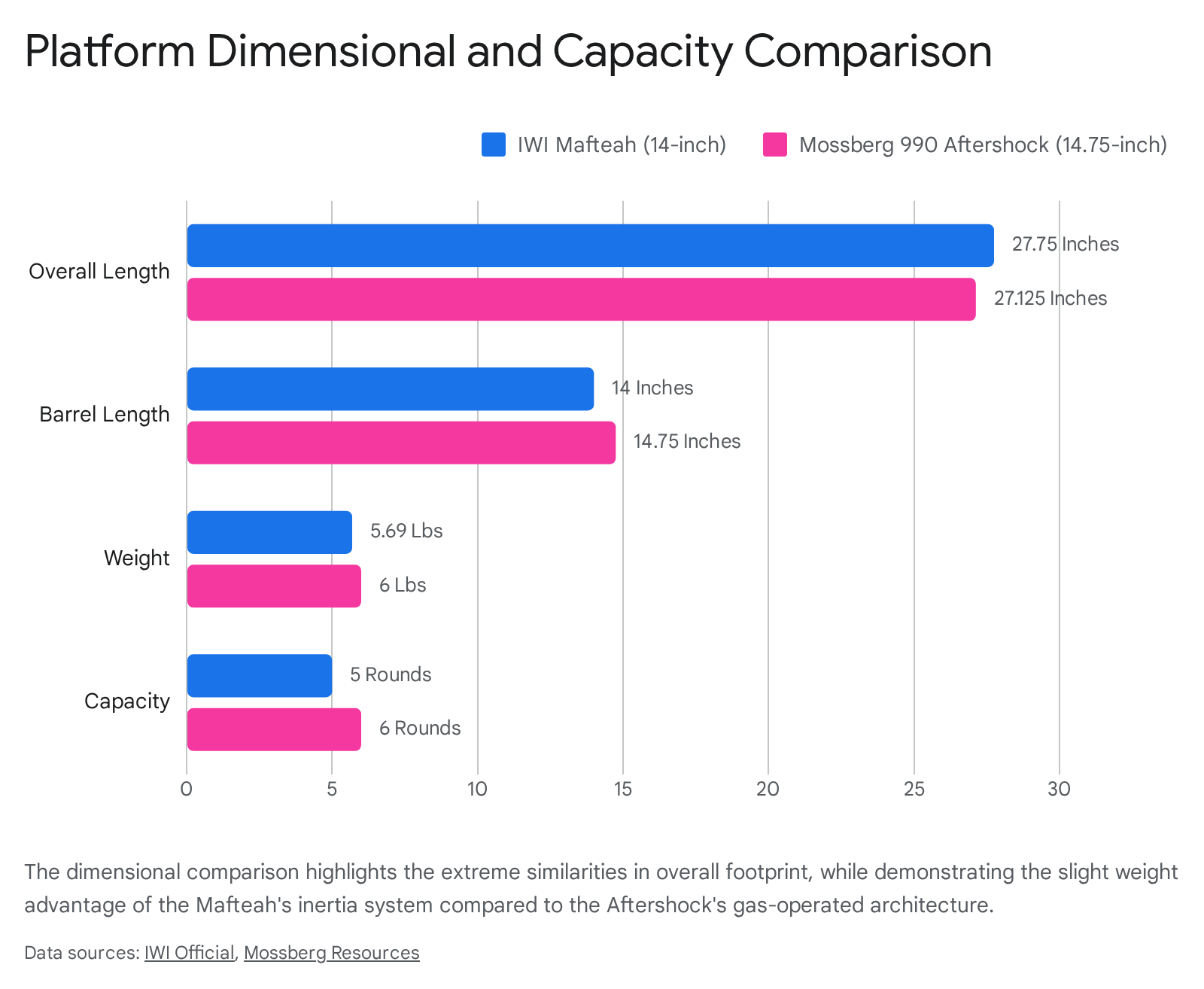
| Specification | IWI Mafteah (MFK1214) | Mossberg 990 Aftershock (83001) |
| Operating System | Recoil Operated (Inertia) 12 | Gas Operated 3 |
| Caliber/Chamber | 12 Gauge, 3-inch Chamber 12 | 12 Gauge, 3-inch Chamber 20 |
| Barrel Length | 14.0 Inches 12 | 14.75 Inches 20 |
| Overall Length | 27.75 Inches 12 | 27.125 Inches 20 |
| Unloaded Weight | 5 lbs 11 oz 12 | 6.0 lbs 20 |
| Capacity (2.75″ Shells) | 5 Rounds (Tube Magazine) 12 | 5 + 1 Rounds 20 |
| Optics Integration | Tapped for Glock MOS Plates 13 | Tapped Receiver / RMSc on SPX 20 |
| Barrel Features | 4140 Steel, Vent Rib, Smooth Bore 12 | Matte Blue, Cylinder Bore 20 |
| Base MSRP | $999.99 12 | $1,120.00 20 |
| Official Manufacturer URL | https://iwi.us/firearms/mafteah-shotgun-series/mafteah-12ga-14/ | https://www.mossberg.com/firearms/others/990-aftershock.html |
7.2 Validated Online Market Availability and Pricing Data
The following procurement data represents an active snapshot of the current retail market for these specific firearms. The vendors selected are authorized distributors, and the listed prices reflect the current market median, situated between the manufacturer’s suggested retail price and the absolute minimum observed retail threshold. Alternative vendors have been utilized exclusively where preferred vendors do not currently feature a direct listing.
IWI Mafteah (Model MFK1214) Vendor Availability:
The observed market median for the Mafteah currently rests near $920.00.
| Authorized Vendor | Listed Price | Direct Product URL |
| Bereli | $919.99 50 | https://www.bereli.com/mfk1214/ |
| Primary Arms | $919.99 51 | https://www.primaryarms.com/iwi-us-mafteah-semiauto-12-gauge-shotgun-14in-black |
| Midway USA | $920.00 52 | https://www.midwayusa.com/product/1028576526 |
| KYGunCo | $929.99 53 | https://www.kygunco.com/product/iwi-mafteah-12-gauge-14-5rd-black |
| GrabAGun (Alternative) | $929.99 54 | https://grabagun.com/iwi-mafteah-12-ga-14-barrel-5-rounds.html |
Mossberg 990 Aftershock (Model 83001 Base / Model 83013 SPX) Vendor Availability:
The observed market median for the 990 Aftershock series currently ranges from approximately $892.00 for base models to $965.00 for upgraded variations.
| Authorized Vendor | Listed Price | Direct Product URL |
| Palmetto State Armory | $892.99 55 | https://palmettostatearmory.com/mossberg-990-aftershock-14-75-12-gauge-5rd-shotgun-83001.html |
| Sportsmans Warehouse | $919.99 56 | https://www.sportsmans.com/shooting-gear-gun-supplies/shotguns/mossberg-990-aftershock-12-gauge-3in-matte-blued-semi-automatic-shotgun-1475in/p/1940754 |
| Brownells (SPX Model) | $925.99 57 | https://www.brownells.com/guns/shotguns/semi-auto-shotguns/990-aftershock-12-gauge-semi-auto-shotgun/ |
| Shooting Surplus | $915.83 58 | https://shootingsurplus.com/mossberg-990-aftershock-12-gauge-14-75-semi-auto-5-1-matte-blue-receiver/?sku=180708 |
| Midway USA | $964.99 59 | https://www.midwayusa.com/product/1028550092 |
8. Conclusions on Tactical Selection and Operational Superiority
The engineering dichotomy between the Israel Weapon Industries Mafteah and the Mossberg 990 Aftershock dictates that neither platform is universally superior, instead, each clearly excels within specific operational parameters and designated maintenance philosophies.
The IWI Mafteah is the optimal selection for operators who prioritize extreme mechanical simplicity, long-term durability without the need for rigorous cleaning schedules, and the absolute lightest possible weight in a twelve-gauge package. By utilizing an inertia-operated system that physically wraps the kinetic spring around the magazine tube, the Mafteah offers a sleek, ultra-clean running firearm that meticulously avoids the carbon fouling inherently associated with gas operation. Its integration of the universally supported Glock MOS optics footprint provides unparalleled flexibility for mounting modern red dot sights securely and low enough to mathematically co-witness with traditional hardware. However, users must be acutely aware that this lightweight platform will transmit significantly more raw recoil energy directly to the hands and wrists, and it stringently requires the use of standard to heavy defensive ammunition to guarantee sufficient kinetic energy for reliable cycling of the bolt carrier.
Conversely, the Mossberg 990 Aftershock represents the absolute pinnacle of refined recoil mitigation and cyclic reliability across a significantly broader spectrum of ammunition types. The integration of the 940 Pro series gas-operated architecture dramatically softens the violent recoil impulse of the twelve-gauge cartridge, effectively stretching the physical shock over a longer duration and allowing for notably faster, more accurate follow-up shots during high-stress encounters. The addition of advanced nickel boron coatings heavily combats the primary flaw of gas systems by preventing dense carbon buildup on critical components, while the oversized controls and deeply beveled loading port offer unmatched ergonomic manipulation under duress. For those seeking immediate out-of-the-box optic integration, the SPX variant’s direct-milled Shield RMSc footprint provides the most secure, ruggedized optical mounting solution available, entirely eliminating the potential failure points of intermediary adapter plates. The penalty for these extensive features is a slightly heavier platform and a thicker forend, alongside the necessity for more frequent deep cleaning of the gas cylinder system to maintain peak reliability.
Ultimately, the deployment of a sub-thirty-inch, semi-automatic twelve-gauge firearm provides formidable ballistic capability in restricted environments where traditional long guns prove utterly unmanageable. Whether relying on the kinetic resilience of the Mafteah’s inertia spring or the thermodynamic fluid dynamics of the Aftershock’s gas piston, operators are equipped with a tool that completely redefines the boundaries of modern close-quarters defense.
Note: Vendor Sources listed are not an endorsement of any given vendor. It is our software reporting a product page given the direction to list products that are between the minimum and average sales price when last scanned.
Please share the link on Facebook, Forums, with colleagues, etc. Your support is much appreciated and if you have any feedback, please email us in**@*********ps.com. If you’d like to request a report or order a reprint, please click here for the corresponding page to open in new tab.
Sources Used
- Mossberg 990 AfterShock 12-Gauge Semi-Auto – GUNS Magazine, accessed April 12, 2026, https://gunsmagazine.com/discover/mossberg-990-aftershock-12-gauge-semi-auto/
- New For 2025: IWI Mafteah | An Official Journal Of The NRA – American Rifleman, accessed April 13, 2026, https://www.americanrifleman.org/content/new-for-2025-iwi-mafteah/
- Mossberg 990 AfterShock, short-barreled 12-gauge gun – GUNSweek.com, accessed April 12, 2026, https://gunsweek.com/en/shotguns/news/mossberg-990-aftershock-short-barreled-12-gauge-gun
- The IWI Mafteah – The Key To Happiness – YouTube, accessed April 13, 2026, https://www.youtube.com/watch?v=b2A82LyKy28
- The IWI Mafteah – The Key – GAT Daily (Guns Ammo Tactical), accessed April 13, 2026, https://gatdaily.com/articles/the-iwi-mafteah-the-key/
- IWI Mafteah, new Israeli-American 12-gauge “firearm” | GUNSweek.com, accessed April 13, 2026, https://gunsweek.com/en/shotguns/news/iwi-mafteah-new-israeli-american-12-gauge-firearm
- REVIEW: Mossberg 990 AfterShock – Shoot On, accessed April 13, 2026, https://shoot-on.com/review-mossberg-990-aftershock/
- Gun Of The Week: Mossberg 990 Aftershock – YouTube, accessed April 12, 2026, https://www.youtube.com/watch?v=YKP0Bvkcw8U
- Mossberg and IWI released a similar gun coincidentally at the exact same time (Template Included!) : r/GunMemes – Reddit, accessed April 12, 2026, https://www.reddit.com/r/GunMemes/comments/1k6d6u4/mossberg_and_iwi_released_a_similar_gun/
- IWI Mafteah: Super Short, Super Fast, And Super Fun – Inside Safariland, accessed April 13, 2026, https://inside.safariland.com/blog/iwi-mafteah-super-short-super-fast-and-super-fun/
- This Is My Boomstick! The IWI Mafteah – GAT Daily (Guns Ammo Tactical), accessed April 13, 2026, https://gatdaily.com/articles/this-is-my-boomstick-the-iwi-mafteah/
- MAFTEAH 12Ga 14″ – IWI US, accessed April 13, 2026, https://iwi.us/firearms/mafteah-shotgun-series/mafteah-12ga-14/
- MAFTEAH 12GA Shotgun Series | IWI US, accessed April 13, 2026, https://iwi.us/firearms/mafteah-shotgun-series/
- Mossberg® Releases 990™ Aftershock™ SPX Semi-Auto Firearm, accessed April 12, 2026, https://resources.mossberg.com/journal/mossberg-releases-990-aftershock-spx-semi-auto-firearm
- Mossberg® Releases 990 Aftershock Semi-Auto Firearm, accessed April 13, 2026, https://resources.mossberg.com/hubfs/press_releases/Mossberg%20Releases%20990%20Aftershock%20Semi%20Auto%20PR%204-22-2025%20FINAL%20(005).pdf
- Another “Not a Shotgun” | The Armory Life Forum, accessed April 12, 2026, https://www.thearmorylife.com/forum/threads/another-not-a-shotgun.22507/
- MAFTEAH Shotgun – IWI, accessed April 13, 2026, https://iwi.us/wp-content/uploads/2025/05/IWI-Mafteah-Manual-V5.21.25.pdf
- benelli recoil, accessed April 12, 2026, https://forums.benelliusa.com/topic/10407-benelli-recoil/
- Lets talk shotgun recoil, pump vs over/under vs semi-auto inertia vs gas – Reddit, accessed April 12, 2026, https://www.reddit.com/r/Shotguns/comments/1i2ivgf/lets_talk_shotgun_recoil_pump_vs_overunder_vs/
- Mossberg® Releases 990 Aftershock™ Semi-Auto Firearm, accessed April 13, 2026, https://resources.mossberg.com/journal/mossberg-releases-990-aftershock-semi-auto-firearm
- New For 2025: Mossberg 990 Aftershock | An Official Journal Of The NRA, accessed April 13, 2026, https://www.americanrifleman.org/content/new-for-2025-mossberg-990-aftershock/
- Mossberg 990 Aftershock: Not Just An “Other” Firearm | An Official Journal Of The NRA, accessed April 13, 2026, https://www.americanrifleman.org/content/mossberg-990-aftershock-not-just-an-other-firearm/
- MOSSBERG 990 Aftershock 12 Gauge 14.75″ BBL 5 Round Black SKU: 430113433 – Brownells, accessed April 12, 2026, https://www.brownells.com/guns/shotguns/semi-auto-shotguns/990-aftershock-12-gauge-semi-auto-shotgun/?sku=430113433
- Mossberg 990 Aftershock Semi-Auto 12 GAUGE Shotgun – 14.75″ – Black – Primary Arms, accessed April 12, 2026, https://www.primaryarms.com/mossberg-990-aftershock-semiauto-12-gauge-shotgun-1475in-black
- The 990 Aftershock and IWI Mafteah – In Hand Preview – YouTube, accessed April 12, 2026, https://www.youtube.com/watch?v=Dl7w30pzBXY
- Shotgun recommendations for home defense and bear defense : r/liberalgunowners – Reddit, accessed April 12, 2026, https://www.reddit.com/r/liberalgunowners/comments/1fasy8h/shotgun_recommendations_for_home_defense_and_bear/
- Remington 11-87 SP-T Thumbhole | An Official Journal Of The NRA – Shooting Illustrated, accessed April 12, 2026, https://www.shootingillustrated.com/content/remington-11-87-sp-t-thumbhole/
- Mossberg 990 Aftershock 12 GA-3″ 14.75″ Barrel 5-Rounds, accessed April 12, 2026, https://grabagun.com/mossberg-m990-aftershock-12-ga-3-14-7-barrel-5-rounds.html
- Mossberg 990 AfterShock 12 Gauge Semi-Auto Shotgun – Alexander’s Store, accessed April 13, 2026, https://alexandersstore.com/product/msbrg-990-aftershock-12-14-75-ctc-5r/
- manual, accessed April 12, 2026, https://resources.mossberg.com/hubfs/manuals/104254%20M990%20Owners%20Manual3.pdf
- IWI Mafteah 12 Gauge Shotgun 14″ 5-Rd – Alexander’s Store, accessed April 13, 2026, https://alexandersstore.com/product/iwi-mafteah-12ga-14-5rd-blk/
- Mossberg 990 Aftershock 14.75″ 12 Gauge 5rd Shotgun – 83001 | Palmetto State Armory, accessed April 12, 2026, https://palmettostatearmory.com/mossberg-990-aftershock-14-75-12-gauge-5rd-shotgun-83001.html
- MOSSBERG 990 SPX AfterShock Semi-Auto Shotgun 83013 – Gritr Sports, accessed April 12, 2026, https://gritrsports.com/mossberg-990-spx-aftershock-semi-auto-shotgun-83013
- Mossberg 990 Series Breakdown: Aftershock and Magpul SPX – Blog.GritrSports.com, accessed April 13, 2026, https://blog.gritrsports.com/mossberg-990-aftershock-and-990-magpul-spx-review/
- The Mafteah Gets a Stock! – GAT Daily, accessed April 12, 2026, https://gatdaily.com/articles/the-mafteah-gets-a-stock/
- Mossberg 990 Aftershock SPX – AXIS MFG, accessed April 12, 2026, https://axismfg.com/products/mossberg_990_aftershock_spx
- Mossberg 990 SPX MagPul and Aftershock: the new semi-automatic tactical shotguns, accessed April 13, 2026, https://gunsweek.com/en/shotguns/news/mossberg-990-spx-magpul-and-aftershock-new-semi-automatic-tactical-shotguns
- Mossberg 990 Aftershock Review: Shock To The System – Gun Digest, accessed April 12, 2026, https://gundigest.com/gun-reviews/shotguns/mossberg-990-aftershock-review
- 5 Top Glock MOS Pattern Compatible Red Dot Optics – Athlon Outdoors, accessed April 12, 2026, https://athlonoutdoors.com/article/glock-compatible-optics/
- gen6 optic ready system – Glock, accessed April 12, 2026, https://us.glock.com/about/technology/optic-mounting
- AVAILABLE NOW: MPO PRO-F Direct Mount Plates for Glock MOS, HK, FN, & IWI Pistols [+ How to Install] – YouTube, accessed April 12, 2026, https://www.youtube.com/watch?v=uYEUF-0rxGo
- MOSSBERG 990 AFTERSHOCK SPX 12 GAUGE 18.5” SEMI-AUTO SHOTGUN – Brownells, accessed April 12, 2026, https://www.brownells.com/guns/shotguns/semi-auto-shotguns/990-aftershock-spx-12-gauge-18.5-semi-auto-shotgun/
- 2026 CATALOG – Waffen Ferkinghoff, accessed April 12, 2026, https://www.waffen-ferkinghoff.com/media/2c/9f/ea/1770887080/2026_MOSSBERG%202026%20CATALOG_low%20res.pdf
- RMSc Footprint Compatible Handguns – Swampfox Optics, accessed April 12, 2026, https://www.swampfoxoptics.com/rmsc-footprint-compatible-handguns
- Footprints/Mounting Standards on Red Dot Sights – Optics Trade Blog, accessed April 12, 2026, https://www.optics-trade.eu/blog/footprints-on-red-dot-sights/
- IWI MASADA SLIM ELITE OR 9MM 3.44″ M9SLIM13E – Shyda’s Outdoor Center, accessed April 12, 2026, https://shydasoutdoorcenter.com/iwi-masada-slim-elite-or-9mm-3-44-m9slim13e/
- Vortex Optics: The All New Defender CCW – Fin Feather Fur Outfitters, accessed April 12, 2026, https://www.finfeatherfur.com/VentureOut/vortex-optics-the-all-new-defender-ccw/
- The Best Guns of 2025 (Year in Review) – Gun University, accessed April 12, 2026, https://gununiversity.com/best-guns-of-2025/
- IWI Expands Smoothbore Portfolio with 2025 Mafteah Release – Black Basin Outdoors, accessed April 13, 2026, https://blackbasin.com/news/iwi-expands-smoothbore-portfolio-with-2025-mafteah-release/
- IWI US Mafteah 12 Gauge 14″ Barrel Semi-Auto Shotgun, M-LOK, 5+1rd Capacity, Black, accessed April 12, 2026, https://www.bereli.com/mfk1214/
- IWI US Mafteah Semi-Auto 12 GAUGE Shotgun – 14″ – Black – Primary Arms, accessed April 12, 2026, https://www.primaryarms.com/iwi-us-mafteah-semiauto-12-gauge-shotgun-14in-black
- IWI US Mafteah Semi Automatic 12 Ga Shotgun 14 Black Barrel Black – MidwayUSA, accessed April 12, 2026, https://www.midwayusa.com/product/1028576526
- IWI Mafteah 12 Gauge 14″ 5rd – Black, accessed April 12, 2026, https://www.kygunco.com/product/iwi-mafteah-12-gauge-14-5rd-black
- IWI Mafteah 12 GA 14″ Barrel 5-Rounds, accessed April 12, 2026, https://grabagun.com/iwi-mafteah-12-ga-14-barrel-5-rounds.html
- Mossberg 990 Semi-Automatic Shotguns for Self Defense | Palmetto State Armory, accessed April 12, 2026, https://palmettostatearmory.com/brands/mossberg/shotguns/990.html
- Mossberg 990 Aftershock 12 Gauge 3in Matte Blued Semi Automatic Shotgun – 14.75in, accessed April 12, 2026, https://www.sportsmans.com/shooting-gear-gun-supplies/shotguns/mossberg-990-aftershock-12-gauge-3in-matte-blued-semi-automatic-shotgun-1475in/p/1940754
- MOSSBERG 990 AFTERSHOCK 12 GAUGE SEMI-AUTO SHOTGUN – Brownells, accessed April 12, 2026, https://www.brownells.com/guns/shotguns/semi-auto-shotguns/990-aftershock-12-gauge-semi-auto-shotgun/
- Mossberg 990 AfterShock 12 Gauge 14.75″ Semi-Auto 5+1 Matte Blue Receiver, accessed April 12, 2026, https://shootingsurplus.com/mossberg-990-aftershock-12-gauge-14-75-semi-auto-5-1-matte-blue-receiver/?sku=180708&utm_source=wikiarms&utm_medium=referral&utm_content=deallistings&utm_campaign=wikiarmslistings
- Mossberg 990 AfterShock Semi Automatic 12 Ga Shotgun 18.5 Matte Blued – MidwayUSA, accessed April 12, 2026, https://www.midwayusa.com/product/1028550092