
1. Executive Summary
The United States small arms ammunition sector is currently navigating an unprecedented convergence of labor unrest, supply chain fragility, and escalating consumer demand. The focal point of this severe disruption is the ongoing labor strike at the Lake City Army Ammunition Plant located in Independence, Missouri. Initiated on April 4, 2026, the strike by approximately 1,350 members of the International Association of Machinists and Aerospace Workers Local 778 has effectively halted operations at the primary manufacturing hub for United States military small-caliber ammunition.1 As of April 16, 2026, the situation remains entirely unresolved, with negotiations between the union and the facility operator, Olin Winchester, demonstrating little public progress.1
This report provides an updated, exhaustive analysis of the developments surrounding the Lake City strike since initial industry assessments were conducted in early April. The disruption occurs at a highly vulnerable moment for the global defense industrial base. The United States military is actively attempting to replenish domestic stockpiles that have been severely depleted by ongoing international security commitments, while commercial ammunition markets are concurrently suffering from acute shortages of fundamental raw materials, particularly nitrocellulose and copper.3
The core grievances of the striking workers center on the rapid erosion of real wages due to persistent inflation, unsustainable levels of mandatory overtime, and severe compromises to work-life balance in a hazardous manufacturing environment.2 In response, Olin Winchester has maintained a largely silent public posture while allegedly employing aggressive internal communication strategies to pressure employees to return to the production lines.4 The operational standstill at the Independence facility, which is the only government-owned site capable of rapidly scaling the production of 5.56mm, 7.62mm, and.50-caliber munitions, threatens immediate and compounding adverse impacts on military readiness.5
Simultaneously, the commercial ammunition market is exhibiting severe stress indicators. Major manufacturers implemented sweeping wholesale price increases ranging from five to ten percent on April 1, 2026.3 Retail inventories of popular calibers, notably the 5.56mm NATO cartridges produced by Winchester, have been thoroughly depleted across major digital storefronts, driven by a combination of constrained supply and intense consumer panic buying.7 Social media commentary reflects a highly anxious consumer base, with industry analysts issuing stark warnings against the self-fulfilling nature of panic-driven inventory hoarding.9 Furthermore, the strike is unfolding against a backdrop of intensified legislative scrutiny, as federal lawmakers seek to heavily restrict the commercial sale of military-grade ammunition originating from the Lake City plant, citing international trafficking concerns.10
This comprehensive report systematically evaluates the updated labor dynamics, the corporate strategy of Olin Winchester, the cascading strategic effects on national security, the volatility of the commercial pricing index, and the prevailing consumer sentiment as of mid-April 2026.
2. Updated Strike Timeline and Labor Dispute Dynamics
The strike at the Lake City Army Ammunition Plant represents a critical failure in labor relations within the modern defense manufacturing sector. The facility relies entirely on a highly specialized workforce to maintain the exacting tolerances required for military-grade munitions. The International Association of Machinists and Aerospace Workers Local 778 represents approximately 1,350 of these specialized professionals.1 Following the expiration of their previous collective bargaining agreement, the workforce overwhelmingly rejected a management proposal on April 3, 2026, officially initiating the strike at 12:01 a.m. Central Time on Saturday, April 4.2
As the strike has progressed into its second week, the union has demonstrated a high degree of organizational discipline and logistical preparation. On Saturday, April 11, IAM Local 778 hosted a large-scale solidarity rally outside the facility to maintain membership morale and project public resolve to the surrounding community and corporate management.1 The union recognizes that public perception is a critical component of labor leverage, particularly when the employer is a major defense contractor relying on public goodwill and government subsidies.
Internal union logistics reflect active preparation for a protracted and highly organized dispute. On April 14, 2026, the local union published updated strike assignments for the Olin Winchester members, meticulously organizing picket duties alphabetically by last name to ensure continuous coverage of the facility entrances.12 This systematic approach indicates that the union leadership is not treating the strike as a brief, symbolic work stoppage, but rather as a sustained siege on production capabilities designed to force substantive economic concessions from Olin Winchester.
To maintain unity, IAM Local 778 leadership has actively communicated with its members regarding their legal rights and the logistical realities of the strike. In local union guidance distributed during the week of April 12, the union reassured its members regarding the prevalent corporate threat of utilizing replacement workers. The guidance accurately noted that while the company may legally attempt to hire replacement workers, they cannot replace the entire 1,350-person workforce simultaneously, and more importantly, they currently lack the specialized supervisory personnel required to train any potential strikebreakers in the highly dangerous art of energetics manufacturing.12
The resolve of Local 778 is further bolstered by recent successes within their own regional organization. On April 14, the union announced that approximately 1,900 IAM Local 778 members employed at Honeywell Federal Manufacturing and Technologies overwhelmingly voted to ratify a strong new contract.12 This concurrent development is highly significant. It demonstrates to both the public and Olin Winchester that the local union is fully capable of acting in good faith and reaching equitable agreements when presented with fair corporate proposals. By highlighting the successful Honeywell negotiation, the union effectively isolates Olin Winchester, framing the ammunition manufacturer as the sole obstinate party refusing to meet regional industry standards for fair compensation and worker treatment.
3. The Core Grievances of IAM Local 778
To accurately assess the trajectory of the Lake City strike, it is necessary to conduct a deep analysis of the specific grievances driving the workforce. The primary catalyst for the work stoppage is the rapid erosion of real wages relative to the macroeconomic environment. The IAM Local 778 negotiating committee has repeatedly articulated that the workers have not seen compensation adjustments that accurately reflect the persistent inflation that has characterized the broader United States economy over the past several years.2
The union argues that the company’s contract offers are fundamentally detached from the rising cost of living in the Kansas City metropolitan area, where the plant is located. Workers at the facility are not engaged in standard assembly line labor. The manufacturing process involves handling volatile energetics, chemical propellants, explosive primers, and heavy brass extrusion machinery in an environment where microscopic precision is absolutely paramount for the safety of the end-user. The union asserts that Olin Winchester has completely failed to present a contract that respects the unique technical skill, inherent physical risk, and essential national security role these workers perform on a daily basis.1
The financial context of the facility operator further inflames these economic grievances. Union officials have publicly and repeatedly noted that Olin Corporation has benefited significantly from localized public support. According to union data, the corporation has received over 53 million dollars in state and local subsidies since 2001, alongside an additional 81 million dollars in municipal loans and other public guarantees, and over 1.2 million dollars in specific Missouri state tax credits.1 The stark disparity between the corporate receipt of massive public subsidies and the corporate refusal to index essential worker wages to localized inflation forms the ideological core of the union’s public messaging campaign. The workers, in turn, contribute over 108 million dollars annually in economic output to the Kansas City region, positioning themselves as a vital pillar of the local economy.1
Beyond baseline compensation, the issue of excessive mandatory overtime has emerged as a critical sticking point in the failed negotiations.4 To meet the unrelenting demands of both massive military procurement contracts and highly lucrative commercial market backlogs, the Independence facility has reportedly operated on grueling, continuous schedules. The union explicitly cites excessive mandatory overtime and a total collapse of work-life balance as primary drivers of systemic employee dissatisfaction.2
In the specific context of energetics and ammunition manufacturing, severe worker fatigue induced by continuous mandatory overtime is not merely a quality-of-life issue, but rather a profound industrial safety hazard. Handling chemical propellants and operating automated brass forming equipment requires acute mental focus. High turnover rates, which the union explicitly identified as a systemic problem at the plant, heavily exacerbate this danger.5 When experienced, veteran workers resign due to chronic burnout, the facility management must constantly recruit and train new personnel. This dynamic drastically increases the statistical likelihood of production defects, quality control failures, and catastrophic workplace accidents. Industry analysts and manufacturing experts frequently note that relying on an exhausted and constantly churning workforce to produce the backbone of the American military ammunition supply is an inherently unsustainable and dangerous operational model.13
4. Olin Winchester’s Strategic Posture and Corporate Response
The operational structure of the Lake City Army Ammunition Plant profoundly influences the strategic behavior and negotiation posture of its corporate management. The facility operates under a Government-Owned, Contractor-Operated paradigm, commonly referred to as the GOCO model within the defense sector. Under this arrangement, the United States Army owns the physical infrastructure, the manufacturing equipment, and the massive 3,935-acre land footprint, while a private defense contractor is awarded the right to manage production, hire personnel, and oversee daily commercial and military operations.
Olin Winchester assumed full operational control of the plant on October 1, 2020, after successfully securing a massive 8 billion dollar, seven-year contract from the Department of Defense in 2019.5 Crucially, this primary contract includes an option for a three-year extension. While the GOCO model is theoretically designed to leverage private sector efficiency and commercial agility, industry analysts and public commentators frequently highlight its inherent structural flaws.14
Because Olin Winchester is effectively a temporary tenant with a maximum ten-year operational horizon, the corporate incentive structure heavily favors short-term profit maximization over long-term capital improvement and human investment. Commentators within the specialized firearms community have correctly pointed out that any contractor in this specific position has little financial interest in investing heavily in direct physical infrastructure or long-term employee retention programs, primarily because they could lose the facility management contract to a competitor at the end of the term.14 This structural disincentive directly contributes to the wage stagnation and high turnover rates currently plaguing the facility, as management seeks to minimize overhead costs during their contract window. As of April 2026, Olin is entering the final years of its initial seven-year award, making the pursuit of the three-year extension a critical corporate priority. The current inability to fulfill military quotas due to the strike heavily jeopardizes this multi-billion dollar extension.5
Olin Winchester has adopted a highly guarded, almost impenetrable public relations strategy throughout the duration of the strike. As of mid-April, both the parent Olin Corporation and its Winchester subsidiary have largely refused to respond to media requests for comment regarding the union’s specific allegations concerning wages and safety.4 The only public acknowledgment has been a brief, sterile statement expressing corporate disappointment that the collective bargaining agreement was not ratified, alongside a generic commitment to eventually reaching a settlement.5
Internally, however, the corporate strategy appears significantly more aggressive and legally borderline. The IAM union has formally accused the companies of engaging in psychological tactics designed to break the strike and circumvent union leadership. According to union reports filed in early April, Olin Winchester management has been actively communicating directly with striking employees via company emails, text messages, and direct phone calls from line supervisors.4 These communications allegedly inform workers that they must formally call in to the facility each day or face severe attendance penalty points, which could lead to termination. Furthermore, the union claims that management has explicitly threatened workers with the possibility of being permanently replaced by non-union labor or having their specific positions eliminated entirely if they do not abandon the picket line immediately.4 The union has actively counseled its members to ignore these communications, emphasizing that their strike is legally protected under federal labor law and that these communications constitute coercive corporate overreach.
Olin Corporation is facing parallel pressures from the equity markets regarding this lack of production. The company is scheduled to review its first-quarter 2026 financial results in a public conference call on May 8, 2026.15 Institutional investors and market analysts will be acutely focused on the financial impact of the Lake City shutdown, given that Winchester’s military, law enforcement, and commercial ammunition sales constitute a vital segment of Olin’s overall vertically integrated revenue portfolio, which also includes massive chemical divisions producing chlorine, caustic soda, and epoxies.15 The strike directly threatens the company’s ability to fulfill its lucrative Department of Defense delivery quotas, which could trigger contractual penalties. The upcoming earnings call will likely force Olin management to publicly quantify the operational and financial damage inflicted by the labor dispute for the first time.
5. Strategic Impacts on United States Military Readiness
The Lake City Army Ammunition Plant is not merely another interchangeable node in the vast defense supply chain. It is the absolute cornerstone of the United States military small arms procurement strategy. The facility is the only federally owned site in the entire country capable of manufacturing small-caliber ammunition, and more importantly, it is the only site capable of rapidly scaling up production to meet sudden, unforeseen national defense demands during times of global crisis.5
IAM Union sources and independent supply chain analysts indicate that the strike has virtually shut down the entire facility, with very little actual production currently taking place due to the complete absence of the specialized union workforce.1 The magnitude of this disruption cannot be overstated. The plant is responsible for manufacturing virtually every caliber of small-arms cartridges utilized by the U.S. Army, Air Force, Navy, and Marine Corps. This massive output includes 9-millimeter sidearm ammunition, 5.56-millimeter and 7.62-millimeter rifle cartridges,.50-caliber heavy machine gun rounds, and 20-millimeter autocannon munitions utilized by aerial platforms.5
The military requires these munitions in staggering quantities for both active combat deployments and the routine, high-volume training requirements necessary to maintain troop proficiency. Furthermore, the 3,935-acre Lake City site serves as the primary national test center for ammunition performance and weapon firing evaluations under the U.S. Army Joint Munitions Command.5 A prolonged operational halt at the plant not only stops the flow of new bullets but also completely stalls the evaluation and integration of new military hardware and weapons platforms.5
Labor unrest in the broader defense sector is not entirely uncommon, but the immediate tactical implications vary wildly depending on the specific product being manufactured. For contextual comparison, in late March 2026, hundreds of highly skilled designers and engineers at Bath Iron Works in Maine engaged in a five-day strike before successfully securing a new contract featuring significant pay increases.5 However, the Bath Iron Works dispute affected long-term naval shipbuilding, a massive procurement process measured in years and decades. Delays in shipbuilding certainly affect long-term strategic posturing, but they rarely impact day-to-day tactical combat operations.
Conversely, the Lake City strike impacts the production of basic, consumable ordnance on a highly immediate timeframe.5 Ammunition is a consumable resource with an exceptionally high expenditure rate in combat theaters. Disruptions at the primary manufacturing source rapidly degrade the military’s logistical reserves, forcing commanders to ration training supplies and potentially limiting operational capacity.
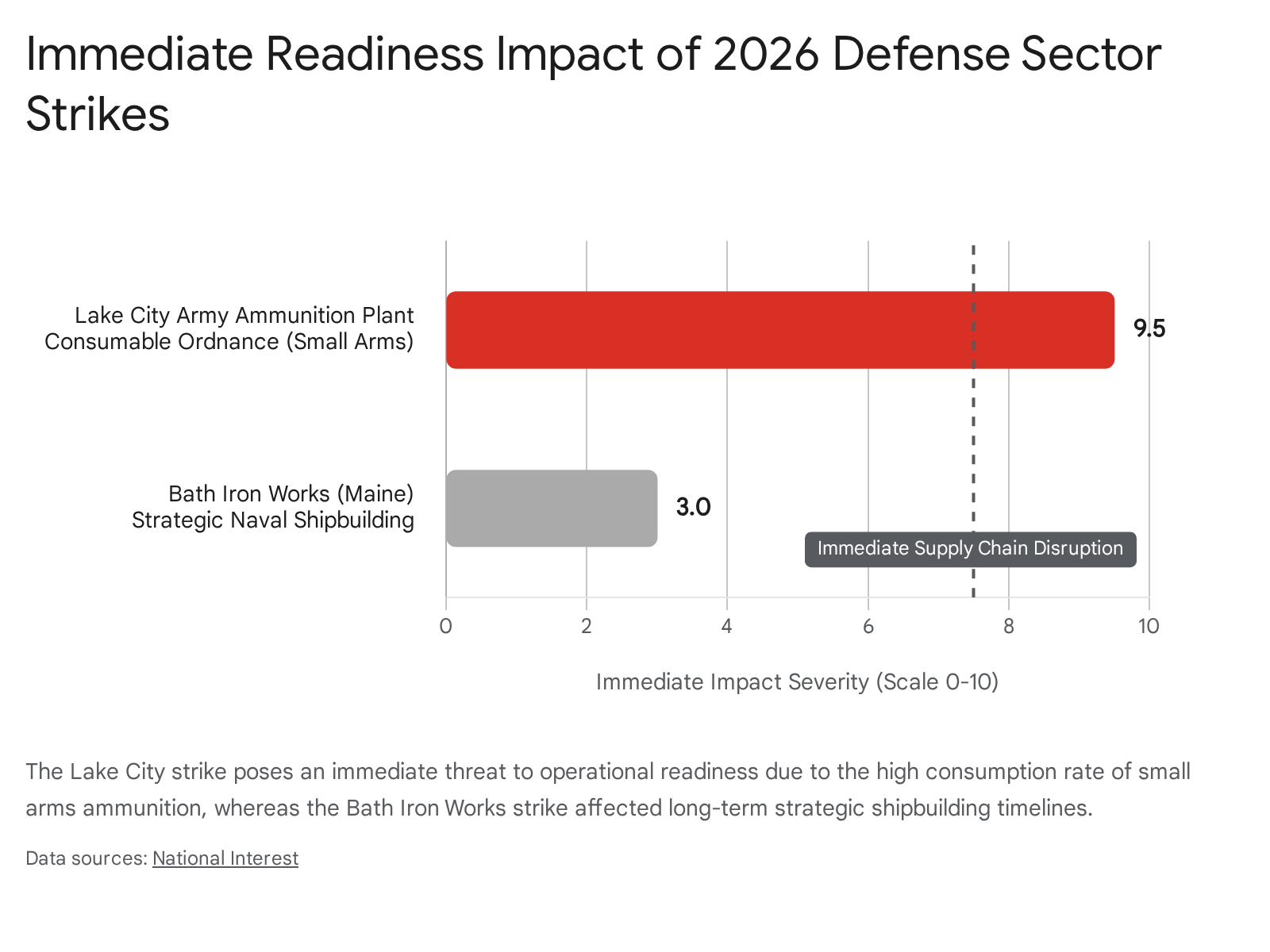
The strategic vulnerability exposed by the strike is massively magnified by the current geopolitical climate. Global conflicts are escalating rapidly, placing immense logistical pressure on the United States to not only fully supply its own armed forces but also to provide continuous, high-volume logistical support to allied partners operating in active combat zones abroad.1 The U.S. military is currently engaged in an aggressive campaign to replenish its own domestic stockpiles, which have been severely drawn down by massive international military aid transfers.3 A prolonged shutdown of the Lake City plant directly undermines this strategic replenishment effort, forcing military planners to rely on secondary, lower-capacity commercial suppliers or allied nations to fill the compounding deficit.
Furthermore, the strike occurs precisely as the Department of Defense is attempting to execute a generational modernization of its small arms capabilities. In February 2025, the U.S. Army broke ground on a massive new 450,000-square-foot facility at the Lake City site, a project explicitly designed to support the mass production of the new 6.8-millimeter Next Generation Squad Weapon ammunition.5 This modernization requires a stable, highly skilled workforce capable of operating advanced manufacturing systems to produce complex projectile and casing combinations. A protracted labor dispute threatens to severely delay the rollout of this critical new weapon system to frontline infantry units.
To illustrate the breadth of the disruption, the following table details the primary military munitions produced at the Lake City facility and their respective operational roles, all of which are currently halted by the strike action.
| Munition Caliber | Primary Military Application and Platform | Strike Impact Severity |
| 9-millimeter NATO | Standard issue sidearms (e.g., M17/M18 modular handgun systems) and submachine guns. | High; impacts base security and close-quarters training. |
| 5.56-millimeter NATO | Standard issue infantry rifles and carbines (e.g., M4 series, M16 series) and squad automatic weapons. | Critical; primary combat cartridge for all frontline infantry units. |
| 7.62-millimeter NATO | Medium machine guns (e.g., M240 series), designated marksman rifles, and sniper support platforms. | Critical; essential for platoon-level suppressive fire and vehicle mounts. |
| .50-caliber BMG | Heavy machine guns (e.g., M2 series), anti-materiel rifles. Vital for vehicle defense and barrier penetration. | Critical; heavily utilized in current global combat theaters. |
| 20-millimeter Autocannon | Rotary-wing aircraft cannons, fixed-wing fighter aircraft, and naval close-in weapon systems (CIWS). | High; essential for aerial fire support and naval missile defense. |
6. The Commercial Ammunition Market and Escalating Price Indices
The commercial ammunition market in the United States is highly sensitive to any disruptions within the primary military supply chain. When the Department of Defense prioritizes stockpile replenishment or requires surging quantities of ammunition due to global conflicts, major manufacturers must fulfill those federal contracts first. Civilian sales lines are routinely the first to be cut back, delayed, or entirely suspended.3 The strike at Lake City removes massive aggregate capacity from the overall market ecosystem, exacerbating an already highly volatile economic situation known widely within the industry as the “Powder Keg Boom”.3
Even before the strike fully paralyzed operations in Independence, the civilian market was bracing for severe inflation. Effective April 1, 2026, several of the largest ammunition conglomerates in the world, including Federal, CCI, Remington, and Winchester, instituted systemic price increases across their entire product lines.6 These price adjustments reflect continued volatility in raw material costs, and the increases ranged generally from five percent to ten percent, encompassing all sub-brands and bulk pack configurations.3
This is not an isolated or singular event. Winchester executives have publicly cited sustained rises in material costs and global economic pressures as the primary catalysts for these hikes. Furthermore, the company indicated a fundamental shift in its economic strategy, announcing that product pricing will now be reviewed on a quarterly basis rather than the traditional annual schedule.3 This quarterly review cycle heavily suggests that manufacturers anticipate continued supply chain volatility and are actively establishing a higher, more flexible pricing floor to protect corporate profit margins against unpredictable geopolitical and logistical shocks.
The structural limits of the modern ammunition supply chain dictate that retail availability is governed primarily by rigid upstream production bottlenecks, rather than short-term fluctuations in consumer demand.6 Expanding output for core energetic components requires years of complex regulatory permitting, specialized facility construction, and massive capital investment.
The current price increases and supply constraints are driven by severe, compounding shortages in fundamental raw materials required for munitions manufacturing.
First, the global industry is suffering from a critical scarcity of nitrocellulose, colloquially known as guncotton, which serves as the essential chemical base for modern smokeless gunpowder.3 The global supply chain for nitrocellulose relies heavily on the export of specialized cotton linters from China. Ongoing geopolitical tensions and disrupted shipping lanes have severely restricted this supply, sparking an intense bidding war among global defense entities. Because massive military contractors and sovereign nations possess far greater purchasing power than commercial manufacturers, civilian ammunition companies are routinely outbid for available powder shipments. This dynamic was vividly illustrated earlier in the year when America’s Ammunition Company, a prominent budget-friendly manufacturer, was forced to temporarily suspend operations entirely after its primary powder supplier diverted all available inventory to fulfill lucrative military contracts.3
Second, the cost of the raw metals required for casing and projectile manufacturing continues to climb relentlessly. Copper prices have surged due to intense global demand driven by the transition to electric vehicles and the expansion of green energy infrastructure.3 Copper is a critical, non-negotiable component for both brass casings and bullet jackets, establishing an absolute floor price for manufacturing that cannot be circumvented through increased efficiency. Similarly, stringent environmental regulations and the permanent closure of domestic smelting facilities have heavily restricted the supply of refined lead within the United States, further inflating the cost of basic full metal jacket and hollow point projectiles.3
To understand the severity of the current market conditions, it is vital to review historical pricing contexts. The following table illustrates the extreme volatility of the 5.56mm NATO commercial market over the past six years, utilizing data compiled from major retail tracking indices.17
| Market Era | Average Price Per Round (Brass 5.56mm) | Primary Market Drivers |
| Pre-2020 Baseline | $0.30 | Stable supply chains, robust commercial production capacity, standard demand. |
| 2021 Shortage Peak | $0.96 to $1.17 | COVID-19 logistics failures, extreme civil unrest, unprecedented influx of first-time buyers. |
| Early 2026 Normalization | $0.45 to $0.50 | Stabilized supply chains, normalization of demand, establishing a new floor above pre-2020 levels. |
| April 2026 Crisis | Escalating rapidly above $0.60+ | Implementation of 5-10% manufacturer price hikes, critical nitrocellulose shortages, and the Lake City strike removing surge capacity. |
Heading into early 2026, the market had seemingly stabilized at a “new normal” baseline of approximately 45 to 50 cents per round for standard training ammunition.17 However, the devastating combination of the April 1 manufacturer price hikes and the April 4 Lake City strike has completely shattered this temporary equilibrium. Market analysts observe that the minimum price per round is rapidly escalating, and consumers are responding with predictable aggression.
7. Consumer Behavior, Panic Buying, and Social Media Sentiment
The commercial firearms community operates within a highly sensitive and deeply interconnected psychological ecosystem. The combination of verified manufacturer price increases and prominent news reports regarding the massive labor strike at the nation’s premier military ammunition plant has triggered intense reactions across retail channels and social media platforms.
The ammunition market is uniquely vulnerable to a phenomenon defined by industry analysts as the “shortage loop”.3 When consumers observe news reports warning of potential scarcity or strikes, the fear of future unavailability triggers immediate, aggressive panic buying. This rapid surge in demand strips retail shelves bare in a matter of days, transforming a theoretical, future shortage into a sudden, tangible reality. The sight of empty shelves heavily validates the initial consumer fear, prompting retailers to raise prices in response to extreme demand, and prompting consumers to aggressively hoard whatever residual inventory they can locate, thereby perpetuating the cycle endlessly.
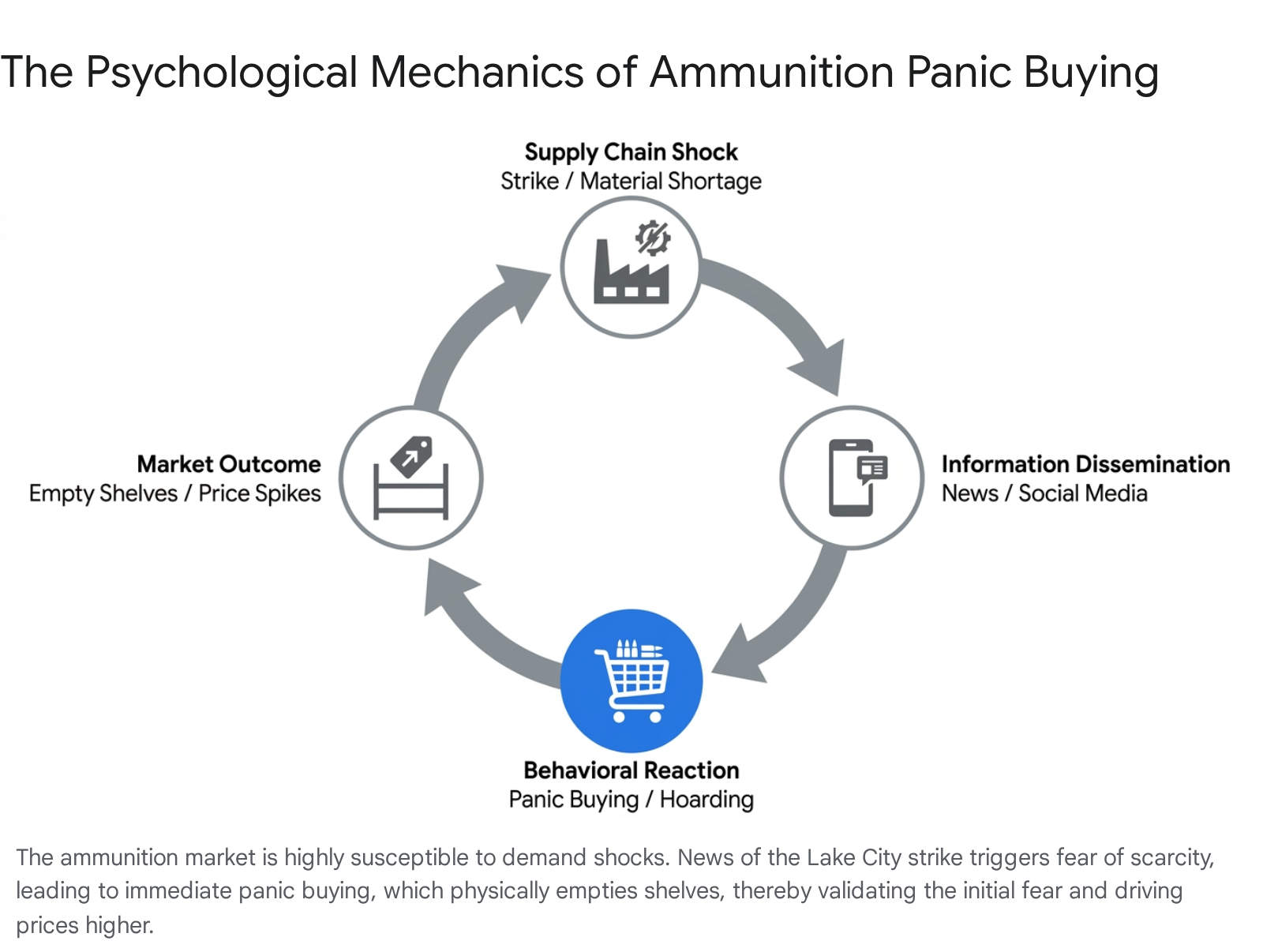
Prominent industry analysts and social media commentators are acutely aware of this dangerous psychological dynamic. By mid-April 2026, content creators across major video platforms began publishing extensive content aimed at mitigating the widespread panic. Channels produced content with titles such as “Ammo Shortage or Mass Panic? Here’s What’s Actually Happening,” pleading with viewers to prioritize long-term, slow-and-steady preparedness over highly reactive hoarding behavior.9 Other influential creators stressed that endlessly discussing shortages on the internet invariably worsens the macroeconomic situation by fueling the exact fear that drives the run on retail supplies, advocating for consumer discipline.18 Independent investigative content, such as ground-level stock checks at major retailers like Academy Sports and Dunham’s Sports, has proliferated massively as consumers seek real-time verification of supply constraints outside of official corporate statements.19
Despite these logical calls for restraint from industry veterans, the broader social media sentiment reflects deep anxiety, frustration, and an expectation of prolonged scarcity. Financial analysis videos explaining the structural collapse of budget ammunition companies due to powder shortages and the aggressive consolidation of the industry under massive corporate umbrellas have garnered significant attention, reflecting a consumer base that feels increasingly priced out of their hobby or profession.20
The tangible, real-world result of the strike and the price hikes is clearly visible in the digital retail space. A comprehensive mid-April review of major online ammunition distributors reveals a catastrophic depletion of 5.56-millimeter NATO and.223 Remington inventory, particularly for Winchester-branded products originating from the Olin network.
- Palmetto State Armory: Widespread “Out of Stock” notifications are present across almost all bulk listings for 5.56-millimeter ammunition, including standard Winchester USA 55-grain full metal jacket, Federal 5.56 NATO, and PMC X-TAC configurations.8
- MidwayUSA: Standard Winchester 5.56 ammunition is listed entirely as out of stock, with prices historically indexed between 1.75 and 1.80 dollars per round for remaining specialty lines, representing a massive premium over historical averages.22
- Target Sports USA: While some bulk shipments of various calibers arrive in cyclical, unpredictable waves, standard Winchester M193 5.56-millimeter is completely unavailable for purchase on the platform.7
- The Mag Shack: Even small, 20-round boxes of Winchester 5.56 NATO M193 are completely out of stock, indicating that even localized, low-volume distribution networks have been entirely exhausted by panicked buyers.23
The only platforms showing sporadic availability are highly specialized bulk aggregation sites, though even these vendors are explicitly advising customers that inventory is rapidly depleting without reliable timelines for restocking from the manufacturers.24
Discourse on community platforms like Reddit and specialized accuracy forums reflects a bifurcated, often contentious response to the Lake City strike. On platforms dedicated to liberal gun owners, there are highly visible, organized calls for consumer boycotts of all commercial Winchester products in direct solidarity with the striking IAM Local 778 workers.14 These users heavily emphasize the importance of standing by the laborers who are demanding fair wages, strict overtime limits, and basic work-life balance, while harshly critiquing the structural flaws and corporate greed inherent in Olin’s GOCO management contract.14
Conversely, on more traditional shooting forums, the conversation focuses heavily on personal stockpile management strategies and deep skepticism regarding the union’s economic demands. Some users argue that any wage increases won by the union will simply be passed down directly to the consumer, further exacerbating retail prices in an already highly inflated market.25 Others fiercely debate the specialized nature of the work, noting that assembling energetics is a highly technical skill that cannot simply be outsourced to unskilled labor, thereby validating the workers’ significant leverage against Olin management.25 Regardless of ideological alignment regarding the role of labor unions, the overarching consensus across all digital platforms is a grim acknowledgment that the era of affordable, widely available 5.56-millimeter ammunition has decisively ended.
8. Legislative Scrutiny and Regulatory Pressures
The severe operational crisis at the Lake City plant is occurring within a highly hostile and rapidly evolving legislative environment. The Independence facility has recently become the explicit target of federal lawmakers seeking to aggressively regulate the domestic firearms and ammunition market, adding a layer of extreme political volatility to the ongoing labor dispute.
In March 2026, just weeks prior to the onset of the union strike, a powerful coalition of Democratic lawmakers introduced sweeping federal legislation aimed directly at the commercial output of the Lake City Army Ammunition Plant.10 Senators Elizabeth Warren and Andy Kim, alongside Representatives Robert Garcia and Jamie Raskin, formally co-sponsored a bill designed to absolutely prohibit defense contractors and government-owned facilities from selling military-grade ammunition to the civilian public.10
The primary impetus for this aggressive legislation was a high-profile, joint media investigation conducted by the International Consortium of Investigative Journalists and the New York Times, detailing the illicit trafficking of Lake City ammunition to international criminal organizations. The exhaustive investigation revealed that massive quantities of.50-caliber ammunition, explicitly manufactured by government contractors at the Independence facility, had been successfully trafficked across the southern border and actively utilized by Mexican cartels in armed conflicts against the Mexican government and law enforcement agencies.10 The report highlighted the shocking statistic that nearly half of all the powerful.50-caliber munitions seized by Mexican authorities originated directly from the United States Army plant.10
Senator Warren utilized this damning data to argue forcefully that American tax dollars are effectively subsidizing international cartel violence and domestic mass shootings. By pushing to ban the civilian sale of weapons and ammunition produced by Pentagon contractors, these lawmakers intend to completely sever the massive commercial pipeline that currently allows excess Lake City inventory to reach the retail market.10 If this legislation ultimately passes, the commercial availability of authentic Lake City 5.56-millimeter and.50-caliber ammunition will drop to absolute zero, permanently altering the civilian supply landscape regardless of union negotiations or global raw material availability.
Complementing the effort to restrict the origin of the ammunition, lawmakers are also aggressively targeting the distribution methodology. Senator Warren and Congressman Garcia reintroduced the Ammunition Modernization and Monitoring Oversight Act, commonly referred to as the AMMO Act.11 This legislation seeks to restrict the bulk sale of ammunition by mandating that businesses conduct rigorous federal background checks on all buyers prior to any transaction. Furthermore, it requires any business selling ammunition to obtain the exact same stringent federal licensing currently required for physical firearms dealers.11
Simultaneously, Representatives Bonnie Watson Coleman and Kweisi Mfume reintroduced the Stop Online Ammunition Sales Act.26 This bill effectively attempts to ban the direct-to-consumer online sale of ammunition entirely. It proposes a new licensing requirement for the retail sale of munitions and mandates that any “bulk” purchases, defined strictly as 1,000 rounds or more, must be reported directly to law enforcement agencies for monitoring.26
These legislative maneuvers represent a highly coordinated effort to suppress the civilian ammunition market through bureaucratic friction and access restriction. The firearms industry argues vehemently that these bills are unconstitutional attacks on the Second Amendment, designed explicitly to make the procurement of ammunition excessively slow, legally burdensome, and economically unviable for the average citizen.26 Industry advocates point out that purchasing ammunition in bulk is standard practice for competitive target shooters and hunters, and that the proposed regulations would severely damage the business models of smaller, rural retail shops that do not sell firearms but provide essential goods to their communities.26 Furthermore, these acts would completely dismantle the logistics of massive online bulk distributors, forcing consumers back into localized, highly constrained retail environments.
In defense of the facility and the broader industry, the National Shooting Sports Foundation heavily mobilized its lobbying arm. On April 13, 2026, the NSSF announced the filing of a bicameral letter, signed by over 100 Members of Congress and United States Senators, formally warning the Secretary of the Army not to risk vital military readiness by attempting to appease gun control special interests through administrative actions targeting the Lake City plant.27 This action demonstrates the intense political polarization surrounding the facility.
The convergence of the IAM Local 778 strike, severe raw material inflation, and this highly aggressive legislative push creates a perfect storm of instability for the commercial market. Even if Olin Winchester reaches a satisfactory settlement with the union and resumes full production, the long-term legal and regulatory environment surrounding the commercial sale of that production remains highly precarious.
9. Conclusion
The April 2026 strike at the Lake City Army Ammunition Plant is a watershed event that is actively exposing the profound fragilities within both the United States defense industrial base and the commercial firearms market. The steadfast refusal of approximately 1,350 highly skilled union workers to accept stagnant wages and dangerous levels of excessive mandatory overtime highlights the systemic flaws of utilizing short-term corporate contracts to manage vital, long-term national security assets.
Olin Winchester’s apparent strategy of public silence coupled with internal pressure has thus far failed completely to fracture the resolve of IAM Local 778. As the strike progresses through mid-April, the total cessation of operations at the military’s primary small-arms manufacturing hub poses an immediate and exponentially escalating threat to national combat readiness. With global conflicts demanding constant logistical resupply, the Department of Defense can ill afford a protracted shutdown of the Lake City facility, placing immense pressure on all parties to find an immediate resolution.
For the commercial market, the strike has acted as a severe and immediate catalyst, amplifying the devastating economic effects of the concurrent raw material crisis. Driven by insurmountable price spikes in copper and a critical global shortage of nitrocellulose, major manufacturers implemented heavy wholesale price increases at the exact moment the Lake City shutdown triggered massive consumer panic buying. Consequently, retail inventories have been decimated across the digital landscape, establishing a harsh new reality of high prices and extreme scarcity for standard calibers.
Looking forward, the ammunition industry faces an incredibly challenging operational horizon. The immediate resolution of the labor dispute is absolutely imperative, yet it will only solve one facet of a multi-dimensional crisis. Manufacturers must still navigate the complex geopolitics of raw material procurement in a hostile global market, while consumers and retailers must prepare for the potential, paradigm-shifting impacts of the AMMO Act and other federal legislative efforts aimed at dismantling the commercial sale of military-grade munitions. The historical era of cheap, easily accessible bulk ammunition has definitively concluded, replaced entirely by a highly volatile paradigm dictated by labor negotiations, international commodity wars, and aggressive federal regulation.
Appendix: Methodology
This research report was compiled using a rigorous synthesis of digital intelligence gathered through targeted search queries executed on April 16, 2026. The methodology prioritizes the extraction, cross-referencing, and contextualization of updated data from authoritative union communications, defense industry analyses, financial press releases, and active commercial retail platforms to provide an exhaustive update on the situation since the initial April 10 assessment.
Primary data regarding the labor dispute, including specific worker grievances, updated strike timelines, solidarity rally details, and internal corporate communications, was sourced directly from the official publications of the International Association of Machinists and Aerospace Workers, specifically IAM Local 778 and the IAM International newsroom.
Assessments of the corporate posture of Olin Winchester were derived from a synthesis of available industry reporting and direct reviews of the official Olin Corporation investor relations portals, confirming the upcoming May 2026 earnings disclosures.
Analysis of military readiness impacts utilized reporting from defense-focused publications, notably(https://nationalinterest.org/blog/buzz/ammunition-plant-strike-could-leave-us-soldiers-without-bullets-ps-041126), outlining the strategic output of the Lake City Army Ammunition Plant, its comparison to the Bath Iron Works strike, and its relationship to the broader Department of Defense procurement strategy.
Commercial market dynamics and price indexing data were compiled through a review of historical pricing databases, such as(https://www.ammunitiondepot.com/ammo-price-history/223-556), and contemporary industry analysis blogs detailing the raw material shortages (e.g.,(https://blog.targetsportsusa.com/2026-ammunition-outlook-supply-pricing-availability/),(https://inside.safariland.com/blog/the-powder-keg-boom-why-are-ammo-prices-rising-again/)). Real-time consumer sentiment and panic buying metrics were gauged through an extensive review of active product listings across major digital storefronts, including(https://palmettostatearmory.com/bulk-ammo/bulk-556-ammo.html),(https://www.midwayusa.com/interest-hub/winchester-556-ammo), and(https://themagshack.com/shop/in-stock-ammo/556-nato-ammo/winchester-5-56x45mm-nato-55gr-fmj-20-rounds/), confirming widespread “Out of Stock” statuses.
Furthermore, qualitative analysis of public discourse was conducted by reviewing active threads on Reddit and specialized firearms forums like(https://forum.accurateshooter.com/threads/lake-city-ammo-plant-strike.4176046/), alongside commentary from prominent YouTube industry analysts. Legislative context was established by reviewing policy summaries published directly by the(https://www.warren.senate.gov/newsroom/press-releases/warren-kim-garcia-raskin-renew-fight-to-keep-military-grade-weapons-off-american-streets-out-of-civilian-hands), investigations by the International Consortium of Investigative Journalists, and lobbying updates provided by the(https://www.nssf.org/articles/nssf-hails-bicameral-letter-protecting-lake-city-army-ammunition-plant-from-political-intrusion/). All data points were synthesized to produce a comprehensive, non-partisan evaluation of the geopolitical, economic, and logistical factors currently shaping the small arms ammunition sector.
Please share the link on Facebook, Forums, with colleagues, etc. Your support is much appreciated and if you have any feedback, please email us in**@*********ps.com. If you’d like to request a report or order a reprint, please click here for the corresponding page to open in new tab.
Sources Used
- IAM Union Escalates Pressure on Military Ammo Maker Olin Winchester as Missouri Strike Raises Concerns Amid Escalating Global Conflicts, accessed April 16, 2026, https://www.goiam.org/news/imail/iam-union-escalates-pressure-on-military-ammo-maker-olin-winchester-as-missouri-strike-raises-concerns-amid-escalating-global-conflicts/
- 1350 IAM Union Members at Olin Winchester in Kansas City Vote to Reject Contract, Strike for Fairness, accessed April 16, 2026, https://www.goiam.org/news/1350-iam-union-members-at-olin-winchester-in-kansas-city-vote-to-reject-contract-strike-for-fairness/
- The Powder Keg Boom: Why Are Ammo Prices Rising Again …, accessed April 16, 2026, https://inside.safariland.com/blog/the-powder-keg-boom-why-are-ammo-prices-rising-again/
- Over 1,300 Winchester workers strike at Olin factory in Missouri | Manufacturing Dive, accessed April 16, 2026, https://www.manufacturingdive.com/news/olin-winchester-machinists-iam-ammunitions-plant-kansas-city-missouri/817007/
- An Ammunition Plant Strike Could Leave US Soldiers Without Bullets – The National Interest, accessed April 16, 2026, https://nationalinterest.org/blog/buzz/ammunition-plant-strike-could-leave-us-soldiers-without-bullets-ps-041126
- Ammunition in 2026: Supply Conditions, Price Pressures, and …, accessed April 16, 2026, https://blog.targetsportsusa.com/2026-ammunition-outlook-supply-pricing-availability/
- Winchester USA 5.56x45mm NATO M193 Ammo 55 Grain Full Metal Jacket – WM193K, accessed April 16, 2026, https://www.targetsportsusa.com/winchester-usa-5-56-45mm-nato-m193-ammo-55-grain-fmj-wm193k-p-111476.aspx
- 5.56 Bulk Ammo – Trusted Online Dealer | Palmetto State Armory, accessed April 16, 2026, https://palmettostatearmory.com/bulk-ammo/bulk-556-ammo.html
- Ammo Shortage or Mass Panic? Here’s What’s Actually Happening – YouTube, accessed April 16, 2026, https://www.youtube.com/watch?v=jwaLsrPpI5o
- Lawmakers seek to stop sales to the public of ammunition made at U.S. Army plant – ICIJ, accessed April 16, 2026, https://www.icij.org/news/2026/03/lawmakers-seek-to-stop-sales-to-the-public-of-ammunition-made-at-u-s-army-plant/
- Congressman Robert Garcia and Senator Elizabeth Warren Reintroduce ‘AMMO Act’ to Prevent Bulk Sales of Ammunition During Gun Violence Awareness Month, accessed April 16, 2026, https://robertgarcia.house.gov/media/press-releases/congressman-robert-garcia-and-senator-elizabeth-warren-reintroduce-ammo-act
- IAM Local 778, accessed April 16, 2026, https://local778.org/
- What the Winchester Strike Means for American Ammunition Manufacturing – Detroit Ammo Co., accessed April 16, 2026, https://detroitammoco.com/blog/what-the-winchester-strike-means-for-american-ammunition-manufacturing
- Winchester Ammo workers just went on STRIKE✊️! Don’t be a SCAB ! : r/liberalgunowners, accessed April 16, 2026, https://www.reddit.com/r/liberalgunowners/comments/1sc76dr/winchester_ammo_workers_just_went_on_strike_dont/
- Olin Corporation First Quarter 2026 Earnings Conference Call Announcement – Morningstar, accessed April 16, 2026, https://www.morningstar.com/news/pr-newswire/20260402ny24986/olin-corporation-first-quarter-2026-earnings-conference-call-announcement
- Ammo prices are going up again on April 1st. Federal, CCI, and Remington confirmed 2% to 10% hikes. : r/CCW – Reddit, accessed April 16, 2026, https://www.reddit.com/r/CCW/comments/1s3yncs/ammo_prices_are_going_up_again_on_april_1st/
- 10 Year 223 / 5.56 Ammo Price History | Ammunition Depot, accessed April 16, 2026, https://www.ammunitiondepot.com/ammo-price-history/223-556
- “Ammo Shortages” and Misinformation… – YouTube, accessed April 16, 2026, https://www.youtube.com/watch?v=4CV-CC3RKAk
- I Investigated the 2026 Ammo Shortage… Here’s What I Found – YouTube, accessed April 16, 2026, https://www.youtube.com/watch?v=TZUzmO06iBo
- Ammo Prices KEEP GOING UP! Every Shooter Needs To See This! – YouTube, accessed April 16, 2026, https://www.youtube.com/watch?v=Vt8zJK6k-1I
- 2026 Ammo Crisis: You’re Not Ready for What’s Coming! – YouTube, accessed April 16, 2026, https://www.youtube.com/watch?v=3hIZkfmY1XM
- Winchester 5.56 Ammo – MidwayUSA, accessed April 16, 2026, https://www.midwayusa.com/interest-hub/winchester-556-ammo
- Winchester 5.56x45mm NATO M193 55gr FMJ Ammo | The Mag Shack, accessed April 16, 2026, https://themagshack.com/shop/in-stock-ammo/556-nato-ammo/winchester-5-56x45mm-nato-55gr-fmj-20-rounds/
- Buy Bulk 5.56×45 Ammo Online at BulkAmmo.com – Available and Ready to Ship, accessed April 16, 2026, https://www.bulkammo.com/rifle/bulk-5.56×45-ammo
- Lake City Ammo plant Strike | Shooters’ Forum, accessed April 16, 2026, https://forum.accurateshooter.com/threads/lake-city-ammo-plant-strike.4176046/
- Stop Online Ammunition Sales Act introduced in Congress. – NRA-ILA, accessed April 16, 2026, https://www.nraila.org/articles/20260203/stop-online-ammunition-sales-act-introduced-in-congress
- NSSF Hails Bicameral Letter Protecting Lake City Army Ammunition Plant from Political Intrusion, accessed April 16, 2026, https://www.nssf.org/articles/nssf-hails-bicameral-letter-protecting-lake-city-army-ammunition-plant-from-political-intrusion/