1.0 Executive Summary
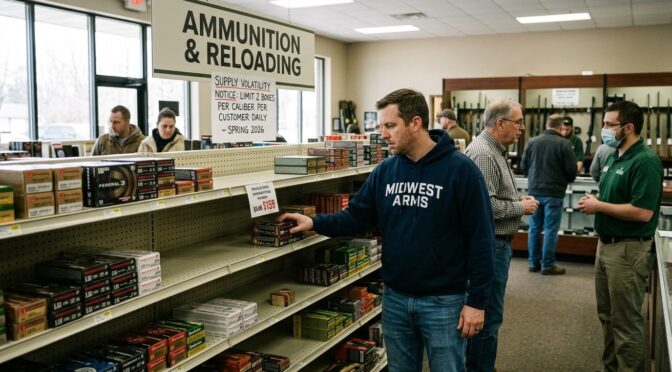
The United States commercial ammunition market has entered a period of pronounced economic volatility in the spring of 2026. After a brief era characterized by promotional pricing and normalized retail channel inventory throughout 2024 and 2025, a confluence of macroeconomic pressures, geopolitical tensions, and severe raw material cost escalations has fundamentally altered the pricing landscape.1 Major domestic ammunition manufacturers have announced sweeping wholesale price increases, fundamentally shifting the cost burden to distributors, retailers, and end consumers. These adjustments are particularly evident in the high volume centerfire cartridge categories, most notably the 9mm Luger and the 5.56x45mm NATO.1
This comprehensive research report investigates the specific market drivers causing this upward pricing trajectory. The analysis details the financial positioning of the primary manufacturing conglomerates, the impact of international trade policies, the behavioral economics of consumer purchasing patterns, and the direct retail pricing outcomes for specific bulk ammunition products. By examining historical pricing data alongside current retail figures, this report provides a thorough assessment of the spring 2026 ammunition market. The intent of this document is to provide procurement professionals, institutional buyers, and high volume consumers with the empirical data required to navigate an increasingly hostile pricing environment.
The promotional pricing era that defined the middle of the decade is definitively over. The post pandemic glut of inventory in the distribution channel has been consumed, and the raw material costs required to manufacture new inventory have made previous retail pricing models financially unsustainable for producers.2 Consequently, the industry is witnessing the implementation of confirmed price hikes ranging from two percent to ten percent across nearly all major brands.4 This report will synthesize these variables, offering a detailed examination of caliber specific pricing for the 9mm Luger and 5.56 NATO cartridges while recommending strategic bulk purchasing strategies to hedge against future inflation.
2.0 Macroeconomic Drivers and Global Supply Chain Disruptions
The pricing architecture of the commercial ammunition sector is highly sensitive to fluctuations in global commodity markets. Ammunition manufacturing relies on a rigid, specialized supply chain that consumes vast quantities of copper, lead, zinc, antimony, and chemical propellants.4 In early 2026, the costs associated with procuring these essential materials reached levels that forced manufacturers to abandon the promotional pricing strategies utilized in previous years.2 The industry cannot easily substitute these materials due to the strict ballistic and safety tolerances required for firearms, making producers inherently vulnerable to commodity market shocks.
2.1 The Global Commodity Squeeze and Raw Material Escalation
The primary driver of the April 2026 price increases is the sustained cost pressure across critical raw material inputs.4 Copper and zinc, which are alloyed to create the cartridge brass utilized in nearly all premium ammunition, have seen substantial price inflation on global exchanges.1 The production of a single brass casing requires a highly specific metallurgical blend, typically consisting of seventy percent copper and thirty percent zinc. Because copper is heavily utilized in global infrastructure and green energy initiatives, commercial ammunition manufacturers must compete with international technology and construction sectors to secure their supply.
Furthermore, lead and antimony, the primary components of traditional projectile cores, have become significantly more expensive to source and transport.4 Lead requires heavy industrial processing, and antimony is a critical hardening agent necessary to prevent lead projectiles from deforming at high velocities. Retailers and suppliers of reloading components have observed these price increases firsthand on the ground level. Bill Bizak, the proprietor of Muzzleloader’s Supply in Puyallup, Washington, reported that his procurement costs for shipments of raw lead shot up by as much as 150 percent.7 The wholesale cost per box escalated dramatically from approximately twenty eight dollars to as high as seventy two dollars, largely driven by compounding freight and shipping rates.7 These localized examples reflect a broader systemic issue facing the tier one manufacturers who consume these dense metals by the ton. The absolute inability to absorb these material cost hikes internally has necessitated the direct pass through of expenses to the consumer market.7
2.2 Chemical Propellants and Industrial Choke Points
Beyond base metals, the industry is facing severe constraints regarding the chemical propellants required to manufacture smokeless powder. Nitrocellulose is the foundational ingredient in modern firearm propellants, and its production is limited to a small number of specialized chemical plants globally. Manufacturers have cited ongoing volatility and rising costs tied to these propellants as a primary justification for the April 2026 price adjustments.4
Military demand is currently competing directly with the commercial sector for these shared raw materials.2 The United States military and its global allies require vast amounts of copper, brass, and nitrocellulose propellants to sustain operational readiness and supply ongoing international conflicts. When global conflicts erupt, military procurement contracts inherently take legal and logistical priority over civilian commercial production.1 This dynamic restricts the available volume of chemical propellants for the civilian market, resulting in an environment where commercial manufacturers must bid exponentially higher prices to secure their required production inputs, further driving up the retail cost of finished ammunition.2
2.3 Geopolitical Instability and Freight Volatility
International geopolitical tensions have exacerbated the raw material supply crisis, creating a cascading effect on global logistics. Retailers and market analysts have expressed significant concern regarding the ongoing United States and Israeli conflict with Iran.7 This specific geopolitical crisis threatens to disrupt global energy markets, thereby sending crude oil prices and international maritime shipping rates significantly higher.7
Because bulk metals and dense chemical components are frequently transported via international maritime shipping lanes, any spike in crude oil prices directly translates to higher logistics costs for domestic ammunition producers. Lead, copper, and loaded ammunition are exceptionally heavy commodities, meaning that freight costs represent a disproportionately large percentage of their final retail price compared to lighter consumer goods. Store managers, such as Beamer Morrow at Ready Gunner in Orem, Utah, have noted that while they have attempted to cover these rising shipping costs internally, the sustained pressure will inevitably force them to raise shelf prices for the end consumer.7
2.4 The Impact of Protectionist Trade Policies and Tariffs
Domestic trade policies have also played a decisive and highly controversial role in inflating the cost structures of American ammunition manufacturers. Steep tariffs imposed by President Donald Trump on the metals and chemicals utilized to manufacture ammunition have directly ratcheted up production costs across the domestic industrial base.7 These specific tariffs have choked off access to cheaper international imports, forcing domestic producers to either rely on a limited and more expensive domestic supply chain or pay the heavily taxed premium on imported goods.7
Kenneth Lane, the chief executive officer of Olin Corporation, specifically cited these tariffs during a recent earnings call with stockholders.7 Lane explained to investors that the tariffs jacked up the price of brass and copper, thereby squeezing corporate profit margins and forcing the company to reduce its manufacturing workforce.7 The intersection of these protectionist trade policies with the aforementioned global commodity squeeze has created an unsustainable financial environment for manufacturers. The culmination of these macroeconomic factors made sweeping wholesale price increases completely unavoidable in the spring of 2026.
3.0 Corporate Restructuring and Manufacturing Consolidation
The United States ammunition manufacturing base has undergone significant corporate consolidation and financial restructuring over the past decade. The vast majority of domestic ammunition production is now controlled by a highly concentrated group of corporate entities, effectively operating as an oligopoly. This profound consolidation means that when raw material costs rise, wholesale price increases are implemented almost universally across the market. Consumers often believe they are shopping across competing brands, but multiple seemingly independent brands are actually managed by the same parent organization.6
3.1 The Kinetic Group and Czechoslovak Group Acquisition
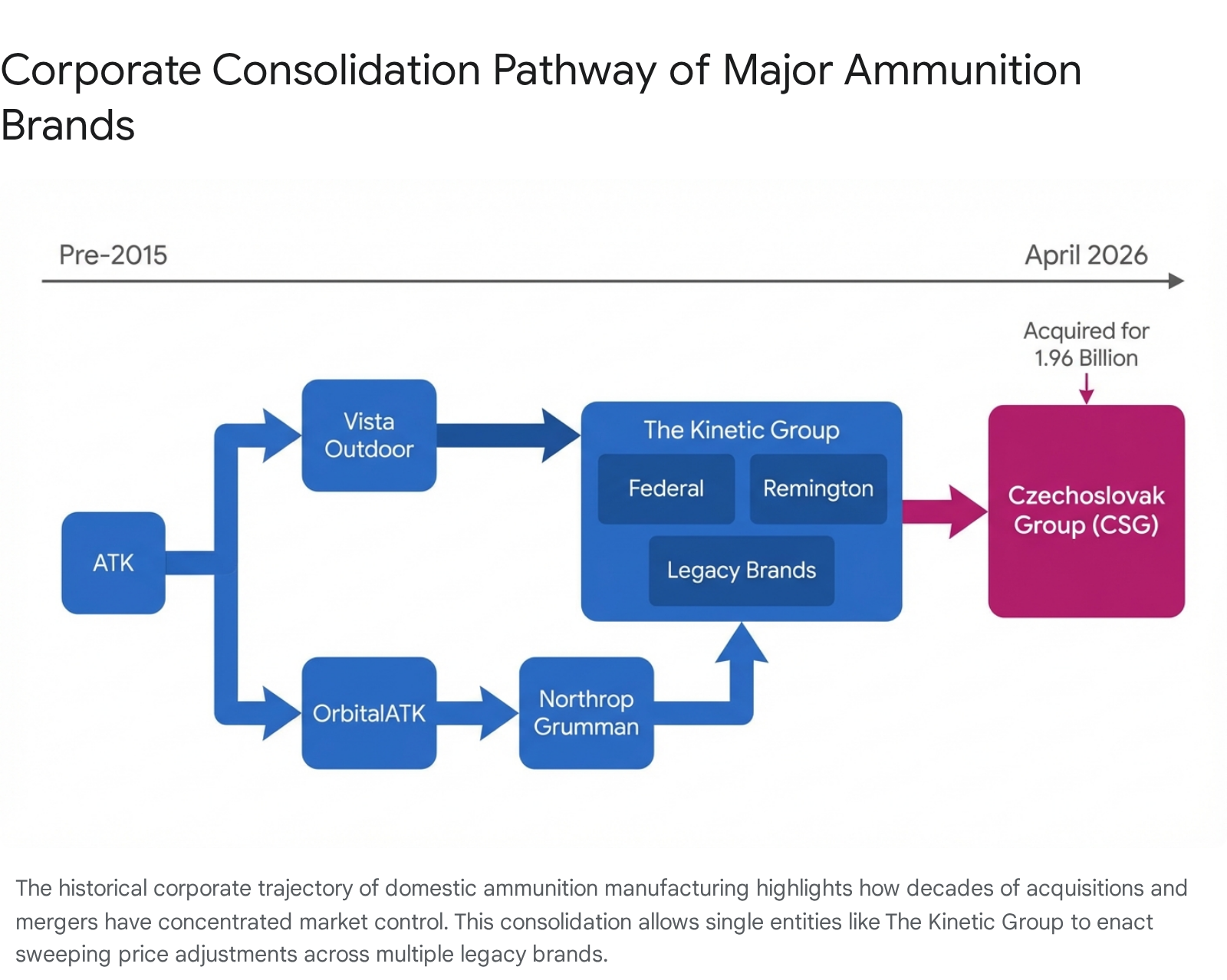
One of the most consequential developments in the modern ammunition industry is the consolidation of legacy brands under The Kinetic Group, a corporate entity previously operating under the Vista Outdoor umbrella.8 This massive conglomerate controls an extensive and dominant portfolio of American ammunition brands, including Federal Premium, CCI, Remington Ammunition, Speer, and Blazer, as well as imported international brands like Fiocchi, B&P, and Hevi-Shot.4
Following a protracted period of corporate maneuvering and shareholder negotiations, Vista Outdoor confirmed a definitive agreement with the Czechoslovak Group, commonly referred to as CSG, to increase the purchase price for The Kinetic Group business to a staggering 1.96 billion dollars.9 CSG is a massive European defense and industrial conglomerate with deep ties to international military procurement.10 This acquisition places a substantial portion of the American commercial ammunition market under foreign corporate ownership, marking a significant shift in the operational control of domestic manufacturing.10
In early March 2026, operating under this newly consolidated structure, The Kinetic Group issued a formal notice to its nationwide dealer network announcing a new round of wholesale price increases set to take effect on April 1, 2026.4 The official notice specified that adjustments would fall between two percent and ten percent across their entire portfolio of rifle, handgun, shotshell, and rimfire ammunition categories.4 The company explicitly cited the unprecedented volatility in global commodity markets, specifically copper, lead, zinc, antimony, and propellants, as the primary justification for the hike.4 Furthermore, The Kinetic Group warned distributors that pricing conditions beyond mid 2026 remain highly uncertain, signaling that additional increases could be implemented on remarkably short notice if supply chain conditions deteriorate further.4
3.2 Olin Corporation and Winchester Financial Pressures
The secondary pillar of the American ammunition manufacturing duopoly is the Olin Corporation, a massive chemical manufacturer which owns and operates the iconic Winchester Ammunition brand.2 Winchester is a critical player not only in the civilian commercial sector but also in the military industrial base, as they currently hold the exclusive government contract to manage and operate the sprawling Lake City Army Ammunition Plant.10 Despite this dominant market position and substantial government backing, Winchester has faced severe financial headwinds in the consumer market.
During a February 2026 earnings call, Olin Corporation executives reported that their fourth quarter 2025 financial results came in significantly below Wall Street expectations.7 The Winchester segment saw its earnings collapse spectacularly, dropping to a mere 0.6 million dollars from 42 million dollars just one year prior.2 Olin Corporation as a whole reported an 85.7 million dollar net loss for the fourth quarter of 2025.2 Chief Executive Officer Kenneth Lane attributed this devastating financial performance to shrinking civilian consumer demand combined with the unrelenting increases in raw material costs and soaring electrical power expenses required to run their factories.7
To rectify these massive losses and achieve profitability for their shareholders, Lane informed stockholders that the company would be forced to pass these elevated costs directly through to the consumer base.7 Consequently, Winchester announced commercial price increases ranging from three percent to eight percent, slated to take effect in the first quarter of 2026.2 Management specifically noted that the promotional pricing era that characterized the market normalization of 2024 and 2025 is effectively over, and buyers should expect elevated brass and propellant costs to persist indefinitely.2
4.0 Consumer Psychology and the Shortage Loop
The volatility in the United States ammunition market is not driven solely by raw material costs, trade tariffs, and corporate spreadsheets. Consumer psychology and behavioral economics play an equally powerful role in dictating retail pricing and product availability on the store shelf.1 The firearms community has long been conditioned to expect sudden, dramatic market fluctuations. When shooters anticipate regulatory changes, political shifts, or supply chain breakdowns, they engage in rapid preemptive purchasing to secure their necessary training inventories.1
4.1 The Era of Expensive Availability
Following the historic and highly publicized supply shortages of 2020 and 2021, the market transitioned into an economic era accurately described by industry analysts as expensive availability.1 Unlike the height of the global pandemic, when store shelves were completely bare and acquiring common calibers was nearly impossible regardless of budget, ammunition in early 2026 remains widely available for purchase.1 Consumers can walk into almost any big box sporting goods store or browse major online retailers and easily locate high volume calibers like 9mm Luger, 5.56 NATO, and.308 Winchester in stock.1
However, the cost baseline has permanently and noticeably shifted. The retail prices that consumers currently accept as standard or promotional sale prices would have been considered exorbitant or predatory five years ago.1 The days of acquiring a thousand round case of.22 Long Rifle rimfire ammunition for nineteen dollars and ninety nine cents are entirely relegated to history.1 The market had seemingly stabilized into this new, more expensive paradigm throughout 2025, but the spring 2026 manufacturer price hikes have deeply disrupted this fragile equilibrium, threatening to initiate a new and aggressive cycle of consumer panic.
4.2 The Mechanics of the Shortage Loop
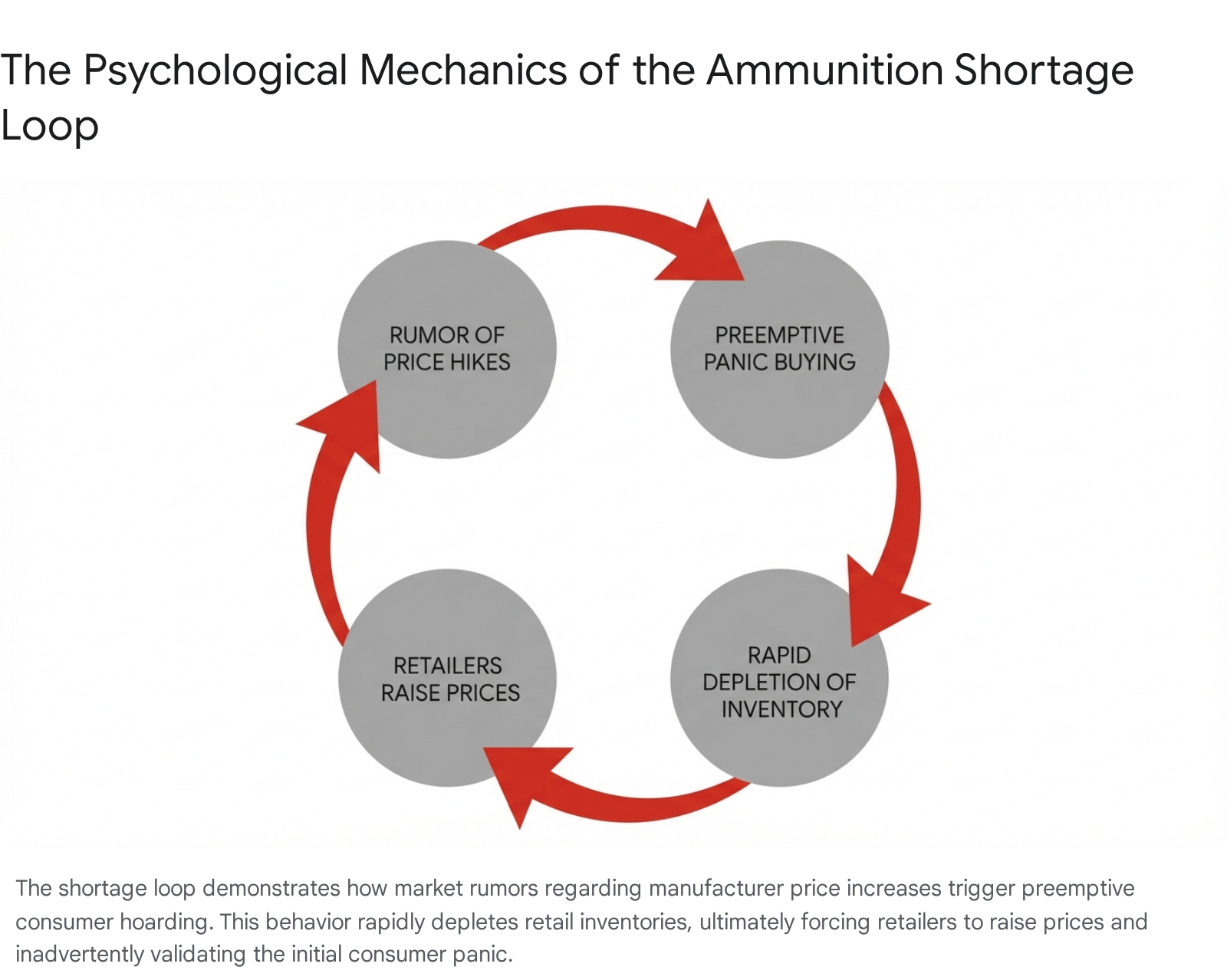
Market analysts warn of a psychological phenomenon within the firearms industry known as the shortage loop.1 This concept posits that the mere fear or rumor of an ammunition shortage is often the direct catalyst that creates an actual, physical shortage.1 When news circulates through the highly connected shooting community that major manufacturers like Federal, CCI, and Winchester are raising wholesale prices by up to ten percent on April first, consumers react swiftly and decisively.13
Shooters immediately begin buying in mass anticipation of the price increases, transitioning their purchasing habits from buying single fifty round boxes to hoarding multiple thousand round bulk cases. This sudden, unmodeled surge in consumer demand rapidly depletes the existing retail and wholesale inventory channels.1 As warehouse shelves empty, retailers are forced by standard supply and demand algorithms to raise prices dynamically to slow the velocity of sales and protect their remaining stock from complete depletion. This resulting retail price spike becomes a self fulfilling prophecy, validating the initial consumer fear that ammunition is becoming unaffordable and fueling further panic buying.1 Spring is historically the most critical buying window, as shooters begin planning summer range time, booking training courses, and preparing for fall hunting seasons, making the timing of the April 2026 price hikes particularly volatile.3
5.0 Caliber Specific Market Analysis: 9mm Luger
The 9mm Luger, also formally designated as the 9x19mm Parabellum or simply 9mm, remains the undisputed standard for centerfire handgun ammunition in the United States.14 Its enduring domestic market dominance is rooted in a highly favorable balance of manageable recoil characteristics, superior magazine capacity, terminal ballistic performance, and broad commercial availability.14 Originally created by firearms designer Georg Luger in 1903, the cartridge features a 9.01mm diameter projectile seated in a rimless, tapered casing with a 19.15mm case length.15 It was initially named Parabellum after the German munitions plant where it was produced before the First World War.15
The cartridge has benefited from over a century of technological advancement in propellant formulation and hollow point projectile design.15 Because it is utilized universally by domestic law enforcement agencies, military personnel, concealed carry permit holders, and civilian recreational shooters, the 9mm Luger serves as the most accurate barometer for the overall health and pricing trends of the broader handgun ammunition market.7 When the price of 9mm Luger fluctuates, the entire handgun training industry feels the economic impact.
5.1 Historical Context and Baseline Pricing
To accurately understand the severity of the spring 2026 pricing environment, it is absolutely necessary to establish the historical economic baseline for 9mm Luger ammunition. Prior to the geopolitical and biological disruptions of 2020, factory new brass cased 9mm ammunition routinely sold for as low as eighteen cents per round, occasionally dipping to historical lows of nine cents per round during intense retailer promotional clearing events.16
The market experienced unprecedented volatility in late 2020 and 2021, driven by a perfect storm of surging first time gun owner demand and completely broken raw material supply chains. By December 2020, standard 115 grain Full Metal Jacket target ammunition, which had previously sold for roughly one hundred and eighty dollars per thousand rounds, exploded to over six hundred to seven hundred dollars per thousand.16 Industry pricing trackers confirm that the average price per round peaked at approximately seventy one cents during this crisis period.16 As the market recovered and slowly entered the expensive availability phase, the five year average stabilized near twenty nine cents per round.17
5.2 Spring 2026 Price Trajectory
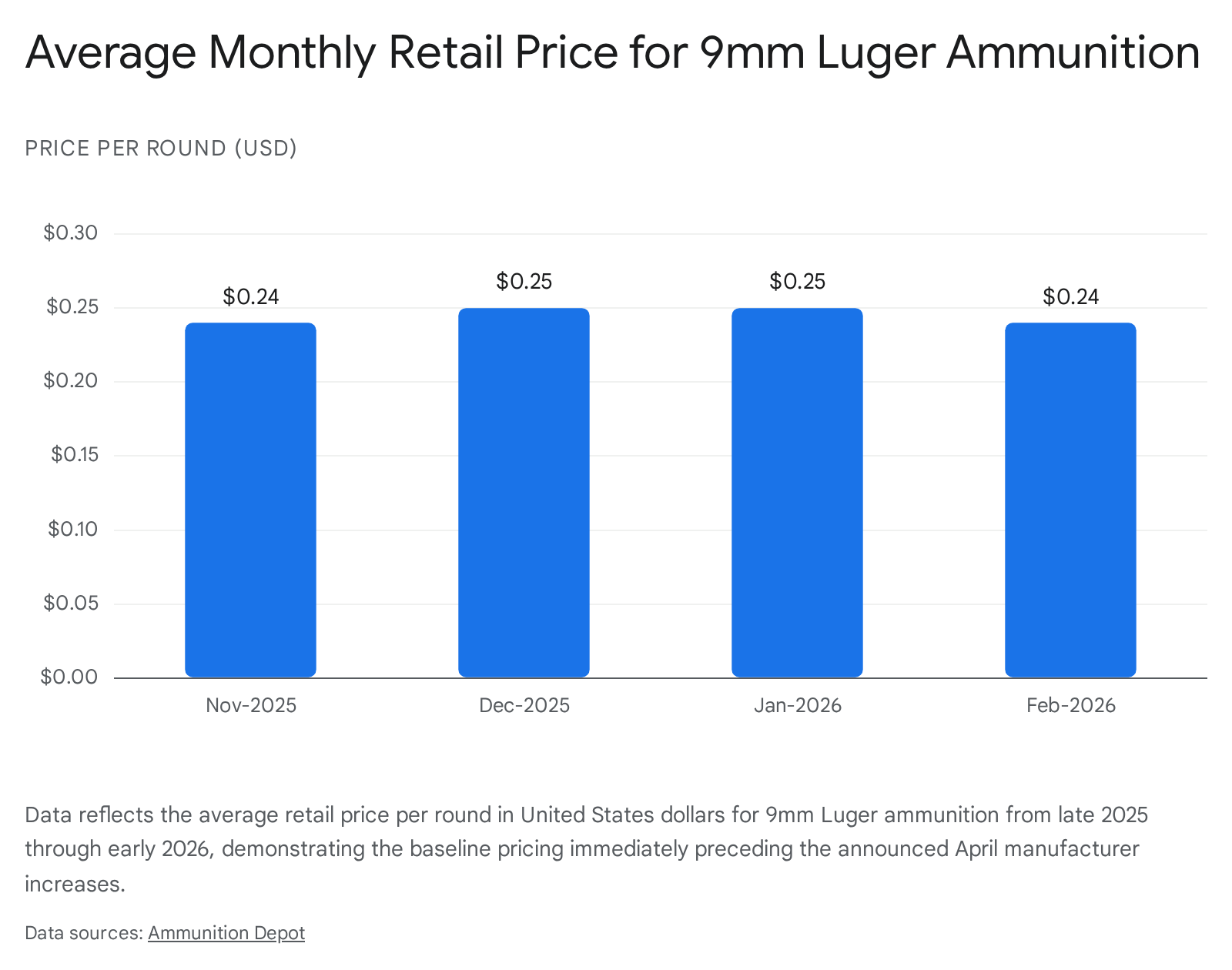
Throughout late 2025 and into early 2026, 9mm Luger pricing remained relatively stable but began to show distinct signs of upward pressure as manufacturers prepared their new pricing sheets. In November 2025, the average price per round sat at twenty four cents, rising slightly to twenty five cents in December 2025 and January 2026, before returning to twenty four cents in February 2026.16 However, retail analysts reported that by early March 2025, prices had dipped briefly to twenty cents per round, but this downward trend rapidly reversed as raw material costs spiked.17
Data compiled by the major online retailer Ammunition Depot indicated that the average daily price of 9mm full metal jacket ammunition began ticking up steadily throughout the winter.7 By January 2026, the price twice breached the thirty five cents per round threshold, marking the highest retail pricing levels observed since the turbulence of 2023 and representing an approximate ten cent increase over the 2025 average.7 For high volume consumers purchasing ammunition by the hundreds or thousands of rounds, a ten cent per round spike represents an immediate and highly noticeable hundred dollar increase in training costs per case.7
5.3 Product Focus: Winchester USA 9mm Luger 115 Grain FMJ
To provide actionable and specific market intelligence, this economic report isolates the pricing data for a widely recognized benchmark product. The selected product is the Winchester USA 9mm Luger 115 Grain Full Metal Jacket bulk case, containing exactly one thousand rounds. This particular product, frequently referred to in the firearms industry as Winchester White Box or Winchester Service Grade, represents the quintessential high volume training and target ammunition utilized across the nation.18
Manufactured domestically by the Olin Corporation, the Winchester USA 115 grain FMJ features a fully reloadable brass casing and a non corrosive boxer primer.19 The 115 grain projectile weight is universally considered the standard for entry level shooters and high volume tactical training, offering a flat ballistic trajectory and highly manageable recoil characteristics compared to heavier 124 grain or 147 grain alternatives.15 The lighter bullet weight results in slightly snappier recoil, but the increased muzzle velocity translates to reliable performance on the range.22
Ballistically, this specific Winchester load achieves a stated muzzle velocity of 1190 feet per second and generates 362 foot pounds of muzzle energy out of a standard length pistol barrel.20 The full metal jacket flat nose bullet profile is engineered specifically by Winchester to ensure highly reliable feeding mechanics across a wide variety of modern semi automatic handguns and pistol caliber carbines while simultaneously reducing harmful lead fouling within the barrel.20
For comprehensive technical specifications and manufacturer details, the official product page can be accessed here:(https://winchester.com/Products/Ammunition/Handgun/USA/USA9W).25
5.4 Vendor Pricing Analysis for 9mm Luger
An extensive analysis of the online retail market for the 1000 round bulk case of Winchester USA 9mm Luger 115 Grain FMJ reveals significant price dispersion among competing retailers. Across the aggregated vendor data gathered for this report, the absolute minimum observed price for this specific product was $239.99, while the maximum observed price peaked at $355.99.26 The calculated average market price across all surveyed retailers currently sits at approximately $280.82 per case.
To assist consumers and institutional buyers in navigating this volatile pricing environment, the following list identifies five reputable vendors currently offering this exact Winchester product at a price point strictly between the market minimum and the overall market average.
- Sportsman’s Den: Priced at $239.99 per 1000 round bulk pack.(https://www.sportsmansden.com/all-products/browse/brand/winchester/caliber/9mm).26
- Bereli: Priced at $245.00 per 1000 round case, notably inclusive of free shipping.(https://www.bereli.com/sg9w50/).19
- BulkMunitions: Priced at $260.00 per 1000 round range pack.(https://bulkmunitions.com/9mm-115gr-fmj-winchester-usa-usa9w-1000-rounds/).28
- TrueShot Ammo: Priced at $262.80 per 1000 round bulk case.(https://trueshotammo.com/products/winchester-9mm-115-grain-fmj-2).29
- Brownells: Priced at $279.98 for a total of 1000 rounds, achieved by purchasing two 500 round cases priced at $139.99 each.(https://www.brownells.com/ammunition/handgun-ammunition/service-grade-9mm-luger-handgun-ammo/?sku=105000736).30
| Retail Vendor | Product Configuration | Stated Price (USD) | Price Per Round |
| Sportsman’s Den | 1000 Round Bulk Pack | $239.99 | $0.24 |
| Bereli | 1000 Round Case | $245.00 | $0.245 |
| BulkMunitions | 1000 Round Range Pack | $260.00 | $0.26 |
| TrueShot Ammo | 1000 Round Bulk Case | $262.80 | $0.262 |
| Brownells | 500 Round Case (x2) | $279.98 | $0.28 |
6.0 Caliber Specific Market Analysis: 5.56x45mm NATO
If the 9mm Luger is the undisputed king of handgun calibers, the 5.56x45mm NATO cartridge holds the identical prestigious position in the rifle category. Widely recognized and designated as America’s rifle round, the 5.56 NATO is the standard chambering for the AR-15 platform, which is currently owned by tens of millions of American citizens.31 The caliber is universally applied across diverse shooting disciplines, ranging from high volume tactical training and competitive three gun matches to home defense applications and varmint hunting.32 The market health of the 5.56 NATO cartridge directly impacts the operational budgets of nearly every rifle shooter in the country.
6.1 High Pressure Mid Caliber Demand
The engineering requirements for modern 5.56 NATO ammunition place distinct and heavy pressures on the manufacturing supply chain. As the ammunition market approaches the latter half of 2026, requirements across military, law enforcement, and civilian shooting disciplines are rapidly converging.33 Shooters across all sectors are universally demanding ammunition that performs reliably under substantially higher chamber pressures within modern, often suppressed, weapon platforms.33 It is important to note that while the 5.56 NATO shares identical external dimensions with the.223 Remington cartridge, the NATO specification is loaded to significantly higher internal pressures, requiring stronger brass casings and more robust construction.34
Military organizations globally are issuing procurement requests that specify these higher operating pressures to achieve improved velocity, flat trajectories, and superior terminal performance at extended combat ranges.33 This necessitates the use of premium brass alloys, strictly controlled nitrocellulose propellant charges, and meticulously constructed full metal jacket projectiles. Because the civilian market demands identical performance specifications to military issue ammunition, commercial manufacturers cannot cut corners on raw materials. This rigid standard makes the 5.56 NATO highly susceptible to the aforementioned commodity price hikes in copper and chemical propellants, as manufacturers must purchase top tier materials to meet safety tolerances.33
6.2 Spring 2026 Price Trajectory
The historical pricing trajectory of the 5.56 NATO cartridge closely mirrors the extreme volatility seen in the 9mm Luger market. Prior to the severe supply chain disruptions of 2020, standard 55 grain 5.56 NATO target ammunition traded steadily near thirty cents per round.16 During the absolute peak of the 2021 supply shortage, the average price skyrocketed to approach an incredible ninety six cents per round, effectively rendering high volume rifle training prohibitively expensive for the average civilian consumer.16
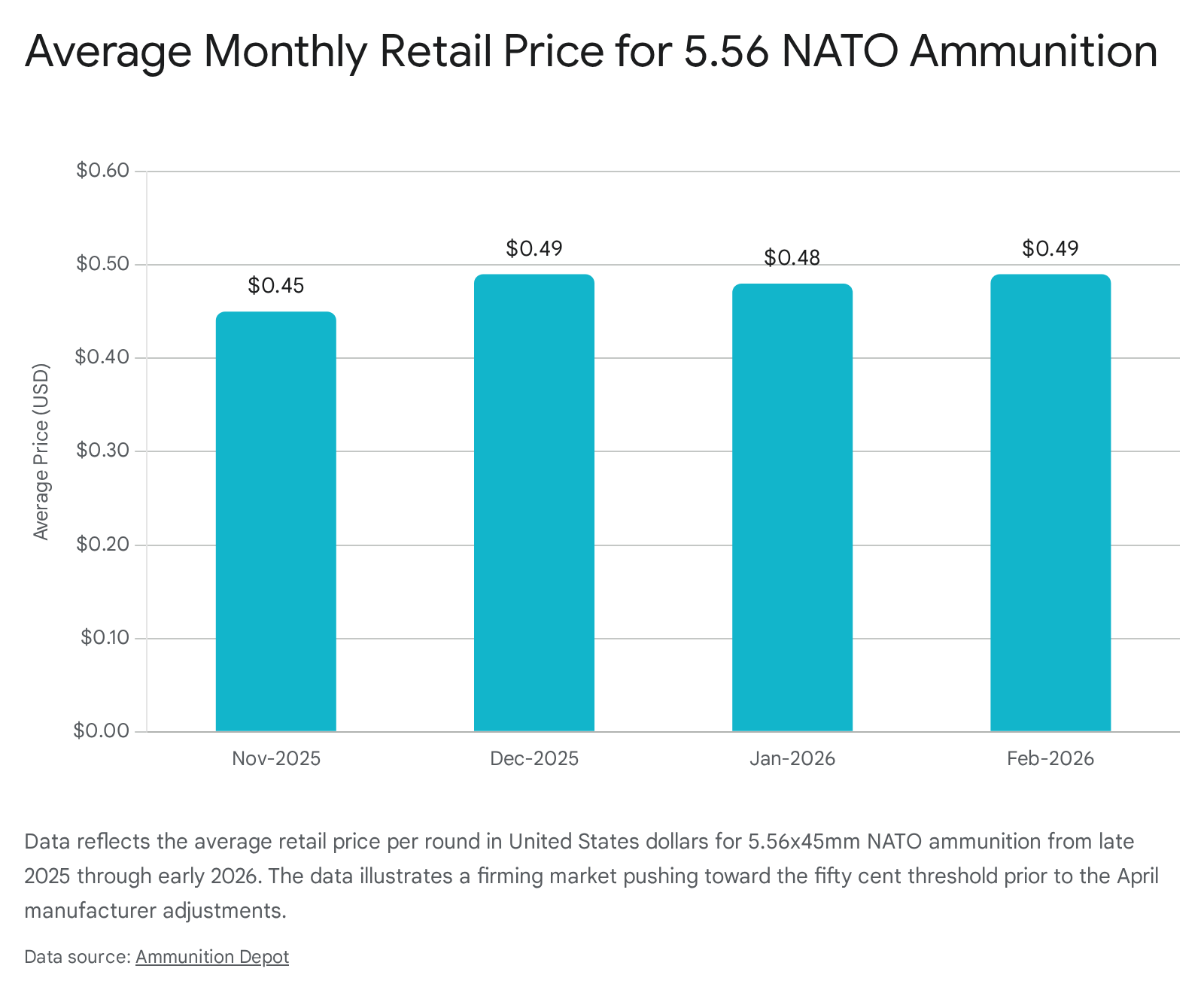
As the market entered the brief stabilization phase of 2025, retail prices finally settled into a more predictable and acceptable band. According to historical tracking data, the average monthly pricing generally hovered in the low to mid forty cent range.35 A notable low occurred in the summer, specifically July 2025, with prices dipping to approximately $0.385 per round.35 However, the data clearly shows the market tightening significantly as it moved into the critical spring 2026 window. In November 2025, the average price was forty five cents, jumping rapidly to forty nine cents in December 2025, relaxing slightly to forty eight cents in January 2026, and returning to forty nine cents per round in February 2026.35 With the looming April price increases from The Kinetic Group and the Q1 increases from Winchester taking full effect, analysts project the average price will securely breach the fifty cent threshold in the immediate term.
6.3 Product Focus: Federal American Eagle 5.56 NATO 55 Grain FMJ
To establish a highly accurate and comparable pricing metric for the rifle market, this economic report isolates the Federal American Eagle 5.56x45mm NATO 55 Grain Full Metal Jacket bulk case, packaged loosely in one thousand round quantities. Often sold under the widely recognized SKU designation XM193BK or AE193, this specific product is universally considered the gold standard for bulk military specification commercial ammunition.36
Manufactured by the Federal Cartridge Company, a prime corporate entity operating under The Kinetic Group, this highly sought after ammunition is famously produced at the legendary Lake City Army Ammunition Plant.37 The product is manufactured to exacting United States Military M193 specifications, featuring a 55 grain full metal jacket boat tail bullet design.37 The boat tail configuration at the rear of the projectile drastically improves the aerodynamic efficiency and ballistic coefficient of the bullet, resulting in superior accuracy, retained energy, and wind resistance at extended distances.40
The ammunition is loaded into brand new, virgin annealed brass casings that feature visible, discolored annealing marks around the case neck, which is a required hallmark of true military specification production indicating the brass has been properly heat treated for maximum durability.38 It utilizes non corrosive boxer primers that are heavily crimped and sealed to ensure military grade reliability in adverse environmental conditions.37 Ballistically, the Federal XM193 generates an impressive muzzle velocity of 3165 feet per second and delivers 1282 foot pounds of kinetic energy upon impact.37 The high quality brass casings are highly prized by the handloading community and can safely be reloaded up to seven times, providing substantial secondary value to the consumer.38
For comprehensive technical specifications and manufacturer details, the official product page can be accessed here:(https://www.federalpremium.com/rifle/american-eagle/american-eagle-rifle/11-AE193C.html).41
6.4 Vendor Pricing Analysis for 5.56 NATO
Evaluating the online retail market for the one thousand round bulk case of Federal American Eagle 5.56 NATO 55 Grain FMJ demonstrates substantial variance in dealer pricing strategies. Across the surveyed vendors, the absolute minimum price observed for this specific bulk case was $499.00, while the maximum price demanded by retailers reached an astonishing $1249.99.34 The calculated average market price across the entire data set rests at approximately $731.36 per case.
To guide intelligent procurement decisions in a volatile market, the following list identifies five reputable vendors currently offering this exact Federal XM193 product at a price point strictly between the market minimum and the overall market average.
- Top Gun Ammo: Priced at exactly $499.00 per 1000 round case.(https://www.topgunammo.com/federalamericaneagle5.56nato55grfmj1000rds.html).36
- Bereli: Priced at $550.00 per 1000 round case, notably inclusive of free shipping.(https://www.bereli.com/shooting/ammunition/federal-american-eagle-5-56mm-nato-ammo-55-grain-fmj/).40
- BulkMunitions: Priced at $600.00 per 1000 round loose bulk pack.(https://bulkmunitions.com/5-56x45mm-55-gr-fmj-bt-federal-xm193bkx-bulk-1000-rounds/).42
- Outdoor Limited: Priced at $630.00 per 1000 round loose pack. Visit Outdoor Limited.43
- Shooting Surplus: Priced at $715.91 per 1000 round case.(https://shootingsurplus.com/5-56mm-nato-55gr-full-metal-jacket-1-000-case/).31
| Retail Vendor | Product Configuration | Stated Price (USD) | Price Per Round |
| Top Gun Ammo | 1000 Round Case | $499.00 | $0.499 |
| Bereli | 1000 Round Case | $550.00 | $0.55 |
| BulkMunitions | 1000 Round Bulk Pack | $600.00 | $0.60 |
| Outdoor Limited | 1000 Round Loose Pack | $630.00 | $0.63 |
| Shooting Surplus | 1000 Round Case | $715.91 | $0.715 |
7.0 Spring 2026 Procurement Strategies
Given the verified macroeconomic pressures, the widespread corporate restructuring of manufacturing giants, and the psychological triggers inherent in the firearms community, navigating the spring 2026 ammunition market requires strategic discipline. The promotional pricing era is definitively over, and the baseline cost of participation in the shooting sports has permanently elevated.1 Consequently, individual consumers, law enforcement agencies, and institutional buyers must adopt sophisticated procurement strategies to mitigate the severe financial impact of the impending price hikes.
7.1 The Financial Mechanics of Strategic Bulk Purchasing
The single most effective mechanism to combat rising per round costs is strategic bulk purchasing. Buying ammunition one or two fifty round boxes at a time mathematically guarantees that the consumer pays the maximum possible premium.44 Manufacturers and retailers deliberately price smaller quantities higher to compensate for increased packaging expenses, complex shipping logistics, and the economic premium placed on consumer convenience.44
When purchasing scales up to full case quantities, typically defined as five hundred or one thousand rounds, the cost per round drops precipitously.44 Purchasing a heavy one thousand round case consolidates freight shipping into a single optimized package, effectively eliminating the redundant delivery fees that rapidly erode training budgets over the course of a year.44 For high volume shooters who consume hundreds of rounds per month in practice, professional training, or competition, saving even a few cents per cartridge through bulk acquisition translates into substantial annual budget retention.44 In an environment where the base price is rising up to ten percent, offsetting that increase by eliminating the small box premium is a critical financial maneuver.
7.2 Hedging Against the April Price Adjustments
The concept of the spring ammo window is a fundamental tenet of market timing within the firearms industry.3 Spring is historically the season when ammunition pricing and availability exhibit the highest degree of volatility.3 This inherent seasonal volatility is amplified exponentially in 2026 by the confirmed April first price increases announced by The Kinetic Group and the ongoing first quarter adjustments implemented by the Olin Corporation.2
This undeniable dynamic transforms immediate bulk purchasing from a mere discount mechanism into a highly practical financial hedge.2 Securing inventory before the mandated manufacturer increases artificially tighten the market allows shooters to lock in their operating capital at predictable and manageable valuations.3 It effectively insulates the buyer from the impending seasonal summer demand squeeze and the psychological shortage loop that threatens to strip retail shelves bare in the coming months.1 Waiting to purchase ammunition as needed throughout the summer of 2026 exposes the consumer entirely to the unmitigated impact of raw material inflation, corporate price structuring, and potential retail stockouts.
8.0 Conclusion
The United States commercial ammunition market in the spring of 2026 is characterized by severe, structural pricing volatility that demands immediate attention from high volume consumers. This instability is not the result of transient market anomalies or brief supply chain hiccups, but rather the culmination of foundational economic shifts across the globe. Escalating global commodity prices for copper, lead, zinc, and chemical propellants, exacerbated by protectionist trade tariffs and international logistical disruptions in maritime shipping, have systematically destroyed the traditional profit margins of domestic manufacturers.
The profound corporate consolidation of the industry, underscored most notably by the Czechoslovak Group acquisition of Vista Outdoor’s Kinetic Group and the severe financial restructuring of Olin’s Winchester division, ensures that these massive cost pressures are universally and uniformly passed down to the retail level. Consequently, the baseline costs for critical high volume calibers like 9mm Luger and 5.56x45mm NATO have experienced, and will continue to experience, sustained upward momentum throughout the year.
For the informed consumer, the era of passive, ad hoc ammunition procurement has definitively ended. Navigating the current and future market requires a highly disciplined approach to strategic bulk purchasing. By securing necessary training inventories prior to the scheduled April 2026 price implementations, buyers can effectively hedge against market inflation, avoid the psychological pitfalls of the retail shortage loop, and maintain the financial predictability necessary to sustain long term participation in the shooting sports. Failure to acknowledge these market realities will result in significantly higher procurement costs and potential exposure to acute supply shortages as the year progresses.
Note: Vendor Sources listed are not an endorsement of any given vendor. It is our software reporting a product page given the direction to list products that are between the minimum and average sales price when last scanned.
Please share the link on Facebook, Forums, with colleagues, etc. Your support is much appreciated and if you have any feedback, please email us in**@*********ps.com. If you’d like to request a report or order a reprint, please click here for the corresponding page to open in new tab.
Sources Used
- The Powder Keg Boom: Why Are Ammo Prices Rising Again? – Inside Safariland, accessed April 15, 2026, https://inside.safariland.com/blog/the-powder-keg-boom-why-are-ammo-prices-rising-again/
- Ammo Prices Rising as Costs Squeeze Manufacturers | The Boise Gun Club Handbook, accessed April 15, 2026, https://boisegunclub.com/handbook/ammo-prices-rising-as-costs-squeeze-manufacturers
- Top 5 Best Ammo to Purchase This Spring 2026 – Target Sports USA, accessed April 15, 2026, https://blog.targetsportsusa.com/top-5-best-ammo-to-purchase-this-spring/
- Federal, CCI, Remington and Other Major Ammo Brands Announce April 2026 Price Increases – Target Sports USA, accessed April 15, 2026, https://blog.targetsportsusa.com/federal-cci-remington-ammo-price-increase-april-2026/
- The Kinetic Group Announces Another Ammunition Price Increase Effective April 2026, accessed April 15, 2026, https://blackbasin.com/news/the-kinetic-group-announces-another-ammunition-price-increase-effective-april-2026/
- Ammo Prices KEEP GOING UP! Every Shooter Needs To See This! – YouTube, accessed April 15, 2026, https://www.youtube.com/watch?v=Vt8zJK6k-1I
- Trump’s Tariffs Are Driving Up Ammo Prices – The Trace, accessed April 15, 2026, https://www.thetrace.org/2026/03/trump-tariffs-ammunition-prices/
- Ammo pricing getting a little Spicy : r/CAguns – Reddit, accessed April 15, 2026, https://www.reddit.com/r/CAguns/comments/1rpil43/ammo_pricing_getting_a_little_spicy/
- Vista Outdoor Confirms CSG Increases Purchase Price for The Kinetic Group Business by $50 Million to $1.96 Billion, accessed April 15, 2026, https://investors.vistaoutdoor.com/Investors/news/news-details/2024/Vista-Outdoor-Confirms-CSG-Increases-Purchase-Price-for-The-Kinetic-Group-Business-by-50-Million-to-1.96-Billion/default.aspx
- Anyone notice price increase in 5.56 since this “war” started? : r/ammo – Reddit, accessed April 15, 2026, https://www.reddit.com/r/ammo/comments/1rpse66/anyone_notice_price_increase_in_556_since_this/
- Winchester Ammo Q4 Profits Tumble on Pricing Pressures | SGB Media Online, accessed April 15, 2026, https://sgbonline.com/winchesters-q3-profits-tumble-on-ammo-pricing-pressures/
- Buy Now or Pay More Later? Winchester to Raise Ammo Prices 3-8% Starting January 1, 2026 – USA Carry, accessed April 15, 2026, https://www.usacarry.com/buy-now-or-pay-more-later-winchester-to-raise-ammo-prices-3-8-starting-january-1-2026/
- Ammo prices are going up again on April 1st. Federal, CCI, and Remington confirmed 2% to 10% hikes. – Reddit, accessed April 15, 2026, https://www.reddit.com/r/ammo/comments/1s3ynws/ammo_prices_are_going_up_again_on_april_1st/
- 9mm Ammo vs. .45 ACP in 2026: Why the Debate Is Finally Over – AR15Discounts, accessed April 15, 2026, https://ar15discounts.com/9mm-ammo-vs-45-acp-in-2026-why-the-debate-is-finally-over/
- 9mm Ammo: A Brief Overview, accessed April 15, 2026, https://trueshotammo.com/blogs/true-shot-academy/9mm-ammo-a-brief-overview
- 10-Year 9mm Ammo Price History (2016–2026) – Ammunition Depot, accessed April 15, 2026, https://www.ammunitiondepot.com/ammo-price-history/9mm
- 9mm Ammo Price History + Chart – How Much is 9mm Today? | Black Basin Outdoors, accessed April 15, 2026, https://blackbasin.com/ammo-prices/9mm/
- 1,000 Rounds Of Winchester USA 9mm FMJ 115 Grain Ammo …, accessed April 15, 2026, https://palmettostatearmory.com/1-000-rounds-of-winchester-usa-9mm-fmj-115-grain-ammo.html
- Winchester USA 9mm Luger 115 Grain Full Metal Jacket (FMJ …, accessed April 15, 2026, https://www.bereli.com/sg9w50/
- WINCHESTER 9MM LUGER 115 GRAIN FMJ (1,000 Rounds) + BROWNING X-POINT DEFENSE 9MM LUGER 147 GRAIN JHP (200 Rounds) – Bereli.com, accessed April 15, 2026, https://www.bereli.com/b191700092-200-w9mm50-1000/
- Winchester 9mm 200-Round Pistol Target Ammunition | Big 5 Sporting Goods, accessed April 15, 2026, https://www.big5sportinggoods.com/store/details/winchester-9mm-200-round-pistol-target-ammunition/0320133080117
- 115 vs 124 vs 147 Grain: Which 9mm Should You Choose? – Palmetto State Armory, accessed April 15, 2026, https://ads.palmettostatearmory.com/blog/115gr-vs-124gr-vs-147gr-which-9mm-should-you-choose.html
- USA Ready – Winchester Ammunition, accessed April 15, 2026, https://winchester.com/Products/Ammunition/Handgun/USA-Ready
- Winchester USA Full Metal Jacket 9mm Luger 115-Grain Handgun Ammunition – 100 Rounds | Academy, accessed April 15, 2026, https://www.academy.com/p/winchester-usa-full-metal-jacket-9mm-luger-115-grain-handgun-ammunition-100-rounds
- USA9W – Handgun Ammo – Winchester Ammunition, accessed April 15, 2026, https://winchester.com/Products/Ammunition/Handgun/USA/USA9W
- Winchester – Sportsman’s Den |, accessed April 15, 2026, https://www.sportsmansden.com/all-products/browse/brand/winchester/caliber/9mm
- Winchester USA Forged 9mm Luger 115gr FMJ Centerfire Handgun Ammo – 1000 Rounds, accessed April 15, 2026, https://www.sportsmans.com/shooting-gear-gun-supplies/ammunition-ammo-for-hunting-shooting-sports/handgun-ammo-hunting-shooting-sports/winchester-usa-forged-9mm-luger-115gr-fmj-centerfire-handgun-ammo-1000-rounds/p/1801781
- 9mm 115gr FMJ – Winchester USA (USA9W) – 1000 Rounds – BulkMunitions, accessed April 15, 2026, https://bulkmunitions.com/9mm-115gr-fmj-winchester-usa-usa9w-1000-rounds/
- Winchester – 9mm – 115 Grain – FMJ – Bulk Pack – True Shot Ammo, accessed April 15, 2026, https://trueshotammo.com/products/winchester-9mm-115-grain-fmj-2
- WINCHESTER SERVICE GRADE 9MM LUGER HANDGUN AMMO, accessed April 15, 2026, https://www.brownells.com/ammunition/handgun-ammunition/service-grade-9mm-luger-handgun-ammo/
- Federal American Eagle 5.56mm NATO Full Metal Jacket 55 Grain …, accessed April 15, 2026, https://shootingsurplus.com/5-56mm-nato-55gr-full-metal-jacket-1-000-case/
- 5.56 Ammo For Sale | GunMag Warehouse, accessed April 15, 2026, https://gunmagwarehouse.com/ammunition/5-56mm-nato
- Ammunition Trends for 2026: Where Performance, Pressure, and Innovation Converge, accessed April 15, 2026, https://shellshocktechnologies.com/academy/ammunition-trends-for-2026-where-performance-pressure-and-innovation-converge/
- 5.56 mm NATO Ammunition for Sale | Sportsman’s Outdoor Superstore, accessed April 15, 2026, https://www.sportsmansoutdoorsuperstore.com/category.cfm/sportsman/5.56-x-45-mm-nato-ammunition-for-sale
- 10 Year 223 / 5.56 Ammo Price History – Ammunition Depot, accessed April 15, 2026, https://www.ammunitiondepot.com/ammo-price-history/223-556
- Federal American Eagle 5.56 NATO 55gr FMJ Ammo – 1000 Rounds, accessed April 15, 2026, https://www.topgunammo.com/federalamericaneagle5.56nato55grfmj1000rds.html
- 1000rds – 5.56 Federal Lake City XM193BK 55gr. FMJ Ammo, accessed April 15, 2026, https://www.ammunitiontogo.com/1000rds-556-federal-lake-city-xm193bk-55gr-fmj-ammo
- Federal American Eagle 5.56mm NATO Ammo 55 Grain Full Metal Jacket 1000 Rounds Bulk – Target Sports USA, accessed April 15, 2026, https://www.targetsportsusa.com/federal-american-eagle-556mm-nato-bulk-ammo-55-grain-full-metal-jacket-1000-rounds-xm193bkf-p-110305.aspx
- 5.56 Ammo at AmmoMan.com – Federal Lake City XM193BK 55 Grain Full Metal Jacket Boat Tail – 1000 Rounds Loose Pack, accessed April 15, 2026, https://www.ammoman.com/xm193-federal-xm193bk-556-nato-loose-pack-1000-rounds
- Federal American Eagle 5.56mm NATO Ammo 55 Grain FMJ – Bereli …, accessed April 15, 2026, https://www.bereli.com/shooting/ammunition/federal-american-eagle-5-56mm-nato-ammo-55-grain-fmj/
- American Eagle Rifle, 5.56x45mm, 55 Grain, Full Metal Jacket Boat-Tail, 3165 fps, accessed April 15, 2026, https://www.federalpremium.com/rifle/american-eagle/american-eagle-rifle/11-AE193C.html
- Federal XM193BKX 5.56x45mm Bulk Ammo 55gr FMJ – 1000 Rounds, accessed April 15, 2026, https://bulkmunitions.com/5-56x45mm-55-gr-fmj-bt-federal-xm193bkx-bulk-1000-rounds/
- Federal 5.56x45mm NATO Ammunition XM193BK 55 gr FMJ Bulk 1,000 rounds, accessed April 15, 2026, https://outdoorlimited.com/rifle-ammo/5-56x45mm-nato-ammo/federal-5-56x45mm-nato-ammunition-xm193bk-55-gr-fmj-bulk-1000-rounds/
- Maximum Value: Why Bulk Buying Ammunition is Your Best Move in 2026, accessed April 15, 2026, https://www.wholesalehunter.com/blog/maximum-value-why-bulk-buying-ammunition-is-your-best-move-in-2026/