Executive Summary
The proliferation of uncrewed aerial systems has fundamentally altered the calculus of modern mechanized warfare. Over the past three years, the battlefield has transformed into a highly transparent, sensor-saturated environment where precise, low-cost kinetic effectors have challenged the historical dominance of heavy armor. First-Person View drones and loitering munitions now act as the primary nodes for intelligence, surveillance, reconnaissance, and indirect fire. This shift has precipitated an asymmetric cost-per-effect dynamic, wherein commercially derived aerial systems costing less than a thousand dollars routinely neutralize multimillion-dollar main battle tanks.
This analysis evaluates the economic asymmetry defining the current threat landscape, assessing the structural impact on defense procurement and operational sustainment. The report explores the specific engineering adaptations required to ensure the survivability of armored formations, focusing heavily on the integration and evolution of Active Protection Systems and electronic warfare modules. By examining current vendor solutions, such as those from Rafael Advanced Defense Systems, Elbit Systems, Rheinmetall, Hensoldt, and Aselsan, the text details how hard-kill and soft-kill countermeasures are being rapidly upgraded to defeat top-attack threats.
Furthermore, the document addresses the prevailing debate surrounding the strategic obsolescence of heavy armor. While the tactical vulnerability of tanks has undeniably increased, leading to the temporary de-mechanization and dispersal of ground forces, armored vehicles remain strategically indispensable for projecting mobile, protected firepower. Examining massive procurement initiatives, such as Poland’s aggressive expansion of its armored forces, indicates that allied militaries are heavily investing in upgraded platforms rather than abandoning the concept of armored maneuver. The analysis concludes that the future of mechanized warfare relies on the deep integration of combined arms doctrine, automated defensive technologies, and resilient, dispersed logistical networks.
1.0 Introduction to the Drone-Saturated Battlespace
The character of ground combat is undergoing a rapid technological evolution driven by the mass deployment of cheap, disposable, and networked aerial technologies.1 Traditional military doctrine, which has long relied on the shock action of armored columns, is currently lagging behind the realities of a battlespace dominated by persistent aerial surveillance and precision strike capabilities.2
1.1 The Shift in the Tactical Paradigm
In contemporary high-intensity conflicts, the battlespace is saturated with sensors to a degree previously considered impossible. Within 15 kilometers of the forward line of own troops, vehicle movement has become exceedingly difficult, and in many sectors, nearly impossible during daylight hours.3 Infantry units are frequently forced to dismount and march significant distances to their positions to avoid the high probability of detection and destruction that accompanies mechanized transport.3
This environment has been characterized as the “Uberization” of warfare, a paradigm where low-cost, on-demand weaponry provides ubiquitous fires across the operational theater.1 Drones now account for an estimated 60 to 70 percent of all battlefield losses across all categories.4 They function simultaneously as binoculars, grenades, and mortars, forming an automated nervous system that dictates the pace of fire support and movement coordination.4 In response to this persistent threat, armies have developed improvised defenses and rely heavily on camouflage, decoys, and dispersed operations.5
1.2 The Ubiquity of Sensor-Shooter Networks
The defining feature of this new paradigm is the collapse of the sensor-to-shooter timeline. Historically, calling in precision artillery required specialized forward observers, complex communication relays, and high-value munitions like the Excalibur precision artillery round, which costs approximately $100,000 per unit.6 Today, small tactical units possess organic aerial assets that provide both the target acquisition and the terminal kinetic effect. This integration allows a small cadre of operators to inflict disproportionate damage. Simulated exercises have demonstrated that a group of ten drone operators can successfully neutralize up to twenty armored vehicles in a single day, highlighting the severe threat posed to concentrated mechanized formations.7
To survive in this transparent environment, forces have resorted to de-mechanization and extreme dispersal. Large-scale operations involving battalion or regimental maneuvers have become prohibitive due to the intense requirements for integrated air defense and electronic warfare support.4 Instead, defensive operations are increasingly conducted by highly dispersed squads, where a maximum of ten personnel can effectively hold off heavily reinforced enemy companies by leveraging deep drone magazines.4 Psychologically, the battlespace has become transparent, leaving units struggling to hide from persistent surveillance and slowing the overall operational tempo.5
2.0 Economic Asymmetry and the Cost-Imposition Model
The core disruption in modern armored warfare is not merely tactical, but deeply economic. The cost-per-effect ratio has tilted heavily in favor of the offense, creating a structural dilemma for defense planners who must protect incredibly expensive assets against ubiquitous, inexpensive threats.6
2.1 The Mathematics of Attrition
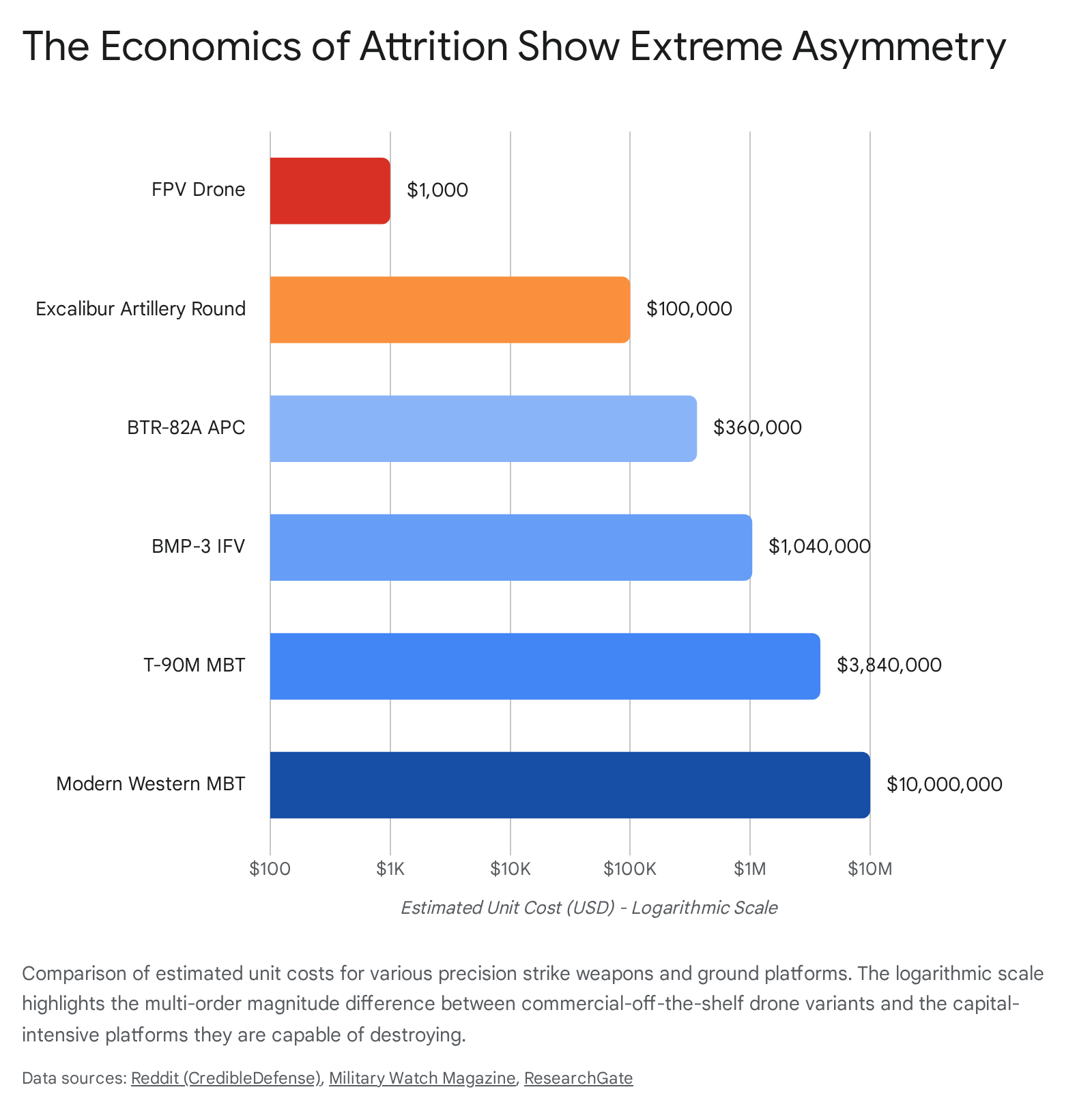
The stark contrast in unit costs defines the current attrition dynamics. A standard First-Person View drone customized for lethal payload delivery ranges in price from $300 to $1,500.6 In contrast, the targets they seek to destroy are capital-intensive strategic assets. A modern infantry fighting vehicle costs between $3 million and $4 million, while a main battle tank ranges from $2 million for older, upgraded models to over $10 million for the latest Western variants.6
Empirical data from recent conflicts indicates that FPV drones are the primary driver of tank losses, accounting for approximately 65 percent of Russian tank combat losses as of early 2025.8 For advanced platforms like the T-90M, which has an estimated unit cost of $3.84 million, roughly 50 percent of confirmed losses were attributed directly to final terminal strikes by FPV drones.8
The cost disparity is staggering. Based on field estimates, it typically requires a swarm of 5 to 6 FPV drones to successfully isolate, disable, and destroy a single heavily armored unit.8 Even at the upper end of the cost spectrum, six $1,500 drones represent an investment of $9,000 to eliminate a $3 million to $10 million asset. This yields an exchange ratio that is entirely unsustainable for traditional armor procurement models. As a point of reference, a BTR-82A armored personnel carrier, valued at approximately $360,000, costs the equivalent of 300 heavy FPV drones.9 A BMP-3 infantry fighting vehicle equates to 870 drones, and a BMD-4M airborne combat vehicle equates to 1,170 drones.9
2.2 Component Economics and Commercial Supply Chains
The economic advantage of the drone swarm is driven by the commoditization of commercial-off-the-shelf electronics. Unlike bespoke military hardware subject to decades of rigid qualification processes, lethal drones rely on agile, iteration-heavy commercial supply chains.
High-performance components are readily available on the global retail market, currently in stock, and actively utilized by drone manufacturing hubs. For example, flight controllers designed for micro-drones, such as the(https://betafpv.com/products/f4-1s-12a-aio-brushless-flight-controller-v3-0), provide sophisticated multi-axis stabilization and motor regulation for lightweight aerial platforms.10 These boards feature built-in current meters, serial receivers, and highly capable microprocessors that easily handle the flight dynamics required for terminal dive attacks, and are priced well under $50.10
Propulsion is similarly inexpensive. High-torque brushless motors, such as the(https://emax-usa.com/products/eco-ii-2807-brushless-motor-1300kv-1500kv-1700kv), deliver the heavy-lifting capability necessary to strap shaped-charge warheads to carbon fiber frames.12 These motors are widely available in retail stock for roughly $20 per unit.12 For targeting, high-definition video transmission systems like the(https://store.dji.com/product/dji-o3-air-unit) offer exceptionally low latency and high-definition feeds over distances of several kilometers for approximately $229.14
When state-sponsored manufacturing hubs combine these components with 3D-printed payload releases and legacy anti-tank grenades, the result is a highly maneuverable precision guided munition produced at a fraction of the cost of a traditional guided missile.8
2.3 Structural Shift in Procurement
This dynamic creates a durable cost-imposition model. Cheap, iterative offensive systems force the defender to continuously invest in expensive, heavy, and complex defensive adaptations.6 Ukraine’s defense industrial base, for instance, scaled its production capacity to an estimated 200,000 drones per month in 2024, with formal plans to procure upwards of 4.5 million units in 2025.6
If multi-million annual production volumes become the global standard, industrial depth and rapid manufacturing will become far more decisive than the baseline sophistication of a single combat platform.6 The burden is entirely on the armored vehicle to survive a gauntlet of attacks, burning through finite stocks of expensive countermeasures, or forcing air defense batteries to illuminate their positions, which opens them up to subsequent kinetic strikes.16 Wielding such new weapons, attackers aim to wear down sophisticated defenses by cluttering and confusing the sensor picture.16
To address this gap, Western defense departments have initiated rapid procurement programs. The United States Pentagon initiated the Gauntlet program, a billion-dollar phased initiative aimed at identifying and procuring small, one-way attack drones at scale.17 During Phase I evaluations in March 2026, Skycutter’s fiber-optic Shrike topped the leaderboard with 99.3 points, resulting in eleven companies securing prototype delivery orders totaling approximately $150 million.17 This highlights a distinct pivot toward integrating cheap, mass precision fires force-wide, moving away from systems like the older Switchblade-300, which cost over 100 times the price of a standard FPV unit.17
However, the economic argument has logistical limits. Russian defense analysts have correctly pointed out that drones are not yet fully autonomous and cannot be fielded in exact proportion to armored vehicle costs.9 While a T-90M costs the equivalent of 3,200 heavy drones, operating a swarm of that magnitude simultaneously would require at least 6,400 skilled personnel functioning in a highly coordinated, jam-free environment.9 Therefore, the current limiting factor for the offense is human capital and electromagnetic spectrum availability, rather than pure financial expenditure.
3.0 Engineering Adaptations for Top-Attack Survivability
The sudden ubiquity of aerial threats has laid bare the fundamental design biases of legacy armored vehicles. For the past seventy years, tank design prioritized protection against direct-fire kinetic energy penetrators and ground-launched anti-tank guided missiles. Consequently, heavily layered composite armor and explosive reactive armor were concentrated on the frontal arc and turret cheeks.
3.1 The Vulnerability of Legacy Armor Topologies
The top hemisphere of the tank, including the turret roof, commander’s cupola, and the engine deck, remained relatively thin to save weight and preserve the platform’s mobility.8 FPV operators have successfully exploited this structural weakness, utilizing the drone’s high maneuverability to bypass frontal defenses entirely. The standard engagement tactic involves a preliminary strike aimed at the vehicle’s tracks or transmission to disable its mobility, followed by terminal strikes directed vertically down into the top armor or optical sensor housings.8
In response, militaries initially resorted to improvised physical defenses, welding steel cage armor over the turrets to mitigate top-attack drones by prematurely detonating shaped charges.5 However, as drone payloads increase in penetration capability, these static physical barriers have proven insufficient, necessitating the rapid deployment of complex, sensor-driven countermeasures. Furthermore, there is a fundamental limit to the addition of physical firepower and protection before the vehicle’s mobility is critically compromised.18
3.2 Hard-Kill Active Protection Systems
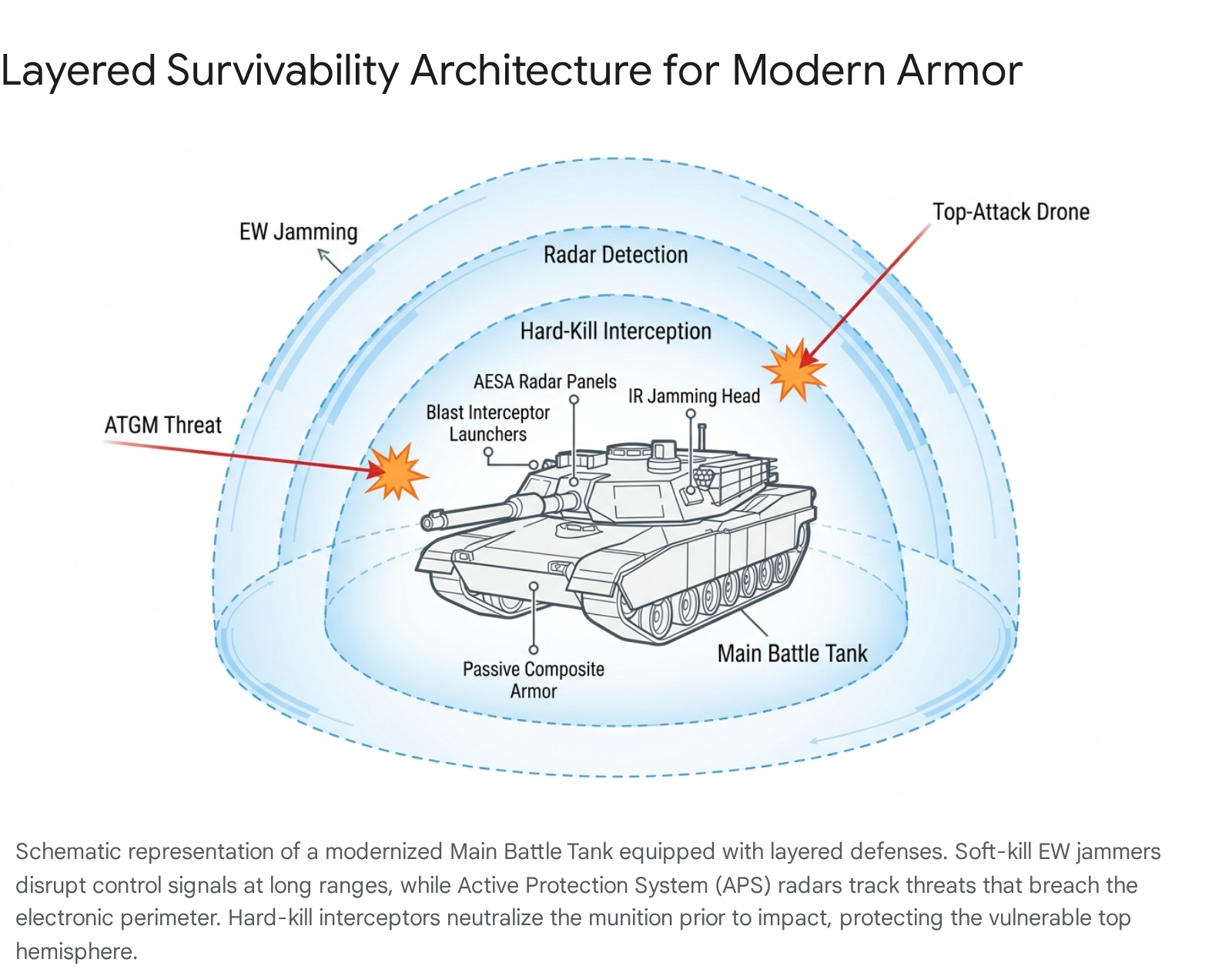
Hard-kill Active Protection Systems operate by detecting an incoming threat via radar or electro-optical sensors and physically destroying the projectile before it impacts the vehicle’s armor. The integration of these systems is no longer an optional upgrade, it is an absolute necessity for platform survival against loitering munitions.
Rafael Trophy Active Protection System Developed by Israel’s Rafael Advanced Defense Systems, the(https://www.rafael.co.il/trophy/) is currently the most widely deployed and combat-proven system on the market, having been utilized extensively on Merkava tanks and Namer armored personnel carriers.20 Initially designed to defeat ground-launched rockets by firing a matrix of explosively formed penetrators to disintegrate the incoming threat, Trophy has undergone significant software and hardware evolution.22
In 2024, Rafael announced a critical top-attack defense capability upgrade.21 By integrating an artificial intelligence layer into the system’s processing architecture, the upgraded Trophy speeds up detection-to-intercept timelines, allowing the radar to track and destroy drones and loitering munitions diving from high angles above the turret.21 This capability is executed via non-explosive kinetic slugs that intercept the threat while minimizing collateral damage to nearby dismounted infantry.22
The system’s effectiveness is well regarded, with European nations actively standardizing its use. In early 2026, a €330 million multi-nation contract was signed between EuroTrophy and KNDS Deutschland to integrate Trophy as part of the baseline configuration for the Leopard 2A8 fleets of Lithuania, the Netherlands, the Czech Republic, and Croatia.20 Embedding the system directly into the electrical and command architecture at the production stage, rather than functioning as a retrofit, indicates a major shift in NATO armored force design.26
Elbit Systems Iron Fist The(https://www.elbitsystems.com/land/combat-vehicle-systems/warning-self-protection/iron-fist-aps) offers a different mechanical approach to threat neutralization. It utilizes a highly sensitive dual-sensor suite comprising small active electronically scanned array radars paired with passive infrared cameras.27 When a threat is detected, Iron Fist launches a small blast interceptor that detonates at a precisely calculated safe distance.27 This creates a shockwave that destroys the incoming warhead or disrupts the jet formation of a shaped charge without initiating the explosive payload of the threat itself.27
Recent testing has officially validated Iron Fist’s capability to shoot down quadcopters and small fixed-wing drones, marking a significant milestone in counter-UAS vehicle defense.27 The system’s low weight and minimal power requirements have made it attractive for infantry fighting vehicles, where preserving operational weight is critical. In 2026, Elbit secured a $228 million contract to supply Iron Fist for the U.S. Army’s Bradley M2A4E1 variants, followed closely by a $150 million contract with BAE Systems Hägglunds for European NATO CV90 fleets.28 During European demonstrations, the system successfully intercepted over a dozen 120mm kinetic energy tank rounds, validating its capabilities against high-velocity threats alongside drones.29
Rheinmetall StrikeShield Germany’s(https://www.rheinmetall.com/en/products/protection-systems/protection-systems-land/active-protection-systems) represents a highly innovative approach to standoff active protection technologies.30 Unlike the turreted launchers of Trophy and Iron Fist, StrikeShield utilizes a distributed architecture. The system physically embeds sensors and directed-energy countermeasure modules seamlessly into the passive armor profile along the length of the vehicle.30
This distributed layout provides the fastest possible reaction time, intercepting missiles or drones in the immediate vicinity of the hull, which drastically reduces the collateral damage radius.30 Furthermore, StrikeShield operates with a highly restricted radar emission range, providing the lowest electronic warfare signature on the market.31 This is a critical advantage in an environment where adversary electronic support measures continuously hunt for active radar emissions to target artillery strikes.16 By combining active and passive protection into a modular design, the system manages weight distribution efficiently across the platform.31
Aselsan AKKOR Turkey has aggressively pursued indigenous protection networks following combat lessons learned in recent conflicts. The(https://www.aselsan.com/en/blog/detail/533/akkor-active-protection-system) active protection system is entering serial production in 2025, specifically designed for the new Altay main battle tank and upgraded Leopard 2A4s.32 AKKOR operates entirely optics-free, relying strictly on high-resolution radio frequency radars to cut through severe battlefield obscurants like mud, dust, and heavy snow.32 It pairs smart hard-kill munitions with an integrated electronic warfare computer, offering comprehensive 360-degree coverage against asymmetric threats.32 The Turkish Armed Forces have formally adopted the AKKOR 10 variant following successful qualification tests against anti-tank guided missiles.33
Russian Arena-M The Russian defense industry has similarly accelerated its protection programs, despite severe industrial constraints. The Arena-M system has been specifically updated with software algorithms to recognize and engage drones approaching from non-traditional trajectories.34 In early 2026, footage confirmed that fresh batches of T-90M Proryv tanks were rolling off the Uralvagonzavod production lines with Arena-M integrated directly alongside their standard Relikt explosive reactive armor, an acknowledgment that passive protection alone is inadequate.35 The system has also undergone expanded trials against captured foreign munitions to verify its effectiveness under current combat conditions.37
| System Name | Manufacturer | Primary Defeat Mechanism | Key Feature / Threat Focus | Current Status / Platform |
| Trophy | Rafael Advanced Defense Systems | Hard-Kill (Kinetic Slug) | AI-upgraded for top-attack drone intercept | Combat proven; Baseline for Leopard 2A8 |
| Iron Fist | Elbit Systems | Hard-Kill (Blast Interceptor) | Low collateral damage, UAV intercept proven | Serial production; Bradley M2A4E1, CV90 |
| StrikeShield | Rheinmetall | Hard-Kill (Distributed Directed Energy) | Lowest EW signature, passive armor integration | Production; Modular platform integration |
| AKKOR | Aselsan | Hard & Soft-Kill (RF Radar / EW) | High-resolution optics-free operation | Serial production 2025; Altay, Leopard 2A4 |
| MUSS 2.0 | Hensoldt | Soft-Kill (IR Jamming / Obscurant) | Defeats laser-guided munitions, low weight | Production; Puma IFV integration |
4.0 Soft-Kill Countermeasures and Electronic Warfare Integration
Hard-kill systems suffer from a distinct vulnerability regarding magazine depth. A launcher holding only a few physical interceptors can be rapidly overwhelmed by a coordinated swarm attack designed to exhaust the vehicle’s defensive stores.27 Therefore, hard-kill systems must be seamlessly layered with soft-kill countermeasures that disrupt the threat’s guidance mechanisms before terminal approach.
4.1 Automated Soft-Kill Networks
The(https://www.hensoldt.net/products/muss-20-self-protection-for-armoured-vehicles) functions as a premier soft-kill active protection system. Weighing under 60 kilograms, the system employs four passive missile and laser warning sensors linked to a central computer, minimizing the vehicle’s own electronic signature.38 When an incoming threat is detected, MUSS 2.0 automatically prioritizes the danger and triggers an advanced laser-based infrared jammer to break the lock of semi-automatic command to line of sight missiles.38 Simultaneously, a directional smoke launcher dispenses multi-spectral obscurant to hide the vehicle from thermal targeting.38 The 2.0 variant has been explicitly upgraded to classify low-power lasers and second-generation beam-riders, preventing advanced guided munitions from acquiring the platform.40
4.2 Theater-Level Spectrum Dominance
On a broader operational level, dedicated electronic warfare vehicles are required to sanitize the airspace surrounding armored columns. Systems like the(https://gdmissionsystems.com/intelligence-systems/signals-intelligence/tactical-electronic-warfare-system-tews) provide brigade commanders with modular, platform-independent electronic attack capabilities.41 By moving alongside mechanized formations, TEWS units can detect, locate, and identify enemy positions while simultaneously denying, disrupting, and degrading the control frequencies used by FPV operators.41 This forces incoming drones to either drop out of the sky or revert to basic analog behavior, rendering them largely ineffective.
However, this measure-countermeasure cycle is advancing rapidly. In response to heavy localized radio frequency jamming, drone manufacturers have begun reverting to physical optical fiber spools for guidance, completely bypassing the electromagnetic spectrum and rendering traditional EW jammers obsolete for those specific engagements.7 Furthermore, AI integration is allowing drones to utilize automatic target recognition, meaning the drone can autonomously complete its terminal dive even if the operator’s video feed is severed by electronic warfare.8 These developments underscore that no single countermeasure can guarantee absolute protection.
5.0 Industrial Depth and Supply Chain Resilience
The tactical deployment of active protection systems and heavily armored vehicles relies entirely on an invisible tether of logistical support and supply chain resilience. The drone war has proven that industrial depth and the ability to rapidly reconstitute losses are just as decisive as the initial technological sophistication of the combat platform.6
5.1 The Component Obsolescence Challenge
The integration of complex defense systems like APS and EW modules onto tanks exacerbates long-term sustainment challenges. These high-tech components rely on fragile electronic supply chains. When critical commercial components reach the end of their lifecycle mid-program, the fallout immediately degrades mission readiness.42
Procurement teams face mounting pressure to navigate hardware obsolescence. Replacing a single obsolete timing circuit in an aerospace or defense program can trigger months of required requalification testing, costing millions of dollars in programmatic delays and lost production capacity.42 This rigid defense procurement reality sits in stark contrast to the agile, commercial component supply chain utilized by FPV drone manufacturers, who can swap generic parts with minimal friction. To counter this, defense programs must adopt early lifecycle planning to secure long-term component availability and build structural contingencies into their schedules.42
5.2 OSINT and Evaluating Defense Production
Accurately evaluating the impact of these industrial challenges requires navigating the profound fog of war regarding defense industrial production. Traditional strategic intelligence often struggles to quantify the exact scale of drone production versus armored vehicle attrition.
Open Source Intelligence methodologies have emerged as a critical tool for assessing national defense capacities.43 By methodically cross-referencing visual evidence of battlefield losses with official state claims and expert estimates, OSINT models can expose significant discrepancies in reported production figures.43 For instance, while Russian state media may claim massive outputs of newly modernized tanks, OSINT verification of chassis losses often suggests that actual serial production is much lower than reported, and that forces are relying heavily on the refurbishment of obsolete Cold War-era stockpiles.43 This data transparency provides defense planners with a more accurate picture of strategic attrition rates.
6.0 The Strategic Obsolescence Debate
The proliferation of videos showcasing million-dollar tanks burning after strikes by hobbyist drones has sparked intense debate over the future of armored warfare. Pundits and defense analysts alike have questioned whether the era of the main battle tank has finally come to an end, drawing historical parallels to the obsolescence of the battleship.
6.1 The Enduring Requirement for Mobile Firepower
Despite the severe tactical vulnerabilities exposed by the drone-saturated environment, reports of the tank’s strategic obsolescence are premature. The tank remains an indispensable component of ground combat because it uniquely combines mobility, protection, and direct firepower.44
In modern conflicts, infantry troops remain the ultimate arbiter of holding and seizing terrain.3 However, advancing infantry across contested ground without heavy armored support results in unsustainable casualties. Artillery and machine guns create an impassable environment for unprotected troops. The tank was invented precisely to break this deadlock during World War I, and its core function, providing a mobile fortress capable of delivering high-explosive ordnance directly onto enemy strongpoints, cannot currently be replicated by any other platform.7
To declare the tank obsolete is to misunderstand the cyclical nature of military technology. Throughout the 20th century, anti-tank guided missiles, rocket-propelled grenades, and attack helicopters all periodically threatened to render armor useless. In each instance, the equilibrium was restored not by abandoning the tank, but through the integration of new countermeasures and refined tactics.7
6.2 Poland’s Massive Armor Procurement
Concrete evidence against the obsolescence theory can be seen in the procurement strategies of frontline NATO states. Poland’s recent armor buildup is the most aggressive in Europe since the Cold War, transitioning their doctrine from contract to capability at an unprecedented speed.45
By 2030, Poland aims to field approximately 900 modern tanks across three distinct platforms, an inventory larger than those of France, Germany, and the United Kingdom combined.45 This includes a $6.7 billion contract with Hyundai Rotem for 290 K2 Black Panther tanks, with options potentially reaching 1,000 vehicles.45 The K2PL variant specifically incorporates recent armored warfare lessons, including the integration of an active protection system like Trophy.45
Simultaneously, Poland has aggressively acquired American armor, receiving 117 M1A2 SEPv3 Abrams tanks as of early 2026, alongside 116 refurbished M1A1 FEP variants.45 Sustaining these assets requires massive long-term investment, as evidenced by a June 2025 Foreign Military Sale approving $325 million merely for M1A2 Abrams system sustainment support in Kuwait.46 Furthermore, Poland continues to operate and upgrade approximately 233 Leopard 2 tanks.45 This monumental financial commitment by a frontline state facing immediate strategic threats clearly indicates that professional defense establishments do not view the main battle tank as obsolete, but rather as an asset requiring profound modernization.
| Platform | Contracted Units | Delivered (End 2025) | Total Goal by 2030 | Sourcing Details |
| K2 / K2PL | 290 | ~180 | 290+ | South Korea / Poland JV ($6.7B contract) |
| M1A2 SEPv3 | 250 | ~117 | 250 | United States FMS |
| M1A1 FEP | 116 | 116 | 116 | US Army surplus (Refurbished) |
| Leopard 2 | ~233 | ~233 | ~233 | Germany (2A5) / Domestic Upgrade (2PL) |
7.0 Doctrinal Shifts and the Future of Combined Arms
The technological and economic realities of drone warfare dictate a fundamental re-evaluation of military doctrine and force structure at the brigade and tactical levels. The conundrum posed by FPV drones will not be solved by a single “silver bullet” technology, but through the strict application of combined arms theory.7
7.1 De-mechanization and Dispersal of Forces
To survive the persistent threat of aerial surveillance and precision strikes, front-line infantry units have largely abandoned standard mechanized movement near the zero line. Ground operations have temporarily de-mechanized, with troops advancing in highly dispersed, small teams of between two and four personnel to minimize their visual and thermal signatures.3
This extreme dispersal severely limits the ability of commanders to concentrate combat power for decisive shock action, a core tenet of modern combined arms doctrine.2 Western militaries, particularly the U.S. Army, are currently facing a doctrinal lag. Existing manuals and operational concepts continue to emphasize massed armored formations striking at the point of decision, but largely fail to account for battlespaces where low-cost aerial threats can attrit the armor to combat ineffectiveness long before the decisive engagement occurs.2
7.2 Operational Logistics in the Kill Web
The tactical deployment of heavily armored vehicles relies on redefining operational logistics. Historically, mechanized armies relied on massive, static logistics nodes, often colloquially referred to as “iron mountains,” to store the ammunition, fuel, and spare parts required to keep tanks operational. Today, these static nodes present easy, high-value targets for adversaries equipped with long-range strike capabilities and continuous drone surveillance.47
To ensure survivability, sustainment operations must undergo a radical transformation toward dispersed, lean logistics. Supply chains must reduce their physical footprint and enhance their mobility to remain effective in contested environments.47 Formations are adapting by maintaining only mission-critical supplies forward, heavily utilizing uncrewed ground vehicles to transport spare parts and evacuate casualties across dangerous terrain.1 Furthermore, retrograde operations, the continuous identification and removal of excess materials from the front lines, must become a synchronized, daily function to minimize the target signature of forward operating bases.47
7.3 The Future Armored Brigade
Defense ministries recognize that structural redesign is required. The Trump administration’s initiatives in 2025 pushed for the forceful integration of uncrewed aerial systems from the brigade down to the squad level, recognizing that small, disposable drones must be classified and procured as expendable ammunition rather than traditional aircraft.17
Simultaneously, the demand for armored vehicles has not vanished, but the baseline requirements have shifted. The future armored brigade combat team will likely feature a highly diverse mix of platforms. It will consist of a smaller number of heavily protected, APS-equipped main battle tanks acting as the primary nodes for direct fire, supported by a vast periphery of automated, uncrewed ground vehicles and organic drone swarms providing continuous screening and reconnaissance. When tanks operate alongside data networks, agile logistics, and integrated air support, their effectiveness improves exponentially, reinforcing their permanent role in multi-domain warfare.44
8.0 Conclusion
The saturation of the modern battlespace by inexpensive, precision-guided FPV drones has undeniably disrupted the traditional dominance of mechanized formations. The extreme cost asymmetry, where commercial components enable thousand-dollar drones to reliably destroy multimillion-dollar tanks, forces a profound reckoning for defense procurement and operational strategy.
However, heavy armor is not strategically obsolete. The necessity for mobile, protected firepower to support infantry maneuvers remains an immutable law of ground combat. Instead of abandoning the tank, the defense industry is engaged in a rapid, high-stakes measure-countermeasure cycle. Through the deployment of highly sophisticated hard-kill Active Protection Systems with top-attack interception capabilities, paired with integrated soft-kill electronic warfare modules, armored vehicles are adapting to survive the kill web. Widespread procurement efforts by allied nations demonstrate a continued reliance on heavily modernized platforms. Ultimately, the future of mechanized warfare will belong to the forces that can seamlessly integrate these defensive technologies with dispersed logistics, robust industrial depth, and deeply refined combined arms doctrine.
Works cited
- The Impact of Drones on the Battlefield: Lessons of the Russia-Ukraine War from a French Perspective | Hudson Institute, accessed April 19, 2026, https://www.hudson.org/missile-defense/impact-drones-battlefield-lessons-russian-ukraine-war-french-perspective-tsiporah-fried
- Armor in 2025: Getting Armored Brigades Back into the Fight – Line of Departure, accessed April 19, 2026, https://www.lineofdeparture.army.mil/Journals/Air-Defense-Artillery/ADA-Archive/2026-E-Edition/Armor-in-2025/
- Seven Contemporary Insights on the State of the Ukraine War – CSIS, accessed April 19, 2026, https://www.csis.org/analysis/seven-contemporary-insights-state-ukraine-war
- Design, Destroy, Dominate. The Mass Drone Warfare as a Potential Military Revolution | Ifri, accessed April 19, 2026, https://www.ifri.org/en/papers/design-destroy-dominate-mass-drone-warfare-potential-military-revolution
- Loitering Munitions in Modern Combat: Addressing Tactical Gaps at the Small Unit Level, accessed April 19, 2026, https://www.swcs.mil/Special-Warfare-Journal/Article/4338971/loitering-munitions-in-modern-combat-addressing-tactical-gaps-at-the-small-unit/
- Cost asymmetry in Ukraine: Can $800 FPV drones sustainably threaten $2M armored platforms? – Reddit, accessed April 19, 2026, https://www.reddit.com/r/CredibleDefense/comments/1rh2dpq/cost_asymmetry_in_ukraine_can_800_fpv_drones/
- The Menace of Misunderstanding: Learning the Wrong Lessons …, accessed April 19, 2026, https://mwi.westpoint.edu/the-menace-of-misunderstanding-learning-the-wrong-lessons-from-ukraines-drone-saturated-battlefields/
- (PDF) The $500 Drone That Kills a $3M Tank: Cost-Efficient Lethality …, accessed April 19, 2026, https://www.researchgate.net/publication/393440648_The_500_Drone_That_Kills_a_3M_Tank_Cost-Efficient_Lethality_and_the_Rise_of_FPV_Warfare
- Russian Analysts Question Tanks’ Cost Effectiveness Compared to Modern Drone Swarms, accessed April 19, 2026, https://militarywatchmagazine.com/article/russian-analysts-question-tanks-cost-effectiveness-drone
- F4 1S 12A AIO Brushless Flight Controller V3 – BETAFPV, accessed April 19, 2026, https://betafpv.com/products/f4-1s-12a-aio-brushless-flight-controller-v3-0
- Flight Controllers – BETAFPV, accessed April 19, 2026, https://betafpv.com/collections/flight-controllers
- ECO II 2807 Brushless Motor – CHOOSE KV – Emax USA, accessed April 19, 2026, https://emax-usa.com/products/eco-ii-2807-brushless-motor-1300kv-1500kv-1700kv
- Emax ECO II Series 2807-1300KV Motor – Pyrodrone, accessed April 19, 2026, https://pyrodrone.com/products/emax-eco-ii-2807-stator-for-7-propeller-freestyle-heavy-lifter-and-long-range-crafts-1300kv
- DJI O3 Air Unit – Digital HD FPV Transmission System – GetFPV, accessed April 19, 2026, https://www.getfpv.com/dji-o3-air-unit.html
- DJI Introduces The O3 Air Unit To Empower FPV To Truly Go The Distance, accessed April 19, 2026, https://www.dji.com/media-center/announcements/dji-launches-o3-air-unit
- David vs. Goliath: Cost Asymmetry in Warfare – RAND, accessed April 19, 2026, https://www.rand.org/pubs/commentary/2025/03/david-vs-goliath-cost-asymmetry-in-warfare.html
- Beyond the Gauntlet: Drone Dominance and the Lessons of Ukraine’s FPV War, accessed April 19, 2026, https://insideunmannedsystems.com/beyond-the-gauntlet-drone-dominance-and-the-lessons-of-ukraines-fpv-war/
- Systems Analysis of Sense and Strike Capabilities within an Armored Combat Unit in an Offensive Urban Operation – DTIC, accessed April 19, 2026, https://apps.dtic.mil/sti/trecms/pdf/AD1201779.pdf
- Exclusive Report: How British Challenger 3 Tank Must Evolve to …, accessed April 19, 2026, https://www.armyrecognition.com/focus-analysis-conflicts/army/defence-security-industry-technology/exclusive-report-how-british-challenger-3-tank-must-evolve-to-counter-drone-and-loitering-munition-threats
- TROPHY APS has been selected by Four NATO countries for their Leopard 2 A8 Fleets, accessed April 19, 2026, https://www.rafael.co.il/news/trophy-aps-has-been-selected-by-four-nato-countries-for-their-leopard-2-a8-fleets/
- Trophy vehicle-defense system gets top-attack upgrade, accessed April 19, 2026, https://www.defensenews.com/global/mideast-africa/2024/10/08/trophy-vehicle-defense-system-gets-top-attack-upgrade/
- JUST IN: Rafael Upgrading Trophy System to Protect Against Drones, accessed April 19, 2026, https://www.nationaldefensemagazine.org/articles/2025/10/22/just-in-rafael-looks-to-upgrade-trophy-system-to-protect-against-drones
- Trophy (countermeasure) – Wikipedia, accessed April 19, 2026, https://en.wikipedia.org/wiki/Trophy_(countermeasure)
- AI Supercharges Rafael’s TROPHY Active Protection System for Top‑Attack Drone and Missile Threats – Autonomy Global, accessed April 19, 2026, https://www.autonomyglobal.co/ai-supercharges-rafaels-trophy-active-protection-system-for-top-attack-drone-and-missile-threats/
- TROPHY™ – Active Protection System and Hostile Fire Detection – Leonardo DRS, accessed April 19, 2026, https://www.leonardodrs.com/what-we-do/products-and-services/trophy-active-protection-system-aps/
- Trophy Selected as Baseline Protection for NATO’s Next-Generation Tanks – Techtime News, accessed April 19, 2026, https://techtime.news/2026/01/19/trophy-selected-as-baseline-protection-for-natos-next-generation-tanks/
- Iron Fist Active Protection System For Armor Can Shoot Down Drones – The War Zone, accessed April 19, 2026, https://www.twz.com/land/iron-fist-active-protection-system-for-armor-can-shoot-down-drones
- Elbit Systems Awarded $228 Million Follow-on Contract to Provide Iron Fist APS for U.S. Army Bradley IFV Upgrades, accessed April 19, 2026, https://www.elbitsystems.com/news/elbit-systems-awarded-228-million-follow-contract-provide-iron-fist-aps-us-army-bradley-ifv
- Elbit Systems’ Iron Fist APS to Enhance the Survivability of NATO European CV90 Fleets, accessed April 19, 2026, https://www.elbitsystems.com/news/elbit-systems-iron-fist-aps-enhance-survivability-nato-european-cv90-fleets
- StrikeShield – Active Protection System – Rheinmetall, accessed April 19, 2026, https://www.rheinmetall.com/en/products/protection-systems/protection-systems-land/active-protection-systems
- STRIKESHIELD – Rheinmetall, accessed April 19, 2026, https://www.rheinmetall.com/Rheinmetall%20Group/brochure-download/Protection-Systems/B316e0324-StrikeShield-APS-active-protection-system.pdf
- AKKOR ACTIVE PROTECTION SYSTEM – ASELSAN, accessed April 19, 2026, https://www.aselsan.com/en/blog/detail/533/akkor-active-protection-system
- Turkey has adopted the AKKOR 10 active protection system, accessed April 19, 2026, https://militarnyi.com/en/news/turkey-has-adopted-the-akkor-10-active-protection-system/
- Russia adds Arena-M protection to latest T-90M production – The Defence Blog, accessed April 19, 2026, https://defence-blog.com/russia-adds-arena-m-protection-to-latest-t-90m-production/
- Russia Delivers New T-90M Tanks Despite Sanctions – YouTube, accessed April 19, 2026, https://www.youtube.com/shorts/U7mB61YHHmY
- Russian Army Receives New T-90M Tanks as Incremental Modernisation Further Boosts Performance – Military Watch Magazine, accessed April 19, 2026, https://militarywatchmagazine.com/article/russian-army-t90m-tanks-modernisation
- Russian industry continues development of key land warfare systems, accessed April 19, 2026, https://euro-sd.com/2025/07/articles/exclusive/45628/russian-industry-continues-development-of-key-land-warfare-systems/
- HENSOLDT develops “MUSS 2.0, accessed April 19, 2026, https://www.hensoldt.net/news/hensoldt-develops-muss-20
- MUSS 2.0 | HENSOLDT, accessed April 19, 2026, https://www.hensoldt.net/products/muss-20-self-protection-for-armoured-vehicles
- HENSOLDT presents further developed fully autonomous self-protection system MUSS 2.0, accessed April 19, 2026, https://www.hensoldt.net/news/hensoldt-presents-further-developed-fully-autonomous-self-protection-system-muss-20
- Tactical Electronic Warfare System (TEWS) – General Dynamics Mission Systems, accessed April 19, 2026, https://gdmissionsystems.com/intelligence-systems/signals-intelligence/tactical-electronic-warfare-system-tews
- How defence tech faces the obsolescence challenge – Procurement Pro, accessed April 19, 2026, https://procurementpro.com/how-defence-tech-faces-the-obsolescence-challenge/
- Open Source Intelligence (OSINT) and the fog of war at the strategic level: Defence industrial production in Russia | European Journal of International Security | Cambridge Core, accessed April 19, 2026, https://www.cambridge.org/core/journals/european-journal-of-international-security/article/open-source-intelligence-osint-and-the-fog-of-war-at-the-strategic-level-defence-industrial-production-in-russia/C732FF8D8AE9956A4920BA6DC2451F20
- Why are Main Battle Tanks Strategic in Today’s Warfare Scenario? – Indra Defence, accessed April 19, 2026, https://defence.indragroup.com/en/blog/why-are-main-battle-tanks-strategic-in-todays-warfare-scenario
- Poland’s Armour Surge: 900 Tanks, Three Platforms, and the Gap to Berlin – Großwald, accessed April 19, 2026, https://www.grosswald.org/polands-armor-surge-779-modern-tanks-by-end-of-2026/
- Major Arms Sales | Defense Security Cooperation Agency – Tag tanks, accessed April 19, 2026, https://www.dsca.mil/Press-Media/Major-Arms-Sales/Tag/73676/tanks
- Surviving the Kill Web Adapting Army Sustainment to the Precision Strike and Unmanned Threat Era – Line of Departure, accessed April 19, 2026, https://www.lineofdeparture.army.mil/Journals/Army-Sustainment/Army-Sustainment-Archive/ASPB-Summer-2025/Surviving-the-Kill-Web/