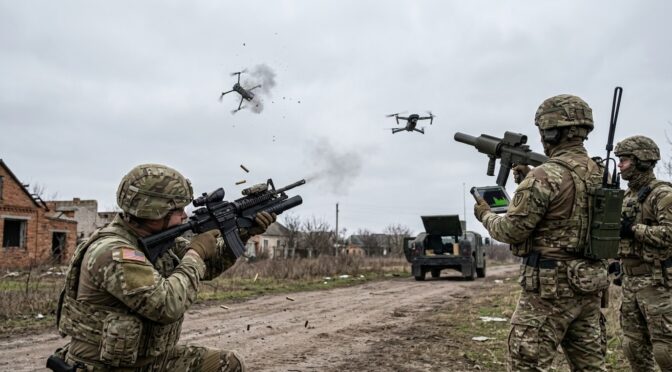
1.0 Executive Summary
The rapid proliferation of Unmanned Aerial Systems on the modern battlefield has fundamentally altered the tactical environment for the dismounted infantryman. Small, highly maneuverable First-Person View drones present a persistent, lethal threat that requires organic, squad-level defensive capabilities. Historically, the immediate response to this threat has relied heavily on man-packable Electronic Warfare systems designed to sever the radio frequency and satellite navigation links that control these aircraft. However, adaptations in drone technology, specifically the deployment of autonomous navigation and fiber-optic control tethers, have increasingly neutralized the effectiveness of radio frequency jammers.
This report evaluates the engineering feasibility, tactical effectiveness, and ballistic performance of small-arms kinetic counter-UAS munitions compared to portable Electronic Warfare jammers. It focuses specifically on the Size, Weight, and Power limitations imposed on dismounted infantry. Advanced 5.56mm and 5.45mm fragmentation cartridges, alongside specialized 12-gauge ammunition, offer immediate kinetic interception capabilities without the electromagnetic signature liabilities associated with active jamming. Furthermore, the integration of artificial intelligence-driven fire control systems provides individual soldiers with target acquisition capabilities that previously required heavy, crew-served platforms. The analysis demonstrates that while Electronic Warfare remains a critical component of layered air defense, the physical realities of the infantry loadout and the evolution of electromagnetically silent drones dictate a necessary shift toward lightweight, organic kinetic solutions.
A final validation pass of current market vendors is included to verify the procurement availability and stock status of these emerging technologies for defense professionals.
2.0 Introduction to the Dismounted Counter-UAS Environment
Unmanned Aerial Systems have evolved from strategic reconnaissance platforms into ubiquitous, low-cost precision strike weapons. In recent high-intensity conflicts, particularly the ongoing war in Ukraine, the mass deployment of First-Person View drones has forced military organizations to rapidly field counter-UAS technologies.1 During early 2025, drones were accounting for a staggering sixty to seventy percent of the damage and destruction caused to equipment on the battlefield, reflecting an unprecedented scale of deployment.2
For armored vehicles and fixed installations, air defenses often involve heavy radars, directed energy weapons, or multi-barrel autocannons integrated into a layered defense architecture.2 The United States Marine Corps, for example, utilizes the Marine Air Defense Integrated System mounted on a Joint Light Tactical Vehicle, combining radar, electronic warfare, and a 30mm autocannon.3 However, the dismounted infantry squad lacks the capacity to transport or power these heavy systems.4
The infantry squad requires a counter-UAS solution that operates within strict physical limits. Every piece of equipment issued to a soldier must be carried on their person, competing for space and weight with ammunition, water, body armor, and medical supplies.5 The fundamental problem lies in bridging the gap between the need for reliable aerial defense and the physiological limits of human endurance. Solutions generally fall into two categories: non-kinetic disruption via Electronic Warfare and kinetic destruction via small arms. Each approach presents distinct engineering challenges, tactical tradeoffs, and physical burdens that must be carefully evaluated by defense planners.
3.0 Engineering Feasibility of Small-Arms Kinetic Munitions
Historically, hitting a small, erratically moving quadcopter traveling at speeds up to 112 kilometers per hour with a single 5.56mm rifle bullet has been statistically improbable.7 Standard ball ammunition is designed for point-target engagement. To increase hit probability, munitions engineers have developed multi-projectile rounds and advanced fire control optics that transform standard infantry small arms into effective anti-aircraft weapons without adding significant logistical weight.
3.1 Internal and External Ballistics of the 5.56x45mm NATO Cartridge
The 5.56x45mm NATO cartridge is a rimless bottlenecked centerfire intermediate cartridge standardized under STANAG 4172.9 Standard projectiles, such as the SS109 or M855, rely on the rifling twist of the rifle barrel, which is typically one rotation in seven inches or one rotation in nine inches, to gyroscopically stabilize the bullet in flight.9 This stabilization ensures the bullet travels point-forward to maximize penetration and accuracy against human-sized targets at extended ranges.9
However, this point-target stability becomes a liability when engaging tiny aerial targets. An FPV drone presents a minimal cross-section, and hitting it with a single, stable projectile is often compared to swatting a hummingbird.7 Consequently, munitions developers realized that counter-drone ammunition must intentionally abandon gyroscopic stability in favor of controlled dispersion.
3.2 Mechanisms of In-Flight Destabilization and Fragmentation
Counter-UAS cartridges are engineered to intentionally lose structural integrity or aerodynamic stability shortly after exiting the muzzle, expanding into a dispersion pattern that compensates for aiming errors against erratic targets.10 Testing of specialized 5.56x45mm cartridges has shown that engineering the projectile to lose stability after ten to fifteen meters creates a wide cone of destruction.10 At distances of forty to fifty meters, this cone expands to between sixty and eighty centimeters in diameter, significantly increasing the mathematical probability of a rotor or chassis strike on a small quadcopter.10
3.3 Development and Deployment of the Drone Round Defense Cartridge
The most operationally seamless approach to infantry counter-UAS involves engineering these standard rifle cartridges to behave as multi-projectile interceptors. This concept maintains the soldier’s primary weapon platform while providing specialized capabilities through a simple ammunition swap.7
A prominent manufacturer in this space is(https://dronerounddefense.com/), which produces a 5.56x45mm NATO cartridge engineered to fragment after leaving the barrel.12 This design effectively turns a standard M4 carbine into a high-velocity precision shotgun without requiring weapon modifications, new optics, or specialized magazines.7 The 5.56mm cartridge exits the muzzle at approximately 2,200 feet per second, which is roughly twice the velocity of a standard 12-gauge shotgun shell.7
The Drone Round Defense ammunition is produced in two distinct variants to address different engagement envelopes. The K-variant splits into eight projectiles with an effective range of approximately fifty meters.12 The L-variant splits into five slightly larger projectiles to maintain necessary kinetic energy out to one hundred meters.12
The tactical utility of this ammunition has moved beyond theoretical development. On April 9, 2026, troops assigned to the United States Army XVIII Airborne Corps Signal Detachment conducted live-fire training with the 5.56mm L-variant Drone Round at the Oak Grove Training Center in North Carolina.7 Soldiers, including Staff Sergeant Dwayne Oxley of the Headquarters and Support Company, loaded the specialized rounds into their standard M4 carbines and successfully engaged FPV drones.7 The selection of Signal Detachment personnel for this testing highlights the vulnerability of troops tasked with setting up fixed communications infrastructure, who often become priority targets for enemy drone operators.7
3.4 Ukrainian and Russian 5.56mm and 5.45mm Anti-Drone Innovations
Similar developments are occurring rapidly in Eastern Europe. Ukraine’s Brave1 defense innovation cluster recently fielded a 5.56mm NATO round nicknamed “Horoshok”, which translates to little pea.11 This cartridge is designed to fragment and cover a wider area, operating from any NATO 5.56mm rifle currently carried by Ukrainian soldiers, such as the M4 or the CZ Bren.14 Ukrainian officials announced plans to produce approximately 400,000 of these rounds monthly, demonstrating a massive industrial commitment to kinetic infantry defense.11
Concurrently, Russian manufacturer Kalashnikov Concern is developing a 5.45mm multi-element projectile specifically designed for the standard AK-12 assault rifle.7 Russian developers have engineered the bullet to release multiple elements immediately after leaving the barrel, and testing has been conducted on both hovering and moving drones.11 Prior to this industrial-scale manufacturing, Russian soldiers frequently resorted to modifying 7.62mm ammunition with steel pellets and heat-shrink tubes to create homemade counter-drone rounds, underscoring the urgent frontline demand for this capability.11
4.0 Advanced 12-Gauge Counter-UAS Ammunition Development
The 12-gauge shotgun has historically served as a reliable tool for close-range defense, but standard birdshot lacks the energy retention required for modern drone warfare.10 The United States Army has recognized the utility of this platform by ordering 25,000 Mossberg M590A1 shotguns specifically for the counter-UAS role.10 However, the ammunition fired from these weapons dictates their actual battlefield utility.
4.1 Limitations of Traditional Birdshot Against Military FPV Drones
Civilian drones often feature fragile plastic components, whereas military FPV drones are constructed from highly durable plastics, carbon fiber housings, and densely packed electronics.15 Ammunition developers originally tested standard #8 lead birdshot, which has a pellet diameter of 2.25mm, commonly used against civilian drones.15 However, testing revealed that these smaller lead pellets often fail to deliver sufficient terminal kinetic energy to destroy robust military platforms.15
4.2 Tungsten Payload Integration: The Norma AD-LER 12-Gauge Cartridge
To address this lethality deficiency, Swedish ammunition manufacturer Norma, a subsidiary of the Beretta holding company, developed the AD-LER 12-gauge cartridge, which stands for Anti-Drone Long Effective Range.8 This specialized shell is engineered for use by defense professionals and is loaded with 34 grams of #6 tungsten pellets.16
Tungsten is significantly denser than lead, allowing the slightly larger pellets to retain their velocity and destructive kinetic energy over much greater distances. The AD-LER round exits the muzzle at a velocity of 405 meters per second and provides effective penetration against carbon fiber drone housings at distances up to one hundred meters.16The ammunition is explicitly recommended for use with tactical platforms such as the Benello M4 AI Drone Guardian, a specialized semi-automatic shotgun designed to manage the high pressures of these defensive rounds.16
4.3 Tethered Capture Net Systems: SkyNet Drone Defense Mechanics
An alternative approach to shotgun-based kinetic defense involves tethered net systems designed to physically entangle the drone rather than penetrate its chassis. The SkyNet Drone Defense round, officially designated as the ALS12SKY-MI5, is an advanced 12-gauge system manufactured by Amtec Less Lethal Systems.19
Distributed by vendors such as Maverick Drone and sporting retailers like BUDK, this system utilizes a two and three-quarter inch 12-gauge shell that deploys five tethered projectiles upon firing.21Constructed from materials such as zinc, lead, or tungsten, these weighted anchors, made of Zuerillium alloy, are connected by high-strength ballistic Spectra fiber tethers.19
Upon leaving the barrel, centrifugal force expands the tethers to create a capture net measuring approximately five feet in diameter.19 When the net impacts the drone, the tethers wrap around the rapidly spinning propellers, causing an immediate catastrophic failure of the aircraft’s lift capability.19 Depending on the specific projectile material utilized, the effective engagement range extends from 320 feet for the zinc option to 420 feet for the denser tungsten and lead variants.23
Furthermore, to mitigate collateral damage when employed in populated urban environments or near sensitive equipment, the SkyNet system features an integrated safety measure. Missed rounds are designed to deploy a small parachute, allowing the tethered weights to return to the ground at a slow, non-ballistic trajectory, significantly reducing the risk of falling debris.19
5.0 Smart Optic Integration for Kinetic Hit Probability Enhancement
While specialized multi-projectile ammunition increases hit probability through wide dispersion patterns, advanced optical systems achieve the same goal through precise computational targeting.
5.1 Physiological Limitations of Human Reaction Time
The category of FPV drones that infantrymen must engage are typically five to seven inches in diameter, referencing the size of the propellers.8 These drones can measure roughly thirty centimeters across and are flown by operators wearing virtual reality goggles at speeds reaching 112 kilometers per hour.8 Engaging a target of this size and velocity pushes the extreme boundaries of human reflex and hand-eye coordination. Even highly trained marksmen struggle to calculate the necessary lead distance for a target moving erratically in three dimensions.
5.2 The SMARTSHOOTER SMASH 3000 Fire Control System
To completely eliminate the variable of human error, the defense industry has developed intelligent targeting optics. The SMASH 2000L, which is also heavily marketed as the SMASH 3000, is manufactured by the Israeli defense firm Smart Shooter.24This system represents a fundamental paradigm shift in small arms fire control, transforming a standard rifle into an automated drone-hunting platform.
The device weighs exactly 740 grams and mounts seamlessly to standard MIL-STD-1913 Picatinny rails, replacing the conventional red dot or holographic sight on weapons such as the M4A1 carbine.25 Internally, the SMASH 3000 utilizes a powerful dual-core computer, advanced electro-optical sensors, and artificial intelligence-driven image processing software.25 The unit operates for up to seventy-two hours on a single rechargeable lithium-ion battery.25
5.3 Algorithmic Target Acquisition and Engagement Calculations
The operational mechanics of the SMASH system remove the burden of ballistics calculation from the infantryman. The operator looks through the display, identifies the drone, and marks the target using a button mechanism.26 The proprietary tracking algorithm then instantly calculates the target’s speed, distance, wind vectors, and humidity.25
Crucially, the system features a hardware integration that interrupts the weapon’s firing mechanism.25 The operator depresses the trigger, but the rifle physically will not discharge until the internal computer calculates that the bullet has a ninety-five percent probability of striking the drone.25 Once the target crosses the precise computed trajectory, the system releases the sear and fires the weapon automatically.26 This “lock and track” capability effectively guarantees a hit on erratic aerial targets, allowing a standard 5.56mm ball projectile to achieve the success rate normally reserved for specialized fragmentation ammunition.26
6.0 Technical Evaluation of Portable Electronic Warfare Jammers
Electronic Warfare has historically remained the primary pillar of counter-UAS strategy. EW systems are designed to exploit the communication and navigation vulnerabilities inherent in remote-controlled platforms.28 Portable, man-packable jammers function by broadcasting powerful radio signals that overwhelm the specific radio frequency bands used for operator control, alongside the Global Navigation Satellite System frequencies used for automated navigation.29
6.1 Principles of Radio Frequency and GNSS Signal Disruption
Most commercial and military drones rely on a predictable spectrum of communication frequencies. Control links and video feeds typically operate on 433 MHz, 868 MHz, 900 MHz, 2.4 GHz, 5.2 GHz, and 5.8 GHz bands.29 Navigation relies on GPS L1 (1570-1620 MHz) and GPS L2/L5 (1160-1290 MHz).29 By transmitting white noise or structured interference on these exact frequencies, an EW jammer severs the connection between the drone and the pilot, usually forcing the aircraft to initiate an automatic landing protocol or return to its launch point.30
6.2 Low SWaP Wearable Systems: MyDefence Pitbull Analysis
Man-packable systems range significantly in size, power, and utility. For dismounted troops prioritizing mobility, manufacturers have developed low Size, Weight, and Power profiles. The Pitbull drone jammer, developed by My Defence, is a wearable, hands-free device designed for continuous operation.30
Weighing only 1,330 grams including its NATO-standard military-grade battery, the Pitbull provides targeted mitigation across 1.6 GHz, 2.4 GHz, 5.2 GHz, and 5.8 GHz frequencies.30 It offers a jamming range of up to 1,000 meters and features a coverage angle of sixty degrees horizontally and vertically.30 The device can operate in a standby mode for twenty hours, providing a continuous active jamming duration of two hours.30 Its integration with the Android Team Awareness Kit allows for real-time sharing of jamming data across the squad, improving team coordination.30
6.3 Medium and High-Power Backpack Platforms: DroneShield and Jammers4u
To achieve greater ranges and broader frequency coverage, manufacturers must utilize larger antennas and larger power supplies. The DroneGun Mk4, manufactured by Drone Shield, is a highly regarded handheld tactical jammer weighing 3.37 kilograms with its lithium-ion battery attached.31It provides an aggregate operational time of greater than one hour per charge and disrupts a wide range of Industrial, Scientific, and Medical bands alongside GNSS signals.31
Conversely, high-power systems designed for maximum coverage incur massive weight penalties. The Man Pack series manufactured by Jammers4u delivers extreme disruption capabilities, achieving a jamming radius of 3,000 to 4,000 meters.29 The top-tier model, the CT-4038-UAV, blasts 235 watts of total jamming power across eight independent bands.29 It directs forty watts to GPS L1, thirty watts to 5.8 GHz video links, and forty watts to 433 MHz control links, effectively neutralizing any RF-dependent drone in the airspace.29 However, this massive power output requires an equally massive internal power supply, resulting in a base unit weight of thirteen kilograms, which does not even account for the heavy directional antennas and accessories.29 Furthermore, despite the heavy battery weight, this system only operates for one to two hours.29
7.0 Tactical Effectiveness and Battlefield Adaptations
The operational reality of recent conflicts has repeatedly demonstrated that neither kinetic weapons nor Electronic Warfare can function as an isolated, perfect shield. The contest between drone operators and air defenders is highly dynamic, adaptive, and marked by rapid technological counter-measures.32
7.1 The “EW Dome” Fallacy and Dynamic Countermeasures
Defense analysts initially assumed that projecting a localized Electronic Warfare dome could create a protective bubble, stopping all drones from penetrating the airspace of an infantry unit.20 Battlefield evidence has thoroughly debunked this assumption.32 Electronic Warfare produces localized, temporary, and system-specific effects rather than comprehensive aerial denial.32
When facing successful jamming operations, drone operators rapidly execute frequency-hopping agility protocols, constantly shifting the control bands to create brief windows of operational opportunity.33 It is a continuous cat-and-mouse game, and achieving permanent electromagnetic dominance is nearly impossible against a peer adversary.8
7.2 The Advent of Fiber-Optic Tethered Drones
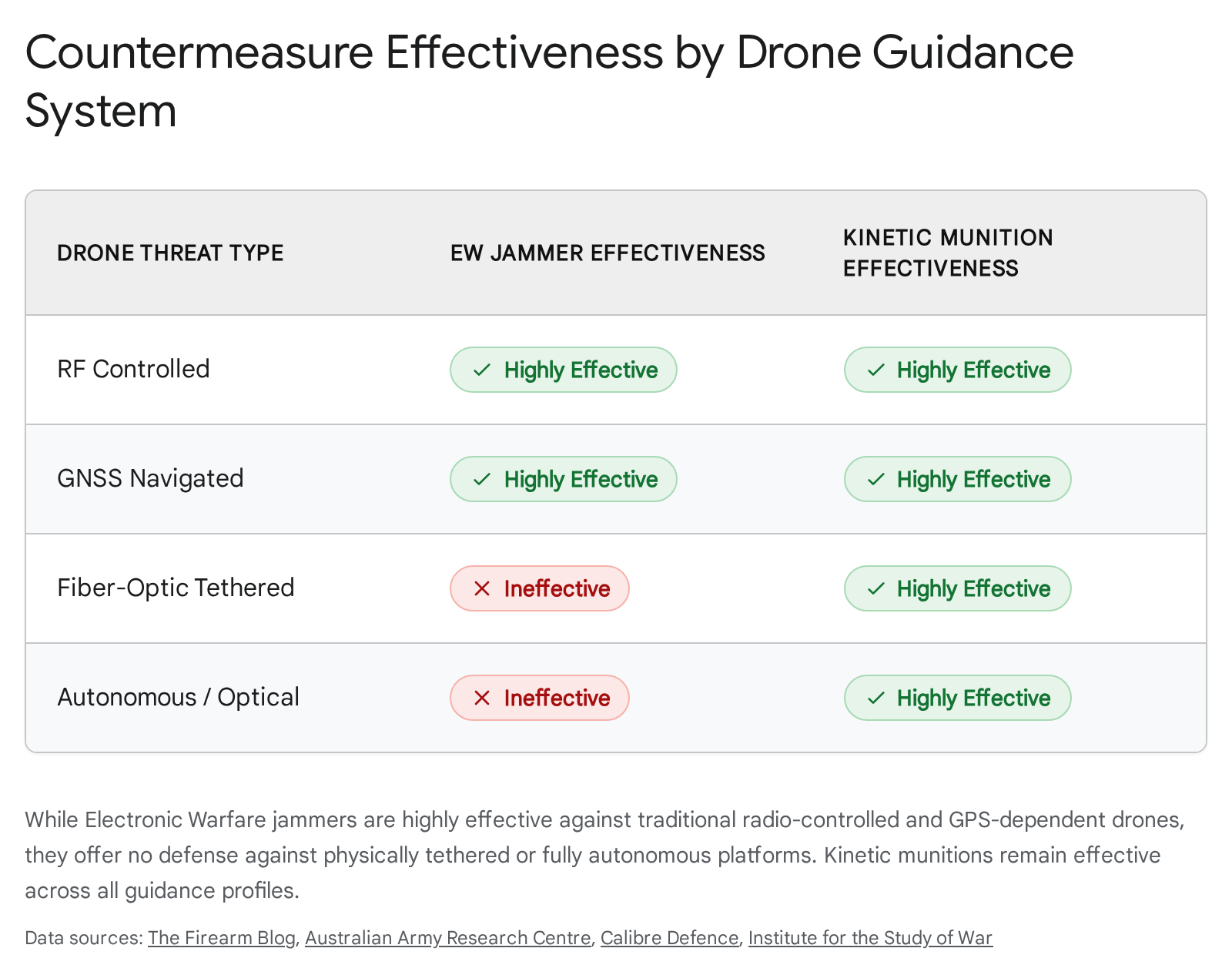
The most significant and lethal disruption to established counter-UAS doctrine has been the introduction of fiber-optic guided drones. To completely circumvent heavily contested electromagnetic environments, combatants have deployed FPV drones that trail up to twenty kilometers of physical optical fiber.34
Because these advanced systems transmit high-definition video feeds and receive flight controls via a physical cable rather than radio waves, they emit absolutely no RF signature and are completely immune to traditional EW jamming, including intense GNSS denial operations.32 Both Ukrainian and Russian forces have explicitly employed fiber-optic drones to bypass EW-heavy sectors, demonstrating that electromagnetic dominance does not equate to drone denial.32 The United States Army has acknowledged this significant capability gap, noting that fiber-optic spool-fed drones enjoy relatively unrestricted access to the battlefield despite adversaries’ best efforts to deploy jamming technology.36
7.3 Autonomous Waypoint Navigation and Inertial Guidance
Beyond physical cables, the integration of machine learning and artificial intelligence allows drones to operate autonomously.35 Long-range drones utilizing inertial navigation, terrain-matching cameras, and optical guidance reduce their reliance on external satellite signals.32 Once these drones are locked onto a target visually, they do not require a constant radio link from an operator.32 Consequently, they are incredibly difficult to disrupt through jamming alone.32
7.4 The Shift Back to Kinetic Interception
When a drone is physically shielded from electromagnetic interference by a fiber-optic cable, or when it operates autonomously without needing remote instructions, the tactical equation shifts entirely to physical interception.32 Against these advanced threats, portable EW systems like the DroneGun Mk4 or the Jammers4u backpack are rendered completely tactically ineffective.20 In these critical scenarios, kinetic solutions, such as the 5.56mm Drone Round, the 12-gauge AD-LER cartridge, or a rifle equipped with the SMASH 3000 optic, serve as the indispensable and only viable line of defense for the infantry squad.8
8.0 Electromagnetic Signature Management and Force Protection
The employment of high-power radio frequency jammers introduces a critical and often deadly vulnerability for the dismounted infantry squad: signature management. Modern warfare is characterized by intense, highly capable signals intelligence operations where electromagnetic emissions are constantly monitored.39
8.1 Signals Intelligence and the Triangulation Vulnerability
Tactical FM radios operating on low power can be detected by enemy radio direction finding units at distances exceeding ten kilometers, while high-power signals can be detected at distances up to forty kilometers.41 When an infantry unit activates a 235-watt backpack jammer to protect against a localized drone threat, the system emits a massive spike of electromagnetic energy.29 This emission effectively acts as a highly visible homing beacon for enemy electronic support measures.39
8.2 Artillery Counter-Fire and the EW Activation Dilemma
Once the jammer’s position is triangulated by enemy signals intelligence, the coordinates are immediately relayed to an integrated fires command.42 This creates a severe tactical dilemma for the squad leader. Activating the EW system successfully protects the squad from immediate drone observation and direct FPV strikes, but it simultaneously exposes the unit to devastating, long-range indirect artillery fire.29 The very shield designed to protect the soldiers often becomes the mechanism that ensures their destruction.
8.3 The Zero-Emission Profile of Kinetic Engagements
Conversely, kinetic weapons possess a zero electromagnetic signature prior to the moment of engagement.43 A soldier equipped with a standard rifle loaded with specialized 5.56mm fragmentation rounds remains electromagnetically dark and invisible to enemy signals intelligence until the trigger is pulled.40 This stealth capability drastically reduces the squad’s overall risk profile during covert maneuver operations, allowing them to counter aerial threats without broadcasting their position to enemy artillery batteries.
9.0 Size, Weight, and Power (SWaP) Loadout Burden Analysis
The theoretical benefits of any military technology must survive the harsh realities of dismounted infantry deployment. Size, Weight, and Power limitations dictate what a soldier can actually utilize in combat.
9.1 Historical Context of the Infantry Combat Load
The modern infantryman carries a combat load unlike anything seen in previous generations.5 Rifles, heavy ceramic armor plates, advanced radios, night-vision equipment, and medical supplies all compete for space on a soldier’s frame.5 Historical data indicates that dismounted ground combat troops routinely carry loads ranging from ninety to one hundred and forty pounds.6 The Improved Outer Tactical Vest body armor system alone can weigh twenty-seven pounds.6 Adding heavy specialized equipment to this existing burden severely degrades mobility, increases fatigue, and mathematically reduces the soldier’s shooting response time and overall mission performance.6
9.2 Battery Chemistry, Weight Penalties, and Operational Endurance
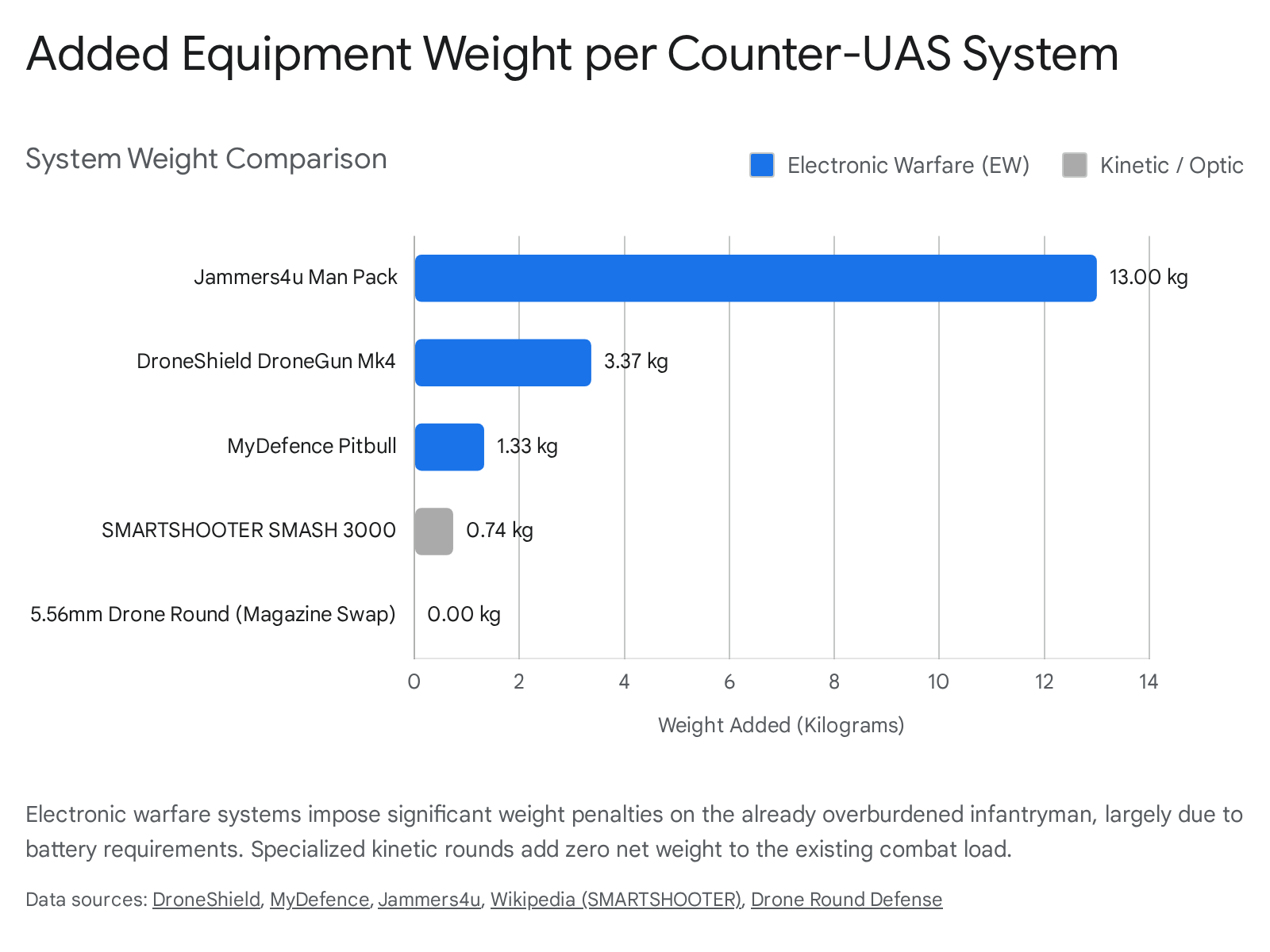
Portable Electronic Warfare jammers impose severe SWaP penalties, and the primary contributor to this weight is the battery requirement.44 High-frequency radio transmission requires substantial power generation.
While the DroneGun Mk4 is considered relatively light at 3.37 kilograms, it only provides a single hour of active aggregate jamming.31 In extended forty-eight-hour combat operations without access to supply vehicles, soldiers must carry multiple spare lithium-ion batteries to keep the system operational.44 Standard military ASIP radio batteries weigh roughly three pounds each.44 To sustain continuous EW operations, multiple batteries must be distributed among the squad members, rapidly increasing the gross weight borne by the operators.44 Heavy backpack systems, weighing thirteen kilograms natively, are nearly impossible to sustain in dynamic infantry assaults without severely compromising the operator’s speed and endurance.29
9.3 Logistical Efficiencies of Ammunition Interoperability
Kinetic counter-UAS solutions offer exceptional SWaP advantages because they utilize the soldier’s existing weapons platform. A standard thirty-round magazine loaded with 5.56mm Drone Round fragmentation cartridges weighs practically the same as a magazine loaded with standard M855 ball ammunition.14 Transitioning the squad into an air defense posture requires zero additional hardware and zero battery power; the operator simply swaps magazines and engages the aerial target.7
Even when employing advanced computational optics like the SMASH 3000, the weight penalty is highly manageable. At 740 grams, it replaces the standard combat optic, resulting in a marginal net weight increase while providing sophisticated ballistic tracking and seventy-two hours of internal battery life.25
The primary logistical drawback of kinetic solutions involves the 12-gauge shotgun approach. While undeniably lethal against carbon fiber drones, carrying a secondary weapon system like a Benelli M4 or Mossberg 590A1 adds substantial weight and bulk to the loadout.10 Furthermore, 12-gauge shotgun shells are significantly heavier and more voluminous than 5.56mm cartridges, heavily restricting the total number of aerial engagements a single soldier can sustain before requiring a resupply from the company trains.34
10.0 Validation of Counter-UAS Vendor Availability and Stock Status
To ensure the actionable utility of this report, a current validation pass of the mentioned vendors and products was conducted. The following data reflects the procurement availability and stock status of these systems for defense professionals as of April 2026.
10.1 Procurement Status of 5.56mm and Smart Optic Systems
The specialized 5.56x45mm and 7.62x51mm anti-drone ammunition manufactured by Drone Round Defense is actively produced within the United States. The company’s fully integrated facility boasts a production capacity of up to 350 million rounds per year.12However, this product is strictly regulated. It is exclusively available to professional organizations, including the United States military, law enforcement agencies, and authorized private security firms, and is not currently available for civilian purchase.12Authorized entities can initiate procurement inquiries directly through their verified website at Drone Ground Defense.12
The SMASH 3000 fire control optic, manufactured by SMARTSHOOTER, is currently fielded and available for procurement.24While specific real-time inventory counts are not publicly listed, military and defense organizations can contact the manufacturer directly via their official portal at Smart Shooter to establish contracts or request technical datasheets.24
10.2 Availability of 12-Gauge Drone Defense Ammunition
The 12-gauge SkyNet Drone Defense tethered rounds are commercially available through multiple vendors. The primary distributor, Maverick Drone Systems, lists the single-shot zinc variant five-packs and twenty-five-packs as currently in stock and ready to ship.22The heavier lead variants are also actively in stock in limited quantities, while bulk orders of five hundred units are accepted on a backorder fulfillment basis.22Customers can purchase these directly at Maverick Drone22Additionally, sporting retailer BUDK currently has the three-pack variant in stock for $29.99, though shipping is legally restricted in several US states, including New York, Illinois, and California.21Their verified portal is BUDK.21
The Norma AD-LER 12-gauge tungsten ammunition is categorized strictly under the company’s governmental applications.15As military-grade ammunition certified by the Commission Internationale Permanente (CIP), it does not feature an open commercial shopping cart.17Procurement officers must route inquiries through the Beretta Defense Technologies network or contact the manufacturer via Norma Governmental.17Similarly, the Benelli M4 A.I. Drone Guardian shotgun requires procurement through authorized law enforcement and military dealers, which can be located using the manufacturer’s official dealer locator at Benelli Italy or the regional branch at Benelli USA.47
10.3 Procurement Lead Times for Electronic Warfare Systems
The procurement of high-end Electronic Warfare systems currently faces high global demand. DroneShield, manufacturer of the DroneGun Mk4, recently established a European manufacturing footprint to advance sovereign counter-UAS capabilities under the ReArm Europe Plan.48Production at this new facility is underway, with broad European deliveries scheduled for mid-2026.48Concurrently, DroneShield has secured multiple Western military contracts, with existing inventory deliveries slated for Q1 2026.50Official procurement details can be found at Drone Shield.31MyDefence products, including the wearable Pitbull jammer, are similarly available for defense procurement via their official portal at My Defence).30
| Product Name | Manufacturer | Primary Function | Verified Web Portal | Current Availability Status |
| 5.56mm Drone Round | Drone Round Defense | Kinetic Fragmentation | dronerounddefense.com | Military/LE Only, 350M capacity |
| SMASH 3000 Optic | SMARTSHOOTER | AI Fire Control | smart-shooter.com | Available via Defense Contract |
| SkyNet 12-Gauge | Amtec / Maverick | Tethered Capture Net | maverickdrone.com | In Stock (Select Variants) |
| AD-LER 12-Gauge | Norma Precision | Tungsten Kinetic | norma-ammunition.com | Governmental Procurement Only |
| DroneGun Mk4 | DroneShield | RF/GNSS EW Jammer | droneshield.com | Deliveries scheduled Q1/Mid-2026 |
11.0 Conclusions
The modern battlefield demands a layered, technologically diverse approach to countering Unmanned Aerial Systems. While portable Electronic Warfare jammers provide excellent non-kinetic disruption against commercial and military drones utilizing standard radio frequencies and satellite navigation, their severe SWaP limitations and vulnerability to enemy signal triangulation limit their utility for front-line infantry. Most critically, the advent of fiber-optic tethers and fully autonomous drones has created a tactical environment where electromagnetic dominance no longer guarantees airspace denial.
In this environment, small-arms kinetic munitions are no longer a weapon of last resort, but a primary defensive necessity. Engineered 5.56mm fragmentation rounds and dense tungsten 12-gauge cartridges provide immediate, highly lethal, and electromagnetically silent interception capabilities. By leveraging the infantryman’s existing weapons platforms, these kinetic solutions impose virtually no additional weight or power burden, preserving mobility and combat endurance.
Military procurement commands must recognize that while heavy, vehicle-mounted EW systems are vital for protecting operational hubs, the dismounted squad survives on mobility and low observability. Equipping riflemen with specialized multi-projectile ammunition and smart fire control optics provides the most resilient, SWaP-compliant method for neutralizing the persistent threat of low-altitude drone strikes.
Please share the link on Facebook, Forums, with colleagues, etc. Your support is much appreciated and if you have any feedback, please email us in**@*********ps.com. If you’d like to request a report or order a reprint, please click here for the corresponding page to open in new tab.
Sources Used
- The Impact of Drones on the Battlefield: Lessons of the Russia-Ukraine War from a French Perspective | Hudson Institute, accessed April 18, 2026, https://www.hudson.org/missile-defense/impact-drones-battlefield-lessons-russian-ukraine-war-french-perspective-tsiporah-fried
- Counter-Drone Systems Comparison: C-UAS Technology Assessment – Norsk luftvern, accessed April 18, 2026, https://norskluftvern.com/2025/07/10/counter-drone-systems-comparison-c-uas-technology-assessment/
- Counter-Drone Weapons: How Militaries Are Fighting Back Against the Drone Threat, accessed April 18, 2026, https://militarymachine.com/counter-drone-weapons-military
- Small Units Need Protection from Drones—But What Capabilities Should a Light, Maneuverable Counter-UAS Platform Include?, accessed April 18, 2026, https://mwi.westpoint.edu/small-units-need-protection-from-drones-but-what-capabilities-should-a-light-maneuverable-counter-uas-platform-include/
- Inside the Modern Infantryman’s Full Battle Load – 24/7 Wall St., accessed April 18, 2026, https://247wallst.com/military/2025/12/13/inside-the-modern-infantrymans-full-battle-load/
- The Soldier’s Heavy Load | CNAS, accessed April 18, 2026, https://www.cnas.org/publications/reports/the-soldiers-heavy-load-1
- Army Troops Test Anti-Drone Bullets For Standard Rifles, accessed April 18, 2026, https://dronexl.co/2026/04/14/army-troops-anti-drone-bullets-rifles/
- Countering FPVs: Norma develops 12 gauge cartridge – Calibre Defence, accessed April 18, 2026, https://www.calibredefence.co.uk/norma-develops-counter-fpv-cartridge/
- 5.56×45mm NATO – Wikipedia, accessed April 18, 2026, https://en.wikipedia.org/wiki/5.56%C3%9745mm_NATO
- Using Small Arms to Defend against Unmanned Aircraft Systems (UAS) – The Last Line of Defense – The Lightning Press, accessed April 18, 2026, https://www.thelightningpress.com/using-small-arms-defend-unmanned-aircraft-systems-uas/
- Russia’s AK-47 maker unveils special bullets designed to take down drones mid-air, accessed April 18, 2026, https://m.economictimes.com/news/international/us/russias-ak-47-maker-unveils-special-bullets-designed-to-take-down-drones-mid-air/articleshow/130171020.cms
- Anti-Drone Ammunition | 5.56, 7.62×51 | Drone Round, accessed April 18, 2026, https://dronerounddefense.com/product-information/
- Anti-Drone Rounds | Counter Drone Technology | Drone Round, accessed April 18, 2026, https://dronerounddefense.com/
- Your standard rifle can now be an anti-drone weapon. Seriously. – We Are The Mighty, accessed April 18, 2026, https://www.wearethemighty.com/tactical/your-rifle-can-now-be-an-anti-drone-weapon-seriously/
- Swedish Norma Finds the Best Shotgun Round Against FPV Drones: Which # They Chose and Another Key Factor | Defense Express, accessed April 18, 2026, https://en.defence-ua.com/industries/swedish_norma_finds_the_best_shotgun_round_against_fpv_drones_which_they_chose_and_another_key_factor-12760.html
- Enforce Tac 2025: The 12-gauge strikes back: Norma AD-LER and Centanex Breacher ammunition – YouTube, accessed April 18, 2026, https://www.youtube.com/watch?v=YOxe9MqoLCE
- AD-LER Anti-Drone Ammunition | Norma Precision, accessed April 18, 2026, https://www.norma-ammunition.com/governmental/products/ad-ler
- Investor Relations – DroneShield, accessed April 18, 2026, https://www.droneshield.com/investor-relations
- SKYNET™ Mi-5 – lesslethal.com, accessed April 18, 2026, https://lesslethal.com/products/skynet-mi-5
- Infantry-Portable Anti-Drone Options – European Security & Defence, accessed April 18, 2026, https://euro-sd.com/2026/03/articles/armed-forces/49834/infantry-portable-anti-drone-options/
- 12 Gauge Skynet Drone Defense – 3-Pack – BUDK.com, accessed April 18, 2026, https://www.budk.com/12-Gauge-Skynet-Drone-Defense-3-Pack-35975/35975.html
- SKYNET 12GA Drone Defense – 2 3/4” round – Maverick, accessed April 18, 2026, https://www.maverickdrone.com/products/skynet-drone-defense
- New frontiers in anti-drone munitions were on display at SHOT Show 2026 | Sandboxx, accessed April 18, 2026, https://www.sandboxx.us/news/new-frontiers-in-anti-drone-munitions-were-on-display-at-shot-show-2026/
- SMASH 2000L (3000) – smart-shooter, accessed April 18, 2026, https://www.smart-shooter.com/gun/smash-3000/
- SMASH2000: Finally, an AI-powered optic that turns your AR-15 into a drone hunter, accessed April 18, 2026, https://www.wearethemighty.com/tactical/smash2000-finally-an-ai-powered-optic-that-turns-your-ar-15-into-a-drone-hunter/
- SMASH Handheld – Wikipedia, accessed April 18, 2026, https://en.wikipedia.org/wiki/SMASH_Handheld
- Solutions – Smart Shooter, accessed April 18, 2026, https://www.smart-shooter.com/products/
- A Comprehensive Approach to Countering Unmanned Aircraft Systems – Joint Air Power Competence Centre, accessed April 18, 2026, https://www.japcc.org/wp-content/uploads/A-Comprehensive-Approach-to-Countering-Unmanned-Aircraft-Systems.pdf
- Man Pack Anti-Drone Jammer up to 8 bands Max 235W up to 4000m – Jammers4u, accessed April 18, 2026, https://jammers4u.com/man-pack-anti-drones-uav-jammer
- Pitbull Drone Jammer – Wearable, Portable C-UAS Solution, accessed April 18, 2026, https://mydefence.com/products/pitbull-drone-jammer/
- Dismounted Counter-UAS System Products | DroneShield, accessed April 18, 2026, https://www.droneshield.com/products-dismounted
- Drone Warfare in Ukraine: From Myths to Operational Reality – Part 1, accessed April 18, 2026, https://researchcentre.army.gov.au/library/land-power-forum/drone-warfare-ukraine-myths-operational-reality-part-1
- Lessons from the Ukraine Conflict: Modern Warfare in the Age of Autonomy, Information, and Resilience – CSIS, accessed April 18, 2026, https://www.csis.org/analysis/lessons-ukraine-conflict-modern-warfare-age-autonomy-information-and-resilience
- An Old School Solution to a Very Modern Threat: Shotguns vs Drones | thefirearmblog.com, accessed April 18, 2026, https://www.thefirearmblog.com/blog/an-old-school-solution-to-a-very-modern-threat-shotguns-vs-drones-44817970
- Mapping the MilTech War: Eight Lessons from Ukraine’s Battlefield – Ifri, accessed April 18, 2026, https://www.ifri.org/en/studies/mapping-miltech-war-eight-lessons-ukraines-battlefield
- Fiber Optic Drones: Posing a Significant C-UAS Challenge | Article | The United States Army, accessed April 18, 2026, https://www.army.mil/article/287737/fiber_optic_drones_posing_a_significant_c_uas_challenge
- KSE_Institute_Report_Harnessin, accessed April 18, 2026, https://kse.ua/wp-content/uploads/2025/11/KSE_Institute_Report_Harnessing_Ukraines_Drone_Innovations_to_Advance.pdf
- Russian Drone Innovations are Likely Achieving Effects of Battlefield Air Interdiction in Ukraine – Institute for the Study of War, accessed April 18, 2026, https://understandingwar.org/research/russia-ukraine/russian-drone-innovations-are-likely-achieving-effects-of-battlefield-air-interdiction-in-ukraine/
- Dispersed, Disguised, and Degradable: The Implications of the Fighting in Ukraine for Future U.S.-Involved Conflicts – RAND, accessed April 18, 2026, https://www.rand.org/content/dam/rand/pubs/research_reports/RRA3100/RRA3141-2/RAND_RRA3141-2.pdf
- Harnessing SIGINT and EW for Tactical Dominance: A Guide for Combat Arms Leaders, accessed April 18, 2026, https://www.army.mil/article/286341/harnessing_sigint_and_ew_for_tactical_dominance_a_guide_for_combat_arms_leaders
- FM 6-50: Tactics, Techniques, and Procedures The Field Artillery Cannon Battery – BITS, accessed April 18, 2026, https://www.bits.de/NRANEU/others/amd-us-archive/FM6-50%281996%29.pdf
- Army Counter-UAS 2021–2028, accessed April 18, 2026, https://www.armyupress.army.mil/Journals/Military-Review/English-Edition-Archives/March-April-2021/Scott-Counter-UAS/
- Breaking the Shield: Countering Drone Defenses – NDU Press, accessed April 18, 2026, https://ndupress.ndu.edu/Media/News/News-Article-View/Article/3838997/breaking-the-shield-countering-drone-defenses/
- Was Afghanistan uniquely bad for combat loads for your average infantryman or are 100+ pound rucks normal? – Reddit, accessed April 18, 2026, https://www.reddit.com/r/WarCollege/comments/vaw0p2/was_afghanistan_uniquely_bad_for_combat_loads_for/
- Soldier Load: The Art and Science of ‘Fighting Light’ – Fort Benning, accessed April 18, 2026, https://www.benning.army.mil/infantry/magazine/issues/2024/Fall/pdf/7_Childers-Yost_txt.pdf
- National Training Center Exercise Operating Procedures (EXOP) – U.S. Army, accessed April 18, 2026, https://home.army.mil/irwin/application/files/1816/9455/6714/FY23_JUNE_2023_NTC_EXSOP_RELEASEABLE.pdf
- Benelli M4 A.I. Drone Guardian: Semi-Automatic Anti-Drone Shotgun, accessed April 18, 2026, https://benelli.it/en/arma/m4-ai-drone-guardian
- DroneShield Establishes European Manufacturing Footprint to Advance Sovereign Counter-UAS Capability, accessed April 18, 2026, https://www.droneshield.com/media/press-releases/droneshield-establishes-european-manufacturing-footprint-to-advance-sovereign-counter-uas-capability
- DroneShield establishes European manufacturing footprint to advance sovereign counter-UAS capability – EDR Magazine, accessed April 18, 2026, https://www.edrmagazine.eu/droneshield-establishes-european-manufacturing-footprint-to-advance-sovereign-counter-uas-capability
- DroneShield Secures $21.7M Western Military Contracts, accessed April 18, 2026, https://euro-sd.com/2026/02/news/industry-news/49600/droneshield-secures-21-7m-western-military-contracts/