Executive Summary
Asymmetric naval warfare is fundamentally altering the maritime battlespace in the twenty-first century. While traditional naval doctrine centers on capital ships such as aircraft carriers and guided-missile destroyers, modern operational realities reveal a profound vulnerability within symmetric fleet architectures. The rapid maturation of autonomous systems, specifically Unmanned Surface Vessels (USVs), has introduced a new calculus to sea control and sea denial operations. By leveraging low-cost technologies with high-impact potential, smaller actors and nations operating without conventional navies can now challenge advanced fleets. This dynamic effectively rewrites the established balance of global naval power.
This report provides a detailed evaluation of the engineering, tactical deployment, and strategic implications of modern USV warfare. The analysis utilizes the Ukrainian Magura V5 and Sea Baby platforms as primary case studies to illustrate broader technological trends. The evaluation encompasses the hydrodynamic and low-observable properties of their carbon-composite hulls, the integration of commercial off-the-shelf propulsion systems, and the sophisticated software logic governing autonomous transit and terminal guidance. Furthermore, this document examines the role of Open Source Intelligence (OSINT) in facilitating these distributed strikes. It also provides a validated assessment of the commercial supply chain sustaining these maritime platforms, complete with current market availability for critical navigation, propulsion, and optronic subsystems.
1.0 The Strategic Landscape of Asymmetric Naval Warfare
Historically, naval warfare revolved around symmetrical engagements where dominance was achieved through superior tonnage, advanced kinetic firepower, and massive fleet coordination. Capital ships operated within large formations designed to control vital sea lanes and project power across the global commons. However, the contemporary maritime domain is characterized by distributed networks, high-speed automated platforms, and highly evasive low-profile threats.
1.1 The Shift to Distributed Maritime Operations
The emergence of asymmetric tactics subverts the traditional model of naval engagements. Adversaries no longer need to match a dominant navy hull for hull. Instead, they deploy dispersed, highly maneuverable drone swarms that are designed to overwhelm layered fleet defenses.1 The threat of even a single munition reaching its target creates immense uncertainty, requiring advanced fleets to maintain a constant and highly resource-intensive defensive posture.2 This dynamic shifts the cost-benefit ratio heavily in favor of the asymmetric actor. A single uncrewed surface vessel, costing a fraction of a modern interceptor missile, can inflict catastrophic structural damage on a warship valued in the hundreds of millions of dollars.3
This evolution toward maritime drone swarms represents one of the most destabilizing factors in modern fleet operations. A coordinated naval swarm could theoretically overwhelm a carrier strike group’s layered defenses by saturating tracking radars, rapidly depleting missile interceptor magazines, or striking simultaneously from multiple distinct vectors.4 The fundamental advantage of these systems lies in their expendability. Because they do not carry human operators, the vessels can be deployed on one-way attack missions, navigating directly into heavily contested waters where traditional crewed vessels would face unacceptable risks of high casualties.5
1.2 Blue OSINT and the Transparent Ocean
The success of asymmetric USV campaigns relies heavily on the modern intelligence environment. The movements of colossal military vessels can no longer be shrouded in the fog of war. Through a concept known as “Blue OSINT”, the maritime battlespace has become almost entirely transparent.7 A vast and interconnected network of commercial imagery satellites, synthetic-aperture radar platforms, and automated identification system trackers provide continuous data streams to any motivated actor with internet access.7
Open-source intelligence allows operators to monitor the mobilization, transit routes, and port activities of adversary fleets in near real-time. By analyzing these disparate data points, asymmetric forces can predict the exact coordinates of a target vessel, plan a precise intercept trajectory, and deploy USVs to loiter in transit zones until an operational trigger is activated.5 This intelligence democratization means that capabilities previously requiring billions in state investment are now accessible functions available to non-state actors, proxies, and smaller militaries.8 The vast expanse of the world’s oceans is increasingly illuminated by data streams flowing from space to the seabed, rendering traditional surprise naval maneuvers nearly obsolete.7
1.3 Global Parallels in Asymmetric Doctrine
While the Black Sea serves as the primary modern testing ground, the tactical application of USVs is proliferating globally. In the Middle East, the Iranian Islamic Revolutionary Guard Corps Navy (IRGC-N) has developed a long-term strategy built entirely around asymmetric warfare.9 The IRGC-N operates hundreds of small, fast attack craft and has increasingly integrated unmanned surface and underwater vessels into its coastal defense posture in the Persian Gulf and the Strait of Hormuz.9 These Iranian platforms are designed for swarm tactics, mine countermeasures, and intelligence gathering, highlighting a concerted effort to disrupt established maritime orders without directly competing with Western capital ships.9
Similarly, Houthi forces in Yemen, acting as a component of the broader Axis of Resistance, have deployed explosive-laden USVs alongside aerial drones and ballistic missiles in the Red Sea.2 These operations have severely disrupted commercial shipping and forced advanced navies into intense, continuous defensive engagements.2 The ability of non-state actors to utilize pulsed saturation tactics with relatively inexpensive unmanned systems demonstrates the democratizing effect of this technology on global conflict.2
2.0 Operational Analysis of the Black Sea Campaign
The operational deployment of USVs in the Black Sea theater serves as the definitive blueprint for modern asymmetric naval warfare. Without a traditional fleet of large surface combatants, Ukraine successfully eroded the maritime power of the Russian Black Sea Fleet, securing sea denial capabilities and reopening critical commercial shipping lanes for grain exports.6
2.1 The Transition from Coastal Raids to Open Water Intercepts
The integration of explosive-laden USVs into active combat operations began with a multi-pronged attack on the Sevastopol Naval Base in Crimea on October 29, 2022.10 This initial operation utilized early generation USVs and effectively proved the concept of remotely operated swarm attacks against fortified harbors.6 The early vessels, such as the Magura V1, were essentially cut-down fishing boat hulls equipped with explosives and satellite communications.6 These early strikes demonstrated that coordinated USVs could penetrate defended perimeters, damaging vessels like the frigate Admiral Makarov and the minesweeper Ivan Golubets.3
As harbor defenses adapted with the deployment of physical booms, nets, and concentrated machine gun emplacements, the operational strategy shifted geographically. The transition from coastal harbor attacks to deep-water intercepts demonstrates the extended endurance of modern USVs and their ability to leverage OSINT for open-ocean targeting. The attacks moved away from the fortified anchorages of Sevastopol and Novorossiysk, pushing further out into the open waters of the Black Sea, south of Crimea and near the Kerch Strait.
2.2 Decisive Fleet Engagements
In early 2024, the Main Directorate of Intelligence of Ukraine (HUR), operating through a specialized unit designated as “Group 13”, demonstrated the lethal efficacy of the refined Magura V5 platform.11 On January 31, 2024, multiple Magura V5 drones executed a coordinated swarm attack on the Tarantul-class missile corvette Ivanovets, successfully sinking the vessel.13 This operation was characterized by sequential strikes, where subsequent drones targeted the breaches in the hull created by the initial impacts.
This success was followed closely by the destruction of the Ropucha-class landing ship Caesar Kunikov on February 14, 2024, near Yalta.14 In March 2024, the Sergey Kotov patrol vessel was struck and sunk near Feodosia after a prolonged campaign that included several earlier, unsuccessful interception attempts.11 These operations validated a clear tactical evolution. Operators learned to bypass static harbor defenses by targeting vessels while they were underway, exploiting their limited maneuverability and maximizing the element of surprise.17
2.3 The Economics of Asymmetric Deterrence
The strategic value of USV warfare is deeply rooted in its extreme cost-effectiveness. The unit cost of a Magura V5 is publicly estimated at approximately $273,000.12 In stark contrast, the warships they target represent hundreds of millions of dollars in capital investment, carrying advanced vertical launch systems, close-in weapon systems, and highly trained specialized crews.3
This profound asymmetry forces larger navies into an unfavorable defensive posture. To protect their assets, targeted fleets must expend costly surface-to-air missiles, interceptor rounds, and aviation flight hours to defend against relatively inexpensive fiberglass and epoxy craft.4 Ultimately, the mere presence of long-range, weaponized USVs achieves a state of sea denial, restricting adversary fleet movements to port facilities and neutralizing their broader capacity to project power ashore or enforce maritime blockades.6
3.0 Comparative Analysis of Strike Platforms
The rapid iterative development of unmanned maritime systems has resulted in a diverse array of platforms, each optimized for specific mission profiles ranging from long-endurance surveillance to heavy-impact kinetic strikes. A direct comparison of these platforms highlights the engineering compromises required to balance payload capacity, speed, and radar cross-section.
The historical data demonstrates a consistent upward trend in both the physical size and the payload capabilities of subsequent USV generations. The following table provides a comparative breakdown of the primary uncrewed surface vessels utilized in the Black Sea theater.
| Platform Designation | Primary Operating Agency | Length (meters) | Max Speed (knots) | Operational Range (km) | Payload Capacity (kg) | Mission Profile Focus |
| Magura V5 | HUR (Intelligence) | 5.5 | 42 | 833 | 320 | High-speed intercept, swarm tactics, surface-to-air engagements |
| Sea Baby | SBU (Security Service) | 6.0 | 49 | 1000 | 850 | Heavy kinetic strike, infrastructure targeting, thermobaric fire |
| Katran X1 | Armed Forces / RVC | 8.0 | 56 | 1200 | 150 | Long-range patrol, FPV drone carrier, remote weapon station platform |
| Stalker 5.0 | Unspecified / Commercial | 5.0 | 40 | 600 | 150 | Cost-effective reconnaissance, logistics transport |
Data sourced from documented specifications and OSINT analysis.6
As indicated in the comparative data, the Sea Baby sacrifices a smaller operational profile for a significantly larger explosive payload, making it ideal for targeting hardened infrastructure such as bridge abutments or heavy amphibious transport ships. Conversely, the Magura V5 optimizes for a balance of range and speed, presenting a minimal target profile suitable for engaging active naval combatants in open waters. The Katran X1 represents a shift toward larger, faster patrol vessels designed to act as motherships for smaller aerial drones or remote weapon stations, extending the operational reach of the force.6
3.1 Flooded Versus Dry Hull Architectures
When designing an autonomous surface vehicle, engineers must decide between a flooded hull or a dry hull concept. In a flooded hull design, the internal volume of the craft is allowed to fill with water, relying on rigid foam blocks to maintain buoyancy and make the vessel unsinkable.23 All electronic components, payloads, and actuators must be individually housed in heavily waterproofed enclosures and connected with specialized marine cabling.23 While this ensures survivability in the event of a breach, the flooded volume adds substantial weight, causing the vessel to sit lower in the water and requiring greater propulsive power to maintain speed.
Modern strike USVs like the Magura V5 generally favor a compartmentalized dry hull architecture. This design relies on the structural integrity of the outer skin to keep water out, allowing for a lighter overall displacement and higher maximum speeds. The internal space is divided by bulkheads, ensuring that a partial breach does not immediately result in the loss of the entire vessel. This approach requires rigorous sealing of the engine compartment and electronics bays, but it maximizes the fuel-to-weight ratio critical for extended offshore missions.23
4.0 Hull Architecture and Low-Observable Engineering
The physical engineering of strike USVs is heavily optimized for stealth, speed, and lethality in hostile environments. The Magura V5, developed by the Ukrainian state-owned enterprise SpetsTechnoExport, exemplifies this specific architectural philosophy through its meticulous attention to material science and hydrodynamic design.25
4.1 Dimensions and Hydrodynamic Profile
The Magura V5 features a highly streamlined, semi-planar hull shape that is carefully designed to minimize hydrodynamic drag while maximizing stability at high cruising speeds.27 The vessel measures exactly 5.5 meters in length and 1.5 meters in width, operating with a shallow draft of 0.4 meters.25 Most crucially for its survival, its height above the waterline is restricted to a mere 0.5 meters.19
This extremely low profile provides two distinct operational advantages in a combat scenario. First, it drastically reduces the vessel’s radar cross-section (RCS). Modern naval targeting radars struggle significantly to differentiate a target of this minimal size from ambient sea clutter, especially when operating in elevated sea states with significant wave action.29 The visual and radar signature is further obscured by the natural curvature of the earth and the presence of atmospheric ducting, a refractive phenomenon that can bend radar energy and complicate surface detection.30 Second, the low silhouette physically limits visual detection by lookouts from the deck of an adversary vessel until the drone has entered its final, rapid terminal attack phase, severely reducing the window of time available for defensive counter-fire.
4.2 Advanced Composite Materials
The material composition of the hull is integral to the vessel’s survivability and its stealth characteristics. The Magura V5 is constructed utilizing a complex matrix of carbon fabric and epoxy resin.24 Carbon fiber composites are renowned in aerospace and marine engineering for their exceptionally high strength-to-weight ratios, allowing the vessel to withstand the physical stresses of high-speed transit through rough seas.
Furthermore, these composite materials possess inherent radar-absorbent properties. Unlike traditional steel or aluminum ship hulls, which reflect radar energy efficiently, advanced composites serve to absorb, deflect, and dissipate incoming electromagnetic waves rather than reflecting them directly back to a hostile radar receiver.31 This material choice is a critical component of the platform’s low-observable design, enabling it to penetrate defensive perimeters that would easily detect a conventional metal-hulled craft.
4.3 Thermal Signature Management
To further enhance its stealth profile, engineers implemented rigorous thermal management techniques within the internal structure. Internal combustion engines generate immense heat, which can easily be detected by the sophisticated electro-optical and infrared (EO/IR) targeting pods mounted on enemy patrol helicopters and warships.
To mitigate this vulnerability, the engine compartment of the Magura V5 is constructed from lightweight aluminum and heavily insulated using thick construction-grade polyurethane mounting foam.24 This internal insulation layer effectively traps the intense heat generated by the propulsion system, preventing the outer skin of the carbon-epoxy hull from heating up. By maintaining an external surface temperature that closely matches the surrounding ocean water, the vessel emits a significantly reduced infrared signature, complicating detection and tracking by thermal imaging sensors.24 Furthermore, the electronic equipment is mounted above the engine, further isolating the compartment from the outer skin and reducing surface heating.24
5.0 Propulsion, Power, and Mechanical Engineering
Speed, maneuverability, and mechanical reliability are the primary survival mechanisms for an unarmored surface vessel operating in contested waters. To achieve the necessary performance metrics without inflating research and development costs, USV designers have successfully adapted commercial off-the-shelf (COTS) personal watercraft propulsion systems to military applications.
5.1 Internal Combustion and Waterjet Integration
The Magura V5 utilizes internal combustion engines sourced directly from high-performance commercial jet skis, specifically the three-cylinder Rotax engines manufactured for Sea-Doo recreational watercraft.33 While experimental variants of the Magura series may utilize different power bands, they rely heavily on the proven Rotax 900 ACE platform or the significantly more powerful supercharged Rotax 1630 ACE engines.6 The top-tier Rotax 1630 ACE engine is capable of producing up to 325 horsepower, providing extraordinary acceleration and top speed for a vessel of this displacement.35
These specific engines are selected for their proven durability in harsh marine environments. A critical feature of the Rotax design is its closed-loop cooling system, which utilizes dedicated engine coolant rather than drawing in corrosive seawater to manage internal operating temperatures.35 This engineering choice significantly extends the lifespan of the engine block and prevents internal fouling during prolonged offshore deployments.
The rotational energy from the internal combustion engine drives a specialized waterjet pump assembly. Unlike traditional exposed marine propellers, waterjets completely enclose the impeller within a protective housing.37 This configuration protects the propulsion mechanism from damage caused by floating debris or shallow water obstructions. Furthermore, waterjets mitigate the effects of cavitation at high speeds and provide exceptional directional thrust for aggressive maneuvering. This propulsion configuration grants the Magura V5 a steady cruising speed of 22 knots and a maximum burst speed of 42 knots, allowing the vessel to rapidly close the distance during the terminal attack phase while actively evading kinetic counter-fire.28
5.2 Endurance and Operational Range
Fuel efficiency and extended autonomy are critical requirements for missions originating hundreds of kilometers away from the intended target zone. The Magura V5 boasts an impressive operational range of 450 nautical miles, or approximately 833 kilometers, and can operate continuously for up to 60 hours without refueling.6
To achieve this level of endurance, the fuel system relies on carefully calibrated Electronic Fuel Injection (EFI) modules native to the Rotax architecture. These modules optimize the air-fuel mixture for steady-state cruising, maximizing range while ensuring immediate throttle response when burst speed is required. For extreme long-range strike operations, larger platforms like the Sea Baby can be equipped with external auxiliary fuel tanks, extending their effective reach to an estimated 1000 kilometers.22
6.0 Command, Control, and Communications Networks
Maintaining reliable command and control over a maritime drone operating hundreds of miles offshore in a hostile electronic warfare environment requires a robust, redundant, and highly secure communications architecture. A severed data link or jammed signal immediately degrades a sophisticated USV from a precision-guided weapon to an unguided navigational hazard.
6.1 Redundant Satellite Architecture
The primary command link for modern asymmetric USVs is facilitated by low-earth orbit (LEO) satellite constellations, which offer high bandwidth and low latency across global coverage areas. Physical analysis of captured Magura V5 units has revealed the integration of specialized satellite hardware, specifically dual Starlink flat high-performance antenna arrays.24 These advanced phased array antennas are explicitly designed for demanding maritime environments, offering wide fields of view and maintaining consistent high-bandwidth connectivity despite the aggressive pitch, roll, and yaw experienced by a small craft navigating through rough seas.38
To effectively counter persistent electronic warfare, deliberate signal interference, and localized GPS spoofing, the communication suite is designed with multiple layers of redundancy. Alongside the primary Starlink arrays, the Magura V5 utilizes Kymeta satellite terminals as a resilient secondary backup link.6
6.2 Terrestrial Networks and Cryptographic Security
For operations conducted closer to the coastline, the vessels integrate commercial cellular hardware. Specifically, the Magura V5 employs Teltonika RUT956 cellular routers equipped with dual SIM card slots.24 This configuration allows the drone to seamlessly transition from satellite communications to terrestrial mobile networks when operating within approximately 40 kilometers of the shore, ensuring continuous connectivity even if the satellite link is compromised.24
To protect the integrity of the mission, all data and video streams transmitted between the USV and the remote operators are secured using advanced 256-bit encryption protocols.19 This stringent cryptographic protection prevents adversary electronic warfare units from intercepting the command signals, hacking the video feeds, or attempting to hijack the vessel’s control systems mid-mission.
7.0 Precision Sensors and Navigation Instruments
Precision Navigation and Timing (PNT) is the foundational requirement for autonomous maritime operations. The USV must accurately determine its position in space, calculate its orientation, and navigate safely to the target zone without continuous manual input.
7.1 GNSS and Inertial Navigation Systems
Primary navigation is managed through military-grade Global Navigation Satellite System (GNSS) receivers tightly coupled with Inertial Navigation Systems (INS). Commercial systems frequently utilized in these applications, such as the NovAtel OEM7700, offer multi-frequency, multi-constellation tracking capabilities, allowing the receiver to simultaneously process signals from GPS, GLONASS, Galileo, and BeiDou networks.39
These advanced receivers feature proprietary interference mitigation algorithms and specialized toolkits designed to filter out deliberate jamming and spoofing attempts.41 However, in environments where all GNSS signals are entirely denied or degraded, the vessel must rely on its internal sensors. The Attitude and Heading Reference System (AHRS), utilizing modules such as the Xsens MTi-630, relies on highly sensitive micro-electromechanical systems (MEMS) accelerometers and gyroscopes.43 These sensors constantly measure the vessel’s linear acceleration and angular velocity to calculate dead-reckoning trajectories. This ensures the USV can maintain its general course toward the target zone even when isolated from external positioning data.
7.2 Electro-Optical and Infrared Targeting
For visual targeting and situational awareness, the USV employs highly stabilized electro-optical and infrared (EO/IR) gimbal systems mounted on a small superstructure above the hull.44 Commercial marine thermal cameras, such as the widely available FLIR M232 or the premium FLIR M364C, are commonly integrated into these platforms.45
These sensor suites provide high-resolution thermal imaging and low-light visible spectrum video across 360 degrees of continuous rotation, allowing operators to detect thermal signatures of enemy vessels through fog, total darkness, or atmospheric haze.45 The Magura V5 is capable of transmitting up to three simultaneous high-definition video streams back to the command center.19 This high-fidelity visual data enables human-in-the-loop target verification, precise damage assessment, and meticulous manual control during the critical final moments of a night engagement.
8.0 Software Logic and Terminal Guidance Automation
The most formidable engineering challenge in asymmetric USV warfare is the development of the software logic required to autonomously intercept a highly evasive, fast-moving naval target. While transit from the launch point to the general engagement zone relies on relatively simple waypoint-based autopilot systems, the terminal attack phase demands highly sophisticated guidance algorithms capable of operating in real-time with minimal latency.
8.1 Flight Controllers and Vision-Based Tracking
Modern USVs often leverage robust open-source or heavily modified commercial flight control software architectures, such as ArduPilot or PX4, running on powerful companion computers like the NVIDIA Jetson series.48 These systems process the raw telemetry from the IMU, GNSS, and visual sensors to continuously compute the vessel’s state estimation.
The control architecture is fundamentally divided into two distinct operational modes: a Rapid Approach Phase, where the vessel navigates at maximum speed via predefined GNSS waypoints, and a Terminal Tracking Phase, which initiates immediately once the target is visually acquired by the onboard sensors.50
During the terminal phase, particularly in deeply contested environments where GNSS is actively jammed and satellite communications experience high latency, the USV must rely entirely on autonomous optical guidance. The onboard companion computer utilizes advanced machine learning and computer vision algorithms to process the live video feed. Algorithms such as YOLO (You Only Look Once) are employed for rapid object detection, while more advanced Transformer-based models like SeqTrack excel in maintaining persistent target locks despite dynamic camera movement, interference from water splashes, and low visibility conditions.51
The vision software isolates the target vessel within the video frame, identifies critical structural vulnerabilities such as the engine room exhaust or the waterline near the stern propulsion systems, and continuously calculates a pixel error rate. This error rate represents the deviation between the center of the camera frame and the designated target point. This pixel error is then translated directly into real-time yaw and thrust commands for the steering nozzles.51
8.2 Advanced Terminal Guidance Laws
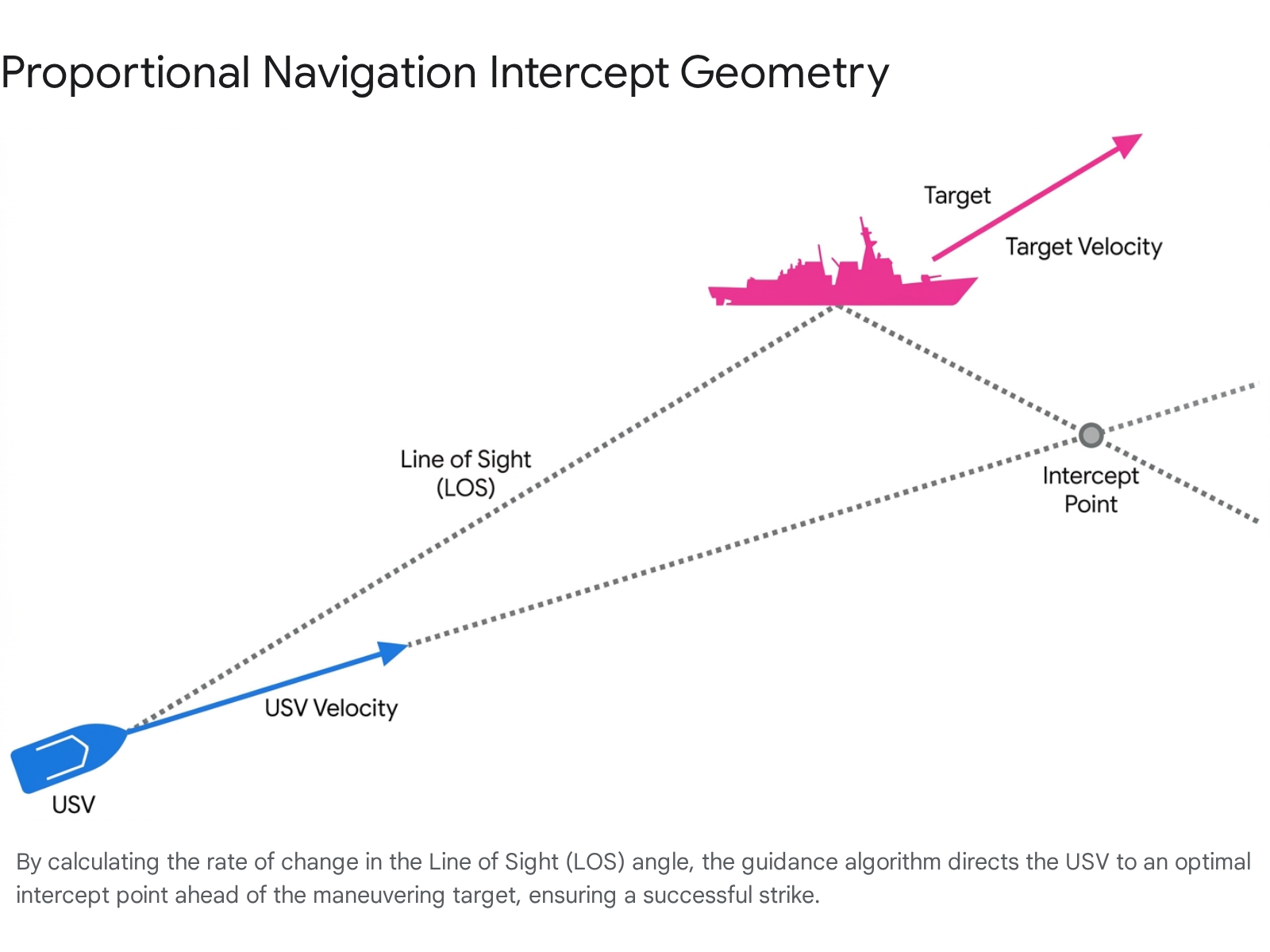
To successfully intercept a maneuvering warship, simple pursuit logic where the USV merely points its nose directly at the target is wholly insufficient. A fast-moving target will constantly shift out of the direct path, forcing the pursuing USV into a trailing position where it must fight through the turbulent wake and expose itself to stern-mounted machine gun fire. Instead, the software logic must employ advanced predictive intercept algorithms.
Proportional Navigation (PN) is widely implemented for dynamic target interception.53 The fundamental principle of the PN algorithm dictates that the USV must maneuver such that the rate of rotation of its heading is directly proportional to the rate of rotation of the line-of-sight (LOS) to the target.53 Mathematically, if the bearing to the target remains constant while the physical range decreases, a collision is guaranteed. The flight controller continuously processes the bearing drift and commands the steering nozzles to pull a calculated “lead” on the target, predicting its future position based on its current velocity vector.53
For mitigating the complex effects of crosswinds and aggressive ocean currents that push the light vessel off course, engineers employ Model Predictive Line-of-Sight (PLOS) guidance.50 The PLOS algorithm calculates the desired heading while actively estimating and compensating for the drift angle caused by these environmental disturbances. The outputs of these sophisticated guidance laws are fed into a low-level Proportional-Integral-Derivative (PID) controller or a Linear Quadratic Regulator (LQR).51 These controllers rapidly regulate the physical servos manipulating the waterjet steering nozzle, ensuring smooth, precise, and aggressive maneuvering without inducing hydrodynamic instability or overcorrection.51
9.0 Payload Integration and Multi-Domain Engagements
While the primary, historical function of a strike USV is to deliver a kinetic payload to a surface target, the ongoing conflict has necessitated rapid iterations in payload design. These adaptations are transforming simple explosive boats into complex, multi-domain combat platforms capable of engaging varied threats.
9.1 Impact Detonation and Decoy Swarms
The terminal lethality of the standard Magura V5 relies entirely on its 320-kilogram high-explosive charge.28 Detonation is generally not managed by complex electronic proximity fuses, which are vulnerable to jamming or failure. Instead, it relies on mechanical reliability. The bow of the vessel is fitted with three distinct contact fuses or physical impact sensors that protrude slightly from the hull.6 Upon aggressively ramming the adversary hull, the physical crushing of these sensors triggers the primary detonator. Hitting a warship precisely at the waterline with hundreds of kilograms of explosives causes massive structural trauma, immediate flooding in critical engineering spaces, and frequently leads to catastrophic secondary detonations within the target’s own munition magazines or fuel stores.55
To ensure the primary strike drone successfully navigates the defensive fire and reaches the target, operators have begun integrating sophisticated swarm tactics involving dedicated decoy USVs. These unarmed or lightly armed decoys surge ahead of the main strike package, intentionally triggering enemy radar systems and drawing the concentrated fire of rotary-wing aircraft and CIWS installations.56 By saturating the defensive processing bandwidth and depleting the ready ammunition of the target, the trailing strike drones can slip through the defensive perimeter largely undetected.56 Furthermore, multi-agent swarm logic allows these groups to operate cohesively, adjusting to failures within the swarm and sharing local perception data without centralized control.57
9.2 Surface-to-Air Defense Capabilities
In a significant evolutionary leap, engineers recognized the critical vulnerability of slow-moving USVs to airborne interdiction, particularly from naval aviation helicopters dispatched to hunt them. This realization led to the rapid development of the Magura V7 and specialized modular variants equipped with improvised air-defense systems.
These advanced platforms feature a modified launch apparatus, commonly referred to as the “Sea Dragon” system, capable of firing heat-seeking air-to-air missiles directly from the deck of the surface drone.12 Specifically, these USVs have been armed with dual Soviet-era R-73 (AA-11 Archer) infrared-homing missiles, or Western AIM-9M Sidewinder missiles.6 The launch rails are mounted at a fixed, steep upward angle.59
When the USV’s thermal camera detects the heat bloom of an incoming helicopter, the remote operator maneuvers the entire boat to align the missile’s sensitive seeker head with the aircraft’s engine exhaust. Once a solid thermal tone is achieved, the missile is launched autonomously.56 This exact configuration was successfully utilized to engage and destroy Russian Mi-8 and Mi-24 helicopters operating over the Black Sea, representing a historic and highly unconventional instance of a surface drone downing a manned military aircraft in combat.59
Additionally, larger platforms like the Sea Baby have been outfitted with unguided RPV-16 thermobaric rocket launchers, firing salvos of 122mm rockets.6 Firing these rockets during the final approach serves to violently suppress enemy deck crews manning heavy machine guns, creating a chaotic environment of fire and pressure that masks the final ramming maneuver.6
10.0 Commercial Supply Chain and Vendor Verification
The rapid prototyping, constant iteration, and mass deployment of asymmetric USVs are made possible by the efficiency of the global commercial supply chain. Rather than relying on slow, rigid, and expensive military procurement processes for every custom component, engineers heavily utilize high-end civilian, industrial, and commercial hardware.
The following table outlines key components identified within systems like the Magura V5, providing verified suppliers and active commercial links to demonstrate the accessibility of this technology in the current market.
| Subsystem Category | Component / Technology | Primary Manufacturer / Vendor | Verified Availability / Source Link |
| Propulsion (Engine) | Rotax 1630 ACE (325 HP, 3-Cylinder) | BRP / Sea-Doo | (https://sea-doo.brp.com/us/en/discover/technologies/vehicle-technologies/rotax-engines.html) |
| Propulsion (Spares) | Rebuilt Jet Pumps & Wear Rings | SBT / Westside Powersports | (https://sbt.com/products/sea-doo-jet-pump-assembly-lrv-rx-xp-gsx-gtxgti-gts) |
| Communications | Flat High Performance Maritime Kit | SpaceX (Starlink) | (https://www.starlink.com/business/maritime) |
| Navigation (GNSS) | OEM7700 Multi-Frequency Receiver | NovAtel (Hexagon) | NovAtel OEM7700 |
| Navigation (IMU) | MTi-630 AHRS / Inertial Sensor | Xsens (Movella) | (https://shop.movella.com/us/product-lines/sensor-modules/products/mti-630-ahrs-development-kit) |
| Electro-Optical (EO/IR) | FLIR M232 / M364C Marine Camera | Teledyne FLIR | (https://marine.flir.com/en-us/marine-cameras/fixed-mount/flir-m232) |
The profound reliance on these commercial networks presents a unique and enduring challenge for traditional arms control frameworks and export restrictions. Components like the Starlink maritime terminal, the FLIR thermal camera, and the Rotax recreational engine are explicitly designed and marketed for civilian maritime, leisure, or industrial applications. Their seamless integration into highly lethal autonomous weapon systems highlights the dual-use nature of modern technology. This reality allows state and non-state actors alike to assemble highly capable military platforms entirely outside the purview of traditional defense manufacturing oversight.
11.0 Conclusion
The strategic deployment of asymmetric Unmanned Surface Vessels has fundamentally disrupted the established paradigms of naval warfare. The engineering philosophy behind systems like the Magura V5, which prioritizes low-observable composite materials, modular commercial propulsion systems, and highly sophisticated vision-based terminal guidance, demonstrates that effective sea denial can be achieved without the massive capital investment historically required to field traditional surface fleets.
By leveraging the transparency of the modern maritime environment via open-source intelligence, and combining that data with the lethal precision of autonomous intercept algorithms, asymmetric forces can project disproportionate power against technologically superior adversaries. As these unmanned platforms continue to evolve rapidly, incorporating robust anti-air capabilities and collaborative swarm logic, naval forces worldwide will be compelled to radically adapt their defensive doctrines, vessel architectures, and operational strategies to survive and operate effectively in an increasingly hostile and autonomous littoral environment.
Please share the link on Facebook, Forums, with colleagues, etc. Your support is much appreciated and if you have any feedback, please email us in**@*********ps.com. If you’d like to request a report or order a reprint, please click here for the corresponding page to open in new tab.
Sources Used
- Asymmetric Naval Warfare and the Rise of Maritime Drone Threats, accessed April 19, 2026, https://www.tarideal.com/blog/asymmetric-naval-warfare/
- 514. Redefining Asymmetric Warfare – Mad Scientist Laboratory – U.S. Army, accessed April 19, 2026, https://madsciblog.tradoc.army.mil/514-redefining-asymmetric-warfare/
- Lessons from Ukraine and the Red Sea on Autonomous Systems and the Future of the US Navy, accessed April 19, 2026, https://nps.edu/documents/110773463/156219640/EAG_Lessons+from+Ukraine+and+the+Red+Sea+on+Autonomous+Systems+and+the+Future+of+the+US+Navy.pdf/33b910f4-24a4-98d6-f427-6e1ae9426662?t=1744381910002
- The Future of Unmanned Autonomous Vehicles in the Maritime Battlespace – Small Wars Journal, accessed April 19, 2026, https://smallwarsjournal.com/2025/11/27/unmanned-maritime-warfare/
- USV: The Critical Role of Guidance, Navigation and Control in Modern Naval Defense, accessed April 19, 2026, https://www.uavnavigation.com/company/blog/usv-critical-role-guidance-navigation-and-control-modern-naval-defense
- Overview Of Ukrainian Maritime Drones (USVs) Of The Russo-Ukrainian War | Covert Shores, accessed April 19, 2026, https://www.hisutton.com/Ukrainian-USVs-Russo-Ukraine-War.html
- Sailing through the spyglass: The strategic advantages of blue OSINT, ubiquitous sensor networks, and deception – Atlantic Council, accessed April 19, 2026, https://www.atlanticcouncil.org/in-depth-research-reports/issue-brief/sailing-through-the-spyglass-the-strategic-advantages-of-blue-osint-ubiquitous-sensor-networks-and-deception/
- Democratized Intelligence: How Open-Source Intelligence is Reshaping Asymmetric Advantage – Irregular Warfare Initiative, accessed April 19, 2026, https://irregularwarfare.org/articles/democratized-intelligence-how-open-source-intelligence-is-reshaping-asymmetric-advantage?action=genpdf&id=25758
- The IRGC Navy’s long-term strategy of asymmetrical warfare | Note de la FRS, accessed April 19, 2026, https://www.frstrategie.org/en/publications/notes/irgc-navy-s-long-term-strategy-asymmetrical-warfare-2024
- How Ukraine’s Unmanned Surface Vessels Have Reshaped Modern Naval Warfare in the Black Sea – Rabdan Security and Defence Institute, accessed April 19, 2026, https://rsdi.ae/en/publications/how-ukraines-unmanned-surface-vessels-have-reshaped-modern-naval-warfare-in-the-black-sea
- Group 13 (Ukraine) – Wikipedia, accessed April 19, 2026, https://en.wikipedia.org/wiki/Group_13_(Ukraine)
- MAGURA V5 – Wikipedia, accessed April 19, 2026, https://en.wikipedia.org/wiki/MAGURA_V5
- Sea Denial: The Ukrainian Case Study and the Future of Naval Warfare – Digital Commons @ USF – University of South Florida, accessed April 19, 2026, https://digitalcommons.usf.edu/cgi/viewcontent.cgi?article=2564&context=jss
- Seen For First Time: Ukraine’s Original Naval Drone, accessed April 19, 2026, https://www.navalnews.com/naval-news/2025/07/under-wraps-no-more-ukraines-original-naval-drone-revealed/
- How Ukrainian Sea Drones Destroyed a Russian Ship Caesar Kunikov – YouTube, accessed April 19, 2026, https://www.youtube.com/watch?v=XlBkeJ75j_s
- Magura vs. Sea Baby: Closer look at Ukrainian drone warfare against Russian ships, accessed April 19, 2026, https://newsukraine.rbc.ua/news/magura-vs-sea-baby-closer-look-at-ukrainian-1709831518.html
- A History and Analysis of Ukrainian Naval Drones – Carnegie Mellon Policy and Law Review, accessed April 19, 2026, https://cmuplr.org/2025/10/07/a-history-and-analysis-of-ukrainian-naval-drones/
- Analysis: An Operational View on the USV Attacks in the Black Sea from an Admiral’s Eyes, accessed April 19, 2026, https://www.navalnews.com/naval-news/2024/02/analysis-an-operational-view-on-the-usv-attacks-in-the-black-sea-from-an-admirals-eyes/
- Weapons of Ukrainian Victory: MAGURA V5 Maritime Drones – Root-Nation.com, accessed April 19, 2026, https://root-nation.com/en/articles-en/weapons-en/en-magura-v5-ukraine/
- Ukraine’s Magura V5: Military innovation washed up on Turkish coast – Daily Sabah, accessed April 19, 2026, https://www.dailysabah.com/opinion/op-ed/ukraines-magura-v5-military-innovation-washed-up-on-turkish-coast
- Sea Baby – Wikipedia, accessed April 19, 2026, https://en.wikipedia.org/wiki/Sea_Baby
- Ukraine’s Sea Baby Maritime Drone (USV) | Covert Shores, accessed April 19, 2026, https://www.hisutton.com/Ukraine-Sea-Baby-USV.html
- How to Build an ASV/USV: Hull Design – Blue Trail Engineering, accessed April 19, 2026, https://www.bluetrailengineering.com/post/how-to-build-an-asv
- Russians showed the design of the Ukrainian Magura V5 USV, accessed April 19, 2026, https://militarnyi.com/en/news/russians-showed-the-design-of-the-ukrainian-magura-v5-usv/
- MAGURA V5, accessed April 19, 2026, https://docs.tuyap.online/FDOCS/99368.pdf
- Media Reveal Magura V5, the Ukrainian Naval Drone: Features and Specifications, accessed April 19, 2026, https://en.defence-ua.com/weapon_and_tech/media_reveal_magura_v5_the_ukrainian_naval_drone_features_and_specifications-7471.html
- AUTONOMOUS MARITIME SYSTEMS IN MODERN WARFARE: OPERATIONAL ANALYSIS OF THE MAGURA NAVAL DRONE IN THE UKRAINIAN CONFLICT – AGIR, accessed April 19, 2026, https://www.agir.ro/buletine/3426.pdf
- Analysis: The Magura-V5 Sea Drone – Scourge of Russia’s Black Sea Operations, accessed April 19, 2026, https://www.kyivpost.com/analysis/29068
- Adaptive Sea Clutter Suppression for Marine Radar Systems to Enhance USV Autonomy, accessed April 19, 2026, https://www.youtube.com/watch?v=LRHGb4-ReuY
- Sensors – Navsea – Navy.mil, accessed April 19, 2026, https://www.navsea.navy.mil/Portals/103/Documents/NSWC_Dahlgren/LeadingEdge/Sensors/Sensors03.pdf
- How Aerospace Composites Can Reduce Aircraft Radar Signatures – AXIOM Materials, accessed April 19, 2026, https://axiommaterials.com/aircraft-radar-signatures/
- How a Tougher Skin Could Change the Shape of Stealth Aircraft | NC State News, accessed April 19, 2026, https://news.ncsu.edu/2021/05/tougher-skin-for-stealth-aircraft/
- Ukraine’s Maritime Drones (USV) What You Need To Know – Covert Shores, accessed April 19, 2026, https://www.hisutton.com/Ukraine-Maritime-Drones.html
- 2026 Sea-Doo GTI SE 170 ROTAX 1630 ACE | RideNow Forney, accessed April 19, 2026, https://www.ridenowforney.com/New-Inventory-2026-Sea-Doo-Personal-Watercraft-GTI-SE-170-ROTAX-1630-ACE-RideNow-Burleson-TX-18542599
- Rotax Engines for Personal Watercraft & Pontoon Boat – Sea-Doo – BRP, accessed April 19, 2026, https://sea-doo.brp.com/us/en/discover/technologies/vehicle-technologies/rotax-engines.html
- 2026 Sea-Doo RXP-X 325 w/ Tech Package & BRP Premium Audio – RIVA Motorsports, accessed April 19, 2026, https://www.rivasuperstore.com/–xInventoryDetail?1=1&fr=xnewinventory&oid=18434518&condition=NEW&year=2026&make=Sea%2DDoo&model=RXP%2DX%E2%84%A2+325+Tech%2C+BRP+Premium+A%2C+iBR+Gulfstream+Blue+Premium&vtype=Personal+Watercraft&trimid=25748681&location=RIVA+Motorsports&stockno=54793C&vin=YDV54793C626&format=print
- OEM Used SeaDoo Jet Pumps for Sale, accessed April 19, 2026, https://seadoopartsdepot.com/seadoo-jet-pumps/
- STARLINK Flat High Performance Kit White 02541705 – Best Buy, accessed April 19, 2026, https://www.bestbuy.com/product/starlink-flat-high-performance-kit-white/J3R8ZC25S4
- NovAtel OEM7600 Dual-Frequency GNSS Receiver – Canal Geomatics, accessed April 19, 2026, https://canalgeomatics.com/products/novatel-oem7600-dual-frequency-gnss-receiver/
- NovAtel OEM7700 Multi-Frequency GNSS Receiver – Canal Geomatics, accessed April 19, 2026, https://canalgeomatics.com/products/novatel-multi-frequency-oem7700/
- NovAtel OEM7 GNSS Receivers – NavtechGPS, accessed April 19, 2026, https://www.navtechgps.com/novatel_oem7_gnss_receivers/
- OEM GNSS GPS Receivers – Teleplan Forsberg Ltd., accessed April 19, 2026, https://teleplanforsberg.com/index.php/products/oem-gps-gnss-receivers-novatel-oem7/
- Buy MTi-630 AHRS Development Kit – Movella, accessed April 19, 2026, https://shop.movella.com/us/product-lines/sensor-modules/products/mti-630-ahrs-development-kit
- Ukrainian military demonstrated the domestic-made naval kamikaze drone, accessed April 19, 2026, https://militarnyi.com/en/news/ukrainian-military-demonstrated-the-domestic-made-naval-kamikaze-drone/
- FLIR M232 Marine Thermal Camera System – E70354, accessed April 19, 2026, https://defender.com/en_us/flir-m232-marine-thermal-camera-system-e70354
- FLIR M364C – Fixed Mount Marine Cameras, accessed April 19, 2026, https://marine.flir.com/en-us/marine-cameras/fixed-mount/flir-m364c
- FLIR Thermal Imaging Cameras | The GPS Store, Inc., accessed April 19, 2026, https://www.thegpsstore.com/Brands/FLIR-Thermal-Cameras
- Mapping the MilTech War: Eight Lessons from Ukraine’s Battlefield – Ifri, accessed April 19, 2026, https://www.ifri.org/en/studies/mapping-miltech-war-eight-lessons-ukraines-battlefield
- SBU apparently used ardupilot for the recent attacks on russian airbases. – Reddit, accessed April 19, 2026, https://www.reddit.com/r/ardupilot/comments/1l0pdg9/sbu_apparently_used_ardupilot_for_the_recent/
- A Salvage Target Tracking Algorithm for Unmanned Surface Vehicles Combining Improved Line-of-Sight and Key Point Guidance – MDPI, accessed April 19, 2026, https://www.mdpi.com/2077-1312/13/6/1158
- Benchmarking Vision-Based Object Tracking for USVs in Complex Maritime Environments, accessed April 19, 2026, https://arxiv.org/html/2412.07392v1
- [2412.07392] Benchmarking Vision-Based Object Tracking for USVs in Complex Maritime Environments – arXiv, accessed April 19, 2026, https://arxiv.org/abs/2412.07392
- Missile Terminal Guidance and Control Against Evasive Targets – DTIC, accessed April 19, 2026, https://apps.dtic.mil/sti/tr/pdf/ADA378653.pdf
- Research and Flight Test on the Terminal Guidance Control Technology for Cruising Unmanned Aerial Vehicles – MDPI, accessed April 19, 2026, https://www.mdpi.com/2226-4310/11/12/975
- The Age of Uncrewed Surface Vessels – RAND, accessed April 19, 2026, https://www.rand.org/pubs/commentary/2022/11/the-age-of-uncrewed-surface-vessels.html
- Ukrainian Magura V5 Sea Drones Get a Swarm of Decoys, Ready to Pounce · TechUkraine, accessed April 19, 2026, https://techukraine.org/2025/03/19/ukrainian-magura-v5-sea-drones-get-a-swarm-of-decoys-ready-to-pounce/
- Multi-Agent Swarm in UAV Operations: The Future of Coordinated Drone Missions, accessed April 19, 2026, https://uavnavigation.com/company/blog/multi-agent-swarm-uav-operations-future-coordinated-drone-missions
- New variants of Ukraine’s SEA BABY Unmanned Surface Vessel – Future Warfare Magazine, accessed April 19, 2026, https://www.fw-mag.com/shownews/777/new-variants-of-ukraine-rsquo-s-sea-baby-unmanned-surface-vessel
- Ukrainian Surface Drone Equipped with R-73 Air-to-Air Missiles Shot Down Russian Mi-8 Helicopter – The Aviationist, accessed April 19, 2026, https://theaviationist.com/2024/12/31/ukrainian-magura-usv-r-73-vs-mi-8-helicopter/
- In A ‘Historic First’, Ukrainian Magura V5 Sea Drone “Downs” Russian Mi-8 Chopper Using SeeDragon Missile – EurAsian Times, accessed April 19, 2026, https://www.eurasiantimes.com/in-a-historic-first-ukrainian-magura-v5-sea/