
Executive Summary
The strategic environment in Europe and its immediate periphery has reached a state of severe, multi-domain volatility during the week ending February 28, 2026. The intersection of kinetic military escalation in the Middle East, intensifying Russian shaping operations in Eastern Europe, aggressive grey-zone provocations in the Baltic and Arctic theaters, and profound internal institutional fractures within the European Union has created a highly complex threat matrix. This convergence of crises requires an immediate recalibration of European security, economic, and diplomatic postures, as the fundamental pillars of regional stability are simultaneously tested.
The most critical and immediate external shock occurred on February 28, when the United States and Israel initiated “Operation Epic Fury,” launching preemptive, multi-domain military strikes against military and nuclear infrastructure across the Islamic Republic of Iran.1 This operation marks the definitive collapse of the renewed nuclear negotiations in Geneva and the culmination of escalating diplomatic tensions following the “12-Day War” of June 2025.1 The immediate retaliatory ballistic missile and drone strikes launched by Iran’s Islamic Revolutionary Guard Corps (IRGC) against U.S. military installations in the Persian Gulf have placed global energy markets on high alert.2 These tit-for-tat strikes present an acute and direct threat to critical energy supply lines, most notably through the Strait of Hormuz, which handles approximately one-fifth of the world’s liquefied natural gas (LNG) and a quarter of seaborne oil trade.5 For the European continent, this represents an immediate risk of energy-driven inflation and supply chain disruption, compounded by the widespread suspension of commercial aviation routes across the Middle East by major European flag carriers.6
Simultaneously, the European security architecture is facing direct, calculated testing by the Russian Federation. In the Baltic Sea, a Russian signals intelligence (SIGINT) vessel deliberately launched an unauthorized drone to harass the French nuclear-powered aircraft carrier Charles de Gaulle while it was anchored in Malmö, Sweden.8 This brazen grey-zone provocation is assessed as an effort to test NATO’s electronic warfare countermeasures and signal displeasure at Sweden’s integration into the Alliance’s defense frameworks.8 Further north in the Arctic theater, renewed and aggressive diplomatic maneuvers by the U.S. administration to annex Greenland have triggered a profound political crisis in Denmark, forcing the Prime Minister to call early elections amid unprecedented intelligence warnings of hybrid electoral interference emanating from both Moscow and Washington.11
On the Eastern Flank, the Russo-Ukrainian War is rapidly entering a highly critical and potentially decisive operational phase. Russian military forces have initiated a massive, theater-wide Battlefield Air Interdiction (BAI) and artillery preparation campaign specifically targeting Ukraine’s “Fortress Belt” in the Donetsk Oblast-a heavily fortified urban agglomeration comprising Slovyansk, Kramatorsk, Druzhkivka, and Kostyantynivka.14 This intense shaping operation, heavily leveraging unmanned aerial systems and glide bombs to interdict logistics, signals the imminent commencement of the long-anticipated Russian Spring-Summer 2026 ground offensive, aimed at breaking the last major urban defensive line in the Donbas region.17
Internally, the European Union is navigating a severe institutional and macroeconomic crisis that threatens the bloc’s political cohesion. European Commission President Ursula von der Leyen’s highly controversial decision to provisionally apply the EU-Mercosur Free Trade Agreement-deliberately bypassing the European Parliament and a pending legal review by the European Court of Justice-has deeply fractured the bloc along industrial and agricultural lines.19 This maneuver, while strongly supported by export-heavy economies like Germany, has been vehemently opposed by France and Italy, igniting violent, large-scale agricultural protests that have paralyzed transit routes in Brussels and Paris.19 While recent macroeconomic indicators show a tentatively stabilizing Eurozone inflation rate of 1.7 percent for January 2026, the dangerous convergence of geopolitical energy shocks in the Middle East and internal trade disputes threatens to completely derail the European Central Bank’s fragile disinflationary trajectory in the coming quarters.23
1. Geopolitical Flashpoints and External Threat Vectors
1.1. Operation Epic Fury: The U.S.-Israeli Strikes on Iran
On the morning of February 28, 2026, the geopolitical landscape of the Middle East was radically altered when the United States and Israel launched a massive, coordinated military offensive against the Islamic Republic of Iran. The military campaign, codenamed “Operation Epic Fury” by the United States Department of Defense and “Operation Roaring Lion” by the Israel Defense Forces, represents a severe escalation in regional hostilities.2 The strikes denote the absolute collapse of the renewed nuclear negotiations held in Geneva and the execution of a preemptive military strategy designed to neutralize Iran’s ballistic missile infrastructure and nuclear enrichment capabilities.1
The diplomatic runway for this conflict had been deteriorating for months. Following the “12-Day War” between Israel and Iran in June 2025, the International Atomic Energy Agency (IAEA) declared Iran in violation of its nuclear commitments.3 In response, the E3 nations-France, Germany, and the United Kingdom-initiated their own dialogue with Tehran in a desperate bid to salvage a diplomatic framework, but ultimately failed, leading the E3 to issue a statement in August 2025 declaring Iran in violation and setting in motion the ‘snapback’ provision of UN Resolution 2231, which restored the international arms embargo.3 Despite intense last-minute diplomatic efforts by U.S. envoys Steve Witkoff and Jared Kushner, and explicit warnings from the E3 Ministers and the High Representative of the European Union urging de-escalation, the military option was authorized.27
The multi-domain military operation utilized a highly complex array of assets. The opening salvos featured sea-launched Tomahawk cruise missiles and air-launched munitions fired from U.S. Air Force and Navy jets.2 The United States had recently surged its regional force posture, positioning over a dozen warships in the theater, including the destroyers USS Michael Murphy and USS Mitscher, alongside littoral combat ships USS Canberra and USS Santa Barbara near the critical Strait of Hormuz.2 The strikes targeted a broad spectrum of military infrastructure, command and control centers, and surface-to-surface missile sites across multiple Iranian cities, with verified explosions reported in the capital Tehran, as well as Karaj, Qom, Isfahan, Kermanshah, and Tabriz.2 U.S. President Donald Trump publicly declared that the strategic objective was to eliminate imminent threats to the American homeland and explicitly called for regime change, urging the Iranian populace to “take over your government” while ensuring that the regime’s nuclear and missile industries would be “obliterated”.1
The strategic implications for European security and economic stability are immediate, profound, and overwhelmingly negative. Unwilling to absorb the strikes passively, Iran’s Islamic Revolutionary Guard Corps (IRGC) rapidly initiated retaliatory ballistic missile and drone barrages.4 These retaliatory strikes were not limited to northern Israel; they deliberately targeted U.S. military installations hosted by Gulf Arab states.4 Targeted facilities reportedly include the U.S. Navy’s 5th Fleet headquarters at Naval Support Activity in Bahrain, Al Udeid Air Base in Qatar, Ali Al Salem Air Base in Kuwait, and Al Dhafra Air Base in the United Arab Emirates.2 The UAE government later confirmed that one person was killed in Abu Dhabi by falling debris from an intercepted Iranian missile.7
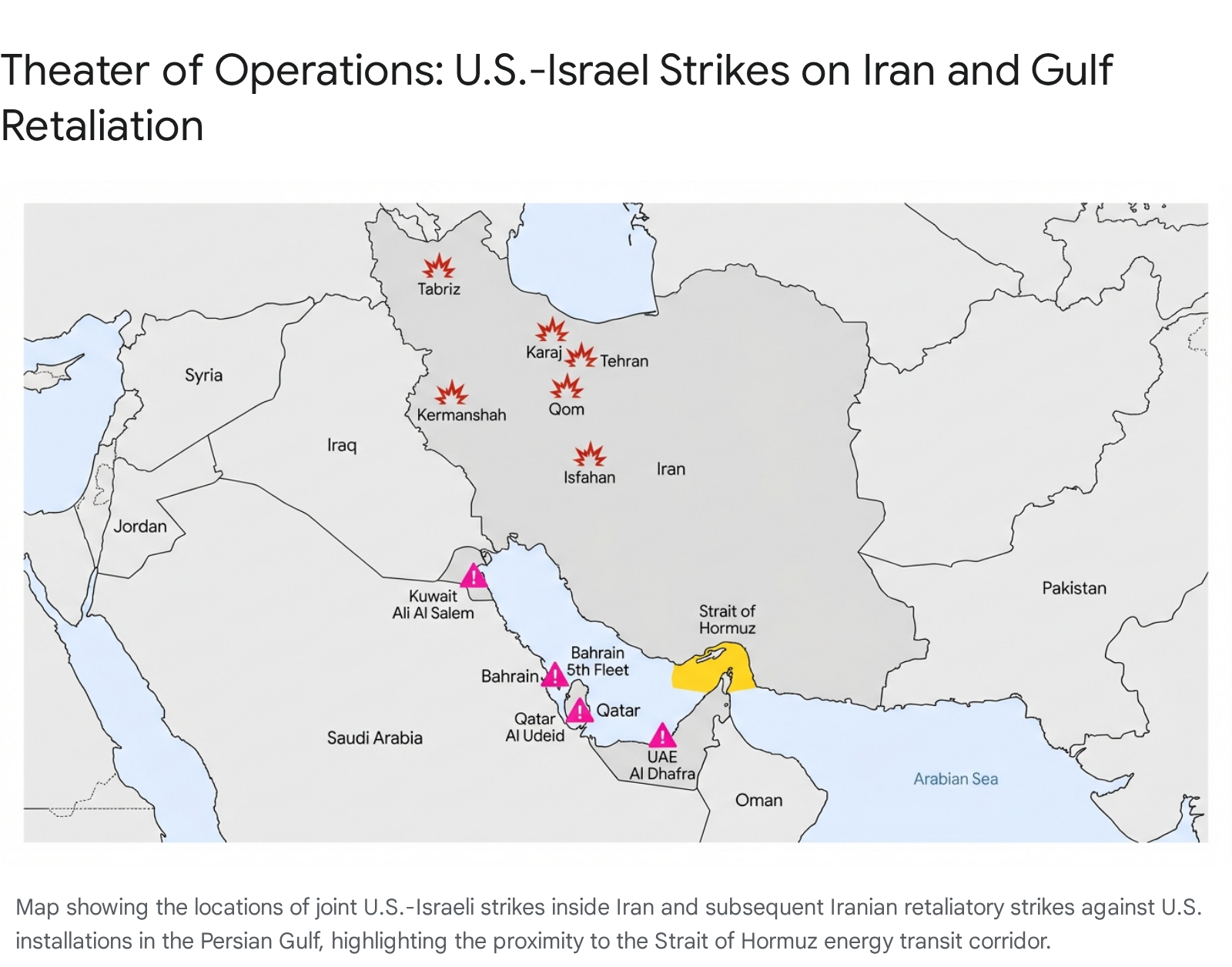
The sudden kinetic escalation has forced a rapid and chaotic recalibration of European foreign policy and logistics. European airspace management has been thrown into complete disarray. Major European commercial carriers, including Lufthansa, Air France, and KLM, immediately canceled routes to Tel Aviv, Beirut, Amman, and Dubai, while the Hungarian low-cost carrier Wizz Air suspended all flights to the region until at least March 7.7 This effectively severs primary commercial air corridors between Europe and the Middle East, creating massive logistical bottlenecks. Furthermore, the conflict threatens to draw in European military assets currently deployed in the region for maritime security operations, forcing national commands to urgently evaluate force protection protocols against the threat of asymmetric Iranian retaliation or proxy attacks on European shipping. The UK Government, via the Chair of the Commons Foreign Affairs Committee, Emily Thornberry, expressed deep concern over the legal basis of the preemptive action and warned of the severe risks of Britain being dragged into a wider regional war due to its permanent military presence in the area.34
1.2. The Malmö Incident: Russian Grey-Zone Aggression
Amid the overwhelming focus on the Middle Eastern crisis, the Russian Federation executed a highly provocative and calculated grey-zone operation against a key European naval asset, demonstrating Moscow’s continued willingness to test NATO’s defensive thresholds. During the week, the French nuclear-powered aircraft carrier Charles de Gaulle, operating as the flagship of its strike group, made a historic port call in Malmö, Sweden, as part of routine NATO integration and exercise activities.8 The port of Malmö is strategically located on the Öresund strait, directly opposite the Danish capital of Copenhagen, representing a vital maritime chokepoint connecting the Baltic Sea to the North Sea.35
On February 26, the Swedish Armed Forces detected an unauthorized unmanned aerial vehicle (UAV) approaching the French carrier. Swedish military intelligence and naval sources subsequently confirmed, via intercepted technical data, that the drone was launched directly from the Zhigulevsk, a Russian signals intelligence (SIGINT) vessel operating in the immediate vicinity within the Öresund strait.10 The Russian drone deliberately breached Swedish territorial airspace and approached within 13 kilometers (eight miles) of the Charles de Gaulle before the Swedish naval vessel HMS Rapp, integrated into the carrier’s security cordon, initiated active electronic countermeasures to disrupt, jam, and neutralize the threat.8
The diplomatic fallout was immediate. French Foreign Minister Jean-Noel Barrot, speaking from aboard the Charles de Gaulle, dismissed the event as a “ridiculous provocation,” while Swedish Defense Minister Pål Jonson condemned it as an irresponsible and serious violation of sovereign Swedish airspace.8 Swedish Prime Minister Ulf Kristersson explicitly noted that the timing of the drone flight was not a coincidence, recognizing it as a familiar pattern of Russian asymmetric behavior.8 Kremlin spokesperson Dmitry Peskov characteristically denied involvement, labeling the Swedish accusations as “absurd”.8
However, European intelligence analysts assess this incident as a highly deliberate probing operation rather than a mere nuisance. By launching a drone from a dedicated SIGINT vessel in close proximity to a nuclear-powered aircraft carrier, the Russian military command intentionally aimed to force the deployment and activation of French and Swedish electronic warfare (EW) and localized air defense systems. The primary objective of such an operation is the collection of highly valuable electronic intelligence (ELINT) and signature data on NATO’s latest countermeasures and response times. Furthermore, the incident serves as a potent strategic messaging tool, demonstrating Moscow’s willingness to harass high-value NATO assets within the territorial waters of the Alliance’s newest member state, thereby continuously applying pressure below the threshold of armed conflict.
1.3. The Nordic Theater: The Greenland Crisis and Electoral Interference
The geopolitical stability of the Nordic region has been further degraded by a severe and escalating diplomatic friction between the United States and Denmark regarding the status of Greenland. Following his inauguration in 2025, U.S. President Donald Trump resurrected his highly controversial 2019 campaign objective to effectively annex or purchase the autonomous Danish territory.38 This push is driven by a deep strategic imperative within the U.S. administration to secure Arctic dominance and gain exclusive access to Greenland’s vast, untapped reserves of rare earth minerals, which are critical for both defense technologies and the broader energy transition.39
In January 2026, the diplomatic pressure escalated into overt economic coercion. President Trump announced the application of an extra 10 percent tariff on Denmark, the United Kingdom, and six other European nations, explicitly linking the economic penalties to European resistance to his Greenland ambitions.12 This resulted in an immediate mobilization of European military personnel under the banner of a reconnaissance mission dubbed “Operation Arctic Endurance”.12 Despite briefly reversing his position at the Davos conference in late January by pledging not to use military force to annex the island, the intense U.S. focus has irrevocably altered the diplomatic landscape.38
This relentless pressure campaign has profoundly destabilized the Danish domestic political environment. Prime Minister Mette Frederiksen, seeking a strong public mandate to navigate what analysts are calling the worst U.S.-Europe diplomatic crisis in decades, was forced to call for early general elections, scheduled for March 24, 2026.11 While her rejection of U.S. demands temporarily boosted her Social Democrat party’s polling to 21 percent, the situation has rapidly evolved into a severe national security threat.13
In a highly unusual and alarming joint statement, Denmark’s Police Intelligence Service (PET) and the military intelligence service (FE) issued explicit public warnings that foreign powers are actively preparing to interfere in the upcoming parliamentary elections.11 While the Russian Federation is cited as the primary threat-motivated by a desire to punish Denmark for its staunch military and financial support for Ukraine-the intelligence agencies unprecedentedly named the United States as a potential source of influence operations.11 Intelligence assessments indicate that the intense U.S. focus on Greenland has generated a chaotic and highly polarized information environment, creating “new international fault lines” that both official and informal state actors are exploiting.13 These actors are anticipated to utilize tactics including the spread of disinformation, the deepening of social divisions, the discrediting of specific candidates, and the execution of limited cyberattacks against electoral infrastructure.11 This dynamic highlights a deeply concerning fracturing of trust within the transatlantic alliance, forcing European domestic intelligence agencies to treat a primary, foundational ally as a potential vector for political destabilization and hybrid warfare.
2. The Russo-Ukrainian War: Operational Assessment
2.1. Shaping the Battlefield: The Assault on the Fortress Belt
On the Eastern Flank of the European continent, the ongoing Russo-Ukrainian War has entered a highly critical and potentially decisive operational phase. Comprehensive intelligence assessments indicate that Russian military forces have commenced extensive, theater-wide artillery and drone preparation of the battlefield ahead of their anticipated Spring-Summer 2026 offensive campaign.14 The primary, overarching strategic objective of this upcoming campaign is the reduction, encirclement, and capture of Ukraine’s “Fortress Belt” in the Donetsk Oblast.
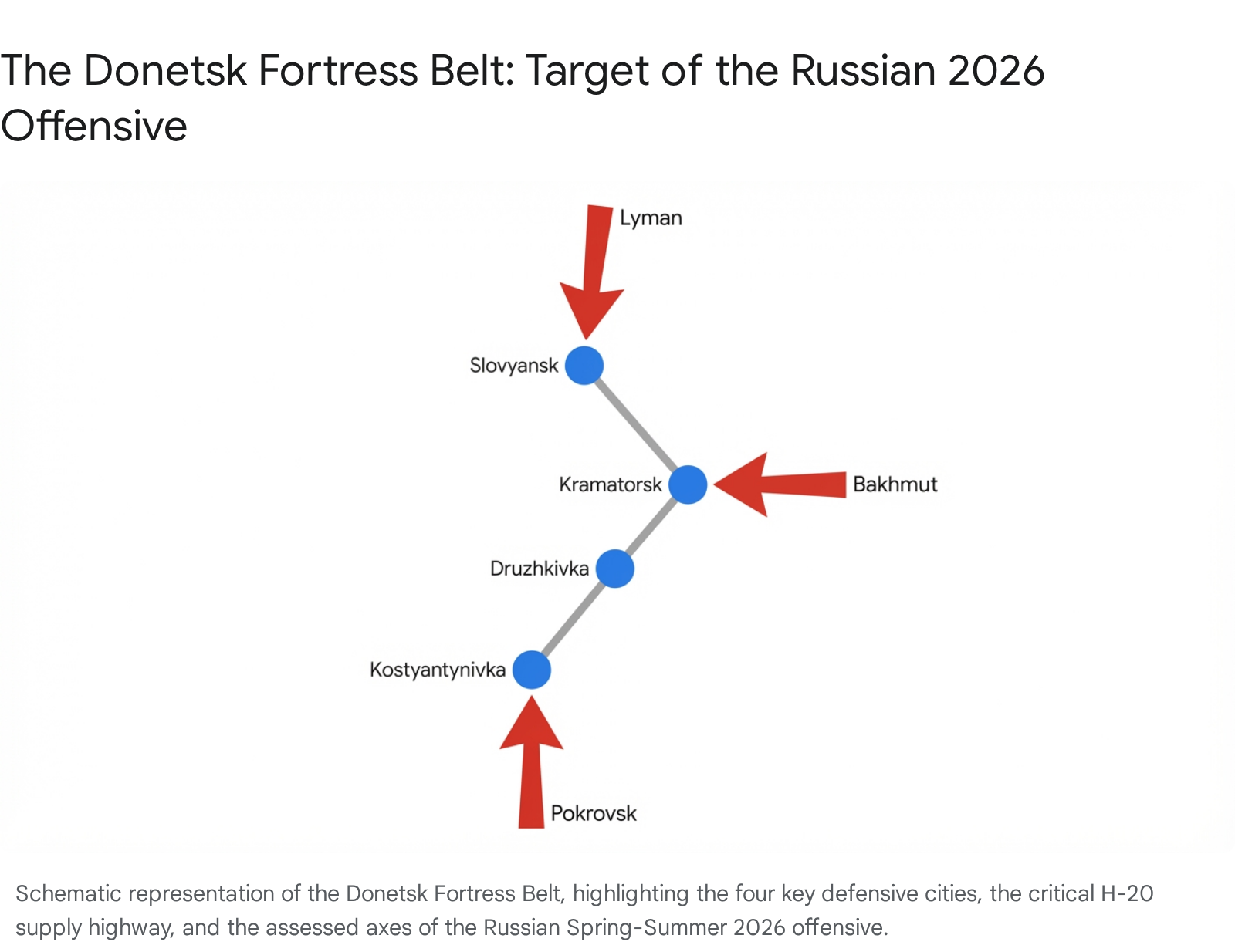
The Fortress Belt is a heavily fortified, interconnected urban conurbation consisting of four major cities-Slovyansk, Kramatorsk, Druzhkivka, and Kostyantynivka.14 These cities run along a north-to-south axis, physically connected by the critical H-20 (also designated N-20) ground line of communication (GLOC) highway.14 With a pre-war combined population exceeding 380,000 residents, this urban agglomeration represents the absolute backbone of the Ukrainian defense in the Donbas.18 The Ukrainian Armed Forces have spent the past 11 years-dating back to the initial 2014 Russian incursions led by Igor Girkin in Slovyansk-pouring immense time, capital, and engineering effort into reinforcing this specific belt, establishing significant defense-industrial and subterranean infrastructure in and around these cities.18
The operational conditions for this new phase were set by the slow, grinding, and highly costly Russian capture of the logistical hub of Pokrovsk in late December 2025.44 While the capture of Pokrovsk did not immediately “open up” the entire region as the Kremlin claimed, it provided a staging ground for a northward thrust.44 During the week ending February 28, Russian tube artillery began striking the settlement of Bilenke, located roughly 14 kilometers northeast of Kramatorsk.14 This marks a significant escalation, as it is the first time the northern tip of the Fortress Belt has come under sustained, direct conventional artillery fire in this phase of the war.14
Simultaneously, Russian forces are exerting severe, multi-directional pressure on the southern anchor of the belt. Ukrainian defenders are gradually being forced to retreat from their last holding positions within the city limits of Kostyantynivka, with the majority of the city now categorized as a contested grey zone or under direct Russian control.17 The broader Russian offensive architecture is unfolding along three distinct operational axes: pushing south from the Lyman direction, advancing west from the Bakhmut direction, and thrusting north from the recently captured Pokrovsk and Kostiantynivka sectors.17 This tri-directional pressure threatens to physically sever the M03 motorway, the vital logistical artery supplying the northern Fortress Belt cities directly from the Kharkiv Oblast.17
2.2. Tactical Evolution: The Battlefield Air Interdiction (BAI) Campaign
In order to degrade the formidable defenses of the Fortress Belt before committing to massive infantry ground assaults, the Russian military command has radically intensified a theater-wide Battlefield Air Interdiction (BAI) campaign. This campaign explicitly targets Ukraine’s operational rear-defined as the zone roughly 20 to 100 kilometers behind the line of contact-aiming to paralyze logistical movements and impact tactical battlefield operations.14 This campaign represents a significant and lethal evolution in Russian tactical doctrine, heavily leveraging a diverse array of unmanned aerial systems (UAS) to isolate tactical sectors.
Russian forces are currently utilizing a complex, layered mix of drone technologies. This includes modified tactical first-person view (FPV) drones equipped with fiber-optic cables (rendering them immune to traditional radio-frequency electronic warfare jamming), “sleeper” drones that are pre-positioned to lie in ambush on the ground until activated by the acoustic or thermal signatures of approaching targets, and long-range Geran-2 (Shahed-type) strike drones.16 These assets are systematically targeting the H-20 highway, ruthlessly hunting Ukrainian unmanned ground vehicles (UGVs), exposing drone operators, and striking civilian logistics corridors in what military analysts have starkly termed “human safari” tactics.14 For example, geolocated footage from February 26 confirmed Russian drone strikes against both military personnel in Oleksiievo-Druzhkivka and a civilian cyclist utilizing the H-20 highway northwest of Kostyantynivka.14
This pervasive drone interdiction is heavily augmented by the mass deployment of KAB glide bombs. These highly destructive munitions provide immense explosive power capable of penetrating fortified concrete positions in cities like Druzhkivka and Kostyantynivka, while allowing Russian tactical aviation to release their payloads from distances that keep them safely outside the engagement envelope of Ukrainian short-range air defenses.16 The strategic intent behind this months-long BAI campaign is to systematically starve the Fortress Belt of ammunition, food, and reinforcements, thereby creating localized tactical gaps and degrading drone defenses. Once these vulnerabilities are established, Russian forces-including recently deployed reinforcements in the Slovyansk direction consisting of ex-convicts motivated by financial incentives-will exploit them utilizing rapid infiltration tactics during the ground assault phase.15
2.3. European Military Aid and Air Defense Gaps
The severe vulnerability of the Ukrainian operational rear to Russian drone and glide bomb strikes starkly highlights the critical, ongoing shortage of Integrated Air and Missile Defense (IAMD) systems across Europe. NATO Secretary-General Mark Rutte had previously outlined a staggering requirement to increase overall NATO IAMD capability by 400 percent to adequately address the sheer volume and persistent nature of the Russian aerial threat.45 While European nations have significantly accelerated procurement efforts-ordering an estimated 18 billion USD worth of short- and very-short-range air defense systems since 2022, a massive increase compared to the 7.5 billion USD spent in the preceding four years-deployable inventories remain vastly insufficient to simultaneously protect NATO’s eastern flank and satisfy the voracious consumption rates of the Ukrainian military.45
Furthermore, Europe is currently engaged in a frantic race to supplant U.S. defense enablers, particularly in the domain of space-based Intelligence, Surveillance, and Reconnaissance (ISR). Following a controversial U.S. policy decision to halt the sharing of certain proprietary space intelligence with Ukraine in March 2025, European nations recognized the acute risk of over-reliance on American data.46 This prompted a flurry of sovereign investments, with Poland, Portugal, the Netherlands, Finland, Germany, and France all announcing expedited plans to acquire independent satellite-based radar and intelligence capabilities.46 However, significant structural bottlenecks remain unresolved. Getting hardware into orbit is insufficient; Europe currently faces a severe, systemic shortage of trained analysts with the requisite expertise to exploit raw signals intelligence and convert it into the precise targeting data required by modern precision-guided munitions.46
3. European Defense Posture, Spending, and Internal Security
3.1. The 2026 Military Balance: European Rearmament
The relentless sequence of geopolitical shocks over the past four years has triggered a permanent and historic alteration of the European defense-industrial base and fiscal landscape. According to the authoritative Military Balance 2026 report released this week by the International Institute for Strategic Studies (IISS), total global defense spending reached a staggering record of 2.63 trillion USD in 2025, representing a 2.5 percent real-term increase from the 2.48 trillion USD recorded in 2024.47 As a proportion of global GDP, average spending increased from 1.89 percent to 2.01 percent.47
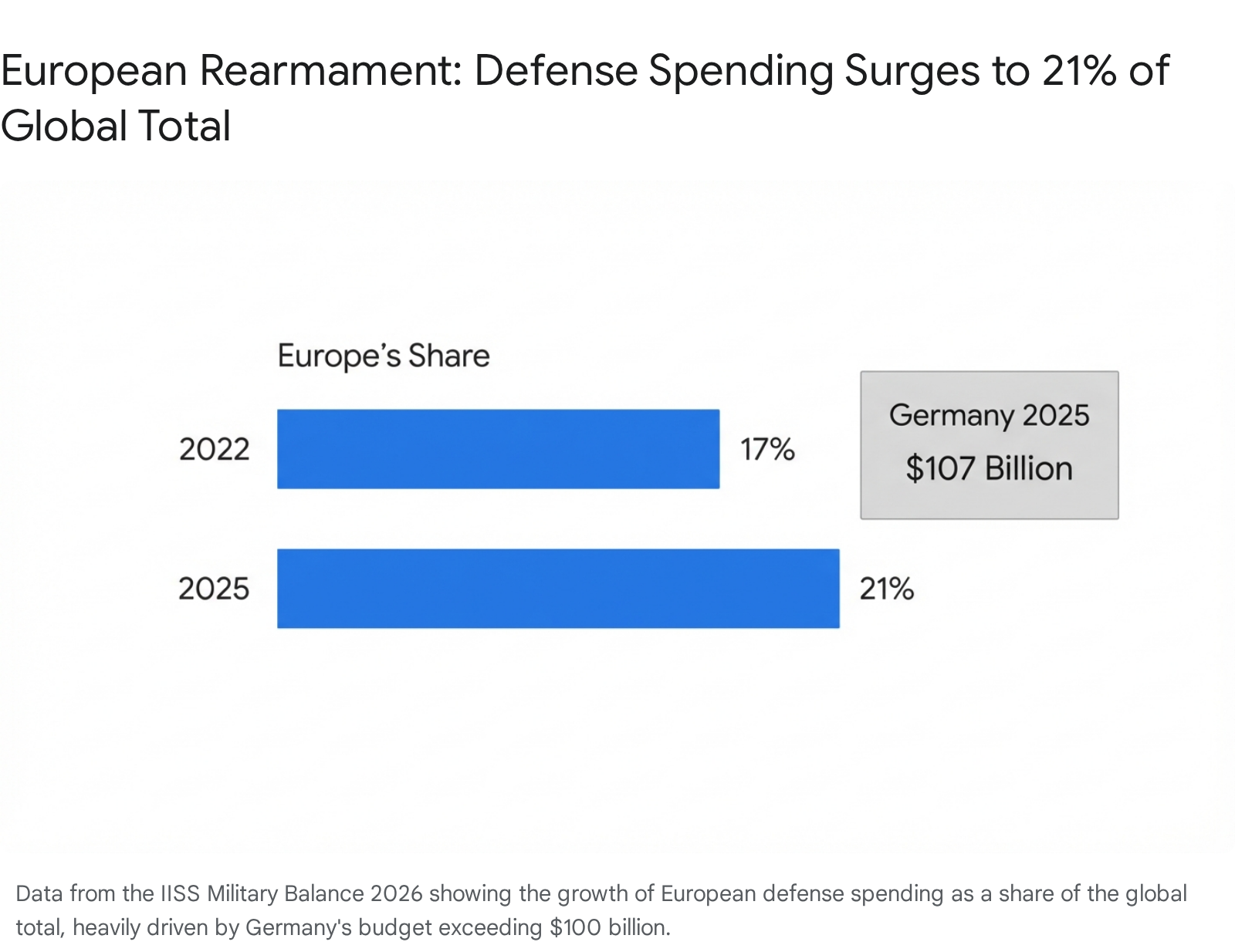
Europe has unequivocally emerged as the primary global driver of this fiscal uplift, defying expectations that spending would plateau after the initial shock of the 2022 Russian invasion of Ukraine. The European continent now accounts for over 21 percent of total global defense expenditure, a significant strategic shift from its 17 percent share in 2022.48 In 2025 alone, European defense spending grew by a remarkable 12.6 percent in real terms, reaching nearly 563 billion USD.49 NATO’s European member states are now spending an average of 2.16 percent of their GDP on defense, firmly establishing the 2 percent metric as a baseline rather than an aspirational ceiling.48
This continental rearmament is being disproportionately driven by the Federal Republic of Germany. Berlin’s national defense budget passed the historic and psychologically significant 100 billion USD threshold in 2025, reaching 107 billion USD (95 billion EUR), which constitutes an 18 percent real-term increase year-on-year.48 Germany alone has accounted for a full quarter of all European defense-spending growth over the past two years, cementing its position as the fourth-largest absolute defense spender globally.48 This massive capital influx is rapidly reshaping the broader European defense sector, characterized by a notable surge in venture capital investment directed toward agile defense start-ups focusing on autonomous systems, artificial intelligence, and dual-use capabilities.47
| Defense Spending Metric (IISS 2026 Report) | 2024 Value | 2025 Value | Real-Term Growth / Shift |
| Global Total Spending | $2.48 Trillion | $2.63 Trillion | +2.5% |
| Global Spending as % of GDP | 1.89% | 2.01% | +0.12 percentage points |
| European Total Spending | ~$463 Billion | ~$563 Billion | +12.6% |
| Europe’s Share of Global Spending | 17% (in 2022) | 21% | +4 percentage points |
| German Total Spending | $86 Billion | $107 Billion | +18% |
| Average European NATO Spending | N/A | 2.16% of GDP | Above 2.0% NATO benchmark |
3.2. Force Integration and NATO Exercises
To effectively operationalize this unprecedented funding surge and deter further Russian aggression, NATO is currently executing a highly complex series of multi-domain military exercises across the European continent. These exercises are explicitly designed to stress-test the newly formed Allied Reaction Force and enhance seamless interoperability among member states’ militaries.
The scope and scale of these deployments are significant, as detailed in the current operational schedule:
| Exercise Name | Operational Dates (2026) | Primary Host Nations / Regions | Strategic Objective |
| Steadfast Dart 26 | Jan 2 – Mar 18 | Germany (Lower Saxony) / Baltic Sea | Joint deployment exercise testing the operational deployment and rapid reinforcement of Allied Reaction Force elements under peacetime conditions.51 |
| Arctic Dolphin 26 | Feb 2 – Feb 24 | Norway (western fjords) | Naval and amphibious operations focused on securing critical northern maritime approaches.52 |
| Dynamic Manta 26 | Feb 23 – Mar 6 | Mediterranean Sea | Advanced submarine warfare and Anti-Submarine Warfare (ASW) war-fighting capabilities.51 |
| Cold Response 26 | Mar 9 – Mar 19 (field phase) | Norway, Finland, Sweden | Routine winter military exercise testing rapid deployment across the Atlantic and host nation reception capabilities.52 |
| Dynamic Front 26 | Early Feb | Romania (Cincu) | Artillery and fire support coordination along the eastern flank.52 |
Of particular note is Exercise Cold Response 26, operating in northern Norway as part of the broader Arctic Sentry vigilance activity.53 This exercise achieved a historic integration milestone in January and February 2026 by successfully establishing the first fully integrated combined joint logistics headquarters between the U.S. Marine Corps (specifically the 2nd Marine Logistics Group, commanded by Brig. Gen. Maura Hennigan) and the Norwegian Armed Forces.53 This Unified Combined Joint Logistics Support Group is vital for validating the capability to manage the rapid reception, staging, and onward movement of massive transatlantic reinforcements into the austere Arctic theater during a crisis scenario.53
Concurrently, during Steadfast Dart 26, NATO’s Allied Air Command executed highly targeted counter-UAS (Unmanned Aircraft System) training over the Baltics.54 Directed by the Combined Air Operations Centre in Uedem, this exercise integrated German and Italian Eurofighters, Spanish F-18s, and a Spanish A400M tanker with a Turkish Baykar Bayraktar TB3 drone.54 The objective was to refine integrated air and missile defense tactics against the exact profile of drone threats currently paralyzing the Ukrainian frontlines, ensuring Allied forces can effectively sanitize contested airspace.54
3.3. Internal Security and Counterterrorism Resiliency
While conventional military threats dominate the exterior flanks, the internal security apparatus of the European Union is undergoing rapid modernization to address an evolving, technologically sophisticated hybrid threat landscape. On February 26, the European Commission formally presented a comprehensive new counterterrorism agenda, acting as a flagship initiative under the broader ProtectEU European Internal Security Strategy.55
The driving force behind this new agenda is the rapid weaponization of emerging technologies by both state-sponsored actors and extremist organizations. The Commission explicitly identified the growing misuse of artificial intelligence, crypto-assets, commercially available drones, and 3D-printed weapons as primary vectors reshaping terrorist activity.55 Furthermore, the strategy addresses the alarming rise in the rapid online radicalization of minors orchestrated via social media algorithms.55
To counter these threats, the strategy focuses heavily on the “Anticipating Threats” pillar, proposing the creation of a centralized Single Intelligence Analysis Capacity (SIAC) at the EU level.55 This mechanism is designed to significantly augment Europol’s existing analytical support capacities, particularly by institutionalizing and expanding open-source intelligence (OSINT) capabilities and strengthening security research into emerging technologies via funding from Horizon Europe and the EU Internal Security Fund.55
Concurrently, the European regulatory landscape regarding critical infrastructure and cybersecurity is hardening. The Commission has proposed critical amendments to the NIS2 Directive (2022/2555).57 These amendments aim to simplify risk-management compliance for companies operating within the EU single market while simultaneously removing micro and small DNS service providers from the scope, and redesignating small mid-cap companies as “important” rather than “essential” entities.57 This regulatory adjustment is backed by proposed reinforced support and funding for the European Union Agency for Cybersecurity (ENISA), aimed at creating a more resilient, whole-of-society deterrence posture against state-sponsored cyber espionage and sabotage.57
4. Macroeconomics, Trade, and Energy Security
4.1. The EU-Mercosur Institutional Crisis
The geopolitical cohesion and internal political stability of the European Union suffered a severe, highly public blow this week over the deeply controversial EU-Mercosur Free Trade Agreement. The landmark deal, which has been under negotiation since 2000, aims to create a massive combined market of approximately 780 million people, covering nearly 25 percent of global GDP, by progressively eliminating tariffs between the EU and the South American Mercosur bloc (comprising Brazil, Argentina, Uruguay, Paraguay, and Bolivia).20 However, final ratification has been stalled for years due to profound environmental concerns and intense protectionist pressure from the European agricultural sector.
In a highly unorthodox, legally contentious, and politically divisive maneuver, European Commission President Ursula von der Leyen unilaterally decided to move forward with the “provisional application” of the agreement following its formal ratification by the legislatures of Argentina and Uruguay.19 Under this specialized procedural mechanism, the two trading blocs will formally exchange diplomatic communications known as “notes verbales” in early March. According to the established rules of the agreement, this would legally permit preferential trade and tariff reductions to commence on the first day of the second month following the exchange, potentially as early as May 2026.19
This executive decision has triggered an immediate and profound institutional crisis within Brussels. A majority of Members of the European Parliament (MEPs) had previously voted to refer the contested trade deal to the European Court of Justice (ECJ) to adjudicate on its fundamental legality, a move that effectively paused the standard democratic ratification process.19 By executing a provisional application, von der Leyen is taking a massive, calculated political gamble. Legal experts estimate that the ECJ could take up to two years to issue a final ruling.19 The Commission’s strategy relies on the assumption that over those 24 months, the agreement will deliver such significant, tangible macroeconomic growth and export benefits that it will become politically impossible for the European Parliament to retroactively vote to dismantle the deal once the ECJ ruling is finally delivered.19
The maneuver has fiercely and publicly divided the leaders of the EU’s largest member states. The German government, recognizing the immense potential benefits for its export-driven automotive and industrial manufacturing sectors, strongly backed the Commission’s decision. German Foreign Minister Johann Wadephul hailed the move as a “historic” achievement, declaring “This is the hour of Europe” and emphasizing the immediate need for increased prosperity and growth.19 Bernd Lange, the German Chair of the European Parliament’s Trade Committee, defended the bypass, arguing that the agreement provides vital “certainty, predictability and economic opportunities” in an era where international trade rules are routinely violated by competitors like the U.S. and China.19
Conversely, the governments of France and Italy, deeply protective of their politically powerful agricultural sectors, vehemently opposed the maneuver. French President Emmanuel Macron led the vocal opposition, publicly rebuking von der Leyen during a press conference. Macron characterized the move to provisionally apply the deal as a “bad surprise” and explicitly condemned it as “disrespectful” to the European Parliament and its democratic role in the approval process.19 French Agriculture Minister Annie Genevard echoed this sentiment, stating the decision was damaging to institutional cooperation.19 While some MEPs, such as Ireland’s Maria Walsh, cynically dismissed the original ECJ referral as a mere “delaying tactic” and a “political gesture dressed up as strategy” that failed to protect domestic farmers, the fundamental breach of trust between the Commission, the Parliament, and key member states remains severe.19
4.2. Agricultural Unrest and Supply Chain Disruptions
The political fallout from the Mercosur provisional application decision did not remain confined to diplomatic statements; it materialized immediately and violently on the streets of Europe’s major capitals. European farmers’ unions-who argue that the free trade deal will flood the European market with cheap South American beef, poultry, and grain produced under significantly lower environmental and labor standards-view themselves as unacceptable “collateral damage” sacrificed for the benefit of industrial export interests.19
Between February 22 and 28, massive, highly organized agricultural protests escalated across the continent. In Brussels, the administrative heart of the EU, thousands of farmers driving heavy tractors successfully blockaded critical arterial roads, set off pyrotechnics, and targeted EU institutional offices, resulting in severe clashes with riot police who were forced to deploy tear gas and water cannons to disperse the crowds.20
Concurrently, the powerful French agricultural union, the FNSEA, orchestrated a nationwide campaign of disruption. French farmers erected massive tractor roadblocks across major national highways and critical roundabouts, systematically dumped tons of manure at government prefectures, and targeted local EU administrative offices.22 While EU leaders, including Italian Prime Minister Giorgia Meloni, attempted to mitigate the political damage by securing a nominal delay in the final ceremonial signatures until January-requesting time to “reassure domestic farmers”-the reality of the provisional application mechanism ensures that the structural crisis regarding European agricultural sovereignty and market protectionism remains entirely unresolved.20
4.3. Macroeconomic Baseline: Disinflation Trends and Equity Markets
Before the massive geopolitical and military shocks of the weekend, the Eurozone economy was exhibiting signs of a paradoxical, yet welcome, stabilization. According to the latest flash estimates released by Eurostat, the Euro area annual headline inflation rate dropped to 1.7 percent in January 2026, down from 2.0 percent in December 2025.24 This represents the lowest inflation rate observed within the currency bloc since September 2024, placing it comfortably below the European Central Bank’s (ECB) stated 2.0 percent medium-term target.23
This disinflationary trend was heavily driven by a sharp 4.0 percent year-on-year contraction in energy prices, compounding a 1.9 percent decline observed in the previous month.24 Furthermore, core inflation-a critical metric that strips out the volatile energy, food, alcohol, and tobacco sectors to reveal underlying price pressures-also cooled significantly to 2.2 percent, marking its lowest point since October 2021.24
The inflation moderation was generally broad-based across the bloc’s largest national economies, though slight divergences remain, as detailed in the January 2026 data:
| Eurozone Member State / Component | January 2026 Annual Inflation Rate | December 2025 Annual Inflation Rate | Trend Direction |
| Euro Area (Overall) | 1.7% | 2.0% | Decreasing |
| Euro Area (Core Inflation) | 2.2% | 2.3% (est) | Decreasing |
| Germany | 2.1% | 2.0% | Slightly Increasing |
| France | 1.0% (1.1% harmonised) | 0.7% | Increasing (base effect driven) |
| Spain | 2.4% | 3.0% | Decreasing |
| Italy | 1.0% | 1.2% | Decreasing |
| Component: Services | 3.2% | 3.4% | Decreasing |
| Component: Energy | -4.0% | -1.9% | Sharp Decrease |
(Note: As of February 2026, Eurostat implemented methodological changes to the Harmonised Index of Consumer Prices (HICP), aligning with the UN COICOP 2018 classification, updating the index reference period to 2025=100, and fully integrating Bulgaria into the EA21 aggregate series).60
This period of easing price pressures occurred alongside a notable strengthening of the euro, which climbed above $1.20 at the end of the month, its highest valuation against the U.S. dollar in over four years.24 Gross Domestic Product (GDP) for the fourth quarter of 2025 also registered a modest but positive growth rate of 0.3 percent for both the euro area and the broader EU, avoiding a technical recession.63
Driven by these stabilizing figures and strong corporate earnings reports, European equity markets experienced a highly bullish week. The UK’s FTSE 100 index hit multiple record intra-day highs, closing the week at a record 10,910.55 points, drawing ever closer to the psychological 11,000 mark.64 In mainland Europe, despite slight end-of-week cooling, the German DAX and French CAC 40 remained robust, supported by strong corporate performances from entities like the London Stock Exchange Group (LSEG), Rightmove, and International Consolidated Airlines Group (IAG), the latter reporting a 26 percent surge in pretax profit to 4.51 billion EUR.64
However, significant underlying vulnerabilities persist beneath the surface. European consumer confidence remains entrenched in negative territory at -11.7 points for the EU and -12.2 points for the euro area.67 This reflects deep structural anxieties regarding purchasing power, as consumers’ perceived inflation remains substantially higher than the official data suggests, prompting elevated savings rates and constrained domestic consumption.23 While economists had broadly anticipated that the ECB would hold interest rates steady at their March 19 meeting due to these stabilizing figures, the sudden, violent explosion of conflict in the Middle East has introduced massive, immediate inflationary risk to the forecast.23
4.4. The Strait of Hormuz Shock: Energy Market Vulnerability
The massive joint U.S.-Israeli military strike on Iran on the morning of February 28 instantly shattered the Eurozone’s favorable energy price trajectory and injected a severe dose of geopolitical volatility into global markets. The immediate market reaction was swift: Brent crude oil surged approximately 3 percent on the final trading day of the month to close at 73.12 USD per barrel, marking its highest level since June 2025.26 West Texas Intermediate (WTI) crude mirrored this movement, gaining 2.7 percent to trade near 67.22 USD per barrel.69
For the European economy, the primary and most devastating threat vector is not the physical destruction of Iranian domestic oil infrastructure-which primarily services East Asian markets-but rather the potential asymmetric disruption of maritime traffic through the Strait of Hormuz.6 As a retaliatory measure, the Iranian regime possesses the well-documented capability to harass, mine, or effectively blockade this narrow, 33-kilometer-wide geographic chokepoint.5
The strategic importance of this waterway cannot be overstated. Approximately 19 to 20 million barrels of liquid fuel transit the Strait of Hormuz daily, alongside nearly one-fifth of the entire world’s liquefied natural gas (LNG) supply, which predominantly originates from Qatar.5 Given Europe’s heavy pivot toward seaborne LNG following the severing of Russian pipeline gas in 2022, the continent is exceptionally vulnerable to disruptions in Qatari exports.
Energy analysts assess that the risks associated with the Iranian conflict are highly ‘asymmetric’ for the oil market, presenting significantly more upside price risk than downside potential.6 Even a brief, localized disruption or a severe spike in maritime insurance premiums for tankers navigating the Strait could rapidly push Brent crude prices toward 80 USD per barrel.6 In a worst-case scenario involving a prolonged military closure or severe mining of the waterway, geopolitical risk analysts warn that crude oil prices could experience a violent spike toward 150 USD per barrel.69 Such an eventuality would instantly transmit a massive inflationary shock throughout the entire European economy, immediately erasing the ECB’s hard-won disinflationary progress, drastically inflating industrial production and transport costs, and severely dampening consumer sentiment and economic growth projections for the remainder of 2026.69
5. Strategic Outlook and Intelligence Forecast
The unprecedented convergence of kinetic military action, hybrid grey-zone operations, and severe internal political fractures during the final week of February 2026 has profoundly degraded the strategic outlook for the European continent across multiple interconnected domains.
In the immediate term (1-4 weeks), the highest probability threat to European stability is the economic and security spillover originating from the execution of “Operation Epic Fury.” European capitals and intelligence services must urgently prepare for asymmetric, secondary Iranian retaliation. While the primary Iranian response has targeted U.S. installations, the risk of proxy harassment of European-flagged commercial shipping in the Red Sea, the Gulf of Aden, and the Persian Gulf is exceptionally high. Furthermore, state-sponsored cyberattacks against European critical infrastructure, financial institutions, and energy grids cannot be ruled out as Tehran seeks to punish allies of the United States. Macroeconomically, the European Central Bank will likely be forced to rapidly pivot its forecasting models to account for a sustained, elevated geopolitical risk premium embedded in crude oil and LNG prices. If the Strait of Hormuz is even partially restricted, the resulting energy shock will threaten a severe resurgence of imported inflation, potentially forcing the ECB to reconsider its anticipated interest rate trajectory.
In the near term (1-3 months), the operational focus will remain intensely fixated on the Eastern Flank. The Russian military is methodically positioning itself to initiate high-intensity ground assaults against the Donetsk Fortress Belt. If the sustained, drone-heavy Battlefield Air Interdiction campaign successfully starves Ukrainian defenders and degrades logistics along the H-20 highway, Russian forces may achieve localized tactical breakthroughs. The fall of any of the four anchor cities-Slovyansk, Kramatorsk, Druzhkivka, or Kostyantynivka-would threaten the total collapse of the primary Ukrainian defensive line in the Donbas. This imminent operational crisis will generate intense, immediate political pressure on European NATO members to drastically expedite the delivery of highly scarce short-range air defense systems, electronic warfare countermeasures, and artillery munitions, further straining a continental defense-industrial base that is already operating at maximum capacity.
Internally, the European Union’s institutional cohesion is deeply and perhaps irrevocably compromised. The unilateral executive action taken by the Commission regarding the provisional application of the Mercosur agreement has deeply alienated key member states, particularly France and Italy, and aggressively bypassed the oversight function of the European Parliament. As highly organized agricultural protests continue to disrupt critical supply chains and paralyze urban centers across the continent, domestic political polarization will only increase, empowering populist factions ahead of critical national elections.
Concurrently, the severe diplomatic friction with the United States regarding the status of Greenland, coupled with verified, unprecedented intelligence warnings of hybrid electoral interference in Denmark orchestrated by both Moscow and Washington, underscores a stark new reality. Europe is now forced to navigate an incredibly hostile geopolitical environment characterized not only by overt Russian military aggression on its borders but also by increasingly transactional, unpredictable, and potentially destabilizing pressure from its primary transatlantic ally. In this volatile matrix, the pursuit of genuine European strategic autonomy-in defense procurement, energy security, and diplomatic leverage-is no longer merely a theoretical policy objective debated in Brussels, but an absolute, immediate operational necessity for the survival of the bloc’s security architecture.
Please share the link on Facebook, Forums, with colleagues, etc. Your support is much appreciated and if you have any feedback, please email us in**@*********ps.com. If you’d like to request a report or order a reprint, please click here for the corresponding page to open in new tab.
Sources Used
- US and Israel launch strikes on Iran: what we know so far, accessed February 28, 2026, https://www.theguardian.com/world/2026/feb/28/us-israel-launch-strikes-attack-iran-what-we-know-so-far-latest
- Live updates: U.S. and Israel launch attack on Iran as Trump calls for regime change, accessed February 28, 2026, https://www.washingtonpost.com/world/2026/02/28/israel-strikes-iran-live-updates/
- Iran Turned to Russia, China for Missiles After 12-Day War – Defense Security Monitor, accessed February 28, 2026, https://dsm.forecastinternational.com/2026/02/27/iran-turned-to-russia-china-for-missiles-after-12-day-war/
- Iran strikes Israel, UAE, Qatar, Bahrain, and Kuwait following US-Israel attack, accessed February 28, 2026, https://www.middleeasteye.net/news/us-israel-strike-iran-joint-attack
- How strikes on Iran put focus on the Strait of Hormuz, accessed February 28, 2026, https://www.straitstimes.com/world/middle-east/how-strikes-on-iran-put-focus-on-the-strait-of-hormuz?ref=latest-headlines
- Will the resumption of conflict in Iran push Brent crude oil prices to test $80 again?, accessed February 28, 2026, https://www.moomoo.com/news/post/66187583/will-the-resumption-of-conflict-in-iran-push-brent-crude
- UAE intercepts several Iranian missiles, state news agency says, accessed February 28, 2026, https://iranintl.com/en/202602283447
- France slams ‘ridiculous provocation’ as Sweden confirms Russian drone buzzed French aircraft carrier, accessed February 28, 2026, https://www.malaymail.com/news/world/2026/02/28/france-slams-ridiculous-provocation-as-sweden-confirms-russian-drone-buzzed-french-aircraft-carrier/210722
- Swedish Navy intercepts suspected Russian drone nearing French aircraft carrier, accessed February 28, 2026, https://www.defensenews.com/global/europe/2026/02/27/swedish-navy-intercepts-suspected-russian-drone-nearing-french-aircraft-carrier/
- Sweden says it intercepted Russian drone during visit by French aircraft carrier, accessed February 28, 2026, https://community.triblive.com/news/3991328
- Danish intelligence warns of threat of Russian and US interference in general elections in March, accessed February 28, 2026, https://unn.ua/en/news/danish-intelligence-warns-of-threat-of-russian-and-us-interference-in-general-elections-in-march
- President Trump and Greenland: Frequently asked questions – House of Commons Library, accessed February 28, 2026, https://commonslibrary.parliament.uk/research-briefings/cbp-10472/
- Russia may interfere in Danish election, exploiting chaos sewn by US, spies warn, accessed February 28, 2026, https://www.theguardian.com/world/2026/feb/28/denmark-election-interference-russia-chaos-us-greenland-intelligence-agencies
- Russian Offensive Campaign Assessment, February 27, 2026, accessed February 28, 2026, https://understandingwar.org/research/russia-ukraine/russian-offensive-campaign-assessment-february-27-2026/
- Russian Offensive Campaign Assessment, February 26, 2026 – Institute for the Study of War, accessed February 28, 2026, https://understandingwar.org/research/russia-ukraine/russian-offensive-campaign-assessment-february-26-2026/
- Russia’s Quest to Intensify The Theater-Wide Battlefield Air Interdiction Campaign Against Ukraine’s Logistics, accessed February 28, 2026, https://understandingwar.org/research/russia-ukraine/russias-quest-to-intensify-the-theater-wide-battlefield-air-interdiction-campaign-against-ukraines-logistics/
- The Russians are advancing towards Sloviansk and Kramatorsk. Day 1462 of the war, accessed February 28, 2026, https://www.osw.waw.pl/en/publikacje/analyses/2026-02-24/russians-are-advancing-towards-sloviansk-and-kramatorsk-day-1462-war
- The Donbas ‘fortress belt’: why does it matter? – Newspaper – DAWN.COM, accessed February 28, 2026, https://www.dawn.com/news/1934973
- Von der Leyen pushes through Mercosur deal, splitting European …, accessed February 28, 2026, https://www.theguardian.com/world/live/2026/feb/27/russia-europe-nuclear-plant-iaea-southern-ukraine-latest-news-updates
- EU Delays Mercosur Deal as Farmers’ Protests Shake Brussels – Materia Rinnovabile, accessed February 28, 2026, https://www.renewablematter.eu/en/eu-delays-mercosur-deal-as-farmers-protests-shake-brussels
- EU delays massive free-trade deal with South American bloc Mercosur amid farmer protests, accessed February 28, 2026, https://www.pbs.org/newshour/world/eu-delays-massive-free-trade-deal-with-south-american-bloc-mercosur-amid-farmer-protests
- Thousands of Farmers March Against EU-Mercosur trade deal | Paris Protest – YouTube, accessed February 28, 2026, https://www.youtube.com/watch?v=nC6HyRA2SG4
- Eurozone Inflation: What to Expect from February’s CPI Data, accessed February 28, 2026, https://global.morningstar.com/en-gb/economy/eurozone-inflation-what-expect-februarys-cpi-data
- Euro Area Inflation Rate – Trading Economics, accessed February 28, 2026, https://tradingeconomics.com/euro-area/inflation-cpi
- 2026 Israeli–United States strikes on Iran – Wikipedia, accessed February 28, 2026, https://en.wikipedia.org/wiki/2026_Israeli%E2%80%93United_States_strikes_on_Iran
- US, Israel launch major attack on Iran, accessed February 28, 2026, https://www.argusmedia.com/en/news-and-insights/latest-market-news/2794460-us-israel-launch-major-attack-on-iran
- Trump ‘not happy’ with Iran situation and says military force is still an option, accessed February 28, 2026, https://www.theguardian.com/world/2026/feb/27/us-urges-citizens-leave-israel-threat-strike-iran
- Marco Rubio orders US officials to stop commentary that could strain Iran talks, accessed February 28, 2026, https://www.theguardian.com/us-news/2026/feb/27/marco-rubio-iran-talks-mike-huckabee
- Statement by the Ministers of Foreign Affairs of France, Germany, and the United Kingdom, together with the High Representative of the European Union | EEAS, accessed February 28, 2026, https://www.eeas.europa.eu/eeas/statement-ministers-foreign-affairs-france-germany-and-united-kingdom-together-high-representative_en
- US and Israel attack Iran: What we know so far, accessed February 28, 2026, https://www.aljazeera.com/news/2026/2/28/us-and-israel-attack-iran-what-we-know-so-far
- US and Israel attack Iran as Trump says ‘major combat operations’ under way – live, accessed February 28, 2026, https://www.theguardian.com/world/live/2026/feb/28/israel-attacks-iran-as-blasts-heard-in-tehran-live-updates
- US-Israel Attacks Iran LIVE Updates: Iran Vows “Decisive Response” After Israel-US Strikes, accessed February 28, 2026, https://www.ndtv.com/world-news/iran-us-tensions-live-updates-explosion-rocks-iran-amid-heightened-nuclear-tensions-with-us-iran-israel-tensions-tehran-tel-aviv-tensions-11148388
- Live Updates: U.S. and Israel attack Iran, with Trump confirming “major combat operations”, accessed February 28, 2026, https://www.cbsnews.com/live-updates/israel-us-attack-iran-trump-says-major-combat-operations/
- UK should resist being dragged into war after Iran strikes – Labour MP, accessed February 28, 2026, https://global.morningstar.com/en-gb/news/alliance-news/1772272756075474400/uk-should-resist-being-dragged-into-war-after-iran-strikes-labour-mp
- Sweden says it intercepted Russian drone during visit by French aircraft carrier, accessed February 28, 2026, https://apnews.com/article/sweden-france-aircraft-carrier-drone-russia-c8905513cb9ade27176a88ef642411b7
- Sweden confirms drone that approached French aircraft carrier was Russian – Ukrinform, accessed February 28, 2026, https://www.ukrinform.net/rubric-polytics/4096419-sweden-confirms-drone-that-approached-french-aircraft-carrier-was-russian.html
- Sweden confirms Russian drone intercepted near French aircraft carrier, accessed February 28, 2026, https://www.aljazeera.com/news/2026/2/28/sweden-confirms-russian-drone-intercepted-near-french-aircraft-carrier
- Greenland crisis – Wikipedia, accessed February 28, 2026, https://en.wikipedia.org/wiki/Greenland_crisis
- Trump & Greenland: Is There Logic in the Chaos? | The Arctic Institute, accessed February 28, 2026, https://www.thearcticinstitute.org/trump-greenland-logic-chaos/
- Dispatch Politics Roundup: Reflections on the Union, accessed February 28, 2026, https://thedispatch.com/newsletter/dispatch-politics/state-of-the-union-rubio-trump-tariffs-patel/?utm_source=google-news&utm_medium=syndication
- What follows President Trump’s decision to step back from threatening to use force in Greenland? | Brookings, accessed February 28, 2026, https://www.brookings.edu/articles/what-follows-president-trump-decision-to-step-back-from-threatening-to-use-force-in-greenland/
- The Critical Importance of Ukraine’s Fortress Belt in Donetsk Oblast | ISW, accessed February 28, 2026, https://understandingwar.org/research/russia-ukraine/the-critical-importance-of-ukraines-fortress-belt-in-donetsk-oblast/
- Why Putin wants Donetsk | The Spectator Australia, accessed February 28, 2026, https://www.spectator.com.au/2025/08/why-putin-wants-donetsk/
- Russian Offensive Campaign Assessment, February 25, 2026 – Institute for the Study of War, accessed February 28, 2026, https://understandingwar.org/research/russia-ukraine/russian-offensive-campaign-assessment-february-25-2026/
- The Military Balance 2026: Fortifying NATO’s eastern flank, accessed February 28, 2026, https://www.iiss.org/publications/the-military-balance/2026/the-military-balance-2026/fortifying-natos-eastern-flank/
- The good, the bad and the ugly – Inside Europe’s race to supplant US defense enablers, accessed February 28, 2026, https://www.defensenews.com/global/europe/2026/02/27/the-good-the-bad-and-the-ugly-inside-europes-race-to-supplant-us-defense-enablers/
- The Military Balance 2026: Global defence spending, accessed February 28, 2026, https://www.iiss.org/publications/the-military-balance/2026/the-military-balance-2026/global-defence-spending/
- Europe ramps up defense spending to 21% of global total, led by Berlin: Report, accessed February 28, 2026, https://breakingdefense.com/2026/02/europe-ramps-up-defense-spending-to-21-of-global-total-led-by-berlin-report/
- Global defence spending continues to grow amid geopolitical uncertainty, accessed February 28, 2026, https://www.iiss.org/online-analysis/military-balance/2026/02/global-defence-spending-continues-to-grow-amid-geopolitical-uncertainty/
- EU Member States’ defence budgets | Epthinktank | European Parliament, accessed February 28, 2026, https://epthinktank.eu/2025/05/07/eu-member-states-defence-budgets/
- NATO Exercises and Activities, accessed February 28, 2026, https://shape.nato.int/nato-exercises
- NATO Exercises 2026: The Complete Guide to Allied Readiness, accessed February 28, 2026, https://www.grosswald.org/nato-exercises-2026/
- U.S. and Norway establish first fully integrated joint logistics command for NATO Exercise Cold Response 26, accessed February 28, 2026, https://defence-industry.eu/u-s-and-norway-establish-first-fully-integrated-joint-logistics-command-for-nato-exercise-cold-response-26/
- NATO conducts counter-drone training mission over Baltics to reinforce Eastern Flank air defence and deterrence, accessed February 28, 2026, https://defence-industry.eu/nato-conducts-counter-drone-training-mission-over-baltics-to-reinforce-eastern-flank-air-defence-and-deterrence/
- ProtectEU: Commission presents new counterterrorism agenda – Migration and Home Affairs, accessed February 28, 2026, https://home-affairs.ec.europa.eu/news/protecteu-commission-presents-new-counterterrorism-agenda-2026-02-26_en
- Commission proposes new measures to prevent and counter terrorism, accessed February 28, 2026, https://commission.europa.eu/news-and-media/news/commission-proposes-new-measures-prevent-and-counter-terrorism-2026-02-26_en
- Cyber security | UK Regulatory Outlook February 2026 – Osborne Clarke, accessed February 28, 2026, https://www.osborneclarke.com/insights/regulatory-outlook-february-2026-cyber-security
- Europe Knows It’s Under Attack. So Why Won’t It Respond?, accessed February 28, 2026, https://moderndiplomacy.eu/2026/02/28/europe-knows-its-under-attack-so-why-wont-it-respond/
- France farmers protest against low incomes and EU-Mercosur trade deal – JURIST – News, accessed February 28, 2026, https://www.jurist.org/news/2026/01/france-farmers-protest-against-low-incomes-and-eu-mercosur-trade-deal/
- Euro area annual inflation down to 1.7%, accessed February 28, 2026, https://ec.europa.eu/eurostat/web/products-euro-indicators/w/2-04022026-ap
- Eurozone Inflation Falls to 1.7% in January 2026 | Core Rate at 2021 Low – News and Statistics, accessed February 28, 2026, https://www.indexbox.io/blog/euro-area-inflation-drops-to-17-in-january-lowest-since-2024/
- Annual inflation down to 1.9% in the euro area – European Commission, accessed February 28, 2026, https://ec.europa.eu/eurostat/web/products-euro-indicators/w/2-19012026-ap
- EU economic press review, 2 February 2026: Monetary stabilisation and industrial challenges – L’Europe à Contre-Courant, accessed February 28, 2026, https://europeacontrecourant.eu/en/eu-economic-press-review-2-february-2026/
- LONDON MARKET MIDDAY: FTSE 100 draws closer to 11,000 mark, accessed February 28, 2026, https://global.morningstar.com/en-gb/news/alliance-news/1772194121423046800/london-market-midday-ftse-100-draws-closer-to-11000-mark
- Late market roundup: Stocks close up with new FTSE 100 record, accessed February 28, 2026, https://www.ajbell.co.uk/news/articles/late-market-roundup-stocks-close-new-ftse-100-record
- European stocks mixed as corporate earnings continue; inflation data in focus, accessed February 28, 2026, https://www.investing.com/news/stock-market-news/european-stocks-steady-as-corporate-earnings-continue-inflation-data-in-focus-4530540
- 19 February 2026 – Economy and Finance – European Union, accessed February 28, 2026, https://economy-finance.ec.europa.eu/document/download/e65fe2dc-b81c-4888-8723-77d5de9f9f90_en?filename=Flash_consumer_2026_02_en.pdf
- European Economic Outlook – February 2026 – KPMG agentic corporate services, accessed February 28, 2026, https://assets.kpmg.com/content/dam/kpmgsites/uk/pdf/2026/02/eu-outlook-feb-2026.pdf
- Israel strike risk heightens oil price concerns amid nuclear deadlock, accessed February 28, 2026, https://www.aa.com.tr/en/energy/energy-diplomacy/israel-strike-risk-heightens-oil-price-concerns-amid-nuclear-deadlock/55019
- When Commodities Meets War: What a US Strike on Iran Could Mean for Markets, accessed February 28, 2026, https://www.share-talk.com/when-commodities-meets-war-what-a-us-strike-on-iran-could-mean-for-markets-2/