Executive Summary
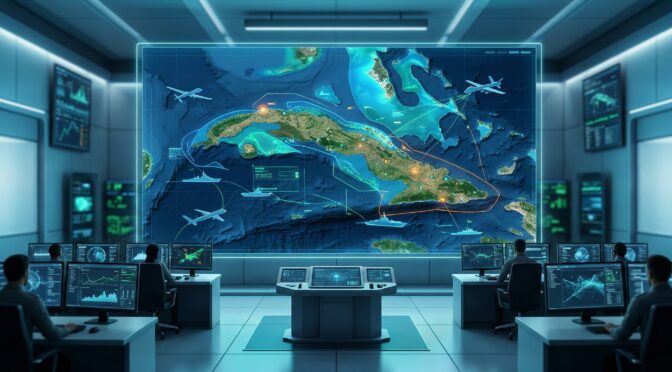
The week ending February 28, 2026, represents a historic and highly volatile inflection point in the multidimensional crisis currently paralyzing the Republic of Cuba. Intelligence assessments, diplomatic cables, and on-the-ground socioeconomic indicators definitively demonstrate that the Cuban state is undergoing a systemic and structural collapse of unprecedented magnitude, surpassing the severe deprivations of the 1990s Special Period. This rapid deterioration is the direct consequence of an engineered convergence of external geopolitical coercion orchestrated by the United States, a catastrophic domestic energy deficit, the rapid evaporation of state capacity across all critical public sectors, and a demographic hemorrhage that has permanently crippled the nation’s human capital.
At the geopolitical echelon, the United States has successfully implemented a comprehensive hemispheric energy blockade, fundamentally altering the survival calculus of the Cuban regime. Following the capture of Venezuelan President Nicolás Maduro in January 2026, the subsequent cessation of Venezuelan oil exports, and the forced compliance of Mexico to halt its own crude shipments under the threat of aggressive U.S. tariffs, Havana has been effectively severed from its primary petro-lifelines. In tandem with these punitive economic measures, the U.S. administration has signaled an unconventional diplomatic off-ramp. This strategy has been characterized publicly by President Donald Trump as a potential “friendly takeover” and is being executed privately through high-level backchannel negotiations spearheaded by Secretary of State Marco Rubio and Raúl Guillermo Rodríguez Castro, a highly influential figure within the Cuban military elite.
Domestically, the systemic withdrawal of imported hydrocarbons has plunged the island into darkness, with the national electrical grid operating at a fraction of its baseline requirements. The implementation of severe energy rationing protocols, colloquially referred to by the regime as “Option Zero,” has triggered cascading failures in public transportation, food distribution networks, water sanitation facilities, and the healthcare apparatus. Tertiary care hospitals are resorting to triage under cellular phone illumination, while citizens engage in desperate daily subsistence strategies amidst soaring hyperinflation and widespread, acute food insecurity. The macroeconomic landscape is defined by a functionally worthless sovereign currency, a paralyzed formal economy, and an extreme poverty rate that now engulfs approximately 89 percent of the remaining population.
Furthermore, internal security dynamics remain highly volatile and prone to sudden escalation. The desperation of the domestic populace is increasingly mirrored by a mobilized and militant diaspora, evidenced by a violent maritime incursion off the northern coast of Villa Clara on February 25. This incident, involving heavily armed anti-government exiles originating from Florida, resulted in a lethal firefight with Cuban Border Guard Troops. While the Cuban state security apparatus successfully repelled the speedboat infiltration, the incident underscores the growing risk of asymmetric paramilitary actions and the potential for a broader armed confrontation across the Straits of Florida. Meanwhile, traditional geopolitical allies such as the Russian Federation and the People’s Republic of China have offered rhetorical solidarity and calibrated material assistance. However, both nations face insurmountable logistical, economic, and geopolitical hurdles in rapidly replacing the lost hemispheric support. The current trajectory indicates that without an immediate restoration of mass energy imports, a significant diplomatic breakthrough with Washington, or an unforeseen internal realignment, the Cuban state apparatus faces an imminent risk of total operational paralysis and an uncontainable humanitarian catastrophe.
1. Geopolitical Landscape and the U.S. “Friendly Takeover” Proposition
1.1 The Architecture of the Maximum Pressure Campaign
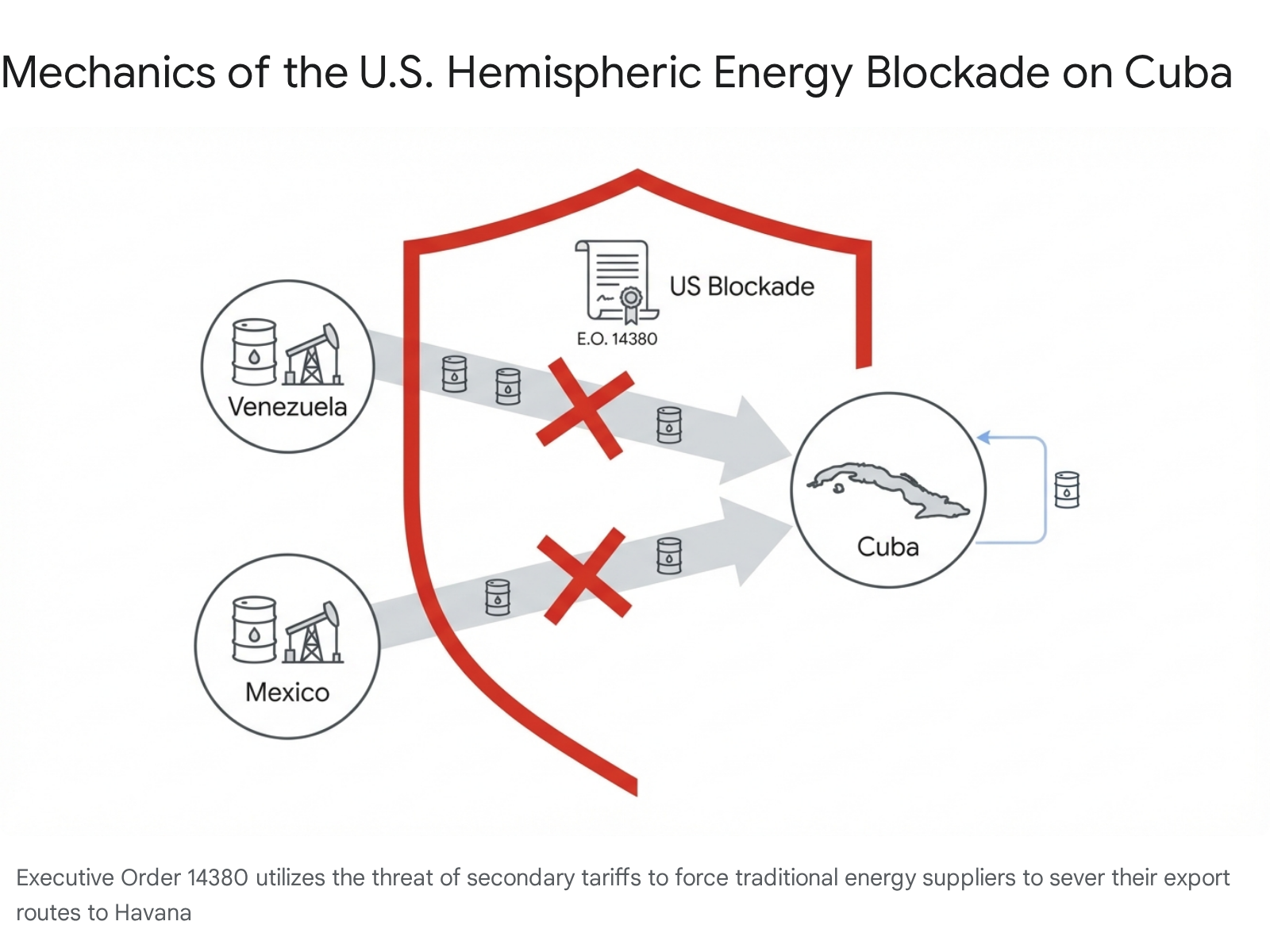
The geopolitical posture of the United States toward the Republic of Cuba has evolved from historical containment into an active, aggressive strategy of regime displacement, characterized by maximal economic strangulation coupled with an unprecedented diplomatic proposition. The foundational architecture of this current U.S. strategy was formalized through Executive Order 14380, signed on January 29, 2026, titled “Addressing Threats to the United States by the Government of Cuba”.1 This sweeping executive action declared a formal national emergency, classifying the Cuban government as an “unusual and extraordinary threat” to the national security and foreign policy of the United States.1
The justification for this drastic escalation relies heavily on Havana’s strategic alignment with, and hosting of, hostile state and non-state actors. The executive order explicitly names the Russian Federation, the People’s Republic of China (PRC), the Government of Iran, Hamas, and Hezbollah.1 The administration cites the presence of Russia’s largest overseas signals intelligence facility—tasked with intercepting sensitive U.S. communications—and deepening Sino-Cuban defense and intelligence cooperation as direct, proximal threats requiring immediate neutralization.1 Furthermore, a concurrent National Security Presidential Memorandum (NSPM) was issued to definitively reverse previous administrations’ policies that had eased pressure on the regime. This NSPM expressly prohibits direct or indirect financial transactions with entities controlled by the Cuban military and its sprawling economic conglomerate, Grupo de Administración Empresarial S.A. (GAESA), enforces strict statutory bans on U.S. tourism, mandates rigorous audits of travel-related transactions, and permanently terminates the “Wet Foot, Dry Foot” migration policy.3
1.2 The “Friendly Takeover” Rhetoric and High-Level Backchannels
Capitalizing on the acute vulnerabilities generated by these economic measures, the U.S. administration has introduced a highly unconventional diplomatic maneuver. On February 27, 2026, while departing the White House for a campaign event in Texas, President Donald Trump publicly suggested that the United States could execute a “friendly takeover” of Cuba.4 Framing the potential transition of the sovereign Cuban state in the terminology of corporate acquisitions, the President stated that the Cuban government is in “a big deal of trouble” and that high-level communications are actively underway.4 He noted that the island currently possesses “no money” and “no anything right now,” but suggested that a takeover could be a “very positive” development for the Cuban exile community living in the U.S., many of whom desire to return and assist in rebuilding the nation.4
The mechanics of this proposed transition are reportedly being managed through discrete, high-level backchannel negotiations. Intelligence and diplomatic reporting indicate that Secretary of State Marco Rubio, functioning as the primary architect of this policy, has engaged in direct talks with Raúl Guillermo Rodríguez Castro.4 Rodríguez Castro, the grandson of 94-year-old former leader Raúl Castro, holds no formal civilian government title but is widely viewed as a pivotal power broker, intimately connected to the military and representing a pragmatic, business-oriented faction within the regime that recognizes the failure of orthodox communism.7
These negotiations notably bypass the official diplomatic channels of Cuban President Miguel Díaz-Canel, a deliberate U.S. strategy to engage directly with the loci of actual coercive and economic power.4 A significant engagement occurred on the sidelines of the 50th regular meeting of the Caribbean Community (CARICOM) in Basseterre, Saint Kitts and Nevis, during the week of February 22.4 According to Caribbean diplomatic sources, Secretary Rubio communicated privately that talks with the Cuban leadership were “very advanced,” centered on the gradual easing of U.S. sanctions in exchange for the month-by-month implementation of structural reforms by Havana, aiming for a phased transition that neutralizes top leadership without inducing anarchic state failure.14 While the Cuban Permanent Representative to the UN, Ernesto Soberón Guzmán, publicly dismissed these reports as “speculation,” the regime has not issued a categorical denial of informal contacts with Rodríguez Castro.7
1.3 Legal Hurdles and the Supreme Court Complication
Despite the aggressive posturing, the U.S. strategy faces significant domestic and international legal constraints. The U.S. embargo, codified into permanent law by the 1992 Cuban Democracy Act and the 1996 Cuban Liberty and Democratic Solidarity (Helms-Burton) Act, places severe statutory limits on what concessions the U.S. president can unilaterally guarantee to Havana without congressional approval.15 Furthermore, the extraterritorial application of the energy blockade suffered a critical legal setback in late February. On February 20, 2026, the U.S. Supreme Court struck down the administration’s sweeping tariffs on nearly all U.S. trading partners.16
Crucially, this ruling directly undermines the enforcement mechanism of Executive Order 14380, declaring it illegal for the United States to utilize the International Emergency Economic Powers Act (IEEPA) and the National Emergencies Act (NEA) to impose punitive tariffs on third-party nations solely for engaging in lawful energy trade with Cuba.1 United Nations human rights experts, including the UN Resident Coordinator in Havana, Francisco Pichón, seized upon this ruling, noting that threats against countries providing oil to Cuba have been legally diminished, and condemned the original policy as an extreme form of unilateral economic coercion that constitutes collective punishment.5 This judicial intervention provides a theoretical opening for allied nations to resume shipments, though the chilling effect of U.S. displeasure continues to severely suppress the maritime logistics market.
2. The Hemispheric Energy Blockade and Petro-Lifeline Collapse
2.1 The Severance of the Venezuelan Artery
The efficacy of the U.S. maximalist strategy is entirely dependent on the neutralization of Cuba’s two primary regional energy benefactors: Venezuela and Mexico. For over a quarter-century, the Cuban economy relied on a symbiotic, non-market barter arrangement with the Venezuelan state, exchanging thousands of medical professionals, educators, and intelligence personnel for millions of barrels of crude oil and refined petroleum products.19 However, following the U.S. military operation in Caracas in January 2026 that resulted in the capture of Venezuelan President Nicolás Maduro, the geopolitical landscape fractured immediately.4
Acting Venezuelan President Delcy Rodríguez, securing U.S. cooperation, immediately ceased all subsidized oil exports to the Cuban island.4 This sudden severance eliminated roughly 34 percent of Cuba’s imported crude—historically estimated at 9,528 barrels per day (bpd) in recent years, though output was significantly higher during the peak of the Chávez administration.21 While the U.S. Treasury Department announced in late February that it would authorize major trading houses, such as Vitol and Trafigura, to seek licenses to resell stored Venezuelan oil to Cuba, this concession is functionally useless to Havana; the Cuban state lacks the hard currency required to purchase fuel at fair market prices on the spot market without the highly favorable barter terms previously extended by Maduro.19
2.2 The Mexican Retreat
Following the precipitous loss of Venezuelan supply, Mexico briefly emerged as Cuba’s absolute, indispensable lifeline. In 2025, under the administration of Andrés Manuel López Obrador and continuing under current President Claudia Sheinbaum, Mexico surpassed Venezuela as Cuba’s primary supplier.22 The state-owned oil firm Petróleos Mexicanos (Pemex), operating through its subsidiary Gasolinas Bienestar S.A. de C.V., shipped an estimated 10 million barrels of heavily subsidized crude oil and refined products to Cuba, valued at approximately $869 million.22 This accounted for 44 percent of the island’s crude imports, averaging 12,284 bpd.22
However, the aggressive secondary tariff threats outlined in U.S. Executive Order 14380 forced Mexico City into a rapid compliance posture to protect its own macroeconomic stability. Threatened with severe disruptions to the United States-Mexico-Canada Agreement (USMCA) and realizing that Mexico’s economy is overwhelmingly dependent on exports to the U.S. market, President Sheinbaum announced the suspension of all oil shipments to Cuba in early February 2026.24 While Mexico continues to dispatch limited humanitarian aid in the form of food and medical supplies, the sequential loss of both Venezuelan and Mexican crude has left Havana entirely bereft of its traditional, subsidized energy security framework.24
| Hemispheric Oil Supplier | 2025 Estimated Daily Volume | Percentage of Cuban Imports | Current Export Status (Feb 2026) | Primary Cause of Cessation |
| Mexico (Pemex) | 12,284 bpd | 44% | Suspended | U.S. threat of USMCA tariffs / EO 14380 |
| Venezuela (PDVSA) | 9,528 bpd | 34% | Suspended | U.S. capture of Maduro / Change in regime |
| Russia (Rosneft) | Sporadic/Minimal | < 10% | Highly Restricted | Logistical costs / War sanctions / Insurance risks |
| Domestic Production | 30,000 – 40,000 bpd | N/A | Active (Declining) | Decaying infrastructure / High sulfur content |
3. The Villa Clara Maritime Incursion and Border Security
3.1 Tactical Overview of the February 25 Firefight
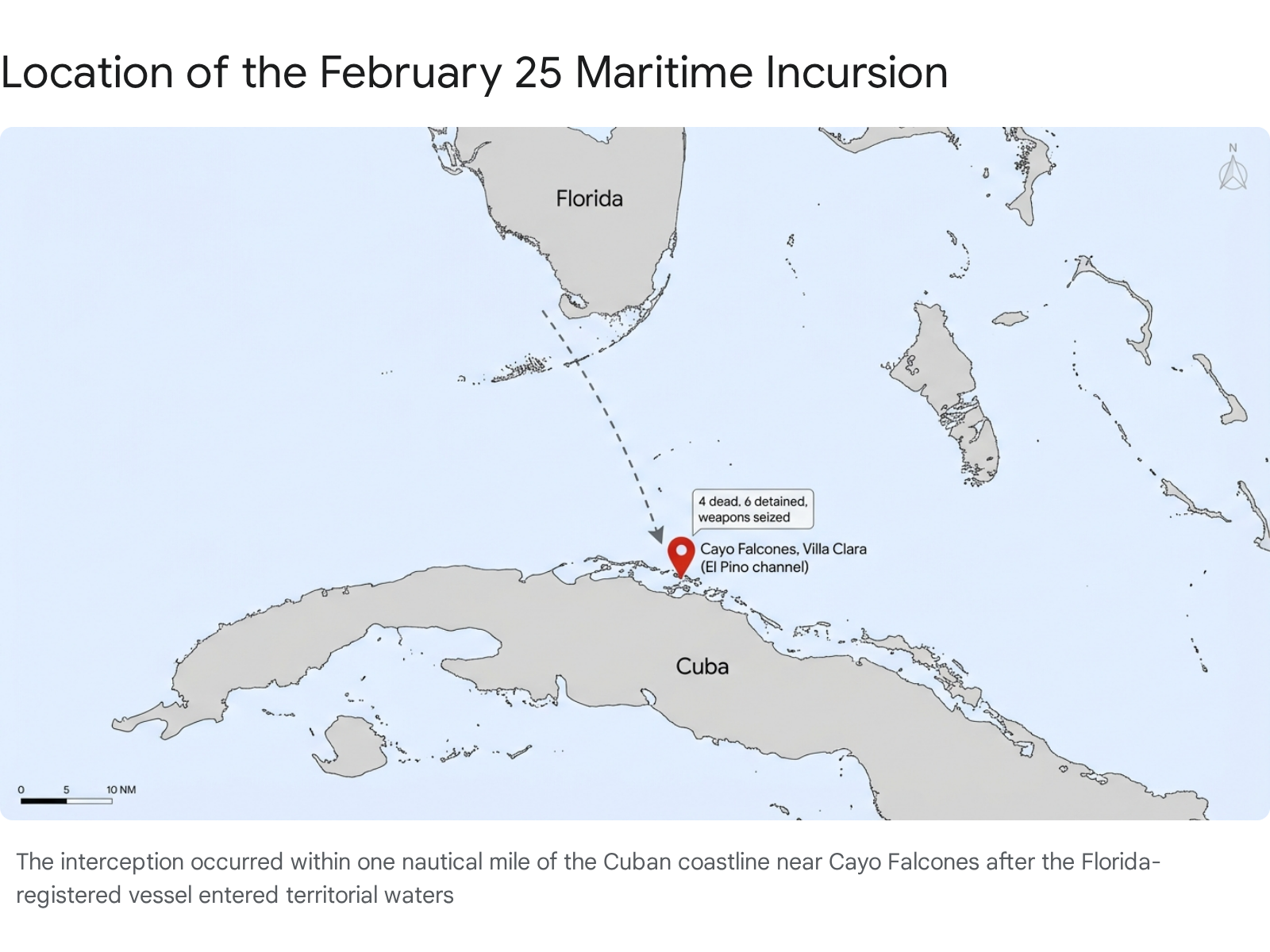
The severe domestic vulnerability of the Cuban state has catalyzed external paramilitary provocations, culminating in a highly violent maritime clash off the northern coast during the reporting period. On the morning of Wednesday, February 25, 2026, a United States-registered speedboat bearing the Florida registration number FL7726SH violated Cuban territorial waters.28 The vessel, carrying ten heavily armed individuals identified as anti-government Cuban exiles residing in the United States, approached within one nautical mile of the El Pino channel, near Cayo Falcones in the Corralillo municipality of Villa Clara province.28
The vessel was intercepted by a surface unit of the Cuban Border Guard Troops (Tropas Guardafronteras) carrying a crew of five military personnel.28 According to the official situational report released by the Cuban Ministry of the Interior (MININT), upon being approached for mandatory identification, the crew of the invading speedboat initiated unprovoked hostile action, opening fire on the Cuban patrol and severely injuring the commander of the Cuban vessel.28 The Border Guard forces returned fire, resulting in a lethal close-quarters maritime engagement. The firefight left four of the speedboat’s occupants dead, including at least one confirmed U.S. citizen, and the remaining six individuals wounded.4
The surviving six combatants were evacuated for medical treatment and subsequently detained by state security forces.29 During the post-engagement interdiction, Cuban authorities seized a substantial cache of military-grade equipment from the speedboat, including assault rifles, handguns, Molotov cocktails, ballistic vests, telescopic sights, and camouflage fatigues.6
3.2 Intelligence Fallout, Identity Contradictions, and Reactions
The Cuban government rapidly categorized the incursion as a state-sponsored terrorist infiltration designed to exploit the current economic vulnerability, stoke internal conflict, and destabilize the communist regime.31 Cuban state media released the identities of the six detained survivors, naming Amijail Sánchez González, Leordan Enrique Cruz Gómez, Conrado Galindo Sariol, José Manuel Rodríguez Castello, Cristian Ernesto Acosta Guevara, and Roberto Azcorra Consuegra.36 Furthermore, Havana announced the arrest of an individual named Duniel Hernández Santos, who allegedly confessed to operating as a domestic facilitator sent from the U.S. to receive the armed infiltration team.37
However, the operational intelligence generated by MININT exhibited critical flaws immediately following the release. The inclusion of Roberto Azcorra Consuegra on the detainee list was swiftly retracted by Havana after Azcorra Consuegra publicly confirmed his presence in South Florida in an interview with the Associated Press, stating his shock at being identified as a participant.36 The Cuban government subsequently issued a clarification conceding he was “mistakenly identified”.36 Furthermore, relatives of the actual detainees expressed profound disbelief; Maria de Jesus Galindo, daughter of Conrado Galindo Sariol, stated she believed her father was executing routine package deliveries for Amazon in Miami and had not returned to Cuba in ten years.33
Conversely, other intelligence indicates premeditated militant intent. Associates of the detainees, such as Michel “Kiki” Naranjo Riverón, publicly rejected the terrorist classification but confirmed the group’s militant nature. Naranjo identified detainee Amijail Sánchez González as the leader of an organization called “Auto Defensa del Pueblo” (People’s Self-Defense), describing it as a clandestine network dedicating years to recruiting Cubans on the island to execute internal sabotage against the government.38
The diplomatic response was immediate and highly polarized. U.S. Secretary of State Marco Rubio, speaking from the Caribbean, categorically denied any U.S. government involvement or operational support for the incursion, pledging that Washington would conduct an independent investigation as it was “highly unusual to see shootouts on open sea like that”.13 Florida Attorney General James Uthmeier ordered the Office of Statewide Prosecution to initiate a joint investigation with federal law enforcement, pointedly stating that the “Cuban government cannot be trusted” and vowing to hold the communist regime accountable.32 Meanwhile, the Russian Foreign Ministry seized upon the incident, characterizing it as an “aggressive provocation by the United States” explicitly designed to trigger a broader conflict.39
| Identified Detainee / Individual | Alleged Role / Affiliation | Current Status & Location |
| Amijail Sánchez González | Alleged leader of “Auto Defensa del Pueblo” militant network | Detained in Cuba, wounded |
| Conrado Galindo Sariol | U.S. resident, Florida-based delivery driver | Detained in Cuba, wounded |
| Leordan Enrique Cruz Gómez | Alleged participant | Detained in Cuba, wounded |
| José Manuel Rodríguez Castello | Alleged participant | Detained in Cuba, wounded |
| Cristian Ernesto Acosta Guevara | Alleged participant | Detained in Cuba, wounded |
| Duniel Hernández Santos | Alleged domestic facilitator for the infiltration | Arrested in Cuba |
| Roberto Azcorra Consuegra | Mistakenly identified by MININT as a participant | Safe in South Florida, U.S. |
| Unidentified U.S. Citizen | Participant in the firefight | Deceased |
4. Internal Security, Repression, and the Carceral State
4.1 Prioritization of the Security Apparatus
Amidst the collapse of public services and external paramilitary threats, the internal security apparatus of the Cuban state remains intact, robust, and hyper-vigilant. The regime has made a calculated operational decision to prioritize the suppression of domestic dissent over the provisioning of essential civil services. Hydrocarbon fuel that is critically scarce for public bus transportation networks and hospital emergency generators is systematically diverted to mobilize the National Revolutionary Police and State Security (Seguridad del Estado) forces.41 These units are heavily deployed in central municipalities to aggressively monitor, intimidate, and arrest political dissidents, social media influencers, and any citizens demanding political change.41
4.2 The Carceral Crisis and Prison Mortality
The human rights environment within the Cuban carceral system has reached a critical nadir. According to international non-governmental organizations, including Prisoners Defenders, the Cuban regime currently holds nearly 700 verified political prisoners.43 Furthermore, the NGO Justicia 11J reports that at least 359 individuals remain incarcerated specifically for their participation in the historic July 11, 2021, anti-government protests, with many serving draconian sentences of up to 22 years.43 Arbitrary detention remains a primary tool of state control; the legal observatory Cubalex documented at least 203 arbitrary detentions in police surveillance operations between January and June of the previous year.43 While the government did facilitate the release of 553 detainees in January 2025 following trilateral negotiations with the Vatican and the United States, the overall carceral population remains massively inflated by political detainees.43
During the week of February 22, the extreme volatility within the prison system was horrifically exposed. Credible reports emerged that approximately ten political prisoners died in custody following a brutal state crackdown.45 These deaths occurred during coordinated protests organized by inmates in response to the hanging of a 19-year-old prisoner.45 This tragic event followed weeks of ignored complaints regarding severe, systemic food shortages, total medical neglect, and pervasive physical abuse by prison authorities, highlighting the absolute collapse of institutional care and the state’s reliance on lethal coercion to maintain facility order.45
4.3 Public Order and Localized Civil Unrest
The daily struggle for physical survival has severely eroded the social fabric and public order in urban centers, particularly Havana and Santiago de Cuba. The lack of basic utilities has transformed the cityscape; avenues are largely deserted, and cultural venues, such as the National Theater during the normally vibrant International Jazz Plaza Festival, remain nearly empty as citizens focus entirely on subsistence.46
While mass, nationwide protests on the scale of the 2021 demonstrations have not fully materialized due to the pervasive, preemptive security presence, localized outbreaks of civil unrest are becoming endemic.42 In several precarious municipalities of Havana, including Los Sitios, Cayo Hueso, and La Victoria, exhausted citizens have resorted to setting fires to piles of uncollected garbage in the streets.41 This is a direct, desperate tactic intended to force local authorities to deploy emergency resources or restore localized power grids.41 Furthermore, urban crime is escalating rapidly. The collapse of street lighting infrastructure has facilitated a massive surge in burglaries and violent robberies, with police responses increasingly limited exclusively to politically sensitive or affluent zones.41
5. Macroeconomic Collapse and the Duality of the Economy
5.1 Hyperinflation and the Devaluation of Sovereign Currency
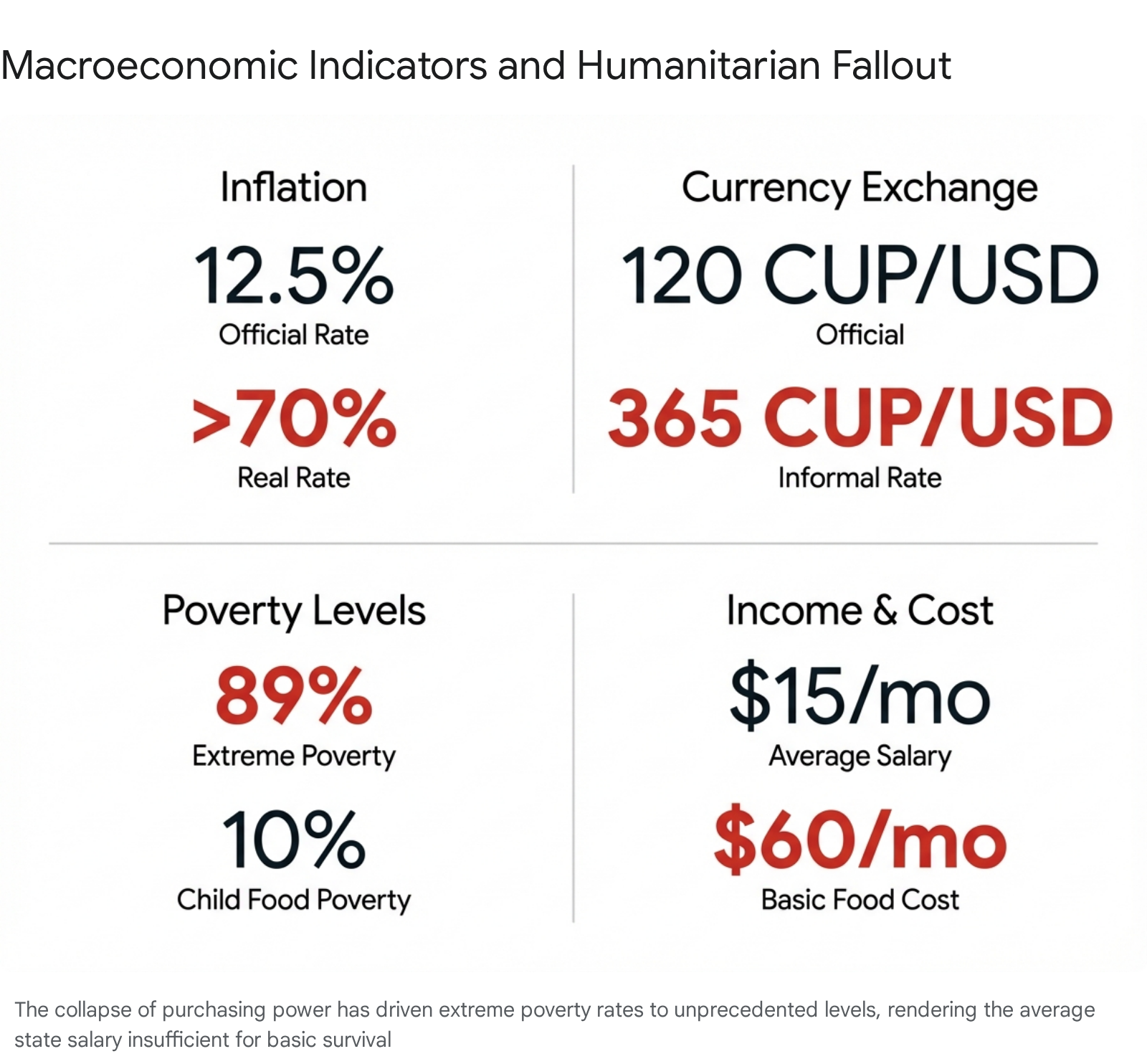
The Cuban macroeconomic environment is characterized by profound insolvency, plummeting industrial productivity, and rampant, uncontained hyperinflation. The nation’s Gross Domestic Product (GDP) contracted by 5 percent in 2025 alone, contributing to a devastating cumulative economic contraction estimated between 11 and 15 percent over the preceding five-year period.20 While the National Office of Statistics of the Republic of Cuba reported a purportedly easing official annual inflation rate of 12.52 percent in January 2026, independent economists, private estimates, and on-the-ground purchasing power parity indicate that real inflation exceeds 70 percent.20 This discrepancy is driven by the total collapse of domestic agricultural and industrial production, forcing an absolute reliance on increasingly expensive, sanction-evading imports.41
The duality of the Cuban economy has never been more extreme, with the state-managed formal economy operating entirely decoupled from the functional reality of the informal street market. The sovereign currency has collapsed in actual utility. While the government stubbornly maintains an artificial, fixed official exchange rate of 24 Cuban Pesos (CUP) to the US dollar for state entities, and 120 CUP for the population, the street value has plummeted to 365 CUP per USD and 380 CUP per Euro.48 Furthermore, the valuation of the cryptocurrency Tether (USDT) at 400 CUP reflects a desperate flight to decentralized, stable digital assets by citizens seeking to shield their meager wealth from disastrous central bank monetary policy and exchange rate uncertainty.48
5.2 The Eradication of Purchasing Power and Extreme Poverty
The destruction of purchasing power has plunged the vast majority of the population into a state of extreme, unmitigated poverty. According to independent data, an astonishing 89 percent of the Cuban populace now lives below the extreme poverty threshold.41 The average state salary hovers between 6,600 and 6,800 pesos a month (approximately $15 USD on the informal market), while the minimum pension provides a mere $7 USD equivalent.41 Against these starvation wages, basic physical survival requires roughly 30,000 CUP monthly (approximately $60 USD) just to procure minimal food on the black market, resulting in a mathematically impossible survival scenario for any citizen without access to foreign remittance streams.46
The resulting food insecurity is staggering and unprecedented in post-revolutionary history. Seven out of ten Cubans currently report routinely skipping at least one meal a day—breakfast, lunch, or dinner—due to absolute scarcity in the markets or total financial inability.41 The crisis is so profound that the Ministry of Public Health has been forced to publicly acknowledge the rising phenomenon of citizens surviving on a single meal per day.41 Most alarmingly, data from UNICEF indicates that one-tenth of all children in Cuba currently live in conditions of “severe food poverty,” an indicator of child malnutrition that had previously been virtually eliminated from the island’s public health profile.41
| Economic Indicator (Feb 2026) | State / Official Value | Informal Market / Real Value | Strategic Implication |
| Annual Inflation Rate | 12.52% | > 70.0% | Total erosion of domestic purchasing power |
| USD Exchange Rate | 120 CUP | 365 CUP | De facto dollarization of the survival economy |
| USDT (Tether) Exchange Rate | N/A | 400 CUP | Flight to digital assets to evade state controls |
| Average Monthly Salary | ~6,700 CUP ($55 official) | ~$15 (Informal equivalent) | Mathematically guarantees extreme poverty status |
| Cost of Basic Food Subsistence | Highly subsidized (Ration book) | ~30,000 CUP ($60) | Absolute reliance on remittances or black market |
6. The Sistema Eléctrico Nacional (SEN) and the Renewable Paradox
6.1 Infrastructural Atrophy and “Option Zero” Parameters
The structural foundation of the current crisis is the near-total failure of the Cuban national electricity grid, known as the Sistema Eléctrico Nacional (SEN). The current degradation is the culmination of years of deferred maintenance and critical spare part deficits, heavily exacerbated by the 2024-2025 blackouts, which included the catastrophic failure of the Antonio Guiteras Power Plant and subsequent nationwide total blackouts.20 Cuba requires an absolute minimum of 100,000 barrels of oil per day (bpd) to maintain basic functional normality across its industrial, transportation, and residential sectors.21 Following the cessation of imports from Venezuela and Mexico, the island is entirely reliant on its domestic crude production, which yields a mere 30,000 to 40,000 bpd of highly sulfurous, low-quality heavy crude that damages already fragile refinery infrastructure.20 One of these deteriorating domestic refineries caught fire in mid-February, further crippling capacity.41
This domestic output covers less than 40 percent of the nation’s baseline energy requirements, forcing the Díaz-Canel administration to implement extreme emergency measures, effectively plunging the country into a state of “Option Zero” energy consumption.41 Official reports indicate that over 60 percent of the national territory is subjected to simultaneous power outages during peak hours.26 In Havana, blackouts are unpredictable, often lasting between six and twelve hours daily, while the situation is markedly worse in eastern provinces like Santiago de Cuba, Holguín, and Guantánamo, where citizens report receiving electricity for a mere four to six hours per 24-hour cycle.26 Energy companies and independent analysts project that a total, unrecoverable nationwide grid collapse could occur as early as March 2026 without an immediate external fuel injection.41
6.2 The Strategic Shift Toward Sino-Cuban Solar Initiatives
In a desperate, structurally mandated bid to decouple the nation’s energy security from imported fossil fuels, Havana has dramatically accelerated its transition to renewable energy, leaning heavily on the People’s Republic of China for critical technological hardware and sovereign financing. Under the United Nations Framework Convention on Climate Change (UNFCCC), Cuba has committed to generating 26 percent of its total energy from renewable sources by 2035.52 In a remarkably compressed timeframe between early 2025 and early 2026, Cuba successfully connected 49 new photovoltaic solar parks to its national grid, adding over 1,000 megawatts of capacity, one of the fastest adoptions of renewable infrastructure by any developing nation globally.53
The overarching national plan, designed by the Cuban Ministry of Energy and Mines, targets the installation of 92 solar parks by 2028, aiming for a total installed capacity of 2,000 megawatts (2 Gigawatts).52 During peak daytime radiation hours, these solar installations, such as the 21.87 MW Cabaiguán park in Sancti Spíritus and the 21.8 MW Vertientes facility in Camagüey, now successfully supply roughly 9 percent of the nation’s 3,200-megawatt peak demand.50
However, the strategic efficacy of this rapid, China-backed transition is severely undermined by a critical, systemic technological deficit: the near-total absence of utility-scale battery storage capacity. Of the initial 55 solar facilities planned for immediate operation, intelligence indicates only four, located in Bayamo, Cueto, CUJAE in Havana, and El Cotorro, are equipped with 50-megawatt battery storage systems.54 Consequently, while solar power effectively mitigates daytime fossil fuel consumption, it cannot supply base-load power during the critical evening peak demand period when solar radiation ceases.50 This technological paradox leaves the grid just as vulnerable to nocturnal blackouts and overall instability, failing to provide relief to the suffering civilian population.
| Energy Generation Metric | Baseline Demand / Target | Current Operational Reality (Feb 2026) |
| Daily Hydrocarbon Requirement | 100,000 bpd | ~40,000 bpd (Domestic heavy crude only) |
| National Peak Electricity Demand | 3,200 Megawatts | Severely curtailed via rolling blackouts |
| Renewable Energy Contribution | 26% of total by 2035 | ~9% of peak daytime demand |
| Solar Infrastructure (2028 Goal) | 92 Parks (2,000 MW total) | 49 Parks connected (>1,000 MW added) |
| Utility Battery Storage Integration | Universal integration required | Only 4 out of 55 initial parks equipped |
7. Public Health Catastrophe and Epidemiological Vulnerabilities
7.1 Systemic Failures in Tertiary and Primary Medical Care
The Cuban healthcare system, historically promoted by the Castro regime as the unassailable crown jewel of the revolution and a global paradigm for accessible primary care, is undergoing a phase of terminal operational failure. The system is currently paralyzed by a nearly 70 percent deficit in basic pharmaceutical supplies and essential medical consumables.41 In urban polyclinics and rural consultancies alike, medical professionals are routinely forced to instruct patients to independently acquire and bring their own syringes, bandages, and critical medications – such as the antibiotic gentamicin – which must be purchased at extortionate markups on the informal black market.41
The physical infrastructure of the medical system is equally degraded by the energy crisis. Major general hospitals suffer from constant, unpredictable power outages, forcing surgical teams to perform highly sensitive emergency procedures, including neonatal resuscitation and obstetrics, utilizing the inadequate flashlight functions of their cellular phones.25 Essential diagnostic equipment, surgical lamps, and anesthesia machines are routinely rendered inoperable by grid fluctuations, causing entirely preventable fatalities.25 Furthermore, laboratories lack the basic chemical reagents necessary to perform standard blood and urine analyses, entirely paralyzing diagnostic capabilities.41
This material collapse is disastrously compounded by a catastrophic drain of highly trained medical personnel. The mass, uncontrolled migration of the professional class has devastated the localized family doctor program, the foundational layer of Cuban preventative medicine. In the 1980s, the national ratio stood at one primary care physician for every 350 citizens; today, that ratio has plummeted to one physician for every 1,500 patients.41 The resulting severe backlog forces disabled, elderly, and chronically ill citizens to endure hours-long waits in decaying, unlit hospital corridors merely to receive rudimentary care or basic blood pressure checks.41
7.2 The Resurgence of Vector-Borne Pathogens
The erosion of the healthcare system has coincided disastrously with a severe epidemiological crisis. The total lack of municipal sanitation, intermittent water supply that forces unsafe domestic water storage practices, and the massive accumulation of uncollected garbage in urban streets have created optimal, unregulated breeding environments for mosquito vectors. Consequently, the island is currently battling concurrent, widespread, and largely unmitigated outbreaks of dengue fever and the chikungunya virus, alongside seasonal respiratory pathogens.41
International health authorities are monitoring the Cuban epidemiological situation with extreme concern. The European Centre for Disease Prevention and Control (ECDC) reported significant global activity regarding the chikungunya virus (CHIKVD) in early 2026, tracking over 2,881 cases globally.55 In response to the unchecked spread within Cuba, travel health clinics across the United States and Canada are actively advising prospective visitors to the island to secure the newly approved chikungunya vaccine prior to travel.56 The inability of the local family doctor network to function as the traditional bulwark against these viral outbreaks ensures that transmission rates will likely remain elevated, further burdening the already overwhelmed and under-resourced tertiary care facilities.
8. Demographic Hemorrhage and the Extinction of Human Capital
8.1 The Scale of the Population Contraction
The amalgamation of political repression, physical darkness, starvation, and economic hopelessness has triggered the largest demographic hemorrhage in the 500-year history of the Cuban nation. Between 2022 and 2026, independent demographic studies, unacknowledged external migration data, and border encounter metrics indicate that the island’s population has contracted massively. While official United Nations population prospects for 2026 still estimate the population at roughly 10.89 million—accounting only for minor negative growth rates of approximately -0.41 percent annually—ground-level data, demographic experts, and independent legal observatories suggest the actual population residing on the island has plummeted from 11 million to approximately 8.5 million.41
This independent assessment represents an astonishing, catastrophic loss of over 20 percent of the national populace in under five years. The exodus was heavily facilitated by various escape routes, notably the visa-free travel arrangement with Nicaragua implemented in 2021 following the July 11 protests. However, the government of Nicaragua, in a series of concessions potentially influenced by U.S. pressure, unexpectedly canceled visa-free travel for Cuban citizens in February 2026, cutting off the primary terrestrial route to the U.S. southern border and further trapping the desperate populace.63
8.2 The Structural Implications of the Exodus
This demographic collapse is not merely a tragic indicator of current socio-political despair, but a structural guarantee of future economic stagnation. The exodus is heavily skewed toward the youth, the highly educated professional class, and able-bodied laborers. This phenomenon has resulted in a hollowed-out workforce and an accelerating, severe aging crisis among the remaining, highly vulnerable population.61 The Cuban state has permanently lost the human capital required to rebuild its physical infrastructure, maintain its healthcare system, staff its educational institutions, or transition to a modern, productive economy, regardless of any future political configurations or the lifting of external sanctions.
| Year | UN Official Population Estimate | Official Yearly % Change | Independent / Ground-Level Estimate |
| 2022 | 11,059,820 | -0.52% | ~11.0 Million |
| 2023 | 11,019,931 | -0.36% | N/A |
| 2024 | 10,979,783 | -0.36% | N/A |
| 2025 | 10,937,203 | -0.39% | N/A |
| 2026 | 10,892,659 | -0.41% | ~8.5 Million (22% Contraction) |
9. Multilateral Responses and the Authoritarian Axis
9.1 Russian Asymmetric Assistance and Contingency Evacuations
The geopolitical vacuum created by the U.S. embargo and the hasty retreat of Venezuela and Mexico has forced Havana to appeal directly to its historic Cold War patron, the Russian Federation. In mid-February, Cuban Foreign Minister Bruno Rodríguez Parrilla traveled to Moscow to secure emergency energy lifelines and reaffirm the strategic alliance.64 In response, Russian Deputy Prime Minister Alexander Novak and President Vladimir Putin publicly affirmed their unwavering commitment to supporting Cuba.64 Putin categorized the new U.S. blockade restrictions as “unacceptable,” and Novak promised the imminent delivery of crude oil and petroleum products to the island as “humanitarian aid,” openly declaring Moscow’s intent to defy U.S. secondary sanctions.25
However, the practical, logistical application of Russian support is severely constrained by geopolitical realities. Transporting low-quality heavy crude from the Black Sea or Baltic ports across the Atlantic to the Caribbean is a high-cost, high-risk endeavor, compounded by the threat of U.S. naval monitoring, secondary sanctions on global shipping insurers, and Russia’s own severe, wartime economic strains.26 Intelligence indicates that while Russian security apparatuses advise the Cuban leadership to accept a negotiated transition (the “Delcy” solution) to ensure the regime’s physical safety and prevent an anarchic collapse, actual fuel deliveries remain painfully slow and vastly insufficient to offset the daily 60,000-barrel deficit.26
Furthermore, acknowledging the systemic, unmanageable instability on the island, the Russian Ministry of Economic Development took the extraordinary and deeply embarrassing step of officially recommending that Russian citizens refrain from traveling to Cuba.67 Concurrently, the state-owned air carrier Aeroflot initiated emergency evacuation flights from Havana and the resort town of Varadero to repatriate Russian tourists trapped by the prolonged blackouts, dealing a final blow to Cuba’s vital tourism sector.67 Air Canada also suspended flights to Cuba during this period, citing the island’s inability to provide jet fuel.27
9.2 China’s Calibrated Economic Support
The People’s Republic of China (PRC) has adopted a highly calibrated, strategic approach to the Cuban crisis. While Beijing desperately seeks to maintain its vital intelligence and political foothold 90 miles from the U.S. mainland, it is unwilling to trigger a full-scale, devastating trade war with Washington over Cuban oil shipments.26 Consequently, Chinese assistance has explicitly avoided direct confrontation regarding fossil fuels, focusing instead on long-term, state-led infrastructure investment, specifically in the renewable energy sector.25
Diplomatic engagement remains incredibly robust; following his trip to Moscow, Foreign Minister Rodríguez met with high-ranking Chinese Communist Party officials in Beijing, including Wang Yi and Liu Haixing, to solidify the “China-Cuba community with a shared future”.65 China’s primary, tangible contribution remains the rapid financing and technological provisioning of the aforementioned solar parks, including a recent agreement to build seven new parks with a 35 MW capacity.50 This approach aligns perfectly with China’s broader Latin American strategy of emphasizing direct state-led finance, infrastructure development, and the utilization of the entire industrial chain, thereby expanding its regional influence without overtly violating U.S. secondary sanctions regarding petroleum transport.69
9.3 Multilateral Condemnation and Western Humanitarian Aid
The extreme nature of the U.S. maximum pressure strategy has provoked significant pushback from the broader international community and multilateral organizations. The Non-Aligned Movement formally condemned the tightening of the embargo, citing gross violations of international law, multilateralism, and the foundational principles of the UN Charter.72 Concurrently, Cuban diplomatic efforts within multilateral bodies continue; Ambassador Tania López Larroque recently presented her credentials as the Permanent Representative to the International Seabed Authority (ISA) to Secretary-General Leticia Carvalho in Jamaica, reaffirming Cuba’s commitment to multilateral institutions despite its domestic collapse.73
Furthermore, Western allies of the United States have opted to dramatically increase humanitarian engagement rather than support the coercive blockade. The Government of Canada, officially acknowledging the humanitarian collapse driven by severe fuel shortages and prolonged blackouts, announced an immediate, accelerated deployment of $8 million in targeted assistance.74 As announced by Minister of Foreign Affairs Anita Anand and Secretary of State for International Development Randeep Sarai, this aid is specifically structured to bypass Cuban state mechanisms, distributed instead through trusted NGOs like UNICEF and the World Food Programme to directly deliver food and nutrition to vulnerable Cuban communities.74
Simultaneously, Canadian parliamentary hearings led by the Standing Committee on Foreign Affairs and International Development explored the Cuban human rights crisis, featuring testimonies from Cuban civil society representatives like John Suarez of the Center for a Free Cuba and Yaxys Cires of the Cuban Observatory of Human Rights, who argued that democratic nations like Canada and Spain inadvertently abet the regime’s repression through economic engagement.75 This criticism is particularly resonant in Europe, where the European Union’s financing of the Havana regime has sparked protests, and Spain faces scrutiny over a €375 million “Debt Conversion Program” aimed at forgiving Cuban debt to reinvest in infrastructure, a program heavily utilized by over 150 Spanish companies operating on the island.45
10. Strategic Intelligence Outlook and Predictive Trajectories
The convergence of geopolitical, economic, and social indicators during the week ending February 28, 2026, points unequivocally toward a terminal phase for the Cuban state as it is currently constructed. The strategy of maximum pressure executed by the United States—specifically the weaponization of secondary tariffs via Executive Order 14380—has successfully eradicated the regime’s external macroeconomic support pillars, leaving the state wholly exposed to its own profound, decades-in-the-making domestic inefficiencies. The resulting energy deficit is not a temporary, manageable disruption, but a permanent structural failure. Without a massive, sustained, and highly subsidized injection of foreign crude oil—which neither the Russian Federation nor the People’s Republic of China appears capable or geopolitically willing to fully provide under the current sanction threat matrix—the total, unrecoverable collapse of the national electricity grid is highly probable in the immediate near term.
The cascading implications of this infrastructural collapse are dire and multidimensional. The Cuban state is rapidly losing its monopoly on public order. The physical darkness has provided cover for rising urban criminality, while the total evaporation of public services has dissolved the implicit, foundational social contract of the revolution. The regime’s calculated decision to prioritize its limited, dwindling fuel reserves for state security, intelligence operations, and violent crowd control indicates a posture of final entrenchment, relying purely on lethal coercion to suppress an exhausted, starving, and disease-ridden populace. However, the February 25 maritime incursion by heavily armed Florida exiles demonstrates that external, militant actors recognize this acute vulnerability and are increasingly willing to test the perimeter, risking a broader asymmetric paramilitary conflict that could rapidly spiral completely out of Havana’s control.
The central geopolitical variable dictating the immediate future of the island is the efficacy of the U.S. backchannel negotiations. President Trump’s public proposition of a “friendly takeover” suggests that U.S. intelligence believes the internal fractures within the Cuban military and political elite—represented by figures like Raúl Guillermo Rodríguez Castro—are severe enough to force capitulation to American demands. If these high-stakes negotiations fail to yield a managed, phased transition of power, the systemic atrophy currently paralyzing the island will inevitably and rapidly transition into chaotic, violent state failure. Such an uncontrolled outcome would manifest not only in total humanitarian collapse and widespread internal violence but in a renewed, massive, and highly chaotic maritime migration crisis across the Straits of Florida, fundamentally destabilizing the security dynamics of the entire Caribbean basin and creating an immediate, severe national security crisis for the United States.
Please share the link on Facebook, Forums, with colleagues, etc. Your support is much appreciated and if you have any feedback, please email us in**@*********ps.com. If you’d like to request a report or order a reprint, please click here for the corresponding page to open in new tab.
Sources Used
- Addressing Threats to the United States by the Government of Cuba – Federal Register, accessed February 28, 2026, https://www.federalregister.gov/documents/2026/02/03/2026-02250/addressing-threats-to-the-united-states-by-the-government-of-cuba
- New Executive Order Declares National Emergency and Authorizes Tariffs on Goods from Countries Supplying Oil to Cuba | Insights | Mayer Brown, accessed February 28, 2026, https://www.mayerbrown.com/en/insights/publications/2026/02/new-executive-order-declares-national-emergency-and-authorizes-tariffs-on-goods-from-countries-supplying-oil-to-cuba
- Fact Sheet: President Donald J. Trump Strengthens the Policy of the United States Toward Cuba – The White House, accessed February 28, 2026, https://www.whitehouse.gov/fact-sheets/2025/06/fact-sheet-president-donald-j-trump-strengthens-the-policy-of-the-united-states-toward-cuba/
- Trump suggests US could carry out ‘friendly takeover’ of Cuba …, accessed February 28, 2026, https://www.theguardian.com/us-news/2026/feb/27/trump-cuba-regime-change
- Trump suggests a ‘friendly takeover’ of Cuba amid US fuel blockade, accessed February 28, 2026, https://www.aljazeera.com/news/2026/2/27/trump-suggests-a-friendly-takeover-of-cuba-amid-us-fuel-blockade
- Trump says U.S. discussing ‘friendly takeover’ of Cuba, accessed February 28, 2026, https://www.ctvnews.ca/world/article/trump-says-us-discussing-friendly-takeover-of-cuba/
- U.S. President Trump Suggests Friendly Takeover of Cuba, accessed February 28, 2026, https://ticotimes.net/2026/02/27/u-s-president-trump-suggests-friendly-takeover-of-cuba
- Trump raises the possibility of a ‘friendly takeover of Cuba’ coming out of talks with Havana, accessed February 28, 2026, https://www.ksat.com/news/politics/2026/02/27/trump-raises-the-possibility-of-a-friendly-takeover-of-cuba-coming-out-of-talks-with-havana/
- Trump hints at ‘friendly takeover’ of Cuba, accessed February 28, 2026, https://www.weareiowa.com/article/news/nation-world/trump-cuba-hints-friendly-takeover/507-3eb09302-0fe2-4b8b-9448-8df8bbf7f3a3
- Trump’s plans for Cubans in the US: ‘Maybe they want to go back. They’re going to have that choice’, accessed February 28, 2026, https://english.elpais.com/international/2026-02-25/trumps-plans-for-cubans-in-the-us-maybe-they-want-to-go-back-theyre-going-to-have-that-choice.html
- The United States demands Cuba make ‘dramatic changes very soon’, accessed February 28, 2026, https://english.elpais.com/usa/2026-02-19/the-united-states-demands-dramatic-changes-very-soon-from-cuba.html
- U.S. Officials Close To Marco Rubio Reportedly Met With Grandson Of Raul Castro To Continue Cuba Negotiations, accessed February 28, 2026, https://www.latintimes.com/us-officials-close-marco-rubio-reportedly-met-grandson-raul-castro-continue-cuba-negotiations-595133
- Trump raises prospect of ‘friendly takeover’ of Cuba, says Rubio in talks, accessed February 28, 2026, https://cyprus-mail.com/2026/02/27/trump-raises-prospect-of-friendly-takeover-of-cuba-says-rubio-in-talks
- U.S. Officials Met With Castro’s Grandson at the Caricom Summit, According to the Miami Herald – Translating Cuba, accessed February 28, 2026, https://translatingcuba.com/u-s-officials-met-with-castros-grandson-at-the-caricom-summit-according-to-the-miami-herald/
- How far will Trump push Cuba? | Chatham House – International Affairs Think Tank, accessed February 28, 2026, https://www.chathamhouse.org/2026/02/how-far-will-trump-push-cuba
- Trump’s 2026 State of the Union: Foreign Policy Issue Guide, accessed February 28, 2026, https://www.cfr.org/articles/trumps-2026-state-of-the-union-foreign-policy-issue-guide
- Humanitarian pressures grow as Cuba continues to struggle with energy shortages, accessed February 28, 2026, https://news.un.org/en/story/2026/02/1167046
- Trump raises the possibility of a ‘friendly takeover of Cuba’ coming out of talks with Havana, accessed February 28, 2026, https://www.thehindu.com/news/international/trump-raises-the-possibility-of-a-friendly-takeover-of-cuba-coming-out-of-talks-with-havana/article70687286.ece
- US says it will allow resale of Venezuelan oil to Cuba, accessed February 28, 2026, https://wkzo.com/2026/02/25/us-to-allow-resale-of-venezuelan-oil-to-cuba-treasury-department-says/
- Cuba’s Self-Induced Crisis May Be Its Worst Yet | Cato at Liberty Blog, accessed February 28, 2026, https://www.cato.org/blog/cubas-self-induced-crisis-may-be-its-worst-yet
- Seven Charts on Cuba’s Economic Woes | AS/COA – Americas Society, accessed February 28, 2026, https://www.as-coa.org/articles/seven-charts-cubas-economic-woes
- Why is Mexico suddenly Cuba’s biggest oil supplier? – Mexico News Daily, accessed February 28, 2026, https://mexiconewsdaily.com/news/mexico-cubas-top-oil-supplier/
- EAI brief: Mexico surpasses Venezuela to become Cuba’s largest oil supplier, accessed February 28, 2026, https://energy-analytics-institute.org/2026/01/07/eai-brief-mexico-surpasses-venezuela-to-become-cubas-largest-oil-supplier/
- Trump Administration Eases Fuel Restrictions for Cuba Amid Deepening Humanitarian Crisis, accessed February 28, 2026, https://www.visiontimes.com/2026/02/26/trump-administration-eases-fuel-restrictions-for-cuba-amid-deepening-humanitarian-crisis.html
- Cuba under siege battles U.S. oil blockade – People’s World, accessed February 28, 2026, https://peoplesworld.org/article/cuba-under-siege-battles-u-s-oil-blockade/
- The Energy Siege Of 2026: Cuba’s Struggle For Survival Amidst International Sanctions And Systemic Collapse – Analysis – Eurasia Review, accessed February 28, 2026, https://www.eurasiareview.com/20022026-the-energy-siege-of-2026-cubas-struggle-for-survival-amidst-international-sanctions-and-systemic-collapse-analysis/
- Trump’s siege of Cuba must be broken | Counterfire, accessed February 28, 2026, https://www.counterfire.org/article/trumps-siege-of-cuba-must-be-broken/
- Cuban military kills 4 aboard US-registered speedboat, Rubio says Washington gathering information on incident, accessed February 28, 2026, https://indianexpress.com/article/world/us-news/cuba-boat-firing-incident-us-armed-group-florida-vessel-10553148/
- Cuba motorboat shooting: First details on four killed after Florida vessel fired on; sparks maritime security fears, accessed February 28, 2026, https://www.hindustantimes.com/world-news/cuba-motorboat-shooting-news-first-details-on-four-killed-after-florida-vessel-fired-on-101772050646255.html
- Cuba kills four crew members of a US civilian speedboat, accessed February 28, 2026, https://english.elpais.com/international/2026-02-25/cuba-kills-four-crew-members-of-a-us-civilian-speedboat.html
- Cuba says 4 killed in speedboat shooting were were attempting to infiltrate the country, accessed February 28, 2026, https://www.pbs.org/newshour/world/cuba-says-4-killed-in-speedboat-shooting-were-were-attempting-to-infiltrate-the-country
- Cuba says it killed heavily armed exiles who attacked from US-registered speedboat, accessed February 28, 2026, https://www.theguardian.com/world/2026/feb/25/cuba-says-border-guards-killed-four-gunmen-on-us-registered-speedboat
- Cubans attempted to infiltrate island on U.S. speedboat, Havana says, accessed February 28, 2026, https://www.washingtonpost.com/world/2026/02/25/cuba-us-boat-shooting/
- Cuban Coast Guard kills 4, injures 6 in gunfire with Florida-based boat | FOX 13 Tampa Bay, accessed February 28, 2026, https://www.fox13news.com/news/cuban-coast-guard-kills-4-injures-6-gunfire-florida-based-boat
- What to Know About Cuba’s Shootout With Florida Speedboat – TIME, accessed February 28, 2026, https://time.com/7381346/cuba-florida-speedboat-shooting-terrorism-oil-energy-crisis-rubio-us/
- U.S. citizen killed in deadly Cuba boat shooting, accessed February 28, 2026, https://www.wmra.org/2026-02-26/cuba-says-armed-group-planned-terrorist-infiltration
- Americans Confirmed Among Dead, Injured In Cuba Boat Shootout | 99.1 is K-99 COUNTRY, accessed February 28, 2026, https://k99country.iheart.com/content/2026-02-27-americans-confirmed-among-dead-injured-in-cuba-boat-shootout/
- Cuba says armed group planned ‘terrorist infiltration’ – WVIA, accessed February 28, 2026, https://www.wvia.org/news/2026-02-26/cuba-says-armed-group-planned-terrorist-infiltration
- 2026 Cuban boat incident – Wikipedia, accessed February 28, 2026, https://en.wikipedia.org/wiki/2026_Cuban_boat_incident
- TRT World – Cuba names individuals it says were involved in armed infiltration by US-registered speedboat, accessed February 28, 2026, https://www.trtworld.com/article/4f54f910c0b9
- The sinking of Cuba: ‘We are a sacrificial altar’ | International – The Pais in English – EL PAÍS, accessed February 28, 2026, https://english.elpais.com/international/2026-02-21/the-sinking-of-cuba-we-are-a-sacrificial-altar.html
- 2024–2026 Cuban protests – Wikipedia, accessed February 28, 2026, https://en.wikipedia.org/wiki/2024%E2%80%932026_Cuban_protests
- World Report 2026: Cuba | Human Rights Watch, accessed February 28, 2026, https://www.hrw.org/world-report/2026/country-chapters/cuba
- 2021 Cuban protests – Wikipedia, accessed February 28, 2026, https://en.wikipedia.org/wiki/2021_Cuban_protests
- Cubans Protest EU Financing of Havana Regime Amid Rising Tensions – Business Wire, accessed February 28, 2026, https://www.businesswire.com/news/home/20260223106922/en/Cubans-Protest-EU-Financing-of-Havana-Regime-Amid-Rising-Tensions
- Energy crisis: The daily struggle to survive in Cuba, an island on the …, accessed February 28, 2026, https://english.elpais.com/international/2026-02-26/the-daily-struggle-to-survive-in-cuba-an-island-on-the-verge-of-darkness.html
- Cuba Inflation Rate – Trading Economics, accessed February 28, 2026, https://tradingeconomics.com/cuba/inflation-cpi
- Cuba: Ten Consecutive Years of Macroeconomic Deterioration, accessed February 28, 2026, https://horizontecubano.law.columbia.edu/news/cuba-ten-consecutive-years-macroeconomic-deterioration
- 2024–2025 Cuba blackouts – Wikipedia, accessed February 28, 2026, https://en.wikipedia.org/wiki/2024%E2%80%932025_Cuba_blackouts
- US sanctions, power cuts, climate crisis: why Cuba is betting on renewables – The Guardian, accessed February 28, 2026, https://www.theguardian.com/global-development/2026/feb/18/us-sanctions-power-cuts-climate-crisis-why-cuba-is-betting-on-renewables
- From blackouts to food shortages: How US blockade is crippling life in Cuba – Al Jazeera, accessed February 28, 2026, https://www.aljazeera.com/economy/2026/2/8/from-blackouts-to-food-shortages-how-us-blockade-is-crippling-life-in-cuba
- Cuba Expands Renewables Amid Power Crisis – The Supply Chain Report, accessed February 28, 2026, https://supplychainreport.org/cuba-expands-renewables-amid-power-crisis/
- With Chinese support, Cuba triples solar power in one year – Friends of Socialist China, accessed February 28, 2026, https://socialistchina.org/2026/02/25/with-chinese-support-cuba-triples-solar-power-in-one-year/
- Cuba Accelerates Solar Expansion with 2000 MW Plan by 2028 – POWER Magazine, accessed February 28, 2026, https://now.solar/2026/01/13/cuba-accelerates-solar-expansion-with-2000-mw-plan-by-2028-power-magazine/
- Chikungunya virus disease worldwide overview – ECDC – European Union, accessed February 28, 2026, https://www.ecdc.europa.eu/en/chikungunya-monthly
- Cuba’s Chikungunya Outbreak Causes Concerns in Miami in 2026 – Vax-Before-Travel, accessed February 28, 2026, https://www.vax-before-travel.com/cubas-chikungunya-outbreak-causes-concerns-miami-2026-2026-02-20
- Contents Chikungunya The Americas – Updated 2026 Data; Incidence Highest in Suriname and Cuba:, accessed February 28, 2026, https://globalhealthreports.health.ny.gov/sites/default/files/2026-02/Global%20Health%20Update%202.19.26%20-%20Final.pdf
- Cuba Population (2026) – Worldometer, accessed February 28, 2026, https://www.worldometers.info/world-population/cuba-population/
- Cuba Population (1950-2025) – Macrotrends, accessed February 28, 2026, https://www.macrotrends.net/global-metrics/countries/cub/cuba/population
- record view | Total population, both sexes combined (thousands) – UNdata, accessed February 28, 2026, https://data.un.org/Data.aspx?q=cuba&d=PopDiv&f=variableID%3A12%3BcrID%3A192
- Cuba empties: Exodus of more than one million people leaves an aging population, accessed February 28, 2026, https://en.unav.edu/web/global-affairs/cuba-se-vacia-exodo-de-un-millon-de-personas-que-deja-una-poblacion-envejecida
- Cuba: Demographic or Systemic Crisis?, accessed February 28, 2026, https://horizontecubano.law.columbia.edu/news/cuba-demographic-or-systemic-crisis
- 2026 Cuban crisis – Wikipedia, accessed February 28, 2026, https://en.wikipedia.org/wiki/2026_Cuban_crisis
- Russia considers new restrictions against Cuba unacceptable: Putin – China Economic Net, accessed February 28, 2026, http://en.ce.cn/main/latest/202602/t20260219_2779996.shtml
- Senior CPC official meets with special envoy of party, government of Cuba – Xinhua, accessed February 28, 2026, https://english.news.cn/20260205/45741f93ec3543a0846781b4c504cb75/c.html
- Russian assistance to Cuba underway as US-made crisis deepens | Al Mayadeen English, accessed February 28, 2026, https://english.almayadeen.net/news/politics/russian-assistance-to-cuba-underway-as-us-made-crisis-deepen
- Russia to supply energy to Cuba as humanitarian aid – Anadolu Ajansı, accessed February 28, 2026, https://www.aa.com.tr/en/energy/general/russia-to-supply-energy-to-cuba-as-humanitarian-aid/54646
- The Putin plan for Cuba and the Castro family-more Gorbachev, definitely not Khrushchev, accessed February 28, 2026, https://mronline.org/2026/02/21/the-putin-plan-for-cuba-and-the-castro-family-more-gorbachev-definitely-not-khrushchev/
- Latin America in a vise: The “Trump Corollary” vs. China’s 2025 policy paper, accessed February 28, 2026, https://www.piie.com/blogs/realtime-economics/2026/latin-america-vise-trump-corollary-vs-chinas-2025-policy-paper
- Wang Huning meets with senior Cuban official, accessed February 28, 2026, http://en.cppcc.gov.cn/2026-02/06/c_1159771.htm
- Beijing, China. 5th Feb, 2026. Chinese Foreign Minister Wang Yi, also a member of the Political Bureau of the Communist Party of China Central Committee, holds talks with Bruno Rodriguez Parrilla, who is the special envoy of the party and government of Cuba, a member of the Politburo of the Central Committee of the Cuban Communist Party and the foreign minister of Cuba, in Beijing, capital of China, Feb. 5, 2026. Credit: Li Xin/Xinhua/Alamy Live News, accessed February 28, 2026, https://www.alamy.com/beijing-china-5th-feb-2026-chinese-foreign-minister-wang-yi-also-a-member-of-the-political-bureau-of-the-communist-party-of-china-central-committee-holds-talks-with-bruno-rodriguez-parrilla-who-is-the-special-envoy-of-the-party-and-government-of-cuba-a-member-of-the-politburo-of-the-central-committee-of-the-cuban-communist-party-and-the-foreign-minister-of-cuba-in-beijing-capital-of-china-feb-5-2026-credit-li-xinxinhuaalamy-live-news-image718184722.html
- Special Communiqué of the Non-Aligned Movement on the new measures aimed at tightening the embargo on Cuba – CubaMinrex, accessed February 28, 2026, https://cubaminrex.cu/en/special-communique-non-aligned-movement-new-measures-aimed-tightening-embargo-cuba
- The Permanent Representative of Cuba Presents Credentials to the Secretary-General of the International Seabed Authority, accessed February 28, 2026, https://isa.org.jm/news/the-permanent-representative-of-cuba-presents-credentials-to-the-secretary-general-of-the-international-seabed-authority/
- Canada provides assistance to the people of Cuba, accessed February 28, 2026, https://www.canada.ca/en/global-affairs/news/2026/02/canada-provides-assistance-to-the-people-of-cuba.html
- Canadian Parliamentary Hearing Reveals Unity of Cubans Against Weakened and Exposed Communist Regime, accessed February 28, 2026, https://www.morningstar.com/news/business-wire/20260227005052/canadian-parliamentary-hearing-reveals-unity-of-cubans-against-weakened-and-exposed-communist-regime
- China trade agreement, Cuba humanitarian crisis in the spotlight, accessed February 28, 2026, https://www.ipolitics.ca/2026/02/26/china-trade-agreement-cuba-humanitarian-crisis-in-the-spotlight/