Executive Summary
The week ending February 28, 2026, represents a profound and catastrophic inflection point in the geopolitical and security architecture of the Middle East. Following the complete collapse of high-stakes, Omani-mediated nuclear negotiations in Geneva, the United States and the State of Israel initiated a massive, coordinated, preemptive military campaign against the Islamic Republic of Iran. Designated “Operation Epic Fury” by the United States Department of Defense and “Operation Roaring Lion” by the Israel Defense Forces, this offensive marks the transition from a prolonged strategy of maximalist diplomatic pressure and deterrence into direct, theater-wide, high-intensity armed conflict.1 The kinetic operations, deliberately executed in broad daylight to maximize psychological impact and demonstrate absolute airspace dominance, targeted the deepest echelons of the Iranian command-and-control apparatus, critical subterranean nuclear infrastructure, and ballistic missile production facilities across multiple provinces.1
In immediate response to the US-Israeli offensive, Iran activated its strategic retaliatory framework, initiating “Operation True Promise 4.” Demonstrating a severe horizontal escalation of the conflict, the Islamic Revolutionary Guard Corps (IRGC) launched extensive waves of ballistic missiles, cruise missiles, and unmanned aerial vehicles (UAVs) not only at Israeli territory but directly at sovereign Gulf Arab states hosting United States military installations.4 By explicitly targeting US assets in the United Arab Emirates, Qatar, Bahrain, and Kuwait, Tehran has signaled its intent to fracture the US-led regional security umbrella, imposing unbearable security costs on US allies and transforming a localized dispute into a comprehensive, multi-front regional war.4
This kinetic exchange is simultaneously supported by a devastating non-kinetic cyber offensive. A near-total internet blackout has effectively isolated the Iranian populace from the global digital sphere, crippling state media apparatuses and reducing national internet connectivity to an estimated four percent of its ordinary baseline levels.6 The macroeconomic shockwaves of this sudden outbreak of war are already registering violently across global markets. Brent crude and West Texas Intermediate (WTI) oil prices have spiked amid acute fears of an Iranian blockade of the Strait of Hormuz, while safe-haven assets such as gold have surged to historic, unprecedented highs above $5,230 per ounce.9 Concurrently, commercial aviation across the Middle East has ground to a complete halt as regional airspaces close, severing critical logistical arteries connecting Europe, Asia, and Africa.12
This situation report synthesizes multi-source intelligence across the military, diplomatic, cyber, and economic domains. The analysis indicates that the conflict has irrevocably altered the balance of power in the region. The decapitation strikes aimed at the inner circle of Supreme Leader Ayatollah Ali Khamenei suggest an explicit US and Israeli objective of catalyzing regime change from within, exploiting existing domestic fractures, widespread economic despair, and ongoing anti-government protests.14 As the Iranian proxy network – the Axis of Resistance – mobilizes across Lebanon, Syria, Iraq, and Yemen, the international community faces the immediate threat of a protracted, devastating regional conflict with severe implications for global energy security and great power competition.
1. Strategic Precursors and the Collapse of the Geneva Framework
The military operations executed on February 28 did not occur spontaneously; they represent the explosive culmination of a massive, multi-month force generation effort and a deliberate shift in strategic posture following the inconclusive 12-day war in June 2025.16 The intelligence landscape in the weeks leading up to the strike was dominated by unmistakable indicators of an impending offensive, driven by the United States’ maximalist pressure campaign and the catastrophic failure of last-ditch diplomatic efforts to curb Iran’s advancing nuclear program.
1.1. The Final Diplomatic Push in Geneva
Throughout February 2026, the international community observed a high-stakes, highly volatile diplomatic effort aimed at averting regional war. Indirect negotiations between the United States and Iran were held in Geneva, Switzerland, mediated heavily by Omani Foreign Affairs Minister Badr al Busaidi.18 The US delegation, led by envoys Steve Witkoff and Jared Kushner, engaged with Iranian Foreign Minister Abbas Araghchi in an attempt to forge a comprehensive agreement to replace the defunct 2015 Joint Comprehensive Plan of Action (JCPOA).20
The Omani mediation channel initially reported “significant progress,” suggesting that a diplomatic off-ramp was within reach.18 According to Omani sources, Iran had tentatively agreed to cap its uranium enrichment, blend down existing stockpiles of highly enriched uranium (HEU) to the lowest possible level, and grant inspectors from the International Atomic Energy Agency (IAEA) “full access” to its nuclear sites to verify compliance.19 Iranian officials indicated a willingness to consider an interim deal, floating the possibility of addressing non-nuclear issues in later stages to delay military action and extract economic sanctions relief.15
1.2. Irreconcilable Red Lines
Despite the optimistic framing by regional mediators, the core negotiating positions of Washington and Tehran remained fundamentally irreconcilable. US negotiators presented a rigid set of maximalist demands that Tehran viewed as an unacceptable infringement on its national sovereignty. Specifically, the US demanded the complete and permanent physical dismantlement of Iran’s highly fortified subterranean nuclear facilities at Fordow, Natanz, and Esfahan.18 Furthermore, the US insisted on the total surrender and extraction of all enriched uranium from Iranian territory, a permanent agreement without sunset clauses, and an absolute “zero-enrichment” mandate.18
Iran categorically rejected these conditions. An unspecified Iranian source with intimate knowledge of the discussions stated unequivocally that Iran was not willing to destroy its nuclear infrastructure, ship its enriched uranium out of the country, or accept a zero-enrichment mandate, insisting instead on its sovereign “right” to a peaceful nuclear program.15 In counter-proposals, US negotiators signaled a slight softening, indicating they “could be open” to allowing “token enrichment” at very low levels strictly for medical purposes, provided Iran could credibly prove it lacked the capacity to weaponize the material.18 However, the US offered only “minimal sanctions relief” in exchange for these sweeping concessions, a proposition that directly contradicted Tehran’s absolute prerequisite that all US and United Nations Security Council (UNSC) sanctions be lifted as the foundation of any deal.18
| Date (Feb 2026) | Event Description | Strategic Implication |
| Mid-Feb | US initiates largest military buildup in the Middle East since 2003, moving naval, air, and logistics assets into the theater.23 | Establishes overwhelming theater supremacy and provides the President with diverse kinetic strike options. |
| Feb 19 | US President issues a 10-15 day deadline for Tehran to reach a “meaningful deal,” warning that otherwise “bad things happen”.24 | Sets a firm, public countdown clock for diplomacy, cornering both US and Iranian leadership into actionable commitments. |
| Feb 26 | Geneva talks hit an impasse. US demands dismantlement of Fordow, Natanz, and Esfahan; Iran categorically refuses.18 | The diplomatic track officially fails as core red lines regarding domestic uranium enrichment prove unbridgeable. |
| Feb 27 | US President publicly expresses extreme dissatisfaction, stating he is “not happy” with the talks and that Iran “cannot have nuclear weapons”.19 | Signals the formal end of the diplomatic window and the imminent authorization of preemptive military force. |
| Feb 28 | Operations Epic Fury and Roaring Lion commence; US and Israeli forces launch massive preemptive strikes across Iranian territory.1 | The transition from deterrence and coercive diplomacy into direct, theater-wide armed conflict. |
The timeline of escalation demonstrates a rapid compression of the diplomatic window. The failure to bridge the gap over domestic uranium enrichment directly precipitated the authorization of military force, bringing the months-long military buildup to its intended, kinetic conclusion.
2. Force Posture and Theater Buildup: The Road to War
To execute a campaign of this magnitude, the United States Department of Defense, operating in deep coordination with the Israel Defense Forces, required an unprecedented staging of military assets. Beginning in late January 2026, the United States executed its largest and most comprehensive military deployment to the Middle East since the 2003 invasion of Iraq.23 This force generation was meticulously designed to establish absolute theater supremacy, overwhelm Iran’s integrated air defense systems (IADS), and provide a diverse array of strike vectors to ensure the destruction of deeply buried, hardened targets.
2.1. United States and Allied Force Generation
The maritime component of this buildup was anchored by the deployment of two massive Carrier Strike Groups (CSGs). The USS Abraham Lincoln (CVN-72) and its accompanying strike group assumed operational positions in the Arabian Sea and the Gulf of Oman, providing immediate striking distance to Iran’s southern and eastern provinces.21 Simultaneously, the USS Gerald R. Ford (CVN-78), the newest and most advanced aircraft carrier in the US fleet, was deployed to the eastern Mediterranean Sea, providing an alternative strike vector and deep strategic reserve.20
Complementing the immense naval presence was a historic influx of land-based aerial assets. Intelligence reports tracked more than 100 aerial refueling tankers and over 200 heavy strategic cargo planes moving into regional bases in mid-February to establish the logistical backbone required for sustained combat operations.30 Satellite imagery analysis of the Muwaffaq Salti Air Base in Jordan confirmed the presence of more than 50 combat aircraft massing near the Iraqi border.30
Crucially, the United States relocated 12 F-22 Raptor stealth air superiority fighters to highly secure installations within Israel.30 This specific deployment of fifth-generation stealth fighters, augmented by existing regional deployments of F-15, F-16, and F-35 squadrons previously utilized in other theaters, signaled a high-end combat capability explicitly intended to penetrate heavily defended Iranian airspace and systematically dismantle advanced surface-to-air missile (SAM) networks prior to the arrival of heavier payload bombers.28
| Asset Type | Deployment Details | Strategic Role |
| Carrier Strike Groups | USS Abraham Lincoln (Arabian Sea); USS Gerald R. Ford (Eastern Mediterranean).20 | Massive maritime power projection; diverse launch vectors for strike aircraft and Tomahawk cruise missiles. |
| Stealth Fighters | 12 F-22 Raptors deployed to bases in Israel; diverse F-35 squadrons.28 | Penetration of contested airspace; Suppression/Destruction of Enemy Air Defenses (SEAD/DEAD); escort missions. |
| Strike/Multirole Aircraft | 50+ aircraft (F-15s, F-16s) staged at Muwaffaq Salti Air Base in Jordan.28 | High-volume precision strike capabilities against infrastructure, command nodes, and missile silos. |
| Logistics Support | 100+ aerial refueling tankers; 200+ heavy cargo planes deployed across European and Middle Eastern bases.30 | Essential logistical backbone enabling sustained, high-tempo combat operations over vast geographic distances. |
2.2. Iranian Defensive Posture and Critical Vulnerabilities
The Iranian regime and the IRGC were acutely aware of the massing US armada. Intelligence assessments indicate that Iran accurately perceived the high probability of a kinetic strike and initiated emergency, albeit insufficient, defensive preparations.31 Acknowledging critical vulnerabilities within its airspace coverage, Iran sought immediate materiel support from its primary geopolitical partners, the Russian Federation and the People’s Republic of China, to prepare for an asymmetrical war against the United States.31
Tehran specifically requested alternative, advanced air defense components to fortify its IADS.31 However, intelligence indicates that the stopgap measures acquired—such as portable Russian Verba man-portable air-defense systems (MANPADS)—were entirely insufficient to replace or supplement their localized, older S-300 batteries.31 These localized systems lacked the integration and processing power required to repel a coordinated, multi-axis stealth attack utilizing electronic warfare, cyber-blinding, and saturation munitions.
Furthermore, the Iranian regime was operating under immense internal pressure. Renewed anti-regime student protests had spread organically from university campuses to elementary and secondary high schools across the nation, indicating a deep, systemic, and generational disillusionment with the theocratic government.31 The Iranian economy, suffocated by compounding US sanctions and rampant hyperinflation, left the regime with limited domestic capital and severely degraded civilian morale. Analysts assess that this dual vulnerability—a porous, technologically outmatched air defense network and a highly hostile, economically devastated domestic populace—was heavily factored into the US and Israeli calculus as a critical force multiplier for preemptive kinetic action.
3. Execution of Operations Epic Fury and Roaring Lion
On the morning of Saturday, February 28, 2026, the United States and Israel crossed the ultimate threshold from coercive diplomacy to major combat operations. The joint offensive, utilizing dozens of attack aircraft flying from regional bases and carrier decks integrated with stand-off munitions and naval fires, struck deeply into the sovereign territory of the Islamic Republic.22
3.1. Tactical Shifts: The Psychology of the Daylight Offensive
A highly significant tactical anomaly in the February 28 offensive was the operational decision to conduct the initial waves of strikes in broad daylight, commencing at approximately 8:10 AM local time.1 Modern Western air campaigns, including the initial strikes of the 2003 Iraq War and the June 2025 air war against Iran, almost exclusively initiate during predawn hours.1 Operating under the cover of darkness maximizes the asymmetric advantages of superior Western night-vision capabilities, degrades the visual detection capacities of ground-based optical targeting systems, and exploits the circadian rhythms of defending forces.1
The decision to operate in the harsh light of day represents a profound psychological and tactical choice by US and Israeli command. Analytically, a daylight strike serves three primary strategic functions. First, it demonstrates absolute, supreme confidence in the success of the initial Suppression of Enemy Air Defenses (SEAD) campaign. By flying combat sorties in daylight, the US and Israel signaled that Iran’s radar warning receivers and anti-aircraft artillery networks had been thoroughly blinded, jammed, or physically destroyed.
Second, the daylight operation provided immediate, undeniable visual confirmation of the regime’s destruction to the Iranian populace. Large, towering plumes of black smoke dominated the skylines of Tehran, Isfahan, and other major metropolitan areas, making it impossible for the state media to deny or downplay the scale of the attack.1 Third, it served as a direct, humiliating psychological blow to the regime’s carefully cultivated aura of invincibility, essentially executing a punitive, decapitating operation while the civilian populace was fully awake to witness the ultimate vulnerability of the state security apparatus.
3.2. Target Matrix and Decapitation Efforts
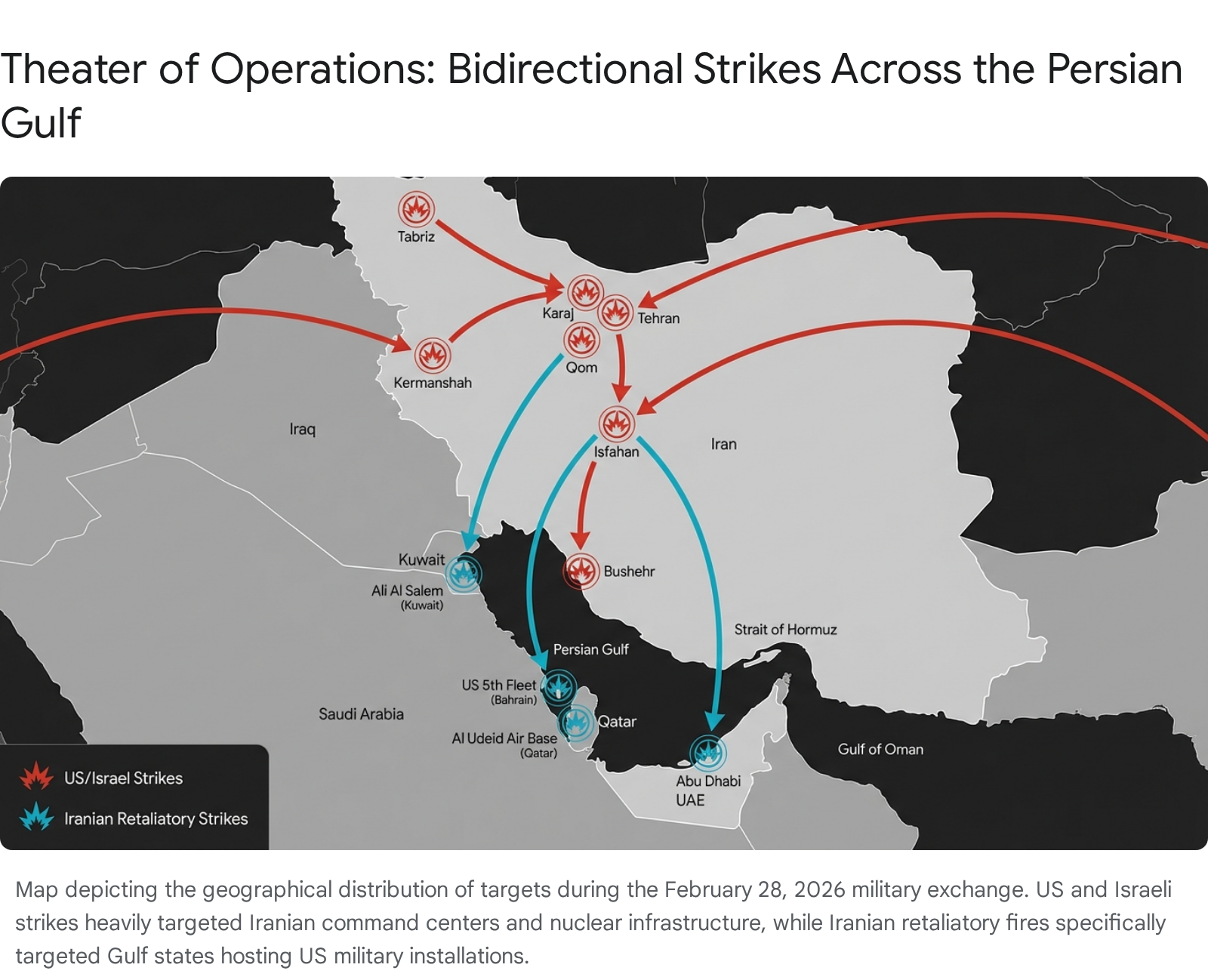
The target matrix for Operation Epic Fury and Roaring Lion was extensive, spanning the entirety of the Iranian geography but heavily, deliberately concentrated on the nodes essential for regime preservation, command and control, and strategic deterrence. Strikes were confirmed in the capital city of Tehran, the nuclear hub of Isfahan, the holy city of Qom, as well as critical military and industrial zones in Karaj, Kermanshah, Lorestan, Tabriz, Ilam, Khorramabad, and the southern port city of Bushehr.3
The most strategically significant targeting occurred within the political heart of Tehran. Precision strikes obliterated sections of the Pasteur Street compound in downtown Tehran.1 This highly fortified, multi-block complex houses the operational office of the Iranian President, the headquarters of the Supreme National Security Council, and the central intelligence leadership of the Islamic Revolutionary Guard Corps.1
More critically, the first wave of strikes directly targeted the immediate vicinity of the residential and office complex of Supreme Leader Ayatollah Ali Khamenei—an area long considered the symbolic and operational center of the regime’s absolute authority.34 While state-affiliated media immediately broadcasted reports that the 86-year-old Khamenei was unharmed and had been preemptively transferred to a “secure location” outside of the capital, the kinetic penetration of his inner sanctum is a severe, unprecedented blow to the regime’s prestige.34 Videos circulating on restricted social media networks showed Iranian citizens reacting with shock, and in several verified instances, open celebration, referring to the targeted site as the “leader’s house” and expressing disbelief at the precision of the strikes.34
Beyond leadership decapitation nodes, the strikes prioritized the neutralization of the regime’s strategic military deterrents. Sites in Isfahan, a known hub for Iranian nuclear enrichment and research facilities, were heavily bombarded.3 While exact battle damage assessments regarding the deep subterranean centrifuge cascades remain highly classified, the strikes were intended to permanently degrade Iran’s nuclear breakout capacity.3 Furthermore, President Trump explicitly stated that the operational objective was to completely “annihilate” the Iranian Navy to ensure unimpeded freedom of navigation in the Persian Gulf and to “destroy their missiles and raze their missile industry to the ground,” eliminating the primary delivery mechanisms for any potential unconventional payloads.3
4. Operation True Promise 4: Iran’s Retaliatory Framework and Horizontal Escalation
The swiftness, volume, and specific targeting of Iran’s immediate counter-offensive, officially dubbed “Operation True Promise 4” by the IRGC, reveals a profound, highly dangerous shift in Tehran’s strategic military doctrine.5 Following the initial waves of US-Israeli airstrikes, Iran’s Foreign Ministry and the Supreme National Security Council rapidly mobilized, invoking Article 51 of the United Nations Charter to claim the inherent right to self-defense against what they termed “criminal aggression” and “flagrant violations” of international law.4
However, rather than exclusively targeting Israeli territory in a localized, symmetrical response—as witnessed during the April 2024 iteration of “Operation True Promise”—Iran unleashed a massive horizontal escalation.40 Tehran deliberately expanded the theater of war by launching a barrage of strikes targeting the sovereign territory of multiple Gulf Arab states that host critical United States military infrastructure.4
4.1. Targeting the US Gulf Security Architecture
Intelligence confirms that the IRGC Aerospace Force launched extensive waves of ballistic missiles, cruise missiles, and suicide drones directed southward across the Persian Gulf at the United Arab Emirates, Qatar, Bahrain, and Kuwait.4 This target selection is a cold, calculated strategic maneuver designed to test the resilience of the US alliance network. For years, Iran has explicitly threatened that any neighboring nation allowing its airspace, territorial waters, or landmass to be utilized by the US or Israel as a launchpad for an attack on the Islamic Republic would immediately be considered a legitimate, primary military target.4 Operation True Promise 4 is the brutal execution of this longstanding threat, attempting to impose an unbearable, visceral security cost on US allies.
The specific nodes targeted by the IRGC underscore Iran’s intent to decouple the United States from its regional partners:
- Qatar: Iranian missiles specifically targeted the Al Udeid Air Base, the largest US military installation in the Middle East, which serves as the central node for US Central Command (CENTCOM) air operations.5
- Bahrain: A barrage of missiles was directed at Juffair in the capital city of Manama, striking facilities directly linked to the headquarters of the US Navy’s Fifth Fleet, the entity responsible for securing the Persian Gulf and the Strait of Hormuz.5
- United Arab Emirates: Multiple ballistic missiles penetrated Emirati airspace, targeting locations near Abu Dhabi, triggering massive air raid sirens and forcing residents into shelters.5
- Kuwait: The Kuwaiti military engaged multiple incoming projectiles transiting its airspace, aimed at neutralizing bases such as Ali Al Salem, which hosts thousands of US personnel.4
| Targeted Gulf State | Specific Military Target / Location | Incident Details & Casualties |
| Qatar | Al Udeid Air Base (Largest US Base in region) 5 | Incoming missiles successfully intercepted by US-made Patriot systems; no structural damage reported.5 |
| Bahrain | US Navy Fifth Fleet Headquarters (Manama/Juffair) 5 | Missiles struck facilities linked to the Fifth Fleet; loud explosions and smoke confirmed; casualty data restricted.5 |
| United Arab Emirates | Abu Dhabi and surrounding residential/military zones 5 | Air defenses engaged; falling missile debris caused material damage and the death of one Asian national civilian.5 |
| Kuwait | Sovereign Airspace / US troop concentrations 5 | Multiple explosions reported as military dealt with incoming missiles; no immediate casualties reported.5 |
4.2. Air Defense Efficacy and the Reality of Civilian Impact
The response of regional, US-supplied air defense networks was robust, yet ultimately imperfect against the volume of the Iranian saturation tactics. In Qatar, government officials confirmed that Patriot missile defense batteries successfully intercepted the incoming ballistic threats targeting Al Udeid, preventing structural damage to the strategic airfield.5 Similarly, the Jordanian military, acting as a buffer state, successfully engaged and shot down at least two ballistic missiles transiting its airspace en route to Israeli population centers.5
However, the sheer density of the IRGC barrage inevitably strained the regional defensive umbrellas. In the United Arab Emirates, while the Ministry of Defense proudly reported that its air defenses responded with “high efficiency” to intercept a number of incoming Iranian ballistic missiles, the physical reality of missile interception resulted in tragedy.41 Heavy, burning debris from the intercepted missiles fell into a densely populated residential area of Abu Dhabi, resulting in significant material damage and, crucially, the death of one Asian national.41
This specific civilian casualty represents a highly volatile inflection point in Gulf geopolitics. The UAE government immediately issued a furious condemnation, labeling the attack a “flagrant violation of national sovereignty and international law” and explicitly reserving the sovereign right to respond militarily.5 The realization of civilian casualties on Emirati soil severely tests the delicate diplomatic tightrope Abu Dhabi has walked over the past year—attempting to maintain ironclad US security guarantees while simultaneously pursuing economic détente and de-escalation with Tehran.
5. The Non-Kinetic Front: Cyber Warfare and Information Dominance
Synchronized perfectly with the physical destruction raining down on Iranian cities, a highly sophisticated, multi-pronged non-kinetic offensive was launched, aimed at severing the Iranian regime’s internal command and control and entirely blacking out its external communications. Analysts assess that this massive cyber campaign was designed to induce overwhelming friction within the IRGC, prevent the state from managing the domestic narrative, and facilitate civilian uprisings by demonstrating the regime’s technological impotence.
5.1. The Severing of Digital Arteries
Beginning concurrently with the first wave of airstrikes, global internet monitors, including the widely cited watchdog NetBlocks, registered a catastrophic, nation-wide drop in Iranian telecommunications infrastructure.6 Within minutes, national internet connectivity plummeted to a mere four percent of its ordinary baseline levels, constituting a near-total digital blackout.6
While the Iranian government routinely restricts internet access and throttles bandwidth during periods of domestic unrest to prevent civilian coordination, the scale, speed, and totality of this specific outage suggest an externally driven, state-sponsored cyberattack targeting core national routing infrastructure and primary internet service providers (ISPs).7 This blackout severely complicates the dissemination of verifiable, on-the-ground intelligence from within Iran. Independent eyewitness accounts, civilian videos of the strikes, and localized battle damage assessments are effectively embargoed within the country, forcing global analysts to rely on highly fragmented reports, satellite telemetry, or state-sanctioned broadcasts that manage to bypass the blockages.6
5.2. Targeting State Media Apparatuses and Psychological Operations
In addition to the broad degradation of civilian internet access, highly precise cyberattacks were directed specifically against the Iranian state’s propaganda and information ministries. Major domestic news agencies that serve as the mouthpieces of the regime, including the Islamic Republic News Agency (IRNA), the Iranian Students’ News Agency (ISNA), Tabnak, and the IRGC-affiliated Fars News Agency, experienced massive disruptions, defacements, and distributed denial-of-service (DDoS) attacks, rendering them entirely inaccessible for extended periods during the height of the crisis.8
By systematically neutralizing these platforms, the cyber offensive stripped the Iranian regime of its ability to project strength, broadcast continuous counter-narratives, issue civil defense instructions, or claim early victories. To aggressively fill this artificially created information vacuum, foreign intelligence services rapidly exploited the blackout to conduct sophisticated psychological operations (PSYOPS). Notably, the Israeli intelligence agency, Mossad, utilized the chaos to launch a dedicated Farsi-language Telegram channel, designed to provide unfiltered news updates, strike footage, and anti-regime messaging directly to the Iranian populace.44 This psychological maneuver aligns perfectly with the explicit, public calls from US and Israeli leadership for the Iranian people to rise up, seize the moment of regime weakness, and overthrow their government.14
6. Activation of the Axis of Resistance: Proxy Mobilization and Regional Spillover
The direct US and Israeli strikes on the sovereign territory of their patron state have triggered a coordinated, albeit stressed, response from the “Axis of Resistance”—Iran’s vast network of regional proxy militias and allied terror groups. These organizations serve as Iran’s forward defense line, designed to bleed adversaries asymmetrically, and are now fully activated to project power across multiple theaters to relieve the immense pressure on Tehran.
6.1. Hezbollah’s Precarious Posture in Lebanon
In Lebanon, Hezbollah represents the absolute crown jewel of Iran’s proxy network, possessing the most sophisticated arsenal of any non-state actor globally. However, intelligence indicates that Hezbollah entered this specific conflict in a state of severe, unprecedented vulnerability. Following devastating Israeli kinetic actions throughout late 2024 and 2025, which included a grueling ground invasion and the highly disruptive assassination of long-time Secretary General Hassan Nasrallah, the group’s operational capacity, command structure, and domestic political standing were significantly degraded.45
Recent reporting highlights that the situation became so dire that senior IRGC officers had effectively “taken over” Hezbollah’s operational command in early 2026 in a frantic, accelerated effort to rebuild its depleted drone and precision-guided missile stockpiles ahead of this exact scenario.15 Despite this extreme vulnerability, Hezbollah is inherently, ideologically bound to its patron in Tehran. The existential threat now posed to the Iranian regime forces Hezbollah to activate. Analysts assess that Hezbollah will prioritize opening a massive, sustained northern front against Israel, attempting to overwhelm the Iron Dome and David’s Sling air defense systems, regardless of the severe domestic political backlash within Lebanon regarding the destruction such a war will bring to the already failing Lebanese state.45
6.2. Houthi Resurgence and the Iraqi Militia Threat
To the south, the Iranian-backed Ansar Allah (Houthi) movement in Yemen has officially declared its absolute solidarity with Tehran and its intent to violently re-enter the conflict. Two senior Houthi officials, speaking anonymously, confirmed the group’s decision to immediately resume widespread, indiscriminate ballistic missile and suicide drone attacks on international commercial shipping routes in the Red Sea and Gulf of Aden, as well as direct, long-range strikes targeting the southern Israeli port city of Eilat.26 The resumption of Houthi maritime interdiction threatens to reignite the severe supply chain disruptions and naval skirmishes witnessed throughout 2024 and 2025, forcing the US Navy to expend further resources on defensive patrols.46
Simultaneously, in Iraq and Syria, Iranian-aligned Shia militias are rapidly mobilizing to strike soft US targets. Kataib Hezbollah, a premier and highly lethal Iraqi militia, issued stark warnings threatening the security and future of Iraqi Kurdistan if the regional government facilitates or ignores US or Israeli air operations transiting their airspace.18 Following the outbreak of hostilities on February 28, the Sabereen news agency reported that US positions southwest of Baghdad were immediately targeted by militia fires, highlighting the omnipresent, 360-degree threat to the approximately 30,000 US military personnel stationed in exposed bases across Iraq, Syria, and the broader Middle East.6 The activation of these proxy networks ensures that the conflict will not remain contained within the borders of Iran and Israel, but will bleed violently into Iraq, Syria, Lebanon, and the critical maritime chokepoints of the global economy.
7. Global Economic Fallout, Market Shocks, and Logistical Paralysis
The rapid transformation of the Middle East—the world’s primary energy producing region—into an active, high-intensity war zone has triggered immediate and profound shockwaves across global commodity markets, international equities, and global logistics networks. The escalation threatens the core nervous system of the global energy supply and has driven panicked institutional capital into safe-haven assets at historic rates.
7.1. Energy Markets and the Threat to the Strait of Hormuz
The primary economic vector for this crisis is the existential threat posed to the Strait of Hormuz. At its narrowest point, the strait is roughly 30 miles wide and no deeper than 200 feet, yet it serves as the irreplaceable maritime corridor for approximately 20 million barrels of crude oil per day, representing roughly 20 percent of the world’s total oil supply, alongside massive volumes of liquefied natural gas (LNG) from Qatar.10 Iran has long threatened to mine or militarily paralyze this chokepoint if its own territory or oil export infrastructure were ever attacked by the United States.20
Anticipating this catastrophic disruption, global energy markets immediately priced in a massive geopolitical risk premium. In the hours following the strikes, trading indices reflected severe, highly reactive volatility. West Texas Intermediate (WTI) crude spiked to $67.02 per barrel, and the global benchmark Brent crude surged to $72.87.10 Analysts at major financial institutions project that if Iran successfully initiates even a partial blockade of the Strait of Hormuz, or if its own 3.1 million barrels per day of production is taken offline by strikes, crude prices could easily and rapidly breach the $90 per barrel threshold in the near term.10 The sheer volume of oil passing through the region means that a disruption will transmit severe inflationary pressure through the global economy, directly impacting consumer prices, manufacturing costs, and forcing central banks to rapidly reassess interest rate policies.11
7.2. Safe Haven Assets and Unprecedented Aviation Chaos
In tandem with the energy shock, global investors, already roiled by inflation fears and technology sector volatility, have fled en masse to safety.9 Gold, the traditional, ultimate hedge against geopolitical catastrophe and runaway inflation, experienced its largest one-month percentage gain since January 2012. In February 2026 alone, gold jumped nearly 11 percent, finishing at an unprecedented $5,230.50 an ounce, the biggest one-month net gain ($516.60) on record.9 This historic surge reflects deep, systemic institutional fear regarding the trajectory of the US-Iran conflict and its potential to trigger a broader global recession.
| Economic/Logistical Sector | Key Metric / Data Point | Strategic Implication |
| Global Energy Supply | Strait of Hormuz: 20M barrels/day transit (~20% of global supply).10 | Extreme vulnerability to Iranian mining or naval harassment; risk of severe global energy inflation.11 |
| Commodity Markets (Oil) | WTI spiked to $67.02/bbl; Brent spiked to $72.87/bbl.10 | Markets pricing in high probability of supply disruption; potential to breach $90/bbl if conflict protracts.51 |
| Safe Haven Assets | Gold surged 11% in February to $5,230.50/oz.9 | Largest one-month net gain on record reflects immense institutional panic and flight from risk assets.9 |
Compounding the severe economic damage is the immediate, near-total paralysis of commercial aviation across the region. The Middle East serves as the vital connective tissue and primary transit hub for air travel between Europe, Asia, and Africa. Following the US strikes and the subsequent Iranian retaliatory ballistic missile barrages, Israel, Iran, Iraq, Kuwait, and Jordan were forced to completely shutter their sovereign airspaces to civilian traffic to prevent the accidental downing of commercial airliners.5
A cascade of major international carriers immediately suspended regional routes, canceled flights outright, and executed emergency mid-air rerouting. Lufthansa suspended flights to Tel Aviv, Beirut, and Amman; Air India and IndiGo canceled all flights to the Middle East; and Qatar Airways aircraft were observed flying in holding patterns over Saudi Arabia, unable to navigate the congested and hostile skies.5 With Russian and Ukrainian airspace already heavily restricted due to ongoing conflicts, the sudden closure of the Middle Eastern corridor poses an astronomical logistical challenge. Airlines are forced to fly significantly longer routes, driving up fuel consumption, increasing operational costs, and severely disrupting global passenger travel and high-value air freight.
8. Domestic Iranian Dynamics and Regime Stability
A crucial, highly volatile, and entirely unpredictable variable in this conflict is the internal stability of the Islamic Republic. The US and Israeli strategic doctrine explicitly attempts to weaponize the profound domestic unpopularity of the Iranian regime, utilizing the shock of external military strikes to catalyze an internal political collapse. In his public address confirming the strikes, US President Donald Trump issued a direct, unambiguous call to the Iranian populace to “take over your government” and warned the Iranian military and IRGC to lay down their weapons to receive “complete immunity,” or otherwise face “certain death”.3
These direct calls for insurrection land on highly fertile, combustible ground. Iran has been convulsed by successive, massive waves of anti-government protests, most recently reignited by widespread student movements across university campuses and high schools in January and February 2026.15 The regime’s brutal, uncompromising crackdowns, which have resulted in thousands of civilian deaths and the ongoing executions of political dissidents, have fundamentally shattered the social contract between the theocracy and the populace.3 The Iranian economy is in shambles, crippled by decades of international sanctions, systemic corruption, and catastrophic mismanagement, leaving the average citizen impoverished.
Intelligence analysis presents a bifurcated outlook on the potential domestic response to the strikes. On one hand, the highly visible destruction of IRGC command nodes, the humiliating penetration of the Supreme Leader’s protective apparatus, and the total failure of the state’s air defenses may shatter the illusion of regime omnipotence. This perceived weakness could embolden furious protesters to launch a decisive, violent uprising while the state security forces are distracted and degraded by external war.
Conversely, foreign military intervention historically triggers a powerful “rally ’round the flag” effect, even among populations deeply hostile to their own government. The Iranian regime, utilizing whatever communication channels remain, will undoubtedly frame the US and Israeli attacks not as strikes against the government, but as an existential, imperialist threat to the Iranian nation, its history, and its people. The state will attempt to use the atmosphere of total war to justify absolute martial law, silence all remaining dissent under the unassailable guise of national security, and unite the fractured populace against a common external enemy.
9. Great Power Dynamics and International Diplomatic Posture
The sudden outbreak of high-intensity war in the Middle East has forced the international community, particularly great power rivals and traditional European allies, into complex, reactive diplomatic postures. The varied reactions across the globe underscore the increasingly multipolar reality of international diplomacy and highlight the profound limitations of unilateral US military action.
9.1. Russia and China: Capitalizing on Chaos
The Russian Federation and the People’s Republic of China are meticulously navigating the conflict, seeking to maximize their strategic advantage while strictly minimizing direct military involvement or exposure.57 Dmitry Medvedev, deputy chairman of Russia’s powerful Security Council, publicly mocked the United States in the aftermath of the strikes, chiding the US President as a false “peacemaker” whose true intention was always violent military action.58 Medvedev stated that “All negotiations with Iran are a cover operation,” and tauntingly questioned the longevity of the 249-year-old United States compared to the 2,500-year-old Persian civilization.58 For Moscow, the conflict is highly advantageous; it rapidly diverts massive US military resources, political capital, and global public attention away from the ongoing war in Ukraine, providing Russia with immense strategic breathing room.
China, conversely, is playing a highly nuanced “long game”.59 Beijing has consistently opposed US military strikes, advocated for diplomatic dialogue, and publicly urged restraint, given its heavy reliance on Middle Eastern energy imports and its formal comprehensive strategic partnership with Iran.59 However, China has pointedly refused to provide direct material military support or sophisticated air defenses to Tehran in its hour of need, repeating its behavior of strict non-intervention from the 2025 conflict.59 Beijing fundamentally opposes a nuclear-armed Iran, which would destabilize its energy supply lines, and may quietly tolerate the degradation of Iran’s nuclear infrastructure by the US, provided the conflict does not escalate into an all-out regional war that permanently disrupts global trade.59 Ultimately, China stands to benefit immensely from a weakened, increasingly economically dependent Iran and a United States bogged down in yet another costly, protracted Middle Eastern quagmire.
9.2. Allied Divergence and the United Nations
The reaction from traditional US allies has been notably fractured, lacking the unified front seen in previous global crises. While Australian Prime Minister Anthony Albanese issued a strong statement of absolute support for the US strikes, arguing they were a necessary and justified action to prevent a radical dictatorship from acquiring a nuclear weapon, European capitals have been far more circumspect and critical.3 In the United Kingdom, prominent political figures, such as Dame Emily Thornberry, openly questioned the fundamental legality of the preemptive US-Israeli strikes under international law, accurately noting that neither nation faced an “imminent threat” of attack at the precise moment the operation commenced.41 This divergence threatens to isolate the United States diplomatically and severely complicates any future efforts to build a unified Western coalition to manage the post-strike geopolitical fallout or enforce new sanctions regimes.
| Geopolitical Actor | Official Stance / Reaction | Strategic Assessment |
| Russia | Highly critical of US; Medvedev mocks US diplomacy as a “cover operation”.58 | Benefits immensely from US distraction and resource diversion away from the Ukrainian theater.58 |
| China | Calls for restraint and dialogue; refuses direct military aid to Tehran.59 | Plays the “long game.” Tolerates US degrading Iran’s nuclear program but fears long-term energy disruption.59 |
| United Kingdom / EU | Deeply skeptical; officials question the international legality of preemptive strikes.41 | Reflects a fractured Western alliance; extreme reluctance to be drawn into a new Middle Eastern war.41 |
| United Nations | Iran demands emergency UNSC action, citing Article 2, Paragraph 4 violations.39 | The UNSC will likely remain paralyzed by US, Russian, and Chinese veto powers, rendering the body ineffective in halting the conflict. |
Within the diplomatic halls of the United Nations, the Iranian Foreign Ministry has implored the Security Council to take immediate emergency action, framing the US and Israeli attacks as a “clear armed aggression” and a blatant violation of the UN Charter.39 However, given the veto power held by the United States, alongside the competing interests of Russia and China, the Security Council is guaranteed to remain paralyzed, incapable of passing binding resolutions to halt the violence, leaving the trajectory of the war to be decided entirely on the battlefield.
10. Intelligence Assessment and Strategic Outlook
As the week concludes, the Middle East stands at the precipice of a protracted, highly destructive, and entirely unpredictable conflict. The initial phase of Operations Epic Fury and Roaring Lion undeniably succeeded in delivering massive kinetic payloads onto Iranian soil, successfully penetrating deep into the regime’s protective rings, neutralizing critical infrastructure, and severely humiliating the central leadership. However, Iran’s immediate, aggressive, and highly calculated retaliation via Operation True Promise 4, specifically its horizontal escalation targeting sovereign US host nations in the Gulf, demonstrates that the US strategy of deterrence by punishment has utterly failed, and that Tehran retains significant, highly lethal offensive capabilities.
Analysts assess the following critical vectors will define the immediate future of the conflict:
- Nuclear Acceleration and Breakout: The physical destruction of above-ground nuclear facilities will not erase the deep technical knowledge Iran has acquired over decades of research. The IAEA assesses that Iran already possesses enough highly enriched uranium (60 percent purity) to produce multiple nuclear weapons within weeks if the political decision is made.38 Driven into an existential corner by decapitation strikes, and realizing conventional deterrence has failed, the regime may decide that its only absolute guarantee of survival is an immediate, covert sprint to a fully assembled nuclear warhead, fundamentally altering global security.
- Fracturing the Gulf Alliance: The true strategic test of this war will be the political resilience of the Gulf Arab states. As Iranian ballistic missiles rain down on US bases in the UAE, Qatar, and Bahrain, these wealthy, stability-focused monarchies face intolerable domestic and security pressures.5 If Iran can inflict sufficient economic and infrastructural pain, or cause further civilian casualties, it may successfully force these states to demand the withdrawal of US forces to save themselves, achieving a massive, long-term strategic victory for Tehran even amidst short-term tactical military defeat.
- Regime Survival and Internal Conflict: The coming weeks are absolutely critical for the survival of the Islamic Republic. The regime must simultaneously fight a high-intensity external war against the world’s preeminent superpower while desperately attempting to suppress a furious, economically devastated, and increasingly radicalized domestic population. The confluence of these immense external and internal pressures has created the most severe existential threat the theocracy has faced since its violent inception in 1979.
The transition from coercive diplomacy to major combat operations has unleashed a cascade of variables that neither Washington, Tel Aviv, nor Tehran can fully control. The situation remains highly fluid, with the potential for rapid, unpredictable escalation across all domains of warfare – land, sea, air, and cyber – threatening to drag the global economy and international security into a prolonged state of crisis.
Please share the link on Facebook, Forums, with colleagues, etc. Your support is much appreciated and if you have any feedback, please email us in**@*********ps.com. If you’d like to request a report or order a reprint, please click here for the corresponding page to open in new tab.
Sources Used
- US and Israel launch ‘preemptive’ attack against Iran, accessed February 28, 2026, https://www.washingtonexaminer.com/news/world/4475344/iran-preemptive-strikes-israel-us/
- What is Operation Epic Fury? US unleashes sweeping strikes against Iranian military days after Trump’s warning, accessed February 28, 2026, https://www.livemint.com/news/us-news/what-is-operation-epic-fury-us-unleashes-sweeping-strikes-against-iranian-military-days-after-trumps-warning-11772271137268.html
- Live Updates: U.S. and Israel attack Iran, with Trump confirming “major combat operations”, accessed February 28, 2026, https://www.cbsnews.com/live-updates/israel-us-attack-iran-trump-says-major-combat-operations/
- Iran strikes Israel, UAE, Qatar, Bahrain, and Kuwait following US …, accessed February 28, 2026, https://www.middleeasteye.net/news/us-israel-strike-iran-joint-attack
- Saudi Arabia slams Iranian attacks on Persian Gulf states | Iran …, accessed February 28, 2026, https://iranintl.com/en/202602281158
- Strikes in Iran: Live updates as U.S. and Israel launch joint attack …, accessed February 28, 2026, https://www.washingtonpost.com/world/2026/02/28/israel-strikes-iran-live-updates/
- 2026 Internet blackout in Iran – Wikipedia, accessed February 28, 2026, https://en.wikipedia.org/wiki/2026_Internet_blackout_in_Iran
- Cyberattacks hit Iranian news sites, including IRNA, amid Israel-US strikes, accessed February 28, 2026, https://www.anews.com.tr/world/2026/02/28/cyberattacks-hit-iranian-news-sites-including-irna-amid-israel-us-strikes
- Trump says ‘massive’ strike against Iran underway – bitcoin tumble points to rocky start for markets next week, accessed February 28, 2026, https://www.morningstar.com/news/marketwatch/20260228137/trump-says-massive-strike-against-iran-underway-bitcoin-tumble-points-to-rocky-start-for-markets-next-week
- Markets brace for oil shock after US-Israel strikes on Iran, accessed February 28, 2026, https://www.turkiyetoday.com/business/markets-brace-for-oil-shock-after-us-israel-strikes-on-iran-3215288
- U.S.-Israel Strikes on Iran Trigger Global Energy Market Upheaval, accessed February 28, 2026, https://discoveryalert.com.au/energy-market-volatility-2026-global-economic-impact/
- Major Airlines Cancel Middle East Routes Following Iran Military Strikes – Fine Day Radio, accessed February 28, 2026, https://www.finedayradio.com/news/tv-delmarva-channel-33/major-airlines-cancel-middle-east-routes-following-iran-military-strikes/
- Iran-Israel war: Air India, IndiGo and multiple other airlines suspend flights. Check full list, accessed February 28, 2026, https://m.economictimes.com/nri/latest-updates/iran-israel-war-multiple-airlines-suspend-flights-check-full-list/articleshow/128879934.cms
- US and Israel launch joint attack on Iran as Trump urges regime change, accessed February 28, 2026, https://www.theguardian.com/world/2026/feb/28/israel-launches-attack-on-iran-as-explosions-heard-in-tehran
- Iran Update, February 23, 2026, accessed February 28, 2026, https://understandingwar.org/research/middle-east/iran-update-february-23-2026/
- US and Israel attack Iran: What we know so far, accessed February 28, 2026, https://www.aljazeera.com/news/2026/2/28/us-and-israel-attack-iran-what-we-know-so-far
- TIMELINE – US-Iran tensions: From 12-day war to current standoff – Anadolu, accessed February 28, 2026, https://www.aa.com.tr/en/energy/general/timeline-us-iran-tensions-from-12-day-war-to-current-standoff/54519
- Iran Update, February 26, 2026, accessed February 28, 2026, https://understandingwar.org/research/middle-east/iran-update-february-26-2026/
- Trump ‘not happy’ with Iran situation and says military force is still an option – The Guardian, accessed February 28, 2026, https://www.theguardian.com/world/2026/feb/27/us-urges-citizens-leave-israel-threat-strike-iran
- Iran’s Conflict With Israel and the United States – Council on Foreign Relations, accessed February 28, 2026, https://www.cfr.org/global-conflict-tracker/conflict/confrontation-between-united-states-and-iran
- Timeline: Escalating U.S.-Iran tensions since 2015 – CGTN, accessed February 28, 2026, https://news.cgtn.com/news/2026-02-01/Timeline-Escalating-U-S-Iran-tensions-since-January-2026-1Kpi0sg6o2k/p.html
- US launches new strikes on Iran alongside Israel | The Jerusalem Post, accessed February 28, 2026, https://www.jpost.com/middle-east/iran-news/article-888256
- 2026 United States military buildup in the Middle East – Wikipedia, accessed February 28, 2026, https://en.wikipedia.org/wiki/2026_United_States_military_buildup_in_the_Middle_East
- Oman says US-Iran talks end with ‘significant progress’ but no deal reached – as it happened, accessed February 28, 2026, https://www.theguardian.com/world/live/2026/feb/26/us-iran-nuclear-talks-middle-east-latest-news-updates
- Israel Attack Iran Live Updates: Missiles strike US navy headquarters in Bahrain; explosions heard in Abu Dhabi, Doha, accessed February 28, 2026, https://timesofindia.indiatimes.com/world/middle-east/israel-iran-war-news-live-udates-conflict-attack-state-of-emergency-explosions-tehran-us-ali-khamenei/liveblog/128877850.cms
- The Latest: US and Israel attack Iran as Trump says US begins ‘major combat operations’, accessed February 28, 2026, https://www.wsls.com/news/world/2026/02/28/the-latest-israel-launches-attack-on-irans-capital/
- Israel and U.S. Launch Attack on Iran, accessed February 28, 2026, https://theaviationist.com/2026/02/28/israel-us-attack-iran/
- US launches ‘major combat operations’ against Iran, accessed February 28, 2026, https://taskandpurpose.com/news/us-israel-combat-bomb-iran/
- Trump declares “major combat operations” underway against Iran, accessed February 28, 2026, https://peoplesdispatch.org/2026/02/28/trump-declares-major-combat-operations-underway-against-iran/
- US military builds up the largest force of warships and aircraft in the Middle East in decades, accessed February 28, 2026, https://apnews.com/article/us-military-iran-buildup-nuclear-program-5663a8b0d81c8439adfaa010c59a36f5
- Iran Update, February 24, 2026 | ISW, accessed February 28, 2026, https://understandingwar.org/research/middle-east/iran-update-february-24-2026/
- Iran Retaliates Against Israel With Missiles and Drones, accessed February 28, 2026, https://uz.kursiv.media/en/2026-02-28/iran-retaliates-against-israel-with-missiles-and-drones/
- Israel and the U.S. launch strikes against Iran, accessed February 28, 2026, https://www.nprillinois.org/2026-02-28/israel-and-the-u-s-launch-strikes-against-iran
- Israel, United States strike Islamic Republic, targeting heart of regime | Iran International, accessed February 28, 2026, https://www.iranintl.com/en/202602289915
- Live updates: Trump announces ‘major combat operations’ in Iran, accessed February 28, 2026, https://apnews.com/live/live-updates-israel-iran-february-28-2026
- LIVE: Iran conflict escalates as US, Israel strike, accessed February 28, 2026, https://www.euractiv.com/news/live-iran-conflict-escalates-as-us-israel-strike/
- Missiles and sirens: US, Israel rain ‘epic fury’ on Iran, Middle East on edge | World News, accessed February 28, 2026, https://www.hindustantimes.com/world-news/missiles-sirens-shut-airspaces-how-past-hour-unfloded-in-middle-east-amid-us-israels-epic-fury-iran-101772268764624.html
- The Status of Iran’s Nuclear Program | Arms Control Association, accessed February 28, 2026, https://www.armscontrol.org/factsheets/status-irans-nuclear-program-1
- Iran Demands Emergency United Nations Action Amid ‘Criminal Aggression’ by US, Israel, accessed February 28, 2026, https://www.commondreams.org/news/iran-un-security-council
- April 2024 Iranian strikes on Israel – Wikipedia, accessed February 28, 2026, https://en.wikipedia.org/wiki/April_2024_Iranian_strikes_on_Israel
- US and Israel attack Iran as Trump says ‘major combat operations’ under way – live, accessed February 28, 2026, https://www.theguardian.com/world/live/2026/feb/28/israel-attacks-iran-as-blasts-heard-in-tehran-live-updates
- Bahrain says US Navy’s 5th Fleet headquarters hit in ‘missile attack’, accessed February 28, 2026, https://m.economictimes.com/news/defence/iran-israel-war-bahrain-says-us-navys-5th-fleet-headquarters-hit-in-missile-attack/articleshow/128880732.cms
- Iranian media platforms targeted in cyberattacks amid Israel, US …, accessed February 28, 2026, https://www.dailysabah.com/business/tech/iranian-media-platforms-targeted-in-cyberattacks-amid-israel-us-strikes
- Internet services disrupted in Iran as Iranians rush to publish footage of US, Israeli strikes, accessed February 28, 2026, https://www.jpost.com/middle-east/iran-news/article-888261
- Iran Update, February 20, 2026 | ISW, accessed February 28, 2026, https://understandingwar.org/research/middle-east/iran-update-february-20-2026/
- Timeline: Houthi Attacks | Wilson Center, accessed February 28, 2026, https://www.wilsoncenter.org/article/timeline-houthi-attacks
- When Commodities Meets War: What a US Strike on Iran Could Mean for Markets, accessed February 28, 2026, https://www.share-talk.com/when-commodities-meets-war-what-a-us-strike-on-iran-could-mean-for-markets-2/
- How will US strikes on Iran affect oil markets?, accessed February 28, 2026, https://www.straitstimes.com/world/middle-east/how-will-us-strikes-on-iran-affect-oil-markets
- U.S.–Iran Conflict Situation Update – Global Guardian, accessed February 28, 2026, https://www.globalguardian.com/newsroom/u.s.-iran-conflict-situation-update
- Crude Oil – Price – Chart – Historical Data – News – Trading Economics, accessed February 28, 2026, https://tradingeconomics.com/commodity/crude-oil
- Oil Can Hit $91 a Barrel in Late 2026 on Iran Disruption | BloombergNEF, accessed February 28, 2026, https://about.bnef.com/insights/commodities/oil-can-hit-91-a-barrel-in-late-2026-on-iran-disruption/
- Gold Price on 23 February 2026, accessed February 28, 2026, https://goldprice.org/gold-price-today/2026-02-23
- US and Israel launch strikes on Iran: what we know so far – The Guardian, accessed February 28, 2026, https://www.theguardian.com/world/2026/feb/28/us-israel-launch-strikes-attack-iran-what-we-know-so-far-latest
- US, Israel launch major attack on Iran, accessed February 28, 2026, https://www.argusmedia.com/en/news-and-insights/latest-market-news/2794460-us-israel-launch-major-attack-on-iran
- ILTV On The Hour – February 22, 2026 | Tensions with Iran & Middle East Unrest – YouTube, accessed February 28, 2026, https://www.youtube.com/watch?v=77B8z9R6_qE
- UN rights chief warns that more Iranians face execution over protests, accessed February 28, 2026, https://www.al-monitor.com/originals/2026/02/un-rights-chief-warns-more-iranians-face-execution-over-protests
- How Would Iran Respond to a U.S. Attack?, accessed February 28, 2026, https://www.csis.org/analysis/how-would-iran-respond-us-attack
- Russia’s Medvedev chides Trump ‘the peacemaker’ over attack on Iran – Al Arabiya, accessed February 28, 2026, https://english.alarabiya.net/News/middle-east/2026/02/28/russia-s-medvedev-chides-trump-the-peacemaker-over-attack-on-iran
- China is playing the long game over Iran, accessed February 28, 2026, https://www.chathamhouse.org/2026/02/china-playing-long-game-over-iran
- Israel’s strike raises the real question: How near is Iran to nuclear weapons?, accessed February 28, 2026, https://m.economictimes.com/news/defence/israels-strike-raises-the-real-question-how-near-is-iran-to-nuclear-weapons/articleshow/128877401.cms