Executive Summary
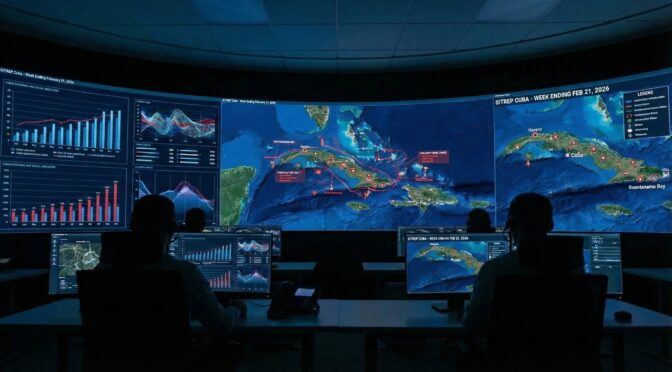
The week ending February 21, 2026, marks an unprecedented and potentially terminal inflection point in the political, economic, and social trajectory of the Republic of Cuba. The current environment is characterized by a massive convergence of external geopolitical strangulation, total systemic energy failure, the collapse of critical domestic infrastructure, and highly sensitive covert diplomatic maneuvering. The United States government, operating under the explicit directives of an executive order issued on January 29, 2026, has fundamentally altered its strategic posture toward Havana.1 Washington has effectively transitioned from enforcing a decades-long, largely financial and commercial economic embargo to executing a kinetic, globally enforced maritime quarantine designed to systematically dismantle Cuba’s energy logistics networks and international supply chains.2 This aggressive strategic escalation was catalyzed by the January 3, 2026, United States military operation in Caracas, Venezuela, which neutralized the leadership of Nicolás Maduro and abruptly severed the primary artery of heavily subsidized crude oil that had sustained the Cuban economy for over two decades.5
By publicly threatening secondary tariffs and devastating financial penalties on any third-party nation, private shipping firm, or maritime insurance conglomerate supplying petroleum to the island, the United States has successfully weaponized global maritime commerce.5 This pressure campaign has forced traditional regional suppliers, most notably the government of Mexico, as well as an array of private commodity traders, to abruptly abandon their Cuban contracts.5 The resulting domestic consequences of this comprehensive oil siege have catalyzed a rapid, cascading failure of Cuba’s critical national infrastructure. The national energy grid is currently operating at a catastrophic deficit, plunging the island into unpredictable, daily rolling blackouts that frequently last upwards of twelve to fifteen hours.10 Simultaneously, the absolute exhaustion of aviation fuel reserves has forced major international carriers, particularly those originating from Canada—historically Cuba’s largest source market for tourism—to suspend all flight operations indefinitely and initiate emergency protocols to repatriate thousands of stranded tourists.9
This comprehensive transportation paralysis has decimated the Cuban tourism sector, historically a vital engine for acquiring the hard currency necessary for state survival.12 The immediate economic fallout includes the indefinite postponement of the internationally renowned Habano cigar festival and the mass closure of major resort facilities in hubs such as Varadero.12 The cascading effects of the energy deficit have prompted the United Nations to formally issue warnings of an impending “humanitarian collapse”.2 This assessment cites the complete disruption of the state-regulated food rationing system, the paralysis of electrically dependent municipal water pumping stations, and a hollowed-out medical infrastructure that is currently operating with a seventy percent deficit of essential medicines while attempting to manage simultaneous, uncontrolled outbreaks of dengue fever, Oropouche fever, and chikungunya.5
Beneath the surface of this manufactured societal collapse, intelligence streams indicate that a highly delicate and secretive diplomatic backchannel is actively operating in Mexico City.17 Representatives of the United States are reportedly engaged in intense negotiations with General Alejandro Castro Espín, the son of former President Raúl Castro, effectively bypassing the civilian administration of President Miguel Díaz-Canel.20 This dynamic suggests that the current United States administration is leveraging the acute suffering of the Cuban populace to force structural economic concessions and the introduction of American corporate interests into specific sectors, rather than pursuing a purely ideological agenda of total regime change.9 Concurrently, traditional Cuban strategic allies, such as the Russian Federation and the People’s Republic of China, have offered rhetorical solidarity and minor humanitarian aid, but have notably refused to risk direct military or severe economic confrontation with the United States to break the maritime blockade.23 The Republic of Cuba is currently functioning as a besieged state, actively negotiating its sovereign survival while navigating the most profound existential threat to its current political and social structure since the October 1962 missile crisis.25
1.0 The Evolution of the United States Pressure Campaign
1.1 Executive Directives and the Legal Framework for Quarantine
The foundational architecture of the current crisis was established on January 29, 2026, when United States President Donald Trump issued a sweeping executive order declaring that the policies and actions of the Cuban government constitute an “unusual and extraordinary threat” to United States national security and foreign policy.1 This declaration formally invoked the National Emergencies Act and the International Emergency Economic Powers Act (IEEPA), granting the executive branch expansive authority to impose a comprehensive system of tariffs and financial penalties on any foreign entity or nation that directly or indirectly supplies oil to the Cuban government.1 The administration’s stated justification for this extreme measure extends beyond historical ideological grievances, explicitly citing national security imperatives. The White House has publicly alleged that Havana provides a safe environment for transnational terrorist organizations, specifically naming Hezbollah and Hamas, allowing them to build economic and logistical networks within the Western Hemisphere.9 Furthermore, the administration highlighted Cuba’s deepening intelligence and defense cooperation with the People’s Republic of China and its hosting of the Russian Federation’s largest overseas signals intelligence facility, framing the island as an active staging ground for adversaries seeking to steal sensitive national security information.26
The practical implementation of this executive order has marked a profound shift from a financial embargo to what the United States Charge d’Affaires in Havana, Mike Hammer, explicitly described to foreign diplomats on January 28 as a “real blockade”.9 The threat of secondary sanctions has been meticulously designed to target the global maritime logistics chain. By warning that any country providing oil to Cuba will face severe United States tariffs, Washington has effectively frozen the credit, insurance, and shipping markets that Havana relies upon.5 Shipping firms, commodity traders, and maritime insurers inherently pause operations when faced with secondary penalty risks, as the potential financial exposure in the United States market vastly outweighs the marginal profits of fulfilling Cuban contracts.8 This strategy demonstrates a sophisticated understanding of modern global supply chains, illustrating how “soft” diplomatic pressure and tariff threats seamlessly translate into hard, real-world disruption without requiring a formal congressional declaration of war.8
1.2 The Shift Toward Transactional Regime Modification
A critical analysis of the current United States posture reveals a significant deviation from the historical bipartisan consensus regarding Cuba. While previous administrations generally predicated the normalization of relations or the lifting of sanctions upon sweeping democratic reforms, the release of all political prisoners, and the dismantling of the single-party state, the current administration’s strategy appears to be fundamentally transactional.18 Intelligence assessments suggest that the United States is not explicitly demanding an immediate change to the political operating system of the Republic of Cuba as a precondition for a rapprochement.22 Instead, the administration is heavily focused on how the Cuban government manages its commercial, economic, and financial infrastructure.22
This transactional approach is modeled on the United States’ relationships with other single-party socialist states, such as the Socialist Republic of Vietnam and the People’s Republic of China, where ideological differences are managed alongside robust commercial engagement.22 The primary objective appears to be securing access and opportunities for United States-based corporations to export products, import goods, and provide services within a restructured Cuban economy.22 This dynamic was clearly telegraphed during the February 2026 Munich Security Conference, where United States Secretary of State Marco Rubio—historically a staunch advocate for total regime change—indicated that granting the Cuban people “more freedom, not just political freedom but economic freedom,” could represent a “potential way forward”.9 This subtle rhetorical shift implies that the United States might accept the continued existence of an authoritarian security state in Havana, provided it abandons its state-monopoly socialist economic model and permits the entry of American capital.9
The military operation in Venezuela in early January 2026 serves as the primary leverage point for this strategy. The removal of Nicolás Maduro demonstrated the United States’ willingness to employ direct kinetic action in the region.7 However, unlike Maduro, who was viewed by Washington as an optical and personality obstacle requiring physical extraction, Cuban President Miguel Díaz-Canel is not viewed with the same level of personalized animosity, largely because he is not perceived as the ultimate arbiter of power within the Cuban regime.22 Consequently, the United States strategy relies on inflicting overwhelming economic pain through the oil siege to force the true power brokers in Havana to the negotiating table, offering an “off-ramp” that exchanges ideological purity for regime survival via economic capitulation.18
2.0 The Diplomatic Backchannel and Dynastic Resurgence
2.1 The Re-emergence of Alejandro Castro Espín
As the external pressure mounts, the internal power dynamics of the Cuban state are undergoing a profound, albeit highly opaque, realignment. The most critical development is the verified existence of high-level, secretive backchannel negotiations taking place in Mexico City between representatives of the United States and the highest echelons of the Cuban power structure.17 Despite public statements from Cuban Deputy Foreign Minister Carlos Fernández de Cossío, who attempted to minimize the interactions as mere “exchanges of messages” while denying the existence of a formal dialogue table, regional intelligence sources confirm that substantive negotiations regarding the survival of the regime are actively underway.18
The composition of the Cuban delegation highlights the marginalized status of the civilian technocratic government.19 The negotiations are reportedly being spearheaded by General Alejandro Castro Espín, the forty-one-year-old son of former President Raúl Castro and the former head of Cuban counterintelligence.19 General Castro Espín previously served as the lead Cuban negotiator during the secret bilateral talks under the Obama administration that culminated in the temporary reestablishment of diplomatic relations in 2014.19 Following the formal transition of the presidency to Miguel Díaz-Canel in 2018, Castro Espín had completely vanished from public view, allegedly placed on the “pajama plan”—a Cuban colloquialism for forced, secretive early retirement within the ranks of the elite.19 His sudden re-emergence, initially previewed during an October 2024 political rally in Havana and now confirmed in the context of the Mexico City talks, indicates a structural reversion to dynastic authority.19
The Revolutionary Armed Forces (FAR) and the Ministry of the Interior (MININT), which possess total ownership over key areas of the economy including tourism and financial services via large holding companies like GAESA, recognize that the civilian administration led by Díaz-Canel lacks the necessary authority and historical legitimacy to negotiate a foundational surrender of the socialist economic model.30 When facing an existential threat, the Cuban power apparatus has bypassed its nominal civilian leaders and re-empowered the Castro bloodline to manage the crisis.19 Additional reporting suggests that Raúl Guillermo Rodríguez, the grandson of Raúl Castro, is also involved in high-level communications, further cementing the dynastic nature of the regime’s crisis management strategy.17
2.2 Parameters of the Secret Negotiations
The substance of the Mexico City negotiations, mediated discreetly by the government of Mexican President Claudia Sheinbaum, revolves around negotiating a managed transition that prevents the violent overthrow of the Cuban regime while satisfying Washington’s demands for economic access.17 According to diplomatic sources, the preliminary exchanges have focused on the potential easing of the acute energy embargo.21 The United States has proposed an initial gesture that would authorize the sale of American crude oil to Cuba in quantities sufficient to sustain its collapsing energy system—estimated at 100,000 to 150,000 barrels per day.21
In exchange for this vital lifeline, the United States is demanding that Havana permit the entry of American corporate entities into highly restricted and lucrative sectors of the Cuban economy, specifically targeting energy infrastructure, telecommunications, banking, and the remnants of the tourism industry.21 This proposed framework represents a fundamental contradiction for the Cuban elite.30 Public officials and the military high command have been heavily indoctrinated in the myth of the socialist revolution and inherently fear that sweeping economic liberalization will inevitably erode their monopoly on political power.30 However, the alternative—a total collapse of the state apparatus driven by mass starvation and civil unrest—leaves them with virtually no negotiating leverage.8
The Mexican government’s role in facilitating these talks highlights its own complex geopolitical position.17 President Sheinbaum has publicly stated that her administration is seeking a diplomatic solution to ease the fuel blockade and restore the oil supply contracts that the Mexican state-owned firm Pemex held with Havana until mid-January 2026.17 However, facing the overwhelming threat of United States tariffs on Mexican exports, Sheinbaum was forced to cancel further Pemex shipments, classifying the cessation as a “sovereign decision” to avoid the appearance of capitulation to Washington while protecting the broader Mexican economy.9 To counterbalance this withdrawal of vital fuel, Mexico has increased its provision of basic humanitarian aid, repeatedly dispatching naval vessels loaded with powdered milk and medical supplies to Havana.12 This approach allows Mexico to maintain its historical posture of solidarity with Cuba while strictly complying with the parameters of the United States energy quarantine.23
3.0 Global Autocratic Realignment and the Failure of Alliances
3.1 The Russian Federation’s Strategic Calculation
The aggressive United States posture toward Cuba has severely tested the operational reality of global autocratic cooperation, particularly the historical alliance between Havana and Moscow.23 For decades, the Russian Federation has cultivated close ties with the Cuban regime, utilizing the island as a strategic listening post and a mechanism to project power into the Western Hemisphere.31 However, the current crisis has laid bare the stark asymmetry of this relationship and the limits of Russian commitment in the face of direct United States military enforcement.31
During high-level bilateral meetings in Moscow on February 18, 2026, Russian President Vladimir Putin and Foreign Minister Sergei Lavrov hosted Cuban Foreign Minister Bruno Rodríguez Parrilla.33 The diplomatic rhetoric from the Russian side was robust; Lavrov publicly condemned the United States blockade as “illegitimate and inhumane,” warning that the restrictions were designed to stifle the economy and provoke violent regime change, and he explicitly demanded that Washington refrain from imposing a full naval military blockade.35 Putin echoed these sentiments, affirming that Russia consistently supports the Cuban people in their struggle for independence and rejects the United States’ aggressive containment strategy.33
However, the substantive outcome of the meeting was a definitive strategic withdrawal by Moscow.24 When Foreign Minister Rodríguez specifically requested that the Russian Navy be deployed to the Caribbean to escort Russian-flagged tankers and break the United States quarantine, President Putin flatly refused.24 Intelligence analyses from Moscow indicate that Putin clearly communicated that while Russia maintains historical solidarity with Cuba, it will not risk a direct military conflict with the United States Navy or Southern Command to secure Havana’s energy supply.24 Regional security analysts characterized this decision as highly pragmatic, noting that Putin is operating with the caution of Mikhail Gorbachev rather than the brinkmanship of Nikita Khrushchev during the 1962 missile crisis.24
This calculation is driven by multiple factors. The Russian economy is currently under significant strain, and the logistical challenges of transporting crude oil from the Black Sea across the Atlantic to Havana are immense.23 Furthermore, the financial risk is unacceptable; deploying Russian tankers under the active threat of seizure by the United States, coupled with the denial of international maritime insurance, makes the endeavor economically unviable.23 Historically, Putin has viewed Cuba as a transactional asset rather than a sacred ideological partner; in 2001, he offered to close the massive Russian signals intelligence base in Lourdes, Cuba, in exchange for improved business relations with the United States.24 Consequently, Moscow’s current support is limited to rhetorical defense at international forums and minor, indirect economic assistance that remains strictly below the threshold of triggering United States retaliation.23
3.2 The People’s Republic of China’s Cautious Distance
The People’s Republic of China has adopted an even more restrained and cautious diplomatic posture regarding the Cuban crisis.23 While Beijing has increasingly utilized its economic leverage to support fellow socialist states and challenge United States hegemony globally, its response to the siege of Havana has been meticulously calibrated to avoid direct confrontation.23 The Chinese Ministry of Foreign Affairs has repeatedly issued statements calling on the United States to lift its unilateral sanctions and respect Cuban sovereignty, but Beijing has explicitly refused to step in as the primary energy guarantor for the island.23
China’s strategic calculus dictates that while maintaining a foothold in the Caribbean is desirable, triggering a full-scale trade war with the United States or exposing its state-owned shipping conglomerates to secondary sanctions over Cuba is an unacceptable risk.23 Therefore, Chinese support has been strictly limited to the provision of “emergency humanitarian aid,” which primarily consists of financing the export of solar panels, limited food shipments, and basic medical supplies.23 While this assistance provides marginal relief, it is entirely insufficient to offset the massive macroeconomic deficit created by the United States blockade of millions of barrels of crude oil.23
The collective failure of both Russia and China to actively break the United States energy quarantine demonstrates a profound shift in the global geopolitical architecture. It reveals that in an era of intense economic interconnectivity and overwhelming United States maritime dominance, autocratic alliances are heavily constrained by pragmatic economic self-interest.23 The Republic of Cuba, despite its strategic location and historical alignment with anti-Western blocs, has been functionally abandoned to face the United States pressure campaign alone.23
4.0 Kinetic Maritime Interdiction and the Blockade Mechanism
The enforcement mechanism of the United States strategy has rapidly evolved from theoretical tariff threats to aggressive, kinetic maritime interdiction operations spanning multiple global theaters.3 Following the January 29 executive order, the United States Department of Defense, utilizing assets from both the Southern Command and the Indo-Pacific Command, initiated a comprehensive campaign to identify, track, and seize vessels attempting to supply petroleum to Cuba.3 This marks a significant escalation, transitioning the policy from an economic embargo to a de facto naval blockade, despite the absence of a formal declaration of war.2

The most significant demonstration of this global capability occurred on February 9, 2026, with the interception and boarding of the oil tanker Aquila II.3 This vessel, laden with approximately 700,000 barrels of Venezuelan heavy crude oil intended for Havana, departed Venezuelan waters in early January following the capture of Nicolás Maduro.3 In an attempt to evade the United States quarantine, the Aquila II operated under a false registry to obscure its identity as part of the global “dark fleet” often utilized by sanctioned states.3 The vessel fled the Caribbean, prompting a relentless pursuit by United States naval forces across the Atlantic Ocean and around the African continent.3 The pursuit concluded when the tanker was boarded and seized in the middle of the Indian Ocean by assets under the Indo-Pacific Command.3
The Aquila II seizure represents the eighth vessel captured by United States forces since late 2025.4 Prior operations included the January 7 boarding and seizure of the Russian-linked tanker Marinera and the Panama-flagged M Sophia in the Caribbean theater.4 The Department of Defense has utilized these seizures to project a highly assertive deterrent posture. Official statements declared that “no other nation has the reach, endurance or will to do this,” emphasizing that international waters do not provide sanctuary and warning adversaries that “you will run out of fuel long before you will outrun us”.3
This aggressive enforcement has systematically dismantled the shadow fleet that Havana previously relied upon to circumvent international sanctions.4 More importantly, the physical seizures have fundamentally altered the risk calculus for the entire global shipping industry.8 Legitimate shipping firms, commodity traders, and maritime insurance conglomerates operate on risk models that cannot accommodate the high probability of physical vessel seizure and total cargo forfeiture.8 Consequently, the maritime logistics network supporting Cuba has entirely frozen. According to tracking data from the commodities consultancy Kpler, Mexico delivered its final, minor cargo on January 9, and since the escalation of United States threats, all inbound flows have ceased.8 Analysts estimate that as of mid-February, Cuba possesses fewer than twenty days of crude oil in storage, leaving the island completely exposed to a total cessation of critical services.8 To enforce the local perimeter, the United States has also repositioned amphibious assault ships, including the USS Iwo Jima and the USS San Antonio, in the Atlantic off Cuba’s northern coast, projecting overwhelming conventional military dominance just outside territorial waters.12
| Maritime Interdiction Timeline (Recent Key Events) | Target Vessel / Entity | Operational Details |
| January 3, 2026 | Government of Venezuela | U.S. military operation in Caracas; arrests Maduro; ceases crude exports to Cuba. |
| January 7, 2026 | Marinera & M Sophia | Russian-linked and Panama-flagged tankers boarded and seized in the Caribbean. |
| January 29, 2026 | Global Shipping / Third-Party States | U.S. Executive Order threatens secondary tariffs on any entity supplying oil to Cuba. |
| February 9, 2026 | Aquila II | Tanker carrying 700k barrels of Venezuelan crude seized in the Indian Ocean after global pursuit. |
Data compiled from Department of Defense announcements and global maritime tracking sources.1
5.0 National Grid Failure and the Energy Deficit
The immediate domestic consequence of the maritime blockade is the total systemic failure of Cuba’s national energy infrastructure.10 The island’s electricity generation system is fundamentally reliant on aging, highly inefficient thermal power plants that require constant inputs of imported petroleum.11 Cuba’s domestic oil production is minimal, capable of satisfying barely forty percent of the nation’s baseline demand.10 Furthermore, the crude extracted domestically is a heavy, sour variant that requires blending with lighter imported crude to be processed effectively in the country’s decaying refineries; notably, one of these strained facilities caught fire in mid-February, further crippling processing capacity.12
Historically, Cuba has relied on foreign imports to meet approximately sixty percent of its total energy needs.11 In 2025, Venezuela contributed roughly 34 percent of Cuba’s total oil demand, while Mexico supplied 44 percent.7 The sudden and total cessation of both supply lines has created an insurmountable mathematical deficit for the national grid.7 By mid-February 2026, the Cuban Electrical Union reported that generation capacity could cover less than half of the national peak demand—leaving a massive shortfall of approximately 3,100 megawatts.13

The immediate result is a brutal regime of rolling blackouts that leave an estimated 50 to 60 percent of consumers—and up to 64 percent of the island during peak hours—without electricity for upwards of twelve to fifteen hours per day.11 Some energy experts project that a “total blackout” of the entire national grid could occur as early as March 2026 if fuel shipments do not resume immediately.12 In response, the government of President Díaz-Canel has implemented harsh emergency measures, prioritizing the meager remaining fuel reserves strictly for national defense, hospitals, and vital food production.6 All non-essential state enterprises have been reduced to a four-day workweek, universities have suspended in-person attendance, and public transportation has been drastically curtailed or completely canceled across major urban centers.4
To manage the absolute scarcity of gasoline for civilian use, the Ministry of Transportation has mandated the use of a digital queuing application known as “Ticket”.38 The implementation of this system has effectively institutionalized severe rationing, limiting purchases to just 20 liters per vehicle and pushing wait times for a refueling appointment to several months.37 The vast majority of service stations in Havana, such as those in the central El Vedado district, are completely dry.39 Furthermore, starting in early February, the state mandated that fuel at available stations must be purchased in United States dollars, a policy that structurally excludes the vast majority of the population who are paid in rapidly depreciating Cuban pesos, further exacerbating profound social inequality.37
In a desperate bid to mitigate the disaster, the government has accelerated a massive pivot toward renewable energy, specifically solar power.36 Backed by Chinese financing and equipment donations, Cuban authorities claim to have added over 1,000 megawatts of solar capacity to the grid, which now accounts for roughly 38 percent of daytime electricity output.10 The government has announced the installation of an additional 5,000 solar systems targeting isolated communities and vital service centers like polyclinics and maternity homes.40 Furthermore, new tax incentives have been implemented to encourage private citizens to import and install solar panels.36 However, the high capital cost of these imported systems, which are priced in foreign currency, makes them accessible only to successful private entrepreneurs or individuals receiving substantial financial remittances from relatives overseas.36 Consequently, while solar energy provides isolated pockets of relief, it is entirely insufficient to replace the baseload power generation required to run an industrialized national economy.32
6.0 Macroeconomic Collapse and the Annihilation of Tourism
The macroeconomic data emerging from Cuba paints a portrait of an economy in terminal freefall. The national economy has shrunk by an estimated 11 percent between 2019 and 2024, with a further 5 percent contraction recorded over the course of 2025.9 While official statistics from the National Office of Statistics report the annual inflation rate eased slightly to 12.52 percent in January 2026 (down from 14.07 percent in December 2025), independent economists and market realities suggest the true rate of inflation—fueled by the collapse of the peso, extreme scarcity of basic goods, and total reliance on the black market—is exponentially higher, effectively destroying the purchasing power of state wages and pensions.9
| Macroeconomic Indicator | Latest Value (Jan/Feb 2026) | Historical Context / Peak |
| Annual Inflation Rate (Official) | 12.52 percent | Peak: 77.30 percent (Dec 2021) |
| Balance of Trade Deficit | 6,596 Million USD | Chronic structural deficit |
| Interest Rate | 2.25 percent | Stagnant monetary policy |
| Crude Oil Production | 25.00 BBL/D/1K | Covers less than 40% of demand |
Data compiled from the National Office of Statistics, Republic of Cuba and international economic monitors.41
The most devastating immediate economic blow has been the functional annihilation of the tourism sector, historically the island’s primary engine for acquiring the hard currency necessary to import food and fuel.12 The national fuel crisis has cascaded directly into the aviation sector. On February 8, 2026, Cuban aviation authorities issued a Notice to Airmen (NOTAM) declaring an absolute exhaustion of aviation fuel, suspending refueling operations at Havana’s José Martí International Airport and the country’s eight other main airports until at least March 11, 2026.9
This NOTAM prompted immediate and total flight suspensions by major international carriers, most notably Air Canada, WestJet, and Air Transat.9 Given that Canada is the absolute largest source market for Cuban tourism—providing 860,000 visitors in 2024—the withdrawal of Canadian airlines is catastrophic for the state budget.12 Air Canada alone was forced to initiate emergency operations to repatriate over 3,000 stranded tourists back to North America.9 While some European carriers, such as Air Europa, have managed to maintain their routes by implementing costly technical refueling stops in Santo Domingo, Dominican Republic, the overall volume of arrivals has plummeted.9 Mexican carriers like Viva are maintaining operations only because they can complete round trips by refueling at their own bases in Mexico.12
The tourism industry was already severely weakened prior to the total fuel cutoff. The year 2024 concluded with just 1.9 million visitors, a 14 percent decline from the previous year and 62 percent below the 2018 peak of 4.7 million travelers.12 Official estimates for tourism revenue at the end of 2024 were a meager 917 million USD, a fraction of historical yields.12 Currently, major resort towns like Varadero have been described as skeleton operations, with the majority of hotels forced to close due to the inability to guarantee power, food, or air conditioning for guests.12
Further compounding the loss of foreign exchange, the Cuban government was forced to indefinitely postpone the iconic Habano cigar festival, originally scheduled for February 24-27, 2026.14 This annual event is a massive international showcase that historically generates millions of dollars and serves as a vital networking nexus for Habanos S.A., the state’s premium export joint venture.15 Organizers cited the inability to guarantee the “highest standards of quality and experience” due to the fuel crisis.14 The cancellation serves as a highly visible international admission of the state’s incapacity to maintain basic operational continuity, deeply damaging the brand prestige of one of its few remaining viable export products.15 Additionally, industrial output has ground to a halt; the Canadian company Sherritt International, which operates a massive nickel and cobalt mine at Moa, reported that it had to suspend operations entirely due to the lack of fuel, severing another critical revenue stream.32
7.0 Humanitarian, Health, and Epidemiological Crises
The intersection of the energy deficit, chronic financial insolvency, and the United States blockade has pushed the Cuban population into a state of profound humanitarian distress.5 The United Nations has formally raised the alarm, with the Spokesperson for the Secretary-General explicitly warning that the humanitarian situation will “worsen, and if not collapse” if the island’s energy needs remain unmet.2
7.1 Extreme Poverty and Food Insecurity
The metrics of the crisis are staggering. Independent economic analyses indicate that nearly 89 percent of the Cuban population is currently living in extreme poverty.12 Citizens are attempting to survive on an average monthly state salary equivalent to approximately 15 USD, while a vast segment of the elderly population relies on minimum pensions equivalent to just 7 USD.12
The fuel shortage has critically disrupted the state-managed logistical networks responsible for the distribution of the regulated basic food basket, effectively severing the final lifeline for the most vulnerable demographics.16 This breakdown affects critical social protection networks, including school feeding programs, maternity homes, and nursing facilities.16 The lack of diesel for agricultural machinery and domestic transportation means that domestic food production is paralyzed, leaving urban centers entirely dependent on imports that the state can no longer afford.8 The Ministry of Public Health has acknowledged a drastic rise in malnutrition, with reports indicating that 70 percent of Cubans are forced to skip meals due to severe shortages, and a significant portion of the population is reduced to eating only once a day.12
The impact on children is particularly severe. The United Nations Children’s Fund (UNICEF) reports that ten percent of children on the island are currently living in “severe food poverty”.12 In response to this unprecedented crisis, the Cuban government was forced into the humiliating position of formally requesting emergency assistance from the United Nations World Food Programme, specifically asking for shipments of powdered milk to feed children under the age of seven.12 While international actors like Mexico have sent naval vessels carrying humanitarian shipments of powdered milk, and the Canadian parliament is debating emergency food aid, experts note that a nation of 11 million people cannot survive indefinitely on external charity while its macro-economy remains completely paralyzed by an energy blockade.12
7.2 The Collapse of the Public Health System
The Cuban public health system—once heavily promoted internationally as a paradigm of universal primary care and a core pillar of the socialist revolution’s legitimacy—is in a state of functional collapse.12 Hospitals and local clinics are currently operating with an estimated 70 percent deficit in essential medicines and basic diagnostic reagents.12 In clinics across Havana, physicians like Dr. Omitsa Valdés are forced to inform patients that they must supply their own syringes, medications, and even the chemical reagents necessary for basic blood and urine tests.12 Hospitals suffer from peeling hallways, burnt-out lightbulbs, and a lack of basic furniture, with patients frequently forced to lean against walls or bring their own bedding and food.12 The ongoing power outages critically compromise intensive care units, emergency rooms, and the cold-chain storage required for vaccines, blood products, and other temperature-sensitive medications.16
This systemic vulnerability is currently being exploited by a severe, multi-vector epidemiological crisis.12 Cuba is currently battling simultaneous, uncontrolled outbreaks of dengue fever, Oropouche fever, and chikungunya, alongside a surge in nine different respiratory viruses and acute diarrheal diseases.12 The epicenter of this crisis has been traced to the city of Matanzas, where the infections rapidly overwhelmed local health infrastructure before spreading nationwide.12 Patients report severe symptoms including fevers reaching 40ºC, debilitating joint pain, and vomiting, with numerous unofficial reports of deaths resulting from hemorrhagic dengue fever.12
The state’s inability to control these vector-borne diseases is directly linked to the broader infrastructure failure. A lack of fuel prevents the operation of fumigation trucks, while the inability to power municipal water pumps—over 80 percent of which depend entirely on the electric grid—leaves citizens without safe drinking water or the means to maintain basic sanitary hygiene.12 Residents are forced to store water in open containers during blackouts, creating ideal breeding grounds for the Aedes aegypti mosquito, the primary vector for these viruses.12 Furthermore, the collapse of municipal sanitation services, hindered by a severe lack of fuel for garbage trucks and a shortage of personnel in the state-owned firm Comunales, has resulted in massive accumulations of waste in urban centers like Havana, where over 30,000 cubic meters of garbage accumulate daily, exacerbating the spread of infection.12
The crisis is compounded by a massive brain drain from the medical sector. The severe economic conditions and the extreme devaluation of state salaries have forced thousands of highly trained medical professionals to emigrate or abandon their practice to work in the private sector; for example, trained physicians frequently resort to driving moto-taxis because they can earn more in a single day than they would in a month practicing medicine.9 Consequently, the ratio of family doctors to citizens has plummeted from one per 350 people in the 1980s to one per 1,500 today, leaving the population highly vulnerable and stripping the state of its ability to monitor and respond to public health emergencies.12
8.0 Internal Security, Dissidence, and State Repression
The intense psychological and physical toll of mass starvation, prolonged periods of darkness, and rampant disease has steadily eroded the traditional mechanisms of state compliance and social control in Cuba. Since 2024, the island has experienced a rolling continuum of localized protests, driven almost entirely by the lack of food, the collapse of electric power, and the sharp rise in internet costs.43 The government’s absolute inability to provide basic services has fundamentally broken the foundational social contract of the revolution, forcing the state to rely increasingly on brute force to maintain order.43
During the week ending February 21, 2026, the structural strain manifested in spontaneous acts of civil disobedience.44 On February 6, a massive “cacerolazo” (the loud banging of pots and pans as a form of protest) erupted during a prolonged blackout in the Arroyo Naranjo district of Havana.44 In other urban sectors, desperate residents have resorted to setting fire to the accumulating piles of garbage in the streets—a highly visible and hazardous tactic designed to force authorities to deploy emergency services and momentarily restore power to the localized grid.12
Despite the severe national fuel shortage that has paralyzed civilian transportation, agriculture, and emergency medical services, the government continues to prioritize the allocation of its dwindling diesel reserves to its repressive forces.12 State Security agents maintain constant surveillance on known dissidents, independent journalists, and political influencers.12 Authorities frequently station patrol cars outside the residences of those demanding political change or the release of prisoners, enforcing de facto house arrest to dissuade them from mobilizing the public.12
The penal system remains the primary tool of social control. As of early 2026, the nongovernmental organization Prisoners Defenders reported that Cuba is holding nearly 700 verified political prisoners.43 A significant portion of these individuals, estimated at 359 by the organization Justicia 11J, are serving extreme sentences of up to 22 years for their participation in the landmark July 2021 anti-government demonstrations.43 Reports from Human Rights Watch detail systematic and horrific abuses within these penal facilities.12 Prisoners are subjected to physical beatings, prolonged solitary confinement, sleep deprivation, and the denial of basic medical care.12 Guards routinely utilize stress positions, such as “the bicycle,” forcing handcuffed prisoners to run with their arms raised above their heads.12 Prominent dissidents, such as José Daniel Ferrer, have been severely beaten and denied treatment during tuberculosis outbreaks within the prisons.12 While the government did negotiate the release of 553 detainees in January 2025 following Vatican-led mediation, the underlying legal and judicial structures that facilitate arbitrary detention without due process remain fully intact, ensuring that the courts serve exclusively as instruments of the executive branch to punish dissent.12
This breakdown in the social fabric has also led to a marked increase in public insecurity and ordinary crime.12 The historical perception of Cuba as a highly secure, heavily policed society has evaporated. Citizens report a surge in violent robberies, home invasions, and the theft of highly prized items such as electric generators, bicycles, and personal food reserves.12 The police response to ordinary crime is reportedly abysmal, with victims waiting hours for assistance.12 This stands in stark contrast to the immediate and overwhelming deployment of militarized Special Forces (known as the “Black Wasps”) when politically motivated protests occur.12 This selective application of state security further alienates the population, underscoring that the state’s primary function is no longer public welfare, but elite preservation.12 Driven by this combination of economic collapse and repression, the country has suffered an unprecedented demographic collapse, losing roughly ten percent of its population in recent years as millions flee the island, shrinking the total population from 11 million to approximately 8.5 million.12
9.0 Strategic Outlook and Intelligence Projections
Based on the synthesis of the preceding diplomatic, military, and macroeconomic intelligence, the trajectory of the Republic of Cuba over the next thirty to ninety days is highly volatile and inherently unstable. The United States strategy of maximalist economic warfare—transitioning from a passive financial embargo to an active, globally enforced maritime energy quarantine—has successfully brought the Cuban state infrastructure to the absolute precipice of total systemic failure.2
Intelligence streams suggest three highly probable, though non-exclusive, scenarios for the near term:
Scenario 1: Negotiated Capitulation (The “Off-Ramp”) The backchannel negotiations in Mexico City between the United States and the dynastic Castro family faction (led by Alejandro Castro Espín) yield a transactional, macroeconomic agreement.18 Under immense pressure to prevent the violent overthrow of the regime and the total loss of their wealth and status, the Revolutionary Armed Forces (FAR) agree to a controlled, structural opening of the Cuban economy. They will concede strategic sectors to American corporate interests in exchange for an immediate lifting of the naval quarantine and the resumption of crude oil shipments.21 This scenario allows the United States to claim a strategic victory in opening a closed market while avoiding the geopolitical chaos of a collapsed state ninety miles from its borders. Crucially, it allows the Cuban military elite to transition from communist administrators to oligarchic managers, akin to the post-Soviet transition in Eastern Europe, maintaining their wealth while shedding the responsibility of universal social welfare.
Scenario 2: State Collapse and Uncontrolled Mass Migration If the negotiations fail, or if hardliners in either Washington or Havana successfully sabotage the talks, the island’s energy reserves will hit absolute zero within weeks.8 The total, permanent paralysis of water pumping, food distribution, and hospital generators will trigger a rapid transition from severe hardship to mass casualty events. This will inevitably ignite uncontrollable, widespread civilian riots that overwhelm the physical capacity of State Security and the military, resulting in the violent fracture of the government apparatus. The immediate secondary consequence of this scenario will be an unprecedented, chaotic maritime migration crisis aimed directly at the Florida straits, fundamentally destabilizing the immediate region and forcing a massive reactionary military and humanitarian response from the United States Coast Guard and Southern Command.12
Scenario 3: Hardened Retrenchment and Escalated Repression The Cuban regime, calculating that any economic concession will inevitably lead to a total loss of political control, rejects the United States demands outright.30 President Díaz-Canel and the military elite invoke a state of total siege, executing the doctrine of “the war of all the people,” and radically escalating domestic repression to crush any dissent.12 The state formally abandons any pretense of providing universal social services, hoarding all remaining resources and fuel exclusively for the military and political elite. They attempt to survive by relying on bare-minimum humanitarian drops from China and Mexico to keep a subservient underclass alive. This scenario prolongs the agonizing status quo, institutionalizing extreme poverty and turning the island into an isolated, heavily militarized holding pen, effectively becoming a Caribbean equivalent to North Korea.
The current evidence, specifically the confirmed physical presence of top-tier, non-civilian Cuban leadership engaging with United States intermediaries in foreign capitals, strongly suggests that Scenario 1 is currently the primary operational objective for both the Trump administration and the pragmatists within the Cuban military establishment.21 However, the extremely narrow timeframe dictated by the complete exhaustion of the island’s fuel reserves means that if a diplomatic breakthrough is not achieved imminently, the physical realities of the energy blockade will preempt negotiations, forcing the situation rapidly toward catastrophic collapse.
Please share the link on Facebook, Forums, with colleagues, etc. Your support is much appreciated and if you have any feedback, please email us in**@*********ps.com. If you’d like to request a report or order a reprint, please click here for the corresponding page to open in new tab.
Sources Used
- U.S. Policy Toward Cuba: Recent Developments and Congressional Considerations, accessed February 21, 2026, https://www.congress.gov/crs-product/IN12650
- Economic Warfare in the Caribbean: Cuba’s Fuel Crisis and the Unravelling “Rules Based Order” – Australian Institute of International Affairs, accessed February 21, 2026, https://www.internationalaffairs.org.au/australianoutlook/economic-warfare-in-the-caribbean-cubas-fuel-crisis-and-the-unravelling-rules-based-order/
- U.S. interceptions of oil tankers in Indian Ocean demonstrate global ability to disrupt illicit maritime activity, accessed February 21, 2026, https://ipdefenseforum.com/2026/02/u-s-interceptions-of-oil-tankers-in-indian-ocean-demonstrate-global-ability-to-disrupt-illicit-maritime-activity/
- U.S. Naval Blockade and Regime Change Dynamics in the Republic of Cuba (Q1 2026), accessed February 21, 2026, https://debuglies.com/2026/02/10/u-s-naval-blockade-and-regime-change-dynamics-in-the-republic-of-cuba-q1-2026/
- Cuba: UN warns of possible humanitarian ‘collapse’, as oil supplies dwindle – UN News, accessed February 21, 2026, https://news.un.org/en/story/2026/02/1166895
- From blackouts to food shortages: How US blockade is crippling life …, accessed February 21, 2026, https://www.aljazeera.com/economy/2026/2/8/from-blackouts-to-food-shortages-how-us-blockade-is-crippling-life-in-cuba
- The Cuban Revolution holds out against U.S. imperialism – MR Online, accessed February 21, 2026, https://mronline.org/2026/02/20/the-cuban-revolution-holds-out-against-u-s-imperialism/
- How US tariff threats froze Cuba’s oil lifeline, and who is picking up the pieces – TradingView, accessed February 21, 2026, https://www.tradingview.com/news/invezz:f54f92452094b:0-how-us-tariff-threats-froze-cuba-s-oil-lifeline-and-who-is-picking-up-the-pieces/
- No fuel, no tourists, no cash – this was the week the Cuban crisis got …, accessed February 21, 2026, https://www.theguardian.com/news/ng-interactive/2026/feb/15/cuba-crisis-oil-shortage-venezuela-donald-trump-havana
- Cubans Struggle Against a Tightening U.S. Noose – Truthdig, accessed February 21, 2026, https://www.truthdig.com/articles/cubans-struggle-under-a-tightening-us-noose/
- Cuba Faces Deepening Energy Crisis as Fuel Imports Dry Up – National Today, accessed February 21, 2026, https://nationaltoday.com/us/dc/washington/news/2026/02/12/cuba-faces-deepening-energy-crisis-as-fuel-imports-dry-up
- The sinking of Cuba: ‘We are a sacrificial altar’ | International | EL …, accessed February 21, 2026, https://english.elpais.com/international/2026-02-21/the-sinking-of-cuba-we-are-a-sacrificial-altar.html
- WestJet, Transat Halt Cuba Flights Over Fuel Shortage – Mexico Business News, accessed February 21, 2026, https://mexicobusiness.news/aerospace/news/westjet-transat-halt-cuba-flights-over-fuel-shortage
- Havana, Feb 14, 2026 (AFP) – Cuba cancels cigar festival amid economic crisis | NAMPA, accessed February 21, 2026, https://www.nampa.org/text/22860155
- Cuba delays Habano Festival, losing key foreign currency source | News.az, accessed February 21, 2026, https://news.az/news/cuba-delays-habano-festival-losing-key-foreign-currency-source
- Concerns over Cuba’s deepening economic crisis | OHCHR, accessed February 21, 2026, https://www.ohchr.org/en/press-briefing-notes/2026/02/concerns-over-cubas-deepening-economic-crisis
- The United States demands Cuba make ‘dramatic changes very soon’, accessed February 21, 2026, https://english.elpais.com/usa/2026-02-19/the-united-states-demands-dramatic-changes-very-soon-from-cuba.html
- What a Deal Between Trump and Cuba Might Look Like – National Security Archive, accessed February 21, 2026, https://nsarchive.gwu.edu/sites/default/files/2026-02/2026-02-05_-_foreign_policy_-what_a_deal_between_trump_and_cuba_might_look_like.pdf
- Alejandro Castro Espín, Cuba’s prince in the shadows | International | EL PAÍS English, accessed February 21, 2026, https://english.elpais.com/international/2026-02-09/alejandro-castro-espin-cubas-prince-in-the-shadows.html
- Cubans wonder if they could be next after Venezuela as rumours swirl about U.S. talks, accessed February 21, 2026, https://www.cbc.ca/news/politics/cuban-cia-castro-energy-collapse-9.7078628
- The Cuban Regime Negotiates Its Survival with Washington, According to ABC News, accessed February 21, 2026, https://translatingcuba.com/the-cuban-regime-negotiates-its-survival-with-washington-according-to-abc-news/
- Trump Administration Opens Diplomatic Door To Cuba: First, Change The Economy. Second, Invite U.S. Companies. Third, For Now, Type Of Government Not Important- Just Make It Work Like China, Vietnam, accessed February 21, 2026, https://www.cubatrade.org/blog/2026/2/15/6gmgnfs8du6zv9u9lx9hjvrkiwmwig
- The Energy Siege Of 2026: Cuba’s Struggle For Survival Amidst International Sanctions And Systemic Collapse – Analysis, accessed February 21, 2026, https://www.eurasiareview.com/20022026-the-energy-siege-of-2026-cubas-struggle-for-survival-amidst-international-sanctions-and-systemic-collapse-analysis/
- The Putin plan for Cuba and the Castro family-more Gorbachev …, accessed February 21, 2026, https://mronline.org/2026/02/21/the-putin-plan-for-cuba-and-the-castro-family-more-gorbachev-definitely-not-khrushchev/
- SWP call to action: US hands off Cuba! End Washington’s economic blockade!, accessed February 21, 2026, https://themilitant.com/2026/02/13/swp-call-to-action-us-hands-off-cuba-end-washingtons-economic-blockade/
- Addressing Threats to the United States by the Government of Cuba – The White House, accessed February 21, 2026, https://www.whitehouse.gov/presidential-actions/2026/01/addressing-threats-to-the-united-states-by-the-government-of-cuba/
- ‘The regime has to go’: Rubio in secret talks with Cuba’s Raul Guillermo Rodriguez, grandson of Castro, accessed February 21, 2026, https://timesofindia.indiatimes.com/world/us/the-regime-has-to-go-rubio-in-secret-talks-with-cubas-raul-guillermo-rodriguez-grandson-of-castro/articleshow/128509950.cms
- The mystery surrounding Cuba’s next ruler: The man who is emerging as the ‘Delcy Rodríguez of Havana’ – El Pais in English, accessed February 21, 2026, https://english.elpais.com/international/2026-02-14/the-mystery-surrounding-cubas-next-ruler-the-man-who-is-emerging-as-the-delcy-rodriguez-of-havana.html
- A deal that Cuba (and Trump) cannot refuse? – Responsible Statecraft, accessed February 21, 2026, https://responsiblestatecraft.org/deal-cuba-trump/
- How far will Trump push Cuba?, accessed February 21, 2026, https://www.chathamhouse.org/2026/02/how-far-will-trump-push-cuba
- Cuba’s Woes Threaten the Kremlin’s Authoritarian International, accessed February 21, 2026, https://cepa.org/article/cubas-woes-threaten-the-kremlins-authoritarian-international/
- Cuba running on fumes as Canada considers sending relief | CBC …, accessed February 21, 2026, https://www.cbc.ca/news/politics/cuba-canada-embargo-aid-9.7100202
- Putin: Russia considers new restrictions against Cuba unacceptable, accessed February 21, 2026, https://www.chinadailyasia.com/article/629149
- Russia considers new restrictions against Cuba unacceptable: Putin, accessed February 21, 2026, http://en.ce.cn/main/latest/202602/t20260219_2779996.shtml
- Lavrov: We urge the U.S. to refrain from imposing a naval military blockade on Cuba, accessed February 21, 2026, https://www.radiorebelde.cu/english/lavrov-we-urge-the-u-s-to-refrain-from-imposing-a-naval-military-blockade-on-cuba-18022026/
- Cuba Turns to Solar Power as Energy Crisis Deepens Amid US Sanctions – Fine Day 102.3, accessed February 21, 2026, https://now.solar/2026/02/21/cuba-turns-to-solar-power-as-energy-crisis-deepens-amid-us-sanctions-fine-day-102-3/
- Darío Hernández – Translating Cuba, accessed February 21, 2026, https://translatingcuba.com/category/authors/dario-hernandez/
- Cuban drivers face monthslong wait for gasoline in a government app designed to reduce lines, accessed February 21, 2026, https://apnews.com/article/cuba-fuel-22a2a6377a83fc0fecb346e175c3bc81
- Most Havana Gas Stations Have Stopped Pumping, accessed February 21, 2026, https://havanatimes.org/features/most-havana-gas-stations-have-stopped-pumping/
- Cuban president announces increase in renewable energy – Radio Rebelde, accessed February 21, 2026, https://www.radiorebelde.cu/english/cuban-president-announces-increase-in-renewable-energy-05022026/
- Cuba Inflation Rate – Trading Economics, accessed February 21, 2026, https://tradingeconomics.com/cuba/inflation-cpi
- Cuba Indicators – Trading Economics, accessed February 21, 2026, https://tradingeconomics.com/cuba/indicators
- World Report 2026: Cuba | Human Rights Watch, accessed February 21, 2026, https://www.hrw.org/world-report/2026/country-chapters/cuba
- 2024–2026 Cuban protests – Wikipedia, accessed February 21, 2026, https://en.wikipedia.org/wiki/2024%E2%80%932026_Cuban_protests