Analysis Published February 8, 2026
The geopolitical equilibrium of the Caribbean Basin has undergone a seismic shift in early 2026, precipitated by the convergence of a total regional energy collapse and an aggressive resurgence of the Monroe Doctrine in United States foreign policy. Following the high-stakes military operation that resulted in the capture of Venezuelan President Nicolás Maduro on January 3, 2026, the subsequent cessation of all subsidized petroleum shipments to Havana has pushed the Cuban state to an existential precipice.1 Faced with a deteriorating electrical grid, a lack of liquid currency, and mounting domestic desperation, the Cuban leadership, headed by Miguel Díaz-Canel and the veteran leadership of the Communist Party of Cuba (PCC), has formally invoked the nation’s ultimate survival mechanism: the doctrine of the “War of the Entire People” (Guerra de todo el pueblo).3
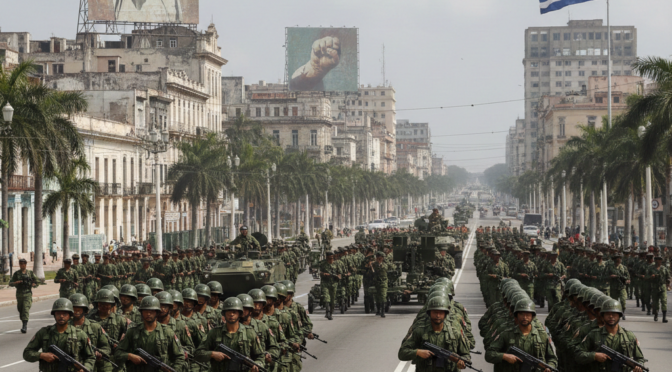
On January 29, 2026, the situation escalated further when U.S. President Donald Trump declared a “national emergency” regarding Cuba and signed an executive order establishing a system of ad valorem tariffs on any country providing oil to the island. This strategic posture is not merely a declaration of combat readiness but a comprehensive mobilization of the island’s social, economic, and paramilitary architecture. As the National Defense Council declared a formal “State of War” on January 17, 2026, the island transitioned into a configuration where every citizen is a combatant and every neighborhood is a fortified trench.4
Doctrinal Foundations and Historical Evolution
The concept of the “War of the Entire People” is rooted in the synthesis of Cuba’s 19th-century independence struggles and the ideological lessons of the 20th-century Cold War. It emerged as a formalized state doctrine in the early 1980s, primarily as a response to the Reagan administration’s perceived hostility and the realization that the Soviet Union would not—or could not—guarantee Cuba’s survival in a direct conflict with the United States.5 By moving away from a traditional, capital-intensive Soviet military model toward a labor-intensive territorial defense system, Havana sought to create a deterrent based on the “prohibitive cost” of an invasion.7
The core tenets of this doctrine assume that while a technologically superior adversary might achieve initial air and maritime dominance, it cannot successfully occupy or pacify a population that is universally armed and organized for perpetual resistance.7 This strategic logic is codified in Law No. 75 of National Defense (1994), which establishes the legal and organizational framework for the country’s transition from peace to a state of war.10
The Role of Constitutional Duty
National defense is elevated to a supreme civic virtue under the Cuban legal system. Article 65 of the Constitution explicitly states that the defense of the “socialist homeland” is the greatest honor and duty of every citizen.10 This legal mandate allows the state to bypass traditional distinctions between civilian and military spheres, ensuring that in times of crisis, the entire workforce, student body, and retiree population can be legally compelled into defense-related roles.10
Evolution of the “Civic-Soldier”
Following the collapse of the Soviet Union, the Cuban military, or Revolutionary Armed Forces (FAR), underwent a radical transformation. To survive the “Special Period” of the 1990s, the FAR adopted the Sistema de Perfeccionamiento Empresarial (System of Enterprise Perfection), a hybrid capitalist-socialist management model aimed at making the military self-sufficient.5 This evolution created the “civic-soldier”—an officer class that manages key economic sectors, including tourism and foreign trade, through conglomerates like GAESA.5 In 2026, this economic integration is vital, as the military’s control over hard currency and fuel reserves is the only mechanism preventing a total collapse of state services during the “Zero Oil” period.1
The Structural Anatomy of Total Defense
The execution of the “War of the Entire People” relies on a multi-tiered hierarchy of command and mobilization that integrates the professional military with paramilitary and mass organizations. This structure is designed to remain functional even if the central government in Havana is incapacitated or communications are severed by electronic warfare.7
The Revolutionary Armed Forces (FAR) and Paramilitary Branches
The professional core of the defense system has been streamlined over the decades, reflecting both economic constraints and a shift toward specialized roles within the broader territorial system.
| Service Branch / Organization | Estimated Personnel / Scope | Primary Strategic Function |
| Revolutionary Army (ER) | 39,000 – 46,000 (Active) | High-readiness core, armored units, and anti-aircraft defense.9 |
| Territorial Troop Militias (MTT) | 1.2 – 2,000,000 | Localized defense, sabotage, and support for regular troops.12 |
| Youth Labor Army (EJT) | Variable (Conscripts) | Agricultural production and basic combat readiness.9 |
| Production and Defense Brigades (BPD) | Millions (Civilians) | Maintaining economic vitality and local security in workplaces.7 |
| Revolutionary Navy (MGR) | 3,000 (including Marines) | Coastal defense, mine-laying, and asymmetric maritime harassment.9 |
| Air and Air Defense Force (DAAFAR) | 8,000 (Active) | Strategic air defense, limited ground support, and transport.9 |
The Territorial Defensive System
The true innovation of the Cuban doctrine is its radical decentralization. The country is divided into Provincial, Municipal, and Zone Defense Councils (Zonas de Defensa).7 During the “State of War” declared in January 2026, these councils assume total authority over their respective territories. The Zone Defense Council is the most granular unit, responsible for organizing the armed resistance, maintaining internal order, protecting the population from air strikes, and ensuring the continuity of essential services like food distribution and primary health care.7
This system ensures that an invading force would not face a single, unified army, but thousands of small, autonomous cells. The mission of these zones is to “wear down” the enemy through a “war without fronts or rearguards,” utilizing everything from sniper fire and improvised explosive devices (IEDs) to the sabotage of infrastructure.6
The 2026 Energy Crisis as a Strategic Catalyst
The current desperation of the Cuban leadership is driven by the total loss of its energy lifeline. For over twenty years, Venezuela provided roughly 50% of Cuba’s oil deficit in exchange for medical and security services.1 The US military intervention in Caracas on January 3, 2026, and the subsequent “Zero Oil” mandate issued by the Trump administration on January 11, have created a catastrophic shortfall.1
Impact on Military and Social Readiness
The fuel shortage has direct implications for the “War of the Entire People.” Modern defense, even when decentralized, requires mobility and power.
- Grid Collapse: Nationwide blackouts have left over 60% of the country without electricity at various points in early 2026.30 Without power, the military’s ability to maintain real-time situational awareness and secure communications is compromised.16
- Logistics and Transportation: The lack of diesel has constrained public transport and the movement of military convoys, forcing the FAR to rely more heavily on local stockpiles and animal-drawn transport in rural zones.1
- Infrastructure Degradation: Without fuel for pumps, water treatment and distribution have failed in many municipalities, increasing the risk of social unrest.1
In response, the government has moved to a full “State of War” footing, which allows for the requisitioning of any remaining private or commercial fuel and food stocks for use by the FAR and the MTT.19
The Role of Strategic Reserves
The Cuban military has historically maintained secret strategic reserves of fuel, food, and munitions in underground bunkers (obras de defensa).6 While the exact volume of these reserves is classified, analysts believe they are sufficient to maintain core defensive operations for several months, though not to sustain the civilian economy.14 The current invocation of the doctrine suggests these reserves are being activated to ensure the “vitality of the population” in the face of what Havana terms a “criminal blockade”.7
Tactical Implementation: What the “War” Looks Like on the Ground
The activation of the “War of the Entire People” has been manifested through nationwide maneuvers, most notably the “Bastión 2024” strategic exercises, which concluded on January 25, 2026.22
Urban and Rural Combat Drills
In cities like Havana and Matanzas, the exercises turned neighborhoods into simulated battlefields. Drills involved the rapid deployment of the MTT, practicing the defense of key infrastructure such as bridges and government buildings.3 In Puerto Padre, a reinforced tank company carried out maneuvers designed to put troops in complete combat readiness.22 In rural areas like Holguín, the focus was on “unconventional warfare” and repelling hypothetical paratrooper assaults.3
| Exercise Type | Participants | Objectives Observed in Jan 2026 |
| Tactical Maneuvers | FAR Tank Units, Infantry | Combat cohesion and armored response in city outskirts.22 |
| Civilian Drills | Women, Children, Elderly | Air defense alerts, medical evacuation, and ration distribution.3 |
| Air Defense Drills | DAAFAR, Anti-Aircraft Batteries | Detection and engagement of drones and high-altitude aircraft.3 |
| Logistics Testing | Provincial Defense Councils | Moving supplies through blackout-affected regions and testing localized communication.3 |
The Integration of New Technologies
Despite the island’s economic isolation, the 2026 maneuvers demonstrated an adaptation to modern warfare. The Bastión exercises specifically highlighted the use of drones for reconnaissance, masking (camouflage), and exploration.22 This indicates that the Cuban military is attempting to incorporate low-cost technology to counter U.S. surveillance. Furthermore, the focus on “confronting challenges in social networks” suggests preparedness for information warfare and the suppression of domestic dissent through digital monitoring.32
Underground Infrastructure: The Tunnels
A core component of the “War of the Entire People” is the extensive network of tunnels (túneles populares) constructed across the island since the 1980s.6 Reports from the 2026 exercises indicate that these tunnels are being re-certified for occupancy, with leadership hubs being moved underground to ensure continuity of the regime.6
Strategic Options for the Desperate Leadership
The Cuban leadership is not relying solely on a defensive posture; it has several proactive “asymmetric cards” to play in its confrontation with the United States.
Migration as a Weapon of Mass Distraction
The most potent asymmetric tool in Havana’s arsenal is the threat of “coercive engineered migration”.23 Historical evidence from the 1980 Mariel Boatlift shows that the Cuban government can intentionally trigger a mass exodus to overwhelm US border security and create political instability in Washington.26 In 2026, analysts suggest that if the U.S. pressure continues, Havana may “open the migration valves,” weaponizing irregular migration in the Florida Straits to force policy concessions.27
The Intelligence and Basing Pawn
Cuba continues to leverage its strategic geography to attract support from actors like Russia and China.
- Chinese Signals Intelligence (SIGINT): CSIS investigations have identified active sites at Bejucal, Wajay, and Calabazar.33 As of early 2025-2026, the PRC is enhancing the Bejucal facility with a new large Circular Disposed Antenna Array (CDAA) capable of intercepting sensitive communications from 20 U.S. military bases in the Southeast.33
- Russian Re-engagement: The 2026 visit of Russian Interior Minister Kolokoltsev underscores a revitalized security relationship.34 U.S. intelligence notes that Cuba hosts Russia’s largest overseas signals intelligence installation, which remains a “direct threat” to U.S. national security.
Cyber and Information Warfare
The Cuban Ministry of the Interior (MININT) and the FAR have developed units for “unconventional warfare” in the cyber domain.28 In a conflict scenario, these units are trained to sow confusion and mask troop movements through digital disinformation.16 The regime’s control over the island’s internet gateway (ETECSA) allows it to shut down communications selectively to prevent internal protests while maintaining military lines.29
Geopolitical Counterweights: The Search for a Lifeline
Havana is engaged in a frantic diplomatic effort to secure alternative energy and financial support to prevent internal collapse.
China’s Strategic Subsidy
In January 2026, China approved an $80 million emergency aid package for the Cuban electrical sector, along with 60,000 tons of rice.30 This aid is a critical buffer but insufficient to replace Venezuelan oil. China’s long-term interest is focused on the “Digital Silk Road,” providing Cuba with tools for social control and surveillance.30
The Russian Solidarity Pivot
Russia reaffirmed its commitment to Cuba’s sovereignty, with President Putin stating Moscow will provide assistance to help “Cuban friends” defend their independence.34 Russia provides vital military assistance and intelligence sharing, which serves as a “nuisance factor” for Washington.35
Mexico: The Precarious Supplier
As of early 2026, Mexico had become Cuba’s top supplier of oil, surpassing Russia and Venezuela.36 However, the Jan 29 U.S. Executive Order threatening tariffs on oil suppliers has placed President Claudia Sheinbaum in a difficult position. While Sheinbaum stated Mexico would seek to continue “humanitarian aid,” shipments have been fluctuating due to mounting U.S. pressure.
The Psychology of Resistance and Internal Security
The “War of the Entire People” is a psychological operation used to demand loyalty and suppress dissatisfaction.
Social Control and Surveillance
The Committees for the Defense of the Revolution (CDRs) maintain a constant watch on every street. During the 2026 state of war, the CDRs are responsible for identifying “internal collaborators” and ensuring participation in drills.7
The Morale Challenge
While state media reports “unwavering conviction in victory,” the population is increasingly exhausted by blackouts and scarcity.3 In a defiant speech on January 30, 2026, President Díaz-Canel condemned the “fascist” U.S. oil blockade and called for millions to stand firm. Meanwhile, U.S. President Donald Trump has recently signaled that the U.S. is talking to “the highest people” in Cuba and voiced confidence that a “deal” could be reached as the pressure campaign widens.
Comprehensive Risk Assessment: Future Outlook
The invocation of the “War of the Entire People” has moved the Caribbean closer to interstate conflict.
Immediate Risks (1-6 Months)
- Humanitarian Implosion: Total failure of the grid could lead to a social explosion that the military cannot contain, forcing a choice between mass repression or fracture.1
- The Migration Trigger: Havana may Provoke a maritime crisis to force a change in US policy.26
- The “Deal” vs. Collapse: The standoff may conclude in either a sudden “deal” with the U.S., as hinted by Trump on Feb 2, or a total regime collapse as oil supplies dry up under new tariff pressures.
Long-Term Strategic Trajectory
If the regime survives, it will likely emerge as a deeply militarized, Chinese-subsidized outpost. The “War of the Entire People” will have transitioned from a defense against invasion to a total system of domestic survival. For the United States, the challenge remains managing a failing state that serves as a sophisticated intelligence platform for global rivals.27
Conclusion: The Final Card of the Revolution
The decision of the Cuban leadership to invoke the “War of the Entire People” is a signal of both desperation and resolve. As of February 2026, the regime has opted to turn the entire island into a fortress. Whether this doctrine can sustain the leadership in the absence of electricity and its primary regional ally remains the defining question. The “Neighborhood as a Trench” is now the operational reality of a state that has chosen total societal militarization as its only remaining path forward.
Works cited
- After Venezuela, the United States Could Turn its Attention to the Cuban Regime, accessed January 31, 2026, https://thesoufancenter.org/intelbrief-2026-january-27/
- Cuba faces looming fuel crisis due to US blockade as oil supplies dry up | Caliber.Az, accessed January 31, 2026, https://caliber.az/en/post/cuba-faces-looming-fuel-crisis-due-to-us-blockade-as-oil-supplies-dry-up
- Old Cold War MiG-15s Fly Over Sancti Spíritus, Cuba – Translating …, accessed January 31, 2026, https://translatingcuba.com/old-cold-war-mig-15s-fly-over-sancti-spiritus-cuba/
- El Estado de Guerra y la Guerra del Estado – CubaxCuba, accessed January 31, 2026, https://www.cubaxcuba.com/blog/estado-guerra-guerra-del-estado
- To the outside world the Cuban-soviet alliance of the Cold war – Army University Press, accessed January 31, 2026, https://www.armyupress.army.mil/Portals/7/military-review/Archives/English/MilitaryReview_20091231_art010.pdf
- Territorial Troops Militia – Wikipedia, accessed January 31, 2026, https://en.wikipedia.org/wiki/Territorial_Troops_Militia
- 174 Systems and Concepts Military Organization The Legal …, accessed January 31, 2026, https://www.resdal.org/ing/atlas/atlas12-ing-15-cuba.pdf
- Cuba – RESDAL, accessed January 31, 2026, https://www.resdal.org/atlas/atlas10-ing-15-cuba.pdf
- Cuban Revolutionary Armed Forces – Wikipedia, accessed January 31, 2026, https://en.wikipedia.org/wiki/Cuban_Revolutionary_Armed_Forces
- Child Soldiers Global Report 2004 – Cuba – Refworld, accessed January 31, 2026, https://www.refworld.org/reference/annualreport/cscoal/2004/en/65613
- Ley de Defensa Nacional – Legal Tools Database, accessed January 31, 2026, https://www.legal-tools.org/doc/f4d886/pdf/
- THE CUBAN TERRITORIAL MILITIA: AN EXPANDED SOURCE OF MANPOWER FOR CUBA’S MILITARY FORCES – CIA, accessed January 31, 2026, https://www.cia.gov/readingroom/docs/CIA-RDP91T01115R000200280001-3.pdf
- FUNDAMENTOS Y ORGANIZACION DE LA DEFENSA NACIONAL – Aula Virtual de Salud, accessed January 31, 2026, https://aulavirtual.sld.cu/pluginfile.php/262259/mod_resource/content/1/07.1b%20Fund.%20org.%20defensa%20nacional.pdf
- Visions of Freedom: Havana, Washington, Pretoria and the Struggle for Southern Africa, 1976-1991 1469628325, 9781469628325 – DOKUMEN.PUB, accessed January 31, 2026, https://dokumen.pub/visions-of-freedom-havana-washington-pretoria-and-the-struggle-for-southern-africa-1976-1991-1469628325-9781469628325.html
- Trump threatens tariffs on countries that sell oil to Cuba – CBS News, accessed January 31, 2026, https://www.cbsnews.com/news/trump-threatens-tariffs-countries-sell-oil-cuba/
- 318. Why the Next “Cuban Missile Crisis” Might Not End Well: Cyberwar and Nuclear Crisis Management – Mad Scientist Laboratory, accessed January 31, 2026, https://madsciblog.tradoc.army.mil/318-why-the-next-cuban-missile-crisis-might-not-end-well-cyberwar-and-nuclear-crisis-management/
- A Battered Cuba Braces for Aftershocks as US Seizures of Oil Tankers Linked to Venezuela Surge | Military.com, accessed January 31, 2026, https://www.military.com/daily-news/2026/01/10/battered-cuba-braces-aftershocks-us-seizures-of-oil-tankers-linked-venezuela-surge.html
- 2024–2025 Cuba blackouts – Wikipedia, accessed January 31, 2026, https://en.wikipedia.org/wiki/2024%E2%80%932025_Cuba_blackouts
- Cuba declara “Estado de Guerra” en medio de tensiones con Estados Unidos – RÉCORD, accessed January 31, 2026, https://www.record.com.mx/contra/cuba-declara-estado-de-guerra-en-medio-de-tensiones-con-estados-unidos
- Trump declares Cuba a “national emergency,” orders tariffs against any country supplying the island oil – WSWS, accessed January 31, 2026, https://www.wsws.org/en/articles/2026/01/30/barb-j30.html
- Our doctrine remains the war of the whole people › Cuba › Granma, accessed January 31, 2026, https://en.granma.cu/cuba/2025-01-22/our-doctrine-remains-the-war-of-the-whole-people
- Bastión 2024 Strategic Exercise Concludes with Several Actions in Puerto Padre, accessed January 31, 2026, https://www.periodico26.cu/index.php/en/we-recommend/20379-bastion-2024-strategic-exercise-concludes-with-several-actions-in-puerto-padre
- The use and abuse of forced migration and displacement as a weapon of war – Frontiers, accessed January 31, 2026, https://www.frontiersin.org/journals/human-dynamics/articles/10.3389/fhumd.2023.1172954/full
- Domestic debate, global strategy: Revisiting immigration in U.S. foreign policy, accessed January 31, 2026, https://www.niskanencenter.org/domestic-debate-global-strategy-revisiting-immigration-in-u-s-foreign-policy/
- exportive-engineered migration as a weapon: the case of syrian refugees in turkey, accessed January 31, 2026, https://www.researchgate.net/publication/390701761_EXPORTIVE-ENGINEERED_MIGRATION_AS_A_WEAPON_THE_CASE_OF_SYRIAN_REFUGEES_IN_TURKEY
- Panel Transcript: The Weaponization of Immigration, accessed January 31, 2026, https://cis.org/Transcript/Panel-Transcript-Weaponization-Immigration
- “From Caracas to Havana: U.S. Strategic Options for Dismantling …, accessed January 31, 2026, https://lansinginstitute.org/2026/01/03/from-caracas-to-havana-u-s-strategic-options-for-dismantling-cuban-authoritarian-rule/
- Defence diplomacy & national security strategy : views from the global south – SciSpace, accessed January 31, 2026, https://scispace.com/pdf/defence-diplomacy-national-security-strategy-views-from-the-3c341cw0cs.pdf
- Page 119 – English Translations of Cubans Writing From the Island, accessed January 31, 2026, https://translatingcuba.com/page/119/?wordfence_logHuman=1&hid=D5A4B896D3C787AB9BFF89AF88A2838C
- Xi Jinping approves new round of aid from the People’s Republic of China to Cuba, accessed January 31, 2026, https://socialistchina.org/2026/01/22/xi-jinping-approves-new-round-of-aid-from-the-peoples-republic-of-china-to-cuba/
- Cuba’s “War of all people” doctrine remains in force – Cuban News Agency, accessed January 31, 2026, http://www.cubanews.acn.cu/cuba/25991-cuba-s-war-of-all-people-doctrine-remains-in-force
- Raúl and Díaz-Canel presided over the start of the Bastión 2024 …, accessed January 31, 2026, https://en.granma.cu/cuba/2025-01-23/raul-and-diaz-canel-presided-over-the-start-of-the-bastion-2024-strategic-exercise
- Beijing’s Air, Space, and Maritime Surveillance from Cuba: A … – CSIS, accessed January 31, 2026, https://www.csis.org/analysis/beijings-air-space-and-maritime-surveillance-cuba-growing-threat-homeland
- China and Russia reaffirm commitment to Cuba – Peoples Dispatch, accessed January 31, 2026, https://peoplesdispatch.org/2026/01/23/china-and-russia-reaffirm-commitment-to-cuba/
- Russia condemns Trump’s Cuba oil tariff order, defines measure as ‘illegitimate’ – Anadolu, accessed January 31, 2026, https://www.aa.com.tr/en/americas/russia-condemns-trumps-cuba-oil-tariff-order-defines-measure-as-illegitimate-/3816465
- Mexico president says Trump tariffs on Cuba’s oil suppliers could trigger humanitarian crisis, accessed January 31, 2026, https://www.theguardian.com/world/2026/jan/30/mexico-sheinbaum-trump-tariffs-cuba-oil-crisis