1. Executive Summary
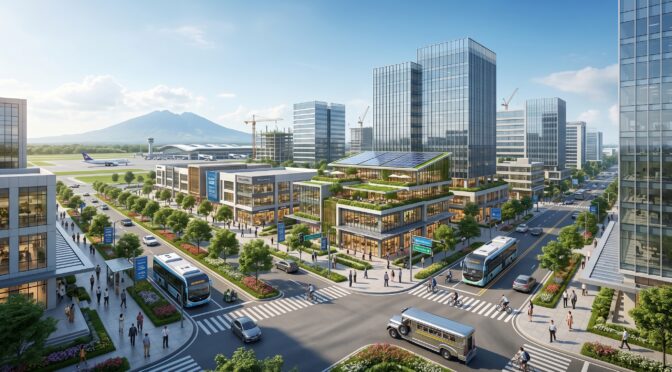
The Metro Clark conurbation, anchored within the province of Pampanga in the Central Luzon region of the Philippines, is currently navigating a structural and macroeconomic transformation of historic proportions. Transitioning from a secondary provincial market into a primary geopolitical and logistics node within the Asia-Pacific region, the area is the focal point of unprecedented sovereign-level investments, master-planned urban decentralization, and aggressive industrial agglomeration. This exhaustive research report provides a granular analysis of the economic fundamentals, demographic profiles, and infrastructural catalysts driving the Clark Air Base environs—encompassing both the mature Clark Freeport Zone (CFZ) and the greenfield New Clark City (NCC).
The regional growth engine is underpinned by highly resilient macroeconomic metrics. In 2024, the provincial economy of Pampanga expanded by 5.1 percent, reaching a Gross Domestic Product (GDP) valuation of P595 billion, while the highly urbanized core of Angeles City posted a 6.9 percent expansion valued at P151 billion.1 This robust economic velocity is supported by a deeply favorable demographic structure. With a provincial population exceeding 3 million and a highly youthful median age of 25.65 years, the region is operating deep within a demographic dividend, supplying the requisite human capital for advanced manufacturing and tertiary services.2
Over the next decade, the region’s trajectory will be definitively shaped by the convergence of trilateral geopolitical mandates and national infrastructure initiatives. The launch of the Luzon Economic Corridor (LEC)—a joint commitment by the United States, Japan, and the Philippines—aims to drive up to $100 billion in investments, primarily centralized around the Subic-Clark-Manila-Batangas (SCMB) Railway.4 Concurrently, the Pax Silica Initiative has designated a 4,000-acre site in New Clark City as an allied technology and economic security zone, fundamentally rewiring global supply chains for semiconductors, artificial intelligence, and critical minerals away from adversarial dependencies.7
This report outlines a strategic outlook segmented into three distinct phases. The three-year horizon (2026–2029) is characterized by infrastructural gestation, highlighted by the operationalization of the P8.5 billion Clark National Food Hub and the massive expansion of aviation logistics facilities by UPS and FedEx.10 The five-year horizon (2026–2031) will witness the mandated institutional migration of the Philippine national government to New Clark City by 2030, alongside the commencement of SCMB rail operations.13 Finally, the ten-year horizon (2026–2036) will see the full maturation of the region as an integrated, globally competitive hub for semiconductor manufacturing and advanced commercial real estate, effectively acting as a permanent counter-magnet to the congestion of Metro Manila.9
2. Macroeconomic Foundation and Regional Fiscal Dynamics
The bedrock of the Metro Clark area’s sustained urban and industrial expansion lies in its robust macroeconomic output. The region is systematically transitioning from an agrarian-heavy economy into a highly sophisticated ecosystem characterized by advanced logistics, financial services, and high-value manufacturing.
2.1. Gross Domestic Product and Sectoral Transitions
The economic performance of the Clark environs demonstrates resilient capital absorption despite volatile global macroeconomic headwinds. According to data from the Philippine Statistics Authority (PSA), Pampanga’s provincial economy grew by 5.1 percent in 2024, bringing its total GDP to P595 billion.1 Simultaneously, Angeles City, which serves as the immediate urban support system for the Clark Freeport Zone, saw its economy expand by 6.9 percent, achieving a valuation of P151 billion.1 While these figures reflect a slight moderation from the aggressive post-pandemic recovery spikes recorded in 2023—where Pampanga and Angeles City grew at 6.5 percent and 7.5 percent, respectively—they indicate a healthy stabilization into sustainable, long-term expansionary territory.1
A granular analysis of the sectoral composition reveals the sophistication of this economic transition. Within Pampanga, the fastest-growing industry in 2024 was Financial and Insurance Activities, which surged by an exceptional 19.4 percent.1 This explosive growth in sophisticated tertiary and quaternary sectors provides critical insight into the changing nature of the regional economy. It demonstrates that the region is rapidly developing the indigenous capital allocation infrastructure necessary to support multinational corporate operations, reducing reliance on Metro Manila-based financial institutions. The Central Luzon region is actively diversifying its economic base to meet regional targets that project Gross Regional Domestic Product (GRDP) growth to remain between 6.2 and 9.3 percent annually through 2028.16
2.2. Foreign Direct Investment and Legislative Catalysts
The influx of capital into the Clark region is heavily supported by national legislative reforms designed to enhance the Philippines’ competitive positioning in Southeast Asia. Foreign Direct Investment (FDI) inflows to the Philippines stabilized at $8.9 billion in 2024, with equity investments predominantly flowing into manufacturing, information and communications technology (ICT), and real estate.17 These are the precise sectors that form the core of the BCDA’s master plan for Clark.
The regulatory environment was structurally enhanced by the passage of the Corporate Recovery and Tax Incentives for Enterprises to Maximize Opportunities for Reinvigorating the Economy (CREATE MORE) Act in November 2024.17 As a signature piece of economic legislation, the CREATE MORE Act provides the fiscal predictability demanded by capital-intensive operators. By extending the duration of tax exemptions for up to 27 years, lowering corporate income taxes for companies operating under the enhanced deductions regime, and streamlining local tax policies, the legislation creates a highly frictionless environment for foreign capital.17
Furthermore, the Clark Special Economic Zone operates under the purview of specialized investment promotion agencies, including the Philippine Economic Zone Authority (PEZA) and the Board of Investments (BOI).18 These agencies have been widely recognized for instituting regulatory transparency, enforcing no-red-tape policies, and providing one-stop-shop services for locators.18 When coupled with the Marcos Administration’s commitment under the “Build, Better, More” agenda to maintain national infrastructure spending at 5 to 6 percent of GDP, the macroeconomic environment surrounding Clark presents an exceptionally low-risk profile for long-term institutional investors.17
| Economic Indicator / Metric | 2024 Performance / Valuation | Strategic Implication for Metro Clark |
| Pampanga GDP Growth | 5.1% (P595 Billion) | Stabilized, sustainable macroeconomic expansion. |
| Angeles City GDP Growth | 6.9% (P151 Billion) | High urban velocity supporting commercial real estate. |
| Fastest Growing Sector | Financial & Insurance (19.4%) | Maturation of local capital and corporate support ecosystems. |
| National FDI Inflows | $8.9 Billion | Capital targeting manufacturing, ICT, and real estate. |
| CREATE MORE Act Incentives | Up to 27 years tax exemption | Secures long-term commitments from multinational fabricators. |
3. Demographic Profiling and Workforce Capacity
The economic vitality of the Metro Clark conurbation is inextricably linked to its deep and highly favorable demographic profile. Translating infrastructural investment into tangible economic output requires a massive, trainable, and youthful workforce, a metric where Pampanga holds a distinct national advantage.
3.1. Population Density and the Demographic Dividend
As of the 2024 census projections, the population of Pampanga, inclusive of the independent component city of Angeles, stands at 3,069,898.2 The province exhibits a high population density of 1,452 persons per square kilometer, largely concentrated along the primary transit arteries and the immediate periphery of the Clark Freeport Zone.2 This density is highly advantageous for industrial locators, as it ensures a concentrated labor pool that can be mobilized efficiently without requiring extensive and costly employee transport infrastructure.
The most critical demographic asset of the region is its age structure. The median age in Pampanga is exceptionally youthful, recorded at 25.65 years.3 A detailed breakdown of the dependency ratios further illustrates this advantage: the youth dependency ratio is 44.24, while the old-age dependency ratio is a mere 7.37, resulting in a total dependency ratio of 51.61.3 In economic terms, this structural configuration indicates that the region is operating deep within a “demographic dividend”—a prolonged macroeconomic phase where the working-age population vastly outnumbers non-working dependents. This allows for higher household savings rates, increased domestic consumption, and a massive supply of labor to fuel industrial expansion.
Furthermore, the national labor force participation rate is projected to increase to 50.98 percent in 2025, reflecting a steady post-pandemic return to economic activity.19 As the human development index (HDI) of the Philippines continues to improve, tracking upward from 0.693 in 2015 to 0.712 in 2018, the baseline health, education, and standard of living for the local workforce provides a solid foundation for advanced industrial training.20
3.2. Human Capital Development and Skills Alignment
However, possessing a massive demographic base is insufficient if the labor force lacks the highly specific technical proficiencies required by the incoming high-tech manufacturing and digital service sectors. A localized skill profiling study conducted on accounting and business graduates in Pampanga revealed nuanced capabilities: while graduates self-reported moderately high competencies in teamwork, communication, and information systems, they demonstrated distinct vulnerabilities in entrepreneurial acumen, advanced auditing, and management accounting.21 This indicates a potential spatial mismatch between legacy educational outputs and the sophisticated demands of global corporate locators.
Recognizing this critical gap, systemic interventions are being deployed. The national government’s EDCOM II Workforce Development Plan is explicitly designed to shift the focus from supply-side education to demand-driven labor outcomes.22 By aligning curricula, certification, and credentialing directly with employer needs, the plan aims to eliminate underemployment and wasted demographic potential.22 In Pampanga, the Technical Education and Skills Development Authority (TESDA) is aggressively recalibrating its programs to support the specific needs of the Clark ecosystem, focusing on electronics assembly, advanced logistics operations, and cold-chain management.23 Local academic institutions, such as the Pampanga State Agricultural University (PSAU), are concurrently launching initiatives to instill crucial soft skills and workplace ethics, ensuring the labor force is not only technically proficient but culturally aligned with multinational corporate environments.25 The success of these institutional interventions is an absolute prerequisite for the successful operationalization of the high-tech economic zones planned for the region over the next decade.
| Demographic Metric | Pampanga Profile (2024/2025) | Economic Analysis / Implication |
| Total Population | 3,069,898 | Massive consumer base and labor pool. |
| Population Density | 1,452/km² | Highly concentrated, allowing for efficient labor mobilization. |
| Median Age | 25.65 years | Deep demographic dividend; highly trainable youth sector. |
| Old Age Dependency Ratio | 7.37 | Extremely low burden on the working population. |
| National LFPR (2025) | 50.98% | Increasing labor market participation driving productivity. |
4. The “W” Growth Corridor and Spatial Urban Dynamics
The physical expansion of the Metro Clark conurbation is not an organic, haphazard sprawl. Instead, it is governed by a highly engineered spatial strategy deliberately designed to pull demographic and economic gravity away from the severely congested National Capital Region (NCR).
4.1. Evolution of the Spatial Framework
The spatial planning of Central Luzon has evolved significantly over the past three decades. In 1995, the Japan International Cooperation Agency (JICA) proposed a “Triad concept” of urbanization, focusing on the interdependent growth of Metro Subic (seaport), Metro Angeles/Clark (airport), and the Bulacan Conurbation.26 While foundational, this triad proved too geographically limiting to capture the massive industrial growth occurring in adjacent provinces.26 Consequently, the regional development apparatus, led by the Department of Trade and Industry, evolved this framework into the “W Growth Corridor”.26 This expansive corridor integrates 49 municipalities and 3 cities that possess high potential for rapid, interdependent growth, forming a contiguous belt of economic activity that visually resembles the letter ‘W’ on a map.26
4.2. The Structure of the Metro Clark Area
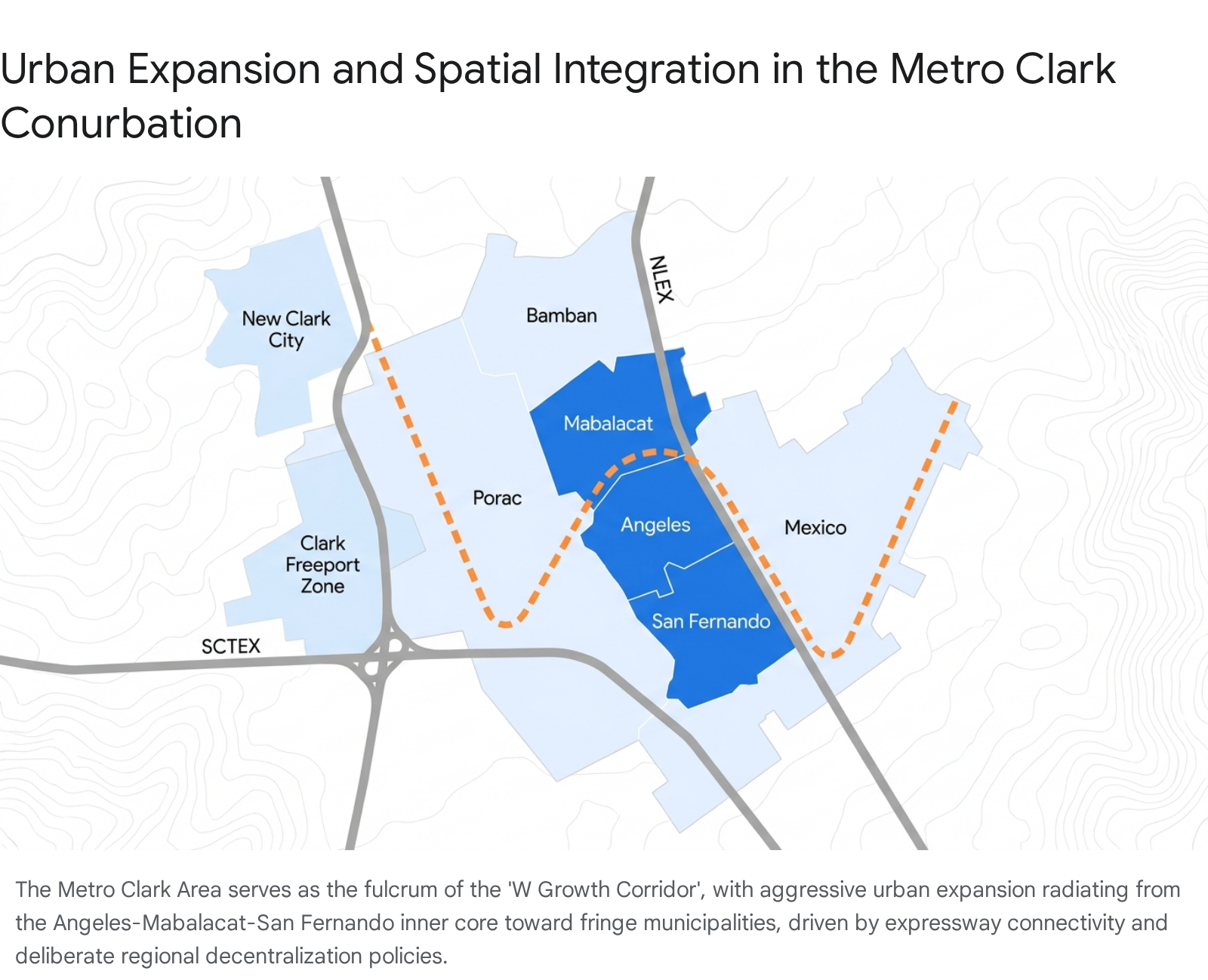
At the absolute fulcrum of this W Growth Corridor lies the Metro Clark Area (MCA). The MCA is formally classified by the Central Luzon Regional Development Plan (CLRDP) 2023-2028 as an emerging conurbation with a distinct concentric structure.27
The inner core consists of the highly urbanized cities of Angeles, Mabalacat, and San Fernando.28 This core is characterized by dense commercial activity, high-rise residential developments, and premium tertiary services, serving as the immediate staging ground for executives and corporations operating within the Freeport Zone. Radiating outward is the urban fringe, which encompasses the municipalities of Magalang, Arayat, Mexico, Santo Tomas, Bacolor, Lubao, and Porac in Pampanga, and extends northward into the municipalities of Bamban and Concepcion in Tarlac.28
This spatial layout is heavily dictated by the Quadspine Connectivity Framework, which leverages major expressway arteries—namely the North Luzon Expressway (NLEX) and the Subic-Clark-Tarlac Expressway (SCTEX)—to physically integrate specialized production zones with rapidly expanding settlement areas.28 The movement pattern demonstrates a deliberate decentralization policy: heavy industrial, manufacturing, and large-scale logistics facilities are being pushed toward the land-rich urban fringe, while high-density commercial and financial services consolidate within the inner core.28
However, this rapid spatial expansion carries inherent geographical risks. The CLRDP emphasizes the critical necessity of developing climate and disaster-resilient infrastructure, as significant portions of the Central Luzon basin remain highly susceptible to seasonal flooding and rain-induced landslides.28 Mitigating these environmental constraints through massive civil engineering projects, such as the Pampanga River Flood Control Project, is essential to maintaining the uninterrupted supply chain velocity demanded by global locators.30
5. Geopolitics and the Luzon Economic Corridor (LEC)
The economic trajectory of the Clark region cannot be assessed purely through the lens of domestic growth metrics. It is currently the primary theater for intense geopolitical maneuvering and sovereign-level investment programs. Driven largely by the strategic imperatives of the United States and Japan, these initiatives are aimed at fundamentally rewiring global supply chains and establishing a resilient economic foothold in the Indo-Pacific.
5.1. The Trilateral Partnership and the SCMB Railway
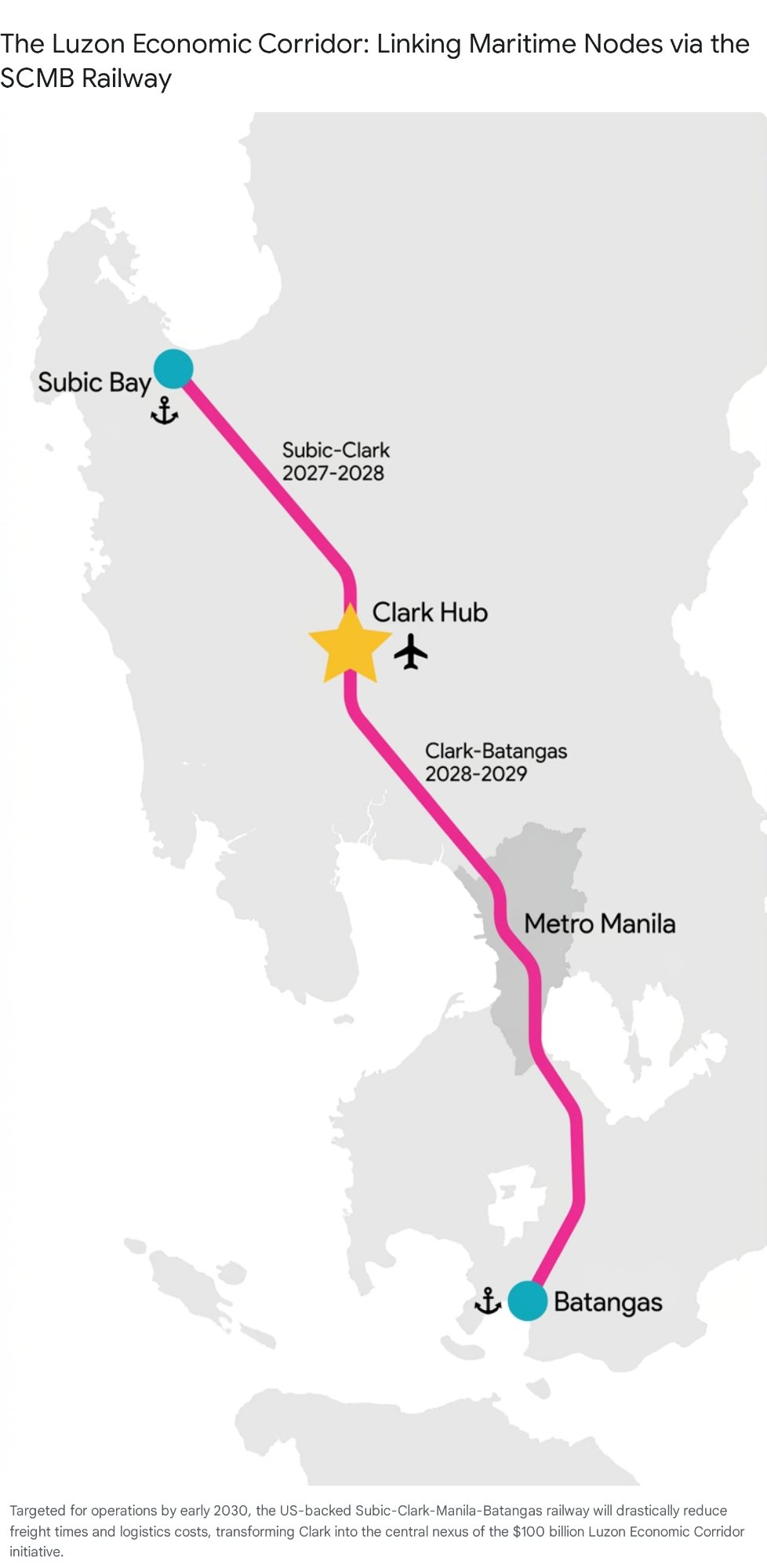
In April 2024, the leaders of the United States, Japan, and the Philippines formalized the launch of the Luzon Economic Corridor (LEC).4 Positioned as a flagship initiative under the Partnership for Global Infrastructure and Investment, the LEC seeks to accelerate coordinated investments in high-impact infrastructure, explicitly linking the critical economic nodes of Subic Bay, Clark, Metro Manila, and Batangas.4 The sheer scale of this initiative is unprecedented, with the Philippine government projecting the generation of approximately $100 billion in direct investments from the US and Japan over the next five to ten years.5
The structural and logistical backbone of the LEC is the proposed Subic-Clark-Manila-Batangas (SCMB) Railway. Envisioned as a 250-kilometer freight and passenger line, the railway will connect two of Luzon’s most vital deep-water maritime ports—Subic Bay in the north and Batangas City in the south—directly through the industrial heartland of Clark and the dense consumer center of Manila.6 The United States Trade and Development Agency (USTDA) has already committed multimillion-dollar funding for technical assistance, comprehensive transportation modeling, and port-rail integration analysis to accelerate the project.6 Current timelines project the construction of the Subic-Clark segment to commence between 2027 and 2028, followed by the Clark-Manila-Batangas segment in 2028–2029, with a target for full rail operations by early 2030.13
The second and third-order economic effects of the SCMB Railway will be profoundly transformative for the region. Currently, logistics operators rely on the congested highway networks spanning Metro Manila. The railway provides a high-capacity, highly resilient alternative that will drastically reduce logistics costs, fuel consumption, and freight dwell times for manufacturers located in the Clark Freeport Zone.6 This modal shift from road to rail freight will lower working capital requirements for locators by dramatically increasing inventory velocity.
Furthermore, the SCMB Railway is fundamentally a dual-purpose infrastructure. Beyond commercial cargo, it possesses significant strategic military mobility value. In an era of heightened Indo-Pacific tensions, the railway enables rapid troop deployment, equipment transfer, and robust disaster response capabilities between deep-water ports and the inland airfields of Clark, perfectly aligning with the broader security objectives of the US-Philippine defense alliance.31
However, realizing this mega-infrastructure is not without significant socio-economic friction. Reports indicate that land acquisition for the right-of-way has already resulted in the eviction of 212 landowners in Porac and Floridablanca, Pampanga, as well as the displacement of indigenous Aeta communities, including approximately 500 families in Capas, Tarlac.13 Managing the environmental safeguards, indigenous rights, and compensation frameworks will be a critical governance challenge that could impact the strict timeline of the project.13
5.2. Pax Silica and the 4,000-Acre Allied Technology Hub
Beyond heavy logistics and transport infrastructure, the Clark region is the vanguard of a highly coordinated effort to secure next-generation technologies. The United States and the Philippines have jointly designated New Clark City as the site for a massive 4,000-acre technology economic zone operating under the Pax Silica Initiative.8
The Pax Silica network comprises thirteen allied nations—including Australia, Japan, the Republic of Korea, and India—committed to establishing secure, transparent, and resilient supply chains for critical minerals, advanced semiconductors, and artificial intelligence capabilities.9 The explicit objective of this initiative is to build a sovereign-aligned manufacturing system capable of competing with, and ultimately displacing, concentrated and adversarial supply chains.8 The selection of the Philippines for the first AI-native industrial acceleration hub leverages the country’s geographical centrality in the Indo-Pacific, its highly technical workforce, and critically, its vast natural endowments of essential minerals like nickel, copper, chromite, and cobalt.7
For business development analysts, the gestation of this 4,000-acre zone signals a guaranteed, massive influx of highly specialized foreign direct investment. The establishment of anchor semiconductor foundries and AI processing centers will force the rapid agglomeration of tier-2 and tier-3 component suppliers, specialized chemical providers, and highly secure data center operators within the Metro Clark area.
Crucially, because advanced semiconductor manufacturing and AI data centers are exceptionally energy-intensive operations, this initiative is forcing a simultaneous acceleration in clean energy deployments. Recognizing the vulnerability of relying on imported energy and the impending depletion of the Malampaya gas fields—which currently supply approximately 30 percent of Luzon’s electricity—the Philippine government has enacted vital legislative reforms, such as allowing 100 percent foreign ownership of renewable energy projects.32 This regulatory shift allows multinational green-energy developers to build the dedicated, utility-scale solar and wind infrastructure required to power the Pax Silica hub, further elevating the region’s Environmental, Social, and Governance (ESG) credentials.
6. Master-Planned Developments: Deconstructing CFZ and NCC
To accurately underwrite real estate and operational risk in the region, analysts must distinguish between the conurbation’s two primary economic engines, both masterfully orchestrated by the Bases Conversion and Development Authority (BCDA): the legacy Clark Freeport Zone (CFZ) and the ambitious greenfield project of New Clark City (NCC). The BCDA has proven highly effective in asset monetization and ecosystem creation, having generated over 400,000 jobs, secured exports worth over $5 billion, and accumulated a total asset value surpassing $10 billion across its special economic zones.10
6.1. The Clark Freeport Zone: Aviation, Global Logistics, and Hospitality
The 31,850-hectare Clark Special Economic Zone, with the CFZ at its historical core, represents the mature commercial and logistical heart of the conurbation.10 Managed by the Clark Development Corporation (CDC), the zone is currently pivoting aggressively away from basic light manufacturing toward becoming a premier, high-value global aviation and logistics hub.33
At the center of this transformation is the Clark Civil Aviation Complex (CCAC). Spanning 2,367 hectares, the CCAC is undergoing a strategic repositioning led by the Clark International Airport Corporation (CIAC) to integrate air cargo, light manufacturing, and associated industries directly adjacent to the tarmac.11 The strategic integration of global logistics giants highlights the scale of this shift. UPS is currently expanding its Clark hub, which is slated to become fully operational by 2026, significantly strengthening its integrated express, supply chain, and healthcare logistics capabilities across the Asia-Pacific.12 Concurrently, FedEx is executing plans to double the size of its gateway facility in Clark, while Lufthansa Technik Philippines has committed an P8 billion investment to construct a second maintenance, repair, and overhaul (MRO) hangar.12
Further amplifying this logistical capacity is the proposed Clark National Food Hub. Utilizing a 62-hectare site within the aviation complex, this project represents an P8.5 billion investment targeted for completion by 2028.10 The Food Hub will revolutionize national agricultural distribution by providing state-of-the-art cold-chain storage and processing for perishables.33 The second-order effects of this facility are profound: by significantly reducing post-harvest agricultural losses and stabilizing regional food supply chains, the hub will help moderate regional inflation, protecting the purchasing power of the local workforce and preventing wage-push pressures that deter industrial locators.
Beyond heavy logistics, the CFZ is experiencing a boom in the commercial and hospitality sectors. In 2025, the zone recorded over 1.5 million overnight guests and 1.8 million same-day visitors, straining the current inventory of 4,100 hotel rooms.34 To capture this surging demand, foreign capital is deploying rapidly. Notably, Korean developer JnH Philippines Development Corp. recently amended its lease agreement to accelerate an P840-million mixed-use project along C.M. Recto Highway.34 By compressing the construction timeline from five years to just 30 months, JnH aims to quickly deliver 17 pool villas and high-rise mixed-use towers, bolstering Clark’s position as a premier destination for Meetings, Incentives, Conferences, and Exhibitions (MICE) tourism.34 Physical connectivity is also being enhanced; the recently completed 894-meter, six-lane Sacobia Bridge now provides a seamless, high-capacity link between the Clark International Airport and the residential zones of New Clark City, reducing transit friction for both tourists and daily commuters.35
6.2. New Clark City: The National Government Administrative Center
While the CFZ serves as the commercial and logistical anchor, New Clark City (NCC)—a massive 9,450-hectare planned community located across the border in the municipalities of Capas and Bamban, Tarlac—is engineered to be the country’s first truly smart, green, and disaster-resilient metropolis.10 Designed from inception to accommodate up to 1.2 million residents and 800,000 workers across 13 distinct neighborhoods, NCC represents the physical manifestation of the state’s ultimate decentralization policy.36
The cornerstone of the NCC master plan is the National Government Administrative Center (NGAC). Legislative initiatives, most notably the proposed “Kabisera 2030” bill, seek to mandate the permanent transfer of the seat of the national government to NCC by 2030.14 Under this proposal, the Office of the President, the Office of the Vice President, and the central offices of all national government agencies and government-owned corporations currently located in the National Capital Region must relocate.14 This is not merely a bureaucratic reshuffling; it is a strategic economic necessity. A study by JICA highlighted the paralyzing economic cost of transportation and congestion in Metro Manila, necessitating a secondary capital protected from the capital’s severe vulnerability to seismic activity and flooding.15
The institutional migration to the NGAC has already commenced, signaling strong sovereign commitment. The Philippine Coast Guard (PCG) is currently relocating its Command and Admiral Staff College to the new Government Building in NCC, a move designed to ensure the continuity of national security institutions outside of flood-risk zones.38 More significantly from a macroeconomic perspective, the Bangko Sentral ng Pilipinas (BSP) is constructing a massive 31-hectare complex in NCC, which will house its highly sensitive Security Plant Complex (SPC) responsible for national currency production.10 The relocation of the central bank’s physical asset production serves as the ultimate endorsement of the city’s geological stability. This sovereign confidence will invariably cascade into the private sector, encouraging major commercial banks and financial institutions to establish robust secondary headquarters and disaster-recovery data centers in the area.
To anchor the city’s civic life, the NGAC also houses the New Clark City Sports Hub, featuring a 20,000-seater Athletics Stadium.40 As the first facility in the Philippines to receive Class 1A certification from World Athletics, equipped with a Polytan synthetic track and advanced RFID performance tracking, it positions NCC to host major international events, driving sports tourism and elevating the city’s global profile.40
6.3. NCC Investment Inflows and Development Timelines
Since the finalization of its master plan in 2017, New Clark City has proven its bankability by attracting P143.22 billion in investments.10 The master plan dictates an orderly rollout across three phases: Phase 1 (2017–2022), Phase 2 (2023–2030), and Phase 3 (2031–2040).41 Currently navigating Phase 2, the focus is squarely on mixed-use industrial and residential integration.
The employment generation potential is staggering. The NCC development inherently possesses the capacity to create over 103,000 jobs.10 Specific industrial allocations, such as the 500-hectare mixed-use industrial park containing general and light industrial zoning, are attracting heavy manufacturing.41 The TARI Estate project alone is projected to create 60,000 new jobs.10 Furthermore, St Baker’s bold initiative to establish battery manufacturing facilities in the area is expected to generate 1,000 jobs by 2030, reserving half of these positions for local technical and engineering talent.10
To support this massive influx of human capital without replicating the slum dynamics of older cities, residential infrastructure is being aggressively scaled. In February 2025, the BCDA formalized a 50-year lease agreement with a consortium including Sta. Clara International Corp. and the state-owned Korea Overseas Infrastructure and Urban Development Corp. to construct a 6.1-hectare real estate project.10 Concurrently, a 33.89-hectare affordable housing project is underway, designed as “modern, grassroots villages” that ensure social inclusivity while minimizing the stigma traditionally associated with subsidized housing.10 The environmental sustainability of this rapid urbanization is guaranteed through partnerships with firms like Danfoss, Inc., implementing comprehensive decarbonization and renewable energy solutions across the city’s 44.8-hectare central park system.10
7. Real Estate Dynamics: Office, Industrial, and Residential Markets
The macroeconomic shifts, infrastructural gestation, and government mandates detailed above are directly reflected in the real estate absorption metrics of the region. As Metro Manila grapples with structural real estate challenges, the Metro Clark area is successfully capturing the overflow, repositioning itself as a highly lucrative destination for institutional real estate capital.
7.1. Commercial and IT-BPM Office Absorption
The Philippine office market is navigating a complex period of recalibration. Nationally, total office demand demonstrated resilience, reaching 966,000 square meters by the third quarter of 2025.43 However, the vacancy rates within Metro Manila’s central business districts remain elevated, stabilizing around 18 percent generally, with certain areas facing much steeper challenges.43
The primary catalyst for commercial real estate growth remains the Information Technology and Business Process Management (IT-BPM) sector, which accounts for 45 percent of total national demand.43 As prime office spaces in Metro Manila face high operational costs and the lingering market distortions caused by the mass exit of Philippine Offshore Gaming Operators (POGOs), IT-BPM firms are executing aggressive provincial expansion strategies.43
Pampanga is uniquely positioned to capture this demand. Ranked as a Tier 1 provincial location, it boasts a substantial total office stock of 529,000 square meters, with approximately 130,000 square meters of high-quality space currently available.44 The region’s viability is secured by its designation as a “Digital City.” To achieve this status, a location must guarantee Grade-AAA power infrastructure, digital fiber optic networks, and an abundant talent pipeline.44 With an annual output of over 54,000 higher education graduates in the wider region, Pampanga easily satisfies the stringent human capital metrics demanded by global outsourcing conglomerates.44
Within the Clark CBD itself, the market is extraordinarily tight. Major BPO players, including iQor, Asurion, and Concentrix, are actively expanding their footprints.10 As of mid-2024, the Clark CBD reported 117,000 square meters of occupied office space, leaving a minimal 8,000 square meters of available space within the immediate Freeport Zone.10 This severe supply-side constraint will inevitably exert strong upward pressure on lease rates in the near term, signaling a highly favorable environment for commercial developers capable of delivering Grade-A, ESG-compliant office towers.
7.2. Residential Real Estate and the POGO Exodus Impact
The residential real estate market presents a sharply bifurcated reality between the capital and the provinces. In the National Capital Region, the residential sector is struggling with massive oversupply. Colliers projects that the overall vacancy rate in Metro Manila’s secondary market will reach an all-time high of 26.5 percent by the end of 2025.45 In specific locations like the Bay Area, vacancy rates exceed 50 percent, a direct consequence of the systemic exodus of POGO operations which previously occupied vast swathes of residential condominiums built immediately prior to and during the pandemic.45 Furthermore, high interest rates and affordability constraints continue to temper buyer appetite among middle-income households in the capital.47
Conversely, the dynamics in provincial areas like Pampanga are distinctly more stable. While the departure of POGOs created localized, temporary shocks in peripheral rental markets, the rapid absorption of commercial space by IT-BPM and traditional corporate occupiers is generating sustained, qualitative demand for mid-market and premium residential housing in the Metro Clark Conurbation. According to market data, average house prices in areas outside the NCR rose by a sustainable 1 percent year-over-year in Q3 2025, representing a healthy stabilization following more aggressive double-digit growth in previous years.45
Developers in Central Luzon are strategically shifting their capital allocation toward sprawling suburban townships and sustainable horizontal developments. This pivot captures the evolving preferences of a growing middle class, as well as the influx of highly compensated expatriate and domestic professionals relocating to the CFZ and NCC, who demand low-density living environments with integrated green spaces rather than vertical condominiums.48
7.3. Industrial Parks and Logistics Facilities
The industrial and logistics real estate sector stands as the most resilient and aggressively expanding asset class in the region. Buoyed by the unabated boom in e-commerce, the imperative for supply chain decentralization, and the impending influx of semiconductor manufacturing, the demand for premium industrial space is accelerating rapidly.46
The market is currently witnessing a qualitative upgrade in industrial facility requirements. The BCDA’s strategic partnerships with entities like the Science Park of the Philippines, and the zoning of 500 hectares in NCC specifically for mixed-use industrial parks (encompassing light industrial, general industrial, and R&D specific zones), align perfectly with the exacting needs of modern manufacturers.42 As the Pax Silica tech zone transitions from policy to physical construction, the absorption of industrial space is projected to remain exceptionally tight. Global manufacturers of electric vehicles, semiconductor fabricators, and food processors increasingly demand built-to-suit, highly automated, and energy-resilient facilities, pushing industrial land valuations in the Clark periphery to historic highs.46
| Real Estate Sector | Current Regional Dynamics (Metro Clark/Pampanga) | Primary Demand Drivers | 10-Year Outlook Implication |
| Commercial/Office | Tight vacancies in Clark CBD (only 8,000 sqm available); Tier 1 provincial status. | IT-BPM provincial expansion, traditional corporate relocation escaping Manila costs. | Upward pressure on rents; urgent requirement for Grade-A smart buildings in NCC. |
| Residential | Stabilizing horizontal growth (1% YoY); pivot toward affordable community developments. | Influx of logistics/BPM workers; impending government employee mass relocation. | Sustained demand for master-planned suburban townships; minimal exposure to the NCR condo glut. |
| Industrial/Logistics | Aggressive expansion; near-zero vacancy in premium cold-chain and logistics parks. | E-commerce, semiconductor friendshoring (Pax Silica), agricultural cold-chain. | Massive capital appreciation for industrial land; demand for built-to-suit, ESG-compliant facilities. |
8. Strategic Growth Outlook: 3, 5, and 10-Year Forecasts
Synthesizing the macroeconomic performance data, hard infrastructural timelines, and sovereign-level geopolitical directives reveals a highly structured, phased trajectory for the Metro Clark conurbation.
8.1. Three-Year Outlook (2026–2029): Infrastructure Gestation and Institutional Relocation
The immediate three-year horizon will be defined by intensive capital expenditure, earthmoving, and the physical realization of foundational logistical assets. Economic growth during this phase will be heavily weighted toward the construction, engineering, and capital goods sectors.
- Logistics Solidification: By 2028, the P8.5 billion Clark National Food Hub will become fully operational, fundamentally altering agricultural supply chains and stabilizing inflation in Central Luzon.10 Simultaneously, the expanded aviation hubs for UPS and FedEx will come online, cementing the Clark Civil Aviation Complex as the premier, high-velocity air freight node in the country, effectively bypassing the bottlenecks of Ninoy Aquino International Airport.12
- Real Estate and Hospitality Recalibration: The accelerated completion of the JnH mixed-use development by late 2028 will add critical capacity to the region’s MICE and hospitality sector.34 This will allow the region to absorb the projected surge in corporate travel associated with the site selection and planning phases of the incoming semiconductor and manufacturing firms.
- Government Migration Initiation: Early phases of the National Government Administrative Center in New Clark City will witness increased physical occupancy.14 As the Philippine Coast Guard and the Bangko Sentral ng Pilipinas operationalize their new facilities, secondary support industries will begin shifting their bureaucratic gravity northward.
8.2. Five-Year Outlook (2026–2031): Logistics Ascendancy and Transit Integration
By 2031, the region will pivot from a construction-led growth model to an operational, logistics-led expansion, characterized by a dramatic, permanent increase in the velocity of goods and human capital.
- The SCMB Railway Catalyst: The projected operationalization of the Subic-Clark-Manila-Batangas railway by 2030 stands as the most consequential economic event of the decade.13 The radical reduction in terrestrial freight costs will immediately boost the gross margins of manufacturers located in the CFZ and NCC. This cost advantage will likely trigger a secondary, massive wave of foreign direct investment from firms that were previously deterred by the prohibitive logistics costs associated with Manila’s congestion.
- The Capital Shift Deadline: 2030 marks the statutory deadline mandated by the Kabisera 2030 proposals for the transfer of the national government seat to NCC.14 The enforcement of this mandate will induce a permanent demographic shift of tens of thousands of highly skilled bureaucrats and their families to the region. This influx will create immense, localized economic multipliers, driving a boom in retail, private education, and healthcare real estate.
- Phase 3 Transition: New Clark City will formally transition into Phase 3 (2031-2040) of its master development plan.41 Having secured its industrial base, the focus will shift toward scaling high-density residential and commercial zones to support a rapidly agglomerating population that approaches the 1 million mark.
8.3. Ten-Year Outlook (2026–2036): Semiconductor Prominence and The Decongested Capital
Looking a decade ahead, the Metro Clark conurbation will operate as a mature, globally integrated economic apex, fundamentally decoupled from the structural limitations and vulnerabilities of Metro Manila.
- The Pax Silica Reality: The 4,000-acre allied technology economic zone in NCC will be fully integrated into global supply chains.8 Clark will no longer be viewed merely as an outsourcing or light-manufacturing hub, but as an indispensable, sovereign-backed node in the semiconductor, AI, and critical minerals network of the United States and its allies.8 The presence of advanced fabrication plants and secure data centers will elevate the region’s per capita GDP significantly above the national average, attracting top-tier global talent.
- Demographic Maturation and Upskilling: The youthful, 25-year-old median population of the 2020s will have aged into their peak earning and consumption years. Assuming the successful execution of the upskilling interventions championed by TESDA and local universities, the indigenous labor pool will be highly specialized.22 This high-income workforce will support a robust, consumption-driven local economy, insulated from external macroeconomic shocks.
- Spatial Equilibrium Achieved: The “W Growth Corridor” will function as a seamless, highly efficient economic organism.26 The spatial mismatch between where people live (the urban fringe) and where they work (the industrial cores) will be largely resolved by the efficient transit linkages provided by the SCMB railway and completed expressway networks. Metro Clark will stand as the definitive blueprint for sustainable, high-growth urban development in the Asia-Pacific.
9. Conclusion
The Metro Clark conurbation is currently executing a textbook transition from a localized special economic zone to a macroeconomic powerhouse of immense national and international consequence. The synergy between massive, physical infrastructural investments—specifically the SCMB Railway and the aviation logistics upgrades within the CCAC—and the sovereign-level geopolitical commitments of the Pax Silica initiative virtually guarantees exceptional capital absorption over the next decade.
For business development analysts, institutional investors, and sovereign wealth funds, the empirical data signals a clear and urgent imperative: the window for securing early-mover advantage in industrial land banking, affordable-to-mid-market residential development, and tertiary commercial services within the urban fringe of the Metro Clark Area is rapidly closing. As the national government finalizes its migration to New Clark City and global supply chains permanently anchor into the newly formed technology zones, the region will unequivocally solidify its position not just as a resilient alternative to Metro Manila, but as the premier destination for high-value, sustainable economic growth in the Republic of the Philippines.
Please share the link on Facebook, Forums, with colleagues, etc. Your support is much appreciated and if you have any feedback, please email us in**@*********ps.com. If you’d like to request a report or order a reprint, please click here for the corresponding page to open in new tab.
Sources Used
- PSA: Pampanga, Angeles City economies expanded in 2024, accessed May 5, 2026, https://pia.gov.ph/regions/psa-pampanga-angeles-city-economies-expanded-in-2024/
- Pampanga (Province, Philippines) – Population Statistics, Charts, Map and Location, accessed May 5, 2026, https://citypopulation.de/en/philippines/luzon/admin/0354__pampanga/
- Pampanga Profile – PhilAtlas, accessed May 5, 2026, https://www.philatlas.com/luzon/r03/pampanga.html
- Philippines Luzon Economic Corridor – International Trade Administration, accessed May 5, 2026, https://www.trade.gov/market-intelligence/philippines-luzon-economic-corridor
- PHILIPPINES: Major Upgrade of the Luzon Economic Corridor Announced, accessed May 5, 2026, https://research.hktdc.com/en/article/MTY5MjYyMjQ0MQ
- USTDA Strengthens U.S.-Philippines Alliance Through Support for Flagship Rail Project, accessed May 5, 2026, https://www.ustda.gov/ustda-strengthens-u-s-philippines-alliance-through-support-for-flagship-rail-project/
- Fact Sheet: U.S. and Philippines Plan the Launch of Historic 4000 Acre Economic Security Zone to Shore Up Supply Chains, accessed May 5, 2026, https://ph.usembassy.gov/fact-sheet-u-s-and-philippines-plan-the-launch-of-historic-4000-acre-economic-security-zone-to-shore-up-supply-chains/
- US, Philippines pick New Clark City for 4000-acre tech zone – Manila Bulletin, accessed May 5, 2026, https://mb.com.ph/2026/04/20/us-philippines-pick-new-clark-city-for-4000-acre-tech-zone
- The United States and The Philippines Launch Plans for 4000-Acre Economic Security Zone to Shore Up Supply Chains, accessed May 5, 2026, https://ph.usembassy.gov/the-united-states-and-the-philippines-launch-plans-for-4000-acre-economic-security-zone-to-shore-up-supply-chains/
- NEXT GREAT CITY – Bases Conversion and Development Authority, accessed May 5, 2026, https://www.bcda.gov.ph/sites/default/files/2026-01/Clark%20Magazine%202026.pdf
- Clark International Airport’s Rise as the Philippines’ Premier Regional Logistics Hub, accessed May 5, 2026, https://blog.gettransport.com/news/clark-airport-logistics-excellence/
- Clark on the road to become global logistics and aviation hub, accessed May 5, 2026, https://bcda.gov.ph/news/clark-road-become-global-logistics-and-aviation-hub
- Subic-Clark-Manila-Batangas Railway serves US imperialist economic and geopolitical interests – NDFP, accessed May 5, 2026, https://ndfp.info/subic-clark-manila-batangas-railway-serves-us-imperialist-economic-and-geopolitical-interests/
- *22 JUL 25 A10 *48 – legacy.senate.gov.ph., accessed May 5, 2026, https://legacy.senate.gov.ph/lisdata/3854234995!.pdf
- New Clark City ready as seat of gov’t by 2030 – Philippine Star, accessed May 5, 2026, https://www.philstar.com/headlines/2019/08/14/1943302/new-clark-city-ready-seat-govt-2030
- Unlocking the Potentials of Central Luzon, accessed May 5, 2026, https://www.bsp.gov.ph/Pages/IRG/irg-files/Clark%202025/Regional%20Development%20Plan%20Updates%20and%20Economic%20Outlook.pdf
- 2025 Investment Climate Statements: Philippines – U.S. Department of State, accessed May 5, 2026, https://www.state.gov/reports/2025-investment-climate-statements/philippines
- 2024 Investment Climate Statements: Philippines – State Department, accessed May 5, 2026, https://2021-2025.state.gov/reports/2024-investment-climate-statements/philippines/
- Philippines Labor Force Participation Rate 2025: 50.98 | Geo Factbook, accessed May 5, 2026, https://geofactbook.com/countries/philippines/labor-force
- 03Overlay of Economic Growth, Demographic Trends, and Physical Characteristics – – Philippine Development Plan, accessed May 5, 2026, https://pdp.depdev.gov.ph/wp-content/uploads/2021/12/Chapter-03.pdf
- Skill Profiling of Pampanga Accounting Graduates | PDF – Scribd, accessed May 5, 2026, https://www.scribd.com/document/965997033/MEDINA-SOFT-AND-TECHNICAL-SKILLS
- EDCOM II • FINAL REPORT – Workforce Development Plan, accessed May 5, 2026, https://edcom2.gov.ph/media/2026/01/EDCOM-II_Y03_Workforce-Development-Plan.pdf
- Tesda – Technical Education And Skills Development Authority, accessed May 5, 2026, https://www.tesda.gov.ph/
- ILS Marks 2025 With Strong Momentum in Research, Policy Leadership, and Global Engagements – DOLE ILS Official, accessed May 5, 2026, https://ils.dole.gov.ph/policy-advocacies/media-resources/news/ils-marks-2025-with-strong-momentum-in-research-policy-leadership-and-global-engagements
- Academics – Pampanga State Agricultural University, accessed May 5, 2026, https://psau.edu.ph/category/vpaa/
- 5.2.1 National and Regional Economic Development Plans – JICA Report PDF, accessed May 5, 2026, https://openjicareport.jica.go.jp/pdf/11525102_04.pdf
- PDP-2023-2028.pdf – – Philippine Development Plan, accessed May 5, 2026, https://pdp.depdev.gov.ph/wp-content/uploads/2023/01/PDP-2023-2028.pdf
- CENTRAL LUZON Regional Development Plan 2023 – 2028 | PDF – Scribd, accessed May 5, 2026, https://www.scribd.com/document/677962642/CENTRAL-LUZON-Regional-Development-Plan-2023-2028
- (Pre-Pub) CL-RDP 2023-2028 1.pdf – Slideshare, accessed May 5, 2026, https://www.slideshare.net/slideshow/prepub-clrdp-20232028-1pdf/259252414
- dpwh strategic infrastructure programs – and projects, accessed May 5, 2026, https://www.bsp.gov.ph/Pages/IRG/irg-files/Clark%202025/Department%20of%20Public%20Works%20and%20Highways%20Clark.pdf
- Subic to Batangas 250KM U.S.-Backed Railway Could Change Philippines Forever, accessed May 5, 2026, https://www.youtube.com/watch?v=anw1mrTd2_Y
- Energy Security and the U.S.-Philippine Alliance – CSIS, accessed May 5, 2026, https://www.csis.org/analysis/energy-security-and-us-philippine-alliance
- Strategic moves push Clark Aviation Capital as a premier global aviation and logistics hub, accessed May 5, 2026, https://philstarlife.com/news-and-views/856786-strategic-moves-push-clark-aviation-capital-premier-global-aviation-logistics-hub
- Korean developer JnH accelerates Clark timeline – BusinessWorld Online, accessed May 5, 2026, https://www.bworldonline.com/economy/2026/05/03/747061/korean-developer-jnh-accelerates-clark-timeline/
- 2024 ANNUAL REPORT – Bases Conversion and Development …, accessed May 5, 2026, https://www.bcda.gov.ph/sites/default/files/2025-08/BCDA%202024%20Annual%20Report_Big,%20Bold%20Moves.pdf
- New Clark City – Wikipedia, accessed May 5, 2026, https://en.wikipedia.org/wiki/New_Clark_City
- Building a better world by connecting communities. – New Clark City Master Plan – aecom, accessed May 5, 2026, https://publications.aecom.com/social-infrastructure/projects/new-clark-city/
- PCG to relocate Command, Admiral Staff College to New Clark City, accessed May 5, 2026, https://pia.gov.ph/news/luzon/cl/pcg-to-relocate-command-admiral-staff-college-to-new-clark-city/
- Coast Guard to relocate school to New Clark City – SunStar, accessed May 5, 2026, https://www.sunstar.com.ph/pampanga/coast-guard-to-relocateschool-to-new-clark-city
- About Us – New Clark City, accessed May 5, 2026, https://newclark.ph/about-new-clark-city/
- New Clark City Development Overview | PDF | Mixed Use Development – Scribd, accessed May 5, 2026, https://es.scribd.com/document/555334946/New-Clark-City-Primer
- 2022 New Clark Primer .pdf, accessed May 5, 2026, https://bcda.gov.ph/sites/default/files/2022-01/2022%20New%20Clark%20Primer%20.pdf
- Leechiu: Office recovery strengthens in Q3 2025 on steady outsourcing growth – InsiderPH, accessed May 5, 2026, https://insiderph.com/leechiu-office-recovery-strengthens-in-q3-2025-on-steady-outsourcing-growth
- Central Luzon Property Market Updates: – Log In ‹ Ayala Land Estates Seller’s Hub, accessed May 5, 2026, https://admin.ayalalandestates.com.ph/wp-content/uploads/2025/06/Central-Luzon-Property-Market-Updates-by-Colliers-Philippines-Research.pdf
- Philippines’s Residential Property Market Analysis 2026, accessed May 5, 2026, https://www.globalpropertyguide.com/asia/philippines/price-history
- Philippine Property Market Outlook 2025 | PDF | Metro Manila | Economies – Scribd, accessed May 5, 2026, https://www.scribd.com/document/806166150/Colliers-Manila-2025-Outlook-v1
- Leechiu: Residential market recovering, office demand shows resilience – Manila Bulletin, accessed May 5, 2026, https://mb.com.ph/2025/10/06/leechiu-residential-market-recovering-office-demand-shows-resilience
- PH real estate 2025: Poised for growth amid shifting dynamics | Inquirer Business, accessed May 5, 2026, https://business.inquirer.net/494580/ph-real-estate-2025-poised-for-growth-amid-shifting-dynamics
- BCDA reaffirms focus on infrastructure development, projects in New Clark City, accessed May 5, 2026, https://www.bcda.gov.ph/news/bcda-reaffirms-focus-infrastructure-development-projects-new-clark-city