1. Executive Summary
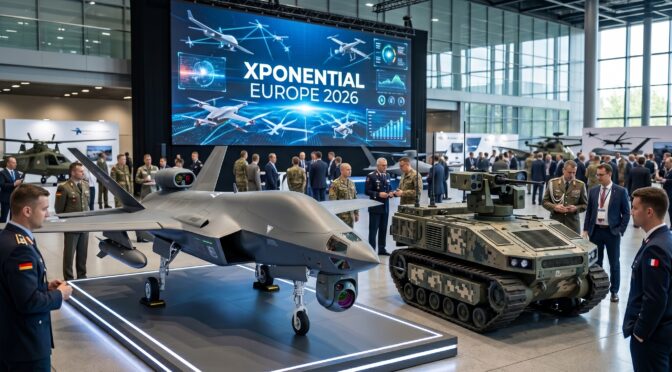
The XPONENTIAL Europe 2026 trade fair and conference, convened in Düsseldorf, Germany, from March 24 to 26, 2026, represented a defining inflection point in the trajectory of the global unmanned systems industry.1 Historically dominated by civil and commercial aviation applications, the 2026 iteration of the event was overwhelmingly characterized by a strategic pivot toward defense, national security, and dual-use technologies.1 This realignment is a direct institutional response to the modern Euro-Atlantic threat landscape, which is increasingly defined by hybrid warfare, massed unmanned aerial vehicle (UAV) incursions, and sophisticated cyber operations targeting both military installations and civilian critical infrastructure.1 The strategic integration of the German Armed Forces (Bundeswehr) as an official and active partner, alongside comprehensive presentations from major European defense contractors such as Rheinmetall AG and Diehl Defence, underscored the urgent imperative of transitioning autonomous capabilities from theoretical models to mass-produced, battlefield-ready assets.1
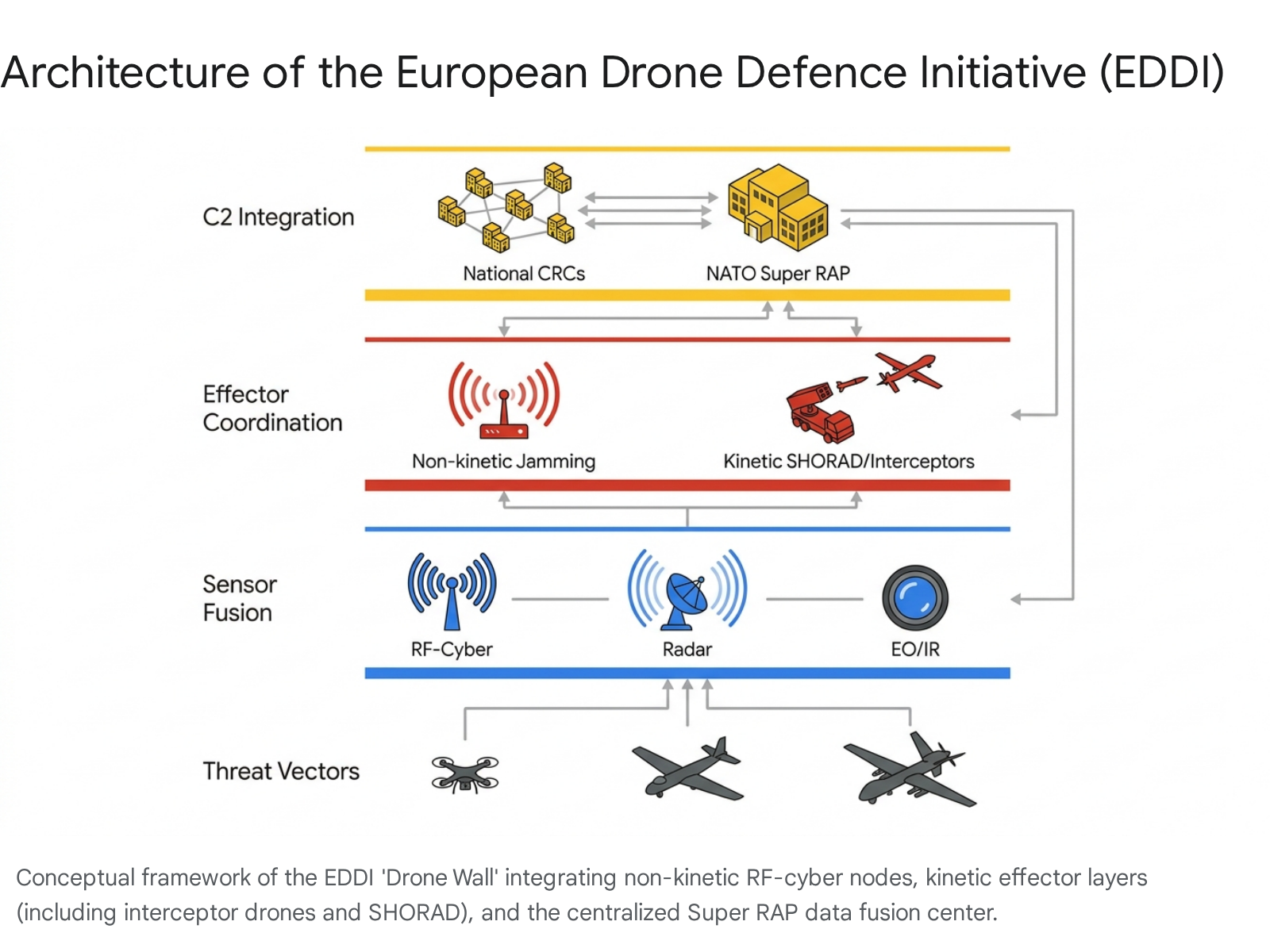
The overarching analytical deduction drawn from the event proceedings is that traditional, hardware-heavy, kinetic air defense paradigms are fiscally and operationally unsustainable against low-cost, mass-produced unmanned systems.3 In direct response to this asymmetric vulnerability, European defense architectures are aggressively pivoting toward the European Drone Defence Initiative (EDDI)—colloquially and strategically framed as the “Drone Wall”—which prioritizes software-centric, Radio Frequency (RF)-cyber disruption layers complemented by localized, low-cost interceptor drones.3
Simultaneously, tactical lessons exported from the Ukrainian theater are forcing a radical restructuring of Western defense procurement methodologies. The accelerated innovation cycles demonstrated by the Ukrainian “Brave1” cluster have provided empirical evidence that battlefield feedback loops must be compressed from traditional multi-year procurement cycles to mere weeks.7 Furthermore, the pervasive presence of hostile Electronic Warfare (EW) has rendered standard Global Navigation Satellite Systems (GNSS) highly vulnerable, catalyzing a rapid industry-wide shift toward visual navigation and fiber-optic tethered systems designed to operate in entirely electromagnetically denied environments.7
Cross-domain logistics have also entered a new era of practical application and doctrinal evaluation. The European Defence Agency’s (EDA) Operational Experimentation (OPEX) campaign, detailed extensively at the Düsseldorf event, provided robust empirical evidence that the theoretical efficiency of unmanned aerial and ground systems frequently diverges from their actual tactical effectiveness in contested environments.8 To support these emerging operational doctrines, the European industrial base is mobilizing an unprecedented mass-manufacturing effort. This industrial mobilization was codified at the event by a landmark twenty-five-company Memorandum of Understanding (MoU) aiming to produce over one hundred thousand drone and counter-drone systems annually by 2027.9 This report provides an exhaustive, granular analysis of these technological leaps, doctrinal shifts, and supply chain realignments.
2. Strategic Reorientation: The Securitization of XPONENTIAL Europe
The execution of XPONENTIAL Europe 2026 clearly demonstrated a fundamental strategic reorientation within the autonomous technologies sector, moving decisively from commercial utility toward military necessity.10 With approximately 360 exhibitors representing 43 distinct nations, the event more than doubled its exhibitor footprint compared to the previous year, reflecting the exponential influx of capital and strategic interest into dual-use applications.2 The opening of the event by Federal Transport Minister Patrick Schnieder highlighted the intersection of civilian mobility infrastructure and strategic sovereignty, illustrating that national security architectures are no longer confined to traditional defense contractors but now encompass the broader technological ecosystem.4
2.1 The Role of the Bundeswehr and Strategic Partnerships
The defining characteristic of the 2026 exhibition was the unprecedented integration of the German Armed Forces (Bundeswehr) as a core strategic partner.4 Moving beyond mere observation, the Bundeswehr actively shaped the discourse by hosting the “German Drone-Defence & Innovation Forum,” powered in collaboration with Diehl Defence.11 This forum established a targeted dialogue focusing explicitly on capability development, the digitization of the battlespace, uncrewed systems autonomy, and the necessary acceleration of military procurement processes.12
Rear Admiral Christian Bock, Head of the Bundeswehr Innovation Center, articulated the strategic necessity of this partnership, noting that unmanned systems are now a central factor in modern security architectures.1 The fundamental military lesson emphasized throughout these sessions is the requirement to closely interlink frontline operational experience, rapid technological development, and agile political framework conditions.1 Without this trilateral alignment, technological superiority cannot be effectively translated into operational dominance.
2.2 Addressing the Euro-Atlantic Threat Landscape
The strategic discussions at XPONENTIAL Europe were firmly anchored in the reality of the contemporary Euro-Atlantic threat environment. Panelists and military analysts consistently highlighted that the operational requirements for defense and the protection of critical infrastructure have been irrevocably altered by hybrid threats.1 The weaponization of commercial technology, combined with state-sponsored cyber operations, demands a responsive defense posture that integrates autonomous systems, artificial intelligence, and robotics directly into the security apparatus.1
The conference explicitly addressed deterrence and defense capabilities through the deployment of unmanned systems across all operational domains: Air, Ground, Maritime, and Space.1 This multi-domain approach acknowledges that isolated technological solutions are insufficient; modern deterrence requires a networked, interconnected web of autonomous sensors and effectors capable of identifying and neutralizing threats before they impact critical civilian and military infrastructure.13
3. The Asymmetric Threat Environment and Fiscal Sustainability
A foundational premise established during the defense symposiums at XPONENTIAL Europe 2026 is the severe cost-exchange asymmetry defining modern air defense.3 The proliferation of low-cost unmanned aerial systems has fundamentally broken the economic models underpinning traditional Western air superiority and defense doctrines.
3.1 The Economic Calculus of Interception
Military analysts and industry leaders at the event presented stark economic realities regarding current interception methodologies. Intercepting attritable, low-cost loitering munitions—which often cost merely a few thousand dollars to manufacture—using high-end combat aircraft or advanced surface-to-air missiles represents a strategic trap engineered by adversarial forces.3 Deploying advanced fighter platforms such as the F-35A or F-16C/D to counter commercial-grade drone incursions entails operating costs ranging from $33,000 to $42,000 per flight hour.3 Furthermore, utilizing sophisticated kinetic interceptors, such as the AIM-120 Advanced Medium-Range Air-to-Air Missile (AMRAAM), incurs a cost of approximately one million dollars per round.3
When adversaries deploy “Shahed-type” loitering munitions en masse, their primary objective is not solely the physical destruction of targets, but rather the economic attrition of the defending force.3 By forcing NATO and allied forces to expend multi-million-dollar interceptors on targets possessing a fraction of that value, adversaries effectively exhaust high-tier interceptor stockpiles and impose an unsustainable financial burden on defense budgets.3 The consensus reached during the “Operational and Innovative Security and Defence Perspectives” sessions was that continuing to rely exclusively on these legacy defense mechanisms is fiscally ruinous and operationally unviable in a protracted conflict.1
3.2 The Imperative for Cost-Proportionate Countermeasures
The recognition of this fiscal vulnerability has catalyzed an intense focus on developing cost-proportionate Counter-Unmanned Aerial Systems (C-UAS). Discussions highlighted the urgent requirement for defense systems that align the cost of the effector with the cost of the threat.5 This strategic imperative is driving rapid investment into non-kinetic neutralization methods, localized directed energy weapons, and attritable interceptor drones.3 The defense industry is actively shifting its developmental focus away from exquisite, multi-role platforms toward single-purpose, low-cost effectors capable of being deployed in massive swarms to match the scale of incoming hostile UAVs.
4. The European Drone Defence Initiative (EDDI) and the “Drone Wall” Architecture
To resolve the asymmetric vulnerability posed by massed drone incursions, European leaders and defense ministries have accelerated the conceptualization and implementation of the European Drone Defence Initiative (EDDI), widely referred to within strategic circles as the “Drone Wall”.3 Proposed initially as a flagship project under the EU Defence Readiness Roadmap 2030, the EDDI is advancing rapidly through the procurement pipeline, with initial operational capabilities expected by the end of 2026 and full system functionality targeted for the 2027 to 2028 timeframe.3
4.1 Conceptual Framework of the Eastern Flank Watch
The Drone Wall explicitly abandons the outdated concept of a static, physical barrier resembling historical fortifications. Instead, it relies on a deep, multi-layered, technologically advanced sensor and effector network extending across the borders and deep into the national territories of participating states.16 Jointly led by Finland and Poland, the closely associated “Eastern Flank Watch” initiative coordinates the integration of physical, air, and maritime defenses across a coalition of nations including Bulgaria, Estonia, Latvia, Lithuania, Romania, Sweden, and Norway.3 This initiative is designed to reinforce the European Union’s eastern borders against hybrid, cyber, maritime, and conventional threats originating from adversarial actors.3
4.2 Software-Centric RF-Cyber Disruption Layers
A critical technological shift presented at XPONENTIAL Europe is the prioritization of software-centric defense layers over purely kinetic solutions. As detailed by specialized C-UAS firms such as D-Fend Solutions during the exhibition, relying solely on hardware-heavy kinetic approaches is insufficient and often dangerous when countering Group 1 and Group 2 commercial and do-it-yourself (DIY) drones, particularly in urban or critical infrastructure environments.5
The primary component of the Drone Wall for managing these specific threat profiles is an advanced Radio Frequency (RF)-cyber layer.6 By utilizing RF-cyber technologies like the EnforceAir system, defending forces can achieve precise, non-kinetic takeovers of hostile drones.6 This capability allows operators to sever the adversary’s command link, assume control of the UAV, and force a safe landing in a designated zone, thereby mitigating the severe collateral damage risks associated with kinetic interceptions over populated areas.6 This non-kinetic first line of defense is essential for maintaining operational safety while neutralizing intelligence-gathering and disruptive drone flights.
4.3 Command Interoperability and the “Super RAP”
A highly complex operational challenge debated extensively at XPONENTIAL Europe concerns the aggregation and dissemination of target data across international borders to form a Recognized Air Picture (RAP).3 Currently, national defense forces operate distinct Integrated Air and Missile Defence (IADS) networks, each possessing its own localized Control and Reporting Centres (CRC).3
For the EDDI Drone Wall to function effectively as a cohesive continental shield, the tactical-level RAPs generated by decentralized edge sensors must be rapidly transmitted to higher military echelons.3 This transmission is necessary to formulate a comprehensive “Super RAP” covering the entirety of the EDDI zone of responsibility.3 Furthermore, this Super RAP must be seamlessly shared with NATO’s Allied Air Command headquarters at Ramstein Air Base.17 Achieving this level of data fusion requires overcoming significant hurdles in cybersecurity, data standardization, and international communications protocols, ensuring that coalition forces possess real-time, uncorrupted visibility of low-altitude threats across the European theater.
4.4 National Implementations: Poland’s “East Shield”
While the EDDI provides the overarching software, sensor, and command framework, the physical and kinetic implementation of the Drone Wall relies heavily on proactive national defense programs. Poland’s “East Shield” (Tarcza Wschód), scheduled for full completion by 2028, serves as a primary example of how the Drone Wall is being operationalized on the ground.3
Poland is actively accelerating its System Antydronowy (SAN) program, procuring eighteen batteries to provide robust protection for units deployed along its vulnerable northern and eastern borders.3 The SAN system represents a highly effective hybridization of kinetic and non-kinetic capabilities, specifically designed to engage and destroy threats that manage to bypass the initial RF-cyber disruption layers.
| Component Category | Polish SAN System Technical Capabilities |
| Heavy Kinetic Effectors | Integration of 35 mm and 30 mm cannons engineered to fire programmable airburst ammunition. |
| Light Kinetic Effectors | Deployment of 12.7 mm heavy machine guns capable of cyclic rates up to 3,600 rounds per minute. |
| Precision Guided Munitions | Utilization of Advanced Precision Kill Weapon System (APKWS) laser-guided rocket launchers. |
| UAS Interceptors | Integration of loitering munitions and “hunter” interceptor drones based on the MEROPS system architecture. |
| Support and C2 Architecture | Inclusion of organic radar stations, mobile command vehicles, and localized electronic warfare (EW) disruption modules. |
The rapid acquisition and deployment of these capabilities are partially underwritten by the European Union’s Security Action for Europe (SAFE) funding vehicle.3 This financial mechanism is expressly intended to assist member states in the timely satisfaction of urgent capability requirements, ensuring that individual nations can populate the broader Drone Wall network without facing insurmountable fiscal bottlenecks.3
5. Tactical Shifts: Combat-Proven Doctrines from the Ukrainian Theater
The most profound disruptions to Western military orthodoxy and procurement strategies presented at XPONENTIAL Europe 2026 originated directly from the battlefields of Ukraine. The ongoing conflict has acted as a severe operational crucible, accelerating technological evolution and forcing tactical adaptations at a pace previously unseen in modern, high-intensity warfare.18
5.1 The Brave1 Ecosystem and the Compression of Innovation Cycles
The traditional NATO military procurement cycle—which frequently spans five to ten years from initial requirement generation to final operational capability—has been rendered obsolete by the realities of rapid drone warfare.7 Ukrainian defense representatives detailed the operations of the “Brave1” defense technology cluster, a government-backed initiative functioning as a central platform linking over 2,300 startups and engineers directly with military end-users and state investors.7
The Brave1 model successfully bypasses rigid, peacetime bureaucracies by instituting a continuous, high-velocity battlefield feedback loop. Innovative technologies move from conceptualization and engineering to frontline combat testing in a matter of weeks, rather than years.7 Procurement within this ecosystem is highly decentralized; through the Brave1 digital marketplace, individual military units receive operational credits based on battlefield performance and can directly order the specific technological systems they deem most effective for their immediate tactical needs.7 This demand-driven model ensures that state and allied capital is allocated exclusively to platforms that demonstrate immediate tactical utility, fostering a hyper-Darwinian industrial environment where underperforming systems are immediately identified and discarded.18
5.2 The Rise of the Attritable Interceptor Drone
A direct and highly effective consequence of this rapid iterative process is the evolution of the interceptor drone. Faced with overwhelming barrages of Shahed-type loitering munitions and the aforementioned exorbitant costs of traditional surface-to-air missiles, Ukrainian firms have pioneered the development of low-cost, fixed-wing vertical take-off and landing (VTOL) interceptors.7
General Cherry, a prominent Ukrainian manufacturer presenting at the exhibition, showcased the “Bullet” interceptor.14 Developed from a conceptual stage to combat deployment in under eighteen months, the Bullet platform epitomizes the new economics of air defense.14 Capable of reaching terminal interception speeds of 309 km/h with a tactical operational range of 17 to 20 kilometers, the Bullet carries a modular 0.4 to 0.8 kilogram warhead designed to destroy larger, incoming hostile drones via direct kinetic collision or proximity detonation.14 With a highly optimized unit cost of approximately $2,100, the Bullet reverses the adverse cost-exchange ratio, allowing defending forces to intercept sophisticated threats for a fraction of the cost of the incoming munition.14 However, defense analysts at the event consistently stressed that these localized interceptors cannot operate in isolation; they represent the terminal “effector” end of the kill chain and must be deeply integrated into the overarching radar and command architectures established by macro-initiatives like EDDI.7
5.3 Navigating the Electromagnetically Contested Battlefield
The pervasive proliferation of advanced Electronic Warfare (EW) by hostile forces has fundamentally altered the baseline requirements for drone design. Extensive operational evidence presented by manufacturers at the fair indicated that standard GPS and GNSS navigation systems are now effectively obsolete on the modern, peer-to-peer battlefield.7 Unmanned systems relying solely on unencrypted or easily jammed satellite navigation signals are immediately neutralized by broad-spectrum EW disruption.
To maintain operational effectiveness in these denied environments, tactical designs have decisively shifted toward multi-layered, resilient navigation.7 This shift includes the rapid integration of visual navigation odometry, allowing AI-equipped drones to navigate autonomously by comparing real-time electro-optical camera feeds against pre-loaded topographical terrain maps, entirely without emitting or relying upon vulnerable RF signatures.20
Furthermore, the deployment of fiber-optic First-Person View (FPV) drones has emerged as a dominant tactical solution for close-in engagements.7 By physically tethering the drone to the operator via a highly durable, lightweight fiber-optic cable that rapidly unspools mid-flight, the system achieves complete immunity to radio frequency jamming, electronic spoofing, and signal interception.7 This unbroken, unjammable optical data link ensures high-fidelity video feeds and zero-latency control inputs right up to the point of terminal impact. Demonstrating the extreme asymmetric leverage of these jam-proof systems, General Cherry reported that one of its OPTIX fiber-optic drones recently successfully engaged and destroyed a Russian Ka-52 attack helicopter—an asset valued at approximately $16 million—using a platform costing merely a few thousand dollars.14
5.4 Distributed Manufacturing and Supply Chain Sovereignty
Scaling the production of these attritable systems to meet immense wartime consumption rates introduces severe industrial vulnerabilities. Recognizing the strategic risk of concentrating critical production facilities within the strike range of hostile ballistic missiles, Ukrainian defense firms are aggressively adopting a distributed, transnational manufacturing model.7
General Cherry, for instance, formalized a memorandum of cooperation with the Croatian drone manufacturer Orqa to co-produce interceptor drones within secure EU territory.14 This distributed architecture ensures that European production can scale rapidly to meet allied needs without draining Ukraine’s domestic interceptor supply, while simultaneously shielding the manufacturing base from direct kinetic attacks.14
However, this distributed manufacturing model introduces highly complex legal and compliance challenges. The transfer of defense-related technical data, schematics, and software across international borders engages stringent export controls, including the Wassenaar Arrangement, the EU dual-use regulation, and stringent national export frameworks.21 Legal and compliance experts at the conference drew pertinent parallels to a 2018 enforcement action against FLIR Systems, where inadequate information governance and access controls across a multinational subsidiary led to $30 million in fines for the unauthorized transfer of ITAR-controlled technical data.21 For Ukraine’s nascent defense technology sector to successfully and legally integrate into the broader NATO industrial base, manufacturers must implement rigorous, auditable data access controls to satisfy allied compliance regimes.21 Concurrently, there is an industry-wide mandate to re-engineer platforms to eliminate dependency on Chinese-origin components, prioritizing sovereign, secure supply chains to meet strict NATO procurement and security standards.7
6. Cross-Domain Logistics: Empirical Findings from the EDA OPEX Campaign
While lethal applications and counter-measures dominated much of the strategic discourse, the operationalization of unmanned systems for frontline logistics represented a critical doctrinal advancement showcased at the event. The European Defence Agency (EDA), operating through its Hub for European Defence Innovation (HEDI), presented the comprehensive empirical findings of its first Operational Experimentation (OPEX) campaign.8
6.1 The CEPOLISPE Trials and Methodology
Conducted at the Centro Polifunzionale di Sperimentazione dell’Esercito (CEPOLISPE) proving ground near Rome, Italy, the OPEX campaign decisively shifted the evaluation of unmanned logistics from theoretical modeling and controlled demonstrations to grueling, real-world field tests.8 A specialized coalition of 90 military and technical experts drawn from 14 EU member states, Switzerland, and Ukraine designed and executed 130 distinct operational scenarios.8 These rigorous scenarios simulated high-stress combat logistics, specifically focusing on the autonomous delivery of critical ammunition to forward-deployed frontline positions and the autonomous evacuation of casualties (RasEvac) under simulated hostile conditions.8
6.2 Comparative Platform Analysis
The OPEX campaign systematically evaluated a diverse portfolio of commercially available and near-production autonomous platforms to establish definitive baseline capabilities for cross-domain resupply operations.8 By standardizing the mission parameters across platforms possessing wildly different propulsion systems, navigation software, and payload limits, the EDA generated a precise comparative matrix of current European logistical capabilities.8
| Operational Domain | Manufacturer / Origin | Selected Platforms Evaluated | Core Logistical Capabilities & Class |
| Aerial (UAS) | Beyond Vision (Portugal) | BVQ418 / VTOne | Class 3 fully electric multirotor; 7kg autonomous payload capacity; 90-minute sustained flight endurance. |
| Aerial (UAS) | Schiebel (Austria) | CAMCOPTER S-100 / S-301 | Rotary-wing VTOL systems; designed for heavy-lift cross-domain maritime and land interoperability. |
| Aerial (UAS) | Altus LSA (Greece) | (Various tactical models) | Rapid deployment platforms optimized for urgent frontline resupply and forward reconnaissance. |
| Ground (UGV) | ARX Robotics (Germany) | Modular tracked/wheeled platforms | Rapidly modifiable chassis systems adaptable for both heavy cargo and casualty transport (MEDEVAC). |
| Ground (UGV) | Alisys Robotics (Spain) | Quadrupedal “Robot Dogs” | Exceptional mobility in complex, unstructured, and debris-strewn urban or forested terrain. |
| Ground (UGV) | PIAP (Poland) | Heavy Tracked/Wheeled systems | High-torque systems optimized for heavy-duty logistics and autonomous explosive ordnance disposal. |
6.3 The Dichotomy Between Technical Efficiency and Tactical Effectiveness
The most critical doctrinal deduction drawn from the EDA OPEX campaign was the stark divergence observed between theoretical technical efficiency and actual tactical effectiveness.8 In peacetime environments, engineers optimize logistical platforms for maximum payload capacity and maximum speed. However, military evaluators determined during the trials that a highly efficient, heavy-lift platform is operationally useless if its large physical profile, acoustic signature, and thermal emissions immediately attract enemy artillery fire.8
For example, the quadrupedal UGVs (“robot dogs”) supplied by firms like Alisys Robotics possess relatively low individual payload capacities compared to traditional wheeled drones.8 Assessed solely on a cost-per-kilogram transport metric, they appear inefficient. Yet, tactically, they proved immensely valuable. Their low physical profile, highly articulated agility, and minimal acoustic signature allowed them to move discreetly and almost silently between enemy lines, successfully navigating complex debris fields that completely halted larger, more efficient tracked vehicles.8 This finding empirically validates the military utility of distributing critical logistics across a decentralized swarm of smaller, stealthier attritable assets rather than relying upon a few high-value, heavy-lift platforms that present highly visible targets.
6.4 Human-Machine Teaming and Rapid Battlefield Iteration
The OPEX campaign also generated essential human-factors data regarding the cognitive load required for soldiers to operate these complex systems under stress.8 A significant observation was that while the aerial platforms (UAS) frequently required highly trained manufacturer personnel or specialized pilots to operate effectively and navigate airspace regulations, the ground platforms (UGVs) demonstrated a vastly superior human-machine interface for general infantry.8 Frontline soldiers participating in the trials were able to confidently take control of the UGVs and successfully execute logistics missions after only a brief, rudimentary instruction period.8
This direct interaction between end-users and technology developers yielded immediate industrial dividends. The feedback loop established during the trials was so tightly integrated that at least one UGV manufacturer, ARX Robotics, implemented hardware modifications and software updates to its vehicles in real-time based on soldier critiques.8 These troop-mandated refinements were instantly integrated into the production lines for the UGVs currently being shipped to active combat units in Ukraine, demonstrating the profound value of concurrent operational testing and manufacturing.8
7. European Industrial Base Modernization and Sovereign Manufacturing
The ambitious technological architectures outlined by the EDDI Drone Wall and the operational strategies validated by the OPEX trials are entirely dependent on a massive, unprecedented expansion of the European defense industrial base. The transition from producing exquisite, artisan-crafted aerospace assets in low volumes to the mass manufacturing of attritable, autonomous drones requires a fundamental restructuring of continental supply chains.7
7.1 The 100,000 Systems Memorandum of Understanding
To officially codify this industrial mobilization, twenty-five leading companies operating within the drone sector utilized the XPONENTIAL Europe 2026 platform to sign a landmark Memorandum of Understanding (MoU).9 Coordinated by UAV DACH, which serves as Europe’s largest industry association for unmanned aviation, the MoU establishes a binding framework aimed at scaling production to exceed 100,000 units of drones and drone defense systems per year by 2027.9
Achieving this aggressive target necessitates a paradigm shift in defense manufacturing, including the adoption of automotive-style assembly lines, extreme component simplification, and the stringent standardization of parts to eliminate persistent supply chain bottlenecks.7 The accompanying joint report drawn up by UAV DACH aims to align national governments and the European Commission on the necessary regulatory reforms, financial investments, and logistical support required to meet these production quotas.9 This initiative aligns closely with funding instruments such as the European Defence Fund and SAFE loans, which aim to incentivize domestic production and reduce reliance on extra-European suppliers.28
7.2 Overcoming Global Supply Chain Dependencies
A recurring theme across the industrial panels was the necessity of establishing sovereign supply chains. The integration of advanced autonomous systems is highly dependent on microelectronics, specialized materials, and AI-capable processing units.30 The strategic push to eliminate dependence on Chinese-origin components is not merely a political objective but a stringent requirement to align with NATO and allied procurement security standards.7 Defense firms are actively exploring alternative sourcing for rare earth materials and investing heavily in domestic electronic design automation (EDA) workflows and next-generation microelectronics manufacturing (NGMM) to ensure that the European industrial base can sustain high-intensity production independent of geopolitical disruptions.31
8. Next-Generation Autonomous Platforms and Counter-UAS Demonstrations
The exhibition floors at XPONENTIAL Europe provided a comprehensive, tangible view of how prime European defense contractors are evolving their portfolios to meet the demands of the Drone Wall, decentralized warfare, and intelligent mission systems. Germany’s leading defense firms, Rheinmetall AG and Diehl Defence, anchored the technological showcases, presenting mature systems ready for immediate deployment.32
8.1 Rheinmetall AG: Full-Spectrum Autonomous Operations
Rheinmetall positioned itself strategically as a provider of full-spectrum, networked autonomous operations extending across land, air, and space domains, emphasizing seamless interoperability.32
- Loitering Munitions (FV-014): The FV-014 represents a next-generation portable reconnaissance and strike drone tailored for the modern battlefield. Unlike fully autonomous “fire-and-forget” kill-vehicles, the system is explicitly engineered to ensure the human operator remains actively involved in the decision-making process.32 This human-in-the-loop architecture allows for detailed target observation and analysis before executing a precise strike, thereby minimizing collateral damage and ensuring strict compliance with operational rules of engagement.32
- Hard-Kill Interception (RV-005 c-UAS): Directly addressing the fiscal unsustainability of relying on expensive missile intercepts, Rheinmetall showcased the RV-005 specialized interceptor.32 This hard-kill effector utilizes onboard artificial intelligence to autonomously track and engage Group 1 and 2 drone threats via direct physical collision or the detonation of a small localized warhead. Crucially, its autonomous targeting algorithms allow it to complete its intercept mission successfully even if its external command link is severed by hostile radio jamming, ensuring effectiveness in high-EW environments.32
- Space Domain Integration (ICEYE): Recognizing that effective ground operations and C-UAS networks require persistent, high-fidelity intelligence, Rheinmetall highlighted its strategic joint venture with ICEYE to develop a sovereign German constellation of Synthetic Aperture Radar (SAR) satellites.32 These space-based assets provide high-resolution targeting imagery that is entirely impervious to cloud cover or nighttime conditions, generating the strategic data required to feed the EDDI Super RAP.32
- Teleoperated Mobility and Robotics: Through its subsidiary MIRA GmbH, Rheinmetall demonstrated advanced teleoperation centers. Utilizing 5G mobile networks, these consoles allow operators to safely drive and manage UGVs in complex, hazardous environments using high-resolution, low-latency video feeds.32 Additionally, the robust YARO Cobot was displayed, designed to maintain operational precision via vibration control in extreme battlefield temperatures.32
8.2 Diehl Defence: Mobile Counter-UAS Architectures
Diehl Defence, operating as a key strategic partner and lead sponsor of the “German Drone-Defence & Innovation Forum,” showcased mobile systems specifically tailored for rapid deployment and the close-in protection of advancing forces.33
- The GARMR System: Presented as a highly mobile, combat-enhanced drone defense system, GARMR is designed to provide immediate, organic C-UAS coverage for advancing mechanized infantry units. This mobile umbrella is critical for preventing the kind of devastating FPV drone attrition currently observed in the Ukrainian theater.33
- CICADA and Sky Sphere: Diehl displayed the CICADA effector, an integral component of the broader Sky Sphere drone defense architecture. This highlights the industry-wide transition toward modular, open-architecture systems capable of integrating multiple disparate sensor and effector types into a unified defense net.33
- Ziesel UGV and PLATON: Showcasing advancements in ground autonomy, Diehl presented the Ziesel UGV integrated with the PLATON Autonomy Kit, allowing for autonomous logistics transport and perimeter patrol without requiring constant manual control.33
- LIBELLE: Representing the company’s anti-armor capabilities, the LIBELLE loitering munition provides infantry units with precision, top-attack capabilities against heavily armored mechanized targets.33
9. Policy, Governance, and NATO Integration
Technological capabilities frequently outpace the development of doctrinal integration and regulatory frameworks. To actively bridge this gap, the German Armed Forces (Bundeswehr) hosted the central “Defense Theater” conference at the event, operating under the title “Operational and Innovative Security and Defence Perspectives of an Unmanned Environment”.1
9.1 The Doctrine of Meaningful Human Control
A prevailing and critical theme of the Bundeswehr conference was the ethical, legal, and operational governance of Artificial Intelligence within weapons systems.1 As autonomy algorithms become more advanced, military commanders face an inherent temptation to remove human operators entirely from the kill chain to exponentially increase reaction speed against hypersonic or swarming threats. However, the conference forcefully reiterated the strict doctrinal necessity of maintaining “meaningful human control”.1 This operational principle mandates that while AI can assist in rapid target detection, classification, and complex flight navigation, the ultimate decision to deploy lethal force must remain vested in a human operator.1 Adherence to this doctrine ensures compliance with international humanitarian law and prevents unpredictable, automated escalation cycles driven by interacting autonomous algorithms.
9.2 NSATU and Institutional Interoperability
The seamless integration of diverse, rapidly evolving unmanned systems into a coherent, multinational NATO framework represents a monumental logistical and institutional challenge. This complex issue was addressed comprehensively during the conference presentation titled “Innovate to Survive,” delivered under the auspices of the NATO Security Assistance and Training for Ukraine (NSATU).12
NSATU, operating from Poland with nearly 700 personnel led by a U.S. three-star general, is currently tasked with coordinating the massive, highly varied influx of military equipment donations to Ukraine.36 The presentation underscored a fundamental reality: surviving modern conflicts requires not just rapid technological innovation, but profound institutional innovation. NATO forces must adopt commercial product- and platform-based operating models, decisively discard legacy procurement bureaucracy, and utilize digital-native tools to align multinational supply chains.38 NSATU’s mandate includes standardizing training and logistics for the myriad of autonomous systems currently in use. By doing so, NSATU is effectively building the institutional muscle memory required for NATO to operate a cohesive, multi-domain unmanned force in future near-peer conflicts.36
Furthermore, the bilateral “Defence meets Wirtschaft” symposium, curated by the British Chamber of Commerce in Germany (BCCG), highlighted the absolute necessity of aligning these procurement strategies across key European allies.1 Ensuring strict interoperability, shared regulatory frameworks, and robust industrial resilience between the United Kingdom, Germany, and broader NATO structures is deemed vital for sustaining European defense capabilities in the face of protracted, high-intensity conflicts.1 Efforts by organizations such as JEDA and ASTM to align European drone operations with global standards further emphasize the requirement for standardized, cross-border operational frameworks.39
10. Conclusion
The proceedings, demonstrations, and strategic dialogues at XPONENTIAL Europe 2026 provide conclusive evidence that unmanned systems, robotics, and artificial intelligence are no longer peripheral or emerging technologies; they now form the absolute bedrock of contemporary military strategy, deterrence, and critical infrastructure protection. The traditional paradigms of high-cost, low-volume kinetic warfare have been permanently disrupted by the rapid proliferation of attritable, software-defined autonomous systems.
To maintain strategic sovereignty and effective deterrence, European defense structures are correctly pivoting toward highly integrated, multi-layered architectures such as the EDDI Drone Wall, which prioritize resilient RF-cyber disruption capabilities and localized, low-cost interceptors. Furthermore, the rapid innovation cycles imported directly from the Ukrainian theater prove unequivocally that defense procurement must be agile, highly responsive, and deeply connected to continuous frontline operator feedback. The binding commitment by twenty-five European companies to scale production beyond 100,000 units annually indicates a robust, serious industrial mobilization. Moving forward, the primary challenge for NATO and EU defense planners will not merely be developing better technology, but ensuring complex institutional interoperability, maintaining secure cross-border data governance, and strictly enforcing the doctrine of meaningful human control as these autonomous swarms increasingly take to the skies, land, and sea.
Appendix A: Methodology
The analysis presented in this report was compiled utilizing a rigorous Open-Source Intelligence (OSINT) framework, drawing exclusively from authoritative, publicly available documents, official press releases, technical briefings, and specialized journalistic coverage of the XPONENTIAL Europe 2026 event.
The analytical process employed a multi-layered synthesis technique designed to extract both tactical and strategic meaning from raw data points. First, discrete technological specifications—such as the payload capacities, range, and navigation systems of specific UAS and UGVs showcased at the event—were isolated. Second, these technical parameters were cross-referenced against the stated operational objectives of European defense institutions, notably the EDA’s OPEX campaign findings and NATO’s NSATU mandate. Finally, macro-level geopolitical and economic constraints—such as the fiscal sustainability of missile defense and the supply chain vulnerabilities inherent in decentralized manufacturing—were mapped onto the technological data to generate holistic insights. This approach ensures the report constructs a cohesive narrative detailing why specific technologies are being procured, how they alter existing military doctrines, and the systemic challenges involved in their large-scale deployment.
Appendix B: Glossary of Acronyms
- AISS – Autonomous Inland & Short Sea Shipping
- APKWS – Advanced Precision Kill Weapon System
- AUVSI – Association for Uncrewed Vehicle Systems International
- BCCG – British Chamber of Commerce in Germany
- C2 – Command and Control
- C-UAS – Counter-Unmanned Aerial Systems
- CRC – Control and Reporting Centre
- DIY – Do-It-Yourself
- EDA – European Defence Agency
- EDDI – European Drone Defence Initiative
- EO/IR – Electro-Optical/Infrared
- EU – European Union
- EW – Electronic Warfare
- FPV – First-Person View
- GNSS – Global Navigation Satellite System
- GPS – Global Positioning System
- HEDI – Hub for European Defence Innovation
- IADS – Integrated Air and Missile Defence
- ISR – Intelligence, Surveillance, and Reconnaissance
- ITAR – International Traffic in Arms Regulations
- MEDEVAC – Medical Evacuation
- MOSA – Modular Open System Approach
- MoU – Memorandum of Understanding
- NATO – North Atlantic Treaty Organization
- NGMM – Next Generation Microelectronics Manufacturing
- NSATU – NATO Security Assistance and Training for Ukraine
- OPEX – Operational Experimentation
- PURL – Prioritised Ukraine Requirements List
- RAP – Recognized Air Picture
- RF – Radio Frequency
- SAFE – Security Action for Europe
- SAN – System Antydronowy (Anti-Drone System)
- SAR – Synthetic Aperture Radar
- SHORAD – Short-Range Air Defense
- UAS – Unmanned Aerial Systems
- UAV – Unmanned Aerial Vehicle
- UGV – Unmanned Ground Vehicle
- VSHORAD – Very Short-Range Air Defense
- VTOL – Vertical Take-Off and Landing
Please share the link on Facebook, Forums, with colleagues, etc. Your support is much appreciated and if you have any feedback, please email us in**@*********ps.com. If you’d like to request a report or order a reprint, please click here for the corresponding page to open in new tab.
Sources Used
- XPONENTIAL Europe 2026 focuses on Security and Defence, accessed May 9, 2026, https://www.xponential-europe.com/en/Media_News/Press/Press_Material/Press_Releases/XPONENTIAL_Europe_2026_focuses_on_Security_and_Defence
- XPONENTIAL Europe – Europe’s Leading Trade Fair for Autonomy and Robotics, accessed May 9, 2026, https://www.xponential-europe.com/
- The Counter-UAS Conundrum – European Security & Defence, accessed May 9, 2026, https://euro-sd.com/wp-content/uploads/2026/02/ESD_03_2026_WEB.pdf
- Defense Systems at XPONENTIAL Europe 2026, accessed May 9, 2026, https://www.xponential-europe.com/en/Defense
- Europe’s Drone Wall: Software‑Centric RF‑Cyber Core Key to Defeat Commercial and DIY Drone Threats – Autonomy Global, accessed May 9, 2026, https://www.autonomyglobal.co/europes-drone-wall-software-centric-rf-cyber-core-key-to-defeat-commercial-and-diy-drone-threats/
- Media Coverage, Anti-Drohne – D-Fend Solutions, accessed May 9, 2026, https://d-fendsolutions.com/de/newsroom/media-coverage/
- Ukraine Building Drone Industry Under Fire – Inside Unmanned …, accessed May 9, 2026, https://insideunmannedsystems.com/ukraine-building-drone-industry-under-fire/
- EDA launches test campaign for UAS & UGV logistics – XPONENTIAL Europe, accessed May 9, 2026, https://www.xponential-europe.com/en/Media_News/Articles/Cross-Domain_Logistics_European_Defence_Agency_Launches_Test_Campaign_for_UAS_and_UGV
- Active Conflicts & News Megathread March 25, 2026 : r/CredibleDefense – Reddit, accessed May 9, 2026, https://www.reddit.com/r/CredibleDefense/comments/1s35z78/active_conflicts_news_megathread_march_25_2026/
- Strength through innovation: Around 360 exhibitors present autonomous systems and robotics at XPONENTIAL Europe, accessed May 9, 2026, https://www.xponential-europe.com/en/Media_News/Press/Press_Material/Press_Releases/Strength_through_innovation_Around_360_exhibitors_present_autonomous_systems_and_robotics_at_XPONENTIAL_Europe
- Supporting Program – XPONENTIAL Europe 2026, accessed May 9, 2026, https://www.xponential-europe.com/en/Program/Supporting_Program
- German Drone-Defence & Innovation Forum 2026 | Bundeswehr at XPONENTIAL Europe, accessed May 9, 2026, https://www.xponential-europe.com/en/Program/Partner_Conferences/Bundeswehr
- Defense and National Security – XPONENTIAL Europe, accessed May 9, 2026, https://www.xponential-europe.com/en/Program/Supporting_Program/XPONENTIAL_Europe_Conference/Defense_and_National_Security
- General Cherry And Orqa Sign MoU To Build Counter-Drone Systems On European Soil, accessed May 9, 2026, https://dronexl.co/2026/04/07/general-cherry-orqa-counter-drone/
- Lockheed Martin to scale laser to 500kW power level, aiming at C-UAS missions inter alia, accessed May 9, 2026, https://www.unmannedairspace.info/counter-uas-systems-and-policies/lockheed-martin-to-scale-laser-to-500kw-power-level-aiming-at-c-uas-missions-inter-alia/
- Drone alert over Europe | HENSOLDT, accessed May 9, 2026, https://www.hensoldt.net/insights/Drone-alert-over-Europe
- Drone Evolution: Higher, Further, and Deadlier – European Security & Defence, accessed May 9, 2026, https://euro-sd.com/wp-content/uploads/2025/06/ESD_06_2025_WEB.pdf
- The development of unmanned systems in Ukraine – European Security & Defence, accessed May 9, 2026, https://euro-sd.com/2025/04/articles/43553/the-development-of-unmanned-systems-in-ukraine/
- Ukraine Scales Robotic Ground Assaults To 9,000 Missions A Month As Zelensky Pitches Unmanned Warfare To Europe – Drone News & DJI Rumors, accessed May 9, 2026, https://dronexl.co/2026/04/20/ukraine-ground-robots-9000-missions-zelensky/
- All Themes | ESA Space Solutions, accessed May 9, 2026, https://business.esa.int/projects/theme
- When Weapons Cross Borders, Data Follows: Ukraine’s Drone Expansion and the Compliance Reckoning to Come – ComplexDiscovery, accessed May 9, 2026, https://complexdiscovery.com/when-weapons-cross-borders-data-follows-ukraines-drone-expansion-and-the-compliance-reckoning-to-come/
- Engineers, missile strikes and high technology: can Ukraine produce more weapons in 2026? | Ukrainska Pravda, accessed May 9, 2026, https://www.pravda.com.ua/eng/articles/2026/01/04/8014603/
- European Defence Agency: Portugal to host Operational Experimentation Campaign OPEX, accessed May 9, 2026, https://ieu-monitoring.com/editorial/european-defence-agency-portugal-to-host-operational-experimentation-campaign-opex/871916?utm_source=ieu-portal
- Öffentliche Sicherheit und Katastrophenschutz – XPONENTIAL Europe, accessed May 9, 2026, https://www.xponential-europe.de/de/Programm/Rahmenprogramm/XPONENTIAL_Europe_Conference/%C3%96ffentliche_Sicherheit_und_Katastrophenschutz
- Beyond Vision Demonstrates VTOL & Quadcopter Drones During OPEX 2025, accessed May 9, 2026, https://www.defenseadvancement.com/feature/beyond-vision-demonstrates-vtol-quadcopter-drones-during-opex-2025/
- UAS Archives – HeliHub.com, accessed May 9, 2026, https://www.helihub.com/tag/uas/
- Shelter from the swarm | European Defence Agency, accessed May 9, 2026, https://eda.europa.eu/docs/default-source/eda-magazine/edm30—european-defence-matters-shelter-from-the-swarm.pdf
- Commission presents action plan to counter drone threats – Global Airspace Radar, accessed May 9, 2026, https://globalairspaceradar.com/news/commission-presents-action-plan-to-counter-drone-threats/
- XPONENTIAL Europe 2026 | Uncrewed Systems Momentum – ePropelled, accessed May 9, 2026, https://epropelled.com/blogs/blog/europe-s-uncrewed-systems-momentum-germany-the-uk-and-the-path-to-xponential-europe-2026
- The digital humanism era triggered by individual creativity | Request PDF – ResearchGate, accessed May 9, 2026, https://www.researchgate.net/publication/368888877_The_digital_humanism_era_triggered_by_individual_creativity
- Defense Advanced Research Projects Agency (DARPA) – Justification Book – Department of War, accessed May 9, 2026, https://comptroller.war.gov/Portals/45/Documents/defbudget/FY2027/budget_justification/pdfs/03_RDT_and_E/RDTE_Vol1_DARPA_MasterJustificationBook_PB_2027.pdf
- Rheinmetall showcases advanced drones, robotics and satellite …, accessed May 9, 2026, https://defence-industry.eu/rheinmetall-showcases-advanced-drones-robotics-and-satellite-systems-at-xponential-europe-2026-in-dusseldorf/
- XPONENTIAL Europe: Diehl Defence showcases its C-UAV …, accessed May 9, 2026, https://new.diehl.com/defence/en/press-media/news/xponential-europe-diehl-defence-showcases-its-c-uav-capabilities
- Rheinmetall at XPONENTIAL, accessed May 9, 2026, https://www.rheinmetall.com/en/media/news-watch/news/2026/03/2026-03-20-rheinmetall-at-xponential
- German Drone-Defence & Innovation Forum 2026 – Bundeswehr @ XPONENTIAL Europe, accessed May 9, 2026, https://www.xponential-europe.de/de/Programm/Partner-Konferenzen/Bundeswehr
- Operation Atlantic Resolve Quarterly Report to Congress, April 1, 2024-June 30, 2024 – Inspector General, accessed May 9, 2026, https://oig.usaid.gov/sites/default/files/2024-09/OAR_Q3_JUN2024_REVISE.pdf
- Operation Atlantic Resolve Quarterly Report to Congress, April 1, 2024-June 30, 2024, accessed May 9, 2026, https://oig.usaid.gov/sites/default/files/2024-08/Special_IG_OAR_Q3_Final_508_0.pdf
- 2025 AFCEA TechNet Cyber: Conference Schedule, accessed May 9, 2026, https://events.afcea.org/afceacyber25/Public/sessions.aspx?View=Sessions&ID=113469
- Ukraine, Germany strengthen cooperation in C-UAS and air defence and drones, accessed May 9, 2026, https://www.unmannedairspace.info/counter-uas-systems-and-policies/ukraine-germany-strengthen-cooperation-in-c-uas-and-air-defence-and-drones/