Tag Archives: Cuba

SITREP Cuba – Week Ending March 28, 2026

Executive Summary

During the week ending March 28, 2026, the Republic of Cuba has entered a phase of acute, multidimensional systemic failure, driven by the unprecedented convergence of external geopolitical coercion, catastrophic internal infrastructure collapse, and severe macroeconomic deterioration. Intelligence and strategic assessments generated for this period indicate that the regime of President Miguel Díaz-Canel is operating under extreme existential friction, with the foundational pillars of the state’s command economy effectively paralyzed. The primary catalyst for the current acceleration of this crisis is the maximalist United States energy blockade, structurally formalized under the military and diplomatic umbrella of Operation Southern Spear. Initiated following the United States intervention in Venezuela in January 2026, this operation has successfully severed Havana’s vital petroleum lifelines from Caracas, dropping Cuban state oil imports to effectively zero for the entire first quarter of 2026. This artificial energy starvation has catalyzed a cascading collapse of the island’s critical civilian and state infrastructure.

Throughout the month of March 2026, the Cuban national power grid has suffered three complete, nationwide collapses, the most severe occurring on March 16. This event left an estimated 10 million citizens without electricity and demonstrated the terminal fragility of the island’s aging, Soviet-era thermoelectric generation network. Without the baseline heavy fuel oil required to run these facilities, the state has been forced to implement rolling blackouts lasting up to 20 hours per day in vast swaths of the country. The second-order effects of this energy deficit are rapidly unspooling across the socio-economic spectrum: municipal water distribution systems have ceased functioning, cold chain logistics for food and pharmaceuticals have entirely ruptured, and the public health apparatus is buckling under the cumulative strain of these deficits combined with the lingering devastation of Hurricane Melissa, which struck the eastern provinces late last year. Consequently, the United Nations has issued an urgent $94 million humanitarian appeal to stave off mass starvation and the spread of vector-borne diseases.

Internal security indicators are simultaneously flashing red across all provinces. Driven by acute resource scarcity, prolonged darkness, and food insecurity, civilian unrest has metastasized beyond the state’s traditional containment capabilities. More than 160 distinct protest events have been recorded across the island since early March, characterized primarily by nighttime cacerolazos (pot-banging protests) and localized acts of defiance against state symbols, including the physical vandalization of a Communist Party office in the central municipality of Morón. While state security forces maintain a monopoly on organized violence and continue to execute targeted detentions of high-profile dissidents and digital influencers, the geographic dispersal and spontaneous nature of the protests suggest that the state’s internal control apparatus is becoming increasingly stretched and exhausted.

In response to this existential threat, the Cuban government has initiated parallel tracks of crisis management that highlight its internal desperation. Domestically, the Council of Ministers has accelerated the rollout of the newly updated “Government’s Economic and Social Program for 2026,” attempting to introduce highly controlled market incentives and administrative decentralization to municipalities without abandoning the core tenet of one-party supremacy. Concurrently, Havana has engaged in highly sensitive, back-channel diplomatic negotiations with Washington, yielding the release of 51 political prisoners in a desperate bid to ease the embargo. However, the Trump administration appears resolutely committed to a strategy of maximal pressure aimed at forcing an expedited regime transition by the end of the year. Globally, the crisis is drawing in great power competitors. While Moscow and Beijing have issued strong diplomatic statements of solidarity with Havana, their actual material interventions remain cautiously calibrated to avoid direct military or economic entrapment with the United States. The immediate trajectory points toward deepening socio-economic fragmentation, mass outward migration into the broader Latin American corridor, and a highly volatile internal security environment heading into the second quarter of 2026.

1. Geopolitical Environment and U.S. Strategic Coercion

The existential threat currently facing the Cuban government cannot be analyzed in isolation; it is the direct, intended consequence of a broader, aggressive hemispheric realignment driven by the United States. The inauguration of the Trump administration in 2025 ushered in a maximalist approach to the Western Hemisphere, viewing the survival of the Cuban Communist Party not merely as a regional irritant, but as an intolerable vulnerability that enables strategic competitors—namely the Russian Federation and the People’s Republic of China—to project power into the Caribbean basin.1 To neutralize this perceived threat, the United States has engineered a comprehensive strategy of economic and geopolitical asphyxiation.

The foundational shift in this regional architecture occurred on January 3, 2026, when United States military forces executed Operation Absolute Resolve, intervening directly in Venezuela and forcibly capturing President Nicolás Maduro and his inner circle.2 By decapitating the Venezuelan government, the United States effectively destroyed Cuba’s primary ideological ally and its most vital economic benefactor. For over two decades, subsidized Venezuelan crude oil served as the lifeblood of the Cuban state, replacing the massive subsidies lost following the collapse of the Soviet Union.5 The subsequent imposition of a de facto naval blockade on all Venezuelan oil exports severed the trans-Caribbean umbilical cord that had sustained Havana’s command economy.1

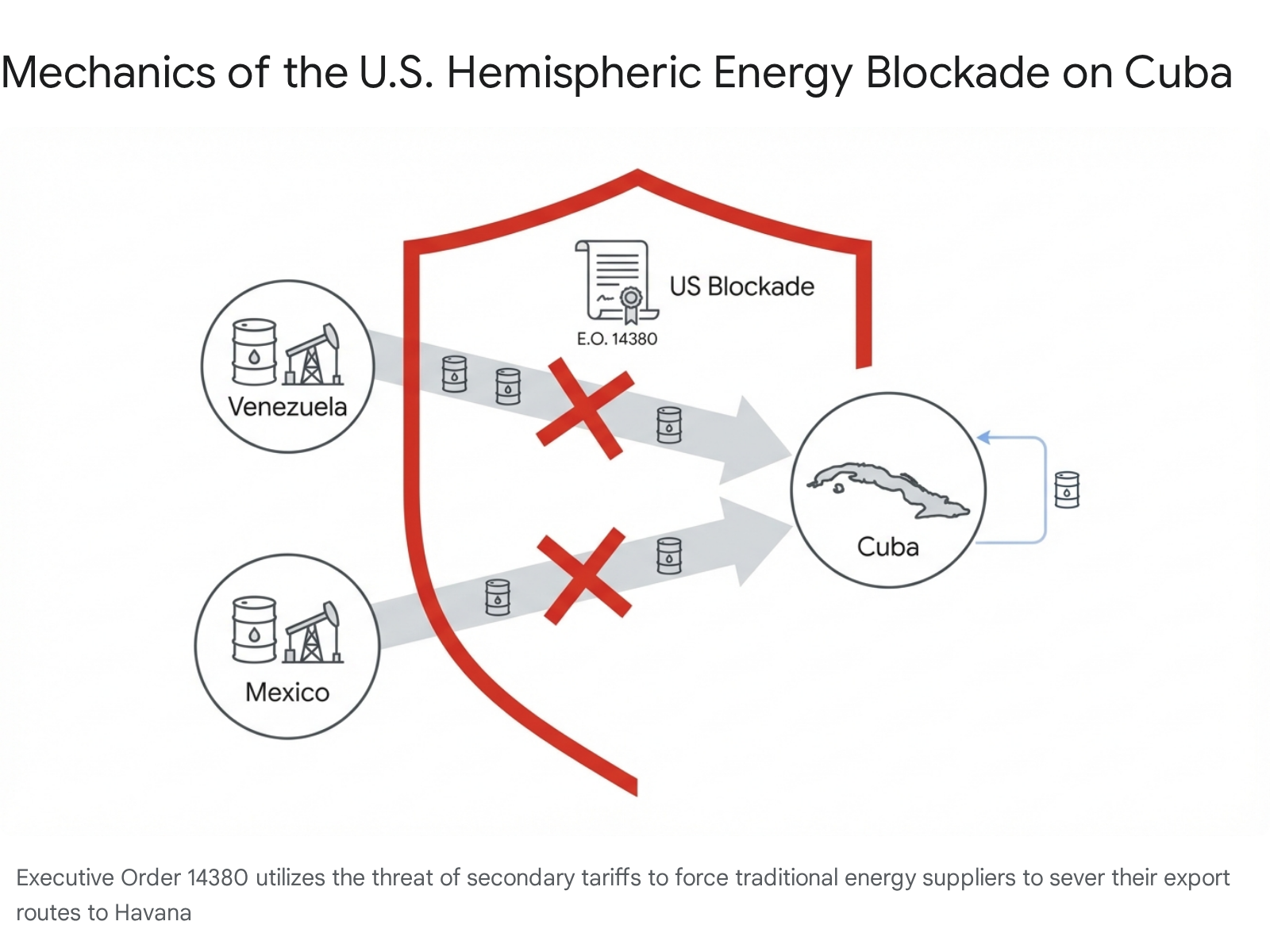
Following the neutralization of the Venezuelan supply line, President Donald Trump escalated the administrative and economic warfare against Cuba directly. On January 29, 2026, the administration issued a sweeping executive order classifying the Cuban government as an “unusual and extraordinary threat” to the national security and foreign policy of the United States.2 This executive order formally authorized the imposition of severe tariffs and secondary sanctions on any nation, corporate entity, or shipping conglomerate that sells, provides, or transports oil to the island.2 The order explicitly accused Havana of aligning with hostile transnational actors, suppressing free speech, and maintaining an inherently destabilizing presence in the hemisphere.6

This secondary sanctions regime has proven devastatingly effective. By actively threatening state-owned enterprises, such as Mexico’s Pemex, with crippling access restrictions to the US market, the United States successfully forced regional partners to immediately abandon their supply contracts with Havana.1 Oil imports from Mexico, which had already declined by 73 percent in late 2025 due to Cuba’s chronic inability to pay, dropped to absolute zero as the tariff threats materialized.8 The explicit objective of this policy, championed prominently by US Secretary of State Marco Rubio, is to precipitate a terminal, structural crisis within the Cuban state apparatus, with the stated objective of achieving total regime change by the end of 2026.1 The administration has publicly mocked the resilience of the Cuban system, with President Trump frequently asserting that the island is going to “fall pretty soon” and openly floating the concept of a US-managed “friendly takeover” of the sovereign nation.1

However, intelligence analysis indicates that the United States is not relying solely on blunt-force starvation; it is employing a sophisticated, asymmetric economic “wedge strategy” designed to foment internal socio-economic division. While the state apparatus is entirely blockaded from receiving petroleum, the Trump administration has introduced a highly calculated carve-out for Cuba’s nascent private sector.11 Since early February 2026, the US has authorized and facilitated the export of approximately 30,000 barrels of fuel (roughly 1.27 million gallons) shipped directly by US suppliers to independent, non-state Cuban enterprises.11 As explicitly articulated by Secretary Rubio, this policy is “entirely designed to place the private sector, and private Cubans who are not affiliated with government or the military in a position of privilege”.11

This maneuver represents a highly advanced form of economic warfare. By starving the state while feeding the independent market, the United States is actively attempting to build an independent, capitalized economic power base within the island that owes its survival and operational capacity not to the Communist Party, but to the architects of the US embargo. This creates a volatile internal dynamic where state-run hospitals, transportation networks, and distribution centers remain paralyzed, while privately owned logistics companies, restaurants, and transport services continue to operate. This stark disparity serves to continuously erode the ideological legitimacy of the state, demonstrating to the populace that the regime is the primary obstacle to prosperity, thereby accelerating the timeline for the desired regime transition.
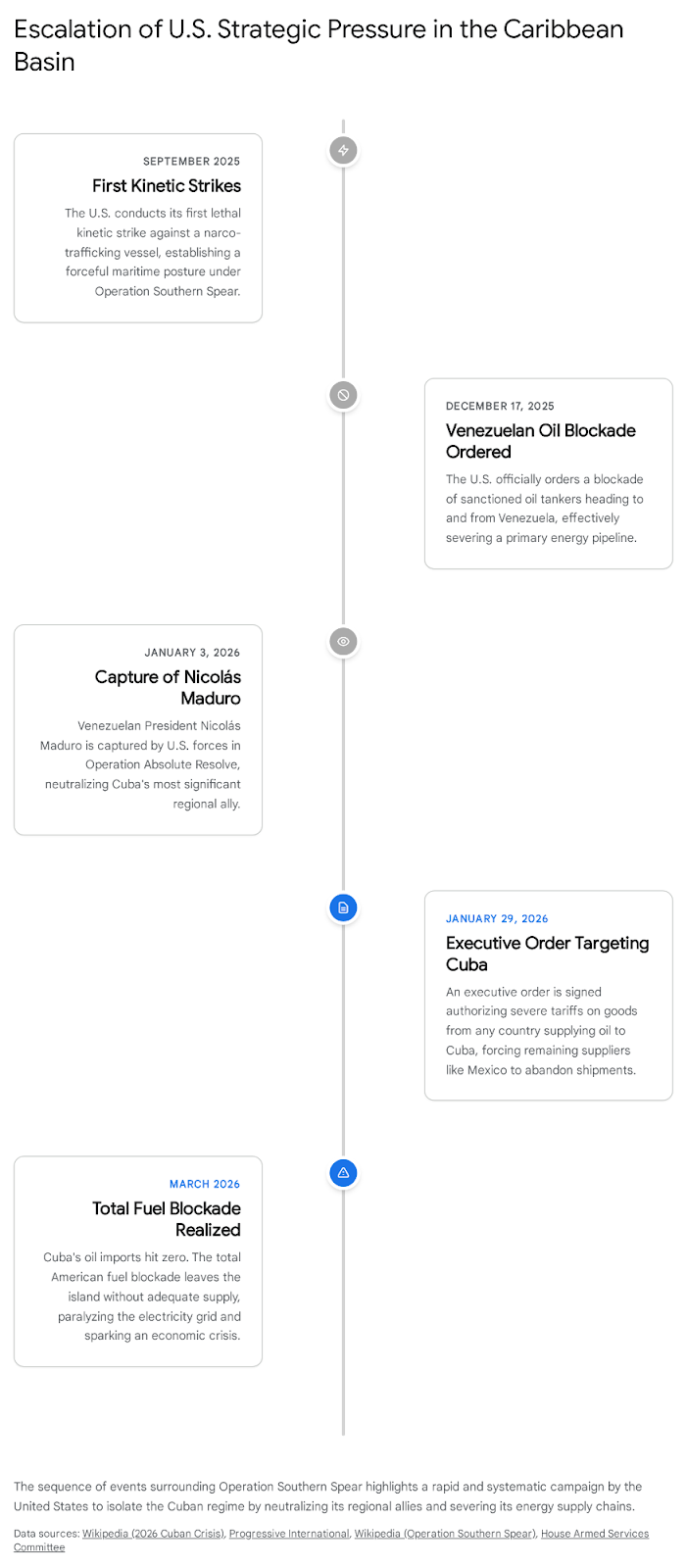
Escalation of U.S. strategic pressure in the Caribbean Basin, 2025-2026. "SITREP Cuba" timeline.

2. Operation Southern Spear: Kinetic Actions and Regional Militarization

The enforcement mechanism for this sweeping regional policy is Operation Southern Spear, a massive projection of United States military power spanning the Caribbean Sea, the Eastern Pacific, and extending into the northern coast of South America. Formally announced by US Secretary of Defense Pete Hegseth in November 2025 as an expansion of prior naval interdiction efforts, the operation represents a paradigm shift in how the United States secures its southern maritime approaches.4 While officially framed to the domestic US audience as a robust counter-narcotics mission targeting designated terrorist organizations, intelligence analysts assess that its secondary—and perhaps primary geopolitical—function is the absolute enforcement of the Venezuelan and Cuban energy blockades.12

Operation Southern Spear utilizes a highly sophisticated, hybrid fleet architecture. It integrates traditional blue-water naval assets, including the immense power of the USS Gerald R. Ford (CVN 78) carrier strike group, alongside the heavily armed Amphibious Ready Group comprised of the USS Iwo Jima (LHD 7), USS San Antonio (LPD 17), and USS Fort Lauderdale (LPD 28).13 These manned platforms are deeply augmented by advanced robotics, autonomous surface vessels, and persistent aerial surveillance networks designed to detect, track, and intercept any vessel attempting to traverse the Caribbean basin without US authorization.4

The rules of engagement under Operation Southern Spear are unprecedented in recent regional history, characterized by a highly aggressive, lethal posture. The Department of Defense, operating under the direction of US Southern Command (SOUTHCOM) Commander Marine Gen. Francis L. Donovan, has actively authorized and executed lethal kinetic airstrikes against suspected narco-trafficking and smuggling vessels in international waters.14 This campaign began with the first kinetic strike on September 1, 2025, and has escalated rapidly.4

During the reporting period of late March 2026, this lethal tempo was maintained. On March 19, 2026, Joint Task Force Southern Spear conducted a lethal kinetic strike on a low-profile vessel in the Eastern Pacific, leaving three survivors who were subsequently detained.16 While the Eastern Pacific is geographically distant from the Cuban mainland, this strike is strategically highly relevant to Havana’s threat perception. Operation Southern Spear is a synchronized, multi-theater campaign spanning both the Caribbean and the Pacific.12 The routine authorization of lethal force in the Pacific theater vividly demonstrates the unprecedented rules of engagement and sheer lethality of the exact same U.S. military apparatus currently enforcing the energy blockade around Cuba, serving as a stark warning to any “dark fleet” tanker attempting to supply the island. Less than a week later, on March 25, 2026, another airstrike destroyed a vessel transiting the Caribbean, resulting in the deaths of four individuals designated by SOUTHCOM as “narco-terrorists”.14 As of this latest engagement, the Department of Defense has officially carried out 47 kinetic strikes, destroying an equal number of vessels and resulting in the deaths of approximately 163 individuals.12

The strategic effects of this campaign are profound. The intense friction generated by constant US patrols and the ever-present threat of lethal drone strikes has severely disrupted the maritime logistics networks that illicit actors and sanctioned states rely upon. SOUTHCOM reports a 20 percent reduction in illicit vessel movements in the Caribbean and a 25 percent reduction in the Eastern Pacific.12 The operation has forced smuggling networks and “dark fleet” oil tankers to abandon direct routes across the central Caribbean, pushing them eastward toward Guyana and Suriname, vastly increasing their transit times, operational costs, and exposure to interdiction.12

For the Cuban government, Operation Southern Spear represents an impenetrable maritime wall. The US Navy’s aggressive boarding and seizure operations, exemplified by the apprehension of the Motor/Tanker Veronica in early 2026 for operating in defiance of the Venezuelan quarantine, demonstrate that standard blockade-running tactics are no longer viable.13 While a few isolated dark fleet tankers, such as the Sea Horse, have occasionally managed to discharge fuel in Cuba using deceptive maneuvers like transponder deactivation and abnormal routing, these occurrences are statistical anomalies that cannot provide the volume necessary to sustain the Cuban state.3

Furthermore, the sheer proximity and lethality of the US forces massed just beyond Cuba’s territorial waters have fundamentally altered Havana’s threat perception. The regime interprets the deployment of carrier strike groups and the routine use of kinetic force not merely as an interdiction effort, but as the forward staging of an invasion force.18 This has forced the Cuban Revolutionary Armed Forces (FAR) into a posture of high alert. Cuban Deputy Foreign Minister Carlos Fernández de Cossío publicly stated in March 2026 that the Cuban military is actively mobilizing and preparing for the possibility of direct military aggression by the United States.18 However, this mobilization is largely psychological; the FAR’s conventional capabilities are severely degraded by the very fuel crisis they are posturing against. Without aviation fuel for interceptors or diesel for mechanized infantry, Cuba’s defensive doctrine is forced to rely entirely on asymmetric, irregular warfare concepts and the mobilization of civilian militias—a strategy heavily compromised by the current state of mass civilian unrest.

Table 1: Operation Southern Spear Kinetic Action Summary (As of March 28, 2026)

Operational MetricValue / StatusStrategic Implication
Total Kinetic Strikes Executed47Demonstrates sustained, lethal enforcement of US maritime dominance.12
Total Target Fatalities163High attrition rate establishes a powerful psychological deterrent against blockade running.12
Caribbean Traffic Reduction20% DeclineForces logistics networks to adopt longer, highly inefficient eastern routes.12
Recent Caribbean StrikeMarch 25, 2026 (4 Killed)Reaffirms active lethal posture adjacent to Cuban territorial waters.14
Recent Pacific StrikeMarch 19, 2026 (3 Survivors)Demonstrates multi-theater capability of Joint Task Force Southern Spear.16

3. Critical Infrastructure: The Anatomy of the National Grid Collapse

The most immediate, debilitating consequence of the United States petroleum blockade is the catastrophic structural failure of the Cuban national power grid. The island’s energy infrastructure is fundamentally brittle, heavily reliant on a fleet of 16 Soviet-era thermoelectric power plants constructed between the 1960s and 1980s.8 These facilities have operated decades beyond their intended mechanical lifespans. Years of deferred maintenance, acute capital starvation, and a chronic inability to procure replacement parts due to long-standing financial sanctions have left the entire generation network highly vulnerable to systemic shock.7

That shock arrived in the first quarter of 2026. The Cuban economy historically requires approximately 100,000 barrels of crude oil per day to maintain baseline electrical generation and fuel its transportation sector.11 Domestic extraction in the shallow waters off the northern coast satisfies barely 40 percent of this daily requirement, leaving the state exceptionally dependent on constant foreign imports.7 By January 2026, following the initiation of the US secondary sanctions regime, foreign oil imports plunged to absolute zero for the first time since 2015.8 The state’s strategic fuel reserves were rapidly depleted, leading to the current state of infrastructural paralysis.

The physical manifestation of this energy starvation reached a critical threshold on March 16, 2026. At 12:41 p.m., a severe boiler leak forced the emergency shutdown of the Antonio Guiteras thermoelectric plant in Matanzas.8 As the island’s largest and most vital power station, boasting a theoretical capacity of 330 megawatts, its sudden, unscheduled removal from the grid created an insurmountable generation deficit.8 The sudden loss of massive baseload power caused the grid’s electrical frequency to plummet precipitously. The automated load-shedding systems designed to isolate the fault failed to stabilize the network, triggering a cascade of automatic disconnections that swept destructively across the system from Camagüey to Pinar del Río in a matter of minutes, resulting in a total, island-wide blackout.8

The scale of the generation deficit during this period of collapse is staggering. At the nadir of the crisis in mid-March, the entire national system could only output approximately 590 megawatts of power.8 This figure represents less than a third of the grid’s normal, effective capacity of roughly 2,000 megawatts, and falls catastrophically short of the national maximum demand, which peaks at approximately 3,500 megawatts.8 This resulted in an immediate, unmanageable deficit of nearly 3,000 MW, forcing the state to plunge 64 percent of the island into darkness, with rolling blackouts lasting up to 20 hours daily for those not connected to vital circuits like hospitals.8 In the capital city of Havana, home to two million residents, only 5 percent of the population had their power restored days after the initial collapse.8 While some localized micro-systems were established in provinces like Holguín and Matanzas to power essential centers, these efforts are highly localized and unstable.7

As of late March 2026, the grid remains fundamentally broken. Eight of the 16 thermoelectric plants remain completely offline due to overlapping mechanical breakdowns and acute fuel exhaustion.8 The remaining operational facilities are limping along at an average of just 34 percent of their installed capacity.8 For instance, the Antonio Maceo plant is currently capped at a maximum of 65 percent capacity due to severe, unrepairable mechanical fractures in its high-pressure vapor lines, operating constantly on the verge of failure.8

While the Cuban government has invested heavily in renewable energy mitigation strategies, partnering closely with China to deploy 92 utility-scale solar parks by 2028, these efforts are vastly insufficient to prevent systemic failure.2 Currently, 34 solar parks have been synchronized with the national grid, contributing approximately 560 megawatts at peak solar irradiance during the day.8 However, the critical absence of utility-scale battery storage infrastructure means this generation capacity completely vanishes during the evening peak demand window.8 When the sun sets, the fragile thermal plants are forced to bear the full, surging load precisely when they are most vulnerable to tripping, frequently resulting in localized blackout cascades. Energy infrastructure experts assess that restoring and modernizing the Cuban grid would require an immediate capital injection of between $8 billion and $10 billion.8 Given the state’s total exclusion from international financial markets and the ongoing economic embargo, securing this level of funding is considered an absolute impossibility, guaranteeing that grid instability will remain a permanent feature of Cuban life for the foreseeable future.
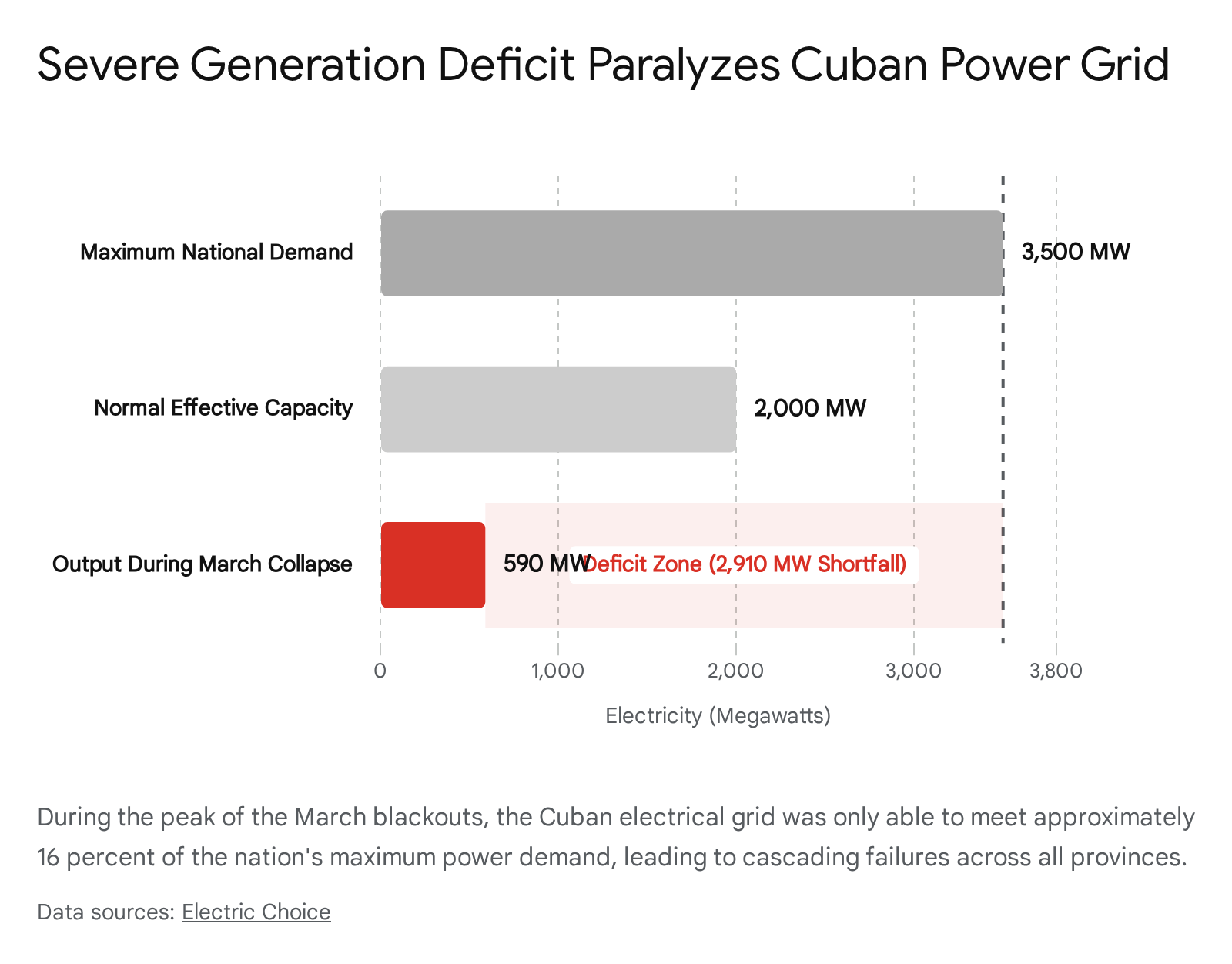
Cuban power grid deficit: Demand 3500 MW, Capacity 2000 MW, Output 590 MW during March 2026 collapse.

Table 2: Cuban National Power Grid Status (March 2026)

Grid Component / MetricStatusOperational Impact
Thermoelectric Plants (Total)16The backbone of the national energy infrastructure.8
Plants Offline8Halves theoretical base generation capacity due to fuel/mechanical issues.8
Peak National Demand~3,500 MWRequired generation to sustain normal economic/civilian operations.8
Effective Normal Capacity~2,000 MWChronic baseline deficit of 1,500 MW even under optimal conditions.8
Output During Collapse~590 MWTriggered uncontrolled cascading failures and total national blackout.8
Operational Solar Parks34 (560 MW)Provides daytime relief but lacks battery storage for evening peak demand.8

4. Macroeconomic Instability and State Reform Efforts

The mechanical failure of the energy grid is inextricably linked to the total collapse of Cuba’s macroeconomic stability. The formal state economy has effectively ceased to function as a mechanism for generating wealth or providing baseline goods, forcing the population into heavily dollarized and euroized informal markets simply to survive the day-to-day realities of hyperinflation.19

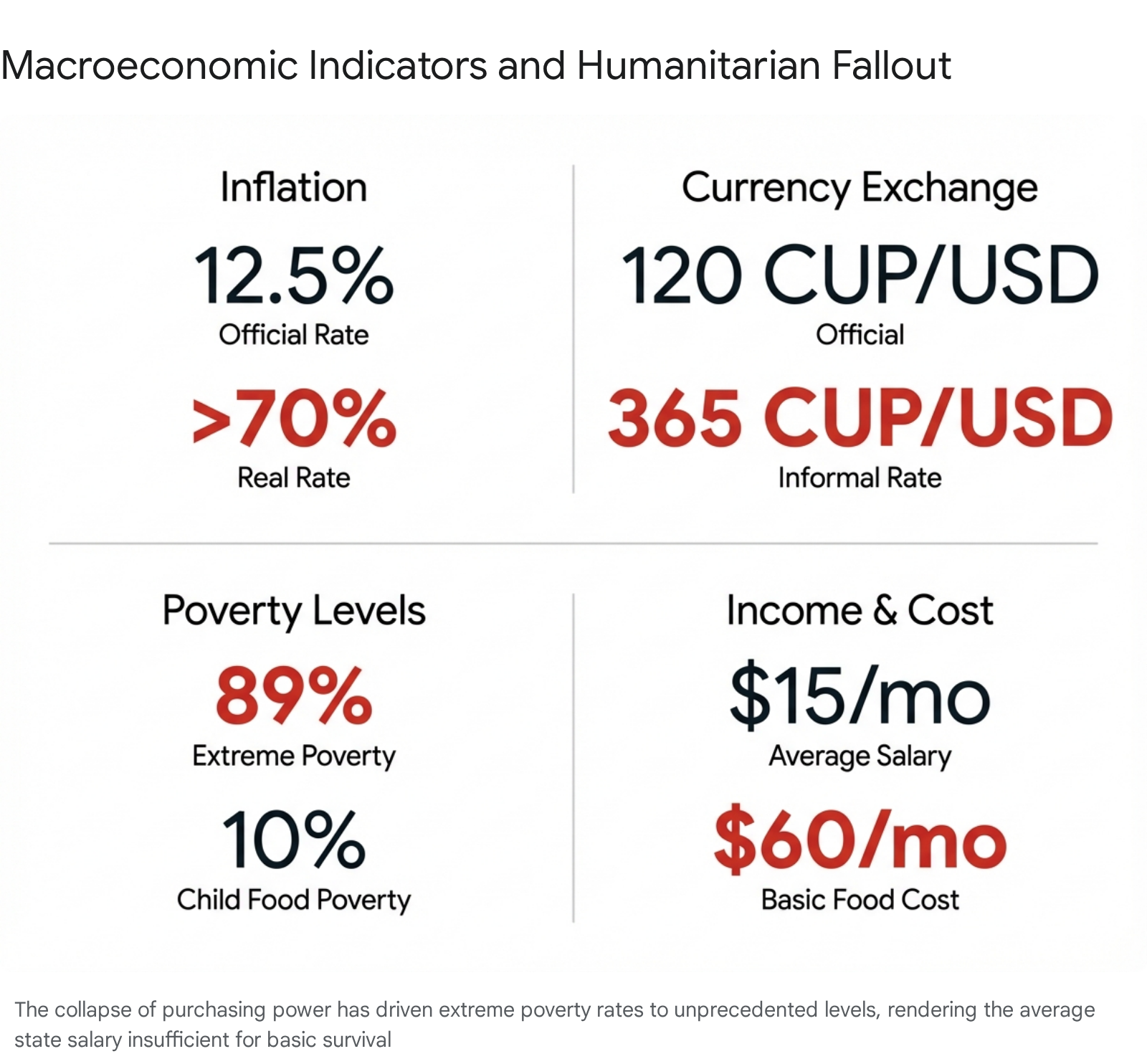
The catastrophic loss of confidence regarding the Cuban Peso (CUP) is starkly reflected in street-level exchange rates. While the official government exchange rate has remained artificially fixed by the central bank, the informal market rate—which dictates the actual purchasing power of the citizenry—has plummeted precipitously over the last two years. By early 2025, the rate had settled at approximately 340 CUP to 1 USD, nearly double its value from the previous year.19 During the heightened instability and physical darkness of the first quarter of 2026, the street rate experienced extreme volatility, hovering between 280 and 340 CUP to the dollar, while the Euro commanded a similar premium at approximately 285 CUP.19 This rapid hyperinflation has entirely decimated the purchasing power of state salaries and pensions. A government worker paid in CUP effectively earns pennies on the dollar, pushing vast segments of the population below the absolute poverty line and rendering them entirely dependent on remittances sent from relatives abroad.19

To address this fiscal deterioration, the Cuban government has initiated a highly controlled, deeply cautious reform process, recognizing that systemic adjustments are required to prevent a total economic seizure. In mid-March 2026, the Council of Ministers, led by Prime Minister Manuel Marrero Cruz and presided over by Esteban Lazo Hernández, finalized the update of the newly titled “Government’s Economic and Social Program for 2026”.23 This expansive policy document, developed after public consultation, encompasses 10 general objectives, 111 specific directives, and 505 actionable items aimed at correcting severe macroeconomic distortions and revitalizing domestic production.23

The core philosophy of this reform is not a transition to free-market capitalism, which the regime views as ideologically anathema and practically suicidal, but rather a shift toward a highly limited “market socialism” that fundamentally preserves the political monopoly and oversight of the Communist Party.25 A key legislative initiative within this program is the implementation of Decree 140, which decentralizes certain economic competencies to municipal governments.24 This decree aims to bypass the paralyzing bureaucracy of the central state by granting local territories greater autonomy in managing foreign direct investment, forging partnerships between state and non-state sectors, and managing local resource allocation.24

Crucially, the government has been forced by financial desperation to redefine the role of the Cuban diaspora. Under new, highly controversial provisions announced in March 2026, Cubans residing abroad under specific immigration categories are now permitted to participate in private businesses on the island as owners, and are authorized to open foreign currency bank accounts directly within Cuban financial institutions.5 This represents a profound ideological concession, attempting to capture much-needed hard currency and capital investment from the very exile community the state has historically vilified. Concurrently, state banking institutions like Banco de Crédito y Comercio (BANDEC) are rapidly expanding electronic credit facilities for the use of prepaid USD cards, attempting to formalize, track, and ultimately tax the heavily dollarized transactions occurring within the domestic black market.22

Despite these maneuvers, the reforms face massive internal and external headwinds. The state apparatus remains deeply hesitant to allow unchecked expansion of the private sector out of political fear, viewing independent wealth as a direct threat to state authority. Consequently, the government actively imposes strict price caps and controls to counter inflation, which perversely stifles the very entrepreneurial activity and agricultural production they seek to foster.19

Externally, the reforms have been met with derision. The Trump administration has openly mocked the announcements, with Secretary of State Marco Rubio stating from the Oval Office that the measures are fundamentally insufficient to solve an economy trapped within an unworkable political system that can no longer rely on Soviet or Venezuelan subsidies.5 The reality of the risk environment is further highlighted by the withdrawal of international business interests. The Canadian Commercial Corporation, a Crown corporation that historically facilitated Canadian business entry into the Cuban market, officially ended its Cuba program, citing a convergence of rising financial risks, potential expropriation, and the ongoing liquidity crisis.18

This liquidity crisis presents a tragic paradox regarding food security. Data indicates that United States agricultural exports to Cuba—primarily frozen chicken, pork, and dairy products—actually grew to $443.9 million in 2025.27 However, due to the embargo, these massive food shipments must be purchased on a strict cash-in-advance basis.27 As the Cuban state has exhausted its hard currency reserves and cannot secure international credit, it is increasingly unable to purchase these available US foodstuffs, directly contributing to the empty shelves and starvation conditions experienced by the populace.19

5. Humanitarian Catastrophe and the UN Response

The structural failure of the energy grid and the evaporation of state financial capacity have triggered a massive humanitarian crisis, plunging the populace into conditions of severe deprivation not seen since the darkest days of the “Special Period” in the early 1990s. The absence of electricity has neutralized the essential infrastructure required for human survival in a modern, urbanized state.

Without power, municipal water pumping stations across the island have ceased functioning.28 Millions of citizens, particularly in densely populated urban centers like Havana, are denied access to clean, running water, forcing them to rely on sporadic, limited deliveries by state water trucks, which themselves are hampered by the lack of diesel fuel.29 This lack of potable water has dire implications for sanitation and hygiene, creating optimal conditions for the rapid spread of gastrointestinal illnesses.

Furthermore, the prolonged, unpredictable outages have decimated the nation’s fragile cold chain logistics. Food supply chains—from agricultural production in the provinces to warehousing, transportation, and retail distribution—have been severely disrupted.29 Basic, life-sustaining food items are rotting in non-functioning refrigeration units before they can reach consumers, creating acute, widespread food insecurity.29 The United Nations has warned that the sheer lack of fuel is severely restricting the operational capacity of both the state and international aid organizations, forcing food and water delivery trucks to operate at a fraction of their necessary capacity.29

The current crisis is vastly compounded by the lingering, unmitigated devastation of Hurricane Melissa. In late October 2025, Melissa struck eastern Cuba as a catastrophic storm.30 Having peaked over the Caribbean Sea as a Category 5 hurricane with record-tying sustained winds of 190 mph (matching Hurricane Allen) and a barometric pressure of 892 millibars, the storm made landfall in Santiago de Cuba as a powerful Category 3 storm with sustained winds of 125 mph.30 The hurricane produced extreme rainfall, catastrophic storm surges, and massive landslides.30 The eastern provinces of Santiago de Cuba, Granma, and Holguín were utterly decimated, with more than 215,000 homes damaged and approximately 645,000 people directly impacted.30 Recovery in these regions is particularly challenging due to pre-existing vulnerabilities and the cumulative effect of prior disasters, such as Hurricane Oscar in 2024.30

The most severe secondary consequence of Hurricane Melissa has been the precipitation of a massive public health emergency. The torrential rains left behind vast expanses of stagnant water, creating ideal breeding grounds for mosquitoes.30 Consequently, the crippled public health sector is currently battling simultaneous, widespread outbreaks of vector-borne diseases, primarily dengue fever, oropouche, and chikungunya.30 The failure of the national energy grid means that hospitals and clinics are struggling to care for the thousands of infected citizens without reliable power for diagnostic equipment, patient monitors, or basic climate control, turning medical facilities into zones of extreme peril.7

In response to this multi-dimensional catastrophe, the United Nations launched a massive $94 million Plan of Action on March 24, 2026.21 The urgent appeal targets the 2 million most vulnerable individuals out of the estimated 4.2 million directly affected by the dual shocks of the energy crisis and Hurricane Melissa.21 The emergency response spans critical sectors including health, water and sanitation (WASH), food security, education, and shelter.21 However, UN coordinators have explicitly noted a grim reality: fuel availability remains the absolute central constraint on the delivery of this life-saving assistance.21 Until the logistical bottlenecks created by the US embargo are circumvented or a dark-fleet supply chain is established, much of the financial aid pledged by the international community remains entirely moot, as trucks cannot move supplies and generators cannot power hospitals without diesel.
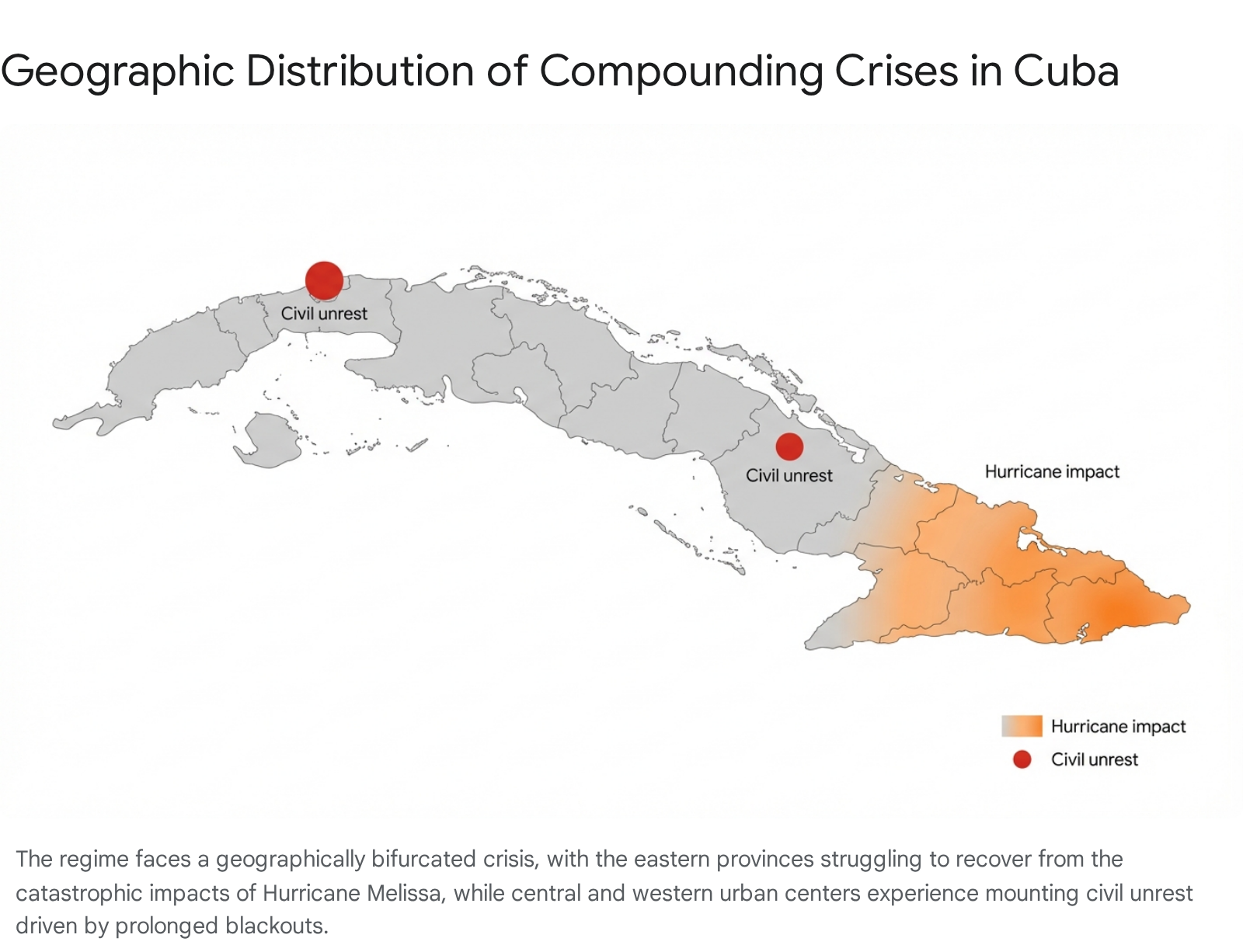
Map of Cuba showing civil unrest and hurricane impact areas. SITREP Cuba.

6. Domestic Security: Civil Unrest and Regime Control

The total evaporation of basic state services, combined with the visceral suffering of the populace, has ignited a wave of spontaneous, geographically dispersed civil unrest, severely testing the internal security apparatus of the Cuban state. Historically, the regime has maintained an iron grip on public assembly, utilizing rapid deployment forces and neighborhood watch committees to stifle dissent before it can materialize. However, the sheer scale of the population’s current suffering has overridden the psychological fear of reprisal. According to human rights monitors such as Cubalex, more than 160 distinct protest events have erupted across the island since March 6, 2026.34

Unlike the highly organized, politically driven demonstrations of previous decades, these protests are largely organic, decentralized responses to immediate physical deprivation. They are characterized primarily by nighttime cacerolazos—the loud, rhythmic banging of pots and pans—conducted under the cover of the blackouts.35 Significant cacerolazos were recorded in the Arroyo Naranjo district of Havana in early February, and throughout March, these nocturnal protests erupted repeatedly across the capital.35 The blackouts provide a tactical advantage to the populace, offering anonymity from state cameras and making it difficult for security forces to pinpoint ringleaders in the dark.36

However, the unrest has occasionally escalated beyond mere noise protests, indicating a dangerous fraying of the social contract. On March 14, in the central town of Morón, intense frustration over endless blackouts, food shortages, and the worsening economic crisis boiled over into direct kinetic action.35 Demonstrators actively attacked and vandalized a local Communist Party office under the cover of night.35 This represents a severe breach of state authority; the physical targeting of Party infrastructure demonstrates a profound erosion of the regime’s psychological deterrence and signals a willingness among the populace to confront the state apparatus directly.

The Cuban government’s response has been a predictable, two-pronged approach of rhetorical defiance mixed with targeted, surgical repression. President Díaz-Canel has attempted to rally nationalist sentiment, framing the current crisis as a “war of the people” against American imperialism.37 In public addresses, he has demanded that citizens close ranks, maintain discipline, and defend the Revolution against the aggression of the Trump administration, promising to “give his life” for the cause.23

Concurrently, state security forces have executed targeted arrests of protest participants and media figures to prevent the formulation of a cohesive, national opposition movement.35 The regime is acutely sensitive to the dissemination of the crisis on social media. In early February, two prominent young social media influencers affiliated with the outlet El4tico, Ernesto Ricardo Medina and Kamil Zayas Pérez, were detained by state security simply for broadcasting videos that detailed the agonizing living conditions of ordinary Cubans.39 This demonstrates the state’s desperate attempt to maintain an absolute monopoly on information flow, preventing the digital documentation of state failure from reaching both the domestic population and the international community.

The strategic concern for Havana’s intelligence services is that the demographic and psychological profile of the country has fundamentally shifted since the massive protests of July 11, 2021.19 While the state successfully crushed that previous iteration of dissent, it did so at the cost of alienating the populace. The people remaining on the island today are deeply impoverished, exhausted by daily survival, and increasingly desperate, harboring no illusions that the state can resolve the crisis.19 Analysts assess a moderate-to-high probability that if the energy and food deficits persist through the heat of the summer months, the state’s traditional crowd-control mechanisms will fail, forcing the government to formally declare martial law and utilize the military to forcibly ration remaining resources and maintain physical order.37

7. Demographic Shifts: The “Walking Generation” and Regional Migration

The acute deterioration of living standards, combined with the lack of political freedom, has triggered a profound, historic shift in regional migration patterns. Following the suppression of the 2021 protests and the subsequent, unrelenting economic collapse, Cuba has experienced a massive demographic hemorrhage. Over one million citizens have fled the island in recent years, a phenomenon colloquially termed the “Walking Generation” by local journalists.19 By 2025, Cubans represented the third-largest group seeking asylum globally.40

This mass exodus has fundamentally altered the demographic composition of the country, acting as a devastating brain drain. The island has been stripped of its educated youth, experienced medical professionals, and specialized technical workforce precisely when their expertise is desperately required to manage the compounding infrastructural and health crises.37 In past crises, such as the Special Period, a youthful, educated professional class was present to help the nation endure; today, that generation has already emigrated.37

However, the dynamics of this migration have shifted significantly in early 2026. A new report from the International Organization for Migration’s (IOM) Displacement Tracking Matrix reveals that Latin America is no longer functioning merely as a transit corridor for Cubans seeking illicit entry into the United States.41 As pathways into the US become increasingly restricted, heavily militarized at the southern border, or legally perilous under the new US administration, a growing proportion of Cuban migrants are choosing to permanently settle in various Latin American nations and Spain.40 “These trends show that Latin America is no longer just a corridor for Cuban migrants, but is increasingly becoming their intended home,” noted María Moita, IOM Regional Director.41

Paradoxically, the deep internal crisis of early 2026 has not yet resulted in a massive, uncontrolled maritime surge toward nearby territories, an event historically known as a balsero (rafter) crisis. Authorities in the Cayman Islands, a typical destination for maritime migrants, reported only 24 irregular migrant arrivals from Cuba in the first quarter of 2026.42 Intelligence assessments attribute this low number to the exceptionally tight coastal surveillance maintained by the Cuban Border Guards and the military.42 The regime views unauthorized mass emigration by sea as a profound internal security risk and a highly visible international embarrassment that projects weakness. Consequently, the state dedicates its highly scarce fuel and security resources to stringent coastal interdiction, ensuring the borders remain sealed even as internal civilian systems collapse completely.

8. Foreign Relations: Multipolar Maneuvering and Bilateral Dialogues

As the United States tightens the economic noose, Havana has frantically engaged the diplomatic apparatus of the multipolar world to secure economic lifelines and geopolitical cover. The current crisis has effectively transformed Cuba into a frontline proxy in the broader, escalating contest between the United States and the Sino-Russian alignment.6

In mid-March 2026, following President Trump’s aggressive public rhetoric regarding a potential “friendly takeover” and his assertion that the island was in “deep trouble,” the Cuban diplomatic corps mobilized.9 Cuban Foreign Minister Bruno Rodriguez held urgent, high-level telephone consultations with his counterparts in Moscow (Sergei Lavrov) and Beijing.9 Both nations publicly reaffirmed their solidarity with Havana. The Russian Foreign Ministry issued a statement expressing “serious concern” over the mounting US pressure, firmly condemning the “illegal unilateral restrictive measures,” and pledging to provide Cuba with necessary material assistance.44

However, intelligence analysis indicates that beneath the strong rhetoric, the actual material support provided by Cuba’s multipolar allies is heavily conditioned, highly calculated, and strictly limited. Russia, historically Cuba’s most vital patron, is providing material assistance but explicitly avoiding the establishment of any formal mutual-defense commitments that could lead to direct military entrapment or confrontation with the United States in the Caribbean.43 Russian strategists are acutely aware of their own military overextension in Ukraine and their complex, escalating involvement in the ongoing conflict between Iran, Israel, and the United States.10

Moscow’s strategy regarding Cuba is to maintain the island as a low-cost, high-leverage irritant to Washington—a strategic, ideological foothold located just 90 miles from Florida—without expending the massive capital required to actually solve Cuba’s systemic economic collapse.3 Russian political commentators note that allowing Cuba to fall to American coercion would be a devastating blow to the perceived power projection capabilities of the Global South, forcing Moscow to maintain a baseline level of support.6 Therefore, Russia seeks to keep the Cuban state alive, but possesses neither the capacity nor the desire to underwrite its full recovery.

Concurrently, in a highly unusual and desperate maneuver, the Cuban government has engaged in direct, albeit strained, back-channel diplomatic negotiations with the United States. In a mid-March address, President Díaz-Canel publicly confirmed for the first time that his government was seeking “solutions” with Washington regarding the crushing energy blockade.1 As an upfront concession to demonstrate good faith and respond to long-standing US demands for political liberalization, the Cuban government released 51 political prisoners.1

Despite this significant concession, the Cuban government is attempting to project strength. Deputy Foreign Minister Carlos Fernández de Cossío publicly downplayed the scope of the talks in an interview with NBC, insisting that the negotiations were strictly limited to bilateral issues and did not encompass systemic regime change.18 He boldly asserted that Cuba was not in a state of collapse and that the military was prepared for US aggression.18 The US administration, however, views these negotiations from a position of overwhelming, unilateral strength. Influenced heavily by hardliners, the US demands fundamental, structural changes to the island’s political, economic, and security systems in exchange for any meaningful sanctions relief, a demand that is tantamount to requesting the regime’s peaceful capitulation.39

9. Strategic Forecast and Predictive Scenarios

The situational geometry surrounding Cuba entering the second quarter of 2026 is highly unstable. Intelligence indicators comprehensively suggest that the status quo—rolling blackouts, hyperinflation, and a blockaded state—is physically and politically unsustainable in the near term. The following forward-looking trajectories outline the most probable scenarios for the coming months:

Scenario 1: Accelerated State Fragmentation and Imposition of Martial Law (High Probability) If the United States maintains the absolute petroleum embargo on the state sector, the current trajectory points toward the total, permanent cessation of municipal services and an exponential increase in food insecurity. As rolling blackouts extend into the hotter summer months, intensifying the ongoing disease outbreaks (dengue, oropouche), civilian unrest will inevitably surpass the state’s capacity for targeted, surgical repression.37 Under this scenario, the regime is highly likely to declare formal martial law. The military would assume direct, overt control of food distribution, water logistics, and infrastructure rationing, stripping away the civilian facade of the government.37 This draconian move would trigger intense international condemnation and likely sever the fragile, ongoing diplomatic talks with Washington, plunging the island into a protracted state of siege.

Scenario 2: The “Wedge Strategy” Fractures the Command Economy (Moderate Probability) The US policy of authorizing fuel imports exclusively to the private sector (currently at 30,000 barrels) acts as a slow-burning fuse within the Cuban socio-economic structure.11 If the US incrementally expands this allowance, it will create a highly visible, parallel economy where private enterprises possess power, mobility, and resources, while state institutions remain paralyzed in darkness. This deepens internal class divides and fundamentally undermines the ideological legitimacy of the Communist Party.11 The regime will face a critical, perhaps terminal, dilemma: confiscate the private fuel and risk destroying the only functioning sector of the economy (inviting further, devastating US retaliation), or allow the private sector to eclipse the state in wealth and operational capability, thereby paving the way for a structural transition away from communism from within.

Scenario 3: Geopolitical Bailout via Asymmetric Supply Lines (Low to Moderate Probability) While Russia and China are currently offering carefully calibrated, limited support, a sudden calculation in Moscow or Beijing that the Cuban regime is on the absolute verge of total collapse might prompt a more aggressive, risk-tolerant intervention.3 This would likely involve sophisticated, sanctions-evading maritime logistics—such as a massive influx of “dark fleet” oil transfers utilizing transponder deactivation, spoofing, and abnormal routing—to deliver sufficient fuel to stabilize the Cuban grid.3 However, executing this maneuver under the intense, lethal surveillance of Operation Southern Spear would risk a direct, kinetic maritime confrontation between the US Navy and Sino-Russian proxy vessels in the Caribbean, an escalation that all parties currently wish to avoid.4

The Republic of Cuba is trapped in a terminal spiral. The combination of an aging, failing infrastructure, the devastating localized effects of Hurricane Melissa, and the surgical economic and military warfare executed by the United States has stripped the regime of its historical resilience. The upcoming months will dictate whether the state can manage a highly controlled, defensive contraction into martial law, or if the internal pressure, fueled by darkness, hunger, and a newly empowered private sector, results in the final, chaotic fragmentation of the post-revolutionary order.


Please share the link on Facebook, Forums, with colleagues, etc. Your support is much appreciated and if you have any feedback, please email us in**@*********ps.com. If you’d like to request a report or order a reprint, please click here for the corresponding page to open in new tab.


Sources Used

  1. 2026 Cuban crisis – Wikipedia, accessed March 28, 2026, https://en.wikipedia.org/wiki/2026_Cuban_crisis
  2. Defend Cuba From US Efforts to Crush It | Progressive International, accessed March 28, 2026, https://progressive.international/wire/2026-03-18-defend-cuba-from-us-efforts-to-crush-it/en/
  3. Here’s Why Cuba Remains Russia’s Foothold on Washington’s Doorstep, accessed March 28, 2026, https://www.themoscowtimes.com/2026/03/24/heres-why-cuba-remains-russias-foothold-on-washingtons-doorstep-a92323
  4. Operation Southern Spear – Wikipedia, accessed March 28, 2026, https://en.wikipedia.org/wiki/Operation_Southern_Spear
  5. Marco Rubio Dismisses the Reforms Announced by the Cuban Regime: “They Need To Put New People in Charge” – Translating Cuba, accessed March 28, 2026, https://translatingcuba.com/marco-rubio-dismisses-the-reforms-announced-by-the-cuban-regime-they-need-to-put-new-people-in-charge/
  6. The Crisis in Cuba, Explained – TIME, accessed March 28, 2026, https://time.com/article/2026/03/17/cuba-economic-energy-crisis-trump-us-explainer/
  7. Cuba begins to restore power after third nationwide collapse in month, accessed March 28, 2026, https://www.thehindu.com/news/international/cuba-begins-to-restore-power-after-third-nationwide-collapse-in-month/article70774192.ece
  8. Cuba’s Electricity Crisis: What Happened & Why — Electric Choice, accessed March 28, 2026, https://www.electricchoice.com/blog/cuba-electricity-crisis/
  9. Cuban Foreign Minister Speaks to Chinese, Russian Counterparts, accessed March 28, 2026, https://chinaglobalsouth.com/2026/03/13/cuba-china-russia-diplomatic-call-us-pressure/
  10. Trump threatens “Cuba is next” following U.S. attacks on Venezuela, Iran, accessed March 28, 2026, http://en.people.cn/n3/2026/0328/c90000-20441041.html
  11. US Increases Fuel Exports To Cuban Private Sector, accessed March 28, 2026, https://www.marinelink.com/blogs/blog/us-increases-fuel-exports-to-cuban-private-sector-104428
  12. 1 RECORD VERSION STATEMENT BY JOSEPH M. HUMIRE PERFORMING THE DUTIES OF THE ASSISTANT SECRETARY OF WAR FOR HOMELAND DEFENSE AND, accessed March 28, 2026, https://armedservices.house.gov/uploadedfiles/ptdo_asw_hdasa_writen_posture_statement.pdf
  13. Maritime Interdiction Operation, Jan. 15, 2026 > U.S. Southern Command > Press Releases, accessed March 28, 2026, https://www.southcom.mil/News/PressReleases/Article/4380252/maritime-interdiction-operation-jan-15-2026/
  14. Lethal Kinetic Strike, March 25, 2026 – southcom, accessed March 28, 2026, https://www.southcom.mil/News/PressReleases/Article/4444436/lethal-kinetic-strike-march-25-2026/
  15. US says 4 killed after strike on alleged drug-trafficking vessel in Caribbean, accessed March 28, 2026, https://www.aa.com.tr/en/americas/us-says-4-killed-after-strike-on-alleged-drug-trafficking-vessel-in-caribbean/3879753
  16. Lethal Kinetic Strike, March 19, 2026 > U.S. Southern Command > Press Releases, accessed March 28, 2026, https://www.southcom.mil/News/PressReleases/Article/4439576/lethal-kinetic-strike-march-19-2026/
  17. Four killed in latest US attack on alleged drug-smuggling boat in Caribbean, accessed March 28, 2026, https://www.aljazeera.com/news/2026/3/25/four-killed-in-latest-us-attack-on-alleged-drug-smuggling-boat-in-caribbean
  18. Americas – Cuba 2026 | Wednesday-Night, accessed March 28, 2026, https://www.dianaswednesday.com/2026/03/americas-cuba-2026/
  19. Cuba Country Report 2026 – bti-project.org, accessed March 28, 2026, https://bti-project.org/en/reports/country-report/CUB
  20. From blackouts to food shortages: How US blockade is crippling life in Cuba – Al Jazeera, accessed March 28, 2026, https://www.aljazeera.com/economy/2026/2/8/from-blackouts-to-food-shortages-how-us-blockade-is-crippling-life-in-cuba
  21. Latin America & The Caribbean Weekly Situation Update as of 27 …, accessed March 28, 2026, https://reliefweb.int/report/cuba/latin-america-caribbean-weekly-situation-update-27-march-2026
  22. 8% Commission? New Private Company Financial Regulations Add Further Stress To Re-Emerging Private Sector In Cuba. – U.S.-Cuba Trade and Economic Council, accessed March 28, 2026, https://www.cubatrade.org/blog/2024/1/25/9b7rkl6vn11w77mma5nicvoa490igy
  23. The Council of Ministers met › Cuba › Granma – Official voice of the PCC, accessed March 28, 2026, https://en.granma.cu/cuba/2026-03-02/the-council-of-ministers-met
  24. Cuba’s Council of State evaluates 2026 Economic and Social Program – Radio Rebelde, accessed March 28, 2026, https://www.radiorebelde.cu/english/cubas-council-of-state-evaluates-2026-economic-and-social-program-20032026/
  25. Cuba Is Developing A Highly Controlled Reform Plan – Analysis – Eurasia Review, accessed March 28, 2026, https://www.eurasiareview.com/26032026-cuba-is-developing-a-highly-controlled-reform-plan-analysis/
  26. Cuba’s president pushes for ‘urgent’ changes to island’s economic and business model, accessed March 28, 2026, https://www.ctvnews.ca/world/article/cubas-president-pushes-for-urgent-changes-to-islands-economic-and-business-model/
  27. Cuba Buys U.S. Foods, Courts Add Uncertainty Now – RFD-TV, accessed March 28, 2026, https://www.rfdtv.com/cuba-buys-u-s-foods-courts-add-uncertainty-now
  28. Cuba Blackout Crisis Explained: Inside the U.S. Oil Blockade | Connecting The Dots, accessed March 28, 2026, https://www.youtube.com/watch?v=7ctKfRo5hnQ
  29. Cuba’s strained health system approaching critical point, UN warns amid fuel crisis, accessed March 28, 2026, https://www.aa.com.tr/en/americas/cubas-strained-health-system-approaching-critical-point-un-warns-amid-fuel-crisis/3858683
  30. Cuba | Hurricane Melissa – Revised Emergency Appeal (MDRCU013) – ReliefWeb, accessed March 28, 2026, https://reliefweb.int/report/cuba/cuba-hurricane-melissa-revised-emergency-appeal-mdrcu013
  31. Hurricane Melissa | Path, Jamaica, & Facts | Britannica, accessed March 28, 2026, https://www.britannica.com/event/Hurricane-Melissa
  32. NATIONAL HURRICANE CENTER TROPICAL CYCLONE REPORT, accessed March 28, 2026, https://www.nhc.noaa.gov/data/tcr/AL132025_Melissa.pdf
  33. Protests against US blockade of Cuba spread, actions called for March 8-15 – The Militant, accessed March 28, 2026, https://themilitant.com/2026/03/06/protests-against-us-blockade-of-cuba-spread-actions-called-for-march-8-15/
  34. Cuba faces 13th day of consecutive protests, as efforts to send humanitarian aid spark controversy in South Florida – CBS News, accessed March 28, 2026, https://www.cbsnews.com/miami/news/cuba-13-days-protests-humanitarian-aid-south-florida/
  35. 2024–2026 Cuban protests – Wikipedia, accessed March 28, 2026, https://en.wikipedia.org/wiki/2024%E2%80%932026_Cuban_protests
  36. Cuba, in a total crisis: all the keys of what is happening on the island | Demócrata, accessed March 28, 2026, https://www.democrata.es/en/international/cuba-in-total-crisis-all-the-keys-of-what-is-happening-on-the-island/
  37. Cuba is facing an economic and social catastrophe, and not entirely because of Donald Trump | WLRN, accessed March 28, 2026, https://www.wlrn.org/americas/2026-02-13/cuba-is-facing-an-economic-and-social-catastrophe-and-not-entirely-because-of-donald-trump
  38. Cuba is nudged closer to the edge: ‘Shower fast! Cook quickly, before the power goes!’, accessed March 28, 2026, https://english.elpais.com/international/2026-03-23/cuba-is-nudged-closer-to-the-edge-shower-fast-cook-quickly-before-the-power-goes.html
  39. Pressure on Havana is mounting: What comes next for Cuba matters, accessed March 28, 2026, https://www.bushcenter.org/publications/pressure-on-havana-is-mounting-what-comes-next-for-cuba-matters
  40. WOLA: U.S. and Cuban governments should center their actions on responding to the Cuban people’s needs and protecting their rights, accessed March 28, 2026, https://www.wola.org/2026/03/cuba-humanitarian-crisis-governments-response/
  41. More Cubans Are Choosing to Stay in Latin America, New IOM Data Shows, accessed March 28, 2026, https://www.iom.int/news/more-cubans-are-choosing-stay-latin-america-new-iom-data-shows
  42. Cuban migration patterns shift, but arrivals to Cayman remain modest, accessed March 28, 2026, https://www.caymancompass.com/2026/03/25/cuban-migration-patterns-shift-but-arrivals-to-cayman-remain-modest/
  43. Spectator, beneficiary, player: Russia’s strategy in the Iran war, from oil to drones, accessed March 28, 2026, https://www.chathamhouse.org/2026/03/spectator-beneficiary-player-russias-strategy-iran-war-oil-drones
  44. Russia voices serious concern over U.S. pressure on Cuba, vows support – Xinhua, accessed March 28, 2026, https://english.news.cn/europe/20260318/114cc3312bde49588d6d2e30c072d399/c.html
SITREP Cuba – Week Ending March 21, 2026

Executive Summary

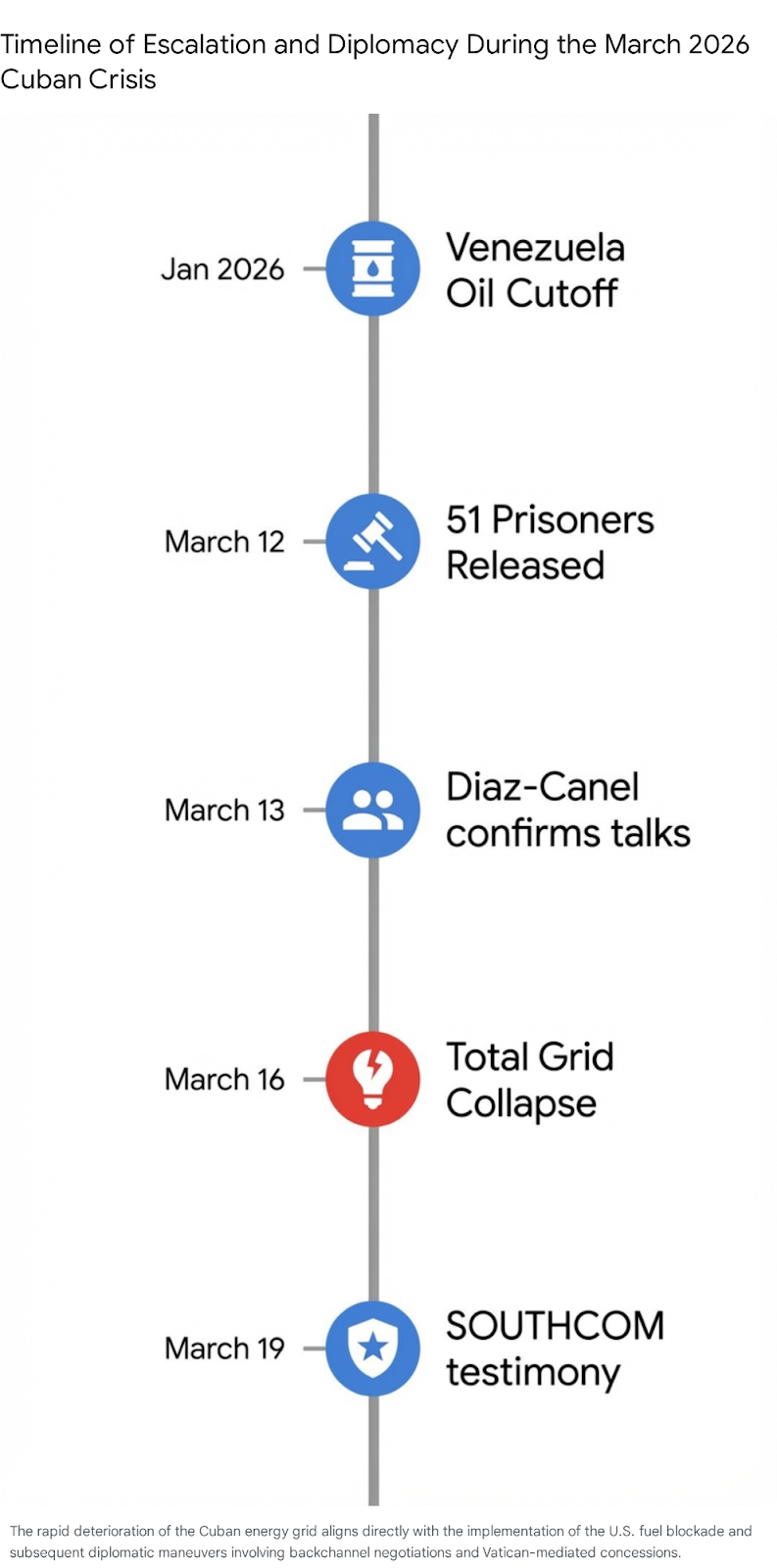
During the week ending March 21, 2026, the Republic of Cuba experienced a severe convergence of systemic shocks, escalating the island’s ongoing economic, infrastructural, and political crises to unprecedented, near-terminal levels. The most critical operational event of the reporting period occurred on Monday, March 16, when the national electrical grid suffered a total, catastrophic collapse, leaving approximately ten million residents across the archipelago without power for over twenty-nine hours.1 This infrastructure failure is the direct, intended consequence of an acute fuel shortage engineered by the United States’ maximalist pressure campaign, which effectively severed Cuban access to vital Venezuelan oil imports earlier in the year following decisive U.S. military operations in Caracas.3 Although partial power transmission restoration was achieved by the evening of March 17, rolling blackouts lasting upwards of fifteen to twenty hours a day continue to severely degrade municipal services, healthcare operations, agricultural production, and daily commerce.1

Simultaneously, the island is witnessing sustained, decentralized civil unrest. The reporting period marked the thirteenth consecutive day of protests, with nearly 160 distinct demonstrations recorded nationwide since early March by independent human rights monitors.6 Driven by the prolonged blackouts, chronic food and water shortages, and triple-digit real inflation, these protests have evolved from localized demonstrations of frustration, such as the rhythmic banging of pots in the dark, to acts of physical direct action, including the barricading of streets in Havana and the arson of a Communist Party office in the central municipality of Morón.6 The Cuban government’s response has involved a calibrated combination of state security deployments, border defense mobilizations against armed exile infiltration, and calculated diplomatic concessions aimed at de-escalation.8

Most notably in the diplomatic sphere, on March 13, President Miguel Díaz-Canel publicly confirmed for the first time that his government is engaged in direct, albeit highly sensitive, negotiations with the United States.10 In a coordinated gesture of goodwill mediated by the Vatican, Havana announced the release of fifty-one prisoners, including high-profile individuals incarcerated during the historic July 2021 uprisings.12 However, intelligence indicates these bilateral talks are occurring under extreme duress, with U.S. officials utilizing the energy blockade to demand the removal of the civilian presidency while reportedly maintaining backchannel communications with military elites tied to the Castro family, threatening to fracture the internal cohesion of the Cuban Communist Party.3

Geopolitically, the escalating crisis is rapidly drawing in external adversarial networks, transforming the Caribbean into a theater of renewed great-power competition. The Russian Federation has forcefully reiterated its solidarity with Havana and mobilized significant maritime energy assets to bypass the U.S. blockade architecture.15 Two Russian-flagged tankers carrying nearly one million combined barrels of crude oil and refined diesel are currently in transit to the island, representing a direct, overt challenge to U.S. regional hegemony and sanctions enforcement.17 Concurrently, the U.S. military posture in the Caribbean remains highly elevated. While U.S. Southern Command has explicitly denied preparations for a kinetic invasion of Cuba, military planners are actively preparing for the contingency of a mass maritime migration event, including the potential expansion of refugee holding and processing facilities at Naval Station Guantanamo Bay.18

The confluence of total energy insecurity, fracturing domestic stability, elite-level factional negotiations, and high-stakes great-power maneuvering indicates that the Cuban state is currently navigating its most perilous existential threat since the collapse of the Soviet Union. The immediate trajectory of the crisis hinges entirely on the successful delivery and domestic refinement of Russian petroleum products, the capacity of the Cuban Revolutionary Armed Forces to contain sprawling, decentralized unrest in pitch-black urban centers, and the opaque backchannel negotiations occurring between U.S. strategists and the upper echelons of the Cuban military-business conglomerate.

1. Strategic Environment and U.S. Coercive Diplomacy

The geopolitical environment surrounding the Republic of Cuba has deteriorated into a high-stakes standoff characterized by intense U.S. coercive diplomacy, desperate Cuban elite survival strategies, and the re-emergence of Cold War-era adversarial alignments in the Western Hemisphere. The operational environment is strictly defined by Washington’s overt objective of utilizing Cuba’s structural macroeconomic vulnerabilities to force a regime transition, juxtaposed against Havana’s frantic attempts to secure external logistical lifelines and manage cascading internal dissent.3

1.1 The Catalyst: Venezuelan Operations and the Energy Blockade

The current hyper-accelerated crisis environment was catalyzed by the cascading regional effects of U.S. special military operations in Venezuela in January 2026. This operation, which resulted in the targeted seizure and removal of Venezuelan President Nicolás Maduro and the deaths of thirty-two Cuban military intelligence officers serving in his security detail, fundamentally altered the regional balance of power.3 This decisive action severed Cuba’s primary strategic alliance and immediately choked off the heavily subsidized petroleum shipments that have historically sustained the Cuban baseline economy since the early two-thousands.3

Following the decapitation of the Venezuelan leadership structure, the U.S. administration, under President Donald Trump, instituted a comprehensive, near-total fuel blockade against Cuba.2 This blockade was enforced not merely through direct bilateral embargo mechanisms, but by explicitly threatening devastating secondary tariffs and financial sanctions against any third-party sovereign nation or commercial maritime entity providing petroleum products to the island.2 The efficacy of this blockade has been profound; by mid-March, maritime shipping data analyzed by intelligence firms indicated that foreign-originating tanker port calls to Cuba had collapsed, falling from a monthly average of fifty in 2025 to merely eleven domestic transfers in March 2026, marking the lowest maritime trade volume since 2017.21

1.2 “Friendly Takeover” Rhetoric and Escalation Dominance

Throughout the reporting period, rhetoric from the highest levels of the U.S. executive branch escalated significantly, signaling a posture of escalation dominance. President Trump repeatedly stated to the press that the United States could implement a “friendly takeover of Cuba,” asserting aggressively that he could do “whatever he wants” with the neighboring sovereign nation.1 This language has been accompanied by statements indicating that “imminent action” could be taken, framing the island as the logical next theater for the expansion of U.S. regional influence following successful, high-intensity operations in Venezuela and ongoing military strikes in Iran.3

U.S. Secretary of State Marco Rubio, operating as the primary architect of the administration’s Caribbean policy, has consistently reinforced this maximalist posture. Rubio has publicly stated that the Cuban government’s socialist economic model must “change dramatically” and emphasized the administration’s explicit goal of seeing new leadership installed in Havana.23 The strategic intent behind this coordinated rhetoric appears two-fold: first, to maximize psychological pressure on the Cuban administrative bureaucracy, forcing fractures between the civilian leadership and the military intelligence establishment; and second, to signal unequivocally to the increasingly restive Cuban populace that U.S. support for systemic, structural change is absolute.3

1.3 U.S. Southern Command Posture and Migration Contingencies

Despite the highly aggressive public signaling regarding imminent action, U.S. Southern Command (SOUTHCOM) has maintained a posture focused on containment, interdiction, and contingency management rather than kinetic invasion preparations. General Francis Donovan, the head of SOUTHCOM—who assumed command in February 2026 following the abrupt December resignation of Admiral Alvin Holsey over the legality of lethal U.S. strikes on regional drug vessels—testified before the Senate Armed Services Committee on March 19.18 General Donovan explicitly assured lawmakers that the U.S. military is not currently rehearsing for an invasion of Cuba or actively preparing to militarily occupy the island.18

Instead, the Department of Defense is heavily positioning maritime and logistical assets to manage the severe second-order effects of the economic blockade, primarily the threat of a mass maritime exodus. During the Senate hearing, military planners, prompted by inquiries regarding a looming “humanitarian crisis,” confirmed readiness to expand infrastructure and “set up a camp” at the U.S. Naval Station at Guantanamo Bay.18 This facility would be utilized to intercept, detain, and process a sudden influx of maritime migrants attempting to flee the island’s total economic collapse across the Florida Straits, mirroring historical contingency operations but scaled for the current, unprecedented level of systemic failure.18 This defensive operational posturing indicates that while the administration seeks regime change, the military apparatus views the most immediate threat as regional destabilization driven by mass civilian flight.

U.S. Strategic VectorOperational ActionPrimary ObjectiveCuban Counter-Measure
Regional IsolationJan 2026 seizure of Venezuelan leadership.3Eliminate Cuba’s primary regional ally and source of subsidized petroleum.3Emergency diplomatic appeals to Russia and China for alternative logistical supply chains.17
Economic AsphyxiationImplementation of secondary tariffs on global oil suppliers to Cuba.2Induce catastrophic grid failure to foment unmanageable domestic civil unrest.2Implementation of extreme domestic rationing; transitioning bakeries to solid fuels; reliance on informal markets.32
Psychological WarfareExecutive rhetoric threatening a “friendly takeover” and imminent military action.10Break the psychological deterrence of the Cuban Communist Party and embolden domestic opposition.26Public mobilization of the Revolutionary Armed Forces; defiant nationalistic messaging denouncing imperialism.22
Contingency ManagementSOUTHCOM preparations at Naval Station Guantanamo Bay.18Contain and process anticipated mass maritime migration resulting from state collapse.19Heightened coastal patrols; lethal interception of armed exile infiltration attempts.9

2. Total Infrastructure Failure: The March 16 Grid Collapse

The structural degradation of Cuba’s national infrastructure, long strained by decades of underinvestment and Soviet-era technological reliance, reached a critical, terminal inflection point during the reporting period. On Monday, March 16, 2026, at approximately 1:40 PM local time, the Cuban Ministry of Energy and Mines reported a “complete disconnection” of the country’s National Electric System (SEN), plunging the island’s entire population of ten to eleven million residents into total darkness.2 This event marks the sixth total national blackout—defined as a scenario where the entire island is generating zero megawatts of power—recorded in the past eighteen months, underscoring the terminal fragility of the state’s baseline energy grid.36

2.1 Anatomy of the Grid Failure

The immediate technical cause of the March 16 blackout was a catastrophic generation deficit that overwhelmed the grid’s minimum operating baseload capacity.5 Unlike localized, routine outages caused by transmission line damage or isolated blown transformers, a “complete disconnection” indicates that national power generation dropped so far below baseline civilian and industrial demand that the system shut down entirely via automated safety protocols to prevent the physical destruction of the transmission infrastructure.2

The deep-rooted vulnerability of the grid lies in its near-total reliance on a network of highly obsolete, Soviet-manufactured thermoelectric power plants. These facilities, most notably the Antonio Guiteras power plant located in Matanzas—the largest and historically most reliable generation facility in the country—suffer from chronic technical failures, extensive deferred maintenance cycles extending back to 2024, and a severe lack of specialized spare parts.5 The Antonio Guiteras plant had already experienced a critical shutdown earlier in the month on March 4, which resulted in partial outages affecting millions in the western provinces, foreshadowing the total collapse.36

However, the baseline generation crisis was severely, fatally compounded by the complete exhaustion of liquid fuel reserves. Due to the intense U.S. blockade and secondary sanctions, President Díaz-Canel confirmed to the public that the island had not received any foreign oil shipments in over three months prior to the blackout.23 In the first quarter of 2026, detailed maritime tracking data analyzed by international observers indicated that only two highly inadequate shipments—one small crude vessel from Mexico in January and a minor liquefied petroleum gas delivery from Jamaica—managed to reach the island.4 This represented a catastrophic shortfall for a nation that requires a steady, massive supply of heavy fuel oil and diesel to maintain the thermal temperatures required by its aging plants.4

Furthermore, environmental factors acted as a secondary catalyst for the collapse. An approaching heavy cold front on the morning of March 16 brought dense cloud cover over the entirety of the island, drastically reducing the operational output of Cuba’s network of solar parks.37 Under normal weather conditions, these decentralized solar facilities had been partially mitigating daytime generation deficits, accounting for up to a third of daytime generation.37 The sudden, precipitous drop in solar megawatt generation, combined simultaneously with bone-dry fuel tanks at the major thermal plants, triggered the total systemic collapse.37

2.2 The Complexities of Restoration and Persistent Deficits

Following twenty-nine punishing hours of a total national blackout, Cuban energy officials announced that the grid had been successfully reconnected by 6:11 PM on Tuesday, March 17.1 Because the Cuban power grid operates as a network of separate, regional generation islands, restarting the system from a true zero-megawatt state is a highly volatile, complex, and dangerous engineering process.36 Lázaro Guerra, the electricity director for the Ministry of Energy and Mines, noted that the system had to be brought back online in meticulous, gradual stages because “systems, when very weak, are more susceptible to failure,” risking further damage to transformers.2 State-owned media reported that initial restoration efforts strictly prioritized bringing 5 percent of Havana’s residents back online alongside critical infrastructure, such as hospitals and the communications sector, before attempting to load residential circuits.2

However, within the Cuban context, the term “restored” is merely a technicality defining transmission continuity rather than a return to normalcy. While the physical transmission grid was reconnected from the westernmost Pinar del Rio province to Holguin, generation officials immediately warned the populace that severe, crippling power shortages would continue indefinitely due to an absolute lack of fuel to burn in the operational plants.1 The reality on the ground is a seamless continuation of the punishing status quo that preceded the total collapse: rolling blackouts lasting fifteen to sixteen hours a day in the capital of Havana, and exceeding twenty hours a day in the eastern provinces, which remain the most critically affected and resource-deprived.1

2.3 Secondary and Tertiary Sectoral Collapse

The total failure of the electrical grid serves as an overwhelming force multiplier for broader humanitarian and economic degradation across all sectors of Cuban society. The lack of reliable electricity fundamentally disrupts the basic mechanisms of human survival on the island.

Water distribution has been catastrophically compromised. Approximately 84 percent of Cuba’s municipal water pumping equipment requires high-voltage grid electricity to function.4 Consequently, when the grid fails, the municipal water supply fails entirely. Intelligence reports indicate that nearly one million residents are now entirely reliant on a highly inadequate fleet of scarce, fuel-starved tanker trucks for daily drinking water, severely elevating the risk of localized dehydration and the spread of waterborne diseases in densely populated urban centers.4

The healthcare sector is operating under extreme duress. While critical hospitals were prioritized during the grid restoration, routine power loss to regional clinics and surgical centers has forced the government to postpone tens of thousands of elective and critical surgeries.7 This poses an extreme, immediate risk to the estimated five million citizens living with chronic illnesses, particularly thousands of cancer patients who require continuous, energy-intensive care and temperature-controlled pharmaceuticals.4

Food security, already heavily compromised by inflation, has been devastated by the loss of residential and commercial refrigeration, leading to the rapid spoilage of scarce, high-cost food rations.2 In a stark demonstration of the systemic regression caused by the energy crisis, President Díaz-Canel admitted that over 115 state-run bakeries across the island have been forced to physically convert their ovens to run on burning firewood or coal simply to produce basic bread staples for the population.32 Furthermore, the lack of electricity has forced a total halt to electrified public transit and the shutdown of digital payment terminals, paralyzing the formal retail sector, crippling the emerging private enterprise (MIPYME) sector, and preventing the workforce from commuting, thereby ensuring a zero-growth economic environment.4

3. The “Havana Talks” and Elite Political Factionalism

In a highly unusual departure from standard Communist Party state secrecy, President Miguel Díaz-Canel utilized a March 13 public address, broadcast from the headquarters of the Communist Party of Cuba, to confirm definitively that his government is actively engaged in direct diplomatic talks with the United States.10 Framed by Havana as an effort to find “solutions through dialogue to the bilateral differences,” these talks are occurring under conditions of extreme asymmetry and duress.11 Díaz-Canel outlined the broad, vague framework of these negotiations as identifying bilateral problems, determining mutual willingness for concrete actions, and finding areas of cooperation to guarantee regional security and peace.11

3.1 Shadow Negotiations and Regime Cleavages

Intelligence reporting and backchannel leaks indicate that these negotiations are highly complex and are potentially designed by the U.S. to bypass or isolate the civilian presidency. U.S. officials, notably led by Secretary of State Marco Rubio, have reportedly established high-level backchannel communications not solely with Díaz-Canel’s foreign ministry, but with Raúl Guillermo Rodríguez Castro, the grandson of former President Raúl Castro.20

Rodríguez Castro is not merely a figurehead; he serves as a vital nexus of power within the military-business conglomerate known as GAESA (Grupo de Administración Empresarial). GAESA, managed by the Revolutionary Armed Forces (FAR), controls the vast majority of the Cuban economy, including the lucrative tourism, retail, and port sectors.42 The U.S. negotiating position reportedly demands that President Díaz-Canel step down from power as an absolute precondition for any meaningful easing of the energy sanctions.3 By explicitly targeting the civilian administrator while simultaneously preserving a diplomatic channel with the Castro family and the deep-state military elite, Washington seeks to force a controlled, negotiated transition rather than a chaotic, anarchic state collapse.3

This dynamic suggests a highly calculated U.S. strategy to drive a wedge between the bureaucratic, civilian face of the regime and the deeply entrenched military and intelligence apparatus whose primary objective is institutional survival. The Trump administration is betting that the economic devastation caused by the blockade will force military leaders to calculate that sacrificing the civilian presidency is an acceptable, necessary price for sanctions relief and the preservation of their core economic assets.3

3.2 Public Defiance and Exile Reactions

Despite the reality of these ongoing talks, President Díaz-Canel has maintained a posture of public defiance, likely to project strength to domestic hardliners and maintain party discipline. Following his address, he lashed out at U.S. demands, warning on March 17 that any U.S. aggression or attempts at a “friendly takeover” would be met with “impregnable resistance,” heavily criticizing the “almost daily public threats” against his government’s sovereignty.1 He attempted to compare the current negotiations to the Obama-era diplomatic thaw, a comparison heavily criticized by observers given the current total lack of U.S. economic concessions.43

The revelation of these talks has provoked intense reactions from the Cuban exile community and U.S. domestic political figures. Hardline opposition figures, such as José Daniel Ferrer (who was released from a Cuban prison in January 2025 and exiled to the U.S.), expressed extreme skepticism, questioning why the U.S. would negotiate with a “dictator” whose downfall seems imminent due to the protests.44 Furthermore, Florida political representatives have reiterated that any negotiation must adhere to the fundamental requirements of the 1996 Libertad Act (Cuban Liberty and Democratic Solidarity Act), which mandates a transition to a multi-party democracy and fundamentally rejects negotiations that merely preserve a one-party communist system under new leadership.44 Domestic political pressure within the U.S., including proposals by Florida state representatives to allow investment only if “the communist regime falls,” significantly narrows the diplomatic maneuvering room for U.S. negotiators seeking a pragmatic compromise with the Cuban military.6

Timeline of the March 2026 Cuban Crisis: Venezuela oil cutoff, prisoner release, talks, grid collapse, SOUTHCOM testimony.

4. Humanitarian Concessions: The Political Prisoner Release

As a direct result of the ongoing, sensitive backchannel negotiations, and attempting to demonstrate a tangible “spirit of goodwill” to international observers, the Cuban Ministry of Foreign Affairs announced on the evening of Thursday, March 12, that the government would release fifty-one prisoners in the coming days.10 This specific action was heavily mediated by the Holy See, with Pope Leo XIV actively encouraging bilateral negotiations to resolve the humanitarian crisis and alleviate the suffering caused by the blockade.10

4.1 The Mechanics of the Concession

The Cuban government, adhering to its long-standing domestic narrative, officially categorized the releases as routine pardons for inmates who had “served a significant part of their sentence and have maintained good conduct in prison”.45 State communications explicitly avoided the term “political prisoner,” continuing the regime’s historical practice of denying the existence of political detainees and classifying political dissidents, protesters, and independent journalists as common criminals guilty of public disorder or vandalism.47 The government defended the release as part of the “humanitarian trajectory of the Revolution,” noting it coincided with the proximity of Holy Week celebrations.12

However, independent human rights organizations and tracking groups immediately identified the geopolitical nature of the action. The Justicia 11J rights group, which meticulously tracks arrests stemming from the massive July 2021 anti-government protests, confirmed that the releases included high-profile individuals explicitly designated as political prisoners by the international community.13 Observers witnessed the return home of Adael Leyva Diaz, a twenty-nine-year-old serving a severe thirteen-year sentence, and Ronald García Sanchez, a thirty-three-year-old serving a fourteen-year sentence, both of whom were incarcerated solely for their participation in the July 11 uprisings.13

4.2 Strategic Inadequacy and Historical Context

The release of these specific individuals represents a highly calculated, albeit severely limited, concession to U.S. demands. The Trump administration has consistently conditioned any relief of the energy blockade on the immediate release of political prisoners and demonstrable progress toward structural political liberalization.2 However, the scale of the release falls drastically short of human rights baseline demands. Independent organizations provide varying but consistently high estimates of the incarcerated political population; the Madrid-based NGO Prisoners Defenders estimated the total number of political prisoners on the island to be approximately 1,214 as of February 2026, while Justicia 11J tracks at least 760 individuals behind bars specifically related to protest activities.12

In this context, the release of merely fifty-one individuals is viewed by intelligence analysts as a minimal, tactical maneuver designed to keep diplomatic channels open and appease Vatican mediators without fundamentally altering or weakening the regime’s domestic security posture.12 This tactic mirrors previous diplomatic cycles; in January 2025, during negotiations with the outgoing Biden administration aimed at removing Cuba from the State Sponsors of Terrorism list, Havana agreed to the gradual release of 553 individuals, including prominent dissident José Daniel Ferrer.45 The current, much smaller release indicates a regime that is highly defensive, viewing its political prisoners as vital leverage to be traded incrementally for specific operational concessions, rather than signaling a genuine shift toward domestic political tolerance.

5. Internal Security, Protests, and State Control

The severe socioeconomic deterioration driven by the energy crisis and the failure of basic state services has ignited a persistent, highly volatile, nationwide wave of civil unrest. The reporting period marked the thirteenth consecutive day of public protests, representing the most significant, sustained challenge to the internal security apparatus of the Cuban state since the historic uprisings of July 2021.6

5.1 The Evolution of Decentralized Unrest

According to the human rights monitoring organization Cubalex, nearly 160 distinct protest events have been documented across the archipelago since the current wave of unrest began on March 6, 2026.6 Unlike the centralized, politically organized protests seen in other Latin American nations, the current Cuban demonstrations are highly decentralized, entirely spontaneous, and primarily motivated by acute material deprivation—specifically, the intolerable conditions of prolonged fifteen-hour blackouts, the lack of potable water, and the inability to feed families.5

The tactical execution of these protests has rapidly evolved from passive to active disruption. Initially characterized by nighttime cacerolazos—the rhythmic banging of pots and pans in the dark from balconies, which provides anonymity to protesters—demonstrations have escalated into direct, physical action.6 In several neighborhoods across the capital of Havana, residents have taken to the streets to construct physical barricades and light bonfires to block major municipal roadways, signaling a significant escalation in frustration and a newfound willingness to physically disrupt state control and traffic flow.6 The unrest has also permeated state institutions; university students have mobilized, staging highly visible sit-ins on the steps of the University of Havana to protest the unlivable conditions.5

The most violent and symbolically potent display of dissent occurred in the central municipality of Morón, located in Ciego de Ávila province, on March 14.7 A group of highly agitated protesters bypassed local security cordons, forcefully broke into a provincial office of the Cuban Communist Party, and set fire to computers, furniture, and an adjacent state pharmacy.7 This targeted destruction of state political property is extremely rare in modern Cuba and indicates a dangerous erosion of the psychological deterrence traditionally maintained by the regime’s internal security organs.

5.2 The State Security Response and Paramilitary Readiness

The Cuban government has historically relied on a robust, multi-layered security apparatus—comprising the National Revolutionary Police (PNR), the Department of State Security (DSE), and rapid-response civilian paramilitary organizations—to swiftly isolate and violently suppress unrest.7 Authorities have officially classified the more aggressive demonstrations, such as the Morón incident, as criminal acts of “vandalism” funded by foreign agitators, confirming the swift arrest of at least five individuals in connection with the fire to reassert control.5

While mass casualty events have thus far been avoided during this specific reporting period, the Cuban Revolutionary Armed Forces (FAR) remain on a state of highest alert.7 The regime is highly sensitized to the threat of external military or paramilitary exploitation of the domestic unrest. In late February, this threat materialized when Cuban border guard units engaged in a deadly, close-quarters firefight approximately one mile off the coast of Villa Clara province.9 The guards intercepted a Florida-registered speedboat carrying heavily armed individuals attempting to infiltrate the island. The resulting firefight left four of the infiltrators dead—including a U.S. resident identified as Michael Ortega Casanova—and six wounded.9 Cuban intelligence reported the boat was packed with assault and sniper rifles, Molotov cocktails, night-vision equipment, and body armor, asserting the group intended to “infiltrate, incite public disorder, carry out violent acts, and attack military units”.9

The ongoing, low-intensity nature of the protests presents a highly complex logistical challenge for the state. Suppressing 160 scattered, neighborhood-level protests severely strains security manpower, especially when operating in pitch-black urban environments where police lack situational awareness and communication equipment fails due to dead batteries. Intelligence assessments conclude that if the material conditions driving the unrest are not alleviated by the incoming Russian fuel shipments, the likelihood of these isolated, decentralized incidents coalescing into a synchronized, nationwide popular uprising similar to the 2021 and 2024 unrest increases exponentially, which would likely force the FAR into a posture of lethal domestic suppression to maintain control.7

6. Macroeconomic Deterioration and Demographic Hemorrhage

The Cuban economy is currently trapped in a profound stagflationary spiral—experiencing a severe, sustained contraction in gross domestic product simultaneously with runaway, unmanageable inflation. The macroeconomic indicators for the period ending early 2026 illustrate a structural collapse of domestic purchasing power, which is driving an unprecedented humanitarian and mass migration crisis that threatens the viability of the state.33

6.1 The Reality of Triple-Digit Real Inflation

Official data published by the Cuban National Office of Statistics and Information (ONEI) reported a year-on-year inflation rate of 14.07 percent at the close of 2025, which further decreased slightly to 12.52 percent by January 2026.33 The government has eagerly presented these figures to the public as evidence of a successful economic “slowdown” and a stabilization of the peso, especially when compared to the 24.88 percent inflation recorded in 2024 and the staggering 77 percent recorded during the currency crisis of 2021.33

However, intelligence analysis and independent economic assessments indicate that the official ONEI consumer price index (CPI) is fundamentally flawed, artificially manipulated, and vastly underrepresents the economic reality experienced by the Cuban populace. The official ONEI methodology almost exclusively tracks prices within the highly regulated state market, which is characterized by price controls but chronic, systemic shortages and empty shelves.33 Because the state cannot provide basic goods, the vast majority of the population must turn to the private, informal, and black markets to procure basic caloric necessities, medicine, and fuel.7 When factoring in the volatile, extortionate pricing dynamics of the informal sector, independent Cuban economists estimate that the real annual inflation rate for the past year was approximately 70 percent.33

Cuba inflation gap: Official CPI 14.07% vs. Real Informal Market Estimate 70%. SITREP Cuba.

This immense inflationary pressure is highly regressive, disproportionately affecting essential caloric staples and the poorest segments of the population. A detailed analysis of provincial data from Las Tunas, a traditionally agricultural eastern province, highlights the severity of food inflation over the past year: beverages and tobacco prices surged by 50.3 percent, dairy products and eggs rose by 42 percent, and basic meat sources, specifically pork, increased by 22.8 percent.56 In a centrally planned economy where state wages remain largely stagnant and the Cuban peso has depreciated by an estimated 88 percent since 2021 against foreign currencies, the cost of basic physical survival has mathematically outpaced the earning capacity of the average citizen, necessitating reliance on foreign remittances.53

6.2 The Demographic Collapse

The compounding, devastating effects of systemic energy failure, agricultural collapse, and 70 percent real inflation have rendered the island virtually uninhabitable for a significant segment of the population, triggering a massive, historic demographic contraction. Official government figures now openly acknowledge that Cuba has lost approximately 10 percent of its total population to emigration in recent years, though independent demographic studies and border encounter metrics suggest the actual attrition rate is considerably higher.49

This exodus is heavily weighted toward working-age individuals, technical specialists, and skilled professionals, resulting in a severe brain drain that further degrades the state’s capacity to manage critical infrastructure, repair power plants, or revive the industrial sector. The U.S. strategy of maximum economic pressure explicitly risks accelerating this migration wave into a chaotic surge. During his congressional testimony, SOUTHCOM Commander General Donovan was specifically questioned by Senator Tom Cotton regarding military preparations for a severe “humanitarian crisis” and a “possible flow of refugees” should the socio-economic order in Cuba completely collapse and the regime fall.19 The military’s confirmation of readiness to utilize Guantanamo Bay as a massive migrant processing center underscores the reality that the primary U.S. national security threat emanating from Cuba is no longer military projection, but unchecked demographic collapse.18

7. Foreign Alignments and Strategic Interventions

As the United States aggressively tightens its economic siege, Cuba has become increasingly reliant on overt interventions from adversarial great powers to ensure regime survival and basic caloric intake. The crisis has rapidly transformed the island into a proxy theater for geopolitical maneuvering, with the Russian Federation taking overt, highly visible steps to challenge the U.S. blockade architecture and re-establish its historical, Cold War-era foothold in the Caribbean basin.

7.1 The Russian Maritime Energy Lifeline

In a bold and highly provocative geopolitical maneuver, the Russian government has dispatched significant maritime energy assets to Cuba in direct, open defiance of U.S. sanctions and presidential tariff threats.16 As of late March, maritime tracking data confirms that the Russian-flagged oil tanker Anatoly Kolodkin is actively transiting the Atlantic Ocean, expected to arrive at Cuban ports within days. The vessel is heavily laden with approximately 700,000 to 730,000 barrels of heavy Urals crude oil.16

This shipment represents a critical, existential strategic lifeline for the regime. Energy experts at the University of Texas Energy Institute estimate that once successfully processed, this volume of heavy crude can be refined to produce approximately 180,000 barrels of usable liquid diesel, which is just enough to sustain Cuba’s crippled national daily demand for roughly nine to ten days.17 Furthermore, maritime intelligence indicates that a second vessel, the Hong Kong-flagged Sea Horse, is also en route carrying an additional 200,000 barrels of refined Russian diesel, providing immediate, plug-and-play fuel for decentralized generators.17

The dispatch of these specific vessels is as much a geopolitical statement of intent as it is a humanitarian or economic transaction. The Russian Foreign Ministry issued a formal, combative statement on March 18, expressing “serious concern” over the mounting U.S. pressure, firmly condemning the “illegal unilateral restrictive measures,” and reaffirming “unwavering solidarity” with the Cuban government.15 By sailing sanctioned vessels directly into what the U.S. explicitly considers a restricted zone of influence, Moscow is deliberately testing the operational resolve of the Trump administration’s naval enforcement capabilities.16

Strategic analysts note that the Kremlin is utilizing its vast energy resources as an asymmetric stabilizing tool, countering U.S. attempts at regional isolation.16 While U.S. officials have undoubtedly privately debated the legality and tactical feasibility of intercepting these tankers in international waters, such an action would carry immense, uncontrollable escalatory risks. Legal experts warn that blockading or forcefully seizing a sovereign Russian vessel in neutral waters would likely be classified as piracy under international maritime law, prompting a severe diplomatic and potentially kinetic military response from Moscow.16 The successful arrival and offloading of the Anatoly Kolodkin will signify a critical, highly visible breach in the U.S. blockade architecture, demonstrating globally that the threat of U.S. secondary sanctions is losing its deterrent efficacy against determined, nuclear-armed state adversaries.16

7.2 Diplomatic Support and International Civil Society

In addition to vital Russian material support, Havana is actively leveraging its broader diplomatic network to secure aid, project international legitimacy, and counter U.S. isolation narratives. On March 12, prior to the announcement of the bilateral U.S. talks, Cuban Foreign Minister Bruno Rodríguez held synchronized, high-level telephone consultations with his counterparts in both Moscow and Beijing, briefing them on the escalating U.S. military posture and securing vital rhetorical backing.30

Furthermore, the harsh, visible realities of the total U.S. blockade have galvanized international progressive, socialist, and humanitarian organizations to act independently of state governments. During the reporting period, an international aid convoy dubbed “Nuestra América” (Our America) departed from Milan, Italy, bound directly for Havana.23 Organized by a coalition of European left-wing political parties, trade unions, and advocacy groups, and notably led by members of the European Parliament alongside U.S. progressive organizers like David Adler, the convoy is transporting over twenty tons of specialized humanitarian supplies.23

Crucially, the cargo includes highly targeted aid designed to bypass centralized grid dependency, including massive shipments of decentralized solar panel equipment, alongside specialized cancer medication and food staples.23 While the sheer material volume of this NGO aid is insufficient to resolve the macro-economic crisis of a nation of ten million, it serves a vital, highly effective propagandistic function for the Cuban state. It allows Havana to frame the U.S. embargo as an isolated, unilateral, and cruel aggression universally opposed by global civil society and European political factions.23

Foreign ActorNature of Material/Diplomatic SupportStrategic ObjectiveImplication for U.S. Policy
Russian FederationDirect energy supply (~930,000 combined barrels of crude and diesel via Anatoly Kolodkin and Sea Horse); formal diplomatic solidarity statements.15Counter U.S. regional hegemony; re-establish Cold War-era strategic footholds; utilize energy exports as geopolitical leverage.16Direct challenge to blockade enforcement; risks major maritime confrontation if interception is attempted.16
Vatican (Holy See)High-level diplomatic mediation; facilitation of sensitive negotiations between Havana and Washington.10Prevent humanitarian collapse and mass violence; secure release of political prisoners.12Provides a neutral, face-saving off-ramp for minor regime concessions (prisoner release) without requiring direct bilateral capitulation.12
European NGOs & Coalitions“Nuestra América” convoy providing 20+ tons of targeted humanitarian aid (solar panels, specialized medicine).23Express political solidarity; mitigate immediate human suffering caused by the U.S. blockade.23Undermines the U.S. diplomatic narrative of total international isolation of the Cuban regime and provides critical off-grid medical support.23

8. Intelligence Assessment and Strategic Forecast

The operational situation in the Republic of Cuba remains highly fluid, inherently unstable, and rapidly approaching a critical denouement. The complex interplay between U.S. economic coercion, internal infrastructural and societal collapse, and foreign adversarial intervention presents three primary vectors of immediate concern for national security and regional stability analysts.

First, the short-term survival of the current Cuban state apparatus is fundamentally, inextricably linked to the successful delivery, offloading, and industrial integration of the inbound Russian petroleum shipments. If the Anatoly Kolodkin docks successfully, and critically, if the decaying domestic refineries in Matanzas remain operational enough to process the heavy Urals crude without further catastrophic technical failures, the regime will likely secure enough generating capacity to reduce the rolling blackouts to historically manageable, albeit painful, levels. This vital infusion of energy would temporarily defuse the immediate, most visceral catalyst for the ongoing street protests, granting the government critical operational breathing room to deploy security forces more effectively. Conversely, if the shipment is delayed by naval maneuvering, intercepted, or mishandled by the decaying refinery infrastructure, a rapid return to total, multiday grid collapse is highly probable. This scenario would likely trigger a massive, uncontrollable escalation in decentralized violence, mass looting, and widespread arson against state properties that the FAR may struggle to contain without resorting to mass lethal force.

Second, the political future of President Miguel Díaz-Canel appears increasingly precarious. The overt U.S. negotiating strategy of demanding his absolute removal while simultaneously maintaining backchannel communications with the military-aligned Castro family factions threatens to deliberately cleave the ruling elite.3 If the economic devastation begins to fundamentally threaten the foundational stability of the Revolutionary Armed Forces or the vast commercial interests of GAESA, military leaders may ruthlessly calculate that sacrificing the civilian presidency is an acceptable, necessary price for immediate sanctions relief and the preservation of their institutional survival. The coming weeks will definitively reveal whether the Cuban Communist Party can maintain its historic, monolithic discipline under the immense strain of targeted external wedge tactics, or if a quiet military coup will replace the civilian facade.

Finally, regardless of the immediate political outcome in Havana or the short-term alleviation of the energy grid, the profound structural damage inflicted upon the Cuban economy guarantees that the migratory hemorrhage will continue and likely accelerate drastically. The combination of collapsed public utilities, 70 percent real inflation, the total devaluation of the peso, and the deep psychological exhaustion of the populace creates an overwhelming, unstoppable push factor. U.S. Southern Command’s physical preparations at Naval Station Guantanamo Bay are a prudent, necessary acknowledgement that even a successful U.S. “friendly takeover,” a negotiated managed transition of power, or a brutal military crackdown in Havana will undoubtedly be accompanied by severe short-term chaos, violent economic shockwaves, and a massive, destabilizing surge of maritime migration across the Florida Straits that will test U.S. border enforcement capabilities to their limits.7


Please share the link on Facebook, Forums, with colleagues, etc. Your support is much appreciated and if you have any feedback, please email us in**@*********ps.com. If you’d like to request a report or order a reprint, please click here for the corresponding page to open in new tab.


Sources Used

  1. Cuba restores power after 29-hour blackout amid US oil blockade, accessed March 21, 2026, https://www.aljazeera.com/economy/2026/3/18/cuba-restores-power-after-29-hour-blackout-amid-us-oil-blockade
  2. Cuba hit by island-wide blackout as energy crisis deepens, accessed March 21, 2026, https://www.wutc.org/2026-03-16/cuba-hit-by-island-wide-blackout-as-energy-crisis-deepens
  3. Trump, Rubio call for new Cuban leaders as latest blackout underscores deepening economic crisis, accessed March 21, 2026, https://www.ksat.com/news/2026/03/17/cubas-latest-blackout-underscores-its-deepening-economic-crisis-and-tensions-with-us/
  4. Cuba’s Electricity Crisis: How an Island of 10 Million Lost Power, accessed March 21, 2026, https://www.electricchoice.com/blog/cuba-electricity-crisis/
  5. Prolonged blackouts worsen energy crisis in Cuba in 2026. – Canal Solar, accessed March 21, 2026, https://canalsolar.com.br/en/blackouts-energy-crisis-Cuba-2026/
  6. Cuba faces 13th day of consecutive protests, as efforts to send …, accessed March 21, 2026, https://www.cbsnews.com/miami/news/cuba-13-days-protests-humanitarian-aid-south-florida/
  7. Cuba Plunged into Darkness: Nationwide Blackout Signals a Deepening Crisis, accessed March 21, 2026, https://www.military.com/feature/2026/03/17/cuba-plunged-darkness-nationwide-blackout-signals-deepening-crisis.html
  8. Five arrested in Cuba after protest at local Communist party office – The Guardian, accessed March 21, 2026, https://www.theguardian.com/world/2026/mar/14/arrests-cuba-protest-local-communist-party-office
  9. Cuban border guards prevent armed assault from Florida – The Militant, accessed March 21, 2026, https://themilitant.com/2026/03/06/cuban-border-guards-prevent-armed-assault-from-florida/
  10. 2026 Cuban crisis – Wikipedia, accessed March 21, 2026, https://en.wikipedia.org/wiki/2026_Cuban_crisis
  11. Cuban president says talks were recently held with the U.S. to resolve differences – PBS, accessed March 21, 2026, https://www.pbs.org/newshour/world/cuban-president-says-talks-were-recently-held-with-the-u-s-to-resolve-differences
  12. Cuba announces release of 51 prisoners through Vatican mediation – El Pais in English, accessed March 21, 2026, https://english.elpais.com/international/2026-03-13/cuba-announces-release-of-51-prisoners-through-vatican-mediation.html
  13. Cuba releases prisoners, confirms talks with US – ENG.MIZZIMA.COM, accessed March 21, 2026, https://eng.mizzima.com/2026/03/14/32146
  14. Latest News Headlines, Videos and Photo Galleries on Cuba | Business Standard, accessed March 21, 2026, https://www.business-standard.com/topic/cuba
  15. Russia voices serious concern over U.S. pressure on Cuba, vows support-Xinhua, accessed March 21, 2026, http://www.xinhuanet.com/english/europe/20260318/114cc3312bde49588d6d2e30c072d399/c.html
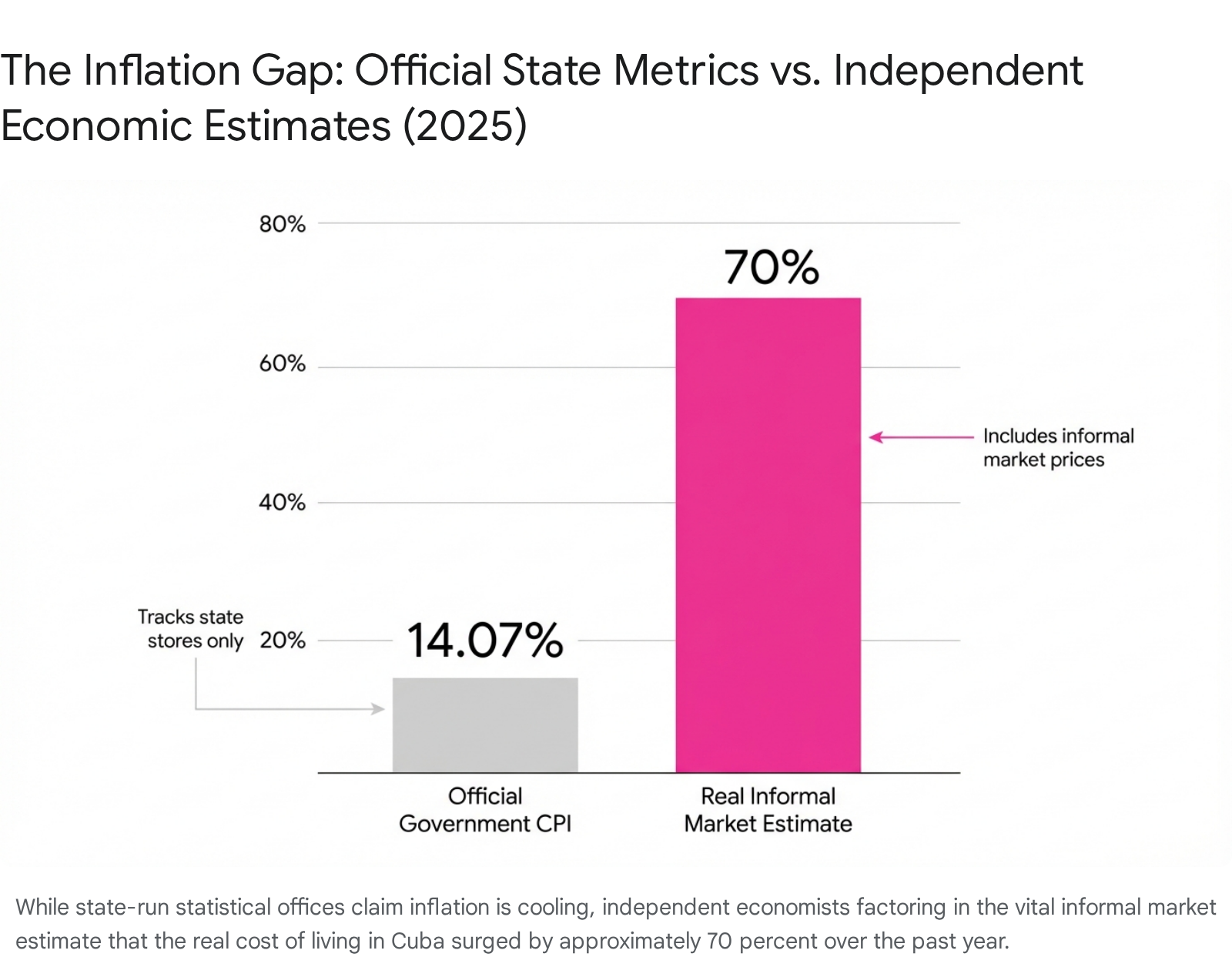
  16. Cuba’s Future Autonomy: An Analysis — EADaily, March 19th, 2026 …, accessed March 21, 2026, https://maritimefairtrade.org/cubas-future-autonomy-an-analysis-eadaily-march-19th-2026-politics-russia/
  17. Cuba readies for first Russian oil shipment of the year as energy crisis deepens | WGCU News | PBS & NPR for Southwest Florida, accessed March 21, 2026, https://www.wgcu.org/2026-03-20/cuba-readies-for-first-russian-oil-shipment-of-the-year-as-energy-crisis-deepens
  18. US military is not preparing for Cuba takeover, top general tells lawmakers – The Guardian, accessed March 21, 2026, https://www.theguardian.com/us-news/2026/mar/19/us-military-not-invading-cuba-trump
  19. ‘Beyond the Pale’: General Says US Military Will Create a ‘Camp’ at Gitmo to ‘Deal With’ Cubans Fleeing Trump Blockade | Common Dreams, accessed March 21, 2026, https://www.commondreams.org/news/cuba-blockade-refugees-gitmo
  20. Cuba’s Woes Threaten the Kremlin’s Authoritarian International – CEPA, accessed March 21, 2026, https://cepa.org/article/cubas-woes-threaten-the-kremlins-authoritarian-international/
  21. Trade with Cuba collapses as Trump escalates pressure on Communist Party leadership, accessed March 21, 2026, https://halifax.citynews.ca/2026/03/19/trade-with-cuba-collapses-as-trump-escalates-pressure-on-communist-party-leadership/
  22. Cubans launch mass demonstration in Havana to decry U.S. attack on Venezuela, demand Maduro’s release | PBS News, accessed March 21, 2026, https://www.pbs.org/newshour/world/cubans-launch-mass-demonstration-in-havana-to-decry-u-s-attack-on-venezuela-demand-maduros-release
  23. European groups join aid convoy to Cuba amid crippling oil blockade, accessed March 21, 2026, https://www.aljazeera.com/news/2026/3/18/as-cuba-found-flotilla-leaves-italy-europe-divided-over-stance-on-crisis
  24. Islandwide blackout hits Cuba as it struggles with deepening energy crisis, accessed March 21, 2026, https://apnews.com/article/cuba-power-outage-electricity-4dcd92d4b7b3bbeda88622b543074ceb
  25. Pursue Negotiations, Not Regime Change, in Cuba | RealClearWorld, accessed March 21, 2026, https://www.realclearworld.com/articles/2026/03/18/pursue_negotiations_not_regime_change_in_cuba_1171182.html
  26. Cuba’s leader says U.S. aggression would meet ‘impregnable resistance’, accessed March 21, 2026, https://www.pbs.org/newshour/world/cubas-leader-says-u-s-aggression-would-meet-impregnable-resistance
  27. Cuban president confirms US talks as island’s energy and economic crises intensify, accessed March 21, 2026, https://apnews.com/article/cuba-us-talks-68bec1bfee9efe696c8ce357463c7a56
  28. Concern, anger and hope simmer in Cuba after Trump calls for ‘imminent action’ against government, accessed March 21, 2026, https://apnews.com/article/cuba-us-diaz-canel-trump-rubio-f078518742b21ec735fa4a6959907ade
  29. ‘Beyond the pale’: general says US military will create a ‘camp’ at Gitmo to ‘deal with’ Cubans fleeing Trump blockade – The Real News Network, accessed March 21, 2026, https://therealnews.com/beyond-the-pale-general-says-us-military-will-create-a-camp-at-gitmo-to-deal-with-cubans-fleeing-trump-blockade
  30. Cuban Foreign Minister Speaks to Chinese, Russian Counterparts, accessed March 21, 2026, https://chinaglobalsouth.com/2026/03/13/cuba-china-russia-diplomatic-call-us-pressure/
  31. Cuba Power Grid Collapse Leaves 10 Million Without Electricity – Vision Times, accessed March 21, 2026, https://www.visiontimes.com/2026/03/17/cuba-power-grid-collapse-leaves-10-million-without-electricity.html
  32. Cuban president says talks were recently held with the US to resolve differences – WLRN, accessed March 21, 2026, https://www.wlrn.org/americas/2026-03-13/cuban-president-says-talks-were-recently-held-with-the-us-to-resolve-differences
  33. Cuba Records Real Annual Inflation of 70% in 2025, but the Government Puts It at Just 14%, accessed March 21, 2026, https://translatingcuba.com/cuba-records-real-annual-inflation-of-70-in-2025-but-the-government-puts-it-at-just-14/
  34. How Trump can increase pressure on the Cuban regime, accessed March 21, 2026, https://www.washingtonexaminer.com/op-eds/4494637/how-trump-can-increase-pressure-on-cuban-regime/
  35. Cuba suffers nationwide blackout after total collapse of national power grid – MercoPress, accessed March 21, 2026, https://en.mercopress.com/2026/03/16/cuba-suffers-nationwide-blackout-after-total-collapse-of-national-power-grid
  36. Cuba is left without power due to the complete collapse of its electrical grid | International, accessed March 21, 2026, https://english.elpais.com/international/2026-03-16/cuba-is-left-without-power-due-to-the-complete-collapse-of-its-electrical-grid.html
  37. Cuba Restores Power After 29-Hour Nationwide Blackout Amid USA Invasion Dangers, accessed March 21, 2026, https://essydo.com/2026/03/18/cuba-power-after-29-hour-blackout/
  38. accessed March 21, 2026, https://en.wikipedia.org/wiki/2026_Cuban_crisis#:~:text=On%204%20March%2C%20a%20shutdown,leaving%20the%20country%20without%20power.
  39. Cuba reconnects electrical grid but millions still without power | The Mighty 790 KFGO, accessed March 21, 2026, https://kfgo.com/2026/03/17/cuba-reconnects-electrical-grid-but-millions-still-without-power/
  40. Tons of aid flows into Cuba as humanitarian convoy arrives on the struggling island, accessed March 21, 2026, https://www.wsls.com/news/2026/03/20/tons-of-aid-flows-into-cuba-as-humanitarian-convoy-arrives-on-the-struggling-island/
  41. Cuban president confirms talks with US and invites FBI to the island, accessed March 21, 2026, https://www.wsws.org/en/articles/2026/03/13/bmys-m13.html
  42. Explainer-Who might the US be talking to in Cuba? By Reuters – Investing.com, accessed March 21, 2026, https://www.investing.com/news/world-news/explainerwho-might-the-us-be-talking-to-in-cuba-4556413
  43. Cuban president confirms talks with Trump officials amid US blockade – The Guardian, accessed March 21, 2026, https://www.theguardian.com/world/2026/mar/13/cuba-us-talks-miguel-diaz-canel-trump
  44. Cuban Exiles React to Díaz-Canel’s Remarks: “What Planet Does This Individual Live On?”, accessed March 21, 2026, https://translatingcuba.com/cuban-exiles-react-to-diaz-canels-remarks-what-planet-does-this-individual-live-on/
  45. Cuba will release 51 people from prison in an unexpected move – Click2Houston, accessed March 21, 2026, https://www.click2houston.com/news/world/2026/03/13/cuba-will-release-51-people-from-prison-in-an-unexpected-move/
  46. Cuba will release 51 people from prison in an unexpected move – KSAT, accessed March 21, 2026, https://www.ksat.com/news/world/2026/03/13/cuba-will-release-51-people-from-prison-in-an-unexpected-move/
  47. Cuba’s announcement of 51 prisoners released doesn’t exactly mean political prisoners, South Florida expert says, accessed March 21, 2026, https://www.cbsnews.com/miami/news/cuba-expert-explains-prisoner-exchange-announcement/
  48. Cuba will release 51 people from prison in an unexpected move – AP News, accessed March 21, 2026, https://apnews.com/article/cuba-prisoner-release-vatican-f94d7310e1dda84f92ab293ef6edb365
  49. World Report 2026: Cuba | Human Rights Watch, accessed March 21, 2026, https://www.hrw.org/world-report/2026/country-chapters/cuba
  50. 2024–2026 Cuban protests – Wikipedia, accessed March 21, 2026, https://en.wikipedia.org/wiki/2024%E2%80%932026_Cuban_protests
  51. US Alarmed as Cuba Unleashes Surprising Military Maneuvers – YouTube, accessed March 21, 2026, https://www.youtube.com/watch?v=vG81y6m40kM
  52. 2021 Cuban protests – Wikipedia, accessed March 21, 2026, https://en.wikipedia.org/wiki/2021_Cuban_protests
  53. The Cuban Economic Crisis: Impact of Government Mismanagement and International Sanctions on a Developing Country, accessed March 21, 2026, https://sites.lsa.umich.edu/mje/2026/01/09/the-cuban-economic-crisis-impact-of-government-mismanagement-and-international-sanctions-on-a-developing-country/
  54. Cuba Inflation Rate – Trading Economics, accessed March 21, 2026, https://tradingeconomics.com/cuba/inflation-cpi
  55. Cuba: Ten Consecutive Years of Macroeconomic Deterioration, accessed March 21, 2026, https://horizontecubano.law.columbia.edu/news/cuba-ten-consecutive-years-macroeconomic-deterioration
  56. Official Report Confirms Persistent Inflation in Cuban Province, accessed March 21, 2026, https://periodico26.cu/index.php/en/special-reports-3/23349-official-report-confirms-persistent-inflation-in-cuban-province
  57. Foreign Ministry statement in connection with the escalating situation around Cuba, accessed March 21, 2026, https://mid.ru/en/press_service/spokesman/official_statement/2086746/
  58. Cuba on the brink of collapse amid earthquakes and energy crisis. Trump renews threats, accessed March 21, 2026, https://www.voxnews.al/english/kosovabota/kuba-ne-prag-te-kolapsit-mes-eve-dhe-krizes-energjetike-trump-r-i112516

SITREP Cuba – Week Ending March 14, 2026

Executive Summary

The week ending March 14, 2026, marks a critical and highly volatile inflection point in the multifaceted crisis currently enveloping the Republic of Cuba. The nation is navigating what intelligence and strategic assessments unilaterally categorize as its most severe existential threat since the immediate aftermath of the Soviet Union’s collapse, a period colloquially known as the “Special Period.” The contemporary operational environment is characterized by a compounding triad of systemic vulnerabilities: a near-total collapse of the national electrical grid driven by a stringent United States oil blockade, an unprecedented and lethal degradation of the public healthcare and water sanitation infrastructure, and escalating civil unrest manifesting in historically loyal urban centers.

The most significant geopolitical development of the reporting period is the unprecedented public confirmation by Cuban President Miguel Díaz-Canel of ongoing, high-level bilateral negotiations with the United States government. These back-channel engagements—reportedly spearheaded on the American side by United States Secretary of State Marco Rubio and on the Cuban side by Raúl Guillermo Rodríguez Castro, a highly influential member of the Cuban military-economic elite and the grandson of Raúl Castro—indicate a mutual recognition of the catastrophic risks associated with a sudden, uncontrolled state collapse. This diplomatic maneuvering occurs against the backdrop of an aggressive strategic posture by the Trump administration, which has publicly oscillated between demanding a “friendly takeover” of the island and threatening forcible regime change, a posture significantly emboldened by the successful United States military capture of Venezuelan leader Nicolás Maduro earlier this year.

Simultaneously, the United States’ strategy of economic strangulation has yielded profound and immediate domestic consequences within Cuba. The abrupt cessation of Venezuelan crude shipments, combined with the chilling effect of threatened United States tariffs on third-party suppliers, has effectively starved the island of essential hydrocarbons. The resulting energy deficit has paralyzed critical state infrastructure, leaving upwards of one million citizens completely reliant on sporadic tanker trucks for drinking water and severely compromising the survival rates of tens of thousands of oncology and maternity patients due to failing hospital infrastructure.

However, despite the immense pressure, the Cuban state is exhibiting signs of asymmetric resilience, heavily subsidized by its strategic global partners. A rapid, Chinese-backed transition toward renewable solar energy is actively altering the island’s energy matrix, while the government of Mexico has openly defied United States diplomatic pressure by deploying naval logistics vessels to deliver substantial humanitarian aid to Havana. Furthermore, a recent United States Supreme Court ruling invalidating secondary tariffs imposed under the International Emergency Economic Powers Act (IEEPA) has injected sudden legal uncertainty into Washington’s secondary sanctions regime, potentially opening a vital logistical corridor for Havana. This comprehensive situation report provides an exhaustive, multi-domain analysis of the political, economic, security, and diplomatic events shaping the Cuban theater as of mid-March 2026.

1. Strategic Geopolitical Posture and Bilateral Diplomacy

1.1 Public Acknowledgment of Negotiations

On March 13, 2026, Cuban President Miguel Díaz-Canel executed a highly calculated strategic communication maneuver by delivering a prerecorded statement to senior Communist Party officials, and subsequently engaging with a vetted press pool, to publicly confirm that the Cuban government is actively engaged in diplomatic talks with the United States.1 This admission represents a stark departure from months of strict official denials regarding the existence of back-channel communications and serves as a critical domestic pressure release valve for the regime.3 Díaz-Canel articulated that the dialogue is “aimed at finding solutions through dialogue to the bilateral differences between our two nations,” explicitly noting that unspecified “international factors” facilitated these exchanges.1

The strategic messaging surrounding this announcement was meticulously choreographed to balance domestic desperation with ideological continuity. By formally acknowledging the talks, the Cuban leadership seeks to inject a measure of hope into a deeply fractured and exhausted populace, signaling that relief from the crippling energy and economic crisis may be negotiable without violent revolution. Díaz-Canel deliberately drew historical parallels, comparing the current diplomatic efforts to the secret negotiations that led to the brief rapprochement during the Obama administration, framing the engagement as a continuation of sovereign diplomacy rather than a capitulation.2

However, intelligence assessments note that the power dynamics in 2026 are markedly different from 2014. The regime is currently negotiating from a position of acute, unprecedented weakness, lacking the geopolitical and economic buffer previously provided by a stable Venezuela. The deliberate physical presence of Raúl Guillermo Rodríguez Castro during Díaz-Canel’s announcement served as a powerful visual confirmation of government unity, implicitly assuring hardliners within the revolutionary apparatus that the negotiations carry the explicit blessing of the old guard and the military establishment.2

1.2 Back-Channel Interlocutors and the GAESA Connection

Intelligence reporting and diplomatic sources indicate that formal diplomatic channels have been largely bypassed in favor of discreet, high-level back-channels. Reports confirm that United States officials, notably including Secretary of State Marco Rubio, engaged in clandestine meetings on the sidelines of the Caribbean Community (Caricom) leaders’ summit in St. Kitts and Nevis in late February 2026.2 The primary interlocutor for the Cuban state during these initial engagements was Raúl Guillermo Rodríguez Castro, widely known within Cuban elite circles by his sobriquet “El Cangrejo” (The Crab).3

The selection of Rodríguez Castro as the tip of the diplomatic spear is of paramount intelligence significance. Aged 41, he holds the rank of lieutenant colonel within the Revolutionary Armed Forces (FAR) and formerly served as the personal bodyguard to his grandfather, former President Raúl Castro.3 More critically to the current geopolitical calculus, his late father, Luis Alberto Rodríguez López-Calleja, was the architect and head of GAESA (Grupo de Administración Empresarial), the opaque, military-run conglomerate that exerts near-total monopolistic control over the most lucrative sectors of the Cuban economy, including tourism, retail, banking, and port logistics.3

Engaging Rodríguez Castro allows Washington to negotiate directly with the locus of actual power on the island—the military-economic elite—rather than the civilian bureaucratic facade represented by the nominal President, Díaz-Canel. For Havana, utilizing a trusted familial proxy provides plausible deniability while testing the parameters of a potential settlement. This methodology closely mirrors the back-channel strategies Washington successfully employed with Venezuelan elites prior to the neutralization of Nicolás Maduro earlier in the year, indicating a standardized playbook utilized by the current United States administration.3

1.3 Concessionary Measures and Vatican Mediation

As a tangible indicator of goodwill and a necessary precursor to deeper, substantive negotiations, the Cuban Ministry of Foreign Affairs announced on the eve of Díaz-Canel’s speech that the government would release 51 prisoners.1 The identities of the individuals, and their specific status as political detainees versus common criminals, were not immediately disclosed to the public.6 This ambiguity is a standard operating procedure for Havana, allowing the regime to maximize the diplomatic yield of such releases internationally while maintaining strict internal security and avoiding the appearance of capitulating to domestic dissident demands.

This concession was brokered through the direct and active mediation of the Vatican. The official Cuban announcement highlighted the “spirit of goodwill and close relations with the Vatican,” explicitly framing the release as a sovereign decision tied to a “humanistic vocation” rather than a forced concession to United States pressure.1 The groundwork for this move was laid earlier in the month when Cuban Foreign Minister Bruno Rodríguez Parrilla was received by Pope Leo XIV in Rome.10 This high-level summit was immediately followed by statements from Vatican Secretary of State Pietro Parolin, who confirmed that the Holy See was taking “necessary steps” to ensure a negotiated solution between Washington and Havana.10 The involvement of the Catholic Church provides Cuba with a dignified, multilateral off-ramp, allowing the regime to make necessary humanitarian concessions to the United States without losing face before its domestic ideological base.

1.4 United States Coercive Diplomacy and Regime Change Rhetoric

The Trump administration’s posture toward Cuba has aggressively oscillated between diplomatic engagement and overt threats of forcible regime change, constituting a “maximum pressure” doctrine seemingly emboldened by successful kinetic operations in the broader region. In early March, President Trump held a news conference asserting that Cuba is “at the end of the line” and operating strictly on “fumes,” having been systematically stripped of energy, capital, and international support following the capture of Maduro.9

President Trump explicitly introduced the concept of a “friendly takeover” of the communist government, while ominously warning that “it may not be a friendly takeover” if Havana refuses to capitulate to a comprehensive, structural deal.2 This rhetoric is meticulously designed to exploit the psychological shockwaves currently reverberating through the Cuban leadership following the sudden decapitation of the allied Venezuelan state. According to United States officials, the parameters of the proposed deal extend far beyond mere sanctions relief, encompassing mandatory structural changes to Cuban governance, the privatization of state-held assets (specifically targeting ports, energy grids, and tourism infrastructure currently held by GAESA), and potentially arranging for the safe exile or transition of the Castro family and Díaz-Canel.11

Washington’s strategy relies on weaponizing the imminent threat of state collapse to force a systemic capitulation. This involves utilizing Secretary of State Marco Rubio to leverage intense diplomatic and economic pressure, while the Commander-in-Chief maintains the credible threat of unilateral kinetic force.5 The administration’s calculus assumes that the Cuban military elite, faced with the dual threats of mass starvation-induced uprisings and American military intervention, will prioritize personal survival and asset preservation over ideological purity.

2. Macroeconomic Degradation and the Energy Blockade

2.1 The Architecture of the United States Energy Embargo

The primary catalyst for Cuba’s current economic paralysis and social destabilization is a highly targeted United States energy blockade that has successfully severed the island from global hydrocarbon markets. Historically, the Cuban economy requires a baseline minimum of 100,000 barrels of oil per day (bpd) to maintain nominal economic function, power its electrical grid, and support its logistics networks.13 Domestic extraction capabilities, primarily centered in the Matanzas region, peak at approximately 40,000 bpd of heavy, high-sulfur crude, leaving a massive structural deficit of 60,000 bpd that must be imported to prevent systemic failure.13

For over two decades, this critical deficit was reliably subsidized by the Bolivarian Republic of Venezuela, which at its peak under Hugo Chávez supplied Cuba with up to 95,000 bpd in exchange for medical and intelligence personnel.13 The military capture of Nicolás Maduro in January 2026 abruptly and permanently terminated this logistical lifeline.2 In the immediate aftermath of Maduro’s removal, the Trump administration weaponized the International Emergency Economic Powers Act (IEEPA), issuing sweeping executive orders that explicitly threatened crippling secondary tariffs on any sovereign nation or commercial shipping entity that supplied petroleum or refined fuel products to Cuba.9

The physical enforcement of this blockade has been ruthlessly effective. President Díaz-Canel confirmed on March 13 that zero fuel shipments have successfully entered Cuban ports over the trailing three months.2 This artificial energy drought has pushed the national energy matrix beyond the brink of failure. The lack of fuel for the island’s aging thermoelectric plants has resulted in rolling blackouts that alternate between merely four hours of intermittent electricity and up to 20 hours of total darkness across all provinces, including historically shielded administrative zones in the capital city of Havana.17

2.2 Quantitative Macroeconomic Indicators

The macroeconomic indicators for the first quarter of 2026 paint an empirical picture of an economy in structural freefall. The nation had already failed to recover from the severe economic shocks of the COVID-19 pandemic, suffering three consecutive years of negative GDP growth from 2023 to 2025.13 The imposition of the absolute oil blockade has accelerated this contraction to unprecedented levels.

Economic IndicatorActual (Current March 2026)Q4 2026 ForecastTrend Analysis
Full Year GDP Growth-1.10%1.5%Severe contraction; forecast relies heavily on hypothetical sanctions relief.
Inflation Rate12.52%11.0%Persistently high; destroying purchasing power of state salaries in the dollarized informal economy.
Unemployment Rate1.80%3.0%Artificially low due to massive state employment, masking massive underemployment.
Government Debt to GDP119.00%120.0%Unsustainable debt burden; severely limits ability to access international credit markets.
Government Budget (% GDP)-7.30%-9.0%Expanding deficit driven by collapse in tax revenue and subsidized utility costs.
Population9.75 Million9.5 MillionRapid demographic collapse due to unprecedented migratory exodus.
GDP per Capita$7,381.40 USD$7,492 USDHighly distorted metric; fails to capture the massive wealth gap driven by remittance access.

Table 1: Key Macroeconomic Indicators and Projections for the Republic of Cuba (Data sourced from TradingEconomics 19).

The actual inflation rate of 12.52 percent is highly destructive, systematically eroding the purchasing power of the domestic currency (the Cuban Peso) and rendering state salaries virtually worthless in the highly informalized, dollarized black market where basic necessities are now exclusively traded.19 Government debt to GDP has ballooned to an unsustainable 119.00 percent, operating with an expanding budget deficit of -7.30 percent.19 Furthermore, a massive migratory exodus has driven the total population down to 9.75 million, significantly depleting the skilled labor force and leaving behind an aging demographic heavily dependent on a failing state apparatus.19 While GDP per capita nominally hovers at $7381.40 USD, this figure obscures the vast, widening disparity between those with access to foreign remittances and those entirely dependent on the collapsing state rationing system.19

2.3 The Supreme Court IEEPA Ruling and Legal Ambiguity

A highly significant legal development occurred within the United States judicial system during the reporting period, fundamentally altering the tactical landscape of the economic blockade. On February 20, 2026, the United States Supreme Court issued a landmark 6-3 ruling in the case of Learning Resources, Inc. v. Trump.21 The Court definitively determined that the International Emergency Economic Powers Act (IEEPA) does not grant the executive branch the statutory authority to unilaterally impose tariffs to regulate importation.14

Consequently, all tariffs imposed under the IEEPA framework by the Trump administration were rendered legally invalid. United States Customs and Border Protection (CBP) officially ceased collecting these specific tariffs at 12:00 AM on February 24, 2026.21 This ruling directly strikes at the core legal mechanism the administration utilized to enforce secondary sanctions on countries providing oil to Cuba.14

IEEPA Tariff TargetAuthorityPrevious StatusCurrent Status Post-Supreme Court Ruling
Countries providing oil to CubaIEEPASecondary tariffs authorized via Executive OrderInvalidated; collection ceased Feb 24, 2026.
Countries importing Venezuelan oilIEEPASecondary tariffs authorizedInvalidated; collection ceased Feb 24, 2026.
Russian oil (India)IEEPA25% on nonexempt goodsInvalidated; collection ceased Feb 24, 2026.
Mexico/CanadaIEEPA25%/35% respectivelyInvalidated; collection ceased Feb 24, 2026.

Table 2: Status of Key IEEPA-Based Tariff Enforcement Mechanisms.14

From an intelligence perspective, this judicial ruling technically nullifies the United States’ threat to economically penalize third-party maritime suppliers via import tariffs. However, the de facto impact on the Cuban ground reality remains frustratingly muted for Havana. Global shipping conglomerates, maritime insurance underwriters, and foreign governments remain highly risk-averse, demonstrating a profound reluctance to test Washington’s resolve. The United States administration retains other formidable coercive economic tools outside of the IEEPA framework, and the sheer unpredictability of United States foreign policy continues to serve as an incredibly effective psychological deterrent against large-scale commercial fuel shipments to Havana, regardless of the Supreme Court’s strict statutory interpretation.14

3. Humanitarian Crisis and Internal Security Dynamics

3.1 Systematic Collapse of Public Health and Utilities

The severe energy deficit has rapidly metabolized into a profound, life-threatening humanitarian crisis, triggering emergency alarms at the highest levels of the United Nations. UN Resident Coordinator in Cuba, Francisco Pichón, alongside UN Spokesperson Stéphane Dujarric, have issued formal warnings of an impending systemic collapse, explicitly noting that the inability to power basic infrastructure poses acute, immediate risks to human life.23

The most critical secondary infrastructure failure involves the national water supply and sanitation grid. Over 80 percent of Cuba’s water-pumping infrastructure relies exclusively on continuous electrical power.23 As the electrical grid fails, the pumps sit idle, resulting in prolonged, widespread service disruptions across major metropolitan areas. Consequently, nearly one million citizens—representing approximately 10 percent of the total population—are currently forced to rely on highly irregular deliveries of drinking water by state-run tanker trucks.23 These truck deliveries are themselves frequently grounded due to the parallel shortage of diesel fuel, creating a compounding logistical nightmare.

The degradation of Cuba’s universally celebrated public healthcare system is the most lethal consequence of the oil blockade. Hospitals are battling frequent power outages that disable crucial cold-chain systems required to preserve vaccines, insulin, and blood supplies, while rendering life-support, dialysis, and diagnostic equipment dangerously inoperable.24 The UN Office for the Coordination of Humanitarian Affairs (OCHA) estimates that five million Cubans living with chronic illnesses are facing severe treatment disruptions.23 Specifically, over 16,000 cancer patients are unable to receive vital radiotherapy, more than 12,000 are completely cut off from necessary chemotherapy treatments, and 32,000 pregnant women are facing acute survival risks due to heavily compromised maternal care services.23

Furthermore, basic food supply chains are equally fractured; the inability to transport agricultural products from rural provinces to urban centers, or to maintain cold storage at distribution points, has resulted in a steep reduction in basic food availability. This is severely compounded by the ongoing, underfunded recovery from the devastation of Hurricane Melissa, a Category 5 storm that affected 2.2 million people in eastern Cuba in October 2025, for which a $74 million UN appeal has only managed to mobilize $23 million.23 The psychological toll of the crisis is further deepened by collective national grief surrounding regional geopolitical events, particularly the confirmed death of 32 Cuban nationals embedded in Venezuela during the United States military operation on January 3.23

3.2 Manifestations of Civil Unrest and Public Demonstrations

The absolute degradation of basic utilities has fundamentally eroded the fragile social contract between the Cuban state and its citizens, resulting in localized but highly symbolic and deeply concerning outbreaks of civil unrest. The capital city of Havana, typically the most heavily policed and resourced zone in the country, has witnessed a surge in cacerolazos—the rhythmic banging of pots and pans—a form of protest traditionally associated with South American political unrest but historically rare and highly taboo in post-revolutionary Cuba.2

During the reporting period, these protests occurred predominantly under the cover of night, coinciding with the darkest hours of the rolling blackouts. Intelligence indicates these acoustic demonstrations have permeated densely populated, working-class municipalities including Cerro, Central Havana, San Miguel del Padrón, and La Lisa.17 The demographic composition of these protests is vital to analyzing regime stability; these are not traditionally dissident enclaves funded by external actors, but rather historically loyal proletarian neighborhoods that form the bedrock of the revolution’s domestic support. The motivation for these demonstrations is less explicitly political and more existentially driven, stemming from an absolute inability to preserve perishable food, access pumped water, or sleep in tropical heat without electrical ventilation.

Concurrently, a prominent student assembly and sit-in was organized on the steps of the University of Havana.2 The university holds hallowed, near-mythical status within the state’s iconography as the historical incubator of Cuban revolutionary movements, including Fidel Castro’s initial political rise. A protest at this specific location signals a dangerous ideological fracturing among the educated youth demographic. The regime has thus far demonstrated remarkable restraint, refraining from deploying overwhelming, lethal kinetic force to suppress these specific protests. This posture is likely driven by a strategic calculation that mass civilian casualties broadcast globally would instantly derail the fragile back-channel talks with Washington and potentially trigger an uncontrollable, nationwide uprising.

3.3 State Security Responses and Internal Cohesion

The Cuban government’s internal cohesion is being severely tested by the multi-front crisis, but intelligence assessments indicate there are no immediate signs of an uncontrolled institutional fracture within the upper echelons of the Revolutionary Armed Forces (FAR) or the Ministry of the Interior (MININT). The state has responded to the crisis through a dual strategy of severe, wartime resource rationing and calculated political concessions designed to buy time.

Authorities have implemented austere contingency plans that reflect a regression to pre-industrial operational norms. Most notably, the state has mandated the conversion of over 115 state-run bakeries to operate entirely on firewood and coal due to the absolute unavailability of electricity and diesel fuel.16 Daily life has become increasingly fragile, with the state rapidly scaling back essential services, suspending non-critical academic programs, and significantly reducing elder care services to conserve fractional energy reserves.23 The government is relying heavily on its extensive neighborhood watch system, the Committees for the Defense of the Revolution (CDRs), to continuously monitor discontent and preempt organized anti-state mobilization before it reaches critical mass. Despite the acute suffering of the population, the rapid public alignment of Díaz-Canel and the Castro family regarding the absolute necessity of negotiations with the United States suggests the core leadership recognizes that ideological rigidity must temporarily yield to pragmatic survival.

4. Asymmetric Security Threats and Migration Patterns

4.1 Maritime Security Incidents and Bilateral Cooperation

Amidst the macro-level geopolitical standoff between Washington and Havana, tactical-level security friction continues to escalate in the maritime domain, specifically across the Florida Straits. A severe security incident occurred recently involving a Florida-flagged speedboat interdicted by the Cuban Coast Guard well within sovereign Cuban territorial waters.4 The high-speed vessel was carrying ten Cuban nationals who had originated from the United States. According to the official timeline and forensic evidence released by Havana, the heavily armed occupants of the vessel opened fire on Cuban military personnel upon interception, precipitating a lethal kinetic response from state forces.

Four of the vessel’s occupants were killed instantly during the ensuing firefight, and a fifth suspect subsequently succumbed to severe injuries related to the incident.4 The surviving five individuals were detained by state security and are currently facing severe terrorism charges under Cuban military jurisdiction. Havana has loudly framed the event as an act of deliberate “terrorist aggression” perpetrated by violent exiles operating with impunity from the United States mainland.2

However, despite the highly volatile and politically charged nature of the incident, both nations have demonstrated a sophisticated willingness to compartmentalize maritime security from the broader political rhetoric. President Díaz-Canel confirmed that specialized agents from the United States Federal Bureau of Investigation (FBI) are scheduled to visit Cuba imminently to conduct a joint investigation and share critical intelligence regarding the origin, funding, and logistical support of the speedboat operation.4 This bilateral law enforcement cooperation underscores a rare mutual interest: Cuba desperately requires United States assistance to suppress armed exile incursions that threaten state stability, while the United States seeks to prevent the Caribbean basin from devolving into an ungoverned space dominated by maritime smuggling, human trafficking, and rogue paramilitary actors.

4.2 Demographic Hemorrhage and United States Border Hardening

The internal, systemic deterioration of the Cuban state has accelerated a profound demographic collapse, fueling a persistent and historic migratory wave toward the North American continent. The socio-economic despair has fundamentally altered the demographic composition of the island. Statistical data from the previous year highlights the immense scale of this exodus; in 2025, Cubans represented the third-largest asylum-seeking nationality globally, generating an astonishing 5.3 asylum claims per 1,000 inhabitants.26

However, this immense outward demographic pressure is currently meeting an increasingly fortified and hostile United States border apparatus. The current United States administration has implemented a highly aggressive reduction in overall immigration, focusing state resources on record deportations and the systematic curtailment of migrant protections.27 Upon taking office for his second term, President Trump immediately declared a national emergency at the southern border, officially classifying the migration influx from Latin America as an “invasion”.27 The White House has moved decisively to strip temporary legal protections, including humanitarian parole programs and Temporary Protected Status (TPS), from hundreds of thousands of Latin American immigrants. This policy vector disproportionately impacts recent Cuban arrivals who utilized these specific legal pathways in previous years.27

Furthermore, the administration’s broader hemispheric strategy involves utilizing intense diplomatic and economic pressure to force regional governments, particularly Mexico and Central American states, to accept deportees and serve as heavily militarized buffer zones. Consequently, Cubans attempting to flee the island face a perilous and increasingly enclosed reality: maritime routes are heavily policed and highly dangerous (as evidenced by the deadly speedboat interdiction), and traditional land routes through the Darién Gap up through Mexico are increasingly blocked by United States-mandated enforcement mechanisms.4 This dynamic creates a dangerous pressure-cooker environment on the island; historically, the ability to migrate served as a vital release valve for domestic discontent, a valve that is now being systematically sealed shut by Washington.

4.3 Diaspora Economic Integration Efforts

Faced with a rapidly shrinking tax base, a paralyzed state sector, and zero access to international credit markets, the Cuban government has increasingly identified the massive Cuban diaspora as a critical, yet largely untapped, reservoir of capital and technical expertise. The over three million Cubans currently living abroad, primarily in the United States and Spain, represent a strategic economic potential that Havana is increasingly desperate to leverage to prevent total fiscal collapse.28

On March 2, President Díaz-Canel issued a stark national mandate for “urgent transformations,” explicitly prioritizing the “promotion of business with Cubans residing abroad”.28 This directive aims to facilitate direct foreign investment by expatriates into the island’s emerging, highly regulated private sector (the mipymes). However, intelligence analysis from financial sectors and diaspora business leaders indicates that these overtures are met with profound and deeply entrenched skepticism.28 Decades of contradictory legal architecture, bureaucratic hostility, arbitrary asset expropriation, and ideological demonization have entrenched deep distrust within the diaspora community.

While the government economically recognizes that unleashing the potential of diaspora capital is the most viable path to rescuing the dying economy, the state security apparatus remains terrified of the political influence and liberalizing demands that invariably accompany foreign private capital. Consequently, while the official rhetoric encourages investment, the functional, transparent, and reliable rules of the game necessary to secure large-scale financial commitments have yet to be fully implemented, resulting in wasted economic opportunities at a moment of maximum vulnerability for the regime.28

5. Foreign Interventions and the Restructuring of Cuban Alliances

5.1 Russian Diplomatic Support versus Logistical Failure

In direct response to the existential pressure exerted by Washington’s embargo, Havana has aggressively courted its historical and strategic geopolitical allies, primarily the Russian Federation and the People’s Republic of China, seeking both diplomatic cover and immediate material intervention.

On March 12, Cuban Foreign Minister Bruno Rodríguez Parrilla initiated emergency telephone consultations with his Chinese counterpart, Wang Yi, and his Russian counterpart, Sergei Lavrov.12 These calls were deliberately publicized by Havana to demonstrate to both domestic and international audiences that the island is not entirely isolated. The Russian Foreign Ministry subsequently issued a statement confirming Moscow’s “principled position as regards the unacceptability of the US exerting economic and political pressure on Cuba,” explicitly expressing support for the Cuban people in defending their state sovereignty.30 Russian Foreign Ministry spokeswoman Maria Zakharova fiercely condemned what she categorized as blackmail and threats directed at a traditional ally of the Kremlin.30

However, diplomatic rhetoric has not translated into immediate kinetic relief, largely due to the formidable, chilling reach of United States financial hegemony. A stark illustration of this dynamic is the fate of the Russian-origin oil tanker, Sea Horse. Chartered to deliver approximately 200,000 barrels of gas oil—a volume that would have provided several weeks of critical relief to the Cuban electrical grid and transportation sector—the vessel abruptly diverted its course just prior to entering the Caribbean theater.31

Intelligence tracking places the Sea Horse currently drifting aimlessly in the North Atlantic Ocean, unable or unwilling to complete its delivery.31 Despite Moscow’s verbal commitments and prior assertions by Kremlin spokesman Dmitry Peskov that Russia was actively exploring options to assist Cuba and maintain fuel shipments, the tangible fear of United States naval interdiction or devastating financial reprisals against the shipping company’s global operations forced the diversion.32 The inability of a Russian-backed vessel to breach the United States blockade, even after the Supreme Court ruling weakened the legal basis for secondary tariffs, reveals the absolute supremacy of Washington’s embargo architecture in deterring commercial shipping.

5.2 Regional Defiance: The Mexican Naval Airlift

The geopolitical isolation of Cuba orchestrated by the United States has been actively and successfully contested by regional powers, most notably the government of Mexico. In direct, highly publicized defiance of Washington’s threats to impose economic tariffs on nations providing material support to Havana, the Mexican government mobilized significant state military resources to alleviate the humanitarian crisis on the island.

In late February and early March, the Mexican Navy dispatched two massive military logistics vessels, the ARM Huasteco and the ARM Papaloapan, from the port of Veracruz.34 These ships successfully navigated across the Gulf of Mexico to Havana Harbor, delivering a combined cargo of over 814 tons of vital humanitarian supplies, including liquid and powdered milk, meat products, rice, beans, and personal hygiene items.34

This deployment is strategically significant for two primary reasons. First, utilizing sovereign military vessels to transport the aid shields the operation from commercial insurance embargoes and severely complicates any potential United States Coast Guard interdiction efforts, as intercepting or boarding a sovereign naval vessel would constitute a major international incident and a violation of maritime law. Second, the action by Mexican President Claudia Sheinbaum’s administration demonstrates a firm willingness by major Latin American economies to actively breach the United States containment perimeter. Mexico has calculated that the domestic political capital gained by supporting Cuba, combined with its assertion of regional leadership, outweighs the risk of economic retaliation from the Trump administration, especially following the legal weakening of the IEEPA framework by the United States Supreme Court.35

5.3 The Chinese Renewable Energy Pivot

While hydrocarbon imports remain paralyzed by the blockade, Cuba is quietly executing an aggressive, asymmetric energy transition backed entirely by Chinese capital and technical expertise. Recognizing the perpetual vulnerability of relying on imported crude transported via easily interdicted shipping lanes, Havana has radically accelerated its timeline for total energy sovereignty, aiming for complete independence from imported fossil fuels by 2050.18

In what intelligence analysts consider one of the fastest renewable energy transitions ever recorded by a developing nation under sanctions, Cuba has managed to triple the share of solar power in its national electricity generation from 5.8 percent to over 20 percent in just twelve months.18 This impressive feat was achieved through the rapid construction, deployment, and grid connection of 49 new utility-scale solar parks across the island.18 China has supplied the entirety of the photovoltaic hardware, including decentralized home solar kits for isolated rural areas, electric public transport vehicles, and specialized renewable equipment to maintain power in critical medical facilities like maternity wards.18

This represents a profound strategic shift in the geopolitical landscape. By investing heavily in fixed, distributed renewable infrastructure, Beijing is actively helping Havana harden its energy grid against future naval blockades and economic sanctions. This partnership highlights the nature of the contemporary Sino-Cuban relationship: it is less a traditional patron-client dynamic reliant on continuous cash handouts, and more a deep, strategic technological integration designed to build structural resilience against United States economic statecraft, ensuring a permanent strategic foothold for China ninety miles from the United States mainland.18

6. Strategic Outlook and Forward Intelligence Projections

As of the week ending March 14, 2026, the Cuban state is operating at the absolute, critical limits of its structural endurance. The convergence of a total energy embargo, the collapse of secondary public health and water infrastructure, and the resulting, increasingly brazen civil unrest represents a systemic threat matrix unmatched in the post-Fidel Castro era. The Trump administration’s strategy of maximum pressure, highly energized by the neutralization of allied regimes in the region, has successfully brought the Cuban macroeconomy to a standstill, bleeding the state of resources and forcing the leadership into a corner.

However, prevailing intelligence predictions of imminent, chaotic state collapse must be heavily qualified. The Cuban internal security apparatus retains a high degree of cohesion, discipline, and operational capability. The rapid adaptation utilizing Chinese solar technology demonstrates a capacity for asymmetric survival, indicating that while the traditional hydrocarbon economy may die, the state is attempting to pivot toward a decentralized, grid-hardened future. Furthermore, the active humanitarian defiance by Mexico and the rhetorical support from Beijing and Moscow illustrate that Washington’s isolation of Havana is not universally recognized nor entirely watertight, particularly following the Supreme Court’s evisceration of the IEEPA secondary tariff authority.

The most critical variable in the short term remains the trajectory of the newly confirmed bilateral talks. The utilization of Raúl Guillermo Rodríguez Castro as a back-channel interlocutor indicates that the Cuban military-economic elite, represented by GAESA, is prepared to negotiate a survival pact directly with Washington. The release of 51 prisoners via Vatican mediation serves as the opening diplomatic bid in what will undoubtedly be a protracted and highly complex negotiation.

The analytical forecast for the immediate three-to-six-month window hinges entirely on whether Washington is genuinely seeking a negotiated diplomatic settlement—which would likely involve significant, structural Cuban political and economic concessions in exchange for immediate sanctions relief—or if the talks are merely a tactical delay utilized by the United States to manage international optics while waiting for the Cuban state to organically fracture under the crushing weight of its internal contradictions. If the energy blockade remains absolute, and neither Russian nor Mexican logistics can overcome the deficit, the probability of the nocturnal cacerolazos and student protests coalescing into uncontrolled, widespread kinetic civil conflict increases exponentially with each passing week of darkness.


Please share the link on Facebook, Forums, with colleagues, etc. Your support is much appreciated and if you have any feedback, please email us in**@*********ps.com. If you’d like to request a report or order a reprint, please click here for the corresponding page to open in new tab.


Sources Used

  1. Cuban president says talks were recently held with the U.S. to resolve differences – PBS, accessed March 14, 2026, https://www.pbs.org/newshour/world/cuban-president-says-talks-were-recently-held-with-the-u-s-to-resolve-differences
  2. Cuban president confirms talks with Trump officials amid US …, accessed March 14, 2026, https://www.theguardian.com/world/2026/mar/13/cuba-us-talks-miguel-diaz-canel-trump
  3. Trump Signals Cuba Talks But Who Is Washington Really Engaging …, accessed March 14, 2026, https://moderndiplomacy.eu/2026/03/12/trump-signals-cuba-talks-but-who-is-washington-really-engaging/
  4. Cuban president says talks were recently held with the US to resolve …, accessed March 14, 2026, https://www.wlrn.org/americas/2026-03-13/cuban-president-says-talks-were-recently-held-with-the-us-to-resolve-differences
  5. Cuban president confirms US talks as island’s energy and economic crises intensify, accessed March 14, 2026, https://apnews.com/article/cuba-us-talks-68bec1bfee9efe696c8ce357463c7a56
  6. Cuba’s leader Miguel Diaz-Canel confirms talks with Trump administration but warns agreement still far off, accessed March 14, 2026, https://www.cbsnews.com/miami/news/cuba-miguel-diaz-canel-announcement-prisoner-release-march-13-2026/
  7. Cuba’s president confirms US talks as island’s energy and economic crises intensify, accessed March 14, 2026, https://www.wandtv.com/news/national/cubas-president-confirms-us-talks-as-islands-energy-and-economic-crises-intensify/article_7ee0079a-6dff-5d4b-b652-512633b73897.html
  8. Cuba says it will release 51 people from the island’s jails in an unexpected move, accessed March 14, 2026, https://www.ctvnews.ca/world/article/cuba-says-it-will-release-51-people-from-the-islands-jails-in-an-unexpected-move/
  9. Cuba acknowledges secret meetings with U.S. as Trump dials up threats, accessed March 14, 2026, https://www.washingtonpost.com/national-security/2026/03/13/cuba-us-secret-talks-trump-pressure/
  10. Vatican quietly steps up role in US-Cuba talks | Responsible Statecraft, accessed March 14, 2026, https://responsiblestatecraft.org/us-cuba-talks/
  11. ‘May or may not be a friendly takeover’: Trump issues stark warning to Cuba, accessed March 14, 2026, https://timesofindia.indiatimes.com/world/us/may-or-may-not-be-a-friendly-takeover-trump-issues-stark-warning-to-cuba/articleshow/129368096.cms
  12. Cuban Foreign Minister Speaks to Chinese, Russian Counterparts, accessed March 14, 2026, https://chinaglobalsouth.com/2026/03/13/cuba-china-russia-diplomatic-call-us-pressure/
  13. Seven Charts on Cuba’s Economic Woes – AS/COA, accessed March 14, 2026, https://www.as-coa.org/articles/seven-charts-cubas-economic-woes
  14. US Supreme Court Ruling Triggers Major Shifts in US Trade Enforcement Strategy, accessed March 14, 2026, https://www.bakermckenzie.com/en/insight/publications/resources/us-trade-enforcement-strategy
  15. New Executive Order Opens Door to Tariffs on Countries Selling or Supplying Oil to Cuba, accessed March 14, 2026, https://www.hklaw.com/en/insights/publications/2026/02/new-executive-order-opens-door-to-tariffs-on-countries
  16. Cuba’s president confirms US talks as island’s energy and economic crises intensify, accessed March 14, 2026, https://www.wcnc.com/article/news/nation-world/cuba-president-confirms-us-talks/507-b04dd9b2-169a-4c2c-b028-3fc78b821edb
  17. Discontent in Cuba takes shape with pot-banging protests and …, accessed March 14, 2026, https://english.elpais.com/international/2026-03-11/discontent-in-cuba-takes-shape-with-pot-banging-protests-and-student-assemblies.html
  18. China invests in a bright future for Cuba, accessed March 14, 2026, https://socialistchina.org/2026/03/13/china-invests-in-a-bright-future-for-cuba/
  19. Cuba Forecast – Trading Economics, accessed March 14, 2026, https://tradingeconomics.com/cuba/forecast
  20. Cuba Indicators – Trading Economics, accessed March 14, 2026, https://tradingeconomics.com/cuba/indicators
  21. United States terminates IEEPA-based tariffs following supreme court decision, accessed March 14, 2026, https://www.whitecase.com/insight-alert/united-states-terminates-ieepa-based-tariffs-following-supreme-court-decision
  22. The BR International Trade Report: March 2026, accessed March 14, 2026, https://www.jdsupra.com/legalnews/the-br-international-trade-report-march-6752614/
  23. Humanitarian pressures grow as Cuba continues to struggle with …, accessed March 14, 2026, https://news.un.org/en/story/2026/02/1167046
  24. UN says fuel shortages push Cuba into humanitarian crisis, accessed March 14, 2026, https://english.news.cn/northamerica/20260311/89e12ba996e94a7e99d041fbf02303a8/c.html
  25. Cuba’s president confirms US talks as island’s energy and economic crises intensify, accessed March 14, 2026, https://www.courthousenews.com/cubas-president-confirms-us-talks-as-islands-energy-and-economic-crises-intensify/
  26. What You Need to Know About Cuban Migration – CEDA, accessed March 14, 2026, https://www.weareceda.org/ceda-publications/2026/what-you-need-to-know-about-cuban-migration
  27. Tracking Trump and Latin America: Migration—Cuba, Haiti, Venezuela Applications Paused, accessed March 14, 2026, https://www.as-coa.org/articles/tracking-trump-and-latin-america-migration-cuba-haiti-venezuela-applications-paused
  28. Cuba Facing Its Most Important Economic Decision: Attracting Its Diaspora – OnCuba News, accessed March 14, 2026, https://oncubanews.com/en/opinion/columns/propositions/cuba-facing-its-most-important-economic-decision-attracting-its-diaspora/
  29. Cuban foreign minister speaks to Chinese, Russian counterparts | The Straits Times, accessed March 14, 2026, https://www.straitstimes.com/world/cuban-foreign-minister-speaks-to-chinese-russian-counterparts
  30. Cuban foreign minister speaks to Chinese, Russian counterparts, World News – AsiaOne, accessed March 14, 2026, https://www.asiaone.com/world/cuban-foreign-minister-speaks-chinese-russian-counterparts
  31. Tanker Believed To Be Carrying Russian Oil Changes Course, Stops Heading To Cuba As Shortages Continue To Bite, accessed March 14, 2026, https://www.latintimes.com/tanker-believed-carrying-russian-oil-changes-course-stops-heading-cuba-shortages-continue-bite-595129
  32. Ship carrying Russian fuel heads to Cuba, accessed March 14, 2026, https://mronline.org/2026/02/23/ship-carrying-russian-fuel-heads-to-cuba/
  33. Russian Diesel Tanker Bound for Cuba Amid U.S. Oil Pressure – Windward.AI, accessed March 14, 2026, https://windward.ai/blog/russian-diesel-tanker-bound-for-cuba-amid-us-oil-pressure/
  34. The Mexican Navy ship ARM Huasteco is seen on the shores of Havana on… – Getty Images, accessed March 14, 2026, https://www.gettyimages.be/detail/nieuwsfoto%27s/the-mexican-navy-ship-arm-huasteco-is-seen-on-the-shores-nieuwsfotos/2263738276
  35. Mexican ships carrying humanitarian aid enter Havana Harbor, accessed March 14, 2026, https://news.cgtn.com/news/2026-02-13/Mexican-ships-carrying-humanitarian-aid-enter-Havana-Harbor-1KJqlr53fwI/p.html

SITREP Cuba – Week Ending February 28, 2026

Executive Summary

The week ending February 28, 2026, represents a historic and highly volatile inflection point in the multidimensional crisis currently paralyzing the Republic of Cuba. Intelligence assessments, diplomatic cables, and on-the-ground socioeconomic indicators definitively demonstrate that the Cuban state is undergoing a systemic and structural collapse of unprecedented magnitude, surpassing the severe deprivations of the 1990s Special Period. This rapid deterioration is the direct consequence of an engineered convergence of external geopolitical coercion orchestrated by the United States, a catastrophic domestic energy deficit, the rapid evaporation of state capacity across all critical public sectors, and a demographic hemorrhage that has permanently crippled the nation’s human capital.

At the geopolitical echelon, the United States has successfully implemented a comprehensive hemispheric energy blockade, fundamentally altering the survival calculus of the Cuban regime. Following the capture of Venezuelan President Nicolás Maduro in January 2026, the subsequent cessation of Venezuelan oil exports, and the forced compliance of Mexico to halt its own crude shipments under the threat of aggressive U.S. tariffs, Havana has been effectively severed from its primary petro-lifelines. In tandem with these punitive economic measures, the U.S. administration has signaled an unconventional diplomatic off-ramp. This strategy has been characterized publicly by President Donald Trump as a potential “friendly takeover” and is being executed privately through high-level backchannel negotiations spearheaded by Secretary of State Marco Rubio and Raúl Guillermo Rodríguez Castro, a highly influential figure within the Cuban military elite.

Domestically, the systemic withdrawal of imported hydrocarbons has plunged the island into darkness, with the national electrical grid operating at a fraction of its baseline requirements. The implementation of severe energy rationing protocols, colloquially referred to by the regime as “Option Zero,” has triggered cascading failures in public transportation, food distribution networks, water sanitation facilities, and the healthcare apparatus. Tertiary care hospitals are resorting to triage under cellular phone illumination, while citizens engage in desperate daily subsistence strategies amidst soaring hyperinflation and widespread, acute food insecurity. The macroeconomic landscape is defined by a functionally worthless sovereign currency, a paralyzed formal economy, and an extreme poverty rate that now engulfs approximately 89 percent of the remaining population.

Furthermore, internal security dynamics remain highly volatile and prone to sudden escalation. The desperation of the domestic populace is increasingly mirrored by a mobilized and militant diaspora, evidenced by a violent maritime incursion off the northern coast of Villa Clara on February 25. This incident, involving heavily armed anti-government exiles originating from Florida, resulted in a lethal firefight with Cuban Border Guard Troops. While the Cuban state security apparatus successfully repelled the speedboat infiltration, the incident underscores the growing risk of asymmetric paramilitary actions and the potential for a broader armed confrontation across the Straits of Florida. Meanwhile, traditional geopolitical allies such as the Russian Federation and the People’s Republic of China have offered rhetorical solidarity and calibrated material assistance. However, both nations face insurmountable logistical, economic, and geopolitical hurdles in rapidly replacing the lost hemispheric support. The current trajectory indicates that without an immediate restoration of mass energy imports, a significant diplomatic breakthrough with Washington, or an unforeseen internal realignment, the Cuban state apparatus faces an imminent risk of total operational paralysis and an uncontainable humanitarian catastrophe.

1. Geopolitical Landscape and the U.S. “Friendly Takeover” Proposition

1.1 The Architecture of the Maximum Pressure Campaign

The geopolitical posture of the United States toward the Republic of Cuba has evolved from historical containment into an active, aggressive strategy of regime displacement, characterized by maximal economic strangulation coupled with an unprecedented diplomatic proposition. The foundational architecture of this current U.S. strategy was formalized through Executive Order 14380, signed on January 29, 2026, titled “Addressing Threats to the United States by the Government of Cuba”.1 This sweeping executive action declared a formal national emergency, classifying the Cuban government as an “unusual and extraordinary threat” to the national security and foreign policy of the United States.1

The justification for this drastic escalation relies heavily on Havana’s strategic alignment with, and hosting of, hostile state and non-state actors. The executive order explicitly names the Russian Federation, the People’s Republic of China (PRC), the Government of Iran, Hamas, and Hezbollah.1 The administration cites the presence of Russia’s largest overseas signals intelligence facility—tasked with intercepting sensitive U.S. communications—and deepening Sino-Cuban defense and intelligence cooperation as direct, proximal threats requiring immediate neutralization.1 Furthermore, a concurrent National Security Presidential Memorandum (NSPM) was issued to definitively reverse previous administrations’ policies that had eased pressure on the regime. This NSPM expressly prohibits direct or indirect financial transactions with entities controlled by the Cuban military and its sprawling economic conglomerate, Grupo de Administración Empresarial S.A. (GAESA), enforces strict statutory bans on U.S. tourism, mandates rigorous audits of travel-related transactions, and permanently terminates the “Wet Foot, Dry Foot” migration policy.3

Diagram: U.S. energy blockade on Cuba, impacting oil from Venezuela and Mexico. "US Blockade E.O. 14380" text shown.

1.2 The “Friendly Takeover” Rhetoric and High-Level Backchannels

Capitalizing on the acute vulnerabilities generated by these economic measures, the U.S. administration has introduced a highly unconventional diplomatic maneuver. On February 27, 2026, while departing the White House for a campaign event in Texas, President Donald Trump publicly suggested that the United States could execute a “friendly takeover” of Cuba.4 Framing the potential transition of the sovereign Cuban state in the terminology of corporate acquisitions, the President stated that the Cuban government is in “a big deal of trouble” and that high-level communications are actively underway.4 He noted that the island currently possesses “no money” and “no anything right now,” but suggested that a takeover could be a “very positive” development for the Cuban exile community living in the U.S., many of whom desire to return and assist in rebuilding the nation.4

The mechanics of this proposed transition are reportedly being managed through discrete, high-level backchannel negotiations. Intelligence and diplomatic reporting indicate that Secretary of State Marco Rubio, functioning as the primary architect of this policy, has engaged in direct talks with Raúl Guillermo Rodríguez Castro.4 Rodríguez Castro, the grandson of 94-year-old former leader Raúl Castro, holds no formal civilian government title but is widely viewed as a pivotal power broker, intimately connected to the military and representing a pragmatic, business-oriented faction within the regime that recognizes the failure of orthodox communism.7

These negotiations notably bypass the official diplomatic channels of Cuban President Miguel Díaz-Canel, a deliberate U.S. strategy to engage directly with the loci of actual coercive and economic power.4 A significant engagement occurred on the sidelines of the 50th regular meeting of the Caribbean Community (CARICOM) in Basseterre, Saint Kitts and Nevis, during the week of February 22.4 According to Caribbean diplomatic sources, Secretary Rubio communicated privately that talks with the Cuban leadership were “very advanced,” centered on the gradual easing of U.S. sanctions in exchange for the month-by-month implementation of structural reforms by Havana, aiming for a phased transition that neutralizes top leadership without inducing anarchic state failure.14 While the Cuban Permanent Representative to the UN, Ernesto Soberón Guzmán, publicly dismissed these reports as “speculation,” the regime has not issued a categorical denial of informal contacts with Rodríguez Castro.7

1.3 Legal Hurdles and the Supreme Court Complication

Despite the aggressive posturing, the U.S. strategy faces significant domestic and international legal constraints. The U.S. embargo, codified into permanent law by the 1992 Cuban Democracy Act and the 1996 Cuban Liberty and Democratic Solidarity (Helms-Burton) Act, places severe statutory limits on what concessions the U.S. president can unilaterally guarantee to Havana without congressional approval.15 Furthermore, the extraterritorial application of the energy blockade suffered a critical legal setback in late February. On February 20, 2026, the U.S. Supreme Court struck down the administration’s sweeping tariffs on nearly all U.S. trading partners.16

Crucially, this ruling directly undermines the enforcement mechanism of Executive Order 14380, declaring it illegal for the United States to utilize the International Emergency Economic Powers Act (IEEPA) and the National Emergencies Act (NEA) to impose punitive tariffs on third-party nations solely for engaging in lawful energy trade with Cuba.1 United Nations human rights experts, including the UN Resident Coordinator in Havana, Francisco Pichón, seized upon this ruling, noting that threats against countries providing oil to Cuba have been legally diminished, and condemned the original policy as an extreme form of unilateral economic coercion that constitutes collective punishment.5 This judicial intervention provides a theoretical opening for allied nations to resume shipments, though the chilling effect of U.S. displeasure continues to severely suppress the maritime logistics market.

2. The Hemispheric Energy Blockade and Petro-Lifeline Collapse

2.1 The Severance of the Venezuelan Artery

The efficacy of the U.S. maximalist strategy is entirely dependent on the neutralization of Cuba’s two primary regional energy benefactors: Venezuela and Mexico. For over a quarter-century, the Cuban economy relied on a symbiotic, non-market barter arrangement with the Venezuelan state, exchanging thousands of medical professionals, educators, and intelligence personnel for millions of barrels of crude oil and refined petroleum products.19 However, following the U.S. military operation in Caracas in January 2026 that resulted in the capture of Venezuelan President Nicolás Maduro, the geopolitical landscape fractured immediately.4

Acting Venezuelan President Delcy Rodríguez, securing U.S. cooperation, immediately ceased all subsidized oil exports to the Cuban island.4 This sudden severance eliminated roughly 34 percent of Cuba’s imported crude—historically estimated at 9,528 barrels per day (bpd) in recent years, though output was significantly higher during the peak of the Chávez administration.21 While the U.S. Treasury Department announced in late February that it would authorize major trading houses, such as Vitol and Trafigura, to seek licenses to resell stored Venezuelan oil to Cuba, this concession is functionally useless to Havana; the Cuban state lacks the hard currency required to purchase fuel at fair market prices on the spot market without the highly favorable barter terms previously extended by Maduro.19

2.2 The Mexican Retreat

Following the precipitous loss of Venezuelan supply, Mexico briefly emerged as Cuba’s absolute, indispensable lifeline. In 2025, under the administration of Andrés Manuel López Obrador and continuing under current President Claudia Sheinbaum, Mexico surpassed Venezuela as Cuba’s primary supplier.22 The state-owned oil firm Petróleos Mexicanos (Pemex), operating through its subsidiary Gasolinas Bienestar S.A. de C.V., shipped an estimated 10 million barrels of heavily subsidized crude oil and refined products to Cuba, valued at approximately $869 million.22 This accounted for 44 percent of the island’s crude imports, averaging 12,284 bpd.22

However, the aggressive secondary tariff threats outlined in U.S. Executive Order 14380 forced Mexico City into a rapid compliance posture to protect its own macroeconomic stability. Threatened with severe disruptions to the United States-Mexico-Canada Agreement (USMCA) and realizing that Mexico’s economy is overwhelmingly dependent on exports to the U.S. market, President Sheinbaum announced the suspension of all oil shipments to Cuba in early February 2026.24 While Mexico continues to dispatch limited humanitarian aid in the form of food and medical supplies, the sequential loss of both Venezuelan and Mexican crude has left Havana entirely bereft of its traditional, subsidized energy security framework.24

Hemispheric Oil Supplier2025 Estimated Daily VolumePercentage of Cuban ImportsCurrent Export Status (Feb 2026)Primary Cause of Cessation
Mexico (Pemex)12,284 bpd44%SuspendedU.S. threat of USMCA tariffs / EO 14380
Venezuela (PDVSA)9,528 bpd34%SuspendedU.S. capture of Maduro / Change in regime
Russia (Rosneft)Sporadic/Minimal< 10%Highly RestrictedLogistical costs / War sanctions / Insurance risks
Domestic Production30,000 – 40,000 bpdN/AActive (Declining)Decaying infrastructure / High sulfur content

3. The Villa Clara Maritime Incursion and Border Security

3.1 Tactical Overview of the February 25 Firefight

The severe domestic vulnerability of the Cuban state has catalyzed external paramilitary provocations, culminating in a highly violent maritime clash off the northern coast during the reporting period. On the morning of Wednesday, February 25, 2026, a United States-registered speedboat bearing the Florida registration number FL7726SH violated Cuban territorial waters.28 The vessel, carrying ten heavily armed individuals identified as anti-government Cuban exiles residing in the United States, approached within one nautical mile of the El Pino channel, near Cayo Falcones in the Corralillo municipality of Villa Clara province.28

The vessel was intercepted by a surface unit of the Cuban Border Guard Troops (Tropas Guardafronteras) carrying a crew of five military personnel.28 According to the official situational report released by the Cuban Ministry of the Interior (MININT), upon being approached for mandatory identification, the crew of the invading speedboat initiated unprovoked hostile action, opening fire on the Cuban patrol and severely injuring the commander of the Cuban vessel.28 The Border Guard forces returned fire, resulting in a lethal close-quarters maritime engagement. The firefight left four of the speedboat’s occupants dead, including at least one confirmed U.S. citizen, and the remaining six individuals wounded.4

The surviving six combatants were evacuated for medical treatment and subsequently detained by state security forces.29 During the post-engagement interdiction, Cuban authorities seized a substantial cache of military-grade equipment from the speedboat, including assault rifles, handguns, Molotov cocktails, ballistic vests, telescopic sights, and camouflage fatigues.6

Map showing the location of the February 25 maritime incursion near Cayo Falcones, Cuba. Four dead, weapons seized.

3.2 Intelligence Fallout, Identity Contradictions, and Reactions

The Cuban government rapidly categorized the incursion as a state-sponsored terrorist infiltration designed to exploit the current economic vulnerability, stoke internal conflict, and destabilize the communist regime.31 Cuban state media released the identities of the six detained survivors, naming Amijail Sánchez González, Leordan Enrique Cruz Gómez, Conrado Galindo Sariol, José Manuel Rodríguez Castello, Cristian Ernesto Acosta Guevara, and Roberto Azcorra Consuegra.36 Furthermore, Havana announced the arrest of an individual named Duniel Hernández Santos, who allegedly confessed to operating as a domestic facilitator sent from the U.S. to receive the armed infiltration team.37

However, the operational intelligence generated by MININT exhibited critical flaws immediately following the release. The inclusion of Roberto Azcorra Consuegra on the detainee list was swiftly retracted by Havana after Azcorra Consuegra publicly confirmed his presence in South Florida in an interview with the Associated Press, stating his shock at being identified as a participant.36 The Cuban government subsequently issued a clarification conceding he was “mistakenly identified”.36 Furthermore, relatives of the actual detainees expressed profound disbelief; Maria de Jesus Galindo, daughter of Conrado Galindo Sariol, stated she believed her father was executing routine package deliveries for Amazon in Miami and had not returned to Cuba in ten years.33

Conversely, other intelligence indicates premeditated militant intent. Associates of the detainees, such as Michel “Kiki” Naranjo Riverón, publicly rejected the terrorist classification but confirmed the group’s militant nature. Naranjo identified detainee Amijail Sánchez González as the leader of an organization called “Auto Defensa del Pueblo” (People’s Self-Defense), describing it as a clandestine network dedicating years to recruiting Cubans on the island to execute internal sabotage against the government.38

The diplomatic response was immediate and highly polarized. U.S. Secretary of State Marco Rubio, speaking from the Caribbean, categorically denied any U.S. government involvement or operational support for the incursion, pledging that Washington would conduct an independent investigation as it was “highly unusual to see shootouts on open sea like that”.13 Florida Attorney General James Uthmeier ordered the Office of Statewide Prosecution to initiate a joint investigation with federal law enforcement, pointedly stating that the “Cuban government cannot be trusted” and vowing to hold the communist regime accountable.32 Meanwhile, the Russian Foreign Ministry seized upon the incident, characterizing it as an “aggressive provocation by the United States” explicitly designed to trigger a broader conflict.39

Identified Detainee / IndividualAlleged Role / AffiliationCurrent Status & Location
Amijail Sánchez GonzálezAlleged leader of “Auto Defensa del Pueblo” militant networkDetained in Cuba, wounded
Conrado Galindo SariolU.S. resident, Florida-based delivery driverDetained in Cuba, wounded
Leordan Enrique Cruz GómezAlleged participantDetained in Cuba, wounded
José Manuel Rodríguez CastelloAlleged participantDetained in Cuba, wounded
Cristian Ernesto Acosta GuevaraAlleged participantDetained in Cuba, wounded
Duniel Hernández SantosAlleged domestic facilitator for the infiltrationArrested in Cuba
Roberto Azcorra ConsuegraMistakenly identified by MININT as a participantSafe in South Florida, U.S.
Unidentified U.S. CitizenParticipant in the firefightDeceased

4. Internal Security, Repression, and the Carceral State

4.1 Prioritization of the Security Apparatus

Amidst the collapse of public services and external paramilitary threats, the internal security apparatus of the Cuban state remains intact, robust, and hyper-vigilant. The regime has made a calculated operational decision to prioritize the suppression of domestic dissent over the provisioning of essential civil services. Hydrocarbon fuel that is critically scarce for public bus transportation networks and hospital emergency generators is systematically diverted to mobilize the National Revolutionary Police and State Security (Seguridad del Estado) forces.41 These units are heavily deployed in central municipalities to aggressively monitor, intimidate, and arrest political dissidents, social media influencers, and any citizens demanding political change.41

4.2 The Carceral Crisis and Prison Mortality

The human rights environment within the Cuban carceral system has reached a critical nadir. According to international non-governmental organizations, including Prisoners Defenders, the Cuban regime currently holds nearly 700 verified political prisoners.43 Furthermore, the NGO Justicia 11J reports that at least 359 individuals remain incarcerated specifically for their participation in the historic July 11, 2021, anti-government protests, with many serving draconian sentences of up to 22 years.43 Arbitrary detention remains a primary tool of state control; the legal observatory Cubalex documented at least 203 arbitrary detentions in police surveillance operations between January and June of the previous year.43 While the government did facilitate the release of 553 detainees in January 2025 following trilateral negotiations with the Vatican and the United States, the overall carceral population remains massively inflated by political detainees.43

During the week of February 22, the extreme volatility within the prison system was horrifically exposed. Credible reports emerged that approximately ten political prisoners died in custody following a brutal state crackdown.45 These deaths occurred during coordinated protests organized by inmates in response to the hanging of a 19-year-old prisoner.45 This tragic event followed weeks of ignored complaints regarding severe, systemic food shortages, total medical neglect, and pervasive physical abuse by prison authorities, highlighting the absolute collapse of institutional care and the state’s reliance on lethal coercion to maintain facility order.45

4.3 Public Order and Localized Civil Unrest

The daily struggle for physical survival has severely eroded the social fabric and public order in urban centers, particularly Havana and Santiago de Cuba. The lack of basic utilities has transformed the cityscape; avenues are largely deserted, and cultural venues, such as the National Theater during the normally vibrant International Jazz Plaza Festival, remain nearly empty as citizens focus entirely on subsistence.46

While mass, nationwide protests on the scale of the 2021 demonstrations have not fully materialized due to the pervasive, preemptive security presence, localized outbreaks of civil unrest are becoming endemic.42 In several precarious municipalities of Havana, including Los Sitios, Cayo Hueso, and La Victoria, exhausted citizens have resorted to setting fires to piles of uncollected garbage in the streets.41 This is a direct, desperate tactic intended to force local authorities to deploy emergency resources or restore localized power grids.41 Furthermore, urban crime is escalating rapidly. The collapse of street lighting infrastructure has facilitated a massive surge in burglaries and violent robberies, with police responses increasingly limited exclusively to politically sensitive or affluent zones.41

5. Macroeconomic Collapse and the Duality of the Economy

5.1 Hyperinflation and the Devaluation of Sovereign Currency

The Cuban macroeconomic environment is characterized by profound insolvency, plummeting industrial productivity, and rampant, uncontained hyperinflation. The nation’s Gross Domestic Product (GDP) contracted by 5 percent in 2025 alone, contributing to a devastating cumulative economic contraction estimated between 11 and 15 percent over the preceding five-year period.20 While the National Office of Statistics of the Republic of Cuba reported a purportedly easing official annual inflation rate of 12.52 percent in January 2026, independent economists, private estimates, and on-the-ground purchasing power parity indicate that real inflation exceeds 70 percent.20 This discrepancy is driven by the total collapse of domestic agricultural and industrial production, forcing an absolute reliance on increasingly expensive, sanction-evading imports.41

The duality of the Cuban economy has never been more extreme, with the state-managed formal economy operating entirely decoupled from the functional reality of the informal street market. The sovereign currency has collapsed in actual utility. While the government stubbornly maintains an artificial, fixed official exchange rate of 24 Cuban Pesos (CUP) to the US dollar for state entities, and 120 CUP for the population, the street value has plummeted to 365 CUP per USD and 380 CUP per Euro.48 Furthermore, the valuation of the cryptocurrency Tether (USDT) at 400 CUP reflects a desperate flight to decentralized, stable digital assets by citizens seeking to shield their meager wealth from disastrous central bank monetary policy and exchange rate uncertainty.48

5.2 The Eradication of Purchasing Power and Extreme Poverty

The destruction of purchasing power has plunged the vast majority of the population into a state of extreme, unmitigated poverty. According to independent data, an astonishing 89 percent of the Cuban populace now lives below the extreme poverty threshold.41 The average state salary hovers between 6,600 and 6,800 pesos a month (approximately $15 USD on the informal market), while the minimum pension provides a mere $7 USD equivalent.41 Against these starvation wages, basic physical survival requires roughly 30,000 CUP monthly (approximately $60 USD) just to procure minimal food on the black market, resulting in a mathematically impossible survival scenario for any citizen without access to foreign remittance streams.46

The resulting food insecurity is staggering and unprecedented in post-revolutionary history. Seven out of ten Cubans currently report routinely skipping at least one meal a day—breakfast, lunch, or dinner—due to absolute scarcity in the markets or total financial inability.41 The crisis is so profound that the Ministry of Public Health has been forced to publicly acknowledge the rising phenomenon of citizens surviving on a single meal per day.41 Most alarmingly, data from UNICEF indicates that one-tenth of all children in Cuba currently live in conditions of “severe food poverty,” an indicator of child malnutrition that had previously been virtually eliminated from the island’s public health profile.41

Cuba macroeconomic indicators: Inflation, currency exchange, poverty, income, and basic food costs.
Economic Indicator (Feb 2026)State / Official ValueInformal Market / Real ValueStrategic Implication
Annual Inflation Rate12.52%> 70.0%Total erosion of domestic purchasing power
USD Exchange Rate120 CUP365 CUPDe facto dollarization of the survival economy
USDT (Tether) Exchange RateN/A400 CUPFlight to digital assets to evade state controls
Average Monthly Salary~6,700 CUP ($55 official)~$15 (Informal equivalent)Mathematically guarantees extreme poverty status
Cost of Basic Food SubsistenceHighly subsidized (Ration book)~30,000 CUP ($60)Absolute reliance on remittances or black market

6. The Sistema Eléctrico Nacional (SEN) and the Renewable Paradox

6.1 Infrastructural Atrophy and “Option Zero” Parameters

The structural foundation of the current crisis is the near-total failure of the Cuban national electricity grid, known as the Sistema Eléctrico Nacional (SEN). The current degradation is the culmination of years of deferred maintenance and critical spare part deficits, heavily exacerbated by the 2024-2025 blackouts, which included the catastrophic failure of the Antonio Guiteras Power Plant and subsequent nationwide total blackouts.20 Cuba requires an absolute minimum of 100,000 barrels of oil per day (bpd) to maintain basic functional normality across its industrial, transportation, and residential sectors.21 Following the cessation of imports from Venezuela and Mexico, the island is entirely reliant on its domestic crude production, which yields a mere 30,000 to 40,000 bpd of highly sulfurous, low-quality heavy crude that damages already fragile refinery infrastructure.20 One of these deteriorating domestic refineries caught fire in mid-February, further crippling capacity.41

This domestic output covers less than 40 percent of the nation’s baseline energy requirements, forcing the Díaz-Canel administration to implement extreme emergency measures, effectively plunging the country into a state of “Option Zero” energy consumption.41 Official reports indicate that over 60 percent of the national territory is subjected to simultaneous power outages during peak hours.26 In Havana, blackouts are unpredictable, often lasting between six and twelve hours daily, while the situation is markedly worse in eastern provinces like Santiago de Cuba, Holguín, and Guantánamo, where citizens report receiving electricity for a mere four to six hours per 24-hour cycle.26 Energy companies and independent analysts project that a total, unrecoverable nationwide grid collapse could occur as early as March 2026 without an immediate external fuel injection.41

6.2 The Strategic Shift Toward Sino-Cuban Solar Initiatives

In a desperate, structurally mandated bid to decouple the nation’s energy security from imported fossil fuels, Havana has dramatically accelerated its transition to renewable energy, leaning heavily on the People’s Republic of China for critical technological hardware and sovereign financing. Under the United Nations Framework Convention on Climate Change (UNFCCC), Cuba has committed to generating 26 percent of its total energy from renewable sources by 2035.52 In a remarkably compressed timeframe between early 2025 and early 2026, Cuba successfully connected 49 new photovoltaic solar parks to its national grid, adding over 1,000 megawatts of capacity, one of the fastest adoptions of renewable infrastructure by any developing nation globally.53

The overarching national plan, designed by the Cuban Ministry of Energy and Mines, targets the installation of 92 solar parks by 2028, aiming for a total installed capacity of 2,000 megawatts (2 Gigawatts).52 During peak daytime radiation hours, these solar installations, such as the 21.87 MW Cabaiguán park in Sancti Spíritus and the 21.8 MW Vertientes facility in Camagüey, now successfully supply roughly 9 percent of the nation’s 3,200-megawatt peak demand.50

However, the strategic efficacy of this rapid, China-backed transition is severely undermined by a critical, systemic technological deficit: the near-total absence of utility-scale battery storage capacity. Of the initial 55 solar facilities planned for immediate operation, intelligence indicates only four, located in Bayamo, Cueto, CUJAE in Havana, and El Cotorro, are equipped with 50-megawatt battery storage systems.54 Consequently, while solar power effectively mitigates daytime fossil fuel consumption, it cannot supply base-load power during the critical evening peak demand period when solar radiation ceases.50 This technological paradox leaves the grid just as vulnerable to nocturnal blackouts and overall instability, failing to provide relief to the suffering civilian population.

Energy Generation MetricBaseline Demand / TargetCurrent Operational Reality (Feb 2026)
Daily Hydrocarbon Requirement100,000 bpd~40,000 bpd (Domestic heavy crude only)
National Peak Electricity Demand3,200 MegawattsSeverely curtailed via rolling blackouts
Renewable Energy Contribution26% of total by 2035~9% of peak daytime demand
Solar Infrastructure (2028 Goal)92 Parks (2,000 MW total)49 Parks connected (>1,000 MW added)
Utility Battery Storage IntegrationUniversal integration requiredOnly 4 out of 55 initial parks equipped

7. Public Health Catastrophe and Epidemiological Vulnerabilities

7.1 Systemic Failures in Tertiary and Primary Medical Care

The Cuban healthcare system, historically promoted by the Castro regime as the unassailable crown jewel of the revolution and a global paradigm for accessible primary care, is undergoing a phase of terminal operational failure. The system is currently paralyzed by a nearly 70 percent deficit in basic pharmaceutical supplies and essential medical consumables.41 In urban polyclinics and rural consultancies alike, medical professionals are routinely forced to instruct patients to independently acquire and bring their own syringes, bandages, and critical medications – such as the antibiotic gentamicin – which must be purchased at extortionate markups on the informal black market.41

The physical infrastructure of the medical system is equally degraded by the energy crisis. Major general hospitals suffer from constant, unpredictable power outages, forcing surgical teams to perform highly sensitive emergency procedures, including neonatal resuscitation and obstetrics, utilizing the inadequate flashlight functions of their cellular phones.25 Essential diagnostic equipment, surgical lamps, and anesthesia machines are routinely rendered inoperable by grid fluctuations, causing entirely preventable fatalities.25 Furthermore, laboratories lack the basic chemical reagents necessary to perform standard blood and urine analyses, entirely paralyzing diagnostic capabilities.41

This material collapse is disastrously compounded by a catastrophic drain of highly trained medical personnel. The mass, uncontrolled migration of the professional class has devastated the localized family doctor program, the foundational layer of Cuban preventative medicine. In the 1980s, the national ratio stood at one primary care physician for every 350 citizens; today, that ratio has plummeted to one physician for every 1,500 patients.41 The resulting severe backlog forces disabled, elderly, and chronically ill citizens to endure hours-long waits in decaying, unlit hospital corridors merely to receive rudimentary care or basic blood pressure checks.41

7.2 The Resurgence of Vector-Borne Pathogens

The erosion of the healthcare system has coincided disastrously with a severe epidemiological crisis. The total lack of municipal sanitation, intermittent water supply that forces unsafe domestic water storage practices, and the massive accumulation of uncollected garbage in urban streets have created optimal, unregulated breeding environments for mosquito vectors. Consequently, the island is currently battling concurrent, widespread, and largely unmitigated outbreaks of dengue fever and the chikungunya virus, alongside seasonal respiratory pathogens.41

International health authorities are monitoring the Cuban epidemiological situation with extreme concern. The European Centre for Disease Prevention and Control (ECDC) reported significant global activity regarding the chikungunya virus (CHIKVD) in early 2026, tracking over 2,881 cases globally.55 In response to the unchecked spread within Cuba, travel health clinics across the United States and Canada are actively advising prospective visitors to the island to secure the newly approved chikungunya vaccine prior to travel.56 The inability of the local family doctor network to function as the traditional bulwark against these viral outbreaks ensures that transmission rates will likely remain elevated, further burdening the already overwhelmed and under-resourced tertiary care facilities.

8. Demographic Hemorrhage and the Extinction of Human Capital

8.1 The Scale of the Population Contraction

The amalgamation of political repression, physical darkness, starvation, and economic hopelessness has triggered the largest demographic hemorrhage in the 500-year history of the Cuban nation. Between 2022 and 2026, independent demographic studies, unacknowledged external migration data, and border encounter metrics indicate that the island’s population has contracted massively. While official United Nations population prospects for 2026 still estimate the population at roughly 10.89 million—accounting only for minor negative growth rates of approximately -0.41 percent annually—ground-level data, demographic experts, and independent legal observatories suggest the actual population residing on the island has plummeted from 11 million to approximately 8.5 million.41

This independent assessment represents an astonishing, catastrophic loss of over 20 percent of the national populace in under five years. The exodus was heavily facilitated by various escape routes, notably the visa-free travel arrangement with Nicaragua implemented in 2021 following the July 11 protests. However, the government of Nicaragua, in a series of concessions potentially influenced by U.S. pressure, unexpectedly canceled visa-free travel for Cuban citizens in February 2026, cutting off the primary terrestrial route to the U.S. southern border and further trapping the desperate populace.63

8.2 The Structural Implications of the Exodus

This demographic collapse is not merely a tragic indicator of current socio-political despair, but a structural guarantee of future economic stagnation. The exodus is heavily skewed toward the youth, the highly educated professional class, and able-bodied laborers. This phenomenon has resulted in a hollowed-out workforce and an accelerating, severe aging crisis among the remaining, highly vulnerable population.61 The Cuban state has permanently lost the human capital required to rebuild its physical infrastructure, maintain its healthcare system, staff its educational institutions, or transition to a modern, productive economy, regardless of any future political configurations or the lifting of external sanctions.

YearUN Official Population EstimateOfficial Yearly % ChangeIndependent / Ground-Level Estimate
202211,059,820-0.52%~11.0 Million
202311,019,931-0.36%N/A
202410,979,783-0.36%N/A
202510,937,203-0.39%N/A
202610,892,659-0.41%~8.5 Million (22% Contraction)

9. Multilateral Responses and the Authoritarian Axis

9.1 Russian Asymmetric Assistance and Contingency Evacuations

The geopolitical vacuum created by the U.S. embargo and the hasty retreat of Venezuela and Mexico has forced Havana to appeal directly to its historic Cold War patron, the Russian Federation. In mid-February, Cuban Foreign Minister Bruno Rodríguez Parrilla traveled to Moscow to secure emergency energy lifelines and reaffirm the strategic alliance.64 In response, Russian Deputy Prime Minister Alexander Novak and President Vladimir Putin publicly affirmed their unwavering commitment to supporting Cuba.64 Putin categorized the new U.S. blockade restrictions as “unacceptable,” and Novak promised the imminent delivery of crude oil and petroleum products to the island as “humanitarian aid,” openly declaring Moscow’s intent to defy U.S. secondary sanctions.25

However, the practical, logistical application of Russian support is severely constrained by geopolitical realities. Transporting low-quality heavy crude from the Black Sea or Baltic ports across the Atlantic to the Caribbean is a high-cost, high-risk endeavor, compounded by the threat of U.S. naval monitoring, secondary sanctions on global shipping insurers, and Russia’s own severe, wartime economic strains.26 Intelligence indicates that while Russian security apparatuses advise the Cuban leadership to accept a negotiated transition (the “Delcy” solution) to ensure the regime’s physical safety and prevent an anarchic collapse, actual fuel deliveries remain painfully slow and vastly insufficient to offset the daily 60,000-barrel deficit.26

Furthermore, acknowledging the systemic, unmanageable instability on the island, the Russian Ministry of Economic Development took the extraordinary and deeply embarrassing step of officially recommending that Russian citizens refrain from traveling to Cuba.67 Concurrently, the state-owned air carrier Aeroflot initiated emergency evacuation flights from Havana and the resort town of Varadero to repatriate Russian tourists trapped by the prolonged blackouts, dealing a final blow to Cuba’s vital tourism sector.67 Air Canada also suspended flights to Cuba during this period, citing the island’s inability to provide jet fuel.27

9.2 China’s Calibrated Economic Support

The People’s Republic of China (PRC) has adopted a highly calibrated, strategic approach to the Cuban crisis. While Beijing desperately seeks to maintain its vital intelligence and political foothold 90 miles from the U.S. mainland, it is unwilling to trigger a full-scale, devastating trade war with Washington over Cuban oil shipments.26 Consequently, Chinese assistance has explicitly avoided direct confrontation regarding fossil fuels, focusing instead on long-term, state-led infrastructure investment, specifically in the renewable energy sector.25

Diplomatic engagement remains incredibly robust; following his trip to Moscow, Foreign Minister Rodríguez met with high-ranking Chinese Communist Party officials in Beijing, including Wang Yi and Liu Haixing, to solidify the “China-Cuba community with a shared future”.65 China’s primary, tangible contribution remains the rapid financing and technological provisioning of the aforementioned solar parks, including a recent agreement to build seven new parks with a 35 MW capacity.50 This approach aligns perfectly with China’s broader Latin American strategy of emphasizing direct state-led finance, infrastructure development, and the utilization of the entire industrial chain, thereby expanding its regional influence without overtly violating U.S. secondary sanctions regarding petroleum transport.69

9.3 Multilateral Condemnation and Western Humanitarian Aid

The extreme nature of the U.S. maximum pressure strategy has provoked significant pushback from the broader international community and multilateral organizations. The Non-Aligned Movement formally condemned the tightening of the embargo, citing gross violations of international law, multilateralism, and the foundational principles of the UN Charter.72 Concurrently, Cuban diplomatic efforts within multilateral bodies continue; Ambassador Tania López Larroque recently presented her credentials as the Permanent Representative to the International Seabed Authority (ISA) to Secretary-General Leticia Carvalho in Jamaica, reaffirming Cuba’s commitment to multilateral institutions despite its domestic collapse.73

Furthermore, Western allies of the United States have opted to dramatically increase humanitarian engagement rather than support the coercive blockade. The Government of Canada, officially acknowledging the humanitarian collapse driven by severe fuel shortages and prolonged blackouts, announced an immediate, accelerated deployment of $8 million in targeted assistance.74 As announced by Minister of Foreign Affairs Anita Anand and Secretary of State for International Development Randeep Sarai, this aid is specifically structured to bypass Cuban state mechanisms, distributed instead through trusted NGOs like UNICEF and the World Food Programme to directly deliver food and nutrition to vulnerable Cuban communities.74

Simultaneously, Canadian parliamentary hearings led by the Standing Committee on Foreign Affairs and International Development explored the Cuban human rights crisis, featuring testimonies from Cuban civil society representatives like John Suarez of the Center for a Free Cuba and Yaxys Cires of the Cuban Observatory of Human Rights, who argued that democratic nations like Canada and Spain inadvertently abet the regime’s repression through economic engagement.75 This criticism is particularly resonant in Europe, where the European Union’s financing of the Havana regime has sparked protests, and Spain faces scrutiny over a €375 million “Debt Conversion Program” aimed at forgiving Cuban debt to reinvest in infrastructure, a program heavily utilized by over 150 Spanish companies operating on the island.45

10. Strategic Intelligence Outlook and Predictive Trajectories

The convergence of geopolitical, economic, and social indicators during the week ending February 28, 2026, points unequivocally toward a terminal phase for the Cuban state as it is currently constructed. The strategy of maximum pressure executed by the United States—specifically the weaponization of secondary tariffs via Executive Order 14380—has successfully eradicated the regime’s external macroeconomic support pillars, leaving the state wholly exposed to its own profound, decades-in-the-making domestic inefficiencies. The resulting energy deficit is not a temporary, manageable disruption, but a permanent structural failure. Without a massive, sustained, and highly subsidized injection of foreign crude oil—which neither the Russian Federation nor the People’s Republic of China appears capable or geopolitically willing to fully provide under the current sanction threat matrix—the total, unrecoverable collapse of the national electricity grid is highly probable in the immediate near term.

The cascading implications of this infrastructural collapse are dire and multidimensional. The Cuban state is rapidly losing its monopoly on public order. The physical darkness has provided cover for rising urban criminality, while the total evaporation of public services has dissolved the implicit, foundational social contract of the revolution. The regime’s calculated decision to prioritize its limited, dwindling fuel reserves for state security, intelligence operations, and violent crowd control indicates a posture of final entrenchment, relying purely on lethal coercion to suppress an exhausted, starving, and disease-ridden populace. However, the February 25 maritime incursion by heavily armed Florida exiles demonstrates that external, militant actors recognize this acute vulnerability and are increasingly willing to test the perimeter, risking a broader asymmetric paramilitary conflict that could rapidly spiral completely out of Havana’s control.

The central geopolitical variable dictating the immediate future of the island is the efficacy of the U.S. backchannel negotiations. President Trump’s public proposition of a “friendly takeover” suggests that U.S. intelligence believes the internal fractures within the Cuban military and political elite—represented by figures like Raúl Guillermo Rodríguez Castro—are severe enough to force capitulation to American demands. If these high-stakes negotiations fail to yield a managed, phased transition of power, the systemic atrophy currently paralyzing the island will inevitably and rapidly transition into chaotic, violent state failure. Such an uncontrolled outcome would manifest not only in total humanitarian collapse and widespread internal violence but in a renewed, massive, and highly chaotic maritime migration crisis across the Straits of Florida, fundamentally destabilizing the security dynamics of the entire Caribbean basin and creating an immediate, severe national security crisis for the United States.


Please share the link on Facebook, Forums, with colleagues, etc. Your support is much appreciated and if you have any feedback, please email us in**@*********ps.com. If you’d like to request a report or order a reprint, please click here for the corresponding page to open in new tab.


Sources Used

  1. Addressing Threats to the United States by the Government of Cuba – Federal Register, accessed February 28, 2026, https://www.federalregister.gov/documents/2026/02/03/2026-02250/addressing-threats-to-the-united-states-by-the-government-of-cuba
  2. New Executive Order Declares National Emergency and Authorizes Tariffs on Goods from Countries Supplying Oil to Cuba | Insights | Mayer Brown, accessed February 28, 2026, https://www.mayerbrown.com/en/insights/publications/2026/02/new-executive-order-declares-national-emergency-and-authorizes-tariffs-on-goods-from-countries-supplying-oil-to-cuba
  3. Fact Sheet: President Donald J. Trump Strengthens the Policy of the United States Toward Cuba – The White House, accessed February 28, 2026, https://www.whitehouse.gov/fact-sheets/2025/06/fact-sheet-president-donald-j-trump-strengthens-the-policy-of-the-united-states-toward-cuba/
  4. Trump suggests US could carry out ‘friendly takeover’ of Cuba …, accessed February 28, 2026, https://www.theguardian.com/us-news/2026/feb/27/trump-cuba-regime-change
  5. Trump suggests a ‘friendly takeover’ of Cuba amid US fuel blockade, accessed February 28, 2026, https://www.aljazeera.com/news/2026/2/27/trump-suggests-a-friendly-takeover-of-cuba-amid-us-fuel-blockade
  6. Trump says U.S. discussing ‘friendly takeover’ of Cuba, accessed February 28, 2026, https://www.ctvnews.ca/world/article/trump-says-us-discussing-friendly-takeover-of-cuba/
  7. U.S. President Trump Suggests Friendly Takeover of Cuba, accessed February 28, 2026, https://ticotimes.net/2026/02/27/u-s-president-trump-suggests-friendly-takeover-of-cuba
  8. Trump raises the possibility of a ‘friendly takeover of Cuba’ coming out of talks with Havana, accessed February 28, 2026, https://www.ksat.com/news/politics/2026/02/27/trump-raises-the-possibility-of-a-friendly-takeover-of-cuba-coming-out-of-talks-with-havana/
  9. Trump hints at ‘friendly takeover’ of Cuba, accessed February 28, 2026, https://www.weareiowa.com/article/news/nation-world/trump-cuba-hints-friendly-takeover/507-3eb09302-0fe2-4b8b-9448-8df8bbf7f3a3
  10. Trump’s plans for Cubans in the US: ‘Maybe they want to go back. They’re going to have that choice’, accessed February 28, 2026, https://english.elpais.com/international/2026-02-25/trumps-plans-for-cubans-in-the-us-maybe-they-want-to-go-back-theyre-going-to-have-that-choice.html
  11. The United States demands Cuba make ‘dramatic changes very soon’, accessed February 28, 2026, https://english.elpais.com/usa/2026-02-19/the-united-states-demands-dramatic-changes-very-soon-from-cuba.html
  12. U.S. Officials Close To Marco Rubio Reportedly Met With Grandson Of Raul Castro To Continue Cuba Negotiations, accessed February 28, 2026, https://www.latintimes.com/us-officials-close-marco-rubio-reportedly-met-grandson-raul-castro-continue-cuba-negotiations-595133
  13. Trump raises prospect of ‘friendly takeover’ of Cuba, says Rubio in talks, accessed February 28, 2026, https://cyprus-mail.com/2026/02/27/trump-raises-prospect-of-friendly-takeover-of-cuba-says-rubio-in-talks
  14. U.S. Officials Met With Castro’s Grandson at the Caricom Summit, According to the Miami Herald – Translating Cuba, accessed February 28, 2026, https://translatingcuba.com/u-s-officials-met-with-castros-grandson-at-the-caricom-summit-according-to-the-miami-herald/
  15. How far will Trump push Cuba? | Chatham House – International Affairs Think Tank, accessed February 28, 2026, https://www.chathamhouse.org/2026/02/how-far-will-trump-push-cuba
  16. Trump’s 2026 State of the Union: Foreign Policy Issue Guide, accessed February 28, 2026, https://www.cfr.org/articles/trumps-2026-state-of-the-union-foreign-policy-issue-guide
  17. Humanitarian pressures grow as Cuba continues to struggle with energy shortages, accessed February 28, 2026, https://news.un.org/en/story/2026/02/1167046
  18. Trump raises the possibility of a ‘friendly takeover of Cuba’ coming out of talks with Havana, accessed February 28, 2026, https://www.thehindu.com/news/international/trump-raises-the-possibility-of-a-friendly-takeover-of-cuba-coming-out-of-talks-with-havana/article70687286.ece
  19. US says it will allow resale of Venezuelan oil to Cuba, accessed February 28, 2026, https://wkzo.com/2026/02/25/us-to-allow-resale-of-venezuelan-oil-to-cuba-treasury-department-says/
  20. Cuba’s Self-Induced Crisis May Be Its Worst Yet | Cato at Liberty Blog, accessed February 28, 2026, https://www.cato.org/blog/cubas-self-induced-crisis-may-be-its-worst-yet
  21. Seven Charts on Cuba’s Economic Woes | AS/COA – Americas Society, accessed February 28, 2026, https://www.as-coa.org/articles/seven-charts-cubas-economic-woes
  22. Why is Mexico suddenly Cuba’s biggest oil supplier? – Mexico News Daily, accessed February 28, 2026, https://mexiconewsdaily.com/news/mexico-cubas-top-oil-supplier/
  23. EAI brief: Mexico surpasses Venezuela to become Cuba’s largest oil supplier, accessed February 28, 2026, https://energy-analytics-institute.org/2026/01/07/eai-brief-mexico-surpasses-venezuela-to-become-cubas-largest-oil-supplier/
  24. Trump Administration Eases Fuel Restrictions for Cuba Amid Deepening Humanitarian Crisis, accessed February 28, 2026, https://www.visiontimes.com/2026/02/26/trump-administration-eases-fuel-restrictions-for-cuba-amid-deepening-humanitarian-crisis.html
  25. Cuba under siege battles U.S. oil blockade – People’s World, accessed February 28, 2026, https://peoplesworld.org/article/cuba-under-siege-battles-u-s-oil-blockade/
  26. The Energy Siege Of 2026: Cuba’s Struggle For Survival Amidst International Sanctions And Systemic Collapse – Analysis – Eurasia Review, accessed February 28, 2026, https://www.eurasiareview.com/20022026-the-energy-siege-of-2026-cubas-struggle-for-survival-amidst-international-sanctions-and-systemic-collapse-analysis/
  27. Trump’s siege of Cuba must be broken | Counterfire, accessed February 28, 2026, https://www.counterfire.org/article/trumps-siege-of-cuba-must-be-broken/
  28. Cuban military kills 4 aboard US-registered speedboat, Rubio says Washington gathering information on incident, accessed February 28, 2026, https://indianexpress.com/article/world/us-news/cuba-boat-firing-incident-us-armed-group-florida-vessel-10553148/
  29. Cuba motorboat shooting: First details on four killed after Florida vessel fired on; sparks maritime security fears, accessed February 28, 2026, https://www.hindustantimes.com/world-news/cuba-motorboat-shooting-news-first-details-on-four-killed-after-florida-vessel-fired-on-101772050646255.html
  30. Cuba kills four crew members of a US civilian speedboat, accessed February 28, 2026, https://english.elpais.com/international/2026-02-25/cuba-kills-four-crew-members-of-a-us-civilian-speedboat.html
  31. Cuba says 4 killed in speedboat shooting were were attempting to infiltrate the country, accessed February 28, 2026, https://www.pbs.org/newshour/world/cuba-says-4-killed-in-speedboat-shooting-were-were-attempting-to-infiltrate-the-country
  32. Cuba says it killed heavily armed exiles who attacked from US-registered speedboat, accessed February 28, 2026, https://www.theguardian.com/world/2026/feb/25/cuba-says-border-guards-killed-four-gunmen-on-us-registered-speedboat
  33. Cubans attempted to infiltrate island on U.S. speedboat, Havana says, accessed February 28, 2026, https://www.washingtonpost.com/world/2026/02/25/cuba-us-boat-shooting/
  34. Cuban Coast Guard kills 4, injures 6 in gunfire with Florida-based boat | FOX 13 Tampa Bay, accessed February 28, 2026, https://www.fox13news.com/news/cuban-coast-guard-kills-4-injures-6-gunfire-florida-based-boat
  35. What to Know About Cuba’s Shootout With Florida Speedboat – TIME, accessed February 28, 2026, https://time.com/7381346/cuba-florida-speedboat-shooting-terrorism-oil-energy-crisis-rubio-us/
  36. U.S. citizen killed in deadly Cuba boat shooting, accessed February 28, 2026, https://www.wmra.org/2026-02-26/cuba-says-armed-group-planned-terrorist-infiltration
  37. Americans Confirmed Among Dead, Injured In Cuba Boat Shootout | 99.1 is K-99 COUNTRY, accessed February 28, 2026, https://k99country.iheart.com/content/2026-02-27-americans-confirmed-among-dead-injured-in-cuba-boat-shootout/
  38. Cuba says armed group planned ‘terrorist infiltration’ – WVIA, accessed February 28, 2026, https://www.wvia.org/news/2026-02-26/cuba-says-armed-group-planned-terrorist-infiltration
  39. 2026 Cuban boat incident – Wikipedia, accessed February 28, 2026, https://en.wikipedia.org/wiki/2026_Cuban_boat_incident
  40. TRT World – Cuba names individuals it says were involved in armed infiltration by US-registered speedboat, accessed February 28, 2026, https://www.trtworld.com/article/4f54f910c0b9
  41. The sinking of Cuba: ‘We are a sacrificial altar’ | International – The Pais in English – EL PAÍS, accessed February 28, 2026, https://english.elpais.com/international/2026-02-21/the-sinking-of-cuba-we-are-a-sacrificial-altar.html
  42. 2024–2026 Cuban protests – Wikipedia, accessed February 28, 2026, https://en.wikipedia.org/wiki/2024%E2%80%932026_Cuban_protests
  43. World Report 2026: Cuba | Human Rights Watch, accessed February 28, 2026, https://www.hrw.org/world-report/2026/country-chapters/cuba
  44. 2021 Cuban protests – Wikipedia, accessed February 28, 2026, https://en.wikipedia.org/wiki/2021_Cuban_protests
  45. Cubans Protest EU Financing of Havana Regime Amid Rising Tensions – Business Wire, accessed February 28, 2026, https://www.businesswire.com/news/home/20260223106922/en/Cubans-Protest-EU-Financing-of-Havana-Regime-Amid-Rising-Tensions
  46. Energy crisis: The daily struggle to survive in Cuba, an island on the …, accessed February 28, 2026, https://english.elpais.com/international/2026-02-26/the-daily-struggle-to-survive-in-cuba-an-island-on-the-verge-of-darkness.html
  47. Cuba Inflation Rate – Trading Economics, accessed February 28, 2026, https://tradingeconomics.com/cuba/inflation-cpi
  48. Cuba: Ten Consecutive Years of Macroeconomic Deterioration, accessed February 28, 2026, https://horizontecubano.law.columbia.edu/news/cuba-ten-consecutive-years-macroeconomic-deterioration
  49. 2024–2025 Cuba blackouts – Wikipedia, accessed February 28, 2026, https://en.wikipedia.org/wiki/2024%E2%80%932025_Cuba_blackouts
  50. US sanctions, power cuts, climate crisis: why Cuba is betting on renewables – The Guardian, accessed February 28, 2026, https://www.theguardian.com/global-development/2026/feb/18/us-sanctions-power-cuts-climate-crisis-why-cuba-is-betting-on-renewables
  51. From blackouts to food shortages: How US blockade is crippling life in Cuba – Al Jazeera, accessed February 28, 2026, https://www.aljazeera.com/economy/2026/2/8/from-blackouts-to-food-shortages-how-us-blockade-is-crippling-life-in-cuba
  52. Cuba Expands Renewables Amid Power Crisis – The Supply Chain Report, accessed February 28, 2026, https://supplychainreport.org/cuba-expands-renewables-amid-power-crisis/
  53. With Chinese support, Cuba triples solar power in one year – Friends of Socialist China, accessed February 28, 2026, https://socialistchina.org/2026/02/25/with-chinese-support-cuba-triples-solar-power-in-one-year/
  54. Cuba Accelerates Solar Expansion with 2000 MW Plan by 2028 – POWER Magazine, accessed February 28, 2026, https://now.solar/2026/01/13/cuba-accelerates-solar-expansion-with-2000-mw-plan-by-2028-power-magazine/
  55. Chikungunya virus disease worldwide overview – ECDC – European Union, accessed February 28, 2026, https://www.ecdc.europa.eu/en/chikungunya-monthly
  56. Cuba’s Chikungunya Outbreak Causes Concerns in Miami in 2026 – Vax-Before-Travel, accessed February 28, 2026, https://www.vax-before-travel.com/cubas-chikungunya-outbreak-causes-concerns-miami-2026-2026-02-20
  57. Contents Chikungunya The Americas – Updated 2026 Data; Incidence Highest in Suriname and Cuba:, accessed February 28, 2026, https://globalhealthreports.health.ny.gov/sites/default/files/2026-02/Global%20Health%20Update%202.19.26%20-%20Final.pdf
  58. Cuba Population (2026) – Worldometer, accessed February 28, 2026, https://www.worldometers.info/world-population/cuba-population/
  59. Cuba Population (1950-2025) – Macrotrends, accessed February 28, 2026, https://www.macrotrends.net/global-metrics/countries/cub/cuba/population
  60. record view | Total population, both sexes combined (thousands) – UNdata, accessed February 28, 2026, https://data.un.org/Data.aspx?q=cuba&d=PopDiv&f=variableID%3A12%3BcrID%3A192
  61. Cuba empties: Exodus of more than one million people leaves an aging population, accessed February 28, 2026, https://en.unav.edu/web/global-affairs/cuba-se-vacia-exodo-de-un-millon-de-personas-que-deja-una-poblacion-envejecida
  62. Cuba: Demographic or Systemic Crisis?, accessed February 28, 2026, https://horizontecubano.law.columbia.edu/news/cuba-demographic-or-systemic-crisis
  63. 2026 Cuban crisis – Wikipedia, accessed February 28, 2026, https://en.wikipedia.org/wiki/2026_Cuban_crisis
  64. Russia considers new restrictions against Cuba unacceptable: Putin – China Economic Net, accessed February 28, 2026, http://en.ce.cn/main/latest/202602/t20260219_2779996.shtml
  65. Senior CPC official meets with special envoy of party, government of Cuba – Xinhua, accessed February 28, 2026, https://english.news.cn/20260205/45741f93ec3543a0846781b4c504cb75/c.html
  66. Russian assistance to Cuba underway as US-made crisis deepens | Al Mayadeen English, accessed February 28, 2026, https://english.almayadeen.net/news/politics/russian-assistance-to-cuba-underway-as-us-made-crisis-deepen
  67. Russia to supply energy to Cuba as humanitarian aid – Anadolu Ajansı, accessed February 28, 2026, https://www.aa.com.tr/en/energy/general/russia-to-supply-energy-to-cuba-as-humanitarian-aid/54646
  68. The Putin plan for Cuba and the Castro family-more Gorbachev, definitely not Khrushchev, accessed February 28, 2026, https://mronline.org/2026/02/21/the-putin-plan-for-cuba-and-the-castro-family-more-gorbachev-definitely-not-khrushchev/
  69. Latin America in a vise: The “Trump Corollary” vs. China’s 2025 policy paper, accessed February 28, 2026, https://www.piie.com/blogs/realtime-economics/2026/latin-america-vise-trump-corollary-vs-chinas-2025-policy-paper
  70. Wang Huning meets with senior Cuban official, accessed February 28, 2026, http://en.cppcc.gov.cn/2026-02/06/c_1159771.htm
  71. Beijing, China. 5th Feb, 2026. Chinese Foreign Minister Wang Yi, also a member of the Political Bureau of the Communist Party of China Central Committee, holds talks with Bruno Rodriguez Parrilla, who is the special envoy of the party and government of Cuba, a member of the Politburo of the Central Committee of the Cuban Communist Party and the foreign minister of Cuba, in Beijing, capital of China, Feb. 5, 2026. Credit: Li Xin/Xinhua/Alamy Live News, accessed February 28, 2026, https://www.alamy.com/beijing-china-5th-feb-2026-chinese-foreign-minister-wang-yi-also-a-member-of-the-political-bureau-of-the-communist-party-of-china-central-committee-holds-talks-with-bruno-rodriguez-parrilla-who-is-the-special-envoy-of-the-party-and-government-of-cuba-a-member-of-the-politburo-of-the-central-committee-of-the-cuban-communist-party-and-the-foreign-minister-of-cuba-in-beijing-capital-of-china-feb-5-2026-credit-li-xinxinhuaalamy-live-news-image718184722.html
  72. Special Communiqué of the Non-Aligned Movement on the new measures aimed at tightening the embargo on Cuba – CubaMinrex, accessed February 28, 2026, https://cubaminrex.cu/en/special-communique-non-aligned-movement-new-measures-aimed-tightening-embargo-cuba
  73. The Permanent Representative of Cuba Presents Credentials to the Secretary-General of the International Seabed Authority, accessed February 28, 2026, https://isa.org.jm/news/the-permanent-representative-of-cuba-presents-credentials-to-the-secretary-general-of-the-international-seabed-authority/
  74. Canada provides assistance to the people of Cuba, accessed February 28, 2026, https://www.canada.ca/en/global-affairs/news/2026/02/canada-provides-assistance-to-the-people-of-cuba.html
  75. Canadian Parliamentary Hearing Reveals Unity of Cubans Against Weakened and Exposed Communist Regime, accessed February 28, 2026, https://www.morningstar.com/news/business-wire/20260227005052/canadian-parliamentary-hearing-reveals-unity-of-cubans-against-weakened-and-exposed-communist-regime
  76. China trade agreement, Cuba humanitarian crisis in the spotlight, accessed February 28, 2026, https://www.ipolitics.ca/2026/02/26/china-trade-agreement-cuba-humanitarian-crisis-in-the-spotlight/

SITREP Cuba – Week Ending February 21, 2026

Executive Summary

The week ending February 21, 2026, marks an unprecedented and potentially terminal inflection point in the political, economic, and social trajectory of the Republic of Cuba. The current environment is characterized by a massive convergence of external geopolitical strangulation, total systemic energy failure, the collapse of critical domestic infrastructure, and highly sensitive covert diplomatic maneuvering. The United States government, operating under the explicit directives of an executive order issued on January 29, 2026, has fundamentally altered its strategic posture toward Havana.1 Washington has effectively transitioned from enforcing a decades-long, largely financial and commercial economic embargo to executing a kinetic, globally enforced maritime quarantine designed to systematically dismantle Cuba’s energy logistics networks and international supply chains.2 This aggressive strategic escalation was catalyzed by the January 3, 2026, United States military operation in Caracas, Venezuela, which neutralized the leadership of Nicolás Maduro and abruptly severed the primary artery of heavily subsidized crude oil that had sustained the Cuban economy for over two decades.5

By publicly threatening secondary tariffs and devastating financial penalties on any third-party nation, private shipping firm, or maritime insurance conglomerate supplying petroleum to the island, the United States has successfully weaponized global maritime commerce.5 This pressure campaign has forced traditional regional suppliers, most notably the government of Mexico, as well as an array of private commodity traders, to abruptly abandon their Cuban contracts.5 The resulting domestic consequences of this comprehensive oil siege have catalyzed a rapid, cascading failure of Cuba’s critical national infrastructure. The national energy grid is currently operating at a catastrophic deficit, plunging the island into unpredictable, daily rolling blackouts that frequently last upwards of twelve to fifteen hours.10 Simultaneously, the absolute exhaustion of aviation fuel reserves has forced major international carriers, particularly those originating from Canada—historically Cuba’s largest source market for tourism—to suspend all flight operations indefinitely and initiate emergency protocols to repatriate thousands of stranded tourists.9

This comprehensive transportation paralysis has decimated the Cuban tourism sector, historically a vital engine for acquiring the hard currency necessary for state survival.12 The immediate economic fallout includes the indefinite postponement of the internationally renowned Habano cigar festival and the mass closure of major resort facilities in hubs such as Varadero.12 The cascading effects of the energy deficit have prompted the United Nations to formally issue warnings of an impending “humanitarian collapse”.2 This assessment cites the complete disruption of the state-regulated food rationing system, the paralysis of electrically dependent municipal water pumping stations, and a hollowed-out medical infrastructure that is currently operating with a seventy percent deficit of essential medicines while attempting to manage simultaneous, uncontrolled outbreaks of dengue fever, Oropouche fever, and chikungunya.5

Beneath the surface of this manufactured societal collapse, intelligence streams indicate that a highly delicate and secretive diplomatic backchannel is actively operating in Mexico City.17 Representatives of the United States are reportedly engaged in intense negotiations with General Alejandro Castro Espín, the son of former President Raúl Castro, effectively bypassing the civilian administration of President Miguel Díaz-Canel.20 This dynamic suggests that the current United States administration is leveraging the acute suffering of the Cuban populace to force structural economic concessions and the introduction of American corporate interests into specific sectors, rather than pursuing a purely ideological agenda of total regime change.9 Concurrently, traditional Cuban strategic allies, such as the Russian Federation and the People’s Republic of China, have offered rhetorical solidarity and minor humanitarian aid, but have notably refused to risk direct military or severe economic confrontation with the United States to break the maritime blockade.23 The Republic of Cuba is currently functioning as a besieged state, actively negotiating its sovereign survival while navigating the most profound existential threat to its current political and social structure since the October 1962 missile crisis.25

1.0 The Evolution of the United States Pressure Campaign

The foundational architecture of the current crisis was established on January 29, 2026, when United States President Donald Trump issued a sweeping executive order declaring that the policies and actions of the Cuban government constitute an “unusual and extraordinary threat” to United States national security and foreign policy.1 This declaration formally invoked the National Emergencies Act and the International Emergency Economic Powers Act (IEEPA), granting the executive branch expansive authority to impose a comprehensive system of tariffs and financial penalties on any foreign entity or nation that directly or indirectly supplies oil to the Cuban government.1 The administration’s stated justification for this extreme measure extends beyond historical ideological grievances, explicitly citing national security imperatives. The White House has publicly alleged that Havana provides a safe environment for transnational terrorist organizations, specifically naming Hezbollah and Hamas, allowing them to build economic and logistical networks within the Western Hemisphere.9 Furthermore, the administration highlighted Cuba’s deepening intelligence and defense cooperation with the People’s Republic of China and its hosting of the Russian Federation’s largest overseas signals intelligence facility, framing the island as an active staging ground for adversaries seeking to steal sensitive national security information.26

The practical implementation of this executive order has marked a profound shift from a financial embargo to what the United States Charge d’Affaires in Havana, Mike Hammer, explicitly described to foreign diplomats on January 28 as a “real blockade”.9 The threat of secondary sanctions has been meticulously designed to target the global maritime logistics chain. By warning that any country providing oil to Cuba will face severe United States tariffs, Washington has effectively frozen the credit, insurance, and shipping markets that Havana relies upon.5 Shipping firms, commodity traders, and maritime insurers inherently pause operations when faced with secondary penalty risks, as the potential financial exposure in the United States market vastly outweighs the marginal profits of fulfilling Cuban contracts.8 This strategy demonstrates a sophisticated understanding of modern global supply chains, illustrating how “soft” diplomatic pressure and tariff threats seamlessly translate into hard, real-world disruption without requiring a formal congressional declaration of war.8

1.2 The Shift Toward Transactional Regime Modification

A critical analysis of the current United States posture reveals a significant deviation from the historical bipartisan consensus regarding Cuba. While previous administrations generally predicated the normalization of relations or the lifting of sanctions upon sweeping democratic reforms, the release of all political prisoners, and the dismantling of the single-party state, the current administration’s strategy appears to be fundamentally transactional.18 Intelligence assessments suggest that the United States is not explicitly demanding an immediate change to the political operating system of the Republic of Cuba as a precondition for a rapprochement.22 Instead, the administration is heavily focused on how the Cuban government manages its commercial, economic, and financial infrastructure.22

This transactional approach is modeled on the United States’ relationships with other single-party socialist states, such as the Socialist Republic of Vietnam and the People’s Republic of China, where ideological differences are managed alongside robust commercial engagement.22 The primary objective appears to be securing access and opportunities for United States-based corporations to export products, import goods, and provide services within a restructured Cuban economy.22 This dynamic was clearly telegraphed during the February 2026 Munich Security Conference, where United States Secretary of State Marco Rubio—historically a staunch advocate for total regime change—indicated that granting the Cuban people “more freedom, not just political freedom but economic freedom,” could represent a “potential way forward”.9 This subtle rhetorical shift implies that the United States might accept the continued existence of an authoritarian security state in Havana, provided it abandons its state-monopoly socialist economic model and permits the entry of American capital.9

The military operation in Venezuela in early January 2026 serves as the primary leverage point for this strategy. The removal of Nicolás Maduro demonstrated the United States’ willingness to employ direct kinetic action in the region.7 However, unlike Maduro, who was viewed by Washington as an optical and personality obstacle requiring physical extraction, Cuban President Miguel Díaz-Canel is not viewed with the same level of personalized animosity, largely because he is not perceived as the ultimate arbiter of power within the Cuban regime.22 Consequently, the United States strategy relies on inflicting overwhelming economic pain through the oil siege to force the true power brokers in Havana to the negotiating table, offering an “off-ramp” that exchanges ideological purity for regime survival via economic capitulation.18

2.0 The Diplomatic Backchannel and Dynastic Resurgence

2.1 The Re-emergence of Alejandro Castro Espín

As the external pressure mounts, the internal power dynamics of the Cuban state are undergoing a profound, albeit highly opaque, realignment. The most critical development is the verified existence of high-level, secretive backchannel negotiations taking place in Mexico City between representatives of the United States and the highest echelons of the Cuban power structure.17 Despite public statements from Cuban Deputy Foreign Minister Carlos Fernández de Cossío, who attempted to minimize the interactions as mere “exchanges of messages” while denying the existence of a formal dialogue table, regional intelligence sources confirm that substantive negotiations regarding the survival of the regime are actively underway.18

The composition of the Cuban delegation highlights the marginalized status of the civilian technocratic government.19 The negotiations are reportedly being spearheaded by General Alejandro Castro Espín, the forty-one-year-old son of former President Raúl Castro and the former head of Cuban counterintelligence.19 General Castro Espín previously served as the lead Cuban negotiator during the secret bilateral talks under the Obama administration that culminated in the temporary reestablishment of diplomatic relations in 2014.19 Following the formal transition of the presidency to Miguel Díaz-Canel in 2018, Castro Espín had completely vanished from public view, allegedly placed on the “pajama plan”—a Cuban colloquialism for forced, secretive early retirement within the ranks of the elite.19 His sudden re-emergence, initially previewed during an October 2024 political rally in Havana and now confirmed in the context of the Mexico City talks, indicates a structural reversion to dynastic authority.19

The Revolutionary Armed Forces (FAR) and the Ministry of the Interior (MININT), which possess total ownership over key areas of the economy including tourism and financial services via large holding companies like GAESA, recognize that the civilian administration led by Díaz-Canel lacks the necessary authority and historical legitimacy to negotiate a foundational surrender of the socialist economic model.30 When facing an existential threat, the Cuban power apparatus has bypassed its nominal civilian leaders and re-empowered the Castro bloodline to manage the crisis.19 Additional reporting suggests that Raúl Guillermo Rodríguez, the grandson of Raúl Castro, is also involved in high-level communications, further cementing the dynastic nature of the regime’s crisis management strategy.17

2.2 Parameters of the Secret Negotiations

The substance of the Mexico City negotiations, mediated discreetly by the government of Mexican President Claudia Sheinbaum, revolves around negotiating a managed transition that prevents the violent overthrow of the Cuban regime while satisfying Washington’s demands for economic access.17 According to diplomatic sources, the preliminary exchanges have focused on the potential easing of the acute energy embargo.21 The United States has proposed an initial gesture that would authorize the sale of American crude oil to Cuba in quantities sufficient to sustain its collapsing energy system—estimated at 100,000 to 150,000 barrels per day.21

In exchange for this vital lifeline, the United States is demanding that Havana permit the entry of American corporate entities into highly restricted and lucrative sectors of the Cuban economy, specifically targeting energy infrastructure, telecommunications, banking, and the remnants of the tourism industry.21 This proposed framework represents a fundamental contradiction for the Cuban elite.30 Public officials and the military high command have been heavily indoctrinated in the myth of the socialist revolution and inherently fear that sweeping economic liberalization will inevitably erode their monopoly on political power.30 However, the alternative—a total collapse of the state apparatus driven by mass starvation and civil unrest—leaves them with virtually no negotiating leverage.8

The Mexican government’s role in facilitating these talks highlights its own complex geopolitical position.17 President Sheinbaum has publicly stated that her administration is seeking a diplomatic solution to ease the fuel blockade and restore the oil supply contracts that the Mexican state-owned firm Pemex held with Havana until mid-January 2026.17 However, facing the overwhelming threat of United States tariffs on Mexican exports, Sheinbaum was forced to cancel further Pemex shipments, classifying the cessation as a “sovereign decision” to avoid the appearance of capitulation to Washington while protecting the broader Mexican economy.9 To counterbalance this withdrawal of vital fuel, Mexico has increased its provision of basic humanitarian aid, repeatedly dispatching naval vessels loaded with powdered milk and medical supplies to Havana.12 This approach allows Mexico to maintain its historical posture of solidarity with Cuba while strictly complying with the parameters of the United States energy quarantine.23

3.0 Global Autocratic Realignment and the Failure of Alliances

3.1 The Russian Federation’s Strategic Calculation

The aggressive United States posture toward Cuba has severely tested the operational reality of global autocratic cooperation, particularly the historical alliance between Havana and Moscow.23 For decades, the Russian Federation has cultivated close ties with the Cuban regime, utilizing the island as a strategic listening post and a mechanism to project power into the Western Hemisphere.31 However, the current crisis has laid bare the stark asymmetry of this relationship and the limits of Russian commitment in the face of direct United States military enforcement.31

During high-level bilateral meetings in Moscow on February 18, 2026, Russian President Vladimir Putin and Foreign Minister Sergei Lavrov hosted Cuban Foreign Minister Bruno Rodríguez Parrilla.33 The diplomatic rhetoric from the Russian side was robust; Lavrov publicly condemned the United States blockade as “illegitimate and inhumane,” warning that the restrictions were designed to stifle the economy and provoke violent regime change, and he explicitly demanded that Washington refrain from imposing a full naval military blockade.35 Putin echoed these sentiments, affirming that Russia consistently supports the Cuban people in their struggle for independence and rejects the United States’ aggressive containment strategy.33

However, the substantive outcome of the meeting was a definitive strategic withdrawal by Moscow.24 When Foreign Minister Rodríguez specifically requested that the Russian Navy be deployed to the Caribbean to escort Russian-flagged tankers and break the United States quarantine, President Putin flatly refused.24 Intelligence analyses from Moscow indicate that Putin clearly communicated that while Russia maintains historical solidarity with Cuba, it will not risk a direct military conflict with the United States Navy or Southern Command to secure Havana’s energy supply.24 Regional security analysts characterized this decision as highly pragmatic, noting that Putin is operating with the caution of Mikhail Gorbachev rather than the brinkmanship of Nikita Khrushchev during the 1962 missile crisis.24

This calculation is driven by multiple factors. The Russian economy is currently under significant strain, and the logistical challenges of transporting crude oil from the Black Sea across the Atlantic to Havana are immense.23 Furthermore, the financial risk is unacceptable; deploying Russian tankers under the active threat of seizure by the United States, coupled with the denial of international maritime insurance, makes the endeavor economically unviable.23 Historically, Putin has viewed Cuba as a transactional asset rather than a sacred ideological partner; in 2001, he offered to close the massive Russian signals intelligence base in Lourdes, Cuba, in exchange for improved business relations with the United States.24 Consequently, Moscow’s current support is limited to rhetorical defense at international forums and minor, indirect economic assistance that remains strictly below the threshold of triggering United States retaliation.23

3.2 The People’s Republic of China’s Cautious Distance

The People’s Republic of China has adopted an even more restrained and cautious diplomatic posture regarding the Cuban crisis.23 While Beijing has increasingly utilized its economic leverage to support fellow socialist states and challenge United States hegemony globally, its response to the siege of Havana has been meticulously calibrated to avoid direct confrontation.23 The Chinese Ministry of Foreign Affairs has repeatedly issued statements calling on the United States to lift its unilateral sanctions and respect Cuban sovereignty, but Beijing has explicitly refused to step in as the primary energy guarantor for the island.23

China’s strategic calculus dictates that while maintaining a foothold in the Caribbean is desirable, triggering a full-scale trade war with the United States or exposing its state-owned shipping conglomerates to secondary sanctions over Cuba is an unacceptable risk.23 Therefore, Chinese support has been strictly limited to the provision of “emergency humanitarian aid,” which primarily consists of financing the export of solar panels, limited food shipments, and basic medical supplies.23 While this assistance provides marginal relief, it is entirely insufficient to offset the massive macroeconomic deficit created by the United States blockade of millions of barrels of crude oil.23

The collective failure of both Russia and China to actively break the United States energy quarantine demonstrates a profound shift in the global geopolitical architecture. It reveals that in an era of intense economic interconnectivity and overwhelming United States maritime dominance, autocratic alliances are heavily constrained by pragmatic economic self-interest.23 The Republic of Cuba, despite its strategic location and historical alignment with anti-Western blocs, has been functionally abandoned to face the United States pressure campaign alone.23

4.0 Kinetic Maritime Interdiction and the Blockade Mechanism

The enforcement mechanism of the United States strategy has rapidly evolved from theoretical tariff threats to aggressive, kinetic maritime interdiction operations spanning multiple global theaters.3 Following the January 29 executive order, the United States Department of Defense, utilizing assets from both the Southern Command and the Indo-Pacific Command, initiated a comprehensive campaign to identify, track, and seize vessels attempting to supply petroleum to Cuba.3 This marks a significant escalation, transitioning the policy from an economic embargo to a de facto naval blockade, despite the absence of a formal declaration of war.2

Global map showing the U.S. maritime quarantine operation pursuit route of the Aquila II, enforcing the Cuban energy embargo.

The most significant demonstration of this global capability occurred on February 9, 2026, with the interception and boarding of the oil tanker Aquila II.3 This vessel, laden with approximately 700,000 barrels of Venezuelan heavy crude oil intended for Havana, departed Venezuelan waters in early January following the capture of Nicolás Maduro.3 In an attempt to evade the United States quarantine, the Aquila II operated under a false registry to obscure its identity as part of the global “dark fleet” often utilized by sanctioned states.3 The vessel fled the Caribbean, prompting a relentless pursuit by United States naval forces across the Atlantic Ocean and around the African continent.3 The pursuit concluded when the tanker was boarded and seized in the middle of the Indian Ocean by assets under the Indo-Pacific Command.3

The Aquila II seizure represents the eighth vessel captured by United States forces since late 2025.4 Prior operations included the January 7 boarding and seizure of the Russian-linked tanker Marinera and the Panama-flagged M Sophia in the Caribbean theater.4 The Department of Defense has utilized these seizures to project a highly assertive deterrent posture. Official statements declared that “no other nation has the reach, endurance or will to do this,” emphasizing that international waters do not provide sanctuary and warning adversaries that “you will run out of fuel long before you will outrun us”.3

This aggressive enforcement has systematically dismantled the shadow fleet that Havana previously relied upon to circumvent international sanctions.4 More importantly, the physical seizures have fundamentally altered the risk calculus for the entire global shipping industry.8 Legitimate shipping firms, commodity traders, and maritime insurance conglomerates operate on risk models that cannot accommodate the high probability of physical vessel seizure and total cargo forfeiture.8 Consequently, the maritime logistics network supporting Cuba has entirely frozen. According to tracking data from the commodities consultancy Kpler, Mexico delivered its final, minor cargo on January 9, and since the escalation of United States threats, all inbound flows have ceased.8 Analysts estimate that as of mid-February, Cuba possesses fewer than twenty days of crude oil in storage, leaving the island completely exposed to a total cessation of critical services.8 To enforce the local perimeter, the United States has also repositioned amphibious assault ships, including the USS Iwo Jima and the USS San Antonio, in the Atlantic off Cuba’s northern coast, projecting overwhelming conventional military dominance just outside territorial waters.12

Maritime Interdiction Timeline (Recent Key Events)Target Vessel / EntityOperational Details
January 3, 2026Government of VenezuelaU.S. military operation in Caracas; arrests Maduro; ceases crude exports to Cuba.
January 7, 2026Marinera & M SophiaRussian-linked and Panama-flagged tankers boarded and seized in the Caribbean.
January 29, 2026Global Shipping / Third-Party StatesU.S. Executive Order threatens secondary tariffs on any entity supplying oil to Cuba.
February 9, 2026Aquila IITanker carrying 700k barrels of Venezuelan crude seized in the Indian Ocean after global pursuit.

Data compiled from Department of Defense announcements and global maritime tracking sources.1

5.0 National Grid Failure and the Energy Deficit

The immediate domestic consequence of the maritime blockade is the total systemic failure of Cuba’s national energy infrastructure.10 The island’s electricity generation system is fundamentally reliant on aging, highly inefficient thermal power plants that require constant inputs of imported petroleum.11 Cuba’s domestic oil production is minimal, capable of satisfying barely forty percent of the nation’s baseline demand.10 Furthermore, the crude extracted domestically is a heavy, sour variant that requires blending with lighter imported crude to be processed effectively in the country’s decaying refineries; notably, one of these strained facilities caught fire in mid-February, further crippling processing capacity.12

Historically, Cuba has relied on foreign imports to meet approximately sixty percent of its total energy needs.11 In 2025, Venezuela contributed roughly 34 percent of Cuba’s total oil demand, while Mexico supplied 44 percent.7 The sudden and total cessation of both supply lines has created an insurmountable mathematical deficit for the national grid.7 By mid-February 2026, the Cuban Electrical Union reported that generation capacity could cover less than half of the national peak demand—leaving a massive shortfall of approximately 3,100 megawatts.13

Cascading infrastructure failure diagram due to a U.S. maritime quarantine, leading to thermal power plant failure.

The immediate result is a brutal regime of rolling blackouts that leave an estimated 50 to 60 percent of consumers—and up to 64 percent of the island during peak hours—without electricity for upwards of twelve to fifteen hours per day.11 Some energy experts project that a “total blackout” of the entire national grid could occur as early as March 2026 if fuel shipments do not resume immediately.12 In response, the government of President Díaz-Canel has implemented harsh emergency measures, prioritizing the meager remaining fuel reserves strictly for national defense, hospitals, and vital food production.6 All non-essential state enterprises have been reduced to a four-day workweek, universities have suspended in-person attendance, and public transportation has been drastically curtailed or completely canceled across major urban centers.4

To manage the absolute scarcity of gasoline for civilian use, the Ministry of Transportation has mandated the use of a digital queuing application known as “Ticket”.38 The implementation of this system has effectively institutionalized severe rationing, limiting purchases to just 20 liters per vehicle and pushing wait times for a refueling appointment to several months.37 The vast majority of service stations in Havana, such as those in the central El Vedado district, are completely dry.39 Furthermore, starting in early February, the state mandated that fuel at available stations must be purchased in United States dollars, a policy that structurally excludes the vast majority of the population who are paid in rapidly depreciating Cuban pesos, further exacerbating profound social inequality.37

In a desperate bid to mitigate the disaster, the government has accelerated a massive pivot toward renewable energy, specifically solar power.36 Backed by Chinese financing and equipment donations, Cuban authorities claim to have added over 1,000 megawatts of solar capacity to the grid, which now accounts for roughly 38 percent of daytime electricity output.10 The government has announced the installation of an additional 5,000 solar systems targeting isolated communities and vital service centers like polyclinics and maternity homes.40 Furthermore, new tax incentives have been implemented to encourage private citizens to import and install solar panels.36 However, the high capital cost of these imported systems, which are priced in foreign currency, makes them accessible only to successful private entrepreneurs or individuals receiving substantial financial remittances from relatives overseas.36 Consequently, while solar energy provides isolated pockets of relief, it is entirely insufficient to replace the baseload power generation required to run an industrialized national economy.32

6.0 Macroeconomic Collapse and the Annihilation of Tourism

The macroeconomic data emerging from Cuba paints a portrait of an economy in terminal freefall. The national economy has shrunk by an estimated 11 percent between 2019 and 2024, with a further 5 percent contraction recorded over the course of 2025.9 While official statistics from the National Office of Statistics report the annual inflation rate eased slightly to 12.52 percent in January 2026 (down from 14.07 percent in December 2025), independent economists and market realities suggest the true rate of inflation—fueled by the collapse of the peso, extreme scarcity of basic goods, and total reliance on the black market—is exponentially higher, effectively destroying the purchasing power of state wages and pensions.9

Macroeconomic IndicatorLatest Value (Jan/Feb 2026)Historical Context / Peak
Annual Inflation Rate (Official)12.52 percentPeak: 77.30 percent (Dec 2021)
Balance of Trade Deficit6,596 Million USDChronic structural deficit
Interest Rate2.25 percentStagnant monetary policy
Crude Oil Production25.00 BBL/D/1KCovers less than 40% of demand

Data compiled from the National Office of Statistics, Republic of Cuba and international economic monitors.41

The most devastating immediate economic blow has been the functional annihilation of the tourism sector, historically the island’s primary engine for acquiring the hard currency necessary to import food and fuel.12 The national fuel crisis has cascaded directly into the aviation sector. On February 8, 2026, Cuban aviation authorities issued a Notice to Airmen (NOTAM) declaring an absolute exhaustion of aviation fuel, suspending refueling operations at Havana’s José Martí International Airport and the country’s eight other main airports until at least March 11, 2026.9

This NOTAM prompted immediate and total flight suspensions by major international carriers, most notably Air Canada, WestJet, and Air Transat.9 Given that Canada is the absolute largest source market for Cuban tourism—providing 860,000 visitors in 2024—the withdrawal of Canadian airlines is catastrophic for the state budget.12 Air Canada alone was forced to initiate emergency operations to repatriate over 3,000 stranded tourists back to North America.9 While some European carriers, such as Air Europa, have managed to maintain their routes by implementing costly technical refueling stops in Santo Domingo, Dominican Republic, the overall volume of arrivals has plummeted.9 Mexican carriers like Viva are maintaining operations only because they can complete round trips by refueling at their own bases in Mexico.12

The tourism industry was already severely weakened prior to the total fuel cutoff. The year 2024 concluded with just 1.9 million visitors, a 14 percent decline from the previous year and 62 percent below the 2018 peak of 4.7 million travelers.12 Official estimates for tourism revenue at the end of 2024 were a meager 917 million USD, a fraction of historical yields.12 Currently, major resort towns like Varadero have been described as skeleton operations, with the majority of hotels forced to close due to the inability to guarantee power, food, or air conditioning for guests.12

Further compounding the loss of foreign exchange, the Cuban government was forced to indefinitely postpone the iconic Habano cigar festival, originally scheduled for February 24-27, 2026.14 This annual event is a massive international showcase that historically generates millions of dollars and serves as a vital networking nexus for Habanos S.A., the state’s premium export joint venture.15 Organizers cited the inability to guarantee the “highest standards of quality and experience” due to the fuel crisis.14 The cancellation serves as a highly visible international admission of the state’s incapacity to maintain basic operational continuity, deeply damaging the brand prestige of one of its few remaining viable export products.15 Additionally, industrial output has ground to a halt; the Canadian company Sherritt International, which operates a massive nickel and cobalt mine at Moa, reported that it had to suspend operations entirely due to the lack of fuel, severing another critical revenue stream.32

7.0 Humanitarian, Health, and Epidemiological Crises

The intersection of the energy deficit, chronic financial insolvency, and the United States blockade has pushed the Cuban population into a state of profound humanitarian distress.5 The United Nations has formally raised the alarm, with the Spokesperson for the Secretary-General explicitly warning that the humanitarian situation will “worsen, and if not collapse” if the island’s energy needs remain unmet.2

7.1 Extreme Poverty and Food Insecurity

The metrics of the crisis are staggering. Independent economic analyses indicate that nearly 89 percent of the Cuban population is currently living in extreme poverty.12 Citizens are attempting to survive on an average monthly state salary equivalent to approximately 15 USD, while a vast segment of the elderly population relies on minimum pensions equivalent to just 7 USD.12

The fuel shortage has critically disrupted the state-managed logistical networks responsible for the distribution of the regulated basic food basket, effectively severing the final lifeline for the most vulnerable demographics.16 This breakdown affects critical social protection networks, including school feeding programs, maternity homes, and nursing facilities.16 The lack of diesel for agricultural machinery and domestic transportation means that domestic food production is paralyzed, leaving urban centers entirely dependent on imports that the state can no longer afford.8 The Ministry of Public Health has acknowledged a drastic rise in malnutrition, with reports indicating that 70 percent of Cubans are forced to skip meals due to severe shortages, and a significant portion of the population is reduced to eating only once a day.12

The impact on children is particularly severe. The United Nations Children’s Fund (UNICEF) reports that ten percent of children on the island are currently living in “severe food poverty”.12 In response to this unprecedented crisis, the Cuban government was forced into the humiliating position of formally requesting emergency assistance from the United Nations World Food Programme, specifically asking for shipments of powdered milk to feed children under the age of seven.12 While international actors like Mexico have sent naval vessels carrying humanitarian shipments of powdered milk, and the Canadian parliament is debating emergency food aid, experts note that a nation of 11 million people cannot survive indefinitely on external charity while its macro-economy remains completely paralyzed by an energy blockade.12

7.2 The Collapse of the Public Health System

The Cuban public health system—once heavily promoted internationally as a paradigm of universal primary care and a core pillar of the socialist revolution’s legitimacy—is in a state of functional collapse.12 Hospitals and local clinics are currently operating with an estimated 70 percent deficit in essential medicines and basic diagnostic reagents.12 In clinics across Havana, physicians like Dr. Omitsa Valdés are forced to inform patients that they must supply their own syringes, medications, and even the chemical reagents necessary for basic blood and urine tests.12 Hospitals suffer from peeling hallways, burnt-out lightbulbs, and a lack of basic furniture, with patients frequently forced to lean against walls or bring their own bedding and food.12 The ongoing power outages critically compromise intensive care units, emergency rooms, and the cold-chain storage required for vaccines, blood products, and other temperature-sensitive medications.16

This systemic vulnerability is currently being exploited by a severe, multi-vector epidemiological crisis.12 Cuba is currently battling simultaneous, uncontrolled outbreaks of dengue fever, Oropouche fever, and chikungunya, alongside a surge in nine different respiratory viruses and acute diarrheal diseases.12 The epicenter of this crisis has been traced to the city of Matanzas, where the infections rapidly overwhelmed local health infrastructure before spreading nationwide.12 Patients report severe symptoms including fevers reaching 40ºC, debilitating joint pain, and vomiting, with numerous unofficial reports of deaths resulting from hemorrhagic dengue fever.12

The state’s inability to control these vector-borne diseases is directly linked to the broader infrastructure failure. A lack of fuel prevents the operation of fumigation trucks, while the inability to power municipal water pumps—over 80 percent of which depend entirely on the electric grid—leaves citizens without safe drinking water or the means to maintain basic sanitary hygiene.12 Residents are forced to store water in open containers during blackouts, creating ideal breeding grounds for the Aedes aegypti mosquito, the primary vector for these viruses.12 Furthermore, the collapse of municipal sanitation services, hindered by a severe lack of fuel for garbage trucks and a shortage of personnel in the state-owned firm Comunales, has resulted in massive accumulations of waste in urban centers like Havana, where over 30,000 cubic meters of garbage accumulate daily, exacerbating the spread of infection.12

The crisis is compounded by a massive brain drain from the medical sector. The severe economic conditions and the extreme devaluation of state salaries have forced thousands of highly trained medical professionals to emigrate or abandon their practice to work in the private sector; for example, trained physicians frequently resort to driving moto-taxis because they can earn more in a single day than they would in a month practicing medicine.9 Consequently, the ratio of family doctors to citizens has plummeted from one per 350 people in the 1980s to one per 1,500 today, leaving the population highly vulnerable and stripping the state of its ability to monitor and respond to public health emergencies.12

8.0 Internal Security, Dissidence, and State Repression

The intense psychological and physical toll of mass starvation, prolonged periods of darkness, and rampant disease has steadily eroded the traditional mechanisms of state compliance and social control in Cuba. Since 2024, the island has experienced a rolling continuum of localized protests, driven almost entirely by the lack of food, the collapse of electric power, and the sharp rise in internet costs.43 The government’s absolute inability to provide basic services has fundamentally broken the foundational social contract of the revolution, forcing the state to rely increasingly on brute force to maintain order.43

During the week ending February 21, 2026, the structural strain manifested in spontaneous acts of civil disobedience.44 On February 6, a massive “cacerolazo” (the loud banging of pots and pans as a form of protest) erupted during a prolonged blackout in the Arroyo Naranjo district of Havana.44 In other urban sectors, desperate residents have resorted to setting fire to the accumulating piles of garbage in the streets—a highly visible and hazardous tactic designed to force authorities to deploy emergency services and momentarily restore power to the localized grid.12

Despite the severe national fuel shortage that has paralyzed civilian transportation, agriculture, and emergency medical services, the government continues to prioritize the allocation of its dwindling diesel reserves to its repressive forces.12 State Security agents maintain constant surveillance on known dissidents, independent journalists, and political influencers.12 Authorities frequently station patrol cars outside the residences of those demanding political change or the release of prisoners, enforcing de facto house arrest to dissuade them from mobilizing the public.12

The penal system remains the primary tool of social control. As of early 2026, the nongovernmental organization Prisoners Defenders reported that Cuba is holding nearly 700 verified political prisoners.43 A significant portion of these individuals, estimated at 359 by the organization Justicia 11J, are serving extreme sentences of up to 22 years for their participation in the landmark July 2021 anti-government demonstrations.43 Reports from Human Rights Watch detail systematic and horrific abuses within these penal facilities.12 Prisoners are subjected to physical beatings, prolonged solitary confinement, sleep deprivation, and the denial of basic medical care.12 Guards routinely utilize stress positions, such as “the bicycle,” forcing handcuffed prisoners to run with their arms raised above their heads.12 Prominent dissidents, such as José Daniel Ferrer, have been severely beaten and denied treatment during tuberculosis outbreaks within the prisons.12 While the government did negotiate the release of 553 detainees in January 2025 following Vatican-led mediation, the underlying legal and judicial structures that facilitate arbitrary detention without due process remain fully intact, ensuring that the courts serve exclusively as instruments of the executive branch to punish dissent.12

This breakdown in the social fabric has also led to a marked increase in public insecurity and ordinary crime.12 The historical perception of Cuba as a highly secure, heavily policed society has evaporated. Citizens report a surge in violent robberies, home invasions, and the theft of highly prized items such as electric generators, bicycles, and personal food reserves.12 The police response to ordinary crime is reportedly abysmal, with victims waiting hours for assistance.12 This stands in stark contrast to the immediate and overwhelming deployment of militarized Special Forces (known as the “Black Wasps”) when politically motivated protests occur.12 This selective application of state security further alienates the population, underscoring that the state’s primary function is no longer public welfare, but elite preservation.12 Driven by this combination of economic collapse and repression, the country has suffered an unprecedented demographic collapse, losing roughly ten percent of its population in recent years as millions flee the island, shrinking the total population from 11 million to approximately 8.5 million.12

9.0 Strategic Outlook and Intelligence Projections

Based on the synthesis of the preceding diplomatic, military, and macroeconomic intelligence, the trajectory of the Republic of Cuba over the next thirty to ninety days is highly volatile and inherently unstable. The United States strategy of maximalist economic warfare—transitioning from a passive financial embargo to an active, globally enforced maritime energy quarantine—has successfully brought the Cuban state infrastructure to the absolute precipice of total systemic failure.2

Intelligence streams suggest three highly probable, though non-exclusive, scenarios for the near term:

Scenario 1: Negotiated Capitulation (The “Off-Ramp”) The backchannel negotiations in Mexico City between the United States and the dynastic Castro family faction (led by Alejandro Castro Espín) yield a transactional, macroeconomic agreement.18 Under immense pressure to prevent the violent overthrow of the regime and the total loss of their wealth and status, the Revolutionary Armed Forces (FAR) agree to a controlled, structural opening of the Cuban economy. They will concede strategic sectors to American corporate interests in exchange for an immediate lifting of the naval quarantine and the resumption of crude oil shipments.21 This scenario allows the United States to claim a strategic victory in opening a closed market while avoiding the geopolitical chaos of a collapsed state ninety miles from its borders. Crucially, it allows the Cuban military elite to transition from communist administrators to oligarchic managers, akin to the post-Soviet transition in Eastern Europe, maintaining their wealth while shedding the responsibility of universal social welfare.

Scenario 2: State Collapse and Uncontrolled Mass Migration If the negotiations fail, or if hardliners in either Washington or Havana successfully sabotage the talks, the island’s energy reserves will hit absolute zero within weeks.8 The total, permanent paralysis of water pumping, food distribution, and hospital generators will trigger a rapid transition from severe hardship to mass casualty events. This will inevitably ignite uncontrollable, widespread civilian riots that overwhelm the physical capacity of State Security and the military, resulting in the violent fracture of the government apparatus. The immediate secondary consequence of this scenario will be an unprecedented, chaotic maritime migration crisis aimed directly at the Florida straits, fundamentally destabilizing the immediate region and forcing a massive reactionary military and humanitarian response from the United States Coast Guard and Southern Command.12

Scenario 3: Hardened Retrenchment and Escalated Repression The Cuban regime, calculating that any economic concession will inevitably lead to a total loss of political control, rejects the United States demands outright.30 President Díaz-Canel and the military elite invoke a state of total siege, executing the doctrine of “the war of all the people,” and radically escalating domestic repression to crush any dissent.12 The state formally abandons any pretense of providing universal social services, hoarding all remaining resources and fuel exclusively for the military and political elite. They attempt to survive by relying on bare-minimum humanitarian drops from China and Mexico to keep a subservient underclass alive. This scenario prolongs the agonizing status quo, institutionalizing extreme poverty and turning the island into an isolated, heavily militarized holding pen, effectively becoming a Caribbean equivalent to North Korea.

The current evidence, specifically the confirmed physical presence of top-tier, non-civilian Cuban leadership engaging with United States intermediaries in foreign capitals, strongly suggests that Scenario 1 is currently the primary operational objective for both the Trump administration and the pragmatists within the Cuban military establishment.21 However, the extremely narrow timeframe dictated by the complete exhaustion of the island’s fuel reserves means that if a diplomatic breakthrough is not achieved imminently, the physical realities of the energy blockade will preempt negotiations, forcing the situation rapidly toward catastrophic collapse.


Please share the link on Facebook, Forums, with colleagues, etc. Your support is much appreciated and if you have any feedback, please email us in**@*********ps.com. If you’d like to request a report or order a reprint, please click here for the corresponding page to open in new tab.


Sources Used

  1. U.S. Policy Toward Cuba: Recent Developments and Congressional Considerations, accessed February 21, 2026, https://www.congress.gov/crs-product/IN12650
  2. Economic Warfare in the Caribbean: Cuba’s Fuel Crisis and the Unravelling “Rules Based Order” – Australian Institute of International Affairs, accessed February 21, 2026, https://www.internationalaffairs.org.au/australianoutlook/economic-warfare-in-the-caribbean-cubas-fuel-crisis-and-the-unravelling-rules-based-order/
  3. U.S. interceptions of oil tankers in Indian Ocean demonstrate global ability to disrupt illicit maritime activity, accessed February 21, 2026, https://ipdefenseforum.com/2026/02/u-s-interceptions-of-oil-tankers-in-indian-ocean-demonstrate-global-ability-to-disrupt-illicit-maritime-activity/
  4. U.S. Naval Blockade and Regime Change Dynamics in the Republic of Cuba (Q1 2026), accessed February 21, 2026, https://debuglies.com/2026/02/10/u-s-naval-blockade-and-regime-change-dynamics-in-the-republic-of-cuba-q1-2026/
  5. Cuba: UN warns of possible humanitarian ‘collapse’, as oil supplies dwindle – UN News, accessed February 21, 2026, https://news.un.org/en/story/2026/02/1166895
  6. From blackouts to food shortages: How US blockade is crippling life …, accessed February 21, 2026, https://www.aljazeera.com/economy/2026/2/8/from-blackouts-to-food-shortages-how-us-blockade-is-crippling-life-in-cuba
  7. The Cuban Revolution holds out against U.S. imperialism – MR Online, accessed February 21, 2026, https://mronline.org/2026/02/20/the-cuban-revolution-holds-out-against-u-s-imperialism/
  8. How US tariff threats froze Cuba’s oil lifeline, and who is picking up the pieces – TradingView, accessed February 21, 2026, https://www.tradingview.com/news/invezz:f54f92452094b:0-how-us-tariff-threats-froze-cuba-s-oil-lifeline-and-who-is-picking-up-the-pieces/
  9. No fuel, no tourists, no cash – this was the week the Cuban crisis got …, accessed February 21, 2026, https://www.theguardian.com/news/ng-interactive/2026/feb/15/cuba-crisis-oil-shortage-venezuela-donald-trump-havana
  10. Cubans Struggle Against a Tightening U.S. Noose – Truthdig, accessed February 21, 2026, https://www.truthdig.com/articles/cubans-struggle-under-a-tightening-us-noose/
  11. Cuba Faces Deepening Energy Crisis as Fuel Imports Dry Up – National Today, accessed February 21, 2026, https://nationaltoday.com/us/dc/washington/news/2026/02/12/cuba-faces-deepening-energy-crisis-as-fuel-imports-dry-up
  12. The sinking of Cuba: ‘We are a sacrificial altar’ | International | EL …, accessed February 21, 2026, https://english.elpais.com/international/2026-02-21/the-sinking-of-cuba-we-are-a-sacrificial-altar.html
  13. WestJet, Transat Halt Cuba Flights Over Fuel Shortage – Mexico Business News, accessed February 21, 2026, https://mexicobusiness.news/aerospace/news/westjet-transat-halt-cuba-flights-over-fuel-shortage
  14. Havana, Feb 14, 2026 (AFP) – Cuba cancels cigar festival amid economic crisis | NAMPA, accessed February 21, 2026, https://www.nampa.org/text/22860155
  15. Cuba delays Habano Festival, losing key foreign currency source | News.az, accessed February 21, 2026, https://news.az/news/cuba-delays-habano-festival-losing-key-foreign-currency-source
  16. Concerns over Cuba’s deepening economic crisis | OHCHR, accessed February 21, 2026, https://www.ohchr.org/en/press-briefing-notes/2026/02/concerns-over-cubas-deepening-economic-crisis
  17. The United States demands Cuba make ‘dramatic changes very soon’, accessed February 21, 2026, https://english.elpais.com/usa/2026-02-19/the-united-states-demands-dramatic-changes-very-soon-from-cuba.html
  18. What a Deal Between Trump and Cuba Might Look Like – National Security Archive, accessed February 21, 2026, https://nsarchive.gwu.edu/sites/default/files/2026-02/2026-02-05_-_foreign_policy_-what_a_deal_between_trump_and_cuba_might_look_like.pdf
  19. Alejandro Castro Espín, Cuba’s prince in the shadows | International | EL PAÍS English, accessed February 21, 2026, https://english.elpais.com/international/2026-02-09/alejandro-castro-espin-cubas-prince-in-the-shadows.html
  20. Cubans wonder if they could be next after Venezuela as rumours swirl about U.S. talks, accessed February 21, 2026, https://www.cbc.ca/news/politics/cuban-cia-castro-energy-collapse-9.7078628
  21. The Cuban Regime Negotiates Its Survival with Washington, According to ABC News, accessed February 21, 2026, https://translatingcuba.com/the-cuban-regime-negotiates-its-survival-with-washington-according-to-abc-news/
  22. Trump Administration Opens Diplomatic Door To Cuba: First, Change The Economy. Second, Invite U.S. Companies. Third, For Now, Type Of Government Not Important- Just Make It Work Like China, Vietnam, accessed February 21, 2026, https://www.cubatrade.org/blog/2026/2/15/6gmgnfs8du6zv9u9lx9hjvrkiwmwig
  23. The Energy Siege Of 2026: Cuba’s Struggle For Survival Amidst International Sanctions And Systemic Collapse – Analysis, accessed February 21, 2026, https://www.eurasiareview.com/20022026-the-energy-siege-of-2026-cubas-struggle-for-survival-amidst-international-sanctions-and-systemic-collapse-analysis/
  24. The Putin plan for Cuba and the Castro family-more Gorbachev …, accessed February 21, 2026, https://mronline.org/2026/02/21/the-putin-plan-for-cuba-and-the-castro-family-more-gorbachev-definitely-not-khrushchev/
  25. SWP call to action: US hands off Cuba! End Washington’s economic blockade!, accessed February 21, 2026, https://themilitant.com/2026/02/13/swp-call-to-action-us-hands-off-cuba-end-washingtons-economic-blockade/
  26. Addressing Threats to the United States by the Government of Cuba – The White House, accessed February 21, 2026, https://www.whitehouse.gov/presidential-actions/2026/01/addressing-threats-to-the-united-states-by-the-government-of-cuba/
  27. ‘The regime has to go’: Rubio in secret talks with Cuba’s Raul Guillermo Rodriguez, grandson of Castro, accessed February 21, 2026, https://timesofindia.indiatimes.com/world/us/the-regime-has-to-go-rubio-in-secret-talks-with-cubas-raul-guillermo-rodriguez-grandson-of-castro/articleshow/128509950.cms
  28. The mystery surrounding Cuba’s next ruler: The man who is emerging as the ‘Delcy Rodríguez of Havana’ – El Pais in English, accessed February 21, 2026, https://english.elpais.com/international/2026-02-14/the-mystery-surrounding-cubas-next-ruler-the-man-who-is-emerging-as-the-delcy-rodriguez-of-havana.html
  29. A deal that Cuba (and Trump) cannot refuse? – Responsible Statecraft, accessed February 21, 2026, https://responsiblestatecraft.org/deal-cuba-trump/
  30. How far will Trump push Cuba?, accessed February 21, 2026, https://www.chathamhouse.org/2026/02/how-far-will-trump-push-cuba
  31. Cuba’s Woes Threaten the Kremlin’s Authoritarian International, accessed February 21, 2026, https://cepa.org/article/cubas-woes-threaten-the-kremlins-authoritarian-international/
  32. Cuba running on fumes as Canada considers sending relief | CBC …, accessed February 21, 2026, https://www.cbc.ca/news/politics/cuba-canada-embargo-aid-9.7100202
  33. Putin: Russia considers new restrictions against Cuba unacceptable, accessed February 21, 2026, https://www.chinadailyasia.com/article/629149
  34. Russia considers new restrictions against Cuba unacceptable: Putin, accessed February 21, 2026, http://en.ce.cn/main/latest/202602/t20260219_2779996.shtml
  35. Lavrov: We urge the U.S. to refrain from imposing a naval military blockade on Cuba, accessed February 21, 2026, https://www.radiorebelde.cu/english/lavrov-we-urge-the-u-s-to-refrain-from-imposing-a-naval-military-blockade-on-cuba-18022026/
  36. Cuba Turns to Solar Power as Energy Crisis Deepens Amid US Sanctions – Fine Day 102.3, accessed February 21, 2026, https://now.solar/2026/02/21/cuba-turns-to-solar-power-as-energy-crisis-deepens-amid-us-sanctions-fine-day-102-3/
  37. Darío Hernández – Translating Cuba, accessed February 21, 2026, https://translatingcuba.com/category/authors/dario-hernandez/
  38. Cuban drivers face monthslong wait for gasoline in a government app designed to reduce lines, accessed February 21, 2026, https://apnews.com/article/cuba-fuel-22a2a6377a83fc0fecb346e175c3bc81
  39. Most Havana Gas Stations Have Stopped Pumping, accessed February 21, 2026, https://havanatimes.org/features/most-havana-gas-stations-have-stopped-pumping/
  40. Cuban president announces increase in renewable energy – Radio Rebelde, accessed February 21, 2026, https://www.radiorebelde.cu/english/cuban-president-announces-increase-in-renewable-energy-05022026/
  41. Cuba Inflation Rate – Trading Economics, accessed February 21, 2026, https://tradingeconomics.com/cuba/inflation-cpi
  42. Cuba Indicators – Trading Economics, accessed February 21, 2026, https://tradingeconomics.com/cuba/indicators
  43. World Report 2026: Cuba | Human Rights Watch, accessed February 21, 2026, https://www.hrw.org/world-report/2026/country-chapters/cuba
  44. 2024–2026 Cuban protests – Wikipedia, accessed February 21, 2026, https://en.wikipedia.org/wiki/2024%E2%80%932026_Cuban_protests

SITREP Cuba – Week Ending February 14, 2026

Executive Summary

The strategic situation in the Republic of Cuba for the week ending February 14, 2026, has transitioned from a state of chronic economic distress into an acute phase of systemic failure, characterized by a near-total collapse of energy infrastructure and a coordinated international effort to facilitate regime change. Following the January 3, 2026, U.S. military intervention in Venezuela, which successfully extracted Nicolas Maduro and severed Havana’s primary subsidized oil lifeline, the island has faced a mounting humanitarian crisis that UN officials warn could lead to a total societal breakdown.1 The reporting period was punctuated by a significant fire at the Nico Lopez refinery in Havana on February 13, an event that, while physically contained, served as a potent symbol of the fragility of the nation’s remaining energy assets.1

The United States has dramatically escalated its pressure campaign through the issuance of a January 29 Executive Order targeting third-party oil suppliers with secondary tariffs, a move that has successfully coerced Mexico’s state-owned Pemex into halting commercial shipments.3 This week, the Mexican government attempted to mitigate the humanitarian impact by deploying two naval vessels, the Papaloapan and Isla Holbox, carrying roughly 814 tonnes of food and hygiene products.6 However, these shipments do not include the fuel oil necessary to stabilize the national power grid, which currently suffers from a 78 percent infrastructure degradation rate.8

Internally, the Cuban government has declared a state of preparation for war, activating the “War of the Entire People” doctrine and overseeing nationwide military drills to deter perceived imperial aggression.9 Despite this martial posture, internal stability is fraying. Spontaneous “cacerolazo” protests have erupted across the island as blackouts reach 20 hours per day in rural provinces and the informal exchange rate for the Cuban Peso has collapsed to a historic low of 500 to the dollar.11 Intelligence indicators, including statements from U.S. Chief of Mission Mike Hammer, suggest that high-level transition talks may be underway with “reformist” elements within the regime, even as the official leadership denies such contacts.14 The reporting period concludes with Cuba operating on a critical fuel reserve runway estimated to last only until mid-February, placing the state on the precipice of a total functional collapse.8

I. Strategic Context: The Post-Venezuela Paradigm Shift

The current crisis in Cuba must be understood as a direct consequence of the “Operation Southern Spear” in Venezuela on January 3, 2026. For over two decades, the survival of the Cuban revolutionary model was inextricably linked to the Petrocaribe arrangement and subsequent bilateral agreements with the Maduro administration, which provided Havana with approximately 35,000 to 50,000 barrels of oil per day in exchange for medical and security services.2 The removal of Maduro and the subsequent U.S. seizure of the Venezuelan “shadow fleet” effectively ended this subsidy, creating an immediate energy deficit that the Cuban state was neither financially nor structurally prepared to absorb.3

The U.S. Policy of Total Interdiction

The Trump administration has shifted from the previous policy of containment toward a doctrine of active regime displacement. The legal architecture for this shift is anchored in the Executive Order “Addressing Threats to the United States by the Government of Cuba,” signed on January 29, 2026.3 This order utilizes the International Emergency Economic Powers Act (IEEPA) to declare the Cuban government an “unusual and extraordinary threat” to U.S. national security, citing its alignment with adversarial powers such as Russia, China, and Iran, as well as its alleged hosting of transnational terrorist groups like Hezbollah and Hamas.5

The core mechanism of this policy is the imposition of ad valorem tariffs on any country that “directly or indirectly” provides oil to Cuba.3 This has effectively established a global secondary blockade, forcing traditional partners like Mexico and Algeria to choose between their humanitarian or political commitments to Havana and their access to the U.S. consumer market.4 Secretary of State Marco Rubio has explicitly stated that regime change is a prioritized goal for the current year, and the administration has set a “Plan B” timeline of only a few weeks for the Cuban government to negotiate its surrender.2

Table 1: Strategic Indicators of Systemic Stress (Week Ending Feb 14, 2026)

IndicatorCurrent StatusPrevailing TrendReporting Source
National Power Grid Degradation78 percentIncreasing / Deteriorating8
Informal Exchange Rate (CUP:USD)500 : 1Accelerating Devaluation11
Daily Blackout Duration (Rural)16 – 20 HoursCritical / Sustained8
Fuel Reserve Exhaustion DateFeb 17, 2026 (Est.)Imminent8
Tourism Sector RevenueBelow 1 Billion USD (Annualized)Severe Contraction8
Official Military StatusState of War / Wartime StatusMaximum Alert9

II. Energy Infrastructure and the Nico Lopez Crisis

The energy sector remains the primary theater of national collapse. Cuba’s national electricity system (SEN) is characterized by aging Soviet-era thermoelectric plants that are currently operating at less than 50 percent of their nameplate capacity due to a lack of refined fuel and spare parts.13 The reporting period saw a dramatic escalation of this crisis when a massive fire broke out at the Nico Lopez refinery on February 13, 2026.1

The Nico Lopez Refinery Incident

The fire at the Nico Lopez refinery in Havana Bay sent plumes of black smoke over the capital, causing widespread alarm among a population already on edge due to chronic shortages.23 While the Ministry of Energy and Mines claimed the fire was limited to a warehouse and was extinguished without causing injuries or significant damage to refining units, the proximity of the blaze to two moored oil tankers underscores the high-risk environment currently facing the island’s energy storage facilities.1

Analysts suggest that the fire may have been a consequence of increased operational stress as the state attempts to squeeze every remaining drop of fuel from its reserves. The Nico Lopez facility is the island’s oldest and most critical refinery, acting as the primary hub for processing domestic crude and storing fuel for the capital’s essential services.23 Any disruption to this facility, no matter how brief, significantly impairs the government’s ability to maintain even a minimal level of functionality in Havana.

State of the National Grid (SEN)

The national power grid has reached a state of near-terminal failure. Official data released this week indicates a generation deficit of approximately 1,830 to 2,000 megawatts (MW) during peak hours, against a national demand of 3,100 to 3,300 MW.21 This deficit has forced the state power company, Unión Eléctrica (UNE), to implement rolling blackouts that affect 60 percent of the country simultaneously.21

  • Thermoelectric Failures: Nine of the country’s 16 major thermoelectric generation units are currently offline.21 The Antonio Guiteras plant in Matanzas—the island’s largest—is reportedly in desperate need of maintenance, which is scheduled for early 2026.25 However, without fuel to run secondary plants, the government cannot afford to take Guiteras offline for the necessary repairs, creating a “death spiral” for the infrastructure.
  • Substation Faults: On February 4, a major fault at the Holguín 220-kilovolt substation plunged the eastern provinces into total darkness, affecting 3.4 million people in Granma, Santiago de Cuba, and Guantánamo.13
  • Distributed Generation Shortfalls: The government has historically relied on hundreds of small diesel-powered “distributed generation” units to stabilize the grid. However, current estimates suggest that over 1,000 MW of this capacity is unavailable simply because there is no diesel to fuel the engines.20
  • Renewable Limitations: While China has funded the installation of roughly 40 solar farms, their contribution remains marginal. Solar generation increased to 3,000 MWh by the end of 2025, but because the island lacks utility-scale battery storage, this energy is unavailable during the evening peak demand period when the crisis is most acute.22

Table 2: National Electricity System (SEN) Performance Metrics

MetricFebruary 2026 ValueContext / ComparisonSource
Total Available Capacity1,270 MWPeak Demand: 3,100 – 3,300 MW21
Hourly Generation Deficit1,830 – 2,030 MW~61 percent of total demand21
Operational Thermoelectric Units7 of 169 units offline for maintenance/failure21
Rural Outage Duration16 – 20 Hours/DayUrban (Havana) Outages: 8 – 12 Hours8
Total People Impacted by Grid Failure9.6 MillionEntire population affected by rationing16

III. Macroeconomic Collapse and the Informal Economy

The Cuban economy has effectively bifurcated into a failing state sector and a hyper-inflationary informal market. The “Tarea Ordenamiento” (Monetary Ordering) of 2021, which attempted to eliminate the dual-currency system, is now widely viewed as a failure that catalyzed the current inflationary spiral.11 This week, the Cuban Peso (CUP) reached a psychological and economic breaking point.

The 500:1 Exchange Rate Barrier

As of Wednesday, February 11, 2026, the informal exchange rate tracked by the independent outlet El Toque hit 500 CUP to 1 USD.11 This represents a 25 percent loss in value since January 1, 2026, and a collapse approaching 2,000 percent relative to the official state rate of 24:1.11 The government has attempted to stem this tide by creating a new “commercial” rate of approximately 455-458 CUP to the dollar for certain transactions, but the lack of liquidity in the state banking system means that most citizens and private businesses must rely on the black market.12

The impact on the average Cuban is catastrophic. With an average state salary of 7,000 pesos—now worth roughly 14 USD—and the cost of a carton of eggs reaching 3,000 pesos, the majority of the population is unable to meet basic nutritional requirements.12 This has led to what internal observers describe as “poverty acting as an inflationary brake”—people are simply too poor to buy goods, which is the only factor preventing even higher price surges.30

Collapse of the Tourism and Aviation Sectors

Tourism, which has historically been the regime’s most reliable source of foreign exchange, is in a state of freefall. The U.S.-led energy blockade has made it impossible for the government to guarantee the basic services expected by international travelers.

  • Aviation Fuel Crisis: On February 9, Cuban aviation authorities announced they would be unable to provide jet fuel to international airlines for a minimum of 30 days.31 This led to the immediate suspension of flights by Air Canada, WestJet, and Sunwing, essentially cutting off the flow of tourists from the island’s largest market.6
  • Refueling Layovers: European carriers such as Iberia and Air Europa have been forced to implement refueling stops in the Dominican Republic, significantly increasing the cost and duration of flights and making Cuba an unattractive destination compared to regional competitors.6
  • Infrastructure Failure: Tourist arrivals through April 2025 were already down 72 percent compared to the previous year, with hotel occupancy at a dismal 24.1 percent.30 The current fuel crisis has necessitated the closure of several major hotels to conserve energy, further damaging the island’s brand.1
  • Revenue Impact: Projections for 2026 suggest tourism revenue will crash to below 1 billion USD, down from a historical average of 3 billion USD, leaving the state with almost no hard currency to import food or medicine.8

The End of the Sugar Industry

For the first time in centuries, the Cuban sugar industry has ceased to be a viable export sector. The 2024-25 harvest produced only 165,000 metric tons, a volume that barely covers domestic demand and provides nothing for the international market.30 The collapse of sugar production has also threatened the rum industry, specifically global brands like Havana Club, as the underlying supply of molasses and raw alcohol disappears.30 This marks the end of the traditional economic pillars that sustained the island during previous crises.

IV. Geopolitical Dynamics: The Blockade and its Counter-Movements

The international community is increasingly polarized regarding the U.S. “Maximum Pressure” campaign. While the U.S. insists that its actions are a response to Cuba’s alignment with hostile state actors and the repression of its people, traditional allies of the regime view the fuel blockade as an illegal form of collective punishment.17

The Mexican Humanitarian Corridor

Mexico has emerged as the most critical regional mediator and supporter of the Cuban people. Despite the threat of U.S. tariffs, President Claudia Sheinbaum has maintained a policy of solidarity, though she has been forced to shift the nature of Mexico’s aid to avoid direct sanctions.1

  • Naval Aid Deployment: On February 12, two Mexican Navy vessels, the Papaloapan and Isla Holbox, arrived in Havana harbor.6 The ships delivered 814 tonnes of humanitarian aid, including powdered milk, rice, beans, meat, and hygiene items.6 This aid is aimed directly at the civilian population to alleviate the “extreme living conditions” caused by the energy shortage.7
  • Diplomatic Strategy: Sheinbaum has characterized Mexico’s role as “opening the doors for dialogue” while criticizing the U.S. blockade as “unfair”.1 However, Mexico is in a precarious position; with 80 percent of its exports going to the U.S., it cannot afford a full trade war with the Trump administration.1 This explains why Mexico halted commercial oil shipments via Pemex on January 27, opting instead for discrete humanitarian deliveries.2

Russia and China: Symbolic vs. Material Support

Cuba has increasingly sought support from the BRICS nations, specifically Russia and China, to offset the loss of Venezuelan oil.

  • Russia: The Kremlin has confirmed ongoing talks to provide oil and petroleum products as humanitarian aid.34 However, the Russian stance is cautious. While Russian Interior Minister Vladimir Kolokoltsev visited Havana to strengthen security ties, Russia simultaneously evacuated its tourists on February 12, citing the unsustainable fuel crisis.1 This suggests that while Moscow wishes to maintain a strategic foothold on the island, it is not prepared to bankroll the Cuban state’s survival at its own expense.
  • China: Beijing has provided an 80 million USD emergency aid package and 60,000 tons of rice.35 Experts note that Chinese support is often tied to the enhancement of intelligence and surveillance capabilities on the island, which the U.S. cites as a primary reason for its national emergency declaration.17

International Condemnation and UN Warnings

The United Nations has issued increasingly dire warnings about the humanitarian consequences of the fuel blockade. UN Secretary-General Antonio Guterres warned that the island is on the brink of a “humanitarian collapse”.1 UN human rights experts have labeled the U.S. Executive Order an “extreme form of unilateral economic coercion” that violates international law by interfering with the sovereign trade rights of third states.18

The OHCHR has specifically pointed to the impact on essential services:

  • Health: Intensive care units and emergency rooms are operating on precarious generator power, and the lack of refrigeration threatens the storage of vaccines and blood products.26
  • Water: More than 80 percent of water pumping equipment is electricity-dependent; without power, safe water and sanitation are becoming unavailable to the majority of the population.26
  • Food: The inability to refrigerate food at the household or industrial level is leading to massive spoilage and exacerbating the existing food shortage.18

V. Internal Stability: Protests and State Security

The internal security environment in Cuba is at its most volatile since the July 2021 protests. The combination of 20-hour blackouts, food scarcity, and the perceived weakness of the state has led to a new wave of civil disobedience.13

Spontaneous Protests and “Cacerolazos”

Throughout early February, reports and social media videos have documented residents in Havana neighborhoods like Marianao, Centro Habana, and Alamar taking to the streets.2 These protests are often characterized by “cacerolazos”—the rhythmic banging of pots and pans—and the lighting of bonfires.25 In some instances, such as the protests in Marianao, the state responded by immediately restoring electricity to the affected area to pacify the crowd, a tactic that suggests the government is increasingly fearful of escalation.25

However, the state has not abandoned its repressive apparatus. The Special Rapporteurship for Freedom of Expression has condemned a “new wave of repression,” documenting the detention of independent journalists and the sentencing of individuals for “propaganda against the constitutional order”.38 The government continues to blame “online terrorists” in South Florida for orchestrating the unrest, but the decentralized and service-oriented nature of the current protests makes them difficult for the state to preemptively crush.37

The “War of the Entire People” Doctrine

On January 25, 2026, the National Defense Council, chaired by President Miguel Díaz-Canel, approved measures to transition the country to a “wartime status”.9 This involves the activation of the “War of the Entire People” doctrine, a strategic concept that blurs the line between the military and civilian population.10 Under this doctrine, every citizen is assigned a role in the national defense, effectively turning the entire society into a paramilitary structure to deter a U.S. intervention.10

Díaz-Canel has personally overseen military drills across the island, emphasizing that Cuba will never surrender to “imperial aggression”.9 While this rhetoric is designed to project strength, it also reflects a state of siege mentality. The Revolutionary Armed Forces (FAR) and the Ministry of the Interior (MININT) have been placed on maximum alert, with thousands of students and workers mobilized for “torchlight marches” to demonstrate national unity.39

Table 3: Internal Security and State Response Profile

CategoryState Action / IndicatorOperational ImplicationSource
Military ReadinessTransition to “Wartime Status”Suspension of civilian norms; mobilization of militias9
Civil UnrestSpontaneous “Cacerolazos”Driven by energy/food failure rather than political ideology2
State RepressionArbitrary detentions and internet throttlingTargeting journalists and activists to maintain information blockade37
Information ControlLabeling El Toque “economic terrorism”Attempt to delegitimize informal market pricing41
Border ControlDenying entry to U.S. citizensRetaliation for U.S. sanctions; increased isolation31

VI. Intelligence Assessment: Transition Dynamics and “Plan B”

The most significant development of the reporting period is the emergence of credible reports regarding a potential political transition. U.S. Chief of Mission Mike Hammer’s statements during a February 10 interview with Telemundo have fundamentally altered the perception of the regime’s internal cohesion.14

The “Delcy Rodriguez” of Havana

Hammer suggested that Washington is in direct contact with senior Cuban officials and that there exists a figure within the regime comparable to Venezuela’s Delcy Rodriguez—a technocrat capable of leading an interim government through a peaceful transition.14 While Hammer declined to name the individual, analysts have pointed to Oscar Pérez-Oliva Fraga as a primary candidate.42

Pérez-Oliva Fraga is the 54-year-old great-nephew of Fidel and Raúl Castro. Unlike the “gerontocracy” that has governed Cuba for decades, he is a younger, business-oriented technocrat who has recently been appointed as a deputy to the National Assembly.42 His low profile and background in trade diplomacy make him a plausible candidate for a “reformist” faction within the regime that may be looking for an exit strategy as the island faces economic collapse.42

The Hammer “Plan B” Ultimatum

The U.S. strategy appears to be a “carrot and stick” approach. Hammer warned that if “Plan A”—a negotiated transition—does not show progress within weeks, the administration will move to “Plan B”.14 While the specifics of Plan B have not been disclosed, the context of the recent military action in Venezuela suggests it could involve more aggressive kinetic or cyber measures to achieve regime collapse.8

The Cuban government has flatly denied these reports, with Deputy Foreign Minister Carlos Fernández de Cossío dismissing claims of internal divisions as “malicious”.14 However, the unprecedented nature of the current energy crisis has likely created unprecedented fissures among the Cuban elite, particularly those who manage the military-owned tourism conglomerates (GAESA) and see their assets being devalued by the lack of fuel and international isolation.

VII. Sectoral Analysis: Agriculture and Public Utilities

Beyond the immediate energy crisis, the systematic failure of public utilities is creating a broader social emergency. The “Year of the Centennial of the Commander-in-Chief” (2026) has begun not with a celebration of the revolution’s legacy, but with a struggle for basic survival.43

Water Scarcity and Public Health

In Havana, approximately 65 percent of residents lack consistent access to water.8 This is not a result of a drought, but of the total failure of the electrical grid that powers the city’s pumping stations.36 In rural areas, the situation is even more dire, as localized wells and distribution systems have remained dormant for weeks.26 This lack of water, combined with the heat and the breakdown of trash collection services, has significantly increased the risk of cholera, dengue, and other communicable diseases.

Transportation and Mobility

The collapse of the fuel supply has paralyzed the national transport system. Bus and train services have been cut by 50-70 percent, and the remaining public transport is focused solely on moving essential workers.1 Private transport, which relies on gasoline and diesel priced at the black market rate, is unaffordable for the majority of the population.31

One emerging trend is the rapid adoption of electric vehicles (EVs), specifically rickshaw-style tricycles used for short-haul passenger transport.44 These vehicles are being charged during the brief windows when electricity is available and are currently the only means of transport keeping some neighborhoods mobile.44 However, this is a localized solution that cannot replace the heavy transport needs of the nation’s agriculture or industry.

Table 4: Public Utility Status and Criticality Matrix

Utility SystemStatus (Feb 2026)Criticality Score (1-10)Primary Failure MechanismSource
Potable WaterIntermittent / Failing9.8Electrical pump failure8
Public Transport70 percent reduction8.5Diesel/Gasoline shortage1
Health ServicesCritical / Emergency only9.5Lack of fuel for generators/ambulances1
TelecommunicationsIntermittent blackouts7.0Grid failure / State censorship36
Food DistributionChronic shortage10.0Fuel shortage in logistics/agriculture30

VIII. Strategic Forecast: February – March 2026

The intelligence community and geopolitical analysts identify three primary scenarios for the Republic of Cuba in the next 30 to 60 days.

Scenario 1: Total Infrastructure Collapse and Social Explosion

This is the current trajectory. If no significant fuel shipments arrive by February 17, the island will exhaust its remaining reserves.8 This would lead to a “black start” failure of the entire national grid, which could take weeks to recover even if fuel were to arrive. In this scenario, the lack of water and food would likely lead to large-scale, violent unrest that the military may be unable or unwilling to suppress. This would likely trigger the “Plan B” mentioned by U.S. diplomats, possibly involving a humanitarian intervention or a blockade to prevent a mass migration event.

Scenario 2: Negotiated Transition (The “Hammer” Path)

In this scenario, the “reformist” elements within the Cuban government—aware of the imminent collapse—successfully negotiate a transition with the United States. This would involve the resignation of Díaz-Canel and the old guard in exchange for a “soft landing” and a lifting of the oil blockade. The emergence of technocrats like Pérez-Oliva Fraga suggests that the architecture for this transition is already being discussed in secret.42 This scenario is favored by the U.S. as it avoids a bloody conflict and a mass migration crisis.

Scenario 3: The “Resilient Siege” (The North Korea Model)

The Cuban government may attempt to maintain control through extreme repression and a transition to a total subsistence economy, relying on sporadic humanitarian aid from Mexico and symbolic support from Russia and China.7 This would involve a permanent “wartime status,” the complete closure of the tourism sector, and the mobilization of the population for agricultural labor.9 While this could allow the regime to survive in a hyper-impoverished state, the “anthropological damage” and the risk of military defection make this scenario increasingly unlikely given the level of technological and economic integration Cuba reached prior to the crisis.

IX. Conclusion

The week ending February 14, 2026, marks the end of an era for the Cuban revolutionary project. The island is no longer facing a simple economic downturn, but a systemic failure of its foundational infrastructure and its geopolitical support network. The Nico Lopez refinery fire, the 500:1 peso collapse, and the withdrawal of international airlines are all symptoms of a state that has lost the ability to perform its core functions.

The next two weeks will be decisive. The exhaustion of fuel reserves is a hard physical limit that no amount of political rhetoric or military drills can overcome. The United States has clearly positioned itself to dictate the terms of Cuba’s future, and the international community—led by the UN and regional neighbors—is bracing for either a peaceful transition or a humanitarian catastrophe of historic proportions. The presence of Mexican aid provides a temporary buffer for the population, but it does not address the underlying energy deficit that is driving the state toward collapse. The reporting team maintains a high-confidence assessment that the Cuban government is entering its final phase of viability under the current leadership structure.

Summary of Critical Triggers to Monitor

  1. February 17 Fuel Reserve Deadline: If no tankers arrive by this date, the national grid will likely suffer a total failure.
  2. U.S. Supreme Court Ruling on IEEPA: A ruling on the President’s authority to impose tariffs under the International Emergency Economic Powers Act could change the legal standing of the oil blockade.
  3. Military Defections: Any signs of internal dissent within the FAR or MININT leadership would indicate that the “transition talks” mentioned by Mike Hammer are entering a critical phase.
  4. Mass Migration Indicators: An increase in “balsero” (rafter) activity or a surge at the U.S. Embassy in Havana would indicate that the population has lost all hope in a domestic solution.
  5. Mexican-U.S. Tariff Negotiations: The outcome of President Sheinbaum’s talks with Washington will determine if the “humanitarian corridor” remains open or if Mexico is forced to completely isolate the island.

Please share the link on Facebook, Forums, with colleagues, etc. Your support is much appreciated and if you have any feedback, please email us in**@*********ps.com. If you’d like to request a report or order a reprint, please click here for the corresponding page to open in new tab.


Sources Used

  1. Fire at Havana oil refinery as Cuba’s fuel crisis deepens … – Al Jazeera, accessed February 14, 2026, https://www.aljazeera.com/news/2026/2/14/fire-at-havana-oil-refinery-as-cubas-fuel-crisis-deepens
  2. 2026 Cuban crisis – Wikipedia, accessed February 14, 2026, https://en.wikipedia.org/wiki/2026_Cuban_crisis
  3. New Executive Order Opens Door to Tariffs on Countries Selling or Supplying Oil to Cuba, accessed February 14, 2026, https://www.hklaw.com/en/insights/publications/2026/02/new-executive-order-opens-door-to-tariffs-on-countries
  4. U.S. Policy Toward Cuba: Recent Developments and Congressional Considerations, accessed February 14, 2026, https://www.congress.gov/crs-product/IN12650
  5. U.S. Declares National Emergency on Cuba and Announces Tariff Framework Targeting Oil Suppliers | Insights | Greenberg Traurig LLP, accessed February 14, 2026, https://www.gtlaw.com/en/insights/2026/2/us-declares-national-emergency-on-cuba-and-announces-tariff-framework-targeting-oil-suppliers
  6. Mexico sends humanitarian aid to Cuba, accessed February 14, 2026, https://dailypioneer.com/news/mexico-sends-humanitarian-aid-to-cuba
  7. CANALCATORCE : February 8, 2026 8:00pm-8:31pm CST : Free Borrow & Streaming – Internet Archive, accessed February 14, 2026, https://archive.org/details/CANALCATORCE_20260209_020000
  8. U.S. Naval Blockade and Regime Change Dynamics in the Republic …, accessed February 14, 2026, https://debuglies.com/2026/02/10/u-s-naval-blockade-and-regime-change-dynamics-in-the-republic-of-cuba-q1-2026/
  9. Cuba Declares Wartime Status, Díaz-Canel Leads Military Drills Amid US Tensions, accessed February 14, 2026, https://en.didpress.com/24569/
  10. The Cuban Regime Prepares for the ‘War of the Entire People’ – Translating Cuba, accessed February 14, 2026, https://translatingcuba.com/the-cuban-regime-prepares-for-the-war-of-the-entire-people/
  11. Cuba’s Tourism Engine Sputters as Fuel Shortages Darken Daily Life – LatinAmerican Post, accessed February 14, 2026, https://latinamericanpost.com/economy-en/cubas-tourism-engine-sputters-as-fuel-shortages-darken-daily-life/
  12. Cuban peso hits a record low against the US dollar in informal markets – SFGATE, accessed February 14, 2026, https://www.sfgate.com/news/world/article/cuban-peso-hits-a-record-low-against-the-us-21348137.php
  13. Cubans rendered powerless as outages persist and tensions with US escalate, accessed February 14, 2026, https://ground.news/article/cubans-rendered-powerless-as-outages-persist-and-tensions-with-us-escalate_92e1b3
  14. US Diplomat Predicts Cuba Political Transition by 2026, accessed February 14, 2026, https://nationaltoday.com/us/fl/miami/news/2026/02/12/us-diplomat-predicts-cuba-political-transition-by-2026
  15. US envoy suggests Cuba has its own “Delcy Rodríguez” amid transition talks, accessed February 14, 2026, https://www.intellinews.com/us-envoy-suggests-cuba-has-its-own-delcy-rodr-guez-amid-transition-talks-425695/
  16. Oil refinery ablaze in Cuba as fuel crisis deepens – Capital Business, accessed February 14, 2026, https://www.capitalfm.co.ke/business/2026/02/oil-refinery-ablaze-in-cuba-as-fuel-crisis-deepens/
  17. Addressing Threats to the United States by the Government of Cuba – The White House, accessed February 14, 2026, https://www.whitehouse.gov/presidential-actions/2026/01/addressing-threats-to-the-united-states-by-the-government-of-cuba/
  18. UN experts condemn US executive order imposing fuel blockade on Cuba – ohchr, accessed February 14, 2026, https://www.ohchr.org/en/press-releases/2026/02/un-experts-condemn-us-executive-order-imposing-fuel-blockade-cuba
  19. Addressing Threats to the United States by the Government of Cuba – Federal Register, accessed February 14, 2026, https://www.federalregister.gov/documents/2026/02/03/2026-02250/addressing-threats-to-the-united-states-by-the-government-of-cuba
  20. Cuba Faces Deepening Energy Crisis as Fuel Imports Dry Up – National Today, accessed February 14, 2026, https://nationaltoday.com/us/dc/washington/news/2026/02/12/cuba-faces-deepening-energy-crisis-as-fuel-imports-dry-up
  21. More Than Half of Cuba to Lose Power in Peak Period on Thursday After Network Breakdown – Latin Times, accessed February 14, 2026, https://www.latintimes.com/more-half-cuba-lose-power-peak-period-thursday-after-network-breakdown-594306
  22. Cuba producing only enough power for half its needs – CP24, accessed February 14, 2026, https://www.cp24.com/news/world/2026/01/17/cuba-producing-only-enough-power-for-half-its-needs/
  23. Massive Fire Breaks Out at Cuba’s Largest Oil Refinery as Island Faces Deepening Energy Crisis – Latin Times, accessed February 14, 2026, https://www.latintimes.com/massive-fire-breaks-out-cubas-largest-oil-refinery-island-faces-deepening-energy-crisis-594640
  24. Cuba faces widespread blackouts and a record electricity deficit. – Canal Solar, accessed February 14, 2026, https://canalsolar.com.br/en/Cuba-blackouts-record-deficit/
  25. Cuba on the Brink: Protests and Pot-Banging Over Blackouts – Havana Times, accessed February 14, 2026, https://havanatimes.org/features/cuba-on-the-brink-protests-and-pot-banging-over-blackouts/
  26. UN ‘extremely worried’ by Cuba crisis – The Nation, accessed February 14, 2026, https://www.nation.com.pk/14-Feb-2026/un-extremely-worried-cuba-crisis
  27. Cuban peso hits a record low against the US dollar in informal markets – AP News, accessed February 14, 2026, https://apnews.com/article/cuba-us-dollar-exchange-rate-trump-sanctions-35d92af89c53eb2d061bcef7445a09d3
  28. Cuba’s Currency Crisis Deepens Amid Inflation and Shortages | Mayberry Investments Limited, accessed February 14, 2026, https://www.mayberryinv.com/cubas-currency-crisis-deepens-amid-inflation-and-shortages/
  29. Banco Central de Cuba, accessed February 14, 2026, https://www.bc.gob.cu/
  30. Cuba’s Economic Collapse: Inflation, Dollarisation, and a Nation at …, accessed February 14, 2026, https://indepthnews.net/cubas-economic-collapse-inflation-dollarisation-and-a-nation-at-breaking-point/
  31. Latest Cuba News for Travelers | Cuban Adventures, accessed February 14, 2026, https://www.cubagrouptour.com/cuba-travel/latest-news
  32. Are the Days of the Cuban Regime Numbered?, accessed February 14, 2026, https://colombiaone.com/2026/02/13/cuba-crisis-days-regime-numbered/
  33. ALBA CATEGORICALLY REJECTS THE RECENT EXECUTIVE ORDER OF THE UNITED STATES GOVERNMENT AGAINST CUBA, accessed February 14, 2026, https://www.albatcp.org/en/comunicado/alba-categorically-rejects-the-recent-executive-order-of-the-united-states-government-against-cuba/
  34. Russia prepares oil shipment to Cuba despite U.S. blockade, accessed February 14, 2026, https://mronline.org/2026/02/13/russia-prepares-oil-shipment-to-cuba-despite-u-s-blockade/
  35. People and power: How Cubans and their government see US …, accessed February 14, 2026, https://www.aa.com.tr/en/world/people-and-power-how-cubans-and-their-government-see-us-pressure/3829410
  36. OHCHR / CUBA CRISIS | UNifeed – UN Media, accessed February 14, 2026, https://media.un.org/unifeed/en/asset/d353/d3535459
  37. 2024–2026 Cuban protests – Wikipedia, accessed February 14, 2026, https://en.wikipedia.org/wiki/2024%E2%80%932026_Cuban_protests
  38. SRFOE Condemns New Wave of Repression in Cuba and Urges the State to Respect the Right to Freedom of Expression, accessed February 14, 2026, https://www.oas.org/en/IACHR/jsForm/?File=/en/iachr/expression/media_center/preleases/2026/027.asp&utm_content=country-cub&utm_term=class-mon
  39. Cuba prepares to defend its revolution as Washington threatens intervention – The Militant, accessed February 14, 2026, https://themilitant.com/2026/02/06/cuba-prepares-to-defend-its-revolution-as-washington-threatens-intervention/
  40. Cuba Protest LIVE : Torchlight March Highlights Cuban Defiance Against US | NewsX World, accessed February 14, 2026, https://www.youtube.com/watch?v=Npc1cUmFMlg
  41. Cuba accuses US-funded media outlet of economic terrorism, manipulating exchange rate, accessed February 14, 2026, https://www.straitstimes.com/world/cuba-accuses-us-funded-media-outlet-of-economic-terrorism-manipulating-exchange-rate
  42. The mystery surrounding Cuba’s next ruler: The man who is emerging as the ‘Delcy Rodríguez of Havana’ | International, accessed February 14, 2026, https://english.elpais.com/international/2026-02-14/the-mystery-surrounding-cubas-next-ruler-the-man-who-is-emerging-as-the-delcy-rodriguez-of-havana.html
  43. Cuba Liberation Day 2026: 67 Years of the Revolution and the Fidel Centennial, accessed February 14, 2026, https://diplomaticwatch.com/cuba-liberation-day-2026-67-years-of-the-revolution-and-the-fidel-centennial/
  44. Cubans turn to electric vehicles as US tightens oil blockade – Stabroek News, accessed February 14, 2026, https://www.stabroeknews.com/2026/02/14/news/regional/cubans-turn-to-electric-vehicles-as-us-tightens-oil-blockade/

Understanding Cuba’s ‘War of the Entire People’ Doctrine in February 2026

Analysis Published February 8, 2026

The geopolitical equilibrium of the Caribbean Basin has undergone a seismic shift in early 2026, precipitated by the convergence of a total regional energy collapse and an aggressive resurgence of the Monroe Doctrine in United States foreign policy. Following the high-stakes military operation that resulted in the capture of Venezuelan President Nicolás Maduro on January 3, 2026, the subsequent cessation of all subsidized petroleum shipments to Havana has pushed the Cuban state to an existential precipice.1 Faced with a deteriorating electrical grid, a lack of liquid currency, and mounting domestic desperation, the Cuban leadership, headed by Miguel Díaz-Canel and the veteran leadership of the Communist Party of Cuba (PCC), has formally invoked the nation’s ultimate survival mechanism: the doctrine of the “War of the Entire People” (Guerra de todo el pueblo).3

On January 29, 2026, the situation escalated further when U.S. President Donald Trump declared a “national emergency” regarding Cuba and signed an executive order establishing a system of ad valorem tariffs on any country providing oil to the island. This strategic posture is not merely a declaration of combat readiness but a comprehensive mobilization of the island’s social, economic, and paramilitary architecture. As the National Defense Council declared a formal “State of War” on January 17, 2026, the island transitioned into a configuration where every citizen is a combatant and every neighborhood is a fortified trench.4

Doctrinal Foundations and Historical Evolution

The concept of the “War of the Entire People” is rooted in the synthesis of Cuba’s 19th-century independence struggles and the ideological lessons of the 20th-century Cold War. It emerged as a formalized state doctrine in the early 1980s, primarily as a response to the Reagan administration’s perceived hostility and the realization that the Soviet Union would not—or could not—guarantee Cuba’s survival in a direct conflict with the United States.5 By moving away from a traditional, capital-intensive Soviet military model toward a labor-intensive territorial defense system, Havana sought to create a deterrent based on the “prohibitive cost” of an invasion.7

The core tenets of this doctrine assume that while a technologically superior adversary might achieve initial air and maritime dominance, it cannot successfully occupy or pacify a population that is universally armed and organized for perpetual resistance.7 This strategic logic is codified in Law No. 75 of National Defense (1994), which establishes the legal and organizational framework for the country’s transition from peace to a state of war.10

The Role of Constitutional Duty

National defense is elevated to a supreme civic virtue under the Cuban legal system. Article 65 of the Constitution explicitly states that the defense of the “socialist homeland” is the greatest honor and duty of every citizen.10 This legal mandate allows the state to bypass traditional distinctions between civilian and military spheres, ensuring that in times of crisis, the entire workforce, student body, and retiree population can be legally compelled into defense-related roles.10

Evolution of the “Civic-Soldier”

Following the collapse of the Soviet Union, the Cuban military, or Revolutionary Armed Forces (FAR), underwent a radical transformation. To survive the “Special Period” of the 1990s, the FAR adopted the Sistema de Perfeccionamiento Empresarial (System of Enterprise Perfection), a hybrid capitalist-socialist management model aimed at making the military self-sufficient.5 This evolution created the “civic-soldier”—an officer class that manages key economic sectors, including tourism and foreign trade, through conglomerates like GAESA.5 In 2026, this economic integration is vital, as the military’s control over hard currency and fuel reserves is the only mechanism preventing a total collapse of state services during the “Zero Oil” period.1

The Structural Anatomy of Total Defense

The execution of the “War of the Entire People” relies on a multi-tiered hierarchy of command and mobilization that integrates the professional military with paramilitary and mass organizations. This structure is designed to remain functional even if the central government in Havana is incapacitated or communications are severed by electronic warfare.7

The Revolutionary Armed Forces (FAR) and Paramilitary Branches

The professional core of the defense system has been streamlined over the decades, reflecting both economic constraints and a shift toward specialized roles within the broader territorial system.

Service Branch / OrganizationEstimated Personnel / ScopePrimary Strategic Function
Revolutionary Army (ER)39,000 – 46,000 (Active)High-readiness core, armored units, and anti-aircraft defense.9
Territorial Troop Militias (MTT)1.2 – 2,000,000Localized defense, sabotage, and support for regular troops.12
Youth Labor Army (EJT)Variable (Conscripts)Agricultural production and basic combat readiness.9
Production and Defense Brigades (BPD)Millions (Civilians)Maintaining economic vitality and local security in workplaces.7
Revolutionary Navy (MGR)3,000 (including Marines)Coastal defense, mine-laying, and asymmetric maritime harassment.9
Air and Air Defense Force (DAAFAR)8,000 (Active)Strategic air defense, limited ground support, and transport.9

The Territorial Defensive System

The true innovation of the Cuban doctrine is its radical decentralization. The country is divided into Provincial, Municipal, and Zone Defense Councils (Zonas de Defensa).7 During the “State of War” declared in January 2026, these councils assume total authority over their respective territories. The Zone Defense Council is the most granular unit, responsible for organizing the armed resistance, maintaining internal order, protecting the population from air strikes, and ensuring the continuity of essential services like food distribution and primary health care.7

This system ensures that an invading force would not face a single, unified army, but thousands of small, autonomous cells. The mission of these zones is to “wear down” the enemy through a “war without fronts or rearguards,” utilizing everything from sniper fire and improvised explosive devices (IEDs) to the sabotage of infrastructure.6

The 2026 Energy Crisis as a Strategic Catalyst

The current desperation of the Cuban leadership is driven by the total loss of its energy lifeline. For over twenty years, Venezuela provided roughly 50% of Cuba’s oil deficit in exchange for medical and security services.1 The US military intervention in Caracas on January 3, 2026, and the subsequent “Zero Oil” mandate issued by the Trump administration on January 11, have created a catastrophic shortfall.1

Impact on Military and Social Readiness

The fuel shortage has direct implications for the “War of the Entire People.” Modern defense, even when decentralized, requires mobility and power.

  • Grid Collapse: Nationwide blackouts have left over 60% of the country without electricity at various points in early 2026.30 Without power, the military’s ability to maintain real-time situational awareness and secure communications is compromised.16
  • Logistics and Transportation: The lack of diesel has constrained public transport and the movement of military convoys, forcing the FAR to rely more heavily on local stockpiles and animal-drawn transport in rural zones.1
  • Infrastructure Degradation: Without fuel for pumps, water treatment and distribution have failed in many municipalities, increasing the risk of social unrest.1

In response, the government has moved to a full “State of War” footing, which allows for the requisitioning of any remaining private or commercial fuel and food stocks for use by the FAR and the MTT.19

The Role of Strategic Reserves

The Cuban military has historically maintained secret strategic reserves of fuel, food, and munitions in underground bunkers (obras de defensa).6 While the exact volume of these reserves is classified, analysts believe they are sufficient to maintain core defensive operations for several months, though not to sustain the civilian economy.14 The current invocation of the doctrine suggests these reserves are being activated to ensure the “vitality of the population” in the face of what Havana terms a “criminal blockade”.7

Tactical Implementation: What the “War” Looks Like on the Ground

The activation of the “War of the Entire People” has been manifested through nationwide maneuvers, most notably the “Bastión 2024” strategic exercises, which concluded on January 25, 2026.22

Urban and Rural Combat Drills

In cities like Havana and Matanzas, the exercises turned neighborhoods into simulated battlefields. Drills involved the rapid deployment of the MTT, practicing the defense of key infrastructure such as bridges and government buildings.3 In Puerto Padre, a reinforced tank company carried out maneuvers designed to put troops in complete combat readiness.22 In rural areas like Holguín, the focus was on “unconventional warfare” and repelling hypothetical paratrooper assaults.3

Exercise TypeParticipantsObjectives Observed in Jan 2026
Tactical ManeuversFAR Tank Units, InfantryCombat cohesion and armored response in city outskirts.22
Civilian DrillsWomen, Children, ElderlyAir defense alerts, medical evacuation, and ration distribution.3
Air Defense DrillsDAAFAR, Anti-Aircraft BatteriesDetection and engagement of drones and high-altitude aircraft.3
Logistics TestingProvincial Defense CouncilsMoving supplies through blackout-affected regions and testing localized communication.3

The Integration of New Technologies

Despite the island’s economic isolation, the 2026 maneuvers demonstrated an adaptation to modern warfare. The Bastión exercises specifically highlighted the use of drones for reconnaissance, masking (camouflage), and exploration.22 This indicates that the Cuban military is attempting to incorporate low-cost technology to counter U.S. surveillance. Furthermore, the focus on “confronting challenges in social networks” suggests preparedness for information warfare and the suppression of domestic dissent through digital monitoring.32

Underground Infrastructure: The Tunnels

A core component of the “War of the Entire People” is the extensive network of tunnels (túneles populares) constructed across the island since the 1980s.6 Reports from the 2026 exercises indicate that these tunnels are being re-certified for occupancy, with leadership hubs being moved underground to ensure continuity of the regime.6

Strategic Options for the Desperate Leadership

The Cuban leadership is not relying solely on a defensive posture; it has several proactive “asymmetric cards” to play in its confrontation with the United States.

Migration as a Weapon of Mass Distraction

The most potent asymmetric tool in Havana’s arsenal is the threat of “coercive engineered migration”.23 Historical evidence from the 1980 Mariel Boatlift shows that the Cuban government can intentionally trigger a mass exodus to overwhelm US border security and create political instability in Washington.26 In 2026, analysts suggest that if the U.S. pressure continues, Havana may “open the migration valves,” weaponizing irregular migration in the Florida Straits to force policy concessions.27

The Intelligence and Basing Pawn

Cuba continues to leverage its strategic geography to attract support from actors like Russia and China.

  • Chinese Signals Intelligence (SIGINT): CSIS investigations have identified active sites at Bejucal, Wajay, and Calabazar.33 As of early 2025-2026, the PRC is enhancing the Bejucal facility with a new large Circular Disposed Antenna Array (CDAA) capable of intercepting sensitive communications from 20 U.S. military bases in the Southeast.33
  • Russian Re-engagement: The 2026 visit of Russian Interior Minister Kolokoltsev underscores a revitalized security relationship.34 U.S. intelligence notes that Cuba hosts Russia’s largest overseas signals intelligence installation, which remains a “direct threat” to U.S. national security.

Cyber and Information Warfare

The Cuban Ministry of the Interior (MININT) and the FAR have developed units for “unconventional warfare” in the cyber domain.28 In a conflict scenario, these units are trained to sow confusion and mask troop movements through digital disinformation.16 The regime’s control over the island’s internet gateway (ETECSA) allows it to shut down communications selectively to prevent internal protests while maintaining military lines.29

Geopolitical Counterweights: The Search for a Lifeline

Havana is engaged in a frantic diplomatic effort to secure alternative energy and financial support to prevent internal collapse.

China’s Strategic Subsidy

In January 2026, China approved an $80 million emergency aid package for the Cuban electrical sector, along with 60,000 tons of rice.30 This aid is a critical buffer but insufficient to replace Venezuelan oil. China’s long-term interest is focused on the “Digital Silk Road,” providing Cuba with tools for social control and surveillance.30

The Russian Solidarity Pivot

Russia reaffirmed its commitment to Cuba’s sovereignty, with President Putin stating Moscow will provide assistance to help “Cuban friends” defend their independence.34 Russia provides vital military assistance and intelligence sharing, which serves as a “nuisance factor” for Washington.35

Mexico: The Precarious Supplier

As of early 2026, Mexico had become Cuba’s top supplier of oil, surpassing Russia and Venezuela.36 However, the Jan 29 U.S. Executive Order threatening tariffs on oil suppliers has placed President Claudia Sheinbaum in a difficult position. While Sheinbaum stated Mexico would seek to continue “humanitarian aid,” shipments have been fluctuating due to mounting U.S. pressure.

The Psychology of Resistance and Internal Security

The “War of the Entire People” is a psychological operation used to demand loyalty and suppress dissatisfaction.

Social Control and Surveillance

The Committees for the Defense of the Revolution (CDRs) maintain a constant watch on every street. During the 2026 state of war, the CDRs are responsible for identifying “internal collaborators” and ensuring participation in drills.7

The Morale Challenge

While state media reports “unwavering conviction in victory,” the population is increasingly exhausted by blackouts and scarcity.3 In a defiant speech on January 30, 2026, President Díaz-Canel condemned the “fascist” U.S. oil blockade and called for millions to stand firm. Meanwhile, U.S. President Donald Trump has recently signaled that the U.S. is talking to “the highest people” in Cuba and voiced confidence that a “deal” could be reached as the pressure campaign widens.

Comprehensive Risk Assessment: Future Outlook

The invocation of the “War of the Entire People” has moved the Caribbean closer to interstate conflict.

Immediate Risks (1-6 Months)

  • Humanitarian Implosion: Total failure of the grid could lead to a social explosion that the military cannot contain, forcing a choice between mass repression or fracture.1
  • The Migration Trigger: Havana may Provoke a maritime crisis to force a change in US policy.26
  • The “Deal” vs. Collapse: The standoff may conclude in either a sudden “deal” with the U.S., as hinted by Trump on Feb 2, or a total regime collapse as oil supplies dry up under new tariff pressures.

Long-Term Strategic Trajectory

If the regime survives, it will likely emerge as a deeply militarized, Chinese-subsidized outpost. The “War of the Entire People” will have transitioned from a defense against invasion to a total system of domestic survival. For the United States, the challenge remains managing a failing state that serves as a sophisticated intelligence platform for global rivals.27

Conclusion: The Final Card of the Revolution

The decision of the Cuban leadership to invoke the “War of the Entire People” is a signal of both desperation and resolve. As of February 2026, the regime has opted to turn the entire island into a fortress. Whether this doctrine can sustain the leadership in the absence of electricity and its primary regional ally remains the defining question. The “Neighborhood as a Trench” is now the operational reality of a state that has chosen total societal militarization as its only remaining path forward.

Works cited

  1. After Venezuela, the United States Could Turn its Attention to the Cuban Regime, accessed January 31, 2026, https://thesoufancenter.org/intelbrief-2026-january-27/
  2. Cuba faces looming fuel crisis due to US blockade as oil supplies dry up | Caliber.Az, accessed January 31, 2026, https://caliber.az/en/post/cuba-faces-looming-fuel-crisis-due-to-us-blockade-as-oil-supplies-dry-up
  3. Old Cold War MiG-15s Fly Over Sancti Spíritus, Cuba – Translating …, accessed January 31, 2026, https://translatingcuba.com/old-cold-war-mig-15s-fly-over-sancti-spiritus-cuba/
  4. El Estado de Guerra y la Guerra del Estado – CubaxCuba, accessed January 31, 2026, https://www.cubaxcuba.com/blog/estado-guerra-guerra-del-estado
  5. To the outside world the Cuban-soviet alliance of the Cold war – Army University Press, accessed January 31, 2026, https://www.armyupress.army.mil/Portals/7/military-review/Archives/English/MilitaryReview_20091231_art010.pdf
  6. Territorial Troops Militia – Wikipedia, accessed January 31, 2026, https://en.wikipedia.org/wiki/Territorial_Troops_Militia
  7. 174 Systems and Concepts Military Organization The Legal …, accessed January 31, 2026, https://www.resdal.org/ing/atlas/atlas12-ing-15-cuba.pdf
  8. Cuba – RESDAL, accessed January 31, 2026, https://www.resdal.org/atlas/atlas10-ing-15-cuba.pdf
  9. Cuban Revolutionary Armed Forces – Wikipedia, accessed January 31, 2026, https://en.wikipedia.org/wiki/Cuban_Revolutionary_Armed_Forces
  10. Child Soldiers Global Report 2004 – Cuba – Refworld, accessed January 31, 2026, https://www.refworld.org/reference/annualreport/cscoal/2004/en/65613
  11. Ley de Defensa Nacional – Legal Tools Database, accessed January 31, 2026, https://www.legal-tools.org/doc/f4d886/pdf/
  12. THE CUBAN TERRITORIAL MILITIA: AN EXPANDED SOURCE OF MANPOWER FOR CUBA’S MILITARY FORCES – CIA, accessed January 31, 2026, https://www.cia.gov/readingroom/docs/CIA-RDP91T01115R000200280001-3.pdf
  13. FUNDAMENTOS Y ORGANIZACION DE LA DEFENSA NACIONAL – Aula Virtual de Salud, accessed January 31, 2026, https://aulavirtual.sld.cu/pluginfile.php/262259/mod_resource/content/1/07.1b%20Fund.%20org.%20defensa%20nacional.pdf
  14. Visions of Freedom: Havana, Washington, Pretoria and the Struggle for Southern Africa, 1976-1991 1469628325, 9781469628325 – DOKUMEN.PUB, accessed January 31, 2026, https://dokumen.pub/visions-of-freedom-havana-washington-pretoria-and-the-struggle-for-southern-africa-1976-1991-1469628325-9781469628325.html
  15. Trump threatens tariffs on countries that sell oil to Cuba – CBS News, accessed January 31, 2026, https://www.cbsnews.com/news/trump-threatens-tariffs-countries-sell-oil-cuba/
  16. 318. Why the Next “Cuban Missile Crisis” Might Not End Well: Cyberwar and Nuclear Crisis Management – Mad Scientist Laboratory, accessed January 31, 2026, https://madsciblog.tradoc.army.mil/318-why-the-next-cuban-missile-crisis-might-not-end-well-cyberwar-and-nuclear-crisis-management/
  17. A Battered Cuba Braces for Aftershocks as US Seizures of Oil Tankers Linked to Venezuela Surge | Military.com, accessed January 31, 2026, https://www.military.com/daily-news/2026/01/10/battered-cuba-braces-aftershocks-us-seizures-of-oil-tankers-linked-venezuela-surge.html
  18. 2024–2025 Cuba blackouts – Wikipedia, accessed January 31, 2026, https://en.wikipedia.org/wiki/2024%E2%80%932025_Cuba_blackouts
  19. Cuba declara “Estado de Guerra” en medio de tensiones con Estados Unidos – RÉCORD, accessed January 31, 2026, https://www.record.com.mx/contra/cuba-declara-estado-de-guerra-en-medio-de-tensiones-con-estados-unidos
  20. Trump declares Cuba a “national emergency,” orders tariffs against any country supplying the island oil – WSWS, accessed January 31, 2026, https://www.wsws.org/en/articles/2026/01/30/barb-j30.html
  21. Our doctrine remains the war of the whole people › Cuba › Granma, accessed January 31, 2026, https://en.granma.cu/cuba/2025-01-22/our-doctrine-remains-the-war-of-the-whole-people
  22. Bastión 2024 Strategic Exercise Concludes with Several Actions in Puerto Padre, accessed January 31, 2026, https://www.periodico26.cu/index.php/en/we-recommend/20379-bastion-2024-strategic-exercise-concludes-with-several-actions-in-puerto-padre
  23. The use and abuse of forced migration and displacement as a weapon of war – Frontiers, accessed January 31, 2026, https://www.frontiersin.org/journals/human-dynamics/articles/10.3389/fhumd.2023.1172954/full
  24. Domestic debate, global strategy: Revisiting immigration in U.S. foreign policy, accessed January 31, 2026, https://www.niskanencenter.org/domestic-debate-global-strategy-revisiting-immigration-in-u-s-foreign-policy/
  25. exportive-engineered migration as a weapon: the case of syrian refugees in turkey, accessed January 31, 2026, https://www.researchgate.net/publication/390701761_EXPORTIVE-ENGINEERED_MIGRATION_AS_A_WEAPON_THE_CASE_OF_SYRIAN_REFUGEES_IN_TURKEY
  26. Panel Transcript: The Weaponization of Immigration, accessed January 31, 2026, https://cis.org/Transcript/Panel-Transcript-Weaponization-Immigration
  27. “From Caracas to Havana: U.S. Strategic Options for Dismantling …, accessed January 31, 2026, https://lansinginstitute.org/2026/01/03/from-caracas-to-havana-u-s-strategic-options-for-dismantling-cuban-authoritarian-rule/
  28. Defence diplomacy & national security strategy : views from the global south – SciSpace, accessed January 31, 2026, https://scispace.com/pdf/defence-diplomacy-national-security-strategy-views-from-the-3c341cw0cs.pdf
  29. Page 119 – English Translations of Cubans Writing From the Island, accessed January 31, 2026, https://translatingcuba.com/page/119/?wordfence_logHuman=1&hid=D5A4B896D3C787AB9BFF89AF88A2838C
  30. Xi Jinping approves new round of aid from the People’s Republic of China to Cuba, accessed January 31, 2026, https://socialistchina.org/2026/01/22/xi-jinping-approves-new-round-of-aid-from-the-peoples-republic-of-china-to-cuba/
  31. Cuba’s “War of all people” doctrine remains in force – Cuban News Agency, accessed January 31, 2026, http://www.cubanews.acn.cu/cuba/25991-cuba-s-war-of-all-people-doctrine-remains-in-force
  32. Raúl and Díaz-Canel presided over the start of the Bastión 2024 …, accessed January 31, 2026, https://en.granma.cu/cuba/2025-01-23/raul-and-diaz-canel-presided-over-the-start-of-the-bastion-2024-strategic-exercise
  33. Beijing’s Air, Space, and Maritime Surveillance from Cuba: A … – CSIS, accessed January 31, 2026, https://www.csis.org/analysis/beijings-air-space-and-maritime-surveillance-cuba-growing-threat-homeland
  34. China and Russia reaffirm commitment to Cuba – Peoples Dispatch, accessed January 31, 2026, https://peoplesdispatch.org/2026/01/23/china-and-russia-reaffirm-commitment-to-cuba/
  35. Russia condemns Trump’s Cuba oil tariff order, defines measure as ‘illegitimate’ – Anadolu, accessed January 31, 2026, https://www.aa.com.tr/en/americas/russia-condemns-trumps-cuba-oil-tariff-order-defines-measure-as-illegitimate-/3816465
  36. Mexico president says Trump tariffs on Cuba’s oil suppliers could trigger humanitarian crisis, accessed January 31, 2026, https://www.theguardian.com/world/2026/jan/30/mexico-sheinbaum-trump-tariffs-cuba-oil-crisis

SITREP Cuba – Week Ending February 06, 2026

Executive Summary

The reporting period ending February 06, 2026, marks what is arguably the most critical juncture for the Cuban state since the cessation of Soviet subsidies in the early 1990s. The island is currently navigating a convergence of systemic collapses: the total termination of the Venezuelan oil lifeline following the January 03, 2026, capture of President Nicolás Maduro; the implementation of a sophisticated United States economic blockade via Executive Order 14380; and a terminal failure of the domestic energy grid.1 The situation has transitioned from a chronic economic crisis into an acute humanitarian emergency that threatens the fundamental stability of the Revolutionary government.

As of the current week, fuel reserves are estimated to last no more than 15 to 20 days, with the Antonio Guiteras thermoelectric plant and other key infrastructure components operating at near-zero capacity due to a lack of liquid fuel and years of deferred maintenance.5 The eastern provinces have been plunged into near-total darkness, with rural areas reporting up to 20 hours of daily outages.7 In response, the Cuban government has declared a state of emergency, mandating a four-day work week for the public sector, reducing school hours, and suspending all non-essential activities to prioritize what little fuel remains for “vital services” and foreign currency generation.1

Politically, the administration of President Miguel Díaz-Canel appears increasingly isolated. His televised address on February 05, 2026, signaled a desperate, albeit conditional, willingness to engage in dialogue with the Trump administration—a significant rhetorical shift that reflects the severity of the regime’s vulnerability.8 However, Washington has signaled that it views the current crisis as a “once-in-a-lifetime opportunity” for regime change, backed by a significant naval presence in the Caribbean and the threat of secondary tariffs on any nation attempting to provide an energy lifeline to Havana.11

The internal security environment is characterized by growing social unrest and a hyper-vigilant military response. The Conference of Catholic Bishops of Cuba has warned of a risk of “social chaos and violence,” while the Revolutionary Armed Forces (FAR) have commenced their “Year of Defense Preparation” to deter perceived threats of external intervention.6 Migration continues to serve as the primary pressure valve, with more than 10 percent of the population having fled since 2022, though United States Coast Guard interdictions under Operation Vigilant Sentry remain at high levels to prevent a mass maritime exodus.15

Strategic Geopolitical Shift: The Venezuelan Collapse

The foundational security architecture of the Cuban state was irrevocably altered on January 03, 2026, when United States special forces conducted “Operation Absolute Resolve” in Caracas, resulting in the capture of Venezuelan President Nicolás Maduro.11 For Havana, the implications of this operation are existential. Venezuela has served as Cuba’s primary strategic depth, providing subsidized oil in exchange for intelligence, security, and medical personnel for over two decades. The sudden removal of the Maduro administration and the subsequent U.S. control over Venezuelan oil assets have not only cut off Cuba’s fuel supply but have also eliminated its primary source of hard currency, as Havana frequently resold portions of its Venezuelan oil imports on the global market.11

The Human and Intelligence Cost of the Raid

The fallout from the Caracas raid extends beyond economics. Cuban officials have confirmed that 32 “combatants” or security personnel were killed during the U.S. operation to capture Maduro.4 This loss represents a major blow to the prestige of the Cuban military and intelligence services, which had long prided themselves on their ability to protect the Venezuelan leadership. Analysts suggest that the failure to detect or prevent the U.S. raid has led to significant internal scrutiny within the Ministry of the Interior (MININT) and the Directorate of Intelligence (DI), as the regime assesses how its extensive surveillance network in Venezuela was compromised.18

Metric of Venezuelan Relationship ShiftPre-January 2026 StatusCurrent Status (Feb 06, 2026)
Daily Oil Shipments~50,000 – 80,000 barrels 5Zero reported shipments 9
Security PresenceExtensive advisory/protective roles32 confirmed KIA; active withdrawal 4
Economic Integration“Oil-for-Doctors” primary trade modelTerminal breakdown of bilateral trade 1
Diplomatic AlignmentUnified regional “Bolivarian” blocHavana isolated; Caracas under U.S. control 11

The psychological impact on the Cuban leadership cannot be overstated. By successfully capturing a head of state within the Cuban security perimeter, the U.S. has demonstrated a level of operational capability and political will that directly threatens the survival of the Díaz-Canel administration. The subsequent proclamation by the U.S. President that “Cuba is a failed nation” and “ready to fall” has further exacerbated these fears, leading to the current posture of “active defense” and the search for new international patrons.13

The U.S. “Maximum Pressure” Framework: Executive Order 14380

On January 29, 2026, the United States escalated its policy of containment to a strategy of active strangulation by issuing Executive Order 14380, “Addressing Threats to the United States by the Government of Cuba”.3 This order invokes the International Emergency Economic Powers Act (IEEPA) to declare a national emergency, based on the finding that Cuba’s alignment with hostile foreign powers (Russia, China, Iran) and its alleged hosting of terrorist organizations (Hamas, Hezbollah) constitute an “unusual and extraordinary threat” to U.S. national security.3

The Secondary Tariff Mechanism

The core of EO 14380 is a novel and aggressive use of trade policy to enforce a naval-style blockade without the legal and military complications of a formal maritime quarantine. The order authorizes the imposition of ad valorem duties on any goods imported into the United States from third countries that directly or indirectly supply oil to Cuba.3

  1. Scope of Tariffs: Unlike traditional sanctions that target specific entities, these tariffs apply to a country’s entire export portfolio to the U.S., forcing major trading partners like Mexico and Brazil to choose between the Cuban market and access to the American economy.3
  2. Implementation Authority: The Secretary of Commerce is tasked with identifying oil suppliers, while the Secretary of State provides recommendations on the level of tariffs to be applied.23
  3. Deterrence Effect: The threat of a 30% tariff on Mexican exports, for example, has already caused a halt in vital shipments from President Claudia Sheinbaum’s administration, which had previously served as Cuba’s last remaining “lifeline”.8

This “economic siege” is designed to achieve regime change by inducing a total collapse of the Cuban energy grid and food distribution system. By targeting the energy supply, the U.S. is effectively paralyzing every sector of the Cuban economy, from transportation and hospitals to the military’s own logistical capabilities.5

Internal Economic Collapse and Infrastructure Degradation

The Cuban economy is currently in its most precarious state since the 1959 Revolution. Estimates indicate the GDP fell by 11% between 2019 and 2024, followed by a further 5% decline through September 2025.5 Hyper-inflation has completely eroded the purchasing power of the Cuban peso (CUP), and the failure of the “partial dollarization” attempt in December 2025 has left the state without a viable currency strategy.1

The Terminal Grid: Energy and Power

The island’s electrical system is in a state of cascading failure. The grid depends on eight aging thermoelectric plants that are frequently offline due to mechanical failure and a lack of the high-quality fuel they require.7 The Antonio Guiteras plant, located in Santa Cruz del Norte, remains the system’s most critical and fragile node.7

Current energy metrics for the week ending February 06, 2026:

  • Generation Capacity: Operating at less than 40% of national demand.27
  • Regional Impact: The eastern region (Santiago de Cuba, Granma, Guantánamo, Holguín) is largely offline; Havana experiences daily outages of 12 hours or more.7
  • Fuel Reserves: Independent analysts estimate that the island has approximately 14 to 20 days of fuel remaining if no new tankers arrive.5
  • Emergency Measures: Transition to a four-day work week (Monday-Thursday); closure of tourist establishments; 50% reduction in inter-provincial transport.1

The human cost of this collapse is evident in Santa Cruz del Norte, where residents, despite living in the shadow of the nation’s largest power plant, are forced to cook with charcoal and firewood.7 The smell of sulfur and the sight of uncollected garbage characterize urban environments where sanitation trucks have no fuel to operate.4

Agricultural and Food Security Crisis

The energy crisis has direct second-order effects on food security. Agriculture is paralyzed by a lack of diesel for tractors and transport, while the failure of refrigeration systems has led to the loss of existing food stocks.4 The UN warns that the country risks a “humanitarian collapse” as hospitals lose the ability to maintain cold chains for medicines and food rations become increasingly scarce.15

SectorImpact of Energy Crisis (Feb 2026)Long-term Implication
HealthHospitals relying on unreliable generators; critical shortage of medicines 1Increased mortality rates; collapse of public health indicators
Transport50% reduction in bus/train services; gas lines lasting days 1Total paralysis of labor mobility and supply chains
TourismMajor hotel closures; travel warnings from Canada/UK 1Permanent loss of the state’s primary hard currency source
EducationReduced hours; transition to virtual (hampered by poor internet) 1Erosion of human capital and long-term economic competitiveness

The Political Landscape: Leadership and Dissent

The Cuban leadership is facing a “Battle of Ideas” that it is no longer winning on the streets. President Miguel Díaz-Canel’s address on February 05 was an attempt to regain the initiative by framing the national struggle as a defense of “sovereignty” against “imperialist aggression”.8 However, the shift from his usual social media presence to a two-hour televised “YouTube address” suggests a need to reach a broader, more desperate audience.8

The Diaz-Canel Address (February 05, 2026)

The address was notable for its defensive and conciliatory undertones. While Díaz-Canel warned that the country is “not in a state of war – but we are getting ready if need be,” he repeatedly stressed his openness to “sincere and effective dialogue” with the United States “without pressure”.8 Analysts suggest this is a signal to both Washington and his own hardliners that the regime is looking for an exit strategy that preserves its core power structure while alleviating the economic siege.8

The opposition’s reaction, spearheaded by José Daniel Ferrer in exile and internal activists like Manuel Cuesta Morúa, has been to dismiss the speech as more of the same “Castroist rhetoric”.10 Ferrer, who met with U.S. Secretary of State Marco Rubio in November, has called for “no half measures,” insisting that any dialogue must be predicated on a transition to democracy, a general amnesty for political prisoners, and the legalization of civil society.10

The Catholic Church and Social Stability

Perhaps the most significant domestic political development of the week is the public warning from the Conference of Catholic Bishops of Cuba (COCC).6 On February 03, the bishops stated that the country risks descending into “social chaos and violence” if urgent structural changes are not made.6 This intervention by the Church is rare and carries weight, as it reflects the pulse of the “least fortunate” who are bearing the brunt of the crisis.6 The Vatican, through Pope Leo XIV, has echoed these concerns, offering to mediate to “de-escalate hostilities” between the U.S. and Cuba.6

Security Apparatus and Internal Control: Assessment of MININT and FAR

The regime’s survival remains contingent on the loyalty and effectiveness of its security forces. The Ministry of the Interior (MININT) and the Revolutionary Armed Forces (FAR) currently maintain effective control, but the strain of the economic collapse is beginning to impact their operational readiness and social cohesion.28

The “Year of Defense Preparation”

On January 12, 2026, the FAR Western, Central, and Eastern Armies officially began their “Year of Defense Preparation”.14 These drills are designed to:

  • Operationalize the “War of All the People” Doctrine: Training civilian-military units for decentralized resistance against a perceived U.S. invasion.14
  • Bolster Morale: Ceremonies led by figures like Divisional General Eugenio Armando Rabilero Aguilera are intended to reinforce ideological loyalty among young combatants.14
  • Deterrence: Publicizing these activities is a form of signaling to Washington that any attempt at “regime change” via military force would be costly.14

However, the military’s dominance over the economy—specifically through the GAESA conglomerate—is also its greatest liability. The “How the military came to dominate Cuba’s tourism — and bankrupted the country” narrative is gaining traction among the populace, who see the elite as having “$18 billion in offshore accounts” while they cook with coal.10

Civil Unrest and Dissent Suppression

While the security environment is described as “generally stable,” there are frequent reports of small-scale demonstrations, hunger strikes, and spontaneous protests in rural towns.28 The US embassy has warned of a “spike in government-sponsored protests” directed at Washington, used by the regime to channel popular anger away from its own failures.37

Security IndicatorStatus (Week Ending Feb 06, 2026)Risk Assessment
Violent CrimeOn the rise in Havana and Santiago 28High: Deteriorating citizen security
Arbitrary ArrestsUsed as routine method of control 28Constant: Suppression of dissent
Police ResponseInadequate due to fuel/resource shortages 28Increasing: Potential for lawlessness
SurveillanceHigh; plainclothes officers in all provinces 28Persistent: Strong state control

The January 16, 2026, protest outside the U.S. embassy in Havana, involving thousands of citizens, underscores the volatile nature of the current landscape. While framed by the government as an anti-blockade rally, reports suggest the crowd included many demanding improved living conditions and greater political freedom.38

International Lifelines: Russia, China, and Mexico

With Venezuela removed as a viable partner, Cuba is desperately seeking a “replacement patron.”

Russia and the “Dark Fleet”

Russian Ambassador Viktor Coronelli vowed on February 05 that Moscow will “keep oil flowing”.2 However, the logistics of this pledge are complicated by the presence of the U.S. Carrier Strike Group led by the USS Gerald R. Ford in the Caribbean.39 While Russia has extensive experience with “dark fleet” operations to bypass sanctions, the risk of a direct maritime confrontation with the U.S. Navy in the Florida Straits may limit the volume of aid Moscow is willing to provide.15

The Mexico Dilemma

Mexico has emerged as the most critical diplomatic battleground. President Claudia Sheinbaum is under intense pressure from the Trump administration to halt all oil shipments.8 While she has publicly warned of a “humanitarian crisis” if Cuba is cut off, she also admitted, “We don’t want to put our country at risk in terms of tariffs”.9 Reports indicate that Mexico is “quietly searching” for a way to send fuel without triggering U.S. retaliation, but for the current week, shipments have significantly slowed.20

China: Technical and Intelligence Support

China’s role remains focused on the “Battle of Ideas” and digital infrastructure. While Beijing provides support for Cuba’s “Digital Transformation Policy” and Artificial Intelligence development, it has not yet signaled a willingness to provide the massive, subsidized energy shipments required to stabilize the island.22 China’s primary interest in Cuba remains its intelligence-gathering value, specifically the SIGINT facilities that “directly threaten the national security of the United States”.3

Humanitarian Outlook and Migration Dynamics

The UN’s warning of a potential “collapse” is backed by the reality on the ground. The combined impact of Hurricane Melissa in late 2025 and the current energy blockade has left over 2.2 million people in need of urgent assistance.4

The largest exodus in Cuban history is currently underway. Over 1 million people—roughly 10% of the population—have fled since 2022.15 This “brain drain” is hollowed out the human capital required for any future economic recovery.

Maritime Security: Operation Vigilant Sentry

The United States Coast Guard (USCG) has increased its presence in the Florida Straits to interdict what it terms “unlawful maritime migration”.17

Interdiction DatePersonnel CountVessel Type
Feb 03, 202616 migrants25-foot makeshift vessel 43
Jan 21, 202612 migrants“Alien raft” 17
Dec 15, 2024 (Ref)43 migrantsTwo makeshift vessels 44

The USCG emphasizes that makeshift vessels are “unworthy and unsafe,” especially given the rapid weather changes in the Florida Straits.17 However, as the energy crisis deepens, the pressure for a mass migration event—similar to the 1980 Mariel Boatlift or the 1994 Rafter Crisis—is reaching a breaking point.

Information Warfare and Cyber Activity

The Cuban regime is increasingly utilizing Artificial Intelligence (AI) and cyber tools to maintain control and push its narrative.42

  1. AI for State Security: The May 2024 “Strategy for the Development of Artificial Intelligence” is being used to monitor and analyze large volumes of information to detect leaks and dissent.42
  2. Propaganda Narratives: State media is heavily pushing the “genocidal policy” narrative, aiming to blame 100% of domestic failures on the U.S. blockade.15
  3. External Cyber Threats: A vast cyberespionage operation based in Asia (Diaoyu/Unit 42) has been detected targeting dozens of governments, including institutions in the Caribbean.47 Furthermore, APT28 has been observed conducting phishing campaigns targeting defense ministries, which could impact Cuban regional defense communications.48

Conclusion and Strategic Outlook

The week ending February 06, 2026, reveals a Cuban state in its most vulnerable position in modern history. The termination of Venezuelan support and the implementation of the U.S. tariff-based blockade have created a terminal crisis for the island’s energy-dependent economy.

Key Forecasts for the Next 30 Days

  • Grid Stability: Without an immediate and massive infusion of fuel, the national electrical grid faces a high probability of a total, permanent failure. This would effectively terminate all modern economic activity on the island and lead to a critical breakdown in public health and sanitation.5
  • Negotiation Under Duress: President Díaz-Canel’s address signals that the regime is looking for a deal. The Trump administration’s claim that they are “talking to the people from Cuba, the highest people” suggests that back-channel negotiations are focused on a potential transition or significant structural reform in exchange for energy relief.8
  • Social Explosion: The Catholic Church’s warning of “social chaos” is a leading indicator. The combination of blackouts, food scarcity, and a perceived lack of future prospects makes a large-scale, spontaneous uprising increasingly likely, despite the high level of state repression.6
  • Naval Posture: The U.S. Navy’s USS Gerald R. Ford faces a maintenance deadline in early 2026. This creates a finite “window of maximum pressure” for the U.S. to force a change in Havana before its primary maritime enforcement asset must return to port.39

The Republic of Cuba enters the second week of February 2026 on the brink of total collapse. The resilience of the population is being tested to its absolute limit, and the regime’s “Battle of Ideas” is increasingly being replaced by a struggle for basic survival.


Please share the link on Facebook, Forums, with colleagues, etc. Your support is much appreciated and if you have any feedback, please email us in**@*********ps.com. If you’d like to request a report or order a reprint, please click here for the corresponding page to open in new tab.


Sources Used

  1. Cuba adopts urgent measures to address energy crisis: Minister …, accessed February 7, 2026, https://www.thehindu.com/news/international/cuba-adopts-urgent-measures-to-address-energy-crisis-minister/article70602843.ece
  2. Russia vows to keep oil flowing to Cuba amid rising US pressure, accessed February 7, 2026, https://www.trtworld.com/article/a9adbdea1f65
  3. U.S. Declares National Emergency With Respect to Cuba and Threatens New Tariffs on Countries Supplying Oil to the Country, accessed February 7, 2026, https://sanctionsnews.bakermckenzie.com/u-s-declares-national-emergency-with-respect-to-cuba-and-threatens-new-tariffs-on-countries-supplying-oil-to-the-country/
  4. Cuba: UN warns of possible humanitarian ‘collapse’, as oil supplies …, accessed February 7, 2026, https://news.un.org/en/story/2026/02/1166895
  5. Cuba on the brink as Trump turns up the pressure: ‘There is going to be a real blockade’, accessed February 7, 2026, https://www.theguardian.com/world/2026/feb/01/cuba-fuel-shortage-trump-tariffs
  6. Bishops warn that Cuba risks social chaos if urgent changes are not made – EWTN News, accessed February 7, 2026, https://www.ewtnnews.com/world/americas/bishops-warn-that-cuba-risks-social-chaos-if-urgent-changes-are-not-made
  7. Cubans rendered powerless as outages persist and tensions with US escalate – SFGATE, accessed February 7, 2026, https://www.sfgate.com/news/world/article/cubans-rendered-powerless-as-outages-persist-and-21335394.php
  8. Cuba open to talks with US ‘without pressure’ after months of Trump threats, accessed February 7, 2026, https://www.theguardian.com/world/2026/feb/05/trump-cuba-us-talks
  9. Cuba confirms ‘communications’ with US, but says no negotiations yet, accessed February 7, 2026, https://english.alarabiya.net/News/world/2026/02/03/cuba-confirms-communications-with-us-but-says-no-negotiations-yet
  10. Cuban opposition leaders on dialogue with the US: ‘The solution to …, accessed February 7, 2026, https://english.elpais.com/international/2026-02-06/cuban-opposition-leaders-on-dialogue-with-the-us-the-solution-to-the-suffering-of-the-people-must-be-at-the-center-of-the-debate.html
  11. 2026-01-25_sinpermiso.info-is_cuba_next_-_peter_kornbluh.pdf | National Security Archive, accessed February 7, 2026, https://nsarchive.gwu.edu/document/33819-2026-01-25sinpermisoinfo-iscubanext-peterkornbluhpdf
  12. The United States Increases Pressure Against Cuba – Havana Times, accessed February 7, 2026, https://havanatimes.org/news/the-united-states-increases-pressure-against-cuba/
  13. Trump administration considers naval blockade to halt Cuban oil imports, Politico reports, accessed February 7, 2026, https://theduke.fm/2026/01/23/trump-administration-considers-naval-blockade-to-halt-cuban-oil-imports-politico-reports/
  14. Cuban Armies Initiate Year of Defense Preparation, accessed February 7, 2026, http://www.periodico26.cu/index.php/en/cuba-news-2/24427-cuban-armies-initiate-year-of-defense-preparation
  15. US energy blockade threatens Cuba with humanitarian “collapse …, accessed February 7, 2026, https://www.wsws.org/en/articles/2026/02/07/kqhw-f07.html
  16. Press Briefing with Jeremy P. Lewin, Acting Under Secretary of State for Foreign Assistance, Humanitarian Affairs, and Religious Freedom to announce additional humanitarian support for the Cuban people at the Donald J. Trump Institute of Peace, accessed February 7, 2026, https://www.state.gov/press-briefing-with-jeremy-p-lewin-acting-under-secretary-of-state-for-foreign-assistance-humanitarian-affairs-and-religious-freedom-to-announce-additional-humanitarian-support/
  17. Coast Guard repatriates 12 aliens to Cuba, accessed February 7, 2026, https://www.news.uscg.mil/Press-Releases/article/4047571/coast-guard-repatriates-12-aliens-to-cuba/
  18. Latest Breaking Cuba News, Politics & Travel | Miami Herald, accessed February 7, 2026, https://www.miamiherald.com/news/nation-world/world/americas/cuba/
  19. OFAC Sanctions: Top 5 Trends for 2026 | Insights – Holland & Knight, accessed February 7, 2026, https://www.hklaw.com/en/insights/publications/2026/01/ofac-sanctions-top-5-trends-for-2026
  20. Mexico’s Cuba Dilemma: Fuel, Tariffs and a Humanitarian Tightrope – Modern Diplomacy, accessed February 7, 2026, https://moderndiplomacy.eu/2026/02/06/mexicos-cuba-dilemma-fuel-tariffs-and-a-humanitarian-tightrope/
  21. Cuba signals willingness to engage in dialogue as diplomatic tensions escalate with U.S. over sanctions, accessed February 7, 2026, https://www.cbsnews.com/miami/news/cuba-signals-willingness-to-engage-in-dialogue-as-diplomatic-tensions-escalate-with-u-s-over-sanctions/
  22. Addressing Threats to the United States by the Government of Cuba – The White House, accessed February 7, 2026, https://www.whitehouse.gov/presidential-actions/2026/01/addressing-threats-to-the-united-states-by-the-government-of-cuba/
  23. New Executive Order Opens Door to Tariffs on Countries Selling or Supplying Oil to Cuba, accessed February 7, 2026, https://www.hklaw.com/en/insights/publications/2026/02/new-executive-order-opens-door-to-tariffs-on-countries
  24. Cuba condemns Trump’s decision to impose tariffs on nations …, accessed February 7, 2026, https://www.caribbean-council.org/cuba-condemns-trumps-decision-to-impose-tariffs-on-nations-sending-oil-to-cuba/
  25. A deal that Cuba (and Trump) cannot refuse? – Responsible Statecraft, accessed February 7, 2026, https://responsiblestatecraft.org/deal-cuba-trump/
  26. U.S. Blockade of Oil to Cuba Threatens Sovereignty of All Nations – World-Outlook, accessed February 7, 2026, https://world-outlook.com/2026/02/03/u-s-blockade-of-oil-to-cuba-threatens-sovereignty-of-all-nations/
  27. Under threat from the US, Cuba is betting everything on solar energy to escape electricity collapse and dependence on oil, accessed February 7, 2026, https://en.clickpetroleoegas.com.br/Under-threat-from-the-US–Cuba-is-betting-everything-on-solar-energy-to-escape-electricity-collapse-and-dependence-on-oil./
  28. Cuba Country Security Report – OSAC, accessed February 7, 2026, https://www.osac.gov/Content/Report/60e51af6-edd7-4996-83ff-1c8e3c4acee4
  29. As US moves to block oil supply, Cubans wonder how they’ll survive deepening energy crisis | International – WBOC, accessed February 7, 2026, https://www.wboc.com/news/international/as-us-moves-to-block-oil-supply-cubans-wonder-how-theyll-survive-deepening-energy-crisis/article_f1391e3b-cfd5-589c-bfa9-ae13651e05a7.html
  30. New Cuba travel advisory urges ‘high degree of caution.’ Should Canadians worry?, accessed February 7, 2026, https://www.cbc.ca/news/canada/cuba-travel-warning-9.7073480
  31. SportsBet.io: Cuba’s Digital Infrastructure Faces Delays and Challenges in 2026 – weareiowa.com, accessed February 7, 2026, https://www.weareiowa.com/article/news/local/plea-agreement-reached-in-des-moines-murder-trial/524-3069d9d4-6f9b-4039-b884-1d2146bd744f?y-news-29362232-2026-01-19-sportsbetio-cuba-digital-infrastructure-delays-2026
  32. Communications in Cuba: Twelve Months Full of Challenges – Radio Angulo, accessed February 7, 2026, https://www.radioangulo.cu/en/2026/01/02/communications-in-cuba-twelve-months-full-of-challenges/
  33. Cuba celebrates 67th anniversary of the Revolution’s triumph – YouTube, accessed February 7, 2026, https://www.youtube.com/watch?v=s-w02F2rWxA
  34. Cuba’s Cultural Legacy And Political Tensions Resonate In Miami And Havana, accessed February 7, 2026, https://evrimagaci.org/gpt/cubas-cultural-legacy-and-political-tensions-resonate-in-miami-and-havana-517447
  35. On the Anniversary of the Declaration of a ‘Zone of Peace’, the U.S. Heightens its Murderous Assault on the Cuban People and Revolution | Black Agenda Report, accessed February 7, 2026, https://www.blackagendareport.com/anniversary-declaration-zone-peace-us-heightens-its-murderous-assault-cuban-people-and-revolution
  36. Cuba prepares to defend its revolution as Washington threatens intervention, accessed February 7, 2026, https://themilitant.com/2026/02/06/cuba-prepares-to-defend-its-revolution-as-washington-threatens-intervention/
  37. US urges its citizens in Cuba to brace for protests, outages, fuel shortage, accessed February 7, 2026, https://m.economictimes.com/news/international/world-news/us-urges-its-citizens-in-cuba-to-brace-for-protests-outages-fuel-shortage/articleshow/127898725.cms
  38. Political Unrest in Cuba: Thousands Protest Outside US Embassy Amidst Tensions – PokerStars Coverage – eHealth4everyone, accessed February 7, 2026, https://ehealth4everyone.com/?y-news-28314262-2026-01-16-political-unrest-in-cuba-thousands-protest-outside-us-embassy-pokerstars
  39. The USS Ford Aircraft Carrier Is Running Out of Time to Attack …, accessed February 7, 2026, https://www.19fortyfive.com/2026/01/the-uss-ford-aircraft-carrier-is-running-out-of-time-to-attack-venezuela/
  40. United States Sent a Carrier Strike Group Led by the Aircraft Carrier Gerald R. Ford to Venezuela, accessed February 7, 2026, https://militarnyi.com/en/news/united-states-sent-a-carrier-strike-group-led-by-the-aircraft-carrier-gerald-r-ford-to-venezuela/
  41. Foreign Ministry Spokesperson Lin Jian’s Regular Press Conference on February 6, 2026, accessed February 7, 2026, https://www.fmprc.gov.cn/eng/xw/fyrbt/202602/t20260206_11852932.html
  42. Cybersecurity in Cuba 2026 Marked by the Use of AI, accessed February 7, 2026, https://www.cubasi.cu/en/news/cybersecurity-cuba-2026-marked-use-ai
  43. Coast Guard repatriates 16 aliens to Cuba, accessed February 7, 2026, https://www.news.uscg.mil/Press-Releases/Article/4062601/coast-guard-repatriates-16-aliens-to-cuba/
  44. Coast Guard repatriates 43 migrants to Cuba, accessed February 7, 2026, https://www.news.uscg.mil/Press-Releases/Article/4002858/coast-guard-repatriates-43-migrants-to-cuba/
  45. Coast Guard repatriates 41 migrants to Cuba, accessed February 7, 2026, https://www.news.uscg.mil/Press-Releases/Article/3881787/coast-guard-repatriates-41-migrants-to-cuba/
  46. Coast Guard repatriates 29 people to Cuba, accessed February 7, 2026, https://www.news.uscg.mil/Press-Releases/Article/3306722/coast-guard-repatriates-29-people-to-cuba/
  47. Researchers uncover vast cyberespionage operation targeting dozens of governments worldwide – The Record, accessed February 7, 2026, https://therecord.media/research-cyber-espionage-targeting-dozens-worldwide
  48. APT28’s Stealthy Multi-Stage Campaign Leveraging CVE‑2026‑21509 and Cloud C2 Infrastructure – Trellix, accessed February 7, 2026, https://www.trellix.com/blogs/research/apt28-stealthy-campaign-leveraging-cve-2026-21509-cloud-c2/
  49. TrueFlip Reports on Rising Social Unrest in Cuba Amid Economic Crisis – weareiowa.com, accessed February 7, 2026, https://www.weareiowa.com/article/news/local/plea-agreement-reached-in-des-moines-murder-trial/524-3069d9d4-6f9b-4039-b884-1d2146bd744f?y-news-30040252-2026-01-20-trueflip-highlights-growing-social-unrest-in-cuba-amid-economic-challenges