
Executive Summary
The operating environment across the European theater for the week ending February 21, 2026, is characterized by a dangerous convergence of conventional high-intensity conflict, escalating sub-threshold hybrid warfare, and a profound restructuring of the transatlantic security architecture. As the Russia-Ukraine war approaches its four-year mark, the conflict shows no signs of culmination, remaining locked in a brutal war of attrition that is steadily reshaping the continent’s geopolitical and economic realities. Russian forces continue incremental, costly advances in the Donbas—specifically in the Pokrovsk direction—while maintaining a relentless strategic strike campaign against Ukrainian critical infrastructure. In response, Ukraine is executing highly sophisticated deep-strike operations into the Russian interior, targeting advanced missile production facilities.
Simultaneously, the European continent is experiencing an unprecedented surge in Russian hybrid warfare. Intelligence assessments confirm a four-fold increase in state-sponsored sabotage, arson, and cyberattacks targeting critical infrastructure, defense logistics, and political institutions across NATO member states. This shadow war is designed to degrade European public resolve, disrupt military supply chains to Ukraine, and test the thresholds of NATO’s Article 5 collective defense guarantees without triggering an overwhelming conventional military response. The sabotage of the national railway network in Bologna, Italy, coinciding with the Milano-Cortina 2026 Winter Olympics, exemplifies the operationalization of these hybrid tactics against high-visibility civilian and logistical targets.
In response to this deteriorating security environment and evolving signals from Washington regarding burden-sharing, European defense integration is accelerating at a historic pace. The Munich Security Conference and the subsequent European Group of Five (E5) meeting in Krakow highlighted a definitive mindset shift toward European strategic autonomy. The United Kingdom is actively pushing for the creation of a European Defence Mechanism (EDM) to integrate procurement and manufacturing outside of restrictive European Union frameworks, aiming to offset the fragmentation of the continent’s defense industrial base. However, this push for autonomy is revealing internal fractures, most notably public diplomatic friction between Germany and France over defense spending commitments and the pace of rearmament.
The political landscape underpinning these security dynamics is highly volatile. Germany’s new coalition government, formed after the dramatic February 2025 snap elections that saw a significant rise in the right-wing Alternative for Germany (AfD), is under immense pressure to deliver economic stabilization ahead of crucial regional elections. Economically, Europe is navigating a fragile stabilization. While natural gas prices at the Title Transfer Facility (TTF) have eased due to warmer weather forecasts and strong Liquefied Natural Gas (LNG) inflows, energy costs remain structurally elevated compared to pre-crisis levels. This persistent energy premium continues to hamper the European Union’s Clean Industrial Deal and broader economic competitiveness. Furthermore, geopolitical fissures within the bloc remain acute, starkly illustrated by Hungary’s ongoing veto of a 90-billion-euro macro-financial loan to Ukraine. This situation report synthesizes the week’s intelligence, diplomatic, and operational data to provide a comprehensive assessment of the European security landscape, identifying key trends, vulnerabilities, and strategic trajectories for the immediate future.
1. The Evolving European Security Architecture and Transatlantic Relations
The strategic architecture of European defense is undergoing a tectonic shift, driven by the dual pressures of an aggressive, mobilized Russian Federation to the east and a United States increasingly focused on the Indo-Pacific and domestic political considerations to the west. The week’s diplomatic engagements underscore a rapid, albeit friction-laden, transition toward greater European self-reliance in conventional deterrence and defense industrial capacity.
1.1 The Munich Security Conference and the Push for “Interdependence”
The Munich Security Conference (MSC), held from February 13 to 15, 2026, served as the primary forum for articulating the new European security paradigm. The overarching theme of the conference was the acknowledgment that the post-Cold War security architecture is irreparably broken. This realization, explicitly voiced by German Chancellor Friedrich Merz who stated the “old world order no longer exists,” is driving a fundamental reassessment of the transatlantic relationship.1
A highly significant development at the MSC was the diplomatic offensive launched by United Kingdom Prime Minister Keir Starmer. Seeking to fundamentally reset UK-EU relations ten years after the Brexit referendum, Starmer called for an “urgent need” to establish a closer defense relationship covering procurement and manufacturing.1 Warning against overdependence on the United States and describing Europe as a “sleeping giant” whose combined economies dwarf Russia’s by more than ten times, Starmer advocated for a shift from fragmented national planning to strategic “interdependence”.1 He argued that the US security umbrella had allowed European nations to develop bad habits of underinvestment, resulting in massive duplication and critical capability gaps.1
To operationalize this vision, the UK is heavily promoting the European Defence Mechanism (EDM), a concept originally championed by the Bruegel institute and former UK foreign secretary David Miliband.1 The EDM is envisioned as an intergovernmental institution open to all European democracies, deliberately designed to bypass the European Union’s Article 346, which exempts national security from the single market and currently mandates unanimity for any structural change.1
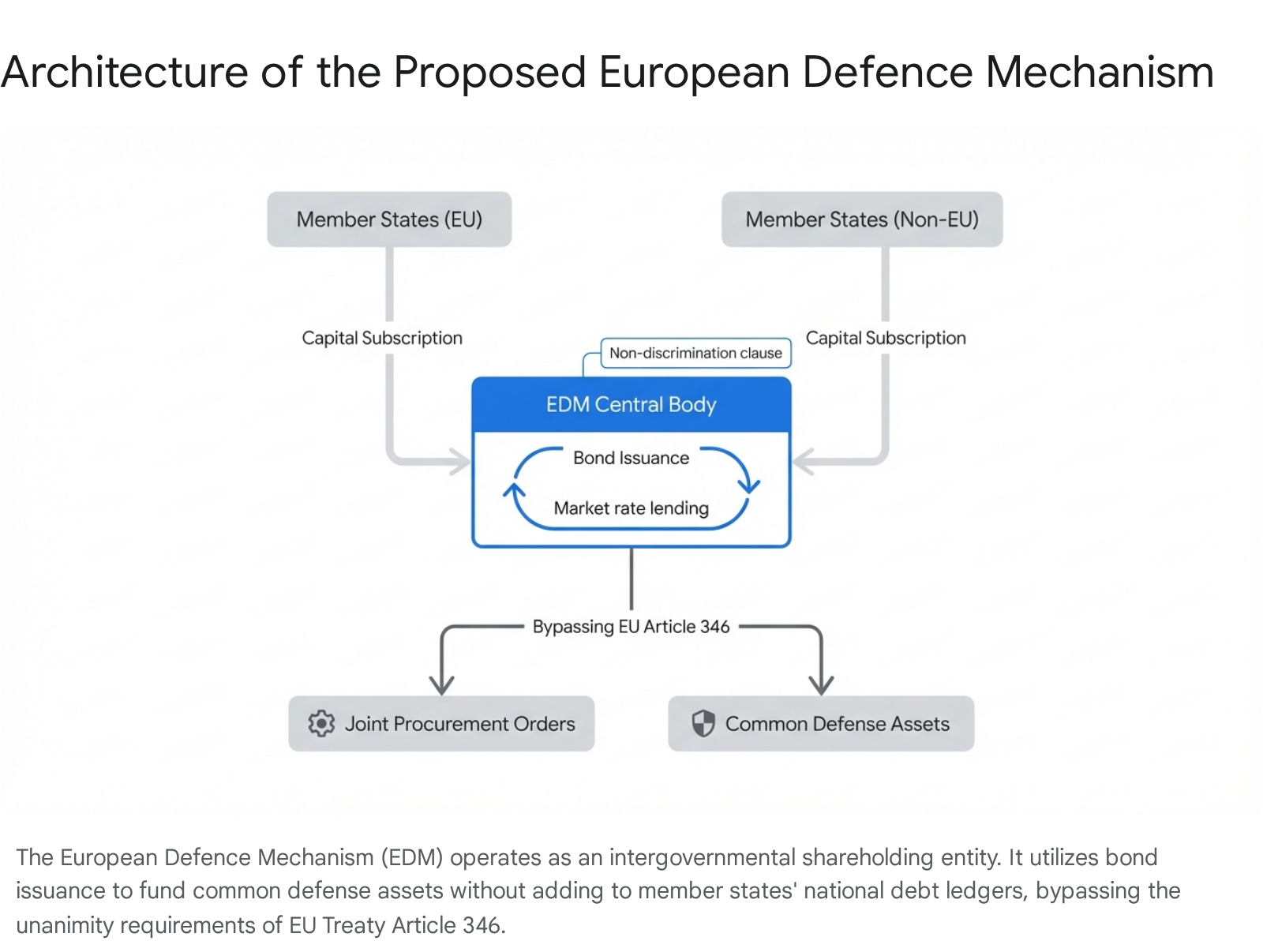
By operating as a shareholding entity that can issue bonds to finance joint procurement and common defense assets—such as European air defense systems or military intelligence satellites—the EDM aims to leverage economies of scale and lower the fiscal costs of rearmament.1 Crucially, debt issued by the EDM to fund large-scale common assets would remain on the mechanism’s books rather than directly inflating the national debt ledgers of individual member states, a highly attractive feature for heavily indebted European economies seeking to rapidly rearm.1 Concurrently, the UK and France are attempting to reopen stalled negotiations regarding the UK joining Security Action for Europe, an EU rearmament scheme, after talks collapsed in 2025 over the European Commission’s calculated cost of entry.1
In the domestic UK context, this push for external integration is mirrored by internal debates over defense procurement efficiency. The UK Ministry of Defence (MoD) is facing intense scrutiny regarding the potential scrapping of the Ajax armored vehicle program, which is eight years delayed and has already consumed £6 billion in taxpayer funds.2 Furthermore, public accounts committees have criticized the MoD for failing to publish its equipment plan in both 2023 and 2024, warning that such opacity damages public trust and signals weakness to adversaries.2 When questioned about independent domestic missile defense systems, the UK Minister of State for Defence confirmed the country will not pursue an independent “Iron Dome” equivalent, but will instead rely on a £1 billion investment integrated firmly within a broader NATO Integrated Air and Missile Defence endeavor.3
1.2 The E5 Consensus in Krakow
Following the MSC, the locus of European defense coordination shifted to Krakow, Poland, for the European Group of Five (E5) meeting on February 20, 2026.4 The E5—comprising defense ministers from France, Germany, Italy, Poland, and the United Kingdom, alongside NATO Deputy Secretary General Radmila Shekerinska and EU High Representative Kaja Kallas—represents the demographic, economic, and military core of the continent.4
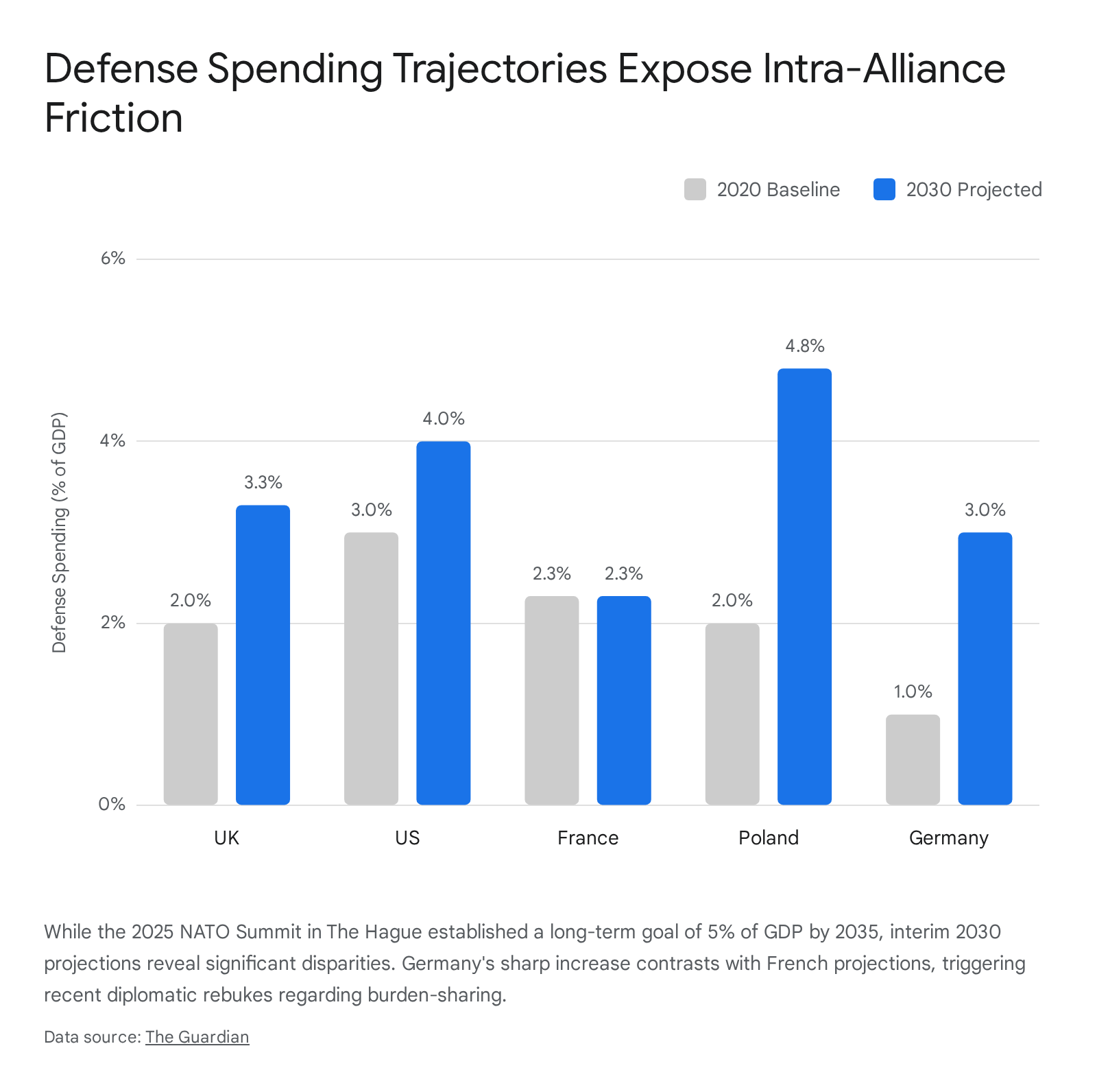
The Krakow summit solidified the mindset shift identified at the MSC. Shekerinska praised the E5 nations for demonstrating extraordinary commitment to increasing defense spending, noting that the pledge made at the 2025 NATO Summit in The Hague to invest 5% of GDP in defense by 2035 is becoming an operational reality.5 Germany’s trajectory is particularly notable in this regard; Berlin is on track to spend 152 billion euros on defense by 2029, effectively doubling its 2021 expenditure levels.7
The E5 discussions prioritized actionable deliverables, specifically focusing on expanding the European defense industrial base to ensure an uninterrupted flow of ammunition, artillery, and autonomous deep-strike drones to Ukraine.5 The presence of Ukrainian Defense Minister Mykhailo Fedorov at the E5 summit allowed for direct coordination on the Prioritised Ukraine Requirements List (PURL), particularly regarding urgently needed air defense systems drawn from Allied stockpiles.4 Shekerinska noted that the Ukrainian Ministry of Defence presented a very clear defense plan designed to help Kyiv remain strong while diplomatic negotiations continue, and to deter any future aggression.9
1.3 Intra-European Friction: The Franco-German Divide
Despite the outward projection of unity at the MSC and the E5 summit, significant intra-European fissures remain, most notably between Berlin and Paris regarding the pace and scale of financial commitment to rearmament. During the Munich Security Conference, German Chancellor Friedrich Merz and Foreign Minister Johann Wadephul publicly criticized France’s defense spending efforts as “insufficient”.10
Wadephul directly challenged French President Emmanuel Macron’s rhetoric on European sovereignty, stating, “He repeatedly and correctly refers to our pursuit of European sovereignty. Anyone who talks about it needs to act accordingly in their own country,”.10 Wadephul noted that while Germany is pushing through tough domestic discussions to reach the 5% of GDP by 2035 target, France’s trajectory is falling short of the required pace.10 This public rebuke highlights Germany’s growing assertiveness within the alliance and its frustration with perceived French reluctance to match rhetorical ambition with proportionate fiscal outlays.10 This friction threatens to complicate efforts to build a truly integrated European defense market, as trust between the continent’s two largest economies is a prerequisite for initiatives like the EDM to succeed.
1.4 US Pressure and the Upcoming Ankara Summit
Looming over European integration efforts is the profound uncertainty regarding United States strategy. Intelligence and diplomatic reports from mid-February indicate that Washington is actively pressing allies to limit the role of Ukraine and four Indo-Pacific partners (Australia, New Zealand, Japan, and South Korea) at the upcoming 36th NATO leaders’ summit in Ankara, scheduled for July 7-8, 2026.13
The United States has urged that these nations be excluded from official core meetings and relegated strictly to parallel events, citing a need to scale back the number of sessions and cut costs amidst resource constraints.13 Furthermore, NATO staff, reportedly under pressure from capitals, have proposed canceling the traditional public forum at the summit—an event that typically features leaders and defense experts engaging in high-profile panel discussions—replacing it with a closed-door NATO Defense Industry Forum.14
This maneuver is widely interpreted by European national security analysts as a US effort to sideline contentious expansion and partnership issues to focus strictly on core alliance deterrence and burden-sharing. However, former NATO spokeswoman Oana Lungescu warned that keeping partner countries on the periphery signals a retreat from global engagement, while keeping Ukraine at arm’s length sends a highly concerning strategic signal to Moscow, potentially validating the Kremlin’s assessment that Western resolve is fatiguing.14 This dynamic further accelerates the perceived necessity for the E5 and mechanisms like the EDM to secure a sovereign European defense capability independent of Washington’s political fluctuations.
2. The Russia-Ukraine Theater of Operations: Year Four
As the conflict nears its four-year anniversary on February 24, 2026, the operational tempo remains exceptionally high.15 The Council of Europe in Strasbourg is preparing to mark the anniversary with a special meeting of the Committee of Ministers to examine the consequences of the ongoing aggression, alongside a public ceremony featuring the raising of the Ukrainian flag and an exhibition titled “Living through the war”.15 On the ground, however, the war has settled into a brutal, multi-domain war of attrition, characterized by grueling, infantry-heavy tactical engagements in the east, sophisticated deep-strike drone warfare, and catastrophic losses on both sides.
2.1 Frontline Developments: The Pokrovsk Vulnerability and Zaporizhzhia Counterattacks
The center of gravity for Russian offensive operations remains the Donetsk Oblast, specifically the Pokrovsk-Myrnohrad agglomeration. Throughout the week of February 15-21, 2026, Russian forces maintained relentless pressure aiming to close a tactical pocket in this sector.17 Geolocated combat footage and intelligence reports indicate incremental Russian advances northwest of Pokrovsk, particularly near the settlements of Hryshyne and Zatyshok, as well as south of Novopavlivka near Filiya and Dachne.17
The Ukrainian 7th Rapid Reaction Corps of the Air Assault Forces reported severe infiltration attempts by small Russian assault groups striking from Kotlyne and Rodynske, attempting to envelop the northern and southern flanks of Pokrovsk.17 The Russian order of battle in this sector involves heavy utilization of the 35th Motorized Rifle Brigade (41st Combined Arms Army, Central Military District), providing sustained artillery barrages, while the Rubikon Center for Advanced Unmanned Technologies is deploying localized swarms of First-Person View (FPV) drones to degrade Ukrainian armored reserves near Dobropillya.17 To counter this, Ukrainian forces executed a frontline strike campaign, successfully eliminating a Russian drone control point near Zatyshok and a communications hub near Novopavlivka.17
Conversely, Ukrainian forces have demonstrated localized tactical successes in the southern theater. Between February 10 and 17, tactical counterattacks successfully liberated multiple small settlements along the Yanchur and Haichur rivers in the Zaporizhzhia Oblast, specifically in the Oleksandrivka and Hulyaipole directions.18 Open-source intelligence indicates that Ukrainian forces exploited a temporary degradation of the Starlink communications network used by Russian forward units to execute these rapid counter-thrusts.18
2.2 Territorial Control and Strategic Attrition Metrics
The war’s overarching stalemate is starkly reflected in territorial control data, though intelligence assessments vary slightly on the margins. As of February 2026, Russian forces control approximately 45,816 square miles of Ukrainian territory, equating to roughly 20% of the nation (an area comparable to the US state of Pennsylvania).18 This total includes the Crimean Peninsula and parts of the Donbas seized prior to the 2022 full-scale invasion.18
Over the past year (February 2025 to February 2026), Russia captured 2,102 square miles, representing less than 0.9% of Ukraine’s total 1991 territory.18 However, weekly fluctuations present conflicting narratives. The Institute for the Study of War (ISW) reported that for the week of February 10-17, 2026, Russian forces actually lost a net 19 square miles due to the aforementioned Zaporizhzhia counterattacks.18 Conversely, Ukraine’s DeepState OSINT group reported a net Russian gain of 6.6 square miles during the same period, citing the occupation of Bondarne and Rivne, while noting Ukrainian forces cleared enemy infiltration near Bilytske and Prymorske.18 Notably, Ukrainian forces maintain a cross-border operational foothold of approximately 4 square miles in the Russian regions of Kursk and Belgorod, serving as a political and tactical buffer.18
The human cost of this grinding territorial stalemate has reached staggering proportions, defining the conflict as the deadliest conventional war in Europe since 1945. Civilian fatalities in Ukraine have reached 15,954, with 2025 recorded as the deadliest year for non-combatants since the initial invasion, showing a 31% increase in casualties over 2024.16
| Entity | Estimated Total Military Casualties (Killed, Wounded, Missing) | Estimated Military Fatalities |
| Russian Federation | 1,000,000 – 1,200,000 | ~325,000 |
| Ukraine | 500,000 – 600,000 | 55,000 – 140,000 |
Data compiled from the Center for Strategic and International Studies (CSIS), Western intelligence officials, and the Estonian Foreign Intelligence Service as of February 2026.18 Ukrainian fatality estimates vary widely between independent assessments (140,000) and official state pronouncements by President Zelenskyy (55,000).18
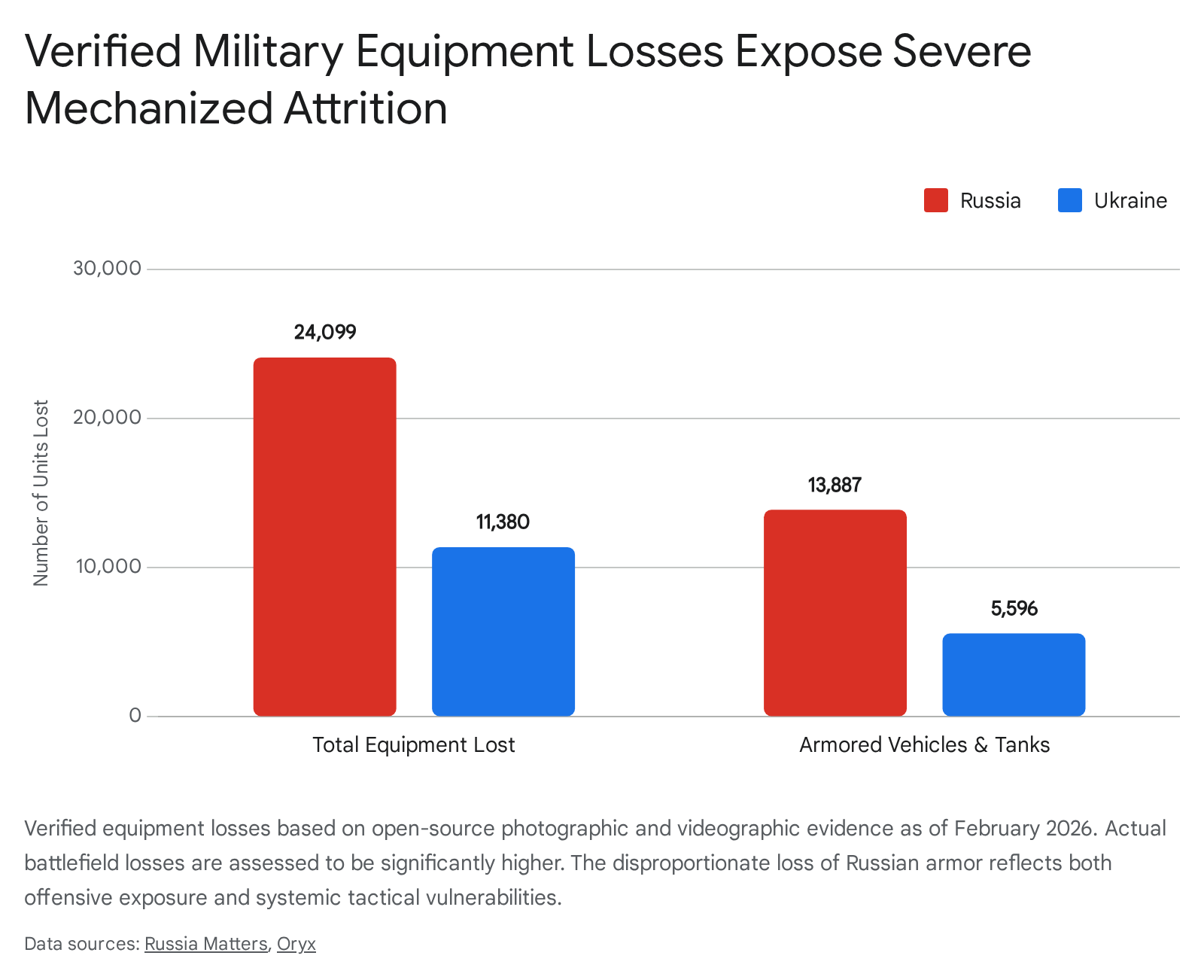
Equipment losses further illustrate the catastrophic attrition. Verified visual evidence documents the loss of 24,099 pieces of Russian military hardware, including a devastating 13,887 armored combat vehicles.18 Ukraine has suffered the verified loss of 11,380 pieces of equipment, including 5,596 armored vehicles.18 A detailed breakdown of verified Russian main battle tank losses reveals the systematic destruction of Moscow’s mechanized reserves across multiple generations of hardware.
| Russian Main Battle Tank Model | Total Verified Losses | Destroyed | Captured by Ukraine |
| T-62 (All Variants) | 274 | 196 | 45 |
| T-64 (All Variants) | 102 | 81 | 3 |
| T-72 (All Variants) | 569+ | 388+ | 93+ |
| Total Verified Tank Losses | 4,334 | 3,239 | 540 |
Data extracted from Oryx OSINT visual verification database. Numbers represent an absolute baseline; actual losses are assessed to be significantly higher due to unrecorded destruction.18
2.3 Deep Strikes and the Targeting of Critical Infrastructure
Beyond the contact line, the strategic air campaign continues unabated. On the night of February 16-17, 2026, Russian Aerospace Forces executed a massive, complex combined strike package utilizing Shahed-136 loitering munitions, cruise missiles, and ballistic trajectories aimed at Ukraine’s already heavily degraded energy infrastructure.19 Over the past twelve months, 70% of Ukraine’s energy facilities have been hit, causing severe winter power outages in major urban centers, including Kyiv.16
During the week of February 15-21, a heavy barrage struck the Black Sea port city of Odesa, destroying a power generating substation and a school building, while simultaneous strikes in the northeastern city of Sumy targeted residential districts, causing multiple civilian casualties, including children.22
Ukraine’s response has been to aggressively strike deeper into the Russian strategic rear, aiming to degrade Moscow’s war-making capacity at its source. On February 21, Ukrainian long-range systems successfully struck a defense manufacturing facility in Votkinsk, located nearly 1,900 kilometers northeast of the Ukrainian border.22 Intelligence reports suggest this factory is deeply integrated into Russia’s strategic missile production supply chain, potentially involved in manufacturing the nuclear-capable hypersonic Oreshnik missile system.22 This strike demonstrates a highly sophisticated Ukrainian C4ISR (Command, Control, Communications, Computers, Intelligence, Surveillance, and Reconnaissance) capability and a willingness to target the most sensitive nodes of the Russian military-industrial complex, despite the potential for escalatory rhetoric from Moscow.
2.4 Diplomatic Stagnation and the Hungarian Veto
Diplomatic efforts to resolve the conflict remain entirely deadlocked. US-brokered peace talks in Geneva collapsed mid-week without any breakthrough, as Moscow rigidly adhered to maximalist demands.22 These demands include the total withdrawal of Ukrainian forces from currently held eastern territories, the legitimization of sham elections to advance claims that the current Ukrainian government is illegitimate, and a permanent veto over Kyiv’s security alignments.22
Compounding Kyiv’s strategic predicament is internal sabotage within the European Union. On February 20, the Hungarian government, led by Prime Minister Viktor Orbán, officially announced it will block a planned 90-billion-euro ($106-billion) EU macro-financial loan to Ukraine.24 Budapest has conditioned its approval on the resumption of Russian oil flows through the Druzhba pipeline, which were interrupted in late January following a Ukrainian drone strike.24
Hungary, alongside Slovakia, maintains a temporary exemption from EU sanctions prohibiting Russian oil imports, arguing that Russian fossil fuels are indispensable to their economies.24 Foreign Minister Péter Szijjártó accused Kyiv of “blackmailing” Hungary by intentionally holding up supplies, a claim made without providing verifiable evidence, and in retaliation, Hungary suspended shipments of diesel to Ukraine.24 This geopolitical hostage-taking exposes the fragility of the EU’s consensus-based foreign policy apparatus and hands the Kremlin a potent vector for dividing the alliance from within. To partially offset these funding delays, France announced the Ukraine Fund II, a €71 million mechanism designed to mobilize French businesses to rebuild critical Ukrainian infrastructure, focusing on energy, agriculture, and mine clearance.25
3. The Shadow War: Hybrid Escalation and Cyber Operations
While conventional combat is confined to Eastern Europe, a sophisticated, multi-domain hybrid war is currently raging across the entire continent. The week ending February 21, 2026, saw multiple intelligence agencies sound the alarm on an unprecedented escalation of Russian sub-threshold aggression aimed at NATO and EU member states, designed to fracture political will and degrade European infrastructure.26
3.1 The Surge in Kinetic Sabotage and Proxy Recruitment
A joint threat assessment published this week by the Dutch General Intelligence and Security Service (AIVD) and the Military Intelligence and Security Service (MIVD), corroborated by data from the Center for Strategic and International Studies (CSIS), confirmed that Russian state-sponsored sabotage operations in Europe nearly tripled between 2023 and 2024, and have increased four-fold leading into 2026.26
The Dutch intelligence report bluntly warned that Russia is utilizing a “hybrid” campaign—comprising sabotage, arson, cyberattacks, disinformation, and espionage—to prepare for a prolonged confrontation with the West, test NATO’s red lines, and sow public fear, all while calculatingly avoiding actions that would definitively trigger an Article 5 collective defense response.27
The operational methodology of this sabotage campaign has evolved significantly. Russian military intelligence (the GRU) has largely pivoted away from using deep-cover officers for kinetic tasks, instead relying on the weaponization of local proxies. Intelligence intercepts indicate that the GRU is actively utilizing networks associated with the Wagner Group to recruit disaffected locals, petty criminals, and radicalized individuals via encrypted platforms like Telegram to carry out low-level arson and vandalism against defense logistics hubs and critical infrastructure.29 This strategy provides the Kremlin with plausible deniability while overwhelming European domestic security services.
Recent examples of this campaign include the deployment of “bloody and flammable parcels” in the logistics network, unauthorized drone overflights of military bases, and physical attacks on energy grids.30 The use of disposable local agents makes traditional deterrence mechanisms—such as prosecution and incarceration—ineffective at stopping the overarching state-directed campaign.29
3.2 The Cyber Domain: Targeting Command and Critical Infrastructure
The hybrid offensive is intimately synchronized with aggressive cyber operations, confirming the Munich Security Report’s finding that the line between cybersecurity and energy security has effectively ceased to exist.30 The European Commission formally acknowledged that on January 30, 2026, its central infrastructure managing mobile devices for thousands of EU civil servants suffered a sophisticated cyberattack.31 While CERT-EU (the central cybersecurity service for EU institutions) managed to contain the breach within nine hours, forensic evidence indicates that threat actors likely gained access to the names and contact information of key staff members.31 This data exfiltration poses a severe counterintelligence risk, potentially facilitating highly targeted spear-phishing or blackmail operations against EU policymakers.
Simultaneously, the threat to physical infrastructure via cyber intrusion is escalating. A late 2025 cyberattack attributed to the Russian threat actor “Sandworm” compromised 30 energy facilities in Poland, directly targeting the Operational Technology (OT) and SCADA systems responsible for energy distribution.20 Furthermore, a joint advisory issued by the US Cybersecurity and Infrastructure Security Agency (CISA) and the German domestic intelligence agency (BfV) revealed a coordinated attempt to insert “logic bombs” into the SCADA systems managing track switching at the vital Leipzig rail hub, a critical logistical node for NATO deployments.20
3.3 The Information Domain: Domestic Control and Information Warfare
To insulate its domestic population from the fallout of the war and control the narrative space, the Kremlin has drastically tightened its grip on the flow of information. On February 20, 2026, President Vladimir Putin signed into law a sweeping new measure granting the Federal Security Service (FSB) unilateral authority to command cellular and landline Internet Service Providers to shut down or throttle internet access across Russia.34 This law effectively finalizes the architecture of the “Sovereign Internet,” allowing the state to instantly blackout communications in the event of domestic unrest or cross-border incursions, further isolating the Russian populace from external factual reporting and amplifying the state’s cognitive warfare efforts aimed at convincing the West to abandon Ukraine.34
4. European Domestic Politics and Institutional Cohesion
The geopolitical maneuvering regarding defense spending and support for Ukraine is deeply intertwined with the volatile domestic political landscapes of key European powers. Germany, as the economic engine of the continent, is navigating a particularly fragile political transition that is directly impacting its foreign policy posture.
4.1 The German Political Landscape Post-2025 Election
Germany is currently operating under a new political reality following the dramatic snap federal elections held on February 23, 2025. These elections, triggered by the collapse of former Chancellor Olaf Scholz’s governing coalition, reshaped the Bundestag and significantly altered the balance of power.36
Under the leadership of Friedrich Merz, the conservative Christian Democratic Union/Christian Social Union (CDU/CSU) emerged victorious, securing 28.5% of the vote.36 However, the most consequential outcome was the massive surge of the right-wing Alternative for Germany (AfD), which captured 20.8% of the vote to become the second-largest parliamentary group.36 The incumbent Social Democrats (SPD) suffered a historic collapse, falling to 16.4%, while the liberal FDP was wiped out entirely, failing to meet the 5% threshold required to enter the newly downsized 630-seat parliament.36
| Political Party | 2025 Popular Vote (%) | Seats Won (Out of 630) | Change in Seats from 2021 |
| CDU/CSU | 28.5% | 208 | +11 |
| AfD | 20.8% | 152 | +69 |
| SPD | 16.4% | 120 | -86 |
| Greens | 11.6% | 85 | -33 |
| Die Linke | 8.8% | 64 | +25 |
Summary of the 2025 German Federal Election results, illustrating the fragmentation of the center-left and the rise of right-wing populism.36
Entering 2026, Merz’s coalition government is under immense pressure to deliver tangible results, particularly economic stabilization. Germany narrowly exited a recession in 2025 with a marginal GDP growth of 0.2%, and forecasts for 2026 project anemic growth between 0.5% and 1.0%.38 The coalition’s cohesion is being severely tested ahead of crucial state-level elections scheduled for September 2026 in regions like Saxony-Anhalt.38 Weak performance in these regional contests could fuel narratives exploited by the AfD, undermining federal stability.38 Consequently, there is only a narrow window between now and September for the government to pass contentious fiscal, social, and energy reforms.38 This domestic fragility explains Merz’s highly assertive stance on burden-sharing at the Munich Security Conference; his government must demonstrate to the German electorate that the massive domestic investments in rearmament are being matched by European partners, hence the public friction with France over defense spending.10
4.2 EU Institutional Focus and French Diplomacy
At the broader institutional level, the European Union is attempting to coalesce around a unified economic strategy. On February 12, 2026, EU leaders convened for an informal strategic retreat at Alden Biesen, Belgium, to discuss the bloc’s competitiveness.40 Guided by the ‘EU Strategic Agenda 2024-2029’, the focus is on strengthening the single market to build European sovereignty and reduce dependencies in a fracturing global order.40 The retreat featured insights from Mario Draghi and Enrico Letta, emphasizing that strengthening the economic base is an “urgent strategic imperative” to survive the ongoing years of “polycrisis”.40 Furthermore, European democracy support strategies are structurally recalibrating to prioritize protecting democratic norms within Europe, acknowledging the internal threat posed by populist movements.42
Simultaneously, French diplomacy is highly active on multiple fronts. At the Munich Security Conference, French Minister for Europe and Foreign Affairs Jean-Noël Barrot held a first-ever trilateral meeting with German Foreign Minister Johann Wadephul and Chinese Foreign Minister Wang Yi.43 Wang Yi utilized the forum to warn against unilateralism and protectionism, arguing that interdependence with China is not a risk and setting a clear agenda to maintain open EU-China trade relations despite US pressure.43 Barrot also chaired an informal G7 Foreign Ministers meeting on the sidelines of the MSC, outlining priorities for the 2026 French G7 Presidency, focusing on overhauling international partnerships and addressing macroeconomic imbalances, while releasing a joint statement with European allies condemning the continued targeting of civilian infrastructure in Sudan.44 Furthermore, Paris is working to revitalize the Australia–India–France trilateral as a more reliable platform for Indian Ocean security, given the chronic instability and shifting focus of the US-led Quad partnership.46
5. Human Security, Border Dynamics, and Environmental Stressors
The European periphery continues to be shaped by the complex interplay of migration flows, state-sponsored hybrid pressures, and increasingly severe environmental shocks.
5.1 Border Security and Migration Trends
Data released by the European Border and Coast Guard Agency (Frontex) indicates a dramatic short-term decline in irregular migration entering the bloc. Preliminary data for January 2026 showed a sharp 60% year-on-year drop in irregular border crossings, with approximately 5,500 detections recorded.47 This follows a broader trend; in 2025, detections of irregular border crossings fell by 26% to almost 178,000, representing the lowest level since 2021.49
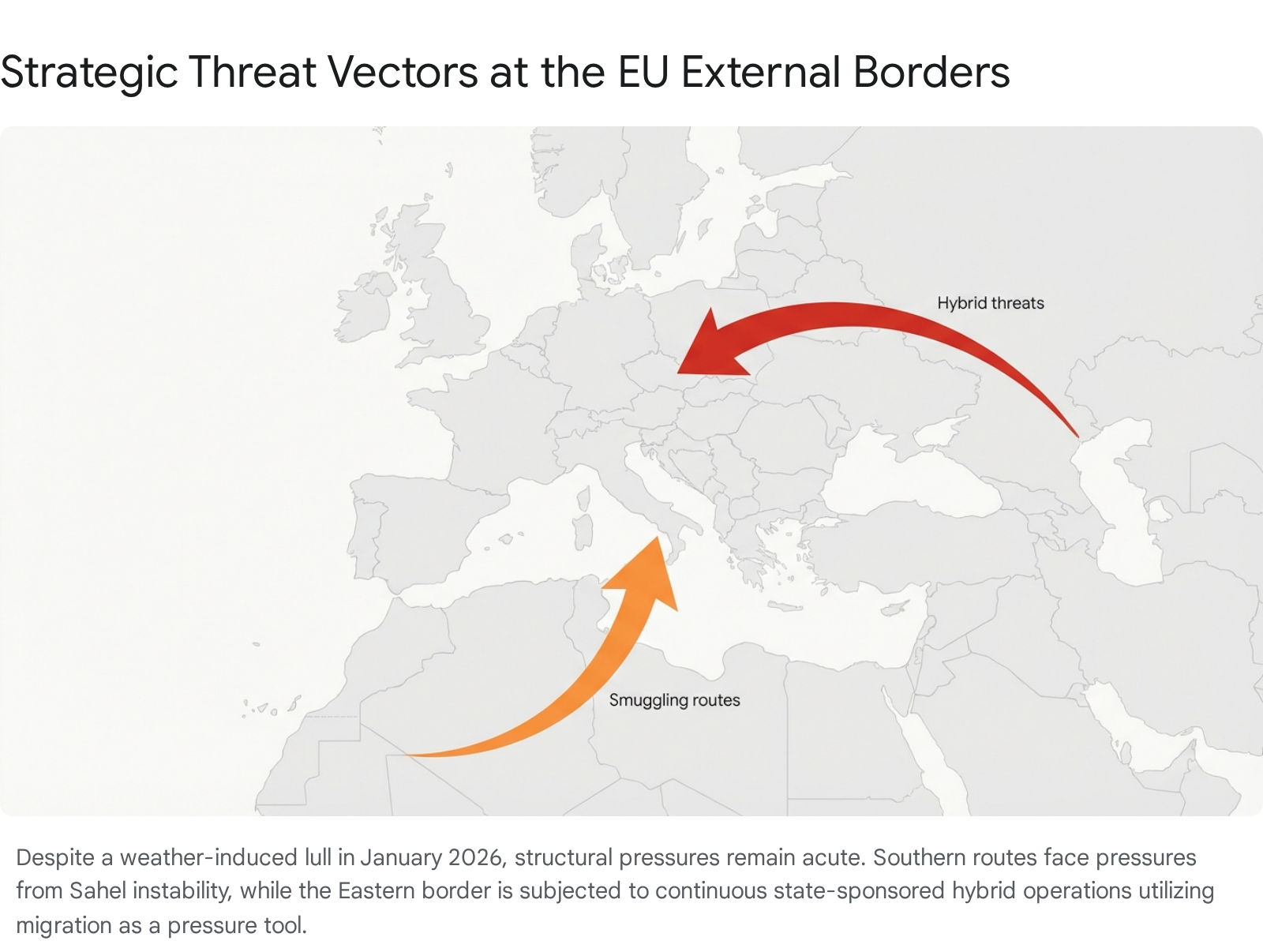
However, intelligence analysts assess this January drop as a temporary, weather-induced anomaly rather than a structural resolution. Frontex explicitly linked the sharp decline to Cyclone Harry, a severe winter storm that battered the Mediterranean coast, Greece, Italy, Malta, and Portugal between January 19 and 21, making sea journeys exceptionally dangerous and temporarily disrupting smuggling departures.47
The Frontex Annual Risk Analysis for 2025-2026 warns that the underlying drivers of migration remain highly potent.50 Instability and external geopolitical influence in the Sahel continue to fuel southern smuggling routes, while the Eastern Borders face persistent, unpredictable pressure from hostile state actors utilizing migration as a hybrid weapon.49 As weather conditions improve, a resurgence in crossings is highly probable. European border management faces a pivotal stress test in June 2026, when the EU Pact on Migration and Asylum becomes fully applicable, alongside the full rollout of the Entry/Exit System (EES) and the planned launch of the European Travel Information and Authorisation System (ETIAS) later in the year.49
5.2 Environmental Shocks and Health Crises
The tactical impact of Cyclone Harry highlights a broader strategic vulnerability: the increasing frequency of extreme weather events destabilizing European infrastructure and society. The back-to-back low-pressure storms that battered the Iberian Peninsula resulted in severe flooding, killing at least 16 people in Portugal and causing localized devastation in Spain, such as the fatal flooding of the Fahala River in Málaga.48 Saturated soils across France prompted widespread flood alerts, creating a new reality where Europe alternates between being underwater in winter and withered by drought in summer.51
These environmental stressors compound existing vulnerabilities, creating vectors for disease. The World Health Organization (WHO) published Epidemiological Update #34 on February 21, 2026, detailing a multi-country outbreak of cholera.52 While the epicenter remains outside the continent, the degradation of water and sanitation infrastructure due to extreme weather events, combined with high volumes of displaced persons moving through informal transit camps, elevates the risk of localized outbreaks on Europe’s periphery, requiring continuous public health surveillance.52
6. The Milano-Cortina 2026 Winter Olympics: Security and Conclusion
The intersection of high-profile international events and the elevated threat environment placed immense strain on European domestic security forces during the conclusion of the Milano-Cortina 2026 Winter Olympics, which ran from February 6 to 22.53
6.1 Securing a Distributed Mega-Event
Operating across a geographically dispersed footprint—spanning the ice venues of Milan (including the San Siro Stadium) to the alpine events in Cortina, Livigno, and Fiemme—the Games created a vast, highly complex attack surface for both physical and cyber threats.53 The intelligence community assessed a high risk of opportunistic lone-actor terrorism, activist disruption, and state-backed sabotage.54
This threat materialized violently during the Games. Italian authorities were forced to investigate a series of coordinated sabotage attacks on the national railway network surrounding the vital transport hub of Bologna.58 The incidents involved synchronized arson at a track switch, severed high-voltage electrical cables, and the discovery of a rudimentary unexploded device.58 These attacks caused severe delays across the northern Italian transit corridor, demonstrating how relatively minor kinetic disruptions can cascade into significant logistical failures and mass strandings during capacity-strained mega-events.54
In the cyber domain, threat actors aggressively probed the Games’ digital infrastructure. Cybersecurity analysts identified the digitized “Smart Road” SS51 Alemagna—which relies on Vehicle-to-Infrastructure (V2I) IoT sensors—as a novel attack vector where false telemetry injection could cause severe gridlock or endanger VIP transit.59 Furthermore, authorities continuously monitored for AI-amplified hybrid threats, anticipating scenarios where threat actors might combine a minor technical outage with the release of high-fidelity deepfake audio or video to trigger mass panic in crowded fan zones.59 The necessity to protect thousands of third-party partners across a temporary digital supply chain highlighted the sprawling complexity of securing modern international events.60
6.2 Sporting Highlights and Diplomatic Undertones
Despite the security pressures, the sporting events proceeded successfully, concluding with the men’s ice hockey and women’s curling finals, and the freestyle skiing halfpipe events.61 Notable sporting narratives included a double gold medal victory for the married Chinese aerials team of Wang Xindi and Xu Mengtao.64
However, even the sporting arenas were not immune to diplomatic friction. Tensions flared during the Board of Peace meeting when International Olympic Committee (IOC) President Kirsty Coventry expressed surprise and concern over the unexpected presence of FIFA President Gianni Infantino alongside US President Donald Trump, indicating ongoing friction regarding the politicization of international sporting bodies.53 The Games officially concluded on February 22 with the “Beauty in Action” Closing Ceremony at the historic 1st-century AD Verona Arena, featuring performances by Roberto Bolle and Achille Lauro, transitioning the Olympic focus toward the upcoming 2026 Winter Paralympics and the 2030 French Alps Games.53
7. Economic Security, Energy Markets, and Industrial Policy
The geopolitical instability continues to exert a profound gravitational pull on Europe’s economic security, most notably in the energy sector, which remains the Achilles’ heel of the continent’s industrial competitiveness.
7.1 Natural Gas Market Volatility
European natural gas markets experienced significant volatility in the opening months of 2026. Following a sharp 45% price spike during January—driven by colder weather and below-average storage levels—prices retreated significantly in mid-February.67 As of February 20, 2026, the benchmark Title Transfer Facility (TTF) front-month contract fell to 31.57 EUR/MWh, representing a 19.48% drop over the preceding month and remaining 31.23% lower than the same period in 2025.68
This downward price pressure was facilitated by revised, warmer temperature forecasts across Northwest Europe, which depressed heating demand, coupled with robust Liquefied Natural Gas (LNG) sendouts averaging over 314 million cubic meters per day.70 Furthermore, a perceived reduction in Middle Eastern geopolitical risk premiums following ongoing US-Iran negotiations contributed to the bearish market sentiment.70
Despite the recent price dip, underlying vulnerabilities persist. European gas storage levels are concerningly low, sitting at just 33.02% capacity as of mid-February, significantly below the previous five-year seasonal average of 49.3%.70 Supply chains also remain sensitive to disruption, evidenced by an unplanned 11.8 million cubic meter per day reduction at Norway’s Ormen Lange facility due to compressor failure.70
| European Trading Hub | Spot Price (Day-Ahead) EUR/MWh | Futures Price (Month-Ahead) EUR/MWh |
| TTF (Netherlands) | 29.94 | 29.81 |
| THE (Germany) | 32.90 | 31.89 |
| CEGH (Austria) | 33.00 | 32.31 |
| PEG (France) | 28.27 | 28.18 |
Snapshot of European natural gas hub pricing as of mid-February 2026, illustrating minor regional pricing disparities but overall market stabilization relative to January peaks.71
7.2 Electricity Demand and the Clean Industrial Deal
The long-term economic outlook is further complicated by structural challenges in the electricity market. The European Commission launched the Clean Industrial Deal in February 2025, aiming to aggressively accelerate decarbonization by increasing the share of electricity in the EU’s gross final energy consumption from 23% in 2024 to 32% by 2030.72
However, intelligence from macroeconomic analysts indicates that this target is severely at risk. Electricity consumption in the Euro area actually decreased by 6.3% between 2015 and 2023, and demand remains broadly stagnant.72 This stagnation is driven primarily by lower overall industrial demand—a symptom of the deindustrialization triggered by the 2021-2022 energy crisis—and a sluggish uptake in key consumer electrification technologies such as electric vehicles and heat pumps.72 While electricity demand from data centers and AI integration is rising globally, it is constrained in Europe by grid connection bottlenecks and stringent new regulations.72
While wholesale electricity prices have stabilized from their crisis peaks, they remain structurally elevated compared to pre-2021 levels. This continuously erodes the purchasing power of European households and devastates the global competitiveness of energy-intensive manufacturing firms.30 The compounding effect of high baseline electricity prices and rising carbon costs—with EU Emissions Trading System (ETS) permits forecast to climb above 100 EUR in 2026—creates a perilous environment for European heavy industry.73 Speculative capital and hedge-fund driven trading in the carbon market risk financializing a system meant to drive real-economy emissions reductions, further alienating affected industries and risking capital flight to jurisdictions with lower energy input costs.73 As Germany and France spar over defense spending, their shared inability to definitively solve the continent’s energy cost premium remains the greatest long-term threat to European strategic autonomy.
Please share the link on Facebook, Forums, with colleagues, etc. Your support is much appreciated and if you have any feedback, please email us in**@*********ps.com. If you’d like to request a report or order a reprint, please click here for the corresponding page to open in new tab.
Sources Used
- Starmer stresses ‘urgency’ of closer defence ties with Europe at …, accessed February 21, 2026, https://www.theguardian.com/politics/2026/feb/14/keir-starmer-munich-conference-closer-europe-defence-ties
- Spending even more on defence won’t buy us peace | Letters, accessed February 21, 2026, https://www.theguardian.com/politics/2026/feb/19/spending-even-more-on-defence-wont-buy-us-peace
- Question: 18 Feb 2026: Hansard Written Answers – TheyWorkForYou, accessed February 21, 2026, https://www.theyworkforyou.com/wrans/?id=2026-02-10.112424.h
- NATO Deputy Secretary General Welcomes Progress On Defence Investment And Support To Ukraine With The E5, accessed February 21, 2026, https://www.eurasiareview.com/21022026-nato-deputy-secretary-general-welcomes-progress-on-defence-investment-and-support-to-ukraine-with-the-e5/
- Statement | NATO Transcript, accessed February 21, 2026, https://www.nato.int/en/news-and-events/events/transcripts/2026/02/20/statement-by-the-nato-deputy-secretary-general-at-the-meeting-of-the-european-group-of-5-defence-ministers
- FULL REMARKS: NATO’s Leader Warns of Uncertain Future, Vows Stronger Defence and Support | AC1G – YouTube, accessed February 21, 2026, https://m.youtube.com/watch?v=RKfnauBfcjA&pp=0gcJCaIKAYcqIYzv
- NATO Secretary General pre-ministerial press conference at Defence Ministers Meeting, 11 FEB 2026 – YouTube, accessed February 21, 2026, https://www.youtube.com/watch?v=UdeAxw9OmMs
- Press conference, accessed February 21, 2026, https://www.nato.int/en/news-and-events/events/transcripts/2026/02/12/press-conference-by-the-nato-secretary-general-following-the-meeting-of-nato-ministers-of-defence
- NATO Has Heard a Clear Defense Plan from Ukraine — Alliance Deputy Secretary General, accessed February 21, 2026, https://armyinform.com.ua/en/2026/02/21/nato-has-heard-a-clear-defense-plan-from-ukraine-alliance-deputy-secretary-general/
- Germany calls on France to increase defence spending – The Guardian, accessed February 21, 2026, https://www.theguardian.com/world/2026/feb/16/germany-calls-on-france-to-increase-defence-spending-merz-macron
- Germany deems French defence spending efforts ‘insufficient’ – The Brussels Times, accessed February 21, 2026, https://www.brusselstimes.com/1975247/germany-deems-french-defence-spending-efforts-insufficient
- Germany says France lagging behind on defense spending – Semafor, accessed February 21, 2026, https://www.semafor.com/article/02/17/2026/germany-says-france-lagging-behind-on-defense-spending
- US Pushes to Sideline Ukraine at NATO Summit as Alliance Scales Back Meetings, accessed February 21, 2026, https://www.kyivpost.com/post/70457
- U.S. presses allies to limit Ukraine, partners’ role at NATO summit in Turkey, accessed February 21, 2026, https://english.nv.ua/nation/u-s-presses-allies-to-limit-invitations-at-nato-summit-politico-50585242.html
- Council of Europe to mark fourth anniversary of start of Russia’s war of aggression against Ukraine, accessed February 21, 2026, https://www.coe.int/en/web/portal/-/council-of-europe-to-mark-fourth-anniversary-of-start-of-russia-s-war-of-aggression-against-ukraine
- Country Conditions: Ukraine February 2026, accessed February 21, 2026, https://refugees.org/country-conditions-ukraine-february-2026/
- Russian Offensive Campaign Assessment, February 16, 2026 – Institute for the Study of War, accessed February 21, 2026, https://understandingwar.org/research/russia-ukraine/russian-offensive-campaign-assessment-february-16-2026/
- The Russia-Ukraine War Report Card, Feb. 18, 2026 | Russia Matters, accessed February 21, 2026, https://www.russiamatters.org/news/russia-ukraine-war-report-card/russia-ukraine-war-report-card-feb-18-2026
- Russian Offensive Campaign Assessment, February 17, 2026 – Institute for the Study of War, accessed February 21, 2026, https://understandingwar.org/research/russia-ukraine/russian-offensive-campaign-assessment-february-17-2026/
- The Erosion of the Multilateral Security Architecture in Central and Eastern Europe Amid Systematic Kinetic-Cyber Hybrid Aggression by the Russian Federation – https://debuglies.com, accessed February 21, 2026, https://debuglies.com/2026/02/08/the-erosion-of-the-multilateral-security-architecture-in-central-and-eastern-europe-amid-systematic-kinetic-cyber-hybrid-aggression-by-the-russian-federation/
- Ukraine war situation update | 31 January – 6 February 2026 – ACLED, accessed February 21, 2026, https://acleddata.com/update/ukraine-war-situation-update-31-january-6-february-2026
- Russian Strikes Hit More Ukrainian Power Facilities, Several People Wounded, accessed February 21, 2026, https://www.rferl.org/a/russia-ukraine-drone-strikes-factory-missile-odesa/33684082.html
- Russian Offensive Campaign Assessment, February 15, 2026 – Institute for the Study of War, accessed February 21, 2026, https://understandingwar.org/research/russia-ukraine/russian-offensive-campaign-assessment-february-15-2026/
- Hungary says it will block a key EU loan to Ukraine until Russian oil shipments resume, accessed February 21, 2026, https://www.newsday.com/news/nation/hungary-eu-ukraine-loan-russian-oil-v81108
- Replenishment of the Ukraine fund: €71 million raised as part of the call for projects open until 9 april 2026 (19.02.26), accessed February 21, 2026, https://www.diplomatie.gouv.fr/en/country-files/ukraine/news/article/replenishment-of-the-ukraine-fund-eur71-million-raised-as-part-of-the-call-for
- How Russia’s Hybrid Warfare Will Escalate in 2026 and What Europe Must Do? | GLOBSEC, accessed February 21, 2026, https://www.globsec.org/what-we-do/commentaries/how-russias-hybrid-warfare-will-escalate-2026-and-what-europe-must-do
- Russia stepping up hybrid attacks, preparing for long standoff with West, Dutch intelligence warns – Cyber Security News, accessed February 21, 2026, https://therecord.media/russia-cyberattacks-europe-warfare
- Russia’s Shadow War Against the West – CSIS, accessed February 21, 2026, https://www.csis.org/analysis/russias-shadow-war-against-west
- Europe’s Cyber Bullets Can’t Replace Political Will | Lawfare, accessed February 21, 2026, https://www.lawfaremedia.org/article/europe’s-cyber-bullets-can’t-replace-political-will
- The grid is the battlefield: what the Munich Security Report reveals about cyber warfare and the fight for Europe’s energy infrastructure, accessed February 21, 2026, https://nationalsecuritynews.com/2026/02/the-grid-is-the-battlefield-what-the-munich-security-report-reveals-about-cyber-warfare-and-the-fight-for-europes-energy-infrastructure/
- Commission responds to cyber-attack on its central mobile infrastructure, accessed February 21, 2026, https://ec.europa.eu/commission/presscorner/detail/en/ip_26_342
- European Commission breached – investigating mobile hack – Computing, accessed February 21, 2026, https://www.computing.co.uk/news/2026/security/european-commission-breached
- Russian Cyber Sabotage in Europe – RUSI, accessed February 21, 2026, https://my.rusi.org/events/russian-cyber-sabotage-in-europe.html
- Putin Signs New Measure Tightening FSB Control Over Russian Internet, accessed February 21, 2026, https://www.rferl.org/a/russia-internet-law-restriction-tech-censorship/33684027.html
- Russian Offensive Campaign Assessment, February 20, 2026, accessed February 21, 2026, https://understandingwar.org/research/russia-ukraine/russian-offensive-campaign-assessment-february-20-2026/
- 2025 German federal election – Wikipedia, accessed February 21, 2026, https://en.wikipedia.org/wiki/2025_German_federal_election
- Shaping Germany’s future: Key takeaways from the 2025 federal election, accessed February 21, 2026, https://riskandcompliance.freshfields.com/post/102k2gh/shaping-germanys-future-key-takeaways-from-the-2025-federal-election
- Germany: Political Outlook 2026 – Edelman Global Advisory, accessed February 21, 2026, https://www.edelmanglobaladvisory.com/insights/germany-political-outlook-2026
- Dispatch from Germany | February ’26 | Clean Energy Wire, accessed February 21, 2026, https://www.cleanenergywire.org/news/dispatch-germany-february-26
- EU’s competitiveness: A key priority for the European Council meeting on 12 February 2026, accessed February 21, 2026, https://www.tovima.com/opinions/eus-competitiveness-a-key-priority-for-the-european-council-meeting-on-12-february-2026/
- Forward look: 2 – 15 February 2026 – PubAffairs Bruxelles, accessed February 21, 2026, https://www.pubaffairsbruxelles.eu/eu-institution-news/forward-look-2-15-february-2026/
- European Democracy Support Annual Review 2025 | Carnegie Endowment for International Peace, accessed February 21, 2026, https://carnegieendowment.org/russia-eurasia/research/2026/02/european-democracy-support-annual-review-2025
- China, Germany, and France Hold Trilateral Foreign Ministers’ Meeting_Ministry of Foreign Affairs of the People’s Republic of China, accessed February 21, 2026, https://www.fmprc.gov.cn/eng/wjbzhd/202602/t20260215_11860534.html
- France and its partners call for an immediate end to fighting in Sudan, accessed February 21, 2026, https://uk.diplomatie.gouv.fr/en/france-and-its-partners-call-immediate-end-fighting-sudan
- G7 Foreign Ministers’ meeting on the sidelines of the Munich Security Conference (14 February 2026) – France Diplomatie, accessed February 21, 2026, https://www.diplomatie.gouv.fr/en/french-foreign-policy/g7-news/article/g7-foreign-ministers-meeting-on-the-sidelines-of-the-munich-security-conference
- Australia–India–France trilateral offers stability for Indian Ocean security, accessed February 21, 2026, https://www.aspistrategist.org.au/australia-india-france-trilateral-offers-stability-for-indian-ocean-security/
- Frontex | European Union Agency, accessed February 21, 2026, https://www.frontex.europa.eu/
- EU Irregular Border Crossings Drop 60% in January – ETIAS.com, accessed February 21, 2026, https://etias.com/articles/eu-irregular-border-crossings-drop-60-in-january
- Irregular border crossings down 26% in 2025, Europe must stay prepared – Frontex, accessed February 21, 2026, https://www.frontex.europa.eu/media-centre/news/news-release/frontex-irregular-border-crossings-down-26-in-2025-europe-must-stay-prepared-lyKpVb
- Frontex releases Annual Risk Analysis 2025-2026 – European Union, accessed February 21, 2026, https://www.frontex.europa.eu/media-centre/news/news-release/frontex-releases-annual-risk-analysis-2025-2026-xq0c2u
- Under water, in denial: is Europe drowning out the climate crisis?, accessed February 21, 2026, https://www.theguardian.com/news/ng-interactive/2026/feb/21/under-water-in-denial-is-europe-drowning-out-the-climate-crisis
- Multi-country outbreak of cholera, epidemiological update #34 -21 February 2026, accessed February 21, 2026, https://www.who.int/publications/m/item/multi-country-outbreak-of-cholera–epidemiological-update–34–21-february-2026
- 2026 Winter Olympics – Wikipedia, accessed February 21, 2026, https://en.wikipedia.org/wiki/2026_Winter_Olympics
- Special Event Threat Assessment: Olympic Winter Games Milano Cortina 2026 – Everbridge, accessed February 21, 2026, https://www.everbridge.com/resource/special-event-threat-report-olympic-winter-games-milano-cortina-2026/
- Olympic Opening Ceremony at San Siro: Everything You Need to Know, accessed February 21, 2026, https://www.olympics.com/en/milano-cortina-2026/news/olympic-opening-ceremony-at-san-siro-everything-you-need-to-know
- RANE Quick Take: Threat Landscape of the Winter Olympics – YouTube, accessed February 21, 2026, https://www.youtube.com/watch?v=X0jUvOrTSuc
- Italian Authorities to Implement Heightened Security for Winter Olympics Through February 2026 | Crisis24, accessed February 21, 2026, https://www.crisis24.com/articles/italian-authorities-to-implement-heightened-security-for-winter-olympics-through-february-2026
- Cyber and Physical Risks Targeting the 2026 Winter Olympics | Flashpoint, accessed February 21, 2026, https://flashpoint.io/blog/cyber-physical-risks-targeting-2026-winter-olympics/
- Understanding the Russian Cyberthreat to the 2026 Winter Olympics – Unit 42, accessed February 21, 2026, https://unit42.paloaltonetworks.com/russian-cyberthreat-2026-winter-olympics/
- The Milan-Cortina 2026 Olympic Games are a prime cyber target. Here’s why – and how defenders are responding – The World Economic Forum, accessed February 21, 2026, https://www.weforum.org/stories/2026/02/2026-milan-cortina-olympic-games-cyber-target-how-defenders-responding/
- Winter Olympics 2026: How to watch Day 16 live – full schedule, medal events and Closing Ceremony start time on Saturday (22 February), accessed February 21, 2026, https://www.olympics.com/en/milano-cortina-2026/news/winter-olympics-2026-how-to-watch-day-16-live-full-schedule-medal-events-and-closing-ceremony-start-time-on-saturday-22-february
- Olympic Schedule & Results – 21 February – Milano Cortina 2026, accessed February 21, 2026, https://www.olympics.com/en/milano-cortina-2026/schedule/21-feb
- 2026 Winter Olympics Men’s snowboarding slopestyle final rescheduled time, and other major events schedule, accessed February 21, 2026, https://m.economictimes.com/news/new-updates/2026-winter-olympics-mens-snowboarding-slopestyle-final-rescheduled-time-and-other-major-events-schedule/articleshow/128494122.cms
- Winter Olympics briefing: united by 2022 fiasco, Maier and Smith rise to the top, accessed February 21, 2026, https://www.theguardian.com/sport/2026/feb/20/winter-olympics-briefing-daniela-maier-fanny-smith-ski-cross
- Olympic Closing Ceremony – Milano Cortina 2026, accessed February 21, 2026, https://www.olympics.com/en/milano-cortina-2026/ceremonies/the-olympic-closing-ceremony
- Winter Olympics 2026 Closing Ceremony: What to expect, accessed February 21, 2026, https://www.olympics.com/en/milano-cortina-2026/news/winter-olympics-2026-closing-ceremony-what-to-expect
- European gas prices rise sharply at the start of 2026 as market tightness returns, accessed February 21, 2026, https://europeangashub.com/report-presentation/european-gas-prices-rise-sharply-at-the-start-of-2026-as-market-tightness-returns
- EU Natural Gas – Price – Chart – Historical Data – News – Trading Economics, accessed February 21, 2026, https://tradingeconomics.com/commodity/eu-natural-gas
- Natural gas price exceeds $400 in Europe – Apa.az, accessed February 21, 2026, https://en.apa.az/energy-and-industry/natural-gas-price-exceeds-400-in-europe-492421
- European Natural Gas – MNI, accessed February 21, 2026, https://media.marketnews.com/MNI_Gas_Weekly_18_02_2026_a6997ee455.pdf
- Gas prices. February 2026 (UPDATING), accessed February 21, 2026, https://agpu.org.ua/en/analytics/gas-prices/gas-prices-january-2026-updating
- Drivers of electricity prices across households and energy-intensive industries and their importance for the EU’s decarbonisation objectives, accessed February 21, 2026, https://www.ecb.europa.eu/press/economic-bulletin/focus/2026/html/ecb.ebbox202601_02~a552b71378.en.html
- Are rising carbon prices a sign of success – or a warning?, accessed February 21, 2026, https://www.weforum.org/stories/2026/02/are-rising-carbon-prices-a-sign-of-success-or-a-warning/