
Executive Summary
The security architecture of the Middle East has reached an acute and highly volatile inflection point during the week ending February 21, 2026. The region is currently defined by the convergence of several primary geopolitical crises, each carrying the potential to trigger systemic cascading failures across military, diplomatic, and macroeconomic domains. The defining force shaping the region is a deliberate architecture of destabilization and calibrated confrontation, heavily influenced by an unprecedented projection of conventional military power by the United States and the ongoing degradation of sovereign boundaries by regional state and non-state actors.1
The most pressing systemic risk is the rapid militarization of the Persian Gulf and the Arabian Sea, representing the largest deployment of American air and naval power to the region since the 2003 invasion of Iraq.2 The deployment of two aircraft carrier strike groups, accompanied by a rigid ten-to-fifteen-day diplomatic ultimatum issued by the United States to the Islamic Republic of Iran, has drastically compressed the timeline for a negotiated settlement regarding Tehran’s nuclear and ballistic missile programs.2 Nuclear negotiations in Geneva have yielded only marginal progress regarding “guiding principles,” leaving the geopolitical theater heavily skewed toward imminent kinetic escalation.4 Concurrently, the Iranian regime is navigating severe domestic vulnerabilities, evidenced by ongoing nationwide protests marking the 40-day mourning period for citizens killed by security forces during the unrest of early 2025 and early 2026.6
In the Levant, the security environment remains highly degraded as the November 2024 ceasefire framework between Israel and Lebanon has effectively collapsed under the weight of continuous systemic violations.8 Israeli military operations have intensified throughout January and February 2026, marked by targeted decapitation strikes against senior Hezbollah leadership in the Bekaa Valley and operations deep within Palestinian refugee camps situated in southern Lebanon.11 These actions reflect a doctrine of continuous preemptive degradation designed to permanently alter the security reality on Israel’s northern border, despite mounting international alarm over rising civilian casualties, the destruction of civilian infrastructure, and the widespread displacement of tens of thousands of Lebanese citizens.8
Simultaneously, in the Palestinian territories, two divergent and highly consequential trajectories are actively unfolding. In the Gaza Strip, the international community, driven primarily by the United States, is attempting to operationalize the “Board of Peace” (BoP) initiative.14 This has resulted in the mobilization of over $7 billion in initial reconstruction pledges and the unprecedented commitment of foreign troops for an International Stabilization Force (ISF) intended to police the enclave.16 However, the viability of this technocratic governance model is fundamentally threatened by the unresolved status of Hamas’s militant infrastructure and the lack of a comprehensive disarmament framework.14 Conversely, in the occupied West Bank, the Israeli security cabinet has enacted sweeping administrative and legal decrees aimed at enforcing land registration in Area C.18 These measures, backed by substantial state funding, effectively transition Israeli policy from military occupation to de facto administrative annexation, systemically eroding the territorial viability of a future Palestinian state and drawing sharp condemnation from the United Nations Security Council.18
Finally, the broader regional map is undergoing a profound strategic realignment following the fall of the Assad government in Syria in late 2024.22 The United States has initiated a full military withdrawal from the Syrian theater, shifting its strategic posture away from counter-insurgency operations and abandoning its long-standing Kurdish partners to focus its resources entirely on major-power deterrence against Iran.22 This geopolitical vacuum, coupled with highly volatile global energy markets reacting to persistent Houthi threats against shipping in the Bab al-Mandab Strait and the Red Sea, underscores a Middle East transitioning rapidly from an era of localized proxy conflicts into a high-stakes arena of direct state-on-state brinkmanship.24
1. Strategic Posture and U.S.-Iran Confrontation: The Coercion-Diplomacy Nexus
The strategic environment surrounding the Islamic Republic of Iran has deteriorated at a rapid pace over the past several weeks, characterized by an immense concentration of American military assets positioned to execute rapid, overwhelming kinetic strikes. The current U.S. posture indicates a definitive shift from passive regional containment to active, coercive diplomacy backed by maximum conventional military force.2
1.1 Unprecedented U.S. Force Projection and Naval Concentration
The scope of the United States military buildup in the Middle East is historically significant and represents the largest concentration of American combat power in the region since the 2003 invasion of Iraq.2 As of February 21, 2026, the force structure effectively mirrors a full war-footing configuration rather than standard deterrence signaling.3 The USS Abraham Lincoln carrier strike group is actively operating within strike range of Iran in the Arabian Sea, supporting nine squadrons of aircraft, including F-35 Lightning IIs and F/A-18 Super Hornets.28 A second supercarrier, the USS Gerald R. Ford—the world’s largest warship—has transited the Strait of Gibraltar from the Atlantic and is rapidly advancing toward the Eastern Mediterranean to establish a rare dual-carrier strike posture.3
This combined naval deployment allows the United States to generate several hundred strike sorties per day for a sustained period, an intensity greater than the operational tempo of the 12-days war.28 The naval deployment is heavily augmented by at least twelve surface combatants, including Arleigh Burke-class destroyers equipped with the Aegis Combat System, as well as multiple undisclosed nuclear attack submarines confirmed to be operating in theater.3 Intelligence analysts estimate that this assembled fleet possesses the capability to unleash an initial salvo of over 600 Tomahawk land-attack cruise missiles.3
The air component of this military buildup has surged simultaneously, creating a robust logistical and tactical network across allied nations. Open-source aviation trackers, including the Military Air Tracking Alliance (MATA), have documented an extraordinary logistical effort involving over 150 military cargo flights moving munitions and logistical support systems to regional bases, alongside more than 85 fuel tankers deployed in mid-February alone.3 The tactical air wing has been heavily reinforced with dozens of advanced fifth-generation fighters, including F-35s and F-22s, operating alongside legacy F-15E Strike Eagles and F-16s.30 Crucially, the deployment of six E-3 Sentry AWACS aircraft to Prince Sultan Air Base in Saudi Arabia indicates the establishment of a massive, real-time command-and-control architecture.28 This specific deployment is necessary to manage a highly complex, multi-layered aerial bombardment campaign aimed at suppressing sophisticated Iranian air defense networks and coordinating large numbers of strike aircraft.30
| U.S. Military Asset Category | Specific Deployments and Capabilities (Feb 2026) |
| Carrier Strike Groups | USS Abraham Lincoln (Arabian Sea); USS Gerald R. Ford (En route to Eastern Mediterranean) 28 |
| Surface & Subsurface Combatants | 12+ surface combatants (including Arleigh Burke-class destroyers with Aegis); Multiple nuclear attack submarines 3 |
| Tactical Air Power | F-35s, F-22s, F-15E Strike Eagles, F-16s, F/A-18 Super Hornets (Generating 125+ sorties per carrier daily) 28 |
| Command & Logistics | 6 E-3 Sentry AWACS (Prince Sultan Air Base); 150+ cargo flights; 85+ fuel tankers 3 |
| Estimated Salvo Capacity | 600+ Tomahawk land-attack cruise missiles in a single coordinated barrage 3 |
1.2 The Ten-Day Ultimatum and the Geneva Diplomatic Track
This massive military mobilization serves as the coercive backdrop to a stringent diplomatic ultimatum designed to force immediate concessions regarding Iran’s nuclear and ballistic missile programs. On February 19, U.S. President Donald Trump publicly declared that the administration would decide within a ten-to-fifteen-day window whether to launch military action against Iranian targets, stating unequivocally that “we have to make a meaningful deal, otherwise bad things happen”.2 U.S. military planning has reportedly reached an advanced stage, with operational options ranging from surgical strikes on Iran’s air defenses and nuclear sites to targeted decapitation strikes focused on Supreme Leader Ayatollah Ali Khamenei and other senior regime figures, potentially aiming for comprehensive leadership change.4
Diplomatic negotiations held in Geneva earlier in the week yielded no immediate breakthroughs, though back-channel dialogues established certain “guiding principles”.4 U.S. Special Envoy Steve Witkoff and Jared Kushner met indirectly with Iranian Foreign Minister Abbas Araghchi, with the U.S. demanding a verifiable halt to uranium enrichment, the curtailment of the ballistic missile program, and the severing of support for Tehran’s proxy militia network.2 The Geneva meeting lasted over three hours, after which U.S. officials indicated that Iran needed to draft a detailed counterproposal within two weeks to address the open gaps in negotiating positions.2
Foreign Minister Araghchi indicated that a draft counterproposal could be ready for top Iranian officials to review within two to three days, emphasizing that “there is no military solution” to the nuclear dispute, referencing previous covert attacks and assassinations of Iranian scientists that failed to halt the program’s progress.4 However, the prospect for a comprehensive agreement remains deeply precarious. Iranian Supreme Leader Ali Khamenei publicly rejected the United States’ demands to halt uranium enrichment and limit the ballistic missile program in a speech on February 17, highlighting a stark misalignment between U.S. maximalist demands and Tehran’s foundational security doctrines.7 Intelligence assessments suggest that Iran is highly unlikely to make any meaningful nuclear concessions in its upcoming draft proposal, utilizing the negotiations primarily as a stalling tactic.6
1.3 Iranian Domestic Vulnerabilities, Military Readiness, and Regional Proxies
The Iranian government is forced to navigate this acute external threat matrix while managing profound internal instability. The nationwide anti-regime protests that began in late December 2025 have not been fully suppressed despite a severe and deadly government crackdown that resulted in thousands of casualties.2 On February 20, open-source intelligence recorded at least 20 distinct anti-regime protests across eight provinces.6 These demonstrations specifically marked the end of the traditional 40-day mourning period for citizens killed by security forces during the January 2026 unrest.6 This sustained domestic unrest severely limits the regime’s political capital, exposes critical vulnerabilities in internal cohesion, and provides the U.S. administration with a potent geopolitical pressure point, as President Trump has explicitly cited the regime’s crackdown as justification for potential military intervention.2
In direct response to the U.S. deadline and force concentration, Iran has engaged in a frantic campaign of military readiness inspections and defensive posturing. Senior Iranian military figures have conducted emergency tours of critical infrastructure over the past week.6 Armed Forces General Staff Chief Maj. Gen. Abdol Rahim Mousavi and Islamic Revolutionary Guards Corps (IRGC) Aerospace Commander Brig. Gen. Majid Mousavi inspected an unspecified IRGC aerospace underground missile facility on February 4.6 Furthermore, Khatam ol Anbiya Air Defense Headquarters Commander Brig. Gen. Alireza Elhami conducted rapid inspections of the Khatam ol Anbiya Northwestern Air Defense Zone Base in Tabriz on February 10, the Shahid Zarafati Group in Babolsar on February 18, and the Eastern Air Defense Zone Base in Birjand on February 20.6 Artesh Navy Deputy Commander Rear Admiral Faramarz Bemani also inspected the Shahid Nezafat Naval Base in Pasabandar.6
Simultaneously, Iran is desperately attempting to shield the remnants of its nuclear program by accelerating engineering operations. Intelligence reports indicate an extensive engineering effort to seal tunnel openings at the nuclear complex in Isfahan and to expedite subterranean construction at the “Pickaxe Mountain” facility, a heavily fortified site located south of Natanz.33
Strategically, Iran continues to rely on its “axis of instability”—a constellation of asymmetric proxies operating across Lebanon, Iraq, Syria, Yemen, and the Palestinian territories—to project deterrence and stretch adversaries across multiple fronts.1 The threat of closing the Strait of Hormuz remains Tehran’s primary economic weapon, reinforced by recent live-fire naval drills conducted in the vital shipping lane in response to the U.S. buildup.2 Furthermore, Lebanese Hezbollah, despite suffering significant recent degradation, maintains complex operational planning and may be compelled to fully enter a conflict if Tehran’s regime survival is fundamentally threatened by U.S. or Israeli war aims.6
2. Levant Security Dynamics: The Unraveling Israel-Lebanon Ceasefire
The security architecture of the Levant is rapidly deteriorating as the November 2024 ceasefire agreement between Israel and Lebanon—designed to end over a year of cross-border hostilities that culminated in an Israeli ground invasion—is systematically dismantled by ongoing kinetic operations.10 Israel has definitively shifted from the localized ground incursions of late 2024 to a sustained, high-intensity campaign of aerial bombardment aimed at neutralizing Hezbollah’s efforts to reconstitute its forces and command structures.34
2.1 The Bekaa Valley Offensive and Decapitation Strikes
The intensity of the conflict saw a dramatic escalation on Friday, February 20, when Israeli air assets launched a coordinated wave of strikes deep into Lebanon’s eastern Bekaa Valley.11 The Bekaa Valley serves as a vital logistical and command artery connecting Hezbollah to its supply lines in Syria and serves as a primary hub for the group’s medium-range missile infrastructure. The Israeli strikes targeted specific infrastructure and personnel in the towns of Riyaq, Qasr Naba, and Tamnine al-Tahta, as well as the Shaara area along the foothills of the eastern Lebanon mountain range.36
The bombardments completely leveled an apartment complex in Riyaq, resulting in the deaths of at least 10 to 12 individuals and injuring over 30 to 50 others, including children, according to varying reports from the Lebanese Health Ministry and security sources.11 Crucially, the attack served as a successful decapitation strike. Hezbollah officially announced the death of Hussein Mohammad Yaghi, a senior military leader who was killed in the Riyaq strike.36 The IDF justified the operation by stating it had successfully targeted multiple Hezbollah “command centers” embedded within the civilian infrastructure of the valley.12
Concurrently, Israel expanded its targeting parameters to include Palestinian militant factions operating within Lebanon. A separate Israeli drone strike on February 20 targeted the Ein el-Hilweh Palestinian refugee camp—the largest such camp in the country—located in the southern port city of Sidon.12 The strike killed two Hamas operatives in what the IDF described as the neutralization of a “Hamas command center”.12 Hamas acknowledged the casualties but condemned the strike, claiming the targeted building belonged to a joint security force tasked with maintaining order within the camp and calling the Israeli justification a “flimsy pretext”.12 Additionally, an Israeli drone strike killed four people targeting a vehicle in the eastern Lebanese town of Majdal Anjar near the Syrian border earlier in the week.39
2.2 Systemic Ceasefire Violations and Strategic Objectives
These operations represent a blatant disregard for the parameters established by the November 27, 2024, U.S. and French-brokered cessation of hostilities.10 Under the terms of that agreement, Israel was mandated to withdraw its forces from southern Lebanon within a 60-day period, while Hezbollah was required to relocate its fighters and heavy weaponry north of the Litani River, allowing the Lebanese Armed Forces (LAF) and the United Nations Interim Force in Lebanon (UNIFIL) to secure the buffer zone.10
However, the enforcement mechanism of the ceasefire has entirely failed. UNIFIL has recorded an excess of 10,000 air and ground violations by Israeli forces since the agreement took effect, reflecting a “total disregard of the ceasefire agreement”.9 Specifically, UNIFIL recorded more than 7,500 air violations and nearly 2,500 ground violations north of the Blue Line.9 Israel maintains five occupied positions inside Lebanese territory and conducts near-daily strikes and reconnaissance operations across the south.35
Israel’s strategic rationale for these continuous operations is grounded in defensive necessity. The IDF argues that Hezbollah categorically refuses to disarm and is actively utilizing the ceasefire framework to rebuild its weapon depots, military sites, and missile launch infrastructure in villages like Jabal al-Reihan and Yaroun, in direct violation of the agreement.34 This dynamic underscores a fundamental shift in Israeli military doctrine: rather than seeking a static, negotiated peace on its northern border, Israel is executing a strategy of constant, preemptive tactical degradation—often termed “mowing the grass”—to ensure a permanent suppression of adversarial capabilities.
2.3 Civilian Infrastructure and the Humanitarian Toll
The civilian impact of this continuous, low-intensity warfare is profound and escalating. Humanitarian organizations operating on the ground, including the Norwegian Refugee Council (NRC), report that Israel carried out at least 50 airstrikes in Lebanon in January 2026 alone, double the number recorded in December and representing the highest monthly figure since the ceasefire was supposedly implemented.8 The bombardments have devastated densely populated civilian centers, private residences, and public infrastructure, deeply impacting reconstruction efforts and leaving tens of thousands of homes in ruins.8
| Lebanon Ceasefire Impact Metrics | Data Points (Nov 2024 – Feb 2026) |
| Total UNIFIL Recorded Violations | 10,000+ (7,500+ Air, 2,500+ Ground) 9 |
| Verified Civilian Casualties (To Oct 2025) | 331 killed, 945 injured 9 |
| Recent Surge Activity (Jan 2026) | 50+ airstrikes (Highest since ceasefire) 8 |
| Internally Displaced Persons (IDPs) | 82,000 to 150,000 civilians remaining displaced 35 |
| Estimated Infrastructure Damage | USD 14 billion 35 |
Recent airstrikes on residential blocks in Qanarit and Kharayeb in south Lebanon have displaced entire families, adding to the estimated 82,000 to 150,000 Lebanese civilians who remain internally displaced, primarily from the southern regions.8 These populations are trapped in a state of permanent instability, with no viable path for return under the current bombardment regime. Lebanese President Joseph Aoun has warned that the ongoing Israeli attacks “constitute a blatant hostile act aimed at undermining diplomatic efforts,” while the failure of the Lebanese government to compel Hezbollah’s disarmament ensures the cycle of violence will continue unabated.35
3. Gaza Reconstruction and the “Board of Peace” Initiative
In a parallel trajectory to the kinetic escalations in the north and the Persian Gulf, an unprecedented, highly ambitious geopolitical framework is being established to govern and reconstruct the comprehensively devastated Gaza Strip. The “Board of Peace” (BoP), an initiative chaired by U.S. President Donald Trump and endorsed under UN Security Council Resolution 2803 in November 2025, is attempting to bypass traditional, slow-moving international aid mechanisms by establishing a deeply capitalized, multinational technocratic authority.40
3.1 The Board of Peace Summit and Financial Capitalization
On February 19, 2026, Washington D.C. hosted the inaugural operational summit of the BoP at the United States Institute of Peace, bringing together global representatives to transition the conceptual framework into a functional reality.14 The Board of Peace is intended to oversee Phase Two of the Comprehensive Plan to End the Gaza Conflict, which mandates the formation of an interim technocratic government, the deployment of an International Stabilization Force, and the handling of massive reconstruction funding.40 The founding executive board features prominent figures across diplomacy and finance, including Secretary of State Marco Rubio, Jared Kushner, Steve Witkoff, Sir Tony Blair, Marc Rowan, and Ajay Banga.45
The summit secured immediate and massive financial commitments. It was announced that participating nations had pledged between $5 billion and $7 billion toward initial humanitarian and reconstruction relief.16 Major contributions were drawn heavily from Gulf and Central Asian states. The United Arab Emirates and Kuwait are each expected to contribute $1.2 billion, alongside pledges from Saudi Arabia, Qatar, Bahrain, Kazakhstan, Azerbaijan, and Uzbekistan.16 In a surprising escalation of financial commitment, President Trump pledged $10 billion from the United States to the Board of Peace, though he did not specify what the funds would be used for or clarify whether the administration has formally requested the necessary congressional approval for the appropriation.15
While these figures are historic and represent a rapid mobilization of capital, they represent only a small fraction of the estimated $70 billion required to rebuild the Palestinian territory following two years of catastrophic war.16 Furthermore, several close U.S. allies, including France and the UK, have hesitated to participate fully, expressing reservations regarding the BoP’s broad global remit and concerns that the structure could sideline traditional United Nations mechanisms.15
3.2 The International Stabilization Force (ISF) Architecture
Beyond financial capital, the operational success of the BoP is entirely dependent on the deployment of a 20,000-strong International Stabilization Force (ISF) to secure the territory, oversee the withdrawal of the IDF, and facilitate humanitarian access.20 During the February 19 summit, ISF commander U.S. Maj. Gen. Jasper Jeffers confirmed the first wave of foreign troop commitments, marking a significant milestone in the establishment of a multinational occupation force.17
| Participating Nation | ISF Commitment Type | Specified Personnel Numbers |
| Indonesia | Combat / Peacekeeping Troops | Up to 8,000 troops 43 |
| Egypt & Jordan | Police Training | 2,000 transitional Palestinian police 16 |
| Morocco | Combat / Peacekeeping Troops | Numbers Undisclosed 16 |
| Kazakhstan | Combat / Peacekeeping Troops | Numbers Undisclosed 16 |
| Kosovo | Combat / Peacekeeping Troops | Numbers Undisclosed 16 |
| Albania | Combat / Peacekeeping Troops | Numbers Undisclosed 16 |
Indonesia has emerged as the cornerstone of this force, with President Prabowo Subianto pledging up to 8,000 troops.43 To complement this foreign military presence with local law enforcement, Egypt and Jordan have initiated a training program for a new transitional Palestinian police force. BoP High Representative Nickolay Mladenov reported that 2,000 applicants had registered for the force within hours of the recruitment launch, indicating a strong local desire for security employment.17 These troops will initially deploy to Rafah, a major population center in southern Gaza, to secure the primary reconstruction hub.16
The physical footprint of this long-term occupation is already being designed. Contracting records reviewed by intelligence agencies reveal advanced plans for the ISF to construct a massive 350-acre military base in southern Gaza.43 This fortified compound, designed to house 5,000 personnel, will be encircled by barbed wire, 26 trailer-mounted armored watchtowers, small arms ranges, bunkers, and heavy equipment warehouses, representing a deeply entrenched international military presence in the enclave.43 International construction companies with experience in war zones have already conducted site visits for the bidding process.43
3.3 The Trump 20-Point Plan and Operational Risks
The framework guiding these deployments is President Trump’s “Comprehensive Plan to End the Gaza Conflict,” originally introduced in September 2025 and signed in October 2025.42 The 20-point proposal mandates that Gaza become a “deradicalized terror-free zone,” leading to immediate ceasefire conditions, the return of all hostages within 72 hours of Israeli acceptance, and the subsequent release of 250 life-sentence prisoners and 1,700 Gazans detained post-October 2023.42 The plan loosely ties Gaza’s redevelopment to a “credible pathway to Palestinian self-determination” only after Palestinian Authority reform programs are faithfully carried out.49
However, the inherent vulnerability of the BoP framework lies in the unresolved status of Hamas’s military capabilities. Phase two of the Comprehensive Plan requires the total disarmament and decommissioning of Hamas’s weapons before the withdrawal of Israeli forces and the handover of all security apparatuses to the ISF.20 During the summit, Hamas’s disarmament was identified as the singular, massive hurdle preventing full implementation.14 If the ISF deploys into Rafah before a comprehensive disarmament agreement is finalized and verified, these multinational troops risk transitioning rapidly from peacekeepers into a counter-insurgency force, highly vulnerable to asymmetric urban warfare from entrenched militant holdouts. Furthermore, the complete exclusion of the Palestinian Authority from the Gaza governing committee threatens to permanently bifurcate Palestinian governance, complicating any future statehood negotiations.14
4. Bureaucratic Annexation and the Legal Restructuring of the West Bank
While international diplomatic bandwidth remains heavily focused on the geopolitical theater in the Persian Gulf and the reconstruction parameters in Gaza, the Israeli government has enacted a series of aggressive legal and administrative measures that fundamentally alter the status of the occupied West Bank. These actions signal a decisive transition from military occupation toward de jure annexation through localized bureaucratic mechanisms, triggering widespread international condemnation.19
4.1 Bureaucratic Annexation in Area C
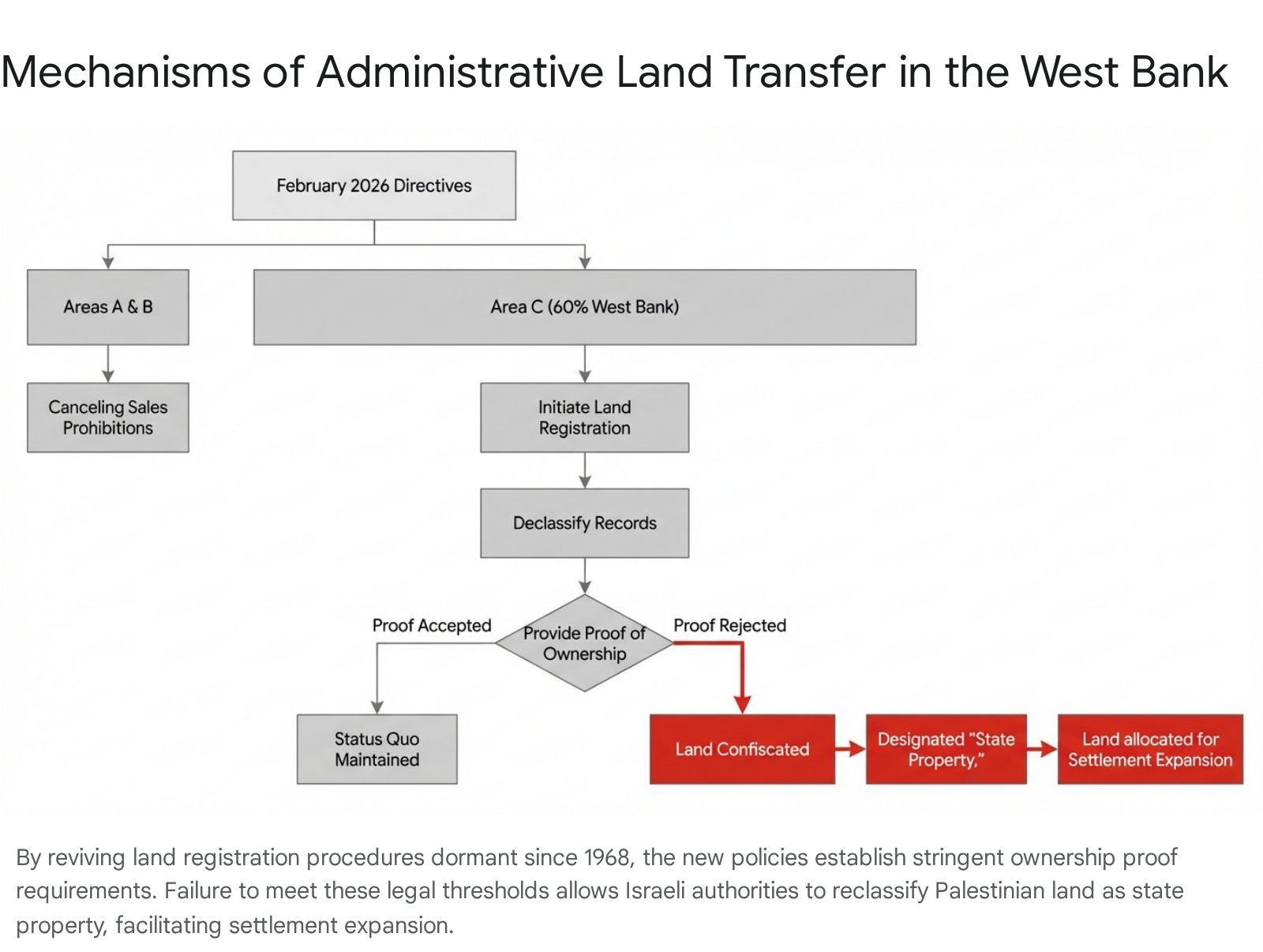
The most significant of these measures was authorized by the Israeli security cabinet on Sunday, February 15, 2026, which approved an initial state budget of NIS 244 million ($79 million) to implement a sweeping “land registration process” across Area C for the years 2026 to 2030.19 Area C, established under the 1995 Oslo II Accords, comprises approximately 60 percent of the West Bank territory and remains under full Israeli military and civilian control.20
The new directive effectively ends a freeze on formal land registration that had been in place since 1968, shortly after the territory was occupied in 1967.18 The policy requires Palestinian landowners to formally prove ownership of their properties to Israeli authorities under newly established, highly stringent criteria.18 A specialized unit operating under Israel’s Coordinator of Government Activities in the Territories will oversee the entirety of the process—issuing sale permits, collecting fees, and supervising registration—while deliberately preventing the Palestinian Authority from exercising any jurisdiction or oversight.18
The legal mechanism is explicitly designed to facilitate dispossession. Land that fails to meet these rigorous ownership proofs will be legally confiscated, reclassified as “state property,” and subsequently made available for the expansion of Israeli settlements and development projects.18 The cabinet has established 35 new positions in various state agencies to conduct the work and has set an aggressive target to register 15 percent of all unregistered land within five years, acknowledging that the entire process could require up to 30 years to fully complete.19
4.2 Erosion of Area A and B Distinctions
This massive land registration effort in Area C follows a preceding, highly controversial directive issued on February 8, which deepened Israeli administrative control over Areas A and B.20 Under the Oslo framework, Area A is nominally under full Palestinian control, while Area B is under Palestinian civil administration and Israeli security control.20 The February 8 measures unilaterally removed prohibitions on the sale of West Bank land to non-Muslims, declassified West Bank land registry records to ease land acquisition by Israeli settlers, and transferred the authority for construction planning at religious sites to Israeli agencies.20 Furthermore, it authorized Israeli enforcement of environmental and archaeological regulations deep within Palestinian-administered zones.20
Intelligence and legal analyses indicate that these measures collectively serve to erase the domestic legal boundaries separating sovereign Israeli territory from the occupied West Bank, creating conditions that accelerate settlement expansion and maximize pressure on Palestinian landowners.20 The rhetoric accompanying these policies has been explicit. Israeli Finance Minister Bezalel Smotrich publicly lauded the decision, stating that the changes would protect the national interest, make it easier for Jewish settlers to acquire land, and declaring unequivocally, “we will continue to bury the idea of a Palestinian state”.19 The impact on the ground is severe; recent data from the Foundation for Middle East Peace indicates the approval of 54 new official settlements, the establishment of 86 new outposts, and the demolition of 1,269 Palestinian structures in Area C due to a lack of building permits.54
4.3 International Legal Pushback and Security Council Dynamics
The international backlash to this bureaucratic annexation has been swift, severe, but practically limited in its enforcement. The Palestinian presidency condemned the step as a “de facto annexation” and a declaration of commencement of annexation plans.19 On February 16, UN Secretary-General António Guterres forcefully condemned the land registration, noting it blatantly violates the July 2024 International Court of Justice advisory opinion, which determined Israel’s settlement policies and occupation to be irredeemably unlawful.21 Guterres warned that the current trajectory is rapidly “eroding the prospect” of a two-state solution.40 Following this, an extraordinary joint stakeout consisting of over 85 member states and regional organizations demanded the immediate reversal of the cabinet decisions.20
These policies dominated the agenda at the UN Security Council’s regular monthly briefing on the Middle East, held on February 18.20 The meeting, chaired at the ministerial level by UK Secretary of State Yvette Cooper, featured briefings by Under-Secretary-General for Political and Peacebuilding Affairs Rosemary DiCarlo.20 UN Special Rapporteur Francesca Albanese issued a stark warning to the international community, stating that the measures are not “routine administrative adjustments” but rather “deliberate, incremental steps toward permanent annexation, advanced piece by piece, in broad daylight, and with total impunity”.21 Despite this near-unanimous diplomatic and legal consensus, no tangible enforcement mechanisms or economic sanctions have been mobilized to halt the registration process, thereby emboldening the further administrative integration of the territory into the Israeli state.
5. Shifting Alignments and Troop Drawdowns in Syria and Iraq
Amidst the heightened tensions in the Persian Gulf and the Levant, a profound, systemic geopolitical realignment is quietly occurring in the northern tier of the Middle East. Following the collapse of Bashar al-Assad’s regime in Damascus in December 2024, the strategic map of Syria and Iraq has been fundamentally rewritten, prompting a major shift in United States military posture.22
5.1 U.S. Drawdown and the Abandonment of the SDF
The most consequential development in this theater is the initiation of a full and rapid withdrawal of the approximately 2,000 United States military personnel currently stationed in Syria, a retrograde process expected to conclude entirely within two months.23 This withdrawal marks the definitive end of nearly a decade of American military presence in the country, which was primarily dedicated to the counter-insurgency campaign against the Islamic State (ISIS).23
As part of this operation, U.S. forces officially vacated the highly strategic Al-Tanf garrison near the tripartite border of Syria, Jordan, and Iraq on Thursday, February 12.22 In the northeast, U.S. forces temporarily handed over control of the Al-Shadadi military base to the Syrian Arab Army to facilitate logistical coordination, a stark reversal of previous military protocols and adversarial postures.22
This complete withdrawal signifies the total strategic abandonment of the Kurdish-led Syrian Democratic Forces (SDF).22 The SDF served as the primary, highly effective ground partner for the U.S.-led international coalition in defeating the ISIS territorial caliphate in 2019.22 However, shifting strategic priorities in Washington have dictated that the necessity of the Kurdish alliance has passed.22 The United States is actively seeking to forge closer diplomatic and pragmatic ties with the new, post-Assad government in Damascus, calculating that maintaining a Kurdish alliance is a geopolitical liability in the new regional order.22
5.2 Geopolitical Vacuum and Baghdad-Damascus Normalization
The American exit from Syria is a calculated, high-stakes risk. While the U.S. Central Command (CENTCOM) continues to execute over-the-horizon strikes—hitting over 30 ISIS targets, including infrastructure and weapon storage facilities, between February 3 and February 12—the absence of a physical ground presence fundamentally alters regional deterrence and intelligence gathering capabilities against a resurgent jihadist threat.22
The vacuum left by the United States is rapidly facilitating a new era of diplomatic normalization and security integration between Damascus and Baghdad, as the two capitals move into a “new era” of relationship building.23 Intelligence analysis suggests that the U.S. withdrawal is driven primarily by a necessity to consolidate forces and eliminate vulnerable troop outposts that could serve as easy, isolated targets for Iranian proxy militias during a broader regional conflict resulting from the nuclear ultimatum. By abandoning the Syrian theater to regional actors, the United States aims to streamline its military focus onto pure, high-end deterrence against Iran in the Gulf, willingly conceding influence in the Levant to local governments, Turkey, and the remnants of Iranian intelligence networks.
6. Maritime Security: Red Sea Threats and Global Energy Markets
The threat of asymmetric warfare continues to dictate the security and economic viability of the region’s critical maritime chokepoints. While the intense daily barrage of Houthi anti-ship ballistic missiles that defined 2024 has subsided, the underlying capabilities of the Iran-backed Yemeni proxy remain intact, casting a long, destabilizing shadow over global supply chains and energy markets.25
6.1 Chokepoint Vulnerabilities and Houthi Posturing
The status of the Bab al-Mandab Strait remains highly volatile. Following the conditional Israel-Hamas ceasefire in late 2025, the Houthis officially suspended their attacks on international shipping.25 This allowed for a cautious, partial reopening of the Red Sea route, with major global carriers like Maersk restarting services to connect India and the Middle East to western markets.55 Egypt attempted to capitalize on this brief stabilization by opening its first semi-automated facility at the Sokhna Port near the southern entrance to the Suez Canal in mid-January 2026 to capture returning traffic.55
However, the threat environment is escalating rapidly in tandem with the unraveling diplomacy regarding Gaza and Iran. The Houthis possess a sophisticated arsenal entirely reliant on Iranian engineering, and intelligence indicates that Tehran continues to actively smuggle advanced weaponry to the group via maritime routes, specifically utilizing Unit 11,000 of the Quds Force.33 The fragility of the shipping lanes was highlighted on Tuesday, February 17, when the United Kingdom Maritime Trade Operations (UKMTO) reported a security incident approximately 70 nautical miles southwest of the Yemeni port of Aden.56 A merchant vessel was approached and hailed by a white skiff carrying five individuals, resulting in an exchange of small-arms warning shots before the incident was downgraded to “suspicious activity”.56 Two additional skiffs were reported in the vicinity, mirroring the tactics previously employed by Somali pirate gangs and Houthi boarding parties.56
Due to these persistent gray-zone threats and the explicit potential for the Houthis to immediately resume strikes if the Gaza ceasefire collapses or if the U.S. strikes Iran, shipping confidence is faltering. Major logistics firms, including CMA CGM, have recently announced that several key Asia-Europe services (FAL1, FAL3, and MEX) are reverting to the longer, vastly more expensive route around the Cape of Good Hope, citing the “complex and uncertain international context”.55 Currently, the share of east-to-west maritime shipments utilizing the Suez Canal languishes at 18.7%, a catastrophic drop from the pre-disruption baseline of approximately 80%.55
6.2 Energy Market Volatility and the Geopolitical Premium
The compounding threats in the Red Sea and the acute, immediate risk of an American kinetic strike on Iran have severely rattled global energy markets, reversing previous trends of stabilization.24 Crude oil prices surged dramatically during the week ending February 21, rising approximately 2% to reach a six-month high.31 Brent crude futures breached the $70 per barrel threshold, rising 1.8% to $71.58, its highest close since July 31.24 Similarly, U.S. West Texas Intermediate (WTI) climbed 2.1% to $66.53 per barrel.31 In the United States, crude inventories unexpectedly dropped by 9 million barrels as refining utilization climbed, indicating anticipatory positioning ahead of potential supply constraints.58
Market analysts attribute this severe pricing premium directly to the geopolitical risk of supply disruptions in the Strait of Hormuz, a critical maritime chokepoint through which approximately 20% to 30% of the world’s seaborne oil flows.24 Iran’s explicit threat to close the strait, validated by its recent joint naval drills with Russia and live-fire exercises in the corridor, forces commodities traders to price in worst-case scenarios involving a weeks-long military campaign disrupting production in a region responsible for pumping one-third of the world’s oil.24
| Major Middle East OPEC Producers | Dec 2025 Supply (mb/d) | Jan 2026 Supply (mb/d) | Target Output (mb/d) | Effective Spare Capacity (mb/d) |
| Saudi Arabia | 9.70 | 10.28 | 10.10 | 1.84 |
| United Arab Emirates (UAE) | 3.64 | 3.60 | 3.40 | 0.67 |
| Islamic Republic of Iran | 3.45 | 3.45 | N/A | N/A |
| Total OPEC-9 | 23.13 | 23.72 | 23.23 | 3.39 |
Data derived from International Energy Agency (IEA) Market Reports, February 2026.24 Note: mb/d = million barrels per day.
The ability of the market to absorb a localized shock in the Persian Gulf depends heavily on the spare capacity of neighboring states. According to February 2026 data from the International Energy Agency, Saudi Arabia, which holds the market’s largest flexible reserve, produced 10.28 million barrels per day (mb/d) in January, slightly over its 10.1 mb/d target, maintaining an effective spare capacity of 1.84 mb/d.24 The UAE produced 3.60 mb/d, holding 0.67 mb/d in reserve.60 Iran’s output remained flat at 3.45 mb/d.60 OPEC+ allies, led by Riyadh and Abu Dhabi, are leaning toward increasing overall output starting in April 2026 to capture market share from Russia and Venezuela and stabilize prices ahead of peak summer demand.24
However, this combined spare capacity (3.39 mb/d for the OPEC-9) would be entirely insufficient to offset a sustained closure of the Strait of Hormuz. The current U.S. administration faces a critical political paradox: executing the threatened military strike against Iran could achieve nuclear deterrence objectives, but it would simultaneously trigger a massive spike in global gasoline prices.24 This presents a profound domestic liability for the Trump administration leading into the November 2026 mid-term elections, forcing a delicate tightrope walk between geopolitical intervention and domestic economic stability.24
Please share the link on Facebook, Forums, with colleagues, etc. Your support is much appreciated and if you have any feedback, please email us in**@*********ps.com. If you’d like to request a report or order a reprint, please click here for the corresponding page to open in new tab.
Sources Used
- The Axis of Instability: Iran, Proxy Warfare, and the Fragmenting Middle East, accessed February 21, 2026, https://www.meforum.org/mef-online/the-axis-of-instability-iran-proxy-warfare-and-the-fragmenting-middle-east
- Iran’s Conflict With Israel and the United States | Global Conflict …, accessed February 21, 2026, https://www.cfr.org/global-conflict-tracker/conflict/confrontation-between-united-states-and-iran
- Assessment of the U.S. Military Buildup (2-17-2026) – Reddit, accessed February 21, 2026, https://www.reddit.com/r/Military/comments/1r9bp7p/assessment_of_the_us_military_buildup_2172026/
- Iran prepares nuclear counterproposal as US considers limited military strikes, accessed February 21, 2026, https://www.theguardian.com/world/2026/feb/21/iran-nuclear-counterproposal-us-strikes-threat
- Amid threat of U.S. attack, Iran nuclear talks proceed without breakthrough, accessed February 21, 2026, https://www.washingtonpost.com/world/2026/02/17/iran-talks-geneva-nuclear-trump/
- Iran Update, February 20, 2026, accessed February 21, 2026, https://understandingwar.org/research/middle-east/iran-update-february-20-2026/
- Iran Update, February 17, 2026 | ISW, accessed February 21, 2026, https://understandingwar.org/research/middle-east/iran-update-february-17-2026/
- Lebanon: Israel’s surge in attacks highest since ceasefire | NRC, accessed February 21, 2026, https://www.nrc.no/news/2026/lebanon-israels-surge-in-attacks-highest-since-ceasefire
- One Year On in Lebanon: Continued Ceasefire Violations Harm Civilians – War Child, accessed February 21, 2026, https://www.warchild.net/news/one-year-on-lebanon-ceasefire-violations-harm-civilians/
- 2024 Israel–Lebanon ceasefire agreement – Wikipedia, accessed February 21, 2026, https://en.wikipedia.org/wiki/2024_Israel%E2%80%93Lebanon_ceasefire_agreement
- Senior Hezbollah leader among 10 killed in Israeli strikes on Lebanon – India Today, accessed February 21, 2026, https://www.indiatoday.in/world/story/israeli-strikes-lebanon-killed-hezbollah-sites-senior-official-2872099-2026-02-21
- Israeli strikes in Lebanon kill at least 12 people, intensifying rising regional tensions, accessed February 21, 2026, https://www.thehindu.com/news/international/israeli-strikes-in-lebanon-kill-at-least-12-people-intensifying-rising-regional-tensions/article70658760.ece
- Israel 19 February 2026 #1 – International Crisis Group, accessed February 21, 2026, https://www.crisisgroup.org/content/israel-19-february-2026-1
- Board of Peace meets as storm clouds gather for another possible …, accessed February 21, 2026, https://mei.edu/publication/board-of-peace-meets-as-storm-clouds-gather-for-another-possible-middle-east-war/
- Five Key Takeaways From Trump’s First Gaza Board of Peace Meeting – Time Magazine, accessed February 21, 2026, https://time.com/7379788/trump-gaza-board-of-peace-first-meeting-takeaways/
- Trump Gets Pledges for Gaza Reconstruction and Troop Commitments at Inaugural Board of Peace Talks, accessed February 21, 2026, https://www.military.com/daily-news/2026/02/19/trump-gets-pledges-gaza-reconstruction-and-troop-commitments-inaugural-board-of-peace-talks.html
- Stabilization force and funding pledged for Gaza at Board of Peace meeting, accessed February 21, 2026, https://www.fdd.org/analysis/2026/02/20/stabilization-force-and-funding-pledged-for-gaza-at-board-of-peace-meeting/
- What does Israel’s land registration in occupied West Bank mean?, accessed February 21, 2026, https://www.trtworld.com/article/afdf78b1c009
- Cabinet OKs new West Bank land registration process, critics decry ‘de-facto annexation’, accessed February 21, 2026, https://www.timesofisrael.com/cabinet-oks-new-west-bank-land-registration-process-critics-decry-de-facto-annexation/
- The Middle East, including the Palestinian Question: Briefing and …, accessed February 21, 2026, https://www.securitycouncilreport.org/whatsinblue/2026/02/the-middle-east-including-the-palestinian-question-briefing-and-consultations-21.php
- Special Rapporteur Francesca Albanese condemns Israeli attempts to further annex West Bank, accessed February 21, 2026, https://www.un.org/unispal/document/special-rapporteur-condemns-israeli-attempts-to-further-annex-west-bank/
- Syria says has taken over another base from US forces | International, accessed February 21, 2026, https://www.bssnews.net/international/361380
- February 20, 2026 – The Syrian Observer, accessed February 21, 2026, https://syrianobserver.com/2026/02/20
- Oil Surges on Iran Fears; Trump Navigates Election Price Risk, accessed February 21, 2026, https://www.whalesbook.com/news/English/commodities/Oil-Surges-on-Iran-Fears-Trump-Navigates-Election-Price-Risk/699667e1d25eafd9cd0002a2
- Yemen: Conflict, Red Sea Security, And U.S. Policy – Analysis, accessed February 21, 2026, https://www.eurasiareview.com/21022026-yemen-conflict-red-sea-security-and-u-s-policy-analysis/
- A look at the US military’s Mideast buildup, technically the region’s largest since 2003, accessed February 21, 2026, https://www.timesofisrael.com/a-look-at-the-us-militarys-mideast-buildup-technically-the-regions-largest-since-2003/
- United States military buildup in the Middle East during the 2026 United States–Iran crisis, accessed February 21, 2026, https://en.wikipedia.org/wiki/United_States_military_buildup_in_the_Middle_East_during_the_2026_United_States%E2%80%93Iran_crisis
- Iran deal prospects will be clear within 10 days, Trump says as military buildup grows, accessed February 21, 2026, https://www.theguardian.com/us-news/2026/feb/19/us-military-buildup-in-middle-east-intensifies-but-to-what-end
- What we know about the U.S. military buildup near Iran, accessed February 21, 2026, https://www.cbc.ca/news/world/us-iran-military-buildup-iran-9.7097884
- Here’s what we know about the buildup of U.S. military assets in the Middle East, accessed February 21, 2026, https://www.pbs.org/newshour/world/heres-what-we-know-about-the-buildup-of-u-s-military-assets-in-the-middle-east
- Oil Prices Rise 2% to Six-Month High on Concern Over Potential US-Iran Conflict – GV Wire, accessed February 21, 2026, https://gvwire.com/2026/02/19/oil-prices-rise-2-to-six-month-high-on-concern-over-potential-us-iran-conflict/
- Iran Threat Geiger Counter: A Probabilistic Approach; What is the probability that Iran will build nuclear weapons?, accessed February 21, 2026, https://isis-online.org/isis-reports/iran-threat-geiger-counter-a-probabilistic-approach-what-is-the-probability-that-iran-will-build-nuclear-weapons
- Iran – Situation Assessment (February 2026): The Race to Rebuild the Nuclear and Missile Array, Casual Terror and the CRINK – Alma Research and Education Center, accessed February 21, 2026, https://israel-alma.org/iran-situation-assessment-february-2026-the-race-to-rebuild-the-nuclear-and-missile-array-casual-terror-and-the-crink/
- Israel strikes Hezbollah weapons depots, military sites in Lebanon, accessed February 21, 2026, https://www.timesofisrael.com/israel-strikes-hezbollah-weapons-depots-military-sites-in-lebanon/
- Lebanon Crisis Situation Analysis (15/12/25 – 21/12/25) – ReliefWeb, accessed February 21, 2026, https://reliefweb.int/report/lebanon/lebanon-crisis-situation-analysis-151225-211225
- Death toll from Israeli strike on eastern Lebanon rises to 10, over 30 injured, accessed February 21, 2026, https://www.aa.com.tr/en/live/death-toll-from-israeli-strike-on-eastern-lebanon-rises-to-10-over-30-injured/3836458
- Lebanon: Israeli strike kills at least 10, including Hezbollah leader …, accessed February 21, 2026, https://www.middleeasteye.net/news/lebanon-israeli-strike-kills-least-10-including-hezbollah-leader
- Israel launches strike on Lebanon; 10 dead including senior Hezbollah leader —video shows aftermath, accessed February 21, 2026, https://timesofindia.indiatimes.com/world/middle-east/israel-launches-strike-on-lebanon-10-dead-including-senior-hezbollah-leader-video-shows-aftermath/articleshow/128630532.cms
- Morning Briefing: Feb. 16, 2026 – Anadolu, accessed February 21, 2026, https://www.aa.com.tr/en/world/morning-briefing-feb-16-2026/3831003
- Security Council LIVE: Situation in the Middle East, accessed February 21, 2026, https://news.un.org/en/story/2026/02/1166994
- Trump hails ‘Board of Peace’, announces over $5 billion pledged by member states for Gaza aid, accessed February 21, 2026, https://timesofindia.indiatimes.com/world/us/trump-hails-board-of-peace-announces-over-5billion-pledged-by-member-states-for-gaza-aid/articleshow/128389790.cms
- Gaza peace plan – Wikipedia, accessed February 21, 2026, https://en.wikipedia.org/wiki/Gaza_peace_plan
- Trump officials plan to build 5,000-person military base in Gaza, files show, accessed February 21, 2026, https://www.theguardian.com/us-news/2026/feb/19/trump-gaza-military-plan
- Gaza Board of Peace Meets Today | Council on Foreign Relations, accessed February 21, 2026, https://www.cfr.org/articles/gaza-board-of-peace-meets-today
- Statement on President Trump’s Comprehensive Plan to End the Gaza Conflict – The White House, accessed February 21, 2026, https://www.whitehouse.gov/briefings-statements/2026/01/statement-on-president-trumps-comprehensive-plan-to-end-the-gaza-conflict/
- Trump vows $10 billion contribution to his own Board of Peace, accessed February 21, 2026, https://www.washingtonpost.com/politics/2026/02/19/trump-board-of-peace-gaza/
- Turkey, several other nations commit troops to Gaza ISF | The Jerusalem Post, accessed February 21, 2026, https://www.jpost.com/middle-east/article-887284
- Trump’s Board of Peace pledges billions of dollars, thousands of troops for Gaza, accessed February 21, 2026, https://www.nepm.org/2026-02-19/trumps-board-of-peace-pledges-billions-of-dollars-thousands-of-troops-for-gaza
- Read Trump’s 20-point proposal to end the war in Gaza | PBS News, accessed February 21, 2026, https://www.pbs.org/newshour/politics/read-trumps-20-point-proposal-to-end-the-war-in-gaza
- What’s in Trump’s 20-point peace plan for Gaza? – The Guardian, accessed February 21, 2026, https://www.theguardian.com/world/2025/sep/29/trump-peace-plan-gaza-israel-hamas
- Gaza 2026: Board of Peace and National Transitional Committee – UK Parliament, accessed February 21, 2026, https://researchbriefings.files.parliament.uk/documents/CBP-10492/CBP-10492.pdf
- Guterres deplores Israel’s move to resume land registration in the West Bank | UN News, accessed February 21, 2026, https://news.un.org/en/story/2026/02/1166973
- Israel will begin contentious West Bank land registration – Central Florida Public Media, accessed February 21, 2026, https://www.cfpublic.org/2026-02-16/israel-will-begin-contentious-west-bank-land-registration
- Settlement & Annexation Report: February 6, 2026 – – Foundation for Middle East Peace, accessed February 21, 2026, https://fmep.org/resource/settlement-annexation-report-february-6-2026/
- Red Sea shipping reopens, but renewed Houthi threats keep route uncertainty high, accessed February 21, 2026, https://www.spglobal.com/market-intelligence/en/news-insights/research/2026/02/red-sea-shipping-reopens
- UK maritime agency says only warning shots fired in Aden incident, accessed February 21, 2026, https://www.timesofisrael.com/liveblog_entry/uk-maritime-agency-says-only-warning-shots-fired-in-aden-incident/
- UKMTO reports incident off Yemen’s Aden port | The Jerusalem Post, accessed February 21, 2026, https://www.jpost.com/middle-east/article-886960
- US-Iran Tensions Drive Oil Price Volatility in 2026 – Discovery Alert, accessed February 21, 2026, https://discoveryalert.com.au/us-iran-tensions-oil-prices-2026-geopolitical-risks/
- Crude Oil Prices Supported by Heightened Geopolitical Risks and Falling US Supplies, accessed February 21, 2026, https://www.barchart.com/story/news/312924/crude-oil-prices-supported-by-heightened-geopolitical-risks-and-falling-us-supplies
- Oil Market Report – February 2026 – Analysis – IEA, accessed February 21, 2026, https://www.iea.org/reports/oil-market-report-february-2026