Executive Summary
During the week ending February 21, 2026, the national security apparatus of the United States navigated a highly volatile and unprecedented convergence of international military escalation, domestic constitutional friction, and complex macroeconomic adjustments. This comprehensive situation report synthesizes multi-source intelligence, diplomatic cables, economic modeling, and cybersecurity telemetry to provide an exhaustive analysis of the geostrategic, domestic, and economic threat landscapes currently shaping and constraining United States national security policy. The operational environment is defined by overlapping crises that require simultaneous management across multiple discrete theaters, stretching the bandwidth of the executive branch as it prepares for the constitutionally mandated State of the Union address.
Internationally, the predominant focus of the national security community is the rapid and massive concentration of United States military assets in the Middle East, representing the largest deployment of American air and naval power in the region since the buildup preceding the 2003 invasion of Iraq.1 Following the apparent collapse of diplomatic negotiations in Geneva regarding Iran’s nuclear program, the executive branch has publicly signaled a ten-to-fourteen day decision window regarding the authorization of kinetic military action against the Islamic Republic of Iran.3 This highly aggressive coercive diplomatic posture is structurally supported by a dual-carrier strike group deployment. The strategic encirclement features the arrival of the USS Gerald R. Ford supercarrier in the Eastern Mediterranean and the operational positioning of the USS Abraham Lincoln in the Arabian Sea.4 Simultaneously, to mitigate asymmetric vulnerabilities to Iranian proxy retaliation, the Department of Defense has initiated a widespread evacuation of non-essential personnel from forward-operating bases across the Middle East, including the critical Al Udeid Air Base in Qatar.7 Compounding the instability in the region, the sudden and accelerated withdrawal of United States forces from northeastern Syria has precipitated the collapse of the Syrian Democratic Forces’ security umbrella, leading directly to the catastrophic failure of the Al-Hol detention facility and the mass release of an estimated 15,000 to 20,000 Islamic State (ISIS) affiliates into the battlespace.3
Domestically, the executive branch suffered a profound and structurally altering legal defeat when the Supreme Court of the United States issued a 6-3 ruling striking down the administration’s sweeping utilization of the International Emergency Economic Powers Act (IEEPA) to impose a global tariff regime.9 This ruling fundamentally alters the trajectory of United States trade policy, instantly injecting massive uncertainty into global supply chains and raising the immediate prospect of the federal government being legally compelled to refund upward of $200 billion to domestic importers for levies collected in 2025 alone.10 This unprecedented judicial rebuke arrives against the backdrop of a visibly cooling domestic economy. Fourth-quarter 2025 Gross Domestic Product (GDP) growth slowed significantly to an annualized rate of 1.4%, heavily dragged down by a six-week federal government shutdown that severely curtailed federal outlays and disrupted aggregate economic activity.12
On the homeland security and interior enforcement front, the administration achieved significant operational milestones that align with its core policy directives. The Department of Homeland Security (DHS) awarded a pivotal, multi-billion dollar oversight contract to Parsons Government Services Inc. to manage the accelerated completion of the southern border wall, funded by the $46.5 billion One Big Beautiful Act.13 Border enforcement metrics remain at historic, unprecedented levels of restriction, with zero interior releases recorded for the ninth consecutive month and a 96% reduction in Southwest border apprehensions compared to the prior administration’s averages.14 However, this total tightening of border security and interior enforcement has visibly constrained the domestic labor market, a dynamic clearly evidenced by the rapid exhaustion of the H-2B supplemental visa cap for returning temporary non-agricultural workers by the first week of February.15
In the cyber domain, sophisticated threat actors continue to demonstrate advanced capabilities, characterized by a 75% year-over-year increase in cloud environment intrusions and the rapid exploitation of artificial intelligence for automated ransomware extortion and identity attacks.16 Significant data breaches at major corporate entities, alongside the active mapping of critical infrastructure control loops by state-sponsored and criminal syndicates, highlight the persistent, systemic vulnerabilities within the United States digital ecosystem.18 Concurrently, the national security community is accelerating its preparation for the post-quantum cryptographic transition, recognizing the existential threat posed by future quantum computing capabilities to current encryption standards.20
As the President prepares to deliver the State of the Union address to a joint session of Congress on February 24, 2026, the administration faces a critical inflection point.22 The convergence of Middle Eastern brinkmanship, constitutional limitations on executive economic authority, a slowing macroeconomic environment, and pervasive digital threats requires immediate, nuanced, and comprehensive strategic recalibration across all instruments of national power.
1. Geostrategic Posture and Military Operations: The Middle East Theater
The most acute and immediate national security development of the reporting period is the rapid, highly visible, and massive concentration of United States military assets across the Middle East. Intelligence, defense, and geopolitical analyses indicate that this unprecedented deployment is designed to maximize coercive diplomatic pressure on the government in Tehran, while simultaneously providing the executive branch with a full spectrum of kinetic military options should current diplomatic ultimatums expire without a comprehensive resolution.3 The scale of this mobilization indicates a posture that extends far beyond routine deterrence, positioning the United States for potential sustained conflict.
1.1 The Architecture of the Dual-Carrier Strike Group Deployment
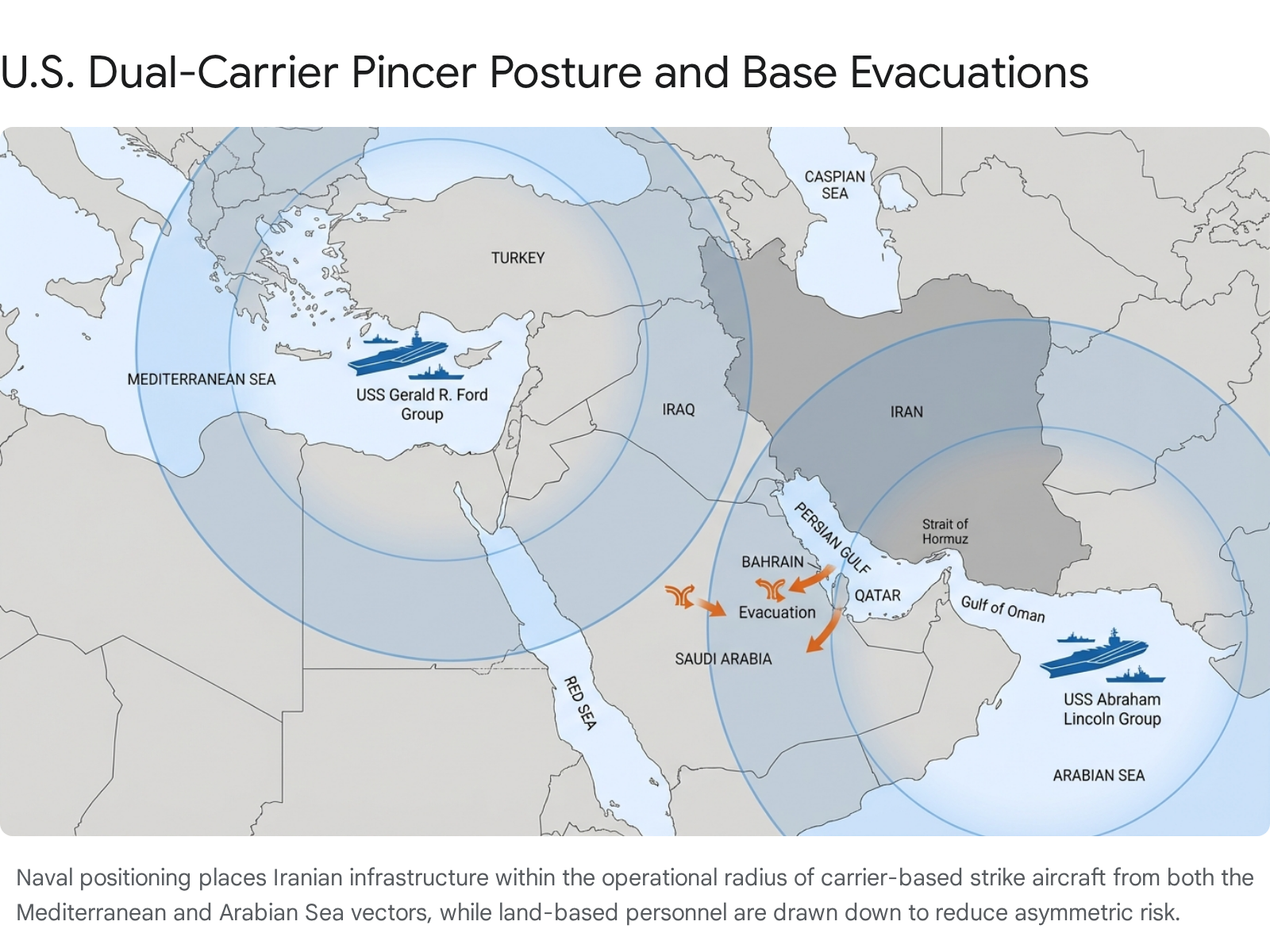
The physical architecture of the current United States military posture relies heavily on the establishment of overwhelming naval and air superiority, designed to project power from multiple vectors simultaneously. The United States has established a highly irregular dual-carrier presence to effectively box in Iranian strategic operational space and divide its air defense networks. At the center of the eastern deployment is the USS Abraham Lincoln Carrier Strike Group, which is currently operating in the northern Arabian Sea.2 Satellite imagery and open-source intelligence confirm the carrier is operating approximately 240 kilometers off the coast of Oman, placing its full complement of advanced F-35C stealth fighters and F/A-18 strike aircraft within immediate, unrefueled striking range of critical Iranian mainland targets, including command and control nodes and nuclear research facilities.2 The Lincoln went operational in the Fifth Fleet’s area of responsibility in late January, immediately flying combat sorties and conducting maritime surveillance with P-8A Poseidon patrol aircraft.23
Simultaneously, the USS Gerald R. Ford—the United States Navy’s newest, largest, and most technologically advanced supercarrier—has completed its transit through the Strait of Gibraltar and entered the Eastern Mediterranean.5 The presence of the Ford significantly expands the Pentagon’s strike vectors. By positioning a carrier strike group in the Mediterranean, the United States military can launch sustained, high-intensity air operations from the west, traversing allied airspace, without relying entirely on the airspace permissions or base access from Gulf Arab partners who may be hesitant to support offensive operations due to fear of Iranian retaliation.2
This overwhelming naval power is augmented by a massive, corresponding influx of land-based aviation and support assets. The United States has relocated extensive tactical and strategic air assets to the region, including deployments of F-22 Raptors, F-16 fighter jets, and long-range strategic bombers, bolstering the roughly 75 warplanes carried by each of the supercarriers.4 Furthermore, aviation tracking experts have noted the highly significant deployment of six E-3 Sentry Airborne Warning and Control System (AWACS) aircraft, which have been repositioned from installations in the United States and Japan to the Prince Sultan Air Base in the Kingdom of Saudi Arabia.26 These AWACS platforms are absolutely critical for real-time command, control, and complex battlespace management, indicating preparations for a highly coordinated, multi-wave air campaign. In total, military analysts assess that the United States has gathered the largest concentration of air power in the Middle Eastern theater since the buildup that preceded the 2003 invasion of Iraq, creating a force capable of sustaining a punishing bombing campaign for weeks or even months.1
1.2 Kinetic Options and the Strategic Absence of Ground Forces
Despite the overwhelming naval and aerial buildup, which includes at least 13 United States destroyers and one nuclear submarine operating across the Persian Gulf, Red Sea, and Northern Arabian Sea, the administration has conspicuously avoided deploying large formations of ground combat troops to the immediate theater.2 This deliberate force structure design heavily signals that the administration’s kinetic options are weighted entirely toward localized, punitive precision strikes or a sustained, high-altitude degradation of Iranian infrastructure, rather than a full-scale ground invasion, territorial occupation, or forced regime change through infantry maneuvers.
Military planners have reportedly presented the President with a menu of kinetic options ranging from a limited, “one-and-done” retaliatory strike designed to shock the Iranian leadership and force immediate diplomatic concessions, to a comprehensive, multi-domain air and naval campaign targeting Iran’s nuclear enrichment facilities, integrated air defense systems, and the command nodes of the Islamic Revolutionary Guard Corps (IRGC).2 Analysts assess that the lack of a credible United States ground invasion threat represents a significant variable in the escalatory calculus. Iranian leadership—operating through a highly decentralized, resilient power structure—likely calculates that the regime can survive a purely aerial bombardment campaign, even if it inflicts massive damage on critical infrastructure, thereby potentially emboldening Tehran to absorb the strikes rather than capitulate to maximalist demands.4
1.3 Force Protection and the Mitigation of Asymmetric Vulnerability
Recognizing the exceptionally high probability of Iranian retaliation through its sophisticated regional proxy network—often referred to as the “Axis of Resistance”—the Pentagon has initiated a calculated, highly sensitive withdrawal of vulnerable assets. The Department of Defense is currently executing the systematic evacuation of hundreds of non-essential troops and civilian contractors from major fixed installations across the region.7 This includes drawdowns at the Al Udeid Air Base in Qatar, the cluster of United States bases in Bahrain that house the Navy’s 5th Fleet, and various facilities across Iraq, Syria, Kuwait, Saudi Arabia, Jordan, and the United Arab Emirates.7
With 30,000 to 40,000 United States troops normally stationed across the Middle East, these fixed bases present highly vulnerable, static, target-rich environments for Iranian ballistic missile barrages and coordinated suicide drone swarms.7 The Iranian mission to the United Nations has explicitly and publicly warned that any United States attack would immediately render all American bases, facilities, and assets in the region “legitimate targets” for reprisal.7 Consequently, while evacuating non-essential personnel, the United States is simultaneously deploying and activating advanced air and missile defense systems, including Patriot and THAAD batteries, around remaining operational nodes to protect essential personnel and critical hardware from anticipated asymmetric counter-attacks.7
1.4 Diplomatic Deadlines, Negotiations, and the Iranian Response
The intense military maneuvering is intrinsically tied to a rapidly closing, high-stakes diplomatic window. The President has publicly stated that a final decision regarding whether the United States will conduct a military strike against Iran will be made within a ten-to-fourteen day timeframe, creating an artificial crisis designed to force a breakthrough.4 United States diplomatic officials have presented Tehran with a hardline end-of-February deadline to agree to sweeping, structural concessions.3 These demands reportedly include the complete, verifiable cessation of all uranium enrichment activities, severe, monitored limitations on Iran’s ballistic missile development program, and the total termination of material and financial support for regional proxy militias in Lebanon, Yemen, Iraq, and Syria.3
While there are reports that the administration has floated the possibility of a narrow, “token” nuclear deal that might allow for highly restricted, low-level uranium enrichment as a face-saving measure for Tehran, the overarching posture remains maximalist.6 Intelligence assessments, however, indicate a high likelihood that Iran will reject these demands. Recent diplomatic engagements, including talks held in Geneva on February 17, have failed to produce a viable framework for de-escalation, leaving United States officials highly pessimistic regarding the prospects for a negotiated settlement before the deadline expires.3
In a clear demonstration of defiance, operational readiness, and allied solidarity, Iranian naval forces hosted a highly publicized joint military exercise with the Russian Navy in the Gulf of Oman and the southern tip of the Persian Gulf on February 19.3 The exercise, which heavily involved Iranian Islamic Revolutionary Guard Corps (IRGC) units and a Russian Steregushchiy-class corvette, focused on practicing joint command-and-control protocols, rapid response maneuvers, and defensive operations against maritime security threats.3 This joint drill clearly signals Iran’s readiness to contest the vital Strait of Hormuz—through which a massive percentage of the world’s daily oil supply transits—in the event of United States military action, explicitly leveraging its strategic partnership with Moscow as a deterrent.3
Simultaneously, the Iranian domestic landscape remains highly volatile and unpredictable. On February 19, Iran witnessed the largest single day of anti-regime protests since the major unrest of January 11.3 Intelligence streams tracked five large-scale demonstrations, defined as exceeding 1,000 participants, alongside 14 smaller, localized protests across the country.3 While this domestic unrest exerts undeniable pressure on the regime and highlights profound internal dissatisfaction, historical geopolitical precedent suggests that external military strikes often generate a powerful “rally ’round the flag” effect. Hardline elements within the IRGC may calculate that absorbing a United States strike would provide the necessary pretext to violently suppress internal dissent and consolidate domestic control under the banner of national defense. Additionally, Israeli and Lebanese intelligence officials assess a high probability that Hezbollah, Iran’s most capable proxy, would participate in any future conflict, potentially opening a devastating northern front against Israel and further regionalizing the war.3
1.5 Domestic Political Calculus and Isolationist Pushback
The administration’s rapid escalation toward potential large-scale conflict has triggered notable, albeit currently muted, resistance from its core political base. Prominent conservative influencers, media personalities, and “America First” advocates, including figures such as Charlie Kirk, Tucker Carlson, and Stephen K. Bannon, have previously expressed deep, principled reservations regarding United States entanglement in another protracted Middle Eastern war or efforts aimed at regime change.27 During earlier periods of escalation, such as the lead-up to the strikes in June 2025, these voices loudly warned the administration that the “MAGA base does not want a war, at all, whatsoever” and strongly resisted “the siren song of displacing dictators in lands we do not understand”.27
While public lobbying against the current, massive military buildup is noticeably less vociferous than in the past—partly due to accumulated trust in the administration’s transactional, unpredictable approach to the use of force—the underlying political constraints remain a critical factor in the executive branch’s calculus.27 The administration has not yet formally articulated a comprehensive casus belli to the American public, nor has it sought formal authorization for the use of military force (AUMF) from the United States Congress, or attempted to build a broad international coalition beyond the immediate support of Israel.4 Launching a sustained bombing campaign without these domestic and international legal frameworks risks igniting severe political backlash, particularly if the conflict results in American casualties, a spike in global energy prices, or a prolonged regional quagmire leading into the midterm election cycle.
2. Global Diplomatic Realignments and Secondary Theaters
While the overwhelming focus of the national security apparatus remains fixed on the Persian Gulf, compounding crises and strategic shifts in secondary theaters continue to demand resources and complicate the global operating environment.
2.1 The Syrian Vacuum and the Catastrophic Resurgence of the Islamic State
A secondary, yet highly consequential and immediate security crisis has erupted in northeastern Syria, directly resulting from the broader shift in United States strategic posture and resource allocation. The administration’s decision to rapidly draw down the remaining United States military presence in Syria—a withdrawal publicly scheduled for completion over a compressed two-month timeframe—has drastically and violently altered the local balance of power.3
As United States Special Operations forces and support units retrograde from their forward positions, the United States-backed Syrian Democratic Forces (SDF), who have served as the primary ground component in the fight against the Islamic State, have been thoroughly routed by advancing Syrian government units backed by Russian airpower.8 This total collapse of the SDF security umbrella led directly to the catastrophic failure of security protocols at the Al-Hol detention facility.8 Located in the harsh eastern Syrian desert, Al-Hol was a sprawling, highly volatile encampment holding tens of thousands of individuals, a significant percentage of whom were highly radicalized family members of deceased or captured ISIS fighters.8
United States intelligence agencies have now concluded, with a high degree of confidence, that between 15,000 and 20,000 individuals, including hardcore Islamic State affiliates, trained operatives, and radicalized youths, have escaped the facility and are currently at large in the Syrian battlespace.8 The Pentagon’s Inspector General had previously reported over 23,000 individuals remaining at the camp at the end of 2025.8 Security experts and counter-terrorism analysts have long warned that Al-Hol functioned as a dangerous incubator for the next generation of jihadist militants, effectively operating as a localized caliphate behind razor wire. The sudden, uncontrolled diffusion of these operatives presents an immediate, severe threat of an ISIS resurgence in the Levant, threatening to undo years of grueling counter-terrorism operations.
In response to this rapidly deteriorating situation, the United States Central Command (CENTCOM) accelerated its kinetic counter-terrorism operations, conducting ten precision strikes against over 30 identified ISIS infrastructure targets, including weapons depots and staging areas, between February 3 and 12.3 However, the broader strategic implication is inescapable: the United States withdrawal signals a de facto, reluctant transfer of the counter-ISIS mandate to the government of Bashar al-Assad and its Russian and Iranian military backers, creating a chaotic security vacuum that transnational terrorist organizations are highly likely to exploit to rebuild their operational networks.3
2.2 Transatlantic Drift and the Pivot from European Security Architectures
The administration’s broader foreign policy is increasingly characterized by a deliberate divestment from traditional, multilateral European security architectures, favoring bilateral engagement with ideologically aligned governments. Concurrently with the massive expenditure of resources in the Middle East, the United States drastically reduced its planned participation in the annual NATO “Cold Response” military exercises in Northern Norway.8 The Pentagon opted to withhold thousands of troops and critical F-35 fighter squadrons that were previously committed to the multinational exercise.8
This visible military withdrawal from European collective defense initiatives aligns seamlessly with the diplomatic itinerary of Secretary of State Marco Rubio, who conducted a highly targeted tour of Eastern Europe, specifically visiting Germany, Slovakia, and Hungary from February 13 to 16.28 The deliberate choice to engage heavily with the populist, often euroskeptic governments of Slovakia, led by Prime Minister Robert Fico, and Hungary, suggests a calculated strategy of cultivating bilateral relationships with specific European factions that share the administration’s nationalist priorities, rather than reinforcing the collective, unified mechanisms of NATO defense.28
2.3 The Western Hemisphere Focus and Latin American Flashpoints
Conversely, the United States strategic focus is pivoting sharply toward security threats within the Western Hemisphere. The Council on Foreign Relations (CFR) in its widely cited 2026 Preventive Priorities Survey has, for the first time in the survey’s history, elevated the risk of a military conflict with Venezuela to a Tier 1 threat.29 This alarming assessment is driven by the visible escalation of United States hard power operations targeting transnational criminal groups operating across Latin America and the Caribbean, operations that risk inadvertently or deliberately destabilizing the heavily armed Maduro regime in Caracas.30 This pivot indicates a growing willingness to utilize military force to address localized hemispheric threats, even as the administration attempts to disentangle from legacy conflicts in the Middle East and Europe.
3. Homeland Security, Border Enforcement, and Immigration Policy
The domestic security apparatus, operating primarily through the Department of Homeland Security, continues to execute a highly aggressive, deeply restrictive border enforcement paradigm. Statistical releases for January 2026 confirm that the administration’s suite of policies has fundamentally suppressed irregular migration flows across the United States-Mexico border, achieving unprecedented enforcement milestones while simultaneously generating severe collateral impacts on the domestic labor market.
3.1 Aggressive Enforcement Statistics and the Apprehension Collapse
United States Customs and Border Protection (CBP) recorded a total of 34,631 nationwide encounters (combining both the United States Border Patrol and the Office of Field Operations) in January 2026.14 This figure represents a staggering 91% decrease from the peak encounter levels experienced during the prior administration, and a highly significant 58% year-over-year decrease from January 2025.14
The restriction of movement is most severe in the areas between official ports of entry. United States Border Patrol apprehensions along the entirety of the Southwest border totaled a mere 6,070 individuals for the month.14 This equates to roughly 196 apprehensions per day, a historic operational decline that is 96% lower than the daily averages sustained under the Biden administration.14
Crucially, the administration has entirely eliminated the controversial practices of internal parole and catch-and-release protocols, a core campaign promise. For the ninth consecutive month, the United States Border Patrol recorded absolute zero illegal aliens released into the interior of the United States, effectively establishing a policy of total detention or immediate expulsion.14
3.2 High-Volume Narcotics Interdiction
The dramatic drop in human traffic coincides with sustained, high-volume narcotics interdictions, primarily occurring at official ports of entry. In January alone, CBP seized 816 pounds of highly lethal illicit fentanyl, with 98% of that volume captured along the Southwest border.14 Additionally, interdiction operations yielded 12,241 pounds of methamphetamine, 5,386 pounds of cocaine (a 40% increase from the previous month), and 17,639 pounds of marijuana.32 The sustained high volume of hard narcotics interdictions—even as human encounters plummet to historic lows—strongly suggests that transnational criminal organizations and cartels are aggressively pivoting their business models toward specialized, high-yield, low-volume smuggling operations, utilizing commercial trucking and passenger vehicles through ports of entry managed by the Office of Field Operations, rather than relying on decentralized human smuggling routes.
3.3 Infrastructure Fortification: The Parsons Contract and the Wall
To permanently solidify these temporary enforcement gains, the Department of Homeland Security announced a historic infrastructure advancement on February 17, 2026. Following what was described as an extremely competitive bidding process engaging dozens of private-sector firms, DHS officially awarded the pivotal “owner’s agent” contract to Parsons Government Services Inc. to oversee, manage, and accelerate the completion of the physical border wall system.13
This massive infrastructure project is fully financed by the $46.5 billion appropriation secured under the One Big Beautiful Act.13 This critical piece of legislation uniquely insulates border construction funding from the broader, ongoing DHS budgetary shutdown, providing uninterrupted capital not only for physical steel barriers but also for advanced non-intrusive inspection technology at ports of entry, vehicle fleet modernization, facility improvements, and significantly expanded CBP staffing and specialized training.13 DHS Secretary Kristi Noem has publicly indicated that the integration of high-level private-sector project management expertise through Parsons is designed to streamline bureaucracy and “supercharge” the construction timeline, with the administration’s strategic goal explicitly set to complete the entire contiguous border wall system by early 2028.13
3.4 Immigration Restrictions and Acute Labor Market Squeeze
The collateral economic impact of this regime of total border restriction, coupled with heightened interior deportation operations, is manifesting acutely within the domestic labor market. The agricultural, hospitality, landscaping, and construction sectors—industries historically dependent on a steady flow of immigrant labor—are experiencing severe, highly disruptive labor shortfalls.
In a powerful statistical indicator of this surging demand, United States Citizenship and Immigration Services (USCIS) formally announced that by February 6, 2026, it had already received more than enough petitions to completely exhaust the cap for the 18,490 supplemental H-2B nonimmigrant visas explicitly allocated for returning workers in the first quarter.15 The rapid, almost immediate exhaustion of these temporary worker visas highlights the deep, systemic reliance of the United States economy on foreign labor. This structural reliance is being increasingly squeezed by the administration’s comprehensive immigration clampdown, forcing businesses to attest to suffering “irreparable harm” simply to qualify for the limited visa lottery.15 This labor constraint is expected to feed directly into domestic inflationary pressures, as businesses are forced to dramatically raise wages to attract scarce domestic workers or curtail operations entirely.
Furthermore, the aggressive posture of interior enforcement agencies continues to generate intense domestic friction. The administration’s policies have sparked significant protests, most notably in Minneapolis, following the highly publicized deaths of Renee Good, who was killed by an Immigration and Customs Enforcement (ICE) officer, and Alex Pretti, who was killed by Border Patrol.33 The fact that both individuals were United States citizens engaging in protest activities has drawn severe judicial scrutiny, with a federal judge noting that the executive branch has “extended its violence on its own citizens,” highlighting the volatile intersection of aggressive homeland security operations and domestic civil liberties.33
4. Macroeconomic Intelligence and Constitutional Friction
On February 20, 2026, the administration’s core economic agenda sustained a critical, potentially devastating blow when the Supreme Court of the United States issued a 6-3 ruling striking down the President’s sweeping deployment of tariffs under the International Emergency Economic Powers Act (IEEPA).9 This landmark ruling represents the most significant judicial check on the administration’s expansive view of executive authority to date and radically reshapes the near-term global economic landscape.
4.1 The Legal Mechanics of the SCOTUS Invalidation
The IEEPA, originally enacted in 1977, grants the President broad, highly deferential authority to regulate commerce, freeze assets, and impose sanctions during declared national emergencies stemming from “unusual and extraordinary” foreign threats to the national security, foreign policy, or economy of the United States.10 The current administration had aggressively utilized and interpreted this statute as the foundational legal justification for a comprehensive, multi-billion-dollar global tariff regime, arguing that global trade imbalances constituted such an emergency. The Supreme Court majority definitively ruled that the administration’s specific application of sweeping, generalized tariffs fundamentally exceeded the powers delegated by Congress within the text of the 1977 law, thereby instantly invalidating the centerpiece of the President’s protectionist “America First” trade policy.9
4.2 Fiscal Repercussions, the Refund Crisis, and Trade Destabilization
The immediate fiscal, logistical, and macroeconomic consequences of this ruling are profound and chaotic. In the year 2025 alone, the federal government collected an estimated $200 billion in direct revenue from these specific, now-illegal tariffs.10 The Court notably declined to issue a prescriptive remedy regarding whether, or precisely how, the federal government must provide refunds to the thousands of domestic importers who paid the unconstitutional levies.10
In his sharply worded dissenting opinion, Justice Brett Kavanaugh highlighted the impending logistical and fiscal catastrophe this lack of clarity creates. He noted that the federal government may be legally required to refund billions of dollars to importers, creating a massive sudden liability, even in complex cases where those importers had already passed the tariff costs down to domestic consumers through higher retail prices.10 Furthermore, Kavanaugh explicitly warned that the ruling instantly destabilizes trillions of dollars in established global trade deals—including major, highly complex bilateral agreements with China, Japan, and the United Kingdom.10 These deals were explicitly negotiated under the coercive threat of the now-invalidated tariffs; with the threat removed, the compliance of these foreign nations is highly uncertain.
4.3 Quantitative Assessment of the Tariff Reversal
Sophisticated economic modeling conducted by the Budget Lab at Yale prior to the ruling underscores the immense magnitude of this policy shift. Their analysis quantifies the massive gap between a counterfactual scenario where the IEEPA tariffs are permanently upheld, versus the current reality of abrupt repeal and mandated refunds.
| Economic Metric (Projected 2026-2035) | Current Policy (IEEPA Repealed, With Refunds) | Counterfactual (IEEPA Upheld) | Variance |
| Effective Overall Tariff Rate | 8.0% | 14.3% | -6.3% |
| Conventional Revenue (Trillions) | $1.2 | $2.7 | -$1.5 Trillion |
| Dynamic Revenue (Trillions) | $1.0 | $2.3 | -$1.3 Trillion |
| Change in PCE Price Level (Inflation) | 0.5% | 0.9% | -0.4% |
| Average Household Real Income Loss | $618 | $1,253 | -$635 |
| Change in Long-Run GDP | -0.10% | -0.31% | +0.21% |
Data synthesized from macroeconomic projections regarding the fiscal effects of 2026 tariffs through February 20. Values reflect post-substitution estimates. 34
The data clearly demonstrates that the Supreme Court’s decision, while drastically and painfully reducing anticipated federal revenue by over $1.5 trillion over the next decade (a massive blow to the administration’s fiscal planning), simultaneously functions as a powerful disinflationary shock.34 The repeal reduces the projected drag on long-run GDP by 0.21 percentage points and effectively halves the average household real income loss, providing an unexpected, structurally mandated stimulus to the consumer economy.34
4.4 Executive Branch Response and Institutional Friction
The ruling has immediately exacerbated profound friction between the executive branch and the judiciary. In a highly unusual, aggressive public rebuke during a press conference on Friday, the President lambasted the justices, characterizing the decision as “disloyal” and referring to the Court as a “disgrace to our nation”—rhetoric previously reserved for lower-court judges.9
However, despite the rhetorical fury, the administration indicated it would comply with the judicial order while immediately seeking alternative, older statutory authorities to rapidly reimpose the tariffs.9 The White House released a rapid-response fact sheet doubling down on the core policy’s intent, arguing that the tariffs were absolutely essential to “reshape the long-distorted global trading system” and combat “fundamental international payment problems”.35 The administration maintains that the “overall direction of travel… reshoring domestic production and expanding market access abroad” will remain totally unaltered, signaling an impending period of intensive legal maneuvering to bypass the Court’s restrictions.35
4.5 Q4 GDP Deceleration and Structural Economic Fragility
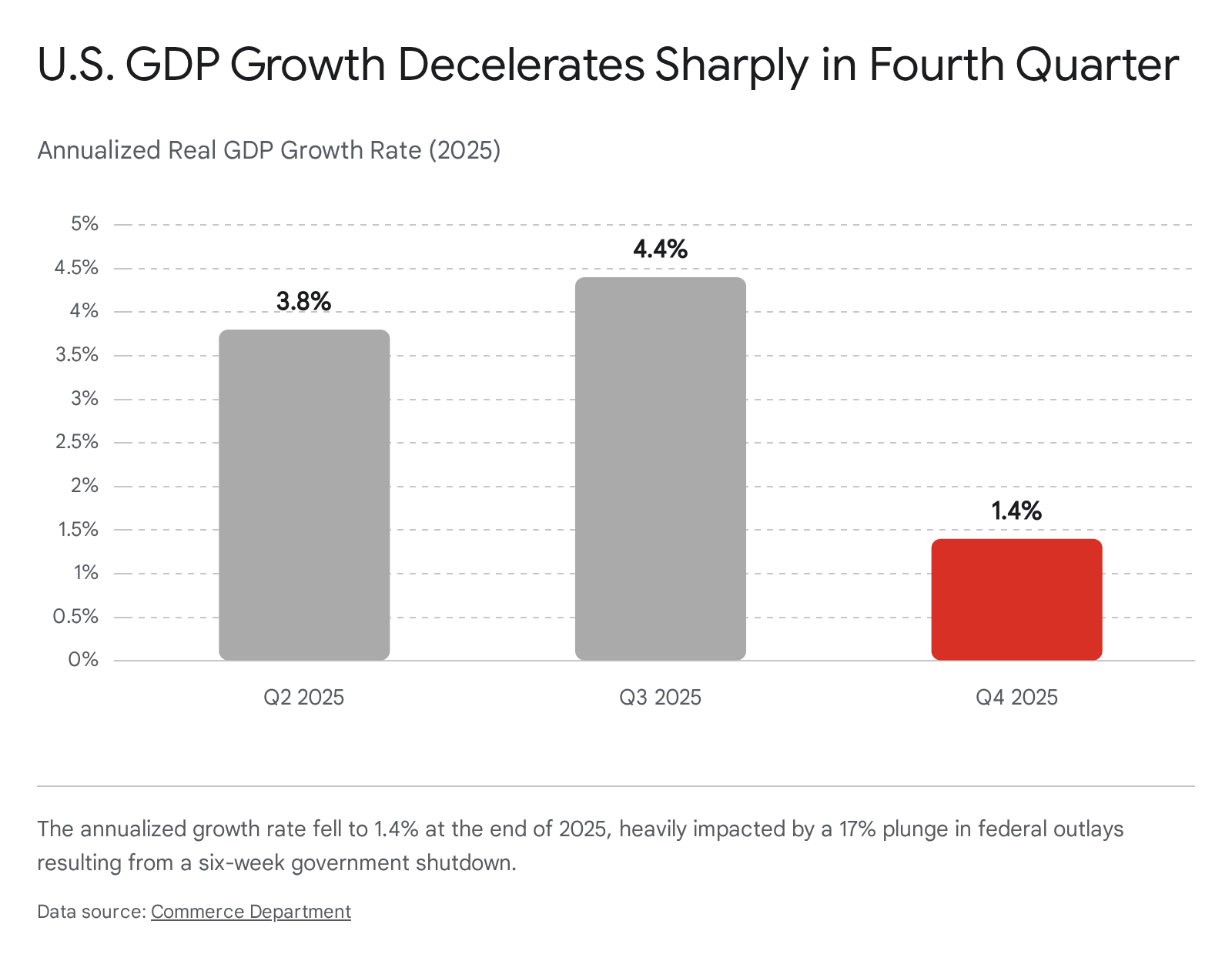
The judicial invalidation of the tariff regime arrives at an exceptionally precarious moment for the United States economy, which demonstrated highly visible, undeniable signs of deceleration at the close of 2025. The Commerce Department officially reported on Friday that United States Gross Domestic Product (GDP) grew at a sluggish annualized rate of just 1.4% in the fourth quarter of 2025.12 This represents a sharp, concerning deceleration from the robust 4.4% growth recorded in the third quarter and the 3.8% growth in the second quarter.12
The primary catalyst for this severe macroeconomic drag was the acute fiscal contraction caused by a brutal six-week shutdown of the federal government. The disruption caused federal government outlays to plunge by nearly 17% during the quarter, directly shaving a full percentage point off the national growth rate.12 Currently, the Department of Homeland Security (DHS) remains the sole federal agency still operating under a localized, highly disruptive shutdown, as Congress continues to painfully negotiate its Fiscal Year 2026 funding levels.22
Despite the alarming headline GDP contraction, underlying private-sector metrics demonstrated a fragile resilience. Consumer spending rose by a solid 2.4% in the fourth quarter, though this marks a noticeable cooling from the 3.5% gain seen in the third quarter.12 A deeper measure of underlying economic health, tracking strictly consumer and business spending (and explicitly excluding the highly volatile government sector), remained healthy at 2.4%.12
However, systemic risks are compounding rapidly beneath the surface. Consumers are increasingly maintaining their spending levels by deeply depleting pandemic-era savings reserves and absorbing significantly higher credit card debt loads, a trajectory economists warn is structurally unsustainable.12 Furthermore, business investment remains highly concentrated in artificial intelligence equipment and data center infrastructure, masking incredibly sluggish capital expenditure across broader traditional industrial and manufacturing sectors.12 Prior to their invalidation by the Supreme Court, the administration’s tariffs were also contributing directly to a slight elevation in inflationary pressure, increasing production costs for United States manufacturers reliant on imported components and severely suppressing export growth, which crawled at a mere 0.4% throughout 2025.12
5. Cybersecurity, Digital Threat Vectors, and Quantum Readiness
The cyber threat landscape facing the United States remains highly elevated, dynamic, and incredibly dangerous. The reporting period is characterized by a rapid, observable transition from traditional ransomware methodologies to highly advanced, automated AI-driven extortion, alongside persistent, critical vulnerabilities in industrial control systems and cloud infrastructure.
5.1 Operational Technology (OT) and Critical Infrastructure Vulnerabilities
High-level intelligence derived from Dragos’s 2026 OT (Operational Technology) Cybersecurity Report highlights a disturbing and highly sophisticated evolution in adversary behavior. Advanced persistent threat (APT) actors have moved beyond mere digital prepositioning and passive espionage; they are now actively mapping complex control loops within industrial networks.19 This indicates a clear intent to deeply understand, and potentially manipulate or destroy, physical industrial processes—such as municipal water treatment, energy generation, and advanced manufacturing—rather than merely stealing data for financial gain or espionage.
The report identified three entirely new threat groups operating in this space and noted that established groups have expanded their operations globally.19 Furthermore, the report notes that ransomware operations have evolved to cause significant, physical operational disruptions in OT environments. Alarmingly, Dragos assesses that despite this escalating, existential threat, only a small fraction of United States OT networks possess the requisite visibility, sensors, and telemetry to detect these sophisticated intrusions before a kinetic, physical operational impact occurs.19
5.2 The Proliferation of AI-Driven Extortion and Cloud Intrusions
Corporate breaches and financial extortion remain relentless and highly lucrative. In January, the notorious ShinyHunters cybercriminal syndicate executed major, highly damaging breaches against corporate targets. This included a breach against Panera Bread, where the group published a massive 760 MB archive containing the sensitive names, physical addresses, and phone numbers of customers after the corporation refused to meet their ransom demands, sparking immediate class-action lawsuits.18 The syndicate also successfully breached the Match family of dating applications.38
More concerning for national security planners is the profound structural shift in attack vectors. Security analytics reveal a staggering 75% year-over-year increase in cloud environment intrusions, and a 110% increase in cases categorized as “cloud-conscious”.16 Disturbingly, 84% of these complex cloud intrusions were executed by financially motivated eCrime actors rather than state-sponsored entities, indicating a democratization of highly advanced hacking capabilities.16
This threat multiplier is being driven directly by the integration of artificial intelligence into the attack chain. Cybersecurity researchers have identified new variants of AI-powered ransomware and extortion tools—identified in the wild as “LunaLock” and “PromptLock”—which are successfully automating the discovery of zero-day vulnerabilities, the drafting of hyper-personalized, flawless phishing lures, and the rapid, autonomous deployment of encryption protocols.17 Furthermore, telemetry shows that 75% of detected identity attacks in the past year were completely “malware-free,” relying instead on sophisticated AI-enhanced social engineering and the targeted abuse of trusted OAuth tokens (as seen in recent attacks targeting Salesforce integrations by the Scattered Lapsus$ Hunters) to effortlessly bypass traditional perimeter defenses.16
5.3 Strategic Defense: The Post-Quantum Cryptographic Transition
Recognizing the impending, mathematical obsolescence of current global encryption standards, the cybersecurity community and federal agencies are rapidly mobilizing to prepare for “Q-Day”—the theoretical point at which advanced quantum computers can easily break standard public-key cryptography, rendering current digital secrets entirely transparent.
This week, the inaugural “Quantum Security 25” list was published by DigiCert and the Techstrong Group, honoring the top global leaders pioneering the transition to post-quantum cryptography (PQC).21 The initiative, which recognizes key figures from institutions such as NIST (Dustin Moody), IBM Research (Vadim Lyubashevsky), AWS (Matthew Campagna), and major banking institutions like JPMorgan Chase, underscores the absolute critical national security imperative of migrating federal, military, and financial data infrastructure to quantum-resistant algorithms.20 The intelligence community assesses that adversarial nation-states are currently engaging in “harvest now, decrypt later” campaigns, stealing vast amounts of encrypted data today with the explicit intention of decrypting it once quantum supremacy is achieved, making the rapid adoption of PQC a matter of urgent national survival.21
6. Strategic Outlook and the State of the Union
The week ending February 21, 2026, presents a uniquely complex, highly volatile matrix of compounding crises for the United States, straining the bandwidth of the executive branch and the national security apparatus.
The administration’s most immediate, dangerous, and unpredictable variable is the ticking diplomatic and military clock in the Middle East. By establishing a massive, highly visible military armada while publicly issuing explicit, unyielding diplomatic deadlines to Tehran, the executive branch has staked massive geopolitical credibility on its ability to force Iranian concessions. The deliberate lack of deployed ground troops suggests a clear intent to rely on punitive, standoff air and naval strikes. However, if Tehran chooses to absorb the strikes without capitulating—a highly likely scenario given its decentralized command structure, immense proxy network, and history of asymmetric warfare—the United States risks becoming rapidly entangled in an open-ended, escalating regional war, precisely the outcome that isolationist domestic factions and the administration’s own political base have repeatedly warned against.
Simultaneously, the administration must navigate a domestic political and economic landscape severely complicated by the Supreme Court’s unprecedented invalidation of the IEEPA tariff regime. This ruling strips the executive branch of its primary, favored lever for unilateral economic coercion on the global stage. The legal requirement to potentially refund billions in collected tariffs, combined with the ongoing, disruptive DHS budgetary shutdown, threatens to severely exacerbate the already tangible deceleration of United States GDP growth, pushing a fragile economy closer to recessionary territory ahead of the critical 2026 midterm elections.
These intersecting, high-stakes crises will fundamentally define the President’s State of the Union address, scheduled for delivery to a joint session of Congress on Tuesday, February 24.22 The nationally televised address is expected to serve as the critical political platform for the administration to frame the humiliating judicial defeat regarding tariffs as establishment obstructionism, to publicly justify the immense military expenditure and risk in the Middle East to a highly war-weary base, and to highlight the undeniable statistical successes achieved in locking down the Southern border.22 The overarching strategic trajectory for the United States for the remainder of the first quarter of 2026 hinges entirely on whether the highly aggressive, coercive military buildup in the Persian Gulf can yield tangible diplomatic dividends before severe domestic economic friction, constitutional limitations on executive power, and the fatigue of the American electorate force an executive retreat.
Please share the link on Facebook, Forums, with colleagues, etc. Your support is much appreciated and if you have any feedback, please email us in**@*********ps.com. If you’d like to request a report or order a reprint, please click here for the corresponding page to open in new tab.
Sources Used
- 2026 United States military buildup in the Middle East – Wikipedia, accessed February 21, 2026, https://en.wikipedia.org/wiki/2026_United_States_military_buildup_in_the_Middle_East
- Jets, warships and bombers: Inside Washington’s expanding military squeeze on Iran, accessed February 21, 2026, https://timesofindia.indiatimes.com/defence/news/jets-warships-and-bombers-inside-washingtons-expanding-military-squeeze-on-iran/articleshow/128557433.cms
- Iran Update, February 19, 2026, accessed February 21, 2026, https://understandingwar.org/research/middle-east/iran-update-february-19-2026/
- With U.S. forces in position, Trump mulls his options for Iran | WUNC …, accessed February 21, 2026, https://www.wunc.org/2026-02-21/with-u-s-forces-in-position-trump-mulls-his-options-for-iran
- Supercarrier USS Gerald R. Ford Has Crossed Into The Mediterranean – The War Zone, accessed February 21, 2026, https://www.twz.com/news-features/supercarrier-uss-gerald-r-ford-has-crossed-into-the-mediterranean
- Trump to offer Khamenei ‘token’ deal as US continues major military buildup in Middle East, accessed February 21, 2026, https://timesofindia.indiatimes.com/world/us/trump-offers-khamenei-token-deal-as-us-continues-major-military-buildup-in-middle-east/articleshow/128633437.cms
- NYT: Pentagon has been evacuating bases in Middle East, accessed February 21, 2026, https://www.jpost.com/middle-east/article-887377
- News | 5 Big News Stories Overnight – Saturday, February 21, 2026, accessed February 21, 2026, https://www.golocalprov.com/news/5-big-news-stories-overnight-saturday-february-21-2026
- Handing defeats to Trump, Supreme Court signals potential course change, accessed February 21, 2026, https://www.washingtonpost.com/politics/2026/02/21/supreme-court-trump-tariffs-presidential-power/
- Supreme Court strikes down tariffs, accessed February 21, 2026, https://www.scotusblog.com/2026/02/supreme-court-strikes-down-tariffs/
- Supreme Court Strikes Down IEEPA Tariffs: What Importers Need to Know Now, accessed February 21, 2026, https://www.hklaw.com/en/insights/publications/2026/02/supreme-court-strikes-down-ieepa-tariffs
- US economic growth weaker than thought in fourth quarter with government shutdown, consumer pullback, accessed February 21, 2026, https://www.ksat.com/business/2026/02/20/us-economy-grows-at-14-rate-in-the-fourth-quarter-slower-than-economists-expected/
- DHS Announces Historic Next Step in Border Wall Project …, accessed February 21, 2026, https://www.dhs.gov/news/2026/02/17/dhs-announces-historic-next-step-border-wall-project
- One year of the most secure border in history, accessed February 21, 2026, https://www.cbp.gov/newsroom/national-media-release/one-year-most-secure-border-history
- Temporary Increase in H-2B Nonimmigrant Visas for FY 2026 | USCIS, accessed February 21, 2026, https://www.uscis.gov/working-in-the-united-states/temporary-workers/h-2b-non-agricultural-workers/temporary-increase-in-h-2b-nonimmigrant-visas-for-fy-2026
- 101 Cybersecurity Statistics and Trends for 2026 | NU – National University, accessed February 21, 2026, https://www.nu.edu/blog/cybersecurity-statistics/
- Recent Cyber Attacks In 2026 | The Breach Report – PurpleSec, accessed February 21, 2026, https://purplesec.us/breach-report/
- SWK Technologies February 2026 Cybersecurity News Recap, accessed February 21, 2026, https://www.swktech.com/swk-technologies-february-2026-cybersecurity-news-recap/
- Dragos 2026 OT Cybersecurity Report: A Year in Review, accessed February 21, 2026, https://www.dragos.com/ot-cybersecurity-year-in-review
- Quantum Security 25 winners announced by Techstrong – SourceSecurity.com, accessed February 21, 2026, https://www.sourcesecurity.com/news/quantum-security-25-winners-announced-techstrong-co-1537770532-ga-co-1771583165-ga.1771584109.html
- Quantum Security 25 honours leaders in post-quantum era, accessed February 21, 2026, https://securitybrief.co.uk/story/quantum-security-25-honours-leaders-in-post-quantum-era
- Healthcare Preview for the Week of: February 17, 2026, accessed February 21, 2026, https://www.jdsupra.com/legalnews/healthcare-preview-for-the-week-of-9597248/
- The Gathering Storm: U.S. and Israeli Military Posturing and the Coming Reckoning with Iran, accessed February 21, 2026, https://smallwarsjournal.com/2026/02/19/the-gathering-storm/
- What we know about the U.S. military buildup near Iran | CBC Accessibility, accessed February 21, 2026, https://www.cbc.ca/news/world/us-iran-military-buildup-iran-9.7097884
- What we know about the massive US military buildup in the Middle East, accessed February 21, 2026, https://www.israelhayom.com/2026/02/17/what-we-know-about-the-massive-us-military-buildup-in-the-middle-east/
- Iran deal prospects will be clear within 10 days, Trump says as military buildup grows, accessed February 21, 2026, https://www.theguardian.com/us-news/2026/feb/19/us-military-buildup-in-middle-east-intensifies-but-to-what-end
- Trump’s MAGA base raged against Iran strikes last year. This time, it’s quieter., accessed February 21, 2026, https://www.washingtonpost.com/politics/2026/02/21/trump-us-iran-maga-base/
- Public Schedule – February 15, 2026 – U.S. Department of State, accessed February 21, 2026, https://www.state.gov/releases/office-of-the-spokesperson/2026/02/public-schedule-february-15-2026
- Which Conflicts Will Matter Most in 2026? – YouTube, accessed February 21, 2026, https://www.youtube.com/watch?v=LdTiKOWaoIY
- Conflicts to Watch in 2026 – Council on Foreign Relations, accessed February 21, 2026, https://www.cfr.org/reports/conflicts-watch-2026
- Conflict Watchlist 2026 – ACLED, accessed February 21, 2026, https://acleddata.com/series/conflict-watchlist-2026
- Historic 9th Straight Month of Zero Releases at the Border | Homeland Security, accessed February 21, 2026, https://www.dhs.gov/news/2026/02/04/historic-9th-straight-month-zero-releases-border
- Trump news at a glance: president lobs insults at US supreme court for striking down his global tariffs – The Guardian, accessed February 21, 2026, https://www.theguardian.com/us-news/2026/feb/20/trump-administration-news-updates-today
- State of U.S. Tariffs: SCOTUS Ruling Update | The Budget Lab at Yale, accessed February 21, 2026, https://budgetlab.yale.edu/research/state-us-tariffs-scotus-ruling-update
- Fact Sheet: President Donald J. Trump Imposes a Temporary Import Duty to Address Fundamental International Payment Problems, accessed February 21, 2026, https://www.whitehouse.gov/fact-sheets/2026/02/fact-sheet-president-donald-j-trump-imposes-a-temporary-import-duty-to-address-fundamental-international-payment-problems/
- The U.S. economy in 2026: What to watch for | Stanford Institute for Economic Policy Research (SIEPR), accessed February 21, 2026, https://siepr.stanford.edu/publications/policy-brief/us-economy-2026-what-watch
- The Budget and Economic Outlook: 2026 to 2036 | Congressional Budget Office – CBO.gov, accessed February 21, 2026, https://www.cbo.gov/publication/62105
- 2026 Data Breaches: Cybersecurity Incidents Explained – PKWARE, accessed February 21, 2026, https://www.pkware.com/blog/2026-data-breaches
- Cybersecurity News Roundup: Mid-December to Mid-February 2026, accessed February 21, 2026, https://www.ptechpartners.com/2026/02/17/cybersecurity-news-roundup-mid-december-to-mid-february-2026/
- Quantum Security 25 honours leaders in post-quantum era – SecurityBrief Asia, accessed February 21, 2026, https://securitybrief.asia/story/quantum-security-25-honours-leaders-in-post-quantum-era
- State of the Union BINGO: 2026, accessed February 21, 2026, https://www.lwv.org/blog/state-union-bingo-2026
- Trump’s State of the Union set for Feb. 24 – POLITICO Pro, accessed February 21, 2026, https://subscriber.politicopro.com/article/2026/01/trumps-state-of-the-union-set-for-feb-24-00715036