Executive Summary
The week ending February 21, 2026, represents a transformative juncture in Canadian statecraft, characterized by structural overhauls in national defense procurement, tectonic shifts in continental trade frameworks, and escalating complexities within the domestic intelligence and security apparatus. The federal government has initiated a sweeping recalibration of its geopolitical and industrial posture, driven by the dual imperatives of deteriorating global stability and an increasingly protectionist United States. Anchoring this strategic pivot is the unveiling of Canada’s first comprehensive Defence Industrial Strategy (DIS). This generational policy mandates a transition away from the country’s historical reliance on foreign military suppliers, instantiating a “Build, Partner, Buy” framework designed to capture 70 percent of federal defense contracts for domestic firms and profoundly expand the nation’s defense-industrial manufacturing base over the next decade. Concurrently, Prime Minister Mark Carney affirmed a historic North Atlantic Treaty Organization (NATO) commitment, agreeing to a 5 percent of gross domestic product (GDP) defense and defense-related spending target by 2035. This pledge, while drawing immediate commendation from NATO leadership, introduces profound macroeconomic execution challenges and risks antagonizing the United States defense-industrial complex.
In the realm of geoeconomics, the global market landscape was upended following the United States Supreme Court’s 6-3 decision on February 20, 2026, which invalidated the Trump administration’s utilization of the International Emergency Economic Powers Act (IEEPA) to unilaterally impose global tariffs. While this ruling theoretically shielded the global economy from a projected long-term contraction, the U.S. executive branch orchestrated an immediate retaliatory maneuver by invoking Section 122 of the Trade Act of 1974, applying a 150-day, 10 percent global tariff. Crucially for Canadian economic continuity, goods compliant with the Canada-United States-Mexico Agreement (CUSMA) were explicitly exempted from this new tariff regime, temporarily safeguarding highly integrated cross-border supply chains. Nevertheless, the Bank of Canada anticipates persistent headwinds, maintaining its key interest rate at 2.25 percent as the national economy undergoes the painful structural adjustments required to diversify export markets away from American reliance.
Simultaneously, the Canadian intelligence and domestic security domains face an intensified threat matrix. The Canadian Security Intelligence Service (CSIS) and allied oversight bodies issued stark, public assessments regarding the escalating sophistication of foreign interference. State-sponsored activities, particularly originating from the People’s Republic of China (PRC) and Pakistan, continue to execute campaigns of elite capture, transnational repression, and coordinated disinformation targeting Canadian democratic institutions and diaspora communities. This intelligence posture is further complicated by a volatile domestic political environment grappling with high-profile parliamentary floor crossings that have intensified public scrutiny over political integrity and the potential for covert influence. On the border security front, law enforcement agencies achieved significant interdiction milestones, including the seizure of over 266 kilograms of methamphetamine at the United States border, while the Financial Transactions and Reports Analysis Centre of Canada (FINTRAC) launched a dedicated mandate to combat the rising tide of transnational, cryptocurrency-enabled extortion. Across these intersecting vectors, the prevailing strategic narrative for Canada is one of forced autonomy, necessitating a rapid transition toward a more robust, self-sufficient, and defensively hardened national architecture.
1.0 The Sovereign Defense Imperative and Industrial Restructuring
1.1 The 2026 Defence Industrial Strategy Framework
On February 17, 2026, Prime Minister Mark Carney, accompanied by Minister of National Defence David McGuinty, unveiled Canada’s inaugural Defence Industrial Strategy in Montréal, Québec.1 This strategy represents a fundamental paradigm shift in Canadian military procurement and national economic planning. Historically, the Canadian defense sector has operated largely as a branch-plant economy, heavily integrated into and reliant upon the United States military-industrial complex.3 The DIS mandates a transition away from this dependency, reframing defense procurement not merely as an operational necessity for the Canadian Armed Forces (CAF), but as a primary engine for domestic economic resilience and sovereign technological capability.1
Backed by the framework established in the November 2025 federal budget—which allocated $81.8 billion in new defense spending—the DIS aims to channel over half a trillion dollars in procurement and capital investment into the Canadian economy by 2035.1 The architectural core of the strategy is the newly codified “Build, Partner, Buy” framework.1 Under this strict hierarchical directive, the federal government will prioritize the domestic “Build” phase, focusing immense capital on areas where Canada possesses latent or active industrial strengths, such as shipbuilding, aerospace, space systems, and land vehicles.1 Canada currently hosts 12 companies classified as major Original Equipment Manufacturers (OEMs), including CAE Inc., General Dynamics Land Systems-Canada, MDA Space, Bombardier, and Irving Shipbuilding, which will serve as the foundational nodes for this domestic expansion.3
When indigenous production is technologically or economically unfeasible, the strategy mandates the “Partner” phase, directing Ottawa to pursue co-production agreements with trusted allies, increasingly looking toward the European Union, the United Kingdom, and key Indo-Pacific partners like Australia, Japan, and South Korea.1 The procurement of off-the-shelf foreign equipment, or the “Buy” phase, is explicitly designated as an absolute last resort.1 Furthermore, any such foreign acquisitions will be subjected to stringent conditions mandating downstream reinvestment into the Canadian defense industrial base and ensuring Canadian sovereign control over the operation, sustainment, and intellectual property of the newly acquired assets.1
1.2 Quantitative Targets and Bureaucratic Streamlining
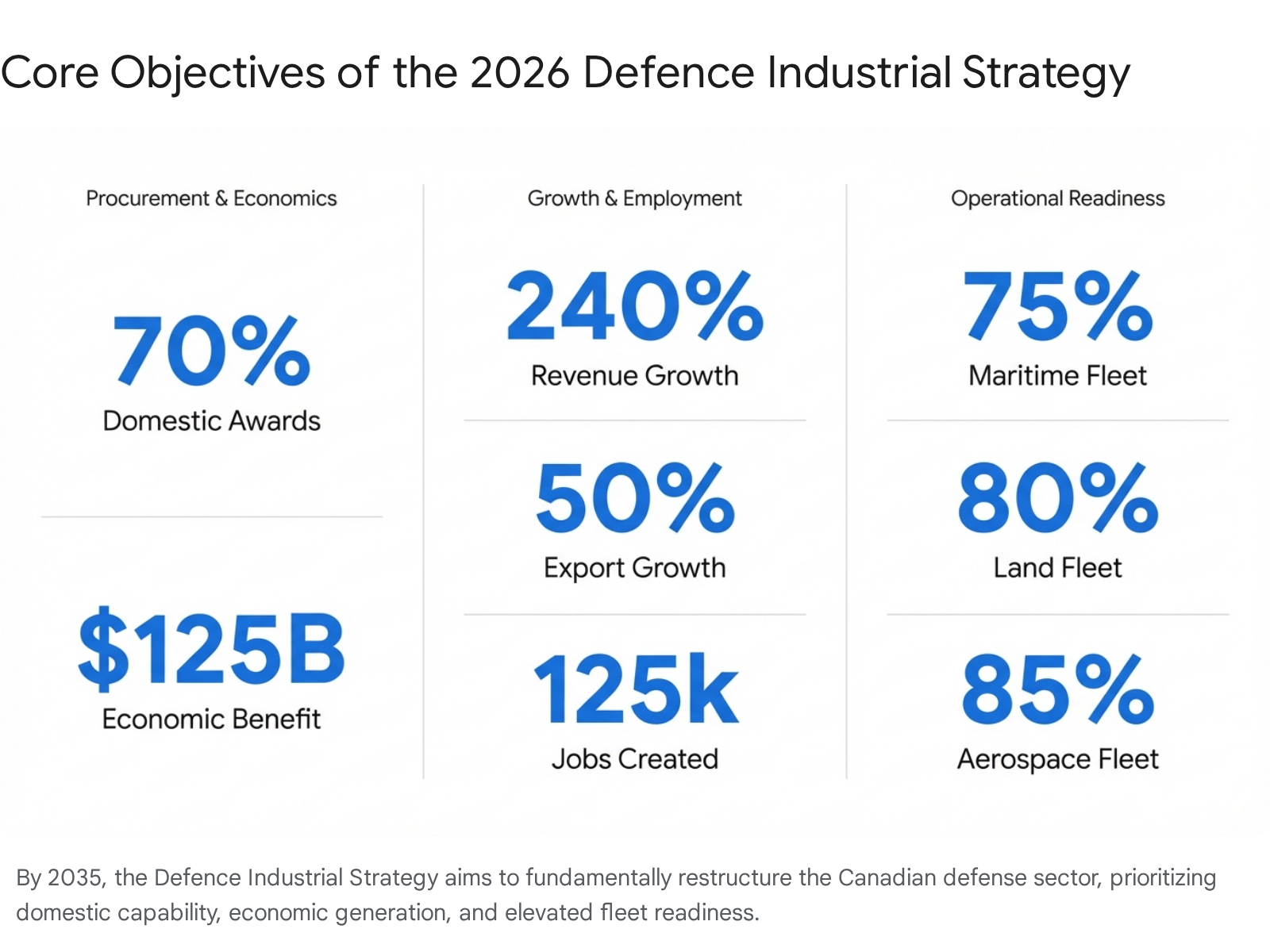
The strategic vision of the DIS is anchored by aggressive, decade-long quantitative targets. Most notably, the strategy sets a hard mandate to raise the share of federal defense acquisitions awarded to Canadian firms to 70 percent.1 From an economic perspective, the strategy is designed to increase total Canadian defense industry revenues by more than 240 percent, boost defense-related exports by 50 percent, and generate 125,000 high-paying, highly skilled careers across the supply chain, ranging from advanced manufacturing welders to quantum research scientists.1 Operationally, the DIS seeks to rectify chronic CAF equipment shortfalls, establishing targets to raise maritime fleet serviceability to 75 percent, land fleets to 80 percent, and aerospace fleets to 85 percent within a decade to meet pressing training and operational readiness requirements.1
To execute this massive industrial pivot, the federal government is dismantling the historically convoluted, slow, and multi-departmental defense procurement process.1 Central to this reform is the establishment of the Defence Investment Agency (DIA), which will act as a standalone, centralized entity to manage procurement.1 Expected to be formally legislated this spring, the DIA will function as the single point of contact for defense acquisitions, tasked with cutting bureaucratic red tape, drastically accelerating the delivery of equipment to the CAF, and prioritizing manufacturing partnerships with Canadian small and medium-sized enterprises (SMEs).1 The DIA will also oversee a permanent Defence Advisory Forum to maintain constant dialogue with industry leaders and accelerate the security clearance processes for defense sector personnel, a critical bottleneck that has historically stifled sector growth.1 In immediate, tangible steps toward supply chain resilience, the strategy also includes the launch of the Canadian Defence Industry Resilience Program, which has already initiated the domestic production of nitrocellulose, a critical chemical precursor required for artillery munitions.1
1.3 The BOREALIS Initiative and Deep Tech Integration
Recognizing that future conflicts will be determined by supremacy in frontier technologies, the Department of National Defence has established the Bureau of Research, Engineering and Advanced Leadership in Innovation and Science (BOREALIS).7 BOREALIS is mandated to align federal innovation efforts toward specific military mission needs and connect partners across government, academia, and private industry.10 On February 18, 2026, BOREALIS issued a $50 million Call for Proposals (CFP) to establish new Defence Innovation Secure Hubs (DISHs).9
Delivered through the Innovation in Defence Excellence and Security (IDEaS) program, this non-repayable contribution funding is specifically targeted at advancing mission-focused research in two critical domains: quantum technologies and uncrewed systems (UxS).9 Canada possesses globally recognized research capabilities in quantum sensing, communications, computing, and cryptography; however, transitioning these laboratory demonstrations into ruggedized defense applications requires Level II (Secret) cleared facilities.9 The DISH initiative will provide these trusted environments, allowing innovators direct access to CAF end-users for rapid integration and testing.9 Similarly, the UxS stream aims to overcome operational challenges inherent in drone warfare, such as electronic warfare vulnerabilities, limited endurance, interoperability, and the development of robust counter-UxS capabilities to protect Canadian assets from asymmetric threats.9 This new CFP builds upon the precedent set in November 2025, when the first Maritime DISH was established at the Centre for Ocean Ventures and Entrepreneurship (COVE) in Halifax with $29.4 million in funding.11
1.4 The BDC’s $4 Billion Capital Mobilization
To ensure the private sector has the necessary capital to meet the government’s ambitious 70 percent domestic procurement target, the Business Development Bank of Canada (BDC) officially launched a $4 billion Defence Platform.12 This unprecedented capital mobilization is designed to eliminate the structural financing bottlenecks that have historically marginalized Canadian defense startups, as traditional private venture capital frequently avoids the defense sector due to extended procurement cycles and stringent security regulations.14
The BDC platform allocates $3.5 billion strictly toward financing and advisory services, intended to allow Canadian SMEs to scale their manufacturing baselines, diversify their product offerings, and integrate seamlessly into the value chains of major national sovereignty projects.12 The remaining $500 million is segmented into targeted venture capital investment vehicles designed to accelerate defense innovation.12 This includes the newly formed StrongNorth Fund, a venture capital fund focusing explicitly on dual-use deep technologies, and the Catalyst Innovation Fund, which is engineered to serve as an innovation catalyst for the sector’s early-stage startup ecosystem.12 By establishing this platform, the BDC is effectively underwriting the technological and manufacturing risk associated with the government’s transition toward defense autarky.
2.0 The Transatlantic Alliance and the NATO 5 Percent Commitment
2.1 The Strategic Architecture of the 5 Percent Pledge
In parallel with its domestic industrial overhaul, Canada has dramatically escalated its international security commitments. At the NATO Summit in The Hague, Prime Minister Carney formally announced that Canada, alongside its NATO allies, has agreed to a revolutionary new Defence Investment Pledge: committing 5 percent of the nation’s annual GDP to defense and defense-related spending by 2035.16 This pledge represents a profound escalation from the traditional 2 percent benchmark, fundamentally redefining the scope and scale of allied burden-sharing.
The 5 percent target is not solely allocated to traditional kinetic military expenditures. The framework intelligently divides the commitment into two distinct tranches: 3.5 percent dedicated to core military spending and capabilities, and 1.5 percent allocated for broader, defense-related strategic investments.18 This 1.5 percent tranche encompasses critical modern security domains, explicitly including the protection of domestic critical infrastructure, the defense of national cyber networks, ensuring civil preparedness and resilience, and direct investments to unleash innovation within the defense industrial base.18 This bifurcated approach allows Canada to categorize its massive domestic investments under the DIS and the BDC’s $4 billion platform directly toward its NATO obligations, synthesizing domestic economic policy with international security treaties.
2.2 Diplomatic Reception and Industrial Realities
The announcement generated an immediate and highly favorable diplomatic response from NATO leadership. NATO Secretary General Mark Rutte publicly commended Canada’s trajectory, explicitly validating that Canada is on track to hit the foundational 2 percent spending target within the current fiscal year, a significant achievement given the country’s historical spending levels hovering around 1.3 to 1.4 percent.20 Referencing Prime Minister Carney’s pledge, Rutte declared that Canada is “really back in NATO, back in defending the transatlantic Alliance”.20
However, beneath the diplomatic triumphs lie severe industrial and logistical realities. Secretary General Rutte issued a stark warning regarding the macroeconomic feasibility of the 5 percent pledge across the alliance, noting that while nations are politically ready, allied defense industrial production is woefully insufficient.20 Rutte explicitly stated that neither the United States nor Europe is currently producing enough materiel to absorb this level of capital injection, pointing out that close allies like Poland are increasingly forced to source advanced weaponry from South Korea because transatlantic supply chains are backlogged and depleted.20 For Canada, fulfilling this 5 percent pledge will rely entirely on the rapid, flawless execution of the Defence Industrial Strategy and the aggressive scaling of domestic manufacturing capacity, ensuring that allocated capital results in tangible operational capabilities rather than administrative bloat.1
2.3 Looming Friction with United States Hegemony
Canada’s aggressive pivot toward domestic preference via the “Build, Partner, Buy” framework, while essential for meeting its NATO obligations, has immediately generated strategic friction with the United States. While Prime Minister Carney has publicly characterized the growth of the Canadian defense industry as strictly complementary to the U.S. military-industrial complex rather than direct competition, Washington has signaled deep systemic reservations.3
On February 13, 2026, the U.S. State Department and the Department of Defense issued a quiet but highly consequential formal rebuke to the European Union regarding its recently revised security directives that favor domestic producers.3 The U.S. submission characterized these “buy European” policies as inherently “protectionist and exclusionary,” arguing that they strong-arm American defense firms out of allied markets and weaken the broader ties between the U.S. and NATO.3 Washington explicitly threatened retaliation if EU member states adopted policies that structurally disadvantaged American defense contractors.3
This action serves as a severe warning shot across the bow for Ottawa. Because the Canadian defense industrial base has historically functioned as a highly integrated subsidiary network for American defense giants—producing components that flow seamlessly southward—any legislative attempt to ring-fence Canadian procurement risks triggering immediate retaliatory measures.3 This tension is exacerbated by U.S. President Donald Trump, who recently signed an executive order designed to ruthlessly reinforce the United States as the global “arms-maker of choice”.3 Trump’s order aims to expedite Washington’s decision-making for weapon sales, deliberately prioritizing the customer list in favor of allied countries with high defense spending.3 Consequently, Canada finds itself navigating an exceptionally narrow diplomatic corridor: it must drastically expand its sovereign defense industry to satisfy NATO demands and domestic economic goals, while simultaneously avoiding triggering punitive protectionist trade measures from a highly aggressive U.S. administration. To mitigate this risk, Canadian defense analysts suggest Ottawa may increasingly leverage international models, such as South Korea’s Defense Acquisition Program Administration (DAPA) or Sweden’s hybrid model with Saab, and expand co-production partnerships into the Indo-Pacific to offset total reliance on the volatile U.S. political landscape.3
3.0 Geoeconomics, Trade Volatility, and the Demise of IEEPA
3.1 The Supreme Court Invalidation of IEEPA Tariffs
The global macroeconomic environment experienced a seismic and unprecedented legal shock on February 20, 2026, when the United States Supreme Court issued its ruling in Learning Resources, Inc. v. Trump.22 In a decisive 6-3 decision authored by Chief Justice John Roberts, the Court struck down the Trump administration’s utilization of the International Emergency Economic Powers Act (IEEPA) to unilaterally impose sweeping global tariffs.22
The Court definitively held that the 1977 IEEPA statute—which was designed to grant the executive branch the authority to regulate commerce during national emergencies created by foreign threats—does not implicitly or explicitly authorize the President to impose taxation in the form of tariffs.22 The majority opinion noted that interpreting the word “regulate” within the statute to include “taxation” would render portions of the Act unconstitutional and pointed to the lack of historical precedent, noting that in nearly fifty years, no previous president had utilized IEEPA for tariff implementation.22 This ruling immediately invalidated the sweeping “reciprocal” tariffs imposed on a vast array of U.S. trading partners, as well as specific tariffs levied against China, Canada, and Mexico purportedly related to immigration and the importation of illicit opioids.22
The economic implications of this ruling are staggering. Economic models estimated that the illegal IEEPA tariffs had already extracted over $160 billion in revenue for the U.S. federal government and would have shrunk long-run U.S. GDP by 0.3 percent if left unabated.23 The invalidation shields the global economy from massive structural damage and raises the highly contentious issue of refunds for importers who paid the unlawful duties.22 In his dissenting opinion, Justice Brett Kavanaugh explicitly warned that the federal government might be required to refund billions of dollars, generating profound uncertainty regarding various international trade agreements.23 The mechanics of this reimbursement process remain entirely unresolved and are expected to trigger years of complex litigation in the U.S. Court of International Trade.22
3.2 The Immediate Invocation of Section 122
The relief provided to international markets by the Supreme Court was highly ephemeral. In a press conference immediately following the decision, a visibly defiant President Trump characterized the ruling as “deeply disappointing” and stated he was “ashamed” of the conservative justices who voted against his administration.25 Within hours, the White House executed a rapid legal pivot, with the President signing a new executive order imposing a blanket 10 percent global tariff under a different legal authority: Section 122 of the Trade Act of 1974.24
Section 122 authorizes the President to impose temporary, global tariffs specifically to address major balance-of-payments issues or perceived unfair trading practices.30 However, unlike the unbounded authority claimed under IEEPA, Section 122 contains strict statutory limitations: tariffs are capped at a maximum of 15 percent and can only remain in effect for a maximum duration of 150 days, absent explicit congressional approval for their extension.24 The new 10 percent global levies were scheduled to take effect on February 24, 2026.29 Furthermore, the administration signaled its intent to aggressively utilize other statutory tools, initiating new investigations under Section 301 of the Trade Act of 1974 and threatening action under Section 338 of the Tariff Act of 1930.24
3.3 The CUSMA Exemption and Canadian Strategic Positioning
Crucially for Canadian economic and national security, the White House released a fact sheet confirming that goods compliant with the Canada-United States-Mexico Agreement (CUSMA) originating from Canada and Mexico are explicitly exempted from the newly imposed Section 122 global tariffs.29 This vital exemption, combined with the judicial termination of the IEEPA levies, represents a significant, albeit potentially temporary, stabilization for Canadian exporters and manufacturers who rely on highly integrated, cross-border supply chains.
The domestic political reaction in Canada was one of cautious optimism. Several provincial leaders, including Ontario Premier Doug Ford, Alberta Premier Danielle Smith, and British Columbia Premier David Eby, publicly praised the Supreme Court’s decision.29 Premier Smith specifically expressed hope that the ruling would safeguard the tariff-free movement of CUSMA goods and help get bilateral trade negotiations “back on track”.29 At the federal level, Conservative Leader Pierre Poilievre called the ruling a “step in the right direction,” while emphasizing that critical work remains to protect the broader Canadian economy.25
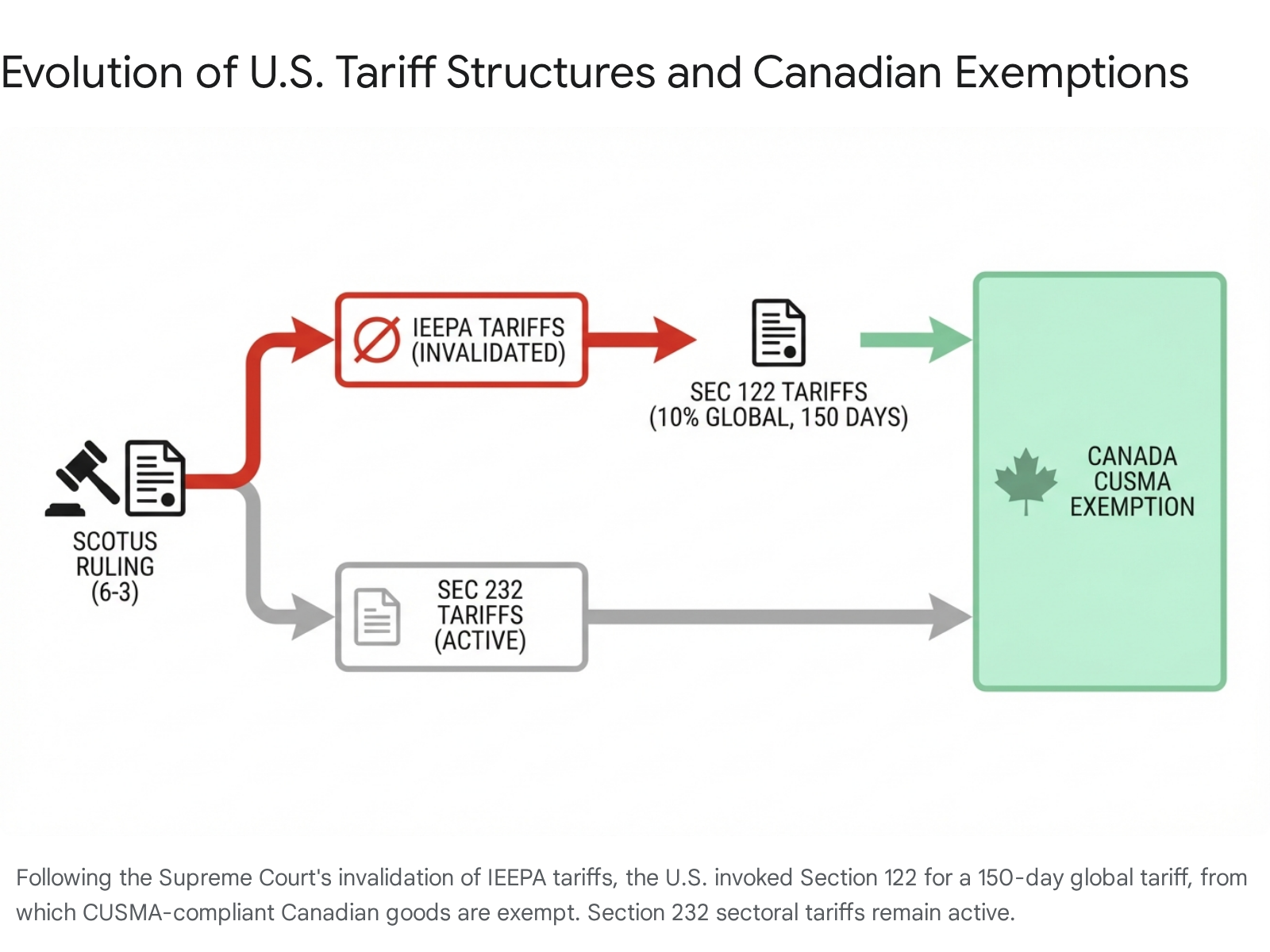
Despite this temporary reprieve, profound geoeconomic uncertainty persists. Analysts caution against assuming this represents a permanent upside risk to Canadian growth.27 Most critically, the targeted, industry-specific tariffs imposed under Section 232 of the Trade Expansion Act of 1962—which allows tariffs on imports deemed to threaten U.S. national security—remain firmly in place and entirely unaffected by the Supreme Court ruling.24 The continued presence of Section 232 tariffs on vital Canadian sectors, primarily steel and aluminum, ensures that the bilateral trade relationship remains highly volatile.32 In response to this ongoing reality, Canada has maintained its own retaliatory countermeasures on U.S. steel and aluminum, even after voluntarily removing counter-tariffs on $44.2 billion worth of other U.S. goods in September 2025 as a gesture of goodwill in recognition of the broader CUSMA compliance framework.33 As the scheduled CUSMA review approaches, the U.S. executive branch retains multiple statutory tools to reconstruct a punitive tariff regime, cementing trade uncertainty as the foundational baseline for Canadian macroeconomic planning.27
4.0 Trade Restructuring and Monetary Policy Response
4.1 Trade Balance Analytics and Market Diversification
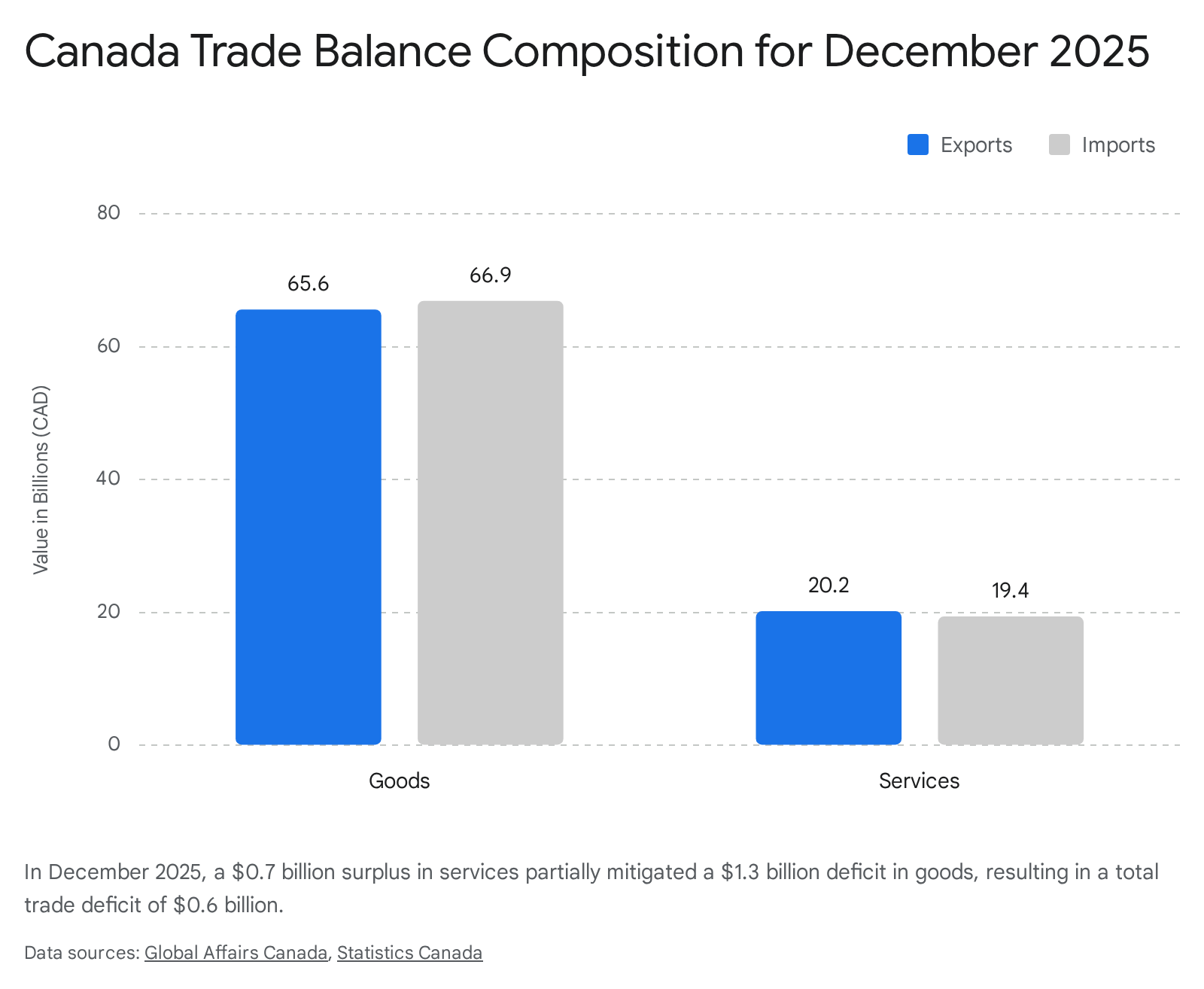
The intense volatility of the United States market is directly quantifiable within Canada’s most recent international trade data. In December 2025, the Canadian merchandise trade deficit narrowed to $1.3 billion, a sequential improvement from the $2.6 billion deficit recorded in November, capping off a highly turbulent year characterized by severe trade disruptions and aggressive inventory fluctuations.34 Total exports of goods increased by 2.6 percent to reach $65.6 billion, driven almost entirely by significant surges in the export of metal and non-metallic mineral products—specifically gold—to both the United States and the United Kingdom.34 When factoring in the services sector, which generated a $0.7 billion surplus in December (driven by increased non-financial commercial services), the combined trade balance for goods and services amounted to a manageable deficit of $0.6 billion for the month.34
| Category (December 2025) | Exports ($ billions) | Monthly Change (%) | Imports ($ billions) | Monthly Change (%) | Balance ($ billions) |
| Goods | 65.6 | 2.6 | 66.9 | 0.6 | -1.3 |
| Services | 20.2 | 0.8 | 19.4 | -2.2 | 0.7 |
| Total | 85.8 | 2.2 | 86.4 | 0.0 | -0.6 |
| Table 1: Canadian International Trade Performance for December 2025.34 |
While the monthly data offers a snapshot of stability, the annualized data reveals the profound structural impact of global trade hostilities. Throughout 2025, total Canadian goods and services exports rose a modest 0.6 percent, largely supported by a solid 3.2 percent gain in services exports.34 However, annual goods exports to the United States fell by a concerning 5.8 percent, a direct consequence of the tariff regimes and deteriorating bilateral trade predictability.36 Notably, this severe decline was almost entirely mitigated by a robust 17.2 percent increase in exports to non-U.S. markets, alongside a 14.3 percent increase in total merchandise trade activity with the rest of the world.36 As a direct result of this forced market diversification, the U.S. share of Canadian goods exports plummeted by 4.2 percentage points to 71.7 percent in 2025—the lowest proportional reliance on the American market since the early 1980s.36
4.2 Monetary Policy and Structural Adjustment
The Bank of Canada’s January 2026 Monetary Policy Report underscores the friction and economic pain inherent in this forced restructuring. The central bank explicitly assesses that U.S. trade restrictions have fundamentally disrupted the Canadian economy, necessitating a painful structural adjustment that will take years to fully unfold.38 This restructuring requires massive capital reallocation to develop new logistics networks, establish alternative supply chains, and gradually shift domestic workers from industries heavily targeted by U.S. tariffs toward entirely new, globally competitive sectors.38
The macroeconomic toll of this transition is significant. The Bank of Canada projects that the persistent negative impacts of U.S. trade volatility will result in the nation’s GDP being approximately 1.5 percent lower by the end of 2026 than was originally forecast in early 2025.38 Despite these severe headwinds, domestic monetary conditions show signs of stabilization. The central bank held its key interest rate steady at 2.25 percent in early 2026, with the deposit rate at 2.2 percent.39 Inflationary pressures have demonstrably eased, with the Consumer Price Index (CPI) growing at 2.3 percent in January, a deceleration from 2.4 percent in December 2025.39 Real per-capita improvements and relatively stable labor conditions—highlighted by an unemployment rate that fell by 0.3 percentage points to 6.5 percent in January as fewer individuals searched for work—are expected to support broadly positive, albeit modest, Canadian growth throughout the year, limiting the immediate necessity for central bank rate cuts.38
5.0 The Foreign Interference Threat Landscape
5.1 Escalating State-Sponsored Subversion
Within the domestic security domain, the Canadian intelligence apparatus continues to issue increasingly stark warnings regarding the pervasive and escalating threat of foreign interference. The Canadian Security Intelligence Service (CSIS) officially assesses that clandestine activities directed at Canada’s democratic institutions, political systems, and societal fabric are intensifying, driven by the complex realities of the modern geopolitical environment.41 According to comprehensive intelligence assessments and recent public inquiries, state actors—most notably the People’s Republic of China (PRC) and Pakistan—are utilizing highly sophisticated, multifaceted methodologies to achieve strategic objectives on Canadian soil.41
These hostile activities manifest through various vectors, primarily targeting all levels of government, civil society, academic institutions, and strategically vital ethnic diaspora communities.41 CSIS reports that foreign intelligence services routinely attempt to intimidate Canadian ethnic communities to suppress dissent against their respective foreign governments, recruit local agents, and covertly manipulate Canadian domestic and foreign policy decisions.43 The tactics deployed include elite capture of influential political and business figures, the proliferation of sophisticated disinformation campaigns designed to erode public trust, and the execution of egregious acts of transnational repression.42 In response to these persistent threats, CSIS confirmed the deployment of highly classified threat reduction measures (TRMs), including successful operations executed between 2018 and 2023 to disrupt Pakistan’s efforts to suppress dissidents residing in Canada.43
5.2 Intelligence Gaps and Political Integrity
The structural vulnerabilities within Canada’s defense against subversion have been painfully exposed by the ongoing Public Inquiry into Foreign Interference in Federal Electoral Processes and Democratic Institutions (PIFI) and the findings of the National Security and Intelligence Committee of Parliamentarians (NSICOP).42 The intelligence community suffered a profound crisis of credibility following the revelation that Member of Parliament Michael Chong and his family were actively targeted by PRC operatives due to his vocal criticism of Beijing’s policies toward the Uighur population.45 Crucially, while CSIS had collected this intelligence in 2021, Chong was never informed that he was a specific target, receiving only a generalized defensive briefing.45 This incident highlighted severe systemic gaps in how the national security community tracks, disseminates, and responds to immediate threats against elected officials.45
This intelligence failure is compounded by explosive findings from the June 2024 NSICOP report, which documented that several parliamentarians—both “witting and semi-witting”—had actively engaged with foreign state actors to influence parliamentary business.42 Against this backdrop of heightened suspicion, recent domestic political volatility has taken on severe national security overtones. The week of February 18, 2026, saw Edmonton Conservative MP Matt Jeneroux cross the floor to join the Liberal caucus, becoming the third Conservative to defect in recent months.46
While parliamentary floor crossings are a legal and historical feature of the Canadian political system, the current climate has amplified public and analytical scrutiny. Intelligence analysts and political commentators point to the earlier defection of Markham–Unionville MP Michael Ma, who crossed the floor in late 2025 and subsequently accompanied the federal government on diplomatic travel to China.47 For an electorate already grappling with validated reports of United Front penetration and covert influence, such rapid political realignments invite profound questions regarding the integrity of the democratic mandate.47 The perception—whether factual or optical—that political transitions may serve strategic realignments influenced by external actors serves as a potent vector for democratic destabilization, slowly eroding the foundational credibility of Canadian institutions.42
5.3 NSIRA Review of the Passenger Protect Program
While CSIS focuses on external state threats, the balance between proactive domestic security and civil liberties was scrutinized by the National Security and Intelligence Review Agency (NSIRA). The agency released a highly critical report evaluating the Passenger Protect Program, commonly known as the national “no-fly list”.48 The program empowers the federal government to bar individuals deemed a threat to aviation security from boarding commercial flights.48
NSIRA’s investigation concluded that the federal government has, in certain instances, retained individuals on the no-fly list without lawful justification.48 While the review body praised recent systemic improvements—such as the implementation of centralized passenger screening which has demonstrably reduced administrative errors and improved overall security protocols—it issued ten binding recommendations demanding the clarification of roles and responsibilities, specifically regarding the establishment of transparent, legally sound protocols for the removal of names from the list.48 This oversight highlights the persistent tension within the national security apparatus: the necessity to aggressively preempt kinetic threats while maintaining the constitutional freedoms required for public trust.48
6.0 Border Security, Transnational Crime, and Extortion
6.1 Transnational Narcotics Interdiction
The integrity of the physical continental border remains a paramount operational concern for Canadian law enforcement, underscored by a major interdiction event in Southern Ontario. On February 4, 2026, a commercial truck arriving from the United States was referred for secondary examination by Canada Border Services Agency (CBSA) officers operating at the Blue Water Bridge port of entry in Point Edward.49
Utilizing specialized detector dog units to sweep the trailer, border services officers discovered 16 duffle bags deeply concealed within the cargo, containing an aggregated 266.4 kilograms (approximately 587 pounds) of suspected methamphetamine.49 The operator of the vehicle, a 29-year-old Canadian national named Kulbir Singh from Woodstock, Ontario, was immediately arrested by the CBSA and subsequently transferred to the jurisdiction of the Royal Canadian Mounted Police (RCMP).49 Singh has been formally charged under the Controlled Drugs and Substances Act with the importation of methamphetamine and possession of methamphetamine for the purpose of trafficking.49 This massive seizure represents a highly significant disruption to the logistical supply chains of transnational organized crime syndicates operating within the vital Great Lakes commercial corridor. The CBSA reports that this incident is part of a broader, escalating trend of synthetic narcotics trafficking, noting that officers in Southern Ontario have intercepted over 616.5 kilograms of methamphetamine originating from the United States since January 1, 2025.49 This domestic interdiction mirrors broader continental pressures, as U.S. Customs and Border Protection (CBP) recently intercepted 662 pounds of methamphetamine, valued at nearly $6 million, at the World Trade Bridge in Laredo, Texas, illustrating the massive scale of synthetic drug flows currently moving across North American logistical networks.52
6.2 The FINTRAC Mandate Against Digital Extortion
In direct response to the escalating, asymmetric threat posed by organized extortion networks, the federal government initiated enhanced financial law enforcement mandates on February 20, 2026.53 Extortion has evolved from localized physical intimidation into highly sophisticated operations executed by organized networks operating across international borders and leveraging anonymized digital platforms.53 To combat this, the Honourable Ruby Sahota, Secretary of State for Combatting Crime, announced the mobilization of the Financial Transactions and Reports Analysis Centre of Canada (FINTRAC) to aggressively prioritize financial intelligence resources specifically targeted at dismantling these extortion rings.53
A foundational component of this new strategy is the launch of the Countering Extortion Partnership.53 This collaborative framework requires FINTRAC to integrate its intelligence operations deeply with Canadian banks, credit unions, and crucially, financial service providers dealing in virtual assets and cryptocurrencies.53 By fusing transaction data across these domains alongside partners such as the Office of the Superintendent of Financial Institutions (OSFI) and the RCMP, the government aims to systematically trace the complex, cross-border illicit financial flows that sustain modern extortion. This capability will equip local and federal law enforcement with the timely, actionable financial intelligence required to hold transnational perpetrators accountable and disrupt the economic incentive structures of digital crime.53
7.0 Cyber Resilience and Information Warfare Realities
7.1 The Evolving Ransomware Ecosystem
The digital threat landscape facing Canadian institutions continues to deteriorate, driven by rapid technological proliferation and the ruthless commercialization of cybercrime. On January 28, 2026, the Canadian Centre for Cyber Security—a branch of the Communications Security Establishment (CSE)—released its highly anticipated Ransomware Threat Outlook 2025 to 2027.54 The intelligence assessment unequivocally states that ransomware will remain a severe, persistent, and growing threat to all sectors of the Canadian economy over the next two years.54
The CSE assesses that the modern ransomware ecosystem has evolved from isolated attacks into a highly sophisticated, interconnected, and heavily franchised criminal industry.54 Opportunistic, financially motivated threat actors are aggressively adopting advanced technologies to scale their operations. Most notably, the integration of artificial intelligence (AI) has fundamentally altered the offensive paradigm, making sophisticated cyberattacks drastically cheaper to execute, significantly faster to deploy, and substantially harder for traditional network defenses to detect.54 Furthermore, the continued reliance on decentralized cryptocurrencies for ransom payments provides the necessary financial anonymity to sustain and incentivize the illicit economy.54 The CSE report stresses that while basic cyber hygiene—such as the rigorous implementation of regular software updates, mandatory multi-factor authentication (MFA), and robust anti-phishing protocols—remains highly effective against broad-spectrum attacks, true resilience requires deep, sustained collaboration between government agencies, private sector entities, and international law enforcement.54 The governance of AI systems and cybersecurity is no longer merely an IT operational issue; it has escalated to a critical, board-level fiduciary responsibility, with corporate directors now facing intense scrutiny over their oversight of “AI sovereignty” and internal data management practices.56
7.2 International Cyber Capacity Building and Indo-Pacific Strategy
Recognizing that cyber threats are inherently borderless and that domestic resilience relies on the strength of international networks, Canada is actively exporting its cybersecurity expertise to strategic regional partners. On February 18, 2026, Sami Khoury, Canada’s Senior Official for Cyber Security at the CSE, held high-level meetings with Philippine defense officials at Camp Aguinaldo.57 This engagement was designed to operationalize the defense partnerships formally established under the November 2025 Philippines–Canada Status of Visiting Forces Agreement.57
The bilateral discussions focused intensely on resilience-building mechanisms, the establishment of protocols for the regular exchange of strategic cyber threat intelligence, and the institutionalization of joint training programs.57 This cooperation is highly pertinent and strategically timed given the geopolitical context in the Indo-Pacific. Philippine Armed Forces intelligence recently issued stark warnings regarding intensifying cyberattacks directly linked to state-sponsored actors based in the PRC.57 These malicious actors are actively deploying advanced malware, distributed denial-of-service (DDoS) attacks, and targeted data leaks specifically designed to advance Beijing’s territorial ambitions and destabilize the West Philippine Sea.57 By actively bolstering allied cyber defenses in the contested Indo-Pacific theater, Canada indirectly fortifies its own digital perimeter, counters PRC power projection, and firmly asserts its role as a stabilizing technological force on the global stage.57
8.0 Diplomatic Posture and Domestic Developments
8.1 Strategic Diplomatic Appointments
In direct alignment with the objectives of the Defence Industrial Strategy and the aggressive NATO spending pledge, the federal government executed a strategic and highly calculated reshuffling of its diplomatic corps. On February 2, 2026, Prime Minister Carney formally announced the intended appointments of the Honourable Bill Blair as High Commissioner for Canada in the United Kingdom, and Nathalie G. Drouin as Ambassador to France and Monaco.58
These senior appointments underscore a deliberate geopolitical focus on fortifying defense and commercial interoperability with tier-one European allies.58 Blair’s unique profile—encompassing four decades of security experience, including highly relevant tenures as the federal Minister of National Defence and Minister of Public Safety—signals unequivocally to London that Canada intends to pursue deeply integrated, operational security cooperation.58 Similarly, Drouin’s extensive background as the National Security and Intelligence Advisor to the Prime Minister, and her central, hands-on role in designing and implementing the current government’s foreign policy strategy, uniquely positions her to navigate complex transatlantic defense procurement negotiations with Paris.58 These diplomatic maneuvers illustrate an active, coordinated effort to diversify Canada’s geopolitical reliance, establishing firmer multilateral anchors in Europe to counterbalance the immense volatility of the North American dynamic.58
8.2 Expanding Arctic Sovereignty
Demonstrating an increased and necessary focus on Northern security and regional partnerships, Canada has formalized and escalated its diplomatic presence in Greenland. Julie Crôteau, operating as Canada’s acting consul in the newly established consulate in the capital of Nuuk, highlighted that the initial “micro mission” is rapidly transitioning into a phase of intensive, continuous on-the-ground presence.59 The consulate is mandated to generate concrete economic gains by expanding trade and cultural ties with the Danish territory, advising Ottawa intelligence desks on local political nuances, and navigating the vast complexities of Arctic sovereignty.59 This presence is a vital intelligence and diplomatic node, establishing a firm Canadian footprint as the polar routes become increasingly viable and heavily contested domains for great-power maritime and resource competition.59
8.3 The Recalibration of Sino-Canadian Relations
The diplomatic posture toward the People’s Republic of China (PRC) has entered a highly delicate phase of pragmatic recalibration, largely precipitated by Prime Minister Carney’s high-stakes visit to Beijing in January 2026.60 Foreign affairs analysts note that the visit exceeded modest expectations, resulting in the successful restart of stalled high-level dialogue mechanisms and yielding preliminary economic agreements regarding the reduction of punitive canola tariffs and the controlled access of Chinese electric vehicles to Canadian markets.60
However, this engagement is strictly interest-based and heavily compartmentalized. Ottawa is attempting to execute a nearly impossible balancing act: securing the lucrative economic dividends of selective engagement with the world’s second-largest economy, while simultaneously managing intense pressure from the United States to decouple entirely from Chinese technological supply chains.60 The ultimate durability of this pragmatic turn will be severely tested by Canada’s ability to ruthlessly enforce domestic security guardrails against documented PRC espionage and interference operations, while reassuring its Indo-Pacific and European partners of its unwavering strategic reliability within the broader Western alliance.60
8.4 Domestic Flashpoints: Education Funding and the Electoral Calendar
At the provincial level, domestic stability faces localized but intense pressure due to highly controversial alterations in education funding mechanisms. In Ontario, massive student unions and advocacy groups have rapidly mobilized to protest the provincial government’s sweeping overhaul of the Ontario Student Assistance Program (OSAP).61 Premier Doug Ford’s administration recently announced a $6.4 billion funding commitment over four years to stabilize post-secondary institutions, but simultaneously lifted a popular seven-year tuition freeze and radically altered the fundamental structure of student financial aid.61
The policy shift will drastically decrease the proportion of non-repayable grants offered through OSAP from an average of 85 percent down to a maximum of 25 percent by the upcoming fall term, shifting the immense financial burden heavily toward repayable, interest-bearing loans.61 While the provincial government argues these austere measures are absolutely vital to salvage an educational sector facing the very real prospect of multiple institutional bankruptcies and closures, student organizers warn the changes will completely jeopardize access to higher education.61 Advocates highlight that students in highly intensive, prolonged programs, particularly within STEM and medical fields, face severe financial distress, leading to planned demonstrations and coordinated political pushback across major university campuses.61
Politically, the federal and provincial landscapes remain active, characterized by a steady rhythm of localized electoral tests. The political calendar for the early weeks of 2026 included highly contested municipal by-elections in jurisdictions such as Saint-Cyrille-de-Wendover in Quebec, and Electoral Area A within the Cariboo Regional District of British Columbia, serving as micro-indicators of voter sentiment amid broader national economic anxieties.62
8.5 Infrastructure and International Sporting Events
In routine domestic governance, the federal government continued to execute targeted infrastructure and environmental resiliency investments. On February 20, 2026, Public Safety Canada announced substantial new funding initiatives designed to severely bolster the pan-Canadian aerial wildfire firefighting capacity.63 This represents a critical, proactive investment following the devastating and economically catastrophic fire seasons of recent years, acknowledging that climate-induced natural disasters are now treated as tier-one national security and economic threats.63
Finally, on the international sporting and cultural stage, national attention was briefly diverted to the athletic achievements and physical well-being of the Canadian delegation competing at the Milano Cortina 2026 Winter Olympics. On February 21, 2026, the Canadian Olympic Committee (COC) and Freestyle Canada issued a joint public statement regarding the status of three-time Olympian and freestyle skiing champion Cassie Sharpe.64 Sharpe experienced a concerning medical incident during competition that necessitated a brief, precautionary hospitalization in the mountain municipality of Livigno, Italy.64 While the COC confirmed that she has been safely released and returned to the Athlete Village, medical staff definitively ruled her out of participating in the highly anticipated finals, marking a somber conclusion to the games for one of Canada’s premier winter athletes.64 Simultaneously, domestic infrastructure illumination projects, such as the special lighting of the Samuel De Champlain Bridge in Montreal, were programmed to celebrate the formal closing ceremonies of the 2026 Winter Olympics, highlighting ongoing civic engagement initiatives amidst a week otherwise dominated by severe geopolitical and economic recalibration.63
Please share the link on Facebook, Forums, with colleagues, etc. Your support is much appreciated and if you have any feedback, please email us in**@*********ps.com. If you’d like to request a report or order a reprint, please click here for the corresponding page to open in new tab.
Sources Used
- Prime Minister Carney launches Canada’s first Defence Industrial …, accessed February 21, 2026, https://www.pm.gc.ca/en/news/news-releases/2026/02/17/prime-minister-carney-launches-canadas-first-defence-industrial
- Canada advances Defence Industrial Strategy to strengthen security …, accessed February 21, 2026, https://www.canada.ca/en/global-affairs/news/2026/02/canada-advances-defence-industrial-strategy-to-strengthen-security-sovereignty-and-prosperity.html
- Warning Shot: How Canada fits into Washington’s rebuke of the EU’s ‘buy European’ defence drive, accessed February 21, 2026, https://www.cbc.ca/news/politics/defence-industry-europe-trump-arms-warning-9.7100449
- Canada’s New Defence Industrial Strategy: What Business Needs to Know, accessed February 21, 2026, https://cassels.com/insights/canadas-new-defence-industrial-strategy-what-business-needs-to-know/
- Canada’s Defence Industrial Strategy Needs an Indo-Pacific Gear, accessed February 21, 2026, https://www.asiapacific.ca/publication/canadas-defence-industrial-strategy-needs-indo-pacific-consideration
- Canada’s Defence Industrial Strategy, accessed February 21, 2026, https://www.canada.ca/en/department-national-defence/corporate/reports-publications/industrial-strategy/security-sovereignty-prosperity.html
- Prime Minister Carney announces the launch of Canada’s first Defence Industrial Strategy, accessed February 21, 2026, https://www.pm.gc.ca/en/news/speeches/2026/02/17/prime-minister-carney-announces-launch-canadas-first-defence-industrial
- What is Canada’s new Domestic Defence Industrial Strategy?, accessed February 21, 2026, https://procurementmag.com/news/canada-launched-domestic-defence-industrial-strategy
- Government of Canada launches Call for Proposals to establish Defence Innovations Secure Hubs for quantum and uncrewed system technologies, accessed February 21, 2026, https://www.canada.ca/en/department-national-defence/news/2026/02/government-of-canada-launches-call-for-proposals-to-establish-defence-innovations-secure-hubs-for-quantum-and-uncrewed-system-technologies.html
- Bureau of Research, Engineering and Advanced Leadership in Innovation and Science (BOREALIS) – Canada.ca, accessed February 21, 2026, https://www.canada.ca/en/department-national-defence/programs/borealis.html
- DND takes next step for Defence Innovation Secure Hubs, issues $50M challenge, accessed February 21, 2026, https://spaceq.ca/dnd-takes-next-step-for-defence-innovation-secure-hubs-issues-50m-challenge/
- BDC introduces platform to provide $4B to boost Canada’s defence and security ecosystem, accessed February 21, 2026, https://www.bdc.ca/en/about/mediaroom/news-releases/bdc-introduces-platform-to-provide-4b-to-boost-canada-defence-security-ecosystem
- BDC introduces platform to provide $4B to boost Canada’s defence and security ecosystem, accessed February 21, 2026, https://www.globenewswire.com/news-release/2025/12/17/3207288/0/en/BDC-introduces-platform-to-provide-4B-to-boost-Canada-s-defence-and-security-ecosystem.html
- Inside Canada’s C$4B defense investment push – POLITICO Pro, accessed February 21, 2026, https://subscriber.politicopro.com/article/2025/12/inside-canadas-c-4b-defense-investment-push-00699768
- News releases – BDC, accessed February 21, 2026, https://www.bdc.ca/en/about/mediaroom/news-releases
- Canada joins new NATO Defence Investment Pledge, accessed February 21, 2026, https://www.pm.gc.ca/en/news/news-releases/2025/06/25/canada-joins-new-nato-defence-investment-pledg
- Canada promises to spend 5% of GDP on defence by 2035 in pact with NATO leaders, accessed February 21, 2026, https://www.cbc.ca/news/politics/canada-agrees-five-percent-gdp-defence-spending-1.7570191
- NATO needs to define the substance of its 1.5 percent pledge – Atlantic Council, accessed February 21, 2026, https://www.atlanticcouncil.org/dispatches/nato-needs-to-define-the-substance-of-its-1-5-percent-pledge/
- NATO summit: Canada pledges 5% defence spending by 2035 | FULL – YouTube, accessed February 21, 2026, https://www.youtube.com/watch?v=Wukckf6rCY8
- Remarks by NATO Secretary General at World Economic Forum, Davos, accessed February 21, 2026, https://www.nato.int/en/news-and-events/events/transcripts/2026/01/21/nato-secretary-general-at-world-economic-forum-davos
- Forthcoming US arm sales changes leave unanswered questions, accessed February 21, 2026, https://breakingdefense.com/2026/02/forthcoming-us-arm-sales-changes-leave-unanswered-questions/
- Supreme Court Strikes Down IEEPA Tariffs: What Importers Need to Know Now | Insights, accessed February 21, 2026, https://www.hklaw.com/en/insights/publications/2026/02/supreme-court-strikes-down-ieepa-tariffs
- Supreme Court strikes down tariffs, accessed February 21, 2026, https://www.scotusblog.com/2026/02/supreme-court-strikes-down-tariffs/
- Supreme Court Strikes Down IEEPA Tariffs—What Now? – WilmerHale, accessed February 21, 2026, https://www.wilmerhale.com/en/insights/client-alerts/20260220-supreme-court-strikes-down-ieepa-tariffs-what-now
- What does the U.S. court ruling on Trump’s tariffs mean for Canada?, accessed February 21, 2026, https://www.ctvnews.ca/world/trumps-tariffs/article/what-does-the-us-court-ruling-on-trumps-tariffs-mean-for-canada/
- What will happen to Trump’s tariffs after supreme court verdict?, accessed February 21, 2026, https://www.theguardian.com/us-news/2026/feb/20/what-will-happen-to-trump-tariffs-after-supreme-court-verdict
- U.S. Supreme Court Rules Against Broad-Based Country Specific Tariffs Under IEEPA, accessed February 21, 2026, https://economics.td.com/ca-us-supreme-court-ruling-trump-tariffs
- Supreme Court Strikes Down President Trump’s Tariffs, accessed February 21, 2026, https://taxfoundation.org/blog/supreme-court-trump-tariffs-ruling/
- Trump adds 10% global tariff after U.S. Supreme Court decision, but CUSMA-compliment goods are exempt, accessed February 21, 2026, https://www.ctvnews.ca/world/trumps-tariffs/article/trump-adds-10-global-tariff-after-us-supreme-court-decision-but-cusma-compliment-goods-are-exempt/
- Trump Tariff Winds Shifting: Navigating Post-IEEPA Waters After the Supreme Court Decision, accessed February 21, 2026, https://blog.freshfields.us/post/102mjzi/trump-tariff-winds-shifting-navigating-post-ieepa-waters-after-the-supreme-court
- State of Tariffs: February 20, 2026 | The Budget Lab at Yale, accessed February 21, 2026, https://budgetlab.yale.edu/research/state-tariffs-february-20-2026
- Inflation: Still Tariffic, accessed February 21, 2026, https://www.policymagazine.ca/inflation-still-tariffic/
- Canada’s response to U.S. tariffs on Canadian goods, accessed February 21, 2026, https://www.canada.ca/en/department-finance/programs/international-trade-finance-policy/canadas-response-us-tariffs.html
- The Daily — Canadian international trade in services, December 2025, accessed February 21, 2026, https://www150.statcan.gc.ca/n1/daily-quotidien/260219/dq260219d-eng.htm
- Canada’s trade deficit narrowed in December to cap volatile 2025 – RBC Economics, accessed February 21, 2026, https://www.rbc.com/en/economics/canadian-analysis/data-flashes/canadas-trade-deficit-narrowed-in-december-to-cap-volatile-2025/
- Monthly trade report: December 2025 – Affaires mondiales Canada, accessed February 21, 2026, https://international.canada.ca/en/global-affairs/corporate/reports/chief-economist/monthly/2025-12
- The Daily — Canadian international merchandise trade, December 2025, accessed February 21, 2026, https://www150.statcan.gc.ca/n1/daily-quotidien/260219/dq260219a-eng.htm
- Outlook, accessed February 21, 2026, https://www.bankofcanada.ca/publications/mpr/mpr-2026-01-28/canadian-outlook/
- Canadian Economic Calendar – February 2026 – Baystreet.ca, accessed February 21, 2026, https://www.baystreet.ca/articles/econ_calendar.aspx
- RBC Monthly Forecast Update – February 2026, accessed February 21, 2026, https://www.rbcis.com/en/insights/2026/02/monthly-forecast-update-feb26
- Foreign Interference Threats to Canada’s Democratic Process, accessed February 21, 2026, https://www.canada.ca/en/security-intelligence-service/corporate/publications/foreign-interference-threat-to-canadas-democratic-process.html
- Canada under pressure – How the gap in foreign interference response is eroding democracy: Stephen Nagy | Macdonald-Laurier Institute, accessed February 21, 2026, https://macdonaldlaurier.ca/canada-under-pressure-how-the-gap-in-foreign-interference-response-is-eroding-democracy-stephen-nagy/
- CSIS Public Report 2024 – Canada.ca, accessed February 21, 2026, https://www.canada.ca/content/dam/csis-scrs/images/2024publicreport/newest/Public_Report_2024-ENG.pdf
- Exhibits list – Foreign Interference Commission, accessed February 21, 2026, https://foreigninterferencecommission.ca/exhibits-list
- Countering Foreign Interference: Weighing in on the Canadian Public Inquiry, accessed February 21, 2026, https://www.belfercenter.org/research-analysis/countering-foreign-interference-weighing-canadian-public-inquiry
- Canada News archive Feb 15 to 21, 2026 page 20260215 – Castanet.net, accessed February 21, 2026, https://www.castanet.net/news/Canada/20260215/
- From Floor Crossings to Foreign Influence, Canada Faces a Crisis of Integrity: Op-Ed, accessed February 21, 2026, https://www.thebureau.news/p/from-floor-crossings-to-foreign-influence
- Government couldn’t always justify keeping people on no-fly list: watchdog | CBC News, accessed February 21, 2026, https://www.cbc.ca/news/politics/no-fly-list-canada-9.7093885
- CBSA seizes 266 kg of methamphetamine at the Blue Water Bridge – Canada.ca, accessed February 21, 2026, https://www.canada.ca/en/border-services-agency/news/2026/02/cbsa-seizes-266-kg-of-methamphetamine-at-the-blue-water-bridge.html
- Canadian border officers seize nearly 600 pounds of methamphetamine at Blue Water Bridge, accessed February 21, 2026, https://www.cbsnews.com/detroit/news/canadian-border-officers-seize-nearly-600-pounds-methamphetamine-blue-water-bridge/
- Canadian Officials Seize Nearly 600 Pounds of Suspected Meth at US Border, accessed February 21, 2026, https://nationaltoday.com/us/mi/detroit/news/2026/02/21/canadian-officials-seize-nearly-600-pounds-of-suspected-meth-at-us-border/
- CBP officers seize nearly $6 million in methamphetamine at World Trade Bridge, accessed February 21, 2026, https://www.cbp.gov/newsroom/national-media-release/cbp-officers-seize-nearly-6-million-methamphetamine-world-trade
- Government announces new measures to help protect Canadians and businesses against extortion, accessed February 21, 2026, https://www.canada.ca/en/public-safety-canada/news/2026/02/government-announces-new-measures-to-help-protect-canadians-and-businesses-against-extortion.html
- Cyber Centre releases Ransomware Threat Outlook 2025 to 2027 – Canada.ca, accessed February 21, 2026, https://www.canada.ca/en/communications-security/news/2025/12/cyber-centre-releases-ransomware-threat-outlook-2025-to-2027.html
- Ransomware Threat Outlook 2025-2027 – Canadian Centre for Cyber Security, accessed February 21, 2026, https://www.cyber.gc.ca/en/guidance/ransomware-threat-outlook-2025-2027
- Blakes upRound™: February 2026, accessed February 21, 2026, https://www.blakes.com/insights/blakes-upround-february-2026/
- Canada helps boost cyber defense efforts, accessed February 21, 2026, https://tribune.net.ph/2026/02/19/canada-helps-boost-cyber-defense-efforts
- Prime Minister Carney announces upcoming diplomatic appointments, accessed February 21, 2026, https://www.pm.gc.ca/en/news/news-releases/2026/02/02/prime-minister-carney-announces-upcoming-diplomatic-appointments
- In first interview, Canada’s envoy to Greenland says new post seeks …, accessed February 21, 2026, https://toronto.citynews.ca/2026/02/21/in-first-interview-canadas-envoy-to-greenland-says-new-post-seeks-concrete-gains/
- Canada’s pragmatic turn towards China is not without strategic limits …, accessed February 21, 2026, https://eastasiaforum.org/2026/02/21/canadas-pragmatic-turn-towards-china-is-not-without-strategic-limits/
- ‘We’re going to fight back’: Student union responds to Ontario’s changes to financial aid, accessed February 21, 2026, https://www.ctvnews.ca/canada/article/student-groups-say-fords-changes-to-osap-will-jeopardize-ontario-education/
- 2026 Canadian electoral calendar – Wikipedia, accessed February 21, 2026, https://en.wikipedia.org/wiki/2026_Canadian_electoral_calendar
- News – Canada.ca, accessed February 21, 2026, https://www.canada.ca/en/news.html
- Team Canada Update – February 21, accessed February 21, 2026, https://olympic.ca/press/team-canada-update-february-21/
- Geopolitical Calendar – Control Risks, accessed February 21, 2026, https://www.controlrisks.com/our-thinking/geopolitical-calendar