Tag Archives: Canada

SITREP Canada – Week Ending February 21, 2026

Executive Summary

The week ending February 21, 2026, represents a transformative juncture in Canadian statecraft, characterized by structural overhauls in national defense procurement, tectonic shifts in continental trade frameworks, and escalating complexities within the domestic intelligence and security apparatus. The federal government has initiated a sweeping recalibration of its geopolitical and industrial posture, driven by the dual imperatives of deteriorating global stability and an increasingly protectionist United States. Anchoring this strategic pivot is the unveiling of Canada’s first comprehensive Defence Industrial Strategy (DIS). This generational policy mandates a transition away from the country’s historical reliance on foreign military suppliers, instantiating a “Build, Partner, Buy” framework designed to capture 70 percent of federal defense contracts for domestic firms and profoundly expand the nation’s defense-industrial manufacturing base over the next decade. Concurrently, Prime Minister Mark Carney affirmed a historic North Atlantic Treaty Organization (NATO) commitment, agreeing to a 5 percent of gross domestic product (GDP) defense and defense-related spending target by 2035. This pledge, while drawing immediate commendation from NATO leadership, introduces profound macroeconomic execution challenges and risks antagonizing the United States defense-industrial complex.

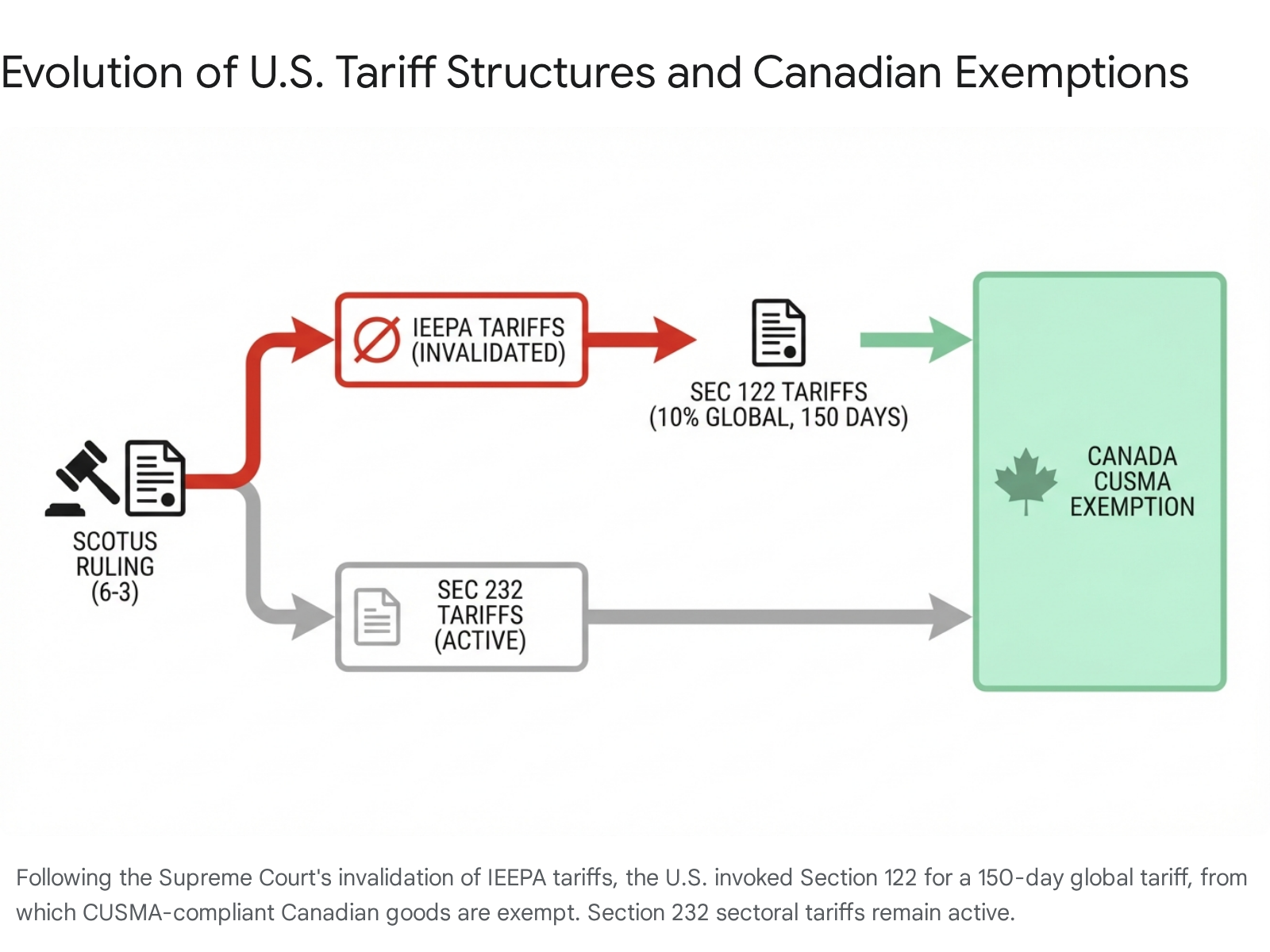
In the realm of geoeconomics, the global market landscape was upended following the United States Supreme Court’s 6-3 decision on February 20, 2026, which invalidated the Trump administration’s utilization of the International Emergency Economic Powers Act (IEEPA) to unilaterally impose global tariffs. While this ruling theoretically shielded the global economy from a projected long-term contraction, the U.S. executive branch orchestrated an immediate retaliatory maneuver by invoking Section 122 of the Trade Act of 1974, applying a 150-day, 10 percent global tariff. Crucially for Canadian economic continuity, goods compliant with the Canada-United States-Mexico Agreement (CUSMA) were explicitly exempted from this new tariff regime, temporarily safeguarding highly integrated cross-border supply chains. Nevertheless, the Bank of Canada anticipates persistent headwinds, maintaining its key interest rate at 2.25 percent as the national economy undergoes the painful structural adjustments required to diversify export markets away from American reliance.

Simultaneously, the Canadian intelligence and domestic security domains face an intensified threat matrix. The Canadian Security Intelligence Service (CSIS) and allied oversight bodies issued stark, public assessments regarding the escalating sophistication of foreign interference. State-sponsored activities, particularly originating from the People’s Republic of China (PRC) and Pakistan, continue to execute campaigns of elite capture, transnational repression, and coordinated disinformation targeting Canadian democratic institutions and diaspora communities. This intelligence posture is further complicated by a volatile domestic political environment grappling with high-profile parliamentary floor crossings that have intensified public scrutiny over political integrity and the potential for covert influence. On the border security front, law enforcement agencies achieved significant interdiction milestones, including the seizure of over 266 kilograms of methamphetamine at the United States border, while the Financial Transactions and Reports Analysis Centre of Canada (FINTRAC) launched a dedicated mandate to combat the rising tide of transnational, cryptocurrency-enabled extortion. Across these intersecting vectors, the prevailing strategic narrative for Canada is one of forced autonomy, necessitating a rapid transition toward a more robust, self-sufficient, and defensively hardened national architecture.

1.0 The Sovereign Defense Imperative and Industrial Restructuring

1.1 The 2026 Defence Industrial Strategy Framework

On February 17, 2026, Prime Minister Mark Carney, accompanied by Minister of National Defence David McGuinty, unveiled Canada’s inaugural Defence Industrial Strategy in Montréal, Québec.1 This strategy represents a fundamental paradigm shift in Canadian military procurement and national economic planning. Historically, the Canadian defense sector has operated largely as a branch-plant economy, heavily integrated into and reliant upon the United States military-industrial complex.3 The DIS mandates a transition away from this dependency, reframing defense procurement not merely as an operational necessity for the Canadian Armed Forces (CAF), but as a primary engine for domestic economic resilience and sovereign technological capability.1

Backed by the framework established in the November 2025 federal budget—which allocated $81.8 billion in new defense spending—the DIS aims to channel over half a trillion dollars in procurement and capital investment into the Canadian economy by 2035.1 The architectural core of the strategy is the newly codified “Build, Partner, Buy” framework.1 Under this strict hierarchical directive, the federal government will prioritize the domestic “Build” phase, focusing immense capital on areas where Canada possesses latent or active industrial strengths, such as shipbuilding, aerospace, space systems, and land vehicles.1 Canada currently hosts 12 companies classified as major Original Equipment Manufacturers (OEMs), including CAE Inc., General Dynamics Land Systems-Canada, MDA Space, Bombardier, and Irving Shipbuilding, which will serve as the foundational nodes for this domestic expansion.3

When indigenous production is technologically or economically unfeasible, the strategy mandates the “Partner” phase, directing Ottawa to pursue co-production agreements with trusted allies, increasingly looking toward the European Union, the United Kingdom, and key Indo-Pacific partners like Australia, Japan, and South Korea.1 The procurement of off-the-shelf foreign equipment, or the “Buy” phase, is explicitly designated as an absolute last resort.1 Furthermore, any such foreign acquisitions will be subjected to stringent conditions mandating downstream reinvestment into the Canadian defense industrial base and ensuring Canadian sovereign control over the operation, sustainment, and intellectual property of the newly acquired assets.1
Yugo M85/M92 dust cover quick takedown pin set with ring

1.2 Quantitative Targets and Bureaucratic Streamlining

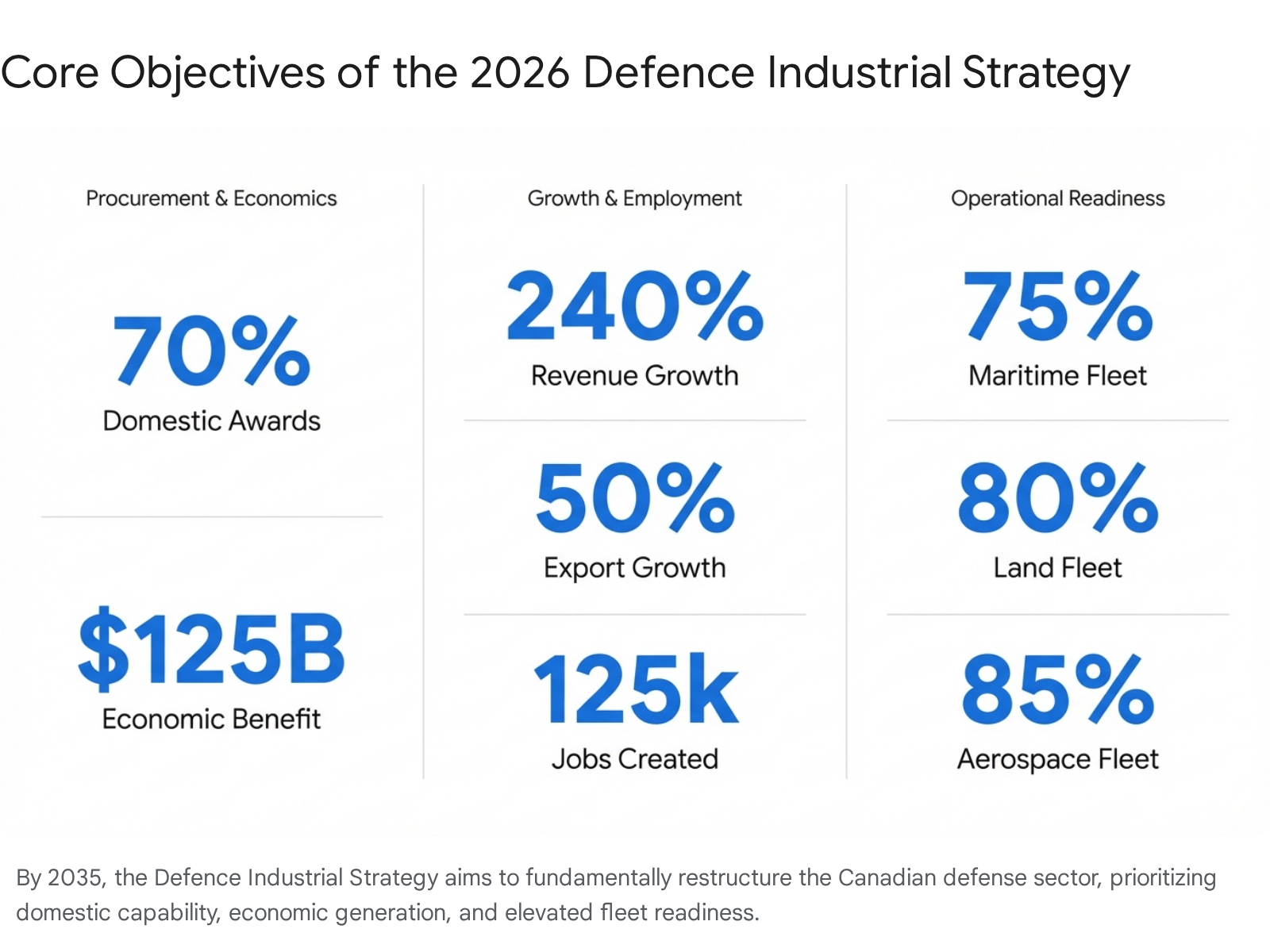
The strategic vision of the DIS is anchored by aggressive, decade-long quantitative targets. Most notably, the strategy sets a hard mandate to raise the share of federal defense acquisitions awarded to Canadian firms to 70 percent.1 From an economic perspective, the strategy is designed to increase total Canadian defense industry revenues by more than 240 percent, boost defense-related exports by 50 percent, and generate 125,000 high-paying, highly skilled careers across the supply chain, ranging from advanced manufacturing welders to quantum research scientists.1 Operationally, the DIS seeks to rectify chronic CAF equipment shortfalls, establishing targets to raise maritime fleet serviceability to 75 percent, land fleets to 80 percent, and aerospace fleets to 85 percent within a decade to meet pressing training and operational readiness requirements.1

To execute this massive industrial pivot, the federal government is dismantling the historically convoluted, slow, and multi-departmental defense procurement process.1 Central to this reform is the establishment of the Defence Investment Agency (DIA), which will act as a standalone, centralized entity to manage procurement.1 Expected to be formally legislated this spring, the DIA will function as the single point of contact for defense acquisitions, tasked with cutting bureaucratic red tape, drastically accelerating the delivery of equipment to the CAF, and prioritizing manufacturing partnerships with Canadian small and medium-sized enterprises (SMEs).1 The DIA will also oversee a permanent Defence Advisory Forum to maintain constant dialogue with industry leaders and accelerate the security clearance processes for defense sector personnel, a critical bottleneck that has historically stifled sector growth.1 In immediate, tangible steps toward supply chain resilience, the strategy also includes the launch of the Canadian Defence Industry Resilience Program, which has already initiated the domestic production of nitrocellulose, a critical chemical precursor required for artillery munitions.1

1.3 The BOREALIS Initiative and Deep Tech Integration

Recognizing that future conflicts will be determined by supremacy in frontier technologies, the Department of National Defence has established the Bureau of Research, Engineering and Advanced Leadership in Innovation and Science (BOREALIS).7 BOREALIS is mandated to align federal innovation efforts toward specific military mission needs and connect partners across government, academia, and private industry.10 On February 18, 2026, BOREALIS issued a $50 million Call for Proposals (CFP) to establish new Defence Innovation Secure Hubs (DISHs).9

Delivered through the Innovation in Defence Excellence and Security (IDEaS) program, this non-repayable contribution funding is specifically targeted at advancing mission-focused research in two critical domains: quantum technologies and uncrewed systems (UxS).9 Canada possesses globally recognized research capabilities in quantum sensing, communications, computing, and cryptography; however, transitioning these laboratory demonstrations into ruggedized defense applications requires Level II (Secret) cleared facilities.9 The DISH initiative will provide these trusted environments, allowing innovators direct access to CAF end-users for rapid integration and testing.9 Similarly, the UxS stream aims to overcome operational challenges inherent in drone warfare, such as electronic warfare vulnerabilities, limited endurance, interoperability, and the development of robust counter-UxS capabilities to protect Canadian assets from asymmetric threats.9 This new CFP builds upon the precedent set in November 2025, when the first Maritime DISH was established at the Centre for Ocean Ventures and Entrepreneurship (COVE) in Halifax with $29.4 million in funding.11

1.4 The BDC’s $4 Billion Capital Mobilization

To ensure the private sector has the necessary capital to meet the government’s ambitious 70 percent domestic procurement target, the Business Development Bank of Canada (BDC) officially launched a $4 billion Defence Platform.12 This unprecedented capital mobilization is designed to eliminate the structural financing bottlenecks that have historically marginalized Canadian defense startups, as traditional private venture capital frequently avoids the defense sector due to extended procurement cycles and stringent security regulations.14

The BDC platform allocates $3.5 billion strictly toward financing and advisory services, intended to allow Canadian SMEs to scale their manufacturing baselines, diversify their product offerings, and integrate seamlessly into the value chains of major national sovereignty projects.12 The remaining $500 million is segmented into targeted venture capital investment vehicles designed to accelerate defense innovation.12 This includes the newly formed StrongNorth Fund, a venture capital fund focusing explicitly on dual-use deep technologies, and the Catalyst Innovation Fund, which is engineered to serve as an innovation catalyst for the sector’s early-stage startup ecosystem.12 By establishing this platform, the BDC is effectively underwriting the technological and manufacturing risk associated with the government’s transition toward defense autarky.

2.0 The Transatlantic Alliance and the NATO 5 Percent Commitment

2.1 The Strategic Architecture of the 5 Percent Pledge

In parallel with its domestic industrial overhaul, Canada has dramatically escalated its international security commitments. At the NATO Summit in The Hague, Prime Minister Carney formally announced that Canada, alongside its NATO allies, has agreed to a revolutionary new Defence Investment Pledge: committing 5 percent of the nation’s annual GDP to defense and defense-related spending by 2035.16 This pledge represents a profound escalation from the traditional 2 percent benchmark, fundamentally redefining the scope and scale of allied burden-sharing.

The 5 percent target is not solely allocated to traditional kinetic military expenditures. The framework intelligently divides the commitment into two distinct tranches: 3.5 percent dedicated to core military spending and capabilities, and 1.5 percent allocated for broader, defense-related strategic investments.18 This 1.5 percent tranche encompasses critical modern security domains, explicitly including the protection of domestic critical infrastructure, the defense of national cyber networks, ensuring civil preparedness and resilience, and direct investments to unleash innovation within the defense industrial base.18 This bifurcated approach allows Canada to categorize its massive domestic investments under the DIS and the BDC’s $4 billion platform directly toward its NATO obligations, synthesizing domestic economic policy with international security treaties.

2.2 Diplomatic Reception and Industrial Realities

The announcement generated an immediate and highly favorable diplomatic response from NATO leadership. NATO Secretary General Mark Rutte publicly commended Canada’s trajectory, explicitly validating that Canada is on track to hit the foundational 2 percent spending target within the current fiscal year, a significant achievement given the country’s historical spending levels hovering around 1.3 to 1.4 percent.20 Referencing Prime Minister Carney’s pledge, Rutte declared that Canada is “really back in NATO, back in defending the transatlantic Alliance”.20

However, beneath the diplomatic triumphs lie severe industrial and logistical realities. Secretary General Rutte issued a stark warning regarding the macroeconomic feasibility of the 5 percent pledge across the alliance, noting that while nations are politically ready, allied defense industrial production is woefully insufficient.20 Rutte explicitly stated that neither the United States nor Europe is currently producing enough materiel to absorb this level of capital injection, pointing out that close allies like Poland are increasingly forced to source advanced weaponry from South Korea because transatlantic supply chains are backlogged and depleted.20 For Canada, fulfilling this 5 percent pledge will rely entirely on the rapid, flawless execution of the Defence Industrial Strategy and the aggressive scaling of domestic manufacturing capacity, ensuring that allocated capital results in tangible operational capabilities rather than administrative bloat.1

2.3 Looming Friction with United States Hegemony

Canada’s aggressive pivot toward domestic preference via the “Build, Partner, Buy” framework, while essential for meeting its NATO obligations, has immediately generated strategic friction with the United States. While Prime Minister Carney has publicly characterized the growth of the Canadian defense industry as strictly complementary to the U.S. military-industrial complex rather than direct competition, Washington has signaled deep systemic reservations.3

On February 13, 2026, the U.S. State Department and the Department of Defense issued a quiet but highly consequential formal rebuke to the European Union regarding its recently revised security directives that favor domestic producers.3 The U.S. submission characterized these “buy European” policies as inherently “protectionist and exclusionary,” arguing that they strong-arm American defense firms out of allied markets and weaken the broader ties between the U.S. and NATO.3 Washington explicitly threatened retaliation if EU member states adopted policies that structurally disadvantaged American defense contractors.3

This action serves as a severe warning shot across the bow for Ottawa. Because the Canadian defense industrial base has historically functioned as a highly integrated subsidiary network for American defense giants—producing components that flow seamlessly southward—any legislative attempt to ring-fence Canadian procurement risks triggering immediate retaliatory measures.3 This tension is exacerbated by U.S. President Donald Trump, who recently signed an executive order designed to ruthlessly reinforce the United States as the global “arms-maker of choice”.3 Trump’s order aims to expedite Washington’s decision-making for weapon sales, deliberately prioritizing the customer list in favor of allied countries with high defense spending.3 Consequently, Canada finds itself navigating an exceptionally narrow diplomatic corridor: it must drastically expand its sovereign defense industry to satisfy NATO demands and domestic economic goals, while simultaneously avoiding triggering punitive protectionist trade measures from a highly aggressive U.S. administration. To mitigate this risk, Canadian defense analysts suggest Ottawa may increasingly leverage international models, such as South Korea’s Defense Acquisition Program Administration (DAPA) or Sweden’s hybrid model with Saab, and expand co-production partnerships into the Indo-Pacific to offset total reliance on the volatile U.S. political landscape.3

3.0 Geoeconomics, Trade Volatility, and the Demise of IEEPA

3.1 The Supreme Court Invalidation of IEEPA Tariffs

The global macroeconomic environment experienced a seismic and unprecedented legal shock on February 20, 2026, when the United States Supreme Court issued its ruling in Learning Resources, Inc. v. Trump.22 In a decisive 6-3 decision authored by Chief Justice John Roberts, the Court struck down the Trump administration’s utilization of the International Emergency Economic Powers Act (IEEPA) to unilaterally impose sweeping global tariffs.22

The Court definitively held that the 1977 IEEPA statute—which was designed to grant the executive branch the authority to regulate commerce during national emergencies created by foreign threats—does not implicitly or explicitly authorize the President to impose taxation in the form of tariffs.22 The majority opinion noted that interpreting the word “regulate” within the statute to include “taxation” would render portions of the Act unconstitutional and pointed to the lack of historical precedent, noting that in nearly fifty years, no previous president had utilized IEEPA for tariff implementation.22 This ruling immediately invalidated the sweeping “reciprocal” tariffs imposed on a vast array of U.S. trading partners, as well as specific tariffs levied against China, Canada, and Mexico purportedly related to immigration and the importation of illicit opioids.22

The economic implications of this ruling are staggering. Economic models estimated that the illegal IEEPA tariffs had already extracted over $160 billion in revenue for the U.S. federal government and would have shrunk long-run U.S. GDP by 0.3 percent if left unabated.23 The invalidation shields the global economy from massive structural damage and raises the highly contentious issue of refunds for importers who paid the unlawful duties.22 In his dissenting opinion, Justice Brett Kavanaugh explicitly warned that the federal government might be required to refund billions of dollars, generating profound uncertainty regarding various international trade agreements.23 The mechanics of this reimbursement process remain entirely unresolved and are expected to trigger years of complex litigation in the U.S. Court of International Trade.22

3.2 The Immediate Invocation of Section 122

The relief provided to international markets by the Supreme Court was highly ephemeral. In a press conference immediately following the decision, a visibly defiant President Trump characterized the ruling as “deeply disappointing” and stated he was “ashamed” of the conservative justices who voted against his administration.25 Within hours, the White House executed a rapid legal pivot, with the President signing a new executive order imposing a blanket 10 percent global tariff under a different legal authority: Section 122 of the Trade Act of 1974.24

Section 122 authorizes the President to impose temporary, global tariffs specifically to address major balance-of-payments issues or perceived unfair trading practices.30 However, unlike the unbounded authority claimed under IEEPA, Section 122 contains strict statutory limitations: tariffs are capped at a maximum of 15 percent and can only remain in effect for a maximum duration of 150 days, absent explicit congressional approval for their extension.24 The new 10 percent global levies were scheduled to take effect on February 24, 2026.29 Furthermore, the administration signaled its intent to aggressively utilize other statutory tools, initiating new investigations under Section 301 of the Trade Act of 1974 and threatening action under Section 338 of the Tariff Act of 1930.24

3.3 The CUSMA Exemption and Canadian Strategic Positioning

Crucially for Canadian economic and national security, the White House released a fact sheet confirming that goods compliant with the Canada-United States-Mexico Agreement (CUSMA) originating from Canada and Mexico are explicitly exempted from the newly imposed Section 122 global tariffs.29 This vital exemption, combined with the judicial termination of the IEEPA levies, represents a significant, albeit potentially temporary, stabilization for Canadian exporters and manufacturers who rely on highly integrated, cross-border supply chains.

The domestic political reaction in Canada was one of cautious optimism. Several provincial leaders, including Ontario Premier Doug Ford, Alberta Premier Danielle Smith, and British Columbia Premier David Eby, publicly praised the Supreme Court’s decision.29 Premier Smith specifically expressed hope that the ruling would safeguard the tariff-free movement of CUSMA goods and help get bilateral trade negotiations “back on track”.29 At the federal level, Conservative Leader Pierre Poilievre called the ruling a “step in the right direction,” while emphasizing that critical work remains to protect the broader Canadian economy.25
Yugo M85/M92 dust cover quick takedown pin set with ring

Despite this temporary reprieve, profound geoeconomic uncertainty persists. Analysts caution against assuming this represents a permanent upside risk to Canadian growth.27 Most critically, the targeted, industry-specific tariffs imposed under Section 232 of the Trade Expansion Act of 1962—which allows tariffs on imports deemed to threaten U.S. national security—remain firmly in place and entirely unaffected by the Supreme Court ruling.24 The continued presence of Section 232 tariffs on vital Canadian sectors, primarily steel and aluminum, ensures that the bilateral trade relationship remains highly volatile.32 In response to this ongoing reality, Canada has maintained its own retaliatory countermeasures on U.S. steel and aluminum, even after voluntarily removing counter-tariffs on $44.2 billion worth of other U.S. goods in September 2025 as a gesture of goodwill in recognition of the broader CUSMA compliance framework.33 As the scheduled CUSMA review approaches, the U.S. executive branch retains multiple statutory tools to reconstruct a punitive tariff regime, cementing trade uncertainty as the foundational baseline for Canadian macroeconomic planning.27

4.0 Trade Restructuring and Monetary Policy Response

4.1 Trade Balance Analytics and Market Diversification

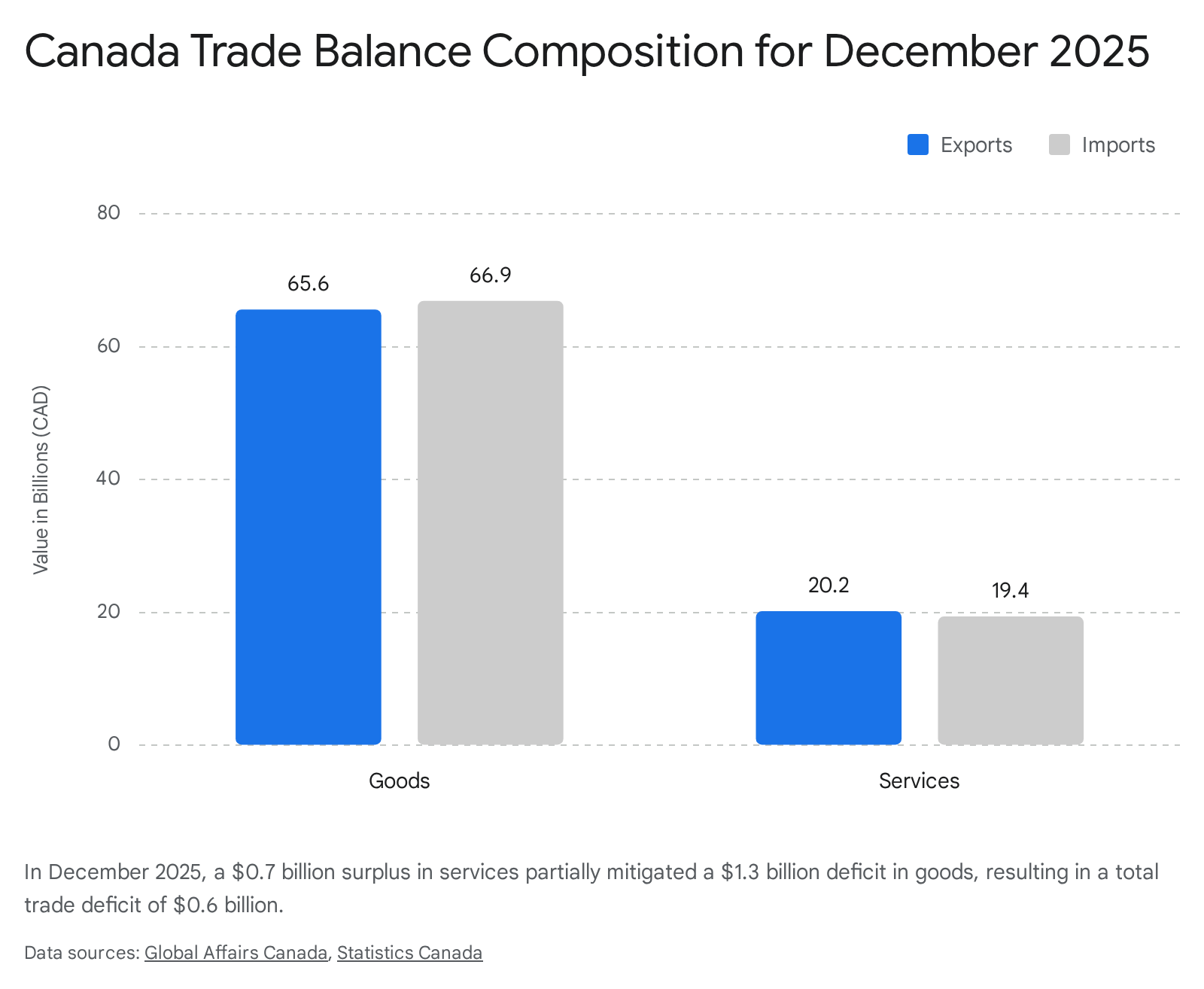
The intense volatility of the United States market is directly quantifiable within Canada’s most recent international trade data. In December 2025, the Canadian merchandise trade deficit narrowed to $1.3 billion, a sequential improvement from the $2.6 billion deficit recorded in November, capping off a highly turbulent year characterized by severe trade disruptions and aggressive inventory fluctuations.34 Total exports of goods increased by 2.6 percent to reach $65.6 billion, driven almost entirely by significant surges in the export of metal and non-metallic mineral products—specifically gold—to both the United States and the United Kingdom.34 When factoring in the services sector, which generated a $0.7 billion surplus in December (driven by increased non-financial commercial services), the combined trade balance for goods and services amounted to a manageable deficit of $0.6 billion for the month.34

Category (December 2025)Exports ($ billions)Monthly Change (%)Imports ($ billions)Monthly Change (%)Balance ($ billions)
Goods65.62.666.90.6-1.3
Services20.20.819.4-2.20.7
Total85.82.286.40.0-0.6
Table 1: Canadian International Trade Performance for December 2025.34
Yugo M85/M92 dust cover quick takedown pin set with ring

While the monthly data offers a snapshot of stability, the annualized data reveals the profound structural impact of global trade hostilities. Throughout 2025, total Canadian goods and services exports rose a modest 0.6 percent, largely supported by a solid 3.2 percent gain in services exports.34 However, annual goods exports to the United States fell by a concerning 5.8 percent, a direct consequence of the tariff regimes and deteriorating bilateral trade predictability.36 Notably, this severe decline was almost entirely mitigated by a robust 17.2 percent increase in exports to non-U.S. markets, alongside a 14.3 percent increase in total merchandise trade activity with the rest of the world.36 As a direct result of this forced market diversification, the U.S. share of Canadian goods exports plummeted by 4.2 percentage points to 71.7 percent in 2025—the lowest proportional reliance on the American market since the early 1980s.36

4.2 Monetary Policy and Structural Adjustment

The Bank of Canada’s January 2026 Monetary Policy Report underscores the friction and economic pain inherent in this forced restructuring. The central bank explicitly assesses that U.S. trade restrictions have fundamentally disrupted the Canadian economy, necessitating a painful structural adjustment that will take years to fully unfold.38 This restructuring requires massive capital reallocation to develop new logistics networks, establish alternative supply chains, and gradually shift domestic workers from industries heavily targeted by U.S. tariffs toward entirely new, globally competitive sectors.38

The macroeconomic toll of this transition is significant. The Bank of Canada projects that the persistent negative impacts of U.S. trade volatility will result in the nation’s GDP being approximately 1.5 percent lower by the end of 2026 than was originally forecast in early 2025.38 Despite these severe headwinds, domestic monetary conditions show signs of stabilization. The central bank held its key interest rate steady at 2.25 percent in early 2026, with the deposit rate at 2.2 percent.39 Inflationary pressures have demonstrably eased, with the Consumer Price Index (CPI) growing at 2.3 percent in January, a deceleration from 2.4 percent in December 2025.39 Real per-capita improvements and relatively stable labor conditions—highlighted by an unemployment rate that fell by 0.3 percentage points to 6.5 percent in January as fewer individuals searched for work—are expected to support broadly positive, albeit modest, Canadian growth throughout the year, limiting the immediate necessity for central bank rate cuts.38

5.0 The Foreign Interference Threat Landscape

5.1 Escalating State-Sponsored Subversion

Within the domestic security domain, the Canadian intelligence apparatus continues to issue increasingly stark warnings regarding the pervasive and escalating threat of foreign interference. The Canadian Security Intelligence Service (CSIS) officially assesses that clandestine activities directed at Canada’s democratic institutions, political systems, and societal fabric are intensifying, driven by the complex realities of the modern geopolitical environment.41 According to comprehensive intelligence assessments and recent public inquiries, state actors—most notably the People’s Republic of China (PRC) and Pakistan—are utilizing highly sophisticated, multifaceted methodologies to achieve strategic objectives on Canadian soil.41

These hostile activities manifest through various vectors, primarily targeting all levels of government, civil society, academic institutions, and strategically vital ethnic diaspora communities.41 CSIS reports that foreign intelligence services routinely attempt to intimidate Canadian ethnic communities to suppress dissent against their respective foreign governments, recruit local agents, and covertly manipulate Canadian domestic and foreign policy decisions.43 The tactics deployed include elite capture of influential political and business figures, the proliferation of sophisticated disinformation campaigns designed to erode public trust, and the execution of egregious acts of transnational repression.42 In response to these persistent threats, CSIS confirmed the deployment of highly classified threat reduction measures (TRMs), including successful operations executed between 2018 and 2023 to disrupt Pakistan’s efforts to suppress dissidents residing in Canada.43

5.2 Intelligence Gaps and Political Integrity

The structural vulnerabilities within Canada’s defense against subversion have been painfully exposed by the ongoing Public Inquiry into Foreign Interference in Federal Electoral Processes and Democratic Institutions (PIFI) and the findings of the National Security and Intelligence Committee of Parliamentarians (NSICOP).42 The intelligence community suffered a profound crisis of credibility following the revelation that Member of Parliament Michael Chong and his family were actively targeted by PRC operatives due to his vocal criticism of Beijing’s policies toward the Uighur population.45 Crucially, while CSIS had collected this intelligence in 2021, Chong was never informed that he was a specific target, receiving only a generalized defensive briefing.45 This incident highlighted severe systemic gaps in how the national security community tracks, disseminates, and responds to immediate threats against elected officials.45

This intelligence failure is compounded by explosive findings from the June 2024 NSICOP report, which documented that several parliamentarians—both “witting and semi-witting”—had actively engaged with foreign state actors to influence parliamentary business.42 Against this backdrop of heightened suspicion, recent domestic political volatility has taken on severe national security overtones. The week of February 18, 2026, saw Edmonton Conservative MP Matt Jeneroux cross the floor to join the Liberal caucus, becoming the third Conservative to defect in recent months.46

While parliamentary floor crossings are a legal and historical feature of the Canadian political system, the current climate has amplified public and analytical scrutiny. Intelligence analysts and political commentators point to the earlier defection of Markham–Unionville MP Michael Ma, who crossed the floor in late 2025 and subsequently accompanied the federal government on diplomatic travel to China.47 For an electorate already grappling with validated reports of United Front penetration and covert influence, such rapid political realignments invite profound questions regarding the integrity of the democratic mandate.47 The perception—whether factual or optical—that political transitions may serve strategic realignments influenced by external actors serves as a potent vector for democratic destabilization, slowly eroding the foundational credibility of Canadian institutions.42

5.3 NSIRA Review of the Passenger Protect Program

While CSIS focuses on external state threats, the balance between proactive domestic security and civil liberties was scrutinized by the National Security and Intelligence Review Agency (NSIRA). The agency released a highly critical report evaluating the Passenger Protect Program, commonly known as the national “no-fly list”.48 The program empowers the federal government to bar individuals deemed a threat to aviation security from boarding commercial flights.48

NSIRA’s investigation concluded that the federal government has, in certain instances, retained individuals on the no-fly list without lawful justification.48 While the review body praised recent systemic improvements—such as the implementation of centralized passenger screening which has demonstrably reduced administrative errors and improved overall security protocols—it issued ten binding recommendations demanding the clarification of roles and responsibilities, specifically regarding the establishment of transparent, legally sound protocols for the removal of names from the list.48 This oversight highlights the persistent tension within the national security apparatus: the necessity to aggressively preempt kinetic threats while maintaining the constitutional freedoms required for public trust.48

6.0 Border Security, Transnational Crime, and Extortion

6.1 Transnational Narcotics Interdiction

The integrity of the physical continental border remains a paramount operational concern for Canadian law enforcement, underscored by a major interdiction event in Southern Ontario. On February 4, 2026, a commercial truck arriving from the United States was referred for secondary examination by Canada Border Services Agency (CBSA) officers operating at the Blue Water Bridge port of entry in Point Edward.49

Utilizing specialized detector dog units to sweep the trailer, border services officers discovered 16 duffle bags deeply concealed within the cargo, containing an aggregated 266.4 kilograms (approximately 587 pounds) of suspected methamphetamine.49 The operator of the vehicle, a 29-year-old Canadian national named Kulbir Singh from Woodstock, Ontario, was immediately arrested by the CBSA and subsequently transferred to the jurisdiction of the Royal Canadian Mounted Police (RCMP).49 Singh has been formally charged under the Controlled Drugs and Substances Act with the importation of methamphetamine and possession of methamphetamine for the purpose of trafficking.49 This massive seizure represents a highly significant disruption to the logistical supply chains of transnational organized crime syndicates operating within the vital Great Lakes commercial corridor. The CBSA reports that this incident is part of a broader, escalating trend of synthetic narcotics trafficking, noting that officers in Southern Ontario have intercepted over 616.5 kilograms of methamphetamine originating from the United States since January 1, 2025.49 This domestic interdiction mirrors broader continental pressures, as U.S. Customs and Border Protection (CBP) recently intercepted 662 pounds of methamphetamine, valued at nearly $6 million, at the World Trade Bridge in Laredo, Texas, illustrating the massive scale of synthetic drug flows currently moving across North American logistical networks.52

6.2 The FINTRAC Mandate Against Digital Extortion

In direct response to the escalating, asymmetric threat posed by organized extortion networks, the federal government initiated enhanced financial law enforcement mandates on February 20, 2026.53 Extortion has evolved from localized physical intimidation into highly sophisticated operations executed by organized networks operating across international borders and leveraging anonymized digital platforms.53 To combat this, the Honourable Ruby Sahota, Secretary of State for Combatting Crime, announced the mobilization of the Financial Transactions and Reports Analysis Centre of Canada (FINTRAC) to aggressively prioritize financial intelligence resources specifically targeted at dismantling these extortion rings.53

A foundational component of this new strategy is the launch of the Countering Extortion Partnership.53 This collaborative framework requires FINTRAC to integrate its intelligence operations deeply with Canadian banks, credit unions, and crucially, financial service providers dealing in virtual assets and cryptocurrencies.53 By fusing transaction data across these domains alongside partners such as the Office of the Superintendent of Financial Institutions (OSFI) and the RCMP, the government aims to systematically trace the complex, cross-border illicit financial flows that sustain modern extortion. This capability will equip local and federal law enforcement with the timely, actionable financial intelligence required to hold transnational perpetrators accountable and disrupt the economic incentive structures of digital crime.53

7.0 Cyber Resilience and Information Warfare Realities

7.1 The Evolving Ransomware Ecosystem

The digital threat landscape facing Canadian institutions continues to deteriorate, driven by rapid technological proliferation and the ruthless commercialization of cybercrime. On January 28, 2026, the Canadian Centre for Cyber Security—a branch of the Communications Security Establishment (CSE)—released its highly anticipated Ransomware Threat Outlook 2025 to 2027.54 The intelligence assessment unequivocally states that ransomware will remain a severe, persistent, and growing threat to all sectors of the Canadian economy over the next two years.54

The CSE assesses that the modern ransomware ecosystem has evolved from isolated attacks into a highly sophisticated, interconnected, and heavily franchised criminal industry.54 Opportunistic, financially motivated threat actors are aggressively adopting advanced technologies to scale their operations. Most notably, the integration of artificial intelligence (AI) has fundamentally altered the offensive paradigm, making sophisticated cyberattacks drastically cheaper to execute, significantly faster to deploy, and substantially harder for traditional network defenses to detect.54 Furthermore, the continued reliance on decentralized cryptocurrencies for ransom payments provides the necessary financial anonymity to sustain and incentivize the illicit economy.54 The CSE report stresses that while basic cyber hygiene—such as the rigorous implementation of regular software updates, mandatory multi-factor authentication (MFA), and robust anti-phishing protocols—remains highly effective against broad-spectrum attacks, true resilience requires deep, sustained collaboration between government agencies, private sector entities, and international law enforcement.54 The governance of AI systems and cybersecurity is no longer merely an IT operational issue; it has escalated to a critical, board-level fiduciary responsibility, with corporate directors now facing intense scrutiny over their oversight of “AI sovereignty” and internal data management practices.56

7.2 International Cyber Capacity Building and Indo-Pacific Strategy

Recognizing that cyber threats are inherently borderless and that domestic resilience relies on the strength of international networks, Canada is actively exporting its cybersecurity expertise to strategic regional partners. On February 18, 2026, Sami Khoury, Canada’s Senior Official for Cyber Security at the CSE, held high-level meetings with Philippine defense officials at Camp Aguinaldo.57 This engagement was designed to operationalize the defense partnerships formally established under the November 2025 Philippines–Canada Status of Visiting Forces Agreement.57

The bilateral discussions focused intensely on resilience-building mechanisms, the establishment of protocols for the regular exchange of strategic cyber threat intelligence, and the institutionalization of joint training programs.57 This cooperation is highly pertinent and strategically timed given the geopolitical context in the Indo-Pacific. Philippine Armed Forces intelligence recently issued stark warnings regarding intensifying cyberattacks directly linked to state-sponsored actors based in the PRC.57 These malicious actors are actively deploying advanced malware, distributed denial-of-service (DDoS) attacks, and targeted data leaks specifically designed to advance Beijing’s territorial ambitions and destabilize the West Philippine Sea.57 By actively bolstering allied cyber defenses in the contested Indo-Pacific theater, Canada indirectly fortifies its own digital perimeter, counters PRC power projection, and firmly asserts its role as a stabilizing technological force on the global stage.57

8.0 Diplomatic Posture and Domestic Developments

8.1 Strategic Diplomatic Appointments

In direct alignment with the objectives of the Defence Industrial Strategy and the aggressive NATO spending pledge, the federal government executed a strategic and highly calculated reshuffling of its diplomatic corps. On February 2, 2026, Prime Minister Carney formally announced the intended appointments of the Honourable Bill Blair as High Commissioner for Canada in the United Kingdom, and Nathalie G. Drouin as Ambassador to France and Monaco.58

These senior appointments underscore a deliberate geopolitical focus on fortifying defense and commercial interoperability with tier-one European allies.58 Blair’s unique profile—encompassing four decades of security experience, including highly relevant tenures as the federal Minister of National Defence and Minister of Public Safety—signals unequivocally to London that Canada intends to pursue deeply integrated, operational security cooperation.58 Similarly, Drouin’s extensive background as the National Security and Intelligence Advisor to the Prime Minister, and her central, hands-on role in designing and implementing the current government’s foreign policy strategy, uniquely positions her to navigate complex transatlantic defense procurement negotiations with Paris.58 These diplomatic maneuvers illustrate an active, coordinated effort to diversify Canada’s geopolitical reliance, establishing firmer multilateral anchors in Europe to counterbalance the immense volatility of the North American dynamic.58

8.2 Expanding Arctic Sovereignty

Demonstrating an increased and necessary focus on Northern security and regional partnerships, Canada has formalized and escalated its diplomatic presence in Greenland. Julie Crôteau, operating as Canada’s acting consul in the newly established consulate in the capital of Nuuk, highlighted that the initial “micro mission” is rapidly transitioning into a phase of intensive, continuous on-the-ground presence.59 The consulate is mandated to generate concrete economic gains by expanding trade and cultural ties with the Danish territory, advising Ottawa intelligence desks on local political nuances, and navigating the vast complexities of Arctic sovereignty.59 This presence is a vital intelligence and diplomatic node, establishing a firm Canadian footprint as the polar routes become increasingly viable and heavily contested domains for great-power maritime and resource competition.59

8.3 The Recalibration of Sino-Canadian Relations

The diplomatic posture toward the People’s Republic of China (PRC) has entered a highly delicate phase of pragmatic recalibration, largely precipitated by Prime Minister Carney’s high-stakes visit to Beijing in January 2026.60 Foreign affairs analysts note that the visit exceeded modest expectations, resulting in the successful restart of stalled high-level dialogue mechanisms and yielding preliminary economic agreements regarding the reduction of punitive canola tariffs and the controlled access of Chinese electric vehicles to Canadian markets.60

However, this engagement is strictly interest-based and heavily compartmentalized. Ottawa is attempting to execute a nearly impossible balancing act: securing the lucrative economic dividends of selective engagement with the world’s second-largest economy, while simultaneously managing intense pressure from the United States to decouple entirely from Chinese technological supply chains.60 The ultimate durability of this pragmatic turn will be severely tested by Canada’s ability to ruthlessly enforce domestic security guardrails against documented PRC espionage and interference operations, while reassuring its Indo-Pacific and European partners of its unwavering strategic reliability within the broader Western alliance.60

8.4 Domestic Flashpoints: Education Funding and the Electoral Calendar

At the provincial level, domestic stability faces localized but intense pressure due to highly controversial alterations in education funding mechanisms. In Ontario, massive student unions and advocacy groups have rapidly mobilized to protest the provincial government’s sweeping overhaul of the Ontario Student Assistance Program (OSAP).61 Premier Doug Ford’s administration recently announced a $6.4 billion funding commitment over four years to stabilize post-secondary institutions, but simultaneously lifted a popular seven-year tuition freeze and radically altered the fundamental structure of student financial aid.61

The policy shift will drastically decrease the proportion of non-repayable grants offered through OSAP from an average of 85 percent down to a maximum of 25 percent by the upcoming fall term, shifting the immense financial burden heavily toward repayable, interest-bearing loans.61 While the provincial government argues these austere measures are absolutely vital to salvage an educational sector facing the very real prospect of multiple institutional bankruptcies and closures, student organizers warn the changes will completely jeopardize access to higher education.61 Advocates highlight that students in highly intensive, prolonged programs, particularly within STEM and medical fields, face severe financial distress, leading to planned demonstrations and coordinated political pushback across major university campuses.61

Politically, the federal and provincial landscapes remain active, characterized by a steady rhythm of localized electoral tests. The political calendar for the early weeks of 2026 included highly contested municipal by-elections in jurisdictions such as Saint-Cyrille-de-Wendover in Quebec, and Electoral Area A within the Cariboo Regional District of British Columbia, serving as micro-indicators of voter sentiment amid broader national economic anxieties.62

8.5 Infrastructure and International Sporting Events

In routine domestic governance, the federal government continued to execute targeted infrastructure and environmental resiliency investments. On February 20, 2026, Public Safety Canada announced substantial new funding initiatives designed to severely bolster the pan-Canadian aerial wildfire firefighting capacity.63 This represents a critical, proactive investment following the devastating and economically catastrophic fire seasons of recent years, acknowledging that climate-induced natural disasters are now treated as tier-one national security and economic threats.63

Finally, on the international sporting and cultural stage, national attention was briefly diverted to the athletic achievements and physical well-being of the Canadian delegation competing at the Milano Cortina 2026 Winter Olympics. On February 21, 2026, the Canadian Olympic Committee (COC) and Freestyle Canada issued a joint public statement regarding the status of three-time Olympian and freestyle skiing champion Cassie Sharpe.64 Sharpe experienced a concerning medical incident during competition that necessitated a brief, precautionary hospitalization in the mountain municipality of Livigno, Italy.64 While the COC confirmed that she has been safely released and returned to the Athlete Village, medical staff definitively ruled her out of participating in the highly anticipated finals, marking a somber conclusion to the games for one of Canada’s premier winter athletes.64 Simultaneously, domestic infrastructure illumination projects, such as the special lighting of the Samuel De Champlain Bridge in Montreal, were programmed to celebrate the formal closing ceremonies of the 2026 Winter Olympics, highlighting ongoing civic engagement initiatives amidst a week otherwise dominated by severe geopolitical and economic recalibration.63


Please share the link on Facebook, Forums, with colleagues, etc. Your support is much appreciated and if you have any feedback, please email us in**@*********ps.com. If you’d like to request a report or order a reprint, please click here for the corresponding page to open in new tab.


Sources Used

  1. Prime Minister Carney launches Canada’s first Defence Industrial …, accessed February 21, 2026, https://www.pm.gc.ca/en/news/news-releases/2026/02/17/prime-minister-carney-launches-canadas-first-defence-industrial
  2. Canada advances Defence Industrial Strategy to strengthen security …, accessed February 21, 2026, https://www.canada.ca/en/global-affairs/news/2026/02/canada-advances-defence-industrial-strategy-to-strengthen-security-sovereignty-and-prosperity.html
  3. Warning Shot: How Canada fits into Washington’s rebuke of the EU’s ‘buy European’ defence drive, accessed February 21, 2026, https://www.cbc.ca/news/politics/defence-industry-europe-trump-arms-warning-9.7100449
  4. Canada’s New Defence Industrial Strategy: What Business Needs to Know, accessed February 21, 2026, https://cassels.com/insights/canadas-new-defence-industrial-strategy-what-business-needs-to-know/
  5. Canada’s Defence Industrial Strategy Needs an Indo-Pacific Gear, accessed February 21, 2026, https://www.asiapacific.ca/publication/canadas-defence-industrial-strategy-needs-indo-pacific-consideration
  6. Canada’s Defence Industrial Strategy, accessed February 21, 2026, https://www.canada.ca/en/department-national-defence/corporate/reports-publications/industrial-strategy/security-sovereignty-prosperity.html
  7. Prime Minister Carney announces the launch of Canada’s first Defence Industrial Strategy, accessed February 21, 2026, https://www.pm.gc.ca/en/news/speeches/2026/02/17/prime-minister-carney-announces-launch-canadas-first-defence-industrial
  8. What is Canada’s new Domestic Defence Industrial Strategy?, accessed February 21, 2026, https://procurementmag.com/news/canada-launched-domestic-defence-industrial-strategy
  9. Government of Canada launches Call for Proposals to establish Defence Innovations Secure Hubs for quantum and uncrewed system technologies, accessed February 21, 2026, https://www.canada.ca/en/department-national-defence/news/2026/02/government-of-canada-launches-call-for-proposals-to-establish-defence-innovations-secure-hubs-for-quantum-and-uncrewed-system-technologies.html
  10. Bureau of Research, Engineering and Advanced Leadership in Innovation and Science (BOREALIS) – Canada.ca, accessed February 21, 2026, https://www.canada.ca/en/department-national-defence/programs/borealis.html
  11. DND takes next step for Defence Innovation Secure Hubs, issues $50M challenge, accessed February 21, 2026, https://spaceq.ca/dnd-takes-next-step-for-defence-innovation-secure-hubs-issues-50m-challenge/
  12. BDC introduces platform to provide $4B to boost Canada’s defence and security ecosystem, accessed February 21, 2026, https://www.bdc.ca/en/about/mediaroom/news-releases/bdc-introduces-platform-to-provide-4b-to-boost-canada-defence-security-ecosystem
  13. BDC introduces platform to provide $4B to boost Canada’s defence and security ecosystem, accessed February 21, 2026, https://www.globenewswire.com/news-release/2025/12/17/3207288/0/en/BDC-introduces-platform-to-provide-4B-to-boost-Canada-s-defence-and-security-ecosystem.html
  14. Inside Canada’s C$4B defense investment push – POLITICO Pro, accessed February 21, 2026, https://subscriber.politicopro.com/article/2025/12/inside-canadas-c-4b-defense-investment-push-00699768
  15. News releases – BDC, accessed February 21, 2026, https://www.bdc.ca/en/about/mediaroom/news-releases
  16. Canada joins new NATO Defence Investment Pledge, accessed February 21, 2026, https://www.pm.gc.ca/en/news/news-releases/2025/06/25/canada-joins-new-nato-defence-investment-pledg
  17. Canada promises to spend 5% of GDP on defence by 2035 in pact with NATO leaders, accessed February 21, 2026, https://www.cbc.ca/news/politics/canada-agrees-five-percent-gdp-defence-spending-1.7570191
  18. NATO needs to define the substance of its 1.5 percent pledge – Atlantic Council, accessed February 21, 2026, https://www.atlanticcouncil.org/dispatches/nato-needs-to-define-the-substance-of-its-1-5-percent-pledge/
  19. NATO summit: Canada pledges 5% defence spending by 2035 | FULL – YouTube, accessed February 21, 2026, https://www.youtube.com/watch?v=Wukckf6rCY8
  20. Remarks by NATO Secretary General at World Economic Forum, Davos, accessed February 21, 2026, https://www.nato.int/en/news-and-events/events/transcripts/2026/01/21/nato-secretary-general-at-world-economic-forum-davos
  21. Forthcoming US arm sales changes leave unanswered questions, accessed February 21, 2026, https://breakingdefense.com/2026/02/forthcoming-us-arm-sales-changes-leave-unanswered-questions/
  22. Supreme Court Strikes Down IEEPA Tariffs: What Importers Need to Know Now | Insights, accessed February 21, 2026, https://www.hklaw.com/en/insights/publications/2026/02/supreme-court-strikes-down-ieepa-tariffs
  23. Supreme Court strikes down tariffs, accessed February 21, 2026, https://www.scotusblog.com/2026/02/supreme-court-strikes-down-tariffs/
  24. Supreme Court Strikes Down IEEPA Tariffs—What Now? – WilmerHale, accessed February 21, 2026, https://www.wilmerhale.com/en/insights/client-alerts/20260220-supreme-court-strikes-down-ieepa-tariffs-what-now
  25. What does the U.S. court ruling on Trump’s tariffs mean for Canada?, accessed February 21, 2026, https://www.ctvnews.ca/world/trumps-tariffs/article/what-does-the-us-court-ruling-on-trumps-tariffs-mean-for-canada/
  26. What will happen to Trump’s tariffs after supreme court verdict?, accessed February 21, 2026, https://www.theguardian.com/us-news/2026/feb/20/what-will-happen-to-trump-tariffs-after-supreme-court-verdict
  27. U.S. Supreme Court Rules Against Broad-Based Country Specific Tariffs Under IEEPA, accessed February 21, 2026, https://economics.td.com/ca-us-supreme-court-ruling-trump-tariffs
  28. Supreme Court Strikes Down President Trump’s Tariffs, accessed February 21, 2026, https://taxfoundation.org/blog/supreme-court-trump-tariffs-ruling/
  29. Trump adds 10% global tariff after U.S. Supreme Court decision, but CUSMA-compliment goods are exempt, accessed February 21, 2026, https://www.ctvnews.ca/world/trumps-tariffs/article/trump-adds-10-global-tariff-after-us-supreme-court-decision-but-cusma-compliment-goods-are-exempt/
  30. Trump Tariff Winds Shifting: Navigating Post-IEEPA Waters After the Supreme Court Decision, accessed February 21, 2026, https://blog.freshfields.us/post/102mjzi/trump-tariff-winds-shifting-navigating-post-ieepa-waters-after-the-supreme-court
  31. State of Tariffs: February 20, 2026 | The Budget Lab at Yale, accessed February 21, 2026, https://budgetlab.yale.edu/research/state-tariffs-february-20-2026
  32. Inflation: Still Tariffic, accessed February 21, 2026, https://www.policymagazine.ca/inflation-still-tariffic/
  33. Canada’s response to U.S. tariffs on Canadian goods, accessed February 21, 2026, https://www.canada.ca/en/department-finance/programs/international-trade-finance-policy/canadas-response-us-tariffs.html
  34. The Daily — Canadian international trade in services, December 2025, accessed February 21, 2026, https://www150.statcan.gc.ca/n1/daily-quotidien/260219/dq260219d-eng.htm
  35. Canada’s trade deficit narrowed in December to cap volatile 2025 – RBC Economics, accessed February 21, 2026, https://www.rbc.com/en/economics/canadian-analysis/data-flashes/canadas-trade-deficit-narrowed-in-december-to-cap-volatile-2025/
  36. Monthly trade report: December 2025 – Affaires mondiales Canada, accessed February 21, 2026, https://international.canada.ca/en/global-affairs/corporate/reports/chief-economist/monthly/2025-12
  37. The Daily — Canadian international merchandise trade, December 2025, accessed February 21, 2026, https://www150.statcan.gc.ca/n1/daily-quotidien/260219/dq260219a-eng.htm
  38. Outlook, accessed February 21, 2026, https://www.bankofcanada.ca/publications/mpr/mpr-2026-01-28/canadian-outlook/
  39. Canadian Economic Calendar – February 2026 – Baystreet.ca, accessed February 21, 2026, https://www.baystreet.ca/articles/econ_calendar.aspx
  40. RBC Monthly Forecast Update – February 2026, accessed February 21, 2026, https://www.rbcis.com/en/insights/2026/02/monthly-forecast-update-feb26
  41. Foreign Interference Threats to Canada’s Democratic Process, accessed February 21, 2026, https://www.canada.ca/en/security-intelligence-service/corporate/publications/foreign-interference-threat-to-canadas-democratic-process.html
  42. Canada under pressure – How the gap in foreign interference response is eroding democracy: Stephen Nagy | Macdonald-Laurier Institute, accessed February 21, 2026, https://macdonaldlaurier.ca/canada-under-pressure-how-the-gap-in-foreign-interference-response-is-eroding-democracy-stephen-nagy/
  43. CSIS Public Report 2024 – Canada.ca, accessed February 21, 2026, https://www.canada.ca/content/dam/csis-scrs/images/2024publicreport/newest/Public_Report_2024-ENG.pdf
  44. Exhibits list – Foreign Interference Commission, accessed February 21, 2026, https://foreigninterferencecommission.ca/exhibits-list
  45. Countering Foreign Interference: Weighing in on the Canadian Public Inquiry, accessed February 21, 2026, https://www.belfercenter.org/research-analysis/countering-foreign-interference-weighing-canadian-public-inquiry
  46. Canada News archive Feb 15 to 21, 2026 page 20260215 – Castanet.net, accessed February 21, 2026, https://www.castanet.net/news/Canada/20260215/
  47. From Floor Crossings to Foreign Influence, Canada Faces a Crisis of Integrity: Op-Ed, accessed February 21, 2026, https://www.thebureau.news/p/from-floor-crossings-to-foreign-influence
  48. Government couldn’t always justify keeping people on no-fly list: watchdog | CBC News, accessed February 21, 2026, https://www.cbc.ca/news/politics/no-fly-list-canada-9.7093885
  49. CBSA seizes 266 kg of methamphetamine at the Blue Water Bridge – Canada.ca, accessed February 21, 2026, https://www.canada.ca/en/border-services-agency/news/2026/02/cbsa-seizes-266-kg-of-methamphetamine-at-the-blue-water-bridge.html
  50. Canadian border officers seize nearly 600 pounds of methamphetamine at Blue Water Bridge, accessed February 21, 2026, https://www.cbsnews.com/detroit/news/canadian-border-officers-seize-nearly-600-pounds-methamphetamine-blue-water-bridge/
  51. Canadian Officials Seize Nearly 600 Pounds of Suspected Meth at US Border, accessed February 21, 2026, https://nationaltoday.com/us/mi/detroit/news/2026/02/21/canadian-officials-seize-nearly-600-pounds-of-suspected-meth-at-us-border/
  52. CBP officers seize nearly $6 million in methamphetamine at World Trade Bridge, accessed February 21, 2026, https://www.cbp.gov/newsroom/national-media-release/cbp-officers-seize-nearly-6-million-methamphetamine-world-trade
  53. Government announces new measures to help protect Canadians and businesses against extortion, accessed February 21, 2026, https://www.canada.ca/en/public-safety-canada/news/2026/02/government-announces-new-measures-to-help-protect-canadians-and-businesses-against-extortion.html
  54. Cyber Centre releases Ransomware Threat Outlook 2025 to 2027 – Canada.ca, accessed February 21, 2026, https://www.canada.ca/en/communications-security/news/2025/12/cyber-centre-releases-ransomware-threat-outlook-2025-to-2027.html
  55. Ransomware Threat Outlook 2025-2027 – Canadian Centre for Cyber Security, accessed February 21, 2026, https://www.cyber.gc.ca/en/guidance/ransomware-threat-outlook-2025-2027
  56. Blakes upRound™: February 2026, accessed February 21, 2026, https://www.blakes.com/insights/blakes-upround-february-2026/
  57. Canada helps boost cyber defense efforts, accessed February 21, 2026, https://tribune.net.ph/2026/02/19/canada-helps-boost-cyber-defense-efforts
  58. Prime Minister Carney announces upcoming diplomatic appointments, accessed February 21, 2026, https://www.pm.gc.ca/en/news/news-releases/2026/02/02/prime-minister-carney-announces-upcoming-diplomatic-appointments
  59. In first interview, Canada’s envoy to Greenland says new post seeks …, accessed February 21, 2026, https://toronto.citynews.ca/2026/02/21/in-first-interview-canadas-envoy-to-greenland-says-new-post-seeks-concrete-gains/
  60. Canada’s pragmatic turn towards China is not without strategic limits …, accessed February 21, 2026, https://eastasiaforum.org/2026/02/21/canadas-pragmatic-turn-towards-china-is-not-without-strategic-limits/
  61. ‘We’re going to fight back’: Student union responds to Ontario’s changes to financial aid, accessed February 21, 2026, https://www.ctvnews.ca/canada/article/student-groups-say-fords-changes-to-osap-will-jeopardize-ontario-education/
  62. 2026 Canadian electoral calendar – Wikipedia, accessed February 21, 2026, https://en.wikipedia.org/wiki/2026_Canadian_electoral_calendar
  63. News – Canada.ca, accessed February 21, 2026, https://www.canada.ca/en/news.html
  64. Team Canada Update – February 21, accessed February 21, 2026, https://olympic.ca/press/team-canada-update-february-21/
  65. Geopolitical Calendar – Control Risks, accessed February 21, 2026, https://www.controlrisks.com/our-thinking/geopolitical-calendar

Modernizing the Canadian Military’s Small Arms

The defense landscape of Canada is currently undergoing a systemic transformation in its small arms inventory, transitioning from the foundational platforms of the mid-to-late Cold War era into a modern, modular, and technologically integrated suite of tactical systems. This evolution is not merely a replacement of aging hardware but represents a fundamental shift in Canadian defense doctrine, moving toward high-intensity, multi-domain operations. As the Canadian Armed Forces (CAF) recalibrate for a future defined by near-peer competition and the complexities of Arctic sovereignty, the selection, procurement, and deployment of small arms have become primary indicators of the nation’s strategic priorities. This analysis explores the technical specifications, organizational distribution, and intelligence implications of the small arms utilized by the Canadian Army, Royal Canadian Navy, Royal Canadian Air Force, and the specialized elements within the Canadian Special Operations Forces Command.

Executive Summary

The modernization of the Canadian small arms fleet is characterized by three primary strategic pillars: the transition to modular multi-caliber platforms, the universal adoption of suppressed systems, and the preservation of a robust domestic defense industrial base. The core of this transition is evidenced by the “Modular Pistol Project,” which has successfully replaced the venerable Browning Hi-Power with the SIG Sauer P320 (designated C22 for general service and C24 for military police).1 In the precision fire domain, the Canadian Army has bifurcated its requirements into a domestic semi-automatic solution, the Colt Canada C20, and an international bolt-action system, the Sako TRG M10, designated as the C21 Multi-Caliber Sniper Weapon.3

Furthermore, the Canadian Modular Assault Rifle (CMAR) program represents an accelerated effort to replace the C7 and C8 family with a new generation of rifles featuring integrated suppression and advanced optical suites.5 This programmatic shift reflects a move away from the “Maple Twist” modifications of American designs toward a unique Canadian standard that emphasizes ergonomic adaptability for diverse personnel and operational reliability in extreme environments ranging from the high Arctic to urban combat zones. The industrial commitment to Colt Canada as a “strategic source” under the Munitions Supply Program remains a central tenet of Canadian procurement, ensuring sovereign control over small arms maintenance and production while selectively leveraging international innovation for niche capabilities.5

Historical Context and the Strategic Role of Domestic Industry

The history of Canadian small arms is defined by the selective adaptation of global designs to meet the specific rigors of the Canadian theater. In 1955, Canada became the first NATO nation to adopt the FN FAL, designated as the FN C1.8 This decision set a precedent for Canadian small arms procurement: taking a proven international platform and modifying it for extreme cold-weather reliability. The Canadian C1 featured an “Arctic trigger” that allowed the trigger guard to be removed for use with heavy mittens and incorporated the ability to top-load the magazine with five-round charger clips.8

The shift to the 5.56x45mm NATO cartridge in 1985 led to the adoption of the C7 and C8 series, manufactured by Diemaco (now Colt Canada). These weapons, while based on the ArmaLite AR-15 architecture, utilized cold-hammer-forged barrels and reinforced furniture to exceed the durability standards of contemporaneous American M16A2 and M4 platforms.10 The current state of Canadian small arms is thus the result of decades of industrial refinement, where the domestic producer, Colt Canada, serves as a “Center of Excellence” for the small arms fleet.5

Summary of General Service Small Arms

CategoryModelCalibreStatusPrimary Users
Service PistolSIG Sauer P320 (C22)9x19mm NATOIn ServiceArmy, RCN, RCAF
Compact PistolSIG Sauer P320 (C24)9x19mm NATOIn ServiceMilitary Police
Assault RifleColt Canada C7A25.56x45mm NATOIn ServiceArmy (Infantry)
CarbineColt Canada C8A35.56x45mm NATOIn ServiceRCN, RCAF, Army Support
Section SAWFN/Colt Canada C9A25.56x45mm NATOIn ServiceArmy (Infantry)
General Purpose MGFN/Colt Canada C6A17.62x51mm NATOIn ServiceAll Branches
Heavy Machine GunM2HB-QCB12.7x99mm NATOIn ServiceArmy, RCN, CANSOFCOM

The Canadian Army: Land Force Modernization and Lethality

The Canadian Army is the primary stakeholder in the CAF’s small arms fleet, driving the requirements for the majority of standard-issue and specialized weaponry. Current land force doctrine emphasizes high-readiness dismounted infantry capable of operating in complex urban terrain and austere Arctic environments.

The Modular Pistol Project: C22 and C24

The transition from the Browning Hi-Power to the SIG Sauer P320 represents one of the most significant upgrades in individual lethality for the Canadian soldier in nearly eight decades. The legacy Browning platforms, adopted in 1944, suffered from a critical lack of replacement parts and lacked the ergonomics required for modern tactical usage.1 The C22 Full Frame Modular Pistol introduced in 2023 provides a striker-fired mechanism with a 17-round magazine capacity and fully ambidextrous controls.1

One of the most innovative aspects of the C22/C24 procurement is the modularity of the fire control unit (FCU). The serialized portion of the weapon is a removable chassis, allowing the grip module to be changed to suit different hand sizes without requiring new firearm registrations.2 This is particularly relevant given the Army’s focus on inclusivity and ensuring that every member can operate their weapon with maximum efficiency. The C24 variant, specifically issued to the Military Police, is a compact version of the P320, optimized for the diverse duty requirements of security and policing roles.14

The C7 and C8 Ecosystem: Evolution Toward CMAR

While the C7A2 remains the standard infantry rifle, it is reaching the end of its viable service life. The A2 variant was a mid-life upgrade that introduced green furniture, a four-point telescoping stock (standardizing it with the C8), and an ambidextrous suite.15 However, the mounting system—initially a “Canadian Rail” that predated the Picatinny standard—is increasingly incompatible with modern accessories.10

The Canadian Modular Assault Rifle (CMAR) project is intended to replace the nearly 90,000 rifles currently in the inventory.5 Intelligence from internal Department of National Defence briefings suggests a “Two-Tier” approach to the CMAR fleet. The Full Spectrum (CMAR-FS) rifle will be optimized for offensive operations with a longer barrel and advanced optics, while the General Service (CMAR-GS) variant will be issued to support personnel and vehicle crews.16 The likely candidate for this program is an evolution of the Colt Canada Modular Rail Rifle (MRR), featuring a monolithic upper receiver and the M-LOK attachment system.6

Precision Fire and the Sniper System Project

The Canadian Army has historically prided itself on the world-class capability of its snipers. The modern sniper section now operates with a sophisticated mix of semi-automatic and multi-caliber bolt-action systems.

The Colt Canada C20 Semi-Automatic Sniper Weapon (SASW) was adopted to fill the gap for an intermediate sniper weapon that provides rapid follow-up shots.3 Chambered in 7.62x51mm NATO, the C20 replaced the C8 carbines previously used by sniper teams as personal protection weapons.3 In testing, the C20 demonstrated extreme precision, achieving 0.66 MOA over 144 groups of five rounds during endurance trials of 8,000 rounds.19 This rifle uses a direct gas impingement system and a monolithic upper receiver, providing a rigid platform for the Schmidt & Bender 3-20×50 Ultra Short riflescope.3

For primary long-range engagements, the Army selected the Sako TRG M10, designated as the C21 Multi-Caliber Sniper Weapon. This bolt-action system allows the operator to switch calibers in the field between 7.62x51mm and.338 Lapua Magnum.4 This multi-caliber capability allows for cost-effective training with the 7.62mm round while maintaining identical ergonomics when configured for the high-power.338 Magnum for active missions.4

Precision Weaponry Specifications

ModelDesignationCalibreActionEffective Range
Colt Canada C20SASW7.62x51mm NATOSemi-Auto800 m
Sako TRG M10 (C21)MCSW7.62mm /.338 LMBolt-Action1,500 m+
McMillan TAC-50 (C15)LRSW12.7x99mm NATOBolt-Action2,500 m+
Accuracy Intl. AWSniper7.62x51mm NATOBolt-Action800 m

Support and Suppression Systems

Land force lethality is augmented by a range of section-level and platoon-level support weapons. The C9A2 Light Machine Gun is the current standard for the infantry section, based on the FN Minimi. It is unique for its ability to accept both linked ammunition and STANAG rifle magazines in emergency situations.8 The Army is also completing the fielding of the C6A1 FLEX General Purpose Machine Gun. This modernized GPMG replaces the old wooden-stocked C6 with a version featuring a polymer stock, integrated Picatinny rails for optics, and an external gas regulator to control the rate of fire.14

In the domain of heavy support, the M2HB-QCB (Quick Change Barrel) provides sustained fire in 12.7x99mm. The C16 Close Area Suppression Weapon (CASW) is a digitized 40mm automatic grenade launcher based on the Heckler & Koch GMG.25 Produced under license by Rheinmetall Canada, the C16 provides airburst capability, allowing the infantry to engage hidden targets in defilade.25

Royal Canadian Navy: Boarding and Ship Defense

Small arms operations within the Royal Canadian Navy (RCN) are specialized around the needs of Naval Boarding Parties (NBP) and the elite Naval Tactical Operations Group (NTOG). The operating environment is characterized by high humidity, salt-water corrosion, and extremely confined spaces.

Naval Boarding Party (NBP) Weaponry

The NBP is tasked with cooperative boardings and the investigation of vessels of interest. Their standard weapon suite emphasizes compact firepower and rapid target acquisition. The Colt Canada C8 carbine is the primary long gun for boarding parties, often equipped with the Integrated Upper Receiver (IUR) to streamline accessory mounting.28

The RCN was a primary driver for the adoption of the C22 pistol, as the polymer frame of the P320 is far better suited to the maritime environment than the steel-framed SIG P226 or Browning Hi-Power.2 For high-threat close-quarters battle (CQB), the Navy continues to utilize the Heckler & Koch MP5 submachine gun in various configurations (MP5A3, MP5SD), valued for its controllability and the stealth provided by suppressed variants during night operations.14

Ship-Self Defense and Specialized Roles

For shipboard defense, the RCN utilizes the M2HB-QCB and the GAU-21 (a high-rate-of-fire version of the.50 caliber machine gun) mounted on pedestal mounts to counter asymmetric threats such as small boat swarms.14 These weapons are critical for protection during transit through narrow straits and littoral waters.

The NTOG, which performs higher-risk maritime interdiction missions, utilizes a more specialized inventory. While specific details of NTOG’s kit are often classified, they have been observed utilizing advanced variants of the C8 with suppressed upper receivers and specialized optics.14

Maritime Small Arms Inventory

PlatformModelCalibreApplication
Boarding CarbineColt Canada C8A3/IUR5.56x45mm NATOPrimary NBP Weapon
Submachine GunH&K MP59x19mm NATOCQB / Boarding
Service PistolSIG Sauer P320 (C22)9x19mm NATOSidearm
Tactical ShotgunRemington 870P12-gaugeBreaching / Security
Heavy Machine GunM2HB-QCB / GAU-2112.7x99mm NATOShip Defense

Royal Canadian Air Force: Protection and Arctic Survival

The Royal Canadian Air Force (RCAF) manages a unique small arms requirement that encompasses base security (Force Protection) and the specialized survival needs of aircrews operating in the high Arctic.

Force Protection and Base Security

RCAF security forces, often operating alongside Military Police, utilize the standard C7A2 and C8A3 platforms for airfield defense. The introduction of the C24 compact pistol provides security personnel with a more concealable and ergonomic sidearm for duty in the confined spaces of aircraft hangars and command centers.14 These forces are increasingly focused on countering unmanned aerial systems (UAS), leading to a greater integration of optics and electronic sighting systems on their standard rifles.

The SAR Rifle: Ruger M77 in.30-06

The most distinctive firearm in the RCAF inventory is the SAR Rifle, a modified Ruger M77 Mk II chambered in.30-06 Springfield.30 This weapon is not intended for combat against human adversaries but is a survival tool for Search and Rescue Technicians (SAR Techs) and aircrews who may find themselves downed in wilderness environments inhabited by dangerous predators.30

The choice of.30-06 Springfield is deliberate, as it provides the necessary kinetic energy to stop a large grizzly or polar bear, a capability that the standard 5.56mm NATO round lacks.30 The rifle is highly customized: it features a 14.5-inch barrel and an international orange folding buttstock made of fiberglass.30 The folding stock reduces the overall length to approximately 25 inches, allowing it to be stored in seat packs or attached to a parachute harness.30 Furthermore, the buttstock contains a trapdoor that stores six extra rounds, ensuring the user has immediate access to ammunition in a survival scenario.30

SAR Rifle Technical Specifications

MetricDetail
ManufacturerSturm, Ruger & Co. / Diemaco
Calibre.30-06 Springfield (7.62x63mm)
ActionBolt-action (Mauser-style Claw Extractor)
Barrel Length36.83 cm (14.5 in)
Total Length (Folded)64.44 cm (25.37 in)
Capacity5-round integral + 6 in stock
Weight (Loaded)3.34 kg (7.37 lbs)
Visual IdentificationInternational Orange Furniture

CANSOFCOM: Specialized Capability and Advanced Tech

The Canadian Special Operations Forces Command (CANSOFCOM), comprising JTF2 and the Canadian Special Operations Regiment (CSOR), maintains a “vault” of specialized weaponry that reflects its status as a high-readiness, multi-domain force.

CSOR and the C8 IUR

CSOR utilizes the standard Army kit but often augments it with specialized components. The C8 IUR (Integrated Upper Receiver) is the primary platform, featuring a monolithic rail that allows for the permanent mounting of advanced laser designators (like the LA-5) and specialized optics (EOTech) without loss of zero.29 CSOR operators often utilize the SIG Sauer P226R as a secondary weapon, though the transition to the C22 platform is underway to align with broader CAF logistics.29

JTF2: Exclusive Weaponry

As Canada’s primary counter-terrorism unit, Joint Task Force 2 (JTF2) has access to a range of weapons not found in any other branch of the CAF. This includes the FN P90 personal defense weapon (PDW), chambered in 5.7x28mm, which provides high magazine capacity and armor-piercing capability in a compact bullpup design.14 JTF2 also utilizes the Benelli M3 Super 90 shotgun, which offers both pump-action and semi-automatic modes, and the Barrett M82A1 anti-materiel rifle for long-range interdiction and vehicle disablement.14

For precision fire, JTF2 utilizes the Accuracy International AW (Arctic Warfare) in 7.62x51mm, a rifle designed to operate in temperatures as low as -40 degrees Celsius.14 The JTF2 inventory reflects a requirement for absolute reliability in extreme maritime, urban, and Arctic conditions.

CANSOFCOM Specialized Inventory

RoleWeapon SystemCalibreBranch Usage
Personal DefenseFN P905.7x28mmJTF2 Exclusive
Semi-Auto ShotgunBenelli M3 Super 9012-gaugeJTF2 Exclusive
Anti-Materiel RifleBarrett M82A112.7x99mm NATOJTF2 Exclusive
High-Precision RifleAccuracy Intl. AW7.62x51mm NATOJTF2 Exclusive
Special Ops CarbineColt Canada C8 IUR5.56x45mm NATOCSOR / JTF2
Heavy Sniper RifleMcMillan TAC-5012.7x99mm NATOCSOR / JTF2

The Future of Canadian Small Arms: Strategic Modernization

The current procurement cycle represents a fundamental shift in how Canada views small arms—from static tools of the infantry to dynamic, modular systems integrated into a digital battlefield.

The CMAR Program: A Shift to Integrated Suppression

The Canadian Modular Assault Rifle (CMAR) program is not merely a rifle replacement; it is a doctrine-shifting initiative. The likely selection of the Colt Canada C8A4 variant introduces several critical upgrades. First, the move to an 11.6-inch or 14.5-inch barrel with a standard-issue suppressor reflects an understanding of the modern acoustic battlefield.6 Suppressed rifles reduce the noise of a firefight, allowing for better voice command and control, while also mitigating the muzzle flash that can give away a soldier’s position.16

The CMAR project is also evaluating new optics. The ELCAN C79 is being phased out in favor of variable power optics like the SAI 1-6x LPVO or the ELCAN Spectre DR 1/4x.6 This allows the soldier to effectively engage targets from close quarters out to the maximum effective range of the 5.56mm cartridge. Furthermore, there is ongoing research into a 77gr 5.56mm cartridge to replace the current 62gr standard, which would provide better terminal ballistics from the shorter carbine barrels of the CMAR fleet.35

Small Arms Modernization Timeline

PhaseMilestoneExpected Date
C22/C24 DeliveryComplete replacement of Browning Hi-PowerMarch 2024
C20 SASW FieldingIntroduction to sniper sections2021-2022
C21 MCSW DeliveryFull distribution to Army snipersApril 2025
CMAR DefinitionFinalization of FS/GS variantsLate 2022
CMAR ContractInitial tranche order (65,401 rifles)2025-2026
CMAR DeploymentFirst units to receive new modular rifles2026

Industrial Intelligence and the Munitions Supply Program (MSP)

The decision to maintain Colt Canada as a “strategic source” for small arms is a calculated intelligence and economic move. While it might be cheaper to buy off-the-shelf rifles from international manufacturers, the MSP ensures that Canada maintains the technical drawings, tooling, and expert personnel required to maintain and modify its own fleet.7 This sovereign capability proved vital during the Afghan conflict, where rapid modifications to the C8 were required based on frontline feedback.10

However, the procurement of the Sako C21 shows a pragmatic evolution of this policy. When the requirement is for a small quantity of highly specialized bolt-action rifles (only 229 units), the DND determined that it was more cost-effective to compete the contract internationally rather than funding a new production line at Colt Canada.7 This “Hybrid Procurement” model allows Canada to sustain its strategic industrial base for high-volume service rifles while leveraging global innovation for niche, high-precision tools.

Strategic Implications of Small Arms Proliferation

The modernization of Canada’s small arms has broader implications for NATO interoperability and national security. The standardization on the SIG Sauer P320 (already used by the US, Denmark, and others) and the move toward M-LOK and Picatinny rails ensures that Canadian troops can seamlessly integrate with allied logistics and shared tactical equipment.35

Furthermore, the “Assault-Style Firearms Compensation Program” currently underway in Canada’s domestic sector reflects a decoupling of military and civilian small arms standards.37 While the military is moving toward more advanced, suppressed, and modular “assault-style” platforms, the civilian ownership of these same designs is being restricted. This ensures that the CAF maintains a distinct “operational edge” over non-state actors or internal threats, while also standardizing the military’s inventory on platforms that are purpose-built for high-intensity warfare rather than civilian or sporting use.

Technical Conclusion

The Canadian Armed Forces small arms inventory in the 2024-2026 period represents a comprehensive modernization of the “Soldier System.” By transitioning to the C22/C24 modular pistols, the C20/C21 precision rifles, and the upcoming CMAR family, the CAF has addressed nearly a century of cumulative technical debt. The shift toward integrated suppression, multi-caliber capability, and modular ergonomics reflects a sophisticated understanding of the modern combat environment. Whether in the hands of a SAR Tech in the Yukon, a boarding party member in the Persian Gulf, or a dismounted infantryman in an Arctic sovereignty patrol, the small arms of the CAF are increasingly modular, reliable, and tailored to the unique demands of Canadian defense.


Please share the link on Facebook, Forums, with colleagues, etc. Your support is much appreciated and if you have any feedback, please email us in**@*********ps.com. If you’d like to request a report or order a reprint, please click here for the corresponding page to open in new tab.


Sources Used

  1. Canadian Armed Forces Transitions to SIG SAUER P320, accessed January 31, 2026, https://www.sigsauer.com/blog/canadian-armed-forces-transitions-to-sig-sauer-p320
  2. C22 Full Frame Modular Pistol – Canada.ca, accessed January 31, 2026, https://www.canada.ca/en/army/services/equipment/weapons/c22-modular-pistol.html
  3. Colt Canada C20 – Wikipedia, accessed January 31, 2026, https://en.wikipedia.org/wiki/Colt_Canada_C20
  4. Snipers set sights on new rifle | Canadian Army Today, accessed January 31, 2026, https://canadianarmytoday.com/snipers-set-sights-on-new-rifle/
  5. New rifles on the way for Canada’s soldiers as defence spending ramps up | CBC News, accessed January 31, 2026, https://www.cbc.ca/news/politics/colt-modular-assault-rifles-army-9.7011113
  6. Colt Canada Unveils New C8A4 Carbine for Canadian Armed Forces at CANSEC 2024, accessed January 31, 2026, https://militaryleak.com/2024/06/05/colt-canada-unveils-new-c8a4-carbine-for-canadian-armed-forces-at-cansec-2024/
  7. ANALYSIS: Is It Time To Open Canadian Military Small Arms Contracts To Competition?, accessed January 31, 2026, https://www.espritdecorps.ca/feature/analysis-is-it-time-to-open-canadian-military-small-arms-contracts-to-competition
  8. FN C1 Self-Loading Rifle | The Canadian Encyclopedia, accessed January 31, 2026, https://thecanadianencyclopedia.ca/en/article/fn-c1-self-loading-rifle
  9. L1A1 Self-Loading Rifle – Wikipedia, accessed January 31, 2026, https://en.wikipedia.org/wiki/L1A1_Self-Loading_Rifle
  10. Canada’s superior C7 and C8 – Service rifles from around the world | – Sandboxx, accessed January 31, 2026, https://www.sandboxx.us/news/colt-canadas-c7-and-c8-service-rifles-around-the-world/
  11. Colt Canada | RAMPART Canada’s Leading Supplier Of Operational Equipment, accessed January 31, 2026, https://rampartcorp.com/colt-canada/
  12. Canadian Armed Forces Receive New C22 (Sig Sauer P320) Modular Pistols, accessed January 31, 2026, https://militaryleak.com/2023/05/30/canadian-armed-forces-receive-new-c22-sig-sauer-p320-modular-pistols/
  13. SIG Sauer P320 – Wikipedia, accessed January 31, 2026, https://en.wikipedia.org/wiki/SIG_Sauer_P320
  14. List of equipment of the Canadian Armed Forces – Wikipedia, accessed January 31, 2026, https://en.wikipedia.org/wiki/List_of_equipment_of_the_Canadian_Armed_Forces
  15. Colt Canada C7 – Wikipedia, accessed January 31, 2026, https://en.wikipedia.org/wiki/Colt_Canada_C7
  16. What’s replacing the C7 assault rifle? | Canadian Army Today, accessed January 31, 2026, https://canadianarmytoday.com/whats-replacing-the-c7-assault-rifle/
  17. Army has two variants in development for the next modular assault rifle, accessed January 31, 2026, https://canadianarmytoday.com/army-has-two-variants-in-development-for-the-next-modular-assault-rifle/
  18. MRR – Colt Canada, accessed January 31, 2026, https://www.coltcanada.com/mrr/
  19. colt canada, semi-automatic sniper rifle, c20, 7.62x51mm, accessed January 31, 2026, https://www.coltcanada.com/c20/
  20. Van Arty Association and RUSI Van Members News May 19, 2020 World War 2 – 1945 – vancouver gunners, accessed January 31, 2026, https://www.vancouvergunners.ca/uploads/2/5/3/2/25322670/19_may_2020__van_gunners_and_rusi_vancouver_members_news_.pdf
  21. FIRST LOOK: Colt Canada’s C20 Sniper Rifle | thefirearmblog.com, accessed January 31, 2026, https://www.thefirearmblog.com/blog/2019/09/26/first-look-colt-canadas-c20-sniper-rifle/
  22. C20 LE | Rampart Corp, accessed January 31, 2026, https://rampartcorp.com/product/c20-le/
  23. Sako TRG M10, accessed January 31, 2026, https://www.sako.global/rifle/sako-trg-m10
  24. C6 and C6A1 7.62-mm Medium Machine Gun – Canada.ca, accessed January 31, 2026, https://www.canada.ca/en/army/services/equipment/weapons/c6-general-purpose-machine-gun.html
  25. Heckler & Koch GMG – Wikipedia, accessed January 31, 2026, https://en.wikipedia.org/wiki/Heckler_%26_Koch_GMG
  26. Our weapon systems – Rheinmetall Canada Inc., accessed January 31, 2026, https://www.rheinmetall.com/en/company/subsidiaries/rheinmetall-canada/systems-and-products/weapon-systems
  27. GMG – Weapon Systems, accessed January 31, 2026, https://old.weaponsystems.net/weaponsystem/BB02%20-%20GMG.html
  28. Students aim for results – Pacific Navy News – The Lookout Newspaper, accessed January 31, 2026, https://lookoutnewspaper.com/students-aim-for-results/
  29. CSOR: The Canadian Special Operations Regiment – Grey Dynamics, accessed January 31, 2026, https://greydynamics.com/csor-the-canadian-special-operations-regiment/
  30. Interesting Canadian milsurp?, accessed January 31, 2026, https://www.canadiangunnutz.com/forum/threads/interesting-canadian-milsurp.2326770/
  31. Ruger M77 – Wikipedia, accessed January 31, 2026, https://en.wikipedia.org/wiki/Ruger_M77
  32. Ruger M77 | Military Wiki – Fandom, accessed January 31, 2026, https://military-history.fandom.com/wiki/Ruger_M77
  33. The History of the M77 Rifle – RIFLE BASIX, accessed January 31, 2026, https://riflebasix.com/blog/the-history-of-the-m77-rifle/
  34. Cansof Kit Guide | PDF | Cbrn Defense – Scribd, accessed January 31, 2026, https://www.scribd.com/document/820461000/Cansof-Kit-Guide
  35. Any Servicemembers on here able to give a really dumbed down (I mean extremely simplified so an ignorant leftist can understand it) explanation of the Canadian Modular Assault Rifle program, C7 vs C8 features, etc.? Essentially, what was standard and what will be the new normal? – Reddit, accessed January 31, 2026, https://www.reddit.com/r/canadaguns/comments/1pk29lt/any_servicemembers_on_here_able_to_give_a_really/
  36. Tag: C22 – The Armourers Bench, accessed January 31, 2026, https://armourersbench.com/tag/c22/
  37. List of firearms: for individuals – Canada.ca, accessed January 31, 2026, https://www.canada.ca/en/public-safety-canada/campaigns/firearms-buyback/individual-lists-firearms-lower-upper-receivers/list-firearms-individuals.html
  38. Lists of firearms and upper receivers: for individuals – Canada.ca, accessed January 31, 2026, https://www.canada.ca/en/public-safety-canada/campaigns/firearms-buyback/individual-lists-firearms-lower-upper-receivers.html

SITREP Canada – Week Ending February 06, 2026

Executive Summary

The strategic landscape for the Dominion of Canada during the week ending February 06, 2026, has been defined by a series of high-velocity developments across the geopolitical, national security, and macroeconomic spheres. Under the leadership of Prime Minister Mark Carney, who assumed office in March 2025, the federal government is currently navigating an unprecedented era of structural transition. The most pressing external pressure remains the aggressive posture of the United States administration under President Donald Trump, particularly concerning his stated ambitions to annex Greenland and his administration’s persistent challenges to Canadian sovereignty over the Northwest Passage.1

On February 6, Canada executed a critical diplomatic maneuver by opening a new consulate in Nuuk, Greenland. This move, conducted alongside the French government, serves as a tangible assertion of Arctic solidarity and a direct counter-narrative to American territorial claims in the region.5 Domestically, the national security apparatus has been highly active, disrupting a sophisticated military-technology cell in London, Ontario, composed of Western University alumni. This group was allegedly involved in the unauthorized development of high explosives and an advanced microwave-based anti-drone weapons system, highlighting a new frontier of homegrown technological extremism.8

Simultaneously, institutional integrity in Canada’s largest urban center has been severely compromised. “Project South,” a multi-jurisdictional corruption probe, led to the arrest and charging of nine Toronto police officers involved in organized crime, bribery, and a conspiracy to murder a senior provincial corrections officer.10 Economically, the Bank of Canada maintains a cautious stance, holding the policy rate at 2.25% while Governor Tiff Macklem warns of a “structural crossroads.” The labor market remains volatile; despite a headline drop in the unemployment rate to 6.5% due to labor force contraction, the manufacturing sector continues to shed jobs as a direct consequence of ongoing American trade restrictions.12

The federal government’s controversial trade pivot toward China, marked by the recent deal to allow 49,000 Chinese-manufactured electric vehicles into the Canadian market, continues to draw fierce criticism from provincial leaders and security experts who view the agreement as a significant national security vulnerability.14 This SITREP provides a detailed analysis of these and other critical developments, assessing their implications for Canadian stability and the rules-based international order.

Geopolitical and Foreign Affairs Analysis

The Arctic Crisis: Greenland, Nuuk, and the Defense of the North

The inauguration of the Canadian consulate in Nuuk on February 6, 2026, represents the most significant shift in Canadian Arctic diplomacy in recent history. Foreign Minister Anita Anand and Governor General Mary Simon traveled to the Greenlandic capital to formally open the mission, which had been delayed since November due to inclement weather.5 While the mission was originally planned in late 2024, its opening has been recontextualized by the Trump administration’s repeated threats to annex Greenland for “national security reasons”.18

The Canadian presence in Nuuk is a strategic “tripwire” designed to signal to both Washington and Copenhagen that Canada views the territorial integrity of the Kingdom of Denmark as non-negotiable. This sentiment was echoed by French officials, who opened their own consulate general on the same day, marking the first European Union diplomatic mission in the territory.5 Minister Anand explicitly framed the region’s challenges as a dual threat: the northward movement of Russian military infrastructure and the environmental destabilization caused by climate change.6

Diplomatic Event/EntityLocationDateSignificance
Canadian Consulate InaugurationNuuk, GreenlandFeb 06, 2026Assertion of Arctic sovereignty and solidarity with Denmark.5
French Consulate General OpeningNuuk, GreenlandFeb 06, 2026First EU mission in Greenland; coordinated Western response to U.S. pressure.5
U.S.-Denmark-Greenland Technical TalksWashington, D.C.OngoingNegotiations over an Arctic security deal and U.S. influence.5
Interparliamentary NATO ActivityBrussels, BelgiumFeb 16-18, 2026 (Scheduled)Review of regional defense security and political committees.22

The geopolitical friction is exacerbated by the “Golden Dome” defense concept championed by President Trump, which envisions Greenland as a critical node for a new North American security architecture.20 Technical talks are currently underway between U.S., Danish, and Greenlandic officials to hammer out an Arctic security deal, yet Danish leaders have warned that any attempt at annexation would effectively end the NATO alliance.17 Canada’s strategy involves leveraging its “near-neighbor” status and shared Inuit heritage to build a coalition that resists unilateral U.S. action. Prime Minister Carney’s recent speech in Davos, which focused on “middle power” cooperation, provided the intellectual framework for this resistance.18

The Northwest Passage: Sovereignty and the New Maritime Reality

As sea ice retreats at an accelerated pace—with some projections suggesting the Arctic Ocean could be ice-free during summer as early as 2027—the legal status of the Northwest Passage has returned to the forefront of Canadian-American tensions.3 Canada has historically maintained that the passage constitutes internal waters subject to Canadian law, whereas the United States, supported by other major maritime powers, classifies it as an international strait where the right of transit passage applies.3

The current U.S. administration has signaled a marked departure from the “agree to disagree” status quo established by the 1988 Arctic Cooperation Agreement. President Trump’s executive orders, particularly those concerning “Arctic Waterway Leadership,” suggest that the U.S. is prepared to ignore Canadian claims in order to secure control over lucrative new shipping lanes that shave 7,000 kilometers off the journey between Asia and Europe.3 Intelligence analysts note that if the U.S. successfully gains control over Greenland, it would anchor both ends of the passage—at the Bering Sea and the Atlantic—rendering the Canadian claim functionally irrelevant and potentially allowing unhindered transit for non-allied vessels, including those from China.3

The China-Canada Trade Pivot: EVs and Canola

The federal government’s trade strategy has undergone a significant recalibration under Prime Minister Carney. On January 16, 2026, the Prime Minister announced a landmark agreement with Beijing to allow 49,000 Chinese-manufactured electric vehicles (EVs) into Canada annually at a reduced tariff rate of 6.1%.14 This represents a reversal of the 100% tariff policy implemented in 2024 to match U.S. trade restrictions. In return, China has agreed to ease duties on Canadian agricultural products, including canola, pork, and seafood.15

The domestic response has been polarized. Ontario Premier Doug Ford has emerged as the chief critic of the deal, labeling the vehicles “subsidized spy cars” and warning that they pose a catastrophic threat to the province’s auto sector and national security.14 Security experts have raised concerns regarding the data-harvesting capabilities of internet-connected Chinese EVs, noting that they could serve as mobile intelligence platforms for the Chinese Communist Party, monitoring the activities of the diaspora and potentially providing a backdoor into Canada’s energy and communications infrastructure.14

Prime Minister Carney has defended the deal as a necessary diversification of Canada’s trade portfolio, arguing that Canada cannot remain entirely dependent on a U.S. market that has become increasingly protectionist and hostile toward Canadian industrial interests.25 However, the deal risks alienating the Trump administration, which has already threatened “across-the-board” tariffs of 25% if Canada does not strictly align its trade and border policies with American interests.4

National Security and Intelligence Operations

Disruption of the London, Ontario Military-Technology Cell

A major multi-agency investigation led by the London Police Service, with support from the RCMP’s Integrated National Security Enforcement Team (INSET), has led to the dismantling of a sophisticated unauthorized military development operation based in London, Ontario.8 The investigation, which began following a trespassing incident at a Western University engineering building on January 24, revealed a clandestine lab in a residential home on Chesham Avenue.8

The suspects, all alumni or graduate students of Western University, were allegedly developing an “anti-drone weapons system” intended for the international arms market.9 The system reportedly used high-frequency microwave radiation to disable drone electronics and was mounted on a modified pickup truck.9 During the search of the residence, the Explosives Disposal Unit recovered high explosives and chemical precursors.8

Name of AccusedAffiliationPrimary Charges
Jerry Tong (27)Western Engineering AlumniPossession of explosives, firearms manufacturing.8
Zekun Wang (26)Western Graduate StudentBreaking and entering, possession of a loaded prohibited firearm.8
Fei (Frank) HanWestern Engineering AlumniStoring a restricted weapon, possession of high explosives.8
Feiyang (Astrid) Ji (21)Western Science StudentUnlawful possession of explosives and chemical precursors.8

This case represents a critical “second-order” threat: the radicalization or exploitation of high-skilled STEM talent for the creation of unauthorized lethal technology. The group’s ability to synthesize “primary and secondary energetics” in a suburban setting highlights significant gaps in the monitoring of dual-use chemical precursors and the oversight of private-sector military research.9

Project South: Systemic Corruption in the Toronto Police Service

The integrity of Canada’s largest municipal police force has been called into question by “Project South,” a seven-month probe into organized crime and police corruption.10 The investigation, led by the York Regional Police, resulted in charges against seven current and one retired Toronto police officers, as well as 19 other suspects.10

The center of the conspiracy involves Constable Timothy Barnhardt, a 19-year veteran who is accused of using police databases to produce confidential information for organized crime figures.10 This information was allegedly used to facilitate violent incidents within the GTA’s competitive and often illicit tow-truck industry.11 Most alarmingly, Barnhardt and his associates are accused of participating in a plot to murder a senior unit commander at the Toronto South Detention Centre.10

The fallout from Project South is expected to be extensive. The Toronto Police Association has expressed being “disturbed” by the allegations, while legal experts warn that the integrity of hundreds of previous cases handled by these officers is now under review.10 The involvement of an officer from the specialized “Guns and Gangs Unit” suggests that the infiltration of organized crime into the TPS may be more pervasive than previously estimated.10

The Iranian “Safe Haven” and Foreign Interference

Canada continues to grapple with its role as a destination for high-ranking officials of the Iranian regime. On February 5, a deportation hearing for a suspected Iranian regime official was held behind closed doors, following an IRB ban on publishing the individual’s name.32 This case is the first since the massive uprising in Iran in December 2025, during which security forces reportedly killed tens of thousands of peaceful protesters.33

Data from the CBSA indicates that while 26 high-ranking Iranian officials living in Canada have been identified for deportation, only one has been successfully removed to date.33 The Conservative opposition has seized on this as evidence of government inaction, demanding that the Liberals “expel regime agents” to ensure the safety of the Iranian-Canadian diaspora.33 Concurrently, activists are calling for “structural investigations”—using the principle of universal jurisdiction—to prosecute regime members currently in Canada for crimes against humanity committed in Iran.35

Economic Indicators and Market Analysis

The Bank of Canada’s Crossroads: Monetary Policy and Structural Change

Governor Tiff Macklem’s address to the Empire Club of Canada on February 5, 2026, articulated the central bank’s view of the “new global trade landscape.” The Bank of Canada maintained its policy rate at 2.25%, signaling a pause in the rate-hiking cycle that dominated 2025.13 Macklem argued that Canada is at a crossroads, where the historical reliance on rules-based open trade with the U.S. has been replaced by a period of profound uncertainty and structural friction.13

The BoC identifies three primary structural drivers:

  1. Trade Fragmentation: New U.S. restrictions are reducing efficiency and raising costs, requiring a fundamental restructuring of Canada’s internal and international markets.13
  2. Artificial Intelligence: The potential of AI to drive productivity is high, but its integration requires significant capital investment and labor market adaptation.13
  3. Demographic Headwinds: Lower population growth, resulting from reduced immigration and a decline in fertility, is shrinking the worker and consumer pool, thereby lowering the country’s economic potential.13

Labor Market Volatility: The January 2026 Report

The January labor market data provided a sobering look at the impact of trade tensions on the real economy. Canada lost 25,000 jobs in January, the first decline in employment since August 2025.12 The losses were concentrated in the manufacturing sector, which shed 28,000 positions due to sustained pressure from U.S. tariffs on Canadian exports.12

Despite the job losses, the unemployment rate fell to 6.5%, a figure that market analysts noted was “broadly point[ing] to further signs of improvement” but was actually driven by a massive contraction in the labor force.12 Nearly 119,000 people stopped looking for work in January, pushing the participation rate to its lowest level in years.12

Economic IndicatorJan 2026 ValueDec 2025 ValueTrend
Unemployment Rate6.5%6.8%Improving (due to labor force exit).12
Employment Change-25,000+10,000Deteriorating.12
Manufacturing Jobs-28,000StableDeteriorating (Tariff Impact).12
Wage Growth3.3%3.4%Decelerating.12
Policy Interest Rate2.25%2.25%Stable.13

The Bank of Canada projects that inflation will remain near its 2% target, but growth will be modest throughout 2026 as the economy adjusts to the “new reality” of North American trade.13

Sectoral Performance: Telecommunications and Technology

The Canadian telecommunications sector is navigating a challenging transition period. Rogers Communications reported strong fourth-quarter 2025 earnings, with adjusted EPS of $1.08, beating market estimates.40 Revenue grew 13% year-over-year to $6.17 billion, primarily driven by the media business and the closing of the MLSE transaction.40 However, the wireless and cable segments saw flat growth, reflecting an intense competitive environment and the impact of government policies limiting immigration, which has traditionally driven subscriber growth.40

BCE Inc. (Bell) is also undergoing a significant structural reset. Following its acquisition of Ziply and the sale of its MLSE stake, the company reduced its dividend by 56% to preserve capital for its fiber-to-the-home (FTTH) expansion.42 RBC Capital Markets maintains an “Outperform” rating on both Rogers and BCE, anticipating a modest recovery in valuations by late 2026 as competitive dynamics stabilize.42

Shopify is scheduled to release its fourth-quarter and full-year 2025 results on February 11, 2026.43 As a bellwether for the Canadian technology sector and digital commerce, these results will be closely watched for signals regarding consumer resilience in a high-interest-rate environment.

Defense Spending and NATO Commitments

The 3.5% Milestone and Fiscal Implications

The week of February 6 saw the release of a critical analysis by the Parliamentary Budget Office (PBO) regarding Canada’s defense spending trajectory. Prime Minister Carney has committed Canada to meeting the new NATO spending benchmark of 3.5% of GDP for direct military expenditures by 2035, with an additional 1.5% allocated to defense-related infrastructure.37

The PBO estimates that this commitment will require an additional $33.5 billion in annual defense spending by 2035.37 The total fiscal lift is substantial; by the 2035-36 fiscal year, the annual defense budget could reach $159.1 billion.37 This surge in spending is expected to increase the federal deficit by $63 billion, or 1.4 percentage points of GDP, and significantly raise the national debt-to-GDP ratio.45

Defense Funding ProjectionFiscal Year 2025-26Fiscal Year 2035-36Change
Annual Core Defense Budget$62.7 Billion 47$159.1 Billion 37+$96.4 Billion
Spending as % of GDP2.0% 375.0% (Combined) 37+3.0%
Projected Federal DeficitStandard Forecast+$63 Billion 37Significant Increase

Despite these ambitious targets, the government has been criticized for “budget secrecy,” refusing to provide the PBO with detailed supporting projections for how these funds will be allocated.45 Furthermore, the promised “Defense Industrial Strategy,” which was intended to outline the framework for domestic procurement and military diversification, missed its Christmas 2025 deadline and has yet to be released.37

Strategic Diversification and the SAFE Program

A notable component of the Carney government’s defense policy is the $2 billion allocation dedicated to diversifying Canada’s defense partnerships.47 The objective is to reduce the Canadian Armed Forces’ reliance on the United States for critical technology and equipment. As part of this effort, Canada has entered the European Union’s “Security Action for Europe” (SAFE) joint procurement program, a $240 billion initiative.48

This “pivot to Europe” is seen as a strategic hedge against the potential for a complete breakdown in the Canada-U.S. defense relationship. The government is also prioritizing digital infrastructure ($10 billion) and “long-range capabilities” ($17.9 billion), including counter-drone systems and domestic ammunition production, to ensure a degree of sovereign self-sufficiency.48

Domestic Policy and Social Stability

Parliamentary Business and Legislative Updates

The House of Commons returned to session with a heavy focus on housing, reconciliation, and economic accountability.

  • Bill C-10 (Commissioner for Modern Treaty Implementation Act): This government bill is currently at the second reading stage. It seeks to establish an independent agent of Parliament to oversee the fulfillment of modern treaties with Indigenous groups.49 While Indigenous leaders and the NDP/Bloc support the bill as a means of ensuring federal accountability, the Conservative Party has criticized it as an “unnecessary bureaucracy” that fails to address the underlying failures of the Liberal government’s treaty negotiations.49
  • Bill C-230 (Debt Forgiveness Registry): A private member’s bill introduced by Conservative MP Adam Chambers, C-230 is scheduled for debate on February 9. It aims to increase transparency regarding government debt forgiveness programs.52
  • Build Canada Homes Act: Introduced by Housing and Infrastructure Minister Gregor Robertson, this legislation is the government’s primary vehicle for addressing the national housing shortage. However, the opposition has raised concerns regarding a $5-billion cut to the transit program, which may undermine the act’s goal of building high-density, transit-oriented communities.31

Public Health and Environmental Security

Manitoba health officials issued a widespread alert this week following potential measles exposure at the “Brandon Ag Days” farm show, which was attended by thousands.55 This incident occurs during a particularly challenging winter for the prairie provinces, marked by an “Arctic blast” that caused over 600 flight disruptions in early January.57

In British Columbia, the record-breaking February heat—with temperatures reaching 19°C in some regions—has accelerated the blooming of spring flowers, a stark indicator of the ongoing climate crisis and its impact on traditional seasonal cycles.58 Simultaneously, the federal government is moving toward a ban on “forever chemicals” (PFAS) in 2026, targeting non-stick coatings and menstrual products as part of a broader environmental health initiative.59

Protests and Civil Unrest

The week ending February 6 saw significant protest activity on Parliament Hill. Hundreds of newcomers and international students, organized by the “Coalition for Fair Immigration Levels,” protested the government’s new Immigration Levels Plan, which cuts permanent-resident admissions to 380,000 for 2026.57 The protesters argue that these cuts, along with freezes on the Parents and Grandparents Program, create deep uncertainty for immigrant families and risk damaging Canada’s reputation as a welcoming nation.57

In Vancouver, the civil trial of the RCMP regarding the arrest of photojournalist Amber Bracken at a 2021 pipeline protest has drawn national attention.60 Testimony from senior RCMP officers this week revealed that “access control points” were used to judge who “qualifies” as media, a practice that the plaintiffs argue violates the constitutional right to freedom of the press.60 The outcome of this trial will have lasting implications for the policing of environmental protests and the rights of journalists in injunction zones.

Strategic Outlook and Conclusion

The convergence of events during the week of February 6, 2026, highlights a Canada that is fundamentally repositioning itself within a volatile global order. The “Carney Realism” in foreign policy—characterized by a willingness to confront the United States on Arctic sovereignty while simultaneously engaging in a high-stakes trade compromise with China—represents a sophisticated but high-risk maneuver.

Key Strategic Vulnerabilities

  • Institutional Corruption: The Project South revelations suggest that organized crime has established a beachhead within the Toronto Police Service, threatening the very foundation of public trust in law enforcement.28
  • Technological Extremism: The Western University cell demonstrates that the barrier to entry for the manufacture of high explosives and advanced electronic weaponry has dropped significantly, requiring a more proactive monitoring of STEM graduates and academic labs.9
  • Economic Fragility: The manufacturing sector’s continued contraction under the weight of U.S. tariffs suggests that Canada’s industrial heartland is in a state of slow-motion crisis, which no amount of Chinese EV imports can easily offset.12

Emerging Opportunities

  • Arctic Leadership: By opening the Nuuk consulate and leading “middle power” talks, Canada has an opportunity to define the rules for the new Arctic maritime era, provided it can match its diplomatic ambition with actual icebreaking and defense capability.3
  • Defense Industrialization: The push toward 5% of GDP for defense spending, if executed correctly, could spark a domestic high-tech manufacturing renaissance, particularly in the fields of long-range sensors, counter-drone tech, and digital defense.37

In conclusion, Canada enters the second quarter of 2026 at a “structural crossroads.” The decisions made by the Carney government this week regarding Arctic solidarity and trade diversification will likely determine the country’s trajectory for the next decade. The immediate priority remains the stabilization of the relationship with the United States while preparing the nation for a future where traditional North Atlantic alliances can no longer be taken for granted.


Please share the link on Facebook, Forums, with colleagues, etc. Your support is much appreciated and if you have any feedback, please email us in**@*********ps.com. If you’d like to request a report or order a reprint, please click here for the corresponding page to open in new tab.


Sources Used

  1. About | Prime Minister of Canada, accessed February 7, 2026, https://www.pm.gc.ca/en/about
  2. Premiership of Mark Carney – Wikipedia, accessed February 7, 2026, https://en.wikipedia.org/wiki/Premiership_of_Mark_Carney
  3. Why does the U.S. support Chinese interests in the Arctic? – Policy Options, accessed February 7, 2026, https://policyoptions.irpp.org/2026/02/us-china-arctic/
  4. After Venezuela and Greenland, is Canada on the U.S. target list?, accessed February 7, 2026, https://www.policyalternatives.ca/news-research/after-venezuela-and-greenland-is-canada-on-the-u-s-target-list/
  5. Canada and France opening consulates in Greenland following tensions over US push for control – KTVB, accessed February 7, 2026, https://www.ktvb.com/article/syndication/associatedpress/canada-and-france-opening-consulates-in-greenland-following-tensions-over-us-push-for-control/616-8f48b2f4-e4cf-49f5-b90b-e2e38a4f7ecd
  6. Canada urges Arctic solidarity against threats, opens Greenland …, accessed February 7, 2026, https://en.yenisafak.com/world/canada-urges-arctic-solidarity-against-threats-opens-greenland-consulate-3714286
  7. In show of support, Canada, France open consulates in Greenland, accessed February 7, 2026, https://www.courthousenews.com/in-show-of-support-canada-france-open-consulates-in-greenland/
  8. What we know (so far) about the people accused in London, Ont., bomb-making scheme, accessed February 7, 2026, https://www.cbc.ca/news/canada/london/london-ontario-bomb-making-suspects-9.7071560
  9. 3 accused in Ontario explosives investigation were developing anti-drone weapons system, accessed February 7, 2026, https://ca.news.yahoo.com/3-accused-in-ontario-explosives-investigation-were-developing-anti-drone-weapons-system-010759365.html
  10. What we know about the Toronto police officers implicated in a corruption probe, accessed February 7, 2026, https://www.ctvnews.ca/toronto/article/heres-what-we-know-so-far-about-the-toronto-police-officers-implicated-in-a-corruption-probe/
  11. 7 Toronto police officers facing charges related to tow-truck violence: sources, accessed February 7, 2026, https://ca.news.yahoo.com/several-toronto-police-officers-facing-230955955.html
  12. Early improvement in (per-worker) Canadian labour markets in 2026, accessed February 7, 2026, https://www.rbc.com/en/economics/canadian-analysis/data-flashes/early-improvement-in-per-worker-canadian-labour-markets-in-2026/
  13. Structural change—Canada at a crossroads – Bank of Canada, accessed February 7, 2026, https://www.bankofcanada.ca/2026/02/structural-change-canada-at-a-crossroads/
  14. Canada deal on Chinese EVs shows trade ‘trumped national security’: experts, accessed February 7, 2026, https://globalnews.ca/news/11625147/chinese-electric-vehicles-security-risks/
  15. Chinese EVs are coming to Canada. How soon will they be here? How much will they cost? | CBC News, accessed February 7, 2026, https://www.cbc.ca/news/business/chinese-evs-canada-questions-answers-9.7048637
  16. Doug Ford slams Canada-China deal on EVs – BNN Bloomberg, accessed February 7, 2026, https://www.bnnbloomberg.ca/business/company-news/2026/01/16/ford-says-carneys-china-deal-on-evs-will-come-at-the-expense-of-canadian-workers/
  17. Canada and France open Greenland consulates in show of …, accessed February 7, 2026, https://www.theguardian.com/world/2026/feb/06/canada-and-france-open-greenland-consulates-in-show-of-denmark-support
  18. What Trump’s aspiration to conquer Greenland means for Canada, accessed February 7, 2026, https://panow.com/2026/02/06/what-trumps-aspiration-to-conquer-greenland-means-for-canada-2/
  19. What Trump’s aspiration to conquer Greenland means for Canada, accessed February 7, 2026, https://fraservalleytoday.ca/2026/02/06/what-trumps-aspiration-to-conquer-greenland-means-for-canada-2/
  20. US confirms technical talks with Denmark on Greenland’s future – [İLKHA] Ilke News Agency, accessed February 7, 2026, https://ilkha.com/english/world/us-confirms-technical-talks-with-denmark-on-greenland-s-future-505233
  21. Rubio says technical talks with Denmark, Greenland officials over Arctic security have begun, accessed February 7, 2026, https://apnews.com/article/trump-rubio-greenland-denmark-technical-talks-7e2180f90bc6e7a6005a6895a8164a00
  22. Interparliamentary Activities and Reports – Interparliamentary Activities – Diplomacy – Parliament of Canada, accessed February 7, 2026, https://www.parl.ca/Diplomacy/en/activities-and-reports?fromDate=2026-01-25&organizations=CANA,CACN,CAFR,CAJP,RUUK,CEUS,CAPF,CAEU,CCOM,CPAM,UIPU,CAAF,SECO,ICCI,SCCI&pageNumber=3
  23. Trump’s Greenland, Canada threats reflect angst over Russia shipping, accessed February 7, 2026, https://responsiblestatecraft.org/northern-sea-route-russia/
  24. Is Mark Carney’s China EV Deal a Disaster—or a Necessity?, accessed February 7, 2026, https://thewalrus.ca/doug-ford-is-furious-about-the-ev-deal-carney-made-with-china/
  25. Doug Ford tells Canadians to ‘boycott’ Chinese EVs that will enter Canada as part of Carney’s trade deal, accessed February 7, 2026, https://www.ctvnews.ca/toronto/politics/queens-park/article/doug-ford-calls-on-canadians-to-boycott-chinese-evs-after-carneys-deal-to-allow-them/
  26. What Mark Carney’s Election Win Means for Trade and U.S.-Canada Relations, accessed February 7, 2026, https://www.cfr.org/articles/what-mark-carneys-election-win-means-trade-and-us-canada-relations
  27. Police remain at home near Western University after chemicals capable of making explosives discovered, accessed February 7, 2026, https://www.ctvnews.ca/london/article/police-remain-at-home-near-western-university-after-chemicals-capable-of-making-explosives-discovered/
  28. ‘Project South:’ What police have said about the investigation so far, accessed February 7, 2026, https://www.ctvnews.ca/toronto/article/toronto-police-officers-arrested-in-plot-to-murder-ontario-corrections-officer/
  29. 7 Toronto police officers facing charges related to tow-truck violence: sources, accessed February 7, 2026, https://www.cbc.ca/news/canada/toronto/toronto-police-officers-charged-tow-truck-related-offences-9.7074587
  30. 9 Toronto Officers Charged in Tow Truck Violence Probe – UL Lawyers, accessed February 7, 2026, https://www.ullaw.ca/news/toronto-police-tow-truck-charges
  31. The Globe and Mail (Ontario Edition) – February 06, 2026 – Globe2Go, accessed February 7, 2026, https://globe2go.pressreader.com/the-globe-and-mail-ontario-edition
  32. Global News | Breaking, Latest News and Video for Canada, accessed February 7, 2026, https://globalnews.ca/
  33. Latest alleged Iranian regime official found in Canada wants his …, accessed February 7, 2026, https://globalnews.ca/news/11645039/latest-iranian-regime-official-canada-deportation-secrecy/
  34. Canada condemns Iran after video shows armored car running over protesters, accessed February 7, 2026, https://www.iranintl.com/en/202602057349
  35. Canadian activists urge probe into Iranian expats linked to repression | Iran International, accessed February 7, 2026, https://www.iranintl.com/en/202602040631
  36. Hundreds of Iranian regime figures have reportedly resided in Canada. When will Ottawa hold them accountable?, accessed February 7, 2026, https://justiceinconflict.org/2026/01/22/hundreds-of-iranian-regime-figures-have-reportedly-resided-in-canada-when-will-ottawa-hold-them-accountable/
  37. Budget watchdog says NATO 5% pledge to hike deficit by $63B | Investment Executive, accessed February 7, 2026, https://www.investmentexecutive.com/news/budget-watchdog-says-nato-5-pledge-to-hike-deficit-by-63b/
  38. Mixed Data Shows Job Losses and Lower Unemployment, but Rate Outlook Holds, accessed February 7, 2026, https://global.morningstar.com/en-ca/economy/mixed-data-shows-job-losses-lower-unemployment-rate-outlook-holds
  39. The Daily — Labour Force Survey, January 2026, accessed February 7, 2026, https://www150.statcan.gc.ca/n1/daily-quotidien/260206/dq260206a-eng.htm
  40. Rogers Communications Q4 Earnings Beat Estimates, Revenues Rise Y/Y – January 30, 2026 – Zacks.com, accessed February 7, 2026, https://www.zacks.com/stock/news/2826447/rogers-communications-q4-earnings-beat-estimates-revenues-rise-yy
  41. Rogers Earnings: Core Business Plods Along, but Stock Is Cheap and Areas for Excitement Exist | Morningstar Canada, accessed February 7, 2026, https://global.morningstar.com/en-ca/stocks/rogers-earnings-core-business-plods-along-stock-is-cheap-areas-excitement-exist
  42. Top Canadian Telecom Stocks: Rogers, BCE Lead RBC’s 2026 Sector Outlook, accessed February 7, 2026, https://za.investing.com/news/stock-market-news/top-canadian-telecom-stocks-rogers-bce-lead-rbcs-2026-sector-outlook-93CH-4031069
  43. Shopify to Announce Fourth-Quarter and Full-Year 2025 Financial Results February 11, 2026 – Newsfile, accessed February 7, 2026, https://www.newsfilecorp.com/release/281865/Shopify-to-Announce-FourthQuarter-and-FullYear-2025-Financial-Results-February-11-2026
  44. Shopify to Announce Fourth-Quarter and Full-Year 2025 Financial Results February 11, 2026, accessed February 7, 2026, https://www.shopify.com/investors/press-releases/shopify-to-announce-fourth-quarter-and-full-year-2025-financial-results-february-11-2026
  45. NATO’s new defence target could add $63B to federal deficit, PBO warns, accessed February 7, 2026, https://ca.news.yahoo.com/natos-defence-target-could-mean-162720931.html
  46. NATO’s new defence target could mean $63B federal deficit, PBO warns | CBC News, accessed February 7, 2026, http://www.cbc.ca/news/politics/nato-defence-spending-canada-budget-deficit-9.7075474
  47. Canada’s Overdue Defence Ambition | Royal United Services Institute – RUSI, accessed February 7, 2026, https://www.rusi.org/explore-our-research/publications/commentary/canadas-overdue-defence-ambition
  48. When Defence Spending Becomes Industrial Policy – TD Economics, accessed February 7, 2026, https://economics.td.com/ca-when-defence-spending-becomes-industrial-policy
  49. Bill C-10 – OpenParliament.ca, accessed February 7, 2026, https://openparliament.ca/bills/45-1/C-10/?page=22
  50. C-10 (45-1) – LEGISinfo – Parliament of Canada, accessed February 7, 2026, https://www.parl.ca/legisinfo/en/bill/45-1/c-10
  51. Bill C-10 | openparliament.ca, accessed February 7, 2026, https://openparliament.ca/bills/45-1/C-10/
  52. Welcome to the House of Commons of Canada – House of Commons of Canada, accessed February 7, 2026, https://www.ourcommons.ca/en
  53. Projected Order of Business – House of Commons of Canada, accessed February 7, 2026, https://www.ourcommons.ca/DocumentViewer/en/house/latest/projected-business
  54. Debates (Hansard) No. 80 – February 5, 2026 (45-1) – House of …, accessed February 7, 2026, https://www.ourcommons.ca/documentviewer/en/house/latest/hansard
  55. CBC News – Latest Canada, World, Entertainment and Business News, accessed February 7, 2026, https://www.cbc.ca/news
  56. Debates (Hansard) – Parliament of Canada – Chambre des communes, accessed February 7, 2026, https://www.noscommunes.ca/documentviewer/en/37-2/house/hansard-index/page-37
  57. Protesters Converge on Parliament Hill Over Canada’s Lower Immigration Targets and Program Pauses – VisaHQ, accessed February 7, 2026, https://www.visahq.com/news/2026-01-10/ca/protesters-converge-on-parliament-hill-over-canadas-lower-immigration-targets-and-program-pauses/
  58. Canada – CBC News, accessed February 7, 2026, https://www.cbc.ca/news/canada
  59. For Canada’s 2026 to Shine, Economy and Environment Must Align, accessed February 7, 2026, https://environmentaldefence.ca/2026/01/04/for-canadas-2026-to-shine-economy-and-environment-must-align/
  60. Pipeline protest created safety risks, but journalists were let in, says RCMP officer – North Shore News, accessed February 7, 2026, https://www.nsnews.com/national-news/pipeline-protest-created-safety-risks-but-journalists-were-let-in-says-rcmp-officer-11849064

Canada SITREP – Week Ending January 31, 2026

The final week of January 2026 has witnessed a profound transformation in Canada’s strategic posture, characterized by a decisive pivot toward “value-based realism” and an intensifying confrontation with the United States over trade, sovereignty, and continental security. The geopolitical landscape is no longer defined by a transition between eras but by what Prime Minister Mark Carney has identified as a fundamental rupture of the rules-based international order.1 This report synthesizes intelligence and policy developments across foreign affairs, national security, domestic governance, and economic resilience to provide a holistic view of the Canadian state at this critical juncture.

Geopolitical Strategy: The Carney Doctrine and the “Value of Strength”

The ideological foundation of the current Canadian administration was codified this month during the Prime Minister’s address at the World Economic Forum in Davos. The administration’s strategic departure from traditional middle-power multilateralism is rooted in the realization that global integration, once viewed as a path to mutual prosperity, has been weaponized by great powers as a tool for subordination and coercion.1

The “Carney Doctrine” posits that Canada must move beyond the performance of sovereignty and instead build the material foundations of strategic autonomy. This involves a shift from relying on the strength of Canadian values to leveraging the “value of Canadian strength”.1 This realism is predicated on the understanding that international institutions like the WTO and the UN are diminished and that the “rules no longer protect” middle powers.1 Consequently, Canada has begun constructing a “web of connections”—variable geometry coalitions that focus on specific issues like critical minerals, AI regulation, and plurilateral trade, rather than universal agreements.1

The China-Canada Roadmap: A Defensive Diversification

A central pillar of this strategic autonomy is the “Roadmap for Economic and Trade Cooperation” signed with the People’s Republic of China in mid-January 2026. This document represents the first high-level cooperation agreement in the history of the two nations’ economic relations and is analyzed by foreign affairs experts as a “course correction” designed to alleviate the pressure of American trade aggression.2

The roadmap is specifically tailored to address sectors where Canada has faced significant Chinese retaliation. By reducing tariffs on Canadian canola seeds from 84% to approximately 15% and lifting restrictions on meat and aquatic products, Beijing has provided a critical safety valve for Canadian exporters currently facing a 100% tariff threat from the United States.2 In exchange, Canada has lowered tariffs on Chinese electric vehicles (EVs) to 6.1% within a 49,000-vehicle quota—a move that signifies a major break from the US-led policy of total exclusion.2

Roadmap Sectoral BreakdownCanadian CommitmentsChinese Commitments
AutomotiveReduction of EV tariffs to 6.1% (within quota)Access to North American supply chain via Canada
AgricultureRescinding of unilateral measures on steel/aluminumReduction of canola tariffs to 15%; lifting meat bans
TechnologyCooperation in AI and clean energy infrastructureRecognition of Canadian agricultural safety standards
DiplomaticRestoration of bilateral communication mechanismsGranting of visa exemptions for Canadian citizens
InvestmentContinued screening via Canadian Investment ActCommitment to settle long-standing trade disputes

While the roadmap provides economic relief, it has fundamentally altered Canada’s relationship with the Trump administration. Intelligence analysts suggest that China views Canada as a gateway for its green technologies into North America, while Canada views the agreement as a necessary hedge against US protectionism.2 This “value-based realism” seeks to balance economic survival with the preservation of national security, as the Canadian government continues to utilize the Canadian Investment Act to protect strategic minerals and sensitive technologies from foreign control.2

Continental Friction: The US-Canada Trade Escalation

The relationship between Ottawa and Washington has entered a period of unprecedented volatility. President Donald Trump’s rhetoric has shifted from transactional skepticism to overt hostility, fueled by Canada’s rapprochement with Beijing and the Prime Minister’s assertive Davos speech.3 The President’s use of the moniker “Governor Carney” is interpreted by diplomatic analysts as a calculated attempt to frame the Canadian Prime Minister as a provincial subordinate rather than a sovereign leader, echoing tactics used against previous administrations.3

The Aircraft Tariff and Decertification Crisis

The most acute escalation of the week occurred on January 29, 2026, when President Trump threatened a 50% tariff on all Canadian-made aircraft and the “decertification” of Canadian planes in US airspace.3 The justification for this move—a dispute over Canada’s refusal to certify Gulfstream 500, 600, 700, and 800 jets—is viewed by industry experts as a proxy for the broader trade war.6

The threat of decertification targets Bombardier’s Global Express series directly, potentially grounding or complicating the operations of 150 aircraft registered in the United States.5 Beyond the commercial fallout, the implications for the aerospace workforce are significant, as Bombardier employs over 3,000 people across nine US facilities.8

Aerospace Sector VulnerabilityPotential Impact of 50% Tariff/Decertification
Commercial AviationMassive disruption to regional airlines (United, Delta, American) using CRJ jets 8
Emergency ServicesRisk to De Havilland water bombers used in US disaster response 8
Military IntegrationComplications for US Army HADES and Air Force E-11A platforms 8
Supply ChainJeopardy for hundreds of thousands of jobs on both sides of the border 6
RegulatoryPotential collapse of reciprocal certification agreements between FAA and Transport Canada 3

Intelligence analysts warn that the US military’s dependence on Canadian airframes for surveillance and transport missions (such as the Global 6500) creates a complex paradox for the Trump administration.9 While the White House has suggested that existing military assets might be exempt, any move to interfere with military air assets is described by defense experts as a “big stupid kettle of fish” that would undermine US readiness.9 The broader strategic intent of the threat appears to be a lever for the upcoming CUSMA negotiations, where the US intends to demand absolute hemispheric loyalty.8

National Security and Intelligence: The Domestic Battlefield

Canada’s internal security environment is increasingly defined by the persistent threat of foreign interference and the resulting strain on intelligence oversight. The findings of the Hogue Inquiry and subsequent reports from the National Security and Intelligence Review Agency (NSIRA) have underscored that foreign interference is no longer an abstract concern but a “lived reality” affecting democratic institutions.11

Foreign Interference and Transnational Repression

The People’s Republic of China has been identified as the “most persistent and sophisticated” threat to Canada’s democratic processes.11 The interference extends beyond electoral meddling to encompass intellectual property theft from universities and the targeting of critical infrastructure.11 CSIS estimates that these activities cost the Canadian economy billions of dollars annually, compromising national competitiveness in emerging fields like quantum computing and biotechnology.11

The revelation that sitting parliamentarians have participated in interference activities, whether knowingly or through “willful blindness,” has significantly eroded public trust.11 Furthermore, transnational repression targeting diaspora communities has created what analysts describe as a “two-tiered system” of citizenship, where some Canadians are effectively denied the protections of democratic life due to threats from foreign states.11 In response, the federal government has proposed a foreign influence transparency registry with fines of up to $1 million for non-compliance, aiming to align Canada with the legislative frameworks of its Five Eyes allies.12

The surveillance apparatus itself has faced a “moment of truth” this week. A newly released report from NSIRA detailed a legal breach by the Communications Security Establishment (CSE), which improperly analyzed data from an electronic device belonging to a Canadian citizen.13 Although the information was shared by CSIS under a valid warrant, the CSE’s analysis of it violated the “core prohibition” against directing activities at Canadians.13

Intelligence Compliance IncidentMechanism of BreachRemediation/Response
Internal Data AnalysisCSE analyzed a Canadian’s device content to find foreign intelligence value 13CSE agreed to update policies to prohibit such analysis 13
International Data SharingIdentifying info of Canadians shared with Five Eyes without de-identification 15CSE sought assurances from partners that data was deleted 15
Lead Info MessagesWatchdog found “tension” in the CSIS-CSE collaboration framework 13CSIS disagreed with cessation, citing negative impact on investigations 13

The ongoing tension between CSIS’s mandate to investigate threats to Canada and the CSE’s foreign-only mandate has created “governance gaps”.13 The refusal of CSIS to stop making requests to the CSE regarding Canadians highlights a fundamental disagreement within the security community about how to leverage technical expertise without infringing on charter rights.13

Defense and Sovereignty: The Northern and Eastern Flanks

Canada’s commitment to its alliances is being tested by a deteriorating security environment in the Arctic and Eastern Europe. The administration has responded by accelerating defense spending and procurement, moving toward a “warrior culture” within the Canadian Armed Forces.16

The Arctic: A Theatre of Increased Interest

The Arctic has been elevated to Canada’s top foreign policy priority as climate change creates new strategic and economic vulnerabilities.4 The “Donroe Doctrine”—a synthesis of the Trump administration’s aggressive Monroe Doctrine approach and the desire for hemispheric dominance—has put Canada’s sovereignty over the Northwest Passage under renewed strain.19

The US Department of War’s national security strategy now explicitly claims the right to guarantee military and commercial access to Greenland and the Arctic.20 While Canada is cooperating with the US and Finland on the ICE Pact to build icebreakers, defense analysts warn that Canada may be “sharpening a sword” that could eventually be used to challenge its own internal waters claims.19 In response, the federal government is making “unprecedented investments” in over-the-horizon radar, submarines, and a new 300,000-strong reservist army.1

Operation REASSURANCE and the Latvia Deployment

Canada’s role as the lead nation in the NATO Multinational Brigade in Latvia represents its largest peacetime overseas mission.21 The mission’s strategic importance was underscored this week by the death of Gunner Sebastian Halmagean, a member of the 4th Artillery Regiment originally from Hamilton, Ontario.23 While the investigation into his death near Riga is ongoing, military leadership has reaffirmed that the deployment is essential for deterring Russian aggression on NATO’s eastern flank.22

Defense Procurement & DeploymentStatus / DeadlineStrategic Objective
Submarine ReplacementRFP deadline: March 1, 2026 26Assertion of sovereignty; Indo-Pacific maritime security
Operation REASSURANCEExtended through 2029 24Leadership of NATO’s eastern flank deterrence
ICE Pact IcebreakersDelivery expected by late 2020s 20Trilateral Arctic presence; industrial capacity
Defence Investment AgencyOperational in Jan 2026 17Streamlining procurement; industrial base modernization

Secretary of State for Defence Procurement Stephen Fuhr is currently in South Korea visiting Hanwha’s shipyard to evaluate the KSS-III submarine bid.26 Hanwha’s proposal to deliver the first of 12 submarines by 2032 is being viewed favorably as Canada seeks to replace its aging Victoria-class fleet, which has seen its operational capacity dwindle to a single vessel.26

The Defence, Security and Resilience Bank (DSRB)

Canada is leading a group of ten nations in establishing the DSRB, a new multilateral lender designed to solve the “defense financing crisis”.17 This bank, modeled after the World Bank, will allow NATO members and allies to borrow at triple-A credit ratings to finance industrial scale-up and supply chain resilience.28

The competition to host the DSRB headquarters has become a significant domestic political issue. Toronto, backed by the Ontario government and a $5 billion “Protect Ontario Account,” is positioned as the financial heart of the bid.17 However, Ottawa-Gatineau remains a strong contender, citing its proximity to National Defence Headquarters and an “intense tech community” in Kanata.31 The selection of a host city will be a decisive move by the Prime Minister in early 2026, marking Canada’s emergence as a global capital for “military capitalism”.17

Domestic Politics: The Conservative Convention and the First Ministers

The domestic political scene is characterized by a “campaign-ready” atmosphere. In Calgary, Conservative Leader Pierre Poilievre secured an 87.4% approval rating in a mandatory leadership review, cementing his authority over the party.33 His address to the convention signaled a tactical shift, replacing the “Canada is broken” narrative with a message of “hope” and “real change” while maintaining his core platform of repealing carbon pricing and emission caps.16

Federal-Provincial Relations and Internal Trade

The First Ministers’ meeting in Ottawa this week focused on building a “Team Canada” approach to the economy.10 Premiers and the Prime Minister agreed to a coordinated effort to double non-US exports over the next decade through a new “Team Canada Trade Hub”.10 A major breakthrough was reached on internal trade, with a commitment to the mutual recognition of credentials for tradespersons by Spring 2027 and the harmonization of building materials approvals by the end of 2026.10

Economic Policy InitiativeImplementation TimelineStrategic Goal
Team Canada Trade HubLaunched Jan 2026 10Coordinate trade diversification efforts globally
Credential RecognitionDigital verification by Spring 2027 10Address labor shortages; enhance mobility
Electricity StrategyTo be released in 2026 10Pursue net-zero grid by 2050; respect jurisdiction
One Project, One ReviewImmediate implementation 10Fast-track nation-building infrastructure projects

Despite this cooperation, the administration faces significant backlash over its workforce adjustment plans. The Canada Strong Budget 2025 has mandated the reduction of the federal public service by 28,000 positions by 2029.34 Departments like Statistics Canada (850 jobs), Environment Canada (840 jobs), and Agriculture Canada (655 jobs) have begun issuing notices to employees.34

The CFIA Cuts and Food Safety

The reduction of 587 positions at the Canadian Food Inspection Agency (CFIA) has emerged as a high-risk policy area.34 The union representing these workers, PIPSC, warns that the cuts represent the loss of nearly one million hours of inspection expertise annually.36 Analysts note that with the agri-food sector worth $100 billion, a $1 billion investment in the CFIA is a high-return insurance policy that is being “cut to the bone”.36 The ongoing Salmonella recall involving 300 pistachio products serves as a timely reminder of the consequences of diminished surveillance capacity.37

The Quebec Constitutional Challenge: Bill 1

Perhaps the most significant long-term threat to the Canadian federation is Quebec’s introduction of Bill 1, the “Quebec Constitution Act, 2025.” This legislation attempts to rewrite the province’s constitutional architecture, asserting that the Quebec Constitution has “precedence over any inconsistent rule of law,” including federal statutes.39

Bill 1 proposes to replace the Lieutenant-Governor with an “Officer of Quebec” and the Executive Council with a “Council of Ministers,” effectively diminishing the role of the Crown and the federal compact.40 The legislation also seeks to centralize power by creating a “Conseil constitutionnel” to interpret Quebec’s laws and by limiting the ability of courts to stay the application of provincial laws.40

Bill 1 Key ProvisionsConstitutional Impact
Hierarchy of LawsPlaces Quebec Constitution at the apex of provincial laws 42
Officer of QuebecReplaces Lieutenant-Governor; asserts post-Confederation sovereignty 39
Collective RightsPrivileges the rights of the “Quebec nation” over individual Charter rights 39
Legal RestrictionsProhibits public funds for challenging laws protecting “national characteristics” 40

Critics argue that Bill 1 is a form of “silent secession” that allows Quebec to exit the constitutional framework of Canada without the honesty of a referendum.39 The Protecteur du citoyen has expressed concerns that the bill fails to recognize Indigenous nations’ right to self-determination and creates a “two-tiered system” of citizenship that excludes minorities who do not identify with the state’s vision of the “francophone majority”.42 The federal government’s strategic silence on Bill 1 this week suggests a desire to avoid an escalation during the trade war with the US, but legal experts warn that the bill represents a fundamental reconfiguration of the Canadian state.39

Cybersecurity: The Ransomware Threat Outlook

The Canadian Centre for Cyber Security released its 2025-2027 outlook this week, flagging ransomware as a core national security threat.44 The integration of AI into the cybercrime ecosystem has made ransomware “faster, cheaper, and harder to detect,” with threat actors now utilizing cryptocurrency and advanced social engineering to maximize financial rewards.44

Cyber Threat AssessmentTrend / OutlookImpact
AI-Enabled AttacksIntensifying through 2027 44Faster extortion; more convincing phishing
Critical InfrastructurePrime target for state-sponsored and criminal actors 44Risks to energy, transport, and public health 46
Pre-Ransomware Alerts336 notifications issued in 2024 44Estimated $18 million in economic savings
Digital TrustNow considered “critical economic infrastructure” 47Board-level accountability for cyber risk

The Cyber Centre’s pre-ransomware notification initiative is a rare success story, having saved Canadian organizations millions by alerting them before data theft occurred.44 However, the report also warns that 64% of organizations are now accounting for geopolitically motivated attacks—such as the disruption of airports or hydroelectric facilities—as part of their standard risk management.46

Social and Regional Developments

The week was marked by significant regional events that highlighted the diverse challenges facing the country. In Saskatchewan, families celebrated Family Literacy Week with a focus on “Mealtime Learning,” reflecting a commitment to education and Indigenous languages even as the province rolls out virtual addiction support programs to rural communities.48

In Western Canada, the city of Vancouver prepared for a “busy protest weekend” with extra police deployments to manage thousands of demonstrators voicing views on conflicts in Iran and Gaza, as well as the political situation in the United States.49 On Vancouver Island, logging protesters in the Walbran Valley were forced to distance themselves from an alleged arson attack on logging equipment, underscoring the ongoing friction between environmental activism and the natural resource sector.51

Infrastructure and Public Safety

The city of Toronto continues to struggle with the aftermath of a record-breaking winter storm, with officials acknowledging that navigating sidewalks remains a major issue for residents.52 Public safety concerns were also raised in Ontario after a fatal accident on the Highway 8 flyover in Kitchener, where two vehicles plunged off the bridge.52

Regional Event / IssueLocationImpact
Family Literacy WeekSaskatchewanFocus on Indigenous and French language resources 48
Addiction VAAM ProgramLloydminster, SKVirtual access to addiction medicine expanded 48
Walbran Valley BlockadeVancouver IslandProtests over old-growth logging; arson investigation 51
Geopolitical ProtestsVancouver11 demonstrations in one weekend; 130+ police deployed 49
Record SnowfallTorontoFailures in sidewalk clearance; residents navigating hazardous conditions 52

In the National Capital Region, the federal government illuminated the Samuel De Champlain Bridge in green to mark the National Day of Remembrance of the Quebec City Mosque Attack and Action Against Islamophobia.54 This symbolic act occurred alongside new government announcements regarding a “Groceries and Essentials Benefit” intended to alleviate the cost-of-living crisis for low-income Canadians.54

Strategic Synthesis and Outlook

The SITREP for the week ending January 31, 2026, depicts a Canada in the throes of a forced transformation. The administration’s move toward “strategic autonomy” via the China-Canada Roadmap has successfully provided a lifeline for the agricultural and green energy sectors but has also served as the primary catalyst for an aggressive US response. The threat to “decertify” the Canadian aerospace industry is a significant escalation that targets the very heart of the North American integrated economy.

The Prime Minister’s “value-based realism” is now facing its most rigorous test. While Canada is building new defense alliances through the DSRB and the Korea submarine partnership, it remains vulnerable to the immediate “shocks” of President Trump’s trade war. Domestically, the government must manage the “silent secession” of Quebec’s Bill 1 and the political resurgence of Pierre Poilievre, all while implementing deep cuts to the public service that could undermine critical safety nets like the CFIA.

The tragic loss in Latvia serves as a reminder that Canada’s global commitments carry a heavy price, yet the administration appears committed to a “strength-based” foreign policy that rejects the comfortable assumptions of the past. As the CUSMA review approaches and the internal constitutional crisis in Quebec matures, Canada’s ability to maintain its strategic posture while preserving national cohesion will be the defining challenge of the coming months. The outlook is one of high volatility, requiring a “Team Canada” approach that transcends party lines and provincial borders to withstand the mounting external and internal pressures on the Canadian state.


Please share the link on Facebook, Forums, with colleagues, etc. Your support is much appreciated and if you have any feedback, please email us in**@*********ps.com. If you’d like to request a report or order a reprint, please click here for the corresponding page to open in new tab.


Sources Used

  1. Carney’s Message to the World: The Rules No Longer Protect You …, accessed January 31, 2026, https://thewalrus.ca/carney-speech-world-economic-forum/
  2. Empowering Middle Powers: China’s Economic Strategy in Canada …, accessed January 31, 2026, https://moderndiplomacy.eu/2026/01/29/empowering-middle-powers-chinas-economic-strategy-in-canada/
  3. Trump threatens to tariff and ‘decertify’ Canadian aircraft in latest trade war move – CBC, accessed January 31, 2026, https://www.cbc.ca/news/politics/trump-tariffs-decertify-canadian-planes-9.7067498
  4. As 2026 dawns, Canada’s North is on the national radar like never before – Nunatsiaq News, accessed January 31, 2026, https://nunatsiaq.com/stories/article/as-2026-dawns-canadas-north-is-on-the-national-radar-like-never-before/
  5. Trump threatens Canada with 50% tariff on aircraft sold in US, expanding trade war, accessed January 31, 2026, https://www.wdrb.com/news/national/trump-threatens-canada-with-50-tariff-on-aircraft-sold-in-us-expanding-trade-war/article_43cb5c25-3ba5-5425-a46c-0809eb20f50d.html
  6. U.S. threat to decertify Canadian aircraft puts aerospace jobs, employers on edge, accessed January 31, 2026, https://www.hcamag.com/us/news/general/us-threat-to-decertify-canadian-aircraft-puts-aerospace-jobs-employers-on-edge/563793
  7. Trump threatens 50 per cent tariffs, decertification of Canadian-made business jets, accessed January 31, 2026, https://ottawa.citynews.ca/2026/01/29/trump-threatens-50-per-cent-tariffs-decertification-of-canadian-made-business-jets/
  8. Bombardier responds to Trump tariff threat, aircraft decertification claims – Skies Mag, accessed January 31, 2026, https://skiesmag.com/news/bombardier-responds-to-trump-tariff-threat-aircraft-decertification-claims/
  9. Trump’s threats to Canadian jets raise questions about a key customer: The Pentagon, accessed January 31, 2026, https://breakingdefense.com/2026/01/with-trumps-threats-over-canadian-jets-questions-about-a-key-customer-the-pentagon/
  10. First Ministers’ Joint Statement – Prime Minister of Canada / Premier ministre du Canada, accessed January 31, 2026, https://www.pm.gc.ca/en/news/statements/2026/01/29/first-ministers-joint-statement
  11. Canada under pressure – How the gap in foreign interference response is eroding democracy: Stephen Nagy | Macdonald-Laurier Institute, accessed January 31, 2026, https://macdonaldlaurier.ca/canada-under-pressure-how-the-gap-in-foreign-interference-response-is-eroding-democracy-stephen-nagy/
  12. Ottawa proposes fines of up to $1M for violating foreign influence registry rules | CBC News, accessed January 31, 2026, https://www.cbc.ca/news/politics/canada-foreign-influence-registry-rules-9.7033034
  13. CSE breached law by directing actions at Canadian: report – CTV News, accessed January 31, 2026, https://www.ctvnews.ca/canada/article/cse-breached-law-by-directing-actions-at-canadian-report/
  14. CSE breached law by directing actions at Canadian: report, accessed January 31, 2026, https://www.cp24.com/news/canada/2026/01/21/cyberspy-agency-breached-law-by-directing-actions-at-canadian-watchdog-report/
  15. Spy agency says it ‘improperly’ shared Canadians’ data with international partners – CBC, accessed January 31, 2026, https://www.cbc.ca/news/politics/cse-intelligence-commissioner-shared-information-1.7566777
  16. Pierre Poilievre easily survives leadership review with 87 per cent support, accessed January 31, 2026, https://www.elorafergustoday.com/local-news/pierre-poilievre-easily-survives-leadership-review-with-87-per-cent-support-11817728
  17. Municipal, provincial, federal officials pitch Toronto as defence bank HQ – TorontoToday.ca, accessed January 31, 2026, https://www.torontotoday.ca/local/politics-government/toronto-defence-bank-hq-municipal-provincial-federal-officials-pitch-11639392
  18. A new ‘cold’ war? Canada looks to bolster Arctic security, sovereignty – Global News, accessed January 31, 2026, https://globalnews.ca/news/11584830/a-new-cold-war-canada-looks-to-bolster-arctic-security-sovereignty/
  19. US Arctic ambitions put Canada’s sovereignty under strain – Chamber of Shipping, accessed January 31, 2026, https://shippingmatters.ca/us-arctic-ambitions-put-canadas-sovereignty-under-strain/
  20. Canada’s icebreaker pact looked great until Trump started threatening the Arctic – CBC, accessed January 31, 2026, https://www.cbc.ca/news/politics/icebreaker-pact-canada-finland-united-states-9.7061953
  21. Top Risks 2026: Remilitarizing the Maple – – RBC, accessed January 31, 2026, https://www.rbc.com/en/thought-leadership/the-growth-project/top-risks-2026-remilitarizing-the-maple/
  22. Canadian Armed Forces member dies in Latvia, accessed January 31, 2026, https://www.cbc.ca/lite/story/9.7069298
  23. Canadian Armed Forces member dies in Latvia, accessed January 31, 2026, https://halifax.citynews.ca/2026/01/30/canadian-armed-forces-member-dies-in-latvia/
  24. Canadian Armed Forces say New Brunswick-based soldier has died in Latvia, accessed January 31, 2026, https://ca.news.yahoo.com/canadian-armed-forces-says-brunswick-015302446.html
  25. Canadian soldier serving overseas on Operation Reassurance dies in Latvia, accessed January 31, 2026, https://ca.news.yahoo.com/canadian-soldier-serving-overseas-operation-032248415.html
  26. Canada’s secretary of state heads to South Korea as submarine bid deadline approaches, accessed January 31, 2026, https://www.ctvnews.ca/politics/article/canadas-secretary-of-state-heads-to-south-korea-as-deadline-for-submarine-bids-approaches/
  27. Secretary of State Fuhr visits Republic of Korea to advance defence relationships and promote industry engagement – Canada.ca, accessed January 31, 2026, https://www.canada.ca/en/defence-investment-agency/news/2026/01/secretary-of-state-fuhr-visits-republic-of-korea-to-advance-defence-relationships-and-promote-industry-engagement.html
  28. Canada to lead first wave of countries in creating defence bank, accessed January 31, 2026, https://www.globalcapital.com/article/2fvksogkqr70hewg3y800/ssa/canada-leads
  29. How a new global defense bank—the ‘Defense, Security, and Resilience Bank’—can solve US and allied funding problems – Atlantic Council, accessed January 31, 2026, https://www.atlanticcouncil.org/in-depth-research-reports/report/how-a-new-global-defense-bank-can-solve-us-and-allied-funding-problems/
  30. Ontario Ready to Take Bid to Host Defence, Security and Resilience Bank to the World, accessed January 31, 2026, https://news.ontario.ca/en/release/1006958/ontario-ready-to-take-bid-to-host-defence-security-and-resilience-bank-to-the-world
  31. Ottawa defence firms back bid to host multinational security bank – Yahoo News Canada, accessed January 31, 2026, https://ca.news.yahoo.com/ottawa-defence-firms-back-bid-090000755.html
  32. Committee Transcript 2026-Jan-14 | Legislative Assembly of Ontario, accessed January 31, 2026, https://www.ola.org/en/legislative-business/committees/finance-economic-affairs/parliament-44/transcripts/committee-transcript-2026-jan-14
  33. Poilievre wins leadership review with 87% support after rousing campaign-style speech, accessed January 31, 2026, https://www.ctvnews.ca/politics/article/poilievre-pledges-to-fight-for-canadians-in-address-to-conservative-convention-ahead-of-leadership-vote/
  34. 587 jobs to be cut at Canadian Food Inspection Agency – CTV News, accessed January 31, 2026, https://www.ctvnews.ca/ottawa/article/587-jobs-to-be-cut-at-canadian-food-inspection-agency/
  35. Home – CEIU_EN, accessed January 31, 2026, https://www.ceiu-seic.ca/home
  36. CFIA cuts put food safety and billions in trade exports at risk, warns PIPSC, accessed January 31, 2026, https://www.newswire.ca/news-releases/cfia-cuts-put-food-safety-and-billions-in-trade-exports-at-risk-warns-pipsc-847057743.html
  37. Press Release — CFIA cuts put food safety and billions in trade exports at risk, warns PIPSC, accessed January 31, 2026, https://pipsc.ca/news-issues/press-releases/press-release-cfia-cuts-put-food-safety-and-billions-in-trade-exports
  38. CFIA cuts put food safety and billions in trade exports at risk, warns PIPSC, accessed January 31, 2026, https://www.pressreleasepoint.com/cfia-cuts-put-food-safety-and-billions-trade-exports-risk-warns-pipsc
  39. Quebec’s Bill 1 Will Be Secession by Other Means – The Walrus, accessed January 31, 2026, https://thewalrus.ca/quebec-bill-1/
  40. Bill 1 – Québec Constitution Act, 2025, accessed January 31, 2026, https://www.assnat.qc.ca/Media/Process.aspx?MediaId=ANQ.Vigie.Bll.DocumentGenerique_213841en&process=Default&token=ZyMoxNwUn8ikQ+TRKYwPCjWrKwg+vIv9rjij7p3xLGTZDmLVSmJLoqe/vG7/YWzz
  41. Why Quebec’s proposed constitution has legal experts, civil rights groups sounding the alarm | CBC News, accessed January 31, 2026, https://www.cbc.ca/news/canada/montreal/quebec-legault-constitution-controversy-9.6988103
  42. Constitutional Autonomy or Constitutional Overreach? Reflections on Québec’s Bill 1 – www.iconnectblog.com, accessed January 31, 2026, https://www.iconnectblog.com/constitutional-autonomy-or-constitutional-overreach-reflections-on-quebecs-bill-1/
  43. Brief on Bill 1 | Protecteur du citoyen, accessed January 31, 2026, https://protecteurducitoyen.qc.ca/en/investigations/reactions-to-bills-and-draft-regulations/brief-bill-1-quebec-constitution
  44. Cyber Centre releases Ransomware Threat Outlook 2025 to 2027 …, accessed January 31, 2026, https://www.canada.ca/en/communications-security/news/2025/12/cyber-centre-releases-ransomware-threat-outlook-2025-to-2027.html
  45. Canada’s Cyber Centre flags rising ransomware risks for 2025 to 2027, accessed January 31, 2026, https://dig.watch/updates/canada-cyber-centre-flags-rising-ransomware-risks
  46. Global Cybersecurity Outlook 2026 – World Economic Forum, accessed January 31, 2026, https://reports.weforum.org/docs/WEF_Global_Cybersecurity_Outlook_2026.pdf
  47. Canada’s Cybersecurity Moment of Truth, accessed January 31, 2026, https://www.prnewswire.com/news-releases/canadas-cybersecurity-moment-of-truth-302671659.html
  48. Saskatchewan celebrates Family Literacy Week Jan. 25–31, focus on mealtime learning – My Lloydminster Now, accessed January 31, 2026, https://www.mylloydminsternow.com/80348/news/education/saskatchewan-celebrates-family-literacy-week-jan-25-31-focus-on-mealtime-learning/
  49. Thousands of protesters expected at various downtown Vancouver gatherings Saturday, accessed January 31, 2026, https://vancouverisland.ctvnews.ca/vancouver/article/thousands-of-protesters-expected-at-various-downtown-vancouver-gatherings-saturday/
  50. Vancouver police prepare for busy protest weekend | Watch News Videos Online, accessed January 31, 2026, https://globalnews.ca/video/11617055/vancouver-police-prepare-for-busy-protest-weekend
  51. Vancouver Island logging protesters hit out at arson ‘insinuation’ – CTV News, accessed January 31, 2026, https://www.ctvnews.ca/vancouver/vancouver-island/article/vancouver-island-logging-protesters-hit-out-at-arson-insinuation/
  52. Canada News archive Jan 25 to 31, 2026 page 20260125 – Castanet.net, accessed January 31, 2026, https://www.castanet.net/news/Canada/20260125/
  53. Vancouver police deployed to 11 planned protests in 1 weekend – Ahead of the Herd, accessed January 31, 2026, https://aheadoftheherd.com/vancouver-police-deployed-to-11-planned-protests-in-1-weekend/
  54. All Canadian Federal Government News and Press Releases from Cision in Canada – Newswire.ca, accessed January 31, 2026, https://www.newswire.ca/news-releases/policy-public-interest-latest-news/canadian-federal-government-list/
  55. News – Canada.ca, accessed January 31, 2026, https://www.canada.ca/en/news.html

Canada SITREP – Week Ending January 24, 2026

Period Covering: January 18, 2026 – January 24, 2026

1. Executive Summary

The reporting period ending January 24, 2026, represents a decisive and volatile inflection point in Canadian grand strategy. The administration of Prime Minister Mark Carney has executed a high-stakes geopolitical pivot, formalizing a “New Strategic Partnership” with the People’s Republic of China (PRC) aimed at economic diversification.1 This maneuver, characterized by a landmark agreement to lower tariffs on Chinese electric vehicles (EVs) and canola 2, explicitly breaks with the “Fortress North America” alignment that has defined continental security for decades. The move is underpinned by the “Carney Doctrine,” articulated at the World Economic Forum in Davos, which posits that the US-led global order has suffered a terminal “rupture” necessitating independent middle-power action.3

The reaction from the United States has been immediate, personalized, and strategically coercive. President Donald Trump has framed Canada’s diversification as an existential betrayal, threatening 100% tariffs on Canadian goods and actively moving to marginalize Ottawa in Arctic defense through a bilateral “framework deal” with Greenland/Denmark for the “Golden Dome” missile defense system.4 The bilateral relationship is currently operating in a zone of high friction, with the U.S. President explicitly questioning the viability of the Canadian state without American protection.6

Domestically, the federal government is attempting to execute a “hard reset” of the state apparatus through the Canada Strong Budget 2025 implementation.7 This has triggered severe labor instability, with over 10,000 workforce adjustment notices issued this week alone targeting critical departments including Statistics Canada, Global Affairs Canada, and Shared Services Canada.7 The juxtaposition of external trade warfare and internal administrative chaotic downsizing presents a composite risk to national stability.

Security agencies are operating under a dual burden: managing the escalated counter-intelligence threat from both Chinese integration and American coercion, while reeling from a reputational crisis following a watchdog report confirming the Communications Security Establishment (CSE) breached federal law by directing surveillance against a Canadian national.8

Key Judgments:

  • Strategic Risk – CRITICAL: The “Carney Pivot” has shattered the North American security consensus. Washington now views Canada not merely as a wayward ally but as a potential vector for Chinese economic and intelligence penetration. This perception shift is driving the U.S. to bypass Canada in Arctic security architecture (Greenland), effectively threatening Canada’s northern sovereignty.4
  • Economic Outlook – NEGATIVE/VOLATILE: While the China deal offers relief to the Western agricultural sector (canola) and invites battery investment, the looming threat of 100% U.S. “Section 232” style tariffs creates existential uncertainty for the broader economy.9 Inflation has risen to 2.4%, complicating monetary policy as the Bank of Canada holds rates at 2.25%.10
  • Domestic Stability – MODERATE TO HIGH RISK: The “culling” of the public service is mobilizing unions for large-scale disruption. The targeting of IT and diplomatic staff (SSC, GAC) degrades the government’s capacity to manage the very international crises it has ignited.12

2. Geopolitical Dynamics: The “Rupture” and the Triangle

2.1 The Carney-Xi Strategic Partnership (The “Pivot”)

The defining geopolitical event of early 2026 is the operationalization of Prime Minister Carney’s “New Strategic Partnership” with President Xi Jinping. Following his delegation to Beijing—the first by a Canadian leader in nearly a decade—the administration has formalized a deal that prioritizes economic diversification over continental alignment.2

The Deal Structure and Mechanics:

The agreement is asymmetric, trading market access for agricultural relief:

  • Automotive Sector: Canada has agreed to admit up to 49,000 Chinese electric vehicles (EVs) annually at a reduced Most-Favored-Nation (MFN) tariff rate of 6.1%. This is a stark reversal from the 100% surtax policy aligned with U.S. measures in 2024.13 The quota is structured to scale, rising to approximately 70,000 vehicles by year five.
  • Price Segmentation: Crucially, half of this quota is reserved for vehicles priced under CAD $35,000, directly targeting the affordability crisis for Canadian consumers but potentially undercutting North American manufacturing.14
  • Agricultural Access: In exchange, Beijing will lower tariffs on Canadian canola from a prohibitive 85% to 15%, effective March 1, 2026. This reopens the massive Chinese market to Western Canadian producers, a move calculated to shore up domestic political support in the Prairie provinces.2
  • Energy & Tech: The partnership includes a “Joint Action Plan” on green energy storage and battery technology, signaling Canada’s intent to integrate Chinese supply chains into its domestic green transition rather than decoupling from them.1

Strategic Rationale & “The Carney Doctrine”: The intellectual architecture for this pivot was unveiled in Davos during the Prime Minister’s special address to the World Economic Forum. Carney explicitly rejected the binary choice between Washington and Beijing, arguing that the US-led global order is undergoing a “rupture” defined by “great power competition and a fading rules-based order”.3

  • The “Post-Pretense” Era: Carney urged middle powers to “stop pretending” that the traditional liberal order remains intact and to “name reality”—an implicit critique of U.S. unpredictability under President Trump. He positioned Canada as a convening power for those nations wishing to avoid satellite status to either hegemon.15
  • Diversification as Survival: The administration argues that reliance on the U.S. is no longer a safety net but a liability due to “on-again-off-again tariffs”.2 By securing a “predictable” relationship with China, Canada attempts to hedge against American volatility.

Assessment of Implications:

This strategy is a high-beta gamble. By creating a regulatory carve-out for Chinese EVs, Canada is effectively creating a “backdoor” in the North American tariff wall. While the quota (49,000 units) is relatively small against total sales (1.8 million), the principle of independent tariff policy violates the spirit of the USMCA (CUSMA) review clause. The administration is calculating that the U.S. is already protectionist regardless of Canada’s actions; however, this underestimates the potential for the U.S. to weaponize security cooperation to force economic compliance.

Ronin's Grips polymer samples showing heat resistance at different temperatures.

2.2 The United States: The “Golden Dome” and Arctic Coercion

The response from Washington has shifted from diplomatic pressure to direct threats against Canadian territorial integrity and economic viability. President Trump’s rhetoric has targeted the fundamental legitimacy of the Canadian state, asserting that “Canada lives because of the United States” and demanding gratitude for American protection.6

The “Golden Dome” & Greenland Gambit: President Trump has resurrected and militarized his interest in purchasing Greenland, explicitly linking it to the “Golden Dome”—a proposed multi-layered missile defense system projected to cost upwards of $175 billion.16

  • The Framework Deal: On January 21, 2026, Trump announced a “framework of a future deal” with NATO Secretary-General Mark Rutte. In exchange for withdrawing punitive tariffs on European allies, the U.S. would secure expanded rights in Greenland.4
  • Strategic Encirclement: The “Golden Dome” architecture relies on mid-course interception capabilities that are geographically optimal in the Arctic. By securing a bilateral deal with Denmark/Greenland, the U.S. is effectively flanking Canada. If the U.S. establishes sovereign base areas in Greenland (similar to the UK’s Akrotiri in Cyprus) 5, it diminishes the strategic value of Canadian geography and the NORAD partnership.
  • The Threat to Canada: Trump explicitly stated on Truth Social: “Canada is against The Golden Dome being built over Greenland… Instead, they voted in favor of doing business with China, who will ‘eat them up’.”.3 This frames Canada not as a partner, but as an obstacle to American security.

Trade War 2.0: The Trump administration has threatened a 100% tariff on all Canadian goods if the China trade deal proceeds.9 Unlike specific sectoral disputes (softwood lumber, dairy), this threat targets the aggregate trade flow. The administration views the entry of Chinese EVs as a national security threat, arguing that “connected vehicles” could serve as surveillance platforms. By permitting them, Canada is labeled a vector for Chinese espionage, potentially justifying “Section 232” national security tariffs.

2.3 International Reaction & Ukraine

While managing the North American crisis, Canada continues to project a hawkish stance in the European theater, creating a disjointed foreign policy where Ottawa opposes authoritarianism in Europe while partnering with it in Asia.

  • Ukraine Support: Prime Minister Carney announced a $2.5 billion economic aid package and facilitated an additional $8.4 billion in IMF financing support for Ukraine.17
  • Peace Coalition: Canada co-signed a pact with the “Coalition of the Willing” in Paris, pledging security guarantees to Ukraine post-conflict.19 This continued commitment aims to maintain standing with European NATO allies (France, Germany) who are also navigating Trump’s tariff threats.

3. National Security & Defense Architecture

3.1 The Communications Security Establishment (CSE) Breach

A significant failure in intelligence oversight was publicized this week, eroding public trust in the national security apparatus at a critical moment.

The Incident: The National Security and Intelligence Review Agency (NSIRA) reported that the CSE violated the Privacy Act and its enabling legislation by directing cyber operations against a Canadian national.8

  • Mechanism: The breach involved the intersection of mandates between the Canadian Security Intelligence Service (CSIS) and CSE. CSIS, responsible for domestic threats, shared information on a Canadian target’s device with CSE. CSE then used its superior technical foreign intelligence capabilities to analyze the device.20
  • Legal Violation: While CSE is permitted “incidental collection” of Canadian data, the NSIRA found that CSE’s analysis was intentional and directed, effectively using its foreign intelligence mandate to conduct domestic surveillance by proxy. The watchdog explicitly rejected the “incidental” defense.20

Implications:

This finding confirms long-held fears regarding the “blurring” of lines between domestic (CSIS) and foreign (CSE) intelligence.

  • Legislative Gridlock: This will complicate the passage of the Critical Cyber Systems Protection Act (Bill C-26 successor), as opposition parties will likely demand stricter oversight mechanisms before granting new powers to CSE.21
  • Operational Hesitancy: Risk aversion may increase within CSE, potentially slowing intelligence collection on genuine foreign interference threats (e.g., PRC activities) just as those threats are escalating due to the new partnership.

3.2 Arctic Sovereignty & Defense Procurement

The “Golden Dome” crisis has accelerated the timeline for Canada’s defense recapitalization, forcing the government to bypass standard procedures.

Procurement Pivot: The government has launched the Defence Investment Agency, a special operating agency within Public Services and Procurement Canada designed to fast-track acquisitions.22

  • Buy Canadian Policy: Effective December 2025/January 2026, new rules mandate “Prioritizing Canadian Materials” (steel, aluminum) in defense projects valued over $25 million.23 While politically popular, industry analysts warn this could increase costs by up to 25% and delay delivery of critical platforms (e.g., submarines, icebreakers) needed to assert Arctic sovereignty.23
  • Spending Targets: The government has reiterated its commitment to reach 2% of GDP by 2026 and an ambitious 5% by 2035.22 However, the Canada Strong Budget 2025 simultaneously demands a 2% budget cut from DND operations (part of the broader public service reduction), creating a contradiction between capital investment aspirations and operational reality.7
Ronin's Grips polymer samples showing heat resistance at different temperatures.

4. Domestic Stability: The Internal “Hunger Games”

While navigating an external crisis, the federal government is inducing a significant internal shock to its own workforce. The “Canada Strong Budget 2025” is now in the execution phase, leading to a period of high volatility in the public sector.

4.1 The “Culling” of the Public Service

For the week ending January 24, the Treasury Board Secretariat and individual departments escalated the issuance of “Workforce Adjustment” (WFA) notices.

Scope of Reductions:

  • Target: Elimination of 28,000 positions over four years (16,000 FTE cuts + 12,000 via attrition) to achieve $60 billion in savings.7
  • Current Wave: Over 10,000 notices were issued this week, following 5,400 the previous week.7
  • Impacted Departments: The cuts are hitting strategic nodes of the government:
  • Statistics Canada: ~3,200 notices. This severe reduction threatens the government’s ability to maintain data sovereignty and accurate economic reporting.7
  • Global Affairs Canada (GAC): ~2,300 notices. At the precise moment Canada requires maximum diplomatic agility to manage the US/China rift, the foreign service is facing a 30% reduction in staff.7
  • Health Canada: ~2,000 notices, raising concerns about drug approval timelines and safety oversight.7
  • Shared Services Canada (SSC): ~1,200 notices. This risks degrading the government’s IT infrastructure and cybersecurity posture.7

Operational & Social Risks: Union leaders have described the environment as “Hunger Games-style anxiety,” where employees are forced to compete for their own positions.12 The Public Service Alliance of Canada (PSAC) and the Professional Institute of the Public Service of Canada (PIPSC) are mobilizing for large-scale protests, including a rally on Parliament Hill scheduled for January 28.24

  • Service Disruption: With widespread morale collapse and “work-to-rule” tactics likely, critical services (Employment Insurance, passports, border processing) face imminent slowdowns.
  • Insider Threat: The deep cuts at Shared Services Canada (SSC) are particularly alarming. Disgruntled IT staff facing layoffs represent a potential “insider threat” risk, or their departure could simply leave gaping holes in network maintenance during a period of heightened state-sponsored cyber activity.
Ronin's Grips polymer samples showing heat resistance at different temperatures.

4.2 Political Landscape

The crisis has sharpened political lines, with opposition parties attacking the Prime Minister’s strategy from both flanks.

  • Conservative Party: Leader Pierre Poilievre has characterized the China deal as a betrayal of national security, accusing Carney of allowing 50,000 “spy vehicles” onto Canadian streets while failing to secure a deal with the U.S. He framed the Davos speech as “eloquent” but ultimately hollow, criticizing the lack of tangible results in reducing US dependence.26
  • NDP: Leader Jagmeet Singh has focused his attacks on the public service cuts, labeling Carney “no friend of working people” and comparing his management style to “Elon Musk” for the severity of the public sector slash.28 The NDP, while historically anti-tariff, is positioning itself as the defender of Canadian manufacturing jobs against the influx of Chinese EVs.

5. Economic Intelligence & Indicators

The macroeconomic environment remains fragile, limiting the government’s fiscal maneuvering room to address the geopolitical shock.

Inflation and Monetary Policy:

  • CPI: The Consumer Price Index (CPI) rose to 2.4% in December 2025 (data released Jan 2026), up from 2.2% in November.10 The increase was driven largely by the expiration of a federal tax holiday, though core measures (CPI-trim, CPI-median) showed some moderation.
  • Interest Rates: The Bank of Canada is widely expected to hold the overnight rate at 2.25% at its upcoming January 28 meeting.11 The “Carney Pivot” to China may be partly driven by a desperate need to stimulate growth through trade without further cutting rates, which would weaken the CAD and import more inflation.
  • Bank Forecasts: Major Canadian banks are divided on the 2026 outlook, with forecasts for the overnight rate ranging wildly. The C.D. Howe Institute’s Monetary Policy Council recommended holding the rate at 2.25% throughout 2026, signaling a prolonged period of restrictive capital costs.11

Productivity and Investment: The IMF’s Article IV consultation (released Jan 2026) highlights that elevated trade uncertainty is reinforcing Canada’s long-standing productivity weakness.29 The government’s “Buy Canadian” policy, while politically expedient, risk shielding inefficient domestic industries from competition, further dragging on productivity.

Real Estate: The housing market remains a critical vulnerability. With rates holding at 2.25%, the hoped-for resurgence in sales has not materialized. Forecasts for 2026 are chaotic, with some analysts predicting a “rate hike” scenario if inflation persists, which would be catastrophic for variable-rate mortgage holders.30

6. Strategic Outlook & Foresight

Short-Term Forecast (0-30 Days):

  • The Tariff Trigger: Expect President Trump to formally initiate a Section 232 investigation into Canadian EVs/Autos within the next 14 days. This legal mechanism, used previously for steel and aluminum, allows the President to impose tariffs on national security grounds without Congressional approval. This will likely serve as the prelude to the threatened 100% tariffs.
  • Labor Escalation: The PSAC/PIPSC rally on January 28 will likely act as a catalyst for rotating strikes. If the government refuses to pause the workforce adjustments, expect targeted disruptions to tax season (CRA) and border services (CBSA) in February.
  • Intelligence Blowback: The NSIRA report on the CSE breach will trigger parliamentary hearings. The government may be forced to sacrifice a senior security official to quell the controversy and protect the pending cybersecurity legislation.

Medium-Term Forecast (30-90 Days):

  • The “Arctic Squeeze”: The U.S. will likely bypass Ottawa to negotiate directly with Nuuk (Greenland) and Copenhagen regarding the Golden Dome. Canada may be presented with a fait accompli: either participate and pay billions in “protection money” for the shield, or be excluded entirely, leaving the Canadian North strategically vulnerable and politically isolated.
  • Political Fragility: If the economy dips due to U.S. retaliation or labor unrest, the Carney government’s poll numbers—already under pressure—could collapse. The NDP may see an advantage in distancing themselves from the “job-cutting” Liberals, raising the specter of a non-confidence vote in the spring session.

Recommendation for Decision Makers:

The government must urgently “wargame” the scenario of a full U.S. border closure or 100% tariff imposition. The current diversification strategy with China will take years to bear fruit; the U.S. retaliation will be immediate. A diplomatic off-ramp with Washington—likely requiring a cap on Chinese EV imports or a specific “national security” carve-out for connected vehicles—must be identified before the tariff threats calcify into permanent policy.

7. Detailed Situation Analysis

7.1 Foreign Affairs: The “Carney Doctrine” in Action

The China Pivot: Economic Necessity or Strategic Error?

The decision to allow 49,000 Chinese EVs into Canada is a calculated defiance of the emerging “North American Fortress” economic model.

  • The Economic Logic: Canada’s automotive sector is struggling to transition to EVs at a competitive price point. By inviting Chinese investment and technology (NIO, BYD), Carney hopes to jumpstart a domestic battery ecosystem that is currently lagging. The reciprocal reduction in canola tariffs offers an immediate win for Western farmers, a key electoral demographic often alienated by Liberal policies.
  • The Geopolitical Cost: This move essentially treats Canada as a separate economic bloc from the U.S. regarding China. In Washington, this is viewed not as “diversification” but as “defection.” It validates the “America First” hawk’s view that Canada is a leaky vessel for Chinese goods to enter the U.S. market via the backdoor.

Diplomatic Fallout:

  • “Board of Peace” Snub: Trump withdrawing Canada’s invitation to his “Board of Peace” is symbolic but significant. It signals Canada’s demotion from “Core Ally” to “Transactional Partner”.31
  • The Davos Exchange: The public spat between Carney and Trump at Davos was unprecedented. Carney’s speech on the “rupture” of the global order was intellectually robust but diplomatically risky. By implying the U.S. is a coercive hegemon (without naming Trump), he provoked a direct, humiliating response from the President. This personalized animosity will make de-escalation difficult.

7.2 National Security: The “Golden Dome” Threat

Operational Analysis of the Golden Dome:

The “Golden Dome” represents a paradigm shift in continental defense. Unlike NORAD’s current warning-centric posture, this system focuses on active interception.

  • Greenland’s Role: Greenland is geographically essential for intercepting ICBMs from Russia or China in the “mid-course” phase of flight. Thule Air Base is already critical, but the “Golden Dome” likely requires new interceptor sites and radar arrays.32
  • Canada’s Exclusion: If the U.S. proceeds with a bilateral deal with Greenland/Denmark, Canada loses its “gatekeeper” status in the Arctic. NORAD is a bi-national command; a unilateral U.S. missile shield over the Arctic undermines the bi-national principle. If Canada is not inside the “Dome,” it is theoretically vulnerable to debris or “leakers” (missiles that miss the intercept).

CSE and the Erosion of Social License:

The NSIRA report on the CSE breach is damaging because it validates the “surveillance state” narrative.

  • The Breach Details: The transfer of a Canadian’s data from CSIS (domestic) to CSE (foreign) for analysis is a “grey zone” practice that civil liberties groups have long warned about. The watchdog’s finding that this was intentional rather than incidental removes the agency’s primary defense (“we didn’t mean to”).20
  • Consequence: This will likely lead to stricter judicial oversight requirements for CSE assistance to CSIS, potentially slowing down counter-terrorism or counter-espionage investigations at a time when speed is critical.

7.3 Domestic Affairs: The Public Service Crisis

The “Canada Strong Budget 2025” Implementation:

The government’s austerity drive is aggressive.

  • Rationale: The cuts are framed as necessary to fund the 2% defense target and reduce the deficit. However, the speed of execution—mass notices issued in a single week—suggests a desire to “rip the bandage off” before the next election cycle.
  • Union Strategy: The unions (PSAC, PIPSC) are framing this as a safety issue (cutting food inspectors, drug approvals at Health Canada) and a sovereignty issue (cutting StatsCan data). Their “Hunger Games” narrative is gaining traction in the media.12
  • Political Risk: The NDP, ostensibly partners in Parliament, are vehemently opposing the cuts. Jagmeet Singh has labeled Carney “no friend of working people.” While the NDP is polling poorly and unlikely to force an election immediately, this issue drives a wedge that weakens the government’s legislative stability.

8. Economic Dashboard: January 2026

The interplay between domestic economic weakness and external trade threats creates a precarious environment.

IndicatorCurrent ValueTrendStrategic Implication
CPI Inflation2.4% (Dec ’25)↗ RisingLimits Bank of Canada’s ability to cut rates; erodes real wage gains.
Overnight Rate2.25% (Target)➡ HoldingBorrowing costs remain restrictive for housing and business investment.
GDP GrowthSluggish↘ SlowingProductivity crisis deepens; reliance on government spending is unsustainable.
Trade BalanceDeficit Risk↘ Worsening100% US tariffs would cause immediate recession; China deal too small to offset.
UnemploymentStable/Rising↗ RiskPublic sector layoffs (28k) will begin to show in data soon.

Analysis:

The rise in inflation to 2.4% is particularly ill-timed. It forces the Bank of Canada to remain hawkish/neutral just as the economy faces a massive external shock (Trump tariffs) and an internal shock (austerity). This “stagflationary” risk—stagnant growth with sticky inflation—limits the government’s ability to use fiscal stimulus to cushion the blow of the trade war.

9. Conclusion

The week of January 18-24, 2026, has fundamentally altered Canada’s strategic landscape. The Carney administration has made a decisive choice to diversify away from the United States, gambling that a partnership with China will provide economic leverage. The immediate result, however, has been to accelerate the disintegration of the North American security and trade perimeter.

Canada is now in a “two-front” diplomatic conflict: a trade and sovereignty war with the United States in the Arctic and automotive sectors, and a high-risk engagement with China that alienates traditional allies. Internally, the government is weakening its own implementation capacity through massive workforce reductions just as it requires a robust state apparatus to manage these crises.

Strategic Watchlist for Next Week:

  1. US Treasury/Commerce Actions: Watch for the official filing of Section 232 investigations against Canadian imports.
  2. Greenland Negotiations: Monitor for any joint US-Denmark statements that exclude Canada.
  3. Union Mandates: Watch for strike vote announcements from PSAC/PIPSC.

End of Report


Please share the link on Facebook, Forums, with colleagues, etc. Your support is much appreciated and if you have any feedback, please email us in**@*********ps.com. If you’d like to request a report or order a reprint, please click here for the corresponding page to open in new tab.


Sources Used

  1. Prime Minister Carney forges new strategic partnership with the …, accessed January 24, 2026, https://www.pm.gc.ca/en/news/news-releases/2026/01/16/prime-minister-carney-forges-new-strategic-partnership-peoples
  2. Canada cosies up to China: Mark Carney strikes key deals with Xi Jinping; why Donald Trump will be furious, accessed January 24, 2026, https://timesofindia.indiatimes.com/world/rest-of-world/canada-cosies-up-to-china-mark-carney-strikes-key-deals-with-xi-jinping-why-donald-trump-will-be-furious/articleshow/126617252.cms
  3. ‘China will eat them up’: Trump slams Canada for rejecting ‘golden dome’ plan in Greenland, accessed January 24, 2026, https://indianexpress.com/article/world/trump-criticises-canadagreenland-china-will-eat-them-up-10492081/
  4. By taking a win on Greenland, Trump set US and allied security in …, accessed January 24, 2026, https://www.atlanticcouncil.org/dispatches/by-taking-a-win-on-greenland-trump-set-us-and-allied-security-in-the-arctic-on-a-better-path/
  5. Trump’s Greenland ‘framework’ deal: What we know about it, what …, accessed January 24, 2026, https://www.aljazeera.com/news/2026/1/22/trumps-greenland-framework-deal-what-we-know-about-it-what-we-dont
  6. Trump challenges Carney at Davos, asserts Canada should be ‘grateful’ for Golden Dome missile defense, accessed January 24, 2026, https://www.foxnews.com/politics/trump-challenges-carney-davos-asserts-canada-should-grateful-golden-dome-missile-defense
  7. Public Service job cuts: 10,000 notices issued – BNN Bloomberg, accessed January 24, 2026, https://www.bnnbloomberg.ca/business/politics/2026/01/23/global-affairs-canadian-heritage-issue-notices-to-public-servants/
  8. Canadian cyberspy agency breached law: watchdog report, accessed January 24, 2026, https://www.ctvnews.ca/canada/article/cse-breached-law-by-directing-actions-at-canadian-report/
  9. Trump threatens Canada with 100% tariffs over its new trade deal with China, accessed January 24, 2026, https://www.beaumontenterprise.com/business/article/trump-threatens-canada-with-100-tariffs-over-its-21312859.php
  10. Canadian Inflation Picks Up in December, Making 2026 Year-Long Rate Hold More Likely, accessed January 24, 2026, https://global.morningstar.com/en-ca/economy/canadian-inflation-picks-up-december-making-2026-year-long-rate-hold-more-likely
  11. Here’s what leading economists say is in store from the BoC in 2026, accessed January 24, 2026, https://www.mpamag.com/ca/mortgage-industry/industry-trends/heres-what-leading-economists-say-is-in-store-from-the-boc-in-2026/562862
  12. ‘Hunger Games-style anxiety’: Unions raise concerns after 5400 layoff notices issued to federal workers – CTV News, accessed January 24, 2026, https://www.ctvnews.ca/ottawa/article/public-service-job-cuts-creating-hunger-games-style-anxiety-union-says/
  13. Canada Cuts China EV Tariffs in Policy Shift, accessed January 24, 2026, https://www.batterytechonline.com/industry-outlook/canada-cuts-china-ev-tariffs-in-policy-shift
  14. How Elon Musk’s Tesla may become a ‘winner’ in Canada PM Mark Carney’s ‘welcome note’ to Chinese auto industry, accessed January 24, 2026, https://timesofindia.indiatimes.com/technology/tech-news/how-elon-musks-tesla-may-become-a-winner-in-canada-pm-mark-carneys-welcome-note-to-chinese-auto-industry/articleshow/126690491.cms
  15. Davos 2026: Special address by Mark Carney, PM of Canada, accessed January 24, 2026, https://www.weforum.org/stories/2026/01/davos-2026-special-address-by-mark-carney-prime-minister-of-canada/
  16. ‘China will eat them up’: US slams Canada for rejecting ‘Golden Dome’, accessed January 24, 2026, https://www.theweek.in/news/world/2026/01/24/china-will-eat-them-up-us-slams-canada-for-rejecting-golden-dome.html
  17. Prime Minister Carney announces new support for a just and lasting peace in Ukraine, accessed January 24, 2026, https://www.pm.gc.ca/en/news/news-releases/2025/12/27/prime-minister-carney-announces-new-support-just-and-lasting-peace
  18. Canada to provide $1.8 billion in economic aid to Ukraine, accessed January 24, 2026, https://kyivindependent.com/canada-to-provide-1-8-billion-in-economic-aid-to-ukraine/
  19. Canada co-signs pact to help secure Ukraine after an eventual peace deal, accessed January 24, 2026, https://www.rmoutlook.com/national-news/canada-co-signs-pact-to-help-secure-ukraine-after-an-eventual-peace-deal-11701075
  20. Canada’s cyberspy agency breached law by targeting citizen, watchdog says – Report, accessed January 24, 2026, https://m.uk.investing.com/news/economy-news/canadas-cyberspy-agency-breached-law-by-targeting-citizen-watchdog-says–report-4463809?ampMode=1
  21. Year in review 2025: Canadian digital policy | Gowling WLG, accessed January 24, 2026, https://gowlingwlg.com/en/insights-resources/articles/2026/year-in-review-2025-canadian-digital-policy
  22. Prime Minister Carney launches new Defence Investment Agency to rebuild, rearm, and reinvest in the Canadian Armed Forces faster, accessed January 24, 2026, https://www.pm.gc.ca/en/news/news-releases/2025/10/02/prime-minister-carney-launches-new-defence-investment-agency-rebuild
  23. Federal Government Rolls Out Its Buy Canadian Policy | Blake …, accessed January 24, 2026, https://www.jdsupra.com/legalnews/federal-government-rolls-out-its-buy-3691817/
  24. PSAC NCR – PSAC NCR, accessed January 24, 2026, https://psac-ncr.com/
  25. Workforce Adjustment Rally – PSAC NCR, accessed January 24, 2026, https://psac-ncr.com/events/workforce-adjustment-rally/
  26. Statement From Conservative Leader Pierre Poilievre on the Prime Minister’s Trip to China, accessed January 24, 2026, https://www.conservative.ca/statement-from-conservative-leader-pierre-poilievre-on-the-prime-ministers-trip-to-china/
  27. Poilievre calls Carney’s Davos speech ‘well-crafted,’ but says action must follow – CBC, accessed January 24, 2026, https://www.cbc.ca/news/politics/poilievre-carney-davos-speech-9.7057086
  28. Poilievre says he wants to cut the federal public service, doesn’t mind remote work – CBC, accessed January 24, 2026, https://www.cbc.ca/news/politics/poilievre-public-service-1.7438154
  29. Canada: 2025 Article IV Consultation-Press Release; and Staff Report, accessed January 24, 2026, https://www.imf.org/en/publications/cr/issues/2026/01/21/canada-2025-article-iv-consultation-press-release-and-staff-report-573340
  30. Bank of Canada 2026 Forecasts are WILD 💣, accessed January 24, 2026, https://www.youtube.com/watch?v=wZ80eUW1adY
  31. Trump says Canada is against Golden Dome in Greenland, accessed January 24, 2026, https://www.cp24.com/news/canada/2026/01/23/live-updates-trump-bars-carney-from-board-of-peace/

What to know about Greenland’s role in nuclear defence and Trump’s ‘Golden Dome’, accessed January 24, 2026, https://www.ctvnews.ca/world/article/what-to-know-about-greenlands-role-in-nuclear-defence-and-trumps-golden-dome/

Video: Manufacturing an Eight Inch High Explosive Howitzer Shell Circa 1917 – Shows a Ton of Machining Operations

If you like to watch old school machining, this video from the Library and Archives Canada is pretty amazing. It’s a silent black and white video that is just shy of 54 minutes long. The title of the video is “Manufacturing an Eight Inch High Explosive Howitzer Shell At The Works Of The John Bertram & Sons Company, Ltd., Dundas, Ontario – Canada”.

The video steps you through the process as well as general view of the shop. This shows you manufacturing in an era where a lot of artisan skill was required to turn out products. It’s really fascinating to watch. The following are some screen shots from the video:

Machining an 8-inch howitzer shell, circa 1917, showcasing industrial manufacturing.
Machining an 8-inch howitzer shell circa 1917
Worker inspects an eight-inch high explosive howitzer shell during manufacturing, circa 1917.
1917 howitzer shell manufacturing: worker machines an 8-inch explosive shell.
Worker applies sealant to wooden crate for 8-inch howitzer shell manufacturing, 1917

Here’s the Video:


I hope you enjoyed this bit of history!


Please note that all images were extracted from the video and are the property of their respective owner.


Please share the link on Facebook, Forums, with colleagues, etc. Your support is much appreciated and if you have any feedback, please email us in**@*********ps.com. If you’d like to request a report or order a reprint, please click here for the corresponding page to open in new tab.