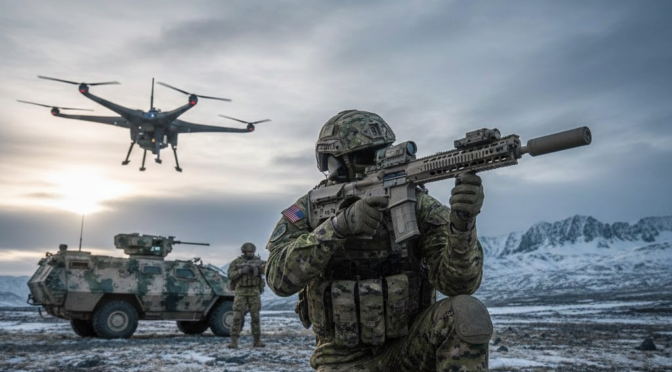
The defense landscape of Canada is currently undergoing a systemic transformation in its small arms inventory, transitioning from the foundational platforms of the mid-to-late Cold War era into a modern, modular, and technologically integrated suite of tactical systems. This evolution is not merely a replacement of aging hardware but represents a fundamental shift in Canadian defense doctrine, moving toward high-intensity, multi-domain operations. As the Canadian Armed Forces (CAF) recalibrate for a future defined by near-peer competition and the complexities of Arctic sovereignty, the selection, procurement, and deployment of small arms have become primary indicators of the nation’s strategic priorities. This analysis explores the technical specifications, organizational distribution, and intelligence implications of the small arms utilized by the Canadian Army, Royal Canadian Navy, Royal Canadian Air Force, and the specialized elements within the Canadian Special Operations Forces Command.
Executive Summary
The modernization of the Canadian small arms fleet is characterized by three primary strategic pillars: the transition to modular multi-caliber platforms, the universal adoption of suppressed systems, and the preservation of a robust domestic defense industrial base. The core of this transition is evidenced by the “Modular Pistol Project,” which has successfully replaced the venerable Browning Hi-Power with the SIG Sauer P320 (designated C22 for general service and C24 for military police).1 In the precision fire domain, the Canadian Army has bifurcated its requirements into a domestic semi-automatic solution, the Colt Canada C20, and an international bolt-action system, the Sako TRG M10, designated as the C21 Multi-Caliber Sniper Weapon.3
Furthermore, the Canadian Modular Assault Rifle (CMAR) program represents an accelerated effort to replace the C7 and C8 family with a new generation of rifles featuring integrated suppression and advanced optical suites.5 This programmatic shift reflects a move away from the “Maple Twist” modifications of American designs toward a unique Canadian standard that emphasizes ergonomic adaptability for diverse personnel and operational reliability in extreme environments ranging from the high Arctic to urban combat zones. The industrial commitment to Colt Canada as a “strategic source” under the Munitions Supply Program remains a central tenet of Canadian procurement, ensuring sovereign control over small arms maintenance and production while selectively leveraging international innovation for niche capabilities.5
Historical Context and the Strategic Role of Domestic Industry
The history of Canadian small arms is defined by the selective adaptation of global designs to meet the specific rigors of the Canadian theater. In 1955, Canada became the first NATO nation to adopt the FN FAL, designated as the FN C1.8 This decision set a precedent for Canadian small arms procurement: taking a proven international platform and modifying it for extreme cold-weather reliability. The Canadian C1 featured an “Arctic trigger” that allowed the trigger guard to be removed for use with heavy mittens and incorporated the ability to top-load the magazine with five-round charger clips.8
The shift to the 5.56x45mm NATO cartridge in 1985 led to the adoption of the C7 and C8 series, manufactured by Diemaco (now Colt Canada). These weapons, while based on the ArmaLite AR-15 architecture, utilized cold-hammer-forged barrels and reinforced furniture to exceed the durability standards of contemporaneous American M16A2 and M4 platforms.10 The current state of Canadian small arms is thus the result of decades of industrial refinement, where the domestic producer, Colt Canada, serves as a “Center of Excellence” for the small arms fleet.5
Summary of General Service Small Arms
| Category | Model | Calibre | Status | Primary Users |
| Service Pistol | SIG Sauer P320 (C22) | 9x19mm NATO | In Service | Army, RCN, RCAF |
| Compact Pistol | SIG Sauer P320 (C24) | 9x19mm NATO | In Service | Military Police |
| Assault Rifle | Colt Canada C7A2 | 5.56x45mm NATO | In Service | Army (Infantry) |
| Carbine | Colt Canada C8A3 | 5.56x45mm NATO | In Service | RCN, RCAF, Army Support |
| Section SAW | FN/Colt Canada C9A2 | 5.56x45mm NATO | In Service | Army (Infantry) |
| General Purpose MG | FN/Colt Canada C6A1 | 7.62x51mm NATO | In Service | All Branches |
| Heavy Machine Gun | M2HB-QCB | 12.7x99mm NATO | In Service | Army, RCN, CANSOFCOM |
The Canadian Army: Land Force Modernization and Lethality
The Canadian Army is the primary stakeholder in the CAF’s small arms fleet, driving the requirements for the majority of standard-issue and specialized weaponry. Current land force doctrine emphasizes high-readiness dismounted infantry capable of operating in complex urban terrain and austere Arctic environments.
The Modular Pistol Project: C22 and C24
The transition from the Browning Hi-Power to the SIG Sauer P320 represents one of the most significant upgrades in individual lethality for the Canadian soldier in nearly eight decades. The legacy Browning platforms, adopted in 1944, suffered from a critical lack of replacement parts and lacked the ergonomics required for modern tactical usage.1 The C22 Full Frame Modular Pistol introduced in 2023 provides a striker-fired mechanism with a 17-round magazine capacity and fully ambidextrous controls.1
One of the most innovative aspects of the C22/C24 procurement is the modularity of the fire control unit (FCU). The serialized portion of the weapon is a removable chassis, allowing the grip module to be changed to suit different hand sizes without requiring new firearm registrations.2 This is particularly relevant given the Army’s focus on inclusivity and ensuring that every member can operate their weapon with maximum efficiency. The C24 variant, specifically issued to the Military Police, is a compact version of the P320, optimized for the diverse duty requirements of security and policing roles.14
The C7 and C8 Ecosystem: Evolution Toward CMAR
While the C7A2 remains the standard infantry rifle, it is reaching the end of its viable service life. The A2 variant was a mid-life upgrade that introduced green furniture, a four-point telescoping stock (standardizing it with the C8), and an ambidextrous suite.15 However, the mounting system—initially a “Canadian Rail” that predated the Picatinny standard—is increasingly incompatible with modern accessories.10
The Canadian Modular Assault Rifle (CMAR) project is intended to replace the nearly 90,000 rifles currently in the inventory.5 Intelligence from internal Department of National Defence briefings suggests a “Two-Tier” approach to the CMAR fleet. The Full Spectrum (CMAR-FS) rifle will be optimized for offensive operations with a longer barrel and advanced optics, while the General Service (CMAR-GS) variant will be issued to support personnel and vehicle crews.16 The likely candidate for this program is an evolution of the Colt Canada Modular Rail Rifle (MRR), featuring a monolithic upper receiver and the M-LOK attachment system.6
Precision Fire and the Sniper System Project
The Canadian Army has historically prided itself on the world-class capability of its snipers. The modern sniper section now operates with a sophisticated mix of semi-automatic and multi-caliber bolt-action systems.
The Colt Canada C20 Semi-Automatic Sniper Weapon (SASW) was adopted to fill the gap for an intermediate sniper weapon that provides rapid follow-up shots.3 Chambered in 7.62x51mm NATO, the C20 replaced the C8 carbines previously used by sniper teams as personal protection weapons.3 In testing, the C20 demonstrated extreme precision, achieving 0.66 MOA over 144 groups of five rounds during endurance trials of 8,000 rounds.19 This rifle uses a direct gas impingement system and a monolithic upper receiver, providing a rigid platform for the Schmidt & Bender 3-20×50 Ultra Short riflescope.3
For primary long-range engagements, the Army selected the Sako TRG M10, designated as the C21 Multi-Caliber Sniper Weapon. This bolt-action system allows the operator to switch calibers in the field between 7.62x51mm and.338 Lapua Magnum.4 This multi-caliber capability allows for cost-effective training with the 7.62mm round while maintaining identical ergonomics when configured for the high-power.338 Magnum for active missions.4
Precision Weaponry Specifications
| Model | Designation | Calibre | Action | Effective Range |
| Colt Canada C20 | SASW | 7.62x51mm NATO | Semi-Auto | 800 m |
| Sako TRG M10 (C21) | MCSW | 7.62mm /.338 LM | Bolt-Action | 1,500 m+ |
| McMillan TAC-50 (C15) | LRSW | 12.7x99mm NATO | Bolt-Action | 2,500 m+ |
| Accuracy Intl. AW | Sniper | 7.62x51mm NATO | Bolt-Action | 800 m |
Support and Suppression Systems
Land force lethality is augmented by a range of section-level and platoon-level support weapons. The C9A2 Light Machine Gun is the current standard for the infantry section, based on the FN Minimi. It is unique for its ability to accept both linked ammunition and STANAG rifle magazines in emergency situations.8 The Army is also completing the fielding of the C6A1 FLEX General Purpose Machine Gun. This modernized GPMG replaces the old wooden-stocked C6 with a version featuring a polymer stock, integrated Picatinny rails for optics, and an external gas regulator to control the rate of fire.14
In the domain of heavy support, the M2HB-QCB (Quick Change Barrel) provides sustained fire in 12.7x99mm. The C16 Close Area Suppression Weapon (CASW) is a digitized 40mm automatic grenade launcher based on the Heckler & Koch GMG.25 Produced under license by Rheinmetall Canada, the C16 provides airburst capability, allowing the infantry to engage hidden targets in defilade.25
Royal Canadian Navy: Boarding and Ship Defense
Small arms operations within the Royal Canadian Navy (RCN) are specialized around the needs of Naval Boarding Parties (NBP) and the elite Naval Tactical Operations Group (NTOG). The operating environment is characterized by high humidity, salt-water corrosion, and extremely confined spaces.
Naval Boarding Party (NBP) Weaponry
The NBP is tasked with cooperative boardings and the investigation of vessels of interest. Their standard weapon suite emphasizes compact firepower and rapid target acquisition. The Colt Canada C8 carbine is the primary long gun for boarding parties, often equipped with the Integrated Upper Receiver (IUR) to streamline accessory mounting.28
The RCN was a primary driver for the adoption of the C22 pistol, as the polymer frame of the P320 is far better suited to the maritime environment than the steel-framed SIG P226 or Browning Hi-Power.2 For high-threat close-quarters battle (CQB), the Navy continues to utilize the Heckler & Koch MP5 submachine gun in various configurations (MP5A3, MP5SD), valued for its controllability and the stealth provided by suppressed variants during night operations.14
Ship-Self Defense and Specialized Roles
For shipboard defense, the RCN utilizes the M2HB-QCB and the GAU-21 (a high-rate-of-fire version of the.50 caliber machine gun) mounted on pedestal mounts to counter asymmetric threats such as small boat swarms.14 These weapons are critical for protection during transit through narrow straits and littoral waters.
The NTOG, which performs higher-risk maritime interdiction missions, utilizes a more specialized inventory. While specific details of NTOG’s kit are often classified, they have been observed utilizing advanced variants of the C8 with suppressed upper receivers and specialized optics.14
Maritime Small Arms Inventory
| Platform | Model | Calibre | Application |
| Boarding Carbine | Colt Canada C8A3/IUR | 5.56x45mm NATO | Primary NBP Weapon |
| Submachine Gun | H&K MP5 | 9x19mm NATO | CQB / Boarding |
| Service Pistol | SIG Sauer P320 (C22) | 9x19mm NATO | Sidearm |
| Tactical Shotgun | Remington 870P | 12-gauge | Breaching / Security |
| Heavy Machine Gun | M2HB-QCB / GAU-21 | 12.7x99mm NATO | Ship Defense |
Royal Canadian Air Force: Protection and Arctic Survival
The Royal Canadian Air Force (RCAF) manages a unique small arms requirement that encompasses base security (Force Protection) and the specialized survival needs of aircrews operating in the high Arctic.
Force Protection and Base Security
RCAF security forces, often operating alongside Military Police, utilize the standard C7A2 and C8A3 platforms for airfield defense. The introduction of the C24 compact pistol provides security personnel with a more concealable and ergonomic sidearm for duty in the confined spaces of aircraft hangars and command centers.14 These forces are increasingly focused on countering unmanned aerial systems (UAS), leading to a greater integration of optics and electronic sighting systems on their standard rifles.
The SAR Rifle: Ruger M77 in.30-06
The most distinctive firearm in the RCAF inventory is the SAR Rifle, a modified Ruger M77 Mk II chambered in.30-06 Springfield.30 This weapon is not intended for combat against human adversaries but is a survival tool for Search and Rescue Technicians (SAR Techs) and aircrews who may find themselves downed in wilderness environments inhabited by dangerous predators.30
The choice of.30-06 Springfield is deliberate, as it provides the necessary kinetic energy to stop a large grizzly or polar bear, a capability that the standard 5.56mm NATO round lacks.30 The rifle is highly customized: it features a 14.5-inch barrel and an international orange folding buttstock made of fiberglass.30 The folding stock reduces the overall length to approximately 25 inches, allowing it to be stored in seat packs or attached to a parachute harness.30 Furthermore, the buttstock contains a trapdoor that stores six extra rounds, ensuring the user has immediate access to ammunition in a survival scenario.30
SAR Rifle Technical Specifications
| Metric | Detail |
| Manufacturer | Sturm, Ruger & Co. / Diemaco |
| Calibre | .30-06 Springfield (7.62x63mm) |
| Action | Bolt-action (Mauser-style Claw Extractor) |
| Barrel Length | 36.83 cm (14.5 in) |
| Total Length (Folded) | 64.44 cm (25.37 in) |
| Capacity | 5-round integral + 6 in stock |
| Weight (Loaded) | 3.34 kg (7.37 lbs) |
| Visual Identification | International Orange Furniture |
CANSOFCOM: Specialized Capability and Advanced Tech
The Canadian Special Operations Forces Command (CANSOFCOM), comprising JTF2 and the Canadian Special Operations Regiment (CSOR), maintains a “vault” of specialized weaponry that reflects its status as a high-readiness, multi-domain force.
CSOR and the C8 IUR
CSOR utilizes the standard Army kit but often augments it with specialized components. The C8 IUR (Integrated Upper Receiver) is the primary platform, featuring a monolithic rail that allows for the permanent mounting of advanced laser designators (like the LA-5) and specialized optics (EOTech) without loss of zero.29 CSOR operators often utilize the SIG Sauer P226R as a secondary weapon, though the transition to the C22 platform is underway to align with broader CAF logistics.29
JTF2: Exclusive Weaponry
As Canada’s primary counter-terrorism unit, Joint Task Force 2 (JTF2) has access to a range of weapons not found in any other branch of the CAF. This includes the FN P90 personal defense weapon (PDW), chambered in 5.7x28mm, which provides high magazine capacity and armor-piercing capability in a compact bullpup design.14 JTF2 also utilizes the Benelli M3 Super 90 shotgun, which offers both pump-action and semi-automatic modes, and the Barrett M82A1 anti-materiel rifle for long-range interdiction and vehicle disablement.14
For precision fire, JTF2 utilizes the Accuracy International AW (Arctic Warfare) in 7.62x51mm, a rifle designed to operate in temperatures as low as -40 degrees Celsius.14 The JTF2 inventory reflects a requirement for absolute reliability in extreme maritime, urban, and Arctic conditions.
CANSOFCOM Specialized Inventory
| Role | Weapon System | Calibre | Branch Usage |
| Personal Defense | FN P90 | 5.7x28mm | JTF2 Exclusive |
| Semi-Auto Shotgun | Benelli M3 Super 90 | 12-gauge | JTF2 Exclusive |
| Anti-Materiel Rifle | Barrett M82A1 | 12.7x99mm NATO | JTF2 Exclusive |
| High-Precision Rifle | Accuracy Intl. AW | 7.62x51mm NATO | JTF2 Exclusive |
| Special Ops Carbine | Colt Canada C8 IUR | 5.56x45mm NATO | CSOR / JTF2 |
| Heavy Sniper Rifle | McMillan TAC-50 | 12.7x99mm NATO | CSOR / JTF2 |
The Future of Canadian Small Arms: Strategic Modernization
The current procurement cycle represents a fundamental shift in how Canada views small arms—from static tools of the infantry to dynamic, modular systems integrated into a digital battlefield.
The CMAR Program: A Shift to Integrated Suppression
The Canadian Modular Assault Rifle (CMAR) program is not merely a rifle replacement; it is a doctrine-shifting initiative. The likely selection of the Colt Canada C8A4 variant introduces several critical upgrades. First, the move to an 11.6-inch or 14.5-inch barrel with a standard-issue suppressor reflects an understanding of the modern acoustic battlefield.6 Suppressed rifles reduce the noise of a firefight, allowing for better voice command and control, while also mitigating the muzzle flash that can give away a soldier’s position.16
The CMAR project is also evaluating new optics. The ELCAN C79 is being phased out in favor of variable power optics like the SAI 1-6x LPVO or the ELCAN Spectre DR 1/4x.6 This allows the soldier to effectively engage targets from close quarters out to the maximum effective range of the 5.56mm cartridge. Furthermore, there is ongoing research into a 77gr 5.56mm cartridge to replace the current 62gr standard, which would provide better terminal ballistics from the shorter carbine barrels of the CMAR fleet.35
Small Arms Modernization Timeline
| Phase | Milestone | Expected Date |
| C22/C24 Delivery | Complete replacement of Browning Hi-Power | March 2024 |
| C20 SASW Fielding | Introduction to sniper sections | 2021-2022 |
| C21 MCSW Delivery | Full distribution to Army snipers | April 2025 |
| CMAR Definition | Finalization of FS/GS variants | Late 2022 |
| CMAR Contract | Initial tranche order (65,401 rifles) | 2025-2026 |
| CMAR Deployment | First units to receive new modular rifles | 2026 |
Industrial Intelligence and the Munitions Supply Program (MSP)
The decision to maintain Colt Canada as a “strategic source” for small arms is a calculated intelligence and economic move. While it might be cheaper to buy off-the-shelf rifles from international manufacturers, the MSP ensures that Canada maintains the technical drawings, tooling, and expert personnel required to maintain and modify its own fleet.7 This sovereign capability proved vital during the Afghan conflict, where rapid modifications to the C8 were required based on frontline feedback.10
However, the procurement of the Sako C21 shows a pragmatic evolution of this policy. When the requirement is for a small quantity of highly specialized bolt-action rifles (only 229 units), the DND determined that it was more cost-effective to compete the contract internationally rather than funding a new production line at Colt Canada.7 This “Hybrid Procurement” model allows Canada to sustain its strategic industrial base for high-volume service rifles while leveraging global innovation for niche, high-precision tools.
Strategic Implications of Small Arms Proliferation
The modernization of Canada’s small arms has broader implications for NATO interoperability and national security. The standardization on the SIG Sauer P320 (already used by the US, Denmark, and others) and the move toward M-LOK and Picatinny rails ensures that Canadian troops can seamlessly integrate with allied logistics and shared tactical equipment.35
Furthermore, the “Assault-Style Firearms Compensation Program” currently underway in Canada’s domestic sector reflects a decoupling of military and civilian small arms standards.37 While the military is moving toward more advanced, suppressed, and modular “assault-style” platforms, the civilian ownership of these same designs is being restricted. This ensures that the CAF maintains a distinct “operational edge” over non-state actors or internal threats, while also standardizing the military’s inventory on platforms that are purpose-built for high-intensity warfare rather than civilian or sporting use.
Technical Conclusion
The Canadian Armed Forces small arms inventory in the 2024-2026 period represents a comprehensive modernization of the “Soldier System.” By transitioning to the C22/C24 modular pistols, the C20/C21 precision rifles, and the upcoming CMAR family, the CAF has addressed nearly a century of cumulative technical debt. The shift toward integrated suppression, multi-caliber capability, and modular ergonomics reflects a sophisticated understanding of the modern combat environment. Whether in the hands of a SAR Tech in the Yukon, a boarding party member in the Persian Gulf, or a dismounted infantryman in an Arctic sovereignty patrol, the small arms of the CAF are increasingly modular, reliable, and tailored to the unique demands of Canadian defense.
Please share the link on Facebook, Forums, with colleagues, etc. Your support is much appreciated and if you have any feedback, please email us in**@*********ps.com. If you’d like to request a report or order a reprint, please click here for the corresponding page to open in new tab.
Sources Used
- Canadian Armed Forces Transitions to SIG SAUER P320, accessed January 31, 2026, https://www.sigsauer.com/blog/canadian-armed-forces-transitions-to-sig-sauer-p320
- C22 Full Frame Modular Pistol – Canada.ca, accessed January 31, 2026, https://www.canada.ca/en/army/services/equipment/weapons/c22-modular-pistol.html
- Colt Canada C20 – Wikipedia, accessed January 31, 2026, https://en.wikipedia.org/wiki/Colt_Canada_C20
- Snipers set sights on new rifle | Canadian Army Today, accessed January 31, 2026, https://canadianarmytoday.com/snipers-set-sights-on-new-rifle/
- New rifles on the way for Canada’s soldiers as defence spending ramps up | CBC News, accessed January 31, 2026, https://www.cbc.ca/news/politics/colt-modular-assault-rifles-army-9.7011113
- Colt Canada Unveils New C8A4 Carbine for Canadian Armed Forces at CANSEC 2024, accessed January 31, 2026, https://militaryleak.com/2024/06/05/colt-canada-unveils-new-c8a4-carbine-for-canadian-armed-forces-at-cansec-2024/
- ANALYSIS: Is It Time To Open Canadian Military Small Arms Contracts To Competition?, accessed January 31, 2026, https://www.espritdecorps.ca/feature/analysis-is-it-time-to-open-canadian-military-small-arms-contracts-to-competition
- FN C1 Self-Loading Rifle | The Canadian Encyclopedia, accessed January 31, 2026, https://thecanadianencyclopedia.ca/en/article/fn-c1-self-loading-rifle
- L1A1 Self-Loading Rifle – Wikipedia, accessed January 31, 2026, https://en.wikipedia.org/wiki/L1A1_Self-Loading_Rifle
- Canada’s superior C7 and C8 – Service rifles from around the world | – Sandboxx, accessed January 31, 2026, https://www.sandboxx.us/news/colt-canadas-c7-and-c8-service-rifles-around-the-world/
- Colt Canada | RAMPART Canada’s Leading Supplier Of Operational Equipment, accessed January 31, 2026, https://rampartcorp.com/colt-canada/
- Canadian Armed Forces Receive New C22 (Sig Sauer P320) Modular Pistols, accessed January 31, 2026, https://militaryleak.com/2023/05/30/canadian-armed-forces-receive-new-c22-sig-sauer-p320-modular-pistols/
- SIG Sauer P320 – Wikipedia, accessed January 31, 2026, https://en.wikipedia.org/wiki/SIG_Sauer_P320
- List of equipment of the Canadian Armed Forces – Wikipedia, accessed January 31, 2026, https://en.wikipedia.org/wiki/List_of_equipment_of_the_Canadian_Armed_Forces
- Colt Canada C7 – Wikipedia, accessed January 31, 2026, https://en.wikipedia.org/wiki/Colt_Canada_C7
- What’s replacing the C7 assault rifle? | Canadian Army Today, accessed January 31, 2026, https://canadianarmytoday.com/whats-replacing-the-c7-assault-rifle/
- Army has two variants in development for the next modular assault rifle, accessed January 31, 2026, https://canadianarmytoday.com/army-has-two-variants-in-development-for-the-next-modular-assault-rifle/
- MRR – Colt Canada, accessed January 31, 2026, https://www.coltcanada.com/mrr/
- colt canada, semi-automatic sniper rifle, c20, 7.62x51mm, accessed January 31, 2026, https://www.coltcanada.com/c20/
- Van Arty Association and RUSI Van Members News May 19, 2020 World War 2 – 1945 – vancouver gunners, accessed January 31, 2026, https://www.vancouvergunners.ca/uploads/2/5/3/2/25322670/19_may_2020__van_gunners_and_rusi_vancouver_members_news_.pdf
- FIRST LOOK: Colt Canada’s C20 Sniper Rifle | thefirearmblog.com, accessed January 31, 2026, https://www.thefirearmblog.com/blog/2019/09/26/first-look-colt-canadas-c20-sniper-rifle/
- C20 LE | Rampart Corp, accessed January 31, 2026, https://rampartcorp.com/product/c20-le/
- Sako TRG M10, accessed January 31, 2026, https://www.sako.global/rifle/sako-trg-m10
- C6 and C6A1 7.62-mm Medium Machine Gun – Canada.ca, accessed January 31, 2026, https://www.canada.ca/en/army/services/equipment/weapons/c6-general-purpose-machine-gun.html
- Heckler & Koch GMG – Wikipedia, accessed January 31, 2026, https://en.wikipedia.org/wiki/Heckler_%26_Koch_GMG
- Our weapon systems – Rheinmetall Canada Inc., accessed January 31, 2026, https://www.rheinmetall.com/en/company/subsidiaries/rheinmetall-canada/systems-and-products/weapon-systems
- GMG – Weapon Systems, accessed January 31, 2026, https://old.weaponsystems.net/weaponsystem/BB02%20-%20GMG.html
- Students aim for results – Pacific Navy News – The Lookout Newspaper, accessed January 31, 2026, https://lookoutnewspaper.com/students-aim-for-results/
- CSOR: The Canadian Special Operations Regiment – Grey Dynamics, accessed January 31, 2026, https://greydynamics.com/csor-the-canadian-special-operations-regiment/
- Interesting Canadian milsurp?, accessed January 31, 2026, https://www.canadiangunnutz.com/forum/threads/interesting-canadian-milsurp.2326770/
- Ruger M77 – Wikipedia, accessed January 31, 2026, https://en.wikipedia.org/wiki/Ruger_M77
- Ruger M77 | Military Wiki – Fandom, accessed January 31, 2026, https://military-history.fandom.com/wiki/Ruger_M77
- The History of the M77 Rifle – RIFLE BASIX, accessed January 31, 2026, https://riflebasix.com/blog/the-history-of-the-m77-rifle/
- Cansof Kit Guide | PDF | Cbrn Defense – Scribd, accessed January 31, 2026, https://www.scribd.com/document/820461000/Cansof-Kit-Guide
- Any Servicemembers on here able to give a really dumbed down (I mean extremely simplified so an ignorant leftist can understand it) explanation of the Canadian Modular Assault Rifle program, C7 vs C8 features, etc.? Essentially, what was standard and what will be the new normal? – Reddit, accessed January 31, 2026, https://www.reddit.com/r/canadaguns/comments/1pk29lt/any_servicemembers_on_here_able_to_give_a_really/
- Tag: C22 – The Armourers Bench, accessed January 31, 2026, https://armourersbench.com/tag/c22/
- List of firearms: for individuals – Canada.ca, accessed January 31, 2026, https://www.canada.ca/en/public-safety-canada/campaigns/firearms-buyback/individual-lists-firearms-lower-upper-receivers/list-firearms-individuals.html
- Lists of firearms and upper receivers: for individuals – Canada.ca, accessed January 31, 2026, https://www.canada.ca/en/public-safety-canada/campaigns/firearms-buyback/individual-lists-firearms-lower-upper-receivers.html