Executive Summary
The People’s Liberation Army (PLA) is confronting a “demographic gravity” that threatens to undermine its goal of becoming a “world-class force” by 2049. China’s transition to a rapidly aging society, marked by a shrinking youth population and the sociopsychological legacy of the One-Child Policy (OCP), has shifted the military’s foundational human capital. With the 18-to-24-year-old cohort expected to contract significantly—mirroring a projected 28 percent decline in the total labor force by 2050—the PLA is forced to compete more aggressively with the civilian sector for high-quality talent.1 Beyond pure numbers, the “only-child” generation presents a unique psychological profile characterized by higher risk aversion and increased casualty sensitivity due to the “four-two-one” family structure, where one soldier represents the sole support for six elders.2 To cope, the PLA is pivoting from a mass-mobilization “People’s War” model to a streamlined, professionalized force that prioritizes STEM graduates, “Targeted Training NCOs,” and “intelligentization”—the integration of AI and autonomous systems to offset human attrition and mitigate operational risks.4
Table 1: Strategic Summary of Demographic Impacts and PLA Responses
| Key Driver | Primary Military Impact | Strategic Mitigation |
| Aging & Shrinking Population | 28 percent labor force decline by 2050 1; shrinking pool of eligible recruits 1 | Prioritizing STEM/University graduates; Targeted Training NCO program 8 |
| One-Child Policy Legacy | “Little Emperor” syndrome: higher risk aversion, lower trust, and reduced conscientiousness 9 | Enhanced psychological resilience training; shift toward inclusive “democratic” command styles 10 |
| Gender Imbalance | 35 million surplus males (“Bare Branches”) 11; increased risk of internal instability/trafficking 12 | Use of military to absorb surplus males; potential for “Peaking Power” diversionary conflict 13 |
| Family Structure (4-2-1) | Extreme casualty sensitivity; losing an only child risks social stability and regime legitimacy 3 | “Intelligentization” (AI, UAVs, and Robotics) to reduce human attrition in combat 6 |
The People’s Republic of China (PRC) is currently navigating a demographic transformation that is unprecedented in both its speed and its scale. For the People’s Liberation Army (PLA), this transformation represents a fundamental shift in the foundational elements of national power. As the military wing of the Chinese Communist Party (CCP), the PLA is tasked with achieving “national rejuvenation” and transforming into a “world-class force” by 2049, yet it must do so against a backdrop of a rapidly aging society, a shrinking youth population, and the complex sociopsychological legacies of decades of radical population control.1 The intersection of these trends creates a set of unique pressures that influence recruitment, training, operational doctrine, and the strategic risk calculus of the Central Military Commission (CMC). To understand the future of Chinese military power, one must analyze the military not merely as a collection of platforms and weapons, but as a human institution struggling to adapt to the reality of demographic decline.
The Strategic Weight of Demographic Gravity: Trajectories through 2050
The demographic landscape of China in the 2020s is the result of a long-term transition from high fertility to one of the lowest birth rates in the world. Following the rapid population growth of the mid-twentieth century—where the population increased by nearly 50 percent between 1950 and 1970—the CCP implemented a series of restrictive policies culminating in the 1980 One-Child Policy (OCP).17 By 2024, the national fertility rate had plummeted to approximately 0.93 to 1.0 children per woman, a figure significantly below the replacement level of 2.1.18 This decline is not a temporary dip but a sustained trend that has led to the first absolute population contraction in 2022.1
For military planners, the most critical metric is the size and health of the 18-to-24-year-old cohort, the primary pool for conscription and officer recruitment. Projections indicate that China’s labor force will experience a 28 percent decrease by 2050 from its 2015 peak.1 While the absolute number of youth in China remains approximately three times larger than that of the United States in the near term, the shrinking share of young people in the total population creates a more competitive labor market where the PLA must vie with a maturing, high-tech civilian economy for the best talent.
Table 2: Comparative Demographic and Economic Projections (2024–2050)
| Metric | 2024 Estimate | 2050 Projection | Strategic Implication |
| Total Fertility Rate (TFR) | 1.0 18 | 1.1 – 1.3 | Sustained Population Decline |
| Labor Force Size (vs 2015 Peak) | 95 percent | 72 percent 1 | Severe Manpower Contraction |
| Old-Age Dependency Ratio | 0.21 1 | 0.52 1 | Fiscal Pressure on Defense |
| Urbanization Rate | 60 percent 1 | 80 percent 1 | Death of the Peasant Army Model |
| Median Age | 39.8 Years | ~50 Years | Aging Society vs. Combat Vitality |
The aging of the population introduces a “guns-versus-butter” trade-off that is increasingly visible in Chinese public discourse. As the old-age dependency ratio doubles by 2050, the state will be forced to allocate a larger share of the Gross Domestic Product (GDP) to healthcare and elderly support. Although official defense spending reached 1.78 trillion RMB ($246.5 billion) in 2025—a nominal increase of 7.2 percent—outside estimates suggest the actual figure is significantly higher, including costs for the People’s Armed Police (PAP) and retired senior officer perquisites that are often excluded from the official budget. The internal pressure to maintain performance legitimacy through economic growth, while simultaneously funding a massive social safety net, may eventually constrain the PLA’s ability to sustain its breakneck modernization pace.
The One-Child Policy Legacy: Sociopsychological Profiles of the “Little Emperor” Soldier
The One-Child Policy did more than alter the quantity of people; it fundamentally changed the character of the Chinese soldier. The generation of “only children” born between 1980 and 2016, often referred to as “Little Emperors,” now makes up over 70 percent of the PLA’s personnel.10 From an intelligence and military perspective, this cohort presents a psychological profile that is markedly different from the peasant-based, sibling-rich force of the Mao and Deng eras.
Research into the behavioral traits of these only children identifies a consistent pattern of increased risk aversion, reduced competitiveness, and lower levels of interpersonal trust compared to those with siblings.9 These traits are not merely academic; they have direct implications for combat motivation and unit cohesion. Only children are found to be more prone to neuroticism and pessimism, characteristics that are detrimental to the high-stress, unpredictable environment of modern warfare.2
Risk Aversion and the “Four-Two-One” Constraint
The “four-two-one” family structure—where one child is responsible for two parents and four grandparents—creates a unique burden of responsibility that influences the soldier’s risk calculus. Survey data indicates that only-child parents are significantly more risk-avoidant in health and finance because the loss of their only child would mean a total lack of support in their old age.3 This parental anxiety filters down to the soldiers themselves, who are acutely aware that their death in combat would leave their entire extended family without a primary caretaker or provider.3
The PLA has responded to this challenge by attempting to build a more inclusive and supportive military culture. Initiatives such as the “three democracies” and “golden ideas” suggest a move away from strictly authoritarian command toward a model that incorporates lower-level input, potentially to build the trust and “buy-in” that only children often lack.10 Furthermore, the military is investing heavily in “resilience training” and psychological wellness to combat the perception that military life is excessively harsh, a perception that discourages many only children from joining or remaining in the force.10
Gender Imbalance and the “Bare Branches” Paradox: Internal and External Security Risks
The cultural preference for sons, combined with the strictures of the OCP, has resulted in a severe gender imbalance in the Chinese population. By the year 2020, it was estimated that 12 to 15 percent of young adult males in China would be unable to find wives.12 These surplus males are known as guang gun-er, or “bare branches”—individuals who will never marry or produce offspring.12
Surplus Males as a Driver of Violence
The sociology of high sex ratios suggests that societies with a surplus of young, unmarried, low-status males are more prone to domestic instability and international aggression.21 These “bare branches” often lack the stabilizing social bonds of marriage and fatherhood, making them more susceptible to recruitment by criminal gangs or involvement in riots.12 Historically, the PLA has been used to manage such surplus populations by absorbing them into the ranks, keeping them away from urban centers, and utilizing them for high-risk public works projects.21
However, this surplus also creates a potential driver for “diversionary war.” According to some theorists, an authoritarian regime facing internal dissatisfaction due to economic slowdown or social volatility (such as that caused by tens of millions of frustrated bachelors) may turn to aggressive foreign policy to redirect public attention and appeal to popular nationalism.23 While some scholars argue that the CCP’s ability to control domestic information makes diversionary conflict less likely, the structural pressure of the surplus male population remains a primary concern for internal security forces like the People’s Armed Police.24
Table 3: Sex Ratio and Gender Imbalance Indicators (2024)
| Cohort | Male-to-Female Ratio | Estimated Missing Females | Strategic Risk |
| At Birth | 1.09 18 | ~40 Million (Total) 13 | Future “Bare Branches” |
| Under 15 | 1.14 18 | ~15 Million 25 | Volatile Youth Cohort |
| 15–64 Years | 1.06 18 | ~20 Million 25 | Workforce/Military Imbalance |
| 65+ Years | 0.86 18 | N/A | Aging Female Population |
The extreme sex ratio at birth, which peaked in 2005 at 118.6 male births per 100 female births, ensures that this gender imbalance will persist for decades, creating a long-term deficit of women that fuels human trafficking and chattel markets, further destabilizing the social environment in which the PLA operates.12
Foreign Adoption and Postnatal Discrimination: The “Lost Daughters” and Military Morale
The phenomenon of international adoption provides a window into the depth of female devaluation during the OCP era. Since 1992, over 160,000 Chinese children—90 percent of whom are girls—have been adopted by families abroad, primarily in the United States. While the absolute number of adoptions is demographically minimal, the underlying cause—widespread abandonment and postnatal discrimination—has left a lasting scar on the national psyche.26
For the military, the “lost daughters” represent more than just a missing cohort of potential female recruits. The devaluation of female life has contributed to a “bride price” crisis in rural areas, where the cost of marriage has skyrocketed due to the scarcity of women.28 This crisis disproportionately affects the poor, who historically provided the bulk of the PLA’s infantry. A soldier who cannot afford to marry and “carry on the family line” is a soldier with potentially lower morale and a higher sense of betrayal by the state.13
Furthermore, as the PLA attempts to increase female recruitment—which saw a 15.6 percent increase in recruitment slots for military academic institutions in 2024—it must contend with the cultural legacy of sexism and the “model minority myth” that often surrounds female roles in Chinese society. The integration of women into combat roles is not merely a personnel solution; it is a direct challenge to the patriarchal norms that the OCP reinforced.26
Recruitment Modernization and the Human Capital War: Quality over Quantity
Faced with a shrinking manpower pool and the demands of “informatized” and “intelligentized” warfare, the PLA has radically shifted its recruitment strategy. The goal is no longer to field a massive army of peasants, but a streamlined, professional force of technical specialists.4
The Shift to College Graduates and STEM Talent
The PLA’s 2024 and 2025 recruitment plans highlight a prioritization of university-educated youth, particularly those with backgrounds in science and engineering. Nearly 90 percent of recruits are now expected to be high school graduates or have higher education credentials.10 Admission to military academic institutions has become highly competitive, with candidates requiring Gaokao (National College Entrance Exam) scores nearly 90 points higher than the admission floor for key provincial universities.8
The specialization of the officer corps is evident in the 51:1 ratio of science to liberal arts students admitted to military schools.8 This focus on the “physics” category track is essential for a military that is re-orienting its force structure around cyber, space, and electronic warfare.8 Following the dissolution of the Strategic Support Force (SSF) in April 2024, the PLA re-affiliated its Space Engineering and Information Engineering universities to the Aerospace Force (ASF) and Cyberspace Force (CSF) respectively, ensuring a direct pipeline of technical talent to the most advanced warfighting domains.8
Professionalizing the NCO Corps
The most significant change in the PLA’s human resource management is the professionalization of the Non-Commissioned Officer (NCO) corps. Historically, NCOs were drawn from the conscript pool after one year of service, but the short two-year conscription cycle made it difficult to develop and retain technical experts.4 To solve this, the PLA launched the “Targeted Training NCO” program in 2012.
Under this program, the military collaborates with civilian vocational colleges to recruit high school graduates. These students spend 2.5 years in a “quasi-militarized” college environment—wearing uniforms and living in NCO dormitories—before completing six months of military training.4 This model allows the military to leverage civilian expertise while contractually securing a minimum five-year service commitment, effectively mitigating the training waste of the conscription cycle.4
Table 4: PLA NCO Recruitment and Pay Structure (2025)
| Category | Recruitment Target | Primary Majors | Salary/Rank |
| Targeted Training NCO | 21,000 Students 4 | UAV Tech, Marine Eng, Cyber | ~6,000 RMB (Corporal) 4 |
| Direct Recruitment NCO | Graduating Civilians 31 | Specialty Technical Skills | Early Promotion (Sergeant) 4 |
| Traditional Conscript | High School Graduates 4 | General Operations | ~1,000 RMB Allowance 4 |
| Priority Forces | ASF, CSF, ISF, PLARF 8 | Sports Training, Electronics | Higher Retention Bonuses 4 |
The 2025 recruitment data reveals a strategic shift away from the Army (PLAA) toward the Navy (PLAN) and Air Force (PLAAF), as well as the new strategic forces. For example, UAV Application Technology has become a top priority for both the PLAA and PLAAF, while Marine Engineering dominates the PLAN’s recruitment.4 The inclusion of “sports training” experts in the Rocket Force (PLARF) recruitment reflects a concern for the physical and psychological maintenance of operators handling high-stress technical equipment.4
Intelligentization as a Structural Offset: The Technological Solution to Demographic Decline
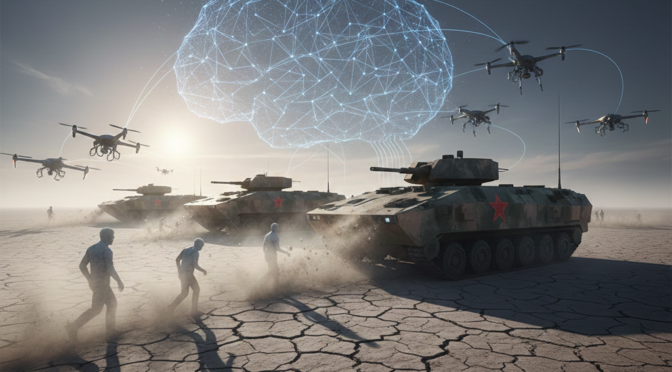
The PLA’s “intelligentization” strategy is perhaps the most ambitious demographic offset program in human history. By integrating AI, quantum computing, big data, and autonomous systems, the PLA seeks to maintain its military overmatch while reducing its reliance on human labor.5
Unmanned Systems and “Meta-War”
Unmanned intelligent combat systems are the centerpiece of this effort. PLA theorists have articulated a vision of “Meta-War” [元战争] or “Battleverse” [战场元宇宙], where AI processes enormous amounts of data to provide situational awareness and decision-making capabilities that exceed human limits.5 Unmanned weapons—including bionic robots, humanoid systems, and autonomous swarms—are viewed as the solution to several demographic problems:
- Reduced Attrition Sensitivity: Unmanned systems can be lost in combat without the political fallout associated with human casualties.6
- Overcoming Physiological Limits: Machines do not need sleep, are not affected by the “Little Emperor” psychology, and can operate in environments (such as deep sea or high-radiation zones) that are lethal to humans.6
- Collective Intelligence: By networking AI-equipped platforms, the PLA can create a “distributed intelligence” that allows smaller, stealthier units to challenge superior conventional forces, such as U.S. carrier strike groups.6
The PLA expects to be “basically” mechanized by 2020, informatized by 2027, and fully intelligentized by 2035. This timeline is not coincidental; it aligns with the period of steepest demographic contraction in China’s youth population.
The Military Metaverse and Training
The use of the metaverse for training is another key coping mechanism. By allowing officers and soldiers to “seamlessly switch between the real-world battlefield and a virtual parallel battlefield,” the PLA hopes to rapidly mature a generation of soldiers who lack real-world combat experience.5 This immersive environment is used to simulate the “horrors of war” to build psychological resilience, as well as to predict enemy intentions through millions of system-to-system simulations.5
Geopolitical Windows and the “Peaking Power” Trap: Timing the Conflict
The interaction between China’s demographic decline and its military modernization has led to the “Peaking Power” theory, most notably articulated by Hal Brands and Michael Beckley. This theory posits that China is a “peaking power” whose economic growth has slowed but whose military capabilities have reached a point where it can disrupt the international order.32
The Closing Strategic Window
According to this theory, peaking powers are the most dangerous kind of country. Unlike rising powers that can “bide their time,” peaking powers perceive a “closing window of opportunity” before their demographic and economic foundations begin to erode significantly.14 For Chinese leaders, this creates a “now or never” mentality, especially regarding the unification of Taiwan.
- Aggressive Revisionism: Since 2008–2010, as growth rates began to slide, Chinese leaders have explicitly called for more “offensive moves” in regional hotspots.14
- Mercantilist Expansion: To counter excess capacity and a shrinking domestic market, China has pursued industrial policies and overseas market expansion that require a more expansive military footprint to protect trade routes and international chokepoints.14
- Regime Survival: The CCP’s legitimacy is tied to its ability to “deliver the goods” and achieve national rejuvenation. If demographic decline makes peaceful growth impossible, the Party may see military assertiveness as the only way to maintain its grip on power.14
This theory suggests that the risk of conflict is highest in the 2020s and early 2030s, as China realizes it may not catch its rivals through peaceful development alone.14
Operational Risk Calculus: Casualty Sensitivity in High-Intensity Conflict
Any military conflict involving the PLA, particularly a major war over Taiwan, must account for the extreme casualty sensitivity of the “only-child” generation. From a cross-functional perspective, this sensitivity is a primary constraint on Chinese operational planning.
Wargaming the Taiwan Scenario
In a major conflict lasting several months, wargames suggest the PLA could suffer up to 100,000 fatalities, with hundreds of thousands more wounded.16 Such losses would have “catastrophic” consequences for social stability in China.33
- The End of the Family Line: For millions of Chinese families, the death of an only son would mean the end of their ancestral line and a total loss of old-age security.19
- Elite and Public Response: High casualties or “spectacular losses,” such as the sinking of an aircraft carrier, could lead to a revolt against civilian leaders perceived to have sacrificed the nation’s youth for political ambition.33
- Political Authority: Xi Jinping has tied his personal legitimacy to the “China Dream.” A military failure or a high-casualty stalemate could turn that dream into a “nightmare” and undermine his authority.16
Table 5: Casualty Sensitivity and Conflict Scenarios
| Conflict Type | Duration/Intensity | PLA Casualties | Domestic Impact |
| Limited Skirmish | Several Weeks | Dozens 16 | Manageable Social Unrest |
| Maritime Blockade | Weeks/Months | Hundreds/Thousands 16 | High Economic/Social Strain |
| Amphibious Invasion | Months | ~100,000 Fatalities 16 | Risk of Regime Collapse |
| Modern Urban War | High Intensity | “Costly, Lengthy, Bloody” | Significant Morale Degradation 37 |
To mitigate these risks, the PLA has increased its study of urban warfare and amphibious operations, focusing on the capacity to seize control of Taiwan “quickly enough to enable a fait accompli”.37 The success of such a campaign depends on the PLA’s ability to achieve victory before the cumulative effect of combat deaths triggers widespread social unrest in the mainland.33
Institutional Responses and the Path to Adaptation
To cope with the changing demographics, the Chinese government and the PLA have begun implementing a multi-pronged adaptation strategy. These efforts go beyond military modernization and include broader social and economic reforms.
Policy Interventions
Since 2017, the government has tested various interventions to boost fertility, including financial rewards, longer maternity leave, and making it more difficult to obtain birth control.10 However, the “lessons taught by the one-child policy” are difficult for the public to forget, and birth rates remain critically low.10 Other potential policy responses include:
- Immigration: While historically rare in China, some analysts suggest that importing labor may be necessary to offset the shrinking workforce.1
- Hukou Reform: Revising the household registration system could ease the urbanization of the remaining rural working-age population, providing a final boost to the urban labor pool.1
- Raising the Retirement Age: To mitigate the labor contraction and the old-age dependency ratio, the state is considering extending the working life of its citizens.
Integrating the Female Workforce
In both the civilian and military sectors, increasing female participation is viewed as a way to offset GDP losses and labor shortages.25 The PLA’s move to increase female recruitment slots by 15.6 percent in 2024 is a clear indicator of this trend.8 However, this requires significant cultural shifts and a “new type of marriage and childbearing culture” that the CCP is currently attempting to foster.10
Synthesis and Strategic Outlook
The impact of shifting age demographics on the Chinese military is comprehensive, affecting every level of the organization from individual psychology to national strategy. The transition from a labor-abundant to a labor-scarce society has forced the PLA to abandon the “People’s War” model of mass mobilization in favor of a “world-class force” defined by technical excellence and intelligentized systems.
The One-Child Policy and the resulting gender imbalance have created a military that is technologically potent but sociologically fragile. The “Little Emperor” syndrome and the “Bare Branches” phenomenon create unique risks of internal instability and casualty sensitivity that the CCP must manage through increased repression or high-tech operational offsets.
As China enters its “peaking power” phase, the strategic window for achieving its regional ambitions may be closing. The next decade will be the most critical for the PLA, as it seeks to integrate AI and autonomous systems fast enough to compensate for the attrition of its human capital. Whether the PLA can achieve its 2049 goals depends not only on its mastery of technology but on its ability to navigate the profound social changes triggered by decades of population control. The future of Chinese military power is inextricably linked to the demographic destiny of the Chinese people, and for the CCP, the clock is ticking.
Please share the link on Facebook, Forums, with colleagues, etc. Your support is much appreciated and if you have any feedback, please email us in**@*********ps.com. If you’d like to request a report or order a reprint, please click here for the corresponding page to open in new tab.
Sources Used
- Fertility Decline in China and Its National, Military, Structural … – RAND, accessed February 8, 2026, https://www.rand.org/content/dam/rand/pubs/research_reports/RRA3300/RRA3372-1/RAND_RRA3372-1.pdf
- Little Emperors—Behavioral Impacts of China’s One-Child Policy1, accessed February 8, 2026, https://conference.nber.org/confer/2011/CE11/Cameron_Erkal_Gangadharan_Meng.pdf
- Risk Behaviors of Only-Child Parents: Evidence from the One-Child Policy in China – American Economic Association, accessed February 8, 2026, https://www.aeaweb.org/conference/2024/program/paper/nZDkEFnn
- The Technical Backbone: Analyzing the 2025 … – Air University, accessed February 8, 2026, https://www.airuniversity.af.edu/Portals/10/CASI/documents/Research/Other-Topics/2026-01-05%20NCO%20Recruitment%20PLA.pdf?ver=iqpSBD2WTjMWzBsJ0_jxag%3D%3D
- The Path to China’s Intelligentized Warfare: Converging on the Metaverse Battlefield – The Cyber Defense Review, accessed February 8, 2026, https://cyberdefensereview.army.mil/Portals/6/Documents/2024-Fall/Baughman_CDRV9N3-Fall-2024.pdf
- Is the PLA Overestimating the Potential of Artificial Intelligence? – NDU Press, accessed February 8, 2026, https://ndupress.ndu.edu/Media/News/News-Article-View/Article/4042798/is-the-pla-overestimating-the-potential-of-artificial-intelligence/
- China’s Military Employment of Artificial Intelligence and Its Security Implications, accessed February 8, 2026, https://www.iar-gwu.org/print-archive/blog-post-title-four-xgtap
- 2024 Military Academic Institution Recruitment Plan – Air University, accessed February 8, 2026, https://www.airuniversity.af.edu/Portals/10/CASI/documents/Research/Other-Topics/2025-02-27%20PLA%202024%20Military%20Academic%20Institution%20Recruitment%20Plan.pdf
- The effects of China’s One Child Policy on its children – Monash University, accessed February 8, 2026, https://www.monash.edu/news/articles/the-effects-of-chinas-one-child-policy-on-its-children
- Factors Shaping the Future of China’s Military – RAND, accessed February 8, 2026, https://www.rand.org/content/dam/rand/pubs/research_reports/RRA2600/RRA2618-1/RAND_RRA2618-1.pdf
- China Faces Consequences of the One-Child Policy – Providence, accessed February 8, 2026, https://providencemag.com/2024/02/china-faces-the-consequences-of-one-child-policy/
- Missing Women and Bare Branches: Gender Balance and Conflict – Wilson Center, accessed February 8, 2026, https://www.wilsoncenter.org/sites/default/files/media/documents/publication/Hudson%2526denBoer.pdf
- Book Review Bare Branches: The Security Implications of Asia’s Surplus Male Population. By Valerie M. Hudson and Andrea M. den Boer. Cambridge, MA: MIT Press, 2004. Militarized Modernity and Gendered Citizenship in South Korea. By Seungsook Moon. Durham, NC: Duke University Press, 2005. | Signs: Journal of, accessed February 8, 2026, https://www.journals.uchicago.edu/doi/10.1086/518267
- The Peril of Peaking Powers: Economic Slowdowns and …, accessed February 8, 2026, https://direct.mit.edu/isec/article/48/1/7/117122/The-Peril-of-Peaking-Powers-Economic-Slowdowns-and
- Political implications of natural disasters: regime consolidation and political contestation – WIT Press, accessed February 8, 2026, https://www.witpress.com/Secure/elibrary/papers/DMAN15/DMAN15024FU1.pdf
- If China Attacks Taiwan – German Marshall Fund, accessed February 8, 2026, https://www.gmfus.org/sites/default/files/2026-01/If%20China%20Attacks%20Taiwan.pdf
- How Severe Are China’s Demographic Challenges? – ChinaPower Project, accessed February 8, 2026, https://chinapower.csis.org/china-demographics-challenges/
- Demographics of China – Wikipedia, accessed February 8, 2026, https://en.wikipedia.org/wiki/Demographics_of_China
- Twitter and Tear Gas. The Power and Fragility of Networked Protest, accessed February 8, 2026, https://d-nb.info/124031910X/34
- Bare Branches: The Security Implications of Asia’s Surplus Male Population – Belfer Center, accessed February 8, 2026, https://www.belfercenter.org/publication/bare-branches-security-implications-asias-surplus-male-population
- Bare Branches: The Security Implications of Asia’s Surplus Male Population (review), accessed February 8, 2026, https://populationreview.com/files/185207pp83-85.pdf
- Bare Branches: The Security Implications of Asia’s Surplus Male Population, accessed February 8, 2026, https://giwps.georgetown.edu/resource/bare-branches-the-security-implications-of-asias-surplus-male-population/
- Domestic Kindling, International Sparks? | International Studies Quarterly – Oxford Academic, accessed February 8, 2026, https://academic.oup.com/isq/article/69/4/sqaf083/8383052
- What Does China Really Spend on its Military? – ChinaPower Project, accessed February 8, 2026, https://chinapower.csis.org/military-spending/
- Promoting Gender Equality and Tackling Demographic Challenges – IMF eLibrary, accessed February 8, 2026, https://www.elibrary.imf.org/downloadpdf/view/journals/067/2024/002/article-A001-en.pdf
- Chinese Adoption: A Complex Narrative of Power Abuse, Sexism, and Unintended Consequences | by Paper Bridges | Medium, accessed February 8, 2026, https://medium.com/@paperbridges/chinese-adoption-a-complex-narrative-of-power-abuse-sexism-and-unintended-consequences-1552836ecb64
- A Closed Door for Orphans? Unpacking China’s International Adoption Policy, accessed February 8, 2026, https://www.cfr.org/articles/closed-door-orphans-unpacking-chinas-international-adoption-policy
- China’s one-child policy: Impacts on adopted girls – The Journalist’s Resource, accessed February 8, 2026, https://journalistsresource.org/economics/china-one-child-girls-adopt/
- Mitigating Civilian Harm in an Asia-Pacific Conflict – Just Security, accessed February 8, 2026, https://www.justsecurity.org/124864/mitigating-civilian-harm-asia-pacific-conflict/
- PLA Information Support to the Battlefield: UAV Employment Concepts and Challenges, accessed February 8, 2026, https://www.airuniversity.af.edu/CASI/Display/Article/4147737/pla-information-support-to-the-battlefield-uav-employment-concepts-and-challeng/
- Chinese military to recruit more officers from college students, accessed February 8, 2026, http://eng.chinamil.com.cn/CHINA_209163/TopStories_209189/16376002.html
- China Is a Declining Power—and That’s the Problem – Scribd, accessed February 8, 2026, https://www.scribd.com/document/557972677/China-Is-a-Declining-Power-and-That-s-the-Problem
- PLA would suffer 100000 casualties in failed Taiwan invasion, study says, accessed February 8, 2026, https://ipdefenseforum.com/2026/01/pla-would-suffer-100000-casualties-in-failed-taiwan-invasion-study-says/
- If China Attacks Taiwan: The Consequences for China of “Minor Conflict” and “Major War” Scenarios – US Army War College – Strategic Studies Institute, accessed February 8, 2026, https://ssi.armywarcollege.edu/SSI-Media/Recent-Publications/Article/4371652/if-china-attacks-taiwan-the-consequences-for-china-of-minor-conflict-and-major/
- If China Attacks Taiwan: Beijing Risks Social Instability in a Conflict – German Marshall Fund, accessed February 8, 2026, https://www.gmfus.org/news/if-china-attacks-taiwan-beijing-risks-social-instability-conflict
- (PDF) War and the trauma of child combatant: A thematic extrapolation of Uzodinma Iweala’s Beasts of No Nation (2005) – ResearchGate, accessed February 8, 2026, https://www.researchgate.net/publication/362158588_War_and_the_trauma_of_child_combatant_A_thematic_extrapolation_of_Uzodinma_Iweala’s_Beasts_of_No_Nation_2005
- the pla’s evolving outlook on urban warfare: – learning, training, and implications for taiwan – Institute for the Study of War, accessed February 8, 2026, https://understandingwar.org/wp-content/uploads/2025/04/The20PLA20Outlook20on20Urban20Warfare20ISW20April202022_0.pdf