Executive Summary
During the week ending February 21, 2026, the People’s Republic of China (PRC) executed a series of highly calculated military, diplomatic, and economic maneuvers designed to capitalize on international volatility while ruthlessly addressing internal structural vulnerabilities. This reporting period is defined by three overlapping strategic vectors that demonstrate Beijing’s comprehensive approach to statecraft, power projection, and systemic resilience. First, the geopolitical landscape experienced a seismic shock following the February 20 ruling by the United States Supreme Court, which struck down the U.S. executive branch’s use of the International Emergency Economic Powers Act (IEEPA) to impose sweeping global tariffs. Beijing has weaponized the resulting policy chaos in Washington, deploying a sophisticated “wedge strategy” that targets U.S. allies. By offering unilateral visa-free travel and lucrative market access agreements—most notably to Canada and the United Kingdom—China is systematically dismantling the unified Western economic front, positioning itself as the anchor of global free trade while the United States signals a retreat toward protectionism and the Western Hemisphere.
Second, the People’s Liberation Army (PLA) continues to push the boundaries of its power projection capabilities, evidenced by the integration of stealth drone technology onto electromagnetic-catapult amphibious assault ships and the development of heavy-lift uncrewed aerial vehicles to solve complex over-the-beach logistical challenges. These technological advancements are designed to fundamentally alter the anti-access/area denial (A2/AD) geometry of the Western Pacific, directly complicating U.S. and allied contingency planning for a Taiwan scenario. Concurrently, the uppermost echelons of the PLA command structure are experiencing severe political turbulence, with unprecedented purges targeting the highest-ranking military officers over alleged failures to meet the Chinese Communist Party’s (CCP) 2027 modernization milestones. This internal friction highlights a critical vulnerability in civil-military relations, suggesting that the operational readiness of the PLA may not align with its rapid procurement of advanced hardware.
Third, internal economic indicators reveal a nation at a critical transition point. The impending 15th Five-Year Plan (2026–2030) signals a monumental pivot from an investment- and export-driven economy to a consumption-led model. While the 2026 Spring Festival travel rush shattered historical records with an estimated 9.5 billion cross-regional trips and a surge in subsidized retail spending, underlying structural deficits—ranging from a protracted property sector slump to a rapidly shrinking labor force—threaten long-term macroeconomic stability. The CCP is attempting to engineer a delicate rebalancing, integrating targeted fiscal stimulus, strategic expansions of the social safety net, and controversial demographic policies, such as raising the national retirement age. However, facing sluggish domestic demand, Beijing continues to rely heavily on its manufacturing supremacy, flooding global markets with high-tech industrial outputs in what economists have termed “China Shock 2.0,” ensuring that Sino-Western trade friction will remain a defining feature of the international system for the foreseeable future.
1. Geopolitical Dynamics and the Global Trade Architecture
1.1 The Supreme Court Tariff Invalidation and U.S. Policy Volatility
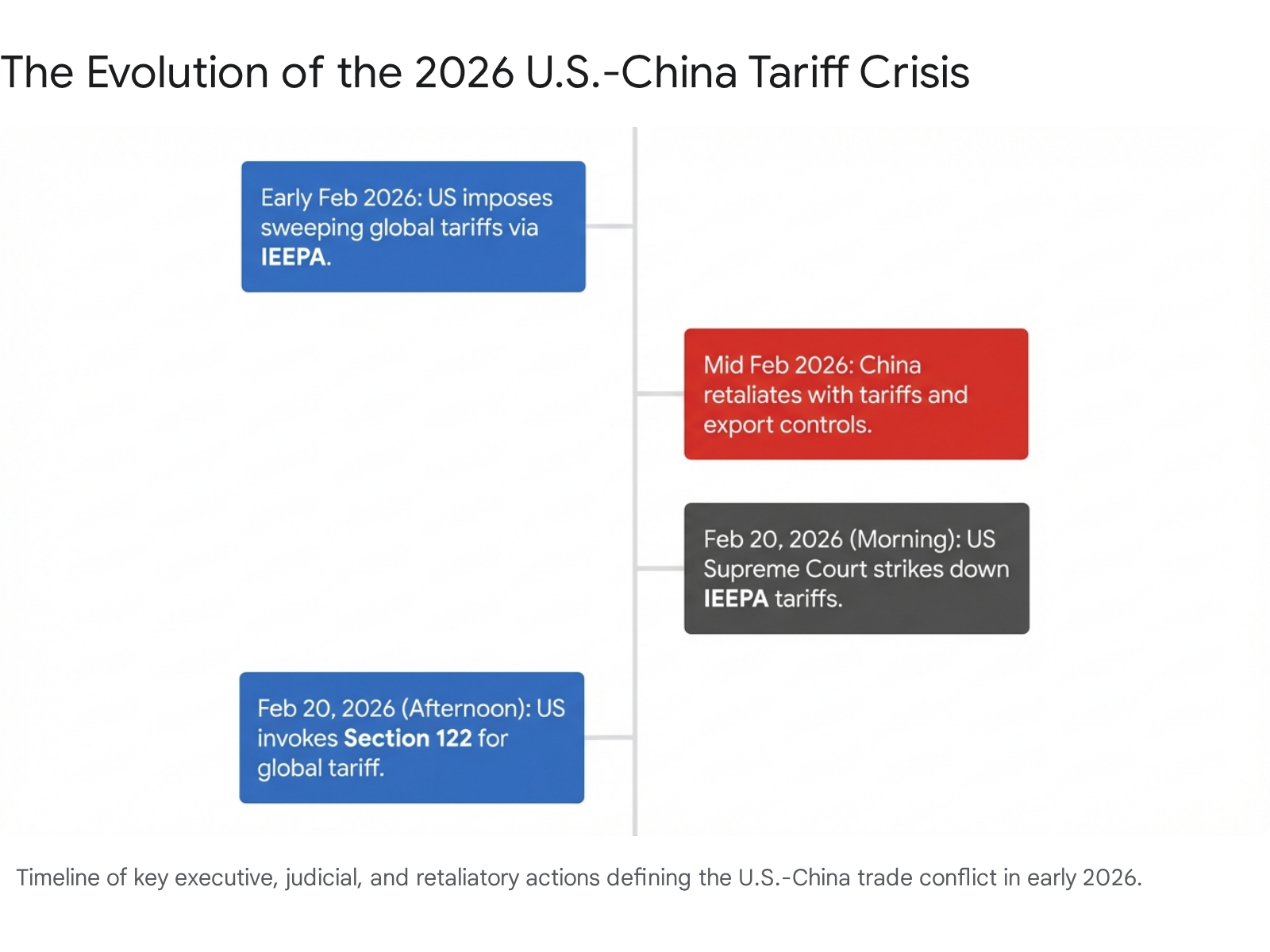
The defining geopolitical event of the reporting period occurred on the morning of February 20, 2026, when the United States Supreme Court issued a landmark 6-3 ruling declaring that the U.S. President does not possess the statutory authority to impose sweeping global tariffs under the International Emergency Economic Powers Act (IEEPA).1 This judicial decision immediately invalidated the legal framework supporting the aggressive trade war initiated by the returning Trump administration, which had previously levied massive, reciprocal tariffs on Chinese imports—culminating in an average effective U.S. tariff rate unseen since 1973.3 The immediate fallout of the ruling injected profound uncertainty into global financial markets, as the legal mechanism that had underpinned hundreds of billions of dollars in import duties was abruptly dismantled.1
However, the legal defeat in Washington was met with an immediate, retaliatory executive pivot that sustained the atmosphere of commercial hostility. Within hours of the ruling, the U.S. executive branch invoked Section 122 of the Trade Act of 1974 to unilaterally impose a “temporary” 10 percent global tariff across the board, valid for a statutory maximum of 150 days due to alleged balance-of-payments emergencies.2 Concurrently, the administration announced the initiation of new, comprehensive investigations under Section 301 of the Trade Act to build a legal and bureaucratic foundation for future, permanent levies.2
China’s response to this volatility has been characterized by strategic patience, opportunistic diplomacy, and asymmetric retaliation. Prior to the Supreme Court ruling, Beijing had systematically countered earlier U.S. tariff escalations by imposing highly targeted 15 percent retaliatory tariffs on U.S. coal and liquefied natural gas (LNG), alongside 10 percent tariffs on crude oil and agricultural machinery—sectors deliberately chosen to inflict maximum political pain on the electoral base of the U.S. administration.13 More significantly, China expanded its export controls on critical minerals essential for high-tech manufacturing, including tungsten, tellurium, bismuth, and molybdenum, effectively weaponizing its near-monopoly over the global critical mineral supply chain.13
| Tariff / Trade Action Category | United States Policy Posture (Post-Feb 20, 2026) | People’s Republic of China Countermeasures |
| Primary Broad Tariffs | 10% Global Tariff under Section 122 (150-day limit).2 | Retaliatory tariffs of 10-15% on U.S. energy and agricultural machinery.13 |
| Legal Frameworks Invoked | Section 301 investigations initiated; IEEPA invalidated.5 | WTO Dispute Settlement filings; Unreliable Entity List designations.13 |
| Strategic Export Controls | Strict semiconductor and AI chip embargoes maintained.14 | Export licensing requirements on tungsten, tellurium, bismuth, molybdenum, and gallium.13 |
Following the chaotic U.S. policy shifts of February 20, the PRC Ministry of Commerce issued stark warnings to global trading partners, condemning the U.S. actions as “economic bullying” and explicitly warning nations like Japan, South Korea, and Taiwan against seeking bilateral exemptions from U.S. tariffs at the expense of Chinese interests.15 The Ministry characterized such appeasement as “seeking the skin from a tiger,” indicating that Beijing will severely punish any regional actor that collaborates with Washington’s containment strategy.15 Chinese strategists correctly perceive the U.S. executive branch’s reliance on fragile legal workarounds as a structural weakness, opting to position China as the stabilizing anchor of the global multilateral trading system while allowing the United States to isolate itself through unilateral protectionism.16
1.2 Wedge Diplomacy and the Strategic Co-optation of U.S. Allies
Sensing deep friction between the United States and its traditional allies over indiscriminate U.S. trade policies, Beijing has launched a highly effective diplomatic offensive designed to drive wedges into Western alliances. On February 17, 2026, the PRC officially implemented a unilateral visa-free travel policy for citizens of Canada and the United Kingdom, allowing stays of up to 30 days for business, tourism, family visits, and transit through December 31, 2026.18
This policy is not merely a mechanism to boost post-pandemic tourism; it is a calculated tool of geopolitical wedge diplomacy. The inclusion of Canada follows a highly publicized January visit to Beijing by Canadian Prime Minister Mark Carney.18 During this diplomatic thaw, Canada agreed to drastically reduce tariffs and allow the entry of 49,000 Chinese electric vehicles (EVs) annually, effectively breaking the unified North American front against subsidized Chinese green technology.16 In exchange, China granted the visa waiver and provided vital tariff relief for Canadian agricultural exports, notably canola seeds, which are politically sensitive in Western Canada.18
By removing the friction of visa applications—which previously cost approximately $140 and required lengthy, opaque processing times—China is actively encouraging Canadian and British corporate executives, researchers, and supply chain managers to bypass increasingly protectionist U.S. markets and re-engage directly with the Chinese economy.18 This strategy exploits the uncertainty generated by the U.S. global tariffs, signaling to U.S. allies that alignment with Beijing offers tangible, immediate economic and logistical rewards, whereas reliance on Washington promises only volatility, unilateral demands, and “America First” protectionism. The UK’s inclusion similarly followed a visit by British Prime Minister Keir Starmer, indicating a broad European reassessment of the risks associated with fully aligning with U.S. decoupling efforts.24
1.3 Multilateral Engagement and the Exploitation of Strategic Vacuums
The effectiveness of China’s diplomatic outreach is amplified by an apparent shift in U.S. strategic priorities. According to the newly released 2026 U.S. National Defense Strategy (NDS), the Pentagon has significantly downplayed the immediate military threat posed by China, pivoting its primary geographic focus toward the Western Hemisphere to reinforce a modern interpretation of the Monroe Doctrine.26 By demanding that Indo-Pacific allies “shoulder their fair share of the burden,” the United States is intentionally creating a strategic vacuum in Asia.26
Beijing is aggressively moving to fill this void through relentless multilateral engagement. From February 1 to 10, China hosted the First APEC 2026 Senior Officials’ Meeting in Guangzhou, utilizing its status as the host of the APEC “China Year” to set the regional agenda.27 Foreign Minister Wang Yi outlined a comprehensive vision for a “Free Trade Area of the Asia-Pacific,” emphasizing digital and green transformations and pushing for deepened practical cooperation that circumvents U.S. financial hegemony.27 Concurrently, Chinese diplomats are fast-tracking stalled bilateral trade negotiations across the Global South and the Pacific rim, engaging heavily with nations like Honduras, Panama, and Peru.16
Furthermore, China’s Commerce Ministry has prioritized entry into the Comprehensive and Progressive Agreement for Trans-Pacific Partnership (CPTPP)—a massive free trade bloc the U.S. abandoned a decade ago.16 Beijing seeks to structurally insulate its $19 trillion economy from future U.S. coercion by tightly binding the economies of the Asia-Pacific to the renminbi and Chinese supply chains.16 This diplomatic push extends to Europe as well, highlighted by Foreign Minister Wang Yi’s mid-February visit to Hungary and his subsequent address at the Munich Security Conference.28 During these engagements, China consistently presented itself as the sole responsible adult in the room, advocating for globalization, systemic stability, and sovereign non-interference, in stark contrast to the transactional and coercive posture currently emanating from Washington.
2. Military Modernization, Power Projection, and Internal Friction
2.1 Amphibious Architecture and the Drone Carrier Paradigm
The PLA has achieved a significant milestone in its naval modernization efforts, fundamentally altering the threat landscape and operational geometry in the Western Pacific. Recent intelligence and open-source imagery circulating on Chinese social media in early February indicate that the PLA Navy’s (PLAN) newest amphibious assault vessel, the Type 076 landing helicopter dock (LHD) Sichuan, is currently undergoing advanced integration trials with the GJ-21 naval stealth drone.29 The Type 076 class represents a generational leap in amphibious warfare architecture; displacing approximately 50,000 tons and capable of carrying 1,000 marines and two air-cushioned landing craft (LCAC), the vessel is uniquely equipped with an electromagnetic catapult launch system, a highly advanced feature historically reserved exclusively for supercarriers.29
The integration of the GJ-21—a specialized naval variant of the GJ-11 “Sharp Sword”—transforms the Sichuan into what Chinese state media has accurately termed a “drone carrier”.29 With an estimated operational range of at least 1,500 kilometers and a massive payload capacity of 2,000 kilograms, the GJ-21 is designed to operate in highly contested airspace, conducting advanced reconnaissance, electronic warfare, and precision strikes against fortified beachhead defenses during the critical shaping phases of an amphibious assault.29
Furthermore, the deployment of up to six GJ-21 drones per vessel remedies a critical structural vulnerability within the current PLAN carrier strike groups. Existing carriers, such as the Shandong and Liaoning, rely on ski-jump ramps (STOBAR) and cannot launch large, fixed-wing airborne warning and control systems (AWACS).29 By accompanying these legacy carriers, the Sichuan can deploy its stealth drones to provide over-the-horizon situational awareness and targeting data, effectively extending the PLAN’s anti-access/area denial (A2/AD) umbrella far beyond the First Island Chain.29 This significantly enhances the survivability of PLAN surface forces and complicates U.S. and allied naval operations in the Philippine Sea and the deep waters east of Taiwan.29
2.2 Uncrewed Aerial Resupply and Over-the-Beach Logistics
Addressing one of the most formidable obstacles to a successful cross-strait invasion, the PLA has accelerated its development of uncrewed logistics platforms to ensure the sustainment of vanguard assault forces. On February 2, 2026, the PLA conducted the maiden test flight of the YH-1000S transport drone.29 This heavy-lift unmanned aerial vehicle utilizes a hybrid electric and gas propulsion system, granting it a 1,600-kilometer range and the highly valuable capability to perform short takeoffs and landings (STOL) from improvised, damaged, or entirely unpaved runways, including dirt roads and grass fields.29
The strategic intent behind the YH-1000S is to execute complex over-the-beach (OTB) resupply operations. Current PLA operational assessments recognize a severe deficit in dedicated military sealift capacity, forcing an over-reliance on roll-on/roll-off (RO-RO) civilian ferries that are slow, cumbersome, and highly vulnerable to anti-ship missiles and naval mines during transit.29 In a Taiwan contingency, capturing intact port facilities is highly unlikely due to deliberate sabotage by defending forces. The YH-1000S, capable of carrying a 1,000-kilogram cargo load, provides the PLA with a resilient, decentralized, and highly survivable vector for delivering critical munitions, medical supplies, and provisions to amphibious units before a secure maritime logistical bridgehead can be established.29 This development indicates a maturation of PLA invasion doctrine, moving beyond the initial kinetic assault phase to actively solve the complex, unglamorous sustainment requirements of a protracted island campaign.
2.3 Gray Zone Escalation, ADIZ Saturation, and Maritime Coercion
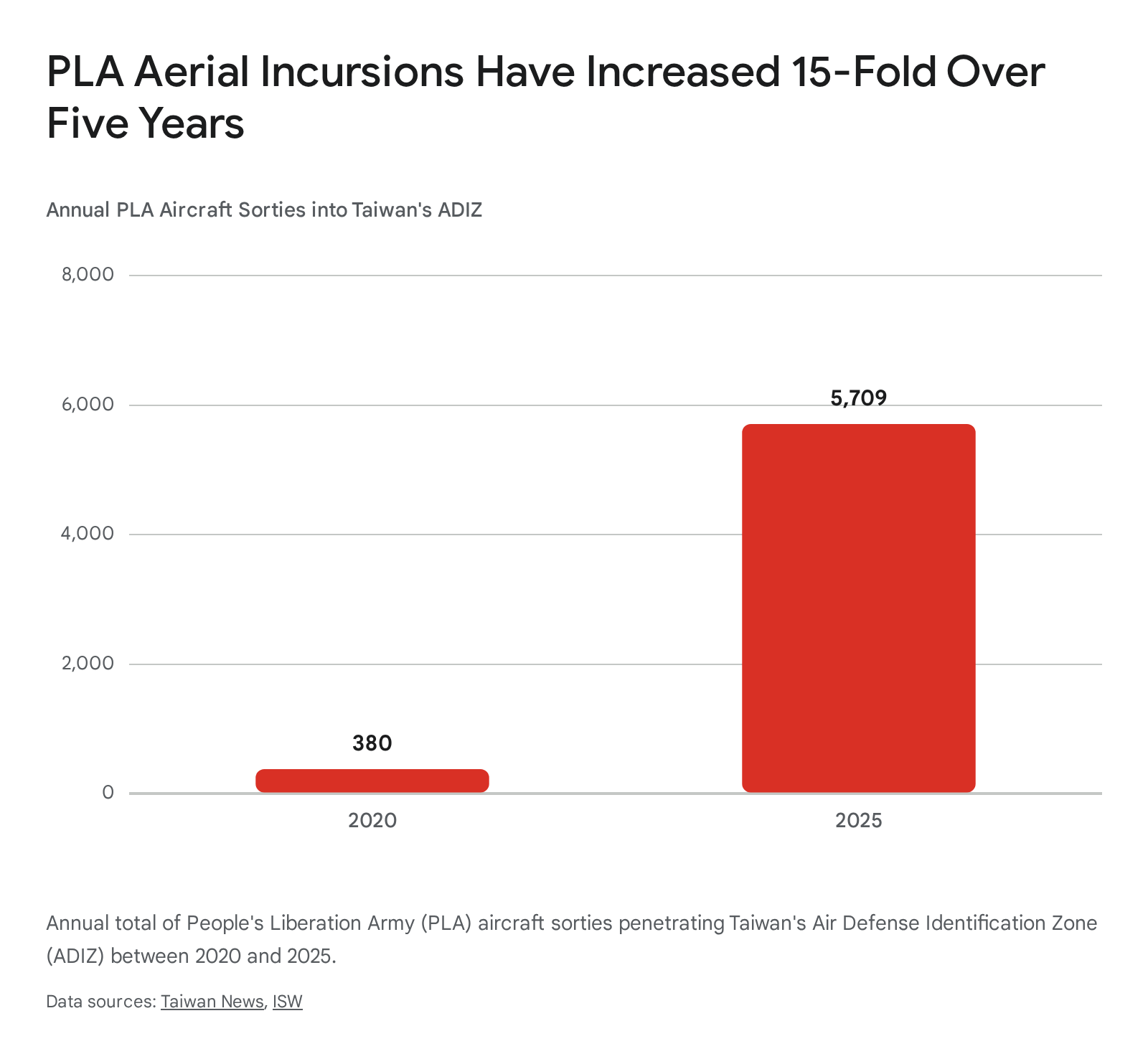
The PRC continues to employ a highly calibrated, relentless campaign of gray-zone coercion aimed at eroding the sovereignty, threat awareness, and operational readiness of its neighbors, particularly Taiwan and the Philippines. While PLA aerial sorties into Taiwan’s Air Defense Identification Zone (ADIZ) saw a localized, seasonal dip in January 2026—recording 166 incursions across the median line in the Taiwan Strait—the broader historical trajectory reveals a massive, systemic escalation.14 Internal defense data from Taiwan indicates that PLA air incursions have skyrocketed by nearly 15 times over a five-year period, jumping from 380 total sorties in 2020 to 5,709 in 2025.14
| Year | Total PLA ADIZ Sorties against Taiwan | Percentage Change (Year-over-Year) |
| 2020 | 380 14 | N/A |
| 2024 | ~3,500 (Estimated) | High Growth |
| 2025 | 5,709 14 | Significant Escalation |
| Jan 2026 | 166 (Monthly Total) 14 | Seasonal Decline |
This sustained high-tempo operational environment is designed to exhaust the Republic of China (ROC) Air Force financially and mechanically, normalize a persistent PLA presence, and compress the decision-making window for Taipei and Washington in the event of a sudden transition to kinetic operations.14 The threat vector has also expanded geographically, with the PLA now conducting regular circumnavigation flights and testing combat operations off Taiwan’s eastern coast, effectively erasing the concept of a secure rear echelon for defending forces.32
In response to this pressure, Taiwan’s domestic politics are increasingly fracturing over defense procurement strategies. In late January 2026, the opposition Kuomintang (KMT) and Taiwan People’s Party (TPP) successfully blocked President William Lai Ching-te’s proposed $40 billion asymmetric warfare budget for the tenth time.29 The opposition advanced a significantly reduced $13 billion version that prioritizes conventional legacy platforms—such as HIMARS and M109A7 howitzers—while stripping funding for critical asymmetric capabilities, including 200,000 combat drones and the proposed “T-dome” integrated air defense network.29 Concurrently, the CCP held its first official exchange with the KMT since 2016, hosting a delegation led by Deputy Chairman Hsiao Hsu-tsen in Beijing from February 2 to 4, indicating a concerted CCP effort to legitimize the opposition and subvert the ruling Democratic Progressive Party (DPP) government through United Front tactics.14
In the maritime domain, the China Coast Guard (CCG) and the People’s Armed Forces Maritime Militia (PAFMM) have significantly amplified their presence in the South China Sea. Following a 2025 campaign that saw the CCG more than double its presence around Scarborough Shoal, the PLA Navy and Air Force conducted highly publicized combat readiness patrols and live-fire drills near the disputed feature in mid-February 2026.14 This assertive posturing is a direct response to the February 17 Philippines-United States Bilateral Strategic Dialogue in Manila, where both nations condemned China’s “coercive actions,” reaffirmed their commitment to the 1951 Mutual Defense Treaty (MDT), and emphasized collective defense in deterring aggression along the First Island Chain.36
2.4 The Dictator’s Dilemma: Political Purges within the High Command
Beneath the veneer of technological advancement and aggressive external posturing, the PLA command structure is experiencing profound, systemic instability. Intelligence assessments and official state media confirm that CCP General Secretary Xi Jinping has initiated unprecedented investigations into two of the highest-ranking military officers in the PRC: Central Military Commission (CMC) Vice Chairman Zhang Youxia and Chief of the CMC Joint Staff Department Liu Zhenli.14 The CMC operates directly under Xi, making the removal of its top uniformed officers highly destabilizing to institutional continuity.
Crucially, official PLA Daily publications have framed these purges not as standard anti-corruption measures—as was the case with former Defense Minister Li Shangfu, who was explicitly accused of bribery—but as explicitly political actions.14 Editorials published in late January and early February declared that the purges were necessary to “remove political threats,” eliminate “watered-down parts of combat capability building,” and clear obstacles hindering the achievement of the PLA’s 2027 modernization milestones, which explicitly include readiness to invade Taiwan.14 The rhetoric demands absolute obedience and responsibility to Chairman Xi, strongly implying that Zhang and Liu either directly contradicted Xi’s strategic directives or provided realistic, pessimistic assessments regarding the PLA’s actual ability to meet the mandated 2027 timeline.14
This dynamic highlights a classic “dictator’s dilemma.” By punishing senior, combat-experienced commanders for failing to achieve unrealistic political milestones, Xi risks cultivating a high command populated entirely by sycophants who will systematically falsify readiness reports to ensure their own political survival. This environment of institutionalized dishonesty drastically increases the risk of strategic miscalculation; if the supreme leader is fed highly sanitized intelligence regarding troop readiness, logistical capacity, and operational competence, he may inadvertently authorize kinetic action based on a deeply flawed, overly optimistic understanding of the PLA’s actual warfighting capabilities.
3. Intelligence, Espionage, and Sub-Threshold Conflict
3.1 Penetrating NATO and Exploiting LEO Networks
Chinese intelligence services, directed primarily by the Ministry of State Security (MSS) and elements of the PLA, are conducting highly aggressive operations targeting Western military alliances and critical communication infrastructures. In early February 2026, French authorities unsealed severe charges against two PRC nationals who were intercepted attempting to compromise Starlink satellite communications near a secure ground station in Villenave d’Ornon.29 This operation indicates a targeted, high-priority effort by the PLA to develop electronic warfare, signal interception, and cyber countermeasures against Low Earth Orbit (LEO) satellite constellations, which have proven absolutely critical for decentralized command and control in modern conflicts, most notably in Ukraine.29
Simultaneously, European counter-intelligence secured a major breakthrough when Greek military authorities arrested a Hellenic Air Force colonel on charges of selling classified NATO documents to PRC intelligence operatives in exchange for cryptocurrency payments.29 This signals an ongoing mandate within the MSS to penetrate NATO networks via human intelligence (HUMINT) assets, likely seeking highly restricted technical specifications regarding allied interoperability, air defense radar signatures, and joint contingency planning that could be reverse-engineered or exploited in a broader Pacific conflict scenario.
3.2 Corporate Proxies and U.S. State-Level Pushback
As the federal government of the United States attempts to decouple from compromised Chinese technology, PRC-linked entities are utilizing sophisticated corporate proxy structures to maintain lucrative market access and massive data-harvesting capabilities. On February 18, 2026, the Attorney General of Texas launched a major lawsuit against Anzu Robotics, LLC, exposing the firm as a “21st-century Trojan horse” operating on behalf of the Chinese Communist Party.39
Intelligence detailed in the state lawsuit alleges that Anzu Robotics was established primarily as a shell company to circumvent U.S. federal blacklists targeting DJI, the dominant Chinese drone manufacturer heavily scrutinized by the Pentagon for its links to the PLA and the CCP.39 Investigators discovered that Anzu drones utilize identical DJI hardware, DJI-signed encrypted firmware, and core software components, thereby preserving the exact surveillance, data collection, and backdoor vulnerabilities that triggered the original federal bans.39 This incident is part of a much broader, coordinated legal offensive by Texas against CCP-aligned tech giants; in the same week, the state filed lawsuits against networking equipment manufacturer TP-Link (February 17), e-commerce platform Temu (February 19) for illegal data harvesting, and fast-fashion giant Shein (February 20) for exposing personal user data to the CCP.39 This highlights a pervasive tactic employed by Chinese state-aligned enterprises: when confronted with Western sanctions, they will rapidly spawn localized, rebranded proxy entities to evade regulatory scrutiny while continuing to funnel critical geospatial, commercial, and user data back to servers accessible by the Chinese state under the PRC’s sweeping 2017 National Intelligence Law.
3.3 Hong Kong Security Law Enforcement and International Backlash
Within its own sovereign territory, the PRC continues to ruthlessly enforce ideological conformity and crush democratic dissent, utilizing the draconian National Security Law as its primary mechanism of control. On February 9, 2026, Hong Kong judicial authorities sentenced prominent pro-democracy publisher Jimmy Lai to 20 years in prison on charges of endangering national security.28 The sentencing of the 78-year-old founder of the defunct Apple Daily newspaper drew immediate, severe condemnation from the United States, the United Kingdom, Australia, and the European Union, who characterized the trial as a sham designed to silence political opposition.28
The Chinese Ministry of Foreign Affairs vehemently rejected the international criticism, stating that Lai was the “principal mastermind” behind the 2019 protests and that the ruling was based strictly on facts and the rule of law.28 The MFA reiterated that Hong Kong affairs are purely internal and warned foreign nations against using “democracy” as a pretext to interfere.28 The harsh sentencing of Jimmy Lai serves as a definitive signal that Beijing will not tolerate any residual democratic infrastructure in Hong Kong, fully prioritizing absolute security and political control over the city’s historical reputation as an open, global financial hub.
4. Internal Political Dynamics and the 15th Five-Year Plan
4.1 The 15th Five-Year Plan (2026–2030): The Consumption Imperative
As the CCP prepares to officially formalize the 15th Five-Year Plan (2026–2030) at the annual session of the National People’s Congress in March 2026, the domestic economic paradigm is undergoing a fraught, mandatory transition. The central theoretical and practical goal of the new plan—as outlined during the Fourth Plenum of the 20th CCP Central Committee in October 2025—is to decisively pivot the world’s second-largest economy away from its decades-long reliance on debt-fueled infrastructure investment and high-volume exports, moving toward a sustainable, domestic consumption-led growth model under the banner of “Chinese-style modernization”.41
This transition is severely hampered by deep structural deficits. The protracted collapse of the Chinese property sector—traditionally the primary vehicle for household wealth generation and local government revenue—combined with an inadequate national social safety net, has severely depressed consumer confidence and generated persistent deflationary pressures.41 Chinese citizens currently engage in massive “precautionary savings” because they lack reliable state support for healthcare, unemployment, and eldercare. Consequently, despite the CCP’s theoretical journal Qiushi declaring that expanding domestic demand is a “strategic move,” the required structural reforms remain elusive.42
International financial institutions, including the IMF, have strongly advised Beijing to implement a “forceful” macroeconomic stimulus package focused exclusively on households rather than further subsidizing industrial overcapacity.41 Key recommendations include doubling rural social spending (which could lead to a cumulative consumption increase of 2.4 percentage points of GDP over five years), increasing the progressivity of labor taxes, and urgently relaxing the Hukou (household registration) system.41 Granting urban status to 200 million rural migrant workers could raise the consumption-to-GDP ratio by 0.6 percentage points by allowing these workers to access urban social benefits, thereby unlocking massive latent consumption.41 However, the CCP has historically been highly reluctant to implement direct cash transfers or dismantle the Hukou system, fearing a loss of centralized control over population movement and welfare dependency.
4.2 Demographic Pressures and the Retirement Age Reform
Compounding the economic transition is a severe, accelerating demographic crisis. In 2022, China’s population shrank for the first time in decades, and by 2023, it had declined by an additional 2 million people.47 This demographic tipping point means the burden of funding pensions and eldercare is falling upon an increasingly smaller, contracting labor force.
To counteract this, the 15th Five-Year Plan will implement highly controversial structural reforms regarding the workforce. Most notably, Beijing is executing a gradual, sustained increase in the statutory retirement age, building on the initial, deeply unpopular reforms passed in 2024.41 This policy is deemed absolutely essential to mitigate the economic drag caused by the shrinking labor force and to prevent the collapse of provincial pension funds. However, raising the retirement age violates a long-standing unwritten social contract between the CCP and the urban working class, risking significant social unrest if the policy is not paired with robust job creation for younger cohorts, who are already suffering from historically high youth unemployment rates.
4.3 Elite Reshuffling and the Central Committee Stability Directive
Amid these economic and demographic challenges, Xi Jinping is tightly consolidating his political apparatus in preparation for the 21st Party Congress scheduled for late 2027. In late February 2026, Xi reviewed the annual work reports of senior Party officials, including members of the Political Bureau, the Secretariat, and the leading party groups of the State Council and the Supreme People’s Court.48 He issued a stern directive demanding that officials take on “new responsibilities,” calmly respond to evolving domestic and international dynamics, and strictly adhere to the central Party leadership’s eight-point decision on improving conduct.48
This emphasis on stability and absolute loyalty is a precursor to a massive elite reshuffling. Following the March 2026 National People’s Congress, the CCP is expected to establish a Leadership Group for Cadre Assessments, headed directly by Xi.49 This group will spend the remainder of the year reviewing and purging the mid-to-high-level bureaucracy, ensuring that only hyper-loyalists are selected as delegates to the 21st Party Congress.49 The intersection of intense economic pressure and ruthless political vetting guarantees that provincial and ministerial leaders will prioritize risk aversion and ideological compliance over the innovative, disruptive policymaking required to actually solve China’s structural economic crises.
5. Macroeconomic Indicators and the Spring Festival Boom
5.1 Spring Festival 2026: Mobility Records and Subsidized Consumption
Early data from the 2026 Spring Festival (Lunar New Year) holiday provides a complex, potentially deceptive picture of the Chinese consumer. Authorities and state media have heavily promoted the nine-day holiday (February 15–23) as a catalyst for economic revival, backed by the distribution of over 2.05 billion yuan ($295 million) in local government consumption vouchers specifically targeting dining, accommodation, and transportation.50
The raw mobility statistics for the period are staggering, underscoring the massive scale of domestic infrastructure. The Ministry of Transport and the National Development and Reform Commission (NDRC) reported a projected, record-breaking 9.5 billion cross-regional trips during the 40-day Chunyun travel rush (February 2 to March 13).53 The railway sector expanded capacity to run over 14,000 passenger trains on peak days, projecting 540 million rail trips, while civil aviation projected 95 million trips.53 Self-driving trips continued to dominate, accounting for roughly 80 percent of all travel, facilitated by a massive national fleet of nearly 44 million new energy vehicles (NEVs).53
| Economic Indicator | Spring Festival 2026 Data Point | Year-over-Year Growth |
| Cross-Regional Trips (Chunyun) | 9.5 Billion (Projected Total) 53 | Record High |
| Retail & Catering Sales (Days 1-4) | Significant volume increase 56 | + 8.6% 56 |
| Wearable Smart Gadgets | High demand on online platforms 56 | + 19.7% 56 |
| Hainan Duty-Free Sales (Days 1-4) | 970 Million Yuan ($140 Million) 56 | + 15.8% 56 |
| Trade-In Subsidy Sales | 196.39 Billion Yuan generated by 28.4M consumers 56 | N/A (New Program) |
| NEV Retail Sales (Feb 1-8) | 119,000 Units 58 | + 42% 58 |
Furthermore, the Ministry of Commerce reported that average daily sales at major retail and catering businesses rose by 8.6 percent compared to the same period the previous year.56 There was a notable surge in the purchase of smart wearable devices, which jumped nearly 20 percent, heavily supported by a massive nationwide consumer goods trade-in subsidy program that successfully incentivized 28.4 million consumers to replace old products, generating nearly 196.4 billion yuan in sales by mid-February.56
5.2 Experiential Spending and Underlying Structural Deficits
However, intelligence analysis of consumption patterns suggests extreme caution when interpreting these holiday figures as proof of a sustained, systemic macroeconomic recovery. The shift in consumer behavior reveals a distinct prioritization of “experiential” spending—such as domestic travel, dining, cultural tourism, and low-cost entertainment—while high-ticket durable goods (outside of heavily subsidized electronics and NEVs) and long-term housing investments remain entirely stagnant.63
The Spring Festival data indicates the release of pent-up demand and the localized, temporary success of state subsidies, but it does not mask the underlying, grim reality of the Chinese economy. Official data released just prior to the holiday showed that consumer inflation eased in January, missing forecasts and indicating that the specter of deflation remains highly active.50 While China’s economy expanded by 5 percent in 2025 (meeting government targets), the IMF projects growth to slow to 4.5 percent in 2026.41 A true, resilient consumption-led recovery requires permanent wage growth, a stabilized real estate sector, and systemic social security guarantees, none of which can be sustainably achieved through short-term holiday vouchers or trade-in subsidies.
5.3 “China Shock 2.0” and the Reliance on Industrial Overcapacity
Unable to fully rely on domestic consumption to drive GDP growth, Beijing has leaned heavily into its manufacturing supremacy, deliberately creating friction with global markets to sustain domestic employment. In 2025, China’s overall trade surplus exceeded a staggering $1 trillion.46 This massive imbalance is driven by what international economists have termed “China Shock 2.0″—the deliberate flooding of global markets with high-tech, heavily state-subsidized industrial outputs.
The data highlights China’s expanding role as the world’s leading supplier of advanced manufacturing components. In 2025, exports of integrated circuits rose by 26.8 percent, accounting for roughly one-fifth of the $196 billion change in overall exports.67 Similarly, exports from China’s world-leading new energy vehicle (NEV) industry bolstered growth, expanding 50 percent year-on-year to total $66.9 billion.67 This export dump is directly impacting regional economies; for instance, India’s merchandise trade deficit widened significantly in January 2026, driven primarily by double-digit growth in exports from China even as Indian shipments to the United States contracted.68 While China briefly lost its status as Germany’s top trading partner to the U.S. in 2024, it aggressively reclaimed the number one spot in 2025 with a total trade turnover of 251.8 billion euros, driven by a surge in Chinese imports into Europe.69
Despite U.S. tariffs, European regulatory scrutiny, and geopolitical headwinds, China’s industrial policy remains ruthlessly focused on dominating the industries of the future. The CCP’s strategy of fostering “New Quality Productive Forces” aims to secure unassailable global leadership in artificial intelligence, robotics, advanced materials, and green energy technologies.42 Evidence of Beijing’s resilience against U.S. technology blockades emerged in early February, when the PRC permitted domestic tech giants ByteDance, Alibaba, and Tencent to import a highly restricted, limited batch of advanced Nvidia H200 semiconductor chips.14 Simultaneously, domestic telecommunications champion Huawei has announced firm intentions to triple its own indigenous advanced chip production in 2026.14 This demonstrates Beijing’s pragmatic, two-pronged technological strategy: aggressively exploiting legal loopholes to acquire essential Western tech in the short term, while pouring limitless state capital into rapidly building a fully sovereign, sanction-proof domestic supply chain for the long term.
Please share the link on Facebook, Forums, with colleagues, etc. Your support is much appreciated and if you have any feedback, please email us in**@*********ps.com. If you’d like to request a report or order a reprint, please click here for the corresponding page to open in new tab.
Sources Used
- Supreme Court strikes down tariffs, accessed February 21, 2026, https://www.scotusblog.com/2026/02/supreme-court-strikes-down-tariffs/
- Trump signs order for global 10-percent tariff -Xinhua, accessed February 21, 2026, https://english.news.cn/northamerica/20260221/1809245250bf4a1bbdd54a94165c5813/c.html
- Trump Tariffs: Tracking the Economic Impact of the Trump Trade War – Tax Foundation, accessed February 21, 2026, https://taxfoundation.org/research/all/federal/trump-tariffs-trade-war/
- Supreme Court Strikes Down IEEPA Tariffs: What Importers Need to Know Now, accessed February 21, 2026, https://www.hklaw.com/en/insights/publications/2026/02/supreme-court-strikes-down-ieepa-tariffs
- Learning Resources, Inc. v. Trump | 607 U.S. ___ (2026) – Justia Supreme Court Center, accessed February 21, 2026, https://supreme.justia.com/cases/federal/us/607/24-1287/
- China and the Impact of “Liberation Day” Tariffs – CSIS, accessed February 21, 2026, https://www.csis.org/analysis/china-and-impact-liberation-day-tariffs
- Tracking tariffs: Key moments in the US-China trade dispute – The World Economic Forum, accessed February 21, 2026, https://www.weforum.org/stories/2025/06/trumps-us-china-trade-tariffs-timeline/
- US Supreme Court Rejects Trump Tariffs Live Updates: ‘Reaction will be given by commerce ministry, MEA,’ says Pralhad Joshi after US SC’s tariff verdict, accessed February 21, 2026, https://timesofindia.indiatimes.com/business/donald-trump-tariffs-live-updates-us-supreme-court-united-states-illegal-tariffs-reciprocal-tariffs-canada-china-mexico-india/liveblog/128615101.cms
- After the Supreme Court Ruling, What Is Next for Trump’s Tariffs?, accessed February 21, 2026, https://www.cfr.org/articles/after-the-supreme-court-ruling-what-is-next-for-trumps-tariffs
- E&E News: Trump launches new 10% global tariff after Supreme Court ruling, accessed February 21, 2026, https://subscriber.politicopro.com/article/eenews/2026/02/20/donald-trump-10-percent-global-tariff-ee-00791317
- S&C Publication: Supreme Court Rules IEEPA Does Not Authorize Tariffs, accessed February 21, 2026, https://www.sullcrom.com/insights/memo/2026/February/Supreme-Court-Rules-IEEPA-Does-Not-Authorize-Tariffs
- Donald Trump announces 10% global tariffs after SC deems his reciprocal tariffs illegal, accessed February 21, 2026, https://timesofindia.indiatimes.com/business/international-business/donald-trump-announces-10-global-tariffs-after-sc-deems-his-reciprocal-tariffs-illegal/articleshow/128620771.cms
- China’s Retaliatory Measures in Response to Trump Tariffs | Insights – Holland & Knight, accessed February 21, 2026, https://www.hklaw.com/en/insights/publications/2025/02/chinas-retaliatory-measures-in-response-to-trump-tariffs
- China & Taiwan Update, February 6, 2026 | ISW, accessed February 21, 2026, https://understandingwar.org/research/china-taiwan/china-taiwan-update-february-6-2026/
- China warns countries against making trade deals with the US unfavorable to Beijing, accessed February 21, 2026, https://apnews.com/article/chian-us-tariffs-retaliation-18b3da9bed1aa1b3ee3a79e91c197730
- China Using Trump ‘Uncertainty’ to Dominate Global Trade: Report – Asia Financial, accessed February 21, 2026, https://www.asiafinancial.com/china-using-trump-uncertainty-to-dominate-global-trade-report
- More Method than Madness: China’s Response to Trump’s New Tariff War, accessed February 21, 2026, https://www.prcleader.org/post/more-method-than-madness-china-s-response-to-trump-s-new-tariff-war
- Canada and China’s Visa-Free Travel Agreement Kicks Off, Creating …, accessed February 21, 2026, https://www.travelandtourworld.com/news/article/canada-and-chinas-visa-free-travel-agreement-kicks-off-creating-a-world-of-opportunities-for-canadians-to-travel-and-do-business-in-china/
- China: Canada and the United Kingdom added to the list of visa-free countries, accessed February 21, 2026, https://visasnews.com/en/china-canada-and-the-united-kingdom-added-to-the-list-of-visa-free-countries/
- Canadians can now travel to China visa-free, accessed February 21, 2026, https://www.cicnews.com/2026/02/canadians-can-now-travel-to-china-visa-free-0271665.html
- China grants 30-day visa-free entry to Canadian travellers in major diplomatic thaw, accessed February 21, 2026, https://www.visahq.com/news/2026-02-18/ca/china-grants-30-day-visa-free-entry-to-canadian-travellers-in-major-diplomatic-thaw/
- Notice on Visa-free Policy for Canada and the UK_Embassy of the People’s Republic of China in Canada, accessed February 21, 2026, https://ca.china-embassy.gov.cn/eng/zytz_0/202602/t20260216_11860601.htm
- China to grant visa-free policy to Canadian, British nationals from Feb. 17, accessed February 21, 2026, https://english.www.gov.cn/news/202602/15/content_WS6991bc11c6d00ca5f9a092d6.html
- China and Climate: January 2026, accessed February 21, 2026, https://www.cfr.org/articles/china-and-climate-january-2026
- China | Chatham House – International Affairs Think Tank, accessed February 21, 2026, https://www.chathamhouse.org/regions/asia-pacific/china
- Pentagon downplays China threat: What it means for US allies | Explainer News – Al Jazeera, accessed February 21, 2026, https://www.aljazeera.com/news/2026/1/25/pentagon-downplays-china-threat-what-it-means-for-us-allies
- Foreign Ministry Spokesperson Lin Jian’s Regular Press Conference on February 11, 2026, accessed February 21, 2026, https://www.fmprc.gov.cn/mfa_eng/xw/fyrbt/202602/t20260211_11856582.html
- Foreign Ministry Spokesperson Lin Jian’s Regular Press Conference on February 10, 2026, accessed February 21, 2026, https://un.china-mission.gov.cn/eng/fyrth/202602/t20260210_11855328.htm
- China & Taiwan Update, February 13, 2026 | ISW, accessed February 21, 2026, https://understandingwar.org/research/china-taiwan/china-taiwan-update-february-13-2026/
- China & Taiwan Update, February 13, 2026 | AEI, accessed February 21, 2026, https://www.aei.org/articles/china-taiwan-update-february-13-2026/
- Chinese incursions around Taiwan rise nearly 15-fold over 5 years | Taiwan News | Feb. 2, 2026 11:47, accessed February 21, 2026, https://www.taiwannews.com.tw/news/6294045
- A New Frontier: PRC Flight Activity to the East of Taiwan, accessed February 21, 2026, https://globaltaiwan.org/2024/09/a-new-frontier-prc-flight-activity-to-taiwans-east/
- Tracking China’s Increased Military Activities in the Indo-Pacific in 2025, accessed February 21, 2026, https://chinapower.csis.org/china-increased-military-activities-indo-pacific-2025/
- Chinese military conducts combat readiness patrols in South China Sea, accessed February 21, 2026, https://en.people.cn/n3/2026/0218/c90000-20426891.html
- Chinese military holds ‘combat readiness’ drills in disputed South China Sea, accessed February 21, 2026, https://www.aa.com.tr/en/asia-pacific/chinese-military-holds-combat-readiness-drills-in-disputed-south-china-sea/3816153
- U.S., Philippines reiterate importance of Taiwan Strait peace, accessed February 21, 2026, https://focustaiwan.tw/politics/202602170007
- US, Manila tout importance of security in Strait – Taipei Times, accessed February 21, 2026, https://www.taipeitimes.com/News/front/archives/2026/02/18/2003852488
- China & Taiwan Update, January 30, 2026 | ISW, accessed February 21, 2026, https://understandingwar.org/research/china-taiwan/china-taiwan-update-january-30-2026/
- Attorney General Paxton Files Second Major Lawsuit Against a CCP …, accessed February 21, 2026, https://www.texasattorneygeneral.gov/news/releases/attorney-general-paxton-files-second-major-lawsuit-against-ccp-aligned-company-week-new-action
- Foreign Ministry Spokesperson Lin Jian’s Regular Press Conference on February 9, 2026, accessed February 21, 2026, https://un.china-mission.gov.cn/eng/fyrth/202602/t20260209_11854459.htm
- How China’s Economy Can Pivot to Consumption-led Growth, accessed February 21, 2026, https://www.imf.org/en/news/articles/2026/02/18/cf-how-chinas-economy-can-pivot-to-consumption-led-growth
- China’s consumption problem, accessed February 21, 2026, https://www.iiss.org/online-analysis/charting-china/2026/chinas-consumption-problem/
- Four trends to watch as China’s industrial policy evolves | World Economic Forum, accessed February 21, 2026, https://www.weforum.org/stories/2026/02/china-industrial-policy-four-trends-to-watch/
- IMF Wraps Up 2025 Article IV Talks With China, accessed February 21, 2026, https://www.miragenews.com/imf-wraps-up-2025-article-iv-talks-with-china-1622422/
- Proposal of the Central Committee of the Chinese Communist Party on Drawing Up the 15th Five-Year Plan for National Economic and Social Development – CSET, accessed February 21, 2026, https://cset.georgetown.edu/publication/china-fourth-plenum-proposal-2026/
- China Economic Consolidation and Strategic Shifts in 2026 – CKGSB Knowledge, accessed February 21, 2026, https://english.ckgsb.edu.cn/knowledge/article/china-economic-consolidation-and-strategic-shifts-in-2026/
- China is raising its retirement age in response to aging workforce and declining population, accessed February 21, 2026, https://www.pbs.org/newshour/world/china-is-raising-its-retirement-age-in-response-to-aging-workforce-and-declining-population
- Xi stresses new responsibilities, actions in advancing Chinese modernization, accessed February 21, 2026, https://english.www.gov.cn/news/202502/26/content_WS67be92bdc6d0868f4e8effb1.html
- The Dictator’s Dilemma toward the 21st Party Congress: Elite Reshuffling and Power Restructuring | China Leadership Monitor, accessed February 21, 2026, https://www.prcleader.org/post/the-dictator-s-dilemma-toward-the-21st-party-congress-elite-reshuffling-and-power-restructuring
- China Unveils New Year Measures as Consumption Data Dips – Asia Financial, accessed February 21, 2026, https://www.asiafinancial.com/china-unveils-new-year-measures-as-consumption-data-dips
- China’s pro-consumption policies to boost Spring Festival spending, accessed February 21, 2026, https://en.people.cn/n3/2026/0212/c90000-20425354.html
- China sees booming cultural and tourism consumption during Spring Festival – Xinhua, accessed February 21, 2026, https://english.news.cn/20260220/1898a84760484c89a7c92ed18f2f5a22/c.html
- China expects record-high passenger trips during 2026 Spring Festival travel rush, accessed February 21, 2026, http://english.scio.gov.cn/m/pressroom/2026-01/30/content_118307936.html
- China’s 2026 spring travel rush set to hit record-breaking 9.5b trips – Global Times, accessed February 21, 2026, https://www.globaltimes.cn/page/202601/1354415.shtml
- Xinhua Headlines: China’s Spring Festival travel rush kicks off with more NEVs, holidaymakers, accessed February 21, 2026, https://english.news.cn/20260202/404c1c29d75a45fdbd4754b27e574801/c.html
- China’s consumer spending reports steady growth during Spring Festival holiday, accessed February 21, 2026, https://english.www.gov.cn/archive/statistics/202602/20/content_WS699817bec6d00ca5f9a09313.html
- China’s 2026 Spring Festival sets record for travel and consumption – CGTN, accessed February 21, 2026, https://news.cgtn.com/news/2026-02-20/China-s-2026-Spring-Festival-sets-record-for-travel-and-consumption-1KVckeAvFjW/p.html
- China NEV Retail Sales Rise 42% to 119,000 Units in Feb 1–8 – ChinaEVHome, accessed February 21, 2026, https://chinaevhome.com/2026/02/12/china-nev-retail-sales-rise-42-to-119000-units-in-feb-1-8/
- China’s consumer spending reports steady growth in Spring Festival holiday – China Daily, accessed February 21, 2026, https://www.chinadailyasia.com/article/629191
- China’s consumer spending reports steady growth in Spring Festival holiday, accessed February 21, 2026, http://global.chinadaily.com.cn/a/202602/20/WS69981593a310d6866eb39a29.html
- China’s 2026 Spring Festival shatters records as travel and consumption boom, accessed February 21, 2026, https://www.app.com.pk/foreign-correspondent/chinas-2026-spring-festival-shatters-records-as-travel-and-consumption-boom/
- Spring Festival consumption reveals China’s new economic momentum | english.scio.gov.cn, accessed February 21, 2026, http://english.scio.gov.cn/m/in-depth/2026-02/11/content_118328684.html
- Spring Festival redefines Chinese consumer behavior, accessed February 21, 2026, https://eng.tourismandsocietytt.com/news-and-newsletter/2026/2026-february/ultimas-noticias/spring-festival-redefines-chinese-consumer-behavior
- China Spring Festival Dining Trends: February 2026 Sentiment Study, accessed February 21, 2026, https://www.circana.com/post/china-spring-festival-dining-trends-february-2026-sentiment-study
- Record-long Spring Festival holiday fuels China travel surge – People’s Daily Online, accessed February 21, 2026, http://en.people.cn/n3/2026/0212/c98649-20425351.html
- National Bureau of Statistics of China >> Latest Releases, accessed February 21, 2026, https://www.stats.gov.cn/english/PressRelease/
- China Bulletin: February 4, 2026 – U.S.-China Economic and Security Review Commission, accessed February 21, 2026, https://www.uscc.gov/trade-bulletins/china-bulletin-february-4-2026
- China-bound exports in double digits even as US shipments fall and trade deficit widens: RBI, accessed February 21, 2026, https://m.economictimes.com/news/economy/indicators/china-bound-exports-in-double-digits-even-as-us-shipments-fall-and-trade-deficit-widens-rbi/articleshow/128607845.cms
- China is Germany’s most important trading partner once again in 2025, accessed February 21, 2026, https://www.destatis.de/EN/Press/2026/02/PE26_056_51.html