Executive Summary
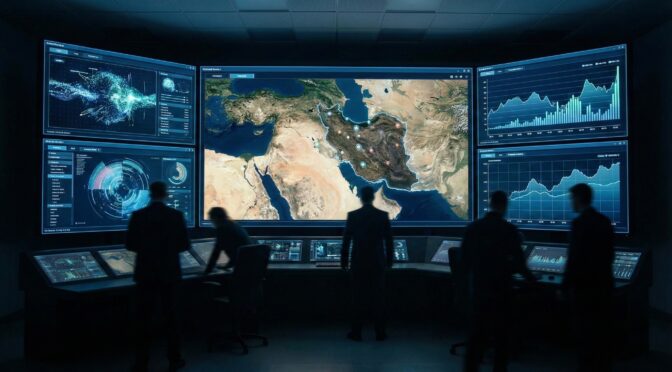
The week ending February 21, 2026, represents a critical and highly volatile inflection point in the geopolitical and internal trajectory of the Islamic Republic of Iran. Operating under the compounding pressures of an unprecedented macroeconomic collapse, the violent aftermath of a historic domestic uprising, and the looming, explicit threat of kinetic military action by the United States, the regime in Tehran is executing a complex, multi-layered strategy of diplomatic stalling paired with aggressive military and subterranean fortification. The analysis indicates that the Iranian state apparatus is simultaneously fighting a war of internal survival against its own populace while racing against an external ticking clock to secure its nuclear infrastructure before American military deployments reach peak operational readiness in the Persian Gulf.
Domestically, the internal security landscape is defined by the ongoing, systematic suppression campaign following the December 2025 to January 2026 nationwide protests, which represented the most severe existential threat to the clerical establishment since the 1979 revolution. While the immediate, street-level demonstrations have been largely quelled through the deployment of overwhelming lethal force, widespread internet blackouts, and mass incarcerations, subterranean resistance remains highly active and deeply entrenched. The structural drivers of the unrest—namely hyperinflation, currency devaluation, and systemic corruption—have only worsened. During the reporting period, the Iranian rial breached the psychological and historical threshold of 1.63 million to the US dollar, effectively stripping the national currency of its utility as a reliable store of value and pushing millions more citizens into deep, precarious poverty. The Central Bank of Iran’s inability to anchor inflation expectations has resulted in a de facto dollarized mindset among the populace, further eroding state legitimacy and driving massive capital flight out of the country.
In the diplomatic and nuclear domains, the strategic environment is dominated by the fallout from the October 2025 termination of the Joint Comprehensive Plan of Action (JCPOA) and the subsequent snapback of international sanctions. Amid this legal vacuum, indirect negotiations between the United States and Iran resumed in Geneva this week, mediated heavily by Oman. These talks are occurring in the immediate shadow of the June 2025 twelve-day war with Israel, which severely degraded portions of Iran’s nuclear and missile infrastructure. Iranian negotiators, led by Foreign Minister Abbas Araghchi, are attempting to draft a new framework with the International Atomic Energy Agency (IAEA) to forestall a threatened US military strike. However, parallel intelligence assessments indicate that Tehran is utilizing this diplomatic window to rapidly accelerate the construction and hardening of ultra-deep, buried nuclear facilities, most notably the Kolang-Gaz La complex, referred to as Pickaxe Mountain. High-resolution satellite imagery acquired this week confirms extensive, round-the-clock engineering efforts to seal and reinforce tunnel portals, suggesting an urgent push to render the facility immune to conventional bunker-buster munitions before US forces can execute a strike.
Regionally, the geopolitical landscape is characterized by a massive United States military buildup in the United States Central Command (CENTCOM) area of responsibility, combined with intense, behind-the-scenes lobbying by Gulf Cooperation Council (GCC) states against an American attack. Saudi Arabia, the United Arab Emirates, and Qatar view the prospect of a US-led bombing campaign with extreme trepidation, assessing with high confidence that Iranian asymmetric retaliation would almost certainly target critical energy and desalination infrastructure across the Persian Gulf. This sharp divergence in threat perception between Washington and its Arab allies is complicating US operational planning and providing Tehran with a crucial diplomatic wedge to exploit.
Concurrently, recognizing its profound isolation from the West, Iran has formalized its strategic pivot to the East by executing a trilateral strategic pact with the Russian Federation and the People’s Republic of China. While carefully stopping short of a binding mutual defense treaty, this pact establishes a unified framework for sanctions evasion, deep economic integration, and enhanced military coordination, effectively signaling the consolidation of a revisionist bloc designed to counter Western pressure and bypass the US dollar-centric global financial system.
Finally, in the realm of asymmetric warfare, the Islamic Revolutionary Guard Corps (IRGC) Quds Force has significantly altered its operational doctrine. Following the severe degradation of traditional proxy forces in the Levant during the June 2025 war, Tehran has increasingly outsourced international terrorism to criminal syndicates under the direction of the highly secretive Unit 11,000. The foiling of a high-profile assassination plot against an Israeli diplomat in Mexico this week underscores the expanding global reach of this network. Concurrently, the Houthi movement in Yemen continues to execute sustained, calibrated anti-shipping attacks in the Red Sea, maintaining severe pressure on global maritime trade choke points and serving as Iran’s most effective remaining proxy deterrent.
1. Internal Security and the Aftermath of the Winter Uprising
1.1 The Post-Uprising Security Landscape and Mass Casualties
The internal security environment in the Islamic Republic of Iran during the week ending February 21, 2026, remains highly volatile and tightly militarized. The regime is currently engaged in the sweeping, bureaucratic consolidation of its crackdown following the massive popular uprising that erupted on December 28, 2025, and burned intensely through mid-January 2026.1 This unrest, which initially triggered over acute economic grievances, water shortages, and the sudden depreciation of the rial, rapidly metastasized into a systemic, nationwide rebellion demanding the total overthrow of the Islamic Republic.1 Intelligence tracking indicates the protests reached an unprecedented geographic scale, with violent unrest reported in 675 distinct locations across 210 cities, spanning all 31 provinces of the country.1
The state’s response, directed explicitly by Supreme Leader Ali Khamenei and senior security officials, resulted in what human rights observers assess to be the largest massacres in modern Iranian history.1 During the most intense phase of the crackdown, particularly between January 8 and January 9, 2026, security forces and the IRGC utilized indiscriminate live fire, heavy weaponry, and foreign proxy militias to crush the demonstrations.1
The true scale of the casualties remains a highly contested information battlespace. According to the United Nations Special Rapporteur on Human Rights in Iran, Mai Sato, the Iranian National Security Council officially published a heavily sanitized figure of 3,117 deaths at the end of January.3 In a transparent attempt to control the narrative, the regime claimed that 2,427 of these victims were “innocent people and protectors of order and security,” while the Minister of Foreign Affairs branded the remaining 690 deceased as armed terrorists.3 However, independent civil society organizations and clandestine monitoring networks estimate the actual death toll to be significantly higher, with credible reports suggesting upwards of 20,000 to 30,000 Iranian citizens were killed during the suppression.2 Sato noted in her mid-February briefing from London that the violence of the regime was unprecedented primarily due to its massive, industrial scale, emphasizing that arbitrary arrests, violent street-level interrogations, and the searching of bystanders’ cellular devices are still occurring daily in major urban centers.3
1.2 Systemic Human Rights Violations and “Black Box” Detentions
As the conflict shifted from the streets to the prison system, the state apparatus implemented a draconian campaign of extrajudicial detentions. Intelligence reports highlight the widespread proliferation of secret “black box” detention sites operated by the Ministry of Intelligence and the IRGC Intelligence Organization.4 Tens of thousands of Iranians swept up in the January raids are currently being held in these undocumented facilities, which are modeled on the notorious prison camps of the 1980s.4 These sites operate entirely outside the purview of the formal judicial system, lacking official records and completely depriving detainees of legal counsel or familial contact, leaving families unable to confirm if their loved ones are alive.4
Reports emerging from these facilities detail extreme, systematic human rights violations. Female prisoners, particularly those accused of affiliation with the opposition Mujahedin-e Khalq (MEK), are reportedly subjected to specialized torture protocols.4 Documented methods include confinement in claustrophobic “coffin-like boxes,” prolonged stress positions such as forced squatting for days at a time, and severe caloric and sleep deprivation aimed at extracting forced, televised confessions.4
Furthermore, the state is actively engaged in a forensic cover-up to obscure the lethality of the January crackdown. Persistent controversy surrounds the Kahrizak Forensic Medicine Center in Tehran, where activists report that the bodies of at least 50 women killed during the uprising remain unidentified and hidden from the public.4 The regime’s Forensic Medicine Organization has vehemently denied these reports, issuing statements claiming that only seven unidentified male bodies are currently held at the facility; however, the heavy militarization of morgues and hospitals across the capital suggests a coordinated effort to manage the release of remains and suppress funeral gatherings, which historically serve as catalysts for renewed protests.4 Demonstrating the volatility of mourning rituals, security forces reportedly opened fire on citizens attending a 40th-day memorial service for a slain protester in the city of Abdanan on February 17, underscoring the regime’s zero-tolerance policy for public assembly.1
1.3 Continued Resistance and State Propaganda
Despite the overwhelming application of coercive force, organized domestic resistance has not been eradicated; rather, it has been forced into decentralized, clandestine operational models. Between February 14 and February 15, specialized PMOI Resistance Units executed 15 coordinated, anti-regime operations across major metropolitan areas, including Tehran, Mashhad, Shiraz, Isfahan, and Tabriz.4 These operations, strategically timed to disrupt the state’s official celebrations of the 1979 Islamic Revolution anniversary, involved the broadcasting of anti-regime messages and the display of banners explicitly rejecting both the current clerical dictatorship and any return to the pre-1979 Pahlavi monarchy, utilizing the widespread slogan “Neither Shah nor Mullahs”.4
Economic grievances continue to drive specific demographics into the streets, defying the general atmosphere of terror. On February 14, Social Security retirees held a highly visible protest in Kermanshah. The demonstrators chanted slogans such as “Our tables are empty of bread, stained instead with our blood,” directly linking their profound economic destitution—caused by hyperinflation and pension mismanagement—to the regime’s violent suppression and systemic corruption.4
In an attempt to project strength and domestic legitimacy to both internal and external audiences, the state orchestrated massive, mandatory rallies on February 11 to mark the 47th anniversary of the victory of the Islamic Revolution.6 State media outlets heavily amplified these events, claiming that up to 26 million Iranians participated nationwide.6 In a televised address preceding the rallies, Supreme Leader Ayatollah Seyyed Ali Khamenei issued a direct directive to the populace to “disappoint the enemy” by demonstrating steadfastness and national resolve.7 Khamenei explicitly argued that true national power is rooted less in military hardware like missiles and aircraft, and more in the ideological unity and resistance of the nation against foreign interference.8 This rhetorical pivot is particularly noteworthy, as it tacitly acknowledges the severe degradation of Iran’s conventional military and missile capabilities following the June 2025 war with Israel, forcing the leadership to increasingly rely on ideological mobilization as a pillar of deterrence.8
The domestic repression is mirrored by an aggressive international push by the Iranian diaspora. During the week ending February 21, MEK supporters held rallies and photo exhibitions in Malmö, Sweden, and Sydney, Australia, displaying portraits of the martyrs of the January uprising and calling for an immediate end to the state’s execution campaign.4 In Berlin, senior former European and American officials addressed the “Iran Conference: Prospects for Change,” endorsing the National Council of Resistance of Iran (NCRI) as a credible democratic alternative.4 Simultaneously, at the Munich Security Conference, Canadian Defense Minister Anita Anand announced severe new sanctions against seven high-ranking Iranian officials linked to the human rights abuses, explicitly stating that Canada will not restore diplomatic relations cut in 2012 unless a fundamental regime change occurs in Tehran.5
2. Macroeconomic Collapse and the Eradication of the Digital Economy
2.1 The Freefall of the Rial and Hyperinflation
The most immediate and pervasive existential threat to the stability of the Islamic Republic is the accelerating, uncontrolled collapse of its macroeconomic foundations. By the week ending February 21, 2026, the Iranian rial plummeted to a historic, unprecedented low, trading between 1,637,000 and 1,646,500 rials per US dollar on the unofficial open market, as tracked by currency monitors Alanchand and Bonbast.10 This represents a catastrophic loss of value and purchasing power; just eight months prior, preceding the outbreak of the 12-day war with Israel in June 2025, the exchange rate hovered around 800,000 rials to the dollar.11
| Economic Indicator | June 2025 (Pre-War) | February 2026 (Current) | Percentage Change |
| Unofficial Exchange Rate (USD to Rial) | 800,000 | 1,630,000 | +103.7% Depreciation |
| Point-to-Point Inflation Rate | ~45% | 60% | +15% Acceleration |
| Highest Value Banknote (2,000,000 Rial) | ~$2.50 | ~$1.22 | -51.2% Purchasing Power |
| Estimated Capital Flight (Annualized) | ~$20 Billion (2024) | ~$40 Billion (Projected) | +100% Increase |
Table 1: Key macroeconomic indicators demonstrating the structural collapse of the Iranian economy from mid-2025 to February 2026. 10
The sheer mathematics of this exchange rate have created an environment of absurd, grinding hardship. Possessing merely 735 US dollars technically grants an Iranian citizen “billionaire” status in local currency (equating to over 1.2 billion rials).10 However, this nominal wealth masks a profound, devastating reduction in household purchasing power. Point-to-point inflation reached a staggering 60 percent in January 2026, meaning that the basic basket of essential goods and services costs households 60 percent more than it did the previous year.11 For the estimated 50 percent of the Iranian workforce reliant on fixed-income wages or state pensions, the lag between wage adjustments and this hyperinflation has pushed millions into extreme poverty, triggering panic buying of basic necessities and widespread hoarding of non-perishable items as a hedge against future price shocks.11
This currency crisis is not merely a cyclical fluctuation but represents a structural breakdown of the state’s monetary authority. The market has entered a state of chronic disequilibrium driven by a combination of internal mismanagement and external geopolitical shocks.11 Internally, the government suffers from persistent, deep-seated budget deficits, financed primarily through the opaque, quasi-fiscal creation of money by a deeply unbalanced and corrupt banking sector.11 The Central Bank of Iran, facing critically depleted foreign exchange reserves due to relentless US sanctions on oil exports, has largely abandoned traditional monetary discipline.11 Instead, policymakers have reverted to short-term currency market arbitrage and gold auctions, reducing the central bank to a mere tool for managing daily political failures.11 Attempts to manage public expectations through “news therapy”—the deliberate seeding of positive diplomatic rumors regarding nuclear talks to artificially lower exchange rates—have entirely lost their efficacy, as the public no longer trusts state narratives unsupported by tangible economic fundamentals.11
Consequently, the populace has reacted rationally to this monetary failure by attempting to shield their assets from rapid evaporation. This behavior has triggered massive capital flight; an estimated 20 billion US dollars left the country in 2024, with analysts projecting net outflows to double to 40 billion US dollars for the remainder of 2025 and early 2026.11 Domestically, there is a widespread, irreversible shift toward informal dollarization. Businesses and citizens are increasingly abandoning the rial as a reliable unit of account, instead pricing real estate, vehicles, and even daily services in US dollars or physical gold.11 The International Monetary Fund (IMF) has long warned that maintaining fragmented, multiple exchange rate regimes functions as a poorly targeted subsidy that accelerates depreciation expectations and permanently unanchors inflation.12 Yet, the Iranian government delays exchange-rate unification, fearing the immediate political backlash and further street protests, thereby ensuring that chronic inflation returns in recurrent, devastating waves.12
2.2 Banking Liquidity Crisis and the Digital Blackout
The commercial banking sector is straining under the immense pressure of this macroeconomic collapse and the public’s rush to convert digital rials into physical assets. To prevent a total liquidity failure and a run on the banks, institutions have instituted severe, informal caps on daily cash withdrawals. Customers are frequently limited to withdrawing between 30 million and 50 million rials (approximately 18 to 30 US dollars) daily over the counter, while automated teller machine (ATM) withdrawal limits have been drastically slashed to as low as 3 million rials (approximately 1.83 US dollars).11 The physical currency itself is failing to facilitate commerce; the largest widely circulating banknote, the 2 million rial “Iran cheque,” holds a purchasing power of barely 1.22 US dollars, making even moderate transactions logistically cumbersome.11 Concurrently, the Tehran Stock Exchange has experienced consecutive days of severe declines, reflecting a total collapse in investor confidence across the domestic industrial base.11
Compounding the monetary crisis is the severe, self-inflicted damage to the nation’s digital infrastructure. During the height of the January 2026 uprising, the regime imposed an unprecedented, near-total internet blackout lasting over 20 days to disrupt the command and control capabilities of the protesters.11 While this draconian tactic achieved short-term security objectives, the collateral economic devastation was staggering. The Iranian digital economy, which prior to the blackout generated an estimated 30 trillion rials (roughly 42 million US dollars) in daily revenue, suffered catastrophic, permanent losses.11 Revenue across the entire tech sector plummeted by 50 to 90 percent during the blackout period.11
The most severe impact was absorbed by the micro-enterprise sector, which forms the backbone of youth employment. An estimated 500,000 small businesses operating primarily through the Instagram platform—which collectively supported approximately one million jobs—were effectively wiped out, with the majority forced into immediate bankruptcy due to the inability to process orders or communicate with clients.11 Support industries experienced simultaneous collapses; domestic logistics and courier services, such as Postex, reported an 80 percent drop in order shipments, forcing immediate layoffs of up to 60 percent of their workforce.11 The intentional throttling of the digital economy highlights the regime’s desperate prioritization of short-term security control over long-term economic viability, further alienating the young, tech-literate demographic that formed the vanguard of the recent uprisings and virtually ensuring future waves of unrest.
3. The Nuclear Program, Post-JCPOA Reality, and Subterranean Fortification
3.1 The Collapse of the Legal Non-Proliferation Framework
The current nuclear crisis cannot be understood outside the legal and diplomatic vacuum created by the final collapse of the Joint Comprehensive Plan of Action (JCPOA). October 18, 2025, marked the highly anticipated ten-year anniversary of the JCPOA’s “Adoption Day,” a milestone originally intended to serve as “Termination Day”.14 Under the initial terms of the agreement, this date was meant to trigger the end of United Nations Security Council Resolution 2231, formally closing the UN’s nuclear file on Iran and permanently expiring the “snapback” mechanism that allowed any participant to unilaterally reimpose prior UN sanctions without the risk of a veto.14
However, anticipating this milestone and reacting to Iran’s steady, alarming escalation of uranium enrichment to 60 percent purity—alongside the discovery of uranium particles enriched to 83.7 percent—the European trio (France, Germany, and the United Kingdom) preemptively triggered the snapback mechanism in August 2025.16 This aggressive diplomatic maneuver successfully reinstated all punitive sanctions from prior UN Resolutions (1696, 1737, 1747, 1803, 1835, and 1929) before the termination deadline.14 In response, following the devastating conclusion of the June 2025 war with Israel, the Iranian government officially declared the JCPOA entirely void on October 18, symbolically burning the text of the agreement in the Islamic Consultative Assembly.15
Consequently, the international community is currently operating without any mutually recognized legal framework governing Iran’s nuclear activities. The International Atomic Energy Agency (IAEA) reports that its verification and monitoring activities have been “seriously affected” by Iran’s cessation of its nuclear-related commitments, leading to a critical loss of continuity of knowledge regarding key aspects of the program.18 The IAEA currently estimates that Tehran’s stockpile of highly enriched uranium is approximately 32 times the amount originally allowable under the JCPOA, positioning the regime dangerously close to the technological capability required to rapidly produce a deliverable nuclear device.17
3.2 The June 2025 War and the Shift in Nuclear Strategy
The sense of urgency surrounding Iran’s nuclear program is heavily informed by the traumatic outcomes of the 12-day Iran-Israel war in June 2025. During this brief but intense conflict, the Israeli Air Force executed a highly effective bombing campaign that dealt a substantial setback to Iran’s potential weaponization efforts.9 Precision strikes heavily damaged the enriched uranium metal processing facility in Isfahan, while targeted assassinations resulted in the deaths of 19 senior Iranian nuclear scientists and 30 high-ranking military commanders.9 Furthermore, the conflict severely depleted Iran’s conventional deterrence; of an estimated pre-war arsenal of 2,500 to 3,000 ballistic missiles, Iran fired over 500, while Israeli strikes destroyed an additional 1,000 missiles and approximately 250 launchers in their silos and storage depots.9
Recognizing that their above-ground and shallow subterranean facilities are highly vulnerable to advanced Western munitions, and lacking the conventional missile deterrence to prevent future strikes, the Iranian leadership has pivoted its nuclear strategy. The regime is now focused on the rapid, frantic construction of ultra-deep underground facilities designed to withstand penetration by the most advanced US bunker-buster munitions, such as the GBU-57 Massive Ordnance Penetrator.22
3.3 Engineering the “Pickaxe Mountain” Complex
The primary locus of this fortification effort is the Kolang-Gaz La mountain complex, broadly referred to in intelligence circles as Pickaxe Mountain, located approximately two kilometers south of the main Natanz enrichment facility.22 Western intelligence agencies assess that this site is being prepared to host a clandestine, deeply buried uranium enrichment plant, designed to process Iran’s existing stockpile of 60 percent enriched uranium into weapons-grade material within an impregnable fortress.22
Recent intelligence reports, confirmed by high-resolution satellite imagery acquired by the Institute for Science and International Security (ISIS) on February 10, 2026, provide undeniable evidence of a massive, round-the-clock engineering effort to secure the facility against imminent airstrikes.24 The imagery reveals a massive deployment of heavy construction equipment—including cement mixers, dump trucks, backhoes, and truck-mounted cranes—operating simultaneously across the complex.24
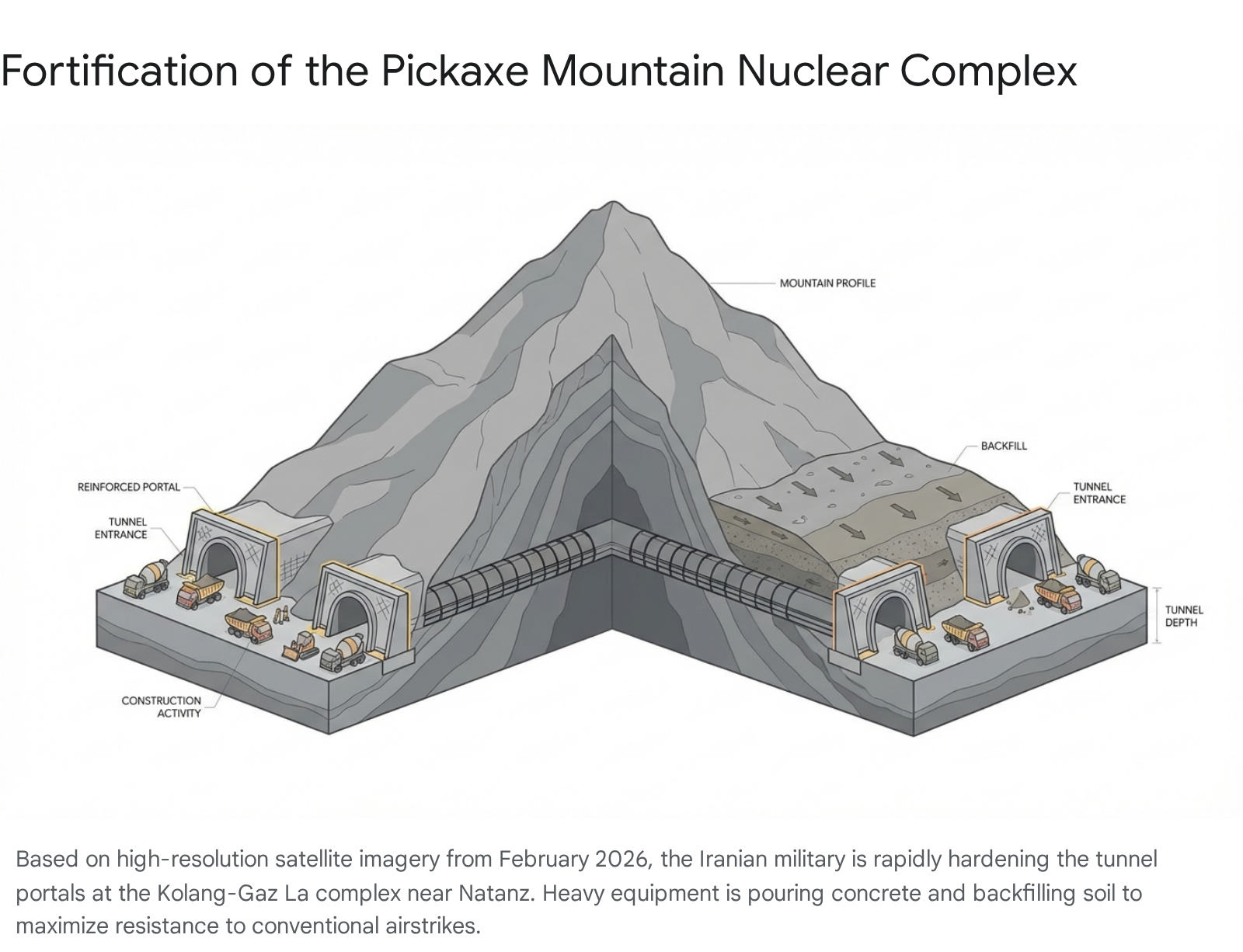
Engineering units are actively pouring thick layers of concrete atop the western tunnel entrance extensions, while massive volumes of rock and soil are being pushed back and leveled over the eastern portals to drastically increase the facility’s earth overburden.24 Furthermore, new concrete-reinforced headworks structures have been integrated into the design, allowing for additional protective layers of earth to be stacked directly above the vulnerable entry points.24 Analysts confirm that these tunnels are now “completely buried,” severely complicating any potential ground raid aimed at seizing or destroying nuclear material.26 Concurrently, similar post-strike debris clearing and fortification efforts have been observed via satellite imagery at the Taleghan 2 facility at the Parchin military complex and the previously bombed Isfahan site, indicating a nationwide effort to reconstruct and harden the entire nuclear infrastructure architecture.22 The speed and scale of this construction indicate a high degree of panic within the Iranian leadership. If the United States intends to launch a preemptive strike, the operational window to destroy the centrifuges destined for Pickaxe Mountain is rapidly closing before the facility becomes completely impregnable to conventional ordnance.
4. Diplomatic Engagements: Geneva Talks and IAEA Coordination
4.1 US-Iran Indirect Negotiations
Against the terrifying backdrop of an accelerating nuclear program and imminent military threats, frantic diplomatic efforts to avert a direct regional war intensified during the reporting period. In early February, Oman hosted an initial round of indirect negotiations in Muscat between the United States and Iran.30 The Iranian delegation, led by Foreign Minister Abbas Araghchi, engaged with US envoys Steve Witkoff and Jared Kushner, utilizing Omani Foreign Minister Sayyid Badr Albusaidi as the primary intermediary.30 Unofficial reports suggest these initial talks explored compromise measures, such as allowing Iran limited uranium enrichment up to 1.5 percent while transferring excess material to Turkey or Russia, in exchange for American economic engagement and sanctions relief.30
Following these preliminary discussions, a second, highly critical round of indirect negotiations convened in Geneva, Switzerland, concluding on February 17.4 The primary objective of these talks, from the Iranian perspective, is to delay or permanently forestall threatened US military strikes targeting their newly fortified nuclear infrastructure. Iranian state media and diplomatic statements have consistently emphasized that these discussions are strictly confined to the nuclear file, explicitly rejecting expansive US demands to broaden the agenda to include Iran’s ballistic missile program, its human rights record, or its support for regional proxy networks.31 However, intelligence assessments suggest Iran may be floating the possibility of discussing its ballistic missile program strictly as a tactical maneuver to extract concessions and buy additional time to reconstitute its depleted missile stocks.37
The outcomes of the Geneva talks remain deeply ambiguous. Araghchi stated that Tehran and Washington had established basic “guiding principles” to avoid further escalation, and the Iranian delegation promised to present more detailed proposals within two weeks to narrow the remaining gaps.33 However, the reality of the negotiations appears far more fraught. US representatives, including Vice President JD Vance, noted publicly that Iran has fundamentally failed to acknowledge Washington’s established red lines, and the talks concluded without a definitive, binding breakthrough.34 To maintain leverage and signal martial defiance during the talks in Europe, the Iranian military simultaneously conducted highly publicized, live-fire naval exercises in the Strait of Hormuz, temporarily closing sections of the critical maritime choke point and declaring it an area of “safety and maritime concern”.33 Supreme Leader Khamenei punctuated these drills with a stark warning that “the strongest army in the world might sometimes receive such a slap that it cannot get back on its feet”.33 This dual-track strategy—engaging in protracted diplomacy in Geneva while demonstrating asymmetrical military capability in the Persian Gulf—is a classic Iranian negotiation tactic designed to raise the perceived costs of American kinetic action while the clock ticks down.
4.2 The IAEA “Framework” Strategy
Parallel to the bilateral talks with the United States, Iran is attempting to actively manage its severely strained relationship with the International Atomic Energy Agency, aiming to prevent the agency from providing the diplomatic casus belli for an American strike. On February 16, Foreign Minister Araghchi met directly with IAEA Director General Rafael Grossi in Geneva, followed by detailed telephone consultations on February 18.34 During these communications, Araghchi claimed that Tehran is actively “drafting an initial and coherent framework” designed to advance future negotiations with Washington and resolve outstanding monitoring disputes.34
Concurrently, Iran’s permanent representative to the IAEA, Reza Najafi, held tripartite meetings in Vienna with Grossi and the ambassadors from Russia and China.34 This maneuver was clearly designed to solidify the diplomatic backing of the Eastern bloc ahead of the upcoming IAEA Board of Governors session, ensuring that Moscow and Beijing would block any formal censure of Tehran’s nuclear advancements.
These diplomatic overtures heavily contrast with the aggressive, defiant rhetoric emanating from Iran’s domestic nuclear establishment. Mohammad Eslami, the head of the Atomic Energy Organization of Iran, recently stated that if Iranian nuclear sites are bombed and destroyed by foreign powers, the IAEA has absolutely no statutory grounds to demand continued oversight or compliance.40 Eslami accused the agency of taking politicized positions and operating outside its mandate.40 This dynamic reveals Iran’s core strategy: utilizing the promise of a future “framework” to string the IAEA along and prevent a formal crisis at the Board of Governors, while simultaneously threatening to completely expel inspectors if military action is taken, thereby holding the global non-proliferation regime hostage to its security demands.
5. Regional Military Posture, US Mobilization, and GCC Strategic Pushback
5.1 The Massive US Military Buildup
The United States has responded to the collapse of the non-proliferation framework, the fortification of Pickaxe Mountain, and the stalling tactics in Geneva with a massive, highly visible mobilization of strategic military assets to the Middle East. The Trump administration has articulated clear preconditions for peace, demanding that Tehran immediately halt its nuclear escalations, abandon its ballistic missile program, and cease all support for regional proxy groups—demands that Tehran views as tantamount to complete capitulation and a violation of its sovereignty.40 President Trump has explicitly stated that the window for a diplomatic resolution is exceedingly narrow, indicating that a definitive decision regarding a deal or kinetic action will be made within “probably 10 days”.23 Furthermore, US Energy Secretary Chris Wright warned that the United States is committed to deterring Tehran from acquiring a nuclear weapon “one way or the other,” signaling a high readiness for preemptive action.34
The scale and composition of the American mobilization suggest preparations for a sustained, comprehensive, and highly destructive air campaign, rather than a limited, single-night surgical strike. Two Nimitz-class aircraft carrier strike groups—led by the USS Abraham Lincoln and the USS Gerald R. Ford—are currently positioned in the Arabian Sea and the broader CENTCOM region, providing the capability to launch upwards of 125 daily bombing sorties.23 To support long-range, heavy payload strike capabilities capable of penetrating deep underground targets, the US Air Force has deployed B-2 Spirit stealth bombers to forward operating locations.43
Crucially, aviation trackers have monitored the deployment of at least 108 aerial refueling tankers converging on the CENTCOM theater, an unprecedented logistical movement necessary to sustain long-range tactical fighter operations over Iranian airspace.44 Furthermore, regional command and control infrastructure has been robustly enhanced, evidenced by the relocation of six E-3 Sentry AWACS aircraft to Prince Sultan Air Base in Saudi Arabia.23 Intelligence officials indicate that all required US forces for a comprehensive strike package will be in position and fully operational by mid-March 2026.35 If authorized, the campaign would likely bypass previously destroyed sites and focus entirely on degrading the newly fortified Pickaxe Mountain complex near Natanz and the Taleghan 2 facility at Parchin.23
5.2 Gulf Arab States’ Strategic Anxiety and Diplomatic Resistance
The massive American military buildup has triggered profound anxiety among the Gulf Cooperation Council (GCC) states, revealing a stark and highly consequential divergence in risk calculus between Washington and its regional Arab partners. Historically, nations such as Saudi Arabia, the United Arab Emirates, Qatar, and Bahrain viewed Iranian expansionism and the “Axis of Resistance” as their primary strategic threat.41 However, in the current context, they view a US-led preemptive war as a far more dangerous and destabilizing scenario.44
The GCC states assess, with high confidence, that they would become the primary targets of Iranian asymmetric retaliation following any American strike. Lacking the intercontinental capability to strike the US homeland, and with Israel possessing a dense, combat-tested, multi-layered air defense network, Iran’s most logical vector for retaliation involves crippling the global energy markets by attacking the highly vulnerable oil production, refining, and desalination infrastructure of the Gulf states hosting US military bases.44 Furthermore, regional leaders fear that a US bombing campaign aimed at regime change would not result in a stable democratic transition, but rather plunge Iran into chaotic fragmentation, potentially empowering even more radical, unpredictable elements on their immediate borders.44
Consequently, an intense, coordinated lobbying effort is underway to restrain Washington. Saudi Arabia, Qatar, Oman, and the UAE, operating in coordination with regional powers like Turkey and Egypt, have engaged in emergency diplomacy to pull the US and Iran back from the brink of conflict.44 Both Riyadh and Abu Dhabi have explicitly signaled to Washington that they will not participate in an attack.41 Crucially, they have categorically refused to grant authorization for US combat aircraft to utilize their sovereign airspace or airbases for offensive strikes against Iranian territory.35 This diplomatic resistance severely complicates US operational planning, forcing strike packages to rely on longer, highly complex, and less efficient routing from carrier decks in the Arabian Sea or distant bomber bases, thereby increasing the operational risk to American pilots and reducing the overall weight of the strike. The situation is further complicated by internal friction within the GCC; Saudi Arabia and the UAE are currently experiencing diplomatic tensions over competing interests in the Horn of Africa, particularly regarding the UAE and Israel’s recent recognition of Somaliland, demonstrating that the anti-Iran coalition in the Gulf is highly fragmented and distracted.42
6. The “CRINK” Alliance and the Eurasian Strategic Pivot
Recognizing its extreme, perhaps permanent, diplomatic and economic isolation from the West, and facing the persistent vulnerability of its domestic economy to US sanctions, the Iranian regime has aggressively accelerated its strategic pivot toward the East. This strategy culminated in late January and early February 2026 with the formal signing of a highly consequential trilateral strategic pact uniting the Islamic Republic of Iran, the Russian Federation, and the People’s Republic of China.47
This new agreement builds upon preexisting bilateral frameworks—specifically the 25-year comprehensive cooperation accord with China and the 20-year strategic partnership with Russia—elevating them for the first time into a coordinated, trilateral mechanism.47 The pact is explicitly framed as a joint commitment to “mutual respect, sovereign independence and a rules-based international system that rejects unilateral coercion,” serving as a direct ideological and economic counterweight to the United States.48 Iranian President Masoud Pezeshkian has elevated the implementation of this treaty to his primary foreign policy directive, mandating strict weekly progress reviews across critical sectors, including transportation, energy, oil and gas, agriculture, food security, defense, and intelligence sharing.50 Underscoring the operational reality of the pact, Russian Energy Minister Sergei Tsivilev arrived in Tehran on February 16 to co-chair the 19th meeting of the Iran-Russia Joint Economic Cooperation Commission, finalized on February 18, signaling rapid advancement in bilateral integration.50
While officials from Tehran, Moscow, and Beijing have carefully stated that the pact does not constitute a formal mutual defense treaty analogous to NATO’s Article 5—meaning it does not obligate automatic military intervention if one party is attacked—its strategic implications are profound and immediate.47 Informally referred to by analysts as the core of the “CRINK” (China, Russia, Iran, North Korea) revisionist alliance, the pact is explicitly designed to dismantle Western economic leverage.2 By accelerating the creation of alternative, non-dollar-centric financial mechanisms and secure trade routes, the alliance seeks to render US sanctions architecturally obsolete.48
For Iran, sitting on vast, untapped energy reserves, this ensures a steady, sanctions-proof flow of capital and advanced technology necessary to sustain both its failing domestic economy and its military-industrial complex.48 In return, China guarantees deep, uninterrupted access to heavily discounted Iranian hydrocarbons necessary to fuel its industrial base and advance its Belt and Road initiatives.48 For Russia, the pact secures a vital, continuous supply line for munitions, drones, and ballistic missiles applicable to the European theater, alongside access to alternative markets to offset European sanctions.2 Militarily, the pact facilitates deeper intelligence sharing and highly coordinated defense planning.49 This alignment significantly alters the geopolitical risk calculus for the United States and NATO; any military escalation or preemptive strike against Tehran now carries the inherent, albeit unstated, risk of drawing a coordinated strategic, economic, or asymmetric response from Beijing and Moscow, thereby raising the global threshold for conflict and drastically reducing the effectiveness of unilateral American threats.49
7. Asymmetric Warfare, Unit 11,000, and Proxy Architecture
7.1 The Evolution of Global Terror Operations: Unit 11,000
The Iranian military strategy has historically relied on a robust ring of heavily armed proxy militias—the so-called Axis of Resistance—to project regional power, harass adversaries, and maintain a forward deterrence posture without triggering direct state-on-state conflict. However, the June 2025 war and preceding regional conflicts severely degraded the strategic, offensive capabilities of key proxy groups, particularly Lebanese Hezbollah and Palestinian Hamas.2 Recognizing that these traditional paramilitary groups can no longer serve as a reliable, immediate strategic deterrent against an impending American or Israeli strike, the Islamic Revolutionary Guard Corps (IRGC) Quds Force has drastically altered its asymmetric warfare doctrine.
Operational focus and funding have shifted significantly toward Unit 11,000, a highly secretive and specialized branch of the Quds Force.2 Commanded by a senior operative identified by Israeli intelligence as “Sardar Ammar,” and operating under the direct, tactical oversight of Quds Force Commander Esmail Qaani, Unit 11,000 is explicitly tasked with executing a global campaign of assassinations, kidnappings, sabotage, and arson aimed at Israeli diplomats, Jewish diaspora institutions, and Western targets worldwide.2
To bypass the intense, high-technology surveillance networks of Western intelligence agencies, Unit 11,000 has adopted a novel “Fire and Forget” doctrine.2 Rather than deploying identifiable Iranian nationals, trained intelligence officers, or ideological zealots who can be easily tracked, the unit relies almost exclusively on outsourcing its operations.2 Unit 11,000 utilizes highly compartmentalized cells of foreign nationals and leverages established transnational criminal syndicates and drug cartels to execute attacks, creating layers of plausible deniability and severing direct forensic links back to the regime in Tehran.52
The efficacy, audacity, and expanding geographic reach of this network were starkly demonstrated during the reporting period, when a joint intelligence operation by Mexican and American security services thwarted a highly sophisticated assassination plot in Mexico City.53 The primary target of the operation was Einat Kranz Neiger, the Israeli Ambassador to Mexico.54 Intercepted intelligence documents revealed that the plot was initiated in late 2024 and coordinated by an IRGC officer named Hasan Izadi, operating under the alias Masood Rahnema.53 Izadi managed the assassination cell while utilizing official diplomatic cover as an aide at the Iranian Embassy in Caracas, Venezuela, highlighting the deep integration of Iranian covert operations with Latin American diplomatic outposts and illicit networks.53 While the Mexico City cell was successfully dismantled by Mexican security forces before executing the attack, the incident underscores the pervasive threat. Similar plots orchestrated by Unit 11,000 utilizing local criminal proxies have been disrupted across Europe and Australia over the past year.52 Furthermore, independent of Unit 11,000’s direct command but indicative of the broader radicalization threat, US authorities in Detroit recently arrested the 19-year-old son of an Iranian-American poet over an alleged, ISIS-inspired plot to bomb local establishments, demonstrating the volatile nature of domestic radicalization influenced by the broader Middle Eastern conflict.55
7.2 Proxy Network Status: The Houthi Maritime Campaign
With its Levantine proxies severely weakened and attempting to rebuild, Tehran has elevated the strategic importance and operational tempo of the Houthi movement (Ansar Allah) in Yemen. The Houthis currently remain the most effective, unconstrained, and aggressive component of Iran’s proxy architecture.2 Deployed far from the immediate borders of Israel, the Houthis are tasked with sustaining asymmetric pressure on the global economy and Western military coalitions through the relentless harassment of international maritime trade routes traversing the Red Sea, the Bab el-Mandeb Strait, and the Gulf of Aden.2
While the overall frequency of Houthi attacks has decreased by approximately 84 percent compared to the peak volumes recorded throughout 2024, the group retains substantial, highly lethal long-range strike capabilities.56 This capability relies entirely on advanced technology, solid-fuel components, and targeting intelligence smuggled into Yemen by the IRGC Navy.2 During the week of February 15-21, 2026, the Houthis executed a renewed series of highly targeted ballistic missile and unmanned aerial vehicle (UAV) strikes against commercial bulk carriers and tankers.
| Date (Feb 2026) | Target Vessel Name | Incident Type / Weapon Used | Location Context |
| 15-Feb | Lycavitos | Anti-Ship Ballistic Missile | Gulf of Aden / Red Sea Approach |
| 16-Feb | Pollux | Anti-Ship Ballistic Missile | Gulf of Aden / Red Sea Approach |
| 18-Feb | Rubymar | Anti-Ship Ballistic Missile | Red Sea |
| 19-Feb | Sea Champion | Missile / Unmanned Aerial Drone | Red Sea / Gulf of Aden |
Table 2: Documented Houthi attacks on commercial shipping in the Red Sea and Gulf of Aden during the reporting period, demonstrating sustained capability to threaten global trade. 58
These recent attacks forcefully demonstrate the strategic failure of sustained United States and United Kingdom airstrikes to entirely degrade the Houthis’ highly mobile, deeply buried launch infrastructure.56 The economic impact of this localized maritime insurgency remains severe and global in scope. Major shipping conglomerates are continually forced to route their vessels away from the Suez Canal, opting instead for the massive detour around the Cape of Good Hope in South Africa.57 Maritime analytics confirm that this detour adds between 3,000 and 6,000 extra nautical miles to a voyage, increases total freight costs by approximately 35 percent, and delays global supply chains by an average of eight additional days per shipment.57 Recognizing the persistent, unyielding nature of this threat to global commerce, the United Nations Security Council recently adopted Resolution 2812 by a vote of 13 in favor, extending the mandate for specialized Secretary-General reporting on Houthi maritime terrorism for an additional six months.59
8. Strategic Outlook and Intelligence Conclusions
The comprehensive analysis of the week ending February 21, 2026, indicates that the Islamic Republic of Iran is navigating a period of unprecedented, multi-vector vulnerability, yet it continues to execute a highly calculated strategy of brinkmanship. The regime is attempting to manage a structural, mathematical economic collapse that fundamentally cannot be solved without massive, immediate sanctions relief. Simultaneously, it faces a highly mobilized, deeply aggrieved domestic population that has fundamentally rejected the ideological legitimacy of the state. The brutal massacres of January 2026 have achieved a tenuous, tactical silence on the streets, but they have permanently severed the social contract, necessitating a permanent, highly visible, and resource-intensive security presence that the bankrupt state can ill afford to maintain indefinitely.
In the international arena, Tehran’s primary, overarching objective is regime survival via the manipulation of time. The ongoing diplomatic negotiations in Geneva, heavily mediated by Oman, are almost certainly a stalling tactic designed to exploit the intense divergence in threat perception between the United States and the Gulf Arab states. Every day that negotiations continue without a breakdown is an additional day that IRGC engineering units can pour thousands of tons of concrete and backfill soil at the Pickaxe Mountain nuclear facility, racing to move critical enrichment cascades beyond the reach of American bunker-buster munitions.
The strategic assessment concludes that a highly dangerous convergence point is rapidly approaching in mid-March 2026. By that timeframe, the massive US military buildup will reach peak operational readiness, while the Iranian fortification of its deep-buried nuclear sites may cross the threshold of absolute invulnerability to conventional weapons. If the US administration determines that the Geneva framework is merely an empty delay tactic, the probability of a massive, preemptive kinetic strike is exceedingly high. Conversely, if the United States refrains from attacking—constrained by intense GCC lobbying, the fear of a regional energy war, and the implicit deterrent of the new Russia-China-Iran trilateral pact—Iran will likely emerge as a de facto, untouchable nuclear-threshold state. However, in either scenario, the irreversible structural collapse of the Iranian economy guarantees that internal instability, hyperinflation, and popular rebellion will remain the most potent, long-term existential threats to the regime’s survival.
Please share the link on Facebook, Forums, with colleagues, etc. Your support is much appreciated and if you have any feedback, please email us in**@*********ps.com. If you’d like to request a report or order a reprint, please click here for the corresponding page to open in new tab.
Sources Used
- 2025–2026 Iranian protests – Wikipedia, accessed February 21, 2026, https://en.wikipedia.org/wiki/2025%E2%80%932026_Iranian_protests
- Iran – Situation Assessment (February 2026): The Race to Rebuild the Nuclear and Missile Array, Casual Terror and the CRINK – Alma Research and Education Center, accessed February 21, 2026, https://israel-alma.org/iran-situation-assessment-february-2026-the-race-to-rebuild-the-nuclear-and-missile-array-casual-terror-and-the-crink/
- Mai Sato, UN Special Rapporteur on Iran: ‘Military action is not a magic solution’, accessed February 21, 2026, https://english.elpais.com/international/2026-02-18/mai-sato-un-special-rapporteur-on-iran-military-action-is-not-a-magic-solution.html
- Iran News in Brief – February 17, 2026 – NCRI, accessed February 21, 2026, https://www.ncr-iran.org/en/news/iran-news-in-brief-news/iran-news-in-brief-february-17-2026/
- Iran News in Brief – February 15, 2026 – NCRI, accessed February 21, 2026, https://www.ncr-iran.org/en/news/iran-news-in-brief-news/iran-news-in-brief-february-15-2026/
- 47TH ANNIVERSARY OF THE VICTORY OF THE ISLAMIC REVOLUTION OF IRAN – WANA, accessed February 21, 2026, https://wanaen.com/47th-anniversary-of-the-victory-of-the-islamic-revolution-of-iran/
- Leader of Islamic Revolution urges Iranians to disappoint enemy in revolution anniversary rallies | Taghribnews (TNA), accessed February 21, 2026, https://www.taghribnews.com/en/news/708967/leader-of-islamic-revolution-urges-iranians-to-disappoint-enemy-in-revolution-anniversary-r_allies
- Leader Urges Iranians to Turn Revolution Anniversary Rallies Into Show of National Resolve | FinancialTribune, accessed February 21, 2026, https://financialtribune.com/node/119611
- Q&A | Twelve days that shook the region: Inside the Iran-Israel war | ACLED, accessed February 21, 2026, https://acleddata.com/qa/qa-twelve-days-shook-region-inside-iran-israel-war
- Iranian rial crashes to 1.63 million per US dollar: How just having $735 now makes you a billionaire in Ir, accessed February 21, 2026, https://m.economictimes.com/news/international/us/iranian-rial-crashes-to-1-63-million-per-us-dollar-how-just-having-735-now-makes-you-a-billionaire-in-iran-amid-soaring-inflation-and-sanctions/articleshow/128565815.cms
- Why Iran cannot stop its currency collapse | Iran International, accessed February 21, 2026, https://www.iranintl.com/en/202601308271
- Iran can still normalize its economy—but the path will be painful and slow, accessed February 21, 2026, https://www.atlanticcouncil.org/blogs/iran-can-still-normalize-its-economy/
- Iran Currency Crisis: What’s Driving the Rial Down, accessed February 21, 2026, https://caspianpost.com/analytics/iran-currency-crisis-what-s-driving-the-rial-down
- The Joint Comprehensive Plan of Action (JCPOA) at a Glance | Arms Control Association, accessed February 21, 2026, https://www.armscontrol.org/factsheets/joint-comprehensive-plan-action-jcpoa-glance
- Joint Comprehensive Plan of Action – Wikipedia, accessed February 21, 2026, https://en.wikipedia.org/wiki/Joint_Comprehensive_Plan_of_Action
- Iran nuclear negotiations snap back to the past, accessed February 21, 2026, https://www.iiss.org/online-analysis/online-analysis/2025/10/iran-nuclear-negotiations-snap-back-to-the-past/
- What is the status of Iran’s nuclear programme and the JCPOA? – Commons Library, accessed February 21, 2026, https://commonslibrary.parliament.uk/research-briefings/cbp-9870/
- As Expiry of Iran Nuclear Deal Approaches and Regional Tensions Flare, Security Council Hears Calls for Return to Diplomacy that Achieved Agreement | UN Meetings Coverage and Press Releases, accessed February 21, 2026, https://press.un.org/en/2024/sc15942.doc.htm
- Iran: Impacts of June 2025 Israel and US strikes – House of Commons Library, accessed February 21, 2026, https://commonslibrary.parliament.uk/research-briefings/cbp-10292/
- How 12 days have changed Iran – The International Institute for Strategic Studies, accessed February 21, 2026, https://www.iiss.org/online-analysis/online-analysis/2025/07/how-12-days-have-changed-iran/
- Iran Update Special Edition: Israeli Strikes on Iran, June 13, 2025, 2:00 PM ET, accessed February 21, 2026, https://understandingwar.org/research/middle-east/iran-update-special-edition-israeli-strikes-on-iran-june-13-2025-200-pm-et/
- New Activity at Iranian Nuclear Site Shows Determination To Rebuild Program – FDD, accessed February 21, 2026, https://www.fdd.org/analysis/2026/01/08/new-activity-at-iranian-nuclear-site-shows-determination-to-rebuild-program/
- Iran deal prospects will be clear within 10 days, Trump says as military buildup grows, accessed February 21, 2026, https://www.theguardian.com/us-news/2026/feb/19/us-military-buildup-in-middle-east-intensifies-but-to-what-end
- Iran reinforcing underground nuclear site, report says citing satellite images, accessed February 21, 2026, https://www.iranintl.com/en/202602116088
- Imagery Update: New Developments at Pickaxe Mountain Tunnel Entrances, accessed February 21, 2026, https://isis-online.org/isis-reports/imagery-update-new-developments-at-pickaxe-mountain-tunnel-entrances
- Fortified tunnels, repaired missile sites: Is Iran preparing for US strike? What satellite images show, accessed February 21, 2026, https://timesofindia.indiatimes.com/world/middle-east/fortified-tunnels-repaired-missile-sites-is-iran-preparing-for-us-strike-what-satellite-images-show/articleshow/128547472.cms
- CSIS Satellite Imagery Analysis Reveals Possible Signs of Renewed Nuclear Activity in Iran, accessed February 21, 2026, https://www.csis.org/analysis/csis-satellite-imagery-analysis-reveals-possible-signs-renewed-nuclear-activity-iran
- Iran expands underground nuclear facility, images show, accessed February 21, 2026, https://www.jpost.com/middle-east/iran-news/article-887125
- Satellite images show Iran repairing and fortifying sites amid tensions with US, accessed February 21, 2026, https://www.timesofisrael.com/satellite-images-show-iran-repairing-and-fortifying-sites-amid-tensions-with-us/
- On the Brink of War: US and Iranian Calculations in the New Negotiations, accessed February 21, 2026, https://studies.aljazeera.net/en/policy-briefs/brink-war-us-and-iranian-calculations-new-negotiations
- Oman says it mediated ‘indirect’ Iran-US talks in Muscat, accessed February 21, 2026, https://www.iranintl.com/en/202602067676
- Trilateral meeting between Oman, Qatar and Iran discusses Iran-US talks | fm.gov.om, accessed February 21, 2026, https://www.fm.gov.om/en/24697/
- Iran says it temporarily closed the Strait of Hormuz as it held more indirect talks with the US, accessed February 21, 2026, https://apnews.com/article/iran-us-nuclear-talks-iaea-dbed41b78ce2ddabc8a04349e72abeba
- Iran ‘drafting framework to advance’ future talks with US, Araghchi …, accessed February 21, 2026, https://english.alarabiya.net/News/middle-east/2026/02/18/iran-drafting-framework-to-advance-future-us-talks-fm-tells-iaea-chief
- Trump talks peace in the Middle East as he readies war on Iran, accessed February 21, 2026, https://www.washingtonpost.com/national-security/2026/02/20/trum-war-iran-peace-middle-east/
- A “Good Deal” with Iran? Requirements for Preventing a Future Nuclear Breakout, accessed February 21, 2026, https://www.washingtoninstitute.org/policy-analysis/good-deal-iran-requirements-preventing-future-nuclear-breakout
- Iran Update, February 11, 2026 | ISW, accessed February 21, 2026, https://understandingwar.org/research/middle-east/iran-update-february-11-2026/
- Iran Update, January 29, 2026 | ISW, accessed February 21, 2026, https://understandingwar.org/research/middle-east/iran-update-january-29-2026/
- Iran informs IAEA it’s ‘drafting framework’ for future talks with US | Daily Sabah, accessed February 21, 2026, https://www.dailysabah.com/world/mid-east/iran-informs-iaea-its-drafting-framework-for-future-talks-with-us
- Iran’s nuclear chief to IAEA: If sites have been destroyed, what are you looking for?, accessed February 21, 2026, https://www.iranintl.com/en/202601284216
- Why a Nervous Mideast Braces for a New Round of Upheaval, accessed February 21, 2026, https://www.cfr.org/articles/why-a-nervous-mideast-braces-for-a-new-round-of-upheaval
- The Gulf Regional Stability under Strain, accessed February 21, 2026, https://idsa.in/publisher/issuebrief/the-gulf-regional-stability-under-strain
- Iran–Israel war – Wikipedia, accessed February 21, 2026, https://en.wikipedia.org/wiki/Iran%E2%80%93Israel_war
- Why Arab states are terrified of US war with Iran | Responsible …, accessed February 21, 2026, https://responsiblestatecraft.org/iran-war-gulf-states/
- Why are Middle Eastern governments lobbying against a US attack on Iran?, accessed February 21, 2026, https://www.chathamhouse.org/2026/02/why-are-middle-eastern-governments-lobbying-against-us-attack-iran
- Scenarios for Iran’s Future and Implications for GCC Security – Stimson Center, accessed February 21, 2026, https://www.stimson.org/2026/scenarios-for-irans-future-and-implications-for-gcc-security/
- Iran, China and Russia Sign Strategic Pact, Deepening Alignment Against Western Pressure, accessed February 21, 2026, https://gvwire.com/2026/02/02/iran-china-and-russia-sign-strategic-pact-deepening-alignment-against-western-pressure/
- Iran, China and Russia sign trilateral strategic pact – Middle East Monitor, accessed February 21, 2026, https://www.middleeastmonitor.com/20260129-iran-china-and-russia-sign-trilateral-strategic-pact/
- Iran, China and Russia Sign Trilateral Strategic Pact – TRANSCEND International, accessed February 21, 2026, https://www.transcend.org/tms/2026/02/iran-china-and-russia-sign-trilateral-strategic-pact/
- Pezeshkian Vows Full Implementation of Strategic Partnership Treaty with Russia, accessed February 21, 2026, https://thediplomaticinsight.com/pezeshkian-implementation-strategic-partnership-treaty-russia/
- Iran determined to implement strategic agreement with Russia: president – Xinhua, accessed February 21, 2026, https://english.news.cn/20260219/3071f69bf8f44f228c6244595d483b5e/c.html
- Mossad Exposes Iranian Mastermind Behind Global Terror Plot Targeting Jews – YouTube, accessed February 21, 2026, https://www.youtube.com/watch?v=ODjo8FfrdV8
- Mexico thwarted Iranian plot to assassinate Israeli ambassador, officials say, accessed February 21, 2026, https://www.timesofisrael.com/mexico-thwarted-iranian-plot-to-assassinate-israeli-envoy-officials-say/
- Mexico Foils Iranian Plot To Assassinate Israeli Ambassador, Officials Confirm, accessed February 21, 2026, https://themedialine.org/headlines/mexico-foils-iranian-plot-to-assassinate-israeli-ambassador-officials-confirm/
- Khamenei advisor accuses UK of orchestrating Manama conference against Tehran, accessed February 21, 2026, https://www.iranintl.com/en/202511095391
- Regional power struggles fuel simmering tensions across the Red Sea – ACLED, accessed February 21, 2026, https://acleddata.com/report/regional-power-struggles-fuel-simmering-tensions-across-red-sea
- Mapping the Red Sea attacks by Yemen’s Houthis – Al Jazeera, accessed February 21, 2026, https://interactive.aljazeera.com/aje/2024/mapping-red-sea-shipping-attacks/
- Reported Houthi attacks in the Red Sea and Gulf of Aden – Lloyd’s List, accessed February 21, 2026, https://www.lloydslist.com/hot-topics/red-sea-risk/map-and-list-of-attacks
- Yemen, February 2026 Monthly Forecast – Security Council Report, accessed February 21, 2026, https://www.securitycouncilreport.org/monthly-forecast/2026-02/yemen-87.php
- Security Council, Adopting Resolution 2812 (2026), Extends Reporting on Houthi Attacks in Red Sea for Six Months | UN Meetings Coverage and Press Releases, accessed February 21, 2026, https://press.un.org/en/2026/sc16274.doc.htm