Executive Summary
The week ending February 21, 2026, marks a profound watershed period in hemispheric affairs, characterized by rapid recalibrations of legal, military, and economic frameworks across the Americas. The strategic environment is currently defined by an unprecedented assertion of United States unilateralism, manifesting in both kinetic military operations abroad and sweeping legal and militarized maneuvers domestically. The aftermath of “Operation Absolute Resolve”—the early January capture and extraction of Venezuelan President Nicolás Maduro by United States military forces—continues to send shockwaves through the geopolitical architecture of South America. This operation has resulted in an unexpected and highly transactional paradigm where a decapitated authoritarian regime has traded sweeping oil sector privatization and international concessions for its continued survival under Acting President Delcy Rodríguez.
Concurrently, the United States domestic legal and international trade landscapes experienced a seismic shift this week. On February 20, 2026, the United States Supreme Court struck down the expansive and controversial tariffs previously imposed under the International Emergency Economic Powers Act (IEEPA), fundamentally challenging the executive branch’s ability to weaponize emergency declarations for unilateral trade policy. In immediate retaliation, the United States administration pivoted to alternative statutory authorities, specifically Section 122 of the Trade Act of 1974, ensuring that global supply chains remain in a state of high volatility and unpredictability. Simultaneously, United States border security policies have achieved historic enforcement milestones. By heavily militarizing the southern boundary through the establishment of National Defense Areas and actively prosecuting unlawful entry as military trespassing, the administration has driven migrant encounters to fifty-year lows, fundamentally altering the migration dynamics of the hemisphere.
In Latin America, regional security architectures are under immense strain, attempting to adapt to both internal insurgencies and external coercion. Mexico is currently attempting a highly delicate balancing act, enacting aggressive internal security measures and offering sweeping trade concessions to the United States to ward off persistent threats of direct United States military intervention against domestic drug cartels. Central America is witnessing sharply diverging political and security trajectories. Guatemala has just concluded a hardline, month-long State of Emergency designed to quell highly coordinated urban gang warfare, while simultaneously facing an escalating and severe famine crisis driven by agricultural collapse. Conversely, Costa Rica has sharply pivoted away from its traditional centrist consensus, electing a right-wing populist government and granting an absolute legislative mandate to President-elect Laura Fernández Delgado, signaling a regional appetite for decisive, uncompromising governance. In the Caribbean, the complete collapse of state authority in Haiti has prompted the United Nations Security Council to renew international mandates, transitioning failing security apparatuses to a highly targeted Gang Suppression Force in a desperate bid to reclaim territory from criminal syndicates.
Economically, the South American continent presents a deeply fractured picture of radical recovery and persistent stagnation. Argentina continues to validate its aggressive macroeconomic shock therapy, posting its twenty-sixth consecutive month of trade surpluses alongside a historic reduction in inflation to under three percent for the month of January, setting a new benchmark for regional market liberalization. Conversely, Brazil faces downward revisions in anticipated gross domestic product growth and persistent, sticky inflationary pressures, severely limiting the fiscal maneuverability and regional soft-power projection of the current administration.
This intelligence report synthesizes these complex, interconnected developments, providing exhaustive analysis on the intersection of trade disputes, militarized border enforcement, transnational organized crime, and macroeconomic stabilization efforts across the Western Hemisphere for the week ending February 21, 2026.
1. North American Security, Trade, and Defense Posture
1.1 The United States: Judicial Constraints, Tariff Pivots, and Border Militarization
The week ending February 21, 2026, delivered a profound constitutional check on executive trade authority in the United States, alongside the continued, aggressive consolidation of the most expansive border security apparatus in modern American history. These simultaneous developments highlight a United States that is aggressively reshaping its domestic legal boundaries while heavily fortifying its physical borders against external populations.
The Supreme Court IEEPA Ruling and Trade Volatility On February 20, 2026, the United States Supreme Court issued a landmark 6-3 decision in the consolidated cases of Learning Resources, Inc. v. Trump and Trump v. V.O.S. Selections, Inc., striking down the administration’s sweeping utilization of emergency tariffs.1 The administration had previously relied heavily upon the 1977 International Emergency Economic Powers Act (IEEPA) to unilaterally impose a 25 percent tariff on Mexican imports, alongside reciprocal global tariffs and specific duties tied to fentanyl trafficking and immigration emergencies.3
Chief Justice John Roberts, writing for the majority, invoked the Major Questions Doctrine, ruling that while IEEPA explicitly grants the President the authority to “regulate importation” during declared national emergencies, it does not explicitly or implicitly confer the power to impose taxes or tariffs.1 The Court established a firm boundary on executive overreach, emphasizing that the power to tax is a distinct sovereign power strictly reserved for the legislative branch under Article I of the Constitution, and cannot be inferred from ambiguous statutory text.2 Furthermore, the majority noted that no prior presidential administration had ever interpreted IEEPA as a mechanism for generating tariffs, highlighting the unprecedented nature of the executive action.2 Dissenting Justices Thomas, Alito, and Kavanaugh argued that the broad phrasing of IEEPA inherently included the regulation of imports via financial duties.1
The second-order economic and bureaucratic effects of this ruling are massive and highly disruptive. The invalidation of the IEEPA tariffs theoretically transforms previously paid duties into refundable corporate overpayments, potentially exposing United States Customs and Border Protection (CBP) to an estimated $175 billion to $200 billion in refund claims from multinational importers.2 However, the Supreme Court deliberately did not prescribe the specific administrative mechanics for these refunds, leaving a complex, multi-year administrative and legislative battle ahead as corporate tax departments scramble to reclaim lost capital.2
Undeterred by the judicial defeat and determined to maintain economic pressure on foreign trading partners, the administration immediately pivoted its legal strategy. Within hours of the Supreme Court ruling, the President invoked Section 122 of the Trade Act of 1974 to impose a temporary 10 percent global tariff, while simultaneously announcing the initiation of new, aggressive trade investigations under Section 301 of the same act.4 This immediate statutory substitution guarantees that while the underlying legal justification for economic protectionism has shifted, the overarching environment of United States trade hostility and global supply chain unpredictability will persist uninterrupted through the remainder of 2026.
Domestic Economic Restructuring and Federal Reserve Policy The turbulence in international trade policy is mirrored by ongoing efforts to restructure domestic financial oversight. In a move toward greater transparency, the Federal Reserve recently invited public comment on its stress test scenarios and models, conforming to a 2024 legal mandate.9 Major trade associations, including the Bank Policy Institute and the United States Chamber of Commerce, submitted a coordinated response this week, praising the shift toward a more objective process that better aligns capital charges with actual market risk.9 While the proposed models for the 2026 stress tests are viewed as an improvement in risk sensitivity, the financial sector continues to push for further refinements to prevent overly restrictive capital allocation that could artificially constrain United States economic growth during a period of intense global trade friction.9 This domestic financial recalibration occurs against a backdrop of fading public trust in traditional institutions, reminiscent of the economic anxiety and high-interest rate environments of the early 1980s, requiring careful maneuvering by the central bank.10
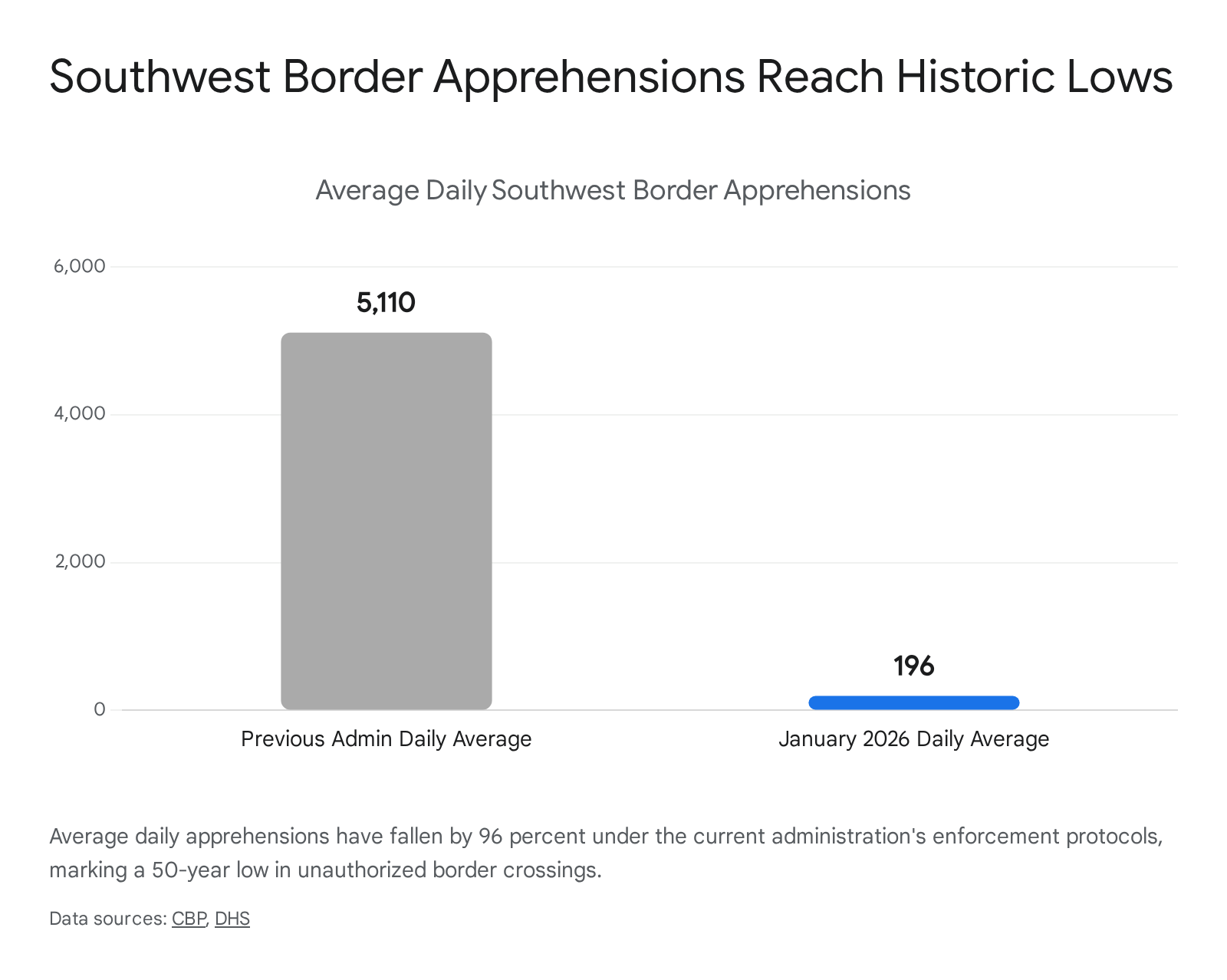
Historic Border Enforcement and the Militarization of Immigration Parallel to trade actions, the United States administration has achieved unprecedented statistical outcomes in border enforcement through the aggressive application of military jurisdiction. Data finalized this week for January 2026 demonstrates that nationwide border encounters plummeted to 34,631—an 87 percent reduction compared to the previous administration’s monthly average of 230,849.11 Even more striking, United States Border Patrol apprehensions on the critical Southwest border fell to just 6,073 for the entire month.11 This represents an average of a mere 196 apprehensions per day, a staggering 96 percent drop from the peak crisis levels that saw thousands of daily crossings.11 Cumulatively, this marks the lowest level of border encounters in more than fifty years, effectively neutralizing the border crisis as a primary vector of uncontrolled migration.13
Crucially, the administration marked its ninth consecutive month of “zero releases”.11 This indicates that absolutely no unauthorized migrants were released into the interior of the United States; every apprehended individual was processed for rapid removal, detained in federal facilities, or subjected to the reinstated Migrant Protection Protocols, colloquially known as the “Remain in Mexico” policy.3
This statistical collapse is not merely the result of standard deterrence, but is heavily driven by the aggressive, systematic prosecution of migrants and smugglers under “Operation Take Back America,” a Department of Justice initiative aimed at dismantling transnational criminal organizations.14 A critical tactical evolution in this strategy has been the deployment of National Security Presidential Memorandum 4 (NSPM-4). This directive placed specific tracts of border land—such as the Roosevelt Reservation in New Mexico—under the direct jurisdiction of the Department of Defense, officially designating them as “National Defense Areas”.14
By redefining the territorial and legal status of the physical border, the United States Attorney’s Office for the District of New Mexico is actively charging migrants not just with standard Title 8 civil immigration violations (such as 8 U.S.C. 1325 for illegal entry), but with severe military security regulation violations (50 U.S.C. 797) and entering military property (18 U.S.C. 1382).14 In the one-week period ending February 20, 2026, 48 individuals were charged under these specific, highly punitive military statutes in New Mexico alone.14
Furthermore, strict, zero-tolerance enforcement against human smuggling networks continues to escalate. This was highlighted by a significant interdiction on February 13, 2026, when Border Patrol agents at the Las Cruces checkpoint stopped a tractor-trailer driven by Adriana Alejandra Coss. A canine inspection led to the discovery and rescue of 19 undocumented individuals locked inside a freezing compartment without any means of escape.14 By applying military trespassing charges and pursuing maximum sentences for smuggling facilitators, the United States has effectively bypassed traditional, backlogged asylum bottlenecks, transforming basic civil immigration violations into federal military offenses. This zero-tolerance dragnet has also ensnared individuals with otherwise valid documentation; reports have emerged of international travelers with valid tourist visas, such as British nationals without criminal records, being detained by Immigration and Customs Enforcement (ICE) due to minor paperwork discrepancies at border crossings, demonstrating the uncompromising nature of the current border apparatus.16
1.2 Mexico: Sovereign Balancing Act, Internal Security, and Economic Interdependence
The government of Mexican President Claudia Sheinbaum finds itself navigating an existential diplomatic and security crisis. The administration is attempting to manage unprecedented United States coercion—including the persistent, explicit threat of unilateral United States military intervention against domestic drug cartels—while desperately attempting to maintain domestic sovereignty and prepare for the critical July 2026 joint review of the United States-Mexico-Canada Agreement (USMCA).3
Security Strategy and Cartel Dynamics Despite intense, persistent assertions from Washington regarding the unchecked, hegemonic power of Mexican cartels, official data presented by the Mexican government this year indicates a different macro-level trajectory. Mexico’s per capita homicide rate fell to 17.5 per 100,000 people in 2025, representing the lowest level recorded since 2015.18 The national per capita homicide rate had previously peaked at a devastating 29.1 per 100,000 residents in 2018 during the transition of power, before undergoing a sustained, multi-year decline.18 Total homicides declined significantly across 26 federal entities, with highly notable drops in states that were previously warzones, such as Zacatecas (down 71.1 percent) and the vital tourism hub of Quintana Roo (down 56.8 percent).18
| Year | National Homicide Rate (per 100,000 residents) |
| 2015 | 17.0 |
| 2018 | 29.1 |
| 2025 | 17.5 |
The Sheinbaum administration attributes this statistical success to a fundamental shift away from the previous administration’s passive “hugs, not bullets” approach, moving toward aggressive intelligence gathering, structural investigations, and the formal consolidation of the Mexican National Guard under the direct command of the defense ministry.3 Between October 2024 and December 2025, Mexican authorities reported the detention of 40,000 individuals for serious crimes and the seizure of an unprecedented 320 tons of illicit drugs.3
However, this macro-level improvement masks the reality that localized, hyper-violent cartel conflicts remain highly destabilizing. In late January 2026, the Santa Rosa de Lima Cartel massacred 11 people at a football match in Salamanca, Guanajuato, a region that remains a critical hub for illicit fuel theft and organized extortion.17 Simultaneously, the Los Chapitos faction of the Sinaloa Cartel initiated a brutal regional conflict, resulting in the abduction of 14 miners from a commercial facility and targeted attacks on state deputies, prompting the federal government to deploy an additional 1,600 military personnel to the region to restore order.17
Under intense, mounting pressure from the United States to permit cross-border military operations—a threat made highly credible following the recent United States intervention in Venezuela—President Sheinbaum has staunchly and publicly refused to allow any United States troop presence on Mexican soil, viewing it as an unacceptable violation of constitutional sovereignty.17 As a massive strategic concession to ward off unilateral United States drone strikes or special operations raids, Mexico has vastly accelerated the extradition of high-value targets. On January 21, 2026, Mexico transferred 37 highly wanted drug traffickers and cartel operatives to the United States in a single, coordinated airlift.17 Furthermore, high-level intelligence sharing between the two nations continues to yield results, culminating in the recent, high-profile capture of a major Canadian drug kingpin, Ryan Wedding, in Mexico City.3
Trade Realignments, Judicial Reform, and USMCA Preparation Economically, Mexico’s growth forecast for 2026 remains highly sluggish at an estimated 1.5 percent, severely hampered by high public debt, required fiscal tightening, and the chilling effect of persistent United States tariff threats on foreign direct investment.3 To stimulate long-term growth and capitalize on global supply chain shifts, Sheinbaum recently launched “Plan Mexico,” an ambitious, state-directed industrial policy aimed at attracting $277 billion in nearshoring investments, particularly focusing on renewable energy infrastructure and advanced manufacturing.3
Recognizing that preserving the USMCA is an absolute, existential economic priority for the nation, Mexico is systematically and aggressively aligning its broader trade policy with Washington to isolate mutual adversaries. Effective January 1, 2026, Mexico preemptively applied a massive 50 percent tariff on over 1,000 products imported from nations lacking free-trade agreements with Mexico—a policy explicitly targeting the People’s Republic of China and India.3 This move serves as a highly strategic signal to the United States Trade Representative that Mexico is willing and able to serve as a protectionist fortress against cheap Asian goods attempting to enter the North American supply chain through the back door. Moreover, Mexico and the United States recently signed a joint Action Plan on Critical Minerals, designed to secure regional resource dominance and cut China out of the battery supply chain.3 Mexico also yielded to United States pressure regarding the 1944 Water Treaty, agreeing to specific water deliveries to Texas after the United States threatened to impose a punitive 5 percent tariff on all Mexican goods.3
Despite these massive trade concessions, deep concerns remain in Washington regarding Mexico’s internal political trajectory. A major constitutional reform requiring the direct, popular election of federal judges was executed in 2025, resulting in a judiciary overwhelmingly aligned with Sheinbaum’s MORENA party.3 This has deepened concerns among United States investors and policymakers regarding the erosion of judicial impartiality, one-party dominance, and the long-term safety of foreign capital within the Mexican legal system.3 Furthermore, Mexico’s foreign policy independence—highlighted by its refusal to condemn the Venezuelan regime prior to the United States intervention and its recent sovereign decision to pause, rather than terminate, oil shipments to Cuba—continues to create diplomatic friction with a Washington administration demanding total hemispheric compliance.3
1.3 Canada: Strategic Realignments and Defense Industrialization
As the rules-based international order frays and the reliability of traditional security guarantees comes into question, Canada is fundamentally reevaluating its national security posture, recognizing that it can no longer passively rely on the United States for continental defense and economic security.
This monumental strategic shift was underscored this week by Prime Minister Mark Carney, who officially launched an unprecedented $500 billion “defence industrial strategy” during an address at a CAE flight-simulator plant in Montreal.21 The initiative is designed to rapidly scale up Canada’s defense readiness, fundamentally reconstruct the domestic defense industrial base, and secure sovereign, independent capabilities to defend the Arctic and NATO’s increasingly vulnerable northern and western flanks.22 The establishment of a new Defence Investment Agency represents a whole-of-government approach to treating defense manufacturing not merely as a procurement issue, but as a core pillar of national economic resilience and technological innovation.22
Simultaneously, Canadian Minister of National Defence David J. McGuinty concluded a highly vital diplomatic tour of Europe, attending the NATO Defence Ministers’ Meeting, the 33rd Ukraine Defense Contact Group meeting, and the 62nd Munich Security Conference.24 Faced with persistent, historical criticism from Washington regarding defense burden-sharing, McGuinty unequivocally committed Canada to meeting the NATO target of spending 2 percent of its gross domestic product on defense within the current fiscal year.24 More significantly, he outlined a highly ambitious, long-term trajectory to reach 5 percent of GDP by 2035, signaling a permanent militarization of the Canadian economy.24
The urgency of this Canadian rearmament is directly linked to shifting global nuclear and conventional architectures. The expiration of the New START Treaty on February 5, 2026, has left the United States and Russia without any legally binding restrictions on their nuclear arsenals, drastically increasing the threat profile for North American airspace.26 Recognizing that the United States umbrella is no longer guaranteed, Canada is aggressively diversifying its security partnerships, binding itself tighter to European allies. In Brussels, Minister McGuinty signed a Joint Vision Statement with the Netherlands to reinforce mutual defense industrial cooperation and sustain military support for Ukraine.24 He also signed a strategic Roadmap with France aimed at delivering actionable mutual defense priorities within the Alliance.24 Furthermore, Canada’s formal integration into the Initial Alliance Future Surveillance Control Support Partnership Committee ensures that Ottawa will have a direct, influential hand in shaping NATO’s technological future, hedging against American unpredictability by asserting its own sovereign military capacity.24
2. Central American Governance and Caribbean Instability
2.1 Guatemala: Transitioning Security Frameworks Amid Humanitarian Strain
On February 16, 2026, the government of Guatemalan President Bernardo Arévalo officially lifted a stringent, 30-day State of Emergency, replacing it with a slightly less restrictive, though still highly militarized, “State of Prevention”.8 The emergency decree was originally invoked in mid-January following a highly coordinated, unprecedented assault by the Barrio 18 gang—a transnational criminal syndicate designated as a terrorist organization by both Guatemala and the United States.8 The January attacks resulted in the assassination of 11 police officers in the capital and synchronized, violent hostage situations across three maximum-security prisons, demonstrating the capacity of incarcerated gang leadership to project lethal force nationwide.17
The Arévalo administration claims the emergency crackdown was a resounding tactical success. Operating with temporarily suspended constitutional rights that allowed for rapid, warrantless raids and detentions, security forces arrested 83 highly dangerous gang operatives, seized over three tonnes of cocaine, and systematically dismantled the illicit prison telecommunications infrastructure that had facilitated the coordination of the attacks.8 Consequently, the government reported that homicides dropped by a massive 49 percent and extortion incidents fell by 33 percent during the 30-day emergency period compared to the same timeframe in the previous year.8
Under the newly implemented “Sentinel Plan,” military and police units will transition to conducting permanent, joint patrols explicitly targeting the metropolitan areas of Guatemala City and surrounding municipalities that remain the epicenters of extortion networks.8 Intelligence analysts note that Arévalo’s approach represents a critical test of democratic resilience in the region. He is attempting to emulate the plummeting crime rates achieved by El Salvador’s President Nayib Bukele, but is attempting to do so within confined, time-limited constitutional boundaries, explicitly avoiding the indefinite authoritarian consolidation seen in neighboring states.29 The administration also leveled serious allegations that the Barrio 18 attacks were not merely criminal enterprises, but inherently political acts, serving as a destabilization plot covertly linked to political opposition figures attempting to undermine Arévalo’s fragile anti-corruption mandate.8
Compounding this acute security crisis is a severe, rapidly escalating humanitarian and agricultural emergency. The United Nations and affiliated humanitarian partners report that up to 3 million Guatemalans (roughly 16 percent of the total population) will face crisis levels of acute food insecurity (IPC Phase 3 or higher) between February and April 2026, with nearly 250,000 individuals slipping into emergency food insecurity (IPC Phase 4).31 This famine is driven by three consecutive years of catastrophic staple-grain failures in the vulnerable Dry Corridor, completely depleted household reserves, and soaring domestic maize prices.31 As a direct consequence, severe malnutrition rates have spiked; 2,800 new cases of acute malnutrition were recorded in the first four weeks of 2026 alone, representing a 15 percent year-over-year increase.31 This widespread agricultural collapse is forcing rural populations into highly negative coping mechanisms, including the rapid liquidation of assets and the initiation of atypical migration patterns toward the increasingly militarized and closed United States border, further straining regional migration dynamics.31 Furthermore, international aid is failing; the World Food Programme faces a critical 92 percent funding shortfall for its crisis response requirements in Guatemala through July 2026.31
2.2 Costa Rica: A Right-Wing Democratic Consolidation
In a stark, historic departure from its long-standing tradition of fragmented, centrist coalition building, Costa Rica held a general election on February 1, 2026, that radically altered its political and ideological landscape. Laura Fernández Delgado, the candidate for the Sovereign People’s Party (PPSO), achieved a highly decisive first-round presidential victory, capturing 48.3 percent of the popular vote and avoiding a runoff.32
More significantly for the governance of the nation, the newly minted PPSO—founded only in 2022 as a right-wing, populist successor movement designed to carry on the legacy of outgoing President Rodrigo Chaves—secured 31 of the 57 seats in the country’s unicameral Legislative Assembly.32 This represents the first time a single political party has achieved an absolute legislative majority in Costa Rica since 1990, granting the incoming executive an unprecedented mandate to enact sweeping reforms without the need for complex parliamentary negotiations.32
Fernández Delgado, slated for formal inauguration on May 8, 2026, campaigned aggressively on the establishment of a “Third Republic.” Her platform pledged rapid state reform, comprehensive anti-corruption purges, the aggressive expansion of free enterprise, and the strategic realignment of Costa Rican foreign policy to foster closer geopolitical and trade ties with Israel.33 While Costa Rica’s highly respected Supreme Electoral Tribunal (TSE) ensured a seamless, transparent, and rapidly tabulated electoral process—reinforcing the country’s status as the most consolidated democracy in Central America—the concentration of power in a populist, right-wing executive and legislature indicates a profound shift in voter sentiment.32 The electorate is highly frustrated with the bureaucratic gridlock that has paralyzed previous centrist administrations.32 The election firmly aligns Costa Rica with the broader hemispheric trend of voters favoring decisive, right-leaning mandates capable of executing rapid economic and security overhauls.32
2.3 Haiti: Protracted State Collapse and International Interventions
Haiti enters late February 2026 in a state of terminal institutional failure, effectively operating without a functional sovereign government. The Transitional Presidential Council (TPC), installed with international backing to guide the nation out of anarchy and toward democratic normalcy, has completely missed its core mandate to facilitate the transfer of authority to elected officials by the constitutionally significant date of February 7, 2026.36 The Council remains entirely paralyzed by internal factional infighting, highlighted by recent, highly destabilizing internal maneuvers by five members attempting to depose Prime Minister Alix Didier Fils-Aimé.17 This political sabotage led the United States government to impose severe visa restrictions on multiple TPC members, officially accusing them of obstructing critical anti-gang operations for personal political gain.17
In the absolute absence of a functional state, a brutal regime of criminal governance has calcified. The “Viv Ansanm” gang coalition now controls the vast majority of the capital, Port-au-Prince, as well as vital national supply arteries and agricultural regions.17 These gangs are no longer merely conducting random violence; they are actively governing, taxing residents, controlling market access, and acting as the sole arbiters of justice in their territories.38 The violence is becoming increasingly institutionalized; the United Nations reports an alarming 200 percent increase in the recruitment and use of children by armed groups over the past year, with minors—some as young as nine—now comprising 30 to 50 percent of gang ranks, subjected to systematic initiation practices designed to isolate them from their families.31 Violence is escalating in lethality, with 140 reported deaths in January during intense police raids into gang strongholds, alongside the internal displacement of thousands of residents attempting to flee the crossfire.17
This domestic security vacuum is heavily exacerbated by immense external migration pressures. Over 270,000 Haitians were forcibly returned to the country in 2025, largely deported from the neighboring Dominican Republic and the United States.31 These deportees routinely arrive in active conflict zones without any shelter, financial support, or integration mechanisms, providing a massive pool of desperate, disenfranchised recruits for criminal syndicates.31 In a minor reprieve, a recent United States federal court order temporarily halted the administration’s termination of Temporary Protected Status (TPS) for Haitians in the United States, which was slated to abruptly end on February 3, 2026.40 This injunction extends work authorizations and protections until at least March 15, 2026, temporarily preventing a further massive influx of deportees, though the long-term legal status of the diaspora remains highly precarious.40
In response to the rapidly deteriorating environment, the United Nations Security Council met on February 18, 2026, unanimously adopting Resolution 2814 to renew the mandate of the United Nations Integrated Office in Haiti (BINUH).42 Acknowledging the severe tactical insufficiency of the previous multinational framework, international efforts are officially transitioning the Multinational Security Support (MSS) mission into a more aggressive, combat-oriented “Gang Suppression Force” (GSF), backed by the logistical and operational framework of the newly established UN Support Office in Haiti (UNSOH).36 However, intelligence analysts and regional delegates note that until the political deadlock within the TPC is resolved, and the continuous flow of illicit arms—primarily smuggled from the United States—is curbed via a strictly enforced arms embargo, the GSF will merely be engaged in perpetual tactical containment rather than achieving strategic, long-term stabilization.44
3. South American Strategic Realignments and Macroeconomics
3.1 Venezuela: Post-Intervention Reorganization and Oil Sector Privatization
The geopolitical landscape of South America was permanently and violently altered on January 3, 2026, when the United States executed “Operation Absolute Resolve”.45 In an unprecedented breach of sovereign airspace conducted entirely without United States Congressional authorization, over 150 United States military aircraft and Delta Force special operators raided Caracas, successfully capturing Venezuelan President Nicolás Maduro and his wife, Cilia Flores.46 Extracted without any United States casualties, both individuals were transported to the United States and are currently imprisoned in New York City.45 They have pleaded not guilty to sweeping narco-terrorism and drug trafficking charges, declaring themselves “prisoners of war,” with their next federal court hearing delayed due to logistical issues until March 26, 2026.45
While the highly kinetic operation successfully decapitated the regime’s leadership, it deliberately did not dismantle the underlying Chavista state apparatus. On January 5, Vice President Delcy Rodríguez was sworn in as acting president, ensuring the continuity of the government.45 What has subsequently emerged is a highly pragmatic, transactional relationship between the interim Venezuelan government and Washington. In direct exchange for its continued survival and recognition, the Rodríguez administration initiated a radical, hyper-capitalist economic restructuring of the socialist state. On January 29, the National Assembly rapidly passed a reformed Hydrocarbons Law, effectively privatizing the production and sale of Venezuelan oil, and drastically lowering state royalties to heavily incentivize immediate foreign direct investment and multinational corporate control.17
In a perfectly synchronized diplomatic and economic maneuver, the United States immediately lifted all sanctions on the Venezuelan oil trade and began issuing licenses to Western energy firms.45 Washington is currently directly facilitating Venezuelan oil sales via an intermediary financial account based in Qatar, utilizing these funds to support the interim government’s payroll and stabilize the collapsing civilian sector.17 The financial windfall for the regime has been rapid; United States officials report that oil sales exceeded $1 billion in the first month post-capture, with official projections anticipating $5 billion in revenue in the coming months.45
To appease international human rights observers and consolidate domestic political control without relying solely on repression, Rodríguez initiated a mass amnesty program. While the government claims 800 political prisoners have been released, independent NGOs like Foro Penal have verified approximately 340 releases as of early February.17
The second-order geopolitical effects of this intervention are profound and destabilizing. While the domestic Venezuelan opposition broadly welcomes Maduro’s removal, the unilateral, militarized nature of the United States strike has severely alienated regional allies. Brazilian President Luiz Inácio Lula da Silva strongly condemned the operation as a blatant, illegal violation of national sovereignty, arguing that Maduro should have faced justice internally rather than via foreign abduction.49 Furthermore, host nations currently sheltering the nearly 8 million Venezuelan diaspora are aggressively re-evaluating their refugee policies. The United States involvement and the removal of Maduro have provided political cover for nations like Chile and Ecuador to consider immediately revoking temporary protections and establishing “humanitarian corridors” to pressure migrants into returning, despite the fact that Venezuela’s structural economic collapse remains largely unresolved and basic services remain non-existent.50 Ultimately, the United States effectively traded traditional democratic institution-building for immediate global energy market stabilization and the swift neutralization of a geopolitical adversary.
3.2 Colombia & Bolivia: Environmental Disasters and Internal Fractures
Colombia’s ambitious pursuit of “Total Peace” under left-wing President Gustavo Petro continues to severely fracture under the dual weight of climate-induced disasters and highly localized, violent territorial disputes between armed factions. Throughout early 2026, severe, atypical rainfall and catastrophic landslides have inundated the country, heavily impacting the departments of Córdoba and Urabá.31 By mid-February, over 251,760 individuals (comprising 71,626 families) across 22 departments were critically affected.31 Extensive damage to critical road and bridge infrastructure has severely limited the delivery of safe water, food, and emergency health services to 82 active temporary shelters, creating a severe logistical crisis for the state.31 Furthermore, the region is battling a severe dengue outbreak, with Colombia recording 9,383 cases and two deaths as the virus capitalizes on the flooded environments.31
This environmental crisis is actively overlapping with and exacerbating kinetic armed conflicts in rural territories. In the Guaviare department, violence has escalated dramatically following the splintering of FARC dissident groups. On January 16, fighters from the Estado Mayor de Bloques y Frente (EMBF)—a faction that officially broke away from the main dissident body in April 2024—ambushed the rival Central General Staff (EMC) in El Retorno, resulting in a massacre that left 26 dead, including reported minors.17
This conflict exposes a critical vulnerability in the government’s pacification strategy. The EMBF and EMC are no longer fighting for ideological supremacy or political goals, but are engaged in a purely mercenary war to monopolize highly lucrative illicit economies, primarily extortion rackets and drug trafficking corridors.17 By prioritizing territorial acquisition over peace negotiations, these splinter factions demonstrate that organized crime, rather than political insurgency, remains the primary driver of instability in rural Colombia, a dynamic that spirals out of control when state military and financial resources are diverted to manage concurrent environmental catastrophes.17
Similarly, Bolivia is facing severe internal destabilization driven by unpopular economic reforms. President Rodrigo Paz’s government faces widespread, paralyzing unrest after issuing a decree eliminating long-standing fuel subsidies, causing the prices of gasoline and diesel to skyrocket by 86 percent and 162 percent, respectively.17 This shock therapy resulted in nearly 270 mass demonstrations in January, led by the Bolivian Workers’ Center (COB).17 The crisis has fractured the executive branch, with Vice President Edmand Lara publicly declaring his fierce opposition to his own government’s economic policies, signaling deep institutional instability within La Paz.17
4. Hemispheric Macroeconomics and Trade
4.1 Argentina: Macroeconomic Stabilization and Sustained Trade Surpluses
In stark contrast to the volatility defining much of the region, Argentina under Libertarian President Javier Milei continues to demonstrate the efficacy of radical, uncompromising macroeconomic shock therapy. Economic indicators published in mid-February 2026 confirm that the administration has successfully arrested the hyperinflationary spiral that defined the previous decade of Argentine economics.
January 2026 inflation registered at 32.4 percent year-over-year—a monumental, historic achievement when considering the country previously operated in the triple digits, making it the lowest annual inflation rate recorded in eight years.51 Month-over-month inflation dropped below 3 percent for January, signaling that price stabilization has taken firm root.53 Concurrently, independent financial consensus forecasts an estimated $900 million trade surplus for January 2026.53 Driven by an 11.6 percent year-over-year surge in exports and a 5.2 percent decline in imports, this marks Argentina’s 26th consecutive month of favorable trade balances.53 In 2025, the nation closed the year with a massive total surplus of $11.29 billion.53
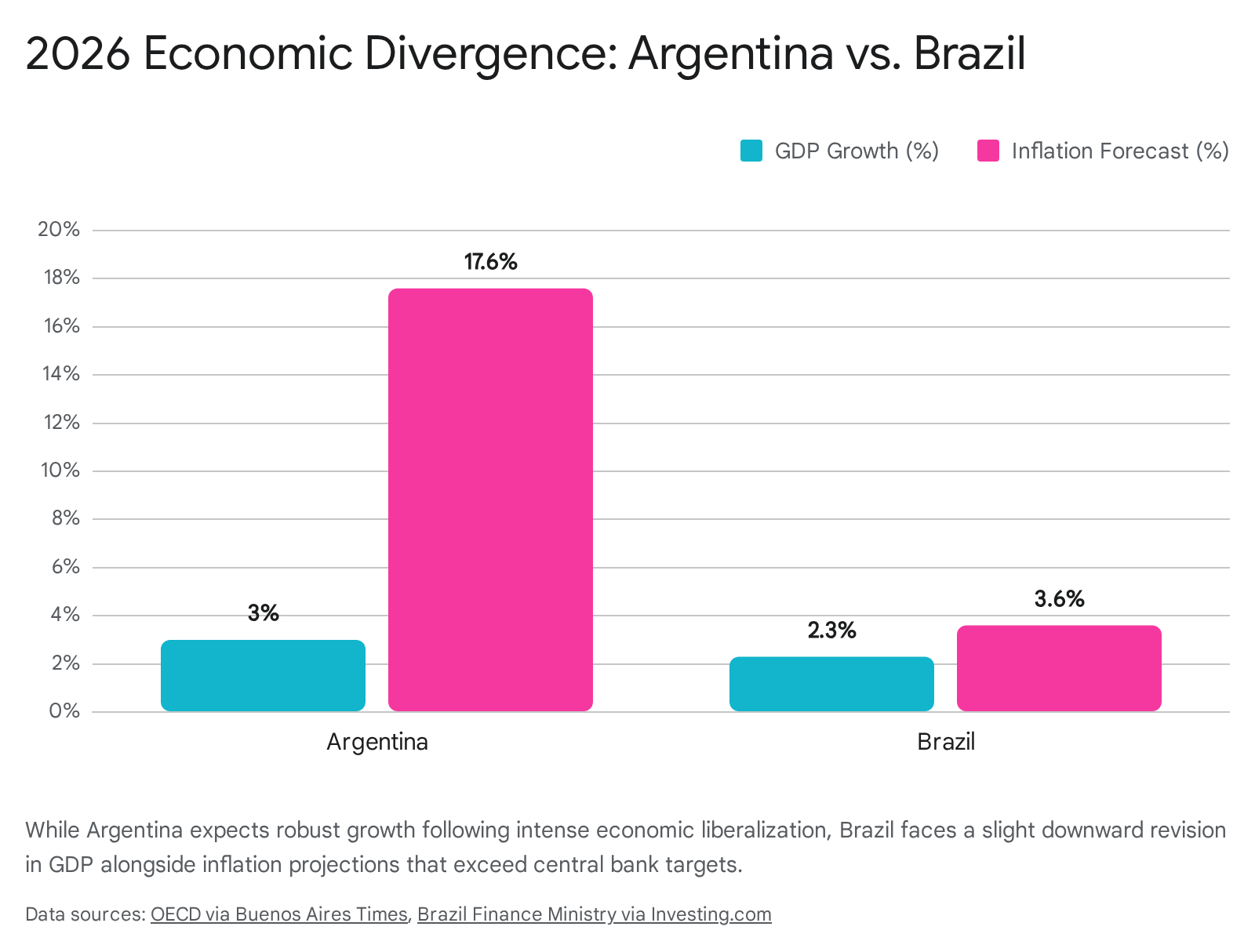
The core driver of this export boom is the administration’s systematic dismantling of currency controls and export taxes, which has heavily incentivized the critical agricultural and grains sector to liquidate reserves and engage with global markets.53 While domestic consumption remains somewhat depressed and unemployment hovered at 6.6 percent in late 2025, international outlooks are highly positive. The OECD recently projected a robust 3 percent GDP expansion for Argentina in 2026, alongside an anticipated inflation drop to 17.6 percent for the year.54 This growth is anticipated to be driven by a highly dynamic energy and mining sector, bolstered by sweeping deregulation and the establishment of a highly favorable environment for foreign direct investment.55 Argentina has successfully transitioned from a regional economic cautionary tale to a burgeoning, successful blueprint for austere, export-led market liberalization.
4.2 Brazil: Modest Growth Revisions and Persistent Inflationary Pressures
Brazil, South America’s largest economy, is experiencing a period of intense macroeconomic friction, caught dangerously between decelerating economic growth and stubbornly resilient inflation that threatens to erode purchasing power. On February 6, 2026, the Brazilian Finance Ministry officially revised its 2026 economic growth forecast downward to 2.3 percent.56 This mirrors the slower, cooling trajectory established in late 2025, where growth cooled significantly due to a highly restrictive monetary environment and a slowdown in the agricultural sector that had previously driven rapid expansion.57
More concerning for the left-wing Lula administration is the inflation outlook. The Finance Ministry revised its 2026 inflation projection upward to 3.6 percent, pushing it firmly above the central bank’s official 3 percent target.56
The absolute inability to decisively tame inflation prevents the nominally independent Brazilian central bank from aggressively cutting interest rates. This fundamentally stifles the cheap credit necessary to stimulate domestic consumption, infrastructure development, and industrial expansion.57 Regionally, Brazil’s economic sluggishness limits its ability to project soft power or act as the undisputed economic engine for the continent. Furthermore, President Lula’s highly vocal opposition to United States interventions—such as his fierce condemnation of the Maduro capture—places Brasilia ideologically at odds with an increasingly assertive, unipolar Washington.49 This risks severe diplomatic isolation and potential economic friction, as the United States has repeatedly demonstrated its willingness to leverage tariffs to enforce hemispheric compliance.59
4.3 Broader Regional Trends: Remittances and Protectionism
The broader economic landscape for Latin America and the Caribbean in 2026 is characterized by “modest growth,” reverting to a slow, highly vulnerable pre-pandemic expansion cycle. Aggregate real GDP growth across the region is projected to settle between 2.1 and 2.4 percent for the year.58 This growth ceiling is strictly dictated by deep, structural constraints, including historically low levels of productive domestic investment, an over-reliance on volatile commodity exports, and persistent vulnerability to external geopolitical shocks.58
A critical, emerging vulnerability in 2026 is the region’s heavy dependence on remittances, primarily originating from diaspora populations in the United States. While remittances continue to grow in absolute terms, the pace of growth has moderated significantly.62 This deceleration is driven by a cooling United States labor market that is generating fewer low-wage jobs, stricter United States immigration enforcement that restricts the influx of new, highly motivated migrant senders, and the introduction of a new, punitive 1 percent United States federal excise tax on physical outbound remittances.62 Although the rapid adoption of digital and mobile payment gateways has slightly offset transaction costs, the overall inflow of capital to nations deeply, structurally dependent on this revenue stream—such as Mexico, Honduras, and El Salvador—will be tangibly constrained, impacting domestic consumption in those nations.62
Furthermore, the region remains acutely exposed to the geopolitical weaponization of global trade. The United States shift toward aggressive protectionism, combined with shifting global trade policies aimed at isolating adversaries (such as Mexico’s tariffs on China), means that Latin American economies are forced to navigate a landscape where supply chain security and political alignment now vastly outweigh traditional market efficiency.58
5. Strategic Implications and Predictive Assessment
The highly volatile events of the week ending February 21, 2026, strongly indicate that the established post-Cold War diplomatic and economic architecture in the Americas is undergoing a forced, rapid deconstruction. The synthesis of this intelligence yields the following strategic trajectories for the coming months:
- The Normalization of Extrajurisdictional Coercion: The kinetic United States military intervention in Venezuela, combined with the extreme militarization of the southern border via National Defense Areas, establishes a firm precedent that Washington will no longer rely on multilateral consensus or international law to achieve core security objectives in the hemisphere. Latin American states will increasingly be forced to rely on massive economic concessions—such as Mexico’s pre-emptive tariffs on China and aggressive extradition compliance—to purchase immunity from United States kinetic or economic coercion.
- Trade Volatility as a Permanent Baseline: The Supreme Court’s invalidation of the IEEPA tariffs does not herald a return to free trade or globalization. Rather, it simply forces the executive branch to utilize alternative, equally disruptive statutory instruments like Sections 122 and 301. Consequently, multinational corporations and regional export markets must factor permanent tariff unpredictability, rapid regulatory shifts, and massive legal compliance costs into their operational models for the foreseeable future.
- The Rise of Criminal Governance vs. Right-Wing Populism: In states lacking the fiscal capacity to maintain security monopolies—such as Haiti and vulnerable parts of Central America—criminal syndicates will continue to formalize their control over territory, acting as parallel governments. Conversely, in nations with functional electoral systems, populations traumatized by crime and economic stagnation will continue to elect hardline, right-wing populists who promise absolute security at the expense of traditional democratic checks and balances, as evidenced by the recent absolute mandate granted in Costa Rica.
- Economic Polarization and Sovereign Realignments: The hemisphere will witness a growing, unbridgeable economic divergence. Nations willing to enact brutal fiscal discipline and align their supply chains completely with United States strategic interests (e.g., Argentina) will attract foreign capital and experience rapid macroeconomic stabilization. Conversely, nations constrained by ideological rigidity, structural debt, or a desire for true multipolar non-alignment (e.g., Brazil) will remain trapped in low-growth cycles, increasingly vulnerable to the shifting, aggressive tides of global great-power competition.
Please share the link on Facebook, Forums, with colleagues, etc. Your support is much appreciated and if you have any feedback, please email us in**@*********ps.com. If you’d like to request a report or order a reprint, please click here for the corresponding page to open in new tab.
Sources Used
- Summary: Supreme Court Decision on IEEPA Tariffs, accessed February 21, 2026, https://www.klgates.com/Summary-Supreme-Court-Decision-on-IEEPA-Tariffs-2-20-2026
- What the Supreme Court tariff ruling means for global trade, accessed February 21, 2026, https://tax.thomsonreuters.com/blog/supreme-court-tariff-ruling-in-learning-resources-inc-v-trump-what-corporate-tax-and-trade-teams-need-to-know/
- Mexico: Background and Key Issues in U.S. Relations …, accessed February 21, 2026, https://www.everycrsreport.com/reports/R48859.html
- Supreme Court Strikes Down IEEPA Tariffs: What Importers Need to Know Now, accessed February 21, 2026, https://www.hklaw.com/en/insights/publications/2026/02/supreme-court-strikes-down-ieepa-tariffs
- Supreme Court Strikes Down IEEPA Tariffs—What Now? – WilmerHale, accessed February 21, 2026, https://www.wilmerhale.com/en/insights/client-alerts/20260220-supreme-court-strikes-down-ieepa-tariffs-what-now
- Supreme Court strikes down tariffs, accessed February 21, 2026, https://www.scotusblog.com/2026/02/supreme-court-strikes-down-tariffs/
- Why US Supreme Court struck down Donald Trump’s trade tariffs; explained in 10 points, accessed February 21, 2026, https://timesofindia.indiatimes.com/business/international-business/why-us-supreme-court-struck-down-donald-trumps-trade-tariffs-explained-in-10-points/articleshow/128630959.cms
- Guatemala ends state of emergency, plans new security operation …, accessed February 21, 2026, https://punchng.com/guatemala-ends-state-of-emergency-plans-new-security-operation/
- BPInsights: February 21, 2026, accessed February 21, 2026, https://bpi.com/bpinsights-february-21-2026/
- We Must Act Together, accessed February 21, 2026, https://www.post-journal.com/opinion/local-commentaries/2026/02/we-must-act-together/
- Historic 9th Straight Month of Zero Releases at the Border | Homeland Security, accessed February 21, 2026, https://www.dhs.gov/news/2026/02/04/historic-9th-straight-month-zero-releases-border
- One year of the most secure border in history | U.S. Customs and Border Protection, accessed February 21, 2026, https://www.cbp.gov/newsroom/national-media-release/one-year-most-secure-border-history
- Migrant encounters at the U.S.-Mexico border are at their lowest level in more than 50 years, accessed February 21, 2026, https://www.pewresearch.org/short-reads/2026/02/02/migrant-encounters-at-the-us-mexico-border-are-at-their-lowest-level-in-more-than-50-years/
- District of New Mexico | U.S. Attorney’s Office for the District of New …, accessed February 21, 2026, https://www.justice.gov/usao-nm/pr/us-attorneys-office-district-new-mexico-weekly-immigration-and-border-crimes-report-38
- The New “National Defense Area” at the Southern Border – Just Security, accessed February 21, 2026, https://www.justsecurity.org/111022/national-defense-area-southern-border/
- ‘Don’t go to the US – not with Trump in charge’: the UK tourist with a valid visa detained by ICE for six weeks, accessed February 21, 2026, https://www.theguardian.com/us-news/2026/feb/21/karen-newton-valid-visa-detained-ice
- Latin America and the Caribbean Overview: February 2026 – ACLED, accessed February 21, 2026, https://acleddata.com/update/latin-america-and-caribbean-overview-february-2026
- Mexico’s homicide rate dropped 30% in 2025, preliminary data shows, accessed February 21, 2026, https://mexiconewsdaily.com/news/mexico-homicide-rate-2026/
- Criminal Violence in Mexico | Global Conflict Tracker – Council on Foreign Relations, accessed February 21, 2026, https://www.cfr.org/global-conflict-tracker/conflict/criminal-violence-mexico
- 2026 in Mexico – Wikipedia, accessed February 21, 2026, https://en.wikipedia.org/wiki/2026_in_Mexico
- Canada: International relations, defense and foreign policy …, accessed February 21, 2026, https://www.dianaswednesday.com/2026/02/canada-international-relations-defense-and-foreign-policy-december-2025/
- Prime Minister Carney to strengthen Canada’s security and defence partnerships at the Munich Security Conference, accessed February 21, 2026, https://www.pm.gc.ca/en/news/news-releases/2026/02/10/prime-minister-carney-strengthen-canadas-security-and-defence
- News – Canada.ca, accessed February 21, 2026, https://www.canada.ca/en/news.html
- Minister McGuinty advances Canada’s defence priorities with Allies and partners in Europe, accessed February 21, 2026, https://www.canada.ca/en/department-national-defence/news/2026/02/minister-mcguinty-advances-canadas-defence-priorities-with-allies-and-partners-in-europe.html
- McGuinty Pushes Canada’s Defense Goals in Europe – Mirage News, accessed February 21, 2026, https://www.miragenews.com/mcguinty-pushes-canadas-defense-goals-in-europe-1620021/
- Geopolitical Calendar – Control Risks, accessed February 21, 2026, https://www.controlrisks.com/our-thinking/geopolitical-calendar
- 2026 in politics – Wikipedia, accessed February 21, 2026, https://en.wikipedia.org/wiki/2026_in_politics
- What comes after New START? – Brookings Institution, accessed February 21, 2026, https://www.brookings.edu/articles/what-comes-after-new-start/
- Guatemala ends emergency powers after a monthlong crackdown sparked by 10 police killings – AP News, accessed February 21, 2026, https://apnews.com/article/guatemala-state-of-emergency-gangs-e26881cf07c0a4a55faf4030734b3298
- Guatemala’s New State of Emergency Isn’t Just About Gangs – Just Security, accessed February 21, 2026, https://www.justsecurity.org/130781/guatemala-state-of-emergency-corruption/
- Latin America & The Caribbean Weekly Situation Update as of 20 …, accessed February 21, 2026, https://reliefweb.int/report/guatemala/latin-america-caribbean-weekly-situation-update-20-february-2026
- Costa Rica’s new political landscape – Latinoamérica 21, accessed February 21, 2026, https://latinoamerica21.com/en/costa-ricas-new-political-landscape/
- Laura Fernández Delgado – Wikipedia, accessed February 21, 2026, https://en.wikipedia.org/wiki/Laura_Fern%C3%A1ndez_Delgado
- Sovereign People’s Party (Costa Rica) – Wikipedia, accessed February 21, 2026, https://en.wikipedia.org/wiki/Sovereign_People%27s_Party_(Costa_Rica)
- Top Geopolitical Trends in 2026 – Lazard, accessed February 21, 2026, https://www.lazard.com/research-insights/top-geopolitical-trends-in-2026/
- Haiti: UN Warns Time Is Running Out to Restore Democratic Institutions – Briefing – YouTube, accessed February 21, 2026, https://www.youtube.com/watch?v=9tHHMCYOG2s
- S/2025/641 Security Council – BINUH, accessed February 21, 2026, https://binuh.unmissions.org/sites/default/files/sg_report_on_the_situation_in_haiti_14_october_2025.pdf
- Haiti’s Political Crisis Deepens Amid a Slide Into Criminal Governance – Americas Quarterly, accessed February 21, 2026, https://americasquarterly.org/article/haitis-political-crisis-deepens-amid-a-slide-into-criminal-governance/
- Latin America & The Caribbean Weekly Situation Update as of 13 February 2026, accessed February 21, 2026, https://www.unocha.org/publications/report/haiti/latin-america-caribbean-weekly-situation-update-13-february-2026
- Update on Termination of TPS for Haiti, accessed February 21, 2026, https://www.uscis.gov/i-9-central/form-i-9-related-news/update-on-termination-of-tps-for-haiti
- Update on Temporary Protected Status and Haiti, accessed February 21, 2026, https://www.ahcancal.org/News-and-Communications/Blog/Pages/Update-on-Temporary-Protected-Status-and-Haiti.aspx
- Unanimously Adopting Resolution 2814 (2026), Security Council Renews Mandate of United Nations Integrated Office in Haiti, accessed February 21, 2026, https://press.un.org/en/2026/sc16285.doc.htm
- UN Documents for Haiti: Security Council Resolutions, accessed February 21, 2026, https://www.securitycouncilreport.org/un_documents_type/security-council-resolutions/?ctype=Haiti&cbtype=haiti
- ‘No Time to Waste’, Security Council Speakers Stress, as Gangs, Arm Flows Threaten Electoral Progress in Haiti, accessed February 21, 2026, https://press.un.org/en/2026/sc16279.doc.htm
- 2026 United States intervention in Venezuela – Wikipedia, accessed February 21, 2026, https://en.wikipedia.org/wiki/2026_United_States_intervention_in_Venezuela
- Unilateral U.S. military intervention to remove authoritarian dictator Nicolas Maduro from power violates international law and sets a dangerous precedent for the region – WOLA, accessed February 21, 2026, https://www.wola.org/2026/01/military-action-venezuela-united-states-maduro-trump/
- Maduro’s Capture: U.S. Foreign Policy in Latin America | RealClearDefense, accessed February 21, 2026, https://www.realcleardefense.com/articles/2026/02/20/maduros_capture_us_foreign_policy_in_latin_america_1166006.html
- Maduro’s Court Hearing Postponed in New York – ISNA News Agency, accessed February 21, 2026, https://en.isna.ir/news/1404112917504/Maduro-s-Court-Hearing-Postponed-in-New-York
- Brazilian President Lula says Maduro should face justice in Venezuela, accessed February 21, 2026, https://www.aa.com.tr/en/americas/brazilian-president-lula-says-maduro-should-face-justice-in-venezuela/3836263
- Venezuela After Maduro: The Temporary Protection Trap, accessed February 21, 2026, https://fpif.org/venezuela-after-maduro-the-temporary-protection-trap/
- Argentina | The 2025 inflation was the lowest in 8 years – BBVA Research, accessed February 21, 2026, https://www.bbvaresearch.com/en/publicaciones/argentina-the-2025-inflation-was-the-lowest-in-8-years/
- Argentina Inflation Rate – Trading Economics, accessed February 21, 2026, https://tradingeconomics.com/argentina/inflation-cpi
- Argentina expected to start 2026 with trade surplus, continuing trend …, accessed February 21, 2026, https://www.investing.com/news/economic-indicators/argentina-expected-to-start2026-with-trade-surplus-continuing-trend-reuters-poll-4511452
- Argentina Indicators – Trading Economics, accessed February 21, 2026, https://tradingeconomics.com/argentina/indicators
- OECD lowers 2026 growth forecast for Argentina, tweaks inflation estimate | Buenos Aires Times, accessed February 21, 2026, https://www.batimes.com.ar/news/economy/oecd-projects-less-growth-and-higher-inflation-for-2026-in-argentina.phtml
- Brazil Finance Ministry revises 2026 growth forecast to 2.3% By …, accessed February 21, 2026, https://www.investing.com/news/economy-news/brazil-finance-ministry-revises-2026-growth-forecast-to-23-93CH-4490174
- Brazil and Latin America’s Carnival, accessed February 21, 2026, https://lipperalpha.refinitiv.com/2026/02/brazil-and-latin-americas-carnival/
- Latin America Set for Moderate Growth in 2026, with Upside Risks, accessed February 21, 2026, https://www.mapfre.com/en/insights/economy/latin-america-moderate-growth-2026/
- Americas security risk trends in 2026 | Healix, accessed February 21, 2026, https://healix.com/international/insights/blog/risk-changing-americas-2026
- Prospects for Latin America and the Caribbean in 2026: Old Growth Constraints, New Uncertainties – Inter-American Development Bank, accessed February 21, 2026, https://www.iadb.org/en/blog/economic-analysis/prospects-latin-america-and-caribbean-2026-old-growth-constraints-new-uncertainties
- Global Economic Prospects — Regional Highlights — Latin America and the Caribbean – The World Bank, accessed February 21, 2026, https://thedocs.worldbank.org/en/doc/8bf0b62ec6bcb886d97295ad930059e9-0050012025/related/GEP-June-2025-Regional-Highlights-LAC.pdf
- 5 key economic forces shaping 2026 – Visa, accessed February 21, 2026, https://usa.visa.com/content/dam/VCOM/regional/na/us/partner-with-us/economic-insights/documents/vbei-lac-economic-outlook-feb-2026.pdf
- Global Trade Update (February 2026): Who wins when trade policies shift? |, accessed February 21, 2026, https://unctad.org/publication/global-trade-update-february-2026-who-wins-when-trade-policies-shift