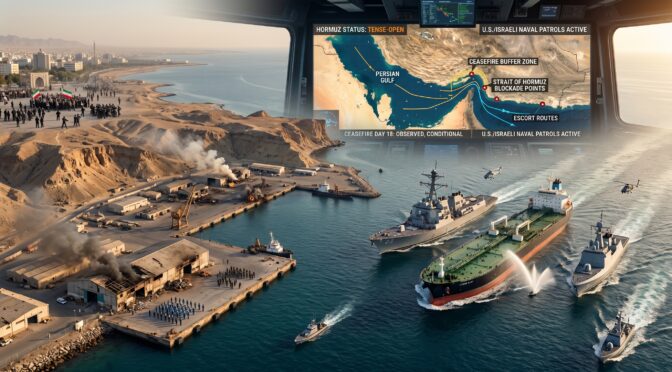
1.0 Executive Summary
During the week ending April 25, 2026, the geopolitical and military landscape of the Middle East underwent a profound and systemic transition. The conflict shifted from a high intensity kinetic air campaign to a protracted period of economic attrition, maritime interdiction, and severe diplomatic polarization. Operation Epic Fury, initiated on February 28 by the United States and Israel, previously resulted in the degradation of over 13,000 Iranian military targets, the functional neutralization of the Iranian Air Force, and the destruction of approximately 90 percent of the regular Iranian naval fleet.1 As the active bombardment phase paused under a fragile, unilaterally extended ceasefire, the conflict evolved into a complex “dual blockade” paradigm centered around the Strait of Hormuz, the Arabian Sea, and the broader Indian Ocean.3
The most critical escalation of the past seven days involved a series of aggressive, tit for tat maritime seizures that effectively shattered the temporary cessation of hostilities. The United States military officially initiated a global naval blockade aimed at enforcing strict economic sanctions, executing the boarding and capture of multiple Iranian linked vessels. This included the high profile interdictions of the M/V Touska and the M/T Majestic X by United States naval forces and Marine Expeditionary Units.5 In direct retaliation, elements of the Islamic Revolutionary Guard Corps (IRGC) utilized asymmetrical “mosquito fleet” tactics to seize two commercial container ships within the Strait of Hormuz, demonstrating their continued capability to disrupt global shipping despite the prior destruction of their primary naval assets.7
Concurrently, diplomatic efforts to secure a permanent cessation of hostilities collapsed entirely this week. Planned negotiations in Islamabad, Pakistan, failed to materialize after the Iranian government refused to send a delegation. Tehran cited the United States maritime seizures as acts of armed piracy and blatant violations of the April 8 ceasefire agreement.5 In response, United States President Donald Trump unilaterally extended the ceasefire while simultaneously intensifying Operation Economic Fury, a comprehensive sanctions and interdiction campaign directed by the Department of the Treasury to suffocate the Iranian economy.10
Systemically, this reporting period revealed profound internal fracturing within the Iranian political establishment. A highly confidential communication addressed to the new Supreme Leader, Mojtaba Khamenei, was leaked to the public. The document, reportedly signed by senior pragmatic officials, warned of an impending economic collapse and urged immediate nuclear negotiations with the United States to secure regime survival.4 This unprecedented leak triggered a severe backlash from ultraconservative factions, exposing a critical power vacuum and a fundamental ideological division regarding the future of the Islamic Republic.4
The spillover effects of this protracted standoff continue to severely impact regional and global systems. Gulf Cooperation Council (GCC) member states remain on high alert, dealing with restricted airspace, targeted energy infrastructure, and the constant threat of proxy militia activity originating from Iraq and Yemen.12 Furthermore, the global economy is absorbing the macroeconomic shockwaves of sustained supply chain disruptions. The United States is experiencing a notable surge in petroleum costs and core inflation indicators directly attributable to the prolonged conflict, indicating that the strategic consequences of Operation Epic Fury will persist well beyond any formal cessation of military operations.14
2.0 Chronological Timeline of Key Events (Last 7 days)
- April 18, 2026, 09:00 UTC: IRGC Quds Force Commander Brigadier General Esmail Ghaani arrives in Baghdad for high level strategic meetings with Iraqi militia leaders to coordinate Axis of Resistance readiness and discuss regional escalation parameters.16
- April 18, 2026, 14:00 UTC: Egyptian Foreign Minister Badr Abdelatty formally announces a joint diplomatic effort with Pakistan, Turkey, and Saudi Arabia to draft a comprehensive regional security deal independent of direct United States involvement.19
- April 19, 2026, 01:00 UTC: The Arleigh Burke class guided missile destroyer USS Spruance fires its 5 inch MK 45 gun to disable the propulsion system of the Iranian flagged container ship M/V Touska in the Arabian Sea after the vessel ignores multiple withdrawal warnings.5
- April 19, 2026, 03:00 UTC: United States Marines from the 31st Marine Expeditionary Unit aboard the USS Tripoli execute a vertical helicopter boarding operation to successfully seize control of the M/V Touska.5
- April 20, 2026, 10:00 UTC: Iranian Foreign Ministry Spokesperson Esmaeil Baghaei denounces the Touska seizure as armed piracy and formally withdraws the Iranian diplomatic delegation from the scheduled Islamabad peace negotiations, collapsing the diplomatic track.5
- April 21, 2026, 13:00 UTC: The United States Department of State issues a comprehensive legal memorandum authored by Legal Adviser Reed Rubinstein, justifying Operation Epic Fury under Article 51 of the UN Charter as collective self defense of Israel and an extension of the June 2025 hostilities.20
- April 22, 2026, 05:00 UTC: United States President Donald Trump unilaterally announces an indefinite extension of the temporary military ceasefire, while simultaneously ordering the continuation and expansion of the global naval blockade against Iran.6
- April 22, 2026, 07:00 UTC: IRGC fast attack boats intercept and seize two commercial container ships transiting the Strait of Hormuz. A third commercial vessel is fired upon but manages to evade capture.7
- April 23, 2026, 02:00 UTC: United States naval forces operating in the Indian Ocean intercept and board the M/T Majestic X, a stateless vessel previously sanctioned for smuggling Iranian crude oil to Chinese refineries.6
- April 23, 2026, 16:00 UTC: The Nimitz class aircraft carrier USS George H.W. Bush (CVN-77) officially enters the United States Central Command (CENTCOM) Area of Responsibility, significantly bolstering the regional maritime deterrence posture.6
- April 24, 2026, 11:00 UTC: Details of a highly confidential letter authored by Iranian Parliament Speaker Mohammad Bagher Ghalibaf and other pragmatic officials leak to the public, revealing severe internal divisions over the necessity of nuclear negotiations to stave off economic collapse.4
- April 24, 2026, 15:00 UTC: Israel and Hezbollah formally agree to extend their localized cessation of hostilities for an additional three weeks, maintaining an uneasy calm on the northern Israeli border to allow for civilian recovery operations.24
- April 25, 2026, 12:00 UTC: The United States Department of War publicly confirms that the maritime blockade is absolute, declaring that no vessel is permitted to sail from the Strait of Hormuz to any global destination without express permission from the United States Navy.2
3.0 Situation by Primary Country
3.1 Iran
3.1.1 Military Actions & Posture
The Iranian military apparatus remains severely degraded following the initial 38 day kinetic phase of Operation Epic Fury. Pentagon assessments indicate that over 80 percent of Iran’s integrated air defense systems (IADS) have been destroyed, leaving the national airspace heavily compromised and vulnerable to continued exploitation by United States and Israeli aviation assets.2 Furthermore, approximately 90 percent of the regular Iranian naval fleet and half of the Islamic Revolutionary Guard Corps (IRGC) small attack craft were systematically neutralized by early April.2 The destruction of major ballistic missile production facilities and solid rocket motor manufacturing plants has significantly curtailed Tehran’s strategic strike capabilities.2
Despite these catastrophic materiel losses, the IRGC has successfully transitioned to an asymmetric maritime warfare doctrine, utilizing a surviving “mosquito fleet” of highly mobile fast attack boats to project localized power in littoral zones. On April 22, IRGC naval units demonstrated their residual capability by intercepting and seizing two commercial container ships transiting the Strait of Hormuz, while concurrently firing upon a third vessel.7 Tehran justified these actions as legitimate responses to maritime violations and explicitly framed them as proportionate retaliation against the ongoing United States naval blockade.7 This action effectively cemented a “dual blockade” scenario, wherein the United States interdicts Iranian commerce in the broader Indian Ocean while Iran holds global commercial shipping hostage within the geographic choke point of the Strait of Hormuz.3
Concurrently, Iran continues to actively manage and coordinate its regional proxy network. On April 18, IRGC Quds Force Commander Brigadier General Esmail Ghaani arrived in Baghdad for high level strategic meetings with Iraqi militia leaders.16 This visit, representing Ghaani’s first confirmed foreign trip since the temporary ceasefire began, was designed to maintain operational cohesion among the Axis of Resistance. The objective was to prepare proxy forces for a potential resumption of widespread regional hostilities should the ceasefire completely collapse, ensuring that Iraqi territory remains a viable vector for asymmetric strikes against United States regional bases.18
3.1.2 Policy & Diplomacy
The diplomatic posture of the Islamic Republic was marked by a complete and highly publicized withdrawal from international peace negotiations this week. Following the United States seizure of the M/V Touska on April 19, Iranian officials labeled the act as armed piracy. Consequently, the foreign ministry refused to dispatch a diplomatic delegation to Islamabad, effectively terminating the mediation efforts painstakingly organized by the Pakistani government.5
Internally, the Iranian political establishment is experiencing a severe structural crisis driven by economic desperation and succession politics. During the week of April 24, a highly confidential letter addressed to the newly installed Supreme Leader, Mojtaba Khamenei, was leaked to the public sphere.4 The document was reportedly drafted by prominent pragmatic and centrist figures, including Parliament Speaker Mohammad Bagher Ghalibaf, President Masoud Pezeshkian, and Foreign Minister Abbas Araghchi.4 The signatories starkly warned that the Iranian economy is on the brink of total systemic collapse. They asserted that the leadership has no practical alternative but to engage in serious, comprehensive nuclear negotiations with the United States to secure immediate sanctions relief and ensure the survival of the regime.4
This internal dissent directly violated a reported red line established by Mojtaba Khamenei, which strictly forbade government officials from discussing the nuclear portfolio with American representatives under any circumstances.4 The leak, allegedly facilitated by former nuclear negotiator Ali Bagheri Kani to prove his non involvement, triggered a fierce backlash from ultraconservative factions. Hardline parliamentarians, such as Mahmoud Nabavian and Amir Hossein Sabeti, publicly attacked the pragmatic signatories, accusing them of advocating for surrender and compromising national security during a time of war.4 To mitigate the appearance of a fragmented leadership and counteract President Trump’s public assertions that Iranian officials were fighting among themselves, the government subsequently launched a coordinated unity campaign. Senior officials issued synchronized statements affirming their absolute loyalty to the Supreme Leader, though the underlying ideological fracture remains unhealed.4
3.1.3 Civilian Impact
The civilian population of Iran continues to suffer from the compounding, catastrophic effects of destroyed civil infrastructure, global financial sanctions, and the ongoing naval blockade. The systematic destruction of major gas, petrochemical, and steel industrial sites during the primary bombing campaign (such as the strikes on the Asaluyeh petrochemical complex and facilities on Lavan and Siri islands) has resulted in profound energy shortages and widespread industrial paralysis.27
The effective closure of maritime trade routes has drastically reduced the importation of essential goods, medical supplies, and technological components. The economic strain is exacerbating deep seated societal grievances, forcing the state security apparatus to double down on domestic repression to contain potential civil unrest.27 While exact civilian casualty figures from the kinetic phase remain difficult to verify independently, the secondary impacts of the conflict have created a widespread humanitarian crisis. The degradation of power grids and water desalination plants has left millions across the southern coastal provinces without reliable access to basic utilities, compounding the trauma of a war weary populace.27
3.2 Israel
3.2.1 Military Actions & Posture
The Israeli military posture during this reporting period remained largely defensive and consolidatory, focusing on maintaining security along the northern border while supporting United States operations in the Persian Gulf through intelligence sharing and strategic coordination. A significant tactical achievement occurred on April 24, when a temporary ceasefire between the Israel Defense Forces (IDF) and Hezbollah forces in Lebanon was officially extended for an additional three weeks.24 This extension provided essential operational relief for the IDF, allowing them to consolidate defensive positions and rotate personnel after a highly intense period of cross border artillery exchanges and airstrikes earlier in the month.27
Domestically, the IDF Home Front Command continues to manage complex urban recovery operations stemming from the initial Iranian retaliatory barrages. Notably, specialized search and rescue units spent over 18 hours executing a highly complex recovery mission in Haifa following a direct impact from an Iranian ballistic missile equipped with a cluster warhead that struck a residential building earlier in the conflict.28
Concurrently, Israeli military operations in the West Bank and Gaza Strip have resulted in profound infrastructural and societal shifts. According to United Nations monitoring, the IDF has established 925 movement obstacles across the West Bank, representing the highest number recorded in two decades.29 The strategic integration of the IDF with United States regional objectives remains absolute, as Israel continues to view the neutralization of the Iranian nuclear and ballistic missile programs as an existential imperative.27
3.2.2 Policy & Diplomacy
Israel’s diplomatic strategy remains tightly synchronized with Washington, carefully maneuvering to maximize the strategic benefits of Operation Epic Fury while managing international legal scrutiny. The Israeli government has maintained a tactical silence regarding the specific operational parameters of the ongoing naval blockade in the Arabian Sea, allowing the United States to absorb the international diplomatic friction associated with maritime interdictions.
A critical development in bilateral policy emerged on April 21, when the United States Department of State published a detailed legal memorandum outlining the international law justification for the war.20 The document explicitly cited the “collective self defense of its Israeli ally” as a primary legal foundation for the preemptive strikes against Iranian infrastructure.20 This public articulation legally entwines the security architectures of both nations, reinforcing Israel’s diplomatic position that the Iranian military apparatus constitutes an imminent threat requiring multilateral intervention. However, this posture has drawn criticism from international legal scholars who argue the justification stretches the definitions of imminent threat and ongoing armed conflict.21
3.2.3 Civilian Impact
The civilian impact within Israel remains pronounced and systemic. The IDF Home Front Command has mandated that the current “special home front situation” defensive guidelines will remain in effect until at least April 28.31 These guidelines dictate civilian behavior, limit the size of mass gatherings, and ensure proximity to fortified safe rooms across 30 designated geographic zones.
The conflict has also resulted in significant and sustained internal displacement. While the northern border with Lebanon has temporarily stabilized due to the extended ceasefire, tens of thousands of Israeli civilians remain evacuated from their communities due to the persistent, lingering threat of Hezbollah rocket fire and potential border incursions.24 The broader economic indicators within Israel reflect the heavy strain of sustained military mobilization. The national economy is experiencing severe disruptions to the technology, construction, and agricultural sectors, which are further compounded by the logistical challenges of restricted regional airspace and localized labor shortages.32
Regionally, the humanitarian situation in the occupied territories has deteriorated sharply. The United Nations Development Programme estimates that the gross domestic product of the Palestinian territories will contract by 35.1 percent in 2026, with unemployment rising to nearly 50 percent.34 The Human Development Index for Gaza is projected to regress by two decades, driven by the collapse of healthcare infrastructure, restricted aid access, and the widespread destruction of civilian environments.29 The fatalities of humanitarian workers, including United Nations peacekeepers and World Central Kitchen contractors, continue to draw intense international condemnation.35
3.3 United States
3.3.1 Military Actions & Posture
The United States Department of War has fully transitioned its primary operational effort toward enforcing absolute maritime dominance and executing economic interdiction. The military posture in the Middle East is exceptionally robust, anchored by three aircraft carrier strike groups currently operating within the CENTCOM Area of Responsibility. The USS Abraham Lincoln (CVN 72) and a second unnamed carrier were joined by the Nimitz class USS George H.W. Bush (CVN-77) on April 23, providing an overwhelming projection of naval aviation and strategic strike capability.6
The defining military action of the week was the aggressive enforcement of a global maritime blockade targeting Iranian commerce. On April 19, the guided missile destroyer USS Spruance fired upon and disabled the Iranian flagged container ship M/V Touska in the Arabian Sea.5 Following the kinetic disabling of the vessel’s propulsion system, Marines from the 31st Marine Expeditionary Unit executed a complex helicopter borne vertical boarding operation from the USS Tripoli to seize the ship.5 A similar interdiction occurred on April 23 in the Indian Ocean, where United States forces boarded and captured the M/T Majestic X, a stateless tanker previously sanctioned for smuggling Iranian crude oil to Chinese destinations.22
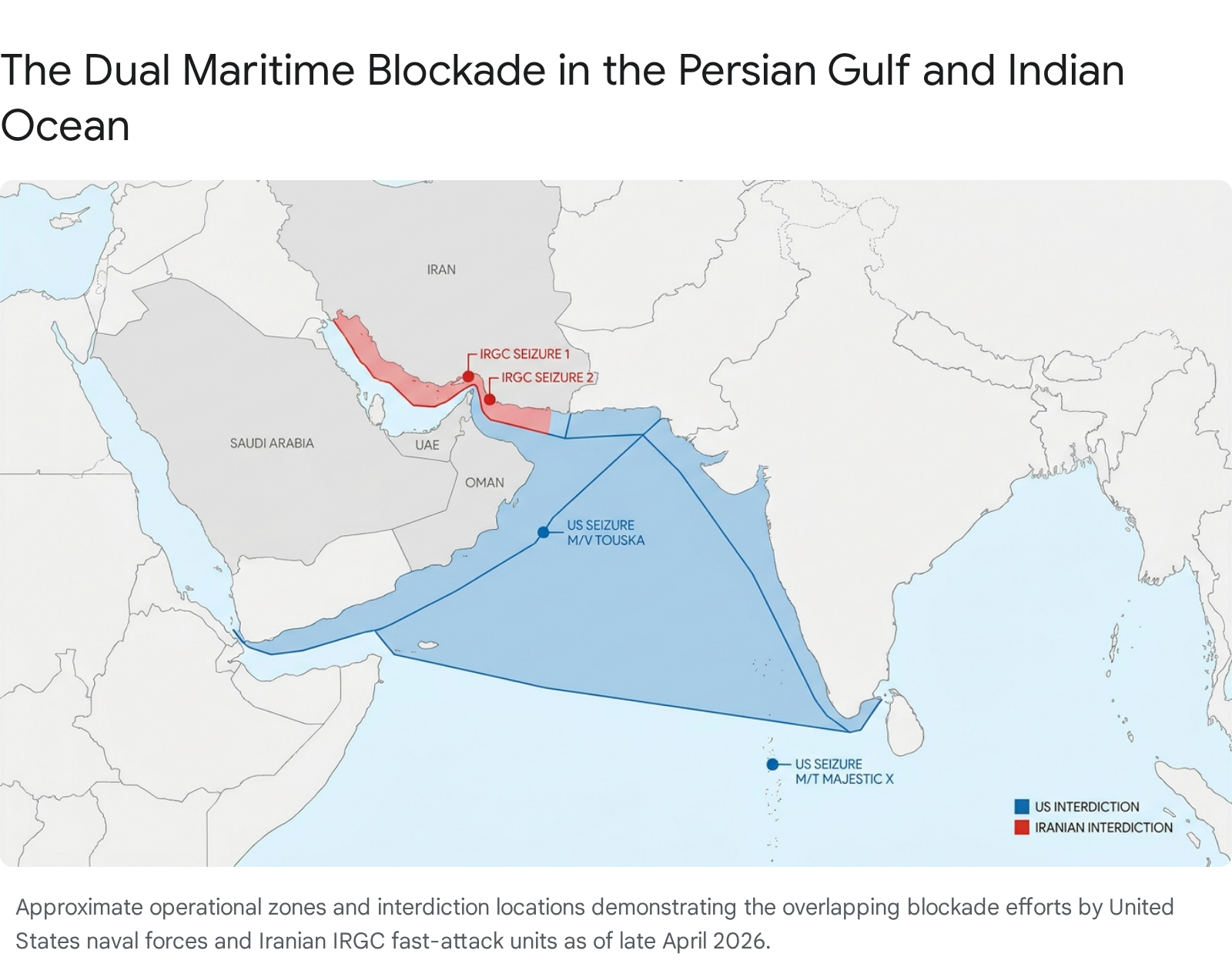
To counter the residual asymmetric threat posed by the IRGC mosquito fleet in littoral waters, the United States has deployed Marine Corps AH-1Z Viper helicopters equipped with Target Sight Systems and Joint Air to Ground Missiles (JAGM), specifically designed to neutralize fast attack swarm tactics.6 Additionally, specialized mine countermeasures are being actively deployed to the Strait of Hormuz. The USS Warrior is currently in transit from Japan to assist the USS Canberra in identifying and clearing naval mines laid by Iranian forces.6
It must be noted that the sustained intensity of Operation Epic Fury has significantly depleted United States precision munition inventories. Analytical models indicate that out of a pre war inventory of 3,100 Tomahawk missiles, approximately 850 have been expended. Furthermore, the joint force has utilized over 1,000 Joint Air to Surface Standoff Missiles (JASSMs) and hundreds of Patriot and THAAD interceptors to defend against incoming ballistic threats.6 While President Trump has publicly asserted that the United States possesses a virtually unlimited supply of ammunition, defense analysts point to a more constrained reality regarding highly advanced, finite interceptor systems.38
3.3.2 Policy & Diplomacy
United States policy regarding the conflict has hardened into a strategy of absolute economic attrition, branded internally by the administration as Operation Economic Fury.10 Following the collapse of the Islamabad negotiations, President Trump unilaterally extended the ceasefire parameters while simultaneously accelerating the enforcement of the global naval blockade.6
The legal framework supporting these actions was formalized on April 21 by State Department Legal Adviser Reed Rubinstein.20 The published memorandum asserted that Operation Epic Fury is not a new conflict, but rather the legal continuation of an ongoing international armed conflict that originated during the June 2025 hostilities.20 By arguing that the previous cessation of hostilities lacked permanence, the administration contends it is acting within the bounds of collective self defense to protect Israel, while simultaneously attempting to bypass the 60 day congressional authorization mandate explicitly outlined in the War Powers Resolution.21 This legal maneuver has drawn intense scrutiny from constitutional scholars and international legal bodies.
Furthermore, the Department of the Treasury implemented sweeping secondary sanctions against 40 shipping firms and vessels, explicitly targeting the shadow fleet networks and Chinese oil refineries that facilitate illicit Iranian petroleum exports.39 This aggressive financial strangulation is designed to completely sever Tehran’s access to foreign currency, compounding the physical blockade enforced by the Navy.
3.3.3 Civilian Impact
The domestic impact of the conflict within the United States is primarily macroeconomic, driven by severe disruptions in global energy markets and supply chains. The functional closure of the Strait of Hormuz has triggered a massive spike in global petroleum prices, resulting in an estimated $8.4 billion increase in aggregate fuel costs for American consumers since the conflict began.14 Industry analysts estimate that between 600 and 700 million barrels of oil production have been lost due to the conflict.40
The national average for gasoline surpassed $4.05 per gallon during this reporting period, directly impacting the disposable income of lower and middle class households.14 Consequently, the Bureau of Labor Statistics reported a sharp increase in core inflation, which jumped to 3.3 percent in March.15 The International Monetary Fund (IMF) subsequently revised its United States inflation forecast upward to 3.2 percent for the year 2026, explicitly warning that the macroeconomic shockwaves of the conflict will persist long after a formal cessation of hostilities is achieved.15 Consumer sentiment has plummeted to a 70 year low, with recent polling indicating that 76 percent of Americans disapprove of how the administration is handling the rising cost of living, reflecting growing domestic anxiety over the economic consequences of the overseas military engagement.41
4.0 Regional and Gulf State Impacts
The strategic spillover from Operation Epic Fury continues to fundamentally destabilize the broader Middle East, particularly the member states of the Gulf Cooperation Council (GCC). These nations (Saudi Arabia, the United Arab Emirates, Qatar, Bahrain, Kuwait, and Oman) find themselves caught in a precarious security dilemma, balancing their reliance on the United States security umbrella with their geographic vulnerability to devastating Iranian retaliation.
Airspace Restrictions and Aviation Logistics The regional aviation network remains severely fractured, forcing global commercial carriers to adopt highly inefficient bypass routing, which drives up operational costs and delays international logistics. The operational picture for GCC airspace as of April 25 demonstrates a complex patchwork of hard closures and tightly managed corridors 12:
| State | Airspace (FIR) Status | Operational Impact and Current Guidelines |
| Kuwait | Closed | The Kuwait Flight Information Region (FIR) remains fully closed to commercial traffic. The airport infrastructure sustained damage in previous drone strikes, rendering it unusable for international transit. Short term closure NOTAMs are continually issued. |
| Iran | High Risk / Partially Open | The Tehran FIR opened for limited eastbound transit above Flight Level 285 under strict recovery procedures. However, major international carriers continue to avoid the airspace entirely due to acute security risks and unpredictable air defense activity. |
| Qatar | Restricted / Controlled | The Doha FIR is open but highly regulated. Arrivals and departures are restricted to specific entry points. Foreign airline rotation caps are structurally limiting regional air cargo uplift, creating significant logistical bottlenecks. |
| UAE | Partially Closed | The Emirates FIR operates under a strict, non flexible corridor system. Overflights are limited to westbound traffic only via the LUDID waypoint. Operators must expect flow measures and extensive delays. |
| Bahrain | Approval-Based | Bahraini airspace remains fully open but is strictly approval based. Operators must secure prior authorization from the Civil Aviation Authority and adhere to fixed, predetermined entry and exit parameters. |
| Saudi Arabia | Open (Bypass Route) | Saudi airspace remains fully open, serving as the primary “southern bypass” for global traffic avoiding the conflict zone. Airports in Jeddah are absorbing massive displaced cargo volumes, leading to severe logistical congestion and delays. |
Diplomatic Maneuvering and Security Posture The GCC states have maintained a unified diplomatic front condemning Iranian aggression. In a joint statement, the foreign ministries of Saudi Arabia, the UAE, Bahrain, Kuwait, Qatar, and Jordan explicitly denounced the Iranian missile and drone strikes that targeted their sovereign territory and energy infrastructure during the kinetic phase of the war.13 The coalition cited Article 51 of the UN Charter, formally reserving their inherent right to individual and collective self defense against further proxy or direct attacks.13
Despite this unified public rhetoric, individual states are pursuing varied, pragmatic mitigation strategies to de escalate the situation. Egypt, acting as a regional mediator, has partnered with Saudi Arabia, Pakistan, and Turkey in an attempt to draft a comprehensive security settlement independent of direct United States involvement.19 This diplomatic initiative reflects a growing, palpable anxiety among Gulf capitals that Washington’s current strategy of total economic blockade prioritizes nuclear containment at the unacceptable cost of regional economic stability.19
Furthermore, significant friction has emerged regarding post conflict financial reparations. Qatar, which experienced an estimated 17 percent drop in its critical energy export capacity following a direct Iranian strike on the Pearl GTL facility in Ras Laffan earlier in the conflict, has publicly demanded financial compensation from Tehran, complicating future normalization efforts.27
Internal Security and Domestic Stability The threat of asymmetrical warfare and domestic subversion remains acute across the Arabian Peninsula. Following the publication of an IRGC target list threatening specific, high value oil and gas facilities in Saudi Arabia, Kuwait, Bahrain, Qatar, and the UAE, local security forces have mobilized heavily to protect critical infrastructure from sabotage.11 To preempt internal dissent, multiple Gulf states have initiated sweeping waves of domestic arrests. These crackdowns explicitly target individuals suspected of harboring affiliations with the Axis of Resistance, as well as civilians arrested for filming or disseminating unauthorized footage of military movements and intercepted missile strikes.27 This heightened security posture reflects the deep concern that external kinetic warfare could catalyze internal political instability across the monarchies.
5.0 Appendices
Appendix A: Methodology
The intelligence, statistical data, and qualitative analysis compiled in this situation report were generated through an exhaustive, real time research sweep of open source intelligence (OSINT) networks, military monitor databases, state sponsored broadcasts, and verified diplomatic communications covering the seven day period ending April 25, 2026. The synthesis of this report explicitly prioritizes official, verifiable statements from the United States Department of War, the Department of State, and CENTCOM press releases for primary operational military data.
To balance potential institutional bias and provide a holistic geopolitical view, these official accounts were systematically cross referenced against regional reporting (including Al Jazeera and Iran International), economic assessments from global financial institutions (IMF, OECD), and independent conflict monitors (such as The Institute for the Study of War and ACLED). Where conflicting timelines emerged regarding specific maritime seizures in the Arabian Sea and Indian Ocean, priority was granted to verifiable maritime tracking data cross referenced with corresponding official military confirmations. The temporal overlap was calculated using Coordinated Universal Time (UTC) to ensure chronological accuracy across disparate time zones.
Appendix B: Glossary of Acronyms
- AOR: Area of Responsibility. The specific geographic region assigned to a military combatant commander for the execution of military operations.
- CENTCOM: United States Central Command. The unified combatant command responsible for United States security interests in the Middle East, Central Asia, and parts of South Asia.
- CSG: Carrier Strike Group. A formidable naval operational formation composed of an aircraft carrier, guided missile cruisers, destroyers, and logistical support ships.
- FIR: Flight Information Region. A specified region of airspace in which a flight information service and an alerting service are provided to civilian and military aviation.
- GCC: Gulf Cooperation Council. A regional, intergovernmental political and economic union consisting of Bahrain, Kuwait, Oman, Qatar, Saudi Arabia, and the United Arab Emirates.
- IADS: Integrated Air Defense System. A highly complex network of radars, surface to air missiles, and command centers used to detect, track, and intercept aerial threats.
- IDF: Israel Defense Forces. The national military of the State of Israel.
- IRGC: Islamic Revolutionary Guard Corps. A multi service primary branch of the Iranian Armed Forces, distinct from the regular military, responsible for internal security, ballistic missiles, and asymmetric warfare.
- JAGM: Joint Air to Ground Missile. A precision guided munition utilized by United States rotary wing aircraft to engage high value stationary and moving targets.
- JASSM: Joint Air to Surface Standoff Missile. A low observable standoff air launched cruise missile used by the United States Air Force.
- MEU: Marine Expeditionary Unit. A highly mobile, rapid response marine air ground task force capable of executing amphibious and special operations.
- THAAD: Terminal High Altitude Area Defense. A United States anti ballistic missile defense system designed to intercept short, medium, and intermediate range ballistic missiles.
Appendix C: Glossary of Foreign Words
- Axis of Resistance: An informal political and military coalition led by the Iranian government, comprising various state and non state actors (including Hezbollah in Lebanon, Shia militias in Iraq and Syria, and the Houthis in Yemen) operating across the Middle East to oppose Western and Israeli influence.
- Khamenei: A prominent Iranian clerical family name. It refers to Ali Khamenei, the former Supreme Leader of Iran who served until his death in the opening salvos of Operation Epic Fury. His son, Mojtaba Khamenei, subsequently assumed the position of Supreme Leader.
- Majlis: The Islamic Consultative Assembly, which serves as the national legislative body or Parliament of the Islamic Republic of Iran.
- Quds Force: One of the five branches of Iran’s Islamic Revolutionary Guard Corps, specifically tasked with conducting unconventional warfare, intelligence gathering, and extraterritorial military operations, often acting as the primary liaison to proxy militias.
Please share the link on Facebook, Forums, with colleagues, etc. Your support is much appreciated and if you have any feedback, please email us in**@*********ps.com. If you’d like to request a report or order a reprint, please click here for the corresponding page to open in new tab.
Sources Used
- Peace Through Strength: Operation Epic Fury Crushes Iranian …, accessed April 26, 2026, https://www.whitehouse.gov/releases/2026/04/peace-through-strength-operation-epic-fury-crushes-iranian-threat-as-ceasefire-takes-hold/
- Epic Fury Quelled for Now, Objectives Accomplished, U.S. Forces …, accessed April 26, 2026, https://www.war.gov/News/News-Stories/Article/Article/4454276/epic-fury-quelled-for-now-objectives-accomplished-us-forces-remain-ready/
- 2026 Iran war – Wikipedia, accessed April 26, 2026, https://en.wikipedia.org/wiki/2026_Iran_war
- Behind Tehran’s unity show: The secret letter to the shadow king …, accessed April 26, 2026, https://www.iranintl.com/en/202604244463
- US captures Iranian ship Touska amid mediation efforts: All we know …, accessed April 26, 2026, https://www.aljazeera.com/news/2026/4/20/us-captures-iranian-ship-touska-amid-mediation-efforts-all-we-know
- Epic Fury Update – April 24, 2026 – SOF News, accessed April 26, 2026, https://sof.news/middle-east/epic-fury-24april2026/
- Tehran Says It Has Seized Two Ships in Strait of Hormuz as Iranian Adviser Argues Cease-Fire Means ‘Nothing’, accessed April 26, 2026, https://time.com/article/2026/04/22/strait-of-hormuz-attacks-vessels-seized-iran-us-war-ceasefire/
- Iran fast-boat swarms add to Hormuz threats for shipping | The Jerusalem Post, accessed April 26, 2026, https://www.jpost.com/middle-east/article-894036
- How Iran raised Hormuz stakes by capturing ships | US-Israel war on Iran News | Al Jazeera, accessed April 26, 2026, https://www.aljazeera.com/news/2026/4/23/how-iran-raised-hormuz-stakes-by-capturing-ships
- U.S. launches ‘Operation Economic Fury’ to obstruct Iran’s revenue streams amid blockade, accessed April 26, 2026, https://defensescoop.com/2026/04/16/trump-economic-pressure-iran-blockade/
- Gulf States: Situation & Travel Update | 24 APRIL 2026 – Solace Global, accessed April 26, 2026, https://www.solaceglobal.com/news/2026/04/24/gulf-sitrep-2404/
- Middle East Airspace – Current Operational Picture – International Ops 2025 – OpsGroup, accessed April 26, 2026, https://ops.group/blog/middle-east-airspace-current-operational-picture/
- Joint Statement by UAE, Kuwait, Bahrain, Saudi Arabia, Qatar and Jordan on Iran’s Blatant Attacks, accessed April 26, 2026, https://www.mofa.gov.ae/en/mediahub/news/2026/3/25/uae-kuwait
- Higher gas prices have cost U.S. drivers an additional $8.4 billion, Democrats say, accessed April 26, 2026, https://www.cbsnews.com/news/gas-prices-iran-war-8-4-billion-increased-costs/
- Impact of Iran war will hurt US even after conflict ends, economists warn, accessed April 26, 2026, https://www.ft.com/content/80436d72-25e1-4a97-be09-3327c2d0af9a?syn-25a6b1a6=1
- Iran Update Special Report, April 19, 2026, accessed April 26, 2026, https://understandingwar.org/research/middle-east/iran-update-special-report-april-19-2026/
- Iran’s Quds Force chief Qaani visits Iraq: senior official – SpaceWar.com, accessed April 26, 2026, https://www.spacewar.com/afp/260418192600.fi7qg6kf.html
- Iran’s Quds Force commander visits Baghdad as factions look to fill PM post | The National, accessed April 26, 2026, https://www.thenationalnews.com/news/mena/2026/04/20/irans-quds-force-commander-visits-baghdad-as-factions-look-to-fill-pm-post/
- Egypt and the Gulf: A Relationship under Pressure, accessed April 26, 2026, https://arabcenterdc.org/resource/egypt-and-the-gulf-a-relationship-under-pressure/
- Operation Epic Fury and International Law, accessed April 26, 2026, https://www.state.gov/releases/office-of-the-legal-adviser/2026/04/operation-epic-fury-and-international-law
- On the State Department Memorandum “Operation Epic Fury and International Law”, accessed April 26, 2026, https://www.justsecurity.org/137097/state-department-epic-fury-international-law/
- U.S. Forces Seize Third Iranian-Linked Tanker in Indian Ocean, accessed April 26, 2026, https://www.sofx.com/u-s-forces-seize-third-iranian-linked-tanker-in-indian-ocean/
- US forces board VLCC carrying Iranian oil, accessed April 26, 2026, https://www.argusmedia.com/en/news-and-insights/latest-market-news/2818030-us-forces-board-vlcc-carrying-iranian-oil
- 2026 Iran war | Explained, United States, Israel, Strait of Hormuz …, accessed April 26, 2026, https://www.britannica.com/event/2026-Iran-war
- Joint Force Enforces Maritime Blockade in Gulf of Oman, Globally, accessed April 26, 2026, https://www.war.gov/News/News-Stories/Article/Article/4470128/joint-force-enforces-maritime-blockade-in-gulf-of-oman-globally/
- Baghdad, April 18, 2026 (AFP) – Iran’s Quds Force chief Qaani visits Iraq: senior official, accessed April 26, 2026, https://www.nampa.org/text/22912461
- Middle East Overview: April 2026 – ACLED, accessed April 26, 2026, https://acleddata.com/update/middle-east-overview-april-2026
- Home Front Command officer says Haifa recovery operation one of war’s ‘most complex’, accessed April 26, 2026, https://www.timesofisrael.com/liveblog_entry/home-front-command-officer-says-haifa-recovery-operation-one-of-wars-most-complex/
- Humanitarian Situation Report | 23 April 2026 – OCHA oPt, accessed April 26, 2026, https://www.ochaopt.org/content/humanitarian-situation-report-23-april-2026
- US memo debunks Trump claims: Iran war launched at ‘Israel’s’ request, accessed April 26, 2026, https://english.almayadeen.net/news/politics/us-memo-debunks-trump-claims–iran-war-launched-at–israel-s
- National Emergency Portal | Home Front Command defensive policy – פיקוד העורף, accessed April 26, 2026, https://www.oref.org.il/eng/articles/info/iron-swords/1100/
- Operation Roaring Lion: A Special Home Front Situation – The Israel Democracy Institute, accessed April 26, 2026, https://en.idi.org.il/articles/63607
- Home Front Command says civilians in most of north can exit bomb shelters, accessed April 26, 2026, https://www.timesofisrael.com/liveblog_entry/home-front-command-says-civilians-in-most-of-north-can-exit-bomb-shelters/
- Gaza war: Expected socioeconomic impacts on the State of Palestine – United Nations Development Programme, accessed April 26, 2026, https://www.undp.org/sites/g/files/zskgke326/files/2024-10/gaza-war-expected-socioeconomic-impacts-palestine-policy-brief-english-1.pdf
- Reported impact snapshot | Gaza Strip (18 February 2026) – Queensland Parliament, accessed April 26, 2026, https://www.parliament.qld.gov.au/Work-of-the-Assembly/Tabled-Papers/docs/5826T0381/5826t381.pdf
- Noon briefing of 24 April 2026 | Secretary-General – the United Nations, accessed April 26, 2026, https://www.un.org/sg/en/content/highlight/2026-04-24.html
- Epic Fury Update – 19 April 2026 – SOF News, accessed April 26, 2026, https://sof.news/middle-east/epic-fury-19april2026/
- As U.S. re-arms during Iran ceasefire, long-term concerns emerge about advanced munitions supplies, accessed April 26, 2026, https://www.cbsnews.com/news/us-rearms-iran-ceasefire-advanced-munitions-supplies/
- U.S. targets China’s shadow trade with Iran in sweeping sanctions, accessed April 26, 2026, https://www.washingtonpost.com/national-security/2026/04/24/china-iran-oil-treasury-sanctions/
- Economic impact of the 2026 Iran war – Wikipedia, accessed April 26, 2026, https://en.wikipedia.org/wiki/Economic_impact_of_the_2026_Iran_war
- Economists give dire prediction about inflation as no end in sight for Iran war, accessed April 26, 2026, https://www.the-independent.com/news/world/americas/us-politics/economists-inflation-estimates-iran-war-b2964524.html
- Pain at the Pump… Are We There Yet?, accessed April 26, 2026, https://www.pennmutualam.com/market-insights-news/blogs/chart-of-the-week/2026-04-23-pain-at-the-pump-are-we-there-yet
- S/PV.10119 Security Council – the United Nations, accessed April 26, 2026, https://docs.un.org/en/S/PV.10119
- Three Scenarios for the Gulf States After the Iran War, accessed April 26, 2026, https://carnegieendowment.org/emissary/2026/04/gulf-states-gcc-iran-war-three-scenarios