1. Executive Summary
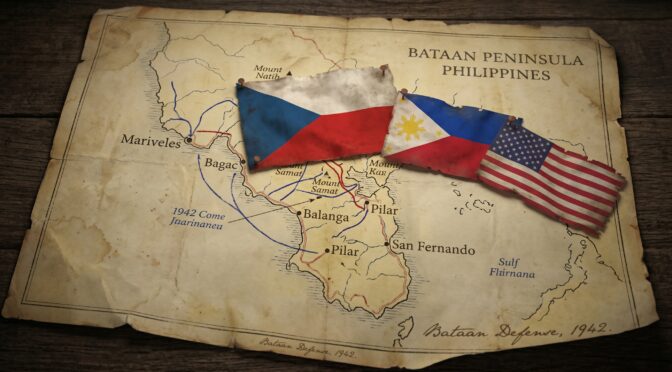
The defense of the Bataan Peninsula during the early months of the Pacific War remains a seminal event in military history, characterized by the prolonged resistance of the United States Army Forces in the Far East (USAFFE) against the advancing Imperial Japanese Army. While the historical narrative is predominantly defined by the sacrifices of Filipino and American service members, a lesser-known but highly significant contingent also participated in this theater: fourteen Czechoslovak nationals. These individuals, primarily civilian employees of the Bata Shoe Company and diplomatic staff stationed in Manila, voluntarily relinquished the diplomatic protections afforded to them as citizens of a territory under German occupation to fight for the defense of the Philippines.1
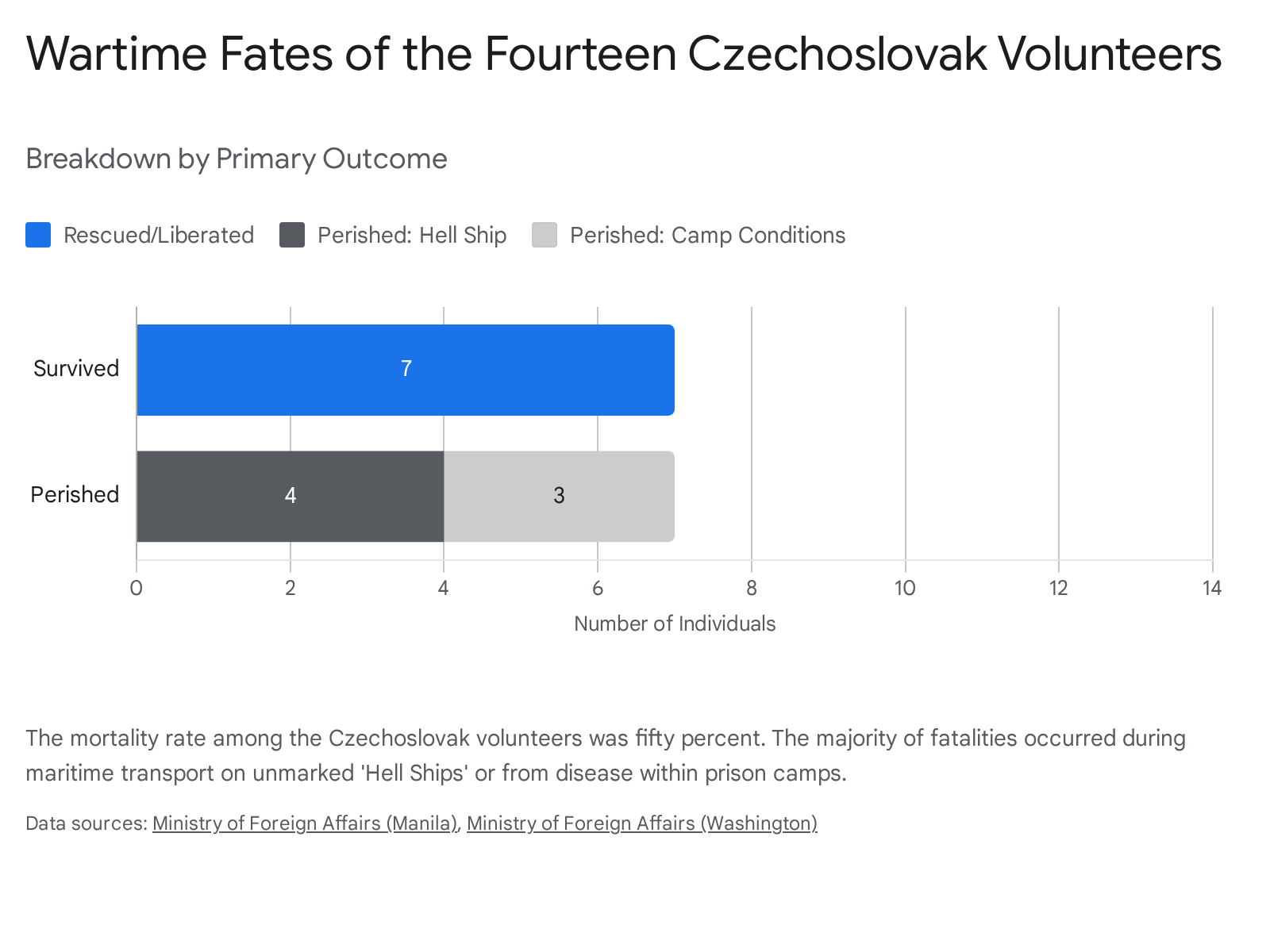
Their involvement spanned critical logistical operations on the frontlines—most notably the retrieval of vital rice-milling equipment under continuous enemy fire at the Abucay line—and culminated in their capture following the fall of Bataan on April 9, 1942.2 Subsequently, these volunteers endured the atrocities of the Bataan Death March, the squalor of Japanese prisoner-of-war (POW) camps, and the lethal maritime transfers aboard unmarked Japanese merchant vessels colloquially known as “Hell Ships”.1 By the end of the conflict, the mortality rate among the Czechoslovak contingent was precisely fifty percent.1 Today, the wartime contributions and sacrifices of these European volunteers are formally commemorated at both the Capas National Shrine in Tarlac and the Mount Samat National Shrine (Dambana ng Kagitingan) in Bataan.1 This report details the historical context of their presence in the Philippines, their specific tactical contributions, their experiences in captivity, and the mechanisms through which their legacy is preserved within Philippine national monuments.
2. Historical Context: The Czechoslovak Economic and Diplomatic Presence in Manila
The presence of a distinct Czechoslovak community in the Philippines prior to the outbreak of World War II was the result of two primary historical vectors: the aggressive globalization strategies of the Bata Shoe Company and the expansion of Central European diplomatic networks in Southeast Asia.5
The formalization of bilateral relations began with the establishment of the Honorary Consulate of Czechoslovakia in Manila in 1927.1 This diplomatic outpost was intended to foster trade and facilitate the export of Philippine agricultural products while introducing European manufactured goods to the archipelago. The consulate served as an anchor for a small but growing expatriate community of businessmen, trade officials, and ultimately, European refugees. By the late 1930s, Manila had become a destination for Jewish refugees fleeing the expanding reach of the Nazi regime in Europe. Individuals such as Hans Lenk and Fred Lenk, who had fled the Dachau concentration camp in Germany, found temporary sanctuary in the Philippine capital, integrating into the local European expatriate network.5
However, the most significant driver of Czechoslovak migration to the Philippines was industrial and commercial. Tomáš Baťa, the founder of the Bata Shoe Company in Zlín, Moravia, had revolutionized footwear manufacturing by introducing mass production techniques and automated, purpose-built factories to Europe.9 Baťa’s corporate philosophy was uniquely ambitious, aiming to “shoe the world” by establishing localized manufacturing facilities, tanneries, and retail outlets across the globe to produce affordable, well-made footwear.9 By 1928, Czechoslovakia was the largest shoe exporter globally, and the Bata empire operated more than 660 outlets internationally.9
Identifying the Philippines as a strategic consumer market and a logistical hub within Southeast Asia, the Bata Shoe Company initiated its first Philippine investments in the 1930s.5 Around 1940, a manufacturing facility was established in the Philippines under the name Gerbec-Hrdina Co. Limited.12 This entity was named after Ludvík Gerbec, the Chief Executive Officer of the Manila branch, and Jaroslav Hrdina, the company director.5 The specific nomenclature was utilized to legally and administratively differentiate the Philippine operation from the parent company in Zlín, which by then was situated within the divided and occupied territory of Czechoslovakia.12 The Bata workforce in Manila included a cadre of young professionals, technicians, and executives—among them Karel Aster, who arrived in 1941 as a buyer and businessman to help establish the factory and manage procurement networks.6 This cohort of industrial professionals, alongside the diplomatic attachés, would soon find themselves at the center of the largest military conflict in the Pacific.
3. The Geopolitical Paradox and the Decision to Volunteer
The outbreak of hostilities in the Pacific theater, triggered by the Japanese attacks on Pearl Harbor on December 7, 1941, and the subsequent bombing of the Philippines on December 8, 1941, presented the Czechoslovak expatriates with an unprecedented geopolitical paradox.6
Following the Munich Agreement in 1938 and the subsequent occupation of the Czech lands, the homeland of these expatriates had been absorbed into the Greater German Reich as the Protectorate of Bohemia and Moravia.1 Because Imperial Japan was a core member of the Axis powers alongside Nazi Germany, Japanese military doctrine and international diplomatic protocols dictated that nationals of allied or protectorate states were to be treated as non-combatant civilians of friendly nations. Consequently, the advancing Japanese forces had explicitly guaranteed the safety of the Czechoslovak nationals residing in the Philippines.2 The expatriates were assured by the occupying authorities that if they remained neutral and non-combative, their assets and physical safety would be protected from the brutalities of the occupation.4
Despite this formal guarantee of safety and the high probability of surviving the war unmolested as civilians, the Czechoslovak community in Manila made a collective, ideological decision to forgo their protected status. The community recognized that the Axis powers—whether German or Japanese—represented a unified, global threat to liberty and democratic governance. Karel Aster, who was twenty-one years old at the time of the invasion, later articulated the collective mindset of the volunteers, stating that the Japanese were viewed as enemies equivalent to the Germans, and the expatriates understood that regaining liberty for their fatherland required actively halting the Axis advance on any available front.13 Furthermore, Aster noted in his post-war correspondence that “fighting for the Philippines at that time was like fighting for the liberty of Czechoslovakia”.1
Motivated by this steadfast anti-fascist ideology, a group of fourteen Czechoslovak men presented themselves to the United States Army Forces in the Far East (USAFFE) headquarters to volunteer for combat and logistical duties.3 Because they were foreign nationals and not citizens of the United States or the Philippine Commonwealth, prevailing military regulations prevented their formal enlistment as regular combat infantry within the established divisional structures. Instead, they were officially integrated into the military organization under the administrative status of “Employees of the Department of War”.6 Despite this civilian nomenclature, the volunteers were deployed directly into the theater of tactical operations, becoming the only nationals from a Nazi-occupied European country to serve en masse within the USAFFE structure during the defense of the archipelago.2 The geographic trajectory of these volunteers spanned the breadth of the Pacific theater. From their initial deployments along the Abucay Line on the Bataan Peninsula, the captured men were forced along the route of the Bataan Death March from Mariveles to Camp O’Donnell in Tarlac. Others, who escaped temporarily, traversed the waters to the island fortress of Corregidor, only to be later captured and transported across perilous maritime routes from Manila, via Hong Kong and Formosa, to industrial labor camps in Fukuoka, Japan.5
4. The Strategic Retreat to Bataan and the Logistical Crisis
Following the initial, overwhelming Japanese landings at Lingayen Gulf and Lamon Bay in late December 1941, General Douglas MacArthur activated the pre-war contingency plan known as War Plan Orange-3.16 This strategy called for a fighting withdrawal of all USAFFE regular and reserve forces onto the rugged terrain of the Bataan Peninsula. The strategic objective was to deny the Japanese Navy the use of the deep-water harbor of Manila Bay and to hold the peninsula in a protracted siege until naval reinforcements and supplies could theoretically arrive from the continental United States.16
As the American and Filipino forces funneled into the confined geography of Bataan, the peninsula rapidly devolved into a logistical nightmare. The sudden influx of approximately 80,000 military personnel, coupled with tens of thousands of fleeing civilian refugees, completely overwhelmed the existing, hastily prepared supply depots.18 By January 5, 1942, before the defensive lines were even fully stabilized, the USAFFE command was forced to place the entire Bataan garrison on half-rations.18 This provided a meager allowance of roughly 2,000 calories a day to soldiers who were engaged in intense physical labor—digging trenches and hauling artillery—and active combat.18 Food scarcity rapidly emerged as a lethal threat equal to the Japanese infantry, leading to widespread malnutrition, debilitating beriberi, and a heightened susceptibility to the endemic malaria that plagued the jungle peninsula.20
Within this dire logistical context, the specific civilian skills of the Czechoslovak volunteers became highly valuable. They were assigned to critical supply, quartermaster, and logistics duties within the USAFFE command structure.2 Their professional backgrounds as corporate managers, procurement specialists, and industrial technicians for the Bata Shoe Company made them uniquely effective in sourcing, repairing, and transporting vital materials under chaotic conditions.
5. Tactical Operations: The Abucay Line and the Rice Mill Extraction
The most highly documented and tactically significant contribution of the Czechoslovak volunteers occurred during the defense of the Abucay Line. The Abucay Line, formally designated as the Main Battle Position, stretched across the northern neck of the Bataan Peninsula, running from the coastal town of Abucay on Manila Bay westward toward Mauban.18 This fortified front served as the first major line of resistance against the Japanese 14th Army and was characterized by a complex network of barbed wire, cleared fields of fire, foxholes, and artillery emplacements.18
Located in a highly contested zone near this defensive perimeter was a heavy, industrial rice mill. With the USAFFE troops starving and the supply lines from Manila severed, securing independent means of processing local agricultural stores became an urgent strategic imperative.18 Unprocessed rice had been harvested from the surrounding fields by desperate units, but without milling equipment, the grain could not be efficiently prepared for mass consumption.18
A specialized unit of Czechoslovak volunteers—including Jan Bžoch, Dr. Pavel Fuchs, Leo Hermann, Fred Lenk, Otto Hirsch, and Arnošt Morávek—was tasked with a highly dangerous salvage and logistics operation.2 They were ordered to advance into the active combat zone near the Abucay line to systematically dismantle the heavy rice-milling machinery and extract it to the rear echelons where it could be reassembled and utilized by USAFFE quartermaster units to feed the garrison.2
The operation was conducted under extreme tactical peril. The volunteers worked continuously for thirty-six hours, utilizing heavy tools to disassemble the mill while fully exposed to intense Japanese artillery barrages and small-arms fire.2 During this protracted retrieval mission, the tactical defense of their specific operational sector was commanded by Brigadier General Vicente Lim, a distinguished Philippine war hero and graduate of West Point who was leading the 41st Infantry Division (PA).2 General Lim’s forces provided the necessary covering fire and defensive screen that allowed the Czechoslovak civilians to complete their engineering task.2
The Czechoslovak volunteers successfully dismantled the machinery, loaded the heavy components onto transport vehicles, and secured its extraction behind friendly lines. This logistical action was deemed highly significant, as it directly increased the efficiency of food rationing available to the besieged US and Filipino forces, marginally extending their operational endurance in the face of starvation.2 For this display of extraordinary courage under fire and their critical contribution to the survival of the garrison, the six men involved—Bžoch, Fuchs, Hermann, Lenk, Hirsch, and Morávek—were subsequently awarded the American Medal of Freedom, the highest civilian decoration issued by the United States government for meritorious service in a war zone.2
6. The Collapse of Sector D and the Battle of Mount Samat
Despite the tactical ingenuity of operations like the rice mill extraction, the overarching strategic position on the Bataan Peninsula was fundamentally unsustainable. The defenders, severely degraded by months of starvation rations, rampant tropical disease, and an acute lack of ammunition and modern weaponry, were eventually forced to fall back from the Abucay Line to a secondary, less developed defensive position known as the Orion-Bagac Line.18
On Good Friday, April 3, 1942, the Japanese forces, heavily reinforced with fresh troops and fresh supplies, launched their final, devastating offensive designed to break the stalemate.24 The assault commenced with an overwhelming artillery barrage; approximately 150 Japanese artillery pieces shelled the Orion-Bagac Line from mid-morning until the afternoon.24 This was coordinated with a massive aerial bombardment, dropping over sixty tons of high-explosive ordnance directly onto the American and Filipino trench networks.24
The bulk of this concentrated fire was targeted on the narrow II Corps front in Sector D, which was thinly held by the exhausted men of the 21st and 41st divisions of the Philippine Army.24 The Japanese placed their 65th Brigade and 4th Division at the vanguard of the assault. The sheer volume of the preliminary bombardment effectively destroyed the combat cohesion of the 41st Division even before the Japanese armor and infantry crossed the line of departure.24
Following the barrage, the Japanese forces advanced rapidly, pushing through the routed defenders and moving directly up the slopes of Mount Samat.24 Mount Samat, rising over 500 meters above sea level, was the most dominant topographical feature in Sector D and the tactical linchpin of the entire USAFFE defense.25 It served as a critical observation post for directing Allied artillery fire across the peninsula.16 By April 5, 1942, the Japanese infantry had successfully seized the summit of Mount Samat, effectively shattering the Main Line of Resistance for the II Corps.24 The loss of this elevated position allowed the Japanese to direct plunging fire onto the rear echelons and outflank the remaining Allied positions, fatally fracturing the defensive integrity of the Bataan garrison.20
Recognizing that his men were facing imminent annihilation and that further resistance would result only in a futile massacre, Major General Edward P. King Jr., who had assumed command of the Bataan forces following MacArthur’s departure to Australia, defied standing orders to counterattack.24 On April 9, 1942, General King formally surrendered the tens of thousands of troops on the Bataan Peninsula to the Imperial Japanese Army.2 The fourteen Czechoslovak volunteers, along with approximately 75,000 American and Filipino soldiers, transitioned instantly from active combatants to prisoners of war.1
A small contingent of the Czech volunteers, including Karel Aster, Leo Hermann, Otto Hirsch, and Jaroslav Hrdina, managed to evade immediate capture in the chaotic hours following the surrender declaration. Aided by the technical expertise of Josef Vařák, a Bata Shoe technician who successfully repaired a damaged marine engine on an abandoned vessel, this group managed to navigate across the heavily patrolled channel to the heavily fortified island of Corregidor.5 There, they integrated with the surviving USAFFE headquarters elements, continuing their resistance.5 However, their reprieve was tragically brief; Corregidor was subjected to a relentless month-long bombardment and amphibious assault, eventually falling on May 6, 1942, resulting in the capture of the remaining Czechoslovak escapees.27
7. The Bataan Death March and Early Captivity Ecosystem
For the tens of thousands of troops captured on the Bataan Peninsula on April 9, the Japanese military high command organized a forcible mass transfer that would become recognized globally as one of the most notorious war crimes of the twentieth century: the Bataan Death March. The logistical objective of the Japanese was to clear the combat zone by moving the POWs from the southern assembly points of Bataan (specifically the municipalities of Mariveles and Bagac) to the railhead at San Fernando, Pampanga, and ultimately to the hastily converted Philippine Army training facility known as Camp O’Donnell in Capas, Tarlac—a grueling distance of roughly 105 kilometers.7
The Czechoslovak volunteers who had not escaped to Corregidor, including Dr. Pavel Fuchs and Jan Bžoch, were forced into the ranks of this march.5 The POWs, already suffering from severe malnutrition and tropical diseases, were subjected to horrific physical abuse. The march was characterized by systemic starvation, the denial of potable water under the punishing heat of the tropical sun, and wanton executions by their captors.15 Stragglers, the wounded, and those who collapsed from sheer exhaustion were routinely bayoneted, beaten to death, or shot on the roadside.15 The march also included organized atrocities, such as the Pantingan River massacre, where hundreds of prisoners were executed by sword.15 Historical consensus estimates the death toll of the march itself to be between 5,500 and 18,650 men.15
Among the Czechoslovak contingent, the brutal conditions immediately took a fatal toll. Dr. Pavel Fuchs, who had previously earned the Medal of Freedom for his actions at the Abucay rice mill, survived the physical exertion of the march itself and arrived at the squalid confines of Camp O’Donnell. However, his physical reserves were entirely depleted; he succumbed to acute dysentery on May 25, 1942, dying alongside thousands of American and Filipino soldiers who perished in the camp’s unsanitary conditions.2
The Czechoslovak volunteers who were captured weeks later at the fall of Corregidor faced a different, but equally humiliating and brutal ordeal. Rather than a forced march through the jungles, they were transported by sea to Manila and deliberately paraded through the city streets in a public spectacle orchestrated by the Japanese military propaganda apparatus.5 This event, historically referred to as the Japanese “Victory March,” was a psychological warfare tactic aimed at humiliating the defeated Western forces and shattering the myth of American invincibility in the eyes of the occupied local populace.5 Following this parade, the men were interned in various overcrowded holding facilities, including the infamous Bilibid Prison, the vast Cabanatuan camp complex, and the camp at Las Piñas.5
In his post-war memoirs and correspondence, Karel Aster provided a harrowing, unfiltered account of life within the camps. He noted that the extreme deprivations and systemic cruelty stripped away the veneers of civilization and basic human dignity. “The conditions were so terrible it is hard for me to describe them,” Aster wrote in a letter to his parents detailing the ordeal. “We no longer behaved as human beings and the only thing that helped us survive was one’s instinct for self-preservation. It shows the human can endure more than most animals”.5
8. The Hell Ships and the Maritime Tragedies
As the Pacific War turned decisively against the Axis powers and American forces under General MacArthur began a massive campaign to retake the Philippines in late 1944, the Japanese military command initiated a frantic operation to relocate thousands of able-bodied POWs. The objective was to transport them to the Japanese home islands, Manchuria, and Formosa to serve as expendable slave labor for the faltering Japanese industrial war effort.5 This mass transfer was conducted using requisitioned merchant vessels and cargo freighters, which history vividly remembers as the “Hell Ships.”
The conditions aboard these maritime vessels were apocalyptic. Thousands of emaciated men were crammed into dark, unventilated cargo holds with almost zero provisions of food, water, or basic sanitation facilities.5 Prisoners suffered from heatstroke, asphyxiation, and madness in the pitch-black holds. Compounding this internal horror was an external tactical threat: the Japanese military deliberately failed to mark these ships as carrying prisoners of war, violating international conventions. Consequently, Allied intelligence assumed they were transporting Japanese troop reinforcements or military cargo, making them prime, legitimate targets for American submarines and carrier-based dive bombers.6
The Czechoslovak volunteers were heavily concentrated on several of these ill-fated vessels, resulting in the highest mass-mortality events for their specific cohort during the entire war.
The Oryoku Maru and Enoura Maru Tragedies: On December 13, 1944, a group of Czechoslovak volunteers—including Jan Bžoch, Jaroslav Hrdina, Josef Vařák, Antonín Volný, and Fred Lenk—were loaded into the suffocating hold of the Oryoku Maru in Manila Bay, shortly before the American liberation forces launched their major raids on the capital.5 The ship was subsequently tracked and bombed by American naval aircraft, eventually sinking in Subic Bay.5 Fred Lenk, who had survived the Dachau concentration camp and the Bataan Death March, was killed in the bombing.5
The survivors of the Oryoku Maru disaster were recaptured by Japanese guards, held in squalid conditions on the beach, and eventually transferred to another Hell Ship, the Enoura Maru.5 The trauma was compounded on January 9, 1945, when the Enoura Maru, while docked in Takao Harbor in Japanese-occupied Taiwan, was targeted and heavily bombed by American planes. The resulting explosions within the crowded holds caused catastrophic carnage. Jan Bžoch, Jaroslav Hrdina (the Director of Bata Shoe in Manila), and Josef Vařák were all killed instantly or died of wounds sustained in the blast.5 Antonín Volný, a Czech diplomat who spoke fluent Japanese and had frequently risked his safety to act as an interpreter for the American prisoners during interrogations, survived the initial bombing. However, while actively seeking permission from the Japanese guards to assist the severely wounded prisoners trapped in the wreckage, Volný was summarily shot and killed by a Japanese soldier.5 He died on the deck of the Enoura Maru on his birthday.5
The Hokusen Maru Journey: Earlier, on October 1, 1944, Karel Aster and Leo Hermann were transported out of Manila aboard the Hokusen Maru.5 They endured a grueling, 39-day maritime voyage via Hong Kong and Formosa.5 Aster later recounted that he was among 2,000 POWs cramped inside the ship, suffering profound dehydration and disease before finally reaching the Japanese home islands.6
9. Slave Labor in the Japanese Home Islands and Alternative Fates
Upon arriving in Japan, the surviving POWs from the Hell Ships were systematically dispersed to various industrial complexes and mining operations to serve as slave labor. Karel Aster, Leo Hermann, and Otto Hirsch were transported to Omuta on Kyushu Island and interned at Fukuoka Camp #17, located near Nagasaki.5 The men were enslaved in the Miike coal mine, operated by the Mitsui corporate conglomerate.30 The subterranean labor was punishing, characterized by deliberate starvation diets, frequent beatings by camp guards and civilian overseers, and constant exposure to industrial accidents and cave-ins.
The relentless physical toll of the coal mines eventually broke the health of Leo Hermann. Exhausted by three years of combat, marches, Hell Ships, and subterranean labor, Hermann died in the Fukuoka camp on April 2, 1945, just months before the end of the war.2 Aster and Hirsch managed to endure the brutal conditions until the camp was finally liberated by Allied forces in August 1945, following the atomic bombings of Hiroshima and Nagasaki and the formal Japanese surrender.5
Not all of the Czechoslovak volunteers experienced the Hell Ships or the labor camps of Japan; several experienced vastly different trajectories throughout the war.
- Norbert Schmelkes: The Deputy Consul of Czechoslovakia in Manila, Schmelkes managed to flee during the chaos of the Bataan Death March.5 Refusing to surrender, he integrated into the robust Philippine guerrilla network. Utilizing a contraband radio and distributing resistance flyers, he eventually joined American resistance fighters operating in the jungles of Mindanao, serving with distinction and attaining the rank of Lieutenant Colonel in the U.S. forces.5
- Ludvík Gerbec: As the CEO of the Manila branch of Bata Shoe, Gerbec suffered from severe hemophilia, which medically disqualified him from volunteering for frontline combat.5 However, he remained in Manila and actively utilized corporate funds and resources to secretly finance the anti-Japanese resistance.5 He was eventually discovered, imprisoned, and tortured by the Japanese secret police (Kempeitai). While he survived to see the liberation, the severe physical trauma sustained during his imprisonment led to his premature death in the United States shortly after the war.5
- Karel Dančák and Hans Lenk: Both men remained imprisoned in the Philippines throughout the war. They endured the squalor of Bilibid Prison in Manila until they were dramatically rescued by advancing American liberation forces in February 1945.5 Hans Lenk, however, contracted severe tuberculosis during his internment, complicating his post-war recovery.5
10. Roster of the Czechoslovak Defenders
The following table provides a comprehensive overview of the fourteen recognized Czechoslovak combat volunteers, alongside Ludvík Gerbec, outlining their professional affiliations in pre-war Manila, their specific wartime actions, and their ultimate fates.
| Name | Professional Background | Wartime Action and Captivity | Ultimate Fate |
| Karel Aster | Buyer/Businessman, Bata Shoe Company | Escaped to Corregidor. Survived Victory March, Hokusen Maru, and slave labor at Fukuoka Camp #17. | Survived. Emigrated to USA. Died Aug. 2017 (Age 97).5 |
| Jan Bžoch | Trade Official, Czechoslovak Consulate | Abucay line rice mill operation. Survived Death March. Transported on Oryoku Maru and Enoura Maru. | Perished. Killed in bombing of Enoura Maru (Jan. 9, 1945).5 |
| Karel Dančák | Employee, Bata Shoe Company | Escaped to Corregidor. Captured, survived Victory March. Imprisoned in Manila. | Survived. Rescued at Bilibid Prison by US forces (Feb. 1945).5 |
| Dr. Pavel Fuchs | European Jewish Refugee | Abucay line rice mill operation. Survived the physical exertion of the Bataan Death March. | Perished. Died of dysentery at Camp O’Donnell (May 25, 1942).5 |
| Bedřich Herman | Employee, Bata Shoe Company | Survived the Bataan Death March and Philippine prison camps. | Survived. Liberated at Bilibid. Emigrated to the USA.5 |
| Leo Hermann | European Jewish Refugee | Abucay line rice mill operation. Escaped to Corregidor. Transported on Hokusen Maru to Japan. | Perished. Died of exhaustion at Fukuoka Camp #17 (Apr. 2, 1945).2 |
| Otto Hirsch | European Jewish Refugee | Abucay line rice mill operation. Escaped to Corregidor. Survived Fukuoka Camp #17. | Survived. Emigrated to California, USA.5 |
| Jaroslav Hrdina | Director, Bata Shoe Manila | Escaped to Corregidor. Captured, survived Victory March. Transported on Oryoku Maru. | Perished. Killed in bombing of Enoura Maru (Jan. 9, 1945).5 |
| Fred Lenk | Refugee (Fled Dachau Concentration Camp) | Abucay line rice mill operation. Survived Bataan Death March and Cabanatuan. | Perished. Killed in bombing of Oryoku Maru (Dec. 1944).5 |
| Hans Lenk | Refugee (Fled Dachau Concentration Camp) | Survived the Bataan Death March. Contracted severe tuberculosis in captivity. | Survived. Rescued at Bilibid Prison (Feb. 1945).5 |
| Arnošt Morávek | Businessman / Czech Community Leader | Abucay line rice mill operation. Escaped to Corregidor. Imprisoned at Bilibid. | Survived. Returned to Czechoslovakia after the war.5 |
| Norbert Schmelkes | Deputy Consul of Czechoslovakia | Fled Death March. Joined resistance forces in Mindanao. Attained rank of US Lt. Col. | Survived. Resistance activities documented in military histories.5 |
| Josef Vařák | Technician, Bata Shoe Company | Repaired boat engine allowing others to escape to Corregidor. Captured. | Perished. Killed in bombing of Enoura Maru (Jan. 9, 1945).5 |
| Antonín Volný | Diplomat (Fluent Japanese speaker) | Served in US intelligence (interrogations). Survived Death March and Oryoku Maru. | Perished. Shot by a Japanese guard on Enoura Maru (Jan. 9, 1945).5 |
| (Ludvík Gerbec) | CEO, Bata Shoe Manila | Did not volunteer for combat due to hemophilia. Financed resistance elements in Manila. Imprisoned and tortured. | Survived, but died shortly after the war in the US due to severe health issues.5 |
11. Historical Documentation and the Preservation of Memory
For decades following the conclusion of World War II, the specific sacrifices of the Czechoslovak volunteers remained obscured within the broader historiography of the Pacific theater, largely overshadowed by the massive scale of American and Filipino casualties. The preservation of their narrative was initially sustained only through personal correspondence and the efforts of individual survivors.
Karel Aster’s detailed memoirs and letters served as a foundational primary source for historians. In a comprehensive letter written to his parents on November 10, 1945, Aster meticulously documented the operational timeline from December 1941 to August 1945.6 He detailed the early days of patrolling roads to salvage abandoned vehicles, the tactical destruction of useful equipment during the retreat, and the systematic dehumanization experienced in the POW camps and aboard the Hell Ships.6 Aster’s records provided undeniable proof of the Czechoslovak presence on the frontlines. Aster himself lived to the age of 97, residing in Florida until his death in August 2017.5 During his final years, he was decorated with the US Medal of Freedom, the Philippine Medal of Victory, the Philippine Medal of Defense, and the Czech Gratias Agit Award.5
In recent years, formal historical research has catalyzed a movement to elevate their story into national consciousness. Authors such as Edna Bautista Binkowski, who wrote “Karel Aster: The Last Czech,” have compiled deep archival research detailing the lives of the fourteen men.33 Simultaneously, diplomatic figures like Jan Vytopil, the Deputy Head of the Czech Embassy in Manila, spearheaded efforts to uncover archival records of the Bata Shoe Company employees and officially link their service to the diplomatic history of the Czech Republic and the Philippines.3 This combined academic and diplomatic advocacy has successfully resulted in the integration of the Czechoslovak volunteers into the physical commemorative infrastructure of the Philippines.
12. Institutional Memorialization: Capas National Shrine and the American Cemetery
The physical memorialization of the European contingent is anchored at sites directly associated with their suffering. The Capas National Shrine in Tarlac is dedicated to the victims of the Bataan Death March and the horrors of Camp O’Donnell, where thousands of prisoners, including Dr. Pavel Fuchs, perished from disease and maltreatment.1
To formalize the memory of the volunteers at this specific geographic location, a dedicated granite marker was erected within the Capas National Shrine grounds.7 Unveiled on August 25, 2023, in a solemn ceremony attended by Philippine defense officials, provincial governors, and the Czech Republic Embassy’s economic and trade counselor, Maroš Martin Guoth, the marker explicitly lists the names of the fourteen Czechoslovak volunteers.7 The inscription serves as a permanent, public historical record of the European civilians who abandoned their neutral status to share the fate of the American and Filipino armed forces.7
Furthermore, the physical remains of two of the volunteers are interred with full military honors. The graves of Leo Hermann and Pavel Fuchs are meticulously maintained at the Manila American Cemetery and Memorial.2 Situated on 152 acres and containing over 16,000 graves of military dead, this cemetery integrates the Czech volunteers fully into the American military commemorative infrastructure, permanently linking their sacrifice to the broader Allied war effort.2
13. Institutional Memorialization: The Mount Samat National Shrine (Dambana ng Kagitingan)
While Capas memorializes the tragedy of captivity, the Mount Samat National Shrine serves to immortalize the tactical valor and combat defense of the USAFFE forces.34 Erected between 1966 and 1970 near the summit of Mount Samat in Pilar, Bataan, the Dambana ng Kagitingan (Shrine of Valor) occupies a location of profound historical significance.34 Mount Samat was the tactical anchor of the USAFFE Sector D defense line; its capture by overwhelming Japanese infantry and artillery on April 5, 1942, was the fatal operational blow that precipitated the total surrender of the Bataan garrison four days later.24
The shrine complex is an imposing architectural achievement, sitting 555 meters above sea level.26 It is dominated by the Memorial Cross, an immense structure constructed of steel and reinforced concrete that rises 95 meters from its base, making it the second tallest cross in the world.26 The arms of the cross measure 74 meters across and house a viewing gallery.26 The sprawling complex also includes a grand esplanade, a colonnade housing an altar backed by a striking stained-glass mural, and a subterranean museum dedicated to preserving the artifacts and narratives of the battle.26
Within this paramount national sanctuary, the Philippine government formally acknowledges the international, anti-fascist dimension of the Bataan defense. Among the curated displays and smaller monuments adjacent to the primary colonnade, there is specific memorialization dedicated to the Czechoslovak volunteers who integrated into the USAFFE ranks, standing alongside similar memorials for the Filipino and American forces.35
The Mount Samat National Shrine is the focal point for national remembrance. Annually, on April 9—a national holiday officially designated as Araw ng Kagitingan (Day of Valor)—the site hosts state-sponsored ceremonies attended by the President of the Philippines, high-ranking military officials, and international diplomats.34 It is here that the diplomatic representatives of the modern Czech Republic actively participate to honor their countrymen. For instance, on April 9, 2019, Czech Ambassador Jana Šedivá formally visited the Mount Samat National Shrine, participating in the wreath-laying ceremonies at the colonnade to explicitly honor the fourteen Czechoslovak citizens.1 Through these continuous diplomatic protocols at Mount Samat, the legacy of the Bata Shoe Company employees and consulate staff is permanently woven into the national military heritage of the Philippines.
14. Conclusion
The presence and active combat participation of fourteen Czechoslovak nationals in the defense of the Bataan Peninsula is a remarkable anomaly in the vast historiography of the Pacific War. Driven to the Philippine archipelago by the commercial expansion of the Bata Shoe Company and the geopolitical upheavals of a fracturing Europe, these civilians found themselves trapped by the sudden, violent expansion of the Japanese Empire.6
Legally protected by international diplomatic conventions due to the Nazi occupation of their homeland, these men faced no legal or civic compulsion to fight the Japanese.2 Their decision to volunteer for the USAFFE was not a matter of conscription, but was rooted in a profound ideological conviction that the defense of Philippine liberty was inextricably linked to the global struggle against fascism and the ultimate liberation of Czechoslovakia.2 Their tactical contributions—particularly the grueling, thirty-six-hour retrieval of the Abucay line rice-milling equipment under heavy artillery fire—provided vital logistical sustenance to a starving army and earned them the highest civilian military decorations.2
The subsequent price they paid for their volunteerism was exorbitant. Half of the Czechoslovak contingent perished, their lives extinguished on the grueling route of the Death March, in the disease-ridden enclosures of Japanese labor camps, or within the suffocating holds of bombed Hell Ships in the final months of the war.1 For decades, their unique contribution was relegated to the margins of history, preserved only in personal memoirs and the archives of the Bata corporation. Today, through persistent diplomatic advocacy and rigorous historical scholarship, their legacy has been rightly restored. At the soaring memorial cross of Mount Samat and the solemn, granite-marked grounds of Capas, the Republic of the Philippines and the Czech Republic jointly commemorate these fourteen men. They are remembered not merely as foreign casualties caught in the crossfire, but as dedicated, ideological defenders of freedom who recognized that the fight against global tyranny possessed no borders.1
Please share the link on Facebook, Forums, with colleagues, etc. Your support is much appreciated and if you have any feedback, please email us in**@*********ps.com. If you’d like to request a report or order a reprint, please click here for the corresponding page to open in new tab.
Sources Used
- Remembering Czechoslovak Bataan Defenders | Embassy of the Czech Republic in Manila, accessed April 24, 2026, https://mzv.gov.cz/manila/en/bilateral_relations/remembering_czechoslovak_bataan.html
- The Czechs on Bataan – American POWs of Japan, accessed April 24, 2026, https://pows.jiaponline.org/2022/04/the-czechs-on-bataan.html
- Embassy of the Czech Republic in Manila, accessed April 24, 2026, https://mzv.gov.cz/manila/en/hommage_to_czech_world_war_ii_volunteers.mobi
- Czechoslovak Courage: Volunteerism in World War II | Embassy of the Czech Republic in Manila, accessed April 24, 2026, https://mzv.gov.cz/manila/en/culture_and_education/czechoslovak_courage_volunteerism_in.html
- Karel Aster Passes Away at 97 | Embassy of the Czech Republic in Washington, D.C., accessed April 24, 2026, https://mzv.gov.cz/washington/en/czech_us_relations/karel_aster_passes_away_at_97.mobi
- ASTER, Karel – the last living veteran from Bataan | Embassy of the Czech Republic in Manila, accessed April 24, 2026, https://mzv.gov.cz/manila/en/bilateral_relations/czechs_in_the_philippine_history/aster_karel_the_last_living_veteran_from.html
- Czech heroism marker rises at Capas shrine – TARLAKENYO, accessed April 24, 2026, https://tarlakenyo.com/2023/08/czech-heroism-marker-rises-at-capas-shrine/
- The Untold Story of Czechoslovak Bataan Defenders – THEPHILBIZNEWS, accessed April 24, 2026, https://thephilbiznews.com/2019/04/13/the-untold-story-of-czechoslovak-bataan-defenders/
- The Cobbler Who Conquered the World by Rob Cameron (Works That Work magazine), accessed April 24, 2026, https://worksthatwork.com/6/bata
- Bata Corporation – Wikipedia, accessed April 24, 2026, https://en.wikipedia.org/wiki/Bata_Corporation
- bata shoe company | spunktitud3, accessed April 24, 2026, https://spunktitud3.wordpress.com/tag/bata-shoe-company/
- Philippines – Bata’s World, accessed April 24, 2026, http://world.tomasbata.org/asia/philippines/
- Last Living Czech Defender of Bataan Awarded | Embassy of the Czech Republic in Manila, accessed April 24, 2026, https://mzv.gov.cz/manila/en/bilateral_relations/czechs_in_the_philippine_history/last_living_czech_defender_of_bataan.html
- Did you know? There are Czechoslovak Nationals who fought for the Philippines during WW2. : r/czech – Reddit, accessed April 24, 2026, https://www.reddit.com/r/czech/comments/tzjgvb/did_you_know_there_are_czechoslovak_nationals_who/
- Bataan Death March – Wikipedia, accessed April 24, 2026, https://en.wikipedia.org/wiki/Bataan_Death_March
- Chapter Twenty – Somos Primos, accessed April 24, 2026, https://www.somosprimos.com/michaelperez/ribera26/ribera26.htm
- Hirohito’s War: Japan’s Pacific Conflict | PDF | Guadalcanal Campaign – Scribd, accessed April 24, 2026, https://www.scribd.com/document/683217645/Hirohito-s-war-the-Pacific-War-1941-1945-PDFDrive
- The U.S. Army and World War II: Selected Papers from the Army’s Commemorative Conferences, accessed April 24, 2026, https://history.army.mil/portals/143/Images/Publications/catalog/68-4.pdf
- PhilHis Halili | PDF | Archaeology | Philippines – Scribd, accessed April 24, 2026, https://www.scribd.com/doc/241929226/PhilHis-Halili
- The Last 100 Yards – Army University Press, accessed April 24, 2026, https://www.armyupress.army.mil/Portals/7/combat-studies-institute/csi-books/the-last-100-yards-lsco-volume-9.pdf
- SENATE – GovInfo, accessed April 24, 2026, https://www.govinfo.gov/content/pkg/GPO-CRECB-1967-pt7/pdf/GPO-CRECB-1967-pt7-3-2.pdf
- Czechoslovak courage: Volunteerism in World War II – Philstar.com, accessed April 24, 2026, https://www.philstar.com/opinion/2022/04/09/2173302/czechoslovak-courage-volunteerism-world-war-ii
- Good Outfit: The 803rd Engineer Battalion and the Defense of the Philippines, 1941-1942 – Air University, accessed April 24, 2026, https://www.airuniversity.af.edu/Portals/10/AUPress/Books/B_0166_ROPP_GOOD_OUTFIT_THE_803RD_ENGINEER_BATTALION_AND_THE_DEFENSE_OF_THE_PHILIPPINES_1941_1942..pdf
- Armies in Retreat: Chaos, Cohesion, and Consequences, accessed April 24, 2026, https://www.armyupress.army.mil/Portals/7/Research%20and%20Books/2023/ArmiesRetrt-HeckMills-2023.pdf
- Teaching Culture and Geography in Schools | PDF | Learning | Critical Thinking – Scribd, accessed April 24, 2026, https://www.scribd.com/document/712089835/TSSEG-culture-and-geography-NOTES-ONLY
- Mt. Samat Shrine of Valor – Behold Bataan, accessed April 24, 2026, https://beholdbataan.ph/destinations/historical/mt-samat-shrine-of-valor/
- 2022 – American POWs of Japan, accessed April 24, 2026, https://pows.jiaponline.org/2022/
- The Diplomat-Scholar: A Biography of Leon Ma. Guerrero 9789814762434 – dokumen.pub, accessed April 24, 2026, https://dokumen.pub/the-diplomat-scholar-a-biography-of-leon-ma-guerrero-9789814762434.html
- This Czech is a Philippine war hero | Philstar.com, accessed April 24, 2026, https://www.philstar.com/other-sections/newsmakers/2017/05/17/1700916/czech-philippine-war-hero
- July 2015 – American POWs of Japan, accessed April 24, 2026, https://pows.jiaponline.org/2015/07/
- Obituary information for Irene Rose Hrdina Vincent – Chapman Funerals & Cremations, accessed April 24, 2026, https://www.chapmanfuneral.com/obituaries/Irene-Rose-Hrdina-Vincent?obId=20631175
- Annals of Mitsui’s Miike Mine: Karel Aster – American POWs of Japan, accessed April 24, 2026, https://pows.jiaponline.org/2015/07/annals-of-mitsuis-miike-mine-karel-aster.html
- Czech defense chief cites Filipina author – Manila Standard, accessed April 24, 2026, https://manilastandard.net/news/national/314566687/czech-defense-chief-cites-filipina-author.html
- Battle of Bataan | Military Wiki – Fandom, accessed April 24, 2026, https://military-history.fandom.com/wiki/Battle_of_Bataan
- Philippine National and Local Museums | PDF – Scribd, accessed April 24, 2026, https://www.scribd.com/document/370380334/National-and-Local-Museum-and-Heritage-Sites-in-the-Philippines
- Mount Samat National Shrine – Wikipedia, accessed April 24, 2026, https://en.wikipedia.org/wiki/Mount_Samat_National_Shrine
- World War II Revisited, accessed April 24, 2026, https://www.union-services.com/images/book_data/9784946428777.pdf
- Mt. Samat War Memorial Cross relighted – Philippine News Agency, accessed April 24, 2026, https://www.pna.gov.ph/articles/1088452
- Aguinaldo Shrine: History and Significance | PDF | Corregidor | Memorial – Scribd, accessed April 24, 2026, https://www.scribd.com/document/506495987/shrine1
- Full text of “Messages of the President Book 15: Benigno S. Aquino III (Volume 1)”, accessed April 24, 2026, https://archive.org/stream/MOP-Vol1-Benigno-S-Aquino-III/13OR%20-%20BSA_djvu.txt