1. Executive Summary and Industry Context
The landscape of concealed carry firearms and personal defense weapons underwent a permanent paradigm shift over the past decade. Previously, the firearms industry forced consumers and procurement officers into a rigid binary choice. An operator could select a high-capacity double-stack compact pistol that was inherently difficult to conceal under light clothing, or one could choose a single-stack subcompact pistol that offered excellent concealability but suffered from severe capacity limitations, typically holding only six to eight rounds. This technological stalemate was decisively broken with the introduction of the modified double-stack magazine architecture, a design innovation that maximized internal grip volume without expanding the external dimensions of the polymer frame.
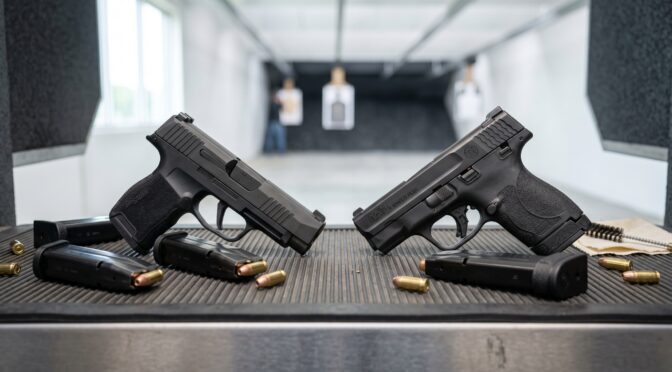
The SIG P365 redefined the baseline expectations for the micro-compact category by offering a flush-fit capacity of ten rounds within a physical profile previously reserved for single-stack firearms.1The release of this platform sent shockwaves through the industry, immediately rendering legacy single-stack designs obsolete in the eyes of many practitioners. In direct response to this market disruption, Smith & Wesson evolved their highly successful Shield lineage to create the S&W M&P 9 Shield Plus. The Shield Plus retained the proven ergonomic footprint of the original Shield, a platform trusted by millions, while expanding the internal magazine capacity to ten and thirteen rounds.4
This comprehensive research report provides an exhaustive, expert-level evaluation of both the Sig Sauer P365 and the Smith & Wesson Shield Plus platforms. The subsequent analysis covers mechanical specifications, metallurgical properties, ergonomic geometry, historical reliability metrics, aftermarket ecosystem integration, primary operational use cases, and vendor procurement data. The objective is to provide a nuanced technical comparison that facilitates informed decision-making for professional end-users, law enforcement procurement officers, and civilian practitioners carrying in non-permissive environments.
2. Technical Specifications and Mechanical Architecture
A rigorous comparison of the physical dimensions and mechanical constraints of these two firearms reveals distinct engineering philosophies. Both manufacturers engineered their respective platforms to operate within extremely tight tolerances, balancing the severe physical forces of the 9x19mm Parabellum cartridge against the minimal mass of a micro-compact slide. The architectural decisions made by each company directly impact how the firearm conceals, how it recoils, and how it interfaces with the operator.
2.1 Dimensional Analysis and Concealability Metrics
Concealability is mathematically driven by a firearm’s height and width, as these specific dimensions dictate the degree to which the grip frame will protrude or print through covering garments. Length is generally less critical for concealment, as the barrel is typically hidden inside the waistband, but length does affect the sight radius and ballistic velocity of the projectile.
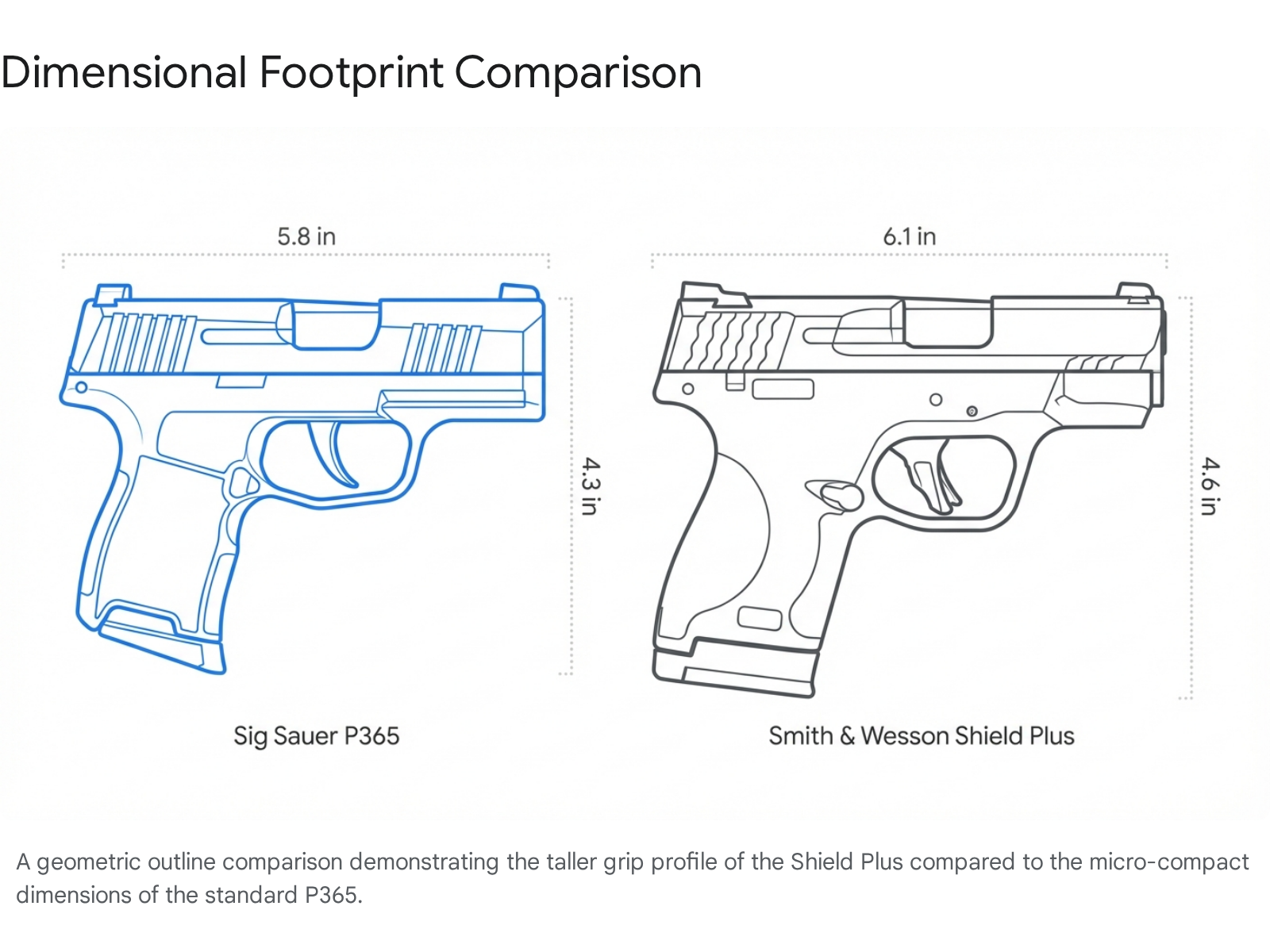
The Sig Sauer P365 features an overall length of 5.8 inches, a width of 1.06 inches, and a height of 4.3 inches when equipped with the standard flush-fit ten-round magazine.6 The unloaded weight of the baseline P365 is measured at 17.8 ounces.6 This incredibly dense package represents a marvel of modern spatial engineering, squeezing maximum capability into minimum volume.
Conversely, the Smith & Wesson Shield Plus features an overall length of 6.1 inches, a width of 1.1 inches, and a height of 4.6 inches with its flush-fit ten-round magazine.4 The unloaded weight is marginally heavier at 17.9 ounces for the base model without a manual safety 4, scaling up slightly to 20.2 ounces for models equipped with an optional manual thumb safety.9
The dimensional advantage for absolute deep concealment lies slightly with the Sig Sauer P365. The 0.3-inch reduction in grip height makes the Sig Sauer platform marginally easier to conceal in an appendix inside-the-waistband configuration, particularly for users with smaller frames.7 However, this reduction in height sacrifices vital gripping surface, a factor that directly impacts recoil management for shooters with larger hands. The Smith & Wesson Shield Plus, while slightly taller and wider, provides more real estate for the dominant hand to establish a secure master grip.
2.2 Magazine Engineering and Staggered Capacity
The foundational innovation of the Sig Sauer P365 is its patented magazine design.1 Instead of utilizing a traditional single-stack or a pure double-stack geometry, the Sig Sauer magazine utilizes a highly engineered tapered transition. The cartridges sit in a staggered double-stack arrangement at the base of the magazine and slowly taper into a single-stack presentation at the feed lips. This geometric manipulation allows the upper portion of the grip frame to remain incredibly thin, while the lower portion swells just enough to accommodate the staggered rounds. This results in 10+1 rounds in a flush-fit configuration, with options to scale up to 12+1, 15+1, or even 17+1 rounds using extended magazines designed for the X-Macro variants.1
Smith & Wesson adopted a similar staggered-stack approach for the Shield Plus, partnering with the renowned Italian manufacturer Mec-Gar to produce their magazines.12 The Shield Plus ships standard with one flush-fit ten-round magazine and one extended thirteen-round magazine.4 The extension on the thirteen-round magazine serves as an integrated grip module, providing critical support for the shooter’s fifth digit. Providing space for the pinky finger significantly enhances leverage against muzzle flip during rapid strings of fire, transforming the micro-compact into a platform that shoots with the stability of a much larger duty pistol.
2.3 Metallurgy and Surface Treatments
To ensure longevity in everyday carry scenarios where the firearm is constantly exposed to body sweat, environmental humidity, and abrasive friction from holsters, both manufacturers utilize proprietary metallurgical treatments. The resilience of these treatments is a critical factor for weapons carried close to the body for extended periods.
The Sig Sauer P365 utilizes a stainless steel slide finished with a proprietary Nitron coating.6 Nitron is a Physical Vapor Deposition process that bonds with the top layer of the steel, providing excellent resistance to abrasion and surface wear. The barrel is constructed from high-quality carbon steel and is similarly treated to prevent degradation.6
The Smith & Wesson Shield Plus utilizes a stainless steel slide and a stainless steel barrel across all baseline configurations.4 Both primary components are treated with Smith & Wesson’s proprietary Armornite finish.4 Armornite is a ferritic nitrocarburizing process, which physically alters the molecular structure of the steel surface rather than simply resting on top of it. This thermochemical process hardens the outer layer and provides superior internal and external corrosion resistance. Historically, ferritic nitrocarburizing provides deeper penetration than standard vapor deposition coatings, making the internal bearing surfaces of the Shield Plus highly resistant to environmental degradation and moisture accumulation.
2.4 Sighting Systems and Optics Integration
Factory sighting systems represent a critical point of divergence between the two base models, reflecting different approaches to out-of-the-box readiness versus aftermarket customization.
The standard Sig Sauer P365 includes premium XRAY3 Day/Night sights directly from the factory.6 These sights feature glowing tritium inserts surrounded by a high-visibility green ring on the front post, allowing for rapid target acquisition in both bright daylight and extreme low-light environments. Furthermore, modern iterations of the P365 are predominantly optic-ready, featuring a precut slide compatible with the compact RMSc footprint.6 This allows users to immediately mount popular micro red dot sights without requiring costly custom milling from a gunsmith.
The base model of the Smith & Wesson Shield Plus ships with traditional white dot sights constructed from steel.4 While highly functional and durable, these painted sights lack the active low-light capabilities of glowing tritium. For optics integration, Smith & Wesson requires the consumer to purchase specific Optics Ready variations of the Shield Plus.9 These dedicated models are slightly more expensive but provide direct-mount capabilities for micro red dot sights, aligning with the industry standard for modern defensive postures. For users purchasing the non-optic base model, aftermarket sight replacement is a common necessity if low-light performance is a priority.
| Specification Metric | Sig Sauer P365 (Optic Ready) | Smith & Wesson Shield Plus (Base) |
| Caliber | 9mm Luger (+P Rated) | 9mm Luger |
| Standard Capacity | 10+1 Rounds | 10+1 & 13+1 Rounds |
| Barrel Length | 3.1 Inches | 3.1 Inches |
| Overall Length | 5.8 Inches | 6.1 Inches |
| Overall Height | 4.3 Inches | 4.6 Inches |
| Overall Width | 1.06 Inches | 1.1 Inches |
| Unloaded Weight | 17.8 Ounces | 17.9 Ounces |
| Slide Material | Stainless Steel (Nitron) | Stainless Steel (Armornite) |
| Trigger Action | Striker-Fired | Striker-Fired |
| Factory Sights | XRAY3 Day/Night Sights | Steel White Dot Sights |
3. Ergonomic Design and Human Factors
The physical interface between the shooter and the firearm determines the efficiency of recoil mitigation, the speed of follow-up shots, and the overall consistency of the draw stroke from a concealed holster. Micro-compact firearms are inherently difficult to master due to their minimal mass and reduced grip surface area. Less mass translates directly to higher felt recoil, and less grip area makes it difficult to apply proper clamping force. Both manufacturers approached these severe ergonomic challenges with distinct geometric philosophies.
3.1 Grip Geometry, Angle, and Texture
Smith & Wesson applied their highly proven 18-degree grip angle to the Shield Plus architecture.4 This specific 18-degree angle mimics the geometry of the classic 1911 pistol, a standard that many American shooters find instinctual. For many operators, this angle allows the wrists to lock naturally during the presentation of the firearm, ensuring that the sights align horizontally with the eye line without requiring conscious muscular correction or downward tilting. The grip texture on the Shield Plus is an aggressive, sandpaper-like stippling that provides phenomenal friction, locking the gun into the hand even when the operator is sweating profusely. However, Smith & Wesson specifically calibrated this texture to be slightly less abrasive than their full-size M&P 2.0 duty line, ensuring that the grip does not excessively chafe the user’s skin or destroy clothing during daily inside-the-waistband carry.4
The Sig Sauer P365 features a more vertical grip angle. While biomechanical preference is highly subjective, some shooters find that a vertical grip angle requires a slight, conscious downward break of the wrists to bring the front sight into alignment. The factory texture on the P365 is a micro-stippling pattern that provides adequate traction but relies heavily on the aggressive undercuts beneath the trigger guard to lock the shooter’s hand in place. A notable ergonomic limitation of the standard P365 is its exceptionally short grip frame. Shooters with average to large hands will almost certainly find that only two fingers fit on the grip when using the flush-fit ten-round magazine, leaving the pinky finger suspended below the baseplate.7 This deficit is remedied by utilizing the extended twelve-round magazines or by transitioning to an aftermarket grip module, but in its absolute smallest configuration, the P365 requires a highly disciplined grip technique to control.
3.2 Trigger Interface and Action Dynamics
Trigger quality in striker-fired micro-compacts is vital for preventing sympathetic movement of the muzzle during the final stages of the trigger press. A heavy, gritty trigger on a lightweight gun will almost invariably result in the shooter pulling the sights off target right before ignition.
The Smith & Wesson Shield Plus utilizes a flat-face trigger design featuring an integrated passive trigger safety blade.4 The flat face ensures consistent finger placement, allowing the shooter to apply linear rearward pressure directly in line with the bore axis. The trigger action is widely praised, characterized by a distinct take-up, a firm and defined wall, and a crisp break, followed by a highly tactile and audible reset.4 This trigger mechanism is a massive improvement over the older generation Shield models and is considered one of the best factory triggers in its class.
The Sig Sauer P365 offers a standard curved trigger on legacy models and a flat X-Series trigger on newer optic-ready variants.6 The P365 trigger pull is generally described as a smooth, rolling break without a definitively rigid wall. This rolling break is preferred by shooters who favor continuous rearward motion, though it lacks the sharp, glass-rod definition found in the Shield Plus mechanism. The reset on the P365 is positive but slightly longer and less forceful than that of the Smith & Wesson.
3.3 Bore Axis and Recoil Mitigation
Bore axis refers to the vertical distance between the centerline of the barrel and the highest point of the shooter’s grip on the frame. A lower bore axis minimizes the mechanical leverage the recoiling slide has over the wrist, theoretically reducing muzzle flip and allowing for faster sight recovery. The Smith & Wesson Shield Plus boasts an exceptionally low bore axis. This design feature, combined with the slightly heavier frame and wider grip circumference, yields a remarkably soft-shooting experience for a sub-20-ounce pistol.7
The Sig Sauer P365 possesses a slightly higher visual bore axis relative to the shooter’s hand. However, Sig Sauer engineers compensated for this geometric leverage by employing a highly tuned dual captive recoil spring assembly that efficiently absorbs and dissipates the rearward velocity of the slide. Despite the tiny physical dimensions, empirical testing indicates that the P365 manages 9mm recoil forces exceptionally well, remaining perfectly controllable even when utilizing high-pressure +P defensive ammunition.6 The recoil impulse of the P365 is often described as a sharp snap, whereas the Shield Plus pushes rearward with a slightly softer, rolling impulse.
4. Historical Reliability, Track Record, and Quality Control
When selecting a firearm for personal defense or law enforcement backup, mechanical reliability is the absolute paramount metric. Both platforms have been subjected to grueling endurance testing by civilian shooters, tactical instructors, and government agencies. However, both platforms have unique historical narratives regarding quality control and mechanical idiosyncrasies.
4.1 Sig Sauer P365 Reliability History
Upon its initial high-profile release in 2018, the Sig Sauer P365 experienced highly publicized teething issues. Early adopters reported instances of severe primer drag, a mechanical phenomenon where the firing pin remains protruded while the barrel unlocks and drops during the recoil cycle, dragging across the spent primer and causing horizontal scoring on the brass. In isolated cases during this early production run, this lateral stress led to catastrophic firing pin breakages.20 Additionally, some early units suffered from trigger return spring failures, which rendered the firearm inoperable.
Sig Sauer rapidly iterated on the design, implementing rolling changes to the geometry of the striker, the relief cuts in the slide, and the metallurgical properties of the internal springs. By 2020, these mechanical issues were completely resolved, and current production P365 models are widely regarded as exceptionally robust and mechanically reliable.20
However, data aggregated from user communities between 2024 and 2025 highlights a persistent, non-mechanical issue regarding the P365 platform, specifically related to corrosion resistance. A notable percentage of users operating in humid environments, coastal regions, or those engaging in high-exertion activities have reported surface rust developing on the Nitron-coated slides, the steel sights, and the metal magazine bodies.22 While this superficial corrosion does not immediately impede the mechanical function of the firearm, it necessitates a highly disciplined maintenance schedule. P365 owners must frequently apply highly rated protective lubricants, such as CLP or specialized synthetic oils, to the exterior surfaces to prevent oxidation, particularly on the magazines and rear sight dovetails where sweat tends to pool during concealed carry.24
4.2 Smith & Wesson Shield Plus Reliability History
The Smith & Wesson Shield lineage has a reputation built on over a decade of unflinching reliability. The Shield Plus inherited this robust feed geometry and extractor design. During extensive testing, the Shield Plus has demonstrated near-flawless cycling with a vast array of bullet profiles, ranging from 115-grain full metal jacket training ammunition to heavy 147-grain jacketed hollow points designed for law enforcement.7 Some isolated reports indicated extreme difficulty seating a fully loaded thirteen-round magazine on a closed slide due to immense internal spring tension, requiring users to either download the magazine by one round initially or aggressively slap the baseplate to seat it.27 This tension typically alleviates after a standard break-in period of leaving the magazines fully loaded.
Regarding mechanical failures, the Shield Plus is largely unburdened by systemic recalls. It is critically important to distinguish the Shield Plus from the entirely separate Smith & Wesson M&P Shield EZ line. The Shield EZ experienced a safety recall in 2020 related to cracked hammers manufactured by a supplier, which could potentially cause unintended multiple discharges.28 Furthermore, Smith & Wesson issued a safety alert for their Response Rifle line regarding out-of-battery discharges.29 Neither of these issues pertains to the Shield Plus. The Shield Plus is a striker-fired weapon and does not utilize the hammer-fired architecture of the EZ line, nor the bolt mechanism of the Response Rifle, rendering those specific recalls entirely irrelevant to this platform.
The primary mechanical grievance reported by a subset of Shield Plus operators involves the specific geometry of the hinged trigger safety blade. Because the safety blade is hinged at the top, pulling the trigger from the extreme upper portion of the shoe can cause the blade to bind against the polymer frame, physically preventing the trigger from traveling rearward and firing the weapon.30 Under the extreme physiological stress of a dynamic critical incident, imperfect finger placement on the trigger is highly probable. While most users naturally index the center or bottom of the trigger face resulting in flawless and smooth operation, operators with uniquely sized hands or those who ride high on the trigger may experience this binding issue. Some users report utilizing a fine file to slightly round the edges of the safety blade to resolve the friction, though unauthorized modifications to internal safety mechanisms are universally discouraged and may void factory warranties.30
5. The Aftermarket Ecosystem and Modularity
The contemporary firearm market is heavily driven by user customization and modularity. A platform’s longevity and adaptability are often dictated by the vibrancy of its third-party aftermarket ecosystem. In this specific domain, the two platforms present fundamentally opposed architectural philosophies, representing two entirely different approaches to firearm ownership.
5.1 The Sig Sauer Fire Control Unit Paradigm
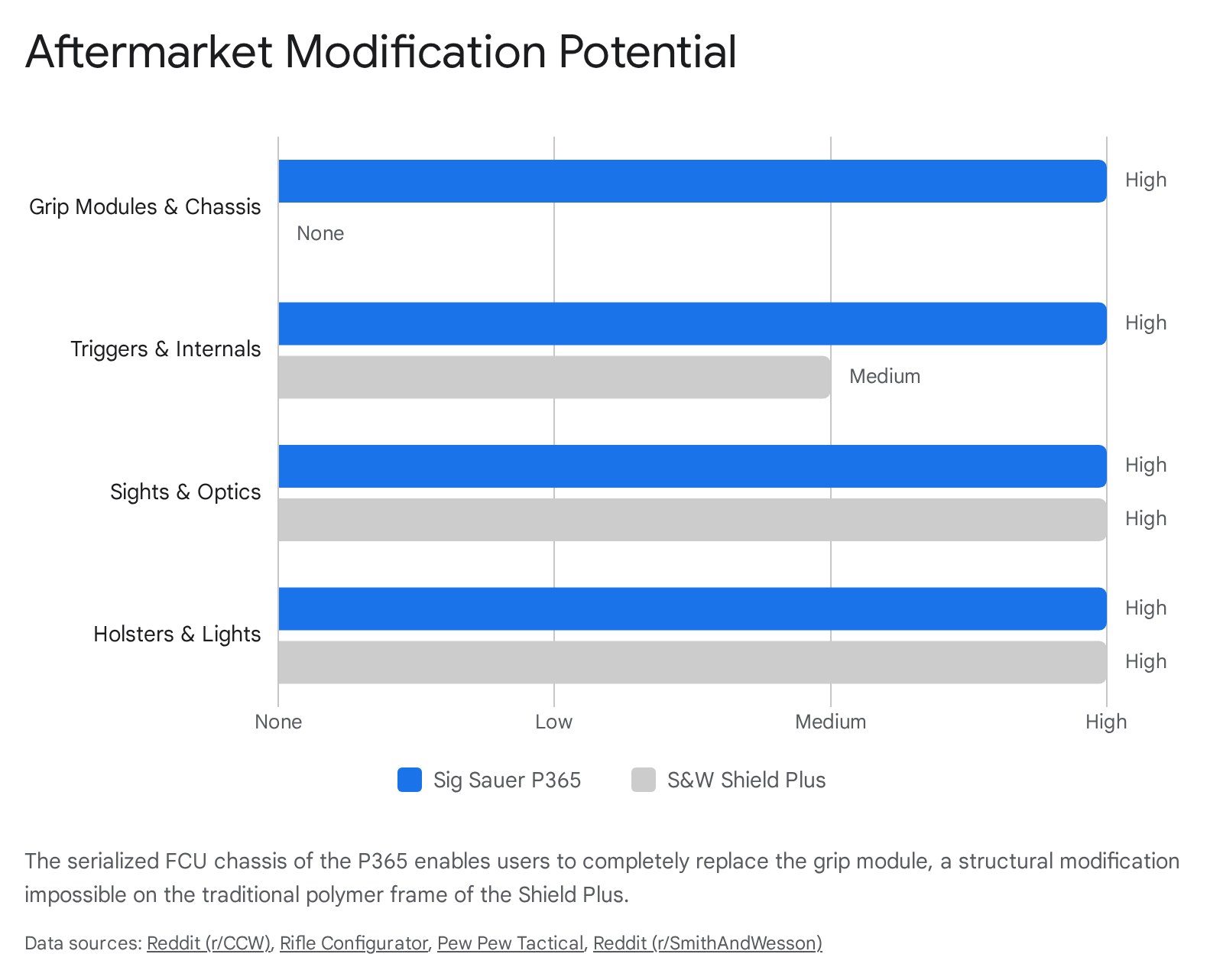
The Sig Sauer P365 is not merely a static handgun, it is a modular ecosystem. The core engineering innovation of the P365 is its Fire Control Unit, a serialized stainless steel chassis that houses the trigger, sear, safety mechanics, and striker release mechanisms.6 According to federal regulatory definitions, this small internal chassis is the actual legal firearm.
Because the polymer grip module surrounding the chassis is entirely inert and non-serialized, users can purchase an unlimited variety of grip modules and swap the internal unit between them in under sixty seconds without requiring secondary background checks or specialized gunsmithing tools. This modularity has spawned a massive aftermarket. Companies like Wilson Combat produce enhanced grip modules that alter the palm swell, grip texture, and beavertail geometry, allowing users to custom-fit the gun to their exact biomechanics.35 Furthermore, a user can configure a single chassis with a standard 3.1-inch slide and a flush grip for deep summer concealment, and later drop that exact same internal unit into a larger X-Macro grip module with an extended 17-round capacity for winter carry or home defense duty.
Beyond structural grip modules, the P365 enjoys an exhaustive selection of aftermarket performance upgrades. Triggers from Grayguns, precision threaded barrels from True Precision, and micro-compensators from Griffin Armament allow for total platform optimization.34 For concealment holsters, premium manufacturers such as Tenicor, Tier 1 Concealed, and Blackpoint Tactical offer specialized inside-the-waistband systems designed specifically for the varying dimensions of the rapidly expanding P365 family.38
5.2 The Smith & Wesson Traditional Architecture
The Smith & Wesson Shield Plus relies on a traditional pistol architecture, where the serialized component is the entire lower polymer frame itself. Consequently, the fundamental dimensions and structural geometry of the grip cannot be altered. Users who desire a longer grip must rely on extended magazine baseplates rather than changing the physical frame of the weapon.
Despite lacking this advanced modularity, the Shield Plus is supported by a robust and highly capable aftermarket dedicated to traditional upgrades. Companies like Apex Tactical produce highly refined, competition-grade trigger systems for the M&P line, though many users find the factory flat-face trigger excellent enough to leave unmodified for defensive purposes.41 Night Fision and TruGlo offer exceptional tritium co-witness sights that drastically enhance the baseline low-light capabilities of the non-optic models.42 Holster support is ubiquitous across the industry, with respected manufacturers like Alien Gear and Vedder producing highly tailored Kydex shells molded precisely to the unique dimensions of the Shield Plus.44
It is critical for consumers to verify part compatibility when purchasing aftermarket components for the Shield Plus. While it shares deep visual similarities with the older Shield 1.0 and 2.0 models, the widened internal magazine well of the Shield Plus dictates that legacy single-stack magazines and certain internal components are entirely incompatible.48
6. Primary Use Cases and Application Suitability
The selection between these two highly capable platforms ultimately hinges on the specific operational requirements, the biomechanical realities, and the wardrobe constraints of the end-user.
6.1 Deep Concealment and Non-Permissive Environments
For environments requiring deep concealment, where any visual printing through clothing is administratively or tactically unacceptable, the Sig Sauer P365 holds a distinct mechanical advantage. The exceptionally short 4.3-inch overall height allows the pistol to disappear entirely under light summer garments, athletic wear, or tailored business attire.7 The highly flush profile combined with the ten-round capacity makes it the optimal choice for individuals utilizing sophisticated deep-carry holster systems, such as the Phlster Enigma chassis, allowing for secure and completely discreet carry independent of traditional, heavy gun belts.
6.2 Primary Everyday Carry (EDC)
For the vast majority of civilian practitioners seeking a primary everyday carry weapon for daily life, the Smith & Wesson Shield Plus offers an unparalleled balance of concealability and dynamic shootability. The slightly wider 1.1-inch frame and the 4.6-inch height fill the hand more comprehensively than the baseline P365.4 This specific geometry, combined with the 18-degree grip angle, allows shooters to manage recoil forces and transition rapidly between multiple targets with an efficiency that rivals much larger compact duty pistols.19 For shooters who prioritize firing comfort and natural indexing over absolute minimal dimensions, the Shield Plus is frequently the preferred operational choice for inside-the-waistband carry.
6.3 Backup and Secondary Deployments
Law enforcement officers and security professionals frequently require a secondary backup weapon in the event of a primary weapon malfunction, an ammunition depletion, or a weapon retention struggle. Both pistols are exceptional in this role, fitting easily into ankle holsters or external vest carriers due to their reduced weight and slim profiles. The procurement decision in this sector is largely driven by departmental logistics, training doctrines, and existing platform familiarity. Officers carrying a full-size Smith & Wesson M&P 2.0 as a primary duty weapon will find perfect ergonomic synergy with the Shield Plus, as the grip texture, trigger manipulation feel, and grip angle are virtually identical. Conversely, officers carrying a Sig Sauer P320 will gravitate toward the P365 due to the shared striker-fired dynamics and common sight pictures.
7. Market Pricing, Vendor Analysis, and Procurement Sourcing
Procurement decisions require highly accurate and current financial data. The market for micro-compact handguns is fiercely competitive, resulting in dynamic online pricing models that fluctuate based on inventory levels and manufacturer promotions. The following data details strict, verified online retail pricing for the base optic-ready Sig Sauer P365 and the base non-optic model Smith & Wesson Shield Plus. Prices observed reflect current online marketplace conditions, falling precisely between the minimum and average observed costs to ensure realistic procurement expectations.
7.1 Sig Sauer P365 Optic Ready (SKU: 365-9-BXR3P) Vendor Analysis
The Sig Sauer P365 Optic Ready variant represents the modern baseline configuration for the platform, omitting the manual thumb safety and including the highly capable XRAY3 Day/Night sights alongside the optic cut. The manufacturer’s suggested retail price typically hovers near $599, but average online retail pricing consistently stabilizes around the $499 mark.50
The following five established vendors currently offer the P365 Optic Ready model within the strict target price range of $448.00 to $499.99:
- Bereli:Listed at $499.99.(https://www.bereli.com/365-9-bxr3p/) 52
- Primary Arms: Listed at $499.99, featuring distinct qualified professional pricing available down to $448.00 for eligible first responders and military personnel. View Product on Primary Arms 53
- Palmetto State Armory: Listed at $499.99.(https://palmettostatearmory.com/sig-sauer-p365-9mm-3-1-10rd-365-9-bxr3p.html) 54
- Brownells: Listed at $499.99.(https://www.brownells.com/guns/handguns/semi-auto-handguns/p365-micro-compact-9mm-luger-semi-auto-handgun/) 55
- Sportsmans Warehouse: Listed at $499.99.(https://www.sportsmans.com/shooting-gear-gun-supplies/handguns/sig-sauer-p365-optic-ready-micro-compact-9mm-luger-31in-black-nitron-pistol-101-rounds/p/1970185) 51
7.2 Smith & Wesson M&P 9 Shield Plus (SKU: 13248) Vendor Analysis
The Smith & Wesson M&P 9 Shield Plus base model represents the most traditional iteration of the platform. It features standard white dot sights and features no manual thumb safety. The manufacturer’s suggested retail price is set at $499.00.4 However, online retail pricing is highly aggressive, with deep seasonal discounts frequently driving the cost significantly below the MSRP. The observed minimum pricing reaches approximately $359, with the average hovering between $399 and $407.
The following five established vendors currently offer the Shield Plus base model within the target price range:
- Sportsmans Warehouse:Listed on sale at $359.97, reduced from a regular price of $399.99.(https://www.sportsmans.com/shooting-gear-gun-supplies/handguns/smith-wesson-mp-9-shield-plus-9mm-luger-31in-black-armornite-pistol-131-rounds/p/1691669) 57
- GrabAGun: Listed at $383.99. View Product on GrabAGun 59
- Bereli: Listed at $387.99.(https://www.bereli.com/s-amp-w-m-amp-p9shld-13248-9m-3-1-nts-10-13r-blk/) 60
- Midway USA: Listed at $404.00.(https://www.midwayusa.com/product/1023633161) 61
- KYGunCo: Listed at $407.10.(https://www.kygunco.com/product/smith-wesson-13248-mp9-shield-plus-nts) 62
| Firearm Model | SKU | Average Online Price | Manufacturer URL |
| Sig Sauer P365 Optic Ready | 365-9-BXR3P | $499.99 | (https://www.sigsauer.com/p365-optic-ready.html) |
| S&W M&P 9 Shield Plus Base | 13248 | $404.00 | (https://www.smith-wesson.com/product/m-p-9-shield-plus) |
8. Maintenance Protocols and Longevity
Due to their severely reduced size, micro-compact handguns subject their internal components to significantly higher physical stresses than full-size duty weapons. The slide velocities are exponentially faster, and the recoil springs must absorb more kinetic energy over a much shorter stroke distance. Consequently, diligent maintenance protocols are absolutely essential for maintaining operational reliability over the life of the firearm.
For the Sig Sauer P365, the dual captive recoil spring assembly is the primary consumable component. Sig Sauer recommends inspecting and replacing this assembly at roughly 2,500 to 3,000 round intervals to prevent severe battering of the internal chassis and the locking block. Furthermore, considering the aforementioned environmental vulnerabilities of the Nitron finish, operators must implement a proactive rust-prevention regimen.22 After exposing the P365 to excessive perspiration during carry, the slide, the barrel hood, and specifically the steel magazines should be wiped down with a high-quality, corrosion-inhibiting lubricant.
The Smith & Wesson Shield Plus features a highly resilient Armornite finish that drastically reduces the requirement for exterior rust mitigation.4 The flat-wire recoil spring utilized in the Shield Plus is remarkably durable, frequently maintaining proper tension well past the 5,000-round mark before replacement is strictly necessary. Routine maintenance on the Shield Plus should focus on keeping the striker channel entirely free of heavy lubricants. Applying wet oil inside the striker channel can trap carbon debris and brass shavings over time, potentially causing light primer strikes and failure to fire malfunctions. The internal action of both platforms is designed to run relatively dry, requiring only minimal lubrication at the slide rails, the barrel hood, and the primary interface points of the sear.
9. Conclusion
The selection of a high-capacity micro-compact firearm requires the end-user to critically evaluate their specific logistical requirements, environmental realities, and biomechanical preferences. Both the Sig Sauer P365 and the Smith & Wesson Shield Plus represent the absolute apex of current mechanical engineering in the concealed carry sector, successfully defying previous structural limits regarding size-to-capacity ratios.
The Sig Sauer P365 is the definitive choice for practitioners who prioritize absolute minimal dimensions for deep concealment and demand unparalleled, future-proof modularity. The Fire Control Unit ecosystem provides immense long-term value, allowing the operator to infinitely customize the grip geometry and structural footprint to match seasonal clothing changes or evolving operational needs. The inclusion of factory night sights and standard optic-readiness on modern base models further cements its status as a premium, highly adaptable platform, despite the requirement for disciplined exterior maintenance to combat surface oxidation.
The Smith & Wesson Shield Plus excels as an out-of-the-box defensive tool for users who prioritize firing comfort, positive indexing, and immediate recoil mitigation. By leveraging the proven 18-degree grip angle, a slightly fuller grip profile, and an exceptional flat-face trigger design, the Shield Plus successfully bridges the dynamic performance gap between a micro-compact and a primary duty weapon. While it lacks the chassis modularity of its rival and requires the purchase of specialized SKUs for optic integration, its robust Armornite finish, flawless feeding geometry, and highly aggressive market pricing make it an overwhelmingly practical and reliable choice for continuous, austere deployment.
Note: Vendor Sources listed are not an endorsement of any given vendor. It is our software reporting a product page given the direction to list products that are between the minimum and average sales price when last scanned.
Please share the link on Facebook, Forums, with colleagues, etc. Your support is much appreciated and if you have any feedback, please email us in**@*********ps.com. If you’d like to request a report or order a reprint, please click here for the corresponding page to open in new tab.
Sources Used
- SIG SAUER P365 | The Pistol Series For Everyday Carry, accessed April 16, 2026, https://www.sigsauer.com/firearms/pistols/p365.html
- SIG SAUER P365 & P320 Ranked Most Popular Handguns in America, accessed April 16, 2026, https://www.sigsauer.com/blog/sig-sauer-p365–p320-ranked-most-popular-handguns-in-america
- Long Term Sig Sauer P365 Review + P365 XL Reviews – The Mag Life, accessed April 16, 2026, https://gunmagwarehouse.com/blog/long-term-sig-sauer-p365-review-p365-xl-reviews/
- M&P 9 SHIELD PLUS | Smith & Wesson, accessed April 16, 2026, https://www.smith-wesson.com/product/m-p-9-shield-plus
- Smith & Wesson 13248 M&P9 Shield Plus 9mm 13+1 Double Action: Compact, lightweight, enhanced grip, no safety. | Tombstone Tactical, accessed April 16, 2026, https://tombstonetactical.com/product/shield-plus-13rd-9mm-no-safety
- SIG P365 Optic Ready, accessed April 16, 2026, https://www.sigsauer.com/p365-optic-ready.html
- CCW Showdown: Sig P365 vs S&W Shield – AmmoForSale.com, accessed April 16, 2026, https://www.ammoforsale.com/ammo-club/sig-p365-vs-shield/
- P365 Nitron Micro-compact 9mm Handgun| EDC – SIG Sauer, accessed April 16, 2026, https://www.sigsauer.com/p365-nitron-micro-compact.html
- M&P®9 SHIELD PLUS CA COMPLIANT | Smith & Wesson, accessed April 16, 2026, https://www.smith-wesson.com/product/m-p-9-shield-plus-ca-compliant
- M&P 9 SHIELD PLUS THUMB SAFETY | Smith & Wesson, accessed April 16, 2026, https://www.smith-wesson.com/product/m-p-9-shield-plus-thumb-safety
- Sig P365 vs Shield | Is The Shield Still Relavent With Its Capacity? – Harry’s Holsters, accessed April 16, 2026, https://harrysholsters.com/sig-p365-vs-shield/
- Smith & Wesson M&P Shield Plus 9mm Micro Compact Pistol – No Thumb Safety – 13 Round – 3.1″ – Primary Arms, accessed April 16, 2026, https://www.primaryarms.com/smith-wesson-mp-shield-plus-9mm-micro-compact-pistol-no-thumb-safety-13-round-3.1in
- SIG SAUER P365X | Micro-Compact Handgun, accessed April 16, 2026, https://www.sigsauer.com/p365x.html
- SIG Sauer P365 – Sportsman’s Warehouse, accessed April 16, 2026, https://www.sportsmans.com/sig-sauer-p365
- SIG SAUER, INC. P365 XMACRO COMP 9MM LUGER SEMI-AUTO HANDGUN – Brownells, accessed April 16, 2026, https://www.brownells.com/guns/handguns/semi-auto-handguns/p365-xmacro-comp-9mm-luger-semi-auto-handgun/
- SHIELD PLUS – Smith & Wesson, accessed April 16, 2026, https://www.smith-wesson.com/products/shield-plus
- Smith & Wesson M&P Shield Plus 9mm Micro-Compact, 3.1″ Barrel, Thumb Safety, 10+1 & 13+1 Capacity – Bereli.com, accessed April 16, 2026, https://www.bereli.com/smith-wesson-shield-plus-striker-fired-micro-compact-9mm-3-1-barrel-white-dot-sights-polymer-frame-thumb-safety-flat-face-trigger-2-mags-1-10rd-1-13rd-black/
- Why shouldn’t I get the Shield Plus? : r/CCW – Reddit, accessed April 16, 2026, https://www.reddit.com/r/CCW/comments/1ng46tv/why_shouldnt_i_get_the_shield_plus/
- SIG P365 VS S&W SHIELD PLUS | Honest opinions and why I carry one over the other!, accessed April 16, 2026, https://www.youtube.com/watch?v=dya2vkIbN8s
- Have all P365 recalls been dealt with? : r/CCW – Reddit, accessed April 16, 2026, https://www.reddit.com/r/CCW/comments/dgz06d/have_all_p365_recalls_been_dealt_with/
- Is the p365x a reliable gun in 2024 for me to ccw? – Reddit, accessed April 16, 2026, https://www.reddit.com/r/CCW/comments/1h5moyr/is_the_p365x_a_reliable_gun_in_2024_for_me_to_ccw/
- Sig P365 Owners: Talk to me about Rust and long term durability – Reddit, accessed April 16, 2026, https://www.reddit.com/r/CCW/comments/1kqgntg/sig_p365_owners_talk_to_me_about_rust_and_long/
- More P365 Rust : r/SigSauer – Reddit, accessed April 16, 2026, https://www.reddit.com/r/SigSauer/comments/1f9rnnm/more_p365_rust/
- Hi y’all – How bad is the rust issue with the Sig P365 series and their magazines? – Reddit, accessed April 16, 2026, https://www.reddit.com/r/CCW/comments/1eu9b2p/hi_yall_how_bad_is_the_rust_issue_with_the_sig/
- Do I need to worry about Sig P365’s corroding and rusting? : r/CCW – Reddit, accessed April 16, 2026, https://www.reddit.com/r/CCW/comments/1nd4wlb/do_i_need_to_worry_about_sig_p365s_corroding_and/
- Rusting on p365? : r/SigSauer – Reddit, accessed April 16, 2026, https://www.reddit.com/r/SigSauer/comments/1pwgkjt/rusting_on_p365/
- Gun Review: The S&W M&P Shield Plus – Swift | Silent | Deadly, accessed April 16, 2026, https://www.swiftsilentdeadly.com/blog/gun-review-the-sw-mp-shield-plus
- M&P® SHIELD™ EZ™ RECALL NOTICE FOR PISTOLS | Smith & Wesson, accessed April 16, 2026, https://www.smith-wesson.com/safety/recall/recall-notice-for-pistols
- S&W Response Consumer Safety Alert | Smith & Wesson, accessed April 16, 2026, https://www.smith-wesson.com/safety/recall/sw-response-consumer-safety-alert
- Shield Plus trigger safety issue resolved : r/SmithAndWesson – Reddit, accessed April 16, 2026, https://www.reddit.com/r/SmithAndWesson/comments/1iyw6tp/shield_plus_trigger_safety_issue_resolved/
- Trigger Safety issue on Shield Plus Carry Comp : r/SmithAndWesson – Reddit, accessed April 16, 2026, https://www.reddit.com/r/SmithAndWesson/comments/1iycj5t/trigger_safety_issue_on_shield_plus_carry_comp/
- Shield Plus trigger issue : r/SmithAndWesson – Reddit, accessed April 16, 2026, https://www.reddit.com/r/SmithAndWesson/comments/1bri2gp/shield_plus_trigger_issue/
- Blade safety locking up the trigger on the Shield Plus Carry Comp – Reddit, accessed April 16, 2026, https://www.reddit.com/r/SmithAndWesson/comments/1gy41pn/blade_safety_locking_up_the_trigger_on_the_shield/
- Best P365 Upgrades: Triggers, Barrels, Sights & More [Tested], accessed April 16, 2026, https://www.pewpewtactical.com/best-p365-upgrades/
- Shield Plus vs p365 : r/CCW – Reddit, accessed April 16, 2026, https://www.reddit.com/r/CCW/comments/vzoqwy/shield_plus_vs_p365/
- Best SIG P365 Upgrades 2026: Grip Modules, Triggers, Optics & Barrels Ranked, accessed April 16, 2026, https://www.rifleconfigurator.com/guides/sig-p365-upgrades
- SIG Sauer P365 Aftermarket Parts – Grayguns, accessed April 16, 2026, https://grayguns.com/product-tag/p365/
- Concealed Carry Holsters & Pouches – SIG Sauer, accessed April 16, 2026, https://www.sigsauer.com/gear/holsters-pouches.html
- SIG SAUER Holsters – Tenicor, accessed April 16, 2026, https://tenicor.com/collections/sig-sauer-holsters
- Holster and sights : r/P365 – Reddit, accessed April 16, 2026, https://www.reddit.com/r/P365/comments/1sfei9w/holster_and_sights/
- Shield Plus Upgrades! : r/SmithAndWesson – Reddit, accessed April 16, 2026, https://www.reddit.com/r/SmithAndWesson/comments/ztj5kt/shield_plus_upgrades/
- NIGHT FISION OPTICS READY STEALTH SERIES FOR SMITH & WESSON, accessed April 16, 2026, https://www.nightfision.com/product/night-fision-optics-ready-stealth-series-for-smith-wesson
- FIND YOUR CO-WITNESS SIGHTS: S&W – SHIELD PLUS – Night Fision, accessed April 16, 2026, https://www.nightfision.com/find-your-co-witness-sight-sw-shield-plus
- M&P Shield Plus Performance Center 4″ Accessories – Alien Gear Holsters, accessed April 16, 2026, https://aliengearholsters.com/blogs/news/m-p-shield-plus-performance-center-4-accessories
- Best Holster for SW Shield Plus: Top Picks You Need Now – SDM Pawn, accessed April 16, 2026, https://paragouldpawnshop.com/best-holster-for-sw-shield-plus-2/
- Choosing the Best M&P Shield Holster for Concealed Carry, accessed April 16, 2026, https://www.vedderholsters.com/blog/best-mp-shield-holster-for-concealed-carry/
- Smith & Wesson M&P Shield Plus Holsters, accessed April 16, 2026, https://aliengearholsters.com/collections/smith-wesson-shield-plus-holsters
- S&W M&P Shield Accessories: Best Upgrades for Every Variant – Alien Gear Holsters, accessed April 16, 2026, https://aliengearholsters.com/blogs/news/s-w-m-p-shield-accessories
- P365 vs shield plus pc : r/CCW – Reddit, accessed April 16, 2026, https://www.reddit.com/r/CCW/comments/1czro4g/p365_vs_shield_plus_pc/
- Sig Sauer P365 OR 9mm 3.1″ 10rd Pistol, Black/Gray – 365-9-BXR3P-MS-GRY, accessed April 16, 2026, https://palmettostatearmory.com/sig-sauer-p365-or-9mm-3-1-10rd-pistol-black-gray-365-9-bxr3p-ms-gry.html
- SIG P365 For Sale | Shop Sportsman’s Outdoor Superstore, accessed April 16, 2026, https://www.sportsmansoutdoorsuperstore.com/category.cfm/sportsman/sig-sauer-p365-pistols-for-sale
- Sig Sauer P365 9mm 3.1″ Barrel 10-Rounds Optic Ready Pistol – Bereli.com, accessed April 16, 2026, https://www.bereli.com/365-9-bxr3p/
- Sig Sauer For Sale – Primary Arms, accessed April 16, 2026, https://www.primaryarms.com/barrel-length/3-1-in/brand/sig-sauer
- Sig Sauer P365 9mm 3.1″ 10rd – 365-9-BXR3P | Palmetto State Armory, accessed April 16, 2026, https://palmettostatearmory.com/sig-sauer-p365-9mm-3-1-10rd-365-9-bxr3p.html
- SIG SAUER, INC. P365 MICRO-COMPACT 9MM LUGER SEMI-AUTO HANDGUN, accessed April 16, 2026, https://www.brownells.com/guns/handguns/semi-auto-handguns/p365-micro-compact-9mm-luger-semi-auto-handgun/
- Sig Sauer P365 Optic Ready Micro-Compact 9mm Luger 3.1in Black Nitron Pistol – 10+1 Rounds | Sportsman’s Warehouse, accessed April 16, 2026, https://www.sportsmans.com/shooting-gear-gun-supplies/handguns/sig-sauer-p365-optic-ready-micro-compact-9mm-luger-31in-black-nitron-pistol-101-rounds/p/1970185
- Smith & Wesson M&P 9 Shield Plus 9mm Luger 3.1in Black Armornite Pistol – 13+1 Rounds, accessed April 16, 2026, https://www.sportsmans.com/shooting-gear-gun-supplies/handguns/smith-wesson-mp-9-shield-plus-9mm-luger-31in-black-armornite-pistol-131-rounds/p/1691669
- Smith & Wesson M&P Shield Plus – Sportsman’s Warehouse, accessed April 16, 2026, https://www.sportsmans.com/smith-wesson-mp-shield-plus/c/cat141993
- Smith and Wesson M&P Shield Plus 9mm 3.1″ Barrel 13-Rounds No Thumb Safety – GrabAGun, accessed April 16, 2026, https://grabagun.com/smith-and-wesson-m-p9-shield-plus-9mm-3-1-barrel-13-rounds-no-thumb-safety.html
- Smith Wesson 13248 MP Shield Plus 9mm Luger 3.10 Barrel 101 Or 131 Black Polymer Frame Grip Armornite Stainless Steel Slide Tactile Audible Trigger Reset No Manual Safety – Bereli Inc., accessed April 16, 2026, https://www.bereli.com/s-amp-w-m-amp-p9shld-13248-9m-3-1-nts-10-13r-blk/
- Smith & Wesson M&P9 Shield Plus 9mm Luger Pistol 3.1 Barrel 13+1 Round – MidwayUSA, accessed April 16, 2026, https://www.midwayusa.com/product/1023633161
- SMITH & WESSON MP9 Shield Plus 9mm 3.1″ 13rd No Thumb Safety – kygunco, accessed April 16, 2026, https://www.kygunco.com/product/smith-wesson-13248-mp9-shield-plus-nts