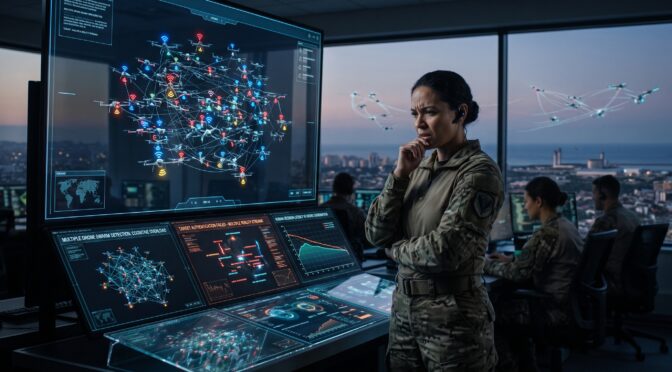
The proliferation of autonomous uncrewed aerial systems (UAS) and coordinated drone swarms has precipitated a paradigm shift in modern military operations. The contemporary battlespace is no longer defined solely by kinetic force; it is increasingly dominated by the speed of information processing and the cognitive endurance of the human operator1. As adversarial tactics evolve from deploying single, high-value aerial platforms to utilizing inexpensive, decentralized, and omnidirectional drone swarms, traditional point-defense systems are rapidly becoming obsolete3. This transition exposes a critical vulnerability in military defense architectures: the biological and neurological limitations of the human brain4.
Defending against a multi-directional drone swarm is not merely a kinetic challenge. It is a profound test of human working memory, sensory bandwidth, and psychological resilience5. Drone swarms are deliberately deployed to exploit these human limitations, operating as instruments of cognitive warfare designed to induce task saturation, degrade situational awareness, and force catastrophic reasoning errors under maximum time pressure3. The sheer volume of simultaneous attack vectors exponentially increases the information available to defenders, which paradoxically degrades the quality of decision-making as operators become overwhelmed1.
This report provides a comprehensive, deeply researched analysis of the cognitive, psychological, and tactical effects on military personnel defending against UAS swarm attacks. By synthesizing principles from human factors engineering, cognitive psychology, neurostrategy, and international humanitarian law, this analysis explores the mechanisms of cognitive overload, the psychoacoustic trauma induced by persistent drone presence, the strategic framework of cognitive warfare, and the emerging technological and doctrinal countermeasures designed to alleviate human cognitive strain.
1. Primary Cognitive Phenomena: Cognitive Overload and Task Saturation
The intersection of human cognitive capacity and high-volume, omnidirectional threat data is the primary friction point in modern counter-UAS (C-UAS) operations. To understand why human operators fail under the stress of a swarm attack, it is necessary to examine the foundational limitations of human cognitive architecture, specifically working memory and attentional resource allocation.
The Architecture of Cognitive Overload
The American Psychological Association defines cognitive overload as a state in which the demands of mental work exceed a person’s cognitive processing capabilities1. In the context of military aviation and air defense, cognitive load is strictly governed by the limitations of human working memory. According to the foundational Cognitive Load Theory (CLT) developed by John Sweller, working memory can only process a finite number of novel interacting elements simultaneously before processing degrades9.
Working memory itself is not a monolithic structure. Cognitive psychology models, such as those proposed by Baddeley and Hitch, segment working memory into specialized components, including the phonological loop for verbal information, the visuospatial sketchpad for visual and spatial data, and the central executive, which prioritizes attention and manages information flow5. During a drone swarm attack, the operator’s visuospatial sketchpad becomes instantly overwhelmed by the presence of dozens of independent aerial targets, leading to a breakdown in the central executive’s ability to prioritize threats12.
Cognitive load is categorized into three distinct types, all of which are manipulated during a swarm engagement:
| Cognitive Load Type | Definition in Psychological Literature | Application to C-UAS Swarm Defense |
| Intrinsic Load | The inherent complexity of the task itself, determined by the nature of the material and the interacting elements10. | Calculating the interception vectors, speeds, and altitudes of multiple highly maneuverable drones simultaneously11. |
| Extraneous Load | Unnecessary cognitive burden imposed by poorly designed interfaces, redundant data streams, or chaotic operational environments11. | Processing duplicate radar tracks, false positives, auditory alarms, and manual interface navigation across disparate defense systems1. |
| Germane Load | Cognitive resources dedicated to processing and integrating new information into long-term memory schemas10. | The mental effort required to build a coherent tactical picture (situational awareness) from fragmented sensor data11. |
In an optimal environment, training and interface design seek to minimize extraneous load to maximize germane load11. However, a drone swarm deliberately spikes extraneous load to extreme levels. Modern sensor systems continuously generate huge amounts of raw data across heterogeneous system landscapes, and without intelligent filtering, the human operator becomes the computational bottleneck1.
Multiple Resource Theory and Task Saturation
The phenomenon of “task saturation” in C-UAS defense is effectively explained through the Multiple Resource Theory (MRT) developed by Christopher Wickens5. MRT posits that the human brain does not possess a single, undifferentiated pool of attentional resources. Instead, it utilizes multiple independent channels based on processing stages (perception vs. action), perceptual modalities (visual vs. auditory), visual channels (focal vs. ambient), and processing codes (spatial vs. verbal)18.
Task interference occurs when multiple tasks compete for the same specific resource channel6. When an operator in a Base Defense Operations Center (BDOC) is monitoring radar screens for spatial anomalies (visual/spatial demand), listening to radio traffic for command updates (auditory/verbal demand), evaluating rules of engagement (cognitive demand), and manually operating targeting software (psychomotor demand), they are drawing on multiple resource channels simultaneously15. A drone swarm introduces extreme resource conflict by demanding concurrent processing within the visual and spatial channels6.
Current industrial-age C-UAS systems, such as the Forward Area Air Defense Command and Control (FAADC2) architecture, exacerbate this conflict by relying heavily on sequential, manual engagement processes15. The operator must manually detect a track, identify it as hostile, transition between weapon systems, and execute a firing sequence. This human-in-the-loop model requires the operator to perform every task sequentially for every single threat20. When 20 to 80 heterogeneous drones approach simultaneously from multiple vectors, this manual engagement sequence leads to absolute task saturation, allowing the swarm to penetrate defensive layers unimpeded while the operator is bogged down in manual interface navigation3.
2. Related Psychological and Sensory Factors
Beyond raw computational overload, the defense against a persistent, omnidirectional drone swarm induces profound psychological trauma and sensory degradation. The human nervous system is not evolved to process continuous, asynchronous, and three-dimensional threats without suffering cascading physiological and perceptual failures.
Sensory Overload, Gaze Entropy, and Attentional Deployment
The influx of simultaneous auditory alerts, visual radar blips, and radio communications induces acute sensory overload. Human factors engineering studies utilizing eye-tracking technology in aviation and drone-operation simulators demonstrate that high cognitive load physically alters human visual scanning behavior21.
Under nominal conditions, an operator utilizes an exploratory mode of attentional deployment. This is characterized by high gaze transition entropy (GTE), which reflects the operator’s ability to smoothly and efficiently scan various areas of interest without becoming fixated21. However, under the severe cognitive strain of a simulated swarm attack, GTE drops precipitously. Operators exhibit a focal mode of visual attention, characterized by longer, locked fixation durations and fewer transitions between critical task zones21. This biologically hard-wired reduction in scanning efficiency directly degrades spatial awareness, creating perceptual blind spots that autonomous swarms are mathematically programmed to exploit21.
Target Fixation and Cognitive Tunneling
When subjected to extreme operational stress, military personnel frequently exhibit a maladaptive psychological response known as perceptual tunneling or cognitive tunneling21. In cognitive psychology, this phenomenon is defined as a rapid, involuntary narrowing of visual and attentional focus toward a single, highly salient stimulus at the expense of all peripheral information25.
In a multi-directional swarm attack, cognitive tunneling is a fatal vulnerability. An operator may become hyper-fixated on tracking a specific drone or rectifying a specific system error. This phenomenon is validated by studies utilizing multi-attribute task batteries, which demonstrate that subjects who commit an initial error remain tunneled on that specific task, completely missing subsequent critical alarms or competing tasks26. Because the human neural error-monitoring system naturally recruits intense cognitive resources to process mistakes, this localized hyper-fixation blinds the operator to secondary and tertiary swarm vectors flanking their position28.
Furthermore, the brain’s reliance on the simplification heuristic under stress forces the operator to ignore complex spatial data in favor of the most immediate, simple threat24. This is often accompanied by stress-related regression, a state where highly trained operators forget complex, recently learned procedural skills and revert to ingrained, often inappropriate, baseline habits, further compounding operational failure24.
Psychoacoustics and Autonomic Arousal
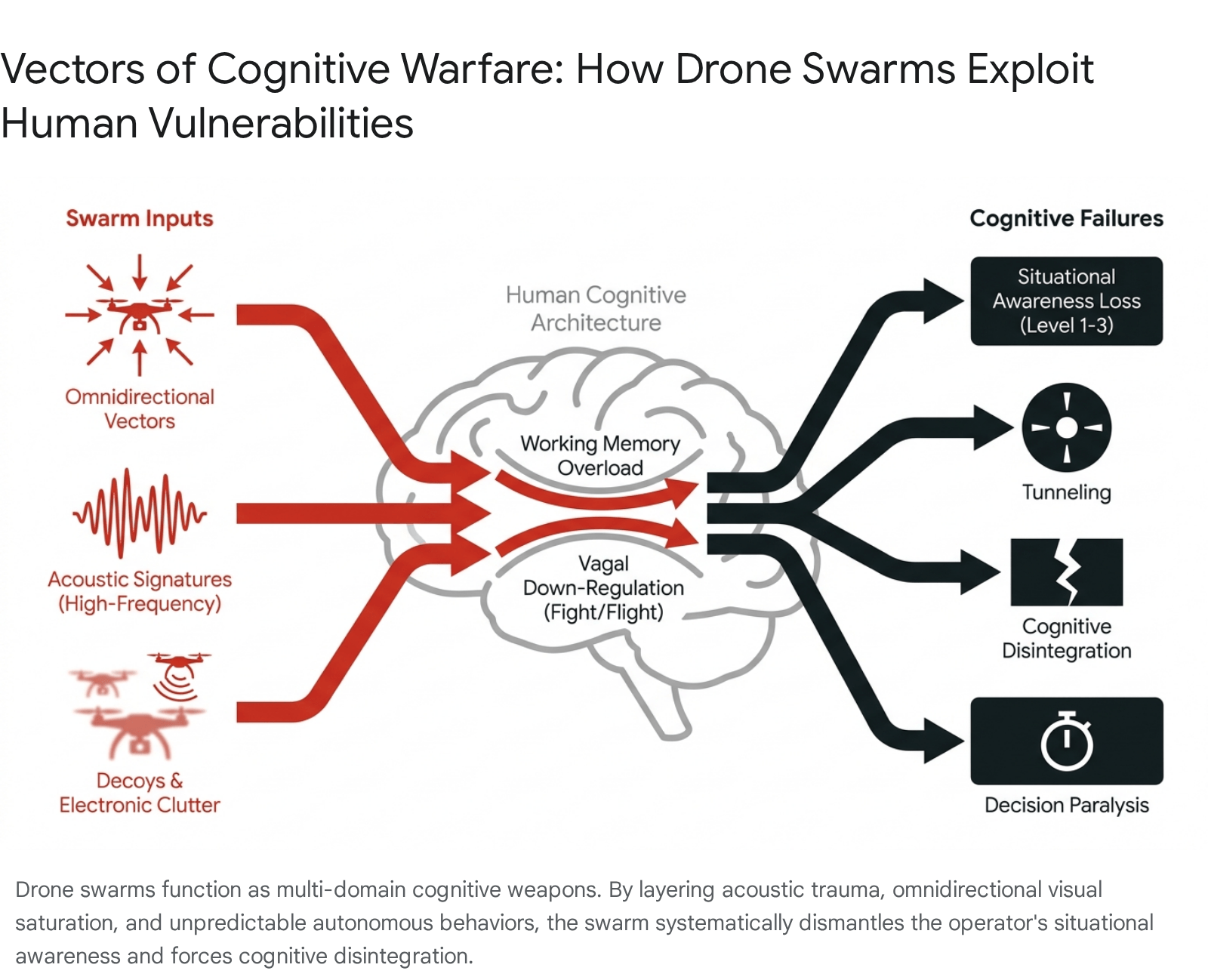
Perhaps the most insidious psychological weapon of the UAS swarm is its acoustic signature. The distinctive, high-frequency tonal qualities and rough acoustic properties of drone rotors trigger immediate, involuntary psychoacoustic responses in human targets31. Studies analyzing the psychoacoustics of drone noise indicate that it is perceived as significantly more annoying and distress-inducing than traditional aviation or road noise at equivalent decibel levels due to its specific spectral features32.
According to research detailed in U.S. Army TRADOC publications, the continuous buzz of drone propellers acts as a severe psychological trigger that artificially activates the autonomic nervous system35. This acoustic stimulus forces the continuous release of stress hormones, primarily cortisol and adrenaline, locking the body into a perpetual fight-or-flight state (sympathetic nervous system arousal)33. The physiological ramifications of this constant hyperarousal include increased heart rate, elevated blood pressure, decreased heart rate variability (HRV), and degraded higher-order reasoning capabilities24.
Anticipatory Anxiety and the Destruction of Safe Zones
The persistent, unseen presence of long-range drones extends the threat envelope far beyond traditional front lines, effectively eradicating the concept of a safe rear area35. This generates chronic anticipatory anxiety, a form of post-traumatic stress disorder (PTSD) that military psychologists compare directly to the shell shock observed during the continuous artillery bombardments of World War I, or the battle fatigue of World War II35.
Combatants subjected to persistent drone surveillance develop exaggerated startle responses, psychosomatic symptoms, and a profound sense of helplessness35. This feeling is exacerbated by the highly maneuverable nature of first-person view (FPV) drones, which can bypass traditional physical cover and navigate through complex terrain to strike individual targets35. The psychological threat is heavily amplified by digital information environments; military bloggers and social media platforms frequently distribute high-definition videos of FPV drone strikes, utilizing haunting soundtracks and quick visual cuts to deliberately spread fear, convey a sense of inescapable vulnerability, and psychologically break the adversary’s morale35.
3. Strategic Framework: Decentralized Swarms as Cognitive Warfare
Drone swarms are not merely tactical munitions designed to deliver kinetic payloads; they represent a fundamental mechanism of cognitive warfare. Military strategists increasingly define cognitive warfare as the operationalization of neuroscience and technology to influence, degrade, and manipulate the neural processes underlying an adversary’s thoughts, emotions, and behaviors7. The objective is to target the human brain as a strategic vector, effectively treating human cognition as a sixth domain of military competition alongside land, sea, air, space, and cyber8.
While traditional psychological operations focus on what a target believes, cognitive warfare aims to influence how a target thinks by attacking the physiological triggers of human reactions7. It relies on a systemic approach that connects neurobiology, information sciences, and artificial intelligence to enhance the speed and impact of military action while degrading the adversary’s ability to reason effectively7.
The Erosion of Situational Awareness
At the core of cognitive warfare is the deliberate destruction of the adversary’s Situational Awareness (SA). As defined by human factors engineer Mica Endsley, SA is an ongoing cognitive loop consisting of three sequential levels16. Drone swarms invert the traditional logic of air defense by systematically attacking all three levels of Endsley’s model simultaneously:
| Situational Awareness Level | Theoretical Definition | Degradation via Drone Swarm Tactics |
| Level 1: Perception | The perception of the elements in the environment within a volume of time and space. | Swarms utilize heterogeneous platforms, decentralized flight paths, and electronic warfare to flood radar screens with duplicate signatures, false positives, and decoys, breaking the operator’s ability to perceive physical reality3. |
| Level 2: Comprehension | The synthesis of perceived elements to understand their significance and meaning. | By attacking from 360 degrees in staggered waves, the swarm prevents the human operator from synthesizing isolated tracks into a coherent, holistic tactical picture3. |
| Level 3: Projection | The ability to forecast future status and events based on current comprehension. | The unpredictable, emergent behaviors generated by autonomous swarm algorithms make it computationally impossible for a human brain to calculate or project future trajectories37. |
The Saturation Trap and Cognitive Disintegration
The strategic intent of deploying a decentralized swarm is to trigger the saturation trap42. Point-defense C-UAS systems perform excellently against isolated targets, but they suffer from a structural flaw: they begin their engagement sequence too late3. Once a swarm appears within line-of-sight or traditional radar engagement range, the time, resources, and decision space available to the defender are already severely constrained3.
A swarm does not achieve its primary effect through precision targeting, but rather through deliberate, synchronized overload3. By exploiting speed, mass, deception, and cognitive resource conflict, cognitive warfare operations utilizing drones aim to induce cognitive disintegration3. At the individual level, this manifests as degraded judgment, complete task saturation, and the collapse of the OODA loop (Observe, Orient, Decide, Act). At the collective level, the defender’s command and control apparatus is forced into a state of reactive paralysis, unable to generate the consensus or allocate the resources required for a coordinated defense8.
4. Mitigation, Countermeasures, and Future Doctrines
Recognizing that human cognitive limits represent a hard biological ceiling, modern militaries are urgently revamping doctrinal guidelines, training methodologies, and technological architectures. The imperative is to offload cognitive strain onto artificial intelligence and transition defense networks from reactive point-defense to proactive, software-defined, multi-domain situational awareness3.
Iterative Doctrinal Adaptation and Psychological Training
Traditional military doctrine development is often too slow to counter the rapid evolution of UAS threats and software-defined warfare. Consequently, organizations like the U.S. Army Combined Arms Doctrine Directorate (CADD) have transitioned to a rapid, iterative learn-by-doing approach. Instead of codifying doctrine before fielding equipment, the Army fields capabilities to soldiers iteratively, harvests real-world tactics, techniques, and procedures (TTPs), and pushes updates back into the doctrinal library30.
Recent doctrinal updates reflecting the persistent drone threat include revisions to Field Manual 3-0 (Operations), which now mandates operational imperatives such as protecting against constant observation and making contact with sensors or unmanned systems rather than human elements8. Simultaneously, domain-specific guidance is being codified at a rapid pace. The Maneuver Center of Excellence is refining ATP 3-90.51 (Tactical Employment of Small Unmanned Aircraft Systems) for offensive operations, while the Fires Center of Excellence is continually updating ATP 3-01.81 (Counter-Small Unmanned Aircraft System Techniques) to establish layered defense protocols that protect forces from various UAS groups30.
To build psychological resilience against drone-induced PTSD and anticipatory anxiety, training paradigms are also undergoing significant overhauls. Research indicates that incorporating persistent UAS presence into live and virtual training regimens (such as through the Virtual OPFOR Academy) desensitizes personnel to acoustic triggers and builds vital confidence in C-UAS technology35. Timely treatment protocols modeled after cognitive and affective reintegration therapies used for shell shock are being deployed to address early signs of mental strain35. Furthermore, the Department of Defense’s Warfighter Brain Health Initiative aims to establish cognitive baselines for soldiers during initial military training. By utilizing ongoing monitoring, medical personnel can detect early signs of cognitive degradation resulting from battlefield stress, sleep deprivation, or blast overpressure from weapon detonations, allowing for proactive clinical interventions47.
Technological Mitigation: AI-Assisted Triage and Edge Computing
To successfully defeat a swarm, the defense system must operate at machine speed. Countering the saturation trap requires shifting the human role from being “in the loop” (executing every detection, tracking, and firing sequence manually) to being “on the loop” (supervising autonomous macro-level decisions)15.
Technological frameworks are evolving to filter extraneous data before it reaches the human cortex. Military C-UAS initiatives increasingly frame their requirements around integrating best-of-breed sensors to reduce cognitive load and speed decisions from human tempo toward machine tempo49. Systems like the Army’s Golden Shield and Parsons’ DroneArmor rely on scalable, open-architecture command and control (C2) frameworks utilizing artificial intelligence and machine learning to automate the detect, track, and cue kill chain44.
By employing multi-sensor data fusion, these systems consolidate fragmented radar, electro-optical/infrared (EO/IR), and acoustic feeds into a single, unified operational picture3. Advanced machine learning models, such as YOLO-family convolutional neural networks (CNNs) and multimodal transformers, classify threats in real time, filter out biological clutter like birds, and assign targeting priorities instantly51. This eliminates sequential bottlenecks and drastically reduces the cognitive burden on operators, allowing them to focus entirely on supervising the engagements rather than manually plotting tracks15.
Hardware innovations are also advancing to support ultra-fast decision-making. Research into neuromorphic computing, which seeks to replicate human brain functionality using nanoscale magnetic artificial neurons, enables highly parallelized processing of microwave drone signals directly at the carrier frequency52. This technology circumvents the latency inherent in signal digitization, allowing edge-computing nodes to classify swarm signals in sub-nanosecond timeframes with extremely low power consumption, effectively bypassing human perception limits entirely52.
Human-Swarm Interaction (HSI) and Interface Design
The design of the human-machine interface is critical for managing operator workload during swarm engagements. The field of Human-Swarm Interaction (HSI) utilizes frameworks such as the Joint Control Framework (JCF) and Cognitive Work Analysis (CWA) to model how operators shift their attention across different levels of autonomy53.
Recent interface designs are moving away from direct per-agent control and toward swarm-level predictive control, utilizing concepts like the Cognitive-Intent Decoupled Architecture (CIDA). CIDA separates the interface into a cognitive stream that maps the threat environment (answering “is it safe to proceed here?”) and an intent stream that translates mission priorities into automated behavior (answering “which direction advances the mission?”)55. By presenting the operator with curated, mission-relevant insights rather than raw sensor data, the system mitigates target fixation1.
Furthermore, studies evaluating human workload using the NASA Task Load Index (NASA-TLX) confirm that interaction modality dictates cognitive survival. Predictive HSI interfaces utilize a “choir” metaphor, allowing the human to dictate high-level templates and spatial boundaries to friendly automated defenses, rather than micro-managing individual interception drones53.
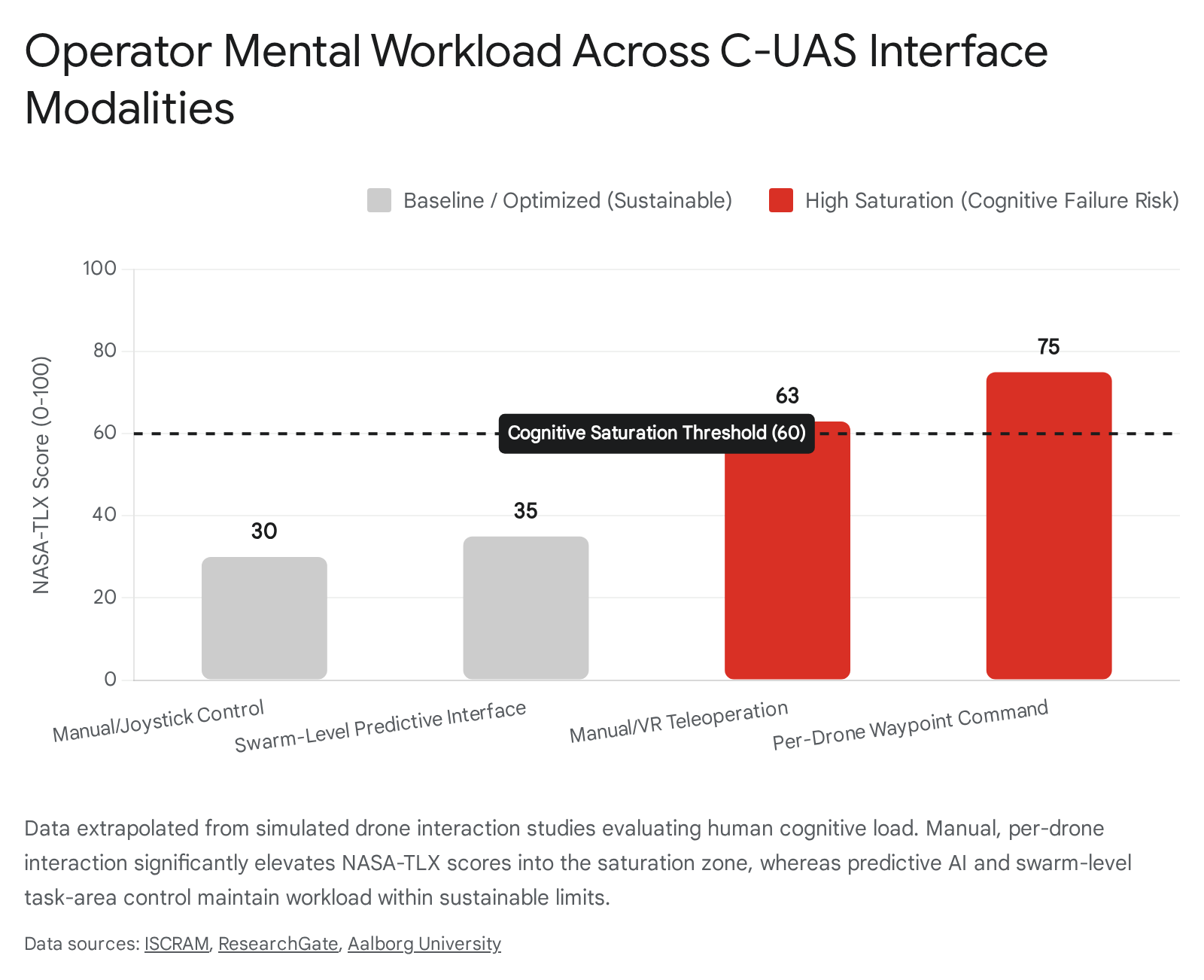
Empirical findings from these HSI experiments demonstrate that swarm-level task-area control yields substantially lower workload, higher situational awareness, and far fewer user inputs than per-drone control, maintaining cognitive load within sustainable limits even as swarm numbers scale56. Virtual Reality (VR) interfaces, while offering intuitive interaction, have been shown to drastically increase physical and mental demand compared to traditional joysticks due to the constant physical effort required to maintain reference points in three-dimensional space, underscoring the necessity for interface designs optimized specifically for cognitive ergonomics57.
International Humanitarian Law (IHL) and Ethical Considerations
While high-speed automation is mandatory for survival against swarms, removing the human from the loop introduces severe legal and ethical complexities under International Humanitarian Law (IHL).
The International Committee of the Red Cross (ICRC) and various legal frameworks define Autonomous Weapon Systems (AWS) as systems that, once activated, select and engage targets without further human intervention51. IHL mandates that all weapons must comply with the foundational rules of distinction, proportionality, and precaution59. The core humanitarian concern is that unpredictable AWS algorithms, particularly those driven by opaque machine learning models, cannot reliably distinguish between active combatants, civilians, or soldiers who are hors de combat (incapacitated)60.
IHL presupposes that the application of lethal force is subject to context-specific human judgment. Therefore, while defensive C-UAS systems must utilize AI for target triage and engagement sequencing to prevent cognitive overload, human commanders retain ultimate legal and ethical accountability48. The current legal consensus suggests that AWS used strictly for anti-materiel defense (e.g., automated systems shooting down incoming missiles or drones) are permissible and operationally necessary60. However, employing fully autonomous systems that target human combatants crosses a profound ethical threshold, running counter to the dictates of public conscience as outlined in the Martens Clause48. Consequently, militaries must architect their C-UAS AI not as an independent decision-maker, but as a cognitive amplifier that enhances human situational awareness, ensuring that the final authorization to employ force remains tethered to a human operator48.
Conclusion
The deployment of multi-directional drone swarms fundamentally alters the character of modern warfare, intentionally weaponizing human biological constraints. As this comprehensive analysis indicates, the innate limitations of human working memory, the susceptibility to target fixation under stress, and the severe psychoacoustic trauma induced by persistent drone operations guarantee that traditional, manual air-defense architectures will fail under saturation conditions.
Defending against these cognitive warfare tactics requires a sophisticated synthesis of doctrine, psychological training, and technological innovation. Militaries must abandon human-in-the-loop paradigms that invite immediate task saturation, pivoting instead toward AI-driven, human-on-the-loop architectures. By leveraging neuromorphic computing, multi-sensor data fusion, and predictive swarm-level interface design, modern defense systems can successfully shield human operators from sensory overload. Ultimately, the victor in the counter-swarm environment will be the force that most effectively harmonizes artificial processing speed with human strategic intent, maintaining legal and ethical accountability while systematically neutralizing the immense cognitive burden of the modern battlespace.
Please share the link on Facebook, Forums, with colleagues, etc. Your support is much appreciated and if you have any feedback, please email us in**@*********ps.com. If you’d like to request a report or order a reprint, please click here for the corresponding page to open in new tab.
Sources Used
- Cognitive overload on the modern battlefield | HENSOLDT, https://www.hensoldt.net/insights/cognitive-overload-on-the-modern-battlefield
- Journal of the Centre for Joint Warfare Studies – CENJOWS, https://cenjows.in/wp-content/uploads/2025/12/Synergy-Journal-online-version-merged.pdf
- SPONSORED CONTENT – Saturation instead of disruption, why drone swarms invert the logic of air defence – EDR Magazine, https://www.edrmagazine.eu/sponsored-content-saturation-instead-of-disruption-why-drone-swarms-invert-the-logic-of-air-defence
- Cognitive Overload: The Hidden Killer in Combat Systems – Ambush’s, https://www.getambush.com/article/cognitive-load-optimization-in-combat-systems
- World Journal of Advance – Pharmaceutical Sciences – WJAPS, https://wjaps.com/images/pdfs/1772311848564.pdf
- Christopher D. Wickens’s research works | Colorado State University and other places, https://www.researchgate.net/scientific-contributions/Christopher-D-Wickens-2175042504
- Cognitive Warfare and the Changing Character of Engagement: A Neurostrategic Perspective – Small Wars Journal, https://smallwarsjournal.com/2026/05/04/cognitive-warfare-and-the-changing-character-of-engagement-a-neurostrategic-perspective/
- “Cognitive warfare”: why the human brain should not become a battlefield, https://blogs.icrc.org/law-and-policy/2026/02/05/cognitive-warfare-why-the-human-brain-should-not-become-a-battlefield/
- Cognitive Load Theory – Emrah Akman, https://www.emrahakman.com/wp-content/uploads/2024/10/Cognitive-Load-Sweller-2011.pdf
- Cognitive load – Wikipedia, https://en.wikipedia.org/wiki/Cognitive_load
- Challenging Cognitive Load Theory: The Role of Educational Neuroscience and Artificial Intelligence in Redefining Learning Efficacy – PMC, https://pmc.ncbi.nlm.nih.gov/articles/PMC11852728/
- The role of attention control in complex real-world tasks – PMC, https://pmc.ncbi.nlm.nih.gov/articles/PMC8853083/
- Cognitive functioning, sleep quality, and work performance in non-clinical burnout: The role of working memory | PLOS One – Research journals, https://journals.plos.org/plosone/article?id=10.1371/journal.pone.0231906
- Reinforcement Learning-Based Low-Altitude Path Planning for UAS Swarm in Diverse Threat Environments – ResearchGate, https://www.researchgate.net/publication/373677643_Reinforcement_Learning-Based_Low-Altitude_Path_Planning_for_UAS_Swarm_in_Diverse_Threat_Environments
- Advancing the U.S. Army’s Counter-UAS Mission Command Systems to Keep Pace with Modern Warfare, https://www.armyupress.army.mil/Journals/Military-Review/English-Edition-Archives/May-June-2024/MJ-24-Modern-Warfare/
- Quantifying situation awareness for small unmanned aircraft – White Rose Research Online, https://eprints.whiterose.ac.uk/id/eprint/124289/7/quantifying-situation-awareness%282%29.pdf
- Cognitive Warfare and the Changing Character of Engagement: A Neurostrategic Perspective – Institute for National Strategic Studies, https://inss.ndu.edu/news/Article/4455563/cognitive-warfare-and-the-changing-character-of-engagement-a-neurostrategic-per/
- (PDF) Multiple Resources and Mental Workload – ResearchGate, https://www.researchgate.net/publication/23157812_Multiple_Resources_and_Mental_Workload
- A prediction model of the mental workload of pilots based on improved multiple resource theory | Kybernetes – Emerald Insight, https://www.emerald.com/k/article/55/7/3295/1259876/A-prediction-model-of-the-mental-workload-of
- Human Factors, Competencies, and System Interaction in Remotely Piloted Aircraft Systems, https://www.mdpi.com/2226-4310/13/1/85
- The effects of a dual task on gaze behavior examined during a simulated flight in low-time pilots – PMC, https://pmc.ncbi.nlm.nih.gov/articles/PMC11611592/
- Exploring Pilot Workload Scenarios via Eye-Tracking: An Attempt at Inducing and Identifying Attentional Tunneling in the Cockpit – electronic library -, https://elib.dlr.de/201947/1/Elena_Rankova_Master_Thesis_MAT239019.pdf
- Eye activity measures as indicators of drone operators’ workload and task completion strategies – HFES Europe, https://www.hfes-europe.org/wp-content/uploads/2016/11/Rauffet2017.pdf
- PERCEPTUAL AND COGNITIVE EFFECTS DUE TO OPERATIONAL FACTORS – USAARL, https://usaarl.health.mil/assets/docs/hmds/Section-24-Chapter-16-Perceptual-and-Cognitive-Effects-Due-to-Operational-Factors.pdf
- Lessons from the Cockpit to the Boardroom: Navigating Task Saturation, https://crockerleadershipcoaching.com/2024/10/25/task-saturation/
- Examining post-error performance in a complex multitasking environment – PMC, https://pmc.ncbi.nlm.nih.gov/articles/PMC10589164/
- (PDF) Examining post-error performance in a complex multitasking environment, https://www.researchgate.net/publication/374870773_Examining_post-error_performance_in_a_complex_multitasking_environment
- Cognitive Performance Enhancement for Multi-domain Operations > US Army War College, https://ssi.armywarcollege.edu/SSI-Media/Recent-Publications/Article/3953046/cognitive-performance-enhancement-for-multi-domain-operations/
- COGNITIVE FACTORS – USAARL, https://usaarl.health.mil/assets/docs/hmds/Section-23-Chapter-15-Cognitive-Factors.pdf
- Army adapts doctrine force-wide, integrating drone lessons to achieve ‘drone dominance, https://www.army.mil/article/291361/army_adapts_doctrine_force_wide_integrating_drone_lessons_to_achieve_drone_dominance
- On the development of noise measurement guidelines for RPAS lighter than 150 kg – NRC Publications Archive, https://nrc-publications.canada.ca/eng/view/ft/?id=4d2125d9-ea3b-4565-a709-ed7187def262
- The Effects of Emerging Technology Aviation Noise on Humans, https://www.caa.co.uk/publication/download/22803
- Avular and Sorama team up to soothe the buzz of drones – Bits&Chips, https://bits-chips.com/article/avular-and-sorama-team-up-to-soothe-the-buzz-of-drones/
- Turning down the noise: the battle against noise pollution – Ingenia, https://www.ingenia.org.uk/articles/turning-down-the-noise-the-battle-against-noise-pollution/
- Drones Having Psychological Impact On Soldiers | T2COM G2 Operational Environment Enterprise, https://oe.t2com.army.mil/product/drones-having-psychological-impact-on-soldiers/
- inHarmony Sound Lounge™ Vibroacoustic Therapy in Colorado, https://indepththerapy.org/indepth-holistic-studio/sound-lounge-therapy/
- Towards evaluating the impact of swarm robotic control strategy on operators’ cognitive load, https://espace2.etsmtl.ca/id/eprint/25169/1/St-Onge-D-2022-25169.pdf
- The Drone Revolution That Isn’t – Modern War Institute, https://mwi.westpoint.edu/the-drone-revolution-that-isnt/
- A Review of Cognitive UAVs: AI-Driven Situation Awareness for Enhanced Operations, https://www.researchgate.net/publication/383189079_A_Review_of_Cognitive_UAVs_AI-Driven_Situation_Awareness_for_Enhanced_Operations
- Chapter: 2 Human-Systems Integration Issues for UASs and Automation Technologies – National Academies of Sciences, Engineering, and Medicine, https://www.nationalacademies.org/read/25009/chapter/3
- SCI-341 Symposium on Situation Awareness of Swarms and Autonomous Systems Technical Evaluation Report – NATO, https://publications.sto.nato.int/publications/STO%20Meeting%20Proceedings/STO-MP-SCI-341/$MP-SCI-341-TER.pdf
- The Saturation Trap: How Swarming Drones Could Break Traditional Air Defence Systems — HIATUS _ Design & Communications for Strategic Industries, https://www.hiatus.design/future-frontiers/swarming-drones
- Army Rewrites Drone Doctrine Force-Wide as “Drone Dominance” Becomes Priority, https://insideunmannedsystems.com/army-rewrites-drone-doctrine-force-wide-as-drone-dominance-becomes-priority/
- Inside the Army’s Golden Shield Counter-Drone System – ExecutiveGov, https://www.executivegov.com/articles/golden-shield-counter-uas-cuas-army-drone-c2
- C-UAS Operations Guide ATP 3-01.81 | PDF | Electronic Warfare | Unmanned Aerial Vehicle, https://www.scribd.com/document/980814241/Extracted-ARN43877-ATP-3-01-81-000-WEB-1
- Counter-Small Unmanned Aircraft Systems: Where Does Aviation Fit in? – Line of Departure, https://www.lineofdeparture.army.mil/Journals/Aviation-Digest/Aviation-Digest-January-March-2025/Counter-Small-Unmanned-Aircraft-Systems/
- DOD Brain Health Initiative Helps Protect Service Members – Department of War, https://www.war.gov/News/News-Stories/Article/Article/4196901/dod-brain-health-initiative-helps-protect-service-members/
- Lethal Autonomous Weapons Systems & International Law: Growing Momentum Towards a New International Treaty – American Society of International Law, https://asil.org/insights/volume-29-issue-1/
- AI in Counter-Drone Systems: From Detection to Neutralization | TTMS, https://ttms.com/ai-in-counter-drone-systems-from-detection-to-neutralization/
- The CUAS Gap Isn’t Capability – It’s Integration – Parsons Corporation, https://www.parsons.com/2026/07/the-cuas-gap-isnt-capability-its-integration/
- Autonomous Weapon Systems | How does law protect in war? – Online casebook – ICRC, https://casebook.icrc.org/case-study/autonomous-weapon-systems
- Drone Swarm Detection Using Artificial Intelligence Based on Ultrafast Neural Networks, https://armysbir.army.mil/topics/drone-swarm-detection-ai-based-ultrafast-neural-networks/
- Full article: Trajectories of attention and control in human-machine interactions: the case of swarms in maritime search and rescue – Taylor & Francis, https://www.tandfonline.com/doi/full/10.1080/1463922X.2025.2535383
- Designing Human-Swarm Interaction Systems – DiVA Portal, https://www.diva-portal.org/smash/get/diva2:1938952/FULLTEXT01.pdf
- Intelligent Unmanned Aerial Vehicle Swarm Control Under Electronic Warfare: A Cognitive–Intent Dual-Stream Reinforcement Learning Framework – MDPI, https://www.mdpi.com/2504-446X/10/5/342
- Human- Drone Swarm Control Approaches in Maritime Search-And-Rescue – Proceedings of the International ISCRAM Conference, http://ojs.iscram.org/index.php/Proceedings/article/download/257/189
- Human Workload Evaluation of Drone Swarm Formation Control using Virtual Reality Interface – ResearchGate, https://www.researchgate.net/publication/369195287_Human_Workload_Evaluation_of_Drone_Swarm_Formation_Control_using_Virtual_Reality_Interface
- Human Swarm Interface with Predictive AI for Onsite Incident Commander in Maritime Search and Rescue Operations – Aalborg Universitet, https://projekter.aau.dk/projekter/files/415049995/Master_Thesis_Final.pdf
- Frequently Asked Questions: International humanitarian law and the use of drones in armed conflict – ICRC, https://www.icrc.org/en/article/faq-international-humanitarian-law-drones-armed-conflict
- Autonomous Weapon Systems and International Humanitarian Law: Selected Issues – ICRC, https://www.icrc.org/sites/default/files/2026-03/4896_002_Autonomous_Weapons_Systems_-_IHL-ICRC.pdf
- Bombs, Bots, and the Principle of Distinction: The Law of Armed Conflict and Contemporary Warfare – Texas National Security Review, https://tnsr.org/2025/12/bombs-bots-and-the-principle-of-distinction-the-law-of-armed-conflict-and-contemporary-warfare/
- The use of armed drones must comply with laws – World – ReliefWeb, https://reliefweb.int/report/world/use-armed-drones-must-comply-laws