1. Executive Summary
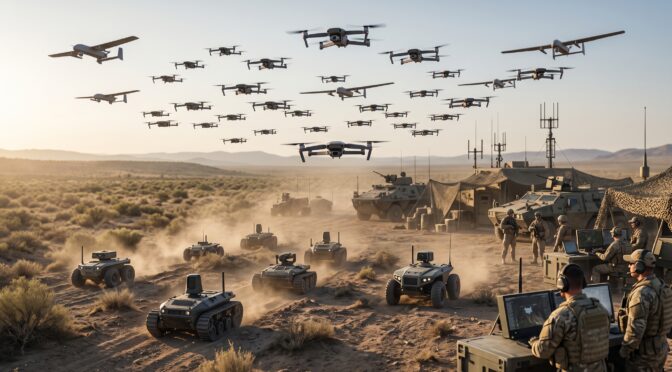
The proliferation of unmanned aerial systems and the continuous integration of artificial intelligence into tactical military platforms have precipitated a fundamental shift in the character of modern warfare. Throughout the latter half of the twentieth century, military dominance was largely defined by the deployment of singular, heavily manned, and technologically exquisite platforms. Fighter aircraft, advanced naval destroyers, and sophisticated radar installations represented the pinnacle of defense acquisition. However, these conventional platforms are increasingly vulnerable to distributed, massed, and autonomous robotic systems. This strategic vulnerability is most acutely realized in the development, refinement, and deployment of military drone swarms. By replacing centralized, one-to-one teleoperation architectures with decentralized, one-to-many command frameworks, defense organizations and non-state actors alike are unlocking tactical capabilities that challenge the foundational assumptions of traditional force projection.1
Drone swarms represent an evolutionary departure from conventional flight formations. While a traditional flight formation relies on human pilots rigidly following a centralized leader or an automated system navigating along pre-programmed, static waypoints, a true swarm functions as a collaborative, autonomous entity. These systems leverage localized interactions, shared sensor data telemetry, and dynamic task allocation to achieve complex mission objectives in highly contested environments.1 The deployment of these autonomous swarms presents a multitude of operational, economic, and tactical benefits that fundamentally alter the balance of power on the battlefield.
From overwhelming legacy air defense systems through localized target saturation and multi-vector attack geometries to inflicting deeply unsustainable economic costs upon defending forces, swarms provide highly asymmetric advantages.3 Furthermore, advancements in peer-to-peer mesh networking, heterogeneous payload integration, and machine-speed decision cycles allow these unmanned networks to operate with a degree of resilience and speed that outpaces human cognitive capacity.5
This report details the top ten benefits of utilizing drone swarm attacks in military operations. It examines the underlying technological mechanisms that enable these benefits and evaluates the strategic implications of swarming systems across various operational domains, including contested urban environments, maritime gray zones, and highly defended airspace.7 The findings indicate that the integration of collaborative autonomy at scale is a paradigm shift that requires a fundamental reassessment of existing defensive architectures, procurement strategies, and modern force structures.
2. Defining the Modern Drone Swarm
Understanding the distinct tactical benefits of a drone swarm attack requires a clear analytical delineation between traditional unmanned aerial vehicles and genuine swarming systems. The deployment of multiple drones simultaneously on a battlefield is a common occurrence, particularly in contemporary conflicts, but scale alone does not constitute a swarm. A swarm is defined by its internal network architecture, operational behavior, and command methodologies rather than mere numerical volume. Various military research institutions characterize a military drone swarm through several distinguishing criteria that separate it from standard unmanned operations.1
For clarity, the United States government’s civilian baseline from the 2017 FAA Order JO 7200.23A defines a swarm simply as multiple aircraft operating in unison to commands from one pilot through a common link.1 However, military doctrine expands this to require complex internal interaction and decentralized execution. Primarily, a military swarm consists of multiple autonomous systems that exhibit continuous internal interaction and coordinated activity. Unlike a standard military flight formation, where individual units adhere to a central leader, swarm agents communicate peer-to-peer.1 They evaluate surrounding threats, share raw sensor data, and allocate operational roles dynamically based on the unfolding tactical situation.2 This decentralized coordination allows the collective to combine individual behaviors to achieve a unified strategic effort without requiring constant direction from an external source.
Furthermore, swarms are defined by a revolutionary span of control. They transition warfare away from the legacy model of teleoperation—where one human operator manually pilots a single drone—to a true one-to-many architecture.1 In a swarm configuration, a single human operator serves as a mission supervisor rather than a pilot. The operator commands dozens or even hundreds of platforms simultaneously by issuing high-level objectives or intent-based commands.1 The swarm’s internal artificial intelligence translates these broad objectives into localized, cooperative actions, navigating space and time constraints that would otherwise limit traditional military forces.1 This definitional baseline is critical for understanding how swarms generate the ten tactical benefits detailed in the subsequent sections of this analysis.
3. Benefit 1: Economic Cost Asymmetry and Attritional Leverage
The most immediate and strategically disruptive benefit of deploying a drone swarm attack is the severe economic cost asymmetry it imposes on the defending force. Modern defense architectures have historically relied on a procurement model focused on producing highly advanced, technologically exquisite interceptors designed to neutralize equally expensive high-value targets, such as ballistic missiles or fifth-generation stealth fighter aircraft.3 Drone swarms directly exploit this legacy procurement model, turning the tactical battlefield into a deeply unfavorable economic environment for the defending force.10
Offensive swarms are primarily composed of low-cost, commercially available materials, or mass-produced attritable components. Systems utilized heavily in recent conflicts, such as the Iranian-designed Shahed-136 one-way attack drones, carry an estimated unit cost ranging from $20,000 to $50,000.3 Conversely, defending against these persistent aerial threats frequently requires the expenditure of advanced surface-to-air missiles. Patriot interceptor missiles, for example, cost approximately $4 million each, while Terminal High Altitude Area Defense (THAAD) interceptors can cost between $12 million and $15 million each.3
This dynamic creates an attritional logic that inherently favors the attacker.11 An adversary can launch a massive salvo of low-cost drones that cost a mere fraction of the defensive munitions required to shoot them down. Even if the defender achieves a flawless interception rate and prevents any kinetic damage to their infrastructure, the economic exchange ratio guarantees long-term strategic depletion. The financial imbalance extends far beyond the munitions to the sensor platforms themselves. In documented instances, drone systems costing roughly $30,000 have successfully targeted and disabled advanced radar support systems, such as the AN/TPY-2, which cost upwards of $1 billion. This represents a profound cost-disabling ratio of more than 30,000 to one in favor of the swarm.3
Beyond direct monetary expenditure, swarms leverage asymmetric supply chains to create logistical exhaustion.3 High-end defensive interceptors require specialized, slow-moving military manufacturing bases and can take years to fully replenish once fired. In stark contrast, an attacking force can quickly mass-produce simple swarm drones utilizing basic manufacturing processes and widely available commercial electronics. By repeatedly launching mixed salvos of inexpensive munitions almost daily, an attacking force physically stretches the defensive network, rapidly consumes the defender’s limited interceptor inventories, and paves the way for follow-on strikes by heavier, more precise conventional weapons.3 Furthermore, the global economic impact is staggering, as seen when asymmetric disruption in critical maritime chokepoints like the Red Sea has cost the global economy hundreds of billions of dollars, making million-dollar interceptors a necessary but painful expenditure to protect high-value assets.12
| System Type | Specific Platform Example | Estimated Unit Cost | Strategic Function |
| Offensive Drone | Shahed-136 (One-Way Attack) | $20,000 – $50,000 | Attrition, Air Defense Saturation 3 |
| Offensive Drone | LOCUST Coyote UAV | $15,000 | Electronic Warfare, Decoy, ISR 13 |
| Defensive Interceptor | Patriot Missile | ~$4,000,000 | High-Altitude Point Defense 3 |
| Defensive Interceptor | THAAD Interceptor | $12,000,000 – $15,000,000 | Ballistic Missile Defense 3 |
| Defensive Sensor | AN/TPY-2 Radar System | ~$1,000,000,000 | Early Warning, Tracking 3 |
4. Benefit 2: Target Saturation and Radar Overload
A foundational tactical benefit of an offensive drone swarm is its innate ability to physically and computationally overwhelm legacy air defense sensors and centralized fire control systems. Conventional air defense architectures were engineered specifically to engage a finite number of discrete, high-speed, high-value objects.4 When confronted with a massed, coordinated group of autonomous systems, these legacy defenses experience immediate and often systemic saturation.
The primary mechanism of this saturation is severe data overload within the centralized fire control processors.4 As dozens or hundreds of small airframes enter the airspace simultaneously from distributed geometry, the radar processor struggles to assign distinct tracking files to the individual elements within the cluster.4 The sheer volume of data points generated by the swarm exhausts the computational limits of standard tracking algorithms. This causes the defensive system to drop target locks, misidentify friend-or-foe signatures, or fail completely to distinguish between viable incoming threats and background environmental clutter.4 Ultimately, swarms create “target saturation,” overwhelming defenders’ radar and processing systems with too many data points to be tracked or engaged effectively.14
Furthermore, swarms actively exploit the mechanical and physical limitations of sequential engagement systems.4 Traditional automated close-in weapon systems and missile launchers are constrained by a rigid, linear kill chain: the system must lock onto a target, fire the munition, visually or electronically confirm the destruction of the target, and then physically slew the turret or redirect the radar array toward the next incoming threat.4 This mechanical process introduces critical latency into the defensive cycle. While the fire control system is engaged in neutralizing the first fraction of the swarm, the computational and mechanical delay allows the remaining elements of the swarm to bypass the engagement zone entirely and strike their intended targets.4 In this operational model, the attacker relies on mathematical certainty; the goal is no longer to seamlessly evade the defensive system, but to predictably and reliably overwhelm it with affordable, autonomous mass.6
5. Benefit 3: Multi-Vector and Omni-Directional Attack Geometry
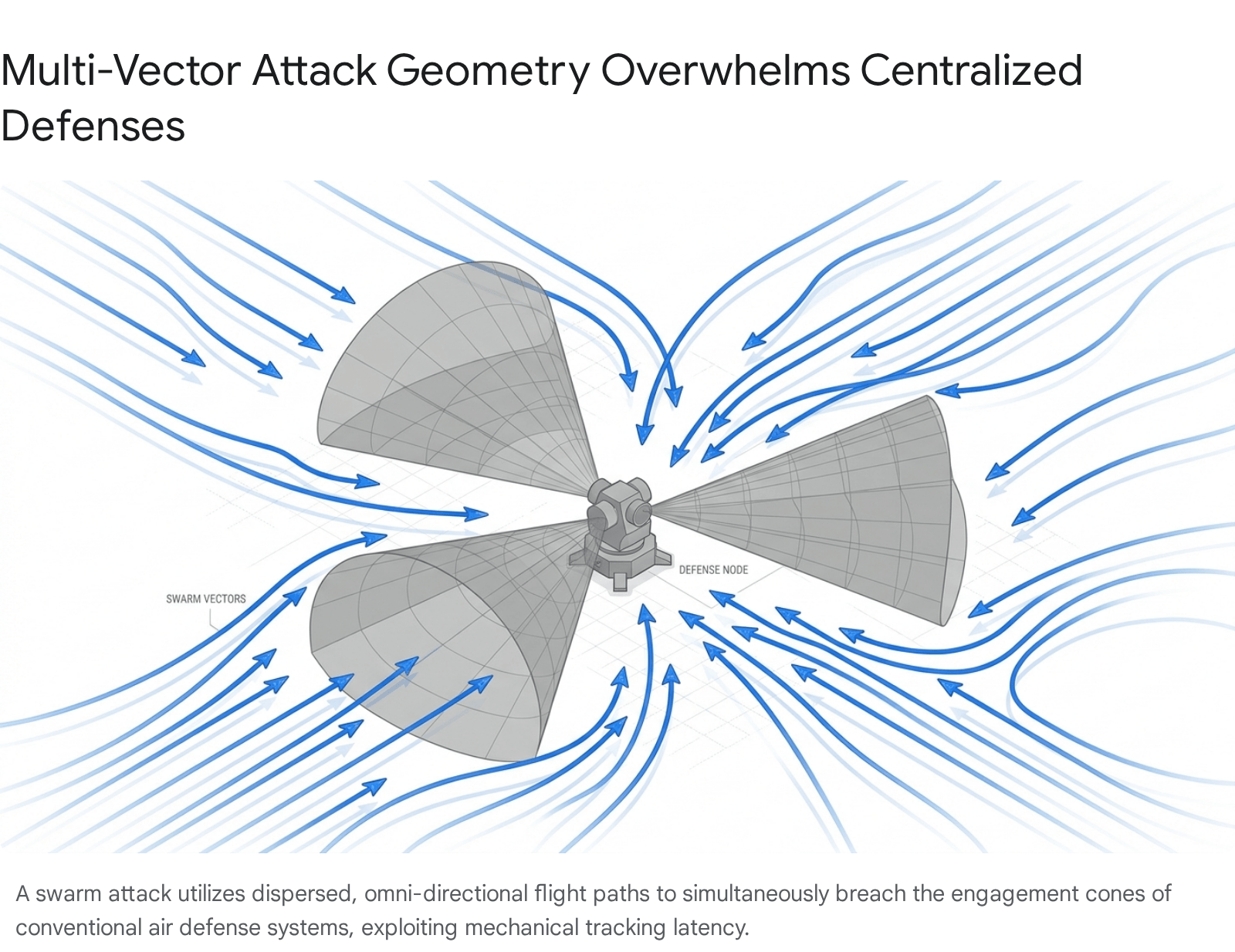
Unlike conventional strike packages—such as bomber formations or cruise missile salvos—that typically approach a target along a predictable, linear flight path, drone swarms execute highly complex, multi-vector attack geometries.14 Upon arriving at the operational area, the swarm can intelligently disperse and surround the objective, converging simultaneously from 360 degrees and across various horizontal and vertical altitudes. Using multiple vectors of attack, swarms can execute coordinated strikes with precision, which overwhelms enemy air defenses and reduces the chance of intercept.16
This multi-axis approach deliberately nullifies the effectiveness of directional air defenses, which inherently feature limited fields of view or specific, forward-facing engagement cones.4 By attacking from multiple bearings at the exact same moment, the swarm forces the defender to divide their attention, radar processing power, and kinetic defensive resources across a vastly wider spatial area.14 This distributed geometry prevents the defender from orienting their primary defensive strength toward a single, manageable axis of advance, allowing the swarm to easily exploit blind spots and inherent gaps in radar coverage.16
The geometric distribution also allows for sophisticated applications of parallel warfare tactics.17 Because individual swarm agents continuously share data regarding target locations and local threat environments, they can dynamically coordinate synchronized, synergistic strikes.17 If one peripheral drone detects a heavily fortified sector, it can immediately alert neighboring agents, allowing the collective intelligence to seamlessly re-route the main body around the threat, or alternatively, to concentrate mass on a newly discovered vulnerability. This geometric flexibility drastically compresses the decision-making window for battlefield commanders, who face a threat that is simultaneously everywhere, fluid, and highly coordinated.14
Historical precedents for confusing radar systems exist, such as Israel’s use of early drone systems during the 1973 October War and the 1983 Bekaa Valley conflict to trick Syrian and Egyptian air defenses into wasting ammunition and revealing their locations.18 Modern swarms take this concept further, executing these decoy and multi-vector maneuvers entirely autonomously, compounding the geographic disadvantage placed upon stationary or localized defense platforms.
6. Benefit 4: Resilience Through Decentralized Control Architectures
Traditional unmanned aerial systems, despite their technological sophistication, possess a critical vulnerability: a single point of failure. If the communication link between the drone and the ground control station is severed through electronic warfare jamming, or if the central command node is physically destroyed, the mission inevitably fails. Drone swarms eliminate this vulnerability by operating almost exclusively on decentralized, leaderless mesh networks.5
Within a true, sophisticated military swarm, there is no centralized router, nor is there a single “queen” or commanding drone that dictates orders to the rest.5 Instead, agents communicate continuously peer-to-peer using localized wireless mesh protocols. Good protocol choices for the mesh layer include MAVLink over 802.11s Wi-Fi mesh for civil applications, custom User Datagram Protocol broadcasts over frequency-hopping spread spectrum radios for contested environments, and Data Distribution Service (DDS) protocols for real-time decentralized coordination.5
In practice, each individual drone maintains a dynamic “neighbor table”—a continuous log of peers it can detect, their respective signal strengths, and their last registered heartbeat timestamp.5 This constant, rapid data exchange ensures that every single drone in the formation carries a complete, cryptographically verifiable copy of the overall mission plan and current mission state.5
This heavily decentralized architecture yields immense operational resilience. Swarms are engineered primarily for attrition; they are designed from the ground up with the assumption that a percentage of the individual units will inevitably be lost to enemy fire, mechanical failure, or electronic warfare degradation.14 When a drone is destroyed, the network does not collapse. Instead, the surviving nodes autonomously register the loss of the heartbeat signal, recalculate the operational parameters, and dynamically redistribute the fallen drone’s tasks among the remaining units.14 This profound self-healing capability ensures that the core mission persists under immense pressure, allowing the swarm to absorb significant casualties while continuing to function as a cohesive, lethal entity.
7. Benefit 5: OODA Loop Compression and Machine-Speed Coordination
The strategic concept of the OODA loop—Observe, Orient, Decide, and Act—developed by military strategist John Boyd, remains foundational to modern military decision-making and operational art. The core principle asserts that the force capable of executing this cognitive cycle faster than its adversary will dictate the tempo of operations, generate confusion, and ultimately achieve victory.6 Drone swarms fundamentally alter this dynamic by compressing the OODA loop to machine speeds, effectively removing human cognitive latency from the tactical execution phase.6
In a conventional defensive or offensive scenario, a human operator must continuously observe incoming targets on a radar screen, orient themselves to the complex threat matrix, decide on an allocation of interceptors or strike assets, and act by manually authorizing the launch sequence.4 Even for highly trained, elite personnel, this cognitive process takes crucial seconds, if not minutes, and is subject to fatigue and emotional stress.4 Drone swarms, powered by edge artificial intelligence and low-latency mesh communication, operate in milliseconds.2 The swarm shares sensor data, evaluates threat vectors, and allocates defensive or offensive roles instantaneously.2
The goal is no longer just to evade defenses—it is to overwhelm them through adaptive, automated responses that adjust dynamically to evolving battlefield conditions in real time.15 This acceleration changes the tempo of operations, enabling forces to respond before an adversary understands the developing tactical situation.2
While the ultimate authorization to use lethal force is currently maintained by human commanders in most doctrine, the “Act” phase is frequently executed autonomously by the swarm.19 This compression poses a massive challenge for defenders, who may fall victim to automation bias.19 The International Committee of the Red Cross and various military observers note that operators under extreme time pressure and cognitive load often defer to algorithmic recommendations, committing errors of omission (missing anomalies the system overlooks) and errors of commission (following faulty AI suggestions without considering alternatives).19
Furthermore, the integration of high-speed drone data into command structures can create a new breed of “tactical generals”—senior commanders with unprecedented access to tactical information who are tempted to micro-manage theater operations from afar, increasing uncertainty and compounding the friction of fast-moving combat scenarios.20 By forcing the adversary into a reactive posture where their command structure cannot process information fast enough to mount a coherent defense, the swarm achieves a decisive temporal advantage.
8. Benefit 6: Heterogeneous Platform Integration and Synergistic Payloads
Early conceptualizations of drone swarms often visualized homogenous groups of identical aircraft functioning as a single blunt instrument. However, modern military swarms derive significant power and flexibility from platform heterogeneity.21 A contemporary swarm can seamlessly integrate diverse platforms carrying varying payloads, operating synergistically to achieve compounding tactical effects that a single platform could never accomplish alone.8
In a heterogeneous configuration, the swarm is intelligently subdivided into specialized clusters based on the specific capabilities of the airframes. Swarms typically integrate AI-based decision-making at the edge, mesh networking protocols, and multi-mission payloads that support intelligence, surveillance, reconnaissance (ISR), jamming, or kinetic strikes.16 For instance, ISR operations can utilize an alliance of different sensor platforms working in tandem. A subset of drones designated as Type-1 may carry Synthetic Aperture Radar (SAR) payloads to conduct primary wide-area searches.23 Leveraging the wide-area coverage and signal penetration capabilities of SAR, they can detect potential targets under complex meteorological conditions, such as dense fog or heavy rain, which would blind standard optical cameras.23 Once a potential target is flagged by the Type-1 drone, the swarm autonomously cues Type-2 drones equipped with high-resolution hyperspectral imagers.23 These Type-2 units approach the target to conduct secondary, fine-grained feature extraction, confirming whether the target is a genuine armored vehicle or an enemy decoy before authorizing a strike.23
Beyond advanced surveillance, heterogeneous swarms routinely combine electronic warfare and kinetic effects. For example, in Israel’s 2021 conflict with Gaza, the military deployed a drone swarm in combat; Russia has also deployed the Kalashnikov KUB-BLA and Lancet-3 loitering munitions capable of advanced targeting. Specific units can be deployed as forward decoys, utilizing acoustic spoofing payloads or radar reflectors to trick enemy air defenses into powering up their tracking systems.24 This deliberate provocation reveals the hidden positions of the air defense batteries.18 Concurrently, specialized jamming drones in the swarm degrade the adversary’s communications, while kinetic one-way effectors execute precision kamikaze strikes against the newly identified radar sites.8 This highly synchronized, combined-arms approach within a single networked entity allows the swarm to map terrain, spoof defenses, and destroy targets simultaneously.
| Swarm Sub-Group Designation | Primary Payload / Sensor Integration | Core Tactical Function within Swarm |
| Type-1 Searchers | Synthetic Aperture Radar (SAR) | Wide-area detection, weather and canopy penetration.23 |
| Type-2 Identifiers | Hyperspectral / Electro-Optical Imagers | High-resolution feature extraction, positive target identification.23 |
| Type-3 Effectors | Kinetic Warhead (High Explosive) | Precision strike, kamikaze tactics, anti-radiation targeting.8 |
| Type-4 Support | Acoustic Spoofers / RF Jammers | Electronic warfare, decoy generation, communication disruption.24 |
9. Benefit 7: Sensor Evasion and Low Observability Profiles
A significant, yet often understated, advantage of the individual units comprising a drone swarm is their inherent physical ability to evade traditional detection mechanisms. Unlike conventional fighter jets, attack helicopters, or large bomber aircraft, small unmanned aerial systems inherently possess extremely low observability profiles that complicate the defender’s situational awareness.25
Swarm drones are frequently manufactured utilizing lightweight composite materials, industrial plastics, and carbon fiber elements.4 These materials do not reflect radar waves in the same manner as the metallic hulls and sharp angles of legacy aircraft. Instead, they absorb or scatter the electromagnetic energy, resulting in a drastically reduced Radar Cross-Section.4 Because they are lightweight and portable, Groups 1-2 drones are highly accessible to most nations and non-state actors, presenting a massive challenge to standard detection.26
Furthermore, the physical footprint of the airframes is incredibly small. Systems like the Coyote unmanned aerial vehicle utilized extensively in the United States Navy’s LOCUST (Low-Cost UAV Swarming Technology) program are only three feet long and weigh between 12 and 14 pounds.27 This diminutive size allows them to easily blend into background ground clutter when flying nap-of-the-earth profiles, effectively hiding among the radar returns of local terrain, trees, and even flocks of birds.28
In addition to defeating primary radar tracking, swarm drones present severe challenges to infrared and thermal tracking systems. By relying on small electric motors or highly efficient, low-output propulsion systems, they generate minimal heat signatures, effectively masking their approach from the thermal sensors relied upon by many short-range air defense systems.4 While it is true that a densely formulated swarm can sometimes aggregate a larger combined Radar Cross-Section than a single drone due to the proximity of the units 29, their individual low signatures force defenders to rely on highly sensitive, exquisitely expensive, and specialized radar arrays just to detect them early enough to mount a response. The combination of a small physical profile, slower approach speeds, and a low thermal output allows swarms to slip past early-warning perimeter defenses undetected until they are within lethal striking distance.25
10. Benefit 8: Force Multiplication via One-to-Many Command Structures
Historically, the strategic expansion of air power required a proportional and highly expensive expansion in personnel, rigorous training pipelines, and logistical support. For every aircraft deployed, militaries required highly trained pilots, expansive ground control crews, and massive maintenance staffs. Drone swarms eliminate this legacy requirement, acting as an unprecedented force multiplier by breaking the linear personnel-to-platform ratio.1
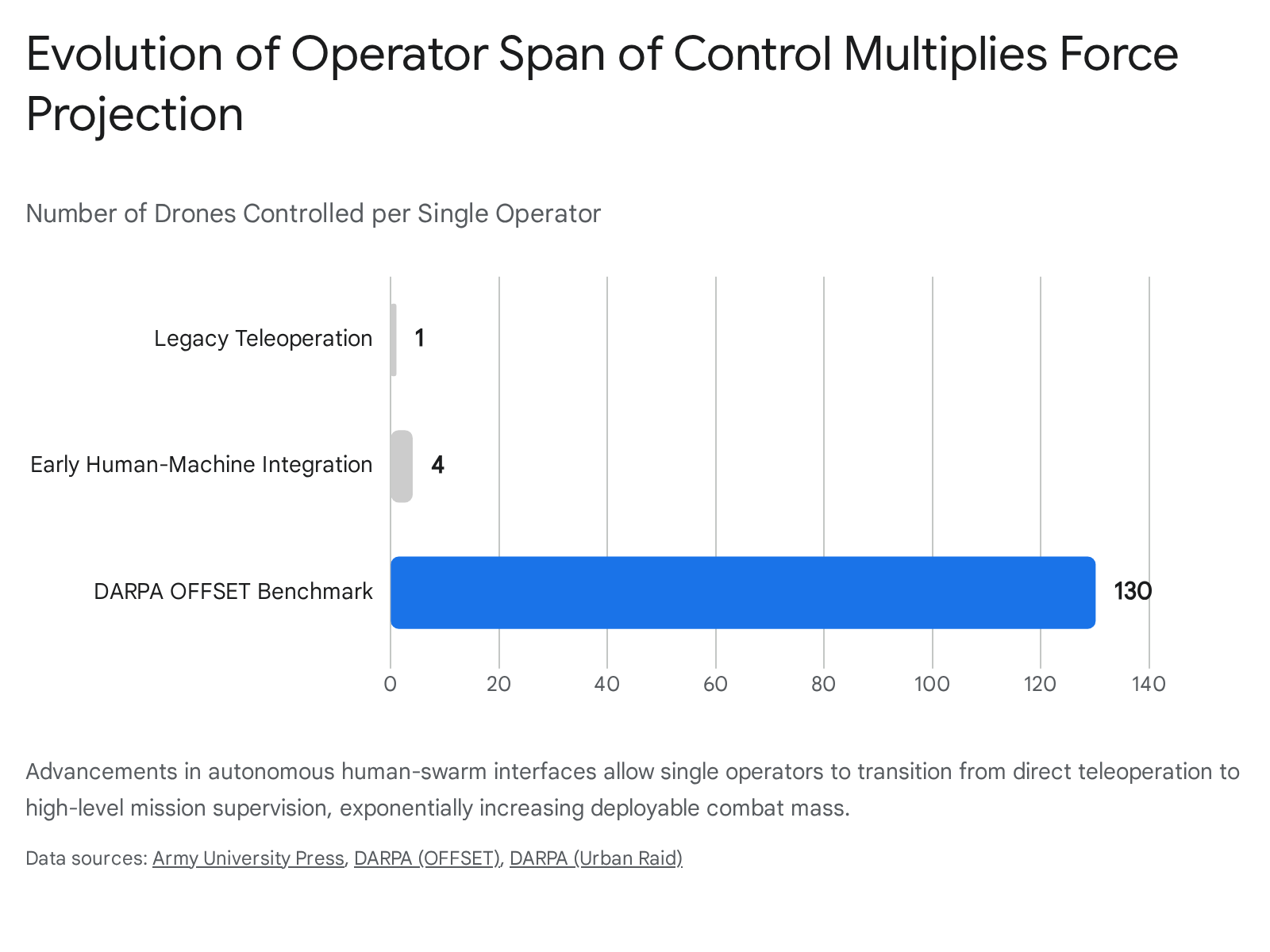
Through the rapid advancement of human-swarm interfaces, military operators are transitioning from flying individual drones via direct teleoperation to supervising massive, distributed formations through intent-driven commands.1 The Defense Advanced Research Projects Agency’s OFFensive Swarm-Enabled Tactics (OFFSET) program has demonstrated the viability of this approach in live-action environments.9 The program focuses on providing commanders with immersive situational awareness tools, including virtual reality, augmented reality interfaces, sketch tablets, and voice-gesture controls, to monitor and direct potentially hundreds of unmanned platforms in real time.9 During live field experiments at the Combined Arms Collective Training Facility at Camp Shelby, a single operator successfully demonstrated command and control over 130 autonomous drones simultaneously, isolating buildings and executing complex urban raid scenarios to locate designated items of interest.1
Autonomous systems will come in a range of platforms and will rely on an array of enterprise and ground control systems, demanding simple, resilient, and secure communications on multiple channels and bands.31 This one-to-many command structure drastically reduces the cognitive load and sensory exhaustion on the operator.2 Instead of painstakingly managing the flight physics, aerodynamics, and sensor orientation of a single aircraft, the operator sets the broad mission parameters—such as “map this terrain,” or “establish a surveillance perimeter along this border”—and the swarm’s decentralized intelligence handles the micro-navigation, collision avoidance, and tactical execution.2 This capability frees manned aircraft and traditional military personnel to execute other critical tasks, essentially multiplying aggregate combat power across the battlespace at a vastly decreased physical risk to the human warfighter.27
11. Benefit 9: Dynamic Task Allocation and Autonomous Adaptability
The environment of a modern battlefield is highly fluid, characterized by unexpected enemy maneuver, sudden electronic warfare interference, shifting meteorological conditions, and rapidly changing mission priorities. Traditional military planning often struggles to adapt to these sudden changes without experiencing significant delays as new orders are drafted and transmitted down the chain of command. Drone swarms inherently excel in this chaotic environment due to their vast mathematical capacity for dynamic task allocation and autonomous adaptability.2
Powered by advanced distributed machine learning architectures and consensus-based algorithms, the swarm can re-evaluate its immediate objectives in real-time without pinging a central command post.33 For example, by utilizing mathematical models such as dynamic extended consensus-based bundle algorithms (DECBBA) or hedonic game-based self-organizing clustering, the swarm can autonomously divide a massive search area into optimal sub-regions.22 It can then assign specialized drones based on dynamic feasibility, current battery life, and specific payload requirements.22 If a sector is suddenly obscured by heavy smoke or cloud cover, the swarm can autonomously re-task radar-equipped drones to that area to pierce the visual obstruction, while smoothly moving optical sensors to clearer zones, balancing the operational load seamlessly.
This adaptability extends directly to swarm survivability and navigation. When mapping terrain or tracking moving targets, drones utilize decentralized search frameworks based on algorithms like the Grey Wolf optimization method to maximize search efficiency and minimize energy consumption.34 Furthermore, hybrid exploration algorithms combining Correlated Random Walk and Levy Flight methodologies have been demonstrated to significantly reduce error rates in environmental monitoring tasks.35 If a subset of drones encounters heavy anti-aircraft fire, the broader network detects the loss of neighbor heartbeats and immediately updates the group’s decisions. The remaining agents adapt to the evolving conditions, recalculating optimal flight paths to ensure the target area remains fully covered despite the unexpected attrition.2 Furthermore, autonomous swarms can dynamically execute resupply drops of medical equipment or ammunition across GPS-denied zones where manned aircraft cannot safely operate.16 This emergent behavior makes the swarm incredibly difficult for adversaries to predict and neutralize.
12. Benefit 10: Asymmetric Leverage in Gray Zone and Anti-Access Environments
The final critical benefit of drone swarm technology lies in the profound asymmetric leverage it provides, particularly in gray zone conflicts and deeply entrenched Anti-Access/Area-Denial (A2/AD) environments.8 The democratization of precision strike capabilities—driven heavily by the low cost, open-source programming, and widespread availability of commercial drone components—allows smaller militaries, non-state actors, and insurgent networks to field offensive capabilities that previously required the massive defense budgets of superpower nations.7
In gray zone environments, which denote military and political operations that fall deliberately below the threshold of conventional armed conflict, swarms offer a highly deniable, persistent, and frustrating threat. For example, in vital maritime chokepoints like the Malacca Strait or the contested waters of the South China Sea, low-cost drone swarms can be rapidly deployed to harass naval patrols, shadow civilian vessels, or disrupt vital global shipping lanes with incredibly minimal financial investment.7 A handful of automated aerial drones or subsurface unmanned vehicles can effectively blockade an area, forcing commercial shipping insurers to halt traffic, thereby requiring nations to spend millions of dollars and deploy advanced warships daily just to clear the lingering threat.3
Furthermore, against peer adversaries operating with robust A2/AD systems, swarms serve as the ideal primary penetrating force. In scenarios involving highly defended airspace, mass-produced, attritable unmanned vehicles can be utilized to execute kamikaze swarm tactics, intentionally drawing fire to map and subsequently blind enemy radar networks before more exquisite, manned platforms are required to enter the battlespace.18 This rebalance of power suggests that states and non-state actors will increasingly employ small unmanned aerial systems to coerce enemies, extract diplomatic concessions, and achieve national security objectives with minimal financial risk.25
13. Strategic Implications and Defensive Repercussions
The operational realities demonstrated by the deployment of drone swarms indicate clearly that reliance on mere scale, massed infantry, and technologically exquisite platforms is no longer sufficient to guarantee battlefield supremacy. The tactical benefits outlined throughout this report—ranging from multi-vector target saturation and OODA loop compression to extreme economic cost asymmetry—demonstrate that defensive systems engineered for twentieth-century conflicts are increasingly obsolete against networked, autonomous robotic threats.
Initiatives such as the United States Department of Defense’s “Replicator” program, which aims to accelerate the fielding of all-domain expendable autonomous capabilities at scale to counter the rapid expansion of peer adversaries, highlight the urgent strategic pivot currently underway.1 However, to successfully restore deterrence and contest the near-surface battlespace effectively, military organizations must rapidly restructure their defense investments and operational doctrines.3
High-value assets, command posts, and legacy fire control radars can no longer exist in isolation; they must be actively shielded by layered, cost-effective counter-unmanned aerial system capabilities. The U.S. Army and allied forces must assume a greater role in defending air bases and perimeters from the drone swarm threats of the future, utilizing non-kinetic directed energy weapons, cognitive electronic warfare jammers, and localized interceptor drones that can neutralize swarms without bankrupting the defender’s missile stockpiles.3 Furthermore, defense forces must fully embrace distributed operational concepts, aggressively dispersing their sensors, weapons, and command systems across highly networked battlefields to avoid presenting concentrated, easily overwhelmed targets to incoming swarm attacks.3 Ultimately, the integration of autonomous swarms demands a total paradigm shift in military thinking, where the speed of technological adaptation, the utilization of artificial intelligence, and the fundamental economics of warfare dictate strategic success.
Appendix: Methodology and Data Sources
The synthesis of this analytical report relied upon a qualitative and quantitative review of contemporary defense industry intelligence, unclassified military doctrine, and technical research literature regarding unmanned aerial systems. The analytical framework prioritized extracting discrete technological capabilities (e.g., decentralized mesh networks, multi-vector attack geometries, algorithmic task distribution) and mapping them directly to their second- and third-order tactical and economic consequences (e.g., radar processor saturation, supply chain exhaustion, OODA loop compression).
Cost-exchange ratios and attritional logic models were derived from empirical contemporary battlefield data, specifically comparing the estimated unit costs of commercial-off-the-shelf and state-sponsored loitering munitions against legacy surface-to-air missile interceptors and radar support structures.3 Operational metrics, including operator span of control evolutions and machine-speed coordination timelines, were evaluated using empirical data from established Department of Defense initiatives, notably the Defense Advanced Research Projects Agency’s OFFSET program and the United States Navy’s LOCUST capability demonstrations.30 Finally, principles of algorithmic task allocation, swarm heterogeneity, and mesh network resilience were synthesized from peer-reviewed academic engineering documentation and aerospace journals to provide a technically grounded assessment of autonomous capabilities.5
Please share the link on Facebook, Forums, with colleagues, etc. Your support is much appreciated and if you have any feedback, please email us in**@*********ps.com. If you’d like to request a report or order a reprint, please click here for the corresponding page to open in new tab.
Sources Used
- Defining Swarm: A Critical Step Toward Harnessing the Power of Autonomous Systems, accessed July 4, 2026, https://www.armyupress.army.mil/journals/military-review/online-exclusive/2025-ole/defining-swarm/
- Swarming in Defense: How Autonomous Systems Transform Modern Operations, accessed July 4, 2026, https://orbotix.tech/swarming-in-defense/
- The new economics of warfare – European Policy Centre (EPC), accessed July 4, 2026, https://www.epc.eu/publication/the-new-economics-of-warfare/
- Global Counter UAS Market Trends and Drone Swarm Defense …, accessed July 4, 2026, https://www.marketsandmarkets.com/ResearchInsight/drone-swarm-defense-next-gen-counter-uas-market-technologies.asp
- Designing Resilient Drone Swarms: Leaderless-Tolerant Mesh …, accessed July 4, 2026, https://simplico.net/2026/04/19/designing-resilient-drone-swarms-leaderless-tolerant-mesh-networks-with-secure-communications/
- Decision-making at the Speed of Relevance: The OODA Loop in Modern Defense Systems, accessed July 4, 2026, https://www.rti.com/blog/the-ooda-loop-in-modern-defense-systems
- The New Economics of War: Cheap Drones, Asymmetric Threats, and the Democratization of Destruction – Global Security Review, accessed July 4, 2026, https://globalsecurityreview.com/the-new-economics-of-war-cheap-drones-asymmetric-threats-and-the-democratization-of-destruction/
- Achtung Swarm – Marine Corps University, accessed July 4, 2026, https://www.usmcu.edu/Outreach/Marine-Corps-University-Press/MCU-Journal/JAMS-vol-16-no-2/Achtung-Swarm/
- OFFSET: OFFensive Swarm-Enabled Tactics – DARPA, accessed July 4, 2026, https://www.darpa.mil/research/programs/offensive-swarm-enabled-tactics
- Latest drones drive down the cost of warfare | Al Majalla, accessed July 4, 2026, https://en.majalla.com/node/331106/business-economy/latest-drones-drive-down-cost-warfare
- Calculating the Cost-Effectiveness of Russia’s Drone Strikes – CSIS, accessed July 4, 2026, https://www.csis.org/analysis/calculating-cost-effectiveness-russias-drone-strikes
- David vs. Goliath: Cost Asymmetry in Warfare – RAND, accessed July 4, 2026, https://www.rand.org/pubs/commentary/2025/03/david-vs-goliath-cost-asymmetry-in-warfare.html
- Watch the Navy’s LOCUST launcher fire a swarm of drones – YouTube, accessed July 4, 2026, https://www.youtube.com/watch?v=qW77hVqux10
- Drone Swarm: A Complete Defensive Guide – Skylock, accessed July 4, 2026, https://skylocksys.com/drone-swarm-a-complete-defensive-guide/
- Modernizing the OODA Loop for Today’s Threats – Vanguard, accessed July 4, 2026, https://vanguardcanada.com/modernizing-the-ooda-loop-for-todays-threats/
- Drone Swarm Tactics: How Coordinated UAVs are Changing the Battlefield – MGI Defence, accessed July 4, 2026, https://mgidefence.co.uk/drone-swarm-tactics-how-coordinated-uavs-are-changing-the-battlefield/
- Demonstrating a Swarm Intelligent Algorithm for Parallel Attack – DTIC, accessed July 4, 2026, https://apps.dtic.mil/sti/tr/pdf/AD1071535.pdf
- Swarm Talk: Understanding Drone Typology – Modern War Institute, accessed July 4, 2026, https://mwi.westpoint.edu/swarm-talk-understanding-drone-typology/
- How AI and Large Language Models Are Reshaping the OODA Loop | by Angi English, accessed July 4, 2026, https://carolinagal14.medium.com/how-ai-and-large-language-models-are-reshaping-the-ooda-loop-76353e5098de
- Automating the OODA Loop in the Age of AI – Nuclear Network – CSIS, accessed July 4, 2026, https://nuclearnetwork.csis.org/automating-the-ooda-loop-in-the-age-of-ai/
- A Classification of Heterogeneity in Uncrewed Vehicle Swarms and the Effects of Its Inclusion on Overall Swarm Resilience – arXiv, accessed July 4, 2026, https://arxiv.org/html/2603.28831v1
- Distributed Task Allocation Method for Scalable Heterogeneous Swarm – 航空学报, accessed July 4, 2026, https://hkxb.buaa.edu.cn/EN/10.7527/S1000-6893.2026.32811
- Distributed Task Allocation and Trajectory Planning for Heterogeneous UAV Swarms in Multi-Constraint Environments – MDPI, accessed July 4, 2026, https://www.mdpi.com/2226-4310/13/7/601
- OFFSET Swarms Take Flight in Final Field Experiment – DARPA, accessed July 4, 2026, https://www.darpa.mil/news/2021/offset-swarms-take-flight
- Countering Swarms: Strategic Considerations and Opportunities in …, accessed July 4, 2026, https://ndupress.ndu.edu/Joint-Force-Quarterly/Joint-Force-Quarterly-107/Article/Article/3197193/countering-swarms-strategic-considerations-and-opportunities-in-drone-warfare/
- Navigating the asymmetric economics of drone warfare – Electro Optic Systems, accessed July 4, 2026, https://eos-aus.com/news/navigating-the-asymmetric-economics-of-drone-warfare/
- Day of the LOCUST: Navy demonstrates swarming UAVs – Defense One, accessed July 4, 2026, https://www.defenseone.com/defense-systems/2015/04/day-of-the-locust-navy-demonstrates-swarming-uavs/190790/
- Micro air vehicle – Wikipedia, accessed July 4, 2026, https://en.wikipedia.org/wiki/Micro_air_vehicle
- UAV Swarm Target Identification and Quantification Based on Radar Signal Independency Characterization – MDPI, accessed July 4, 2026, https://www.mdpi.com/2072-4292/16/18/3512
- OFFSET Swarm Systems Integrators Demonstrate Tactics to Conduct Urban Raid – DARPA, accessed July 4, 2026, https://www.darpa.mil/news/2020/offset-swarm-urban-raid
- Networking the Swarm: Secure Control for Autonomous Drones – ZeroTier, accessed July 4, 2026, https://www.zerotier.com/blog/networking-the-swarm-secure-control-for-autonomous-drones/
- LOCUST: Autonomous, swarming UAVs fly into the future – Office of Naval Research – Navy, accessed July 4, 2026, https://www.onr.navy.mil/media-center/news-releases/locust-autonomous-swarming-uavs-fly-future
- A Dynamic Task Allocation Algorithm for Heterogeneous UUV Swarms – PMC – NIH, accessed July 4, 2026, https://pmc.ncbi.nlm.nih.gov/articles/PMC8951437/
- Autonomous research of drone swarms for collaborative search algorithm design – SPIE Digital Library, accessed July 4, 2026, https://www.spiedigitallibrary.org/conference-proceedings-of-spie/14133/141330G/Autonomous-research-of-drone-swarms-for-collaborative-search-algorithm-design/10.1117/12.3109570.full
- AI-Enhanced Swarm Drones: Decentralized Solutions for Sustainable Environmental Monitoring Applications – CEUR-WS.org, accessed July 4, 2026, https://ceur-ws.org/Vol-3940/AISD-2024_Paper_2.pdf
- Coyote C-UAS | Raytheon – RTX, accessed July 4, 2026, https://www.rtx.com/raytheon/what-we-do/integrated-air-and-missile-defense/coyote
- Countering Swarms: Strategic Considerations and Opportunities in Drone Warfare – NDU Press, accessed July 4, 2026, https://ndupress.ndu.edu/Portals/68/Documents/jfq/jfq-107/jfq-107_4-14_Bell.pdf?ver=mvjNNii9AA2OUQau2KBWTA%3D%3D