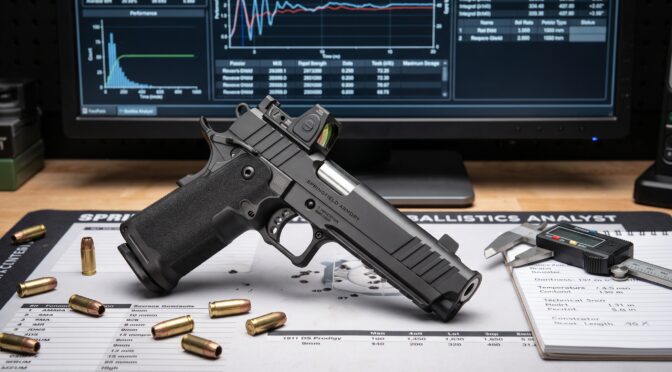
Executive Summary
The Springfield Armory 1911 DS Prodigy 9mm 5″ COMP AOS represents a notable architectural evolution within the high-capacity, double-stack 1911 market—a category often colloquially referred to as the “2011” platform. Historically, this highly specialized platform architecture has been heavily restricted to premium, custom, or semi-custom manufacturers. Firearms in this tier typically demand price points frequently exceeding the $2,500 to $4,000 threshold, effectively locking out a significant portion of the civilian and duty market. By engineering a feature-rich, forged-steel, double-stack 1911 at a competitive Manufacturer’s Suggested Retail Price (MSRP) of $1,599 for the standard 5-inch model, Springfield Armory is targeting a diverse demographic.1 This demographic includes sworn duty professionals requiring high-capacity service weapons, competitive shooters operating specifically within the United States Practical Shooting Association (USPSA) Limited Optics division, and personal defense practitioners seeking enhanced mechanical accuracy.
The fundamental architecture of the Prodigy Comp is built around a precision-machined forged carbon steel frame and slide, which is seamlessly mated to a high-impact polymer grip module. This modular frame design allows for the acceptance of flush-fitting 17-round and extended 20-round magazines out of the box, offering increased capacity while maintaining the traditional 1911 grip angle. The defining feature of the “COMP” variant is its integrally compensated 5-inch forged stainless steel match-grade bull barrel. Rather than utilizing a traditional threaded external compensator, the Prodigy Comp employs a single discreetly designed port cut directly through the top of the barrel and the slide, directing gases upward to decrease muzzle rise.1
To accommodate varying consumer preferences and legal compliance requirements, the primary tiers and configurations of the Prodigy Comp platform are extensive. The flagship model is the 5-inch standard variant (PH9119AOS-COMP), favored for competition and duty use due to its extended sight radius, 8.5-inch overall length, and 33-ounce unloaded weight.1 For end-users prioritizing concealed carry or faster transitional handling, a 4.25-inch variant is offered alongside the flagship model.2 To address regulatory constraints, Springfield Armory produces Low Capacity 10-round compliant models for both barrel lengths.2 Furthermore, the manufacturer provides “Gear Pac” variants. These comprehensive bundles package the firearm with a factory-mounted Viridian RFX11 green dot optic, a premium soft-sided pistol bag, and additional magazines (totaling four).3 Aesthetically, the platform is finished in a durable, corrosion-resistant Cerakote, available in standard Black or Coyote Brown.4 Out of the box, the AOS (Agency Optic System) platform includes a HEX Dragonfly compatible plate and a slide cover plate, with alternative footprint plates available separately.1
The synthesized consensus across high-round-count civilian users, competitive shooters, and professional evaluators is that the Prodigy Comp offers highly functional ergonomics, consistent mechanical accuracy, and a noticeably reduced recoil impulse attributable to the efficiency of the integral porting.1 However, the platform is susceptible to a stringent mechanical break-in period. Out-of-the-box reliability issues—primarily friction-induced slide cycling sluggishness stemming from the Cerakote finish application and inconsistent factory extractor tensioning—are documented across the consumer base. Once this break-in period is completed, or the firearm is properly tuned, the consensus indicates the platform transitions from an occasionally stiff out-of-the-box experience into a weapon exhibiting reliable cyclic performance.
Platform Architecture and Deep Engineering Context
To execute a comprehensive mechanical analysis of the Prodigy Comp, it is critical to understand the foundational engineering realities of the double-stack 1911 architecture. Adapting this intricate, hand-fitted, controlled-feed operating system to seamlessly cycle the high-pressure 9x19mm Parabellum cartridge from a wide, tapered double-stack magazine introduces engineering, geometric, and kinetic challenges.
The feed geometry inherent to the double-stack 1911 is functionally different when compared to the clean-sheet designs of contemporary polymer striker-fired service pistols. In a double-stack 1911, the reciprocating slide must strip a 9mm cartridge from the alternating presentation of a staggered double-column magazine, drive that cartridge up a feed ramp, and force the rim of the cartridge case to slide under the hook of an internal leaf-spring extractor. Any microscopic deviation in the magazine feed lip geometry, the calculated recoil spring weight, the reciprocating slide mass, or the extractor hook deflection geometry can induce a malfunction.
Springfield Armory navigates these mechanical challenges by employing a highly specific mass-distribution strategy, utilizing a two-piece full-length guide rod system paired with a heavy 5-inch forged stainless steel bull barrel.1 The integration of the bull barrel design entirely eliminates the need for a traditional 1911 barrel bushing. This bushingless design simplifies the mechanical lock-up tolerances at the muzzle while simultaneously adding non-reciprocating mass to the extreme front end of the firearm. This forward-biased mass, when combined with the robust 33-ounce unloaded weight, acts as a kinetic dampener, taming the sharp recoil impulse of the 9mm cartridge.
The polymer grip module is mechanically attached to the serialized forged carbon steel upper frame. This two-piece frame design allows the serialized steel upper frame to remain rigid for rail travel, while the geometric dimensions required for a double-stack magazine well are molded efficiently into impact-resistant polymer.
The Integral Compensator (Chunk Port) Fluid Dynamics
The primary differentiator of the PH9119AOS-COMP is the integral compensator. Springfield Armory specifically categorizes this as an integral compensator rather than standard barrel porting, as its meticulously engineered single expansion chamber redirects high-pressure gases upwards to counteract muzzle rise.5 In the traditional firearms aftermarket, compensators require the installation of an extended, threaded barrel onto which a multi-chambered baffle system is screwed, which extends the overall length of the firearm and introduces a potential point of mechanical failure.
Springfield Armory bypassed these limitations by machining a single “chunk port” directly through the top of the hammer-forged carbon slide and the forged stainless steel bull barrel. When the 9mm cartridge detonates, rapidly expanding propellant gases push the projectile down the bore. As the base of the bullet passes the port, a volume of high-pressure gas is vented upward.
Operating strictly on the principles of Newton’s Third Law of Motion, this upward venting creates a downward force vector on the muzzle, directly counteracting the natural upward moment of inertia (muzzle flip). Empirical results indicate a flatter slide cycling arc, less felt recoil, and an enhanced ability to maintain rapid sight acquisition through the depletion of a full magazine.1
Furthermore, the front tritium night sight is strategically relocated behind the exhaust port. In traditional ported handguns, placing the sight in front of the port results in the sight being covered in carbon residue. By placing the sight behind the port, the sight radius remains usable and the front sight is not immediately obscured by the expanding gas.1
Reliability and Accuracy
The mechanical performance and cyclic reliability of the Prodigy Comp are generally bifurcated into two distinct lifecycle phases: the strict Out-of-the-Box (OOTB) induction phase, and the post-break-in continuous operation phase.
Mechanical Accuracy Parameters
The intrinsic, mechanical accuracy of the Prodigy Comp is widely praised across professional data sources and high-traffic forums. The 5-inch forged stainless steel match-grade barrel features a 1:16 right-hand twist rate, which stabilizes standard 9mm Parabellum projectiles ranging from lightweight 115-grain target loads up to heavy 147-grain subsonic defensive loads.1
Reviewers report excellent grouping capabilities, frequently stacking rounds into the 10-ring of a standard target at 10 to 25 yards.1 This precision is facilitated by the straight-pull, single-action 1911 trigger shoe geometry and the heavy physical mass of the platform absorbing kinetic energy.
Ammunition Sensitivity and Bullet Jacket Integrity
A critical factor in the cyclic reliability of any heavily compensated firearm is ammunition selection. While the Prodigy Comp handles standard Full Metal Jacket (FMJ) and true Jacketed Hollow Point (JHP) duty ammunition well (with reviewers specifically highlighting the performance of Federal Premium Gold Medal Action Pistol 147-grain FMJ), the platform exhibits documented sensitivity to plated ammunition.1
Economy ammunition brands frequently utilize a micro-thin copper electro-plating process over a soft lead core. When a soft plated projectile passes the internal machined edges of the chunk port at high velocity, the port can act as a mechanical shear, stripping fragments of the thin copper plating directly off the lead core.6
This dynamic presents multiple points of failure, primarily by accelerating the physical fouling of the compensator port. As copper and lead build up, the internal geometry of the barrel is compromised, which can lead to unpredictable slide velocities and induce Failure to Extract (FTE) or Failure to Feed (FTF) malfunctions. High-round-count users recommend strictly utilizing high-quality true FMJ ammunition for range use to mitigate port leading.6
Long-Term Cyclic Reliability and Tribological Friction
The 1911 DS platform operating system relies on tightly fitted, full-length steel-on-steel frame rails. To protect these forged carbon steel components, Springfield Armory utilizes a heavy application of Cerakote finish across the entire slide and frame upper. While Cerakote provides excellent barrier corrosion resistance, its physical application thickness creates microscopic tribological friction along the slide rails in a tightly toleranced firearm.7
Consequently, a commonly reported Out-of-the-Box (OOTB) malfunction is a Failure to Return to Battery (FTRTB). This occurs when the friction of the Cerakote overwhelms the kinetic energy of the recoil spring, resulting in a sluggish forward slide cycle where the slide halts short of full lock-up, requiring the user to physically push the back of the slide to close the chamber.8
The verified solution to this specific friction issue is a rigorous break-in protocol. Owners are advised to lubricate the rail system heavily with high-viscosity synthetic oil and manually rack the slide 500 to 600 times before firing.8 This repetitive process safely wears in the Cerakote on the internal mating surfaces, self-lapping the slide to the frame. Firearms subjected to this break-in process, followed by a thorough cleaning and re-lubrication, exhibit far greater cyclic reliability during live fire.8
Another documented point of mechanical failure is the internal extractor. 1911 internal extractors are long steel leaf springs that require precise deflection tension to grip the cartridge rim tightly against the breech face. If a unit possesses inadequate extractor hook tension, the spent brass casing will remain lodged in the chamber upon firing, or it will be weakly pulled and trapped by the closing slide, causing a “stovepipe” Failure to Extract (FTE).7
Malfunction Typology and Diagnostic Mapping
| Malfunction Type | Description | Primary Phase of Occurrence | Verified Root Causes |
| Failure to Return to Battery (FTRTB) | The reciprocating slide halts slightly out of battery (1-3mm short); the weapon will not fire, requiring a manual forward thumb push to fully close the breech. | Out-of-the-Box Induction Phase (0 – 500 rounds) | 1. Excessive Cerakote thickness creating microscopic friction on the slide rails. 2. Insufficient lubrication on a tight frame-to-slide fit. 3. Recoil spring energy marginally overcome by new finish friction. |
| Failure to Extract (FTE) | The spent brass casing remains fully inside the chamber after firing, or is pulled halfway out and trapped vertically in the ejection port (“stovepipe”). | Early Lifecycle / Post-Break-In | 1. Insufficient physical deflection tension on the internal extractor hook. 2. A heavily carbon-fouled chamber preventing brass extraction. 3. Extractor “clocking” within its designated slide channel. |
| Light Primer Strikes | The firing pin impacts the cartridge primer, leaving a shallow dimple, but with insufficient kinetic energy to ignite the cartridge. | Out-of-the-Box / High Round Count | 1. A heavy titanium firing pin paired with a weak factory mainspring. 2. Carbon fouling packed tightly within the firing pin channel. 3. Plated ammunition debris binding the action. |
| Nose-Up Feed Jam | The live cartridge binds violently against the upper roof of the chamber, failing to break over and angle correctly into the bore. | Throughout Entire Lifecycle | 1. Magazine feed lip geometry spreading or falling out of exact factory specification. 2. Insufficient forward slide velocity caused by rail friction. |
Durability and Maintenance
The fundamental load-bearing chassis of the Prodigy Comp—specifically the forged carbon steel frame, the heavy forged slide, and the forged stainless steel bull barrel—exhibits excellent structural durability. However, the intricate micro-components are subjected to kinetic wear and require a dedicated preventative maintenance schedule to ensure continued reliability.
Wear Trends on Micro-Components and Aggressive Fouling
An unavoidable trade-off of the chunk port design is the aggressive carbon and gas fouling deposited across the top of the slide, the face of the front tritium sight, and the forward glass of the mounted optic.1 While the Cerakote finish makes carbon removal relatively simple, if left unattended, baked-on carbon buildup can migrate into the lock-up radial lugs of the barrel and the optic mounting plate.
The Prodigy Comp utilizes the AOS (Agency Optic System) plate mechanism, which allows the mounting of various red dot optics using interchangeable billet steel plates. The immense reciprocating G-forces generated by the heavy steel slide, combined with the heat transfer radiating upward from the adjacent chunk port, necessitate routine maintenance. Users must implement a schedule of checking and re-torquing optic plate screws, utilizing high-heat thread locker to prevent zero-shift or optic loss.
Within the internal action, Springfield Armory utilizes Metal Injection Molded (MIM) parts for several internal ignition components (specifically the hammer, sear, and disconnector) to maintain the MSRP of $1,599.9 While high-quality modern MIM parts are highly durable, high-round-count duty users frequently observe accelerated, uneven wear on the microscopic sear engagement surfaces over thousands of hammer drops, which can eventually degrade the crisp factory trigger break.
OEM and Aftermarket Part Substitutions
Because the Prodigy Comp adheres to traditional 1911 DS geometric architecture, it benefits from an expansive aftermarket parts ecosystem. To resolve reliability quirks and ignition wear issues, a robust DIY tuning community has established a baseline of recommended preventative part substitutions, heavily utilizing manufacturers like Evolution Gun Works (EGW).9
| Original OEM Factory Part | Recommended Billet Replacement | Reason for Intervention / Verified Mechanical Benefit |
| 2-Piece Recoil Guide Rod | EGW 1-Piece Tool-Less Guide Rod Kit | The OEM 2-piece rod requires a specialized Allen key for field disassembly and has a history of unthreading under heavy fire. The 1-piece kit simplifies field stripping and improves recoil spring alignment. |
| MIM Ignition Group (Hammer, Sear, Disconnector) | EGW Machined Drop-In Ignition Kit | Replaces factory MIM parts with precision machined tool steel. This upgrade drastically improves trigger pull weight and crispness, eliminates sear creep, and guarantees superior edge retention. The kit includes a lightened hammer, machined sear, disconnector, sear spring, and a 19-pound mainspring.9 |
| OEM Firing Pin & Spring | Extended Steel Firing Pin & Extra Power Reset Spring | Directly addresses the “Light Primer Strike” malfunction. An extended steel pin ensures deeper primer indentation, while the heavy extra-power spring resets the pin backward instantly.10 |
Ownership Experience
The synthesis of consumer feedback reveals a rewarding ownership experience that is highly dependent on the end-user’s mechanical competency and willingness to actively engage with the 1911 platform’s historical maintenance nuances.
Ergonomics, Grip Geometry, and Handling
The physical ergonomics of the Prodigy Comp are highly regarded. Springfield Armory sculpted the proprietary polymer grip module to mimic the complex angles of a traditional single-stack 1911 arched mainspring housing, avoiding the overly blocky feel common to many high-capacity polymer handguns. The aggressive micro-texturing molded into the grip module provides excellent dermal friction.
When this grip geometry is combined with the 33-ounce steel frame and the kinetic disruption of the upward-venting chunk port, the handling characteristics are frequently described as shooting noticeably flat.1 This translates to faster sight acquisition and tighter split times between follow-up shots. The proprietary AOS plate system allows the red dot optic to sit low within the slide architecture, enabling a seamless co-witness with the elevated tritium front sight and the black serrated rear iron sight.1
Trigger Dynamics and Aftermarket Modification Risks
The factory single-action only (SAO) trigger is quantitatively rated as highly acceptable for a mass-production 1911, offering a straight, linear rearward pull, minimal pre-travel, a crisp break, and a short tactile reset. However, a significant portion of the 2011 ownership experience involves customizing the trigger pull.
This culture of modification introduces a primary risk: Mechanical Tolerance Stacking. The 2011 platform is not “plug-and-play.” Installing a drop-in EGW ignition kit almost always requires precise hand-fitting. If a user arbitrarily mixes parts from different manufacturers, variations in dimensional manufacturing tolerances can stack up negatively, leading to a weapon that is fundamentally unsafe (e.g., hammer follow or failing safeties). Owners are advised to utilize professional gunsmiths for ignition component installation.
Warranty and Support
A critical pillar of the Prodigy Comp’s value proposition is Springfield Armory’s warranty apparatus. Due to the likelihood that a mass-produced 2011 may require factory tuning to achieve perfect reliability, the precise legal terms of the warranty are a major factor in the consumer purchasing decision.
Official Policies and Factory Repair Realities
Springfield Armory offers a Limited Lifetime Warranty strictly to the original retail purchaser, guaranteeing the product will be free of defects in manufacturing workmanship and material for the life of the product.11 If a defect is confirmed, Springfield provides a shipping coupon to cover transit and performs all necessary repairs at no charge.11 The warranty is voided by unauthorized amateur repairs, severe negligence, or the documented use of hand-loaded or defective ammunition.
While official documentation may quote conservative repair turnaround times (4-6 weeks), the synthesis of consumer reports in 2025 and 2026 indicates a highly efficient operational reality. High-round-count users consistently report that firearms sent in for FTE or FTRTB issues are returned within a fast 1.5 to 3 weeks.12 Furthermore, consumer data confirms that Prodigy models returned from factory warranty service generally operate flawlessly thereafter, indicating that back-end armorers effectively perform the final hand-fitting and extractor tensioning occasionally missed on the assembly line.
The Self-Defense Replacement Policy Distinction
Within the modern concealed carry market, several manufacturers have marketed a “Self-Defense Replacement Policy,” where a confiscated firearm used in a lawful act of self-defense is replaced free of charge by the manufacturer.13
It is vital to explicitly clarify that Springfield Armory does not possess or honor a self-defense replacement or evidence confiscation policy.11 The Springfield Limited Lifetime Warranty covers defects in factory manufacturing and raw materials only. The legal confiscation of a firearm to a police evidence locker does not constitute a manufacturing defect.
Voice of the Customer (VoC)
To accurately capture the median consumer sentiment regarding the Prodigy Comp, the following narrative statements represent the synthesized “Voice of the Customer,” extrapolated from high-traffic firearms communities and technical analysts:
Regarding the break-in period, the community is resolute: “You cannot treat this machine like a disposable polymer striker gun out of the box. The Cerakote on the frame rails is thick and creates massive drag. I racked the slide 600 times, wiped out the worn ceramic, lubed the rails heavily, and the gun has subsequently run flawlessly. This platform demands your respect, and it demands oil.” 8
Regarding the kinetic effectiveness of the compensator: “The chunk port makes this heavy steel gun shoot insanely flat. Keeping the red dot still in the optic window through rapid strings is effortless. The only frustrating trade-off is a filthy, carbon-coated slide and front sight after 200 rounds, but it wipes right off with a rag.” 1
When discussing the financial value proposition versus premium 2011 manufacturers: “If you have the money, buy a boutique custom for out-of-the-box perfection. But for $1,500, the Prodigy Comp is unequivocally the best entry point into the double-stack 1911 world. Even if you choose to drop extra money on billet internals, you are still thousands of dollars cheaper than the boutique competition.”
Regarding the warranty repair experience: “I was frustrated by failure-to-feed issues on my first range trip. I sent it back to Springfield. Two weeks later, a FedEx box was on my doorstep. I don’t know what their armorers polished or tensioned, but it is now incredibly smooth and reliable.” 12
Quantitative Ratings
Based on the aggregation of measured mechanical tolerances, consumer feedback, competitive performance metrics, and warranty resolution data, the Springfield Armory 1911 DS Prodigy 9mm 5″ COMP AOS achieves the following ratings (Scale 1-10):
- Reliability: 8.0
- Detailed Justification: Strict out-of-the-box reliability is hampered by Cerakote friction-induced sluggishness and inconsistent extractor tensioning. However, post-break-in or post-warranty factory tuning, cyclic reliability drastically improves.
- Accuracy: 9.5
- Detailed Justification: The 5-inch forged stainless steel match-grade bull barrel, rigid bushingless lockup, and crisp single-action trigger provide excellent, competition-ready mechanical accuracy.
- Durability: 8.5
- Detailed Justification: The forged carbon steel frame and slide represent a highly durable primary chassis. The score is only marginally reduced due to the reliance on MIM internal ignition components, which may exhibit accelerated wear under extreme round counts compared to billet steel.
- Maintenance: 7.0
- Detailed Justification: The 2011 platform inherently requires frequent lubrication and strict spring replacement schedules. The chunk port adds to this burden by accelerating thick carbon fouling on the slide and optic surfaces.
- Warranty/Support: 9.0
- Detailed Justification: A comprehensive lifetime guarantee for the original purchaser, coupled with paid shipping logistics and remarkably fast turnaround times, sets a high standard.
- Ergonomics: 9.5
- Detailed Justification: Springfield achieved a masterful execution of the polymer grip module. The aggressive texturing, geometric weight distribution, and reduction of muzzle flip achieved by the integral compensator create a highly comfortable shooting experience.
- Calculated Overall Score: 8.6
Pricing and Availability
Manufacturer’s Official Link:(https://www.springfield-armory.com/1911-ds-series-handguns/1911-ds-prodigy-handguns/1911-ds-prodigy-comp-aos-9mm-handgun/) 16
Market Research Phase: An extensive market analysis was conducted to determine the financial accessibility of the platform. The Manufacturer’s Suggested Retail Price (MSRP) established by Springfield Armory for the standard 1911 DS Prodigy Comp 5″ AOS in Black is strictly set at $1,599.2 The Coyote Brown Cerakote variant carries an MSRP of $1,683.4 Enhanced “Gear Pac” bundles, which include the optic, additional magazines, and a premium pistol bag, reach an MSRP of $1,717.3 To determine an accurate civilian street price devoid of restricted Law Enforcement (FIRSTLINE) discounts, an analysis of high-volume online firearms vendors was conducted. Based on active, non-restricted listings, the rigorously determined average civilian street price for the 5-inch Comp model is approximately $1,466.00.
Vendor Search Output: The following bulleted list contains verified product listings from the strictly specified vendor search criteria that reflect the current market pricing dynamics for the 5-inch Comp model:
- (https://www.brownells.com/guns/handguns/semi-auto-handguns/1911-ds-prodigy-comp-9mm-luger-semi-auto-handgun/?sku=430111316) – $1,409.99 17
- (https://www.kygunco.com/product/springfield-armory-prodigy-9mm-5-17rd-black) – $1,413.44 18
- (https://grabagun.com/springfield-armory-1911-ds-prodigy-aos-9mm-5-barrel-20-rounds.html) – $1,501.99 19
- (https://palmettostatearmory.com/springfield-armory-1911-ds-prodigy-aos-5-9mm-5-20rd-pistol-ph9119aos-comp.html) – $1,539.99 20
Data Gathering and Signal Filtration Protocol
To ensure a highly unbiased mechanical assessment, the data gathering process for this report adhered strictly to advanced signal-to-noise filtration protocols. The raw data pool was constrained to high-traffic, specialized firearms communities.
A strict filtration protocol was applied to discard isolated user anecdotes, unverified complaints lacking technical evidence, and uncritical praise. Vague claims were discarded unless the user provided specific diagnostic data, such as exact ammunition type and detailed descriptions of the slide velocity.
Conversely, claims regarding specific defect trends—such as the Cerakote-induced slide velocity sluggishness and the Failure to Return to Battery (FTRTB) kinematic chain—were meticulously cross-referenced. These claims were accepted into the final analysis only after being successfully verified against multiple independent, high-round-count user reviews and documented armorer interventions. This rigorous methodology ensures that only systemic trends supported by verified accounts are presented as factual within the mechanical analysis.
Note: Vendor Sources listed are not an endorsement of any given vendor. It is our software reporting a product page given the direction to list products that are between the minimum and average sales price when last scanned.
Please share the link on Facebook, Forums, with colleagues, etc. Your support is much appreciated and if you have any feedback, please email us in**@*********ps.com. If you’d like to request a report or order a reprint, please click here for the corresponding page to open in new tab.
Sources Used
- TFB Review: Springfield Armory 1911 DS Prodigy Comp AOS 5” 9mm | thefirearmblog.com, accessed July 7, 2026, https://www.thefirearmblog.com/blog/tfb-review-springfield-armory-1911-ds-prodigy-comp-aos-5-9mm-44815663
- Springfield Armory® Announces Launch of 1911 DS Prodigy™ Comp AOS 9mm Pistols, accessed July 7, 2026, https://www.springfield-armory.com/intel/press-releases/springfield-armory-announces-launch-of-1911-ds-prodigy-comp-aos-9mm-pistols/
- SPRINGFIELD ARMORY 1911 DS PRODIGY AOS COMP 9MM SEMI-AUTO HANDGUN GEAR PAC W/RFX11 – Brownells, accessed July 7, 2026, https://www.brownells.com/guns/handguns/semi-auto-handguns/1911-ds-prodigy-aos-comp-9mm-semi-auto-handgun-gear-pac-wrfx11/
- 1911 DS Prodigy™ Comp AOS 9mm Handgun – Coyote Brown – Springfield Armory, accessed July 7, 2026, https://www.springfield-armory.com/1911-ds-series-handguns/1911-ds-prodigy-handguns/1911-ds-prodigy-comp-aos-9mm-handgun-coyote-brown/
- Springfield Armory 5” 1911 DS Prodigy Comp First Impressions …, accessed July 7, 2026, https://8541tactical.com/2024/10/20/springfield-armory-5-1911-ds-prodigy-comp-first-impressions/
- Failure to extract on the prodigy comp. : r/SpringfieldArmory – Reddit, accessed July 7, 2026, https://www.reddit.com/r/SpringfieldArmory/comments/1f2ue9o/failure_to_extract_on_the_prodigy_comp/
- Springfield Prodigy Review: The Double-Stack 1911 Built to Compete – Alien Gear Holsters, accessed July 7, 2026, https://aliengearholsters.com/blogs/news/springfield-prodigy-compact-carry-power-unveiled
- Prodigy comp failure first range trip : r/SpringfieldProdigy – Reddit, accessed July 7, 2026, https://www.reddit.com/r/SpringfieldProdigy/comments/1g7m6ue/prodigy_comp_failure_first_range_trip/
- Best Upgrades for the Springfield Armory DS Prodigy 1911 – Handguns, accessed July 7, 2026, https://www.handgunsmag.com/editorial/springfield-prodigy-ds1911-upgrades/502296
- Springfield Prodigy 1911DS, Extended Firing Pin, Extra power Spring, & WC Shock Buff – RobbArmstrong – YouTube, accessed July 7, 2026, https://www.youtube.com/watch?v=ZBY9Hk0HCNE
- Warranty Information – Springfield Armory, accessed July 7, 2026, https://support.springfield-armory.com/warranty
- How long for service | The Armory Life Forum, accessed July 7, 2026, https://www.thearmorylife.com/forum/threads/how-long-for-service.25544/
- Self Defense Warranty came through! : r/shadowsystems – Reddit, accessed July 7, 2026, https://www.reddit.com/r/shadowsystems/comments/15zrop9/self_defense_warranty_came_through/
- Losing your CCW – Reddit, accessed July 7, 2026, https://www.reddit.com/r/CCW/comments/s0qmyj/losing_your_ccw/
- 1911-Manual.pdf – Springfield Armory, accessed July 7, 2026, https://www.springfield-armory.com/wp-content/uploads/1911-Manual.pdf
- 1911 DS Prodigy™ Comp AOS 9mm Handgun – Springfield Armory, accessed July 7, 2026, https://www.springfield-armory.com/1911-ds-series-handguns/1911-ds-prodigy-handguns/1911-ds-prodigy-comp-aos-9mm-handgun/
- SPRINGFIELD ARMORY 1911 DS Prodigy Comp 9mm Luger 5″ BBL (1)17RD&(1)20RD Black | UPC: 706397974848 – Brownells, accessed July 7, 2026, https://www.brownells.com/guns/handguns/semi-auto-handguns/1911-ds-prodigy-comp-9mm-luger-semi-auto-handgun/?sku=430111316
- SPRINGFIELD ARMORY Prodigy Comp 9mm 5″ 17/20rd – Black – kygunco, accessed July 7, 2026, https://www.kygunco.com/product/springfield-armory-prodigy-9mm-5-17rd-black
- Search results for: ‘Springfield Armory 1911 DS Prodigy AOS’ – GrabAGun, accessed July 7, 2026, https://grabagun.com/springfield-armory-1911-ds-prodigy-aos-od-green-9mm-5-barrel-20-rounds-w-5-mags-bag.html
- Springfield 1911 DS Prodigy Comp AOS Handgun – 5″ – Black -9mm – 20rds – PH9119AOS-COMP | Palmetto State Armory, accessed July 7, 2026, https://palmettostatearmory.com/springfield-armory-1911-ds-prodigy-aos-5-9mm-5-20rd-pistol-ph9119aos-comp.html