1. Executive Summary
The 2026 FIFA World Cup constitutes a logistical and security operation of historical significance. Spanning 16 host cities across the United States, Canada, and Mexico, the expanded 48-team tournament necessitates a fundamental adaptation in major event security, public order policing, and emergency medical response protocols.1 With 104 matches occurring over a 39-day period—often featuring up to four matches per day during the initial group stages—the operational tempo will severely test the structural limits of municipal, federal, and international law enforcement frameworks.3 Match schedules ranging from group stage fixtures like Algeria versus Austria in Kansas City to Round of 32 elimination games like Brazil versus Japan in Houston demonstrate the vast geographic footprint required to sustain continuous security operations.4
The security architecture required to protect millions of traveling spectators, dignitaries, and critical infrastructure networks relies entirely on a highly integrated, trilateral command structure. In the United States, the designation of all 78 domestically hosted matches as Special Event Assessment Rating (SEAR) Level 1 and 2 events—with some matches potentially elevated to National Special Security Events (NSSE)—initiates a formalized federal command hierarchy. This structure centralizes operational planning under the(https://www.secretservice.gov/protection/events/credentialing) for NSSEs while relying heavily on state and local agencies for tactical execution.5 Parallel frameworks established by Canadian and Mexican authorities mandate seamless cross-border intelligence sharing and synchronized threat mitigation to ensure uniform security standards across the continent.7
This strategic playbook, developed for professional security planners, outlines the foundational blueprint for the tournament’s public safety operations, focusing deeply on three critical domains. First, it analyzes the overlapping command structures and multinational intelligence hubs that dictate resource allocation, interagency communication, and transnational threat assessment. Second, it details the tactical pivot by North American law enforcement toward European-style mounted police operations. This section focuses on the advanced crowd-control formations and equine desensitization programs required to manage the dense, highly passionate supporter demographics inherent to international soccer.8 Third, the analysis examines dynamic threat response models in gridlocked urban environments. Recognizing that traffic congestion neutralizes traditional emergency response, the report emphasizes the critical transition toward Tactical Emergency Medical Support (TEMS), the Rescue Task Force (RTF) model, and two-wheeled rapid response units designed to circumvent systemic urban paralysis.9 The resulting synthesis provides a comprehensive operational framework for navigating the multi-domain threat landscape of the 2026 tournament.
2. Trilateral Command Architecture and Overlapping Jurisdictions
The decentralized geography of the 2026 tournament dictates a security apparatus that transcends traditional municipal and national boundaries. The resulting architecture is a complex composite of federal statutory authority, multinational intelligence cooperatives, and localized tactical execution, designed to function cohesively despite significant jurisdictional overlap.
2.1 The SEAR and NSSE Security Frameworks
In the United States, the overarching security posture is defined by the Department of Homeland Security’s designation of all 78 U.S. matches as Special Event Assessment Rating (SEAR) Level 1 and 2 events, alongside potential National Special Security Event (NSSE) designations for select high-profile gatherings. For events receiving the NSSE designation—originating partially as a legislative response to the security vulnerabilities exposed during the 1996 Atlanta Summer Olympics—a federally mandated command hierarchy is initiated.5 Under Homeland Security Presidential Directive 5 (HSPD-5), the Secretary of Homeland Security authorizes the NSSE designation following assessments by a working group co-chaired by the United States Secret Service (USSS), the Federal Bureau of Investigation (FBI), and the Federal Emergency Management Agency (FEMA).6
Under this statutory framework, routine day-to-day local policing is not usurped; rather, the security perimeters and critical operational zones surrounding stadiums and fan festivals are absorbed into a federal matrix.11 Title 18 USC 3056(e) and Presidential Policy Directive 22 designate the USSS as the lead agency responsible for the design, coordination, and implementation of the operational security plan, including the highly restrictive credentialing processes for all venue participants.6 Simultaneously, the FBI assumes command of intelligence gathering, counter-terrorism operations, and crisis response, while FEMA serves as the federal lead for planning support, consequence management, and operational readiness for mass-casualty emergencies.11
To operationalize this triad, a Multi-Agency Command Center (MACC) is established in each host city to fuse data streams from the FBI’s Joint Operations Center (JOC), the Department of Homeland Security’s National Operations Center (NOC), and local Emergency Operations Centers (EOC).12 This overlapping command structure ensures that local police departments—which supply the vast majority of the tactical manpower—are directed by unified federal intelligence and logistical support. The MACC also integrates specialized cells, including the Joint Information Center (JIC) and the Airspace Security Operations Center (ASOC), creating a unified operational picture.13
2.2 Financial Mobilization and Procurement Timelines
The financial burden of mobilizing tens of thousands of local officers and securing specialized hardware is heavily subsidized by federal grants. U.S. security efforts are supported by a $625 million grant package administered by FEMA, officially designated as the FIFA World Cup Grant Program (FWCGP), distributed across the 11 domestic host cities relative to the number and significance of the matches hosted at each venue. For instance, Florida agencies received the largest single allocation, totaling $73.7 million, directly reflecting Miami’s responsibility for hosting high-profile elimination matches, including the Round of 32, quarterfinals, and the third-place clash.5
However, the procurement cycle for advanced security infrastructure is highly sensitive to political friction. Department of Homeland Security funding was delayed until March 11 due to a partial government shutdown, severely compressing the financial timelines required for host cities to acquire necessary equipment and finalize staffing contracts.5 The impact of these delays was most visible in Foxborough, Massachusetts, where local officials threatened to withdraw Gillette Stadium from the hosting roster due to a $7.8 million shortfall in vital security funding, illustrating that host municipalities cannot sustain the financial weight of an NSSE without uninterrupted federal subsidization.5
2.3 The International Police Cooperation Center (IPCC)
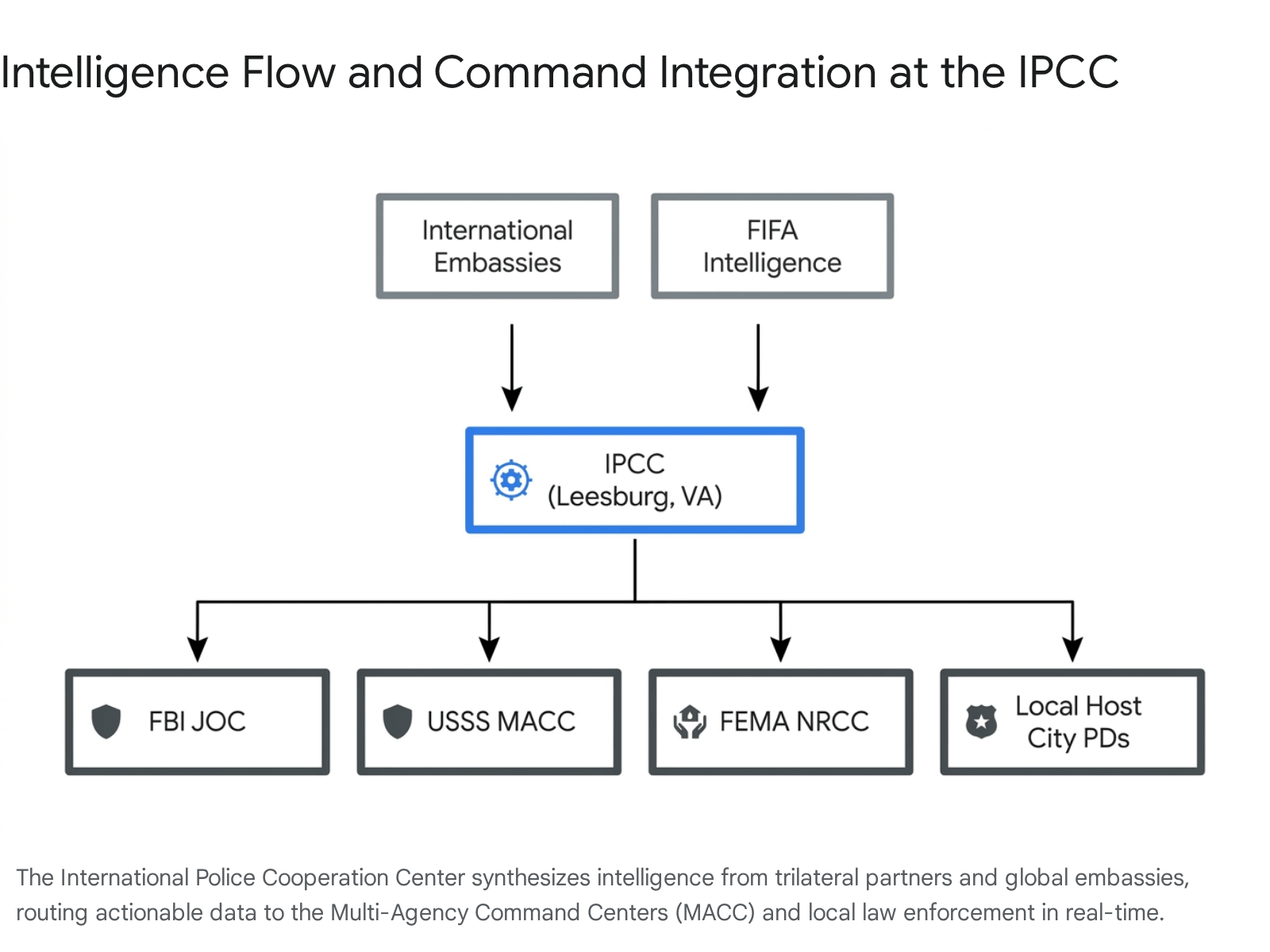
The nerve center for multinational threat assessment and rapid intelligence dissemination during the tournament is the International Police Cooperation Center (IPCC), located at the National Conference Center in Leesburg, Virginia.2 Facilitated in 2025 by the FBI’s Critical Incident Response Group under a mandate from the White House Task Force (Executive Order 14234), the IPCC operates as a secure, 24-hour centralized coordination hub.2
The architectural layout of the IPCC is deliberately designed to reduce bureaucratic friction and foster immediate operational trust. Command desks are arranged to co-locate international liaison officers from participating countries directly with representatives from all 16 host cities.2 This spatial design enables the near-instantaneous transmission of intelligence regarding high-risk individuals, extremist networks, or organized criminal elements entering North America.2 Intelligence sourced from U.S. embassies abroad, state fusion centers, and FIFA’s proprietary risk networks is aggregated within the IPCC, allowing foreign policing intelligence to be rapidly translated into actionable, localized protective measures.2
During pre-tournament operations, officials including White House Task Force Executive Director Andrew Giuliani and FBI Special Agent in Charge Doug Olson highlighted the center’s capacity to actively process upwards of 300 threat assessments and tips in a single day.2 The threats managed range from localized disturbances, such as supporters attempting to smuggle unauthorized pyrotechnics into venues, to highly severe national security concerns including human trafficking rings and coordinated terror plots.2 Throughout the tournament, the IPCC monitors a shared situational awareness dashboard, maintaining a unified operating picture across all stadiums, fan fests, and critical transit nodes to support enterprise-wide decision-making.2
2.4 Cross-Border Synergies and Intelligence Operations
The trilateral nature of the 2026 event necessitates profound integration between United States, Canadian, and Mexican security apparatuses. Through initiatives coordinated by the Organization of American States (OAS) and the((https://unicri.org/News-Coordinating-Security-Across-Borders-Canada-Mexico-United-States-Prepare-for-the-FIFA-World-Cup-2026)) (UNICRI), the three nations are actively aligning their security frameworks, planning timelines, and technological interoperability.7 A key element of this collaboration was the Peer-to-Peer Trilateral Meeting held in Washington, D.C., which gathered delegates from all 16 hosting cities to establish formalized cross-border information sharing protocols and develop strategies to mitigate disinformation, cyber threats, and hooliganism.7
Canada has committed substantial resources to secure matches in Vancouver and Toronto. The federal government allocated an additional $145 million to support local public safety agencies, building upon a baseline $220 million commitment and a separate $100 million budget for federal partners.14 The Royal Canadian Mounted Police (RCMP) leads the federal law enforcement effort, collaborating closely with the Canada Border Services Agency (CBSA) to collect intelligence on high-priority criminal threats, particularly entities exploiting the Nexus trusted traveler program.15 To support these operations, Shared Services Canada (SSC) provides resilient, secure digital networks at FIFA sites, ensuring that the RCMP and local police maintain uninterrupted communications infrastructure.16
Mexico approaches tournament security through an extensive, highly visible militarized deployment, a strategy validated during previous domestic international events. Operations such as “Plan Kukulkan” mobilize nearly 100,000 personnel drawn from the military, the Air Force, the National Guard, and municipal police forces.17 The Mexican security model relies on establishing deep, multi-layered perimeters, extending up to a one-mile radius around venues like the Estadia Azteca.17 This physical perimeter is reinforced by advanced surveillance architecture, including the deployment of robotic dogs, 33 surveillance drones, 24 tactical aircraft, and 188 specialized explosive and narcotic canine detection teams.17 Together, these trilateral efforts form a continental security shield designed to detect and neutralize threats prior to border transit.
3. Threat Landscape and Multi-Domain Risk Analysis
The overarching security apparatus must manage a highly convergent threat environment where physical, digital, and geopolitical risks intersect continuously. The scale and global visibility of the event ensure that localized disruptions possess the inherent potential to cascade into significant international incidents, requiring constant analyst-led assessment to maintain real-time situational awareness.
3.1 Supporter-Related Violence and Hooliganism
Unlike typical North American professional sporting events, international soccer possesses a long, well-documented history of organized supporter violence, commonly referred to as hooliganism.3 Opposing fan bases frequently travel with embedded organizational structures capable of orchestrating pre-planned violence or inciting spontaneous riots. Trilateral intelligence planners have focused heavily on this risk, engaging experts such as Franco Berlin of the Argentine Ministry of National Security to model supporter behavior and crowd control dynamics.7
Threat assessments indicate that because stadium perimeters are highly fortified with rigid access controls, criminal activity and violent confrontation will naturally displace into softer, secondary environments.18 This includes transit hubs, official fan festivals, local hospitality sectors, and team base camps.19 Furthermore, risk intelligence analysts warn that this distributed threat surface increases the likelihood of crimes of opportunity targeting unfamiliar visitors, as well as an escalation in human trafficking and exploitation linked to the massive influx of international travelers and temporary workforces.19 The high concentration of rival factions in dense urban centers requires preemptive intelligence gathering and physical separation tactics to prevent mass-casualty crowd crush events, unmanaged gatherings, or wide-scale rioting in public squares.19
3.2 Geopolitical Activism and Lone-Actor Extremism
The 2026 World Cup provides an unparalleled global platform for geopolitical messaging and targeted activism. Security analysts forecast persistent protest activity driven by international conflicts, domestic political disputes across the host nations, and localized economic disparities.20 While organized activist groups may seek to disrupt transit infrastructure or blockade main stadium access routes to maximize visibility, a more severe kinetic threat profile involves lone-actor extremists.19
Driven by ideological extremism—ranging from Islamist extremism to domestic left- or right-wing militant ideologies in the U.S. and Canada—these individuals typically target the periphery of the event.20 Because host nations maintain highly sophisticated intelligence capabilities to detect and disrupt coordinated, high-casualty terror plots involving multiple operatives, the primary physical threat is derived from isolated actors exploiting the “path of least resistance” in areas with high population density but lower security screening thresholds.18
3.3 The Cyber-Physical Convergence
The modern World Cup relies heavily on deeply interconnected digital infrastructure, creating a massive, highly lucrative attack surface for sophisticated cybercriminals and state-aligned actors. Analysts forecast severe stress tests on global digital infrastructure throughout the tournament.19 The risks extend far beyond data theft; during the 2024 Paris Olympics alone, authorities confirmed over 140 cyber-attacks targeting critical systems.21
For the 2026 tournament, identified cyber risks include widespread ticketing fraud utilizing fake domains that impersonate official FIFA platforms, alongside targeted phishing and social engineering campaigns directed at vendors, event staff, and logistics personnel.19 Most critically, ransomware and Distributed Denial of Service (DDoS) attacks pose a direct physical risk if directed at municipal transit grids, emergency 911 dispatch systems, or stadium access controls.19 A localized digital failure affecting stadium turnstiles or rail schedules could instantly induce dangerous crowd bottlenecks and physical crush risks. To mitigate these logistical vulnerabilities, FIFA relies on enterprise-grade AI command centers, such as the Lenovo technology hub in Miami, to continuously monitor and coordinate team arrivals, stadium resources, and fan transportation networks in real-time.1
4. Adaptation of European Mounted Unit Tactics for Crowd Management
To safely manage the specific behavioral dynamics of massive international soccer crowds, North American law enforcement agencies are undertaking a fundamental overhaul of their public order strategies. A cornerstone of this tactical evolution is the widespread adoption of European and British mounted police methodologies, shifting the role of police cavalry from passive patrol to dynamic crowd manipulation.8
4.1 The Strategic Utility of Police Cavalry in Public Order
The deployment of mounted police units offers an unparalleled mass advantage in civil disorder and crowd management scenarios. Due to the sheer physical dimensions, muscle mass, and weight of a horse, a single mounted officer can safely exert the crowd-displacement force of ten to twelve officers on foot.8 This biological force multiplier allows agencies to push back dense, agitated crowds and physically separate violently opposed fan bases while simultaneously conserving highly valuable ground personnel for targeted arrests or perimeter defense.
Furthermore, mounted units provide critical “vantage point policing” capabilities. Seated approximately ten feet above ground level, mounted officers possess significantly enhanced situational awareness over a packed crowd. This elevated perspective enables the early visual detection of localized fights, medical emergencies, or dangerous crowd surges that would remain entirely invisible to foot patrols submerged within the mass, allowing commanders to intervene and de-escalate situations before they compound.8
4.2 European Methodologies and the “Turnstile” Concept
Historically, U.S. mounted units have been utilized primarily for community engagement or general park patrols.23 To prepare for the World Cup, agencies including the Atlanta Police Department and the Cobb County Sheriff’s Office have partnered with specialized public order consultancies—most notably Survival Edge Tactical Systems.8 Led by instructors with extensive experience in London’s Metropolitan Police and other European forces, these training programs import tactics proven effective against football hooliganism across the United Kingdom and Germany.8
These European doctrines treat the mounted unit as a highly dynamic tool for physical crowd manipulation. A primary tactical application involves utilizing horses as living “turnstiles.” In this capacity, mounted units are positioned strategically at chokepoints to manage and restrict the flow of thousands of supporters moving toward stadium entrances or transit stations, preventing dangerous crushes by regulating the entry velocity of the crowd.8 Additionally, mounted units are designated to secure and escort massive fan marches, flanking the perimeters of the procession to insulate the supporters from vehicular traffic and rival factions.8
Crucially, planners must carefully distinguish between authorized crowd control tactics like “encirclement” and the more controversial European tactic known as “kettling.” While kettling involves police cordons completely containing a large, potentially violent crowd for an extended period—a tactic frequently challenged in human rights contexts—encirclement is a targeted maneuver. Mounted units may use encirclement to isolate a very specific, small section of a crowd to extract a downed officer, separate antagonistic instigators, or execute targeted arrests (snatch squads) without trapping innocent bystanders.
4.3 Dynamic Formations and Tactical Execution
The effectiveness of a mounted unit during civil disorder relies entirely on precise, coordinated geometric formations designed to break the momentum of a mob. These movements must be executed flawlessly amidst extreme acoustic chaos, relying on visual hand signals and standardized auditory commands relayed by the platoon leader.25 The tactical deployment of these formations allows commanders to maneuver the crowd into advantageous positions.
| Tactical Formation | Configuration | Primary Objective | Operational Risk / Limitation |
| Line Formation | Horses positioned shoulder-to-shoulder in a straight horizontal wall. | Broad crowd displacement; pushing mobs straight back across an open area or street. | Susceptible to being outflanked by the crowd in wide, unconfined urban spaces. |
| Wedge Formation | Configured like geese in flight (an inverted ‘V’). Signaled by the commander raising arms in a “V” with clenched fists. | Penetration; splitting a dense mob; escorting dismounted “snatch squads” to capture instigators. | Exposes the flanks of the lead horse to lateral attacks or projectiles from the crowd. |
| Echelon Formation | Organized in a staggered diagonal line, sloping either to the left or right. | Directional diversion; sweeping crowds away from vulnerable infrastructure or opposing fan zones. | Requires highly precise pacing to maintain the staggered diagonal wall without breaking the line. |
| Diamond Formation | A closed geometric modification of the wedge providing cover on all sides. | 360-degree defense; protecting downed officers or VIPs requiring extraction. | Extremely high risk of encirclement and isolation if the unit is vastly outnumbered by the mob. |
The application of the wedge formation is particularly critical for targeted interventions. As the wedge drives into the center of a hostile crowd, it parts the mass, allowing a closely following, dismounted arrest team—often referred to as a “snatch squad”—to safely infiltrate the mob, identify ringleaders, and extract them behind the police line without triggering a broader riot.27
4.4 Equine Desensitization, Logistics, and Embedded Medical Support
The success of these close-quarters formations relies inherently on overriding the biological flight instinct of the horse. Extensive desensitization, or “bombproofing,” is currently the focus of daily operations across host city mounted units. Through continuous repetition, positive reinforcement, and specialized obstacle courses, horses are subjected to extreme sensory overload.8 Instructors expose the animals to industrial smoke machines, wailing sirens, exploding firecrackers, waving flags, and the discharge of blank ammunition directly from the saddle, continuing the training until the horses demonstrate absolute neutrality to riot conditions.8
Sustaining this capability during continuous tournament operations requires meticulous logistics and the procurement of advanced riot equipment matching the British Home Office Scientific Development Branch (HOSDB) standards.24 Recognizing the severe physiological toll on the animals, agencies are implementing European logistical models, deploying mobile staging trailers directly to the operational theater. These forward operating bases are equipped with large volumes of water, forage, and electrolyte syringes, allowing units to rotate out of the hot zone frequently.8 Crucially, operations will feature specialized veterinarians embedded directly into the field alongside the officers on match days. This protocol ensures immediate trauma care is available for any mounts injured by projectiles or crowd violence, securing the operational continuity of the unit.8
5. Dynamic Threat Response in Gridlocked Urban Environments
The influx of millions of international visitors will severely degrade the baseline transportation infrastructure of the host cities. The resulting logistical gridlock poses an existential threat to traditional emergency medical and tactical response models, forcing public safety planners to rethink deployment strategies fundamentally.
5.1 The Friction of Traffic Congestion on Emergency Services
Traffic congestion drastically compromises the efficiency and life-saving capabilities of police, fire, and Emergency Medical Services (EMS). Current industry data indicates that nearly 50% of first responder agencies report worsening response times year-over-year, with 41.7% specifically citing traffic gridlock as the primary insurmountable variable.29 During the high-density travel windows surrounding World Cup matches, the sheer volume of pedestrian and vehicular movement creates localized paralysis in the urban core.
If an incident requires mass evacuation—due to a natural disaster, structural fire, or targeted attack—standard traffic flows collapse entirely. Planners rely on advanced geographic information systems (GIS) and Intelligent Transportation Systems (ITS) to simulate traffic flow and establish viable, pre-planned egress corridors.30 However, in these paralyzed environments, the traditional reliance on heavy, motorized ambulances and large armored tactical vehicles to reach the point of injury is fundamentally flawed.
5.2 Tactical Emergency Medical Support (TEMS) and the Rescue Task Force (RTF)
Historically, during active threat scenarios or mass casualty incidents, conventional fire and EMS personnel adhered to strict operational doctrine: stage in a secure “cold zone” safely outside the perimeter, and wait for law enforcement to entirely neutralize the threat before advancing to treat casualties. This paradigm resulted in significant, often fatal delays in point-of-wounding care, a reality starkly exposed during the 1999 Columbine High School incident.9
To adapt to the modern threat landscape, the public safety architecture has shifted heavily toward Tactical Emergency Medical Support (TEMS) and the Rescue Task Force (RTF) model.33 Developed and refined following the Hartford Consensus protocols, the RTF model pairs conventionally trained fire and EMS personnel with a heavily armed law enforcement escort.35 Outfitted in ballistic personal protective equipment, the RTF aggressively pushes into the “warm zone”—areas where a direct threat is not currently active, but the environment is not entirely secure. This integration allows for immediate hemorrhage control, tourniquet application, and airway management at the exact point of injury.9
Successful “warm zone integration” requires meticulous coordination; joint evaluations of LEO-EMS simulated responses demonstrate that failing to maintain a tight, protective LEO-EMS physical formation is one of the most critical operational errors during extraction. During the World Cup, Casualty Collection Points (CCP) will be pre-identified in warm zones within stadiums and fan fests, heavily reliant on the disciplined RTF framework to stabilize victims prior to extraction through the gridlock.34
5.3 Two-Wheeled Rapid Response: Bicycles and Motorcycles
To successfully extract patients or deploy critical medical personnel through impenetrable traffic to reach these warm zones, host cities are drastically expanding their two-wheeled rapid response capabilities.
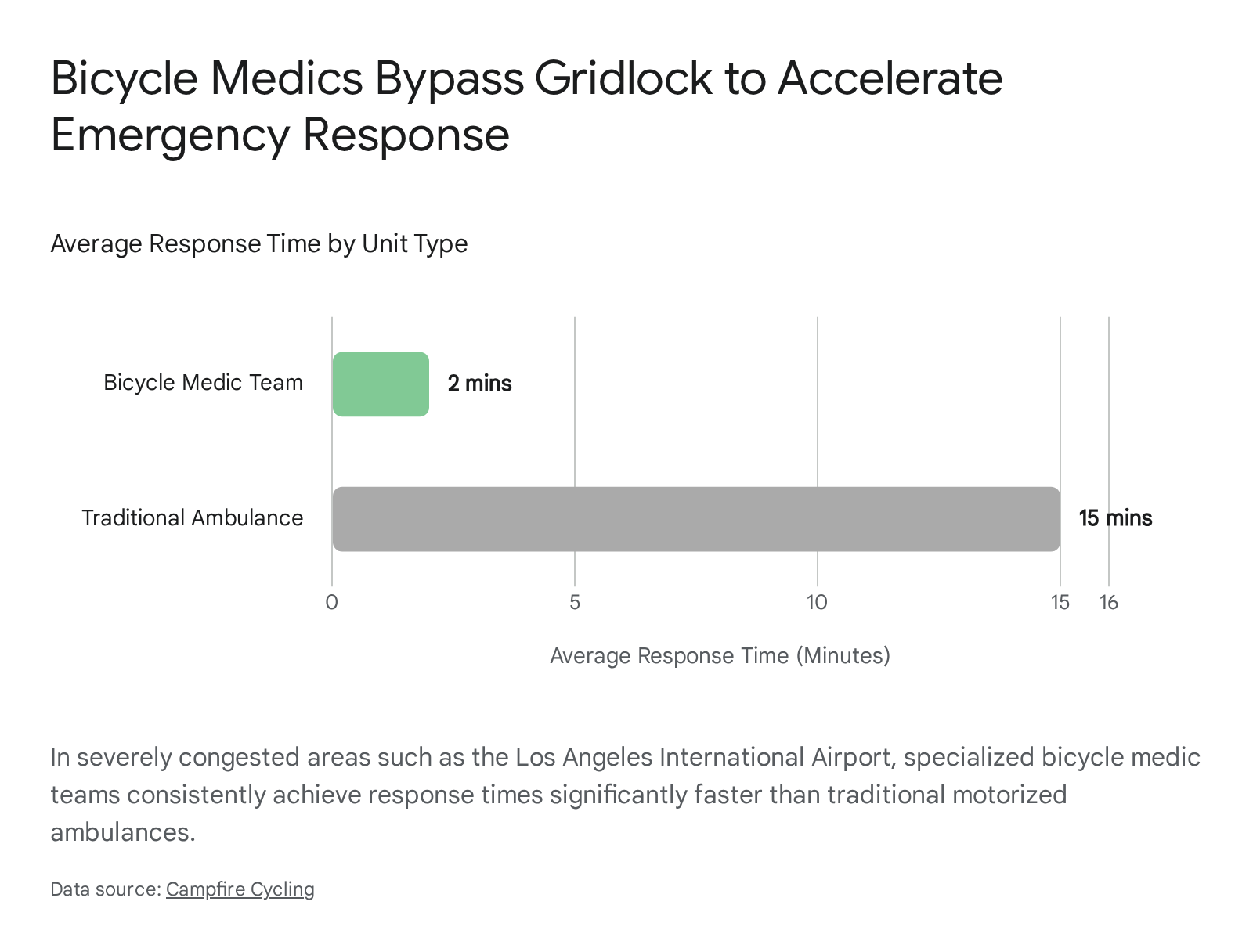
Bicycle Rapid Response Teams: Bike medics possess an unparalleled capacity to navigate dense pedestrian crowds, access narrow alleyways, traverse difficult terrain, and utilize sidewalks or transit corridors entirely inaccessible to motorized transport.10 Case studies from high-density environments demonstrate their efficacy; the Los Angeles Fire Department maintains a full-time bike medic team at the Los Angeles International Airport that routinely achieves response times of two minutes, drastically outperforming traditional ambulances that require up to fifteen minutes to navigate the notorious local gridlock.10 Across the country, approximately 300 specialized bike medic teams are deployed to provide immediate life-saving interventions in environments where heavy vehicles cannot operate.39
Motorcycle Medic Units: For slightly longer transit distances requiring the bypass of vehicular bottlenecks, motorcycle units provide exceptional rapid response capabilities.40 Agencies in cities like Pittsburgh frequently deploy specialized motorcycle medics during major civic events and fireworks displays to intercept heat casualties or trauma victims before heavy ambulances can penetrate the perimeter.42 The speed, narrow profile, and agility of the police motorcycle allow tactical medical assets to weave between stopped vehicles and penetrate the core of an incident rapidly, applying stabilizing care while extraction logistics are coordinated.40
6. Counter-Unmanned Aircraft Systems (C-UAS) and Airspace Interdiction
The rapid proliferation of commercial drone technology presents a highly asymmetrical threat profile to massive open-air venues. Unauthorized Unmanned Aircraft Systems (UAS) pose severe risks, ranging from accidental crashes into packed grandstands causing panic, to the deliberate, malicious deployment of chemical agents or explosive payloads directly over densely populated areas. Securing the airspace requires a robust synthesis of federal regulation and advanced military-grade electronic warfare capabilities.
6.1 Temporary Flight Restrictions (TFR) and Federal Statutes
To establish a sanitized and easily monitored airspace, the Federal Aviation Administration (FAA) will implement strict Temporary Flight Restrictions (TFR) covering all stadiums, official fan festivals, and team encampments throughout the tournament.43 These restrictions dictate precise geographical boundaries, altitude ceilings, and operational timeframes where all civilian drone operations are expressly prohibited. For example, comprehensive TFRs are slated for the airspace surrounding the seven matches hosted at Boston Stadium, as well as the Fan Fest located at Boston City Hall Plaza, establishing a rigid “no-drone zone”.43
Enforcement of these TFRs transitions the airspace from a regulatory concern to an active, zero-tolerance security operation. Unauthorized intrusion into a World Cup TFR is classified as a federal crime, carrying severe penalties that include the permanent seizure of the equipment, up to one year in federal prison, and criminal fines reaching $100,000.43 The FBI maintains explicit statutory authority to deploy counter-UAS mitigation capabilities to detect, track, intercept, and disable unauthorized drones operating within these restricted zones, while simultaneously preserving the hardware for subsequent forensic exploitation and federal prosecution.43
6.2 Civil-Military Integration and the Transfer of Combat Doctrine
The technological requirements for effective C-UAS operations far exceed the baseline capabilities of traditional municipal police departments. Consequently, securing the World Cup airspace requires extensive civil-military integration and the direct transfer of combat-tested methodologies to domestic law enforcement.
To bridge this critical capability gap, the U.S. Army’s Joint Interagency Task Force 401 (JIATF-401), directed by Brig. Gen. Matt Ross, has partnered directly with the FBI.45 Operating through the FBI’s National Counter-UAS Training Center (NCUTC), military instructors are actively transferring Department of Defense drone detection and mitigation practices to state, local, tribal, and territorial law enforcement personnel.45 This exhaustive training curriculum, executed at facilities such as the Yakima Training Center in Washington, encompasses nighttime detection protocols, complex airspace awareness, and coordinated electronic mitigation techniques designed to neutralize drones without causing kinetic fallout or collateral damage over crowded urban areas.45
6.3 Procurement and Implementation of Mitigation Hardware
State agencies are heavily invested in acquiring the necessary hardware to support these advanced operations. Supported by the FEMA FWCGP grant distributions, entities such as the Texas Department of Public Safety have executed multimillion-dollar acquisitions of advanced detection telemetry and mitigation technology, securing $3.2 million specifically for C-UAS hardware. As international stakeholders, including Representative Michael McCaul, raise concerns regarding the potential for state actors or terrorist organizations to utilize drone technology, the implementation of these systems is accelerating.46
During the tournament, a record number of venues will be enveloped in C-UAS mitigation networks. In 2025, only five SEAR-level (Special Event Assessment Rating) events in the United States featured counter-drone coverage; for the 2026 World Cup alone, an unprecedented 326 individual events, matches, and fan gatherings will be protected by active C-UAS mitigation systems, representing a historic escalation in domestic airspace security operations.2
| C-UAS Mitigation Phase | Primary Agency Involvement | Tactical Objective |
| Regulatory Perimeter | Federal Aviation Administration (FAA) | Establish Temporary Flight Restrictions (TFRs); dictate legal boundaries. |
| Detection & Tracking | Local LE, FBI, State DPS | Identify unauthorized signatures; track telemetry and pinpoint operator location. |
| Kinetic/Electronic Interdiction | FBI, Specialized Military/State Units | Disable or assume control of the UAS, minimizing ground casualty risk. |
| Forensic Exploitation | FBI | Seize hardware; extract operational data; pursue federal prosecution. |
7. Strategic Conclusions
The public safety architecture designed for the 2026 FIFA World Cup represents a defining evolution in the execution of major event security. The massive scale of a trilateral, 16-city tournament precludes the viability of isolated, municipal-level security planning. Instead, the operational reality demands a deeply fused, overarching federal command structure, exemplified by the SEAR/NSSE framework and the real-time global intelligence synchronization achieved at the International Police Cooperation Center.
Furthermore, the operational environment dictates severe tactical pivots. The integration of robust European mounted police doctrines provides necessary physical leverage for complex crowd management scenarios, while the rapid adoption of the Rescue Task Force model and two-wheeled medical dispatch effectively circumvents the paralyzing reality of urban gridlock. Finally, the militarization of domestic airspace security through expansive C-UAS networks highlights the critical need to adapt continuously to asymmetric technological threats.
Ultimately, the intelligence-sharing frameworks, interagency funding mechanisms, and tactical cross-training protocols established for the 2026 World Cup will forge a permanent legacy. The standard operating procedures developed during this tournament will irrevocably alter the baseline parameters for public order policing, emergency mass casualty response, and multi-agency coordination for all future North American high-density events.
Appendix: Analytical Approach and Source Architecture
The analytical framework governing this report relies on the synthesis of multi-source intelligence, tactical doctrine, and documented federal security directives related to the 2026 FIFA World Cup. The integration of data across disparate operational domains—ranging from high-level command structures to granular tactical field maneuvers—was achieved by analyzing the intersections of specific law enforcement, emergency management, and military source materials.
Information regarding the overarching command architecture, including SEAR/NSSE designations, FEMA funding parameters, and the IPCC infrastructure, was synthesized from federal communications, State Department briefings, and Congressional oversight documents.
Cross-border security integration parameters and regional risk intelligence matrices were evaluated utilizing reports from international cooperatives (such as UNICRI and the OAS), host-nation government declarations, and private sector risk intelligence analysts mapping cyber and physical vulnerabilities.19
Tactical evaluations of European mounted police crowd-control formations and desensitization training were derived from public order training consultancies, active law enforcement periodicals, and historical tactical manuals detailing cavalry integration into modern policing.
Assessments of emergency response models within gridlocked environments, encompassing the transition to TEMS, the RTF model, and rapid-response bicycle/motorcycle integration, were formulated using emergency management planning guidelines, public safety logistics reports, and specific operational case studies from heavily congested municipalities.
Finally, parameters regarding airspace interdiction, FAA Temporary Flight Restrictions, and civil-military counter-UAS training programs were analyzed through joint DoD-FBI public releases, drone industry publications, and state-level public safety procurement documentation.2
Works cited
- FIFA’s Best-Kept Secret: The AI Command Center Powering the 2026 World Cup, accessed July 1, 2026, https://www.pcmag.com/news/fifas-best-kept-secret-the-ai-command-center-powering-the-2026-world-cup
- Inside the FIFA World Cup 2026™ International Police Cooperation Center, accessed July 1, 2026, https://www.state.gov/briefings-foreign-press-centers/inside-the-world-cup-ipcc
- Full article: Conceptualizing FIFA World Cup security – Taylor & Francis, accessed July 1, 2026, https://www.tandfonline.com/doi/full/10.1080/14660970.2026.2640515
- Google Sports Data, accessed July 1, 2026, https://support.google.com/knowledgepanel/answer/9787176
- Protecting the Goal: Stadium Security Preparations for the 2026 …, accessed July 1, 2026, https://www.kroll.com/en/publications/world-cup-2026-a-security-focused-breakdown
- National Special Security Events Credentialing – Secret Service, accessed July 1, 2026, https://www.secretservice.gov/protection/events/credentialing
- Coordinating Security Across Borders: Canada, Mexico and the United States Prepare for the FIFA World Cup 2026 | UNICRI :: United Nations Interregional Crime and Justice Research Institute, accessed July 1, 2026, https://unicri.org/News-Coordinating-Security-Across-Borders-Canada-Mexico-United-States-Prepare-for-the-FIFA-World-Cup-2026
- How police mounted units are preparing for the World Cup – Police1, accessed July 1, 2026, https://www.police1.com/securing-2026/how-police-mounted-units-are-preparing-for-the-world-cup
- Rescue Task Force (RTF), accessed July 1, 2026, https://mi-bcfa.org/images/Trainings/2024-11-02_RTF.pdf
- Bike Medics Do It Faster – CampfireCycling.com, accessed July 1, 2026, https://www.campfirecycling.com/blog/2016/06/16/bike-medics-do-it-faster
- Pre-NSSE Coordination – FHWA Office of Operations – Department of Transportation, accessed July 1, 2026, https://ops.fhwa.dot.gov/publications/fhwahop11012/nsse5_2.htm
- Planning And Managing Security For Major Special Events: – Agency Portal, accessed July 1, 2026, https://portal.cops.usdoj.gov/resourcecenter/content.ashx/cops-w0703-pub.pdf
- Full Statement of Timothy J. Koerner – ACLU of Colorado, accessed July 1, 2026, https://www.aclu-co.org/app/uploads/2023/10/Testimony.USSS_.Koerner.pdf
- Government of Canada announces up to $145 million to support public safety and security for the FIFA World Cup 2026, accessed July 1, 2026, https://www.canada.ca/en/public-safety-canada/news/2026/04/government-of-canada-announces-up-to-145-million-to-support-public-safety-and-security-for-the-fifa-world-cup-2026.html
- Royal Canadian Mounted Police’s 2026–27 Departmental Plan, accessed July 1, 2026, https://rcmp.ca/en/corporate-information/publications-and-manuals/departmental-plans/2026-2027
- Government of Canada partners prepare for FIFA World Cup 2026™ with SSC, accessed July 1, 2026, https://www.canada.ca/en/shared-services/campaigns/stories/government-canada-partners-prepare-fifa-world-cup-2026-ssc.html
- Security tight in Mexico as World Cup opens – The Watch, accessed July 1, 2026, https://thewatch-journal.com/2026/06/24/security-tight-in-mexico-as-world-cup-opens/
- Three security risks shaping the 2026 FIFA World Cup – Securitas, accessed July 1, 2026, https://www.securitas.com/en/newsroom/blog/three-security-risks-shaping-the-2026-fifa-world-cup/
- Navigating the Threat Landscape of the 2026 FIFA World Cup – Flashpoint, accessed July 1, 2026, https://flashpoint.io/blog/2026-fifa-world-cup-threat-landscape/
- Q&A: What Makes Securing This Year’s World Cup Different? – ASIS International, accessed July 1, 2026, https://www.asisonline.org/security-management-magazine/articles/2026/05/world-cup-security/QA-Geopolitical-hooligans/
- The three security threats and risks shaping the 2026 FIFA World Cup – Securitas, accessed July 1, 2026, https://www.securitasinc.com/news-insights/blog/the-three-security-threats-and-risks-shaping-the-2026-fifa-world-cup/
- America250 Fourth of July Threat Assessment – Security Boulevard, accessed July 1, 2026, https://securityboulevard.com/2026/06/america250-fourth-of-july-threat-assessment/
- Crowd Control and More: Modern Police Mounted Units – The Blue Magazine, accessed July 1, 2026, https://www.thebluemagazine.com/columnist-upload-here/2025/11/10/crowd-control-and-more-modern-police-mounted-units
- Public-Order-LEVEL-1 – Survival Edge Tactical Systems, accessed July 1, 2026, https://survivaledgetactical.com/public-order-level-1/
- Education & Training Bulletin – ETB 11-02 – Crowd Control Operations – Chicago Cop, accessed July 1, 2026, https://chicagocop.com/wp-content/uploads/Education-Training-Bulletin-ETB-11-02-Crowd-Control-Operations.pdf
- Signals for dynamic crowd control tactics – Police1, accessed July 1, 2026, https://www.police1.com/crowd-control/articles/signals-for-dynamic-crowd-control-tactics-hIL2vITDijIyXAq4/
- 3 basic formations used for riot control – YouTube, accessed July 1, 2026, https://www.youtube.com/shorts/4_Mrxs9iDrc
- Riot control – Wikipedia, accessed July 1, 2026, https://en.wikipedia.org/wiki/Riot_control
- The growing challenge of traffic congestion on emergency response times, accessed July 1, 2026, https://www.smartcitiesdive.com/news/archive-acc-the-growing-challenge-of-traffic-congestion-on-emergency-response-times/754760/
- Emergency Evacuation Planning: Minimizing Gridlock and Improving Public Safety, accessed July 1, 2026, https://www.anylogic.com/resources/case-studies/emergency-evacuation-planning-minimizing-gridlock-and-improving-public-safety/
- Preparedness and Catastrophic Event Management for the Washington, D.C. Metropolitan Area, FTA Report No. 0007 – Federal Transit Administration, accessed July 1, 2026, https://www.transit.dot.gov/sites/fta.dot.gov/files/docs/FTA_Report_No._0007.pdf
- USING HIGHWAYS FOR NO-NOTICE EVACUATIONS – ROSA P, accessed July 1, 2026, https://rosap.ntl.bts.gov/view/dot/20674/dot_20674_DS1.pdf
- Webinar: (2022) Rescue Task Force: Public Safety’s Current Jedi Mind Trick – Online – National Tactical Officers Association – NTOA Publications, accessed July 1, 2026, https://public.ntoa.org/default.asp?action=viewonline&courseid=20222270
- INCIDENT COMMAND SYSTEM PUBLICATION UNIFIED RESPONSE TO VIOLENCE INCIDENTS ICS 701 January 2023 – Firescope, accessed July 1, 2026, https://firescope.caloes.ca.gov/ICS%20Documents/ICS%20701.pdf
- Fixing the Rescue Task Force – Police1, accessed July 1, 2026, https://www.police1.com/active-shooter/articles/fixing-the-rescue-task-force-EesmgZQFEk25kTn0/
- Integrated ASHER/RTF Program – Gila River Indian Community Public Safety, accessed July 1, 2026, https://www.gricsafety.org/index.php/emergency-medical-services/asherrtf
- The Rise, Fall and Rebirth of Bicycle Police by Ross D. Petty Babson College Babson Park, MA 02457 USA – IPMBA, accessed July 1, 2026, https://ipmba.org/images/uploads/Ross_Petty_History_of_Bike_Patrol.pdf
- EMS Functions in ICS-Student Manual – National Fire Academy, accessed July 1, 2026, https://apps.usfa.fema.gov/ax/sm/sm_0166.pdf
- ipmba news, accessed July 1, 2026, https://ipmba.org/images/uploads/IPMBA_News_Summer_2006_WebR.pdf
- Police Motorcycles: The Ultimate Guide To These Iconic Bikes – The Wrasse Gazette, accessed July 1, 2026, https://wrasse.plymouth.ac.uk/ac-news/police-motorcycles-the-ultimate-guide-to-these-iconic-bikes-1764802618
- Beyond Police Motorcycle Officer: On Two Wheels For Justice – The Wrasse Gazette, accessed July 1, 2026, https://wrasse.plymouth.ac.uk/ac-news/police-motorcycle-officer-on-two-wheels-for-justice-1764800440
- Public Safety – Pittsburgh, PA, accessed July 1, 2026, https://www.pittsburghpa.gov/City-Government/City-Information/City-Press-Release-Archive/Public-Safety
- FBI Boston Warns Drone Operators of Temporary Flight Restrictions During FIFA World Cup 2026, accessed July 1, 2026, https://www.fbi.gov/contact-us/field-offices/boston/news/fbi-boston-warns-drone-operators-of-temporary-flight-restrictions-during-fifa-world-cup-2026
- FBI, DHS emphasize no-drone zones as World Cup kicks off, accessed July 1, 2026, https://fedscoop.com/dhs-fbi-fifa-world-cup-counter-uas-robodogs/
- U.S. Army, FBI expand counter-drone training ahead of 2026 World Cup, accessed July 1, 2026, https://uasmagazine.com/articles/us-army-fbi-expand-counter-drone-training-ahead-of-2026-world-cup
- DHS Secretary: U.S. Still Building Counter-Drone Defenses for World Cup, accessed July 1, 2026, https://dronelife.com/2026/06/05/world-cup-counter-drone-defenses-mullin/
- Washington National Guard Builds Counter-UAS Partnerships Ahead of World Cup 2026, accessed July 1, 2026, https://www.war.gov/News/News-Stories/Article/Article/4509924/washington-national-guard-builds-counter-uas-partnerships-ahead-of-world-cup-20/
- DPS Secures Drone Mitigation Technology Ahead of 2026 FIFA World Cup, accessed July 1, 2026, https://www.dps.texas.gov/news/dps-secures-drone-mitigation-technology-ahead-2026-fifa-world-cup