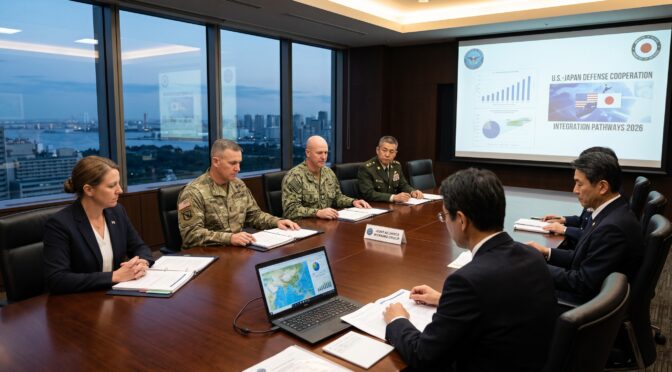
Executive Summary: The Alliance Transformation
The U.S.-Japan Alliance has transitioned from a Cold War-era asymmetrical partnership into a deeply integrated, cross-domain combat union. For decades, the alliance operated under the “shield and spear” (盾と矛, Tate to Hoko) doctrine: Japan provided a defensive shield for its territory, while the United States served as the offensive spear for power projection. However, the Defense of Japan 2026 white paper and the Security Consultative Committee (2+2) have mandated comprehensive reforms that dismantle this division, leading to unprecedented bilateral operational synchronization1.
The primary goal of this transformation is to ensure seamless, real-time coordination to deter or defeat high-intensity threats across the East China Sea and the Taiwan Strait. This shift began with Japan’s 2022 security strategies, which committed to increasing the defense budget to two percent of GDP—approximately ¥43 trillion by 20274. Supported by a record ¥9.04 trillion ($58 billion) budget for Fiscal Year 2026, Japan is now assuming long-range kinetic roles once held exclusively by the U.S. military6.
Despite this deep integration, the allies maintain parallel command structures rather than a single unified command. While merging intelligence, surveillance, and reconnaissance (ISR) and defense industrial bases, Tokyo retains independent control of its forces. This architecture allows Japan to navigate domestic constitutional limits on collective self-defense and avoid automatic entrapment in regional conflicts4. As a result, the alliance functions as a highly synchronized, federated network of complementary capabilities.
Part I: Command, Control, & Bilateral Synchronization (C2 Modernization)
The most significant evolution in the alliance since 1960 is the modernization of bilateral command and control (C2). This effort replaces ad-hoc coordination with a permanent framework that will be used to manage multi-domain combat operations across the Indo-Pacific.
JJOC–USFJ Command Realignment and Parallel Architecture
In March 2025, the Japan Self-Defense Forces (JSDF) established the Japan Joint Operations Command (統合作戦司令部, Tōgō Sakusen Shireibu), unifying control of ground, maritime, and air forces under a four-star commander at Ichigaya10. Simultaneously, the U.S. Department of Defense reconstituted U.S. Forces Japan (在日米軍, Zainichi Beigun) into a fully empowered Joint Force Headquarters (JFHQ) reporting directly to U.S. Indo-Pacific Command2. This change elevated USFJ from an administrative role to an operational warfighting command serving as the direct counterpart to the JJOC12.
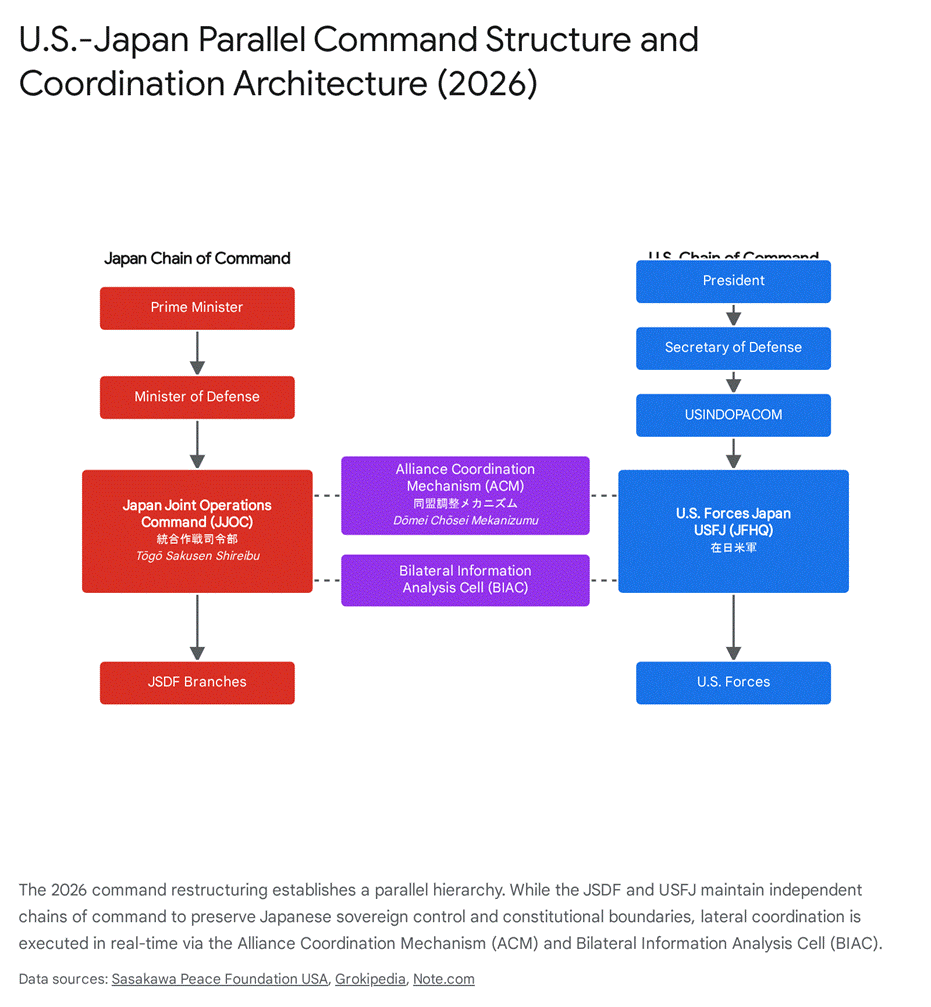
The allies chose a Parallel Command Structure (並列的な指揮系統, Heiretsutekina Shiki Keitō) over a unified binational command. In this setup, the U.S. chain of command remains separate from the Japanese chain, which flows from the Prime Minister to the JJOC. Unlike the U.S.-ROK Combined Forces Command, this architecture preserves Japan’s sovereign decision-making and provides functional “negative control.” It ensures Japan can coordinate defensive logistics during shared crises without being automatically drawn into offensive operations that do not directly threaten its survival10, 15.
Alliance Coordination Mechanism and Intelligence Fusion
The Alliance Coordination Mechanism (ACM, 同盟調整メカニズム, Dōmei Chōsei Mekanizumu) bridges these two command chains. Building on guidelines from 1997 and 2015, the ACM synchronizes bilateral responses to everything from peacetime gray-zone provocations to major armed attacks16. It is the primary vehicle for coordinating defense policy, formulated action plans, and flexible deterrence options16.
A key component is the Bilateral Information Analysis Cell (BIAC, 日米共同情報分析組織, Nichibei Kyōdō Jōhō Bunseki Soshiki) at Yokota Air Base. The BIAC fuses intelligence from U.S. and Japanese MQ-9 drones and space platforms to provide a Common Operating Picture (COP)1, 19. This unified perspective is essential for the “kill webs” required in modern warfare. Planners suggest evolving the BIAC into a trilateral hub that includes Australia to further streamline regional ISR coverage19.
Combined Targeting and Counterstrike Coordination
Japan’s new “counterstrike capabilities” (反撃能力, Hangeki Nōryoku) have fundamentally changed the alliance’s tactical outlook. With 400 U.S. Tomahawk missiles and indigenous extended-range Type 12 missiles, Japan now shares offensive strike responsibilities once held solely by the U.S.3. However, Japan remains reliant on U.S. over-the-horizon targeting data. Consequently, the JJOC and USFJ use the ACM to designate kill boxes and sequence strikes, ensuring Japanese capabilities complement U.S. long-range operations12, 21.
Because Japan currently lacks a fully mature, independent, over-the-horizon targeting architecture—specifically lacking dedicated, high-density satellite constellations and deep-penetration strategic ISR assets—the JSDF remains highly reliant on United States targeting data to guide its counterstrike munitions effectively12. Consequently, the JJOC and USFJ utilize the ACM to coordinate combined asset protection, designate specific geographic kill boxes, and sequence joint fires. This integration ensures that Japanese standoff strikes serve to augment and complement, rather than duplicate or inadvertently interfere with, United States long-range bomber operations and submarine-launched strike packages21. The strategic ambition is to present regional adversaries with a unified, distributed network of strike platforms, complicating adversary defensive planning.
Part II: Joint Operational Posture & Geographic Integration
Alliance operations have shifted southward to the First Island Chain. The goal is to establish an integrated Anti-Access/Area Denial (A2/AD) network that restricts adversary mobility in the East China Sea.
Southwestern (Nansei) Islands & First Island Chain Defense
The Nansei Island chain (南西諸島, Nansei Shotō), stretching toward Taiwan, is the geographic anchor of this posture. Japan is transforming these islands into fortified anti-ship denial barriers9.
In March 2024, the JGSDF activated the 7th Surface-to-Ship Missile Regiment in Okinawa20. By March 2026, Japan deployed advanced counterstrike systems, including the 1,000km-range Type 25 Surface-to-Ship Missile and the Type 25 Hyper Velocity Gliding Projectile (HVGP)3. The HVGP, acting as a hypersonic projectable weapon, significantly increases Japan’s standoff lethality and its ability to penetrate adversary defenses23.
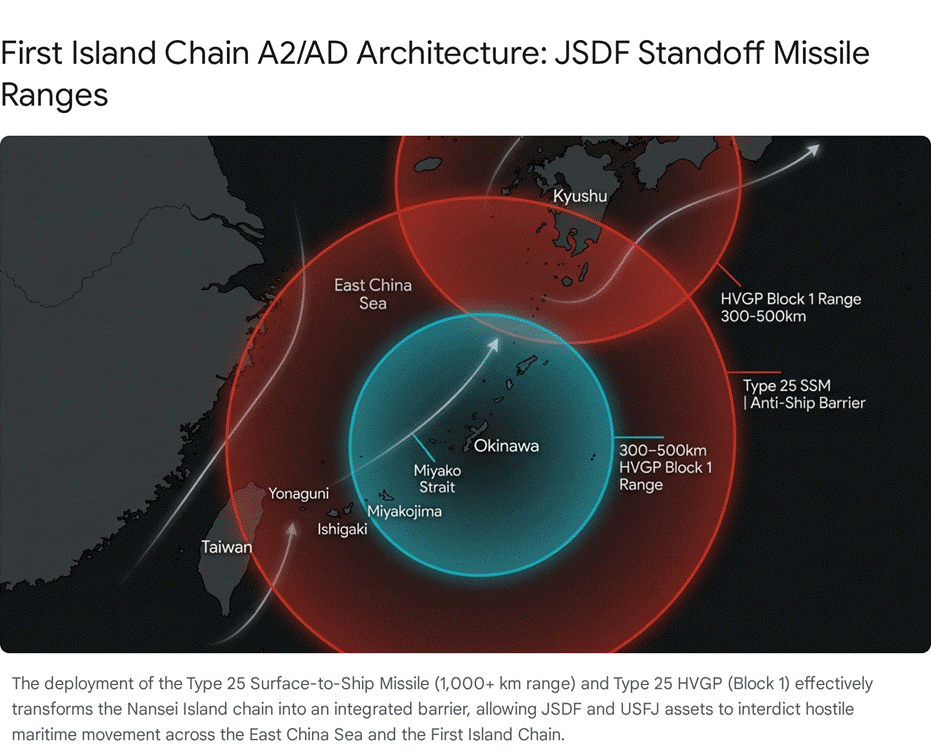
These units operate alongside the JGSDF Amphibious Rapid Deployment Brigade and the U.S. Marine Corps’ 12th Marine Littoral Regiment. Together, they execute Expeditionary Advanced Base Operations (EABO), utilizing mobile platforms across island outposts to secure vital chokepoints like the Miyako Strait22.
Integrated Air and Missile Defense (IAMD)
To counter advanced missile threats, the alliance has developed a multi-layered Integrated Air and Missile Defense (IAMD) system25.
A central part of this is the Aegis System Equipped Vessels (ASEV). Japan is building two 12,000-ton BMD cruisers to replace the canceled land-based Aegis Ashore system26. Featuring SPY-7 radars and 128 VLS cells, these vessels will handle persistent BMD patrols, allowing other Aegis destroyers to return to their duties escorting carrier strike groups1, 26.
The allies are also co-developing the Glide Phase Interceptor (GPI) to counter hypersonic glide vehicles (HGVs)29. While U.S. contractors lead the design, Japan’s Mitsubishi Heavy Industries (MHI) is engineering the rocket motors and propulsion systems6. Japan has allocated over $500 million to this project in FY2024 alone6.
PAC-3 Missile Segment Enhancement (MSE) batteries provide point defense for critical bases and are synchronized with U.S. tracking networks to create a cohesive terminal shield.
Cross-Domain Interoperability: Space and Cyber
The alliance has expanded into the space and cyber domains, recognizing that future conflicts will likely begin in these non-terrestrial areas.
In space, the JASDF—to be renamed the Japan Air and Space Self-Defense Force by 2027—established the Space Operations Group at Fuchu Air Base to monitor orbital threats35. In December 2024, the U.S. Space Force activated its Japanese component (USSPACEFOR-JPN) at Yokota Air Base38. This bilateral cooperation is essential for protecting the GPS and QZSS systems that guide the alliance’s precision weapons36.
Cyber integration has also intensified. In April 2025, Japan’s Diet passed an “Active Cyber Defense” bill, set for full introduction by 202740. This legislation allows the JSDF to preemptively interdict malware, removing a major historical barrier to unified operations with U.S. Cyber Command2.
Part III: Defense Industrial, Co-Production, & Sustainment Cooperation
Strategic competition has fused the U.S. and Japanese defense industrial bases. The U.S. needs Japan’s manufacturing capacity to address shipyard and munition shortages, while Japan requires U.S. technology to maintain its competitive edge41.
DICAS and Co-Production Initiatives
This fusion is managed through the Defense Industrial Cooperation, Acquisition, and Sustainment (DICAS) forum, upgraded to “DICAS 2.0” in April 20262. DICAS focuses on four areas: missile co-production, ship repair, aircraft repair, and supply chain resilience15.
To address U.S. stockpile shortages, Japan now produces PAC-3 interceptors for “reverse-export” to the U.S., a historic shift enabled by 2023 policy revisions15, 44, 45. Under DICAS 2.0, the nations are also co-producing AMRAAM and SM-3 Block IIA missiles, with plans to quadruple production rates for naval interceptors21, 24.
Table 2: Bilateral Co-Production and Sustainment Initiatives under DICAS
| DICAS Working Group | Target Platform / System | Primary Industrial Partners | Strategic Objective |
| Missile Co-Production | PAC-3 MSE, AIM-120 AMRAAM, SM-3 Block IIA | Mitsubishi Heavy Industries, Raytheon, Lockheed Martin | Address global stockpile shortages; establish parallel production lines for rapid replenishment during conflict. |
| Ship Repair (MRO) | U.S. Navy Arleigh Burke-class destroyers, support vessels | Hanwha Ocean (ROK), Japanese commercial shipyards (e.g., Maizuru) | Reduce transit times for deep maintenance; ensure forward-deployed vessels remain in the Indo-Pacific theater. |
| Aircraft Repair (MRO) | F-15, F-16, F-35 FACO, F100/F110 engines | Japanese commercial aerospace facilities | Establish regional engine and component overhaul hubs utilizing the Source Approval Request (SAR) process. |
| Supply Chain Resilience | Critical minerals, small Unmanned Aerial Systems (sUAS) | Joint U.S.-Japan private sector networks | Mitigate reliance on adversary-controlled supply chains; ensure stable production of high-attrition drone systems. |
Forward Sustainment and the Regional Sustainment Framework
The Regional Sustainment Framework (RSF) recognizes that repairing U.S. warships in theater is faster than returning them to the U.S. mainland47. As a result, Washington has turned to Japanese shipyards for Maintenance, Repair, and Overhaul (MRO).
In late 2025, shipyards in Maizuru successfully repaired the USS Fitzgerald, proving the localized MRO concept42. Aircraft engine repair hubs have also been established in Japan15. However, U.S. protectionist laws like the Byrnes-Tollefson Amendment still limit full utilization of allied yards50.
Part IV: Multilateralizing the Alliance (Minilateral Hub-and-Spoke Networks)
The alliance now acts as a central hub for wider regional security networks. This lattice-like structure federates deterrence by connecting the U.S. and Japan with other democracies.
Trilateral U.S.-Japan-ROK Framework
Trilateral cooperation with South Korea matured in July 2024 with the Trilateral Security Cooperation Framework (TSCF), which institutionalizes policy consultations and intelligence sharing51.
The partners have activated real-time missile warning data sharing to track DPRK launches52. The second Freedom Edge exercise in late 2024 integrated 5th-generation fighters and Aegis destroyers from all three nations, demonstrating advanced trilateral tactical coordination54.
The Philippines, Australia, and Minilateral Tech Integration
Japan is also projecting stability in Southeast Asia. It has delivered radar systems to the Philippines and participates in joint maritime patrols in the South China Sea to counter maritime coercion56.
Under AUKUS Pillar II, Japan is collaborating on autonomous systems and AI10. Additionally, through the Partnership for Indo-Pacific Industrial Resilience (PIPIR), Japan works with 15 nations to secure critical mineral supplies and build defense capacity15.
Comparative Matrix & Friction Analysis
Despite massive progress, several operational and political friction points remain. The matrix below outlines the division of labor and current integration levels across key domains.
Table 3: Key Operational Domains vs. U.S.-Japan Division of Labor & Integration Level
| Operational Domain | JSDF Primary Role (Shield/Spear) | U.S. Forces Primary Role (Spear/Enabler) | Current Integration Level | Remaining Friction / Bottleneck |
| Counterstrike / Joint Targeting | Execution of localized standoff fires (Type 25 SSM, HVGP, Tomahawk). | Deep-strike execution; primary provision of ISR, space-based targeting, and BDA. | Moderate-High (Coordinated via ACM/BIAC). | JSDF reliance on U.S. targeting data; strict U.S. data-classification barriers limit real-time machine-to-machine fusion. |
| Integrated Air & Missile Defense (IAMD) | Upper-tier BMD (ASEV, Aegis) and lower-tier terminal defense (PAC-3 MSE). | Regional early warning (SBIRS); strategic upper-tier interception. | Very High (Shared COP via JADGE/Link-16). | Co-production capacity limits (e.g., global PAC-3 shortages); extremely high unit costs and delayed GPI development timelines. |
| First Island Chain Denial (A2/AD) | Persistent coastal anti-ship batteries; amphibious rapid deployment. | Mobile, highly distributed lethal fires (Marine Littoral Regiments). | High (Complementary EABO concepts). | Command deconfliction required between overlapping JSDF/USMC fire zones in congested littorals. |
| Undersea & ASW | Chokepoint monitoring (Sōryū/Taigei-class subs); shallow-water ASW sweeps. | Deep-water hunter-killer operations (SSNs); broad-area maritime patrol. | Very High (Historic division of labor). | N/A – Highly mature operational synchronization honed over decades. |
| Logistics & Industrial Sustainment | MRO for U.S. assets in Japanese commercial yards; component co-production. | Strategic airlift/sealift; provision of complex platform source codes. | Moderate (Maturing via DICAS 2.0/RSF). | U.S. domestic protectionist laws (e.g., Byrnes-Tollefson Amendment) restrict full utilization of allied shipyards. |
Critical Friction Analysis
Complete operational seamlessness is still hindered by three structural issues:
- Cybersecurity Disparities: Japan’s cybersecurity standards do not yet match those of the “Five Eyes” network, creating a barrier to real-time machine-to-machine data fusion2, 19. Achieving this level of integration is essential for hypersonic interception and deep-strike coordination19.
- Sovereignty and Legal Constraints: Article 9 of the Japanese Constitution continues to limit preemptive action3. The parallel C2 structure ensures that Tokyo maintains a sovereign veto, preventing automatic entrapment in U.S. conflicts where Japanese territory is not under direct attack10.
- Okinawa Base Burden: Okinawa hosts 70% of U.S. military facilities in Japan60. Rapid deployments to the Nansei islands have increased local fears of becoming a target in a regional missile exchange. Sustaining the alliance requires careful management of this public friction.
Comprehensive Bilingual Glossary
This glossary standardizes the terminology central to the U.S.-Japan Alliance in 2026.
| Acronym / Japanese Term (Kanji / Rōmaji) | Full English Term | Succinct Operational Definition & Alliance Context |
| JJOC / 統合作戦司令部 (Tōgō Sakusen Shireibu) | Japan Joint Operations Command | The centralized, permanent command activated in March 2025 to direct all JSDF ground, maritime, and air forces. Serves as the primary operational counterpart to USFJ. |
| USFJ / 在日米軍 (Zainichi Beigun) | United States Forces Japan | Reconstituted in 2025 as a Joint Force Headquarters (JFHQ) under INDOPACOM. It shifted from a purely administrative body to one that possesses operational planning and warfighting coordination authorities. |
| ACM / 同盟調整メカニズム (Dōmei Chōsei Mekanizumu) | Alliance Coordination Mechanism | The standing bilateral framework responsible for operational planning, policy deconfliction, and crisis-response coordination across peacetime, gray-zone, and armed-attack contingencies. |
| BIAC / 日米共同情報分析組織 (Nichibei Kyōdō Jōhō Bunseki Soshiki) | Bilateral Information Analysis Cell | A joint intelligence hub located at Yokota Air Base that fuses U.S. and Japanese ISR data (from MQ-9s, space assets, and naval platforms) to create a Common Operating Picture (COP). |
| DICAS / 日米防衛産業協力・取得・維持整備定期協議 (Nichibei Bōei Sangyō Kyōryoku, Shutoku, Iji Seibi Teiki Kyōgi) | Defense Industrial Cooperation, Acquisition, and Sustainment | A high-level forum established in 2024 to map, align, and integrate the U.S. and Japanese defense industrial bases. Focuses on missile co-production, supply chain resilience, and ship/aircraft repair. |
| ASEV / イージス・システム搭載艦 (Ījisu Shisutemu Tōsaikan) | Aegis System Equipped Vessel | Dedicated 12,000-ton ballistic missile defense cruisers under construction by Japan to replace the canceled Aegis Ashore system. Features SPY-7 radars and 128 VLS cells. |
| HVGP / 島嶼防衛用高速滑空弾 (Tōshobōeiyō Kōsoku Kakkūdan) | Hyper Velocity Gliding Projectile | Japan’s indigenous hypersonic glide vehicle. Block 1 (Type 25) was deployed in 2026. It is designed for standoff defense of remote islands by striking naval and amphibious targets from extended ranges. |
| GPI / 滑空段階迎撃用誘導弾 (Kakkū Dankai Geigekiyō Yūdōdan) | Glide Phase Interceptor | A U.S.-Japan co-developed missile interceptor designed to destroy hypersonic glide vehicles in their atmospheric glide phase. Japan provides the rocket motors and propulsion systems. |
| RSF / 地域維持整備枠組み (Chiiki Iji Seibi Wakugumi) | Regional Sustainment Framework | A U.S. DoD logistics initiative that utilizes allied commercial and military facilities (e.g., Japanese shipyards) for the Maintenance, Repair, and Overhaul (MRO) of forward-deployed U.S. assets. |
| TSCF / 日米韓安全保障協力枠組み (Nichibeikan Anzen Hoshō Kyōryoku Wakugumi) | Trilateral Security Cooperation Framework | An institutionalized pact between the U.S., Japan, and South Korea mandating annual multi-domain exercises (Freedom Edge), intelligence sharing, and high-level policy consultations. |
| Three Principles / 防衛装備移転三原則 (Bōei Sōbi Iten San Gensoku) | Three Principles on Transfer of Defense Equipment and Technology | Japan’s regulatory framework governing arms exports, significantly revised in 2023/2024 to permit the export of finished lethal systems and co-developed platforms to allied nations. |
Please share the link on Facebook, Forums, with colleagues, etc. Your support is much appreciated and if you have any feedback, please email us in**@*********ps.com. If you’d like to request a report or order a reprint, please click here for the corresponding page to open in new tab.
Sources Used
- Japan-U.S. Security Consultative Committee (Japan-U.S. “2+2”) | Ministry of Foreign Affairs of Japan, https://www.mofa.go.jp/press/release/pressite_000001_00455.html
- Joint Statement of the Security Consultative Committee (“2+2”) – State Department, https://2021-2025.state.gov/joint-statement-of-the-security-consultative-committee-22-2/
- What Tokyo’s New Long-Range Counterstrike Capabilities Mean | JAPAN Forward, https://japan-forward.com/what-tokyos-new-long-range-counterstrike-capabilities-mean/
- Japan Self-Defense Forces – Wikipedia, https://en.wikipedia.org/wiki/Japan_Self-Defense_Forces
- Role that Japan’s Defense Forces Have to Fulfill, https://www.mod.go.jp/en/publ/w_paper/wp2019/pdf/DOJ2019_3-1-2.pdf
- Japan Approves Record Defense Budget for Fiscal Year 2024 – Naval News, https://www.navalnews.com/naval-news/2023/12/japan-approves-record-defense-budget-for-fiscal-year-2024/
- Japan poised for another record-busting defense budget – Asia Times, https://asiatimes.com/2024/09/japan-poised-for-another-record-busting-defense-budget/
- Japan’s Strategic Shift: Evolving Roles in Indo-Pacific Security – Ronin’s Grips, https://blog.roninsgrips.com/japans-strategic-shift-evolving-roles-in-indo-pacific-security/
- Japan’s Defense Revolution: Takaichi’s Strategic Shift in 2026 – Ronin’s Grips, https://blog.roninsgrips.com/japans-defense-revolution-takaichis-strategic-shift-in-2026/
- 主権の構造的従属と戦略的統合:日米同盟における「51番目の州」パラドックスと英米圏(カナダ・オーストラリア)との比較分析|Takumi – note, https://note.com/_takumi_inoue_/n/n2e2c681b9062
- United States Forces Japan – Grokipedia, https://grokipedia.com/page/United_States_Forces_Japan
- US-Japan NEXT Alliance Initiative – Sasakawa Peace Foundation USA, https://spfusa.org/wp-content/uploads/2025/03/C3-Paper-Final.pdf
- A Vital Next Step for the U.S.-Japan Alliance: Command and Control Modernization – CSIS, https://www.csis.org/analysis/vital-next-step-us-japan-alliance-command-and-control-modernization
- News in Brief – Page 13 – BATTLESPACE Updates, https://battle-updates.com/update-category/news-in-brief/page/13/
- Deepening US–Japan defence-industrial cooperation, https://www.iiss.org/online-analysis/online-analysis/2025/11/deepening-usjapan-defence-industrial-cooperation/
- Modernizing US-Japan Command & Control Relationships for New Challenges | NEXT Alliance Conference Summary: Tokyo 2023 < Sasakawa USA, https://spfusa.org/publications/modernizing-us-japan-command-control-relationships-for-new-challenges-next-alliance-conference-summary-tokyo-2023/
- The U.S.-Japan Alliance and Deterring Gray Zone Coercion in the Maritime, Cyber, and Space Domains – RAND Corporation, https://www.rand.org/content/dam/rand/pubs/conf_proceedings/CF300/CF379/RAND_CF379.pdf
- The United States and Japan in Global Context: 2017 – Reischauer Center, https://www.reischauercenter.org/reischauercenter/wp-content/uploads/EORC_USJY_2017_2017.10.20_1stED.pdf
- AJUSINT: Advancing defence information and intelligence sharing between Australia, Japan and the United States, https://www.ussc.edu.au/ajusint-advancing-defence-information-and-intelligence-sharing-between-australia-japan-and-the-united-states
- Japan Doubles Down on Standoff Missiles to Deter China – Naval News, https://www.navalnews.com/naval-news/2023/05/japan-doubles-down-on-standoff-missiles-to-deter-china/
- The Partnership for Indo-Pacific Industrial Resilience: Activities and challenges, two years on | United States Studies Centre, https://www.ussc.edu.au/the-partnership-for-indo-pacific-industrial-resilience-activities-and-challenges-two-years-on
- 7th Surface-to-Ship Missile Regiment – Grokipedia, https://grokipedia.com/page/7th_surface_to_ship_missile_regiment
- Hyper Velocity Gliding Projectile – Wikipedia, https://en.wikipedia.org/wiki/Hyper_Velocity_Gliding_Projectile
- Japan to Start Making AMRAAMs and Export PAC-3 Missiles – Air & Space Forces Magazine, https://www.airandspaceforces.com/japan-steps-up-missile-production-in-deal-with-u-s/
- An Analysis of Japan’s SHIELD Architecture and Modern Air, https://blog.roninsgrips.com/the-strategic-posture-and-the-evolving-threat-environment-an-analysis-of-japans-shield-architecture-and-modern-air-defense-lessons/
- Japan lays keel of both ASEV Missile Defense Ships – Naval News, https://www.navalnews.com/naval-news/2026/03/japan-lays-keel-of-both-asev-missile-defense-ships/
- Japan’s super Aegis ships: potent deterrence or sitting ducks? – Asia Times, https://asiatimes.com/2026/04/japans-super-aegis-ships-potent-deterrence-or-sitting-ducks/
- First AN/SPY-7(V)1 radar antenna for Japan’s ASEVs delivered by Lockheed Martin, https://euro-sd.com/2025/01/major-news/42094/first-asev-spy-7-delivered/
- U.S. Department of Defense and Japan Ministry of Defense Press Release on the Commencement of Glide Phase Interceptor Cooperative Development – Department of War, https://www.war.gov/News/Releases/Release/Article/3498431/us-department-of-defense-and-japan-ministry-of-defense-press-release-on-the-com/
- Glide Phase Interceptor – Grokipedia, https://grokipedia.com/page/glide_phase_interceptor
- NOTEBOOK, https://www.defense.gouv.fr/sites/default/files/dga/Industrial%20Calepin%202025%20English%20version.pdf
- Japan requests largest defense budget ever – Naval News, https://www.navalnews.com/naval-news/2023/08/japan-requests-largest-defense-budget-ever/
- Sustaining the Fight: Munitions Acquisition, Industrial Capacity, and Integrated Air and Missile Defense for Japan | Hudson Institute, https://www.hudson.org/defense-strategy/sustaining-fight-munitions-acquisition-industrial-capacity-integrated-air-missile-masashi-murano-william-chou
- Fact Sheet: 2024 U.S.-Japan Security Consultative Committee Meeting, https://media.defense.gov/2024/Jul/28/2003512352/-1/-1/1/JAPAN-SECURITY-CONSULTATIVE-COMMITTEE-MEETING-FACT-SHEET.PDF
- From Earth to Uchū – Aerospace Security, http://aerospace.csis.org/wp-content/uploads/2024/08/240823_Bingen_Earth_Uchu-min.pdf
- Protecting Space Security: A New Mission for Japan’s Self-Defense Forces – JapanGov, https://www.japan.go.jp/kizuna/2024/08/protecting_space_security.html
- Space Force Considers New Component in Japan, As Saltzman Bolsters Ties With Visit, https://www.airandspaceforces.com/space-force-new-component-japan-saltzman/
- U.S. Space Forces Japan News, https://www.5af.pacaf.af.mil/News/US-Space-Forces-Japan-News/index.html
- Japan Space Operations Group leadership visits Guardians in Florida, https://www.ussf-cfc.spaceforce.mil/News/Article-Display/Article/4255900/japan-space-operations-group-leadership-visits-guardians-in-florida
- Event Summary: Mapping the Future of US-Japan Cybersecurity Cooperation: Adapting Collaboration under New Administrations, https://spfusa.org/publications/mapping-the-future-of-us-japan-cybersecurity-cooperation-adapting-collaboration-under-new-administrations/
- 2026 Defense Strategy: Autonomous Systems and Modern Warfare – Ronin’s Grips, https://blog.roninsgrips.com/2026-defense-strategy-autonomous-systems-and-modern-warfare/
- The 4th Japan-U.S. Defense Industrial Cooperation, Acquisition, and Sustainment (DICAS 2.0), https://www.mod.go.jp/en/article/2026/04/119520c9725a022e137f982c87f919e8b7d95cb4.html
- Readout of Under Secretary of Defense Dr. William LaPlante’s Visit to Japan, https://www.defense.gov/News/Releases/Release/Article/3800838/readout-of-under-secretary-of-defense-dr-william-laplantes-visit-to-japan/
- Japan to Boost Security Ties with New Defense Export Policy – MediaConnect, https://mediaconnect.com/download?n=8ec76f723472f4d2c870c78d09079d24-pdf&picid=434594
- Japan’s New Arms Export Policy: An Unfinished Breakthrough – nippon.com, https://www.nippon.com/en/in-depth/d00984/
- Joint Statement of the Security Consultative Committee (“2+2”) – Department of War, https://www.defense.gov/News/Releases/Release/Article/3852169/joint-statement-of-the-security-consultative-committee-22/
- US adds a new layer of deterrence in Indo Pacific – Kalinga International Foundation, https://kalingainternational.com/Vijay-Sakhuja135.html
- Federation is deterrence: The US defence industrial and technology integration agenda in the Indo-Pacific | United States Studies Centre, https://www.ussc.edu.au/federation-is-deterrence-the-us-defence-industrial-and-technology-integration-agenda-in-the-indo-pacific
- All together now: growing US–Indo-Pacific maritime co-sustainment, https://www.iiss.org/online-analysis/military-balance/2025/09/all-together-now-growing-usindo-pacific-maritime-co-sustainment/
- Don’t Miss the Boat: Considerations for U.S.-South Korea Maritime Cooperation – CSIS, https://www.csis.org/analysis/dont-miss-boat-considerations-us-south-korea-maritime-cooperation
- 56th Security Consultative Meeting Joint Communique – Department of War, https://www.war.gov/News/Releases/Release/Article/3951794/56th-security-consultative-meeting-joint-communique/
- The “Core Problem” for Trilateral Security Cooperation: Challenges for the US-Japan- Korea Relationship | Nippon.com, https://www.nippon.com/en/in-depth/d01033/
- YL Blog #100 – Integrated Deterrence and Minilateralism: Three Years of Indo-Pacific Security in a Networked Way, https://pacforum.org/publications/yl-blog-100-integrated-deterrence-and-minilateralism-three-years-of-indo-pacific-security-in-a-networked-way/
- Japan-ROK-U.S conduct second Exercise Freedom Edge – PACOM, https://www.pacom.mil/Media/NEWS/Article/3962934/japan-rok-us-conduct-second-exercise-freedom-edge/
- Securing the future of US–Japan–South Korea cooperation | Introduction – Chatham House, https://www.chathamhouse.org/2025/12/securing-future-us-japan-south-korea-cooperation/introduction
- “Responsible State” Vision Drives Defense Export Policy -The Shared Future of Asia and Japan – MediaConnect, https://mediaconnect.com/japan-to-boost-security-ties-with-new-defense-export-policy-the-shared-future-of-asia-and-japan
- Japan-Philippines Military Alliance: Strategic Impact and Future Outlook – Ronin’s Grips, https://blog.roninsgrips.com/japan-philippines-military-alliance-strategic-impact-and-future-outlook/
- Australian Defence Technologies Amidst Shifting Global Economic Dynamics, https://ciasp.scholasticahq.com/article/147830-australian-defence-technologies-amidst-shifting-global-economic-dynamics
- US-South Korea-Japan Trilateral: Challenges to an Enduring Security Cooperation, https://www.orfonline.org/research/us-south-korea-japan-trilateral-challenges-to-an-enduring-security-cooperation
- Base-related Data | Information Portal of Military Bases on Okinawa by the Okinawa PREFECTURAL GOVERNMENT, https://dc-office.org/basedata