I. Macro-Strategic Overview: The Transparent Battlefield and the 2026 Paradigm
The global operational environment in April 2026 is defined by a fundamental and irreversible restructuring of United States military doctrine, procurement strategies, and forward force posture. The assumptions that governed the post-Cold War era—specifically the reliance on exquisite, highly expensive, and centralized weapons platforms—have been systematically dismantled by the realities of modern multi-domain combat. In their place, the Department of Defense (DoD), guided by the sweeping mandates of the 2025 National Security Strategy (NSS), has codified a pivot toward high-mass, attritable autonomous systems and a radically forward-leaning deterrence posture, primarily focused on the Indo-Pacific theater.1
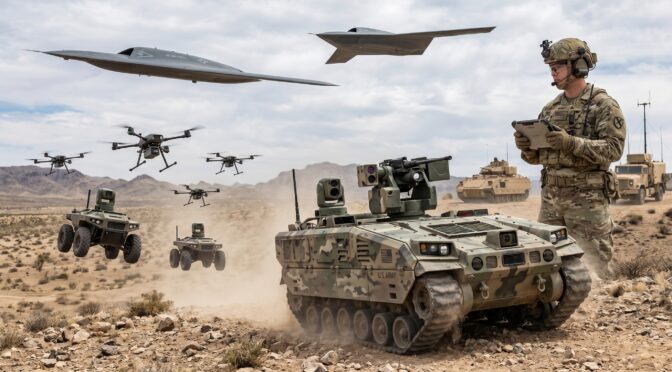
The conventional realities of warfare have been inexorably altered by what military analysts term the “transparent battlefield.” The ubiquity of multi-domain sensor networks, commercial high-frequency satellite imaging, and the rapid deployment of artificial intelligence-enabled munitions have functionally eliminated the concept of hidden maneuver. In contemporary combat scenarios, any significant massing of traditional armored formations, surface naval vessels, or concentrated troop deployments is highly vulnerable to immediate detection and subsequent destruction. The modern operational theater is saturated with persistent surveillance, rendering the electromagnetic emissions of complex platforms and the physical signatures of large command posts highly visible targets.
To survive and operate lethally within this environment, the U.S. military apparatus is undergoing a systemic cultural and industrial overhaul. Under the leadership of Secretary of Defense Pete Hegseth and Secretary of the Army Daniel P. Driscoll, the DoD is executing a strategy designed to replace institutional risk aversion with rapid modernization.1 This transition is not merely technological but is deeply intertwined with a mandated reindustrialization of the defense base, designed to field the world’s most lethal force while simultaneously rooting out bureaucratic inefficiencies and legacy defense paradigms.1
However, this critical transition is occurring against a backdrop of severe and compounding industrial base constraints. Despite a defense budget exceeding $1 trillion for Fiscal Year 2026, and an urgent supplementary injection of $150 billion, the Defense Industrial Base (DIB) continues to struggle with modernization pacing.4 The sector is characterized by a persistent, systemic talent deficit and a precarious reliance on a highly concentrated nexus of venture-backed technology firms that operate outside the traditional defense prime contractor ecosystem.4 Consequently, the immediate strategic imperative for the U.S. Armed Forces involves a delicate balancing act: rapidly reconstituting precision munitions expended during recent Middle Eastern contingencies while urgently deploying an asymmetric, automated “Democratic Shield” across the First Island Chain to deter near-peer aggression.1
II. Operational Validation and the Attrition Crucible: Analyzing Operation Epic Fury
The most immediate catalyst driving the current acceleration in U.S. military modernization is the recent execution of Operation Epic Fury. Spanning 38 days from February 28 to a negotiated ceasefire on April 8, 2026, the campaign serves as a definitive, high-intensity proof-of-concept for the current administration’s “Peace Through Strength” doctrine.5 Ordered directly by the Commander-in-Chief to systematically dismantle the Iranian military and defense industrial base, the joint force achieved a near-total systemic collapse of the target state’s conventional power projection capabilities.5
Strategic Execution and Decisive Capability Degradation
Operating in conjunction with Israeli partners, the U.S. military executed a precision campaign that fundamentally altered the balance of power in the Middle East. Secretary of War Pete Hegseth and Chairman of the Joint Chiefs of Staff Gen. Dan Caine reported that the operation met every predefined objective.5 The Iranian naval apparatus was entirely neutralized, its comprehensive air defense network was systematically wiped out granting U.S. forces total air supremacy, and the regime’s ballistic missile infrastructure suffered catastrophic degradation.6 Intelligence assessments confirm the destruction of more than 80% of Iran’s missile facilities, crucially including its solid rocket motor production capabilities, thereby preventing near-term reconstitution.6
The campaign definitively validated the necessity for high-volume, high-mass strike warfare. During merely the first five weeks of the conflict, United States forces struck more than 13,000 discrete targets.7 While operationally decisive, the sheer volume of high-end munitions expended to achieve this objective has forced a fundamental recalculation within the Pentagon regarding baseline inventory requirements for a peer-level conflict. Military analysts and strategic planners project that a Pacific contingency involving the People’s Republic of China would require the capacity to strike upwards of 100,000 targets.7 The current traditional munitions industrial base cannot independently sustain this required scale of production, laying bare a critical vulnerability in the U.S. strategic posture.
The Human Toll and Post-Conflict Posture
The transparent and lethal nature of modern combat operations was further underscored by the loss of U.S. personnel during the campaign. On March 12, 2026, a U.S. KC-135 aerial refueling aircraft was lost over Iraq, resulting in the confirmed deaths of four crew members.8 This incident highlights the extreme operational risks inherent in deploying manned support assets within contested airspace, further driving the doctrinal mandate to replace manned support and strike assets with uncrewed alternatives wherever feasible.
Despite the April 8 ceasefire and Iran’s subsequent agreement to reopen the strategic maritime choke point of the Strait of Hormuz, the United States maintains a highly aggressive deterrence posture in the region.5 Secretary Hegseth has confirmed that the maritime blockade against Iran will persist indefinitely, asserting that it will remain in place “for as long as it takes”.10 Furthermore, he cautioned that U.S. forces have retooled and re-armed with greater power projection capabilities than before the conflict, standing ready to restart military strikes should Tehran deviate from the terms of the potential broader peace agreement.10
Table 1: Operation Epic Fury Battle Damage Assessment and Munitions Implications
| Operational Metric | Epic Fury (Middle East Contingency) | Projected Indo-Pacific Peer Contingency | Strategic Implication |
| Duration | 38 Days (Major Combat Operations) | Unknown (Projected Multi-Year) | Requires shift from exquisite stockpiles to continuous mass production. |
| Strike Volume | 13,000+ Targets Struck | 100,000+ Targets Projected | Legacy DIB cannot scale to meet a 10x target increase using traditional PGMs. |
| Adversary Degradation | Navy (100%), Air Defense (Critical), Missiles (80%) | High resilience, deep territorial depth | Peer adversaries require distributed, autonomous swarms to penetrate integrated air defenses. |
III. The Doctrine of Mass: Autonomous Systems and the Compression of the Kill Chain
The central technological realization of the 2026 strategic landscape is that warfare in the late 2020s will be heavily dictated by the calculus of attrition versus precision. While precision-guided munitions remain critical for high-value targets, the ability to out-manufacture an adversary in autonomous, expendable systems is now viewed as the primary deterrent and warfighting advantage. This marks a definitive departure from previous eras where technological superiority alone was relied upon to offset numerical disadvantages.
Real-Time Inference and the End of Electromagnetic Reliance
Advances in onboard artificial intelligence inference hardware have fundamentally transformed the capabilities of uncrewed systems. These systems are now capable of real-time target classification without the need for constant cloud connectivity or continuous human-in-the-loop oversight.11 This development removes critical operational constraints, making autonomous systems highly viable and lethal even in severely degraded environments where the Global Positioning System (GPS) is denied and communications are heavily jammed by adversarial electronic warfare.11 This autonomy compresses the “kill chain”—the process of identifying, targeting, and engaging an adversary—to mere minutes, drastically reducing the window for enemy evasion or counter-maneuver.
The Replicator Initiative and Collaborative Combat Aircraft
To actualize this doctrine of mass, the DoD is accelerating multiple high-profile procurement vehicles. The Replicator Initiative, initially seeded with $200 million in the 2024 National Defense Authorization Act, is a DoD strategy explicitly designed to counter the rapid military buildup of peer adversaries.12 Its core objective is to rapidly scale the domestic industrial capacity to field thousands of multidomain autonomous systems across land, sea, and air.13 The initiative targets low-cost, less exquisite, “attritable” systems that provide commanders with the ability to generate overwhelming capabilities with volume and velocity, creating complex dilemmas for enemy air defense networks.13
Parallel to Replicator is the Air Force’s massive Collaborative Combat Aircraft (CCA) program. The DoD forecasts allocating $8.9 billion toward this program between 2025 and 2029.15 The CCA aims to deploy fleets of AI-enabled drones designed to operate in tandem with manned fighter squadrons. These autonomous wingmen will perform high-risk surveillance, intelligence gathering, and strike missions, effectively acting as an attritable buffer for human pilots and extending the sensory reach of the combat formation.15 Furthermore, the rapid development of modular, open-architecture weapons like the Extended Range Attack Munition (ERAM) is being prioritized to give field commanders the immediate ability to generate asymmetric mass in a conflict scenario.7
The AI-Powered Defense Market Explosion
The urgent demand signal from the Pentagon, heavily influenced by the lessons of recent global conflicts demonstrating that cheap loitering munitions can achieve strategic effects at a fraction of the cost of manned aircraft, has catalyzed an explosion in the private sector. The global Defense Autonomous Systems (AI-powered) market reached a base valuation of $18.5 billion in 2025.11 Driven by escalating near-peer military competition, this market is projected to scale dramatically to $62.4 billion by 2034, operating at a compound annual growth rate (CAGR) of 14.7%.11 This massive influx of capital represents a historic shift in how national defense is commodified and procured, relying increasingly on rapid commercial iteration rather than decades-long military development cycles.
IV. Structural Fragility within the Defense Industrial Base
While the doctrinal shift toward autonomous mass is conceptually sound, its execution is currently bottlenecked by the severe realities of the U.S. Defense Industrial Base (DIB). The 2026 National Security Innovation Base (NSIB) Report Card outlines a deeply concerning structural and economic landscape that threatens to undermine the DoD’s modernization timeline.4
Budgetary Disconnects and the Crisis of Scale
For Fiscal Year 2026, the U.S. defense budget exceeds the staggering $1 trillion mark, following the passage of a reconciliation and defense bill.4 This represents roughly 3.3% of the projected Gross Domestic Product (GDP)—a figure consistent with 2025 levels but significantly lower than the 9-11% range maintained during the height of the Cold War era.4 However, the raw topline budget obscures a massive misallocation of resources regarding future warfare capabilities.
Despite high-level rhetoric emphasizing technological transformation, actual funding for defense technology remains less than 1% of total contract dollars. In Fiscal Year 2025, out of a total of $506.2 billion in DoD obligated dollars, a mere $4.3 billion (0.8%) was dedicated to defense technology.4 This fractional allocation highlights a severe institutional inertia, wherein the vast majority of the defense budget is consumed by the sustainment of legacy platforms, personnel costs, and traditional prime contractor programs that do not align with the urgent need for autonomous mass.
Consequently, the NSIB graded the overall pace of defense modernization a dismal “D”.4 The data indicates that the defense apparatus is actually slowing down in its ability to field new capabilities; the average timeframe to deliver major defense programs has increased by 18 months since 2024, now averaging an unacceptable 12 years from conception to deployment.4 This acquisition timeline is fundamentally incompatible with the “Industrial Warp Speed” required to counter adversaries who iterate commercial drone technology in a matter of months.
To temporarily bridge this gap, the administration passed a significant legislative package colloquially known as the “Big Beautiful Bill,” injecting $150 billion across core NSIB priorities over a two-year period.4 This funding targeted critical vulnerabilities, yielding a 24% growth in autonomous systems funding and a 72% growth in hypersonics development.4 However, capital alone cannot solve the systemic physical constraints of the industrial base.
The Talent Deficit and the Concentration of Innovation
The most pressing constraint on U.S. military modernization is not capital, but human labor. The defense manufacturing sector is facing a catastrophic talent gap, with an estimated 1.9 million manufacturing jobs in the Aerospace and Defense (A&D) sector projected to go unfilled through 2033.4 The inability to staff traditional assembly lines forces the DoD to increasingly rely on software-defined hardware and advanced robotics that require fewer manual assembly steps—a capability primarily resident in Silicon Valley rather than traditional industrial heartlands.
This labor shortage has accelerated the DoD’s reliance on alternative contracting mechanisms, which have surged from less than $5 billion to over $17 billion over the past five years.4 Consequently, defense technology funding has become dangerously concentrated. In FY25, a staggering 84% of the $4.3 billion defense tech allocation ($3.7 billion) flowed to just three companies: SpaceX, Palantir, and Anduril.4 These three entities now possess a combined market capitalization greater than the top five traditional defense primes combined, despite receiving only 0.7% of total Pentagon obligated dollars.4
While these venture-backed firms are successfully fielding capabilities at a fraction of the cost of legacy systems—the report notes that commercial drones utilized in recent European conflicts are 16 to 160 times less expensive than U.S. military alternatives 4—this extreme consolidation presents a massive single-point-of-failure risk. If any of these three firms suffer severe supply chain disruptions, cyber-intrusions, or leadership crises, the U.S. military’s entire next-generation technological modernization pipeline could stall.
Table 2: 2026 National Security Innovation Base (NSIB) Diagnostics
| NSIB Metric | Current Status / Valuation | Strategic Implication |
| Topline FY26 Budget | >$1 Trillion (~3.3% GDP) | Massive raw capital, but historically low GDP percentage limits generational overhauls. |
| Tech Funding Percentage | 0.8% of Obligated Dollars ($4.3B) | Severe misalignment between stated modernization goals and actual fiscal outlays. |
| Vendor Concentration | 84% to SpaceX, Palantir, Anduril | Heavy reliance on non-traditional primes creates potential supply chain and market monopolies. |
| Procurement Timeline | 12 Years (Average) | Bureaucratic sclerosis prevents the rapid iteration needed for autonomous warfare. |
| Labor Shortfall | 1.9 Million Manufacturing Jobs | Limits the ability to scale domestic production of attritable mass in a wartime scenario. |
V. Re-architecting the Indo-Pacific: The “Single Theater” and the Democratic Shield
While the Middle East commands immediate operational resources, the paramount focus of U.S. grand strategy remains the Indo-Pacific. Recognizing the existential threat posed by authoritarian expansionism, the strategic geometry of the region is being radically redrawn.
The “Single Theater” Doctrine
In April 2026, Taiwanese Minister of Foreign Affairs Lin Chia-lung forcefully advocated during the “Shield of Democracy” forum for reconceptualizing the First Island Chain as a “single theater” rather than disparate maritime domains.1 This integrated strategic framework encompasses the Taiwan Strait, the East and South China Seas, the Miyako Strait, the Bashi Channel, and all surrounding sea and air spaces.1 This doctrine explicitly abandons the notion that allied nations can rely on independent, compartmentalized defense systems against a peer adversary proficient in multi-domain coercion.
The strategy aims to counter a full spectrum of threats, ranging from direct military intimidation to gray-zone tactics, electromagnetic disruption, and cognitive warfare.1 The operational end-state of this doctrine requires regional allies to jointly monitor the strategic environment, issue synchronized early warnings, and conduct integrated deployments to maintain societal and military resilience.
A critical vulnerability driving Taiwan’s urgent diplomacy is its demographic trajectory. A National Development Council report projects that Taiwan’s population will plummet below 12 million by 2065, driven by a record-low total fertility rate of 0.69.1 With a shrinking pool of available military manpower, Taiwan cannot sustain a traditional standing army capable of repelling a massed amphibious assault. Consequently, autonomous defense is an existential requirement. Minister Lin described low-cost, high-endurance uncrewed systems as the essential “nervous system” of this democratic shield, necessary for asymmetrical warfare, maritime protection, and peacetime governance.1 The Ministry of Foreign Affairs’ Drone Diplomacy Task Force is actively working to establish Taiwan as an Indo-Pacific hub for uncrewed systems, collaborating with the U.S., Japan, South Korea, and the Philippines to build secure, “non-red” supply chains.1
U.S. Forward Posture: Batanes, Mavulis, and the Bashi Channel
In direct alignment with the Single Theater strategy, the U.S. military has executed a highly aggressive forward positioning of forces in the Northern Philippines, transforming isolated geography into heavily fortified strategic choke points. The Philippine military has shifted its strategic focus away from internal counterinsurgency operations toward external territorial defense, a pivot explicitly designed to prepare for a Taiwan contingency.1 This shift is further complicated by the presence of approximately 250,000 Overseas Filipino Workers (OFWs) currently residing in Taiwan, making Noncombatant Evacuation Operations (NEO) a primary planning task for the Philippine Northern Luzon Command.1
The U.S. Army’s 1st Multi-Domain Task Force (MDTF), operating in conjunction with the 3d Marine Littoral Regiment (3d MLR) and the Armed Forces of the Philippines, has established continuous rotational deployments on the Batanes and Babuyan Islands, directly flanking the Luzon Strait.1 A forward operating base (FOB) was activated in Mahatao on Batan Island to serve as a platform for maritime domain awareness and territorial defense.1
Mavulis Island, the uninhabited northernmost territory of the Philippines, has been transformed into a central node for this contingency planning.1 Situated directly in the Bashi Channel—a crucial waterway linking the South China Sea to the Pacific Ocean—Mavulis serves as an early warning outpost. Military strategists assess that control of the Bashi Channel could determine the outcome of a potential invasion of Taiwan, as adversarial naval forces would likely attempt to blockade this passage to isolate Taiwan from U.S. and allied intervention.1
To counter this, Key Terrain Security Operations (MKTSO) conducted during recent Balikatan 25 and KAMANDAG 9 exercises saw U.S. and Philippine forces establish commercial radar systems on high ground across Batan and Mavulis islands.1 Crucially, U.S. Marines have deployed advanced, highly mobile weapon systems to the island chain, specifically the Navy-Marine Expeditionary Ship Interdiction System (NMESIS)—a robotic anti-ship missile launcher—and the Marines Air Defense Integrated System (MADIS).1
The ultimate operational goal of these combined efforts is the creation of an impenetrable maritime shield that restricts the freedom of maneuver for adversarial naval elements in the East China Sea and completely denies passage through the Bashi Channel.1 This is reinforced by broader allied integration, including the upgrading of Japan’s JGSDF 15th Brigade into a full division, the designation of dual civil-military “Specific Use” bases in the Nansei region for logistical support, and the establishment of a coordinating center for the Philippines, Australia, the U.S., and Japan (the “Squad”).1
VI. Institutional Realignment: The Restoration of the Warrior Ethos and Command Purges
The radical shifts in doctrine, procurement, and geographic deployment are mirrored by an equally aggressive and highly controversial restructuring of the military’s internal culture and senior leadership framework. The implementation of the “moneyball military” concept requires agile, non-bureaucratic leadership, prompting civilian leaders to execute unprecedented personnel actions.
The Eradication of DEI and Cultural Reforms
The 2025 National Security Strategy explicitly mandated the rooting out of discriminatory Diversity, Equity, and Inclusion (DEI) practices to restore a culture based strictly on competence and merit.1 Secretary of Defense Hegseth has publicly declared that “DEI is dead at DOD,” initiating rapid, force-wide reviews to ensure that fitness, training, and physical standards for combat roles remain uniformly high, unwavering, and gender-neutral.1
This cultural realignment extends significantly to personnel policies and retention. In a highly publicized move, the DoD has actively welcomed back over 8,700 service members who were involuntarily separated for refusing the COVID-19 vaccine, alongside ending the “low productivity telework” and remote work culture within the civilian workforce, mandating a return to in-person operations.1 Command climates are also undergoing intense scrutiny; Inspector General and Equal Opportunity processes are being reviewed following civilian leadership assessments that these mechanisms had been weaponized against commanders, resulting in a culture of excessive risk aversion.1
According to the DoD, these reforms have yielded immediate dividends in force generation, described by leadership as a “recruiting renaissance.” By prioritizing clear warfighting standards over what leadership termed “wokeness,” the Army reportedly achieved its best recruiting numbers since 2010, while the Navy is projected to reach its highest recruitment levels since 2002.1
The Decapitation of Legacy Command Structures
To ensure these cultural and doctrinal reforms take permanent root, the civilian leadership has demonstrated an uncompromising willingness to forcefully reorganize the highest echelons of military command. In early April 2026, Secretary Hegseth abruptly forced the retirement of Gen. Randy George, the Army Chief of Staff.3 This drastic move, which reportedly surprised even Army Secretary Driscoll’s office, was accompanied by the simultaneous firing of Gen. David M. Hodne, head of the Army’s Transformation and Training Command, and Maj. Gen. William Green Jr., the Army’s top chaplain.3
The removal of highly decorated senior officers with decades of institutional knowledge—such as Gen. George, a Purple Heart recipient with 42 years of service—signals a zero-tolerance administrative approach for command elements that do not align seamlessly with the new pace of modernization. The rapid elevation of figures like Gen. Christopher LaNeve, the Vice Chief of the Army and acting Chief of Staff, underscores a clear preference for agile leadership unburdened by legacy bureaucratic thinking.3 Despite the internal friction generated by these purges, Secretary Driscoll has publicly reaffirmed his commitment to the administration’s goals, explicitly stating he has no plans to resign and remains focused on providing the strongest land fighting force possible.3
VII. The Technological Cold War: Adversary Capabilities and Supply Chain Vulnerabilities
While the United States attempts to rapidly scale its autonomous systems and re-architect its procurement models, peer adversaries are executing highly sophisticated technological advancements designed to undermine Western technological monopolies.
China’s Extreme Ultraviolet (EUV) Lithography Breakthrough
Intelligence reports have confirmed a massive leap in adversarial manufacturing capabilities. Chinese engineers, operating out of a high-security laboratory in Shenzhen, have successfully built a working prototype of an Extreme Ultraviolet (EUV) lithography machine.16 Built by a team of former engineers from the Dutch semiconductor giant ASML who reverse-engineered the complex technology, the machine represents a critical threat to Western military dominance.16
EUV machines are the linchpin of advanced semiconductor manufacturing, using beams of extreme ultraviolet light to etch microscopic circuits onto silicon wafers. These advanced chips are the fundamental building blocks of the artificial intelligence systems, smart munitions, and autonomous drone swarms that both the U.S. and China are racing to deploy. Prior to this development, the capability to produce EUV machines was entirely monopolized by the West.16 While intelligence indicates that the Chinese prototype is operational and successfully generating extreme ultraviolet light, it has not yet produced working chips, and Beijing still faces significant hurdles in replicating the precision optical systems required for mass production.16
Nevertheless, the existence of this prototype suggests that China may be years closer to semiconductor independence than previously assessed by Western intelligence agencies. In response to the rapid militarization of China’s commercial tech sector, U.S. lawmakers are aggressively lobbying the Pentagon to expand economic countermeasures. A bipartisan group of lawmakers has formally urged Secretary Hegseth to add major Chinese technology firms—including the AI firm DeepSeek, smartphone manufacturer Xiaomi, and electronic display maker BOE Technology Group (an Apple supplier)—to the Section 1260H list.17 While inclusion on the 1260H list does not constitute formal sanctions, it legally identifies these entities as assisting the Chinese military, effectively barring them from DoD supply chains and signaling to allied nations the inherent security risks of their hardware.17
VIII. Homeland Defense and the Rejection of the Globalist Paradigm
The strategic reorientation of the U.S. military is fundamentally rooted in the political and economic philosophies outlined in the 2025 National Security Strategy. The strategy explicitly describes itself as a correction to post-Cold War foreign policy, which it criticizes for having misguidedly prioritized globalism and “free trade” at the profound expense of the American middle class and the domestic industrial base.1
The Golden Dome and Energetic Dominance
The NSS emphasizes that overseas force projection is irrelevant without an impregnable homeland. To that end, the DoD is advancing the implementation of a next-generation nationwide missile defense network, dubbed the “Golden Dome,” designed to protect the continental United States from the full spectrum of nuclear, hypersonic, and conventional strikes.1 This defensive posture is coupled with the rapid development of the newly announced F-47 Fighter Jet, intended to restore unquestioned air superiority over both domestic and contested overseas airspace.1
Furthermore, the strategy recognizes that military supremacy is ultimately downstream of economic and energetic dominance. The current administration has aggressively rejected “Net Zero” climate ideologies, pivoting toward maximizing the domestic output of oil, gas, coal, and nuclear energy.1 This energy policy is not merely economic; it is viewed as a primary weapon of national security, aimed at fueling the reindustrialization of the defense sector and expanding exports to allied nations to break their reliance on adversarial energy vectors.1 Taiwan’s recent move to secure 8 million barrels of crude oil shipped via the Red Sea to bypass the vulnerable Strait of Hormuz exemplifies the critical interplay between energy security and military resilience in the current geopolitical climate.1
IX. Analytical Conclusions and Strategic Projections
Based on an exhaustive synthesis of confirmed intelligence, operational deployments, budgetary allocations, and geopolitical maneuvering as of April 2026, the following analytical conclusions are rendered:
- The Era of the Exquisite Platform is Sunset: The U.S. military has unequivocally accepted that massing large formations of traditional armor or deploying singular, multi-billion-dollar maritime assets without an overwhelming, attritable autonomous screen is tactically non-viable. The transparent battlefield ensures that high-value assets are instantly targeted. Future conflicts will be decided by the industrial capacity to mass-produce cheap, interconnected sensor and strike drones. The $18.5 billion AI-defense market is the new industrial center of gravity.
- The First Island Chain is Functionally a Single Battlefield: The deployment of the 1st Multi-Domain Task Force to Batanes and the establishment of radar facilities on Mavulis Island indicate that the U.S. no longer views a Taiwan contingency as an isolated event. The Bashi Channel is the critical geographic choke point of the decade. The integration of robotic anti-ship missiles (NMESIS) on these islands represents a permanent shift from reactive defense to active, forward sea denial.
- Industrial Base Fragility is the Primary Strategic Risk: The tactical successes of Operation Epic Fury mask a severe, systemic vulnerability in munitions stockpiles. The inability of the legacy Defense Industrial Base to scale rapidly—stymied by a 1.9 million labor shortfall and a 12-year procurement cycle—forces an uncomfortable and highly risky reliance on a handful of venture-backed tech firms (SpaceX, Palantir, Anduril). If these commercial entities experience supply chain disruptions—particularly in semiconductor sourcing, given China’s recent EUV breakthroughs—the U.S. autonomous modernization strategy could stall catastrophically.
- Cultural Homogenization for Lethality: The unprecedented purges at the top echelons of the Army and the aggressive eradication of DEI initiatives represent a calculated, high-stakes gamble by the civilian leadership. The administration is intentionally trading institutional continuity for strict ideological and operational alignment. While this has resulted in short-term recruiting spikes by clarifying the warfighting mission, the long-term impact of removing highly experienced senior officers on complex logistical and strategic planning remains a significant operational variable.
In summation, the United States Armed Forces have forcefully transitioned from a state of theoretical modernization to urgent, active deployment. The transparent battlefield is an established, lethal reality, and the United States has staked its strategic future on the ability to out-innovate, out-manufacture, and autonomously out-maneuver its adversaries across the Indo-Pacific theater. Ensuring that the domestic industrial base can physically support this doctrine is the paramount national security challenge of the remainder of the decade.
Please share the link on Facebook, Forums, with colleagues, etc. Your support is much appreciated and if you have any feedback, please email us in**@*********ps.com. If you’d like to request a report or order a reprint, please click here for the corresponding page to open in new tab.
Sources Used
- 在第一島鏈建單一戰區, 進行區域集體聯防 – Google Groups, accessed April 22, 2026, https://groups.google.com/g/bay-area-taiwanese-american/c/N5azMyfnRTk
- accessed April 22, 2026, https://en.wikipedia.org/wiki/Daniel_P._Driscoll#:~:text=On%20February%2025%2C%202025%2C%20the,by%20a%2066%E2%80%9328%20vote.
- Army Secretary Dan Driscoll praises ousted senior leader: ‘I, too, love General George’, accessed April 22, 2026, https://www.washingtonexaminer.com/policy/defense/4531963/army-secretary-driscoll-praises-ousted-senior-leader/
- NSIB Report Card Team, accessed April 22, 2026, https://www.reaganfoundation.org/cms/assets/1773175563-final-nsibreportcard-2026-web.pdf
- Peace Through Strength: Operation Epic Fury Crushes Iranian Threat as Ceasefire Takes Hold, accessed April 22, 2026, https://www.whitehouse.gov/releases/2026/04/peace-through-strength-operation-epic-fury-crushes-iranian-threat-as-ceasefire-takes-hold/
- Epic Fury Quelled for Now, Objectives Accomplished, U.S. Forces Remain Ready, accessed April 22, 2026, https://www.war.gov/News/News-Stories/Article/Article/4454276/epic-fury-quelled-for-now-objectives-accomplished-us-forces-remain-ready/
- F-16 Tests ‘Rusty Dagger’ Extended-Range Missile | Air & Space …, accessed April 22, 2026, https://www.airandspaceforces.com/f-16-tests-rusty-dagger-extended-range-missile/
- Operation Epic Fury – U.S. Central Command, accessed April 22, 2026, https://www.centcom.mil/OPERATIONS-AND-EXERCISES/EPIC-FURY/videoid/997831/dvpmoduleid/41413/
- Operation Epic Fury – U.S. Central Command, accessed April 22, 2026, https://www.centcom.mil/OPERATIONS-AND-EXERCISES/EPIC-FURY/
- Op Epic Fury: CENTCOM Commander says military ‘re-arming, retooling, adjusting techniques’ during ceasefire, accessed April 22, 2026, https://www.aninews.in/news/world/us/op-epic-fury-centcom-commander-says-military-re-arming-retooling-adjusting-techniques-during-ceasefire20260416203726
- Defense Autonomous Systems (AI-Powered) Market Research Report 2034, accessed April 22, 2026, https://marketintelo.com/report/defense-autonomous-systems-ai-powered-market
- NDIS Implementation Plan ii – GovInfo, accessed April 22, 2026, https://www.govinfo.gov/content/pkg/GOVPUB-D-PURL-gpo234260/pdf/GOVPUB-D-PURL-gpo234260.pdf
- Export Controls on Artificial Intelligence and Uncrewed Aircraft Systems: Interagency Challenges – RAND, accessed April 22, 2026, https://www.rand.org/content/dam/rand/pubs/research_reports/RRA3200/RRA3296-1/RAND_RRA3296-1.pdf
- Robotics & Autonomous Systems | Unlock Robotics Funding Opportunities – BW&CO, accessed April 22, 2026, https://www.bwcoconsulting.com/funding/robotics-autonomous-systems
- The Business of Military AI – Brennan Center for Justice, accessed April 22, 2026, https://www.brennancenter.org/media/15340/download/bcj-167_business_of_military_ai_final.pdf?inline=1
- How China built its ‘Manhattan Project’ to rival the West in AI chips – The Economic Times, accessed April 22, 2026, https://m.economictimes.com/tech/technology/how-china-built-its-manhattan-project-to-rival-the-west-in-ai-chips/articleshow/126058560.cms
- US lawmakers urge Pentagon to add DeepSeek, Xiaomi to list of firms allegedly aiding Chinese military – The Economic Times, accessed April 22, 2026, https://m.economictimes.com/tech/technology/us-lawmakers-urge-pentagon-to-add-deepseek-xiaomi-to-list-of-firms-allegedly-aiding-chinese-military/articleshow/126080337.cms