1. Introduction and the Paradigm Shift in Japanese Defense
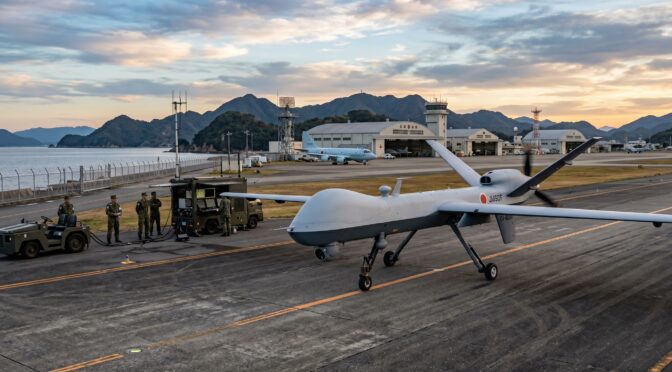
In what can only be described as a watershed moment for Indo-Pacific military architecture, the enactment of Japan’s fiscal year 2026 defense budget on April 7 has codified a fundamental structural shift within the Japan Ground Self-Defense Force (JGSDF).1 This transition mandates the total operational liquidation of the JGSDF’s traditional manned rotary-wing combat aviation assets—specifically the U.S.-supplied Boeing AH-64D Apache and Bell AH-1S Cobra attack helicopters, alongside the Kawasaki OH-1 observation fleet—in favor of a comprehensive “Operational Pivot” toward multi-role unmanned aerial vehicles (UAVs).1 This evolution formally concludes the era of the “Flying Tank” within Japanese military doctrine, replacing it with the overarching strategic concept of “Expendable Mass” and the deployment of highly distributed sensor networks across the maritime domain.
The reallocation of more than ¥280 billion (approximately $1.76 billion) away from legacy attack helicopters toward unmanned strike and reconnaissance systems represents far more than a routine procurement update or budgetary realignment; it is a stark acknowledgment of the “Iron Reality” of 21st-century ground combat.2 Observations drawn from recent high-intensity conflicts in the Ukrainian theater and the Middle East have irrefutably demonstrated that high-end, heavily armored attack helicopters are increasingly vulnerable to sophisticated man-portable air defense systems (MANPADS), low-cost loitering munitions, and expansive electronic warfare (EW) disruptions.2 The modern airspace, stretching from the surface to 10,000 feet, is now so thoroughly saturated with precision-guided interceptors that the deployment of traditional close air support via rotary assets is viewed as tactically obsolete against a peer adversary.
By adopting a “Full-Stack” autonomous posture, Tokyo intends to fundamentally alter the risk calculus of its maritime and littoral defense strategy. The removal of human pilots from the Weapon Engagement Zone (WEZ) permits the JGSDF to accept localized tactical losses of hardware—termed “High-Mass” attrition—that would be politically, demographically, and operationally catastrophic if it involved manned aircraft.1 Concurrently, this transition directly addresses acute demographic and recruitment constraints within Japan. The strategic retirement of approximately 50 AH-1S Cobras, 12 AH-64D Apaches, and 37 Kawasaki OH-1s is projected to free up roughly 1,000 highly trained personnel.1 In an organization facing persistent recruitment headwinds driven by a rapidly aging population, reassigning these personnel to emergent cyber, space, and drone-control domains is not merely an option, but a demographic necessity.1
2. Geopolitical Foundations: The Takaichi Doctrine and Regional Assertion
The catalyst for this accelerated defense modernization is the sweeping political mandate secured by Prime Minister Sanae Takaichi following a landslide electoral victory in February 2026, which granted her Liberal Democratic Party (LDP) a two-thirds supermajority of 316 out of 465 seats in the parliament.5 This unprecedented legislative power has enabled the rapid implementation of a policy framework widely characterized as the “Takaichi Doctrine”.7 This doctrine represents a profound departure from Japan’s historically passive “Basic Defense Force Concept,” pushing the nation entirely into a posture of “Active Deterrence” and proactive strategic autonomy.8
At the core of the Takaichi Doctrine is the unapologetic fusion of military capability with economic security and technological sovereignty. The doctrine operates on the premise that national security begins in supply chains, data centers, and advanced manufacturing capabilities long before it manifests on the kinetic battlefield.11 Furthermore, Takaichi’s approach is marked by a moral and historical revisionism that seeks to overwrite decades of post-war national self-doubt, embracing traditional values and projecting a vision of interpreted sovereignty that refuses to apologize for Japan’s necessity to defend its modern geopolitical interests.7 This stands in stark contrast to historical artifacts like the Hakko Ichiu monument, an emblem of 1930s militarist expansion built from plundered stones; the Takaichi Doctrine, while assertive, focuses on robust defensive deterrence and the preservation of the democratic global commons rather than imperial conquest.8
2.1 The Taiwan Contingency and the “Digital Fence”
The most geopolitically significant aspect of the Takaichi Doctrine is the establishment of rigid, formal red lines regarding the Taiwan Strait. Prime Minister Takaichi has explicitly elevated the late Shinzo Abe’s assertion that “a Taiwan contingency is a Japanese contingency” into official state policy, unambiguously placing Taiwan within Japan’s strategic sphere of influence.13 Under this framework, a Chinese blockade or armed assault on Taiwan is legally and doctrinally defined as an “existential crisis” for Japan, potentially triggering the exercise of collective self-defense rights.13
The geographic and economic realities driving this policy are acute. Taiwan sits a mere 110 kilometers from Japan’s outlying southwestern islands.13 More critically, Japan imports 85% of its total energy requirements, contrasting sharply with regional rival China, which generates 85% of its energy internally from coal, nuclear, and renewables.5 With 90% of Japan’s vital energy imports traversing the maritime chokepoints adjacent to Taiwan, any disruption to these sea lanes poses an immediate, catastrophic threat to the Japanese economy and state survival.5 Japan possesses a strategic crude oil reserve capable of covering approximately 150 days of consumption, but in a prolonged contingency, this stockpile is insufficient without open sea lanes.5
Consequently, the Takaichi Doctrine necessitates the creation of a “Digital Fence” across the Ryukyu island chain—a forward-deployed, “Zero-Latency” surveillance and strike web sustained entirely by long-endurance autonomous assets.13 This digital fortification is designed to raise the costs of adversarial adventurism, ensuring that any hostile movement toward Taiwan or the First Island Chain is immediately detected and held at risk by standoff munitions.13
2.2 Navigating the “Tiger and the Wolf”
Japan’s aggressive defense posture is further necessitated by the complexities of its alliance with the United States. Analysts in Tokyo frequently summarize Japan’s current geopolitical precariousness using the proverb Zenmon no tora, kōmon no ōkami (“A tiger at the front gate, a wolf at the back gate”).8 In this paradigm, China represents the tiger—a powerful, aggressive, and fundamental revisionist threat to Japan’s sovereignty and regional stability. The United States, particularly under the administration of President Donald Trump in 2026, represents the wolf—essential for ultimate survival and extended nuclear deterrence, but simultaneously predatory, transactional, and demanding.8
This transactional pressure is evidenced by U.S. requests for Japanese naval deployments to the Strait of Hormuz to counter Iranian blockades, alongside the looming threat of 25% tariffs on nations continuing to trade with Iran.14 To navigate between the tiger and the wolf, the Takaichi Doctrine pursues “armed coexistence” and strategic autonomy.8 By drastically increasing defense spending and securing its own autonomous strike capabilities, Japan aims to prove it is an independent actor capable of defending its core interests, thereby reducing its vulnerability to both Chinese coercion and American extortion.8
3. The Demise of the Air Cavalry and the ‘Iron Reality’
The doctrinal shift away from manned rotary-wing assets reflects a systemic, data-driven reevaluation of cost-benefit dominance within modern anti-access/area denial (A2/AD) environments. The traditional concept of the “Air Cavalry”—utilizing heavily armed helicopters to conduct close air support, anti-armor strikes, and forward reconnaissance—has been rendered largely untenable by the proliferation of cheap, highly capable countermeasures.2
The warning signs for rotary aviation have been accumulating globally. A pivotal indicator occurred in January 2026, when the United States Army formally deactivated its 5th Air Cavalry Squadron, 17th Cavalry Regiment.2 This reconnaissance and attack helicopter squadron, heavily equipped with AH-64E Apaches, had been stationed in South Korea as a premier deterrent force for over three years.2 Military analysts widely interpreted this deactivation as a direct strategic response to the demonstrated vulnerability of such airframes to drone strikes and advanced air defense networks observed in the Ukrainian theater.2 Following suit, the South Korean Defense Ministry drastically reduced its own outstanding orders for Apache attack helicopters, signaling a region-wide loss of confidence in the platform’s survivability.2
3.1 The Cost-Benefit Asymmetry
The vulnerabilities of the AH-64D Apache and AH-1S Cobra platforms are multifold in the current threat landscape. Exposing a $40 million aviation asset—flown by two highly trained, irreplicable aviators—to asymmetric interception by a $100,000 loitering munition or a shoulder-fired missile represents an unacceptable and unsustainable operational imbalance.1 In the high-stakes landscape of 2026, Japan has determined that the procurement economics heavily favor the drone. For the price of a single AH-64D, the JGSDF can procure up to eight Bayraktar TB2S unmanned aerial vehicles, achieving a “Massive Multiplier” effect that significantly expands battlefield presence and distributed lethality.1
Furthermore, the operational endurance of manned helicopters is biologically and mechanically restricted. A standard Apache sortie window rarely exceeds three to four hours before requiring refueling and crew rotation.3 In stark contrast, securing the vast, 6,800-island geography of the Japanese archipelago—spanning thousands of square miles of open ocean—requires persistent, multi-day loiter capabilities to maintain an unbroken chain of situational awareness.3 Unmanned systems provide this endurance, operating for 27 to 45 hours continuously, thus outlasting the legacy helicopter fleet by ratios approaching 15:1.3
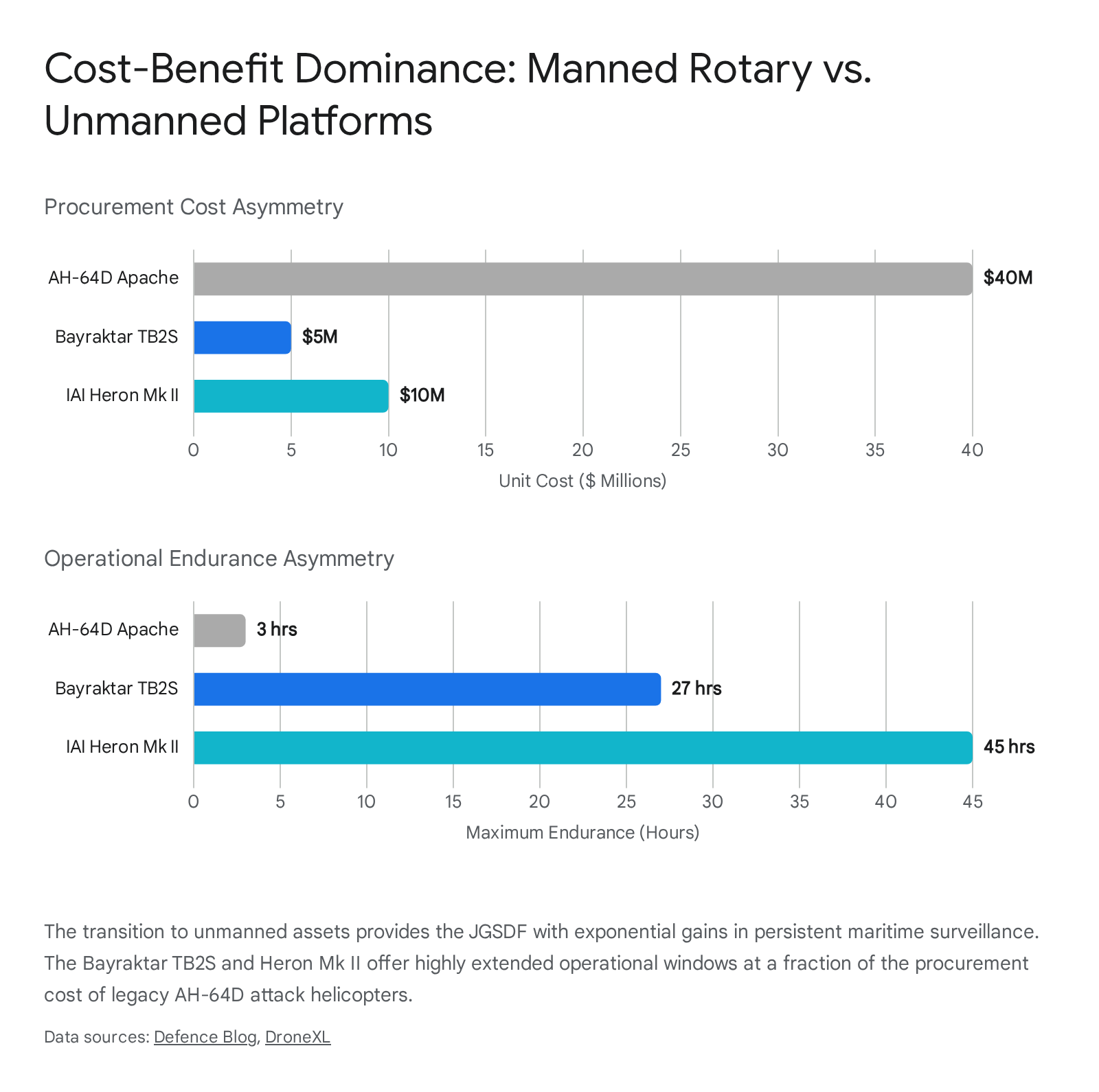
The JGSDF is therefore liquidating its traditional “Air Cavalry” in favor of a “Distributed Sensor” model.3 This model relies on deploying a high volume of cheaper, unmanned nodes that provide superior intelligence gathering and beyond-line-of-sight (BLOS) kinetic strike capabilities, entirely circumventing the logistical footprint and risk profile associated with heavy aviation battalions.3
4. Procurement Profiles: The Vanguard of the Unmanned Fleet
To rapidly operationalize this doctrinal pivot, the fiscal year 2026 defense budget has explicitly allocated ¥11.1 billion (approximately $69.7 million) for the immediate acquisition of five “wide-area UAVs” specifically for the JGSDF.1 Crucially, the Ministry of Defense has intentionally refrained from restricting this procurement to unarmed platforms. The strategic requirement dictates that these new systems must not only detect surface vessels at extreme ranges but also gather real-time intelligence, coordinate multi-domain responses, and directly execute kinetic firepower when authorized.1
Two primary platforms, having successfully completed exhaustive testing and evaluation by the Japanese government throughout FY2024 and FY2025, have emerged as the definitive leading candidates for the JGSDF’s wide-area UAV requirement: the Bayraktar TB2S and the Heron Mk II.1
| Platform Designation | Manufacturer & Origin | Estimated Unit Cost | Max Endurance | Propulsion System | Primary Operational Role in JGSDF Doctrine |
| Bayraktar TB2S | Baykar (Turkey) | ~$5 Million | 27 Hours | 100-hp Rotax 912 | BLOS Kinetic Strike, Maritime Monitoring |
| Heron Mk II | IAI (Israel) | ~$10 Million | 45 Hours | 141-hp Rotax 915 iS | Deep ISTAR, ELINT/COMINT, Electronic Warfare |
| AH-64D Apache | Boeing (USA) | ~$40 Million | ~3 Hours | Twin-turboshaft | Legacy Close Air Support (Phased Out) |
4.1 The Bayraktar TB2S (Baykar, Turkey)
The Bayraktar TB2S represents an advanced, satellite-equipped iteration of the tactical UAV platform that gained immense international prominence during the conflicts in Nagorno-Karabakh and the early phases of the Russo-Ukrainian war.1 For Japan, the critical technological enhancement of the TB2S over the baseline model is the integration of a robust Satellite Communications (SATCOM) link. This addition fundamentally enables Beyond-Line-of-Sight (BLOS) operations, which are absolutely mandatory given Japan’s expansive maritime geography and the strategic necessity to monitor the vast Ryukyu chain continuously without relying on vulnerable ground-based relay stations.1
Powered by a highly reliable 100-horsepower Rotax 912 reciprocating engine, the TB2S can remain airborne for approximately 27 hours per sortie.1 From a lethality perspective, the airframe features four underwing hardpoints capable of carrying up to 150 kilograms (roughly 330 lbs) of laser-guided munitions, effectively fulfilling the “Kinetic Strike” role that was previously the sole purview of the Apache.1 During government testing, completed in fiscal year 2025, the platform demonstrated its ability to operate from austere airstrips that would be entirely inaccessible to the heavy logistical tail required by traditional attack helicopters.1
4.2 The Heron Mk II (Israel Aerospace Industries)
Serving as the heavier, more sensor-dense complement to the TB2S is the Medium-Altitude Long-Endurance (MALE) Heron Mk II, produced by Israel Aerospace Industries (IAI).1 While the TB2S excels in cost-effective kinetic strikes, the Heron Mk II is exquisitely optimized for persistent Intelligence, Surveillance, Target Acquisition, and Reconnaissance (ISTAR) missions.19 Equipped with a more powerful 141-horsepower Rotax 915 iS engine, the Heron Mk II boasts a remarkable operational endurance of 45 hours, capable of operating at speeds up to 278 kilometers per hour and altitudes reaching 35,000 feet.1
The immense strategic value of the Heron Mk II lies in its substantial payload capacity of roughly 1,035 lbs.1 This expanded capacity accommodates advanced electronic warfare (EW) suites, long-range maritime AESA radars, high-fidelity Electro-Optical/Infrared (EO/IR) sensors, and sophisticated signals intelligence components capable of both Electronic Intelligence (ELINT) and Communications Intelligence (COMINT).1 During evaluations at Shirahama Airport in Wakayama Prefecture—overseen by Kawasaki Heavy Industries acting as the domestic handling company—the platform demonstrated its ability to maintain a wide-area surveillance umbrella, peering deeply into contested environments to intercept adversary communications without the necessity of physically penetrating hostile or politically sensitive airspace.17 This aligns perfectly with Japan’s legal frameworks for Self-Defense Force operations, allowing for aggressive intelligence gathering while maintaining a defensive posture.17
4.3 Supplementary Platforms and Multi-Tiered Sourcing
While the TB2S and Heron Mk II represent the vanguard of the JGSDF’s specific replacement program, Tokyo is executing a heavily diversified, multi-sourced unmanned strategy across all its military branches to ensure redundancy and operational flexibility:
- MQ-9B SkyGuardian / SeaGuardian: The Japan Coast Guard and the Japan Maritime Self-Defense Force (JMSDF) are rapidly expanding their fleets of U.S.-made MQ-9B drones for high-end maritime patrol. The JMSDF secured a massive $489.4 million appropriation in the FY2026 budget to acquire four additional units, with a strategic goal of fielding a total fleet of 23 aircraft by 2032 for persistent surveillance of surface vessels and submarines.21
- Shield AI V-BAT: Emphasizing ship-based vertical take-off and landing (VTOL) capabilities, the JMSDF has allocated ¥4 billion for the procurement of six V-BAT UAV systems to be integrated onto the new Sakura-class offshore patrol vessels.22 Furthermore, the platform is undergoing evaluation for integration onto the heavily upgraded Mogami-class frigates (the “New FFM”).22
- Gray Eagle 25M (General Atomics): Currently under secondary consideration by the JGSDF, the Gray Eagle 25M is a modernized variant of the MQ-1C featuring a 200-horsepower heavy-fuel engine and over 40 hours of endurance.17 Its primary advantage is its utilization of a Modular Open Systems Approach (MOSA) architecture, allowing for the rapid, plug-and-play reconfiguration of electronic warfare pods or alternative sensor packages based on immediate mission parameters.17
5. The SHIELD Concept: Asymmetric Littoral Architecture
The tactical application of these diverse unmanned platforms is synthesized under the recently funded, highly ambitious “SHIELD” framework. Formally designated as Synchronised, Hybrid, Integrated and Enhanced Littoral Defense, the SHIELD initiative received a robust $640.6 million appropriation in the FY2026 defense budget.6 This program is specifically designed to operationalize Japan’s unique geographic asymmetries, leveraging the Ryukyu island chain’s natural chokepoints to create an impenetrable, multi-domain defense matrix against adversarial maritime incursions.
SHIELD fundamentally departs from traditional, linear defense models centered on capital ships and manned aircraft by establishing a layered, autonomous kill-web. The architecture seamlessly integrates the aerial, surface, and underwater branches of the Japanese military, focusing heavily on the rapid deployment of swarming, replicable, and largely expendable systems.6
The architectural layout of SHIELD forms a comprehensive cross-domain matrix. Operationally, this functions as an interlocking sensor and strike web stretching from the ocean depths to the upper atmosphere. High-altitude MALE UAVs, such as the Heron Mk II or TB2S, operate in the upper airspace, transmitting persistent telemetry and targeting data signals down to the surface environment. On the ocean surface, Unmanned Surface Vessels (USVs) patrol in tandem with legacy Japanese frigates, which themselves act as forward deployment nodes launching smaller, tactical ship-based UAVs into the immediate engagement zone. Beneath the surface, Unmanned Underwater Vehicles (UUVs) patrol the depths to detect the acoustic signatures of adversarial submarines. Crucially, multi-directional data links connect all these disparate assets in real-time to a central command and control node located on a fortified coastal island, creating a decentralized but highly synchronized littoral barrier.
This intricate system is supported by specific funding line items, including a $14.1 million allocation in FY2026 dedicated solely to conducting demonstration tests for the simultaneous algorithmic control of large swarms of these varied unmanned assets.22 By deploying the SHIELD matrix primarily in the southern islands adjacent to Taiwan, the Ministry of Defense is actively establishing a stand-off disruption zone. If an adversary attempts to breach the First Island Chain, they will not face concentrated formations of vulnerable destroyers or manned helicopters; rather, they will face a decentralized, AI-coordinated swarm of drones capable of autonomous target designation and kinetic interception.6
6. Economic Statecraft, Cyber Defense, and the “Silicon Ceiling”
The transition to autonomous warfare is occurring against the backdrop of profound global macroeconomic and technological shifts. The Takaichi Doctrine recognizes that the nature of deterrence has expanded beyond kinetics into the realm of computational supremacy and energy resilience. Analysts assessing the 2026 threat landscape frequently cite the emergence of the “Silicon Ceiling” and the “Kinetic Bomb”.23
The “Kinetic Bomb” represents a state of extreme systemic vulnerability where the complexity of modern digital economies exceeds the resilience of the physical networks supporting them.23 Concurrently, the “Silicon Ceiling” dictates that the exponential growth of advanced technologies, particularly Artificial Intelligence, is increasingly capped by the physical reality of energy availability and the vulnerability of power grids to simple kinetic strikes.23 The defense of physical infrastructure against cheap drone attacks is paramount because the destruction of a single critical node can cripple a nation’s computational architecture.
To mitigate these vulnerabilities, Japan has enacted the Economic Security Promotion Act, which legally frameworks economic resilience as an explicit extension of national defense.10 This legislation deconstructs Japan’s technological strategy into three critical pillars to maximize the cost of adversarial action:
- Semiconductor Sovereignty: Japan views domestic microchip production not merely as an industrial or commercial policy, but as a dire survival mechanism.10 By heavily subsidizing domestic manufacturing consortiums like Rapidus, Japan aims to reverse industrial fragmentation and establish itself as an indispensable, heavily fortified node in the global semiconductor network, eliminating single points of failure in supply chains historically reliant on Chinese manufacturing.10
- Artificial Intelligence Governance: The strategy moves beyond the rapid development of AI to its strict governance, focusing on establishing guardrails to prevent AI from being weaponized for disinformation or devastating cyber-attacks against critical civilian and military infrastructure.10
- Active Cyber Defense: In perhaps the most controversial shift for a historically pacifist nation, Takaichi has mandated a transition to “active cyber defence”.10 Recognizing that passive firewalls are wholly insufficient against state-sponsored actors, this model implements “slashable safety resilience,” granting the state the authority to conduct preemptive or retaliatory cyber counter-strikes to neutralize threats before they actualize, thereby creating effective, tangible deterrence.10
This approach to economic statecraft actively embraces the concept of “friend-shoring”—aligning supply chains exclusively with trusted allies like the United States and Australia to secure industrial resilience against the weaponization of interdependence and geopolitical coercion.10 It represents a “hard fork” in the regional economy, where Tokyo accepts short-term commercial efficiency losses in exchange for long-term sovereign security.10
7. Industrial Warp Speed: Domestic Sourcing and Technological Sovereignty
A core tenet of this economic security pillar is the absolute requirement to domesticate critical defense supply chains. While the initial procurement of wide-area UAVs relies on proven foreign airframes from Turkey and Israel to rapidly fill the capability gap left by the Apache retirement, the Ministry of Defense is aggressively structuring these acquisitions to ensure “Industrial Warp Speed” integration by Japan’s legacy heavy industries.24
7.1 Licensing and Local Manufacturing
Kawasaki Heavy Industries (KHI) has rapidly established itself as a central player in this industrial transition. KHI is currently designated as the domestic handling company for the Heron Mk II, overseeing rigorous flight testing and payload integration.17 However, military diplomatic engagements—such as visits by Japanese Navy delegations to Baykar facilities in Turkey and vice versa—indicate that this relationship is expected to evolve from mere importation to comprehensive licensed local manufacturing, assembly, and lifecycle maintenance.19
Simultaneously, Subaru—traditionally recognized for its automotive footprint but possessing a highly robust aerospace division—is deeply involved in localizing the unmanned ecosystem. Under a ¥660 million contract awarded by the Acquisition, Technology & Logistics Agency (ATLA) in late 2023, Subaru is spearheading a complex concept-demonstration study for a domestic multi-purpose vertical-takeoff-and-landing (VTOL) UAV.1 By localizing the production and intellectual property of these platforms, Japan ensures “National Security Endurance,” effectively insulating its future drone fleet from external supply shocks, international embargoes, or logistical severing during a regional crisis.24
| Corporate Entity | Primary Domain | Key Defense Initiatives & Unmanned Contracts |
| Kawasaki Heavy Industries (KHI) | Aerospace/Heavy Industry | Domestic handling for Heron Mk II; ¥3.9 billion contract for autonomous combat support drone enhancement; potential localized manufacturing. |
| Subaru | Automotive/Aerospace | ¥660 million ATLA contract for VTOL multi-purpose UAV concept study; cost reduction research for drone systems. |
| Mitsubishi Heavy Industries (MHI) | Defense/Shipbuilding | Development of ARMDC-20X AI combat support drones (Loyal Wingmen); lead contractor for GCAP next-gen fighter. |
7.2 The GCAP Fighter and AI Integration
The domestication of drone technology feeds directly into Japan’s most ambitious aerospace project: the Global Combat Air Programme (GCAP). This collaborative initiative with the UK and Italy aims to field a next-generation fighter aircraft by 2035.25 Japanese firms are explicitly tasked with developing autonomous “loyal wingmen” to fly alongside the piloted GCAP fighter. Mitsubishi Heavy Industries (MHI) has already showcased the ARMDC-20X, an AI-equipped combat support drone, while Kawasaki was awarded a ¥3.9 billion ($26 million) contract to research the performance enhancement of these autonomous support assets.26 Subaru is concurrently focused on reducing the systemic costs of these accompanying drone systems.26
The success of this sweeping domestic integration relies heavily on the mandatory adoption of a Modular Open Systems Approach (MOSA) across all procurement lines.17 By utilizing standardized, open-source architectural frameworks rather than vendor-locked proprietary software, Japanese industries can rapidly reconfigure standard drone platforms.28 A MOSA framework allows the JGSDF to seamlessly swap in indigenous electronic warfare pods, advanced optical sensors, or updated AI-driven decision-support software as the threat environment dictates, without requiring expensive or delayed intervention from the original foreign manufacturer.17 This agility ensures that as the electromagnetic spectrum evolves, Japan can update its autonomous capabilities in real-time.
8. Fiscal Realignments, Tax Policies, and “Zero-Latency” Projections
The scale and scope of Japan’s unmanned modernization are financially unprecedented in the nation’s post-war history. The April 7 enactment of the FY2026 defense budget explicitly funds the initial transition away from helicopters, but it serves only as the baseline for a vastly larger fiscal trajectory.1 To execute the Takaichi Doctrine, Japan is systematically driving its overall defense spending toward 2% of GDP by 2027, definitively breaking the historical political precedent that capped military expenditures at roughly 1%.29
For FY2026, the approved defense spending reached a record $58 billion (approximately 9.04 trillion yen), marking the 12th consecutive year of increases and firmly establishing Japan as the world’s third-largest defense spender behind the United States and China.22 To finance this massive ¥9 to ¥10 trillion annual defense baseline without catastrophically exacerbating the national debt, the Takaichi administration is navigating highly complex domestic fiscal waters. The government has proposed a controversial mix of revenue-generating measures, including corporate tax adjustments, increased tobacco taxes, and a planned 1% income tax surtax scheduled to begin in 2027.4
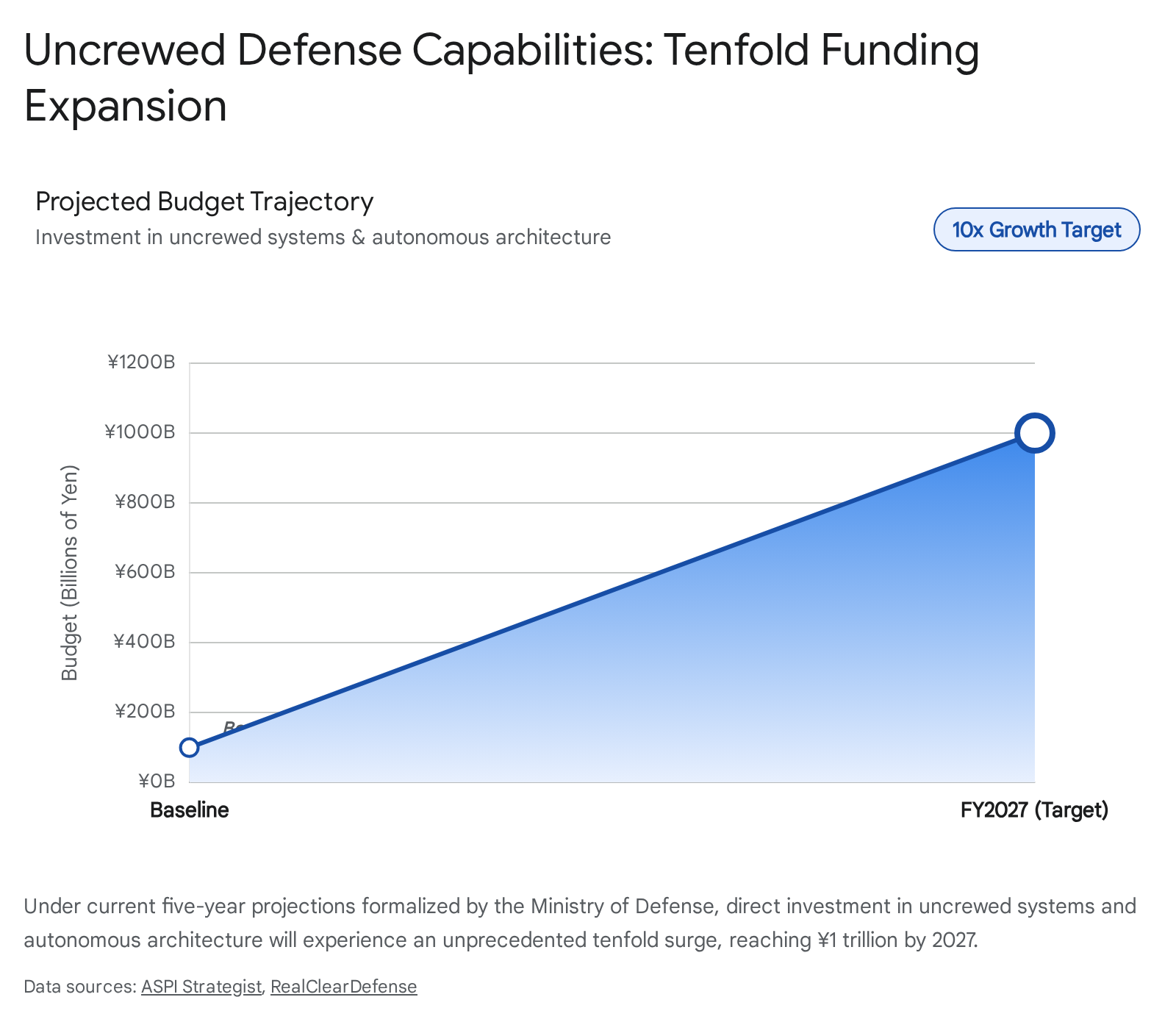
Within this rapidly expanding macro-budget, the specific funding allocated for uncrewed defense capabilities is experiencing an exponential surge. Under the current five-year defense projection mapped out by the National Defense Strategy, direct investment in drone procurement and associated research and development is programmed to increase tenfold—scaling from an initial baseline of ¥100 billion to a staggering ¥1 trillion ($6.3 billion) by 2027.6
A significant portion of this ¥1 trillion investment is directed toward achieving “Zero-Latency” operational environments.34 In drone-centric warfare, the speed of the sensor-to-shooter loop dictates ultimate battlefield superiority. Zero latency refers to the technological aspiration of compressing the time between target identification and kinetic interception to near-instantaneous levels, eliminating the processing delays inherent in human-in-the-loop systems.34 By investing heavily in AI-enabled decision support, multi-domain sensing, and general-purpose computing platforms, the JGSDF aims to fully automate the tactical environment.6 When a TB2S or Heron Mk II identifies an anomalous radar signature traversing the Ryukyu chain, advanced AI algorithms will instantly fuse that data with satellite imagery, verify the threat profile, and authorize a kinetic strike from a SHIELD surface vessel or the drone itself—executing the kill chain faster than a human operator could traditionally process the telemetry.
9. Strategic Conclusions
The liquidation of the Japan Ground Self-Defense Force’s manned attack helicopter fleet in April 2026 is not merely an isolated procurement decision dictated by budget constraints; it is the physical manifestation of a profound national strategic awakening. By systematically replacing the venerable but vulnerable AH-64D Apache and AH-1S Cobra with long-endurance, multi-role autonomous platforms like the Bayraktar TB2S and the Heron Mk II, Tokyo has decisively aligned its tactical capabilities with the brutal, attrition-heavy realities of modern, sensor-dense combat environments.1
Under the robust political mandate and historical revisionism of the Takaichi Doctrine, Japan is now treating economic security, domestic industrial capacity, and military modernization as indistinguishable elements of national survival.10 The aggressive deployment of the SHIELD coastal defense architecture across the Ryukyu island chain effectively establishes a high-attrition, autonomous barrier that fundamentally alters the risk calculus and complicates the operational planning of any revisionist state attempting to project power into the Western Pacific or threaten Taiwan.6
By committing an unprecedented ¥1 trillion to unmanned systems by 2027, embracing active cyber defense, and actively fostering domestic aerospace production hubs through entities like Kawasaki Heavy Industries, Subaru, and Mitsubishi Heavy Industries, Japan has engineered a resilient, “Full-Spectrum” defense apparatus.6 In substituting the exquisite vulnerability of the legacy “Flying Tank” with the persistent, networked lethality of “Expendable Mass,” Tokyo has not merely adapted to the future of warfare—it has positioned itself at the absolute vanguard of Indo-Pacific deterrence, ensuring that it remains an autonomous powerhouse capable of keeping the tigers of the region permanently at bay.
Please share the link on Facebook, Forums, with colleagues, etc. Your support is much appreciated and if you have any feedback, please email us in**@*********ps.com. If you’d like to request a report or order a reprint, please click here for the corresponding page to open in new tab.
Sources Used
- Japan Drops Apaches, Bets $70M On Drones Instead, accessed April 22, 2026, https://dronexl.co/2026/04/14/japan-apaches-70m-drones/
- Japan Replacing Apache Attack Helicopters with Unmanned Strike …, accessed April 22, 2026, https://militarywatchmagazine.com/article/japan-responds-drone-warfare-apache
- Drones instead of Apache helicopters. Japan chooses UAVs, accessed April 22, 2026, https://defence24.com/armed-forces/drones-instead-of-apache-helicopters-japan-chooses-uavs
- Progress and Budget in Fundamental Reinforcement of Defense …, accessed April 22, 2026, https://www.mod.go.jp/en/d_act/d_budget/pdf/fy2026_20251226a.pdf
- Japan Builds Up its Defense Posture Through Investments and Alliances, accessed April 22, 2026, https://maritime-executive.com/article/japan-builds-up-its-defense-posture-through-investments-and-alliances
- Japan Is Pushing Hard on Autonomous Weapons | RealClearDefense, accessed April 22, 2026, https://www.realcleardefense.com/articles/2026/04/08/japan_is_pushing_hard_on_autonomous_weapons_1175307.html
- Japan’s Female Prime Minister | YIP Institute Foreign Policy, accessed April 22, 2026, https://yipinstitute.org/policy/japans-female-prime-minister
- Keeping the Chinese ‘tiger’ and U.S. ‘wolf’ at bay – The Japan Times, accessed April 22, 2026, https://www.japantimes.co.jp/commentary/2026/02/27/japan/keeping-china-us-wolf-at-bay/
- Full article: “All Politics is local”: the U.S.–China balance in the First Island Chain and Japan’s defense transformation – Taylor & Francis, accessed April 22, 2026, https://www.tandfonline.com/doi/full/10.1080/14799855.2025.2580672
- Sanae Takaichi and Japan’s New Technological Strategy: Economic …, accessed April 22, 2026, https://dras.in/sanae-takaichi-and-japans-new-technological-strategy-economic-security-regional-competition-and-geopolitical-assertion/
- Takaichi Marks Japan’s Turn Toward Strategic Maturity – Modern …, accessed April 22, 2026, https://moderndiplomacy.eu/2025/11/12/takaichi-marks-japans-turn-toward-strategic-maturity/
- How Japan rebrands monument of aggression as ‘cultural heritage’, accessed April 22, 2026, http://en.people.cn/n3/2026/0421/c98649-20448653.html
- The CSPC Dispatch – Nov 14, 2025 — Center for the Study of the …, accessed April 22, 2026, https://www.thepresidency.org/the-dispatch/the-cspc-dispatch-nov-14-2025
- Takaichi’s Security Agenda After the Landslide Election | Carnegie …, accessed April 22, 2026, https://carnegieendowment.org/research/2026/03/takaichis-security-agenda-after-the-landslide-election
- imbex – National Maritime Foundation, accessed April 22, 2026, https://maritimeindia.org/wp-content/uploads/2026/01/Making-Waves-16-31-December-2025.pdf
- Politics is local”: the U.S.–China balance in the First Island Chain and Japan’s defense transformation – Taylor & Francis, accessed April 22, 2026, https://www.tandfonline.com/doi/pdf/10.1080/14799855.2025.2580672
- Japan buys drones to replace Apache fleet – The Defence Blog, accessed April 22, 2026, https://defence-blog.com/japan-buys-drones-to-replace-apache-fleet/
- Swarms over the Strait – Amazon S3, accessed April 22, 2026, https://s3.us-east-1.amazonaws.com/files.cnas.org/documents/Indo-Pacific-Drones_DEFENSE_2024-final.pdf
- Israel’s Heron-2 vs Türkiye’s Bayraktar TB2: The High-Stakes Drone Race for Japan’s Skies, accessed April 22, 2026, https://defencesecurityasia.com/en/israel-heron2-vs-turkiye-bayraktar-tb2-drone-race-japan-skies/
- Battle over Tokyo: Israeli and Turkish Drones Compete for Japan’s Defense, accessed April 22, 2026, https://www.israeldefense.co.il/en/node/68617
- Japan tests Israeli Heron MK II amid drone fleet build-up – TURDEF, accessed April 22, 2026, https://turdef.com/article/japan-tests-israeli-heron-mk-ii-amid-drone-fleet-build-up
- Japan Approves Record Defense Budget for Fiscal Year 2026 …, accessed April 22, 2026, https://www.navalnews.com/naval-news/2025/12/japan-approves-record-defense-budget-for-fiscal-year-2026/
- (PDF) The Kinetic Bomb: Reevaluating Ehrlich’s Malthusian Trap Amidst the 2026 Global Energy and AI Crisis – ResearchGate, accessed April 22, 2026, https://www.researchgate.net/publication/402796852_The_Kinetic_Bomb_Reevaluating_Ehrlich’s_Malthusian_Trap_Amidst_the_2026_Global_Energy_and_AI_Crisis
- Japan plans major drone deployment, considers Turkish, Israeli UAVs – Türkiye Today, accessed April 22, 2026, https://www.turkiyetoday.com/world/japan-plans-major-drone-deployment-considers-turkish-israeli-uavs-3205441
- Japan to Develop Successor to Kawasaki T-4 Trainer, accessed April 22, 2026, https://militarnyi.com/en/news/japan-to-develop-successor-to-kawasaki-t-4-trainer/
- Japan unveils AI combat support drones at Tokyo Aerospace Exhibition | Caliber.Az, accessed April 22, 2026, https://caliber.az/en/post/japan-unveils-ai-combat-support-drones-at-tokyo-aerospace-exhibition
- E SD – Security & Defence European, accessed April 22, 2026, https://euro-sd.com/wp-content/uploads/2024/10/ESD_10_2024_WEB.pdf
- Building a Mutually Complementary Supply Chain between Japan and the United States, accessed April 22, 2026, https://csis-website-prod.s3.amazonaws.com/s3fs-public/2024-08/240815_Johnstone_Complementary_Chain.pdf?VersionId=D0Ekoby3TcgDj14daUZ94fOHwaFoe7RN
- Japan’s Defence Budget Surge: A New Security Paradigm – RUSI, accessed April 22, 2026, https://www.rusi.org/explore-our-research/publications/commentary/japans-defence-budget-surge-new-security-paradigm
- Japan’s Present and Future National Security Strategy: Five Key Challenges to Watch, accessed April 22, 2026, https://www.csis.org/analysis/japans-present-and-future-national-security-strategy-five-key-challenges-watch
- Japan’s Cabinet approves record defense budget aiming to deter China as tensions grow, accessed April 22, 2026, https://www.pbs.org/newshour/world/japans-cabinet-approves-record-defense-budget-aiming-to-deter-china-as-tensions-grow
- Japan is pushing hard on autonomous weapons | The Strategist, accessed April 22, 2026, https://www.aspistrategist.org.au/japan-is-pushing-hard-on-autonomous-weapons/
- Japan looks to build drone ‘shield’ in record defense budget request – The Japan Times, accessed April 22, 2026, https://www.japantimes.co.jp/news/2025/08/29/japan/japan-defense-budget-drones/
- (PDF) P o l i t i c s • A r m e d F o r c e s • P r o c u r e m e n t • Te c h n o l o g – Academia.edu, accessed April 22, 2026, https://www.academia.edu/96275997/P_o_l_i_t_i_c_s_A_r_m_e_d_F_o_r_c_e_s_P_r_o_c_u_r_e_m_e_n_t_Te_c_h_n_o_l_o_g
- Security & Defence European, accessed April 22, 2026, https://euro-sd.com/wp-content/uploads/2023/01/ESD_1_2023.pdf
- Department of Defense Fiscal Year (FY) 2026 Budget Estimates – Justification Book – U.S. Army, accessed April 22, 2026, https://www.asafm.army.mil/Portals/72/Documents/BudgetMaterial/2026/Discretionary%20Budget/rdte/RDTE%20-%20Vol%203%20-%20Budget%20Activity%205A.pdf