
Executive Summary
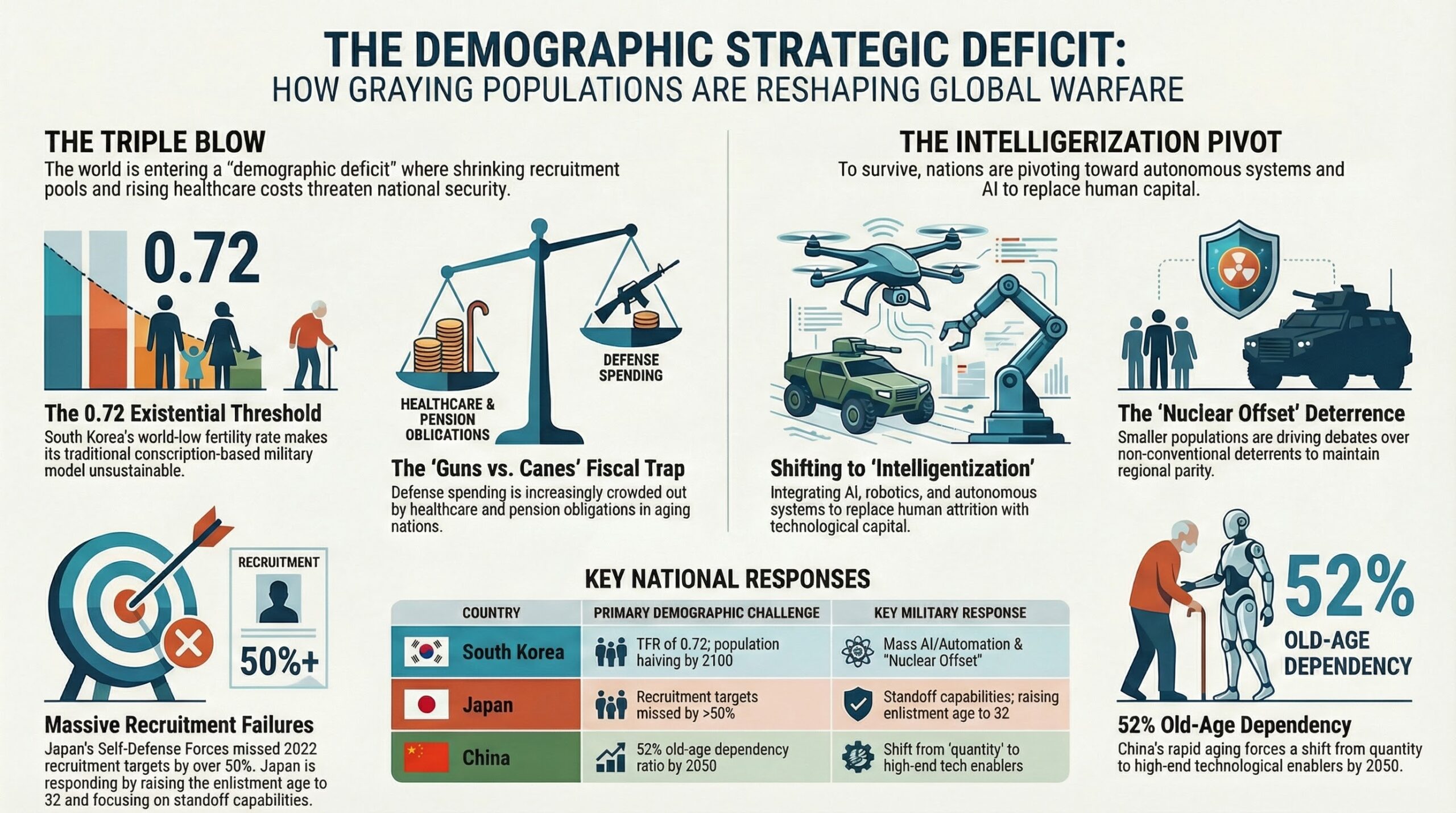
The global demographic transition is fundamentally reshaping the strategic landscape, creating a “demographic deficit” that threatens the traditional foundations of national power: manpower, fiscal resources, and societal resilience.1 As birth rates plummet and populations age across both advanced and emerging economies, militaries are facing a “triple blow” of shrinking recruitment pools, rising personnel costs, and a “guns vs. canes” fiscal dilemma where defense spending is increasingly crowded out by healthcare and pension obligations.1
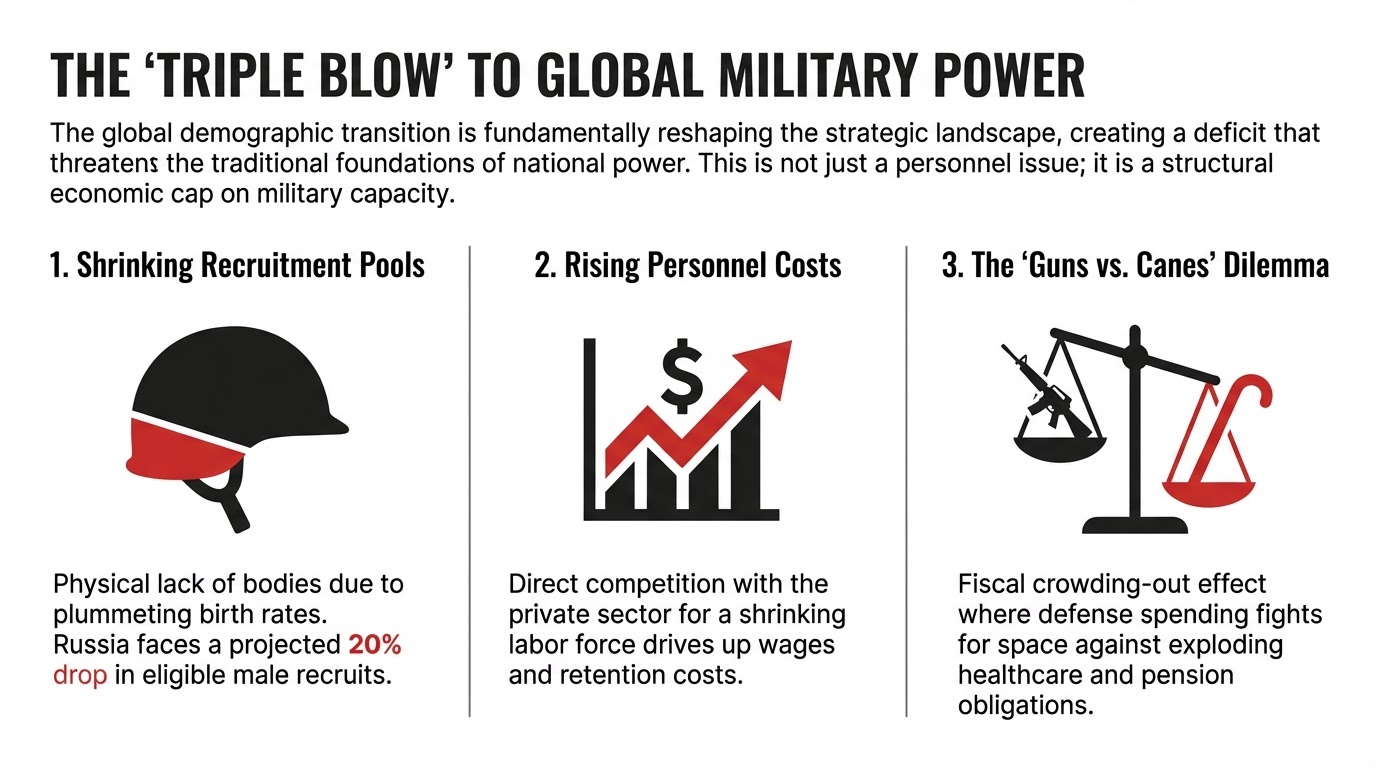
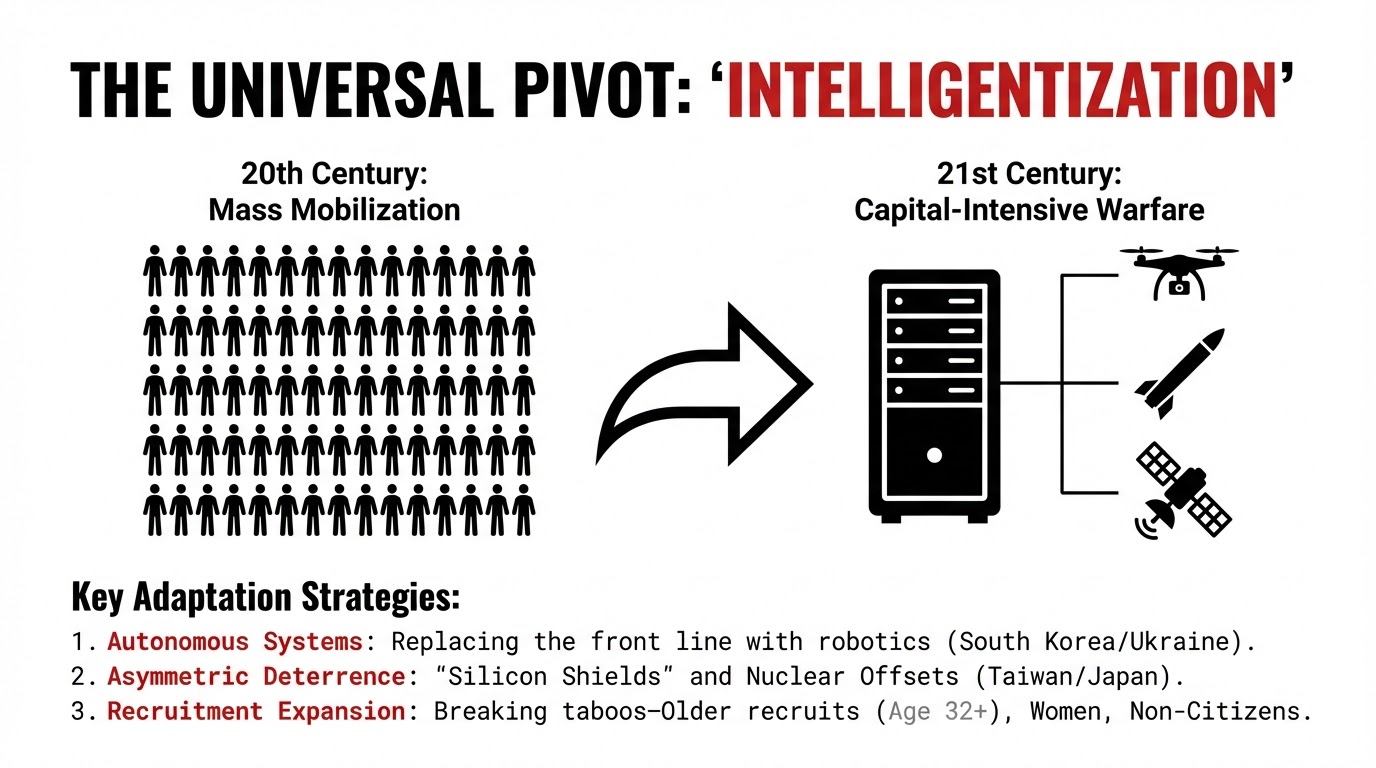
This report identifies ten nations—South Korea, Japan, China, Russia, Ukraine, Poland, Taiwan, Germany, Italy, and Lithuania—where these demographic headwinds are most severe. For instance, Russia faces a projected 20% decrease in eligible male recruits during the 2020s 5, while South Korea’s fertility rate of 0.72 represents an existential threat to its conscription-based model.6 To mitigate these losses, states are pivoting toward “intelligentization”—the integration of AI, robotics, and autonomous systems designed to replace human attrition with technological capital.7 Strategic survival in this new era will require radical shifts, including broadening recruitment to non-citizens, upskilling older cohorts, and deepening regional military integration to achieve economies of scale.
Summary of Demographic Impact on Top 10 Militaries
| Rank | Country | Primary Demographic Challenge | Key Strategic/Military Response |
| 1 | South Korea | Lowest global TFR (0.72); halving population by 2100. | Mass AI/automation; “nuclear offset” deterrence debate. |
| 2 | Japan | Recruitment failure; SDF missing targets by over 50%. | Standoff capabilities; raising enlistment age to 32. |
| 3 | China | Shrinking workforce; 52% old-age dependency by 2050. | “Intelligentization”; shift to high-end tech enablers. |
| 4 | Russia | “Triple demographic blow”; 20% recruit pool drop by 2030. | Increased militarization; reliance on nuclear/coercion. |
| 5 | Ukraine | Biological survival; wartime exodus and 0.9 fertility rate. | Autonomous warfare lab; “total defense” and tech reserves. |
| 6 | Poland | Recruitment-retention gap; record professional exits (9,000). | Rapid heavy rearmament; mobile firepower focus. |
| 7 | Taiwan | Recruitable men falling below 75,000 by 2031. | “Silicon Shield” leverage; UAV/asymmetric capabilities. |
| 8 | Germany | Rapidly aging society; pacifist culture vs. 2031 goals. | New Military Service Act; recruiting EU/non-citizens. |
| 9 | Italy | “Guns vs. Pensions” trap; NATO’s oldest member (median 46+). | Creative accounting; 6th-gen fighter/modernization. |
| 10 | Lithuania | World’s fastest depopulation; 15% loss since 1990. | Societal resilience; reliance on German Panzer Brigade 45. |
A Cross-Functional Assessment of Global Military Attrition and National Power
The contemporary geopolitical landscape is increasingly defined not only by the rapid evolution of technology and the resurgence of great power competition but by a more fundamental and inexorable shift: the global demographic transition. As birth rates plummet and populations age across both advanced and emerging economies, the traditional pillars of military power—manpower, fiscal resources, and societal resilience—are facing unprecedented strain. This cross-functional assessment, integrating perspectives from foreign affairs, intelligence, and military analysis, identifies the top ten nations whose defense capabilities are most severely threatened by these demographic headwinds. The analysis moves beyond mere statistical observations to explore the second- and third-order effects on operational readiness, strategic autonomy, and the very nature of future conflict.
1. South Korea: The Crucible of Demographic Collapse
South Korea represents the most acute example of a military establishment confronting an existential demographic crisis. The nation’s total fertility rate, which dropped to an unprecedented 0.72 in 2023, is the lowest recorded globally, far beneath the 2.1 required for population replacement.6 On its current trajectory, South Korea’s population of 51 million is projected to halve by the year 2100, creating a recruitment deficit that traditional conscription cannot solve.6
The Manpower-Deterrence Paradox
For the Republic of Korea (ROK) Armed Forces, demographics are a matter of immediate national security due to the persistent conventional and nuclear threat from North Korea. The ROK military has historically relied on a robust conscription system, requiring at least 18 months of service.6 However, the shrinking cohort of 18-to-25-year-olds is forcing a radical downsizing of the standing force. Intelligence assessments suggest that the “danger of war” has made families increasingly reluctant to send their only children into service, further complicating recruitment efforts and eroding the traditional social contract that sustained the military.10
| Metric | Current/Projected Value |
| Total Fertility Rate (2023) | 0.72 6 |
| Global Replacement Rate | 2.1 6 |
| Projected Population Decline (by 2100) | 50% 6 |
| Military Fill Rate (2024) | 79.2% 12 |
Strategic and Technological Pivot
To mitigate the loss of human capital, South Korea is leading the world in the integration of automation and artificial intelligence into its defense architecture. Drawing lessons from the conflict in Ukraine, the ROK is prioritizing automation technologies to compensate for the thinning of its front-line units.6 This includes the deployment of unmanned surveillance systems, drone swarms, and autonomous ground vehicles designed to hold territory with minimal personnel. Furthermore, the demographic deficit is intensifying the domestic debate over the acquisition of sovereign nuclear weapons; the logic of the “nuclear offset” suggests that a smaller population requires a more potent, non-conventional deterrent to maintain parity with regional rivals.6
2. Japan: The Aging Vanguard of the Indo-Pacific
Japan has long been the global bellwether for the security implications of an aging society. Its population has been in steady decline since 2011 due to a total fertility rate of 1.2 and a median age that is among the highest in the world.6 By 2050, Japan is projected to lose approximately 18.7 million people, a 15.1% decline that will fundamentally reshape its Self-Defense Forces (SDF).13
Recruitment Failure and Structural Attrition
The SDF operates as a voluntary force, which places it in direct competition with the private sector for a dwindling pool of young talent. In 2022, Japan missed its recruitment target for the SDF by more than half, enlisting fewer than 4,000 personnel.6 The military analyst perspective highlights that an aging workforce typically experiences a “hump-shaped” productivity curve, where the increasing age of service members eventually leads to a decline in physical readiness and higher healthcare costs.14 To counter this, Japan has raised the maximum age for new recruits to 32 and relaxed rules regarding grooming and tattoos, though these measures have yet to reverse the trend.6
Asymmetric Adaptation and Regional Deterrence
Japan’s response centers on a massive increase in defense spending, intended to double the budget to 2% of GDP by 2027.15 This capital is being funneled into standoff capabilities—long-range missiles, unmanned underwater vehicles (UUVs), and space-based surveillance—that allow Japan to project power without a large human footprint. The intelligence community notes that Japan’s demographic weakness is a known factor in Chinese and North Korean strategic calculus, incentivizing Tokyo to leverage its technological depth in robotics and AI to maintain a “silent” but effective deterrent.6
3. China: The Demographic Cliff of a Rising Power
China’s military power has historically been predicated on its vast population and its “demographic dividend”—a large, young, and mobile workforce that fueled both its economy and its massive standing army. This era is ending as China’s population shrinks and ages at a rate faster than almost any other country in history.17
Fiscal and Social Displacement
The People’s Liberation Army (PLA) faces a dual-track demographic crisis. First, the shrinking pool of 18-to-24-year-olds is creating a more competitive labor market, forcing the PLA to increase enlistment ages and offer higher salaries to attract the technical talent required for modern warfare.6 Second, the rapid aging of Chinese society is creating a “tough juggling act” for the central government. Healthcare spending in China soared from 55 billion USD in 2000 to nearly 1.2 trillion USD in 2021, and the old-age dependency ratio—the ratio of people over 65 to the working-age population—is expected to reach nearly 52% by mid-century.17
| China Demographic Projections | 2020 | 2050 (Projected) |
| Old-Age Dependency Ratio | 17% | 52% 17 |
| Healthcare Spending | 1.2 trillion USD | Significant Increase Expected 17 |
| Total Fertility Rate | approx. 1.0 – 1.2 | Continued Decline 17 |
The “Intelligentization” Strategy
To compensate for these pressures, the PLA is pursuing a strategy of “intelligentization,” which seeks to bypass traditional manpower requirements through the widespread use of AI-enabled systems, autonomous platforms, and cyber warfare capabilities. Intelligence analysts point to the severe gender imbalance in China—with roughly 30 million more men than women—as a potential driver of both internal social instability and a surplus of frustrated young men who may be more easily mobilized for nationalist causes.17 However, the economic drag of a shrinking workforce may ultimately limit the resources the CCP can project globally, forcing a shift from a “quantity” military to one defined by high-end technological enablers.17
4. Russia: The Attrition of an Empire
Russia is currently experiencing a “triple demographic blow”: low birth rates, high mortality among working-age men, and massive emigration exacerbated by the ongoing invasion of Ukraine.3 The United Nations projects that Russia’s population will shrink from 146 million in 2022 to 135.8 million by 2050, with some worst-case scenarios predicting a drop to 120 million or even lower by the end of the century.18
The Manpower Cost of Attritional Warfare
The Russian military faces a looming demography crisis that predates the current war but has been catastrophically accelerated by it. In 2020, there were approximately 14.25 million men aged 20-34 in Russia; by 2025, that number is expected to fall to 11.55 million, a 20% decrease in the recruiting pool within just five years.5 To maintain its current military strength of approximately 900,000, Russia would need to increase its militarization rate—the percentage of the youth cohort serving in the armed forces—to over 8%, a level that is economically and socially unsustainable for a modern state.5
Adaptation Through Mobilization and Coercion
The Kremlin has resorted to increasingly desperate measures to fill its ranks, including the recruitment of convicts, the use of private military companies (PMCs), and significant financial incentives that are straining the national budget.5 Intelligence reporting indicates a massive “brain drain” of up to 700,000 Russians fleeing mobilization, representing a loss of human capital that will degrade Russia’s technological and military capabilities for decades.3 To survive, the Russian military must either significantly downsize and professionalize its core or increasingly rely on its nuclear arsenal to offset its conventional weakness—a move that increases the risk of global escalation.5
5. Ukraine: The Biological Survival of the Nation
Ukraine faces the most tragic demographic dilemma in modern history. Even before the full-scale invasion in 2022, Ukraine’s population had declined from over 50 million in the early 1990s to around 37 million.19 The war has precipitated a flood of refugees and a sharp increase in mortality, with the fertility rate plummeting to an estimated 0.7-0.9, among the lowest in the world.3
Protecting the 18-25 Cohort
A central feature of the Ukrainian mobilization strategy has been the deliberate protection of the 18-to-25-year-old cohort. Recognizing that this group is essential for the nation’s future reproduction and reconstruction, the government has historically resisted lowering the conscription age to 18, as is common in military history.21 However, as the war of attrition continues, the Armed Forces of Ukraine (AFU) are facing severe manpower shortages, with some frontline units operating at only 30% of their intended strength.19
| Ukraine Population/Military Data | Value |
| Population Peak (1990s) | 50 Million+ 19 |
| Current Population (2024 Est.) | 37 Million 19 |
| Birth Rate to Death Rate Ratio (2024) | 1:3 21 |
| Companies Reporting Workforce Deficits | 71% 24 |
The Future of High-Tech Resistance
To offset its numerical disadvantage against Russia, Ukraine is rapidly evolving into a global laboratory for autonomous warfare. The AFU is making unprecedented use of drone technology and AI-driven decision support systems to maximize the lethality of its limited personnel.11 For Ukraine, the post-war security environment will require a “total defense” model that integrates its tech-savvy diaspora and leverages high-tech reserves, as it cannot afford to maintain a large, manpower-intensive standing army without risking total demographic collapse.19
6. Poland: The Frontline Fortress vs. Demographic Reality
Poland has set a course for military expansion unprecedented in post-Cold War Europe, aiming to build the continent’s largest land army with a target of 300,000 personnel.25 This ambition, driven by the trauma of the invasion of Ukraine and the perceived threat from Russia, faces profound demographic and economic hurdles.
The Recruitment-Retention Gap
Poland’s population of 38 million is shrinking by 0.5% annually, and the pool of eligible 18-to-25-year-olds is only around 200,000.27 Military analysts point to the “mobilization-voluntarism dilemma”: while most Poles support the military and fear war with Russia, only 23% say they would volunteer for combat if attacked.26 In 2023, the Polish military took in 16,000 new soldiers but saw a record 9,000 professional soldiers leave the service.26 Internal figures suggest that up to 40% of volunteers drop out between registration and enlistment, forcing recruitment officers to relax medical and psychological screening criteria to meet quotas.26
Strategic Pivot to Technological Deterrence
To bridge the gap between its 300,000 target and its current strength of approximately 206,000, Poland is purchasing advanced weaponry at a pace unmatched in Europe, including Abrams tanks, K2 tanks, and HIMARS rocket artillery.25 The strategy is to create a force that outclasses potential adversaries through mobile firepower rather than sheer numbers. However, analysts warn that without a coherent, end-to-end system for recruitment and long-term retention, the Polish military risks overstretch and a decline in quality.25
7. Taiwan: Defending the Silicon Shield with Fewer Men
Taiwan’s security environment is uniquely challenging, as it faces a massive neighbor that seeks “forced, compelled, or coercive change” in its status.16 This threat comes as Taiwan’s recruitment pool is shrinking rapidly; the number of men eligible for military service fell below 100,000 for the first time in 2023 and is projected to drop under 75,000 by 2031.10
Manpower Shortages and Gray Zone Pressures
The Taiwanese military is currently at roughly 80% strength, down from 89% in 2020.29 This personnel deficit is exacerbated by “brain drain” to the commercial sector, particularly in high-demand fields like aviation and cyber security.10 Intelligence analysts highlight that China uses “gray zone” activities—disinformation, hacking, and provocations—to exploit these weaknesses, driving wedges between the Taiwanese people and their government and exhausting the military’s limited human resources through constant high-alert states.11
| Taiwan Recruitable Men Projections | Year |
| 100,000+ | Pre-2023 |
| < 100,000 | 2023 12 |
| < 80,000 | 2027 (Projected) 12 |
| < 75,000 | 2031 (Projected) 10 |
The Foreign Legion and Drone Offset
To address the shortage, Taiwan is exploring radical proposals, including the creation of a “foreign legion” or opening its reserves to the 750,000 foreign migrant workers currently living on the island.29 Additionally, the Ministry of National Defense is focusing on unmanned aerial vehicle (UAV) technology and asymmetric capabilities that pair Taiwan’s high-tech industrial base with battlefield-proven R&D from partners like Poland and Ukraine.30 The “Silicon Shield”—Taiwan’s dominance in semiconductor manufacturing—is being leveraged to anchor international interests and ensure that even with a smaller military, the cost of an invasion remains prohibitively high for Beijing.30
8. Germany: Rebuilding the Bundeswehr in an Aging Society
Germany’s Zeitenwende—a major shift in defense policy following the Russian invasion of Ukraine—is struggling against the reality of a rapidly aging population and a deep-seated culture of pacifism. The Bundeswehr aims to expand to around 203,000 soldiers by 2031, but current strength sits at approximately 184,324.31
The New Military Service Act
Beginning January 1, 2026, Germany will implement a new military service model to address recruitment shortfalls. All young men turning 18 will receive a mandatory questionnaire to assess their health and willingness to serve, creating a database of potential military resources.32 While service remains voluntary in the initial phase, the law allows for “needs-based conscription” (Bedarfswehrpflicht) if the number of volunteers is insufficient.32 This move signals a strategic shift from an all-volunteer professional force back toward a model that enfranchises the nation in its own defense.32
Recruiting Non-Citizens and EU Nationals
A controversial but increasingly discussed proposal within the German Ministry of Defence is the recruitment of non-German EU citizens and even non-citizens generally.35 Proponents argue that a multiethnic military that reflects Germany’s reality as an immigration nation would not only fill manpower gaps but also foster better societal integration.35 This strategy would target the 40-45% of asylum seekers who receive protected status, offering a path to citizenship through military service, similar to the U.S. MAVNI program.35
9. Italy: The Fiscal and Demographic Trap
Italy is NATO’s oldest member country, with a median age of over 46 years and a total fertility rate well below replacement levels.1 This demographic profile creates a critical “guns vs. pensions” dilemma, as rising healthcare and pension costs compete for limited fiscal resources in a nation with high public debt (135% of GDP).1
Creative Accounting and Personnel Reductions
Italy reached the 2% NATO defense spending target in 2025, but economists note that this was largely achieved through the reclassification of existing expenditures, including military pensions and outlays for the tax police and coast guard.36 Since the Reorganization of the Military Instrument Law of 2012, Italy has been actively reducing its total military personnel from 190,000 to 150,000 to control costs and lower the average age of its forces.36
| Italy Budget and Demographic Stress | Value/Trend |
| Median Age | > 46 Years 1 |
| Public Debt | 135% of GDP 36 |
| GDP Growth (2025 Est.) | 0.7% 36 |
| Pension Expenditure Increase | Median 2.5% of GDP (OECD Proj.) 1 |
Technological Substitution and European Integration
The Italian military is responding by investing heavily in high-end modernization, including nuclear readiness exercises, new German tanks, and sixth-generation fighter jets (GCAP).39 Some experts argue that Italy’s only viable path to maintaining modern capabilities is through deeper European defense integration and the creation of a “European Army” to achieve economies of scale that an individual, aging state cannot afford.36
10. Lithuania: Depopulation at the Suwałki Gap
Lithuania is one of the world’s fastest-depopulating countries, having lost over 800,000 people—equivalent to its two largest cities—since its independence in 1990.40 With a population of just 2.8 million and over 20% of residents above retirement age, the nation faces an existential threat on NATO’s eastern flank.40
Geographic Vulnerability and Hybrid Attacks
The “Dieveniškės Pocket,” a sparsely populated area in eastern Lithuania, is identified as a prime target for Russian and Belarusian hybrid operations.41 The shrinking rural population makes the territory difficult to monitor and secure, increasing the risk of “gray zone” incursions designed to test NATO’s Article 5 guarantees.16 Intelligence reporting highlights the recruitment of migrants and the use of illegal drone flights as primary tools for such hybrid aggression.41
Societal Resilience and Allied Offsets
Lithuania’s security strategy emphasizes “societal resilience” and the presence of allied troops, such as the German Panzer Brigade 45.41
http://googleusercontent.com/assisted_ui_content/2 Figure 3: Frontier of Attrition—A conceptualization of autonomous surveillance at the Suwałki Gap. As rural populations decline in border “pockets” like Dieveniškės, NATO frontline states are increasingly relying on unmanned “tripwire” technologies to monitor vast, under-populated territories.41
To counter depopulation, the government is debating labor immigration quotas and targeted family incentives, while also strengthening territorial defense units like the Lithuanian Riflemen’s Union to ensure that even with a small standing army, the nation can present a “comprehensive defense”.43
Thematic Synthesis: The Revolution in Military-Demographic Affairs
The collective experience of these ten nations reveals several cross-cutting themes that define the future of conflict in an aging world.
The Human-Machine Substitution
The most visible impact of demographic decline is the acceleration of the military technological revolution. As the cost of training and maintaining a single soldier rises—estimated at 50,000 to 100,000 USD for initial training and 100,000 USD annually thereafter—robots and AI systems become increasingly attractive as “expendable” and cheaper alternatives.7
Figure 1: Comparison of shrinking recruitment cohorts in key theater states Russia and Taiwan, highlighting the 20-25% drop in eligible manpower during the current decade.
Robotics and Autonomous Systems (RAS) are projected to revolutionize logistics, situational awareness, and force protection, allowing commanders to operate with greater standoff distances and reduced risk to human personnel.8
| Operational Role | RAS/AI Impact |
| Logistics | Autonomous convoys and tactical resupply 8 |
| Reconnaissance | Persistent surveillance in complex terrain 8 |
| Force Protection | Drone swarming and robot sentries 39 |
| Decision Support | Rapid data processing to avoid “cognitive overload” 8 |
The Fiscal Crowding-Out Effect
Demographics create a “negative correlation” between national debt and military spending.38 As populations age, governments are forced to choose between “guns and canes”—funding modern defense capabilities or fulfilling social welfare obligations.1
Figure 2: The fiscal squeeze in Italy, where the ambition to reach a 3.5% defense target by 2035 competes directly with an OECD-projected 2.5% GDP increase in pension expenditures.
In many NATO countries, the OECD projects that pension expenditures alone will rise by 2.5% of GDP, potentially offsetting any planned increases in defense spending.1 This fiscal pressure often leads to “creative accounting,” as seen in Italy, or a strategic reliance on foreign military sales (FMS) from the United States, which provides Washington with significant bargaining leverage over European trade and security policies.37
The Intelligence Gap and Grey Zone Exploitation
Intelligence analysts warn that demographic decline creates “strategic vacuums” that adversaries are quick to exploit. Shrinking populations in border regions, brain drain among technical elites, and the widening “cultural gap” between a professionalized military and an aging civilian society all provide opportunities for subversion and hybrid warfare.16 Adversaries like China and Russia view demographic weakness as a targetable vulnerability, using digital disinformation and lawfare to erode the will of aging societies to resist.16
Strategic Recommendations for Aging Militaries
Based on this cross-functional assessment, states facing demographic decline must adopt several radical shifts in their defense planning to remain viable.
1. Shift to “Attritable” Technology
Militaries must move away from a reliance on expensive, manned platforms that require large crews and move toward “attritable” unmanned systems. These platforms are designed to be lost in combat without creating the same political or personnel trauma as the loss of a human soldier. This requires a fundamental redesign of unit structures to integrate RAS and AI as “teammates” rather than just tools.7
2. Broaden the Recruitment and Service Model
The traditional image of the soldier as a young male in peak physical condition must evolve. Upskilling older service members to extend their time in uniform, increasing the participation of women, and recruiting non-citizens or foreign experts are essential steps to capture underutilized human capital.1 Furthermore, the return of some form of universal service—even in non-combat roles—can help bridge the civil-military gap and ensure the nation remains invested in its own defense.32
3. Deepen Regional and Functional Integration
Small or aging states can no longer afford to maintain full-spectrum militaries. Deeper integration within alliances, joint procurement programs, and functional specialization (e.g., one country providing cyber defense, another providing heavy armor) are necessary to achieve the scale required for deterrence.30 Relying on a single provider like the U.S. creates dangerous dependencies; therefore, building a diverse, “China-free” or “non-red” defense industrial base is critical for long-term strategic autonomy.30
4. Prioritize Cognitive and Cyber Readiness
As the physical workforce shrinks, the “cognitive workload” on the remaining personnel increases.8 Investments in AI-driven command and control (C2) systems that filter and prioritize data are essential to prevent leader burnout and ensure fast, effective decision-making in contested environments.8
In conclusion, the demographic transition is not a distant threat but a current reality that is already hollowing out the military structures of the world’s most critical states. Success in the coming decades will depend not on who has the largest population, but on who can most effectively replace human attrition with technological and organizational innovation. Those who fail to adapt to this “new era” of defense will find their national power diminished by a slow-moving, yet inexorable, biological retreat.1
Appendix: The United States Case Study – Strategic Resilience and Chronic Vulnerability
While the United States faces severe demographic and recruitment challenges, cross-functional analysis places it in the “Top 15” of globally impacted nations rather than the immediate Top 10.45 The U.S. possess unique “structural stabilizers” that distinguish its posture from the existential biological retreat seen in East Asian or Eastern European powers.
Structural Stabilizers
- Demographic Buffer through Immigration: The U.S. is the only large affluent nation projected to see continued growth in its working-age population through mid-century. While the domestic fertility rate is at a record low of 1.6, robust net immigration is projected to prevent the absolute population contraction facing rivals like China or Russia.
- Recruitment Recovery (FY2025): The U.S. military successfully reversed a multi-year shortfall to reach 103% of its recruiting targets in fiscal year 2025. This was driven by a 14.5% pay raise for junior enlisted personnel and the success of “Future Soldier” preparatory courses that help previously ineligible youth meet physical and academic standards.
- Technological Leadership: Through U.S. Army Futures Command, the U.S. leads in integrating Robotics and Autonomous Systems (RAS) to offset manpower requirements in high-risk roles like logistics and reconnaissance.
Critical Vulnerabilities (The “Top 15” Risk)
Despite these strengths, three “red zones” keep the U.S. under close demographic monitoring:
- The Eligibility Crisis: Currently, only 23% of the 17-25 age cohort is qualified to serve without a waiver due to obesity, drug use, and criminal records.
- The 2026 “Birth Dearth”: A sharp recruitment cliff is expected to begin in 2026, as the 10% drop in births following the 2008 financial crisis hits the 18-year-old cohort.
- The Fiscal Squeeze: By 2025, Social Security, Medicare, and Medicaid are projected to claim 60% of all federal outlays, creating a structural “guns vs. canes” dilemma that could crowd out future military modernization.24
In summary, while the U.S. faces a “chronic condition” regarding its all-volunteer force, it currently retains the demographic and technological depth to manage its strategic commitments in ways that the Top 10 nations cannot.
Please share the link on Facebook, Forums, with colleagues, etc. Your support is much appreciated and if you have any feedback, please email us in**@*********ps.com. If you’d like to request a report or order a reprint, please click here for the corresponding page to open in new tab.
Sources Used
- Older and Wiser: Defining NATO’s Strategy for Global Aging – CSIS, accessed February 8, 2026, https://www.csis.org/analysis/older-and-wiser-defining-natos-strategy-global-aging
- Demographics and the Changing National Security Environment | RAND, accessed February 8, 2026, https://www.rand.org/pubs/research_briefs/RB5035.html
- Tragedy After Disaster? War in Ukraine and Demography – Institut Montaigne, accessed February 8, 2026, https://www.institutmontaigne.org/en/expressions/tragedy-after-catastrophe-demographic-impact-war-russia-and-ukraine
- Europe’s dependence on US foreign military sales and what to do …, accessed February 8, 2026, https://www.bruegel.org/policy-brief/europes-dependence-us-foreign-military-sales-and-what-do-about-it
- The Russian Military is Facing a Looming Demography Crisis | Russia Matters, accessed February 8, 2026, https://www.russiamatters.org/analysis/russian-military-facing-looming-demography-crisis
- Asia Countries Worried About Plummeting Fertility Rates, Impact on …, accessed February 8, 2026, https://warwick.ac.uk/fac/soc/pais/people/hughes/businessinsider.com-asia_countries_worried_about_plummeting_fertility_rates_impact_on_armies.pdf
- The Ethics of Robots in War – Army University Press, accessed February 8, 2026, https://www.armyupress.army.mil/Journals/NCO-Journal/Archives/2024/February/The-Ethics-of-Robots-in-War/
- U.S. Ground Forces Robotics and Autonomous Systems (RAS) and Artificial Intelligence (AI): Considerations for Congress – EveryCRSReport.com, accessed February 8, 2026, https://www.everycrsreport.com/reports/R45392.html
- U.S. Endorses Responsible AI Measures for Global Militaries – War.gov, accessed February 8, 2026, https://www.war.gov/News/News-Stories/Article/Article/3597093/us-endorses-responsible-ai-measures-for-global-militaries/
- Taiwan faces decline in troop numbers, report reveals – VOA, accessed February 8, 2026, https://www.voanews.com/a/taiwan-faces-decline-in-troop-numbers-report-reveals-/7940882.html
- EXPLAINED: Taiwan’s military manpower crisis and search for solutions – Radio Free Asia, accessed February 8, 2026, https://www.rfa.org/english/china/2025/03/11/china-taiwan-military-shortage-explained/
- Taiwan military sees boost in recruitment | Taiwan News | Nov. 12, 2025 10:44, accessed February 8, 2026, https://www.taiwannews.com.tw/news/6242015
- Countries with Declining Population 2026, accessed February 8, 2026, https://worldpopulationreview.com/country-rankings/countries-with-declining-population
- DRAFT PAPER Macroeconomic implications of demographic changes in Bulgaria, accessed February 8, 2026, https://www.bde.es/f/webbe/INF/MenuHorizontal/noticias-eventos/conferencias/2025/27_09_IVANOV.pdf
- Geopolitical Instability and Escalating Conflicts: The Impact on East Asian Defence Innovation Systems in – Brill, accessed February 8, 2026, https://brill.com/view/journals/veas/15/1/article-p159_8.xml
- Taiwan’s Evolving Response to China’s Grey Zone Actions – RUSI, accessed February 8, 2026, https://www.rusi.org/explore-our-research/publications/policy-briefs/taiwans-evolving-response-chinas-grey-zone-actions
- How Severe Are China’s Demographic Challenges? | ChinaPower …, accessed February 8, 2026, https://chinapower.csis.org/china-demographics-challenges/
- Aging of Russia – Wikipedia, accessed February 8, 2026, https://en.wikipedia.org/wiki/Aging_of_Russia
- The Ukrainian Mobilization Challenge: Military and Society During Full-Scale War – Sceeus, accessed February 8, 2026, https://sceeus.se/en/publications/the-ukrainian-mobilization-challenge-military-and-society-during-full-scale-war/
- Russia as a military opponent in 2050 — four possible pathways, accessed February 8, 2026, https://www.foi.se/rest-api/report/FOI%20Memo%208609
- Ukraine’s Law on Mobilisation, accessed February 8, 2026, https://foi.se/rest-api/report/FOI%20Memo%208786
- Why isn’t Zelensky lowering the conscription age to 18 to 24-year-olds? The US and NATO countries are asking him to do this but he’s not doing it. – Quora, accessed February 8, 2026, https://www.quora.com/Why-isnt-Zelensky-lowering-the-conscription-age-to-18-to-24-year-olds-The-US-and-NATO-countries-are-asking-him-to-do-this-but-hes-not-doing-it
- Army at a crossroads: the mobilisation and organisational crisis of the Defence Forces of Ukraine | OSW Centre for Eastern Studies, accessed February 8, 2026, https://www.osw.waw.pl/en/publikacje/osw-commentary/2025-03-14/army-a-crossroads-mobilisation-and-organisational-crisis
- Ukraine’s youth exodus highlights mounting demographic challenges – Atlantic Council, accessed February 8, 2026, https://www.atlanticcouncil.org/blogs/ukrainealert/ukraines-youth-exodus-highlights-mounting-demographic-challenges/
- Poland’s Aspiration to Build Europe’s Largest Land Army – www.lvivherald.com, accessed February 8, 2026, https://www.lvivherald.com/post/poland-s-aspiration-to-build-europe-s-largest-land-army
- ANALYSIS: Poland rearming faster than it can find soldiers – TVP World, accessed February 8, 2026, https://tvpworld.com/87513533/analysis-poland-is-rearming-faster-than-it-can-find-soldiers
- “Poland’s Strategic Response to the U.S. ‘Deep Reset’ Policy in 2025: Navigating European Security and the Ukrainian Crisis – https://debuglies.com, accessed February 8, 2026, https://debuglies.com/2025/03/07/polands-strategic-response-to-the-u-s-deep-reset-policy-in-2025-navigating-european-security-and-the-ukrainian-crisis/
- Polish army copes with recruitment targets – English Section – Polskie Radio, accessed February 8, 2026, https://www.polskieradio.pl/395/7789/artykul/3413020,polish-army-copes-with-recruitment-targets
- Taiwan may consider introducing foreign migrants into army – Radio Free Asia, accessed February 8, 2026, https://www.rfa.org/english/china/2025/01/07/taiwan-armed-forces-recruitment-migrants/
- Building Bridges in a Challenging Landscape: Taiwan’s Defense Cooperation with Europe, accessed February 8, 2026, https://europeanvalues.cz/en/building-bridges-in-a-challenging-landscape-taiwans-defense-cooperation-with-europe/
- Bundeswehr – Wikipedia, accessed February 8, 2026, https://en.wikipedia.org/wiki/Bundeswehr
- Germany’s new military service law triggers protests and unease among Ukrainian refugees, accessed February 8, 2026, https://english.nv.ua/opinion/germany-s-new-military-service-law-alarms-youth-and-raises-difficult-questions-for-ukrainian-refugee-50567374.html
- ‘Times have changed’: Germany’s military seeks recruits as it confronts new era, accessed February 8, 2026, https://www.theguardian.com/world/2025/dec/28/germany-military-recruits-bundeswehr-new-rules-young-men
- Universal Conscription as Technology Policy, accessed February 8, 2026, https://issues.org/brad/
- Could Immigrants Serve in the German Military? A New Take on Integration, National Identity, and Achieving Critical Security Objectives, accessed February 8, 2026, https://www.gmfus.org/news/could-immigrants-serve-german-military-new-take-integration-national-identity-and-achieving
- NATO’s 5% Defense Pledge and Italy: Can It? Will It? – CEPA, accessed February 8, 2026, https://cepa.org/article/natos-5-defense-pledge-and-italy-can-it-will-it/
- Italy’s sudden defense-spending uptick lacks details, economist finds, accessed February 8, 2026, https://www.defensenews.com/global/europe/2025/12/09/italys-sudden-defense-spending-uptick-lacks-details-economist-finds/
- Europe’s difficult trade-off between military and welfare spending: the Italian case, accessed February 8, 2026, https://www.brookings.edu/articles/europes-difficult-trade-off-between-military-and-welfare-spending-the-italian-case/
- Italy’s New Defence Plan: Nuclear Readiness Exercises, New German Tanks and Billions in Expenditures – Finabel, accessed February 8, 2026, https://finabel.org/italys-new-defence-plan-nuclear-readiness-exercises-new-german-tanks-and-billions-in-expenditures/
- Lithuania is losing people without a fight | OSW Centre for Eastern Studies, accessed February 8, 2026, https://www.osw.waw.pl/en/publikacje/osw-commentary/2024-12-03/lithuania-losing-people-without-a-fight
- Dieveniškės: A Growing Hybrid Threat to Lithuania, accessed February 8, 2026, https://militarnyi.com/en/blogs/dieveniskes-a-growing-hybrid-threat-to-lithuania/
- Lithuania Cracks Down on Foreign Security Threats, Banning 1721 Belarusian and Russian Nationals – UNITED24 Media, accessed February 8, 2026, https://united24media.com/latest-news/lithuania-cracks-down-on-foreign-security-threats-banning-1721-belarusian-and-russian-nationals-15210
- Lithuania updates security strategy, emphasizing “existential” threat from Russia – УНН, accessed February 8, 2026, https://unn.ua/en/news/lithuania-updates-security-strategy-emphasizing-existential-threat-from-russia
- Lithuania monthly briefing: Migration Policy in Lithuania: Between Economic Necessity.., accessed February 8, 2026, https://china-cee.eu/2025/11/19/lithuania-monthly-briefing-migration-policy-in-lithuania-between-economic-necessity-and-national-preservation/
- International Security Strategy and Global Population Aging – Digital Commons @ USF – University of South Florida, accessed February 8, 2026, https://digitalcommons.usf.edu/cgi/viewcontent.cgi?article=1080&context=jss