
Executive Summary
Overall Fragility Score: 7.8 / 10
Assessed Lifecycle Stage: Stressed (Transitioning rapidly to Crisis)
The Russian Federation is currently operating in a late-stage Stressed lifecycle phase, exhibiting leading indicators of a transition into a systemic Crisis. While the central state apparatus retains macroeconomic control and the capacity to suppress organized political opposition, the underlying structural foundations of the state are eroding at an accelerating pace. The system is characterized by a negative equilibrium where a prioritized military industrial complex thrives at the direct expense of civilian economic vitality, demographic sustainability, and municipal infrastructure. The state’s capacity to absorb concurrent internal and external shocks is severely compromised.
Key Drivers of Fragility:
- Terminal Demographic Contraction: A convergence of a 1.37 total fertility rate, massive wartime casualties exceeding 1.2 million personnel, and a sudden collapse in inward labor migration has created an irrecoverable 2.5 million worker deficit.
- Fiscal Pincer and Asset Depletion: National Wealth Fund liquid assets plummeted by over 70 percent since 2022. Concurrently, structural defense spending remains entrenched at 6.3 percent of gross domestic product, forcing the state into highly inflationary domestic borrowing.
- Security Apparatus Fragmentation: The deliberate atomization of the elite and the elevation of Rosgvardia as a heavily militarized parallel security force reflect deep internal mistrust, heightening the probability of an irregular leadership transition.
- Accelerating Infrastructure Decay: The diversion of federal funding to the military sector has triggered a cascading failure of municipal heating and utility networks across permafrost-heavy regions, fracturing the domestic social contract.
Forecast Trajectory: Over the 36-month forecast horizon, the Russian state faces a 70 percent probability of a partial or full political and economic breakdown if current geopolitical and military expenditures are maintained.1 The state is highly likely to experience localized administrative failures, increased inter-elite violence, and a sharp contraction in civilian living standards, pushing the system to the brink of the formal Crisis stage by late 2027.
State Fragility Dashboard
| Domain / Indicator | Current Score (1-10) | Trend | Volatility | Weighted Impact | Brief Rationale |
| A.1. Public Finances | 6.5 | Deteriorating | High | 15% | Sovereign liquid assets critically depleted; defense spending fixed at 6.3 percent of GDP; reliance on high-yield domestic debt.2 |
| A.2. Economic Structure | 7.5 | Deteriorating | Moderate | 10% | Severe 2.5 million labor deficit; central bank rates at 16 to 21 percent stifling civilian investment; 12 months of falling industrial production.5 |
| A.3. Household Health | 7.0 | Deteriorating | High | 5% | Real inflation eroding wages; massive regional wealth disparities; utility failures increasing household financial distress.7 |
| B.1. Governance & Law | 8.0 | Static | Low | 10% | Total centralization of executive power; arbitrary asset nationalization eroding elite property rights; extreme institutional isolation.7 |
| B.2. State Legitimacy | 6.0 | Deteriorating | Moderate | 10% | Broad public compliance masks deep resentment over local infrastructure decay; grassroots protests rising in ethnic republics.8 |
| B.3. Security Cohesion | 8.5 | Deteriorating | High | 15% | High intra-agency rivalry; Rosgvardia expanding into a parallel military; 20 to 30 percent assessed probability of elite fracturing.9 |
| C.1. Social Fragmentation | 7.0 | Deteriorating | Moderate | 10% | Repression of ethnic minorities; impending systemic crisis regarding the reintegration of over one million traumatized combat veterans.13 |
| C.2. Public Services | 8.0 | Deteriorating | High | 10% | Healthcare system failing under casualty burden; municipal utility failures doubled in 2026 due to diverted federal funds.8 |
| D.1. Climate Vulnerability | 6.0 | Static | Low | 5% | Permafrost thaw threatens 60 percent of territory; tens of billions in projected damages directly threatening Arctic logistics.17 |
| D.2. Demographics | 9.5 | Terminal | Low | 10% | Fertility at 1.37; male life expectancy dropped to 61; massive brain drain; classified data masking severe excess male mortality.1 |
Detailed Domain Analysis
Module A: Economic Resilience and State Capacity
A.1. Public Finances
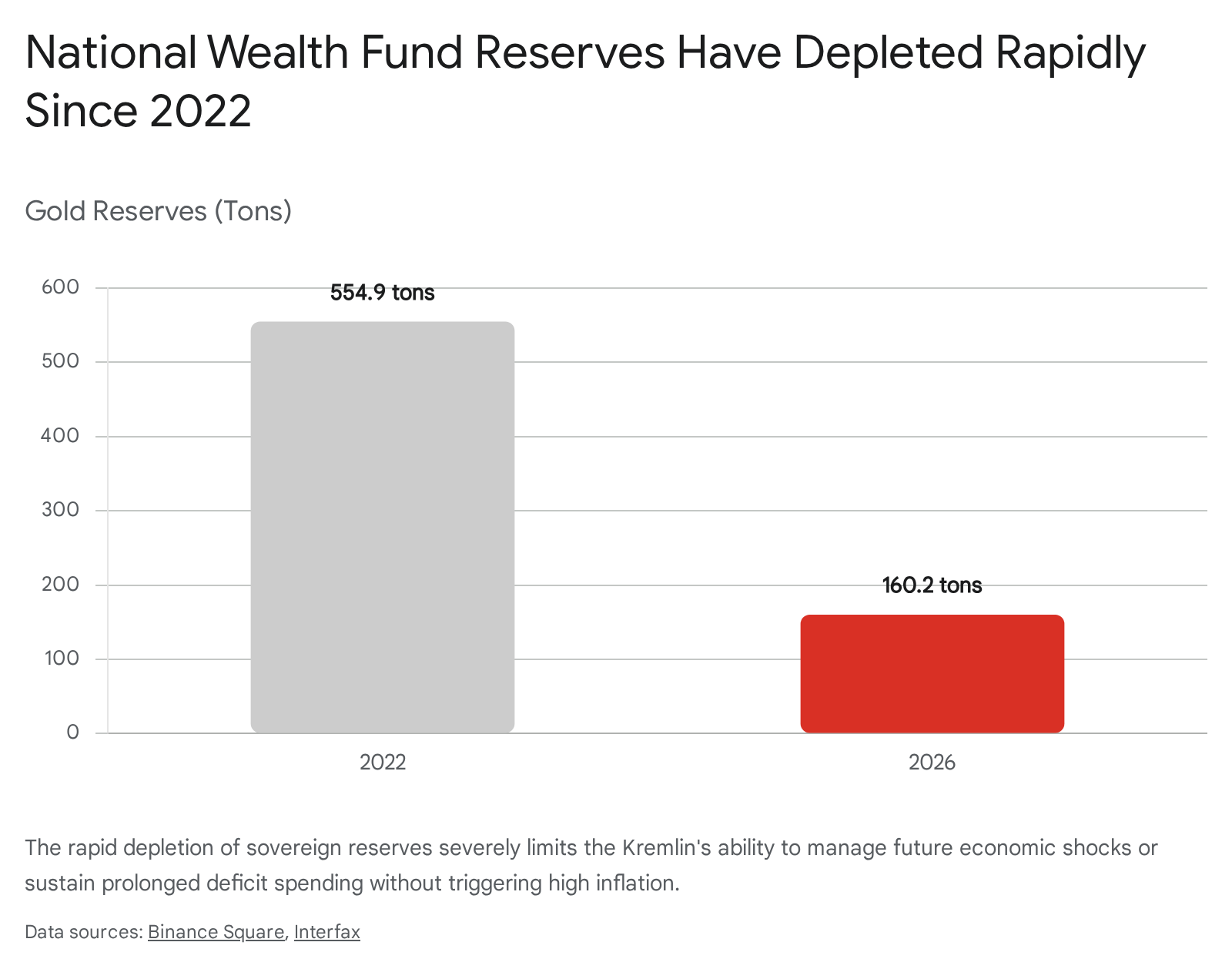
Current State: The Russian state is currently operating under severe fiscal strain that is temporarily masked by state-directed liquidity injections. The National Wealth Fund, historically designed as the primary sovereign macroeconomic shock absorber, has experienced a precipitous and structural decline. Gold reserves within the fund dropped from 554.9 tons in mid-2022 to 160.2 tons by January 2026, representing a massive 71 percent reduction in physical asset backing.3 Total liquid assets have plummeted concurrently. By early 2026, liquid holdings including the Chinese yuan fell to approximately 4.1 trillion rubles, which equates to roughly $52.6 billion.3 This reserve level represents a mere 1.7 percent of projected gross domestic product.20 Concurrently, defense and national security spending has been structurally entrenched at exorbitant levels. Military expenditure is set to reach approximately 13.5 trillion rubles, consuming 6.3 percent of the total GDP and accounting for 40 percent of all federal government outlays.2
Trajectory (Delta): The trajectory of Russian public finances is steeply deteriorating. To bridge the widening gap between stagnant hydrocarbon export revenues and surging military outlays, the federal government has resorted to significant tax hikes. Corporate tax rates were raised from 20 percent to 25 percent at the start of 2025, and the Value Added Tax was increased to 22 percent by January 2026.5 Furthermore, the state budget framework spanning 2026 to 2028 projects ongoing, unresolvable deficits that must be covered almost entirely by domestic borrowing.4 The Russian state plans to issue 15 trillion rubles in new domestic debt over this three-year period.4 This maneuver directly crowds out civilian credit and increases the sovereign debt burden.
Volatility: Fiscal volatility remains exceptionally high. Russian public revenues are critically sensitive to global hydrocarbon pricing fluctuations and the continued willingness of Asian markets, primarily China and India, to accept Russian resources at heavily discounted rates.5 A sudden drop in global oil demand or tighter enforcement of secondary sanctions on maritime shipping would immediately collapse the revenue base supporting the current budget.
Systemic Connection Analysis: The Russian state is caught in a severe fiscal pincer movement. Structural, non-discretionary spending pressures, primarily ongoing military procurement, veteran healthcare, and survivor benefits for the families of the deceased, are vastly outpacing the heavily sanctioned economy’s capacity to generate organic revenue. As the National Wealth Fund liquid assets near depletion, the state will be forced to choose between printing money to monetize the debt or extracting increasingly punitive taxes from a stagnant civilian sector. Both options will rapidly accelerate inflation and erode public compliance, accelerating the transition into a systemic crisis.
A.2. Economic Structure and Productivity
Current State: The Russian economy has fundamentally transitioned into a rigid, two-tiered system operating in a negative equilibrium.21 The military industrial complex successfully monopolizes human capital, bank loans, and federal subsidies, while the civilian economy is systematically suffocated by a lack of resources.21 The most critical bottleneck throttling economic productivity is human capital. As of early 2026, Russia faces an unprecedented labor deficit of 2.5 million workers.6 Central bank chair Elvira Nabiullina has publicly admitted that modern Russia has never experienced a labor shortage of this magnitude, noting that the available labor reserve plummeted from 7 million individuals in 2021 to a mere 4 million by the end of 2025.6 This deficit is severely impacting industrial output. Major manufacturing stalwarts are showing deep structural fatigue. For instance, AvtoVAZ, the nation’s largest carmaker, was forced to institute four-day work weeks, while Uralvagonzavod, the primary tank manufacturer, initiated mass layoffs explicitly citing sheer worker exhaustion alongside supply chain sanctions.6
To demonstrate the depth of this crisis, labor shortages are pervasive across all skill levels:
| Professional Sector | Estimated Worker Deficit (2024 Data) | Regional Examples |
| Commercial Drivers | 216,000 personnel 19 | Sevastopol: 16.3% overall deficit 19 |
| Industrial Mechanics | 166,000 personnel 19 | Chukotka: 12.1% overall deficit 19 |
| Engineering | 141,000 personnel 19 | Kamchatka: 11.9% overall deficit 19 |
| Construction Labor | 112,000 personnel 19 | Moscow Region: 11.0% overall deficit 19 |
Trajectory (Delta): The trajectory is defined by heavily managed stagnation. To combat wage-driven inflation, which is currently running near 10 percent, the Central Bank of Russia has maintained punishingly high key interest rates, fluctuating between 16 percent and 21 percent over the past year.5 These prohibitive rates effectively freeze private sector civilian investment. The workforce is officially projected by Rosstat to shrink by an additional 1.4 million personnel by the end of 2026, guaranteeing that the labor shortage will only intensify.6 Furthermore, Russian factories have cut their workforces for consecutive months, and overall industrial production has fallen for twelve straight months heading into 2026.6
Volatility: Economic volatility is moderate but climbing. The economy’s orientation has shifted entirely toward Asia, making it dangerously dependent on Chinese supply chains for both import substitution and the generation of export revenue.5 Any macroeconomic slowdown in China will immediately cascade into the Russian industrial base.
Systemic Connection Analysis: The labor shortage acts as an inescapable gravity well for the entire Russian macroeconomic structure. The military apparatus drains the most productive demographic cohorts for combat operations and defense manufacturing, forcing civilian industries to compete for a rapidly shrinking pool of available workers. This competition drives up wages without a corresponding increase in actual technological efficiency or output, thereby feeding a persistent inflationary spiral. The central bank attempts to crush this inflation with high interest rates, which subsequently kills long-term civilian productivity growth. The state is structurally degrading its ability to compete globally.
A.3. Household Financial Health
Current State: Household financial health across the Russian Federation is deeply bifurcated. Individuals directly engaged in the military sector, either through combat contracts paying upward of $3000 monthly or via defense manufacturing jobs, are experiencing rapid, artificial wage growth.7 However, the broader civilian population is suffering acute financial distress. While official state inflation is reported at roughly 8.5 percent, the real inflation rate for essential household goods is widely perceived by the public to be between 20 percent and 25 percent.7 Russia remains one of the most unequal societies globally, with the wealthiest one percent of the population controlling over 70 percent of all private assets.7
Trajectory (Delta): The trajectory is deteriorating. Regional disparities are compounding the economic stress. While metropolitan centers like Moscow maintain a per capita income five times higher than peripheral republics like Ingushetia, it is the impoverished peripheral regions that are bearing the disproportionate brunt of military mobilization and combat casualty rates.7
Volatility: High. Household financial distress is heavily correlated with seasonal expenditures, particularly winter utility costs in northern and Siberian regions.
Systemic Connection Analysis: As federal funds are aggressively funneled into the defense sector, municipal subsidies are slashed across the board. This forces local and regional authorities to raise basic utility tariffs on a population already squeezed by double-digit real inflation.8 The resulting localized financial precarity directly fractures the social contract. This dynamic is particularly dangerous in ethnic minority republics, whose populations increasingly feel they are bleeding human capital for Moscow’s geopolitical ambitions without receiving basic municipal security or economic stability in return.
Module B: Political Legitimacy and Institutional Integrity
B.1. Governance and Rule of Law
Current State: The Russian political system operates as a deeply personalized autocracy characterized by total vertical centralization and the complete absence of independent judicial or legislative oversight.7 A defining feature of the current governance model is the arbitrary redistribution of massive economic assets, effectively destroying the concept of property rights. The Prosecutor General’s Office has initiated over 170 nationalization lawsuits since 2022, seizing private assets valued at approximately 4.99 trillion rubles, or roughly 53.5 billion euros.10 These seizures, which have targeted prominent infrastructure like Domodedovo airport, predominantly enrich state corporations and President Vladimir Putin’s immediate inner circle.10
Trajectory (Delta): The governance trajectory is static in structure but increasingly brittle in practical application. The regime has formally transitioned into a Fortress Kremlin governance model.9 This posture is marked by political leadership retreating into highly secured, physically isolated environments. The executive relies heavily on the Federal Protective Service for physical security and strict information filtering, resulting in reduced presidential mobility and bunkerized, paranoid decision-making processes.9
Volatility: Volatility appears low on the surface due to strict state control, but it is exceptionally high beneath the institutional veneer. The system eliminates opponents through politically motivated killings, suppressing all pluralism.7
Systemic Connection Analysis: The authoritarian drift dilemma is fully active within the Russian state. By arbitrarily seizing assets from the technocratic elite to reward loyalist security factions, the Kremlin destroys the foundational property rights required for any long-term economic stability or foreign investment. The economic elites are kept deliberately atomized and locked inside the country by Western sanctions, resulting in a systemic environment where survival dictates absolute public compliance but fosters deep, hidden resentment. As elite competition intensifies over a shrinking pool of economic assets, the regime’s underlying stability becomes highly fragile.10
B.2. State Legitimacy and Public Trust
Current State: Public trust is entirely managed via a state media monopoly and draconian censorship laws that criminalize dissent. Authorities have filed over 10,000 administrative charges and hundreds of criminal prosecutions specifically to suppress anti-war sentiment.7 However, localized legitimacy is visibly fraying. A major shift in public consciousness is occurring as ordinary citizens begin explicitly connecting the deterioration of their daily living conditions with the immense financial drain of the military conflict.8
Trajectory (Delta): The trajectory of public trust is deteriorating. Citizens are increasingly engaging in grassroots, decentralized resistance to bypass federal censorship. In the Republic of Bashkortostan, the sentencing of local environmental activist Fayil Alsynov triggered the Baymak protests, mobilizing thousands of citizens in freezing negative twelve degree temperatures.11 Similar localized protests over land rights and municipal failures have erupted in rural Dagestan and Yakutia, indicating that rural and indigenous communities are reaching a breaking point.23
Volatility: Moderate. Protests currently remain strictly localized and deliberately focus on communal issues rather than explicit anti-regime slogans to avoid immediate, overwhelming state violence.8
Systemic Connection Analysis: Public compliance relies on the state delivering basic stability. As federal funding for municipalities collapses, the state fails to uphold its end of the social contract. The narrative promoted by state media regarding global great power status fails to resonate with citizens freezing in unheated apartment blocks. If local protests over utilities begin to merge with broader grievances regarding mobilization, the state will struggle to contain the unrest without deploying military force domestically.
B.3. Security Apparatus Cohesion
Current State: The state’s monopoly on violence is maintained, but the underlying architecture of that violence is fracturing into competing, heavily armed fiefdoms. The most significant development is the evolution of the Russian National Guard, Rosgvardia, led by Kremlin loyalist Viktor Zolotov. Rosgvardia has been formally elevated into a parallel military structure.12 Operating completely outside the Ministry of Defense’s chain of command, it forms a distinct third pillar alongside the regular military and the Federal Security Service. Rosgvardia has actively absorbed former Wagner private military company fighters, integrated heavy armor and tank units into its formations, and established a dedicated General Staff for intelligence and operational planning.12
Trajectory (Delta): Cohesion is deteriorating rapidly. There is a deeply destabilizing confrontation occurring among the top tiers of the security state, specifically between military intelligence, the FSB, and the Ministry of Defense.9 The environment is characterized by intense paranoia, multi-layer counterintelligence screenings of inner-circle personnel, and violent blame-shifting for military stagnation.9
Volatility: Volatility is extremely high. Geopolitical risk models currently assess a 20 percent to 30 percent probability of a serious coup attempt or a forced, irregular leadership transition within the next 12 to 18 months.9
Systemic Connection Analysis: The vast expansion of Rosgvardia represents a definitive inward turn of the security state. The executive branch recognizes that the regular military, exhausted and depleted by years of high-intensity combat, poses a latent political threat. By building a heavily armed praetorian guard dedicated exclusively to regime survival and insulated from the regular armed forces, the state fundamentally alters the domestic balance of power. While this deters a traditional military uprising, it dramatically increases the likelihood of catastrophic intra-regime violence if elite consensus collapses, as multiple factions now possess the armor and manpower to contest control of the capital.
Module C: Social Cohesion and Human Development
C.1. Social Fragmentation
Current State: Russian society is experiencing severe, cross-cutting fragmentation along geographic, ethnic, and generational fault lines. The burden of military mobilization has fallen disproportionately on peripheral, non-ethnic Russian republics. In tandem with mobilization, the central government has accelerated policies that actively strip these republics of their cultural sovereignty. This includes the systematic abolition of indigenous language studies in regions like Tatarstan and Bashkortostan, and the heavy militarization of local school systems to prepare youth for state service.13
Trajectory (Delta): Social cohesion is deteriorating. A massive wave of social friction is building as combat veterans return to civilian life. Over one million men are expected to return from the front lines, many drawn directly from penal colonies or suffering from profound combat trauma and traumatic amputations.14 These individuals are filtering back into local communities that entirely lack the psychological, medical, or economic infrastructure to reintegrate them effectively.14
Volatility: Volatility is moderate to high. Historical data from post-Afghan and post-Chechen conflicts strongly indicates that such dynamics inevitably result in a severe spike in violent crime, domestic abuse, and organized gang activity, fundamentally destabilizing local governance.14
Systemic Connection Analysis: The suppression of ethnic identities combined with the influx of traumatized veterans creates a highly combustible social environment. As the federal center demands more resources and manpower from the periphery while simultaneously restricting cultural rights, the potential for armed separatism or violent regional defiance increases significantly, threatening the territorial integrity of the state.
C.2. Public Services and Welfare
Current State: Core public services are buckling under the dual weight of mass war casualties and severe federal budget cuts. The civilian healthcare system is in a state of acute crisis. Ten out of the twenty professions with the highest labor deficits in the Russian economy are in the medical sector, including critical, life-threatening shortages of emergency doctors, pharmacists, and dietitians.19 Concurrently, the municipal infrastructure is experiencing catastrophic, systemic failures. During the winter cold snap of January 2026, utility outages for power, heating, and water doubled compared to the previous year, with 1,788 distinct reports of disruptions nationwide.16
Trajectory (Delta): The trajectory for public welfare is rapidly deteriorating. The state explicitly reduced funding for the housing and utilities sector in its three-year budget framework to a mere 1.999 trillion rubles.16 Consequently, the infrastructure repair rate sits at roughly 2 percent annually, falling vastly short of the rate required to halt further deterioration.16 The Ministry of Construction admits that actual wear and tear on utility networks currently ranges from 40 percent to 80 percent depending on the region.16 Government programs intended to replace dilapidated housing have been officially suspended to channel funds to the military.8
Volatility: Volatility is exceptionally high. Infrastructure failures are highly seasonal, meaning that extreme winter weather dictates the immediate tempo of local discontent and physical suffering.
Systemic Connection Analysis: The degradation of public services creates an immediate, reinforcing feedback loop with the country’s demographic decline. The collapse of accessible civilian healthcare accelerates excess mortality rates among the elderly, the chronically ill, and wounded veterans. This systemic failure further strains the labor pool and permanently reduces the long-term economic carrying capacity of the Russian state.
Module D: Environmental and Resource Security
D.1. Climate Change Vulnerability
Current State: The Russian Federation is highly exposed to climate-driven infrastructure degradation, primarily due to its geography. Approximately 60 percent of the Russian landmass is situated on permafrost.8 As global temperatures rise, this foundational permafrost is thawing at an accelerating rate. A recent assessment of the Arctic Circumpolar Permafrost Region reveals that 97 percent of subregions are moderately vulnerable to thaw, while an alarming 25 percent possess exceptionally low adaptive capacities to manage the changing terrain.18
Trajectory (Delta): The environmental security trajectory is deteriorating. The thaw poses an existential, physical threat to Russia’s long-term energy strategy, specifically targeting its critical Arctic Liquified Natural Gas infrastructure.29 Projects like the Yamal LNG facility, which are paramount to Russia’s pivot toward Asian energy markets, rely heavily on frozen ground for structural integrity.29 The Ministry of Natural Resources estimates that permafrost thaw will cause $62.7 billion in direct economic damages by 2050, primarily through the destruction of pipelines, paved roads, and heavy industrial facilities.17
Volatility: Volatility is low, as permafrost thaw is a slow-burn, highly predictable physical process that alters the landscape over decades rather than months.
Systemic Connection Analysis: Climate vulnerability imposes massive unfunded liabilities on the Russian state at the worst possible moment. Just as the central government is redirecting all available domestic capital toward military production and deficit financing, the physical foundation of its primary revenue generator is literally sinking into the tundra. Preventing the collapse of Arctic energy logistics will require tens of billions in unexpected engineering and maintenance interventions, money the state no longer possesses.
D.2. Resource Stress and Demographic Degradation
Current State: Russia is in the midst of a terminal demographic collapse. The total fertility rate has plunged to 1.37, matching the catastrophic demographic lows last seen during the economic depression of the late 1990s.31 In 2024, the nation recorded only 1.22 million total births.19 Exacerbating this severe natural decline are massive, ongoing wartime losses. Estimates of casualties vary, but consensus assessments place total losses well over 1.2 million personnel killed, severely wounded, or missing.6 Independent tracking lists confirm over 213,000 named dead, with statistical models estimating up to 273,000 real fatalities.19 Consequently, male life expectancy in Russia plummeted from 66 years to 61 years by mid-2025.1
Trajectory (Delta): The demographic trajectory is terminal. Historically, Russia managed to offset its severe natural population decline through the mass importation of labor migrants from Central Asia. This mitigation mechanism has now utterly failed. Driven by severe xenophobia, legalized state discrimination, and the omnipresent threat of forced conscription, the migrant labor pool collapsed from a peak of 7 million individuals to barely 3 million.19
To obscure the true scale of this disaster, the federal government has classified all critical demographic data, preventing independent planners from assessing the true mortality rates.19 Concurrently, regional authorities are resorting to draconian measures to force population growth, implementing informal abortion bans and conducting life raids on medical clinics to harass physicians.19
| Demographic Indicator | Recent Data Point | Trend Analysis |
| Total Fertility Rate | 1.37 live births per woman 31 | Dropped 23% since the 2015 peak; below replacement level. |
| Working Age Males | Over 1.2 million casualties 6 | Permanent removal of most productive cohorts from economy. |
| Migrant Labor Pool | Dropped from 7M to 3M 19 | Loss of primary demographic shock absorber due to xenophobia. |
| Male Life Expectancy | Dropped to 61 years 1 | Indicates severe public health and combat-related mortality crisis. |
Volatility: Volatility is low. Demographic momentum operates on generational timelines and requires decades to reverse.
Systemic Connection Analysis: This demographic collapse is the apex vulnerability of the Russian state. It guarantees that the current 2.5 million worker deficit will never be organically resolved.6 This demographic ceiling mathematically caps the future size of the economy, permanently restricts the potential tax base, and severely limits the state’s future capacity to field large conventional armies.
Synthesis and Predictive Outlook
3.1. Dynamic Weighting Algorithm
To determine the overall fragility score and the exact lifecycle trajectory of the Russian state, this analytical framework utilizes a dynamic weighting mechanism. In a Stable lifecycle state, economic, institutional, and social indicators are weighted evenly. However, as the state enters a Stressed-to-Crisis transition, structural constraints take precedence over transient political maneuvering.
- Demographics (30%): Weighted highest. The absolute lack of human capital forms an unbreakable, physical ceiling on economic recovery and military sustainability. No policy directive can rapidly manufacture 2.5 million adults.
- Economic Resilience (25%): Heavily weighted due to the immediate, critical depletion of the National Wealth Fund and the punishingly high-interest rate environment destroying civilian capacity.
- Security Cohesion (25%): Highly weighted due to the severe short-term risk of an irregular leadership transition via siloviki infighting.
- Social and Environmental (20%): Weighted lower for short-term collapse risk, as highly authoritarian regimes can temporarily suppress social unrest through extreme violence, though these factors act as powerful long-term systemic accelerants.
3.2. Feedback Loop and Cascade Failure Analysis
The Russian state is currently trapped within three critical, reinforcing feedback loops that are aggressively accelerating its decline toward a systemic Crisis stage.
Loop 1: The Demographic-Military Trap The state requires immense, continuous infusions of manpower to sustain its military operations, pulling hundreds of thousands of prime-age males out of the civilian workforce.6 This exacerbates the structural 2.5 million labor shortage, driving up civilian wages as companies compete for a shrinking pool of workers, without increasing actual productivity.6 The resulting wage-driven inflation forces the Central Bank to maintain interest rates at 21 percent.5 These punitive rates annihilate civilian business investment, causing overall economic stagnation and preventing the creation of high-value industries.5 Consequently, the state cannot generate enough organic wealth to support families, driving the birth rate even lower and ensuring the labor pool continues to shrink perpetually.19
Loop 2: The Infrastructure-Fiscal Spiral Western sanctions and the permanent loss of the European energy market have structurally constrained federal revenues.5 To maintain the mandatory 6.3 percent military expenditure, the federal government aggressively slashes subsidies for municipal infrastructure.8 The degradation of 40 percent to 80 percent of the utility networks leads directly to mass heating and water failures during the extreme winter months.16 To repair these failures, local governments are forced to raise utility tariffs on households whose real wages are already severely eroded by inflation.8 This localized financial distress sparks grassroots protests in peripheral regions.23 To suppress these protests, the state must increase funding for domestic security forces like Rosgvardia, further draining the federal budget and completing the vicious cycle.
Loop 3: Authoritarian Drift and Elite Fragmentation Facing rising social discontent and a stagnant battlefield, the executive centralizes power further and arbitrarily seizes commercial assets from technocratic elites to reward loyalist security factions.10 This blatant destruction of property rights terrifies the remaining economic elite, who realize their physical and financial survival is completely dependent on unpredictable executive whim.21 Fearing internal betrayal, the executive isolates itself physically and elevates parallel security structures like Rosgvardia outside the traditional military chain of command.9 This institutional bypass provokes intense paranoia and rivalry within the traditional intelligence and military agencies, leading to institutional paralysis, violent scapegoating, and an increased likelihood of a preemptive coup as competing factions realize it is a “now-or-never” scenario for their own survival.9
3.3. Scenario Modeling and Tipping Points
Reasonable Worst-Case Scenario (36-Month Horizon): By the winter of 2027, the National Wealth Fund’s liquid assets drop to absolute zero, forcing the Russian Central Bank to engage in unsterilized money printing to cover the 15 trillion ruble deficit.3 Hyperinflation spikes above 30 percent. Concurrently, a severe, prolonged cold snap triggers a cascading failure of municipal heating grids across multiple ethnic republics and key Siberian industrial centers, leaving millions without heat for weeks.8
Because the regular military is bogged down on the front lines and depleted of rapidly deployable reserves, the executive deploys Rosgvardia to suppress mass, violent riots in regional capitals like Ufa and Makhachkala. When local police units, sympathetic to their freezing constituents, refuse to assist Rosgvardia, low-level armed clashes erupt. Utilizing this domestic chaos and loss of territorial control as a pretext, an alliance between disgruntled elements of the Federal Security Service and the regular military command initiates a palace transition, citing the executive’s health and the urgent need to restore national order.9 The resulting elite fracturing paralyzes central command and control, leading to a de facto collapse of the central political authority and a rapid transition into the formal Crisis or Collapse stage.
Key Tipping Points for State Collapse:
- Reserve Depletion: Liquid assets in the National Wealth Fund fall below 0.5 percent of GDP, entirely eliminating the state’s capacity to subsidize basic social welfare and manage currency shocks.
- Monetary Breaking Point: The Central Bank loses control of inflation, forcing the key interest rate above 25 percent, triggering a wave of mass defaults in the civilian corporate sector and wiping out remaining household savings.
- Security Fracture: A high-profile, violent purge of a top-tier security official within the FSB or Ministry of Defense triggers preemptive, armed self-defense actions by rival security factions.
- Infrastructure Cascade: Winter utility failures exceed the localized level, simultaneously disabling infrastructure in major strategic logistics nodes outside of Moscow, severely disrupting the military supply chain and sparking uncontainable regional protests.
Appendix: Systems-Dynamic Analytical Framework
This assessment utilized a multi-domain systems-dynamic methodology to evaluate state fragility over a 36-month horizon. Rather than isolating individual economic or military data points, the analysis mapped the complex interactions between macroeconomic constraints, political institutional integrity, demographic realities, and environmental stressors. The integration of geopolitical risk forecasting with granular socioeconomic data allowed for the precise identification of the reinforcing feedback loops that drive systemic decay. The framework rigorously evaluated multiple distinct intelligence inputs, applying a weighted algorithm that prioritized structural, unalterable constraints, such as absolute demographic collapse and severe labor deficits, over transient political posturing. This comprehensive systems approach enables an accurate mapping of the Russian Federation onto the five-stage state lifecycle model, providing a highly reliable predictive outlook of state failure probabilities.
Please share the link on Facebook, Forums, with colleagues, etc. Your support is much appreciated and if you have any feedback, please email us in**@*********ps.com. If you’d like to request a report or order a reprint, please click here for the corresponding page to open in new tab.
Sources Used
- Strategic Forecast: Russia Collapse Risk | Small Wars Journal by …, accessed May 5, 2026, https://smallwarsjournal.com/2025/09/16/strategic-forecast-russia-collapse-risk/
- A Budget for a Fifth Year of War: Military Spending in Russia’s Budget for 2026 | SIPRI, accessed May 5, 2026, https://www.sipri.org/publications/2026/sipri-insights-peace-and-security/budget-fifth-year-war-military-spending-russias-budget-2026
- SHOCKING: Russia’s Financial Safety Net is Evaporating! | AFR TRADERS on Binance Square, accessed May 5, 2026, https://www.binance.com/en/square/post/35517913757522
- Russian budget framework for 2026‒2028 foresees tax hikes and lots of red ink, accessed May 5, 2026, https://www.bofbulletin.fi/en/blogs/2025/russian-budget-framework-for-2026-2028-foresees-tax-hikes-and-lots-of-red-ink/
- Russia’s economy faces years of low growth – GIS Reports, accessed May 5, 2026, https://www.gisreportsonline.com/r/russia-economy-low-growth/
- “Russia has never seen this”: Russia’s central bank chief admits a …, accessed May 5, 2026, https://euromaidanpress.com/2026/04/29/russia-labor-floor-nabiullina-admits-unprecedented-shortage/
- Russia Country Report 2026 – BTI Transformation Index, accessed May 5, 2026, https://bti-project.org/en/reports/country-report/RUS
- War Spending Accelerating Russian Infrastructure Collapse …, accessed May 5, 2026, https://www.eurasiareview.com/14012026-war-spending-accelerating-russian-infrastructure-collapse-analysis/
- Fortress Kremlin: Elite Fractures, Regime Security, and Coup Risk in …, accessed May 5, 2026, https://lansinginstitute.org/2026/05/04/fortress-kremlin-elite-fractures-regime-security-and-coup-risk-in-russia/
- www.ssoar.info Wartime Asset Redistribution in Russia: Causes …, accessed May 5, 2026, https://www.ssoar.info/ssoar/bitstream/handle/document/108735/ssoar-russanald-2026-335-burkhardt_et_al-Wartime_Asset_Redistribution_in_Russia.pdf?sequence=1
- Russia’s Bashkortostan protests: Separatism isn’t the real threat facing Putin, accessed May 5, 2026, https://www.atlanticcouncil.org/blogs/ukrainealert/russias-bashkortostan-protests-separatism-isnt-the-real-threat-facing-putin/
- The Evolution of the Russian National Guard – Riddle Russia, accessed May 5, 2026, https://ridl.io/the-evolution-of-the-russian-national-guard/
- From Periphery to Frontline: Ethnic Minority Rights in Wartime Russia – Modern Diplomacy, accessed May 5, 2026, https://moderndiplomacy.eu/2025/07/07/from-periphery-to-frontline-ethnic-minority-rights-in-wartime-russia/
- Russia Analytical Report, March 16–23, 2026, accessed May 5, 2026, https://www.russiamatters.org/news/russia-analytical-report/russia-analytical-report-march-16-23-2026
- Attacks on Health in Ukraine Continue to Escalate Four Years into Russia’s Full-Scale Invasion – PHR, accessed May 5, 2026, https://phr.org/news/attacks-on-health-in-ukraine-continue-to-escalate-four-years-into-russias-full-scale-invasion/
- Utility Failures Plagued Russia During January Cold Snap – Report – The Moscow Times, accessed May 5, 2026, https://www.themoscowtimes.com/2026/02/02/utility-failures-plagued-russia-during-january-cold-snap-report-a91839
- Russia’s Arctic infrastructure is becoming increasingly vulnerable | Polar Journal, accessed May 5, 2026, https://polarjournal.net/russias-arctic-infrastructure-is-under-threat/
- The Arctic Permafrost Vulnerability Index – MDPI, accessed May 5, 2026, https://www.mdpi.com/2071-1050/17/8/3288
- Russia’s Current Demographic Crisis Is Its Most Dangerous Yet …, accessed May 5, 2026, https://carnegieendowment.org/russia-eurasia/politika/2025/09/russia-new-demographic-crisis
- Russian National Wealth Fund falls 90.5 bln rubles in Feb to 13.5 trln rubles, liquid assets at 1.7% of GDP – Interfax, accessed May 5, 2026, https://interfax.com/newsroom/top-stories/116451/
- The Future of Russian Power: Threat Perceptions, Military …, accessed May 5, 2026, https://carnegieendowment.org/events/2026/04/future-of-russian-power-event
- Russia’s economic challenges expected to persist into 2026 amid cooling trend, accessed May 5, 2026, https://aa.com.tr/en/world/russia-s-economic-challenges-expected-to-persist-into-2026-amid-cooling-trend/3791964
- Pro-Democracy Resistance Is All Over Russia. You Are Made Not to Notice It. – LSE Blogs, accessed May 5, 2026, https://blogs.lse.ac.uk/crp/2025/07/31/pro-democracy-resistance-is-all-over-russia-you-are-made-not-to-notice-it/
- Russia building ‘parallel force’ to protect Putin, analyst warns – TVP World, accessed May 5, 2026, https://tvpworld.com/91679651/rosgvardia-becoming-rival-military-force-expert-says
- Putin Expands Rosgvardia’s Role – The Moscow Times, accessed May 5, 2026, https://www.themoscowtimes.com/2026/02/12/putin-expands-rosgvardias-role-a91934
- Regions Calling: What Will 2026 Bring for Russia’s Regions? This Is …, accessed May 5, 2026, https://www.themoscowtimes.com/2026/01/08/regions-calling-what-will-2026-bring-for-russias-regions-this-is-what-experts-say-a91630
- The Roots of Spontaneous Protest in Bashkortostan – PONARS Eurasia, accessed May 5, 2026, https://www.ponarseurasia.org/the-roots-of-spontaneous-protest-in-bashkortostan/
- The Social Contract at War: Mobilization, Legitimacy, and Post-War Cohesion in Ukraine, accessed May 5, 2026, https://tdcenter.org/2026/03/19/the-social-contract-at-war-mobilization-legitimacy-and-post-war-cohesion-in-ukraine/
- Russia’s Arctic LNG Infrastructure: Development and Operational Analysis – Tearline.mil, accessed May 5, 2026, https://www.tearline.mil/public_page/russias-arctic-lng-infrastructure-development-and-operational-analysis
- Cold Realities – per Concordiam, accessed May 5, 2026, https://perconcordiam.com/cold-realities/
- PUTIN’S FATAL BLOW TO RUSSIA’S DEMOGRAPHICS: LATEST DATA, accessed May 5, 2026, https://thinktank.4freerussia.org/wp-content/uploads/2026/03/Digital-Russian_demography_DA_edits_2.0-3.pdf
- Demographics of Russia – Wikipedia, accessed May 5, 2026, https://en.wikipedia.org/wiki/Demographics_of_Russia
- The Russia-Ukraine War Report Card, April 29, 2026, accessed May 5, 2026, https://www.russiamatters.org/news/russia-ukraine-war-report-card/russia-ukraine-war-report-card-april-29-2026
- Russia’s Demographic Vanishing Act: A Warning From History, accessed May 5, 2026, https://www.russiamatters.org/analysis/russias-demographic-vanishing-act-warning-history