
Executive Summary
The Russian Federation has entered a phase of terminal structural degradation, transitioning from a state of artificial wartime stabilization into a formal Crisis stage within the state fragility lifecycle. Driven by a protracted, multi-year war of attrition in Ukraine, the Russian state apparatus is currently operating in what macroeconomic analysts term a “negative equilibrium”—a condition sustained exclusively through the rapid, unrecoverable cannibalization of its finite Soviet-era strategic reserves, sovereign wealth, and human capital.1 As of mid-2026, the state’s capacity to absorb internal and external shocks has been functionally neutralized.
Applying a multi-domain systems-dynamic framework that prioritizes unalterable structural constraints over transient political events, the overall State Fragility Score for the Russian Federation is assessed at 8.03 / 10.00 (Crisis Stage). The 36-month trajectory indicates a high probability of cascading systemic failures culminating in state collapse or severe territorial fragmentation.
The most critical systemic stressors driving this trajectory are deeply interconnected and mutually accelerating. Demographically, the state is experiencing an accelerated contraction of its prime working-age cohorts, exacerbated by over 1.4 million military casualties and mass emigration.2 Economically, the depletion of the National Wealth Fund (NWF) liquid assets coincides with a latent, state-masked banking crisis where toxic assets have breached the International Monetary Fund’s (IMF) 10% critical threshold, alongside a massive 8 trillion ruble corporate non-payment backlog.4 Militarily, the exhaustion of the Soviet-era armored vehicle stockpile—now reduced to under 900 viable restoration candidates—and the irrecoverable loss of high-end strategic aerospace assets severely limit Moscow’s conventional power projection capabilities through 2029.6 Concurrently, environmental degradation and severe wartime underfunding have triggered rolling collapses of civilian utility infrastructure across the Russian periphery, fueling deep social resentment and crime.8 The convergence of these factors ensures that any single exogenous shock could catalyze a rapid transition from managed crisis to unmanaged collapse.
State Fragility Dashboard
| Domain / Indicator | Current Score (1-10) | Trend (Δ) | Volatility | Weighted Impact (%) | Brief Rationale |
| Economic Resilience | 8.2 | Worsening | High | 25.0% | NWF depletion; latent banking crisis; regional fiscal ruin; regressive taxation. |
| Public Finances | 8.5 | Worsening | High | – | NWF liquid assets have dropped from a pre-war $113.5B to $48.0B; federal deficit masked by OFZ issuance.10 |
| Economic Structure | 8.0 | Worsening | Low | – | Complete metabolic prioritization of the military-industrial complex; civilian sector starved.1 |
| Household Financial Health | 8.1 | Worsening | High | – | Corporate non-payments at 8T rubles (3.8% GDP); SMEs crushed by VAT hikes.5 |
| Governance & Social | 8.0 | Worsening | Extreme | 20.0% | Peripheral criminalization; unprecedented violent crime wave; utility collapse; ethnic flashpoints. |
| Governance / Rule of Law | 7.8 | Worsening | High | – | Law enforcement hijacked by war effort; legal mechanisms superseded by presidential pardons for violent convicts.12 |
| State Legitimacy | 7.5 | Stable | Low | – | Depoliticized populace relies on apathy; FSB/Presidential Administration infighting growing.14 |
| Social Fragmentation | 8.5 | Worsening | Extreme | – | Post-war PTSD/convict return causing 14-year high in violent crime; Dagestan terror attacks.12 |
| Public Services | 8.2 | Worsening | High | – | Trillions needed for repair; systemic winter infrastructure collapse across peripheral regions.8 |
| Security & Military | 8.4 | Worsening | High | 25.0% | Tactical mass preserved via meat-assaults, but strategic, armored, and aerospace materiel capabilities are irreparably degraded. |
| Military Capabilities / Readiness | 8.6 | Worsening | High | – | 8:1 casualty ratios; armor reserves nearly exhausted (72% drained); reliance on foreign munitions.2 |
| Security Apparatus Cohesion | 7.5 | Stable | High | – | Systemic depoliticization ensures short-term loyalty, though inter-agency resource competition is intensifying.15 |
| Environmental & Resource | 7.5 | Worsening | Low | 10.0% | Climate degradation destroying physical infrastructure and export routes. |
| Climate Vulnerability | 7.8 | Worsening | Low | – | Permafrost melt threatening 60% of Arctic infrastructure and $110B in pipeline networks.18 |
| Demographic Degradation | 8.5 | Worsening | Low | 20.0% | Loss of 5.9M in 20-29 cohort; TFR at 1.41; irreplaceable wartime losses capping industrial output.3 |
Detailed Domain Analysis
1. Economic Resilience: Metabolic Prioritization and Systemic Insolvency
(Weight: 25%)
The Russian economy is not undergoing a cyclical downturn; it is experiencing structural necrosis. Leading economic analysts, such as Alexandra Prokopenko, observe that the Russian economy has entered a “death zone”—a negative equilibrium where the state is consuming its own future reserves faster than they can be replenished.1 The economy operates much like a freezing human body, prioritizing blood flow to vital organs (the military-industrial complex) at the fatal expense of its extremities (the civilian economy, infrastructure, and small-to-medium enterprises).1
The Depletion of the National Wealth Fund (NWF) and Public Finances
The primary mechanism delaying immediate fiscal collapse has been the aggressive liquidation of the National Wealth Fund (NWF). Prior to the 2022 invasion, the NWF held $113.5 billion in liquid assets, including over 405 metric tons of gold.14 Data indicates a catastrophic decline: by January 2026, liquid assets had fallen to $52.9 billion, and by March 2026, they plummeted further to $48.0 billion.10
The pace of NWF disposal has accelerated drastically to cover widening gaps in oil and gas revenues. In early 2026, the Finance Ministry was forced to sell yuan and gold at a record pace of 12.8 billion rubles ($165 million) per day—more than double the rate of previous months and exceeding peak liquidation rates seen during the COVID-19 pandemic.14 The cumulative federal budget deficit for Q1 2026 hit a record 4.6 trillion rubles ($59 billion), immediately exceeding the government’s full-year target by 21%.10 Furthermore, federal government debt has doubled since the start of the full-scale war, reaching 31 trillion rubles.10
While March 2026 saw a transient surge in oil export earnings to $19.0 billion (driven by global price spikes stemming from the Iran war), the underlying structural deficit remains massive.10 At the current burn rate, if the oil and gas revenue shortfall reaches projected levels of 2.5 to 3.0 trillion rubles, the NWF’s liquid reserves will be mathematically exhausted, eliminating the state’s primary macroeconomic buffer and forcing unbacked currency printing.14 To compensate, Russia has radically increased domestic borrowing, issuing 1.4 trillion rubles in OFZs (federal government bonds) in Q1 2026 alone, a 25% increase year-over-year.10
The Latent Banking Crisis and Corporate Insolvency
Underneath the macroeconomic facade, Russia has quietly crossed into systemic financial destabilization. According to internal reports from the pro-Kremlin Center for Macroeconomic Analysis and Short-Term Forecasting (CMASF), the share of non-performing and toxic assets in Russia’s banking system has formally breached 10%, reaching 23.4 trillion rubles (11.2%) by early March.37 Under IMF methodology, breaching this 10% threshold for three consecutive months designates the definitive onset of a systemic banking crisis.4
The crisis remains “latent” only because the state-dominated banking sector (e.g., Sberbank, VTB) is artificially restructuring toxic loans to prevent retail bank runs.4 However, this strategy merely transfers commercial default risks directly onto the sovereign balance sheet at a time when the state can least afford it. Corporate liquidity is evaporating; overdue intercompany receivables have surged past 8 trillion rubles, representing roughly 3.8% of Russia’s total GDP.5 Nearly 50% of Russian enterprises cite payment delays from contractors as their primary existential threat.5 The combination of a 14.25% central bank interest rate 38, severe logistics costs, and labor shortages is pushing the civilian corporate sector toward a mass wave of defaults by late 2026.20 Consequently, nearly one in five banks (19.7%) in Russia is now operating at a loss, the highest level since the initial sanctions shock of 2022.22
Regional Fiscal Ruin and Regressive Taxation
The financial burden of the war has been disproportionately offloaded onto regional governments, which are mandated to fund local military recruitment drives and social payouts. Rating agency Expert RA estimates that military recruitment costs regions around 1 trillion rubles annually.14 Consequently, regional budget deficits have exploded.
| Fiscal Indicator / Region | 2024 / Historical Status | 2025 / 2026 Reality | Impact |
| Consolidated Regional Deficit | 200–300 Billion Rubles | 1.9 Trillion Rubles (2026 Proj.) | Regions operating in severe, unrecoverable debt.14 |
| Total Regional Debt | Stable | 3.5 Trillion Rubles | Highest level of regional debt recorded in 15 years.14 |
| Republic of Komi | Net Contributor | -50% Profit Tax Receipts | Devastation of local corporate tax base.14 |
| Orenburg Region | Net Contributor | -40% Profit Tax Receipts | Inability to fund localized social services.14 |
| Yamal-Nenets District | High Revenue Energy Hub | -38% Profit Tax Receipts | Signal of deep corporate profit erosion.14 |
To sustain this negative equilibrium, the federal government has resorted to regressive taxation on the civilian population. The 2026-2028 budget mandates a VAT increase from 20% to 22%, directly penalizing domestic consumers and ensuring a disinflationary reduction in civilian living standards.11 Furthermore, the revenue threshold for small business tax exemptions has been drastically slashed from 60 million to 10 million rubles per year (approx. $8,500 per month), exposing the remnants of the civilian SME sector to crippling tax burdens.11
2. Governance & Social: The Criminalization of the Periphery
(Weight: 20%)
The societal fabric of the Russian Federation is fracturing under the pressure of severe psychological trauma, skyrocketing violent crime, systemic utility failures, and ethnic polarization. The state is relying on sheer depoliticization and coercion to govern, masking deep internal decay.
The “Afghan/Chechen Syndrome” Multiplier
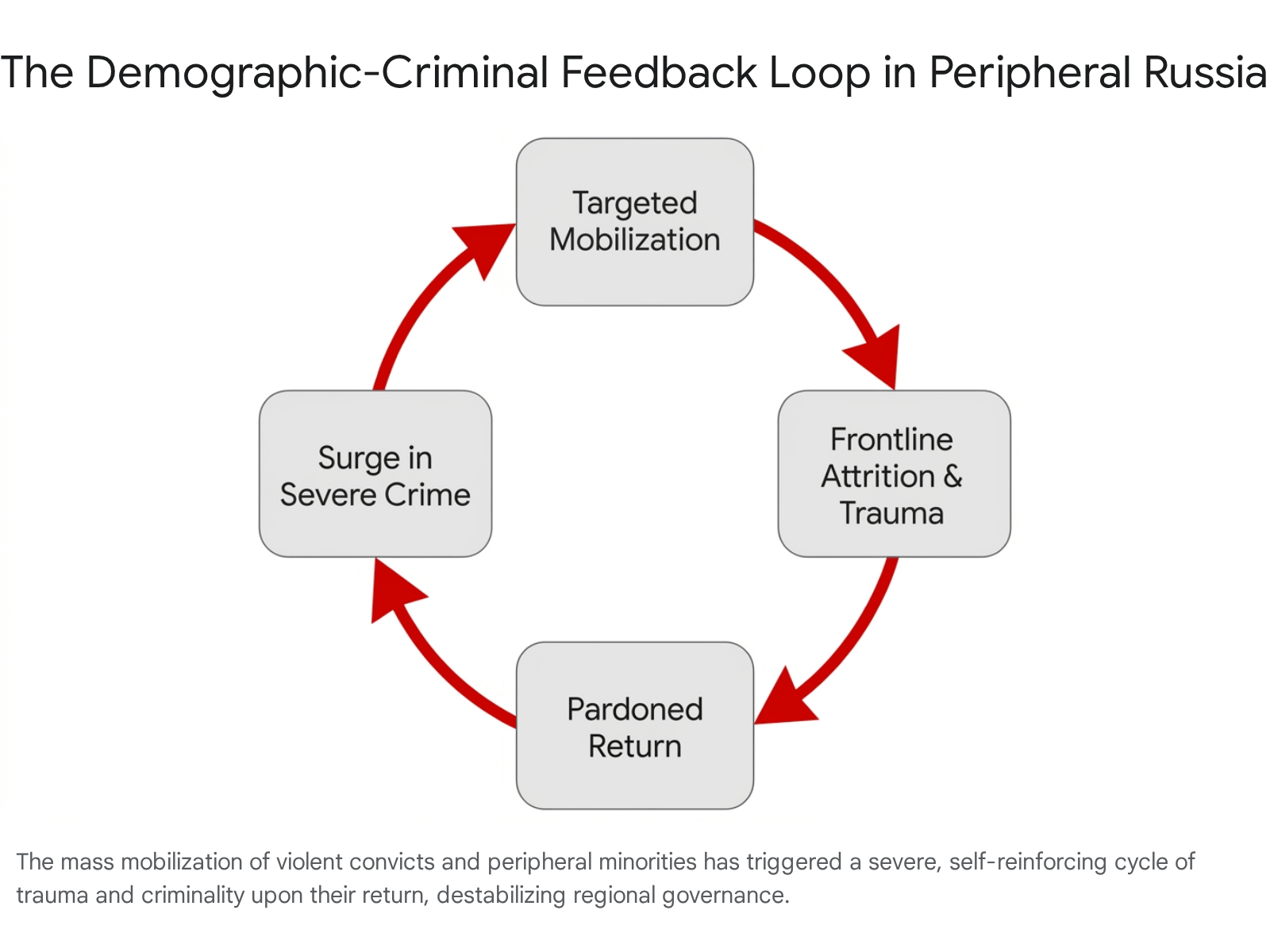
Russia is currently suffering a violent crime epidemic that dwarfs the historical “Afghan” and “Chechen” syndromes of the late 20th century.12 The Kremlin’s reliance on recruiting over 170,000 violent prison convicts into paramilitary units has resulted in the mass return of traumatized, heavily armed, and pardoned criminals into civilian life.12
In 2024, the Russian Interior Ministry recorded a 14-year high of over 617,000 severe and particularly severe crimes.12 Murders have surged, particularly in peripheral and border regions like Belgorod and Kursk, where homicide rates doubled in a single year.12 The situation is particularly dire regarding domestic violence; in 2024, at least 963 women were killed in domestic violence incidents, the highest figure in 15 years.12 Military courts have seen a drastic spike in prosecutions: murder cases involving military personnel jumped from 21 in 2021 to 352 in 2025, and rape cases rose from 30 to 116 in the same timeframe.12 A high-profile example occurred in Kyakhta, Buryatia, where a pardoned mercenary with combat awards beat his wife to death, reflecting the total erosion of social mores.12
This systemic violence is concentrated in socially marginalized ethnic republics—such as Bashkortostan, Buryatia, Dagestan, and Yakutia—regions that were already disproportionately targeted for wartime mobilization.12 Returning mercenaries have killed at least 551 people and seriously injured 465 inside Russia since their return.12 This dynamic creates an inescapable cycle of peripheral destabilization.
Ethnic Tensions and State Repression
The internal security apparatus is increasingly draconian but highly brittle. Domestic policy continues to heavily discriminate against ethnic and religious minorities. According to the U.S. Commission on International Religious Freedom (USCIRF), the Russian government perpetrates severe violations against perceived “non-traditional” religious organizations.23 This systemic marginalization has sparked violent blowback. In June 2024, armed militants linked to ISIS targeted Derbent and Makhachkala in Dagestan, torching a church and a synagogue and killing at least 15 law enforcement personnel.16 The state’s response—articulated by Chechen leader Ramzan Kadyrov advocating for the extrajudicial slaughter of the attackers’ families—demonstrates a reversion to collective punishment and the breakdown of formal rule of law.16
Furthermore, political repression remains total. In 2025, OVD-Info reported significant crackdowns on protests in Bashkortostan, and a total of 173 individuals and organizations were declared “foreign agents”.24 The ruling elite operates as an unaccountable community of managers, devoid of public accountability, who maintain power through the politically motivated elimination of opponents, highlighted by the deaths of Alexei Navalny and Yevgeny Prigozhin.13 However, this depoliticization does not prevent factional friction; leaks and infighting between the Federal Security Service (FSB) and the domestic policy bloc of the Presidential Administration highlight growing cracks within the power vertical.14
Externally, Russia is externalizing its internal instability through state-sponsored terrorism. A joint report by the International Center for Counter-Terrorism and GLOBSEC identified 151 incidents of Russian-backed kinetic hybrid warfare and sabotage across Europe between 2022 and 2026, primarily targeting Poland, France, and Germany.25
Systemic Winter Infrastructure Collapse
The combination of extreme winter weather events (exacerbated by climate change) and the total diversion of state funds to the military resulted in the rolling collapse of regional utility systems during the winter of 2025–2026.8 Extreme snowstorms—the worst in 200 years in some areas—and sub-zero temperatures caused massive regional power system failures.8 In critical military-logistics hubs like Murmansk and Severomorsk (home to the Northern Fleet), thousands of residents were left without electricity or heating for days, forcing the declaration of states of emergency.8 In Kamchatka, severe snowdrifts combined with aggressive state throttling of mobile internet severed access to emergency services, forcing the governor to publicly plead for the suspension of the federal internet blocks.8
Nationwide, Russia’s aging utility infrastructure requires an estimated 4.5 trillion rubles ($50 billion) for basic rehabilitation.8 The federal government has repeatedly refused to allocate these funds, citing wartime fiscal constraints, instead pushing the political fallout onto underfunded regional governors.8 The degradation is nationwide and surreal: from sewage flooding the streets in Engels (a strategic bomber base) to heating system explosions causing mass burns in St. Petersburg, and the simple burying of plastic waste by the roadside in Kaliningrad due to sanitation failures.9 The Russian state can fund a multi-trillion-ruble war but can no longer manage the basic sewage and heating systems of its own cities.9
3. Environmental and Resource Degradation
(Integrated Weight: 10% / 20% with Demographics)
Permafrost Degradation: The Slow-Motion Shock
Russia is warming significantly faster than the global average, transforming its vast geography into a liability.26 The thawing of Siberian and Arctic permafrost presents a catastrophic, slow-moving economic shock. Official intelligence estimates indicate that up to 60% of buildings in the Russian Arctic have already sustained damage from subsidence.18
By 2050, 20% of commercial structures and 19% of critical infrastructure in permafrost zones will be negatively affected.27 More critically, permafrost thaw threatens the physical integrity of Russia’s vast oil and gas pipeline network, the lifeblood of its federal budget. The projected repair costs for these pipelines sit at a staggering $110 billion.19 The Ministry of Natural Resources estimates total economic losses from permafrost degradation at $62.7 billion by mid-century, alongside severe impacts on road networks and agricultural yields in southern regions, which are expected to experience declining grain yields causing $1.2 billion in annual losses.28
Demographic Hollowing and Workforce Depletion
The demographic domain is the most severe and irreversible vulnerability facing the Russian state. According to internal assessments generated by the Center for Macroeconomic Analysis and Short-term Forecasting (CMAKP)—a think tank previously directed by current Defense Minister Andrey Belousov—Russia is facing an unprecedented demographic contraction.3
Between 2010 and 2024, the cohort of employed Russians aged 20 to 29 plummeted by 5.9 million individuals.3 Consequently, the Russian labor force is rapidly aging. The total fertility rate (TFR) officially hovers at 1.41, with independent estimates suggesting figures closer to 1.36.3 The state’s attempt to reverse this through financial incentives, specifically the “Maternity Capital” program, has fundamentally failed. Because the state shifted the bulk of financial payouts to the birth of the first child, it eliminated the primary material incentive for multi-child families, causing the birth rate of second children to enter a steep decline.3 The ongoing war has further depressed birth rates as families postpone reproduction due to deep psychological anxiety, economic uncertainty, and the physical absence or death of hundreds of thousands of reproductive-age males.3
The intersection of demographic collapse and a hyper-militarized economy has resulted in acute labor shortages. At the end of 2025, the Russian economy was operating at effectively “full employment,” with the official unemployment rate artificially pinned below 2.5%.11 This is not an indicator of economic health; rather, it is a symptom of severe labor starvation. The military-industrial complex and the armed forces are actively cannibalizing the civilian labor market, competing for the same shrinking pool of able-bodied men.1 This labor deficit is unalterable and inherently caps Russia’s industrial output, serving as the primary ceiling on its military-industrial reconstitution.
Mandatory Addendum: Military Capabilities and Strategic Readiness
(Weight: 25%)
The Russian Armed Forces have sustained a level of attrition historically unseen by a major power since World War II. While Moscow retains the ability to generate tactical mass—primarily through the expenditure of poorly trained infantry—its strategic materiel reserves and highly complex aerospace assets are approaching functional exhaustion.2
Operational Depletion and Combat Casualties
As of June 2026, the Russian military has suffered approximately 1.4 million battlefield casualties, with up to 450,000 fatalities.2 In the first half of 2026, the casualty ratio between Russian and Ukrainian forces spiked to an unsustainable 8:1, compared to the 2:1 or 3:1 ratios seen earlier in the conflict.2
| Casualty / Fatality Estimates | Source / Date | Range | Context |
| CSIS (June 2026) | Think Tank Analysis | 1.4M Casualties (450K Fatalities) | Over 4x greater than all US fatalities post-WWII combined.2 |
| Mediazona (May 2026) | OSINT Tracker | 352,000 Visually Identified Dead | Represents absolute minimum floor of verifiable fatalities.31 |
| Financial Times (May 2026) | Intelligence Leaks | 1.2M Casualties | Aligns with upper-bound intelligence assessments.31 |
| The Economist (May 2026) | Journalistic Estimate | 1.1M – 1.5M Casualties | High end of the spectrum, accounting for missing/captured.31 |
This disproportionate attrition is driven by Russia’s reliance on “meat-assault” attrition tactics: sending small, dismounted infantry squads into 20-to-40-kilometer deep drone “kill zones” to draw Ukrainian fire, identifying defensive positions for subsequent artillery strikes.2 Over 90% of Russian casualties in these zones are inflicted by AI-enabled drone networks and glide bombs.2
This operational tempo requires a replacement rate of roughly 30,000 personnel per month, which regularly outpaces the estimated domestic recruitment rate of 27,000 per month.2 Consequently, despite massive manpower generation, the overall quality, cohesion, and combat effectiveness of frontline units are in perpetual decline. This has stalled operational advances to a crawl: on the Pokrovsk axis, Russian forces averaged just 70 meters per day; on the Kostiantynivka axis, 50 meters per day; and on the Sloviansk axis, 90 meters per day.2 In April and May 2026, Russia actually suffered a net loss of 400 square kilometers, marking its first monthly net loss of territory since late 2024.2
Defense Industrial Procurement vs. State Rhetoric
Russian state media continuously amplifies narratives of defense-industrial resurgence. Structurally, Russian factories did achieve high output in basic munitions, producing over 7 million artillery, mortar, and rocket rounds in 2025 (up from 4.5 million in 2024).39 According to the Stockholm International Peace Research Institute (SIPRI), Russia increased its military spending to an estimated $190 billion in 2025, or 7.5% of its GDP, operating squarely as a war economy.32
However, this domestic production is insufficient to meet battlefield consumption. Russia’s tactical viability relies heavily on the importation of 5 to 7 million artillery shells from Iran and North Korea since 2023, at a cost of roughly 1 trillion rubles ($10.6 billion) in 2025 alone.39 North Korean munitions alone accounted for nearly 50% of Russian artillery fire in the latter half of 2025.34 Furthermore, the fragility of the Russian defense sector is evident in global rankings; due to supply chain weaponization, component embargoes, and financial opacity, only 2 Russian companies were viable enough to be included in SIPRI’s Top 100 Arms-producing companies list.35
Strategic Reserve Status: The Armor Crisis
Russia’s capability to wage mechanized warfare is approaching a terminal threshold. Pre-war, the Soviet Union bequeathed Russia an estimated 7,342 tanks in strategic reserve facilities.7 High-resolution satellite imagery from June 2026 confirms that these storage bases have been systematically drained.
Only 2,088 tanks remain visible across nine storage facilities.7 Crucially, of these 2,088 vehicles, open-source intelligence analysis confirms that only about 851 tanks remain viable for restoration.7
The viable stock consists entirely of antiquated platforms: roughly 150 T-72As, a hundred T-54/55s, and residual T-62s.7 The remaining 1,200+ vehicles are “dead inventory”—either deeply cannibalized for spare parts or non-standard models like the Ukrainian-designed T-64 (approx. 440 units), which Russia cannot logically integrate or maintain due to a lack of parts.7
Domestic production of new T-90M tanks (estimated at ~250 per year) cannot mathematically offset the visual confirmation of over 3,000 tanks permanently lost in the conflict.6 Russia has already exhausted 72% of its Cold War tank reserve, forcing frontline armies to rely entirely on infantry-led assaults because the mechanized shield is physically gone.7
Irrecoverable Strategic Aerospace and Naval Losses
The most critical failure of the Russian defense industrial base is its inability to reconstitute complex, high-end strategic assets due to technological sanctions, component embargoes, and the permanent loss of post-Soviet supply chains.6
- A-50 AWACS: Essential for command, control, and air defense coordination, Russia has lost 3 of its roughly 12 operational A-50s.6 The original manufacturing ecosystem was located in Soviet Uzbekistan and no longer exists. Russian defense executives, including UAC Deputy General Director Sergey Korotkov, have openly admitted they lack the industrial capacity and technical resources to resume serial production.6 The A-100 replacement program is permanently stalled due to microelectronics embargoes, and its only flying testbed was destroyed by Ukrainian drones in Taganrog.6
- Strategic Bombers & Warships:Russia has lost at least 7 Tu-95 bombers, a platform that is completely out of production. The destruction of the flagship cruiser Moskva remains unrectified, as the required drydocks and shipbuilding infrastructure to build a vessel of that scale reside in Mykolayiv, Ukraine.6
- Electronic Warfare: Highly complex systems like the Palantin EW platform, introduced in 2019, are deeply reliant on Western microelectronics. Having lost at least 3 of these systems, Russia cannot replace them at scale under the current sanctions regime.6
Synthesis and Predictive Outlook
Systemic Feedback Loops
The systems-dynamic framework reveals that the Russian state is trapped in two accelerating, self-destructive feedback loops:
- The Demographic-Fiscal-Military Trap: To sustain the war of attrition, the state must aggressively mobilize its remaining able-bodied male population.2 By doing so, it physically removes workers from the civilian economy, exacerbating the labor shortage.11 This drives up civilian wages and inflation, forcing the Central Bank to maintain cripplingly high interest rates (even after being reduced to 14.25% in June 2026).38 High interest rates throttle civilian business investment and trigger corporate non-payments (currently at 8 trillion rubles).4 As corporate profits plummet, the state loses essential tax revenue, forcing it to drain the National Wealth Fund to balance the budget.10 As the NWF empties, the state lacks the capital to modernize its military, forcing it to rely on even higher manpower mobilization—restarting the vicious cycle.
- The Infrastructure-Fiscal Spiral: Decades of deferred maintenance and climate-induced permafrost melting require massive capital injections ($50 billion minimum) to prevent civilian infrastructure collapse.8 Because the federal budget is consumed entirely by defense and security (absorbing nearly 40% of all nominal expenditure), these funds are denied.20 The infrastructure inevitably fails (e.g., the winter 2025–2026 utility collapses in Murmansk and Kamchatka), inciting local social unrest and economic disruption.8 This further depresses regional tax revenues, leading to higher regional debt (now at 3.5 trillion rubles) and deeper fiscal insolvency at the provincial level.8
36-Month Reasonable Worst-Case Scenario (2026–2029)
In a reasonable worst-case scenario over the next 36 months, the total exhaustion of the NWF’s liquid assets by mid-2027 removes the state’s final macroeconomic buffer. Forced to cover the massive federal deficit, the Russian Central Bank begins unbacked monetization of the debt (printing money). This triggers hyperinflation, destroying the artificial macroeconomic stability. Simultaneously, the latent banking crisis detonates as the state can no longer recapitalize Sberbank and VTB to mask the 10%+ toxic corporate debt.4 Retail bank runs follow.
Militarily, the complete depletion of viable T-72 and T-62 storage stocks by early 2027 forces the Russian army into a purely static, World War I-style infantry defense, unable to conduct mechanized maneuver warfare.7 Mass unrest erupts in peripheral republics (Dagestan, Bashkortostan, Buryatia) not out of ideological rebellion, but triggered by the total collapse of winter heating utilities, crippling taxation, and the uncontrolled violence of returning, pardoned convict-veterans.8 The federal center, lacking financial capital to subsidize loyalty and lacking mechanized reserves to suppress internal revolt, experiences a rapid loss of administrative control over the regions east of the Urals and the Northern Caucasus, resulting in localized state collapse and the fragmentation of the Russian Federation.
Data-Driven Tipping Points for Formal Collapse
- NWF Absolute Depletion: Liquid assets in the NWF fall below $10 billion (approx. 800 billion rubles), removing the state’s ability to cover revenue shortfalls without triggering immediate hyperinflation.14
- Banking Sector Contagion: Overdue intercompany receivables exceed 10% of GDP, and the state-masked toxic asset ratio breaches 15%, forcing visible retail bank failures and credit freezes.4
- Armor Depletion Threshold: The verified number of viable restoration-candidate tanks at bases falls below 200 units nationwide, signaling the definitive end of Russian mechanized force generation capabilities.7
- Urban Utility Freezing: A multi-week, unrecoverable failure of the heating and power grid in a Tier-1 city (e.g., Novosibirsk, Yekaterinburg) during deep winter, prompting mass, uncontrollable climate-driven civilian displacement and anti-federal rioting.8
Appendix: Scoring Algorithm and Analytical Framework
This assessment adheres to a multi-domain systems-dynamic framework, specifically designed to prevent the isolated analysis of transient political events. The methodology explicitly prioritizes structural, unalterable constraints (e.g., missing demographic cohorts, finite Soviet materiel stockpiles, geological permafrost limits) over reversible policy decisions or geopolitical rhetoric.
Definition of Fragility: State fragility is defined mathematically as the erosion of the state’s capacity to absorb exogenous shocks without suffering systemic, non-linear functional degradation across its security, economic, and social apparatuses.
The Scoring Algorithm (1-10 Scale): Indicators are scored from 1 (Absolute Stability) to 10 (Terminal Collapse).
- Stable (1.0 – 3.9): Robust shock absorption; structural reserves intact.
- Stressed (4.0 – 6.9): Eroding buffers; localized vulnerabilities requiring state intervention.
- Crisis (7.0 – 8.9): Systemic feedback loops activated; reserve buffer exhaustion; high risk of non-linear failure.
- Collapse (9.0 – 10.0): Loss of monopoly on violence; formal fiscal insolvency; territorial fragmentation.
Weighting Logic:
- Demographics (30%): Accorded the highest weight because human capital is the foundational, unalterable baseline of state capacity. A missing generational cohort cannot be legislated, borrowed, or printed into existence within a 36-month timeframe.
- Economic Resilience (25%): Prioritizes sovereign liquidity, structural tax bases, and banking system integrity over transient GDP growth figures heavily skewed by wartime military production and inflation.
- Security/Military Capability (25%): Evaluates the state’s physical capacity to project power, focusing strictly on materiel reserves, casualty replacement rates, and defense industrial bottlenecks rather than stated military doctrine.
- Social/Environmental Factors (20%): Assesses the integrity of the social contract, civilian infrastructure stability, and the impact of climate-driven resource degradation (e.g., permafrost) on state logistics.
Please share the link on Facebook, Forums, with colleagues, etc. Your support is much appreciated and if you have any feedback, please email us in**@*********ps.com. If you’d like to request a report or order a reprint, please click here for the corresponding page to open in new tab.
Sources Used
- What to Expect From the Russian Economy in 2026 | Carnegie …, accessed July 4, 2026, https://carnegieendowment.org/russia-eurasia/podcasts/carnegie-politika-podcast/russia-economy-predictions
- Russian Blood and Treasure: The Ballooning Costs of Putin’s War – CSIS, accessed July 4, 2026, https://www.csis.org/analysis/russian-blood-and-treasure-ballooning-costs-putins-war
- Putin’s Fatal Blow to Russia’s Demographics | Free Russia …, accessed July 4, 2026, https://thinktank.4freerussia.org/politics/putin-s-fatal-blow-to-russia-s-demographics/
- Russia Faces Latent Banking Crisis as Bad Assets Breach Critical 10% Threshold – Kyiv Post, accessed July 4, 2026, https://www.kyivpost.com/post/76316
- Signs of systemic crisis emerging in Russia’s banking sector, intel …, accessed July 4, 2026, https://www.ukrinform.net/rubric-economy/4124414-signs-of-systemic-crisis-emerging-in-russias-banking-sector-intel-reports.html
- Russia’s Irrecoverable Losses: Industrial Limits and the Future of …, accessed July 4, 2026, https://www.geopoliticalmonitor.com/russias-irrecoverable-losses-industrial-limits-and-the-future-of-strategic-power/
- Russia has drained 72% of its Cold War tank reserve. Only 851 are left to restore., accessed July 4, 2026, https://euromaidanpress.com/2026/06/14/russia-has-drained-72-of-its-cold-war-tank-reserve-only-851-are-left-to-restore/
- Big freeze causes Russian regional power systems to collapse – bne IntelliNews, accessed July 4, 2026, https://www.intellinews.com/big-freeze-causes-russian-regional-power-systems-to-collapse-423291/
- From Freezing Cold to Scorching Heat: russia’s Infrastructure Is Collapsing Nonstop – Служба зовнішньої розвідки України, accessed July 4, 2026, https://szru.gov.ua/en/news-media/news/from-freezing-cold-to-scorching-heat-russias-infrastructure-is-collapsing-nonstop
- Russia Chartbook by KSE Institute – Oil Export Revenues Surge due …, accessed July 4, 2026, https://kse.ua/about-the-school/news/russia-chartbook-by-kse-institute-oil-export-revenues-surge-due-to-iran-war-revenues-set-to-improve-but-budget-situation-would-only-normalize-with-long-conflict/
- New Budget Confirms the Russian Public Is Paying for the War …, accessed July 4, 2026, https://carnegieendowment.org/russia-eurasia/politika/2025/10/russian-economy-forecast
- Crime and corruption explode in rural Russia amid Ukraine war, accessed July 4, 2026, https://english.nv.ua/russian-war/brutal-crime-wave-sweeps-russia-as-traumatized-soldiers-return-50599707.html
- Russia Country Report 2026 – BTI Transformation Index, accessed July 4, 2026, https://bti-project.org/en/reports/country-report/RUS
- Russia to Tap National Wealth Fund at Record Pace as Oil and Gas …, accessed July 4, 2026, https://www.themoscowtimes.com/2026/01/16/russia-to-tap-national-wealth-fund-at-record-pace-as-oil-and-gas-revenues-slump-a91696
- Loyal but Powerless: The Downgrading of Russia’s Elite, accessed July 4, 2026, https://carnegieendowment.org/russia-eurasia/research/2026/06/russia-elites-political-overview
- World Report 2025: Russia | Human Rights Watch, accessed July 4, 2026, https://www.hrw.org/world-report/2025/country-chapters/russia
- Rising tensions within Russia’s ruling elite: a mounting challenge for …, accessed July 4, 2026, https://www.osw.waw.pl/en/publikacje/osw-commentary/2026-05-18/rising-tensions-within-russias-ruling-elite-a-mounting
- Climate change will cause trillions of rubles in damage to Russia – intelligence – УНН, accessed July 4, 2026, https://unn.ua/en/news/climate-change-will-cause-trillions-of-rubles-in-damage-to-russia-intelligence
- Projection: $110 Billion in Repairs for Russian Pipelines on Permafrost – Eos.org, accessed July 4, 2026, https://eos.org/articles/projection-110-billion-in-repairs-for-russian-pipelines-on-permafrost
- Russia’s 2026 budget: mounting financial challenges and economic …, accessed July 4, 2026, https://www.osw.waw.pl/en/publikacje/osw-commentary/2025-12-09/russias-2026-budget-mounting-financial-challenges-and-economic
- Systemic Banking Crises Database: 1970-2025, WP/26/94, May 2026 – International Monetary Fund, accessed July 4, 2026, https://www.imf.org/-/media/files/publications/wp/2026/english/wpiea2026094-source-pdf.pdf
- One in five banks in Russia now makes a loss: highest level since 2022, accessed July 4, 2026, https://www.pravda.com.ua/eng/news/2026/05/07/8033603/
- Country Update: Russia’s Persecution of Religious Groups and FoRB Actors, accessed July 4, 2026, https://www.uscirf.gov/sites/default/files/2025-06/2025%20Russia%20Country%20Update%20FINAL.pdf
- Repression in Russia in 2025. Overview by OVD-Info, accessed July 4, 2026, https://reports.ovd.info/en/repression-russia-2025-overview-ovd-info
- Update of Russia’s Crime-Terror Nexus: Criminality as a Tool of Hybrid Warfare – GLOBSEC, accessed July 4, 2026, https://www.globsec.org/publication/update-russia-crime-terror-nexus-hybrid-warfare-europe
- Russia’s Extreme Winter Storms Are a Climate Wake-Up Call the Kremlin Is Ignoring – The Moscow Times, accessed July 4, 2026, https://www.themoscowtimes.com/2026/02/02/russias-extreme-winter-storms-are-a-climate-wake-up-call-the-kremlin-is-ignoring-a91841
- Strong impact of warming permafrost on Russia’s buildings and infrastructure, accessed July 4, 2026, https://www.climatechangepost.com/news/strong-impact-of-warming-permafrost-on-russias-buildings-and-infrastructure/
- Russia’s Arctic infrastructure is becoming increasingly vulnerable | Polar Journal, accessed July 4, 2026, https://polarjournal.net/russias-arctic-infrastructure-is-under-threat/
- Demographics of Russia – Wikipedia, accessed July 4, 2026, https://en.wikipedia.org/wiki/Demographics_of_Russia
- Ratio of Russian to Ukrainian military casualties increase to 8:1 this year, accessed July 4, 2026, https://gwaramedia.com/en/ratio-of-russian-to-ukrainian-military-casualties-is-now-81-compared-with-21-and-31-before-2026-study-says/
- The Russia-Ukraine War Report Card, July 1, 2026, accessed July 4, 2026, https://www.russiamatters.org/news/russia-ukraine-war-report-card/russia-ukraine-war-report-card-july-1-2026
- Trends in World Military Expenditure, 2025 – SIPRI, accessed July 4, 2026, https://www.sipri.org/sites/default/files/2026-04/2604_milex_2025.pdf
- The Military Balance 2026: Global defence spending, accessed July 4, 2026, https://www.iiss.org/publications/the-military-balance/2026/the-military-balance-2026/global-defence-spending/
- Russia massively increases ammunition production – preparing for further conflicts?, accessed July 4, 2026, https://militaeraktuell.at/en/russia-massively-increases-ammunition-production-preparing-for-further-conflicts/
- 6. Arms production and military services – SIPRI, accessed July 4, 2026, https://www.sipri.org/yearbook/2026/06
- Russia May Have Fewer Than 900 Combat-Ready Tanks Left in Storage – UNITED24 Media, accessed July 4, 2026, https://united24media.com/war-in-ukraine/russia-may-have-fewer-than-900-combat-ready-tanks-left-in-storage-19707
- A Cat in the Bank: The crisis of non-performing assets in the banking system has come to a head, but is yet to have any consequences, accessed July 4, 2026, https://re-russia.net/en/analytics/0420/
- Russian economy no longer overheating, but no reason to talk about overcooling – CBR, accessed July 4, 2026, https://interfax.com/newsroom/top-stories/118271/
- Estonia warns Russia is stockpiling ammunition for future war …, accessed July 4, 2026, https://www.pravda.com.ua/eng/news/2026/02/11/8020424/