
| Please note the author is not a lawyer and this is not legal advice. |
Executive Summary
The intersection of federal administrative law, statutory interpretation, and firearms regulation has experienced unprecedented turbulence over the past decade, culminating in the Bureau of Alcohol, Tobacco, Firearms, and Explosives (ATF) issuing a May 2026 Notice of Proposed Rulemaking (NPRM) to formally rescind the factoring criteria for stabilizing braces.1 This sweeping regulatory reversal is not the product of proactive agency evolution, but rather the direct consequence of extensive judicial intervention under the Administrative Procedure Act (APA).3 Federal appellate and district courts systematically dismantled the ATF’s 2023 final rule, ruling that the agency’s subjective enforcement mechanisms exceeded statutory authority, violated procedural mandates, and ignored the foundational principles of legislative design.3
The resulting landscape presents a complex administrative paradox for the hundreds of thousands of citizens—out of an estimated 1.4 million affected individuals—who participated in the 2023 tax-exempt amnesty registration.6 These citizens successfully, and legally, integrated Title I pistols into the Title II National Firearms Registration and Transfer Record (NFRTR) as Short-Barreled Rifles (SBRs).7 With the underlying regulatory rule now entirely defunct, these registrants possess firearms governed by the most stringent National Firearms Act (NFA) restrictions—such as severe interstate travel prohibitions and mandatory transfer taxes—despite the fact that the physical configuration of the firearm no longer requires such regulation under the prevailing federal judicial consensus.9
This exhaustive research report documents the chronological regulatory and judicial history that necessitated the ATF’s May 2026 proposal to abandon the factoring criteria. Furthermore, it provides a highly technical advisory analysis for consumers and legal practitioners seeking to explicitly extract their AR and AK-pattern platforms from the NFRTR. By evaluating federal administrative procedures alongside the compounding friction of state-level statutes—specifically Michigan’s RI-060 sales registry and its unique dimensional definitions—this document outlines the definitive legal mechanisms for restoring firearms to Title I status while maintaining absolute future compliance and avoiding state-level felony traps.11
The Statutory and Administrative Architecture of the National Firearms Act
To fully comprehend the magnitude of the stabilizing brace regulatory conflict, it is essential to first analyze the foundational architecture of the National Firearms Act of 1934 (NFA) and the subsequent Gun Control Act of 1968 (GCA). Enacted in response to the rise of criminal violence during the Prohibition era, the NFA was explicitly designed to aggressively regulate specific classes of firearms, notably machine guns, silencers, and short-barreled rifles and shotguns.13 The original legislative intent was to utilize the taxation power of the federal government to render these weapons cost-prohibitive for the average citizen, imposing a $200 making or transfer tax that has remained unchanged for nearly a century.14
The statutory definition of a “rifle” under 26 U.S.C. § 5845(c) forms the absolute nexus of the ensuing legal battles that would arise decades later. A rifle is explicitly defined by Congress as a weapon “designed or redesigned, made or remade, and intended to be fired from the shoulder”.2 If such a weapon features a barrel length of less than 16 inches, or an overall length of less than 26 inches, it is statutorily classified as a Short-Barreled Rifle (SBR).15 This classification immediately subjects the weapon to intense NFA regulation, including the mandatory $200 making or transfer tax, stringent fingerprint-based background checks, and mandatory, permanent inclusion in the NFRTR.7
Conversely, traditional handguns and pistols—weapons conceptually and physically designed to be fired with a single hand without shoulder support—are regulated under the significantly less restrictive Title I provisions of the GCA.14 The regulatory friction between these two statutory regimes emerged with full force in 2012 following the invention of the stabilizing brace. Originally engineered to attach to the rear receiver extension of heavy AR-pattern pistols, the brace was designed to strap to the user’s forearm, facilitating safe, one-handed firing for disabled shooters or those lacking upper body strength. Because the statutory definition of an SBR relies entirely on the subjective physical “design” and the nebulous concept of “intent,” the rapid proliferation of these accessories forced the ATF into a corner. Over the subsequent decade, the agency issued a series of contradictory classification letters, alternately stating that shouldering a brace did or did not constitute the illegal “making” of an unregistered SBR based on minor physical variations in the brace’s design.
The administrative apparatus responsible for managing these classifications and maintaining the registry is the ATF’s National Firearms Act Division, physically located in Martinsburg, West Virginia.18 This division maintains the NFRTR, a centralized, legacy database tracking the ownership, transfer, and physical characteristics of over three million registered NFA items nationwide.20 The rigidity of the NFRTR system, which requires formal, approved applications prior to any transfer or creation of an NFA item, leaves absolutely no room for regulatory ambiguity.21 An item is either within the registry and subject to federal surveillance, or it is outside the registry.
| Form Designation | Statutory Purpose | Required Entity/Applicant | Financial Implication |
| ATF Form 1 (5320.1) | Application to Make and Register a Firearm | Individual, Trust, or Unlicensed Maker | $200 Tax Stamp (waived during amnesty) |
| ATF Form 3 (5320.3) | Application for Tax-Exempt Transfer | Between Qualified FFLs/SOTs | Tax-Exempt |
| ATF Form 4 (5320.4) | Application for Tax Paid Transfer and Registration | Transfer to an Unlicensed Individual | $200 Transfer Tax |
| ATF Form 5 (5320.5) | Application for Tax-Exempt Transfer | Transfer to Government/Heirs | Tax-Exempt |
| ATF Form 10 (5320.10) | Registration of Unregistered Firearm | State and Local Law Enforcement Only | Official Use Only (No commercial transfer) |
| ATF Form 5320.20 | Application to Transport Interstate | Registered Owner of Destructive Device, Machinegun, SBR, or SBS | Regulatory Notification (No fee) |
This rigid classification architecture was fundamentally destabilized when the volume of stabilizing braces in the commercial market reached the millions. The ATF’s reliance on private letter rulings proved insufficient for nationwide enforcement, prompting the agency to transition from individual evaluations to a sweeping regulatory overhaul.
The 2023 Stabilizing Brace Final Rule (2021R-08F): Promulgation and Mechanics
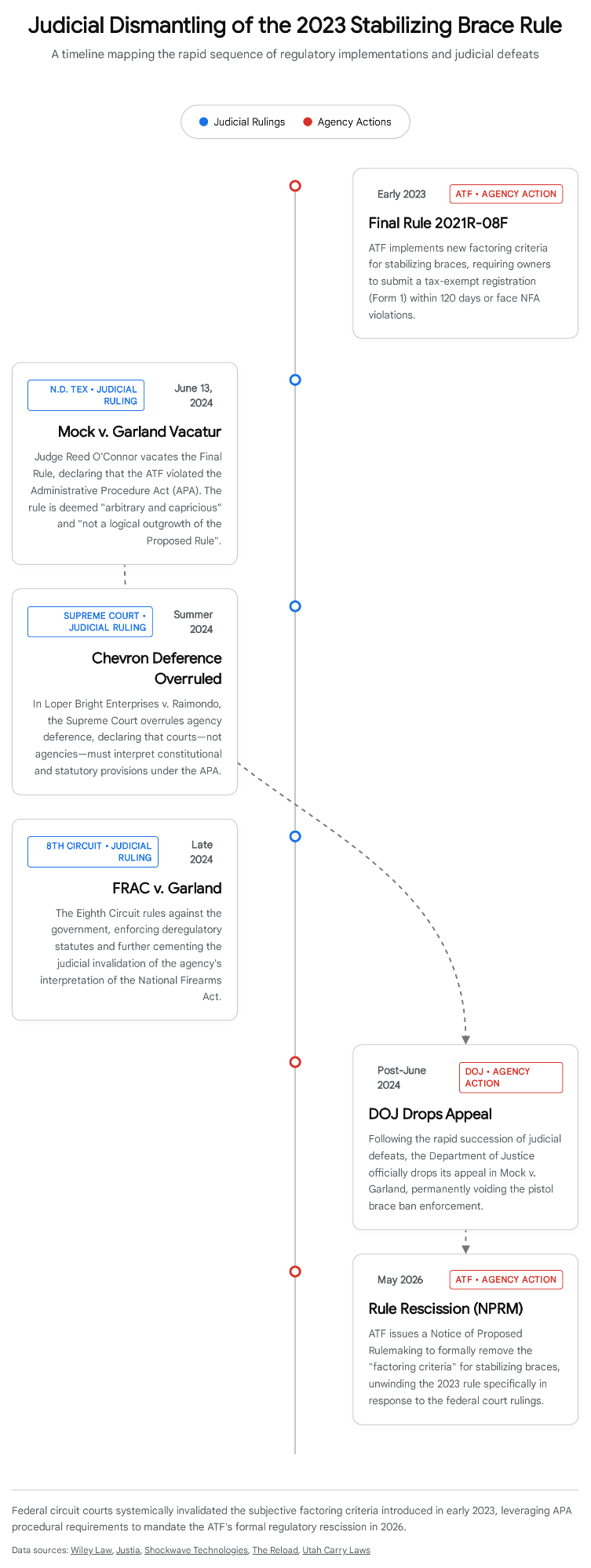
In an ambitious attempt to resolve years of inconsistent classification letters and rising political pressure regarding the presence of brace-equipped firearms in the public sphere, the Department of Justice and the ATF promulgated Final Rule 2021R-08F, officially titled “Factoring Criteria for Firearms with Attached Stabilizing Braces,” which was published and took effect in early 2023.8
The rule sought to fundamentally expand the regulatory definition of a “rifle” within the Code of Federal Regulations by introducing a complex, multi-point factoring criteria to determine if a brace-equipped pistol was, in fact, “designed or redesigned, made or remade, and intended to be fired from the shoulder”.2 This subjective balancing test weighed various opaque factors on an invisible administrative scale.3 The ATF designated a point system evaluating the weapon’s surface area, length of pull, overall weight, presence of secondary grips, and heavily scrutinized the manufacturer’s marketing materials to ascertain the “true” intent of the configuration.3 If an AR or AK-pattern pistol equipped with a brace accumulated enough points, it was summarily reclassified as a rifle. Because these weapons featured barrels shorter than 16 inches, they instantly became unregistered SBRs upon the rule’s publication.
Upon implementation of the final rule, the ATF’s own economic analysis revealed the staggering scope of the regulation. The agency estimated that between 3 million and 7 million stabilizing braces were currently in circulation across the United States.6 Based on disposal data extrapolated from previous regulatory actions regarding bump-stock-type devices, the ATF determined that individual owners typically possessed a mean average of two such accessories.6 Consequently, the ATF estimated that 1.4 million individual citizens would be directly and immediately affected by this proposed rule, transforming them overnight into individuals possessing unregistered Title II NFA items.6 The impact extended deep into the federal firearms licensee (FFL) network as well.
| Impacted Demographic | Estimated Total Population | Estimated Affected Population | Percentage Impacted |
| Individual Owners | N/A | 1.4 Million Citizens | N/A |
| Type 1 FFLs (Dealers) | 52,840 Licenses | 13,210 Licenses | 25.0% |
| Type 7 FFLs (Manufacturers) | 15,524 Licenses | 3,881 Licenses | 25.0% |
Because the rule effectively reclassified the vast majority of these brace-equipped pistols as contraband SBRs, the ATF faced an unprecedented enforcement and compliance nightmare. To mitigate the realization of millions of citizens suddenly possessing felony-level contraband, the Attorney General authorized an extraordinary 120-day tax-exempt amnesty period immediately following the publication of the rule.7
During this 120-day compliance window, owners of brace-equipped pistols were permitted to submit an ATF eForm 1 (Application to Make and Register a Firearm) without the requirement to remit the standard $200 tax stamp.8 This administrative maneuver was unprecedented in modern ATF history and directed a massive, immediate influx of applications into the Industry Processing Branch (IPB) of the NFA Division.20 The sheer volume of amnesty registrations placed an extreme and persistent strain on the NFRTR infrastructure, effectively integrating a massive cohort of standard Title I firearms into the heavily regulated Title II registry, solely based on the presence of a plastic accessory that the agency previously deemed lawful.
Registrants were granted administrative forbearance during the lengthy processing period, but upon final approval of their tax-exempt eForm 1, their firearms became legally recognized, fully registered SBRs. This classification bound the firearms and their owners to the strictures of the NFA in perpetuity. Meaning, the owners were now federally required to submit an ATF Form 5320.20 (Application to Transport Interstate) and await formal approval from Martinsburg before crossing state lines with the weapon.10 Furthermore, they were completely prohibited from transferring or selling the firearm on the commercial market without subsequent ATF approval via Form 4 and the payment of a $200 transfer tax by the receiving party.21
Judicial Backlash: The Systematic Unraveling of the Factoring Criteria
The promulgation of the 2023 Final Rule triggered immediate, aggressive, and highly coordinated litigation from a vast coalition of states, firearms manufacturers, and civil rights organizations. The plaintiffs universally argued that the ATF had egregiously overstepped its statutory authority, bypassed the legislative process of Congress, and violated the procedural safeguards enshrined in the Administrative Procedure Act (APA). The ensuing judicial dismantling of the rule occurred simultaneously across multiple federal circuits, creating a definitive, inescapable consensus that agency deference regarding firearms classification had reached its absolute limit.
Mock v. Garland and the Fifth Circuit’s Arbitrary and Capricious Standard
The initial and most devastating fatal blow to the stabilizing brace rule originated in the United States Court of Appeals for the Fifth Circuit, originating from the Northern District of Texas through the landmark case Mock v. Garland.4 The plaintiffs in the Mock litigation challenged the rule on the grounds that it was an impermissible legislative rule improperly masked as an interpretive rule, and that it fundamentally violated the APA’s logical outgrowth test.4 The APA requires that a final rule must be a logical outgrowth of the initially proposed rule, ensuring the public has a meaningful opportunity to comment on the actual regulatory mechanics that will eventually govern them.
The Fifth Circuit’s appellate review (Mock I, 75 F.4th 563, 2023) sharply and unapologetically criticized the ATF’s regulatory methodology.5 In evaluating the preliminary injunction appeal, the court cataloged numerous reasons why the Final Rule could not withstand judicial scrutiny, explicitly noting that the rule “vests the ATF with complete discretion to use a subjective balancing test to weigh six opaque factors on an invisible scale”.5 The court determined that the agency’s six-part test provided no meaningful clarity to the public regarding what constituted an impermissible configuration, rendering the enforcement completely arbitrary and capricious.5
Following the appellate remand, U.S. District Judge Reed O’Connor of the Northern District of Texas issued a final, sweeping judgment on June 13, 2024, decisively vacating the rule in its entirety.4 Judge O’Connor held that the ATF blatantly violated the APA’s procedural requirements, as the final rule was not a logical outgrowth of the proposed rule.4 In his definitive ruling, O’Connor stated, “Because Defendants fail to show that this is a rare case in which the Court should deviate from the default rule, the Court VACATES the Final Rule on the grounds that Defendants violated the APA’s procedural requirements in promulgating it”.29
The legal concept of vacatur is critical in understanding the collapse of the brace ban in administrative law. Unlike a preliminary or permanent injunction, which merely pauses enforcement for specific named parties in a lawsuit while leaving the rule intact, vacatur erases the rule from the Code of Federal Regulations writ large, treating it as if it never legally existed.5 Following Judge O’Connor’s ruling, the Department of Justice formally dismissed its appeal in the case (now recaptioned as Mock v. Bondi following a change in the Attorney General) on July 17, 2025, surrendering to the decision and cementing the permanent vacatur of the stabilizing brace ban nationwide.2
FRAC v. Garland: The Eighth Circuit and the Post-Chevron Landscape
Parallel to the Fifth Circuit’s proceedings, the Eighth Circuit Court of Appeals delivered a concurrent and equally severe strike against the ATF’s regulatory overreach in FRAC v. Garland, 112 F.4th 507 (8th Cir. 2024).3 Represented by the Firearms Regulatory Accountability Coalition (FRAC), prominent brace manufacturer SB Tactical, and B&T USA, the plaintiffs secured a 2-1 opinion finding they were highly likely to succeed on the merits of their APA challenge.3
The Eighth Circuit explicitly reiterated the legislative history and purpose of the NFA, noting that Congress passed the statute in 1934 strictly “in response to rampant criminal gang violence” to “regulate certain weapons likely to be used for criminal purposes”.13 The court found that reclassifying millions of commonly owned plastic accessories under this draconian, anti-gang statute using amorphous and vaguely defined factors was a massive and unjustifiable overreach.3
Crucially, the jurisprudence surrounding FRAC v. Garland must be analyzed through the lens of the Supreme Court’s landmark 2024 decision in Loper Bright Enterprises v. Raimondo (603 U.S. 369).13 Loper Bright fundamentally and permanently altered administrative law by completely overruling the long-standing doctrine of Chevron deference.13 The Supreme Court dictated that under the APA, courts must independently interpret constitutional and statutory provisions without deferring to an executive agency’s interpretation of ambiguous statutes.13 The Eighth Circuit recognized that the ATF’s expansive, subjective interpretation of the statutory term “rifle” was no longer entitled to any deference, cementing the judiciary as a formidable and unyielding check against agency overreach.13
The convergence of Mock v. Garland, FRAC v. Garland, and the Supreme Court’s concurrent ruling in Cargill (which similarly rejected the ATF’s unilateral reclassification of bump stocks as machine guns) established a binding legal interpretation that the ATF simply lacked the authority to rewrite statutory definitions through interpretive rulemaking.32
The May 2026 Notice of Proposed Rulemaking (RIN 1140-AA98)
Faced with a universally vacated rule, facing mounting legal bills, and operating in a strict post-Chevron environment where agency deference was eliminated, the ATF initiated a formal regulatory surrender. On May 6, 2026, the Department of Justice officially published a Notice of Proposed Rulemaking (NPRM) identified by RIN 1140-AA98: Removing Factoring Criteria for Firearms with Attached “Stabilizing Braces” in the Federal Register.2
This landmark regulatory reform package was explicitly drafted to unwind the 2023 final rule in direct response to the insurmountable federal court rulings in Mock v. Garland and FRAC v. Garland.1 The summary of the proposed rule explicitly acknowledges the agency’s defeat, stating that “Courts have found that ATF’s revisions in the 2023 final rule on the same topic violated the Administrative Procedure Act,” noting that the rule has been enjoined, stayed, or vacated across numerous jurisdictions and has “rarely been in effect”.2
The primary administrative mechanism of RIN 1140-AA98 is the formal removal from the regulatory definitions of “rifle” the two highly contested paragraphs added by the 2023 final rule.2 These paragraphs originally defined the subjective metrics and factoring point systems for determining when a weapon was “designed or redesigned, made or remade, and intended to be fired from the shoulder”.2 By striking these specific paragraphs, the ATF restores the regulatory definitions to be entirely consistent with the underlying statutory definitions enacted by Congress in 1934, totally abandoning the unenforceable factoring criteria.35
The public comment period for this NPRM opened on May 6, 2026, and is scheduled to formally close on August 4, 2026, marking the procedural conclusion of the stabilizing brace saga under the mechanics of the APA.2 While the ATF notes in its mandated economic analysis that removing the criteria increases uncertainty regarding how many manufacturers might attempt to circumvent traditional NFA requirements in the future, the agency acknowledges it lacks the data and, more importantly, the legal authority to maintain the 2023 framework.2
The Amnesty Registration Paradox: Navigating Title I and Title II Jurisdictions
The vacatur of the 2023 rule and the subsequent publication of the 2026 NPRM yield a profound and frustrating administrative paradox for the citizenry. During the 120-day compliance window in early 2023, hundreds of thousands of individuals utilized the tax-exempt amnesty program to register their brace-equipped pistols as Short-Barreled Rifles via eForm 1 to avoid felony prosecution.8
These firearms were legally and permanently entered into the NFRTR. The paradox lies in the administrative reality that while the rule that initially compelled the registration has been legally erased by the courts, the federal registrations themselves remain entirely active within the federal database.9 The DOJ highlighted this lingering, threatening reality during subsequent court filings in Texas, noting explicitly that they would “continue to enforce the NFA’s and the GCA’s regulation of short-barreled rifles against some brace-equipped pistols” if the firearm met the traditional, statutory definition of an SBR independent of the vacated factoring rule.29
Consequently, an amnesty registrant currently possesses a Title II firearm subject to all draconian NFA controls. If they wish to travel interstate with this firearm to attend a competition or training course, they are statutorily required to submit an ATF Form 5320.20 to the NFA Division in Martinsburg, WV, and await formal, written approval before crossing state borders.10 If they wish to sell the firearm in its current configuration to a friend or a local gun store, it requires an ATF Form 4 transfer, a $200 tax paid by the transferee, and a background check waiting period often extending for many months.21
However, foundational ATF regulatory doctrine provides a reliable escape mechanism for these registrants. According to the precedent established in the Supreme Court case United States v. Thompson/Center Arms Co. (504 U.S. 505) and subsequently formalized in ATF Ruling 2011-4, the physical configuration of a firearm dictates its classification at any given moment, provided it was originally manufactured and serialized as a pistol.16
ATF Ruling 2011-4 explicitly states that if a firearm originally started its life as a pistol (i.e., it was originally assembled or produced as a pistol and not as a factory complete rifle), it can be returned to Title I pistol status simply by removing the components that classify it as an SBR—namely, the stabilizing brace or the shoulder stock. It is a common misconception that a firearm’s classification relies entirely on how it was documented on the Form 4473 during transfer (e.g., as an “other” or “receiver”); legally, the classification is entirely dependent on its original physical assembly. Once the stock is removed from the receiver, the firearm ceases to be an SBR in both a physical and a legal capacity.17 It is paramount to note the specific “once a rifle, always a rifle” caveat inherent in the NFA; if the weapon originated as a factory-built rifle, removing the stock does not revert it to a pistol, it merely creates a “weapon made from a rifle,” which remains an NFA item indefinitely.17
Because the vast majority of amnesty-registered firearms originated as AR or AK-pattern pistols built from stripped receivers or bought as complete handguns, they are fully eligible under ATF Ruling 2011-4 to be physically reconfigured back to Title I status without violating the NFA.17
NFRTR Mechanics and Systemic Vulnerabilities
Understanding why the ATF did not simply mass-delete the amnesty registrations following the court vacatur requires an examination of the National Firearms Registration and Transfer Record itself. The NFRTR is the central registry of all NFA firearms in the U.S. not under government control, maintaining records of the identification of the firearm, the date of registration, and the address of the person entitled to possession.7 Dating back to 1934, the registry currently contains over three million individual records.20
The NFRTR is managed by the Industry Processing Branch (IPB) within the NFA Division, and the database infrastructure has historically been plagued by technological limitations. An Office of the Inspector General (OIG) audit of the NFA branch highlighted severe legacy issues within the system.23 The OIG report noted that for extended periods, the ATF delayed vital system enhancements to the NFRTR because they were attempting to integrate multiple databases through a project known as the Firearms Integrated Technology (FIT) project.23 The goal of the FIT project was to allow access to various databases—including the National Tracing Center and the Imports Branch—through a single entry system.23
Because of the architectural rigidity of this legacy system, the NFRTR lacks a mechanism to execute conditional, bulk rollbacks of approved registrations based on court rulings. Furthermore, because a small percentage of registrants may have used the amnesty period to register actual, traditional short-barreled rifles (e.g., adding a physical stock to a pistol rather than just a brace), the ATF cannot globally assume that every amnesty registration is now physically a Title I firearm.24 The agency assumes that once a change is entered into the NFRTR, it remains static until proactive, individual intervention occurs.23 Therefore, the administrative burden of correcting the registry falls entirely upon the individual citizen.
Technical Advisory: Administrative Procedures for Explicit NFRTR De-Registration
While ATF Ruling 2011-4 allows a registered SBR to exist temporarily as a Title I pistol simply by removing the stock or brace, the firearm’s serial number remains indelibly etched into the NFRTR database.9 The ATF takes the strict position that a firearm currently listed in the registry is technically considered an SBR for federal record-keeping purposes, even if it is temporarily physically reconfigured.9
The Legal Rationale for Explicit Removal
For consumers, maintaining an active NFRTR registration for a firearm they intend to treat exclusively as a Title I pistol introduces severe compliance liabilities and unnecessary friction. Law enforcement queries during traffic stops or border crossings may flag the serial number as a restricted Title II weapon, leading to prolonged detainment or confiscation while the physical configuration is debated.39 Furthermore, if the owner wishes to eventually sell the firearm to a standard buyer through a traditional Title I transfer at a local gun store, the persistent NFRTR registration severely complicates the process, as many dealers will refuse to log an NFA-registered serial number into their Title I acquisition books.25
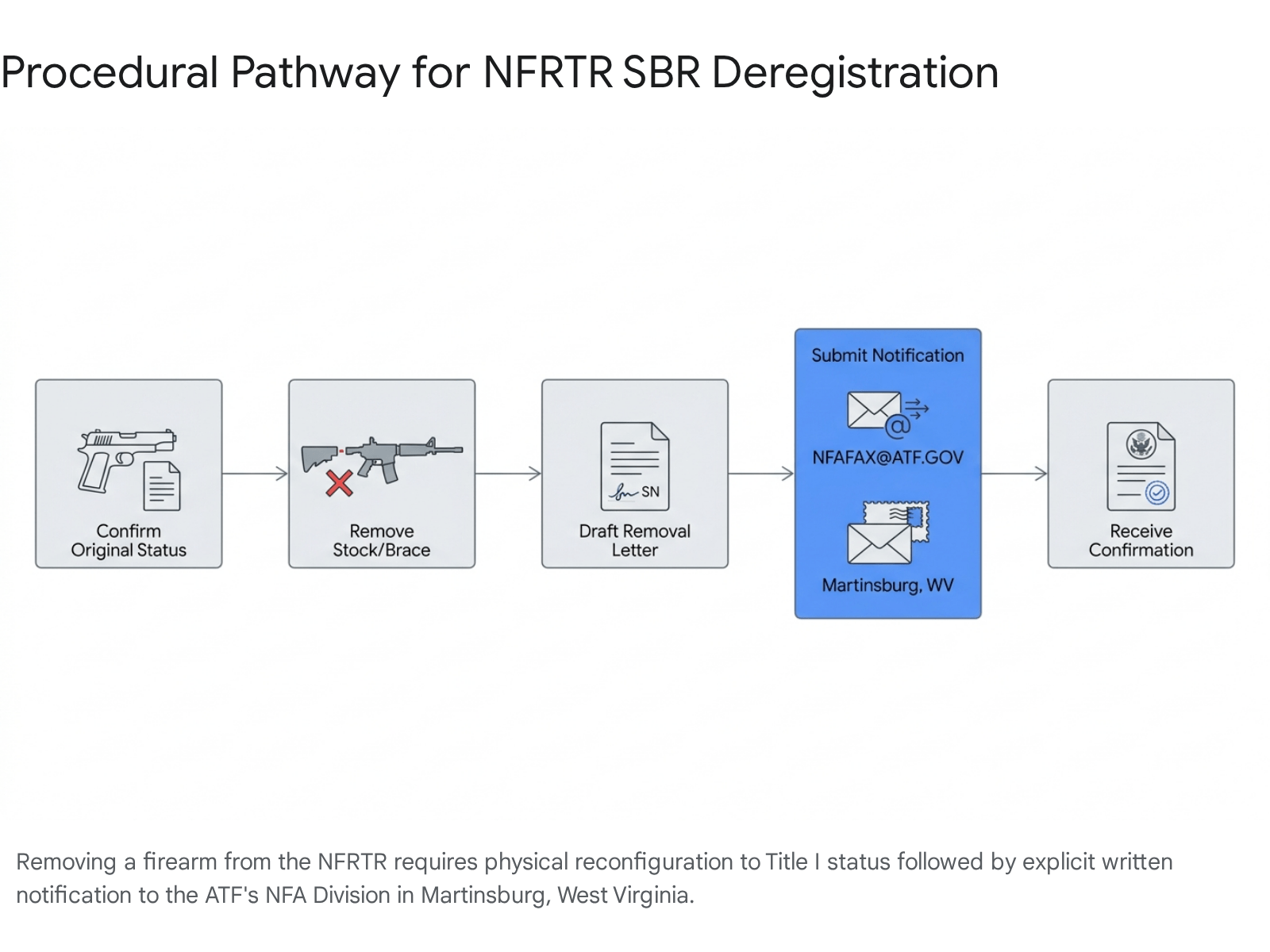
To achieve absolute legal clarity, entirely eliminate interstate travel restrictions (avoiding Form 5320.20), and facilitate unencumbered future sales, the owner must explicitly request that the ATF permanently remove the firearm from the NFRTR.25 The ATF highly recommends this procedure to maintain the accuracy of the registry, noting in their published guidelines that owners should proactively notify the Government Services Branch (GSB) or the Industry Processing Branch of the NFA Division to strike the item.8
Differentiating Between Voids, Withdrawals, and Removals
It is critical for practitioners to utilize the correct terminology when communicating with the ATF to prevent processing delays. The ATF categorizes form cancellations into specific groups:
- Withdrawal: A withdrawal is requested when a submitted Form 1 or Form 4 application is still in “pending” status and has not yet been approved. This stops the process before the item enters the registry.18
- Void: A void is requested when a form has already been approved, but the actual “making” or the physical transfer of the firearm never occurred. In these cases, the applicant must return the original tax stamp to prove the configuration was never realized.18
- Removal: A removal is requested when an approved NFA item was physically made (as was the case with all amnesty braces), but the owner has since permanently reconfigured the item back into a non-NFA status and wishes to strike it from the active registry.12
Drafting and Executing the Notice of Removal
The process for removing a firearm from the NFRTR is not governed by a specific, standardized ATF form (unlike transfers, exports, or making applications). Instead, it requires a meticulously drafted, custom, wet-signed letter submitted directly to the NFA Division.25
An exhaustive removal request must contain the following specific data elements to guarantee processing by the Industry Processing Branch:
- Statement of Intent: An explicit, unambiguous declaration requesting that the National Firearms Registration and Transfer Record (NFRTR) be modified to reflect the removal of the specific firearm from the Title II registry.12
- Statement of Configuration (Reasoning): A clear articulation that the firearm is no longer in a configuration that constitutes an NFA item. The letter must state that the stock or brace has been permanently removed, and the weapon has been returned to a Title I pistol configuration.12
- Firearm Identifiers: The exact Make, Model, Caliber, Barrel Length, Overall Length, and Serial Number of the item, matching precisely what is recorded on the approved Form 1.12 Including the original Form 1 Internal Control Number significantly expedites retrieval from the database.19
- Current Possession Metrics: A statement confirming that the applicant maintains current physical possession and control of the item, and listing the physical address where it is stored.12
- Authentication: The registrant’s full legal name, physical mailing address, and a physical, “wet” signature accompanied by the current date. The ATF routinely rejects digitally signed removal requests or form modifications.12
If submitting via physical mail, practitioners should include two copies of the letter and request that one copy be returned with an official stamp or letter indicating the NFRTR has been modified.45
Proper Routing: Martinsburg vs. Portland Lockboxes
A common point of failure for registrants attempting to correspond with the ATF involves routing the paperwork to the incorrect facility. In 2019, the U.S. Treasury transitioned lockbox services for the ATF from Bank of America in Atlanta, Georgia, to U.S. Bank in Portland, Oregon.49 Consequently, all tax-paid Form 1 and Form 4 applications requiring the processing of a $200 payment are routed to P.O. Box 5015 in Portland.49
However, these lockboxes are strictly financial processing centers; they do not handle general correspondence, compliance queries, or NFRTR database modifications. Mailing a removal letter to the Oregon lockbox will result in the document being discarded or lost. General correspondence, void requests, and NFRTR removal letters must bypass the lockbox entirely and be directed to the physical headquarters of the NFA Division:
Chief, NFA Division National Service Center Bureau of Alcohol, Tobacco, Firearms and Explosives 244 Needy Road Martinsburg, WV 25405 10
| Request Type | Destination Routing | Associated ATF Division |
| Tax-Paid Form 1 / Form 4 | P.O. Box 5015, Portland, OR | Treasury Lockbox Services |
| Tax-Exempt Transfers / Forms | 244 Needy Road, Martinsburg, WV | NFA Division (IPB) |
| Form 5320.20 Interstate Travel | 244 Needy Road, Martinsburg, WV | NFA Division (IPB) |
| NFRTR Removal/Void Letters | 244 Needy Road, Martinsburg, WV | NFA Division (IPB) |
To accelerate processing and ensure a digital paper trail, the ATF strongly encourages transmitting a high-resolution PDF scan of the wet-signed removal letter via electronic mail directly to their designated general inbox for registry actions: NF****@*TF.GOV.10 Sending the request via both certified physical mail to the Martinsburg address and simultaneously to the NFAFAX email address ensures absolute receipt and redundancy.12 The email submission should include the registrant’s full legal name and phone number in the body of the message to facilitate direct contact if errors are detected.39
Processing Timelines and ATF Acknowledgment
The timeline for NFRTR removal varies significantly based on the existing backlog at the Industry Processing Branch. Currently, registrants experience a processing period generally ranging from one to three months (30 to 90 days) from the date of submission.12 In some instances, registrants may see processing completed in as little as one to two months.51
The ATF does not generally issue email confirmations of receipt for removal letters submitted to the NFAFAX inbox, which can cause anxiety for applicants awaiting resolution.47 Instead, completion of the administrative action is signaled strictly by the arrival of physical mail from Martinsburg.47 The registrant will typically receive a formal, printed letter stating that the “Requested Adjustments made to the National Firearms Registration and Transfer Record,” confirming the database update.12 Alternatively, in some cases, the ATF will mail back a physical copy of the registrant’s original Form 1 heavily stamped with a “VOID” watermark.12 Once this physical documentation is secured by the owner, the firearm is unequivocally recognized as a Title I weapon, permanently unshackled from the constraints of the NFA. At this stage, the owner requires no further federal action to conceal carry, transport interstate, or sell the firearm on the commercial market.25
State-Level Entanglements: The Michigan RI-060 Jurisprudential Conflict
While federal deregistration relies solely on administrative correspondence with Martinsburg, consumers attempting to return SBRs to pistol configurations frequently encounter severe state-level statutory entanglements that can carry devastating criminal liabilities. The State of Michigan presents the most complex jurisdictional friction in the nation regarding this process, primarily due to its unique statutory definitions of firearms and its active handgun sales registry.11
Statutory Definitions of Pistols and Short-Barreled Rifles in Michigan
Under the Michigan Penal Code (MCL 750.222), the state implements dimensional definitions that clash severely with federal categorizations. In Michigan, a “pistol” is defined as a loaded or unloaded firearm that is 26 inches or less in overall length, or any firearm that by its construction and appearance conceals itself as a firearm.15 This definition was updated in 2013, shifting the maximum pistol length down from 30 inches to 26 inches to better align with ATF definitions, though complications remain.53 Concurrently, Michigan legally recognizes a “Short-barreled rifle” as a rifle having one or more barrels less than 16 inches in length or an overall length of less than 26 inches, and such weapons were only legalized for civilian possession in the state following legislative changes in 2014 (PA 201 of 2014) which required strict compliance with federal ATF approvals.53
This creates a severe logical trap for builders due to differing measurement standards: while the ATF measures a rifle’s overall length with the stock fully extended, Michigan measures overall length with the firearm in its “shortest operable configuration” (e.g., with the stock or brace folded or collapsed). Consequently, an SBR that is over 26 inches federally may still be under 26 inches under Michigan law. Michigan State Police Legal Update #106 dictates an overlapping mandate: an SBR that is 26 inches or less in its shortest operable configuration must also be registered as a pistol in Michigan under the requirements of MCL 28.422 or 28.422a.54 An SBR under this specific threshold is considered a pistol as defined by Michigan law and is subject to all state statutes applicable to pistols, including strict concealed carry provisions.54 Therefore, if an amnesty registrant in Michigan possessed a brace-equipped AR pistol under 26 inches, it was legally required to be already registered in the state database (MiPistol) prior to the submission of their federal Form 1.
The Falsification Trap and Sales Registry Mechanics
The fundamental and highly dangerous confusion arises when a Michigan resident successfully executes the federal NFRTR removal process, explicitly converting their SBR back into a pure Title I pistol configuration. Because Michigan maintains strict rules regarding pistol registration, many consumers mistakenly believe that the act of physically “re-manufacturing” the pistol from an SBR requires them to submit a new Michigan Firearm Sales Record (Form RI-060) to their local police department to “update” the state on the weapon’s status.57
Michigan law, substantially updated in February 2024, mandates that all firearm acquisitions require a License to Purchase (LTP) unless the purchaser possesses a Concealed Pistol License (CPL), a MCOLES law enforcement certification, or a Federal Firearms License (FFL).59 Exempt purchasers must record pistol transfers using the RI-060 form, which features designated, mandatory fields for both the Seller and the Purchaser.11
Consumers attempting to diligently document the physical reconfiguration of their own firearm frequently attempt to list themselves as both the “Seller” and the “Purchaser” on the RI-060, or invent a fictitious seller entity such as “Self-Assembled” or “Home-Built” in the seller fields.57 This is a severe legal miscalculation that invites intense prosecution. Under MCL 28.422a(4), a person who makes a material false statement on a sales record is guilty of a felony punishable by imprisonment for not more than four years or a fine of not more than $2,500, or both.
The critical jurisprudential insight here is that Michigan maintains a sales and transfer registry, not an absolute ownership registry.64 The statutory mandate to file an RI-060 is triggered exclusively by the acquisition, purchase, gift, or loan of a pistol from one distinct entity to another distinct entity.15 When an owner removes a stabilizing brace or stock from a serialized receiver they already lawfully own, absolutely no transfer of title or acquisition has occurred. The firearm—whether designated federally as an SBR or a pistol—remained continuously in the unbroken possession of the exact same individual.
Therefore, a Michigan resident who successfully extracts a firearm from the federal NFRTR via correspondence with Martinsburg is under absolutely no legal obligation to file a new RI-060 to report the configuration change.65 Submitting a falsified RI-060 listing oneself as both buyer and seller in a misguided attempt to “update” the state database exposes the consumer to immediate felony liability for falsifying a state record.57 Ironically, the failure to register a legitimate sale in Michigan is merely classified as a state civil infraction carrying a $250 fine, whereas lying on the form to over-comply is a severe felony.57 The firearm remains legally logged in the MiPistol database under the owner’s original acquisition record from when they first purchased the receiver or pistol, thereby satisfying all state tracking requirements.11
Strategic Implications for Firearms Compliance
The extensive, multi-year saga of the stabilizing brace—from its inception as a permitted, widely adopted accessory, to its abrupt criminalization via the 2023 factoring criteria, and culminating in the May 2026 NPRM unwinding—serves as a defining, historical case study in the modern limits of the federal administrative state. The systemic, unapologetic vacatur of Final Rule 2021R-08F by the Fifth and Eighth Circuits demonstrates that in a post-Loper Bright legal ecosystem, executive branch agencies can no longer rely on broad interpretive deference to unilaterally rewrite foundational statutory definitions.4
For the hundreds of thousands of citizens who utilized the tax-exempt amnesty program in a good-faith effort to comply with shifting federal mandates, the 2026 regulatory environment demands proactive, highly technical administrative hygiene.6 The persistence and architectural rigidity of the NFRTR means that the judicial erasure of the 2023 rule does not automatically purge the legacy database of the amnesty registrations.9 Amnesty registrants are currently caught in a regulatory net that no longer has a legal foundation, yet the federal record of their Title II ownership persists.
To escape this paradox, registrants must expertly leverage the procedural mechanisms outlined by the NFA Division—submitting highly specific, wet-signed removal declarations detailing their physical reconfiguration directly to Martinsburg—to explicitly detach their hardware from Title II oversight.10
Simultaneously, navigating the compounded friction of state-level statutes, such as Michigan’s strict RI-060 sales registry and dimensional limitations, requires a nuanced, expert understanding of statutory triggers.11 Recognizing the vital legal distinction between a physical component reconfiguration and a legal transfer of title is the only way to prevent consumers from committing technical felonies in their pursuit of over-compliance.11 Ultimately, absolute regulatory compliance in 2026 requires citizens to aggressively and affirmatively manage their federal administrative footprint via NFRTR removal procedures, while simultaneously exhibiting precise, educated restraint regarding state-level record keeping to avoid the catastrophic consequences of falsification.
Please share the link on Facebook, Forums, with colleagues, etc. Your support is much appreciated and if you have any feedback, please email us in**@*********ps.com. If you’d like to request a report or order a reprint, please click here for the corresponding page to open in new tab.
Sources Used
- ATF Announces Historic Firearms Regulatory Reform Package Emphasizing Modernization and Burden Reduction – Wiley Rein, accessed June 26, 2026, https://www.wiley.law/alert-ATF-Announces-Historic-Firearms-Regulatory-Reform-Package-Emphasizing-Modernization-and-Burden-Reduction
- Removing Factoring Criteria for Firearms With … – Federal Register, accessed June 26, 2026, https://www.federalregister.gov/documents/2026/05/06/2026-08930/removing-factoring-criteria-for-firearms-with-attached-stabilizing-braces
- Appeals Court Rules Against ATF’s use of “Vague” and “Amorphous” Factors to Classify Firearms – Wiley Rein, accessed June 26, 2026, https://www.wiley.law/alert-Appeals-Court-Rules-Against-ATFs-use-of-Vague-and-Amorphous-Factors-to-Classify-Firearms
- AR pistol Archives – Shockwave Technologies, accessed June 26, 2026, https://shockwavetechnologies.com/tag/ar-pistol/
- In the United States Court of Appeals for the Fifth Circuit – NationBuilder, accessed June 26, 2026, https://assets.nationbuilder.com/firearmspolicycoalition/pages/6710/attachments/original/1730940750/2024.11.06_035_Brief_for_Plaintiffs-Appellees_%28FPC%29.pdf?1730940750
- Factoring Criteria for Firearms with Attached Stabilizing Braces – ATF, accessed June 26, 2026, https://www.atf.gov/media/21151/download
- chapter 3. registration of nfa firearms | atf, accessed June 26, 2026, https://www.atf.gov/media/25151/download
- ATF Final Rule 2021R-08F “Factoring Criteria for Firearms with Attached Stabilizing Braces”, accessed June 26, 2026, https://utahcarrylaws.com/atf-final-rule-2021r-08f/
- Interstate travel with an amnesty “sbr” : r/NFA – Reddit, accessed June 26, 2026, https://www.reddit.com/r/NFA/comments/184fi98/interstate_travel_with_an_amnesty_sbr/
- Application to Transport Interstate or to Temporarily Export Certain National Firearms Act (NFA) Firearms – ATF, accessed June 26, 2026, https://www.atf.gov/sites/default/files2/f_5320.20_application_to_transport_interstate_or_to_temporarily_export_certain_national_firearms_act_nfa_firearms.pdf
- MSP RI-060 Pistol Sales Record form – PowerDMS, accessed June 26, 2026, https://public.powerdms.com/MSP1917/documents/1742579
- Unregister SBR : r/NFA – Reddit, accessed June 26, 2026, https://www.reddit.com/r/NFA/comments/1p1lqu4/unregister_sbr/
- Case 1:23-cv-00003-DMT-CRH Document 60 Filed 02/18/25 Page 1 of 28, accessed June 26, 2026, https://www.wiley.law/assets/htmldocuments/Summary%20Judgment%20Order.pdf
- National Firearms Act – Wikipedia, accessed June 26, 2026, https://en.wikipedia.org/wiki/National_Firearms_Act
- MCL – Section 750.222 – Michigan Legislature, accessed June 26, 2026, https://www.legislature.mi.gov/Laws/MCL?objectName=mcl-750-222
- ESTTA654620 02/06/2015 IN THE UNITED STATES PATENT AND TRADEMARK OFFICE BEFORE THE TRADEMARK TRIAL AND APPEAL BOARD Proceeding 9 – TTABVue – USPTO, accessed June 26, 2026, https://ttabvue.uspto.gov/ttabvue/ttabvue-91217252-OPP-9.pdf
- SBR still an SBR without the stock? : r/NFA – Reddit, accessed June 26, 2026, https://www.reddit.com/r/NFA/comments/evh2zf/sbr_still_an_sbr_without_the_stock/
- Application to Transfer and Register NFA Firearm (Tax-Paid) – ATF, accessed June 26, 2026, https://www.atf.gov/media/23251/download
- Application for Tax Exempt Transfer and Registration of Firearm | ATF, accessed June 26, 2026, https://www.atf.gov/media/22506/download
- National Firearms Act Division – ATF, accessed June 26, 2026, https://www.atf.gov/firearms/national-firearms-act-division
- NFA Handbook – Chapter 9 – Transfers of NFA Firearms – ATF, accessed June 26, 2026, https://www.atf.gov/media/25086/download
- National Firearms Act Handbook – ATF, accessed June 26, 2026, https://www.atf.gov/media/25161/download
- The Bureau of Alcohol, Tobacco, Firearms and Explosives’ National Firearms Registration and Transfer Record, accessed June 26, 2026, https://oig.justice.gov/sites/default/files/legacy/reports/ATF/e0706/final.pdf
- UPDATE: Final Rule 2021R-80F – National Gun Trusts, accessed June 26, 2026, https://www.nationalguntrusts.com/blogs/nfa-gun-trust-atf-information-database-blog/final-rule-2021r-80f
- Removing an SBR/SBS from the NFRTR and Selling / Reregistering the SBR – National Gun Trusts, accessed June 26, 2026, https://www.nationalguntrusts.com/blogs/nfa-gun-trust-atf-information-database-blog/removing-an-sbr-sbs-from-the-nfrtr-and-then-reregistering-the-sbr-sbs-process
- The State of Texas v Cardona et al, No. 4:2023cv00604 – Document 37 (N.D. Tex. 2024) – Justia Law, accessed June 26, 2026, https://law.justia.com/cases/federal/district-courts/texas/txndce/4:2023cv00604/377970/37/
- No. 24-3101 UNITED STATES COURT OF APPEALS FOR THE TENTH CIRCUIT, accessed June 26, 2026, https://mslegal.org/wp-content/uploads/2024/05/2024.07.24-Motion-for-Injunction.pdf
- Case 4:23-cv-00604-O Document 37 Filed 06/11/24 Page 1 of 112 PageID 708 – Attorney General, accessed June 26, 2026, https://www.texasattorneygeneral.gov/sites/default/files/images/press/Title%20IX%20Guidance%20Injunction%20Order.pdf
- Members’ Newsletter: The Pistol Brace Ban Isn’t Dead | The Reload, accessed June 26, 2026, https://thereload.com/members-newsletter-the-pistol-brace-ban-isnt-dead/
- Mock et al v. Garland et al, No. 4:2023cv00095 – Document 110 (N.D. Tex. 2024) :: Justia, accessed June 26, 2026, https://law.justia.com/cases/federal/district-courts/texas/txndce/4:2023cv00095/372609/110/
- BENBROOK LAW GROUP June 25, 2024 By CM/ECF Lyle W. Cayce, Clerk of Court United States Court of Appeals for the Fifth Circuit O – NationBuilder, accessed June 26, 2026, https://assets.nationbuilder.com/firearmspolicycoalition/pages/6710/attachments/original/1719346889/2024.06.25_143_28%28j%29_Letter.pdf?1719346889
- Boyd Garriott – Wiley Rein, accessed June 26, 2026, https://www.wiley.law/people-BoydGarriott
- Executive Order Signals Rollback of Biden-Era Firearms Regulations and Overhaul of Second Amendment Policy at DOJ – Wiley Rein, accessed June 26, 2026, https://www.wiley.law/alert-Executive-Order-Signals-Rollback-of-Biden-Era-Firearms-Regulations
- CASE NO. 24-2458 UNITED STATES COURT OF APPEALS FOR THE EIGHTH CIRCUIT UNITED STATES OF AMERICA, Plaintiff-Appellee, v. BRADLEY – Gun Owners of America, accessed June 26, 2026, https://www.gunowners.org/wp-content/uploads/Wendt-Amicus-Brief-8th-Cir.pdf
- Repeal | ATF, accessed June 26, 2026, https://www.atf.gov/rules-and-regulations/atf-launches-new-era-reform/repeal
- 2026 Federal Register Index :: Justice Department, accessed June 26, 2026, https://www.federalregister.gov/index/2026/justice-department
- Removing Factoring Criteria for Firearms With Attached “Stabilizing Braces” (RIN 1140-AA98) | ATF, accessed June 26, 2026, https://www.atf.gov/rules-and-regulations/rulemaking-notices/removing-factoring-criteria-firearms-attached-stabilizing-braces-rin-1140-aa98
- New ATF Rules : r/NFA – Reddit, accessed June 26, 2026, https://www.reddit.com/r/NFA/comments/1sz8zf4/new_atf_rules/
- Moving with a Suppressor: Legal Requirements & ATF Forms – Silencer Shop, accessed June 26, 2026, https://www.silencershop.com/blog/moving-with-a-suppressor
- SBR to Pistol ? : r/czscorpion – Reddit, accessed June 26, 2026, https://www.reddit.com/r/czscorpion/comments/129m1w7/sbr_to_pistol/
- ATF NFRTR Letter Requesting Removal of a SBR/SBS Title 2 Status Generator, accessed June 26, 2026, https://www.nationalguntrusts.com/blogs/nfa-gun-trust-atf-information-database-blog/atf-letter-requesting-removal-of-a-sbr-sbs-title-2-status
- Final Rule 2021R-08F – Frequently Asked Questions and SBA Compliance Guide, accessed June 26, 2026, https://www.pa.gov/content/dam/copapwp-pagov/en/mpoetc/documents/training/firearms/faqs%20for%20the%20final%20rule.pdf
- How Do You Void or Withdraw a Form? – National Gun Trusts, accessed June 26, 2026, https://www.nationalguntrusts.com/blogs/nfa-gun-trust-atf-information-database-blog/how-do-you-void-or-withdraw-a-form
- NFA sbr removal – Reddit, accessed June 26, 2026, https://www.reddit.com/r/NFA/comments/18ol5la/nfa_sbr_removal/
- BATFE Letter Requesting Removal of a SBR/SBS from the NFRTR – Prince Law Offices Blog, accessed June 26, 2026, https://blog.princelaw.com/2009/03/25/batfe-letter-requesting-removal-of-a-sbrsbs-from-the-nfrtr/
- Form letter for removing AR-Pistol from SBR database? : r/NFA – Reddit, accessed June 26, 2026, https://www.reddit.com/r/NFA/comments/1tyybdm/form_letter_for_removing_arpistol_from_sbr/
- Converting SBR back to pistol : r/NFA – Reddit, accessed June 26, 2026, https://www.reddit.com/r/NFA/comments/1kvyti9/converting_sbr_back_to_pistol/
- ATF NFA Gun Trusts, ATF Information Database and Silencer Blog, accessed June 26, 2026, https://www.nationalguntrusts.com/blogs/nfa-gun-trust-atf-information-database-blog?page=28
- New Mailing Addresses for Many ATF Registration Forms, accessed June 26, 2026, https://www.atf.gov/firearms/forms/new-mailing-addresses-many-atf-registration-forms
- Federal Firearms Licensee Quick Reference and Best Practices Guide – ATF, accessed June 26, 2026, https://www.atf.gov/firearms/tools-and-services-firearms-industry/current-licensees/federal-firearms-licensee-quick-reference-and-best-practices-guide
- How Long Does a NFRTR Removal Request Take? – National Gun Trusts, accessed June 26, 2026, https://www.nationalguntrusts.com/blogs/nfa-gun-trust-atf-information-database-blog/how-long-does-a-nfrtr-removal-request-take
- Michigan State Gun Laws and Regulations Explained – NRA-ILA, accessed June 26, 2026, https://www.nraila.org/gun-laws/state-gun-laws/michigan/
- Michigan CPL Info – US Gun Classes, accessed June 26, 2026, https://usgunclasses.com/info-by-state/michigan/
- LEGAL UPDATE – State of Michigan, accessed June 26, 2026, https://www.michigan.gov/msp/-/media/Project/Websites/msp/legal-archive-02/msplegalupdate106.pdf
- Michigan (MI) What NFA Firearms can I own? Updated 3/28/14 – NFA Gun Trust Lawyer Blog, accessed June 26, 2026, https://www.guntrustlawyer.com/michigan-mi-what-nfa-firearms/
- With a Michigan CPL, am I allowed to keep a loaded rifle in my vehicle as well? – Reddit, accessed June 26, 2026, https://www.reddit.com/r/Miguns/comments/wo93ni/with_a_michigan_cpl_am_i_allowed_to_keep_a_loaded/
- My FFL told me I need to submit an RIO060 when finished adding a slide/barrel/grip mod to the P365 FCU I bought through them? – Reddit, accessed June 26, 2026, https://www.reddit.com/r/NFA/comments/1dv34v1/my_ffl_told_me_i_need_to_submit_an_rio060_when/
- My FFL told me I need to submit an RIO060 when finished adding a slide/barrel/grip mod to the P365 FCU I bought through them? : r/Miguns – Reddit, accessed June 26, 2026, https://www.reddit.com/r/Miguns/comments/1dv1pl5/my_ffl_told_me_i_need_to_submit_an_rio060_when/
- Gun Registration Information and Form | Grand Traverse County, MI, accessed June 26, 2026, https://www.gtcountymi.gov/2438/Register-a-Firearm
- Firearm Permits and Licenses | City of Ann Arbor – A2gov.org, accessed June 26, 2026, https://www.a2gov.org/police-department/police-services/firearm-permits-and-licenses/
- Firearm Registration – Van Buren County, accessed June 26, 2026, https://vanburencountymi.gov/departments/sheriff/services/firearm-registration/
- RI-060 (05/2016) – Tuscola County, accessed June 26, 2026, https://www.tuscolacounty.org/sheriff/doc/RI-060.pdf
- (Michigan) Building AR from stripped lower. Pistol, Firearm, or SBR? : r/NFA – Reddit, accessed June 26, 2026, https://www.reddit.com/r/NFA/comments/gicbsk/michigan_building_ar_from_stripped_lower_pistol/
- Registering an SBR as a pistol in MI : r/Miguns – Reddit, accessed June 26, 2026, https://www.reddit.com/r/Miguns/comments/ubmcg5/registering_an_sbr_as_a_pistol_in_mi/
- Moved from out of state, need hell : r/Miguns – Reddit, accessed June 26, 2026, https://www.reddit.com/r/Miguns/comments/1qcoii7/moved_from_out_of_state_need_hell/
- MSP RI-060 Pistol Sales Record form, accessed June 26, 2026, https://cms5.revize.com/revize/southlyon/ri-060_696761_7.pdf