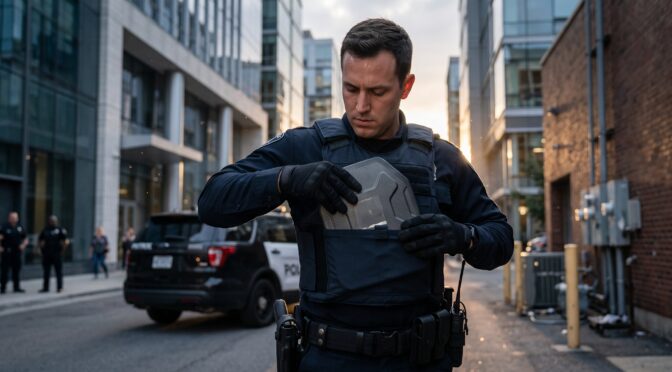
The landscape of law enforcement and military tactical protective equipment is undergoing its most significant structural and philosophical evolution in over fifteen years. The publication of the National Institute of Justice (NIJ) Standard 0101.07, alongside its foundational companion document, NIJ Standard 0123.00, in late 2023, marks a definitive departure from the legacy 0101.06 protocols originally established in 2008.1 This systemic overhaul is not merely a bureaucratic update; it addresses the rapidly shifting reality of ballistic threats—most notably the proliferation of high-velocity rifle platforms in domestic environments—while simultaneously tackling the profound physical limitations of legacy hard armor plates. For the primary readership of blog.roninsgrips.com, understanding this intersection of ballistics, material science, and human physiology is paramount to making informed equipment decisions.
For the modern patrol officer, the operational equation is fundamentally dictated by the balance between survivability and physiological sustainability. The threat of active shooters and rifle-armed assailants necessitates Level III-equivalent protection. However, adding rigid rifle protection to daily-wear soft armor introduces severe penalties in the form of kinematic degradation, metabolic heat accumulation, and neuromuscular fatigue.4 Consequently, the industry is witnessing a strategic pivot toward advanced In-Conjunction With (ICW) plate architectures. Systems such as the Point Blank Delta-IC and the GARMS series leverage hybrid material sciences to shed weight and thickness without sacrificing lethality mitigation.7
This comprehensive report provides an exhaustive, highly technical analysis of the updated NIJ framework, the biophysics of behind-armor blunt trauma (BABT), the physiological burdens of load carriage, and the engineering paradigms driving the next generation of patrol-ready ballistic protection.
Deconstructing the Modular Regulatory Framework: NIJ 0101.07 and 0123.00
The most critical architectural change in the new NIJ regulatory environment is the decoupling of the laboratory testing methodology from the specific threat level definitions.9 Previously, NIJ Standard 0101.06 bundled the mechanical conditioning protocols, the backface deformation metrics, and the specific calibers, masses, and velocities of test ammunition into a single, monolithic standard document.3 This legacy architecture created an administrative bottleneck. Whenever a new prevalent threat emerged on the street, updating the standard required a multi-year bureaucratic overhaul of the entire laboratory methodology and accreditation framework.1
By bifurcating these elements, the NIJ has instituted a modular, highly responsive regulatory system designed for the realities of the 21st century:
- NIJ Standard 0101.07 exclusively dictates the physical test methods, environmental conditioning, laboratory practices, and the performance requirements (such as the 44mm backface deformation limit).11
- NIJ Standard 0123.00 acts as a dynamic repository, titled “Specification for NIJ Ballistic Protection Levels and Associated Test Threats,” which strictly specifies the ballistic protection levels, test threats, ammunition identifiers, and reference velocities.11
This modularity ensures that if a new armor-piercing or intermediate barrier-blind projectile becomes prevalent in domestic crime, the NIJ can rapidly issue an addendum to 0123.00 without disrupting the multimillion-dollar laboratory accreditation programs governing 0101.07.9 The NIJ Certification Testing Program (CTP) has anticipated a lengthy transition; while they ceased accepting applications for new body armor models compliant with 0101.06 in January 2024, the legacy Compliant Products List (CPL) will be maintained through at least the end of 2027.2 It is critical to note that as of mid-2026, the NIJ is still processing the first wave of 0101.07 certifications; therefore, plates currently marketed as RF1 or RF2 are technically still certified under the 0101.06 standard (or independently tested to the new standards) while awaiting official publication on the new CPL.3
The NIJ 0123.00 Threat Matrix in Detail
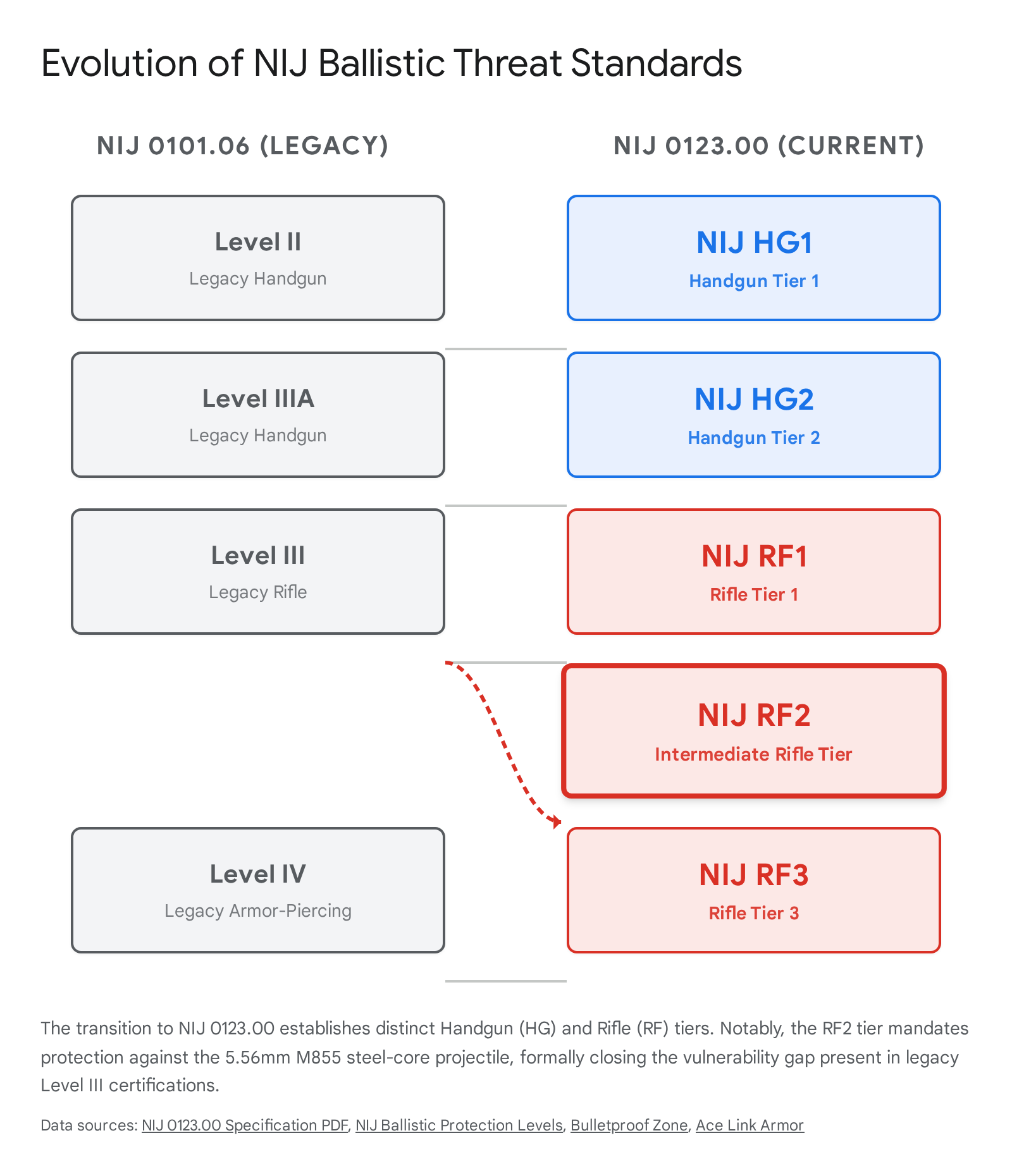
The legacy Roman numeral nomenclature (Level IIA, Level II, Level IIIA, Level III, and Level IV) has been entirely retired. In its place, the NIJ has established a more intuitive, alphanumeric system that clearly delineates Handgun (HG) threats from Rifle (RF) threats, reducing confusion among procurement officers and end-users.3 The obsolete Level IIA, which previously tested against lower-velocity 9mm and.40 S&W rounds, has been eliminated entirely, reflecting the reality that baseline requirements for modern patrol soft armor have surpassed these threats.16
The Handgun (HG) Tiers
The HG classifications govern the flexible soft body armor typically worn daily by patrol officers underneath or over a uniform shirt.
| Protection Level | Legacy Equivalent | Test Threat 1 (Ammunition & Mass) | Reference Velocity 1 | Test Threat 2 (Ammunition & Mass) | Reference Velocity 2 |
| NIJ HG1 | Level II | 9mm Luger FMJ RN (124 grain) | 1305 ft/s (398 m/s) | .357 Magnum JSP (158 grain) | 1430 ft/s (440 m/s) |
| NIJ HG2 | Level IIIA | 9mm Luger FMJ RN (124 grain) | 1470 ft/s (448 m/s) | .44 Magnum JHP (240 grain) | 1430 ft/s (436 m/s) |
Table 1: The NIJ 0123.00 Handgun (HG) Threat Matrix.3
A notable evolution in the HG2 category is the retirement of the.357 SIG round used in the previous 0101.06 standard. It has been replaced by a faster, higher-energy 9mm Luger FMJ RN traveling at an aggressive 1,470 ft/s.17 This swap better reflects the terminal ballistics of over-pressure (P+) 9mm ammunition increasingly encountered by law enforcement, establishing a rigorous new baseline for soft armor flexibility and kinetic energy absorption.17
The Rifle (RF) Tiers
The RF classifications govern rigid hard armor plates, introducing a critical intermediate tier to address previous vulnerabilities in the testing matrix. The test projectiles and reference velocities have been dramatically updated to reflect the evolving threats faced by U.S. law enforcement, encompassing a much wider range of rifle threats than the solitary 7.62x51mm M80 round required under the old Level III standard.15
| Protection Level | Legacy Equivalent | Ammunition Identifier | Bullet Mass | Reference Velocity |
| NIJ RF1 | Level III | 7.62x51mm M80 Ball NATO FMJ | 149 +0/-3 grain | 2780 ft/s (847 m/s) |
| 7.62x39mm MSC (Type 56, Factory 31) | evaluated per App. A | 2400 ft/s (732 m/s) | ||
| 5.56x45mm M193 | 56 +0/-2 grain | 3250 ft/s (990 m/s) | ||
| NIJ RF2 | “Level III+” | All RF1 Threats PLUS: | ||
| 5.56x45mm M855 (Green Tip) | 61.8 ± 1.5 grain | 3115 ft/s (950 m/s) | ||
| NIJ RF3 | Level IV | .30-06 M2 Armor Piercing (AP) | 165.7 +0/-7 grain | 2880 ft/s (878 m/s) |
Table 2: The NIJ 0123.00 Rifle (RF) Threat Matrix, incorporating Addendum 1 modifications to M80 mass.20
The introduction of the NIJ RF2 tier is arguably the most operationally significant update to the standard.10 Under the legacy 0101.06 standard, a Level III plate was only required to stop the 7.62x51mm M80 ball.16 This created a dangerous loophole. Due to the material physics of ultra-high-molecular-weight polyethylene (UHMWPE) plates, a pure Level III PE plate could easily defeat the heavy, lead-core 7.62 NATO round through frictional entanglement, but it would be seamlessly perforated by the 5.56mm M855 “Green Tip”.10 The M855 utilizes a steel penetrator specifically designed to pierce light barriers, exploiting the thermal limitations of pure PE.22 Manufacturers previously created unofficial, unregulated designations like “Level III+” or “Level III++” to communicate M855 protection to buyers.23 RF2 formally bridges this gap, establishing a federally standardized benchmark for intermediate rifle threats.10
Furthermore, the inclusion of the 7.62x39mm Mild Steel Core (MSC) in the baseline RF1 protocol addresses the extreme variability found in foreign-manufactured AK-47 ammunition.15 The MSC round has historically presented significant testing challenges due to metallurgical inconsistencies in the steel cores imported from various nations.15 To combat this, NIJ Standard 0123.00 incorporates Appendix A, a rigorous NIJ Ammunition Audit Process.20 This mandates strict tolerances for core hardness (tested via Rockwell hardness scales), dimensions, and mass, specifying the use of Factory 31 Type 56 ammunition until surrogate test rounds can be validated and commercialized.15
Advanced Testing Protocols: Bridging the Gap Between the Laboratory and the Street
Beyond simply updating the ammunition matrices, NIJ 0101.07 radically alters the physical conditioning and shot placement protocols to better simulate the actual wear, tear, and kinematic stress experienced by tactical gear in the field.10 To achieve this, the NIJ collaborated with the U.S. Army, the National Institute of Standards and Technology (NIST), and the ASTM Committee E54 on Homeland Security Applications, harmonizing testing procedures to align law enforcement standards with established military practices.13
Mechanical Conditioning and Environmental Stress
Body armor represents a major financial investment for any agency, and it must maintain its structural integrity across years of harsh environmental exposure. Soft body armor is now subjected to an intensive tumbling protocol prior to ballistic testing.10 This procedure simulates years of dynamic folding, abrasion, and mechanical fatigue that a vest undergoes during thousands of hours of patrol, folding within carriers, and adapting to the officer’s movements.10 This pre-conditioning forces the ballistic fibers—whether they are aramids like Kevlar or polyethylene variants—to prove their durability against microscopic structural breakdowns before they ever face a projectile.24 If a vest’s fibers degrade from simulated mechanical wear, the ballistic limit will plummet during the live-fire phase.
Similarly, hard armor plates undergo impact durability conditioning based entirely on ASTM E3078 protocols.10 This involves subjecting the plates to controlled drops and mechanical shocks to simulate the routine abuse of being tossed into patrol vehicle trunks, dropped on concrete, or struck against door frames.26 Plates without sufficient edge wrapping, internal crack arrestors, or high-density foam drop-protection often suffer microscopic fractures in their ceramic strike faces during this phase.8 Because ceramic relies on its monolithic structural integrity to shatter incoming penetrators, these micro-cracks lead directly to catastrophic penetration failure during live-fire testing.27 The integration of ASTM E3078 guarantees that laboratory success directly translates to field reliability.12
Geometric Vulnerability Testing: Crown and Edge Strikes
The geometry of an armor plate or a soft ballistic panel inherently creates areas of unequal structural integrity. NIJ 0101.07 specifically targets these vulnerabilities to ensure holistic protection:
- Hard Armor Crown Testing: Both multi-curve and single-curve hard plates derive significant structural rigidity from their physical geometry. However, the highest point of curvature—known as the “crown”—behaves differently under ballistic impact than the flatter, peripheral sections.10 To align with U.S. Army specifications, NIJ 0101.07 now mandates direct projectile impacts to the crown of curved plates.13 This probes for penetration vulnerabilities caused by the manufacturing tension at the apex of the curve, historically a weak spot in composite layups where materials may thin out during the pressing process.10
- Structured Female Armor Edge Testing: A profound leap forward in equitable, biologically appropriate protection is the updated protocol for women’s armor.2 Traditional planar (flat) testing methodologies failed to account for the unique geometric stresses of structured, non-planar female armor panels, such as those featuring molded bust cups.12 Historically, shooting a shaped panel at a standard 0-degree angle of obliquity did not adequately test the stress concentrations at the borders of these molded sections, potentially leaving female officers wearing armor with untested vulnerabilities at the panel edges.12 NIJ 0101.07 corrects this by introducing a shot placed at the top center with a 45-degree angle of obliquity between the projectile and the armor.12 This angled impact specifically replicates real-world edge strikes on curved surfaces, ensuring the complex geometric borders of female-specific panels do not separate and act as pathways for penetration.10
The Physics and Medical Reality of Behind Armor Blunt Trauma (BABT)
Defeating a projectile’s kinetic energy and preventing perforation is only half the function of body armor. Managing the subsequent transfer of that massive kinetic energy into the human body is equally critical for survival. When a high-velocity rifle round—traveling at up to 3,250 feet per second—impacts a hard plate, the plate deforms inward.7 This rapid deformation transfers a highly localized shockwave through the underlying soft tissue.29
This biomechanical phenomenon, classified as Behind Armor Blunt Trauma (BABT), can result in severe, incapacitating injuries.29 Numerous animal studies (including foundational research by Prather, Clare, and Cooper) have demonstrated that the backface deformation (BFD) of the armor causes localized contusions, rib fractures, and potentially fatal internal hemorrhaging.29 Furthermore, the extreme pressure waves and shear waves transmitted through the thorax can cause distant organ damage, resulting in cardiac contusion or neurological trauma far from the immediate point of impact.29
To regulate this, NIJ 0101.07 maintains stringent Perforation-Backface Deformation (P-BFD) testing parameters.12 During laboratory evaluation, the armor is mounted securely over a block of Roma Plastilina #1 clay, a highly calibrated medium designed to simulate the viscoelastic response of human tissue.24 When a round is successfully stopped by the armor, the indentation left in the clay block is precisely measured. Under NIJ 0101.07, the maximum allowable backface deformation is strictly limited to 44mm.3 An armor system that successfully prevents the bullet from entering the body, but records a BFD of 46mm, is classified as a catastrophic failure.12 The blunt force trauma generated by an indentation exceeding 44mm poses an unacceptable, potentially lethal risk to the wearer’s life.12
Physiological Heat Stress and Kinematic Degradation
The demand for Level III / RF1 protection in daily patrol environments is driven by the stark reality of active shooter scenarios.7 However, adding hard armor plates to a standard patrol uniform introduces a profound, sometimes debilitating physiological burden.4
A traditional “Standalone” (SA) Level IV or RF3 plate set, coupled with a rugged plate carrier and necessary load-bearing equipment, can easily add 15 to 25 pounds to the wearer’s torso.4 When a patrol officer wears this rig over an already mandatory HG2 (Level IIIA) soft armor vest, the physiological consequences are immediate, severe, and scientifically measurable.
Kinematic Alteration and Anthropogenic Scaling
The addition of 20 pounds of rigid mass to the thoracic cavity directly impacts the kinematics of the human body.4 It alters the officer’s natural center of gravity, degrading agility, sprinting speed, and endurance.4 Research tracking the mobility effects of body armor demonstrates measurable performance degradation in functional task circuits and physical fitness testing.4 The rigid plates restrict torso flexion and rotation, complicating marksmanship stances, vehicle egress, and hand-to-hand defensive tactics.6 Over a standard 10-to-12-hour patrol shift, the anthropogenic scaling required to carry this weight forces the musculoskeletal system into overcompensation, accelerating chronic joint and lower back fatigue.
The Thermal Wall Effect
Perhaps more dangerous than the weight is the thermodynamic disruption caused by ballistic materials. Body armor acts as an extreme insulative barrier, trapping metabolic heat and entirely blocking evaporative cooling (the body’s primary mechanism for shedding heat via sweat).5 This phenomenon creates a “thermal wall” around the core organs.5 Research indicates that wearing heavy body armor in hot or humid conditions causes a rapid rise in core body temperature and an associated spike in resting heart rate.5
As the core temperature climbs, the body redirects blood flow from the muscles to the skin in a desperate attempt to cool down, inducing rapid neuromuscular fatigue.5 Furthermore, thermal discomfort and heat stress directly impair cognitive processing speeds.5 In a high-threat active shooter scenario, a fraction of a second lost in cognitive processing due to heat exhaustion can be fatal.5 Therefore, the engineering challenge for the tactical gear industry is achieving high-velocity rifle defeat without triggering incapacitating heat stress and fatigue.4
Material Science of Hard Armor Plates: The Modern Triad
The performance, weight, and thermal profile of any plate are dictated entirely by its material composition. As agencies seek to maximize the RF threat level while minimizing the physiological burden, three distinct material architectures dominate the market.
1. Ultra-High-Molecular-Weight Polyethylene (UHMWPE)
Materials like Dyneema® represent the bleeding edge of polymer science. UHMWPE is spun into microscopic fibers, layered in cross-directional plies, and pressed under extreme heat and pressure.7 Pure UHMWPE plates are the lightest ballistic solutions available; a Level III plate can weigh between 1.1 and 3 pounds, and the material is inherently buoyant in water.35
UHMWPE achieves energy dissipation through a process of delamination and frictional melting. As the spinning bullet strikes the plate, it becomes entangled in the fibers, melting the polymer and capturing the round.36 However, because it relies on catching rather than shattering the bullet, pure UHMWPE is generally incapable of defeating armor-piercing rounds or steel-core penetrators like the M855 Green Tip.16 Furthermore, UHMWPE is relatively thick and suffers from thermal sensitivity; the material begins to soften at temperatures between 80°C and 90°C.35 This raises serious long-term durability and safety concerns if the armor is stored in the trunk of a hot patrol vehicle during summer months.35 In contrast, aramid fibers (like Kevlar) used in soft armor are heavier but remain structurally stable above 400°C.35
2. Ceramic Composites
Ceramic materials, such as Silicon Carbide (SiC), Boron Carbide (B4C), and Alumina oxide, feature immense macroscopic hardness properties.28 When an incoming projectile strikes a ceramic plate, the ceramic strike face shatters, simultaneously eroding and fracturing the hardened steel core of an AP or M855 projectile.28 The kinetic energy is then dispersed radially across the plate’s surface area.
Because ceramic is inherently brittle, it cannot function alone; it must be backed by a composite (typically UHMWPE, fiberglass, or aramid) to catch the resulting fragments of the bullet and the ceramic spall.7 Ceramic composite plates are exceptional at stopping the highest-threat rounds (RF2 and RF3), but they suffer from drop fragility (necessitating heavy foam borders) and increased weight and thickness compared to pure PE plates.27
3. Hybrid Steel-Composites
Traditional homogeneous steel plates (often AR500 steel) are cheap but exceptionally heavy, weighing up to 10 pounds each.36 More critically, bare steel is notorious for catastrophic fragmentation, commonly known as “spall”.7 When a rifle bullet hits a steel plate, it shatters on impact, spraying lethal high-velocity fragments outward and upward into the wearer’s neck, arms, and chin.7
However, advanced metallurgical engineering has birthed steel-composite hybrids that harness the core benefit of steel—extreme thinness and durability—while mitigating its flaws.7 By encasing a thin alloy steel strike face in thick polyurea coatings (truck bed liner material) to trap fragments, and pairing it with specific composite backers, manufacturers can produce plates with incredibly low profiles that easily defeat multi-hit impacts.7
The In-Conjunction With (ICW) Paradigm: Solving the Weight Crisis
To solve the weight and bulk crisis for the daily patrol officer, armor engineers have increasingly turned to “In-Conjunction With” (ICW) architectures.7 The logic behind this design philosophy is simple but mechanically profound.
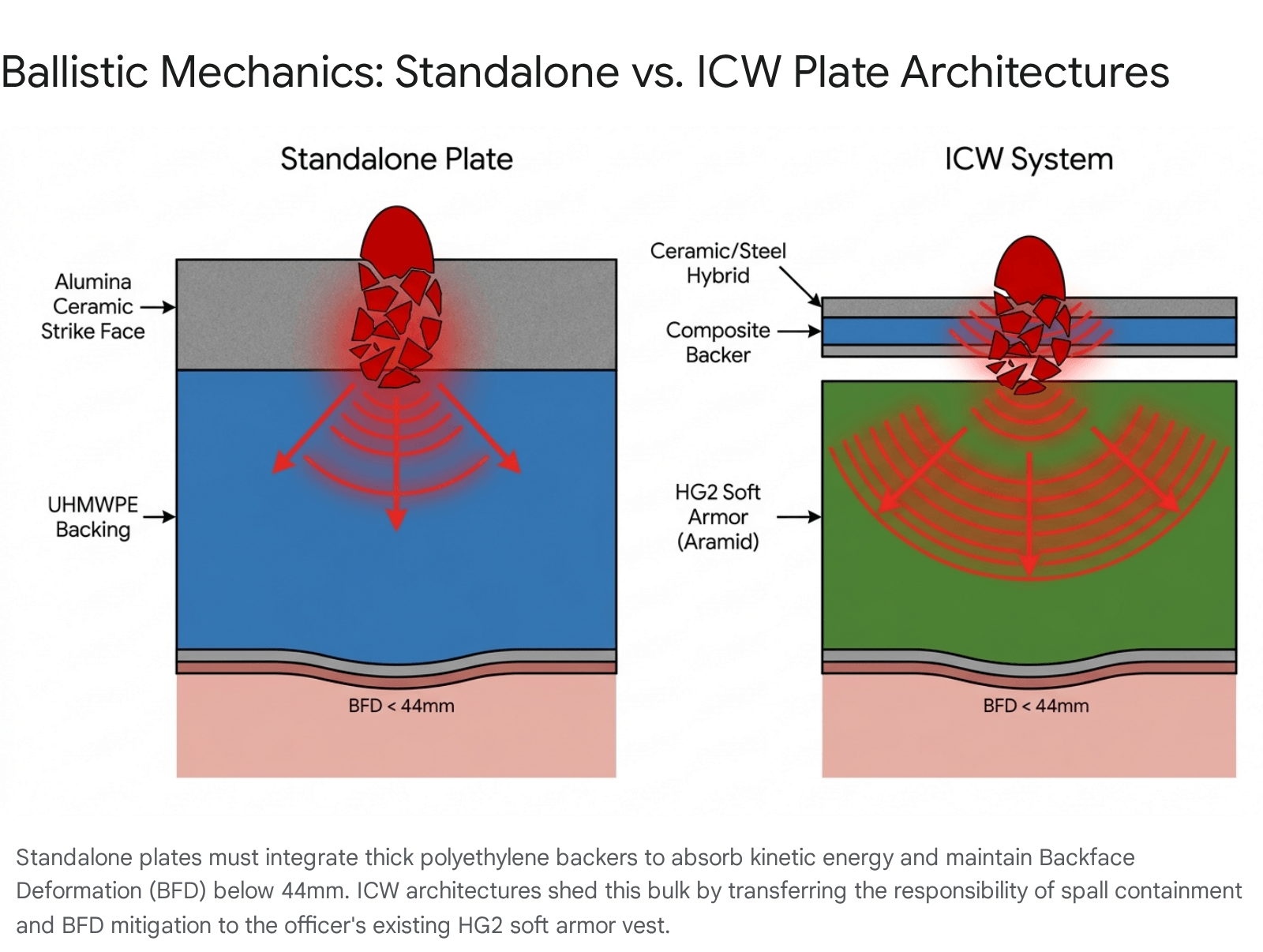
A traditional Standalone (SA) plate must contain all necessary materials to fracture the bullet (the strike face) and catch the fragments while simultaneously keeping the backface deformation under 44mm (the backing material, usually dozens of layers of aramid or UHMWPE).7 This requirement makes standalone plates inherently thick (often 1.0 to 1.2 inches) and incredibly heavy.7
The vast majority of patrol officers are already wearing a mandatory HG2 (Level IIIA) soft armor vest for handgun protection.7 An ICW hard plate leverages that existing soft armor rather than unnecessarily duplicating its energy-absorbing properties.7 The manufacturer strips away the heavy, bulky composite backing material from the hard plate.7 The resulting ICW plate acts primarily as an initial disruptor, designed solely to strip the copper jacket and violently fracture the steel or lead core of the high-velocity rifle round.7
The fragmented projectile and the resulting spall are then driven backward into the officer’s underlying HG2 soft armor vest.3 Critically, the soft armor acts as the primary BFD mitigator, absorbing the dispersed kinetic energy over a wide surface area to prevent fatal blunt force trauma.7 An ICW plate should never be used without its required soft armor backing, as doing so would result in lethal BFD or full perforation.33
Case Study 1: The Point Blank Delta-IC
The theoretical advantages of ICW architecture and hybrid materials are practically realized in emerging patrol-ready systems designed for the NIJ 0101.07 era. Analyzing the specifications of plates like the Point Blank Delta-IC illustrates the precise engineering required to balance protection, weight, and thickness.
Point Blank Enterprises developed the Delta-IC specifically to address the high-volume needs of patrol officers.7 Recognizing that a rapid, scalable up-armor capability is necessary for active shooter response without the bulk of a standalone plate carrier, the Delta-IC is engineered purely as an ICW plate.7
Architecture, Materials, and Form Factor
The Delta-IC utilizes a highly specialized Steel/Composite Hybrid architecture.7 While traditional steel is often criticized for its weight and spall generation, leveraging a thin steel alloy strike face allows for extreme thinness.7 By relying on the extreme hardness of this steel strike face to fracture the rifle projectile, and depending entirely on the officer’s underlying soft armor vest (such as the Point Blank Alpha Elite AXBIIIA, AXIIIA-1, or the Special Threat EXKII/EXKIIIA systems) to catch the spall and manage BFD, the plate avoids the need for a bulky polyethylene backer.7 It is finished with a thick polyurea coating for environmental protection and initial spall mitigation.7
The most striking characteristic of the Delta-IC is its physical thickness. It measures a mere 0.65 inches thick, facilitating extreme concealability and maintaining the officer’s full range of kinematic motion.7 Furthermore, it is manufactured with a multi-curve geometry, conforming to the organic shape of the human torso far better than single-curve plates, which significantly mitigates the localized pressure points that accelerate neuromuscular fatigue over a 12-hour shift.34
Threat Defeat and Weight Mapping
When worn ICW with the specified soft armor, the Delta-IC is certified to NIJ.06 Level III (defeating the 7.62x51mm M80), which translates directly to the baseline RF1 threat, and has been extensively special-threat tested against the 7.62x39mm PS Ball (MSC) and the 5.56x45mm M193.38 Because it is stripped of its heavy backing materials, the system is exceptionally lightweight, offering a highly modular scaling approach based on the officer’s size and coverage needs.
| Plate Size & Shape | Weight (Approximate) | Configuration |
| 11″ x 14″ (Shooter’s Cut) | 2.8 lbs | ICW |
| 10.25″ x 13.25″ (Shooter’s Cut) | 2.5 lbs | ICW |
| 10″ x 12″ (Shooter’s Cut) | 2.2 lbs | ICW |
| 9.50″ x 12.50″ (Shooter’s Cut) | 2.2 lbs | ICW |
| 8.75″ x 11.75″ (Shooter’s Cut) | 1.9 lbs | ICW |
| 7.25″ x 11.50″ (Shooter’s Cut) | 1.5 lbs | ICW |
| 8″ x 10″ (Shooter’s Cut) | 1.4 lbs | ICW |
| 7″ x 9″ (Full Size / Single Curve) | 1.2 lbs | ICW |
| 7″ x 9″ (Female / Single Curve) | 1.2 lbs | ICW |
| 6″ x 8″ (Full Size / Single Curve) | 0.9 lbs | ICW |
| 6″ x 8″ (Female / Single Curve) | 0.9 lbs | ICW |
| 6″ x 6″ (Full Size / Single Curve) | 0.6 lbs | ICW |
Table 3: Comprehensive weight and sizing matrix for the Point Blank Delta-IC hard armor plate series, demonstrating the drastic weight savings achieved through ICW design.38
By analyzing this data, a patrol officer utilizing standard 10″ x 12″ (or equivalent 10.25″ x 13.25″) plates front and back is adding merely 4.4 to 5.0 pounds of total hard armor weight to their loadout, a fraction of the 15+ pounds required for a standalone system.
Case Study 2: Comparative Mechanics and the GARMS Matrix
The precise relationship between backface deformation management, soft armor backing, and overall plate weight is brilliantly illustrated by analyzing the GARMS series of plates, which offers escalating levels of protection across the RF spectrum.8 Examining the progression from GARMS 1 to GARMS 3 SRT reveals the exact biological and physical cost of increasing threat protection.
| Model | Protection Level | ICW Threats Defeated (w/ HG2 Backer) | Standalone Capability (No Soft Armor) | Weight (lbs) | Profile Thickness | Drop Rated |
| GARMS 1 | RF1 (ICW) | M193, 7.62×39 MSC, M80 | Defeats M193 standalone. Defeats MSC/M80 physically, but fails <44mm BFD without soft armor. | 2.2 | 0.69″ | Yes (Inherent) |
| GARMS 2 | RF2 (ICW) | M193, M855, 7.62×39 MSC, M80 | Defeats M193 and MSC standalone. Defeats M80 physically, but fails <44mm BFD without soft armor. | 3.48 | 0.75″ | Yes (Optional) |
| GARMS 3 SRT | RF3 (Standalone) | .30 M2 AP, M855, M855A1, M193, MSC, M80, M80A1 | Fully Standalone. No soft armor required for any threat. | 6.1 | 0.70″ | No (Requires thicker Model 1635) |
Table 4: Analysis of GARMS plate architectures, demonstrating the direct correlation between threat level, BFD management, and mass.8
This comparison highlights the nuanced physics of NIJ 0101.07 testing. The GARMS 1 is highly dependent on the HG2 soft armor backer; while the plate itself possesses the strike face hardness to physically shatter a 7.62x51mm M80 round (and easily defeat M193 standalone), it lacks the internal mass and structural backing to absorb the subsequent kinetic energy of heavier MSC and M80 threats. Consequently, the resulting BFD for those rounds would easily exceed the 44mm safe limit and cause lethal blunt trauma if worn without the soft vest.8
Moving up the threat matrix to the GARMS 2 (an RF2 ICW plate), the weight increases significantly from 2.2 lbs to 3.48 lbs.8 This added 1.28 lbs of mass per plate is a direct engineering trade-off dedicated to managing the increased kinetic energy and intense penetrative power of the M855 Green Tip steel-core round, while simultaneously ensuring BFD remains controlled in conjunction with the vest.8
Finally, the GARMS 3 SRT is a pure standalone Special Rifle Threat (RF3 / Level IV) plate. Because it must defeat the massive, high-energy.30-06 M2 Armor Piercing round and independently keep BFD under 44mm without any assistance from soft armor, its weight spikes dramatically to 6.1 lbs per plate.8 While the GARMS 3 SRT achieves this at a relatively thin 0.70″ profile, it does so by sacrificing the thick high-density foam required to pass standard NIJ drop-test certifications, functioning instead with an internal crack arrestor.8
This progression definitively proves the core thesis for daily patrol wear: where a 12-hour shift renders a 6-pound plate operationally crippling due to kinematic degradation and thermal stress, an ICW RF1 or RF2 system (like the Delta-IC or GARMS 1/2) weighing between 2.2 and 3.5 lbs represents the absolute optimal balance of threat mitigation and physiological sustainability.4
Operational Implications and Lifecycle Maintenance in the 0101.07 Era
As law enforcement agencies and tactical units transition to equipment certified under the new NIJ 0101.07 and 0123.00 standards, procurement strategies must evolve. The NIJ CTP expects the certification process for new models to take several months, with the subsequent publication of the new CPL actively populating throughout 2025 and 2026.2
Strategic Procurement Considerations
Agencies must rigorously evaluate their specific threat models and avoid the trap of “over-armoring.” The blanket procurement of Level IV (RF3) plates for all personnel is often a strategic error rooted in a misunderstanding of operational tempo and physiological limits. While RF3 provides maximum ballistic protection, the kinematic degradation and thermal stress it induces drastically reduce an officer’s combat effectiveness, agility, and situational awareness over a long shift.4
For urban defense, active shooter response, and standard patrol duties, the RF1 or RF2 threat levels cover the vast majority of realistic domestic threats.20 When deployed in an ICW configuration over an HG2 soft vest, officers gain critical high-velocity rifle protection while shedding up to 60% of the plate weight compared to traditional standalone RF3 systems.7 This weight savings translates directly to preserved cognitive function and physical stamina during high-stress encounters.5
Maintenance, Degradation, and Longevity
The transition to advanced, lightweight composites necessitates uncompromising maintenance protocols. Ballistic fibers degrade naturally through environmental exposure. Ultraviolet light, trapped moisture, body oils, and continuous temperature fluctuations severely compromise fiber strength and structural integrity over time.25
For ICW systems, managing this degradation is a matter of life and death. The hard plate relies on the soft armor to perform. If the underlying HG2 soft armor degrades due to improper care or age, it loses its ability to effectively mitigate spall and limit BFD.25 A rifle impact on the hard plate that would have been completely survivable could suddenly become fatal due to excessive blunt force trauma penetrating the degraded soft backing.25
Hidden damage, such as delamination of the plies in soft panels or micro-cracks in the ceramic strike faces of hard plates, can severely reduce protective capabilities without leaving obvious external signs.25 While the integration of ASTM tumbling and drop-conditioning in the 0101.07 standard ensures a much higher baseline of manufactured durability, rigorous field inspection, proper storage (avoiding high-heat environments like car trunks), and adherence to strict replacement schedules remain the ultimate safeguards.12
Conclusion
The release of NIJ Standard 0101.07 and its companion document NIJ Standard 0123.00 is not merely an administrative update; it is a fundamental realignment of ballistic testing with the violent physical realities of the modern tactical environment. By decoupling the laboratory test methodology from the specific threat levels, the NIJ has ensured that protective standards can rapidly and dynamically adapt to emerging ammunition developments without the bureaucratic stagnation that plagued the legacy 0101.06 standard.
The introduction of the RF2 tier successfully standardizes protection against the highly prevalent 5.56mm M855 Green Tip threat, ending the era of ambiguous and unregulated “Level III+” commercial designations. Furthermore, the incorporation of ASTM environmental conditioning and geometric vulnerability testing—specifically the 45-degree angle of obliquity shots designed to secure the borders of non-planar female armor, and the crown strikes designed to expose tension flaws in curved plates—guarantees that laboratory certifications accurately reflect real-world durability and equitable protection across all body types.
Ultimately, the most profound insight derived from this analysis is the undeniable superiority of the In-Conjunction With (ICW) architecture for sustained patrol operations. Standalone rifle protection demands a physiological toll in weight, altered kinematics, and trapped metabolic heat that directly compromises an officer’s mobility, cognition, and overall tactical effectiveness. By intelligently engineering systems like the Point Blank Delta-IC and the GARMS series to leverage the existing HG2 soft armor for kinetic energy dissipation, BFD management, and spall containment, the industry has achieved the critical synthesis of lethality mitigation and operational sustainability. As agencies navigate the multi-year transition into the 0101.07 era, prioritizing these advanced, hybrid-material ICW systems will be paramount to ensuring that personnel remain both lethal in response and protected in engagement.
Please share the link on Facebook, Forums, with colleagues, etc. Your support is much appreciated and if you have any feedback, please email us in**@*********ps.com. If you’d like to request a report or order a reprint, please click here for the corresponding page to open in new tab.
Sources Used
- NIJ Standard 0123.00: A Unified Ballistic Protection System for U.S. Law Enforcement, accessed June 26, 2026, https://velmet.ua/en/nij_standart_0123_00.html
- Next Gen Body Armor Standards Released: A Comprehensive Guide to NIJ 0101.07 and NIJ 0123.00, accessed June 26, 2026, https://bodyarmornews.com/new-nij-standard/
- Body Armor Levels Explained: NIJ 0101.06 & 0101.07 Guide – Bulletproof Zone, accessed June 26, 2026, https://bulletproofzone.com/blogs/bullet-proof-blog/understanding-body-armor-levels
- Ballistic Protection Explained: Understanding The Different Types Of Ballistic Armor, accessed June 26, 2026, https://caliberarmor.com/blogs/caliber-armor-blog/ballistic-protection-explained-understanding-the-different-types-of-ballistic-armor
- Understanding Thermal Comfort While Wearing Body Armor – Ace Link Armor, accessed June 26, 2026, https://acelinkarmor.com/thermal-comfort-while-wearing-body-armor
- The impact of body armor on physical performance of law enforcement personnel: a systematic review – PMC, accessed June 26, 2026, https://pmc.ncbi.nlm.nih.gov/articles/PMC5434519/
- Top 10 Innovations in Body Armor at SHOT Show 2026 – Ronin’s Grips, accessed June 26, 2026, https://blog.roninsgrips.com/top-10-innovations-in-body-armor-at-shot-show-2026/
- ICW Armor Plates – RF1, RF2 & RF3 Protection | GARMS – Gilliam …, accessed June 26, 2026, https://www.gilliamarms.com/collections/special-rifle-threat-armor-srt
- Specification for NIJ Ballistic Protection Levels and Associated Test Threats (NIJ Standard 0123.00) | National Institute of Justice, accessed June 26, 2026, https://nij.ojp.gov/library/publications/nij-ballistic-protection-levels-and-test-threats-nij-standard-012300
- NIJ Standard 0101.07 Explained: Key Changes | PGD, accessed June 26, 2026, https://protectiongroupdenmark.com/blog/explanation-of-nij-standard-0101-07/
- NIJ 0101.07 vs NIJ 0101.06: Key Differences Explained – Premier Body Armor, accessed June 26, 2026, https://premierbodyarmor.com/blogs/pba/nij-07-vs-nij-06-differences
- NIJ 0101.07 Body Armor Standards Explained, accessed June 26, 2026, https://armorexchange.com/body-armor-buying-guide/nij-0101-07-body-armor-standards
- Understanding NIJ Standards 0101.07 and 0123.00: Enhancing Body Armor Performance, accessed June 26, 2026, https://www.customarmorgroup.com/blogs/news/understanding-nij-standards-0101-07-and-0123-00-enhancing-body-armor-performance
- Advancing Ballistic Resistance of Body Armor: A Comprehensive Guide to NIJ Standard 0101.07 and NIJ Standard 0123.00 – IntelAlytic, accessed June 26, 2026, https://intelalytic.com/insights/nij-010107-vs-012300
- Specification for NIJ Ballistic Protection Levels and Associated Test Threats, NIJ Standard 0123.00 – Office of Justice Programs, accessed June 26, 2026, https://www.ojp.gov/pdffiles1/nij/307347.pdf
- Understanding NIJ Levels: A Simple Guide for First-Time Armor Buyers – RTS Tactical, accessed June 26, 2026, https://www.rtstactical.com/blogs/educational/understanding-nij-levels-a-simple-guide-for-first-time-armor-buyers
- NIJ Standard 0101.07: HG1, HG2, RF1, RF2, RF3 Explained – Bulletproof Zone, accessed June 26, 2026, https://bulletproofzone.com/blogs/bullet-proof-blog/nij-standard-0101-07-new-body-armor-levels
- List of body armor performance standards – Wikipedia, accessed June 26, 2026, https://en.wikipedia.org/wiki/List_of_body_armor_performance_standards
- Ballistic Resistance of Body Armor, NIJ Standard 0101.07 | National Institute of Justice, accessed June 26, 2026, https://nij.ojp.gov/topics/equipment-and-technology/ballistic-resistance-body-armor-nij-standard-010107
- Specification for NIJ Ballistic Protection Levels and Associated Test Threats, NIJ Standard 0123.00 | National Institute of Justice, accessed June 26, 2026, https://nij.ojp.gov/topics/equipment-and-technology/specification-nij-ballistic-protection-levels-and-associated-test-threats-nij-standard-012300
- NIJ Standard 0123.00, Specification for NIJ Ballistic Protection Levels and Associated Test Threats Addendum 1 October 31, 2024, accessed June 26, 2026, https://nij.ojp.gov/sites/g/files/xyckuh171/files/media/document/addendum-1-nij-standard-0123-00.pdf
- Decoding NIJ Standards: Your Ultimate Guide to Body Armor Levels and Protection, accessed June 26, 2026, https://caliberarmor.com/blogs/caliber-armor-blog/decoding-nij-standards-your-ultimate-guide-to-body-armor-levels-and-protection
- Ballistic Plates – United Shield, accessed June 26, 2026, https://us.unitedshield.com/products-range/ballistic-plates/
- Draft NIJ Standard 0101.07 Ballistic Resistance of Body Armor, accessed June 26, 2026, https://bodyarmornews.com/wp-content/uploads/2018/03/nij-standard-0101-07-ballistic-resistant-body-armor-draft-for-comment.pdf
- Body Armor Maintenance Guide: Extending Protection Life and Performance, accessed June 26, 2026, https://usarmor.com/blog/body-armor-maintenance/
- NIJ Standard 0101.07, Ballistic Resistance of Body Armor, Addendum 1, accessed June 26, 2026, https://nij.ojp.gov/sites/g/files/xyckuh171/files/media/document/addendum-1-nij-standard-0101-07.pdf
- Lvl 4 Body Armor: Frequently Asked Questions – RMA Armament, accessed June 26, 2026, https://rmadefense.com/level-4-body-armor-frequently-asked-questions/
- Performance of Composite Metal Foam Armors against Various Threat Sizes – MDPI, accessed June 26, 2026, https://www.mdpi.com/2504-477X/4/4/176
- Read “Testing of Body Armor Materials: Phase III” at NAP.edu, accessed June 26, 2026, https://www.nationalacademies.org/read/13390/chapter/10
- Ballistic Resistance of Body Armor NIJ Standard 0101.07 – Office of Justice Programs, accessed June 26, 2026, https://www.ojp.gov/pdffiles1/nij/307346.pdf
- Element U.S. Space & Defense Test Report for Ballistic Resistance Testing – Ace Link Armor, accessed June 26, 2026, https://acelinkarmor.com/wp-content/uploads/2025/10/A_SAP_3APEX.pdf
- backface-deformation – Penn Tactical Solutions, accessed June 26, 2026, https://penntacticalsolutions.com/pages/glossary-term/backface-deformation
- Understanding Body Armor Ratings, accessed June 26, 2026, https://premierbodyarmor.com/blogs/pba/understanding-body-armor-ratings
- Ballistic Armor Glossary – Common terms, threats, and materials., accessed June 26, 2026, https://www.ade.pt/ballistic-armor-glossary/
- Ballistic Helmet NIJ Levels: How to Choose (2026) – Bulletproof Zone, accessed June 26, 2026, https://bulletproofzone.com/blogs/bullet-proof-blog/how-to-choose-the-right-ballistic-helmet-by-nij-level
- NIJ Protection Levels: What Does Level IIIA Stop? (2026) – Bulletproof Zone, accessed June 26, 2026, https://bulletproofzone.com/blogs/bullet-proof-blog/nij-protection-levels-choose-the-right-vest-for-you
- Ballistic Materials Explained: The Science Behind Modern Protection, accessed June 26, 2026, https://www.auto-armor.com/blog/Ballistic-Materials-Explained-The-Science-Behind-Modern-Protection
- DELTA-IC Hard Armor Plate | PARACLETE – Point Blank Enterprises, accessed June 26, 2026, https://www.pointblankenterprises.com/paraclete/delta-ic-hard-armor-plate.html
- Standalone vs ICW Body Armor: Best Plate Choice 2026, accessed June 26, 2026, https://bulletproofzone.com/blogs/bullet-proof-blog/standalone-vs-icw-body-armor-choosing-your-best-armor-plate-in-2026
- My updated “Armor according to your budget” / plate recommendation guide : r/tacticalgear, accessed June 26, 2026, https://www.reddit.com/r/tacticalgear/comments/k16q7y/my_updated_armor_according_to_your_budget_plate/
- 2026 SHOT Show Day 1: Patrol-ready gear that caught our eye – Police1, accessed June 26, 2026, https://www.police1.com/shot-show/2026-shot-show-day-1-patrol-ready-gear-that-caught-our-eye
- Understanding the New NIJ 0101.07 Body Armor Standard, accessed June 26, 2026, https://premierbodyarmor.com/blogs/pba/nij-standard-0101-07