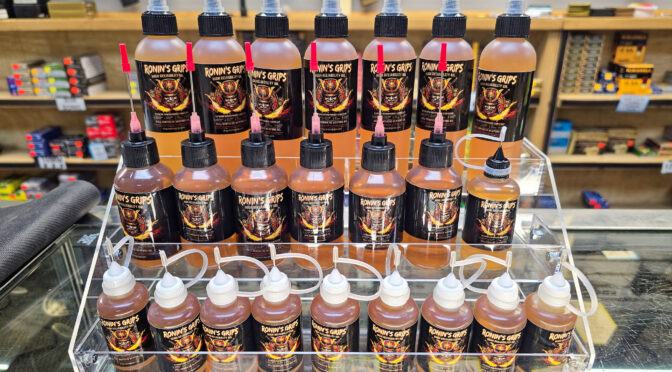
If you’ve had trouble finding our articles or shop products through search engines recently, you aren’t alone. We want to be clear about what’s been happening at Ronin’s Grips, how we’re fixing it, and where we plan to go from here.
What Happened: The July 2026 Shift
In mid-July 2026, major search engines, notably Google, updated their core ranking systems. These updates prioritized AI-generated summaries while applying stricter automated filters to assess content quality across entire sites. As a result, our traffic volumes from search engines to the blog and online store dropped by about 93%.
Rather than evaluating pages individually, these algorithms calculate a site-wide quality rating. If an automated system flags a specific section, it lowers the overall score for the entire domain. Ironically, the very thing we wanted to accomplish, providing social media analytics in a more template-driven manner so you get data to make decisions instead of just our opinion, ended up being our undoing!
Unfortunately, this filter caught our extensive archive of product reviews and comparison guides. Because the search engines evaluate interconnected sections together, reduced visibility on our AI and template-driven blog posts ended up dragging down search rankings for our main store as well.
The Steps We Have Taken So Far
We won’t let automated algorithms compromise our store or the quality of our content. To restore our search visibility and help new customers find us, we’ve taken immediate technical steps.
To safeguard our domain’s overall rating, we added noindex tags to our legacy comparison reports and reviews. The pages are still fully accessible to you directly, but search crawlers are instructed to skip indexing them. This prevents older content from weighing down the main Ronin’s Grips storefront in search rankings.
Where We Go From Here: A Proposal for the Community
While adding noindex tags addresses the immediate search penalties, it prompts us to rethink how we publish in-depth technical guides moving forward. Publicly hosting detailed product comparisons without risking algorithmic downgrades has become increasingly challenging. We remain committed to delivering thorough reviews, but we need a format free from shifting search engine criteria.
That brings us to a new concept we’re exploring: A Private, Members-Only Community.
We’re considering a dedicated, non-indexed community space for Ronin’s Grips members. This private hub would host our data-driven social media analyses of small arms-related matters removed from public search crawlers.
Maintaining this platform independently of public search traffic requires dedicated effort, so we’re considering a small subscription model to support it. Before making any decisions, we want to hear your thoughts.
We would love your input on the following:
What are your thoughts on moving our deep-dive reviews and comparisons into a private, members-only section?
Would you be willing to pay a monthly fee to support this content?
If so, is a price point of $5/month acceptable to you for this level of detail and access?
Please share your thoughts in the comments below or contact us directly. Your support has built Ronin’s Grips from day one, and your feedback will help guide our next steps.
For nearly fifty years, the global firearms industry, military armorers, and civilian shooters relied on a single, multipurpose fluid for weapon maintenance: Cleaner, Lubricant, and Preservative (CLP). Developed in the early 1970s and codified under the U.S. military specification MIL-L-63460 (later updated to MIL-PRF-63460), CLP was hailed as a logistical breakthrough1. It promised to streamline supply chains by replacing various specialized bore solvents, low-temperature oils, and heavy anti-corrosion greases with one versatile liquid3.
Over the past two decades, however, advancements in firearm engineering, the widespread adoption of sound suppressors, and breakthroughs in tribology have exposed the limitations of the CLP formulation. Specialized armorers and elite military units are increasingly moving away from traditional CLP, a shift driven by the physical demands of modern combat rather than marketing trends. High-volume, suppressed fire creates intense heat and carbon fouling that can quickly overwhelm the flash point and shear stability of multipurpose fluids4. Furthermore, the reliance on Polytetrafluoroethylene (PTFE) and other legacy additives has led to mechanical failures under extreme heat while simultaneously facing strict environmental regulations regarding Per- and Polyfluoroalkyl Substances (PFAS)3.
This report analyzes why the industry is moving past CLP. It examines the logistical compromises that led to its creation, the mechanical realities of modern direct-impingement weapons, the chemical failures of older formulations, and the emergence of advanced boundary lubricants and Durable Solid Lubricants (DSL) designed for today’s requirements.
The Historical Compromise of MIL-PRF-63460
To understand why modern engineering has moved away from CLP, it is particularly useful to look at the logistical needs that shaped its development. The goal was not necessarily to maximize a firearm’s lifespan or performance, but to simplify the massive supply chain of the U.S. Department of Defense during the Cold War3.
The “Impossible Specification” and Industrial Warfare Theory
In 1971, the U.S. military issued Purchase Description 48 (PD-48), seeking a single product to maintain its entire weapons portfolio3. At the time, military doctrine focused on “Industrial Warfare,” preparing for large-scale conflicts where systemic efficiency took priority over individual equipment optimization3. Managing separate stocks of bore solvents (MIL-PRF-372), low-temperature oils (MIL-PRF-14107), and heavy preservatives (MIL-PRF-3150) created a complex and vulnerable logistical burden2. Planners believed that consolidating these needs into one fluid would offer significant cost savings and simplicity3.
The resulting standard, MIL-PRF-63460, became known in the industry as the “impossible specification”3. This is because the requirements for cleaning, lubricating, and protecting are often at odds. Dissolving carbon and copper fouling requires penetrating solvents that, by design, break down oils and evaporate quickly9. In contrast, reducing friction requires a fluid with high viscosity and stability that stays on metal surfaces under pressure11. Effective corrosion protection adds another layer of complexity, requiring water-displacing compounds that form a barrier against moisture, as measured by standard ASTM humidity and salt spray tests13.
To combine these competing goals, chemists created a compromised emulsion. Traditional CLP typically uses a light synthetic or mineral base oil mixed with volatile hydrocarbon solvents for cleaning, along with suspended boundary lubricants to provide some protection after the solvents evaporate3.
The 160°F Thermal Disconnect
One of the most significant flaws in the MIL-PRF-63460 specification is its limited thermal range. The specification only requires the fluid to remain stable up to 160°F (71°C)1.
This limit is remarkably low for modern firearms. Weapons like the AR-15 and M16 use a direct impingement gas system that taps superheated, high-pressure gases from the barrel and directs them back into the bolt carrier group (BCG)3. These gases can reach temperatures between 400°F and 1,000°F as they enter the weapon’s internal components3.
Because the military specification was so low, older CLP formulations have low flash points and high volatility3. During sustained fire, the solvent carriers in CLP can boil away rapidly. This leaves the internal parts dry at the exact moment they are facing the most heat and friction3.
Tribological Realities of Modern Small Arms
Modern firearm analysis relies on tribology, the study of interacting surfaces in motion, including friction and wear19.
Lubrication Regimes in Firearms
In industrial engines, wear is typically prevented by hydrodynamic lubrication, where a pump maintains a thick layer of oil that keeps moving parts from touching12. Under these conditions, the fluid itself supports the mechanical load12.
Firearms, however, do not have continuous oiling systems19. Lubricant is applied in small, finite amounts. When a weapon is fired, the extreme pressures—often exceeding 50,000 psi—and the rapid motion of the parts can instantly strip away any thin protective layer of fluid5.
This forces the weapon to rely on boundary lubrication, where protection is determined by a microscopic layer of chemicals adhering to the metal rather than the bulk volume of the oil12. If this layer fails, the microscopic peaks on the metal surfaces (asperities) come into direct, damaging contact20.
Viscosity, Shear Rates, and CLP Failure
Because firearms operate in this boundary regime, a lubricant must stay in place and resist being squeezed out. Viscosity, which measures a fluid’s resistance to flow, is critical here11.
Under military specs, CLP is required to have a very low viscosity—only 14.0 centistokes (cSt) at 40°C5. While this thinness helps the fluid penetrate and clean carbon residue, it is a liability during operation5. The intense motion of the bolt carrier can easily push this thin fluid out of the areas where it is most needed19.
Specific areas like the cam pin track, locking lugs, and carrier rails face extreme stress. Without a way to constantly replenish the lubricant, thin fluids like CLP are quickly stripped away, leading to metal wear and potential malfunctions.
When thin CLP evaporates or is pushed away, the weapon runs dry, leading to higher friction and issues like sluggish cycling or failures to extract and lock19. Historically, the solution was to “run the gun wet” by applying excessive amounts of CLP29. However, this excess fluid can attract dust and sand, creating a sticky paste that can cause jams in harsh environments29.
A suppressor works by trapping and slowing down expanding gases to reduce noise and flash5. This creates significant backpressure, forcing more hot, carbon-heavy gas back into the weapon’s receiver5.
This backpressure stresses the lubrication system in several ways:
Increased Mechanical Stress: The bolt carrier group moves faster and more violently than originally intended, putting more strain on the entire system5.
Higher Temperatures: Trapped heat causes the receiver to reach levels where CLP can vaporize much sooner than expected5.
Fouling and Carbon Build-up: Hot carbon blowback mixes with failing lubricant to create an abrasive sludge that can cause the weapon to seize17.
Chemical Limitations and Environmental Regulations
Beyond mechanical issues, the shift away from CLP is also due to the chemicals used in its formulas, specifically how they behave under heat and their impact on the environment.
The Pyrolysis of Polytetrafluoroethylene (PTFE)
To make up for being so thin, traditional CLPs often include solid additives like Polytetrafluoroethylene (PTFE), better known as Teflon3. The idea is that as the liquid evaporates, these microscopic particles remain behind to provide a dry, low-friction layer3.
While this process works in cooler settings, PTFE can fail in firearms. It begins to break down (pyrolyze) at temperatures as low as 325°F to 400°F3. Since gases inside the weapon often exceed these temperatures, the PTFE in CLP can burn away during sustained fire3.
This decomposition doesn’t just stop the lubrication; it releases toxic gases3. Because these gases are vented near the shooter’s face, they can pose a health risk, exposing operators to harmful substances—a risk many professional units now consider unacceptable3.
The Impact of REACH and PFAS Regulations
Firearm lubricants are also being affected by global regulations on PFAS, often called “forever chemicals”6. These include substances like PTFE, which older CLP formulas value for their resistance to water and grease6.
These chemicals do not break down easily and can accumulate in the environment and the human body37. In response, regulatory bodies in the EU and the U.S. are implementing strict bans and restrictions on their use38. Consequently, the industry is shifting away from PFAS-heavy products to mitigate future legal and supply chain risks6.
Recognizing these risks, manufacturers are engineering PTFE out of their products. Relying on legacy formulas is no longer viable for large-scale military or commercial use39.
The Shift to Biobased Standards (MIL-PRF-63460G)
The U.S. military has also recognized the need for change. Prompted by mandates for sustainable and non-toxic materials, the CLP specification has been overhauled41.
In November 2023, the military released MIL-PRF-63460 Revision G1. This update requires all CLP products used by the Department of Defense to contain at least 33% biobased content, moving away from pure petroleum-based formulas16.
These modern biobased CLPs use plant-derived oils that offer better heat resistance and cleaning ability without the use of harsh or toxic chemicals41. Testing has shown that these new formulas can cut cleaning time by 50%, require less fluid, and eliminate much of the toxic smoke produced by older versions while providing equal or better protection42.
The Transition to Specialized Tribological Solutions
Because an “all-in-one” CLP requires so many compromises, many engineers now prefer using specialized products that separate the tasks of cleaning, lubricating, and preserving.
De-coupling the Maintenance System
Decoupling these functions allows each chemical to work more effectively without competing requirements interfering.
Solvents: Dedicated cleaners can be much more aggressive in dissolving carbon and copper fouling because they don’t need to stay on the metal as a lubricant9.
Lubricants: Modern weapon oils can focus entirely on heat resistance and film strength. High-quality synthetic fluids—like Polyalphaolefins (PAO) or Gas-to-Liquid (GTL) oils—can handle temperatures over 435°F and stay in place much better than CLP4. These oils are far less likely to boil away or migrate during use19.
The Resurgence of NLGI Greases
Many armorers have returned to using heavy synthetic greases in the highest-stress areas, such as the cam pin track and carrier rails.
Greases are rated by consistency using the NLGI standard, as shown in the table below45.
NLGI Grade
Consistency / Appearance
Food Analogy
Firearm & Industrial Application
000
Fluid
Cooking Oil / Ketchup
Legacy CLPs act similarly; easily migrates, runs off sliding surfaces.46
00
Semi-fluid
Applesauce
Centralized lubrication systems requiring low temperature pumpability.46
0
Soft (Flowing)
Brown Mustard
Excellent for loaded roller sliding bearings; optimal for light firearm rails.46
1
Very Soft
Tomato Paste
Used in needles and multiple row roller bearings; ideal for cold-weather firearm lubrication.46
2
Normal Grease
Peanut Butter
Standard multipurpose grease; ideal for AR-15 cam pins and high-load locking lugs. Stays in place.46
3
Firm
Vegetable Shortening
High-speed industrial bearings; generally too thick for optimal firearm cycling.46
4 to 6
Very Firm to Solid
Frozen Yogurt to Cheddar
These are specialized extreme pressure blocks, but they are not applicable for small arms.46
While old CLPs have the consistency of thin oil that can easily run off a weapon, modern armorer standards often call for Grade 0 to Grade 2 synthetic greases for key sliding parts45.
A good grease stays exactly where it is put. It acts like a sponge, holding the lubricating oil and releasing it only when the parts are moving and creating friction48. Once the weapon stops, the oil is reabsorbed, preventing it from dripping or pooling49. This ensures the weapon remains ready even after extensive use or long periods of storage36.
Advanced Additive Packages: Mechanochemical Shielding via ZDDP
With PTFE being phased out, engineers are using advanced chemical additives to protect metal surfaces. One of the most successful is Zinc Dialkyldithiophosphate (ZDDP)19.
Unlike PTFE, which just sits on top of the metal, ZDDP reacts chemically with the steel under heat and pressure50. This reaction creates a durable, protective layer directly on the part19.
This process is highly effective. As parts collide during firing, the localized heat causes ZDDP molecules to break down and bond with the steel54. This forms a tough “glass” layer that protects the metal from wearing down52.
Because this layer is sacrificial—meaning it is designed to wear away instead of the steel—it prevents permanent damage to the weapon’s components50. Since the reaction is driven by heat and friction, the protective film actually rebuilds itself where the stress is greatest51.
Standardized wear tests confirm these results. Lubricants rich in ZDDP consistently outperform thin CLPs in protecting metal under extreme pressure5.
Engineering Out the Fluid: Durable Solid Lubricants and Advanced Coatings
The ultimate goal is to eliminate the need for liquid lubricants entirely. This shift is being led by research into permanent surface treatments that change how the metal itself behaves under friction.
ARDEC and Durable Solid Lubricants (DSL)
Military researchers found that the “wet” nature of CLP, which traps sand and grit, often caused weapon failures in dusty environments. To address this issue, they developed Durable Solid Lubricants (DSL)57.
DSL is a permanent treatment applied during manufacturing, not something added by the user59. The goal was to remove the need for CLP in all environments60.
This technology provides low friction, high wear resistance, and corrosion protection without the need for oil61. Because it is dry, carbon and sand don’t stick easily, making the weapon much easier to clean and more reliable in the field64.
Tests show impressive results: one M4A1 fired 10,000 rounds with zero stoppages and no cleaning, thanks to DSL64. In other endurance tests, parts with DSL showed almost no wear after 15,000 rounds compared to those maintained with traditional CLP61.
Lubrication Method
Component
Measured Wear after 15,000 Rounds
Performance Observation
Traditional CLP (Wet)
Bolt Carrier
~75% loss of phosphate finish
High wear required continuous reapplication and cleaning to prevent stoppage.61
Traditional CLP (Wet)
Bolt
~90% loss of phosphate finish
Critical wear on sliding surfaces; fluid evaporated or mixed with carbon.61
ARDEC DSL (Dry)
Bolt Carrier
<5% total wear
Maintained lubricity and dimensional stability; required no fluid reapplication.61
ARDEC DSL (Dry)
Bolt
<5% total wear
Near-total elimination of abrasive wear; self-cleaning properties observed.61
This tech is now used in high-end commercial products. For example, Geissele Automatics uses a version called “Nanoweapon” for certain military programs33. This treatment creates an incredibly durable surface that makes traditional “wet” lubrication mostly unnecessary33.
Thermochemical Case-Hardening: QPQ Black Nitride
The industry has also adopted processes like QPQ Black Nitride to harden metal parts66.
Unlike coatings that can chip or flake, QPQ is a diffusion process where nitrogen and carbon are integrated into the steel in a high-temperature salt bath67. This creates a deeply hardened layer without adding any measurable thickness to the part67.
This process makes parts extremely slick and durable67. Because the baseline friction is so much lower, any lubricant has to work less intensively.66
Parts treated with black nitride are easier to clean and offer far better corrosion protection than the military standard for liquid CLP67. This type of engineering essentially “designs out” the need for heavy oiling that characterized weapon maintenance in the past16.
Conclusion
The move away from MIL-SPEC CLP is a permanent shift driven by necessity. While CLP was a logistical success during the Cold War, it struggles with the demands of modern suppressed weapons3. High temperatures and backpressures simply exceed what legacy fluids can handle3.
The industry is embracing specialized products, better oils, and permanent coatings to meet these new challenges19. By moving toward a future where we rely less on applied liquids, the mid-century concept of the “all-in-one” CLP is becoming obsolete61.
US10400192B2 – Synthetic lubricant, cleaner and preservative composition, method and product-by-process for weapons and weapon systems – Google Patents, https://patents.google.com/patent/US10400192B2/en
Robust Interfacial Tribofilms by Borate- and Polymer-Coated ZnO Nanoparticles Leading to Improved Wear Protection under a Boundary Lubrication Regime | Langmuir – ACS Publications, https://pubs.acs.org/doi/10.1021/acs.langmuir.0c02985
Over the last decade, the world of small arms has changed significantly. With the rise of short-barreled rifles (SBRs), high-intensity training, and the common use of suppressors, firearms now face much higher levels of heat and pressure than they used to1. At the same time, manufacturers have moved away from all-steel designs toward polymer-based systems. Today, glass-reinforced nylon is the foundation for everything from modern handgun frames to rifle furniture4.
In these punishing environments, old-fashioned mineral oils and legacy military lubricants are struggling to keep up, often failing both chemically and mechanically1. This has led to the development of advanced lubricants like Ronin’s Grips High Reliability Oil (HRO), which uses ultra-pure Gas-to-Liquid (GTL) synthetic fluids designed for maximum protection1.
This report explores a critical question for modern shooters: Is HROsafe to use on polymer frames and receivers? By looking at the chemistry of these materials, we can confirm that HRO is exceptionally safe for structural polyamides (like PA66-GF30) and avoids the health and safety risks found in older lubricants.
1. The Challenges of Modern Suppression
To understand how a lubricant affects a polymer frame, we first have to look at the environment inside the gun. Using a suppressor keeps gas in the system longer, forcing superheated gases, carbon, and unburned powder back into the action2.
1.1 Extreme Heat and Stress
In a direct-impingement AR-15, this extra pressure makes the bolt carrier group move faster, increasing wear on parts like the cam pin3. Temperatures also skyrocket. A suppressed rifle can reach over 500°F during rapid fire, with the gases entering the action reaching even higher peaks1.
1.2 Why Traditional Oils Fail
Standard military-grade lubricants (CLPs) are often too thin for these conditions. They are designed to act like cleaners, which means they have low flash points—sometimes as low as 149°F2. When things get hot, these oils simply evaporate or break down.
This breakdown creates a “sludge” when mixed with carbon, which acts like sandpaper inside your gun1. Worse, as the oil disappears, more heat and vibration are transferred directly into the polymer frame, which can lead to cracks and mechanical failure over time.
2. The Science Behind Ronin’s Grips HRO
To ensure polymer safety, Ronin’s Grips HRO was built differently. Instead of using refined crude oil, it uses a synthetic Gas-to-Liquid (GTL) base equivalent to a 10W-30 oil1.
2.1 Pure Molecules for Better Performance
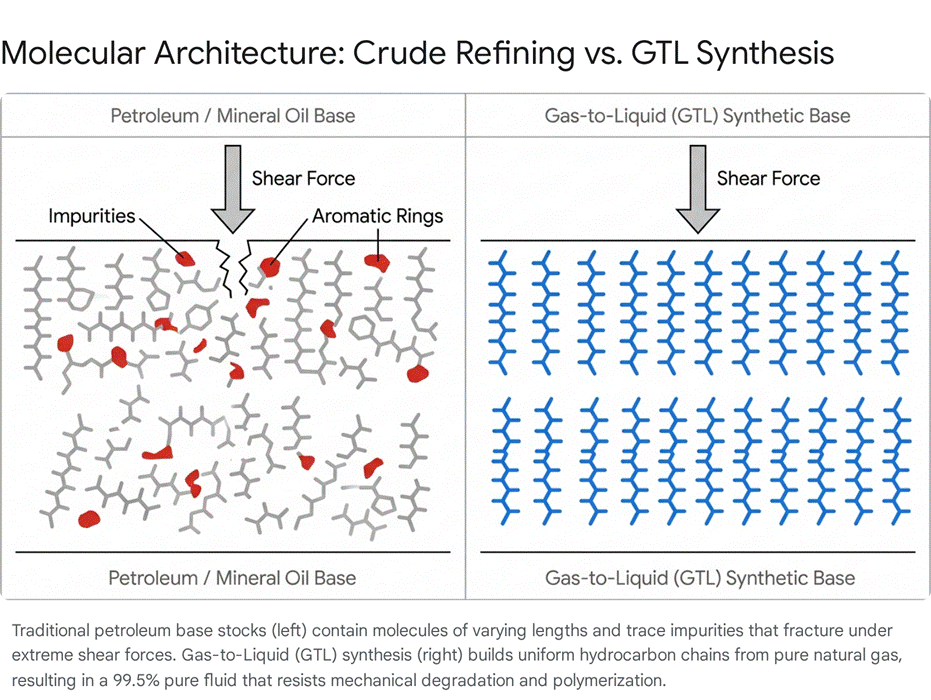
Standard oils are refined from crude oil, meaning their molecules are all different sizes and shapes1. They also contain impurities like sulfur and nitrogen that cause the oil to oxidize and break down when it gets hot1.
HRO uses a revolutionary GTL process that builds the oil from scratch using natural gas1. This creates a synthetic fluid that is 99.5% pure1.
Because these molecules are uniform in size, they act like millions of perfect ball bearings1. This reduces friction, stays on vertical surfaces better, and creates a stronger protective layer for your firearm’s parts1.
2.2 Rheological and Thermal Superiority Metrics
The absolute molecular uniformity of HRO gives it extraordinary thermal stability and shear resistance, which means it can protect nearby polymer structures from heat transfer. While conventional mineral-based CLPs experience massive evaporative loss under thermal stress, HRO’s precise engineering offers profound burn-off resistance.
The difference is clear. When a gun gets hot, HRO’s low volatility ensures it stays liquid and keeps working, while its -60°F pour point means it won’t get sluggish in the cold1.
3. Understanding Firearm Polymers
To evaluate compatibility, we have to look at what modern firearms are actually made of. Manufacturers today use advanced composites designed to handle heavy recoil and high temperatures, not generic plastics6.
Most pistol frames and lower receivers—from Glocks to the FN 509/510 and Springfield Echelon—are made from Polyamide 66, or Nylon 664. To make it strong enough for a firearm, it is reinforced with glass fibers (PA66-GF30)10.
This material has a very high melting point and can handle environments well over 300°F without losing its strength. It is even used for rifle furniture, such as the polymer stocks on a Zastava M70 or durable AK-74 magazines7.
Is HRO safe for these frames? The answer is a scientifically backed yes. Its safety comes down to how its molecules interact with the polymer.
Nylon 66 is famous for resisting chemicals like oils and hydraulic fluids10. Since Ronin’s Grips HRO is an ultra-pure GTL synthetic, it contains no aggressive impurities like toluene or benzene often found in harsh cleaners1, 14. This means it won’t dissolve, swell, or weaken your firearm’s frame, even if it stays on the surface for a long time27.
Polymer Substrate
GTL Isoparaffins (Ronin’s Grips HRO)
Aromatic Solvents (Aggressive CLPs/Bore Cleaners)
Mineral Oils (Crude-Derived)
PA66-GF30 (Standard Frames)
Excellent (Inert) – No swelling or structural degradation.
Fair to Good – General resistance, but susceptible to specific highly concentrated aromatics.
Good – Resists breakdown, but impurities may cause long-term staining.
Polycarbonate (Clear Magazines)
Good – Low solvency prevents rapid attack, though caution is advised with any surface-active fluid.
Severe Risk – High probability of inducing crazing and Environmental Stress Cracking (ESC).
Fair – Moderate risk depending on additive packages and impurities.
Elastomers (FKM / Viton O-Rings)
Excellent – Maintains dimensional stability when properly balanced with ester seal swell agents.
Severe Risk – Causes aggressive swelling, leading to seal shredding and binding.
Variable – Often causes unpredictable swelling or shrinkage based on sulfur/aromatic content.
Whether you are using a Polymer80, a Glock, or an FN 510, HRO provides excellent protection without any risk of chemical damage1, 10.
HRO doesn’t just sit on the surface; it actively protects the polymer frame by managing heat and shock. Most polymer frames fail from physical stress long before they fail from chemical exposure.
Take the FN 510 in 10mm Auto. This powerful round creates huge pressure and slide velocity5, 8. That energy is transferred through the steel locking block into the polymer frame. If a thin oil evaporates, the metal runs dry, increasing friction and shock that can cause the frame to crack1.
HRO prevents this by creating a thick, clinging boundary layer that acts like a microscopic shock absorber1. It refuses to vaporize even under high heat, keeping the system lubricated and protecting your frame from the kinetic shock that leads to failure.
While HRO is safe for frames, we must be careful with clear or translucent magazines. These are often made of Polycarbonate (PC), which is more sensitive than the nylon used in frames16, 18.
Polycarbonate can suffer from “stress cracking” when exposed to certain fluids while under tension from a magazine spring19. Although HRO is much safer than aromatic solvents, as a general rule, you should avoid getting any liquid lubricant on clear magazines to prevent the risk of cracking over time.
HRO also includes advanced additives like ZDDP for extreme-pressure protection and cleansing agents to keep carbon from sticking1, 2. These stay dormant against polymer frames, only “activating” when they hit high-heat metal-on-metal areas where they are needed1, 34.
Finally, HRO is completely free of PTFE (Teflon)1. Older lubricants often used Teflon, but when it gets hot—as it does in suppressed firearms—it can break down into toxic gases40. By avoiding Teflon, HRO ensures a safer shooting experience for you and prevents corrosion inside your firearm1, 44.
Ronin’s Grips HRO is an advanced solution for modern shooters. It provides elite protection for metal parts while being completely safe for your polymer frame, helping your firearm last longer and run more reliably in any condition.
In conclusion, Ronin’s Grips HRO is a highly advanced tribological solution that matches the material parameters of modern polymer-framed firearms. By abandoning dirty crude-oil refining methodologies that introduce aggressive aromatic impurities, HRO delivers a bespoke, chemically inert, and thermally superior boundary layer that enhances both the reliability of the weapon and the structural longevity of its polymer substrates.
Polycarbonate/Titania Composites Incorporating TiO2 with Different Nanoscale Morphologies for Enhanced Environmental Stress Cracking Resistance in Dioctyl Phthalate – PMC, https://pmc.ncbi.nlm.nih.gov/articles/PMC9460384/
Influence of heating temperature and time on mechanical-degradation, microstructures and corrosion performances of Teflon/granite coated aluminum alloys used for non-stick cookware – PMC, https://pmc.ncbi.nlm.nih.gov/articles/PMC11324993/
The reliability of a firearm depends on its tribology, the study of interacting surfaces in motion, including friction, wear, and lubrication. Modern firearms, especially gas-operated systems, work in harsh environments defined by extreme heat, rapid cycling, and heavy carbon contamination1. When a cartridge fires, propellant gases create intense pressure and heat, driving the bolt carrier group or slide back at high speed3. Critical contact points, such as locking lugs and slide rails, face severe mechanical stress and rely on microscopic layers of lubricant to prevent mechanical failure1.
In these high-stress situations, lubrication must work across different stages. In ideal “hydrodynamic” lubrication, a continuous fluid film separates the metal surfaces to eliminate wear1. However, during rapid firing, immense pressure often squeezes this fluid out of the contact zone, forcing the system into “boundary” lubrication1. At this stage, the fluid alone cannot protect the metal; instead, the weapon relies on chemical additives, extreme pressure and anti-wear agents, to react with the steel and form a protective barrier1.
Firearm lubrication has evolved alongside industrial lubricants. Since the first commercial oil well in 1859, petroleum-based oils replaced animal fats to become the standard for weaponry8. While refined crude oil met needs for decades, modern tactical environments are more demanding. Sound suppressors, high-cadence automatic fire, and very hot or very cold weather have pushed traditional petroleum lubricants past their limits.
This evolution requires an analysis of whether petroleum-based oils are still sufficient and why advanced synthetic formulations, specifically Gas-to-Liquid-synthesized High Reliability Oils, are now seen as the superior solution for modern weapons.
The Chemistry and Utility of Petroleum-Based Lubricants
The American Petroleum Institute divides petroleum base oils into three groups: I, II, and III. Groups I and II are processed to remove basic impurities11. Group III oils undergo “hydrocracking,” where the oil is heated to roughly 1,000°F under high pressure and treated with hydrogen to break down impurities and improve molecular stability12.
Petroleum oils remain useful because of their strong natural solvency13. Since they are refined from a varied mixture of crude oil, their irregular molecular structure gives them an aggressive ability to dissolve and carry away carbon fouling and powder residue13.
Additionally, the industry has developed effective additive packages for petroleum stocks over the last century13. When mixed with corrosion inhibitors and anti-wear agents, petroleum oils provide reliable lubrication and rust protection at a low cost8. For casual shooting, range practice, or bolt-action hunting in moderate weather, a high-quality petroleum oil is a safe and cost-effective choice5.
Base Oil Type
Source Origin
Molecular Structure
Natural Solvency
Cost Profile
Petroleum (Mineral)
Refined Crude Oil
Varied, irregular shapes/sizes
Exceptionally High
Low / Economical
PAO (Group IV)
Synthesized Ethylene
Uniform, consistent
Low (Requires Esters)
High / Premium
GTL (Group III+)
Synthesized Natural Gas
Highly uniform iso-paraffins
Moderate to High
Premium
Thermodynamic Limitations and Molecular Variance
Despite their history, petroleum oils struggle under the intense heat and mechanical stress of modern tactical firearms. This is due to their origin; crude oil is a complex mixture with irregular molecules and contaminants like sulfur, nitrogen, and natural waxes1. Even highly refined mineral oils contain molecules that vary widely in size and structure13.
This lack of uniformity is a vulnerability. Under extreme heat, such as the rapid temperature spikes in a receiver during fast firing, the varied molecular structure begins to break apart14. Smaller molecules evaporate quickly, a trait known as volatility15. As these molecules vanish, the remaining oil thickens uncontrollably, significantly changing its viscosity and effectiveness15.
At the same time, impurities in the oil react with oxygen to form corrosive acids, a process called oxidation18. This combination of evaporation and oxidation causes the oil to bake onto hot metal surfaces, leaving behind sticky sludge and varnish14. This residue attracts dust and carbon, forming an abrasive paste that slows down the action and leads to malfunctions like failure to feed or extract1.
Additionally, natural waxes in petroleum oils can congeal in freezing temperatures, hindering performance in cold climates. While some basic oils fail in the cold, modern, highly refined mineral oils, like GNP Defend, can remain reliable down to -35°C by using advanced refinement to prevent thickening13.
The Catalyst for Change: Suppressed Fire and Extreme Gas Dynamics
The limitations of petroleum oils became more apparent with the widespread use of sound suppressors. Adding a suppressor does not just reduce noise; it drastically changes the weapon’s internal pressure and heat2.
Suppressors work by trapping and cooling propellant gases before they exit the muzzle2. This creates intense backpressure, forcing superheated gas and abrasive carbon fouling back into the receiver2. In rifles like the AR-15, this fouling vents directly onto the bolt carrier group.
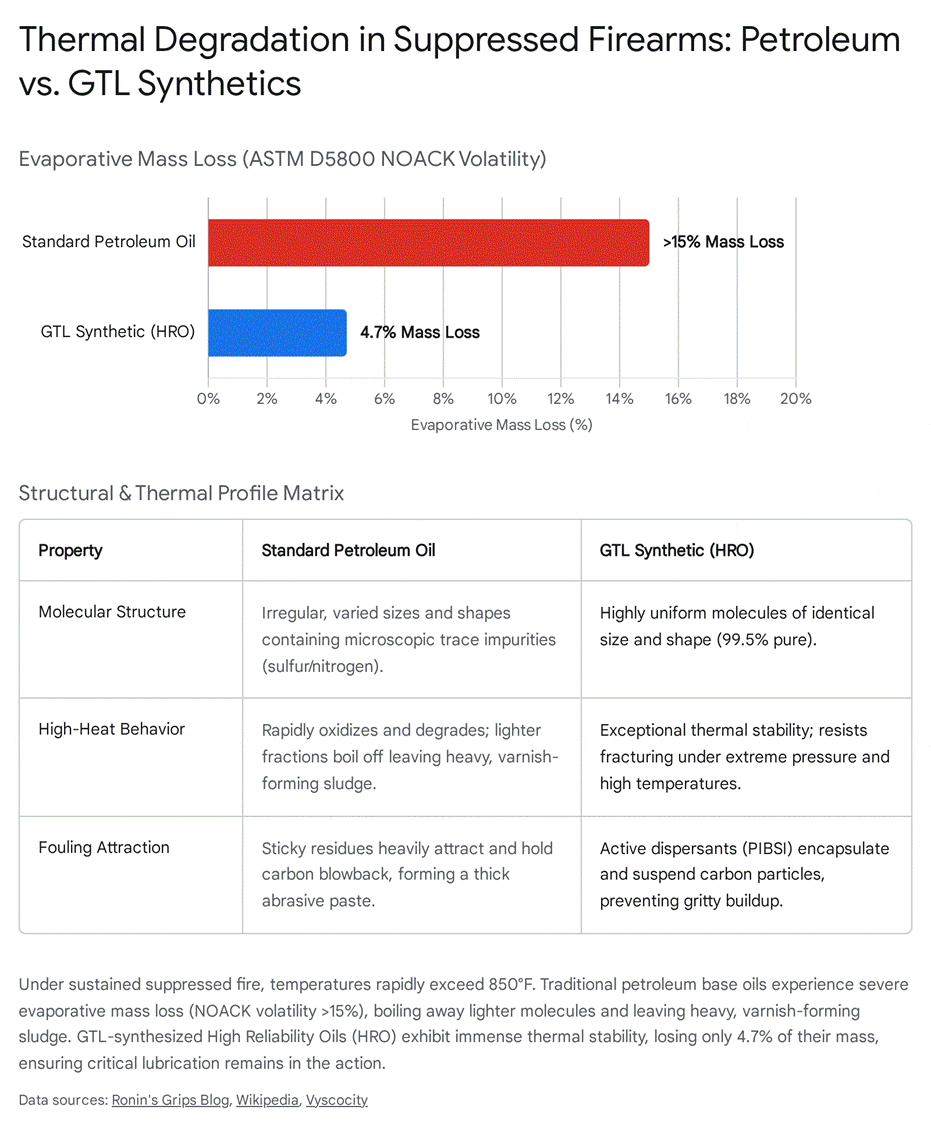
This environment is punishing. Internal temperatures can jump from 300°F to over 850°F in minutes, and sustained fire can exceed 1,200°F1. The weapon also cycles faster, increasing mechanical wear3. The combination of heat and fouling causes “carbon lock,” where hardened residue chokes the action until it stops functioning entirely21.
In suppressed weapons, petroleum lubricants often fail. Intense heat vaporizes the oil, creating clouds of toxic smoke that blow into the operator’s face1. The remaining oil turns into a varnish that traps carbon blowback1. Because of this, using standard petroleum oil in suppressed firearms harms reliability and longevity. Modern suppression requires fluids engineered for high thermal stability.
The Synthetic Evolution: From PAO to Gas-to-Liquid (GTL) Technology
To solve these issues, the industry developed synthetic lubricants. Unlike petroleum oils, which are cleaned-up crude, synthetics are built from the ground up13. Polyalphaolefins (PAOs) are the most common synthetics used in firearms8.
Since synthetics are lab-built, their molecular structure is uniform13. This makes them more stable: they thin out less in extreme heat, thicken less in arctic cold, and resist oxidation longer13. One downside of traditional PAOs is weak natural solvency; they struggle to dissolve carbon fouling on their own and often require extra additives to help13.
The Pinnacle of Tribology: Gas-to-Liquid Synthesis
Gas-to-Liquid (GTL) technology represents the latest leap in firearm lubrication. These ultra-pure fluids are a major upgrade over both petroleum and standard synthetics11.
The GTL process avoids liquid crude oil entirely, starting instead with pure natural gas26. Through chemical reactions, the gas is restructured into long-chain, ultra-pure liquid hydrocarbons26.
The resulting GTL fluid is crystal-clear and 99.5% pure1. It contains no sulfur, nitrogen, or waxes, the components that cause sludge and varnish in petroleum oils14. While petroleum oil is like a random pile of sticks, GTL oil is like a perfectly aligned stack of identical bricks1.
High Reliability Oil (HRO): A Comparative Engineering Analysis
The Noack Volatility Test (ASTM D5800) measures how well an oil survives heat15. A sample is held at 482°F for one hour to simulate extreme use17.
Petroleum oils often lose over 15% of their mass to evaporation in this test1. Even “extreme duty” oils like Lucas Extreme Duty can see their base molecules boil away, leaving thick residues that bind with carbon1.
In contrast, GTL-based HRO loses only 4.7% of its mass1. With a flash point often over 435°F, HRO stays where it is applied and produces very little smoke. This protects the operator from the toxic vapor clouds common with legacy lubricants1.
Low-Temperature Viscosity and Pour Point Dynamics
Lubricants must also work in freezing conditions. While mineral oils are generally reliable, heavy petroleum blends can freeze solid below -38°F1. Since GTL synthetics contain no wax, they stay liquid down to -60°F, ensuring the weapon cycles freely in the coldest environments1.
The base oil provides stability, but the additive package provides real protection. GTL-based HROs use their high purity to make additives more efficient, outperforming petroleum oils that are often hindered by sludge.
Zinc Dialkyldithiophosphate (ZDDP) Activation
To protect metal under heavy pressure, like on an AR-15 cam pin, HRO uses Zinc Dialkyldithiophosphate (ZDDP)1. ZDDP stays dormant until it senses high friction and heat1.
When parts move rapidly, ZDDP reacts to form a microscopic, sacrificial barrier on the steel1. This shield absorbs wear so the steel stays pristine. In a pure GTL oil, ZDDP works at maximum efficiency, unhindered by the impurities found in petroleum1.
Modern HROs also avoid Polytetrafluoroethylene (PTFE), or Teflon. PTFE breaks down at temperatures over 500°F, easily reached in suppressed fire, releasing toxic gases that cause “polymer fume fever”1. HRO provides elite protection without these health risks1.
Carbon Fouling Management via PIBSI Dispersants
Managing carbon soot is also critical. HRO uses Polyisobutylene Succinimide (PIBSI) dispersants as “cleansing agents”1.
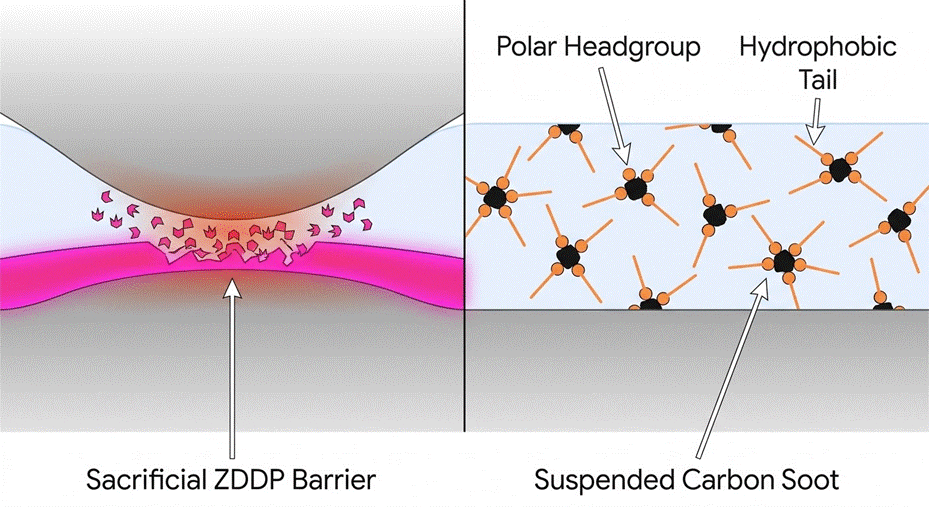
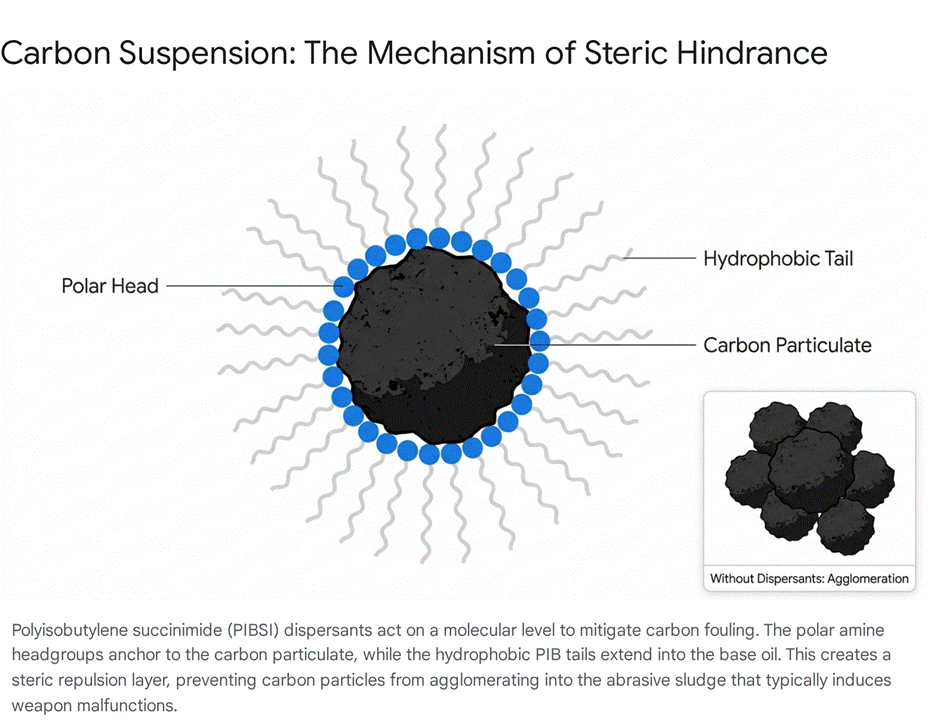
PIBSI molecules have a polar head that bonds to carbon particles and a tail that stays in the oil1. This process, called micellization, keeps carbon particles suspended in the fluid1.
Because soot is suspended, it cannot clump into gritty paste. This makes the firearm “self-cleaning,” as carbon can be easily wiped away without harsh scrubbing1. Petroleum oils lacking these dispersants trap carbon in a sticky sludge that accelerates wear2.
Validation Through Stringent Military Specifications
The benefits of GTL lubricants are proven by U.S. military testing. The governing specification is MIL-PRF-63460G, which sets requirements for Cleaner, Lubricant, and Preservative (CLP)30.
To qualify, a lubricant must pass extreme environmental and live-fire tests31.
The ASTM Tribology Suite
The Four-Ball Wear Test (ASTM D4172) evaluates protection under pressure. Steel balls are rotated under load in the lubricant at high heat for an hour7. The resulting wear scars are measured under a microscope; to pass, the scar must be smaller than 0.8 millimeters31.
ASTM D4172 Wear Scar Diameter
Lubricant Performance Interpretation
0.30 mm – 0.40 mm
Excellent anti-wear protection
0.40 mm – 0.50 mm
Good anti-wear protection
0.50 mm – 0.60 mm
Moderate protection
> 0.60 mm (Up to 0.8 mm max)
Passing military threshold, indicating acceptable boundary film strength
> 0.80 mm
Complete failure; poor wear protection leading to rapid part degradation
Extreme pressure limits are also tested. A qualifying lubricant must sustain a load of 500 pounds without the parts seizing or glowing from friction31.
Environmental and Kinetic Validation
Corrosion protection is tested using the Salt Spray Test (ASTM B117). Coated metal panels are exposed to salt fog for 100 hours35. To pass, there must be almost no visible corrosion35.
Finally, the lubricant is tested in live fire using the M249 Squad Automatic Weapon. It must maintain a firing rate of at least 650 rounds per minute after being frozen at -60°F or exposed to blowing dust31. Advanced GTL formulations easily meet these requirements across the full temperature range needed by the military30.
Strategic Maintenance Applications: The Oil vs. Grease Dichotomy
While GTL/HRO is superior, proper maintenance also requires using the right type of lubricant, oil or grease, on the right parts.
Military manuals once required specific oils for different temperatures40. Today, with synthetic fluids that work in broad temperature ranges, the choice is based on mechanical stress and part geometry.
Synthetic gun oil, like HRO, is best for large surfaces, complex mechanisms, and rust prevention5. Its fluid nature lets it penetrate tight spots and lift fouling away5.
Gun grease is thicker and designed for heavy loads. It should be used on sliding parts that experience high impact, such as locking lugs and slide rails13. Unlike oil, which can be squeezed out under pressure, grease stays in place to provide a cushion under recoil43.
The rule for maintenance is simple: if it slides or slams, use grease; if it spins or just needs rust protection, use oil13. Using HRO for general lubrication and synthetic grease on high-shear points ensures a weapon survives the toughest conditions5.
Conclusion
From an engineering perspective, crude-derived petroleum oils are largely obsolete for high-performance firearms. While they are cost-effective for casual use, their irregular structure makes them unfit for modern tactical environments2. Under the heat and pressure of suppressed fire, petroleum oils evaporate, produce toxic smoke, and degrade into sticky residue that causes malfunctions1.
The future of firearm lubrication is Gas-to-Liquid chemistry. By building a pure, uniform fluid from natural gas, High Reliability Oils offer superior stability and performance that exceeds military standards1. When paired with advanced additives to protect against wear and keep the action clean, the result is a lubricant that not only protects the weapon but actively improves its reliability. For professional operators, shifting to GTL synthetic lubrication is a mandatory step to ensure the longevity of modern weapons systems.
Understanding Modern Firearm Lubrication and Suppressors
The way we use modern firearms has changed dramatically over the last twenty years. The heat and mechanical stress inside these weapons now far exceed what their original designs anticipated, due to the rise of short-barreled rifles (SBRs), intense training schedules, and the common use of suppressors. Older, standard lubricants—like those meeting the military’s MIL-PRF-63460F specification for CLP—often fail to protect a gun under these harsh conditions3. Because today’s shooters deal with high backpressure, extreme heat, and heavy carbon buildup, we need to rethink how we lubricate our weapons1.
To understand why traditional oils fail and how advanced options like Ronin’s Grips High Reliability Oil (HRO) and Lucas Extreme Duty Gun Oil help, we have to look at what happens inside a suppressed firearm. Adding a suppressor does more than just quiet the shot; it changes the gas pressure, heat, and speed of the moving parts2. In a standard AR-15, the suppressor blocks gas from escaping quickly, forcing a much higher volume of hot gas back into the bolt carrier group (BCG)2.
This extra gas creates a domino effect. The BCG is slammed backward much faster than intended, which puts extreme pressure on the bolt as it unlocks1. The cam pin and locking lugs are forced to move while chamber pressures are still very high2. This creates so much friction that the protective layer of oil is often squeezed out, leaving metal to grind against metal2.
At the same time, the weapon gets incredibly hot. A suppressor can heat up from 300°F to over 850°F in just a few minutes of rapid shooting1. After 200 rounds of continuous fire, it can even reach 1,200°F1. This heat, combined with abrasive carbon and unburnt powder being blown back into the receiver, creates a brutal environment2, 4. In these conditions, the quality of your lubricant determines whether your gun keeps running or locks up completely.
The Impact of Suppressors on Lubrication
Using a suppressor makes lubricating a firearm even more difficult. Suppressors are essentially metal cans with internal walls, or baffles, that trap and slow down expanding gases to reduce noise5. Whether they are made of stacked cones or machined from a single block of titanium, they all face the same challenges5.
When you fire that first shot, the oxygen inside the suppressor can cause a mini-explosion of unburnt powder, leading to sudden heat spikes6. This heat and carbon buildup can actually cause the suppressor to “carbon lock” to the barrel, making it almost impossible to remove1. While some designs are easier to clean than others, all are at risk of seizing up if not properly maintained6.
Many shooters try to fix the issue by using heavy grease or anti-seize on the threads7. However, standard oils often evaporate instantly, leaving behind a sticky sludge that makes the problem worse. A truly effective lubricant needs to handle temperatures over 800°F without turning into glue7. The ability to keep carbon from baking onto metal surfaces is what separates modern, purpose-built oils from the older alternatives10.
The Foundation: What’s in the Bottle?
Most of what is in a bottle of gun oil (about 75% to 90%) is the “base stock.” How this base oil handles heat and stress determines how well the lubricant works overall. The differences between Lucas Extreme Duty and Ronin’s Grips HRO start right here at the molecular level.
Lucas Extreme Duty: Petroleum-Based Strength
Lucas Extreme Duty Gun Oil is made from highly refined mineral and petroleum oils11. While modern refining techniques have made these oils much better than they used to be, they still contain tiny amounts of impurities like sulfur and nitrogen1. These mineral bases aren’t perfectly uniform because they are extracted from crude oil.
Because these molecules vary in size and shape, they can break down under the extreme heat of a suppressed weapon2, 3. When the inside of your gun gets hotter than 500°F, the impurities in petroleum oils can oxidize and thicken2. When this process happens and mixes with carbon fouling, it creates a thick, baked-on sludge that slows down the moving parts of your rifle2.
To solve this, Lucas makes their oil exceptionally thick and “tacky” using a special polymer technology9. This high viscosity helps the oil stick to the metal surfaces and resist being blown off by the gas pressure of a suppressed AR-157. Essentially, Lucas uses a thick physical layer to ensure protection remains even if the oil begins to degrade.
Instead of trying to clean up dirty crude oil, the GTL process takes pure natural gas and builds the oil molecules from scratch4. This means every molecule is exactly the same size and shape3. Imagine the difference between a pile of random sticks (crude oil) versus a stack of identical bricks (GTL synthetic). The uniform “bricks” in HRO stay strong and won’t break down under pressure like petroleum oils do3.
Because these molecules are so uniform, they handle extreme heat and stress exceptionally well4. HRO doesn’t fracture, even when hot gas blasts your bolt carrier during rapid fire. It’s free from the impurities that cause sludge, so the oil stays slick and keeps working long after traditional oils would have failed3.
Thermodynamics, Burn-Off Resistance, and Volatility
The true test of a gun oil is how it handles heat. When your firearm gets hotter than 500°F, cheap oils simply evaporate or “burn off.” This leaves the moving parts dry and unprotected, leading to rapid wear or a jammed gun.
Flash Point and High-Temperature Survival
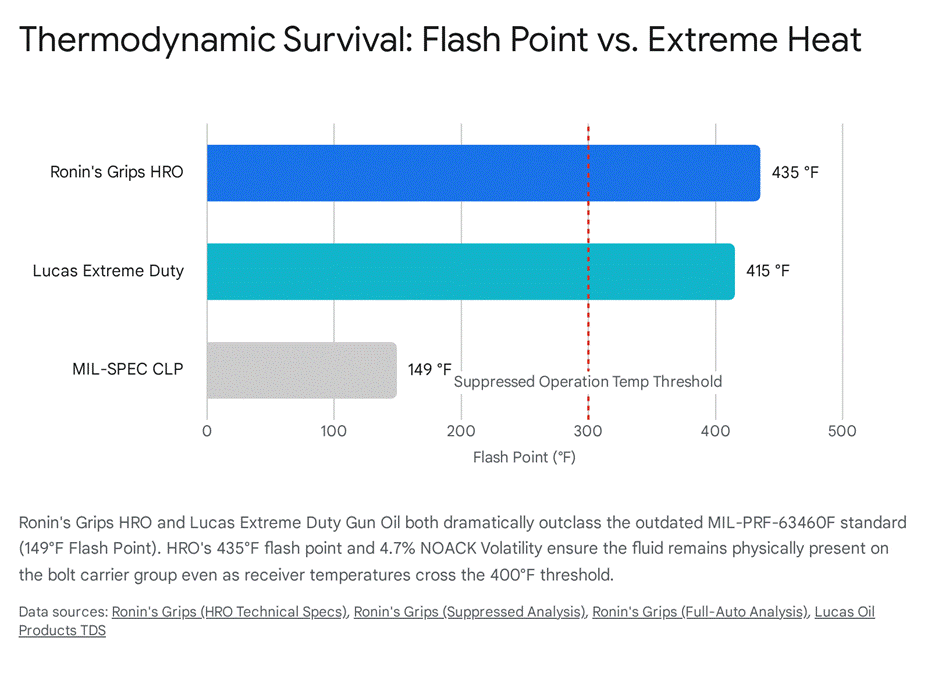
A lubricant’s “flash point” is the temperature at which it starts to turn into a vapor that can catch fire. It’s a useful way to see how much heat an oil can handle. While the military’s minimum standard is only 149°F, both Lucas and Ronin’s Grips HRO far exceed that, offering much better protection1.
Lucas Extreme Duty has a high flash point of 415°F15. This means it won’t smoke or evaporate easily during heavy shooting13. Its thick polymers keep the oil in place on the bolt carrier group even when things get very hot9.
Ronin’s Grips HRO goes even further with a flash point over 435°F3. This high limit makes it very resistant to burning off. HRO is also designed to be “low-smoke.” It won’t create a thick cloud of toxic smoke when you’re shooting with a suppressor, which is a huge advantage if you are shooting in enclosed spaces3.
NOACK Volatility and Evaporative Mass Loss
While flash point is about fire risk, “NOACK Volatility” is the real test of how much oil physically boils away under heat4. In this test, oil is heated to 482°F for an hour, and scientists measure how much of the oil was lost to evaporation4.
Traditional firearm oils often lose more than 15% of their mass in this test4. However, Ronin’s Grips HRO loses only 4.7%3. This means that even when your gun is superheated, the oil stays on the parts to protect them4. It also won’t evaporate while sitting in your safe, so your gun is ready to go even years later3.
Lucas Oil relies on its thickness to stay in place. While its heavy formula resists evaporation better than thin oils, some of the petroleum will still boil away under intense heat. This leaves behind the heavier polymers, which still offer protection but change how the oil feels during long shooting sessions.
Boundary Lubrication and Mechanochemical Shielding
Inside a gun, the parts move back and forth so violently that oil can be physically squeezed out from between them. When this happens, the microscopic bumps on the metal surfaces grind against each other2. To prevent wear and jamming, advanced oils use special chemical additives that bond directly to the steel.
The system instantly enters the boundary lubrication regime, a state where the microscopic peaks and valleys of the metal (asperities) come into direct, violent contact2. To prevent catastrophic metal-to-metal galling, accelerated wear, and mechanical binding, advanced lubricants cannot rely on fluid film thickness alone; they must deploy highly reactive anti-wear (AW) and extreme pressure (EP) chemical additives that bond directly to the steel surface.
The Mechanochemistry of Zinc Dialkyldithiophosphate (ZDDP)
Both HRO and Lucas use Zinc Dialkyldithiophosphate (ZDDP), a highly effective additive that has been around since the 1940s4, 16. ZDDP is unique because it only activates when it feels heat and pressure.
When a suppressed weapon is fired, the extreme contact pressure and localized flash temperatures at the rubbing metal asperities cause the ZDDP molecules suspended in the oil to chemically decompose16. Before the formation of the final protective film, ZDDP decomposes to form intermediate zinc sulfide and iron sulfide species, which are mechanically mixed into the iron oxides on the rubbing steel surfaces19.
When you fire your gun, the friction and heat cause the ZDDP to react and form a thin, glassy protective layer on the metal16, 19. This layer acts as a sacrificial shield. Instead of the steel parts grinding together, these microscopic glassy layers take the hit, slowly wearing away and then reforming from the oil as you keep shooting19, 22.
This means that the more you shoot, the more these oils work to protect your gun’s cam pin, rails, and gas rings. Lucas Oil contains about 15% of this additive, giving it a massive reserve for protection17. HRO uses its pure GTL base to let the ZDDP work even more efficiently, ensuring it doesn’t waste its strength on a degrading base oil3.
The Polytetrafluoroethylene (PTFE) Hazard in High-Heat Environments
Some lubricants use Polytetrafluoroethylene (PTFE), or Teflon, to reduce friction. While this works well for sliding doors or at room temperature, it can be dangerous in a suppressed rifle1.
When Teflon gets hotter than 500°F, it breaks down and releases toxic gases that are harmful to breathe1. This can cause “polymer fume fever,” with symptoms like chest tightness and flu-like aches.
Ronin’s Grips HRO is 100% free of PTFE and other hazardous aerosols3. Lucas Extreme Duty also avoids using PTFE, relying instead on high-quality oil and ZDDP to protect your firearm safely.
Managing Carbon Fouling
Cleaning carbon is one of the most frustrating parts of owning a suppressed firearm. The backpressure from a suppressor drives abrasive soot and lead deep into the gun’s action2. How your oil interacts with this carbon determines how long you can shoot before your gun needs a deep clean.
Polyisobutylene Succinimide (PIBSI) Dispersants in HRO
Ronin’s Grips HRO uses specialized “Active Cleansing Agents” to manage carbon1, 3. These agents, called PIBSI dispersants, act like tiny magnets for carbon particles25, 26.
The inclusion of PIBSI represents a masterclass in organic chemistry applied to small arms tribology. PIBSI is made by reacting polyisobutylene succinic anhydride (PIBSA) with polyalkylene polyamines, creating a molecule with very distinct functional zones. It consists of a long, oil-soluble, hydrophobic polyisobutylene (PIB) tail and a highly polar polyamine headgroup26.
When carbon soot enters the receiver, the polar amine headgroup of the PIBSI molecule is immediately attracted to the highly charged surface of the soot particles26. Through strong dipole-dipole and acid-base interactions, the polar heads anchor themselves firmly to the carbon26. The long, hydrophobic PIB chains then extend outward into the surrounding synthetic oil phase27.
When carbon enters the gun, these dispersants surround each particle, keeping them separated so they can’t clump together into a gritty paste24, 26, 27. This keeps the carbon floating in the oil rather than sticking to your gun’s parts2. This makes the weapon essentially “self-cleaning” because you can simply wipe away the dirty oil without having to scrape off baked-on carbon2.
Polymeric Film Technology in Lucas Extreme Duty
Lucas Extreme Duty uses its thick polymer film to protect surfaces13. This sticky film creates a tough physical barrier that blocks out rust and moisture while staying in place even during intense movement7.
This film exhibits incredibly high tackiness and resilience to mechanical shock. In a direct-impingement weapon, expanding gas inevitably attempts to blow the lubricant out of the ejection port. Lucas Oil’s heavy polymeric film resists this violent blowback, keeping the oil exactly where it is applied on the BCG and severely reducing the amount of fluid migrating into the operator’s face or safety glasses9.
However, this stickiness is a trade-off. While it stays on your gun well, it also attracts dust and carbon29. Over many shots, the residue can turn into a thick, dark paste30. While the gun will still cycle reliably, it usually requires a more thorough cleaning with strong solvents to get all that paste out of the action compared to the HRO29.
Rheology, Viscosity Index, and Environmental Operating Windows
Rheology—the study of the deformation and flow of matter—is a critical factor in small arms lubrication. A lubricant must possess low enough viscosity to penetrate microscopic surface pores and flow smoothly into the tight, exacting tolerances of gas rings, yet high enough viscosity (film strength) to form a tenacious, clinging boundary cushion on the highly loaded cam channel and receiver rails3.
Viscosity Profiles and High-Speed Mechanisms
Ronin’s Grips HRO is designed to thicken similar to 10W-30 motor oil3. It has a high “Viscosity Index,” which means it stays stable regardless of the temperature3. It won’t get too thin when hot or too thick when freezing, keeping your gun cycling at the right speed in any environment3.
Lucas Extreme Duty is a much thicker oil, closer to a 40 or 50 weight oil15. This thickness is what keeps it in place and makes it a favorite among gunners9. It provides a massive cushion against wear, though it might feel a bit more “sluggish” than the thinner HRO.
Arctic Operations and Pour Points
The pour point (evaluated via ASTM D97) of a lubricant determines its fundamental viability in extreme cold-weather operations. Standard crude-derived mineral oils contain inherent wax impurities that begin to crystallize and interlock at sub-zero temperatures, causing the entire fluid matrix to congeal. This induces severe cold-weather sluggishness, dramatically reduces cyclic rates, and directly causes failure-to-return-to-battery malfunctions as the buffer spring struggles to overcome the frozen fluid drag3.
Lucas Extreme Duty works down to -38°F, which is plenty for almost anyone shooting in the winter15.
However, Ronin’s Grips HRO is the champion of cold weather. Because it is a pure synthetic with zero wax, it stays liquid down to -60°F3. This makes it the best choice for extreme arctic conditions, where other oils would freeze solid3.
Corrosion Resistance and Long-Term Preservation
Beyond kinematic lubrication, a weapons oil must serve as an impenetrable barrier against oxidation, galvanic corrosion, and pitting. The industry standard for evaluating corrosion resistance is the ASTM B117 salt spray test, which subjects treated steel to a continuous brine fog at elevated temperatures to measure the hours until red rust appears31.
Lucas Extreme Duty is fantastic at preventing rust7, 32. Its thick, tacky film locks out moisture and salt from your hands7. If you are storing a gun for a long time in a humid basement or near the ocean, Lucas is an elite choice for keeping it rust-free12.
HRO also protects against rust and won’t evaporate over time, but it doesn’t have the same thick, “greasy” feel as Lucas3. Most shooters find it excellent for general storage, but Lucas remains the king of heavy-duty rust prevention.
Packaging, Distribution, and Market Economics
You can find Lucas Extreme Duty almost anywhere—sporting goods stores, auto parts stores, and online33. It also comes in a great 1-ounce bottle with a precision needle tip, which makes it easy to put oil exactly where you need it28. It’s also very affordable, usually under $10 for a small bottle34.
To distill the engineering data, the following table maps the critical technical properties and operational features of both fluids.
Technical Metric / Feature
Ronin’s Grips HRO (High Reliability Oil)
Lucas Extreme Duty Gun Oil
Base Stock Architecture
99.5% Pure Gas-to-Liquid (GTL) Synthetic3
Highly Refined Petroleum/Mineral Oil Blend11
Flash Point (Burn-off Resistance)
> 435°F (224°C)3
415°F (212°C)15
Pour Point (Arctic Operation)
-60°F (-48°C)3
-38°F (-39°C)15
Viscosity Profile
10W-30 Equivalent (60.5 cSt @ 40°C)3
Heavy Viscosity (15.0 cSt @ 100°C)15
Anti-Wear Additive Shield
Zinc Dialkyldithiophosphate (ZDDP)4
Zinc Alkyldithiophosphate (~15%)17
Carbon Management Strategy
Polyisobutylene succinimide (PIBSI) Dispersants1
Heavy Polymeric Adhesion Film13
Polytetrafluoroethylene (PTFE)
0% (Eliminates toxic off-gassing)1
0% (Uses heavy oil/ZDDP instead)17
Volatility (NOACK Evaporative Loss)
4.7% (Extreme stability)3
Unpublished (Mitigated by heavy viscosity)13
Synthesis of Pros and Cons
Lucas Extreme Duty Gun Oil The primary advantage of Lucas Extreme Duty is its exceptional film strength. The heavy viscosity and proprietary polymeric film technology ensure the oil clings aggressively to metal, preventing dry starts even after long periods of storage in unconditioned environments12. This heavy weight provides immense blowback resistance; it significantly reduces the amount of fluid migrating off the bolt carrier and into the operator’s face during suppressed fire, maintaining clear vision12. Furthermore, it serves as a tier-one preservative, neutralizing acids from human hands and locking out moisture12. Packaged in an excellent precision needle oiler, it is highly accessible and cost-effective12.
Conversely, the primary drawback of Lucas Extreme Duty is its propensity for debris attraction. The thick, petroleum-based polymeric film is inherently sticky. While it protects the underlying metal flawlessly, it aggressively attracts environmental dust, lint, and heavy carbon blowback29. Over hundreds of suppressed rounds, this forms a thick paste that requires heavier, solvent-intensive cleaning regimens30. Additionally, while a -38°F pour point is highly effective for general use, it cannot match the deep-arctic fluidity of a pure GTL synthetic3.
Ronin’s Grips High Reliability Oil (HRO) The overwhelming advantage of HRO is its unmatched thermal stability and purity. The 99.5% pure GTL base and minimal 4.7% NOACK volatility rating ensure that the fluid refuses to evaporate or burn off under rapid-fire conditions, fundamentally preventing the formation of crude-based sludge3. Its active carbon suspension is unparalleled; the integration of PIBSI dispersants micellizes carbon soot via steric hindrance, keeping it in fluid suspension and rendering the weapon essentially self-cleaning2. Furthermore, the lack of volatile petroleum impurities guarantees a low-smoke profile, preventing blinding, toxic smoke from obscuring the operator’s vision during suppressed mag-dumps1. Finally, the extreme temperature operating window enables flawless kinematic cycling, ranging from -60°F to receiver temperatures exceeding 500°F.
The limitations of HRO lie primarily in its market presence and physical feel. As a specialized, boutique synthetic, it lacks the ubiquitous retail availability of Lucas and requires targeted procurement3. Additionally, while possessing an elite viscosity index for high-speed parts, it operates closer to a 10W-30 equivalent3. Operators accustomed to the ultra-thick, sticky, shock-absorbing feel of heavy polymeric grease or oil may find HRO’s thinner film build to feel less substantial, even though the chemical ZDDP barrier provides equal or superior microscopic protection against wear.
Final Engineering Verdict
Choosing between these two oils depends entirely on how you use your gun.
If you want a reliable, heavy-duty oil that is easy to find and great for preventing rust during storage, Lucas Extreme Duty Gun Oil is a fantastic choice. It sticks to parts well and provides a thick cushion for your gun’s action. It’s perfect for the average shooter who wants great protection at a good price, though it might take a little more work to clean up afterward.
If you shoot suppressed, use full-auto, or shoot in extreme cold, Ronin’s Grips High Reliability Oil (HRO) is the clear winner. Its synthetic formula won’t burn off or turn into sludge under heat. It keeps carbon floating so you can just wipe your gun clean, and it won’t smoke you out of a room. It is a high-end solution for shooters who demand absolute reliability from their gear.
Shooter Lube Solvent Test. This GM9 has siezed shut multiple times. Already been sent back to gemtech 3x. Today I decided to try and soak and shake it in shooter lube gun cleaning solvent.. ive tried ATF/Mineral spirits mix, Kroil, and Clp before. Ill see how the results are tomorrow evening. : – Reddit, https://www.reddit.com/r/NFA/comments/mtqizr/shooter_lube_solvent_test_this_gm9_has_siezed/
Nano- and Micro-Tribological Investigations of Boundary Layers on Axial Bearing Washers Tested under WEC Critical Conditions – MDPI, https://www.mdpi.com/2075-4442/10/8/198
The landscape of law enforcement and military tactical protective equipment is undergoing its most significant structural and philosophical evolution in over fifteen years. The publication of the National Institute of Justice (NIJ) Standard 0101.07, alongside its foundational companion document, NIJ Standard 0123.00, in late 2023, marks a definitive departure from the legacy 0101.06 protocols originally established in 2008.1 This systemic overhaul is not merely a bureaucratic update; it addresses the rapidly shifting reality of ballistic threats—most notably the proliferation of high-velocity rifle platforms in domestic environments—while simultaneously tackling the profound physical limitations of legacy hard armor plates. For the primary readership of blog.roninsgrips.com, understanding this intersection of ballistics, material science, and human physiology is paramount to making informed equipment decisions.
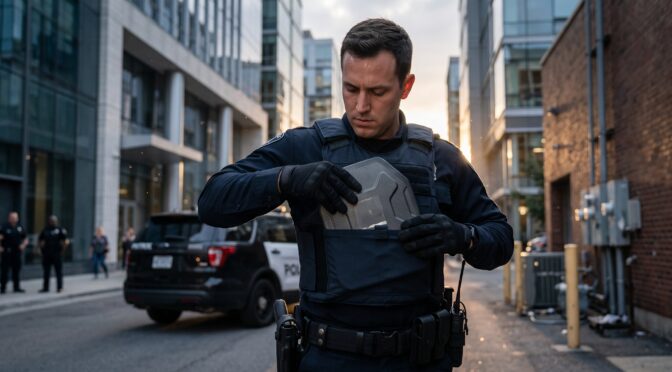
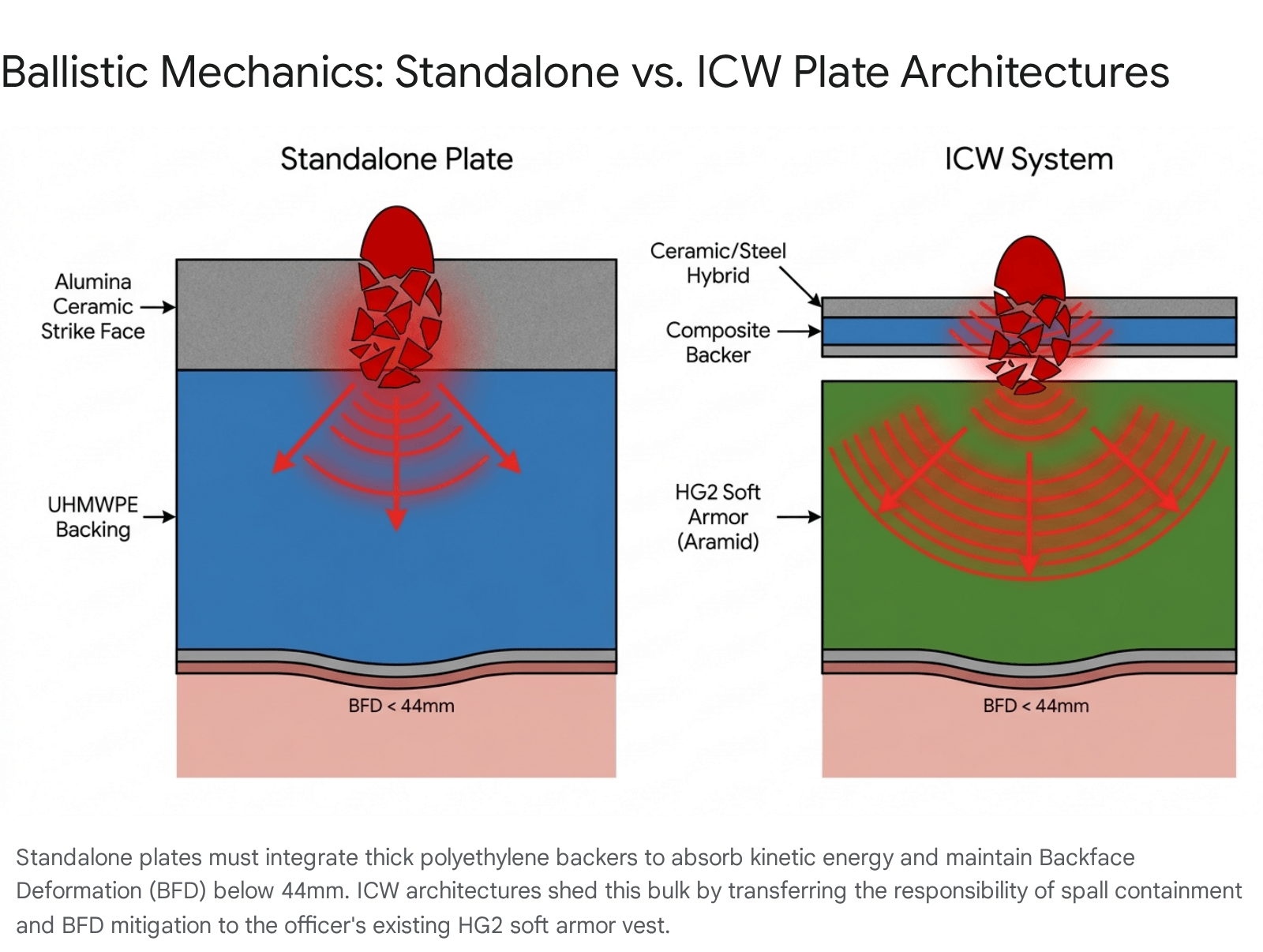
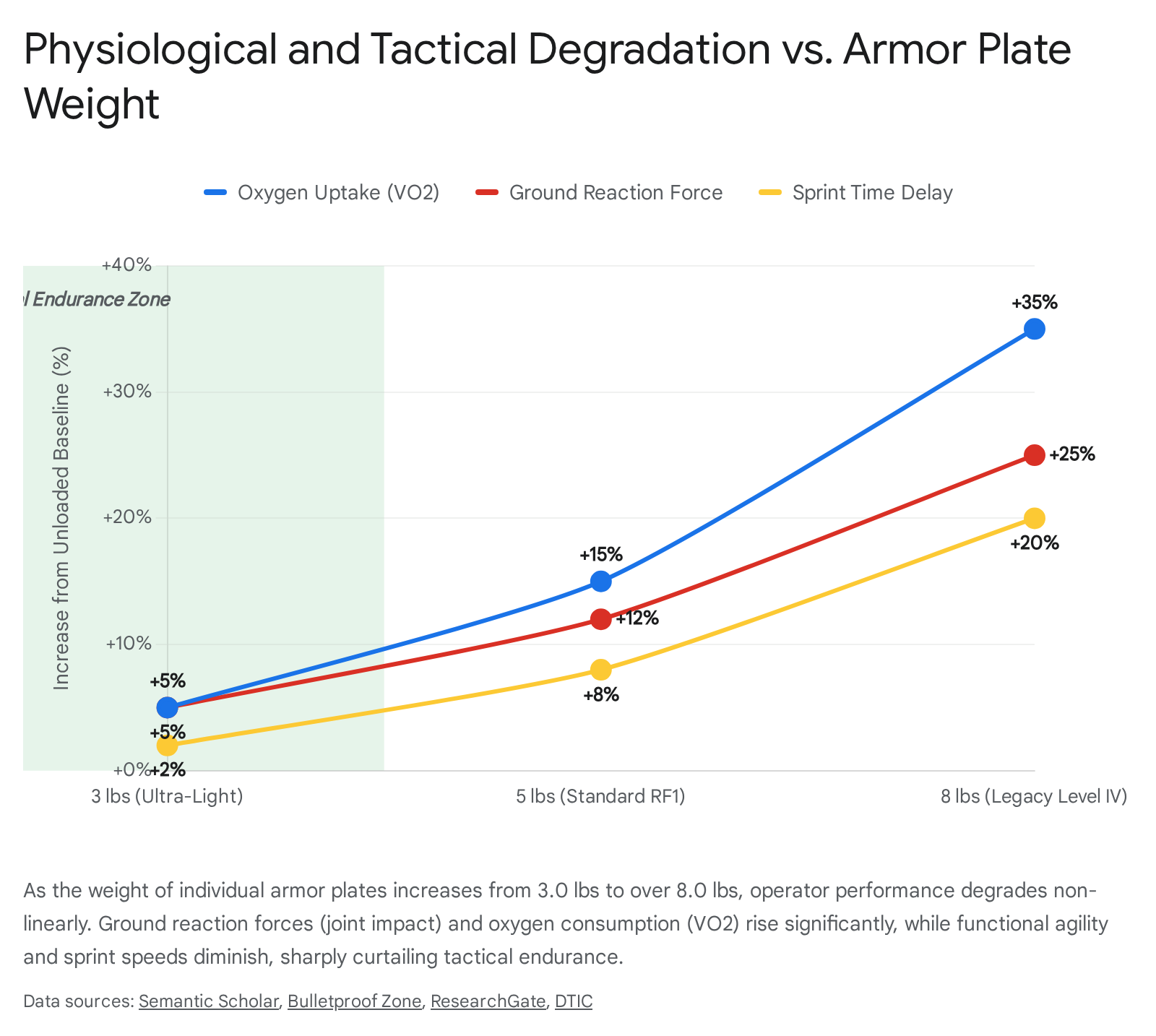
For the modern patrol officer, the operational equation is fundamentally dictated by the balance between survivability and physiological sustainability. The threat of active shooters and rifle-armed assailants necessitates Level III-equivalent protection. However, adding rigid rifle protection to daily-wear soft armor introduces severe penalties in the form of kinematic degradation, metabolic heat accumulation, and neuromuscular fatigue.4 Consequently, the industry is witnessing a strategic pivot toward advanced In-Conjunction With (ICW) plate architectures. Systems such as the Point Blank Delta-IC and the GARMS series leverage hybrid material sciences to shed weight and thickness without sacrificing lethality mitigation.7
This comprehensive report provides an exhaustive, highly technical analysis of the updated NIJ framework, the biophysics of behind-armor blunt trauma (BABT), the physiological burdens of load carriage, and the engineering paradigms driving the next generation of patrol-ready ballistic protection.
Deconstructing the Modular Regulatory Framework: NIJ 0101.07 and 0123.00
The most critical architectural change in the new NIJ regulatory environment is the decoupling of the laboratory testing methodology from the specific threat level definitions.9 Previously, NIJ Standard 0101.06 bundled the mechanical conditioning protocols, the backface deformation metrics, and the specific calibers, masses, and velocities of test ammunition into a single, monolithic standard document.3 This legacy architecture created an administrative bottleneck. Whenever a new prevalent threat emerged on the street, updating the standard required a multi-year bureaucratic overhaul of the entire laboratory methodology and accreditation framework.1
By bifurcating these elements, the NIJ has instituted a modular, highly responsive regulatory system designed for the realities of the 21st century:
NIJ Standard 0101.07 exclusively dictates the physical test methods, environmental conditioning, laboratory practices, and the performance requirements (such as the 44mm backface deformation limit).11
NIJ Standard 0123.00 acts as a dynamic repository, titled “Specification for NIJ Ballistic Protection Levels and Associated Test Threats,” which strictly specifies the ballistic protection levels, test threats, ammunition identifiers, and reference velocities.11
This modularity ensures that if a new armor-piercing or intermediate barrier-blind projectile becomes prevalent in domestic crime, the NIJ can rapidly issue an addendum to 0123.00 without disrupting the multimillion-dollar laboratory accreditation programs governing 0101.07.9 The NIJ Certification Testing Program (CTP) has anticipated a lengthy transition; while they ceased accepting applications for new body armor models compliant with 0101.06 in January 2024, the legacy Compliant Products List (CPL) will be maintained through at least the end of 2027.2 It is critical to note that as of mid-2026, the NIJ is still processing the first wave of 0101.07 certifications; therefore, plates currently marketed as RF1 or RF2 are technically still certified under the 0101.06 standard (or independently tested to the new standards) while awaiting official publication on the new CPL.3
The NIJ 0123.00 Threat Matrix in Detail
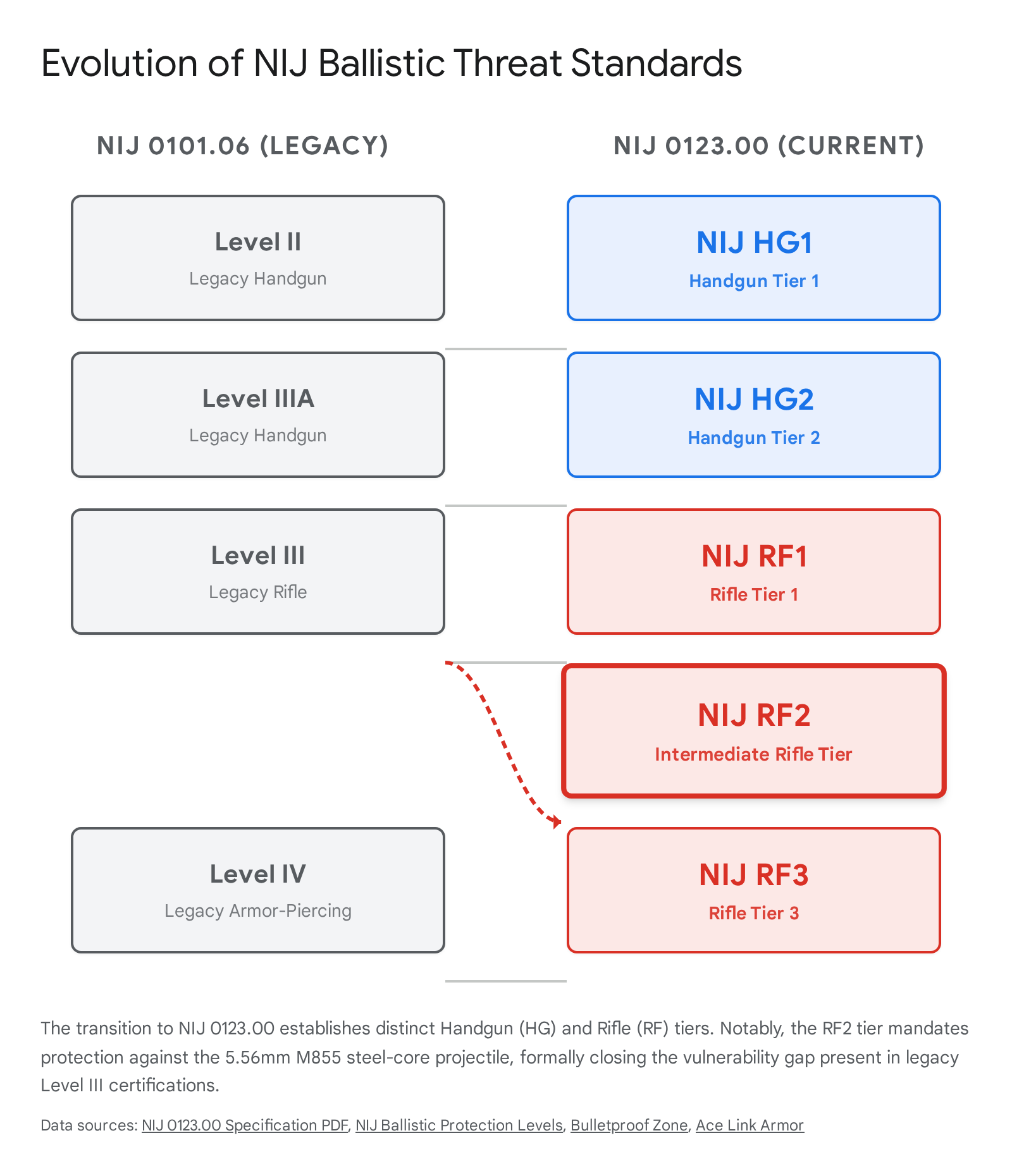
The legacy Roman numeral nomenclature (Level IIA, Level II, Level IIIA, Level III, and Level IV) has been entirely retired. In its place, the NIJ has established a more intuitive, alphanumeric system that clearly delineates Handgun (HG) threats from Rifle (RF) threats, reducing confusion among procurement officers and end-users.3 The obsolete Level IIA, which previously tested against lower-velocity 9mm and.40 S&W rounds, has been eliminated entirely, reflecting the reality that baseline requirements for modern patrol soft armor have surpassed these threats.16
The Handgun (HG) Tiers
The HG classifications govern the flexible soft body armor typically worn daily by patrol officers underneath or over a uniform shirt.
Protection Level
Legacy Equivalent
Test Threat 1 (Ammunition & Mass)
Reference Velocity 1
Test Threat 2 (Ammunition & Mass)
Reference Velocity 2
NIJ HG1
Level II
9mm Luger FMJ RN (124 grain)
1305 ft/s (398 m/s)
.357 Magnum JSP (158 grain)
1430 ft/s (440 m/s)
NIJ HG2
Level IIIA
9mm Luger FMJ RN (124 grain)
1470 ft/s (448 m/s)
.44 Magnum JHP (240 grain)
1430 ft/s (436 m/s)
Table 1: The NIJ 0123.00 Handgun (HG) Threat Matrix.3
A notable evolution in the HG2 category is the retirement of the.357 SIG round used in the previous 0101.06 standard. It has been replaced by a faster, higher-energy 9mm Luger FMJ RN traveling at an aggressive 1,470 ft/s.17 This swap better reflects the terminal ballistics of over-pressure (P+) 9mm ammunition increasingly encountered by law enforcement, establishing a rigorous new baseline for soft armor flexibility and kinetic energy absorption.17
The Rifle (RF) Tiers
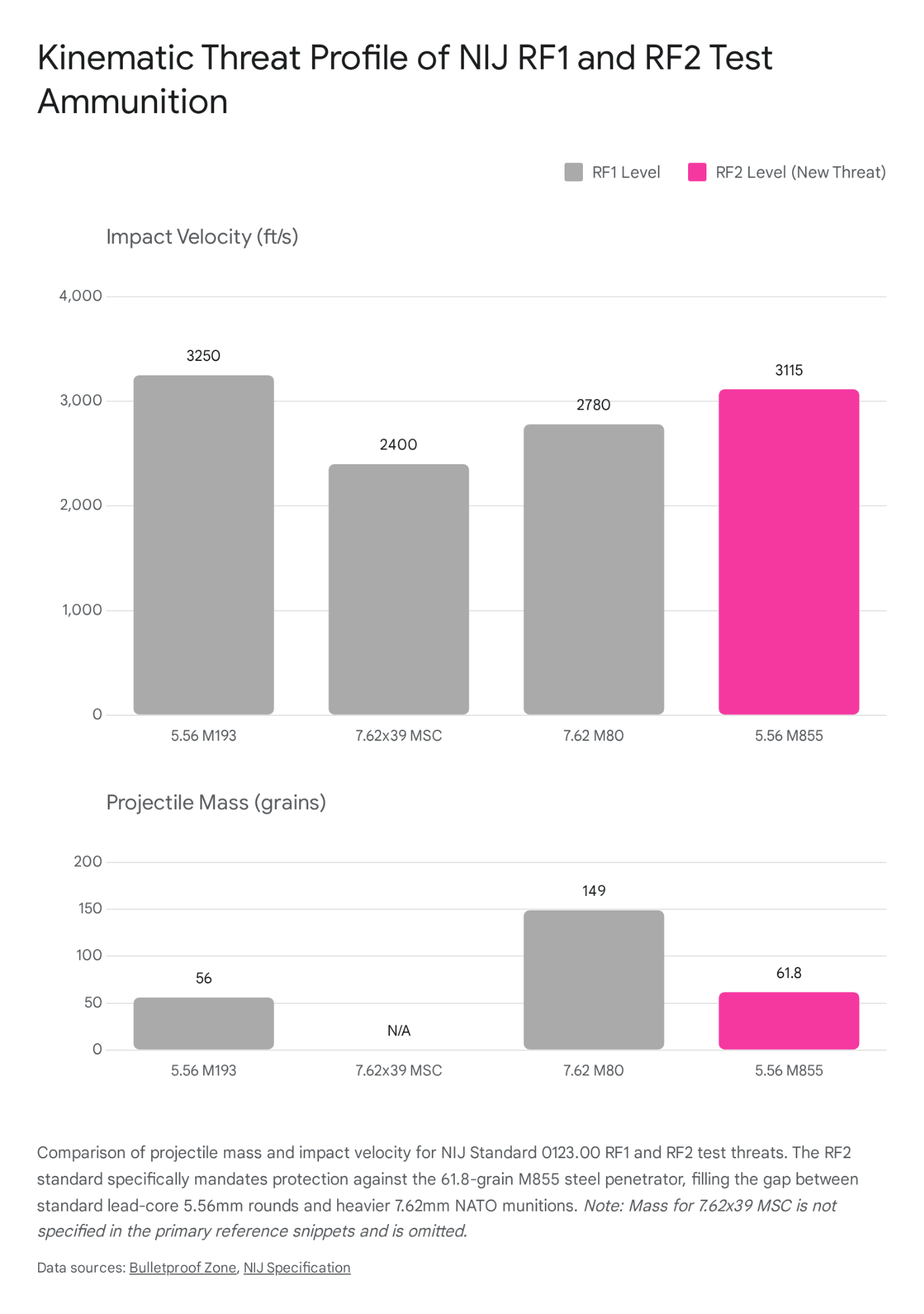
The RF classifications govern rigid hard armor plates, introducing a critical intermediate tier to address previous vulnerabilities in the testing matrix. The test projectiles and reference velocities have been dramatically updated to reflect the evolving threats faced by U.S. law enforcement, encompassing a much wider range of rifle threats than the solitary 7.62x51mm M80 round required under the old Level III standard.15
Table 2: The NIJ 0123.00 Rifle (RF) Threat Matrix, incorporating Addendum 1 modifications to M80 mass.20
The introduction of the NIJ RF2 tier is arguably the most operationally significant update to the standard.10 Under the legacy 0101.06 standard, a Level III plate was only required to stop the 7.62x51mm M80 ball.16 This created a dangerous loophole. Due to the material physics of ultra-high-molecular-weight polyethylene (UHMWPE) plates, a pure Level III PE plate could easily defeat the heavy, lead-core 7.62 NATO round through frictional entanglement, but it would be seamlessly perforated by the 5.56mm M855 “Green Tip”.10 The M855 utilizes a steel penetrator specifically designed to pierce light barriers, exploiting the thermal limitations of pure PE.22 Manufacturers previously created unofficial, unregulated designations like “Level III+” or “Level III++” to communicate M855 protection to buyers.23 RF2 formally bridges this gap, establishing a federally standardized benchmark for intermediate rifle threats.10
Furthermore, the inclusion of the 7.62x39mm Mild Steel Core (MSC) in the baseline RF1 protocol addresses the extreme variability found in foreign-manufactured AK-47 ammunition.15 The MSC round has historically presented significant testing challenges due to metallurgical inconsistencies in the steel cores imported from various nations.15 To combat this, NIJ Standard 0123.00 incorporates Appendix A, a rigorous NIJ Ammunition Audit Process.20 This mandates strict tolerances for core hardness (tested via Rockwell hardness scales), dimensions, and mass, specifying the use of Factory 31 Type 56 ammunition until surrogate test rounds can be validated and commercialized.15
Advanced Testing Protocols: Bridging the Gap Between the Laboratory and the Street
Beyond simply updating the ammunition matrices, NIJ 0101.07 radically alters the physical conditioning and shot placement protocols to better simulate the actual wear, tear, and kinematic stress experienced by tactical gear in the field.10 To achieve this, the NIJ collaborated with the U.S. Army, the National Institute of Standards and Technology (NIST), and the ASTM Committee E54 on Homeland Security Applications, harmonizing testing procedures to align law enforcement standards with established military practices.13
Mechanical Conditioning and Environmental Stress
Body armor represents a major financial investment for any agency, and it must maintain its structural integrity across years of harsh environmental exposure. Soft body armor is now subjected to an intensive tumbling protocol prior to ballistic testing.10 This procedure simulates years of dynamic folding, abrasion, and mechanical fatigue that a vest undergoes during thousands of hours of patrol, folding within carriers, and adapting to the officer’s movements.10 This pre-conditioning forces the ballistic fibers—whether they are aramids like Kevlar or polyethylene variants—to prove their durability against microscopic structural breakdowns before they ever face a projectile.24 If a vest’s fibers degrade from simulated mechanical wear, the ballistic limit will plummet during the live-fire phase.
Similarly, hard armor plates undergo impact durability conditioning based entirely on ASTM E3078 protocols.10 This involves subjecting the plates to controlled drops and mechanical shocks to simulate the routine abuse of being tossed into patrol vehicle trunks, dropped on concrete, or struck against door frames.26 Plates without sufficient edge wrapping, internal crack arrestors, or high-density foam drop-protection often suffer microscopic fractures in their ceramic strike faces during this phase.8 Because ceramic relies on its monolithic structural integrity to shatter incoming penetrators, these micro-cracks lead directly to catastrophic penetration failure during live-fire testing.27 The integration of ASTM E3078 guarantees that laboratory success directly translates to field reliability.12
Geometric Vulnerability Testing: Crown and Edge Strikes
The geometry of an armor plate or a soft ballistic panel inherently creates areas of unequal structural integrity. NIJ 0101.07 specifically targets these vulnerabilities to ensure holistic protection:
Hard Armor Crown Testing: Both multi-curve and single-curve hard plates derive significant structural rigidity from their physical geometry. However, the highest point of curvature—known as the “crown”—behaves differently under ballistic impact than the flatter, peripheral sections.10 To align with U.S. Army specifications, NIJ 0101.07 now mandates direct projectile impacts to the crown of curved plates.13 This probes for penetration vulnerabilities caused by the manufacturing tension at the apex of the curve, historically a weak spot in composite layups where materials may thin out during the pressing process.10
Structured Female Armor Edge Testing: A profound leap forward in equitable, biologically appropriate protection is the updated protocol for women’s armor.2 Traditional planar (flat) testing methodologies failed to account for the unique geometric stresses of structured, non-planar female armor panels, such as those featuring molded bust cups.12 Historically, shooting a shaped panel at a standard 0-degree angle of obliquity did not adequately test the stress concentrations at the borders of these molded sections, potentially leaving female officers wearing armor with untested vulnerabilities at the panel edges.12 NIJ 0101.07 corrects this by introducing a shot placed at the top center with a 45-degree angle of obliquity between the projectile and the armor.12 This angled impact specifically replicates real-world edge strikes on curved surfaces, ensuring the complex geometric borders of female-specific panels do not separate and act as pathways for penetration.10
The Physics and Medical Reality of Behind Armor Blunt Trauma (BABT)
Defeating a projectile’s kinetic energy and preventing perforation is only half the function of body armor. Managing the subsequent transfer of that massive kinetic energy into the human body is equally critical for survival. When a high-velocity rifle round—traveling at up to 3,250 feet per second—impacts a hard plate, the plate deforms inward.7 This rapid deformation transfers a highly localized shockwave through the underlying soft tissue.29
This biomechanical phenomenon, classified as Behind Armor Blunt Trauma (BABT), can result in severe, incapacitating injuries.29 Numerous animal studies (including foundational research by Prather, Clare, and Cooper) have demonstrated that the backface deformation (BFD) of the armor causes localized contusions, rib fractures, and potentially fatal internal hemorrhaging.29 Furthermore, the extreme pressure waves and shear waves transmitted through the thorax can cause distant organ damage, resulting in cardiac contusion or neurological trauma far from the immediate point of impact.29
To regulate this, NIJ 0101.07 maintains stringent Perforation-Backface Deformation (P-BFD) testing parameters.12 During laboratory evaluation, the armor is mounted securely over a block of Roma Plastilina #1 clay, a highly calibrated medium designed to simulate the viscoelastic response of human tissue.24 When a round is successfully stopped by the armor, the indentation left in the clay block is precisely measured. Under NIJ 0101.07, the maximum allowable backface deformation is strictly limited to 44mm.3 An armor system that successfully prevents the bullet from entering the body, but records a BFD of 46mm, is classified as a catastrophic failure.12 The blunt force trauma generated by an indentation exceeding 44mm poses an unacceptable, potentially lethal risk to the wearer’s life.12
Physiological Heat Stress and Kinematic Degradation
The demand for Level III / RF1 protection in daily patrol environments is driven by the stark reality of active shooter scenarios.7 However, adding hard armor plates to a standard patrol uniform introduces a profound, sometimes debilitating physiological burden.4
A traditional “Standalone” (SA) Level IV or RF3 plate set, coupled with a rugged plate carrier and necessary load-bearing equipment, can easily add 15 to 25 pounds to the wearer’s torso.4 When a patrol officer wears this rig over an already mandatory HG2 (Level IIIA) soft armor vest, the physiological consequences are immediate, severe, and scientifically measurable.
Kinematic Alteration and Anthropogenic Scaling
The addition of 20 pounds of rigid mass to the thoracic cavity directly impacts the kinematics of the human body.4 It alters the officer’s natural center of gravity, degrading agility, sprinting speed, and endurance.4 Research tracking the mobility effects of body armor demonstrates measurable performance degradation in functional task circuits and physical fitness testing.4 The rigid plates restrict torso flexion and rotation, complicating marksmanship stances, vehicle egress, and hand-to-hand defensive tactics.6 Over a standard 10-to-12-hour patrol shift, the anthropogenic scaling required to carry this weight forces the musculoskeletal system into overcompensation, accelerating chronic joint and lower back fatigue.
The Thermal Wall Effect
Perhaps more dangerous than the weight is the thermodynamic disruption caused by ballistic materials. Body armor acts as an extreme insulative barrier, trapping metabolic heat and entirely blocking evaporative cooling (the body’s primary mechanism for shedding heat via sweat).5 This phenomenon creates a “thermal wall” around the core organs.5 Research indicates that wearing heavy body armor in hot or humid conditions causes a rapid rise in core body temperature and an associated spike in resting heart rate.5
As the core temperature climbs, the body redirects blood flow from the muscles to the skin in a desperate attempt to cool down, inducing rapid neuromuscular fatigue.5 Furthermore, thermal discomfort and heat stress directly impair cognitive processing speeds.5 In a high-threat active shooter scenario, a fraction of a second lost in cognitive processing due to heat exhaustion can be fatal.5 Therefore, the engineering challenge for the tactical gear industry is achieving high-velocity rifle defeat without triggering incapacitating heat stress and fatigue.4
Material Science of Hard Armor Plates: The Modern Triad
The performance, weight, and thermal profile of any plate are dictated entirely by its material composition. As agencies seek to maximize the RF threat level while minimizing the physiological burden, three distinct material architectures dominate the market.
Materials like Dyneema® represent the bleeding edge of polymer science. UHMWPE is spun into microscopic fibers, layered in cross-directional plies, and pressed under extreme heat and pressure.7 Pure UHMWPE plates are the lightest ballistic solutions available; a Level III plate can weigh between 1.1 and 3 pounds, and the material is inherently buoyant in water.35
UHMWPE achieves energy dissipation through a process of delamination and frictional melting. As the spinning bullet strikes the plate, it becomes entangled in the fibers, melting the polymer and capturing the round.36 However, because it relies on catching rather than shattering the bullet, pure UHMWPE is generally incapable of defeating armor-piercing rounds or steel-core penetrators like the M855 Green Tip.16 Furthermore, UHMWPE is relatively thick and suffers from thermal sensitivity; the material begins to soften at temperatures between 80°C and 90°C.35 This raises serious long-term durability and safety concerns if the armor is stored in the trunk of a hot patrol vehicle during summer months.35 In contrast, aramid fibers (like Kevlar) used in soft armor are heavier but remain structurally stable above 400°C.35
2. Ceramic Composites
Ceramic materials, such as Silicon Carbide (SiC), Boron Carbide (B4C), and Alumina oxide, feature immense macroscopic hardness properties.28 When an incoming projectile strikes a ceramic plate, the ceramic strike face shatters, simultaneously eroding and fracturing the hardened steel core of an AP or M855 projectile.28 The kinetic energy is then dispersed radially across the plate’s surface area.
Because ceramic is inherently brittle, it cannot function alone; it must be backed by a composite (typically UHMWPE, fiberglass, or aramid) to catch the resulting fragments of the bullet and the ceramic spall.7 Ceramic composite plates are exceptional at stopping the highest-threat rounds (RF2 and RF3), but they suffer from drop fragility (necessitating heavy foam borders) and increased weight and thickness compared to pure PE plates.27
3. Hybrid Steel-Composites
Traditional homogeneous steel plates (often AR500 steel) are cheap but exceptionally heavy, weighing up to 10 pounds each.36 More critically, bare steel is notorious for catastrophic fragmentation, commonly known as “spall”.7 When a rifle bullet hits a steel plate, it shatters on impact, spraying lethal high-velocity fragments outward and upward into the wearer’s neck, arms, and chin.7
However, advanced metallurgical engineering has birthed steel-composite hybrids that harness the core benefit of steel—extreme thinness and durability—while mitigating its flaws.7 By encasing a thin alloy steel strike face in thick polyurea coatings (truck bed liner material) to trap fragments, and pairing it with specific composite backers, manufacturers can produce plates with incredibly low profiles that easily defeat multi-hit impacts.7
The In-Conjunction With (ICW) Paradigm: Solving the Weight Crisis
To solve the weight and bulk crisis for the daily patrol officer, armor engineers have increasingly turned to “In-Conjunction With” (ICW) architectures.7 The logic behind this design philosophy is simple but mechanically profound.
A traditional Standalone (SA) plate must contain all necessary materials to fracture the bullet (the strike face) and catch the fragments while simultaneously keeping the backface deformation under 44mm (the backing material, usually dozens of layers of aramid or UHMWPE).7 This requirement makes standalone plates inherently thick (often 1.0 to 1.2 inches) and incredibly heavy.7
The vast majority of patrol officers are already wearing a mandatory HG2 (Level IIIA) soft armor vest for handgun protection.7 An ICW hard plate leverages that existing soft armor rather than unnecessarily duplicating its energy-absorbing properties.7 The manufacturer strips away the heavy, bulky composite backing material from the hard plate.7 The resulting ICW plate acts primarily as an initial disruptor, designed solely to strip the copper jacket and violently fracture the steel or lead core of the high-velocity rifle round.7
The fragmented projectile and the resulting spall are then driven backward into the officer’s underlying HG2 soft armor vest.3 Critically, the soft armor acts as the primary BFD mitigator, absorbing the dispersed kinetic energy over a wide surface area to prevent fatal blunt force trauma.7 An ICW plate should never be used without its required soft armor backing, as doing so would result in lethal BFD or full perforation.33
Case Study 1: The Point Blank Delta-IC
The theoretical advantages of ICW architecture and hybrid materials are practically realized in emerging patrol-ready systems designed for the NIJ 0101.07 era. Analyzing the specifications of plates like the Point Blank Delta-IC illustrates the precise engineering required to balance protection, weight, and thickness.
Point Blank Enterprises developed the Delta-IC specifically to address the high-volume needs of patrol officers.7 Recognizing that a rapid, scalable up-armor capability is necessary for active shooter response without the bulk of a standalone plate carrier, the Delta-IC is engineered purely as an ICW plate.7
Architecture, Materials, and Form Factor
The Delta-IC utilizes a highly specialized Steel/Composite Hybrid architecture.7 While traditional steel is often criticized for its weight and spall generation, leveraging a thin steel alloy strike face allows for extreme thinness.7 By relying on the extreme hardness of this steel strike face to fracture the rifle projectile, and depending entirely on the officer’s underlying soft armor vest (such as the Point Blank Alpha Elite AXBIIIA, AXIIIA-1, or the Special Threat EXKII/EXKIIIA systems) to catch the spall and manage BFD, the plate avoids the need for a bulky polyethylene backer.7 It is finished with a thick polyurea coating for environmental protection and initial spall mitigation.7
The most striking characteristic of the Delta-IC is its physical thickness. It measures a mere 0.65 inches thick, facilitating extreme concealability and maintaining the officer’s full range of kinematic motion.7 Furthermore, it is manufactured with a multi-curve geometry, conforming to the organic shape of the human torso far better than single-curve plates, which significantly mitigates the localized pressure points that accelerate neuromuscular fatigue over a 12-hour shift.34
Threat Defeat and Weight Mapping
When worn ICW with the specified soft armor, the Delta-IC is certified to NIJ.06 Level III (defeating the 7.62x51mm M80), which translates directly to the baseline RF1 threat, and has been extensively special-threat tested against the 7.62x39mm PS Ball (MSC) and the 5.56x45mm M193.38 Because it is stripped of its heavy backing materials, the system is exceptionally lightweight, offering a highly modular scaling approach based on the officer’s size and coverage needs.
Plate Size & Shape
Weight (Approximate)
Configuration
11″ x 14″ (Shooter’s Cut)
2.8 lbs
ICW
10.25″ x 13.25″ (Shooter’s Cut)
2.5 lbs
ICW
10″ x 12″ (Shooter’s Cut)
2.2 lbs
ICW
9.50″ x 12.50″ (Shooter’s Cut)
2.2 lbs
ICW
8.75″ x 11.75″ (Shooter’s Cut)
1.9 lbs
ICW
7.25″ x 11.50″ (Shooter’s Cut)
1.5 lbs
ICW
8″ x 10″ (Shooter’s Cut)
1.4 lbs
ICW
7″ x 9″ (Full Size / Single Curve)
1.2 lbs
ICW
7″ x 9″ (Female / Single Curve)
1.2 lbs
ICW
6″ x 8″ (Full Size / Single Curve)
0.9 lbs
ICW
6″ x 8″ (Female / Single Curve)
0.9 lbs
ICW
6″ x 6″ (Full Size / Single Curve)
0.6 lbs
ICW
Table 3: Comprehensive weight and sizing matrix for the Point Blank Delta-IC hard armor plate series, demonstrating the drastic weight savings achieved through ICW design.38
By analyzing this data, a patrol officer utilizing standard 10″ x 12″ (or equivalent 10.25″ x 13.25″) plates front and back is adding merely 4.4 to 5.0 pounds of total hard armor weight to their loadout, a fraction of the 15+ pounds required for a standalone system.
Case Study 2: Comparative Mechanics and the GARMS Matrix
The precise relationship between backface deformation management, soft armor backing, and overall plate weight is brilliantly illustrated by analyzing the GARMS series of plates, which offers escalating levels of protection across the RF spectrum.8 Examining the progression from GARMS 1 to GARMS 3 SRT reveals the exact biological and physical cost of increasing threat protection.
Model
Protection Level
ICW Threats Defeated (w/ HG2 Backer)
Standalone Capability (No Soft Armor)
Weight (lbs)
Profile Thickness
Drop Rated
GARMS 1
RF1 (ICW)
M193, 7.62×39 MSC, M80
Defeats M193 standalone. Defeats MSC/M80 physically, but fails <44mm BFD without soft armor.
2.2
0.69″
Yes (Inherent)
GARMS 2
RF2 (ICW)
M193, M855, 7.62×39 MSC, M80
Defeats M193 and MSC standalone. Defeats M80 physically, but fails <44mm BFD without soft armor.
Fully Standalone. No soft armor required for any threat.
6.1
0.70″
No (Requires thicker Model 1635)
Table 4: Analysis of GARMS plate architectures, demonstrating the direct correlation between threat level, BFD management, and mass.8
This comparison highlights the nuanced physics of NIJ 0101.07 testing. The GARMS 1 is highly dependent on the HG2 soft armor backer; while the plate itself possesses the strike face hardness to physically shatter a 7.62x51mm M80 round (and easily defeat M193 standalone), it lacks the internal mass and structural backing to absorb the subsequent kinetic energy of heavier MSC and M80 threats. Consequently, the resulting BFD for those rounds would easily exceed the 44mm safe limit and cause lethal blunt trauma if worn without the soft vest.8
Moving up the threat matrix to the GARMS 2 (an RF2 ICW plate), the weight increases significantly from 2.2 lbs to 3.48 lbs.8 This added 1.28 lbs of mass per plate is a direct engineering trade-off dedicated to managing the increased kinetic energy and intense penetrative power of the M855 Green Tip steel-core round, while simultaneously ensuring BFD remains controlled in conjunction with the vest.8
Finally, the GARMS 3 SRT is a pure standalone Special Rifle Threat (RF3 / Level IV) plate. Because it must defeat the massive, high-energy.30-06 M2 Armor Piercing round and independently keep BFD under 44mm without any assistance from soft armor, its weight spikes dramatically to 6.1 lbs per plate.8 While the GARMS 3 SRT achieves this at a relatively thin 0.70″ profile, it does so by sacrificing the thick high-density foam required to pass standard NIJ drop-test certifications, functioning instead with an internal crack arrestor.8
This progression definitively proves the core thesis for daily patrol wear: where a 12-hour shift renders a 6-pound plate operationally crippling due to kinematic degradation and thermal stress, an ICW RF1 or RF2 system (like the Delta-IC or GARMS 1/2) weighing between 2.2 and 3.5 lbs represents the absolute optimal balance of threat mitigation and physiological sustainability.4
Operational Implications and Lifecycle Maintenance in the 0101.07 Era
As law enforcement agencies and tactical units transition to equipment certified under the new NIJ 0101.07 and 0123.00 standards, procurement strategies must evolve. The NIJ CTP expects the certification process for new models to take several months, with the subsequent publication of the new CPL actively populating throughout 2025 and 2026.2
Strategic Procurement Considerations
Agencies must rigorously evaluate their specific threat models and avoid the trap of “over-armoring.” The blanket procurement of Level IV (RF3) plates for all personnel is often a strategic error rooted in a misunderstanding of operational tempo and physiological limits. While RF3 provides maximum ballistic protection, the kinematic degradation and thermal stress it induces drastically reduce an officer’s combat effectiveness, agility, and situational awareness over a long shift.4
For urban defense, active shooter response, and standard patrol duties, the RF1 or RF2 threat levels cover the vast majority of realistic domestic threats.20 When deployed in an ICW configuration over an HG2 soft vest, officers gain critical high-velocity rifle protection while shedding up to 60% of the plate weight compared to traditional standalone RF3 systems.7 This weight savings translates directly to preserved cognitive function and physical stamina during high-stress encounters.5
Maintenance, Degradation, and Longevity
The transition to advanced, lightweight composites necessitates uncompromising maintenance protocols. Ballistic fibers degrade naturally through environmental exposure. Ultraviolet light, trapped moisture, body oils, and continuous temperature fluctuations severely compromise fiber strength and structural integrity over time.25
For ICW systems, managing this degradation is a matter of life and death. The hard plate relies on the soft armor to perform. If the underlying HG2 soft armor degrades due to improper care or age, it loses its ability to effectively mitigate spall and limit BFD.25 A rifle impact on the hard plate that would have been completely survivable could suddenly become fatal due to excessive blunt force trauma penetrating the degraded soft backing.25
Hidden damage, such as delamination of the plies in soft panels or micro-cracks in the ceramic strike faces of hard plates, can severely reduce protective capabilities without leaving obvious external signs.25 While the integration of ASTM tumbling and drop-conditioning in the 0101.07 standard ensures a much higher baseline of manufactured durability, rigorous field inspection, proper storage (avoiding high-heat environments like car trunks), and adherence to strict replacement schedules remain the ultimate safeguards.12
Conclusion
The release of NIJ Standard 0101.07 and its companion document NIJ Standard 0123.00 is not merely an administrative update; it is a fundamental realignment of ballistic testing with the violent physical realities of the modern tactical environment. By decoupling the laboratory test methodology from the specific threat levels, the NIJ has ensured that protective standards can rapidly and dynamically adapt to emerging ammunition developments without the bureaucratic stagnation that plagued the legacy 0101.06 standard.
The introduction of the RF2 tier successfully standardizes protection against the highly prevalent 5.56mm M855 Green Tip threat, ending the era of ambiguous and unregulated “Level III+” commercial designations. Furthermore, the incorporation of ASTM environmental conditioning and geometric vulnerability testing—specifically the 45-degree angle of obliquity shots designed to secure the borders of non-planar female armor, and the crown strikes designed to expose tension flaws in curved plates—guarantees that laboratory certifications accurately reflect real-world durability and equitable protection across all body types.
Ultimately, the most profound insight derived from this analysis is the undeniable superiority of the In-Conjunction With (ICW) architecture for sustained patrol operations. Standalone rifle protection demands a physiological toll in weight, altered kinematics, and trapped metabolic heat that directly compromises an officer’s mobility, cognition, and overall tactical effectiveness. By intelligently engineering systems like the Point Blank Delta-IC and the GARMS series to leverage the existing HG2 soft armor for kinetic energy dissipation, BFD management, and spall containment, the industry has achieved the critical synthesis of lethality mitigation and operational sustainability. As agencies navigate the multi-year transition into the 0101.07 era, prioritizing these advanced, hybrid-material ICW systems will be paramount to ensuring that personnel remain both lethal in response and protected in engagement.
Specification for NIJ Ballistic Protection Levels and Associated Test Threats, NIJ Standard 0123.00 – Office of Justice Programs, accessed June 26, 2026, https://www.ojp.gov/pdffiles1/nij/307347.pdf
Introduction to Next-Generation Kinetic Protection and Operator Survivability
The paradigm of individual ballistic protection within military and law enforcement operational environments is undergoing a profound and necessary transformation. For decades, the design of hard body armor systems was dictated by a rigid, often zero-sum compromise between ballistic efficacy and human performance. Achieving reliable protection against high-velocity, armor-piercing, and steel-core rifle ammunition inherently required the deployment of highly dense, monolithic plates. These legacy systems imposed a severe biomechanical and physiological tax on the operator, directly degrading tactical endurance, altering spatiotemporal kinematics, and contributing to chronic musculoskeletal degradation over the course of a career.1
However, the convergence of advanced materials science, biomimetic structural engineering, and modernized regulatory threat profiles has catalyzed the development of a new echelon of ballistic defense. The impending implementation of the National Institute of Justice (NIJ) Standard 0101.07, alongside its associated standalone threat specification document NIJ 0123.00, formally addresses the realities of the modern ballistic landscape.3 Foremost among the regulatory updates is the introduction of the NIJ RF2 protection level. Designed specifically as an intermediate rifle rating, RF2 targets the 5.56x45mm M855 steel penetrator—a highly prevalent threat that previously fell into an ambiguous regulatory gap between legacy Level III and Level IV categorizations.5
Meeting the stringent RF2 parameters without encumbering the tactical operator has driven rapid and highly sophisticated advancements in composite material sciences. The emergence of 60/40 hybrid ballistic ceramics—specifically incorporating specific molar ratios of Silicon Carbide (SiC) and Boron Carbide (B4C)—represents a watershed achievement in dynamic kinetic energy dissipation and overarching system weight reduction.7 When these advanced ceramic formulations are engineered into interlocking, tessellated tile matrices and paired with Ultra-High-Molecular-Weight Polyethylene (UHMWPE) backing architectures, the resulting systems offer multi-axial flexibility and highly localized fracture containment.9
The culmination of these applied sciences is the production of ultra-lightweight, sub-3-pound hard armor plates that comply with the RF2 mandate.7 This drastic reduction in mass fundamentally alters the operational calculus for the end-user. By minimizing the moment of inertia on the torso, these advanced systems preserve functional mobility, drastically mitigate the metabolic cost of load carriage, and safeguard the long-term structural health of the vertebral column.13 This comprehensive review conducts a meticulous technical and tactical analysis of the latest NIJ 0101.07 RF2 compliant body armor systems, exploring the thermodynamic and microstructural properties of hybrid ceramics, evaluating the mechanical engineering of flexible tile matrices, and quantifying the direct physiological impact of ultra-lightweight load carriage on human performance during high-risk kinetic engagements.
The NIJ 0101.07 Standard and the Evolution of the Kinetic Threat Profile
The National Institute of Justice (NIJ) Standard 0101.07 marks the most comprehensive revision to United States body armor testing methodologies since the publication of the preceding Standard 0101.06 in 2008.3 The fundamental structural change in this iteration is the purposeful decoupling of the testing methodologies from the specific ballistic threat profiles. The complex performance requirements, environmental conditioning protocols, and laboratory practices are maintained within the core NIJ 0101.07 document. Conversely, the specific test projectiles, reference velocities, and ammunition mass requirements have been transitioned to a standalone specification document, identified as NIJ Standard 0123.00.3
This modularity represents a highly strategic administrative shift. It allows regulatory bodies and the NIJ Compliance Testing Program (CTP) to dynamically update threat profiles in response to emerging street-level ammunition trends without requiring a complete, multi-year overhaul of the foundational laboratory testing protocols.16 Furthermore, unlike previous iterations, NIJ Standard 0101.07 directly references a suite of standardized test methods and laboratory practices published by ASTM International, ensuring harmonization across military, federal, and local law enforcement testing facilities.3
Nomenclature Reclassification and the RF2 Specification
The legacy Roman numeral system utilized in previous standards (Level IIA, Level II, Level IIIA, Level III, and Level IV) has been abandoned in favor of a more intuitive and descriptive alphanumeric classification system. This new schema explicitly divides threats into Handgun (HG) and Rifle (RF) tiers.18 The handgun tiers are designated as HG1 and HG2, effectively replacing Level II and Level IIIA, respectively. The rifle tiers represent a more complex restructuring, designated as RF1, RF2, and RF3.19
The RF2 level was engineered to bridge a critical vulnerability gap that persisted within the 0101.06 standard. Under the legacy system, a Level III plate was solely required to defeat 7.62x51mm M80 Ball ammunition.21 However, the 5.56x45mm M855 “Green Tip” round, which features a 61.8-grain bullet with a hardened mild steel penetrator core, possesses the velocity, sectional density, and metallurgical composition to consistently perforate purely polyethylene-based Level III armor.5 Consequently, the body armor industry unofficially adopted the “Level III+” or “Level III Plus” moniker to designate proprietary plates capable of stopping the M855 penetrator, leading to severe regulatory ambiguity and procurement confusion.5
The NIJ 0101.07 RF2 standard formally codifies this operational requirement. To achieve RF2 compliance, a hard armor plate must successfully defeat all threats designated in the lower RF1 tier, in addition to defeating the M855 penetrator at highly specific reference velocities.3
Table 1: NIJ 0101.07 Rifle Threat Profile as specified in the standalone NIJ 0123.00 specification document.6 Note that achieving the RF2 classification strictly requires the defeat of all listed RF1 test threats in addition to the M855.
The inclusion of the 7.62x39mm Mild Steel Core (MSC) Type 56 round further complicates the engineering requirements. Due to the high degree of global variability in the manufacturing consistency of these specific rounds, NIJ Standard 0123.00 explicitly specifies a factory round (Type 56 from Factory 31) and includes stringent audit procedures (detailed in Appendix A of the document) to assess ammunition lots for suitability until mathematically validated surrogate rounds become commercially available.3 Furthermore, recent addenda to the standard have refined mass constraints, such as standardizing the 7.62x51mm M80 Ball NATO ammunition to a precise 149 +0/-3 grain mass.3
The physiological survivability of a high-velocity ballistic impact is not solely dictated by the armor’s ability to prevent absolute projectile perforation. The kinetic energy that is successfully arrested by the strike face is subsequently transferred through the armor’s backing composite and into the operator’s thoracic cavity. This energy transfer, quantitatively measured as Backface Deformation (BFD), can cause lethal blunt force trauma to internal organs, resulting in catastrophic internal hemorrhaging or cardiac contusion even if the bullet is halted.21
NIJ 0101.07 retains the strict 44.00 millimeter maximum limit for backface signature across all defined threat levels, ensuring consistency in physiological survivability baselines.23 However, the testing methodology has been critically updated to account for the physical geometry of modern, anatomically conforming plates. Previous iterations of the standard tested both planar (flat) and nonplanar (curved) plates using similar central impact criteria. The 0101.07 standard rectifies this by mandating an additional P-BFD testing location specifically targeting the “crown” of curved hard armor plates.3
The crown is defined geometrically as the location of the highest point of the strike face when the plate lies horizontally on a flat surface, representing the exact intersection of multiple different curvatures.3 This apex represents a structural vulnerability. During the manufacturing process—specifically the high-pressure consolidation of composite backings—the curvature introduces immense internal tensile stresses at the crown. Impacting this specific location forces the armor to prove its structural integrity at its most geographically isolated and stressed point, ensuring that manufacturers do not sacrifice localized ballistic protection to achieve a highly ergonomic, multi-curve fit.3 In addition to these changes, the 0101.07 standard introduces significant improvements to the test methods for armor specifically designed for female officers, incorporating new clay appliques to accurately assess the complex geometries required for female body armor.3
The Material Science of 60/40 Hybrid Ballistic Ceramics
To meet the rigorous, multi-threat specifications of the RF2 standard while drastically reducing overarching mass, armor manufacturers have been forced to pivot away from legacy monolithic Alumina Oxide (Al2O3) systems. While highly cost-effective and capable of defeating lead-core threats, alumina’s high density inherently results in excessively heavy plates when scaled to defeat the steel penetrators of the M855 and the MSC.25 The current vanguard of ballistic strike-face technology relies on advanced covalent ceramics, specifically utilizing hybrid matrices such as the 60/40 Silicon Carbide (SiC) and Boron Carbide (B4C) composite architecture.7 This precise stoichiometric ratio exploits the unique crystallographic and mechanical properties of both materials to maximize kinetic energy dissipation while aggressively minimizing specific density.
The Dichotomy of Absolute Hardness and Fracture Toughness
The operational mechanics of ceramic armor rely on the principle of projectile disruption. Upon high-velocity impact, the extreme hardness of the ceramic strike face serves to blunt, shatter, or erode the ogive (nose) of the incoming projectile.28 This mechanism effectively increases the projectile’s cross-sectional area, fundamentally diminishing its penetrative efficacy by distributing the kinetic energy over a wider surface area.29 To achieve this against hardened steel cores, the strike face must possess a hardness exceeding that of the penetrator, typically requiring a Vickers Hardness (HV) of at least 20 GPa.26
Boron Carbide (B4C) satisfies this requirement, ranking as the third hardest material known to materials science. It possesses an extraordinarily low density (approximately 2.55 g/cm3) and an exceptionally high elastic modulus.30 However, monolithic B4C exhibits a critical crystallographic vulnerability: under the hyper-velocity shockwaves generated by high-energy rifle impacts, B4C undergoes localized, stress-induced amorphization.26 The organized crystalline lattice collapses into an amorphous, glass-like phase at the impact epicenter, leading to sudden, catastrophic brittle failure and a sharp reduction in ballistic efficiency against high-energy armor-piercing penetrators.26
Conversely, Silicon Carbide (SiC) possesses a slightly higher mass density (3.12 g/cm3) and a marginally lower absolute hardness than B4C, but it exhibits vastly superior fracture toughness (averaging between 3.0 and 4.0 MPa·m1/2) and exceptional damage tolerance.26 Crucially, SiC strongly resists the amorphization mechanism under extreme strain rates, maintaining its structural integrity deeper into the temporal window of the ballistic event.26
The 60/40 SiC-B4C Synergy and Advanced Densification
By synthesizing a hybrid composite—typically via advanced reaction-bonding or pressureless melt infiltration techniques—materials engineers achieve a ceramic strike face that transcends the inherent limitations of its constituent parts. The 60/40 ratio (60% Silicon Carbide to 40% Boron Carbide, either by volume or molar percentage) creates a highly complex multiphase microstructure that optimizes both mass and kinetic resistance.8
Ceramic Material Type
Specific Density (g/cm3)
Vickers Hardness (HV)
Fracture Toughness (MPa√m)
Elastic Modulus (GPa)
Minimum Viable Plate Thickness (mm)
Monolithic Alumina (Al2O3)
~3.80
~1500 – 1800
3.5 – 4.5
~300 – 350
> 8.0
Monolithic SiC
3.12 ± 0.03
> 2200
3.0 – 4.0
400 – 420
5.5
Monolithic B4C
2.55 ± 0.04
> 2550
3.0 – 5.0
400 – 420
6.0
60/40 Hybrid (SiC/B4C)
2.83 ± 0.04
> 2300
3.0 – 4.5
380 – 400
2.5
Table 2: Comparative mechanical and physical properties of standard monolithic armor ceramics against the advanced 60/40 hybrid composite, demonstrating the hybrid’s optimization of density, hardness, and thickness profiles.7
The functional superiorities of the 60/40 hybrid matrix manifest through several distinct physical mechanisms during a kinetic engagement:
Optimized Density for Ultra-Lightweight Systems: The hybridization yields an ultra-low specific density of approximately 2.83 g/cm3.7 When combined with advanced powder engineering and uniform particle distribution, this permits the manufacturing of ceramic strike faces as thin as 2.5 mm.7 This thickness reduction is instrumental in creating the ultra-lightweight systems capable of defeating the high-velocity M193 and the steel-cored M855 without encumbering the operator.7
Tribochemical Energy Dissipation: During the high-speed sliding and immense frictional forces generated as the projectile core grinds against the ceramic, the SiC component within the 60/40 matrix undergoes a localized tribochemical reaction. The extreme heat and pressure catalyze the formation of a nanometer-thick Silicon Dioxide (SiO2) film.32 This transient layer serves as a dynamic energy sink and a protective tribological barrier, lubricating the immediate fracture zone and shielding the underlying B4C grains from premature catastrophic fragmentation.32
Crack Propagation Arrest and Intergranular Fracture: In a pure monolithic ceramic, a ballistic impact initiates rapid transgranular fracture, where the shockwave drives cracks straight through the internal crystal grains, causing large-scale structural failure.26 In the 60/40 hybrid, the differing acoustic impedances and elastic moduli between the SiC matrix and the embedded B4C particulates force the kinetic shockwave to scatter. The microstructural phase boundaries deflect crack propagation, actively transitioning the failure mechanism from transgranular to intergranular fracture (cracks tracing around the grains).26 This highly tortuous crack path vastly increases the amount of kinetic energy absorbed by the plate before localized structural collapse occurs.26
The incorporation of transient liquid-phase sintering agents, advanced poly(methyl methacrylate) pore-forming techniques, and varying concentrations of yttrium oxide (Y2O3) or aluminum nitride (AlN) during the high-temperature manufacturing of these composites further refines the grain boundary chemistry to maximize structural integrity.26
Once synthesized, these ultra-thin hybrid strike faces must be permanently bonded to high-performance composite backings to function as armor. This backing typically consists of tension-loaded Ultra-High-Molecular-Weight Polyethylene (UHMWPE) or highly advanced para-aramid fabrics suspended in a specialized dicyclopentadiene (DCPD) or epoxy matrix.5 The severe acoustic impedance mismatch between the hyper-rigid ceramic strike face and the viscoelastic UHMWPE or aramid backing ensures that the residual kinetic shockwave is dispersed laterally across the plate.36 This structural dynamic not only arrests the projectile but effectively traps the ceramic spall and the pulverized bullet fragments within the polymer matrix, ensuring safety for the operator.28
While the advanced compositional formulation of 60/40 hybrid ceramics resolves the inherent dilemma of balancing extreme hardness against mass, the physical geometry of the strike face largely dictates the armor’s ergonomic functionality and multi-hit endurance. Traditional hard armor systems utilize a monolithic strike face—a single, continuous curved sheet of ceramic. While these are relatively cost-effective to manufacture in standard profiles, monolithic plates are inherently rigid and suffer from widespread radial cracking upon high-velocity impact. A single strike can propagate micro-fractures across large swaths of the plate, severely degrading its ability to withstand subsequent localized impacts in a multi-hit scenario.38
To achieve unparalleled flexibility and anatomical conformity without sacrificing RF2 ballistic integrity, mechanical engineers have developed advanced interlocking ceramic tile matrices (frequently referred to as mosaic armor, tessellated ceramic elements, or functionally oriented material tiles).9
Matrix Architecture and Biomimetic Engineering
In an interlocking matrix system, the ceramic strike face is not a continuous sheet, but is instead composed of hundreds of individual, optimally shaped pellets or tiles (which may be hexagonal, spherical, cylindrical, or angle-cut).29 These discrete elements are arranged in tightly packed arrays, highly mimicking the microscopic structure of natural armors found in biology, such as nacre (mother-of-pearl).9
The paramount engineering challenge of a mosaic system is preventing the individual tiles from separating, rotating, or sliding past one another under the extreme shear forces of a ballistic impact. This vulnerability is mitigated through two highly sophisticated primary design features:
Nanoscale Asperities and Surface Friction: The individual ceramic tiles within the matrix are engineered with nanometer-sized asperities (intentional, microscopic surface roughness) on their interlocking edge faces.9 Under resting or ambulatory conditions, the matrix remains pliable. However, when subjected to the sudden, immense compressive force of a rifle strike, these asperities instantly lock together. This shear-thickening, jam-locking mechanism forces the individual tiles to immediately act as a unified, hyper-rigid monolithic surface at the exact millisecond of impact, maximizing the stopping force required to shatter the penetrator.9
Bio-Mimetic Tendon-Reinforced (BTR) Webs: The ceramic tiles are encapsulated within a highly advanced, flexible support structure. This architecture often involves a high-strength aramid (such as Kevlar) or UHMWPE cable network embedded deeply within an elastomeric matrix, such as specialized polyurethane, polycarbonate, or specialized foam formulations.10 This intricate cable web acts analogously to biological tendons, holding the ceramic tiles in precise, tight geometric alignment while permitting the overall armor plate to twist, bend, and flex synergistically with the dynamic movements of the operator’s torso.29
Multi-Hit Efficacy, Deflection, and Localized Containment
The mosaic design offers a profound tactical advantage in multi-hit survivability paradigms. When a traditional monolithic plate is struck by a rifle round, microscopic fractures inevitably radiate outward from the impact epicenter, systematically weakening the entire structural continuum of the plate. In a tile matrix configuration, catastrophic fracture is inherently contained solely to the single tile (and immediately adjacent tiles) that absorbed the direct kinetic strike.39
The surrounding elastomeric matrix absorbs the transverse shockwave, effectively preventing the propagation of cracks into the broader surrounding ceramic array.29 Consequently, the armor maintains nearly 100% of its ballistic integrity across the vast majority of the plate surface, allowing it to withstand six or more independent, spatially separated RF2-level strikes without catastrophic failure.23
Furthermore, certain matrix designs utilize specific tile geometries—such as angle-cut cylinders—to maximize ballistic deflection. The inclined boundary surfaces of the individual pellets induce highly asymmetric forces on the incoming projectile upon impact. This geometric disruption effectively rotates the bullet off its primary longitudinal axis, rapidly stripping its penetrative kinetic energy and forcing it to yaw into the dense UHMWPE backing.29
The Biomechanical and Tactical Impact of Sub-3 Pound Armor
The aggressive integration of 60/40 hybrid ceramics and UHMWPE composite backing architectures has successfully driven the mass of RF2-compliant, standard 10×12-inch armor plates to unprecedented lows. Commercially viable plates, such as those utilizing proprietary Amorphoid-UHMWPE composites, now weigh as little as 3.45 lbs.41 Other iterations utilizing pure, ultra-thin hybrid ceramics and optimized matrix backings are aggressively pushing this boundary down to approximately 3.0 lbs or less per plate.7
To accurately grasp the profound tactical significance of these sub-3 pound plates, one must evaluate the physiological degradation consistently caused by traditional load carriage systems. Standard Level IV or heavy Level III steel/ceramic hybrid plates routinely weigh between 7.0 and 9.5 pounds each.12 When an operator combines a front plate, a rear plate, side plates, a loaded plate carrier, hydration bladders, spare ammunition, and communication gear, the tactical operator’s external load frequently exceeds 25 to 30 pounds on the upper torso alone.1
Alteration of Gait and Amplification of Ground Reaction Forces
Carrying dense, heavy armor plates drastically and immediately alters the wearer’s spatiotemporal kinematics. The sudden addition of substantial mass to the anterior and posterior planes of the torso radically shifts the body’s natural center of gravity. To compensate for this shift and maintain an upright balance, the wearer naturally—often subconsciously—adopts an exaggerated posterior pelvic tilt alongside an increased lumbar lordosis (an excessive inward curvature of the lower spine).1
Rigorous biomechanical analyses of soldiers and law enforcement officers navigating simulated tactical scenarios demonstrate that traditional armor loads cause significant, quantifiable deviations in fundamental human gait. With heavy armor configurations, subjects consistently exhibit wider strides to maintain lateral stability, prolonged stance times to manage weight transfer, and noticeably decreased swing times during the stride phase.14
Critically, the musculoskeletal system is forced to absorb significantly higher Ground Reaction Forces (GRF) during the heel strike phase of both walking and running. Similarly, the calf and thigh musculature must generate substantially higher push-off forces during the toe-off phase to propel the added mass forward.14 Every single footfall sends a magnified kinetic shockwave upward through the skeletal structure. Over the course of a standard 12-hour patrol, or during a prolonged mobile field force deployment involving hours of standing and tactical movement, this continuous amplified impact translates to severe neuromuscular fatigue. Muscular endurance plummets rapidly; clinical electromyography (EMG) studies indicate that the median frequency of lumbar muscle contractions declines by nearly 45% to 49% when heavily armored, signaling acute and systemic physiological exhaustion.47
Preservation of Long-Term Musculoskeletal Health
The physiological consequences of heavy load carriage extend far beyond the parameters of acute fatigue; they present a profound, career-altering occupational health hazard. Epidemiological studies indicate that between 42% and 60% of active-duty law enforcement officers experience severe lower back pain annually, with heavy equipment loads consistently identified as the primary catalyst.1
The exaggerated lumbar lordosis induced by traditional 7-to-9 pound plates places severe, asymmetrical compressive stress on the intervertebral discs (specifically targeting the L4-L5 and L5-S1 junctions) and the posterior facet joints of the spine.1 Simultaneously, the increased Ground Reaction Forces travel upward through the kinetic chain during movement, significantly increasing the required dynamic torque on the knee flexors and extensors. Clinical dynamometer testing has shown that wearing heavy body armor causes an approximate 158 N increase in box drop peak GRF and a reduction of approximately 10 N·m in the maximum isometric strength of the knee flexors.13 Over a 15 to 20-year career, this constant micro-trauma accelerates severe disc degeneration, osteoarthritis, and debilitating chronic neuropathy.
Transitioning an operator to sub-3 pound RF2 plates mathematically removes 8 to 12 pounds of static, upper-body deadweight (when accounting for the combined mass of both front and rear plates). This substantial mass reduction linearly correlates with decreased spinal compression and allows the body to restore the operator’s natural anatomical posture. By realigning the center of gravity centrally over the hips rather than cantilevered anterior to the chest, ultra-lightweight plates passively mitigate the biomechanical triggers of chronic back pain, preserving the physical longevity of the operator.
Tactical Mobility and Functional Movement in Kinetic Engagements
In close-quarters kinetic engagements, operator survivability is heavily dictated by speed, lateral agility, and the physical capacity to rapidly transition through asymmetrical environments (e.g., executing emergency vehicle egress, vaulting structural barriers, moving rapidly between bounding cover). The addition of heavy armor severely restricts these critical life-saving capabilities. Clinical evaluations utilizing the standardized Functional Movement Screen (FMS) and the Star Excursion Balance Test (SEBT) conclusively demonstrate that when equipment loads cross a threshold of 4.8 to 5.3 kg (10.5 to 11.6 lbs), operators begin to exhibit statistically significant impairments in dynamic balance, shoulder mobility, and rotary stability.49
Quantitative performance metrics highlight this degradation. Heavy body armor configurations consistently increase the time required to complete 5-meter tactical sprints, severely hinder the physical execution of victim-drag maneuvers, and reduce absolute mechanical power output during vertical jumps by up to 16%.15 For instance, testing has revealed that officers wearing an external load of approximately 7.65 kg (16.8 lbs) saw their simulated vehicle exit and sprint times increase from 1.67 seconds (unloaded) to 1.95 seconds (loaded), a statistically significant delay in a life-or-death scenario.15 In separate physical task testing, heavy body armor configurations reduced female officers’ hang time by 63% and reduced male officers’ pull-up capacity by 61%, while stair-stepping capability decreased by 16% across both genders.51
Furthermore, the metabolic heat generated by carrying dense, insulating plates drastically escalates sweat loss. This leads to accelerated dehydration, rapid cardiovascular drift, and a measurable spike in the wearer’s Rating of Perceived Exertion (RPE).51 Studies confirm that subjects walking at even a slow or moderate pace while wearing heavy armor exhibit significantly greater increases in oxygen uptake (VO2), heart rate, and blood lactate levels compared to unloaded baselines.51 As the core temperature and resting heart rate climb into upper aerobic zones simply from carrying the equipment, cognitive processing, situational decision-making, and complex physical reaction times all face severe degradation.53
By outfitting tactical operators with ultra-lightweight, sub-3-pound RF2 plates, agencies functionally unburden the tactical athlete. The sub-3 pound threshold keeps the cumulative weight of the plate carrier system well below the 4.8 kg FMS degradation breakpoint identified in physiological literature. Consequently, the operator retains near-unloaded physiological baselines. Time-to-target during emergency vehicle egress remains optimized, explosive anaerobic power is preserved for vaulting and grappling, and the onset of metabolic exhaustion is significantly delayed. During prolonged civil unrest scenarios or mobile field force deployments—where personnel may be required to maintain a physical posture for 12 to 16 hours continuously—this preservation of musculoskeletal endurance dictates the overall operational tempo and minimizes the potential for physical exhaustion.54
Conclusion
The transition to the NIJ 0101.07 standard and the formal implementation of the RF2 protection level represents a necessary and long-overdue recalibration of body armor specifications. By aligning testing protocols with the lethal reality of the 5.56x45mm M855 penetrator, the standard ensures that personnel are protected against the most prevalent rifle threats deployed in modern kinetic environments. However, attempting to fulfill these stringent new ballistic requirements using legacy monolithic alumina or pure steel composites would inherently compromise the physical effectiveness and long-term health of the personnel the armor is designed to protect.
The application of 60/40 hybrid ceramics—meticulously leveraging the extreme absolute hardness of Boron Carbide and the superior fracture toughness of Silicon Carbide—has effectively resolved this complex engineering paradox. When engineered into bio-mimetic, interlocking tile matrices, these advanced composites yield anatomically conforming strike faces that isolate fracture propagation and rapidly dissipate immense kinetic energy through complex tribochemical and intergranular mechanical processes.
The resulting ultra-lightweight, sub-3-pound hard armor plates are not merely a comfort-enhancing luxury; they are a fundamental tactical asset. By significantly reducing Ground Reaction Forces, mitigating destructive lumbar lordosis, preserving functional agility, and keeping the operator’s load profile safely below critical biomechanical degradation thresholds, these systems ensure that tactical mobility and cognitive endurance are preserved during high-risk engagements. Ultimately, the synthesis of advanced materials science with human biomechanics ensures that modern military and law enforcement operators are optimally equipped to survive both the acute kinetic impact of a rifle threat and the long-term physiological attrition inherent to the profession.
the effects of body armor on lower back and knee biomechanics during basic and military inspired tasks – UKnowledge – University of Kentucky, accessed May 10, 2026, https://uknowledge.uky.edu/cbme_etds/24/
Silicon Carbide Ceramics for Armor Applications: A Review of Sintering Methods and Additive Systems – MDPI, accessed May 10, 2026, https://www.mdpi.com/1420-3049/31/7/1185
Multi-Layer Fabric Composites Combined with Non-Newtonian Shear Thickening in Ballistic Protection—Hybrid Numerical Methods and Ballistic Tests – MDPI, accessed May 10, 2026, https://www.mdpi.com/2073-4360/15/17/3584
Elastic textile-based wearable modulation of musculoskeletal load: A comprehensive review of passive exosuits and resistance clothing – PMC, accessed May 10, 2026, https://pmc.ncbi.nlm.nih.gov/articles/PMC11894418/
The paradigm of emergency medical response within law enforcement has undergone a foundational shift over the past two decades. Historically, patrol officers were trained to secure a scene and wait for emergency medical services to arrive. However, the proliferation of high threat environments, active shooter incidents, and catastrophic vehicular collisions has necessitated the integration of point of wounding care directly into the operational doctrine of law enforcement agencies. This shift is deeply rooted in the principles of Tactical Combat Casualty Care, a framework initially developed by the United States military and subsequently adapted for civilian first responders.
This report provides an exhaustive, objective analysis of the Individual First Aid Kit and its critical components, specifically tailored for law enforcement officers. The focus is directed toward evidence based trauma supplies capable of mitigating the leading causes of preventable death in tactical environments. These primary causes include massive extremity hemorrhage, tension pneumothorax resulting from penetrating thoracic trauma, and airway obstruction.
Through a rigorous examination of physiological mechanisms, material sciences, and tactical ergonomics, this document evaluates the industry standard components required for a functional trauma kit. Core items analyzed include the Combat Application Tourniquet Generation 7, kaolin impregnated hemostatic dressings such as QuikClot Combat Gauze, and vented occlusive dressings like the HyFin Vent Chest Seal Twin Pack. Furthermore, this report assesses the integration of these medical supplies into the daily loadout of a patrol officer. The physical footprint, accessibility, and retention of medical gear are paramount. Consequently, a detailed review of compact pouch systems, highlighting the North American Rescue MFAK and ROO MFAK platforms, is provided to demonstrate optimal duty belt and plate carrier integration.
In strict adherence to procurement transparency, this analysis also includes current market data, cataloging the availability and median pricing of these essential items across multiple authorized retail vendors. The explicit intent of this document is to inform agency procurement officers, tactical medics, and individual patrol personnel about the scientific realities, operational constraints, and equipment specifications governing modern tactical medicine.
2. The Evolution of Tactical Medicine in Law Enforcement
2.1 The Tactical Combat Casualty Care Paradigm
The Committee on Tactical Combat Casualty Care revolutionized battlefield medicine by acknowledging that medical interventions must be dictated by the tactical situation.1 In a civilian law enforcement context, this translates to the realization that an officer cannot effectively treat a casualty, or themselves, if the active threat has not been neutralized or if they are standing in a zone of direct fire. This doctrine introduces the concept of Care Under Fire, where the sole medical intervention recommended is the rapid application of a tourniquet to control life threatening extremity bleeding, followed immediately by extracting the casualty to a secure location.
Once in comparative safety, the protocol transitions to Tactical Field Care. Here, officers utilize the MARCH algorithm, a systematic triage and treatment pathway standing for Massive Hemorrhage, Airway, Respiration, Circulation, and Hypothermia.2 The Individual First Aid Kit is expressly designed to provide the physical tools necessary to execute the MARCH algorithm during the critical window following a traumatic injury, bridging the gap until definitive paramedical intervention and surgical care become available.3
2.2 The Preventable Death Profile
Statistical analysis of tactical fatalities reveals a consistent profile of preventable deaths. Approximately sixty percent of preventable combat and tactical deaths are attributed to exsanguination from extremity wounds.1 Another thirty three percent are caused by tension pneumothoraces resulting from penetrating trauma to the chest cavity.1 The remaining six percent involve airway obstructions.1 Consequently, an effective trauma kit must eschew traditional first aid items, such as adhesive bandages and antibiotic ointments, which do nothing to prevent immediate loss of life.4 Instead, the kit must be strictly curated to address catastrophic hemorrhage and respiratory compromise.
Mechanism of Injury
Percentage of Preventable Tactical Deaths
Primary Point of Wounding Intervention
Extremity Exsanguination
60%
Windlass Tourniquet Application
Tension Pneumothorax
33%
Vented Occlusive Chest Seal
Airway Obstruction
6%
Nasopharyngeal Airway Placement
2.3 The Translation to Civilian Law Enforcement
The adaptation of military medical protocols into the civilian law enforcement sphere, often governed by the Tactical Emergency Casualty Care guidelines, reflects the unfortunate reality that patrol officers are frequently the first individuals to arrive at scenes of extreme violence. Unlike military corpsmen who operate within a dedicated medical chain of evacuation, a solitary patrol officer may find themselves isolated with multiple casualties. The individual officer trauma kit serves as the ultimate fail safe, providing the necessary equipment to sustain life when traditional emergency medical services are staged outside a hot zone waiting for clearance.3 This operational reality demands that the equipment carried be completely reliable, highly intuitive, and standardized across the entire agency.
3. Massive Hemorrhage Control and Tourniquet Technology
3.1 Pathophysiology of Extremity Exsanguination
The human body contains approximately five liters of blood. Laceration or complete transection of a major arterial conduit, such as the femoral artery in the leg or the brachial artery in the arm, can lead to complete exsanguination and death in under three minutes.5 Under the immense physiological stress of a traumatic injury, the body releases a massive surge of catecholamines, including epinephrine and norepinephrine. This sympathetic nervous system response dramatically spikes the victim’s systolic blood pressure. Therefore, controlling arterial bleeding requires a mechanical device capable of generating significant, sustained circumferential pressure that exceeds the elevated systolic pressure, completely occluding blood flow to the distal portion of the limb. Improvised solutions, such as a belt or a torn shirt, categorically fail to generate the focal pressure required to collapse an artery against the underlying bone, making purpose built commercial tourniquets an absolute necessity.5
3.2 The Combat Application Tourniquet Generation 7
The North American Rescue Combat Application Tourniquet Generation 7 is widely regarded as the premier prehospital field tourniquet.2 It has been validated as completely effective in occluding blood flow in both upper and lower extremities by the United States Army Institute of Surgical Research.6
The mechanism of the Generation 7 model relies on a patented free moving internal band housed within a durable nylon sleeve.7 This design ensures that when the windlass is twisted, true circumferential pressure is applied evenly around the extremity.8 Earlier iterations of tourniquets often suffered from localized pinching, which could cause tissue necrosis or fail to properly compress deep arteries. The internal band mitigates this risk by distributing the mechanical load evenly across the entire surface area of the strap.9
The Generation 7 model introduced a single routing buckle.10 This design advancement significantly decreases application time and reduces blood loss during the application process.6 Under extreme cognitive and physical stress, fine motor skills degrade rapidly. The single routing buckle eliminates the need to thread the strap through multiple friction routing slots, simplifying training protocols and allowing for rapid, one handed self application.7
Additional structural features include a reinforced polycarbonate windlass rod that resists deformation under high torque, a stabilization plate with beveled edges to prevent skin pinching, and a writable security strap to lock the windlass in place and record the time of application.6 The high visibility Red Tip Technology provides a critical visual cue to help the user locate the end of the strap quickly in low light conditions or when vision is obscured by blood.6
3.3 Training and Deployment Considerations
The mere possession of a tourniquet provides no inherent safety benefit. Officers must be rigorously trained to deploy the device from their tactical gear and apply it to their own limbs using only one hand.7 This training must account for the degradation of fine motor skills under the acute stress of a lethal force encounter. Furthermore, the tourniquet must be stored in a manner that facilitates immediate access. It should never be wrapped in rubber bands, buried in the bottom of a cargo pocket, or left in its original plastic packaging.12 Proper staging involves threading the strap through the friction buckle to create a large loop, ready to be slipped over a wounded limb without delay.
3.4 Manufacturer and Authorized Vendor Sourcing
To guarantee operational reliability, agencies must procure tourniquets exclusively from the manufacturer or authorized distributors. The market price for an authentic Generation 7 tourniquet spans from roughly twenty eight to thirty eight dollars. The average observed price across the industry is approximately thirty four dollars. Counterfeit tourniquets, often manufactured with inferior plastics and weak stitching, have a documented history of catastrophic failure under tension, resulting in preventable loss of life. Procurement officers must remain vigilant against deeply discounted medical gear appearing on unauthorized online marketplaces.4
Verified Retail Vendors for the Combat Application Tourniquet Generation 7:
The following vendors represent authorized distributors offering the authentic product at prices falling between the lowest observed market rate and the overall industry average.
4. Junctional Hemorrhage Control and Hemostatic Agents
4.1 The Challenge of Non Compressible Trauma
While tourniquets are highly effective for extremity limbs, they are physically impossible to apply to junctional areas.13 Junctional regions include the groin, the axilla or armpit, and the base of the neck. When major vessels in these locations are compromised, such as the iliac or subclavian arteries, traditional mechanical compression via a tourniquet is unviable. In these scenarios, the standard of care requires the aggressive technique of wound packing utilizing a specialized hemostatic dressing.13
4.2 The Coagulation Cascade and Kaolin Impregnation
Normal physiological clotting relies on a complex cascade of enzymatic reactions. However, trauma patients rapidly lose blood, body heat, and clotting factors, often entering the lethal triad of hypothermia, acidosis, and coagulopathy. Once coagulopathic, the patient’s blood loses its intrinsic ability to form stable fibrin clots.
To combat this, modern tactical medical kits employ active hemostatic agents. QuikClot Combat Gauze Law Enforcement Edition is the benchmark product in this category.14 It consists of a sterile, soft white, non woven, three inch by four yard gauze.15 The critical differentiating factor is that this gauze is impregnated with kaolin.15 Kaolin is a naturally occurring, inert aluminosilicate mineral.16 When introduced to human blood, kaolin acts as a potent contact activator for Factor XII, also known as the Hageman factor.15 By directly and aggressively stimulating the intrinsic coagulation pathway, the kaolin accelerates the conversion of prothrombin to thrombin, and subsequently fibrinogen to fibrin, creating a robust structural clot in a fraction of the normal physiological time.17
Crucially, unlike earlier generations of granular hemostatic agents which were notorious for exothermic reactions, kaolin does not generate heat.17 It completely eliminates the risk of collateral thermal tissue damage to the patient or the rendering officer, making it a significantly safer alternative for field deployment.17
4.3 Physical Configuration and Tactical Application
QuikClot Combat Gauze is typically manufactured in a Z Fold configuration rather than a traditional continuous roll.19 The Z Fold packing allows the user to continuously feed the gauze from the package directly into the void of the wound cavity without the risk of the roll dropping into the dirt or unspooling uncontrollably.21 The material includes an x-ray detectable strip to ensure surgical teams can easily locate and remove the packing during definitive surgical repair at a trauma center.15
Effective utilization requires the officer to locate the severed vessel deep within the tissue bed, tightly pack the hemostatic gauze directly against the bleeding source to fill the entire void, and apply unyielding manual pressure for a minimum of three minutes.17 This sustained pressure is vital, as it allows the kaolin catalyzed clot to stabilize against the arterial pressure without being washed out by the flow of blood.
4.4 The Importance of Secondary Compression
Once the wound cavity has been successfully packed with a hemostatic agent, the intervention must be secured. Hemostatic gauze alone does not apply mechanical pressure. Therefore, tactical protocols dictate that the packed wound must be wrapped tightly with an elastic compression bandage, commonly referred to as an Emergency Trauma Dressing or Israeli Bandage. This secondary dressing serves to maintain the necessary hydrostatic pressure against the packed kaolin gauze, ensuring the newly formed clot remains undisturbed during the physical exertion of casualty evacuation.
4.5 Manufacturer and Authorized Vendor Sourcing
Because hemostatic agents are medical devices regulated by strict quality control standards, ensuring supply chain integrity is mandatory. The pricing for QuikClot Combat Gauze LE Z Fold generally ranges from forty one dollars to fifty four dollars. The average market rate is approximately forty seven dollars. Procuring these agents from authorized distributors ensures the chemical impregnation remains viable and the sterile packaging is uncompromised.
Verified Retail Vendors for QuikClot Combat Gauze LE Z Fold:
The selected vendors below offer this critical hemostatic product within the lower tier of the market average, strictly between the minimum observed price and the calculated median.
The human lungs operate within the pleural cavity via negative pressure. When the diaphragm contracts and moves downward, it expands the volume of the thoracic cavity, creating a vacuum that draws atmospheric air through the trachea and into the lungs. However, if a projectile, such as a bullet or shrapnel, punctures the chest wall, it creates an abnormal pathway directly into the pleural space.22 Because air naturally follows the path of least resistance, atmospheric air is drawn through the chest wound rather than through the patient’s airway.
If this wound acts as a one way valve, air will enter the pleural space during inhalation but will be trapped during exhalation. This condition is known as a tension pneumothorax.23 As pressure aggressively builds inside the chest cavity, it completely collapses the ipsilateral lung. Furthermore, the trapped air begins to physically displace the mediastinum, shifting the heart and major vessels.1 This internal shifting compresses the superior and inferior vena cava, drastically reducing venous blood return to the heart. The resulting drop in cardiac output leads directly to obstructive shock and rapid death.1
5.2 The HyFin Vent Chest Seal Twin Pack
To prevent the formation of a tension pneumothorax, penetrating chest wounds must be immediately sealed with an occlusive dressing.23 The HyFin Vent Chest Seal Twin Pack, engineered by North American Rescue, represents the pinnacle of modern thoracic trauma management.24
The HyFin seal utilizes an advanced, highly aggressive hydrogel adhesive technology.22 In tactical environments, casualties are rarely clean and dry. The skin of the chest is often heavily contaminated with sweat, massive amounts of blood, body hair, and environmental debris.22 Standard medical tape and basic adhesives will routinely fail under these adverse physiological conditions. The hydrogel compound in the HyFin seal is explicitly formulated to bite through these contaminants, establishing a permanent, airtight seal over the defect.23
The most critical feature of the HyFin design is the integration of three distinct pressure relief vent channels.23 Unlike early generation flat occlusive dressings that required manual burping by the medical provider, the vented channels allow trapped ambient air and blood to escape the pleural cavity during the casualty’s exhalation phase.23 During inhalation, the ambient atmospheric pressure forces the seal tight against the skin, preventing new air from entering.23 The redundancy of three separate channels acts as a vital fail safe system, ensuring that if one or two channels become obstructed by coagulating blood or tissue debris, the remaining channel will maintain the patency of the vent, keeping the device fully operational.23
The product is supplied as a twin pack because gunshot wounds frequently present with both an entry and an exit wound.23 Law enforcement officers are trained to conduct a rapid blood sweep to identify all penetrating injuries to the torso, from the neck to the navel. Each seal features a large, easy to grip red pull tab that allows for a rapid, single step, peel and apply deployment, even when the officer is wearing heavy nitrile gloves.23 The foil packaging is exceptionally rugged, designed to protect the hydrogel from extreme temperature fluctuations common in patrol vehicles.
5.3 Manufacturer and Authorized Vendor Sourcing
Procuring chest seals in highly durable, compact, vacuum sealed foil packaging is essential to maintain the integrity of the hydrogel adhesive over years of storage in hot patrol vehicles. The market pricing for the HyFin Vent Twin Pack ranges from nearly sixteen dollars to twenty six dollars, with the industry average settling around nineteen dollars.
Verified Retail Vendors for the HyFin Vent Chest Seal Twin Pack:
The vendors listed below provide this essential piece of thoracic trauma equipment at pricing strictly between the minimum market floor and the overall observed average.
6. Tactical Carriage Systems and Loadout Integration
6.1 The Ergonomics of Law Enforcement Loadout
The highest quality medical supplies are entirely useless if they are left in the trunk of a patrol cruiser during an active incident.4 To be effective, the trauma kit must be carried on the officer’s physical person. However, modern law enforcement officers are already heavily burdened with duty belts and plate carriers bearing sidearms, extra magazines, communications equipment, conducted electrical weapons, and handcuffs. Space on the duty belt is fiercely contested real estate, and improper weight distribution can lead to chronic orthopedic issues for patrol personnel over a long career.
Integrating an individual first aid kit requires a pouch system that is exceptionally compact, highly durable, and capable of extremely rapid deployment.25 The pouch must protect the internal medical components from ultraviolet degradation, abrasive wear, and precipitation while allowing instant, gross motor skill access under high stress. Furthermore, the pouch must be positioned so that it can be reached with both the dominant and non dominant hand. If an officer sustains a catastrophic injury to their primary arm, they must still be able to retrieve their tourniquet and hemostatic gauze utilizing their uninjured limb.
6.2 North American Rescue MFAK and ROO MFAK Systems
To address the severe space limitations of the patrol officer, North American Rescue developed the MFAK Mini First Aid Kit and its enhanced variant, the ROO MFAK.26 These platforms are engineered specifically to provide a full complement of basic life support trauma gear in the smallest possible physical profile without sacrificing capability.28
The exterior of these pouches is constructed from rugged 500 Denier CORDURA nylon, providing excellent abrasion resistance while remaining pliable enough to conform to body armor or duty belts.27 The unique feature of the ROO MFAK variant is the dedicated front tourniquet pouch.27 Recognizing that the tourniquet is the most time critical piece of equipment, the ROO pouch features a rapid access pull tab that allows the officer to deploy the tourniquet with one hand, without needing to unzip or open the primary medical compartment.27 This design drastically reduces the time from point of wounding to occlusion of blood flow.
The interior architecture of the MFAK relies on a multi loop elastic organization system.27 Instead of allowing components to settle loosely at the bottom of the bag, the internal elastic bands secure the hemostatic gauze, pressure dressing, and chest seals tightly against the inner walls.27 This prevents chaotic spillage when the pouch is opened aggressively and ensures the officer can quickly identify and index the exact tool required for the specific injury.
Mounting versatility is a core strength of the MFAK series. The rear of the pouch features a standard Laser Cut Laminate MOLLE interface, allowing for seamless vertical attachment to tactical vests, plate carriers, and active shooter response rigs.27 Alternatively, the pouch incorporates a three inch internal sleeve that allows for horizontal integration directly onto a standard 2.25 inch rigid police duty belt.27 Mounting the kit horizontally at the small of the back is a common operational tactic, as it utilizes traditionally dead space while keeping the profile flat enough to prevent severe lumbar discomfort when the officer is seated in a patrol vehicle.
6.3 Environmental Protection and Equipment Degradation
Medical supplies are sensitive to environmental factors. Hydrogel adhesives can degrade if exposed to extreme heat over successive summers, and the nylon webbing of a tourniquet can lose tensile strength if subjected to constant ultraviolet radiation. The enclosed nature of the MFAK system shields these critical components from environmental decay. Agencies must establish protocols for the routine inspection and rotation of medical gear, recognizing that an individual first aid kit has a finite operational lifespan, typically governed by the expiration dates of the hemostatic agents and chest seal adhesives.
6.4 Manufacturer and Authorized Vendor Sourcing
Acquiring the complete pouch systems often presents agencies with the choice between purchasing the bag empty and fulfilling it via separate supply lines, or purchasing pre built, vacuum sealed insert kits directly from the vendor. The market pricing for the compact MFAK and ROO MFAK systems varies widely based on the colorway and the level of medical fill included, ranging from sixty six dollars for basic variants up to over one hundred and fifty dollars for advanced kits containing Combat Gauze. The observed average for these compact tactical systems is approximately one hundred and five dollars.
Verified Retail Vendors for the NAR MFAK and ROO MFAK Systems:
The vendors below offer variations of the highly compact MFAK and ROO MFAK platforms. The listed prices fall safely below the upper average threshold, providing excellent procurement options for agencies seeking low profile carriage solutions.
7. Procurement Integrity and the Threat of Counterfeit Medical Devices
7.1 Supply Chain Vulnerabilities
The explosion in popularity of tactical medical gear has led to a highly concerning proliferation of counterfeit products.4 Unregulated e commerce platforms and third party sellers often host listings for trauma kits that are intentionally designed to mimic the exact visual appearance of industry standard equipment, such as the Combat Application Tourniquet. These counterfeit items are frequently manufactured in overseas facilities utilizing inferior polymers, weak nylon webbing, and substandard stitching techniques.
7.2 The Operational Reality of Failure
When a legitimate tourniquet is applied, the windlass rod is subjected to tremendous torque as it compresses the underlying tissue and arterial structures. A counterfeit windlass, manufactured from brittle plastics rather than high strength polycarbonate, will frequently snap under this pressure. When the windlass breaks, the circumferential pressure is instantly lost, and arterial bleeding resumes. In a tactical scenario where seconds separate survival from exsanguination, the failure of a life saving device directly results in preventable mortality.4
Similarly, counterfeit chest seals often utilize cheap industrial adhesives that cannot adhere to skin slick with blood and sweat, rendering them useless for preventing a tension pneumothorax. Bogus hemostatic dressings may lack the active kaolin chemical agent entirely, acting merely as expensive standard gauze that fails to initiate the rapid coagulation cascade necessary to control junctional hemorrhage.
7.3 Mitigating Liability in Law Enforcement
The procurement of counterfeit or substandard medical equipment exposes a law enforcement agency to severe legal and civil liability. If an officer dies in the line of duty, or if a citizen perishes while in police custody due to the mechanical failure of an unverified medical device, the agency faces profound legal scrutiny. Procurement officers must institute rigid supply chain protocols, authorizing purchases exclusively through verified tactical medical distributors and demanding documentation of authenticity from the manufacturer. Selecting the lowest bidder is a dangerous paradigm when acquiring life saving medical interventions.
8. Standard Operating Procedures and the Role of Muscle Memory
8.1 Equipment Standardization Across the Agency
For a law enforcement agency to effectively implement point of wounding care, equipment standardization is absolutely mandatory. Every single officer within a department should be issued the exact same brand, model, and generation of tourniquet, hemostatic gauze, and chest seal. Furthermore, department policy should dictate exactly where on the uniform or plate carrier this equipment is to be staged.
In a chaotic tactical environment, an officer rendering aid to an injured colleague will automatically reach for the downed officer’s individual trauma kit. This is a foundational principle of tactical medicine: you use the casualty’s kit to treat the casualty, preserving your own gear for yourself or future victims. If the rendering officer expects to find a Generation 7 Tourniquet mounted horizontally on the front left cummerbund of a plate carrier, but instead encounters a distinctly different device buried blindly inside a zippered cargo pocket, the resulting cognitive delay can consume the entire critical survival window. Uniformity across the agency eliminates hesitation and allows officers to operate instinctively.
8.2 Training, Stress Inoculation, and Perishable Skills
The possession of advanced medical gear does not grant medical competence.4 Tactical medicine relies entirely on muscle memory cultivated through repetitive, stress inoculated training. A profound misunderstanding within law enforcement management is the belief that attending a single basic first aid seminar qualifies an officer for tactical medical response.
Under the extreme acute stress of a lethal force encounter, the human brain undergoes physiological changes that drastically degrade fine motor skills and complex cognitive reasoning, a phenomenon related to Hick’s Law. An officer must be capable of indexing their tourniquet, applying it to their own limb using only one hand, and securely locking the windlass into the retention clip in under twenty seconds while their vision is obscured, their heart rate exceeds one hundred and fifty beats per minute, or while they are actively receiving incoming fire.
Similarly, the psychomotor skill required to properly pack a deep junctional wound with hemostatic gauze requires extensive hands on practice utilizing physical wound simulators that bleed synthetic blood. Officers must be trained to aggressively strip away clothing, visually identify the exact point of arterial bleeding, tightly pack the kaolin gauze to fill the deep tissue void, and maintain continuous, agonizing physical pressure on the packed wound. These are perishable skills. Without mandatory, recurrent quarterly or bi annual training blocks, the muscle memory degrades, and the officer’s ability to successfully intervene in a catastrophic medical emergency vanishes.
9. Legal and Policy Implications of IFAK Deployment
9.1 The Standard of Care and Duty to Act
The integration of individual first aid kits into law enforcement operations carries complex legal implications. While specific statutes vary by jurisdiction, the general legal consensus dictates that once an officer has neutralized a threat and secured a scene, they have a duty to render aid to the injured, including the suspect. Historically, this duty was fulfilled by requesting emergency medical services and waiting for their arrival. However, as agencies issue advanced trauma equipment and provide specialized training, the acceptable standard of care inherently shifts.
9.2 Good Samaritan Protections and Civil Liability
Law enforcement officers utilizing issued medical equipment are generally protected under various state level Good Samaritan laws and qualified immunity doctrines, provided they act within the scope of their training and do not exhibit gross negligence. However, failure to maintain issued equipment, such as carrying expired hemostatic dressings or utilizing tourniquets that have been left to degrade in the sun for years, can open the door to civil litigation.
Agencies must establish clear standard operating procedures detailing the required contents of the individual first aid kit, the required daily inspection of the kit by the patrol officer, and the exact protocols for replacing used or expired components. By formally codifying these requirements, a department protects both its personnel and its municipality from claims of negligence while simultaneously elevating the survivability of its officers.
10. Conclusion and Strategic Recommendations
The transition of law enforcement personnel into immediate, front line medical responders is an irreversible and necessary evolution in modern public safety doctrine. The injuries routinely sustained in the line of duty, whether resulting from ballistic impacts, edged weapons, or severe vehicular trauma, adhere to strict physiological timelines. A severed femoral artery or a developing tension pneumothorax does not allow for the delayed response of traditional paramedical services staging in a cold zone.
By strategically equipping personnel with evidence based interventions, agencies provide their officers with the exact physical tools required to interrupt the cycle of preventable death. The Combat Application Tourniquet Generation 7 remains the undisputed standard for halting extremity exsanguination. QuikClot Combat Gauze Law Enforcement Edition, leveraging the rapid coagulation properties of kaolin, provides a safe, non exothermic solution for uncompressable junctional hemorrhage. The HyFin Vent Chest Seal Twin Pack delivers reliable thoracic occlusion under the most adverse environmental conditions, safeguarding against obstructive shock.
Integrating these vital tools into rugged, highly compact ecosystems like the North American Rescue MFAK and ROO MFAK ensures that the equipment remains protected, standardized, and instantly accessible on the duty belt or armor carrier without impeding the officer’s mobility. However, successful implementation demands rigorous adherence to authorized supply chains to eliminate the dire risk of counterfeit device failure, combined with relentless, standardized training protocols. Only through the uncompromising synthesis of superior medical technology, tactical ergonomics, and repetitive stress training can a law enforcement agency truly prepare its personnel to survive and stabilize casualties during the most catastrophic moments of their careers.
Note: Vendor Sources listed are not an endorsement of any given vendor. It is our software reporting a product page given the direction to list products that are between the minimum and average sales price when last scanned.