
1. Executive Summary
The character of strategic competition has evolved significantly, positioning human cognition as a primary operational theater alongside the physical, maritime, aerospace, and cyber domains1. Within this environment, state and non-state actors aim to structurally alter how target populations and military personnel perceive reality, process information, and execute decisions2. This report examines the concept of cognitive superiority, defined as the capacity to maintain a sustained comparative advantage in decision-making under adversarial pressure4.
Operating at the intersection of military strategy, national intelligence, and psychological science, cognitive warfare deliberately exploits the neurocognitive architectures that govern human orientation and judgment5. Adversaries leverage agentic artificial intelligence (aAI), immersive virtual reality environments (VREs), biometric surveillance, and synthetic media to execute continuous, adaptive campaigns4. These campaigns are designed to degrade decision tempo, induce orientation divergence, and foster action misalignment across both acute and chronic temporal horizons4.
Countering these threats requires a transition from traditional information security to systemic cognitive resilience8. This involves treating the cognitive domain as critical infrastructure5, implementing structured doctrinal adaptations such as the Countering Cognitive Warfare (CCW) Training 2.0 framework, and embedding procedural cognitive checkpoints into command-and-staff operations8. By integrating real-time intelligence analytics with psychological inoculation, defending organizations can preserve their decision-centric operational loops and maintain cognitive superiority in contested environments8.
2. Defining Cognitive Superiority and Cognitive Warfare
2.1. Doctrinal Evolution and the Shift to Decision-Centric Competition
The conceptualization of the human mind as an operational domain has historical roots, yet its codification in modern military doctrine is a recent development. The term “cognitive warfare” first appeared prominently in a 1996 thesis by Dahl at the United States Air University, where it was presented as an analytical tool within command and control warfare (C2W) to understand stressors hampering decision-making11. The concept gained significant traction during the 2017 Department of Defense Intelligence Information System (DoDIIS) conference, where the Director of the Defense Intelligence Agency characterized fifth-generation warfare as “cognitive warfare,” emphasizing the imperative of winning the information and decision space before or during a conflict6. Subsequently, NATO’s Allied Command Transformation initiated analytical work in 2020, leading to the 2021 Warfighting Capstone Concept’s emphasis on “cognitive superiority” and finalized doctrinal frameworks in 20251.
Modern conflict models identify the human mind as both the target and the weapon1. Cognitive warfare represents a deliberate expansion of conflict, focusing on the systemic weakening of an adversary’s capacity to orient and act2. It is functionally defined as an adaptive contest over human decision-making, where actors synchronize military and non-military instruments to shape or disrupt perception, interpretation, and judgment over time2. Unlike traditional psychological operations (PSYOPS) or information operations (IO) that often seek to persuade audiences or control the flow of data, cognitive warfare aims directly at the mechanisms of decision1.
Cognitive superiority is the condition achieved when an actor maintains a sustained comparative advantage within this domain2. It requires the capacity to excel in understanding the operating environment—gathering deeper, broader intelligence—and applying more effective, rapid decision-making than the adversary2. Success is not measured by the reach of a message, but by the extent to which operations translate into degraded adversarial judgment, delayed reaction times, and the protection of friendly cognitive processes7.
2.2. Delineation from Adjacent Domains
Cognitive warfare is frequently conflated with cyber and information warfare, yet clear analytical boundaries exist that distinguish it from adjacent operations in the information environment (OIE)2.
| Domain | Primary Target | Operational Objective | Evaluative Metric |
| Cyber Warfare | Digital infrastructure, hardware, and networks1. | Disruption of data storage, transmission, and system integrity2. | Network downtime, data exfiltration volume, system compromise2. |
| Information Warfare | The information environment and media landscape1. | Control of information flow, restriction of access, narrative dominance1. | Message reach, audience engagement, narrative penetration1. |
| Cognitive Warfare | Input-output relationships in neural systems and human cognition1. | Disruption of the decision-making cycle (OODA loop) and orientation parameters1. | Decision latency, orientation divergence, action misalignment1. |
Cyber and information capabilities function as enablers or delivery vectors for cognitive effects2. For example, compromised platforms (cyber) can amplify deceptive narratives (information) to induce hesitation in command staff (cognitive)2.
3. The Theoretical Architecture of Decision Advantage
3.1. The Multi-Horizon Cognitive OODA Framework
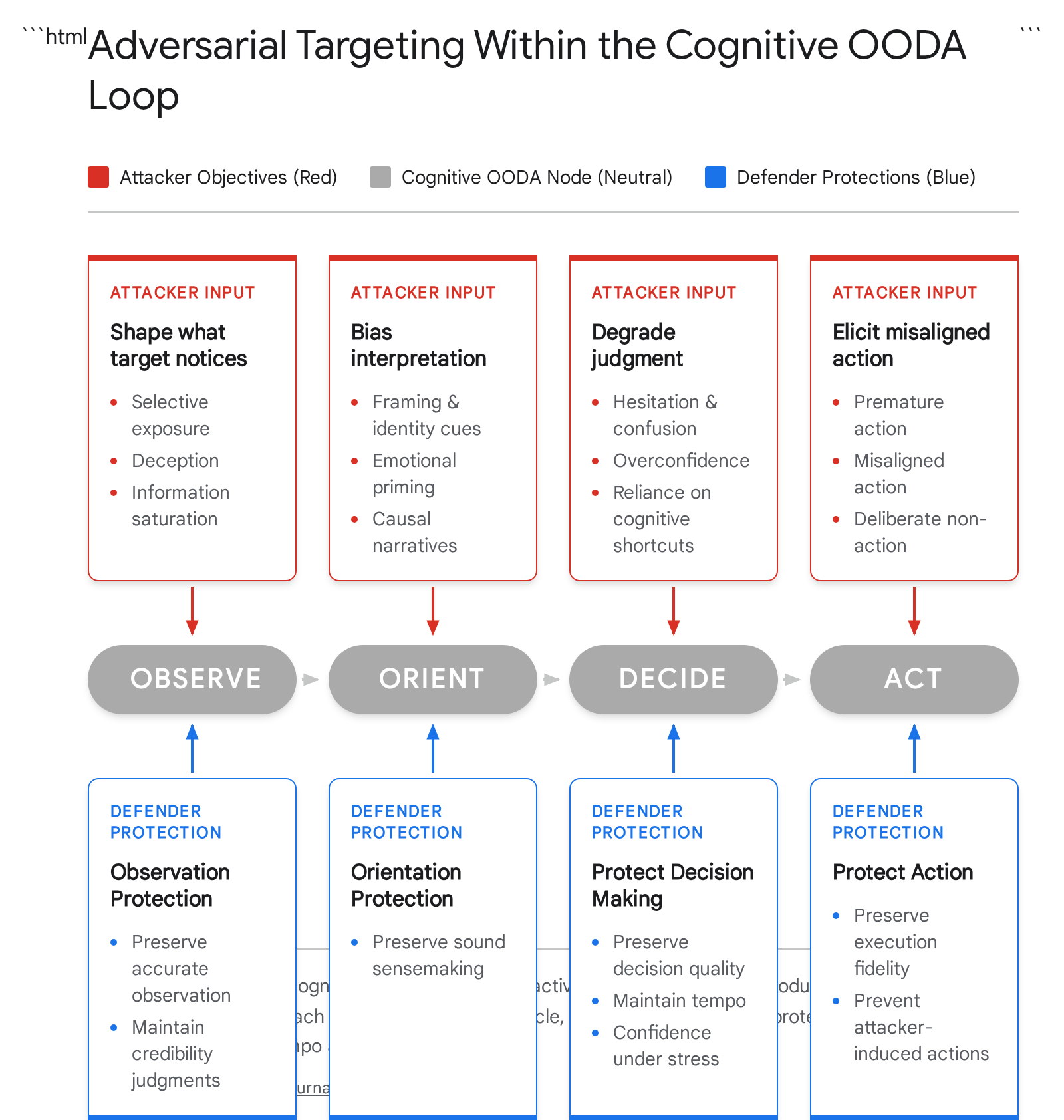
To operationalize the study of cognitive superiority, military and intelligence analysts utilize the Multi-Horizon Cognitive Observe-Orient-Decide-Act (OODA) Framework2. Grounded in Colonel John Boyd’s original decision cycle, this model treats cognitive conflict as a sustained attacker-defender interaction rather than a unidirectional broadcast2.
An attacker attempts to insert friction into every stage of the defender’s OODA loop, while the defender applies protective capacities to maintain operational tempo:
- Observe: The attacker aims to shape what the target notices through selective exposure, deception, and information saturation, forcing the target to allocate cognitive resources to irrelevant or manipulated data. Concurrently, the defender utilizes observation protection to preserve accurate credibility judgments2.
- Orient: The attacker introduces framing biases, identity cues, and emotional priming to distort the target’s sensemaking and interpretation of reality. The defender counters with orientation protection to preserve sound causal narratives2.
- Decide: By flooding the environment with contradictory narratives, the attacker induces hesitation, confusion, and overreliance on cognitive heuristics (mental shortcuts), degrading judgment quality. The defender works to preserve decision confidence under stress2.
- Act: The culmination of degraded observation, orientation, and decision results in premature action, strategic paralysis, or operations misaligned with the defender’s actual objectives. The defender aims to preserve execution fidelity2.
3.2. Acute Disruption versus Chronic Conditioning
The framework evaluates cognitive effects across two distinct temporal horizons, which must be measured differently to assess true cognitive superiority2.
Acute, or short-horizon, effects manifest within minutes to days. These are observable as immediate degradations of OODA loop performance4. Examples include delayed situational awareness convergence, slowed decision tempo, and operational pauses during a crisis2. Acute disruptions exploit real-time processing vulnerabilities, shaping immediate perceptions and eliciting misaligned actions before verification processes can conclude2.
Conversely, chronic, or long-horizon, effects accumulate over weeks, months, or years2. Chronic operations aim to erode institutional trust, polarize cultural identity, and normalize false beliefs2. The strategic utility of chronic conditioning is that it “re-parameterizes” the target’s baseline psychological state15. It alters how targets observe, orient, and decide before a crisis even begins7. When an acute event occurs, the target’s OODA loop is already structurally compromised by these persistent shifts in trust calibration and interpretive priors, raising the baseline difficulty of rapid orientation and response7.
3.3. Evaluative Metrics for Decision Advantage
To evaluate cognitive superiority, intelligence analysts move away from unidirectional, engagement-based metrics—such as message exposure, reach, or sentiment indicators—and utilize comparative performance indicators centered on decision integrity2. These metrics quantify the friction introduced into a command structure:
- Decision Latency: The time or speed required for an organization to make and execute decisions under pressure2.
- Orientation Divergence: The degree of internal misalignment, confusion, or contested interpretation among decision-makers regarding a shared situation2.
- Action Misalignment: Instances where a defending entity executes actions contrary to its strategic interests due to adversarial manipulation2.
- Attribution Discipline and Verification Tempo: The speed and accuracy of correctly identifying an attacker, alongside how quickly incoming information can be verified2.
- Amplification Velocity and Adaptation Speed: The speed at which an attacker can generate and pivot narrative variants compared to the defender’s capacity to detect, clear, and synchronize counter-framing2.
A theoretical case study detailing these metrics involves a fictional partner nation termed “Norland,” where an adversary sought to derail a logistics agreement2. The analysis concluded that the attacker achieved cognitive superiority not by converting the beliefs of the population, but through asymmetric cost imposition2. The attacker generated rapid narrative variants and reseeded them after takedowns at a low marginal cost5. Concurrently, the defender was burdened with the high operational costs of verification, internal alignment, public communication, and consequence management5. This structural asymmetry allowed the attacker to sustain pressure across the observe-orient-decide stages significantly longer than the defender could maintain high-tempo mitigation, resulting in slowed decision tempo, orientation divergence among staff, and misaligned operational pauses2.
4. Psychological Mechanisms and Neurocognitive Exploitation
Achieving cognitive superiority relies on integrating deeply understood psychological principles with scalable technologies. The target is the input-output processing mechanism of the human nervous system, aiming to manipulate perception before cognitive bandwidth allows for rational assessment2.
4.1. The Integration of Emotion and Cognition
A core psychological vector in cognitive warfare is the manipulation of emotion. Historical cognitive science occasionally viewed emotion as a limitation or obstacle to rationality, treating the mind purely as an information-processing device6. However, neuroscientific research—supported by figures such as Joseph LeDoux and studies on the amygdala and hippocampus by Antoine Bechara—demonstrates that emotion is inextricably linked to cognition6.
Rational decision-making is biologically impossible without emotional input6. Emotions function as a necessary neurological triage mechanism, allowing individuals to navigate uncertainty, evaluate stimuli, and prioritize competing, sometimes mutually exclusive, values based on how they align with survival or operational goals6. Emotions adjust the perception of probability and risk, heavily influencing attention and memory encoding6.
To compromise an adversary’s decision-making apparatus, attackers systematically manipulate the emotional states integral to that process6. By engineering content that triggers fear, anger, or outrage, adversaries bypass rational inhibition3. Neurologically, emotionally charged stimuli travel faster through processing centers, provoking impulsive sharing and immediate orientation divergence before the target has the time to empirically assess the information3.
4.2. Embodied Cognition and the Interoceptive Model
The theory of embodied cognition posits that cognitive processes are fundamentally dependent upon the physical body’s perceptual and motor interactions with the environment6. Rejecting traditional brain-centric computationalism, this framework suggests that human reasoning, memory, and language are anchored in bodily experiences6. A significant portion of communication relies on subconscious, nonverbal signals such as eye gaze, facial expressions, and posture6. Embodied cognition is frequently categorized into the “Four Es”: Embodied, Embedded, Enactive, and Extended cognition6.
Cognitive attackers exploit embodied cognition through the deployment of Virtual Reality Environments (VREs)6. Under the emotional processing theory established by Foa and Kozak, dysfunctional fear operates as a memory network comprising information about a stimulus, the fear response, and propositions of meaning6. VREs simulate complex, multimodal scenarios (combining visual, acoustic, and vestibular stimuli) that directly activate the perceptual pathways of the brain, bypassing top-down conceptual inputs6.
The efficacy of VREs relies on two psychological phenomena:
- Presence: The psychological illusion of non-mediation. According to Seth et al.’s interoceptive predictive coding model, presence is achieved when the brain successfully suppresses the mismatch between predicted interoceptive (internal emotional) states and actual physiological states, leading the user to feel they are genuinely inside the environment6.
- Embodiment: The sensation that a virtual avatar is the user’s actual physical body6.
When presence and embodiment are achieved, malicious actors can execute influence techniques that trigger intense emotional responses far exceeding the capabilities of traditional media6. For example, VREs can be hacked to plant synthetic, simulated encounters—termed authenticity spoofing—where avatars mimic organic interactions using calculated gestures, voice tones, and pupil dilations designed to spread panic or demoralization among deployed forces6.
4.3. Facial Mimicry and Subconscious Influence
A highly documented psychological vulnerability leveraged in cognitive warfare is similarity-based attraction and facial mimicry6. Evolutionary psychology indicates that humans have evolved to preferentially favor those who look similar to them, utilizing facial similarity as a subconscious proxy for genetic relatedness (kin recognition)6.
Studies conducted by researchers at Stanford University (Bailenson, Iyengar, Yee, and Collins) demonstrated the extreme efficacy of this vulnerability in political and strategic contexts6. Through multiple experiments using national representative samples during the 2004 and 2006 U.S. elections, researchers subtly altered photographs of political candidates (e.g., Charlie Crist, Jim Davis, George W. Bush, John Kerry) to blend them with the facial features of the viewing voter6.
The findings revealed that if up to 40% of the voter’s facial features were morphed into the candidate’s face, the voter remained entirely unaware of the manipulation6. Despite this lack of conscious awareness, the voter became significantly more favorably disposed toward the candidate, resulting in measurable shifts in preference (up to a 20% shift in voting preferences)6. The study noted that this effect was particularly strong for unfamiliar candidates where strong partisan ties or explicit policy proximity were absent6. In immersive digital domains and cognitive warfare scenarios, this technique can be applied dynamically at scale, altering the perceived faces of avatars, leaders, or communicators to subconsciously build trust and lower the target’s cognitive defenses6.
4.4. Perceptual Illusions and Cognitive Stress
In addition to emotional manipulation, cognitive warfare directly attacks visual and spatial processing using perceptual illusions6. Techniques include the use of reversible and bistable figures (such as the “duck-rabbit” illusion), where the brain is structurally unable to perceive both forms of an image simultaneously6. Forcing a voluntary mental shift from one interpretation to another requires cognitive energy, inducing fatigue6. Hermann Grid illusions and orientation-based distortions are similarly used to exploit gaps in visual processing, forcing cognitive stress upon targets to predictably degrade mental acuity, disrupt causal attribution, and inhibit a target’s ability to take action through indecision and cognitive overload6.
5. Technological Execution and Intelligence Operations
The scale, precision, and speed required to maintain cognitive superiority are facilitated by the integration of biometric tracking, autonomous algorithms, and the exploitation of critical cognitive infrastructure4.
5.1. Biometric Data Harvesting in Immersive Environments
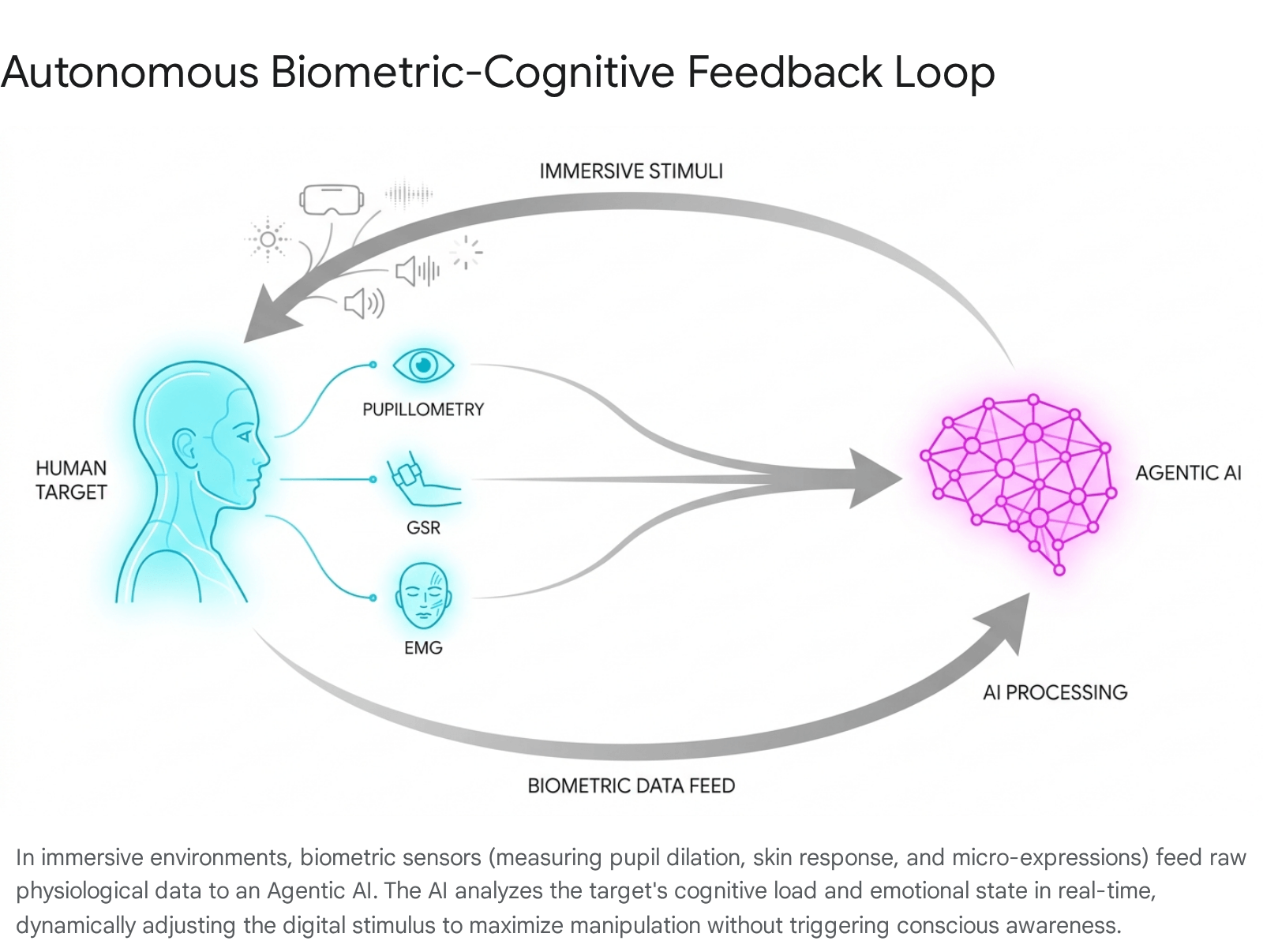
Immersive technologies and modern smart sensors collect continuous streams of biometric data, allowing adversaries to map a target’s real-time emotional and cognitive state6. China has reportedly developed an “Intelligent Psychological Monitoring System,” utilizing smart sensor bracelets to record facial information, emotional changes, and psychological states to determine the combat status of soldiers13.
The integration of multiple biometric vectors provides deep intelligence on internal psychological states:
| Biometric Vector | Measurement Target | Exploitation and Intelligence Value |
| Pupillometry (Pupil Dilation) | Irrepressible expansion of the pupils. | Correlates heavily with physiological arousal, indicating interior mental states, hidden biases, or undisclosed interest6. |
| Eye Tracking | Visual gaze path. | Identifies specific visual salience; maps exactly what captures and holds a target’s cognitive attention6. |
| Electromyography (EMG) | Facial muscle tension and activity. | Detects micro-expressions, accurately predicting underlying emotions (anger, fear, contempt, disgust) before they can be consciously masked6. |
| Galvanic Skin Response (GSR) | Electrical resistance of the skin. | Measures the raw intensity of the emotion being experienced, providing a verifiable metric of physiological stress6. |
| Electroencephalography (EEG) | Brain wave activity. | Assesses attentiveness, cognitive load, and distraction levels, verifying if a target is actively processing information6. |
By merging these streams, cognitive attackers construct detailed psychological profiles and create dynamic feedback loops6. The biometric data acts as real-time intelligence, allowing systems to dynamically adjust virtual stimuli to maximize manipulative impact and verify if the target’s cognitive state has been successfully altered, blurring the line between persuasion and explicit behavioral control6.
5.2. Autonomous Narrative Warfare via Agentic AI
Strategic competition increasingly relies on Agentic AI (aAI)—systems capable of planning, remembering, using tools, and functioning with autonomy to conduct influence operations5. Standard generative AI models rely heavily on transformer architectures, responding to specific prompts, but agentic systems represent a step change in operational capacity5. While traditional information operations relied on human-directed messaging cycles involving planning, dissemination, assessment, and revision, aAI conducts these functions simultaneously and recursively5.
Intelligence operations utilize AI-based signals analysis, sentiment analytics, and social mapping to conduct behavioral forecasting5. Agentic systems map these social environments and synthesize detailed cognitive profiles of communities by micro-segmenting populations for psychographic targeting5. They generate adaptive, persuasive narratives calibrated to specific psychological predispositions, rapidly amplifying these across networks4. By operating at computational speed, aAI achieves an amplification velocity that shapes what is salient in the information environment long before defending human analysts can coordinate a response, effectively transferring an asymmetric operational burden onto the defender2. The integration of “deepfakes” and synthetic media further destabilizes the environment by diluting truth as a referential concept, exploiting confirmation bias, and driving hostility toward out-groups16.
5.3. The Defense Metaverse as an Operational Domain
To harness technological advantages and train forces, military planners are developing a “defense metaverse”6. While standard simulators like SIMNET have existed since the 1980s, a fully realized defense metaverse connects disparate virtual worlds through an open architecture prioritizing interoperability6. This environment supports continuous, portable professional military education (PME), replacing episodic classroom activities6. It allows warfighters to seamlessly train in highly realistic synthetic spaces, experiencing the fog and friction of combat to build teamwork and resilience6. Furthermore, it creates a “cycle of research,” where findings from wargames inform modeling and live experiments without manual human effort, streamlining acquisitions and identifying maverick leaders uniquely suited for future conflicts6.
6. Countermeasures, Cognitive Defense, and Resilience
Defending against cognitive warfare and maintaining cognitive superiority requires shifting from a purely technological defense posture (such as cybersecurity) to one grounded in structural cognitive resilience8. This involves whole-of-society involvement, transparent institutional coordination, and specialized doctrinal implementations12.
6.1. Institutional Protection and Critical Cognitive Infrastructure
A foundational countermeasure is the formal integration of cognitive security into national defense planning4. Policy frameworks must classify artificial intelligence, data centers, and information ecosystems as “critical cognitive infrastructure”5. Much like physical power grids or water supplies, cognitive infrastructure requires mandatory risk management programs, reporting obligations, and structural protection to ensure that cross-border data flows do not create vulnerabilities9.
NATO doctrines, including the 2022 Strategic Concept, emphasize that sub-threshold cognitive interference is designed to erode public trust and complicate the Alliance’s ability to demonstrate resolve without risking military escalation12. Traditional deterrence mechanisms, such as NATO’s Article 5, were designed for overt, kinetic aggression by identifiable actors12. Prolonged cognitive interference undermines strategic coherence by fragmenting political will, meaning deterrence in this domain depends heavily on transparency, media literacy, and coordinated information exchange among allies12.
6.2. Operationalizing Resilience through CCW Training 2.0
Mere awareness of cognitive threats is insufficient; resilience must be systematically integrated into military decision-making8. The Countering Cognitive Warfare (CCW) Training 2.0 framework provides a structured pedagogical architecture to operationalize this resilience within professional military education8.
The program utilizes scenario-based training, prominently featuring “Operation Broken Signal,” an exercise developed to stress-test leadership under conditions of extreme uncertainty, time pressure, and adversarial influence8. Trainees process staggered social media feeds and simulated communications to assess narrative coherence and evaluate intended effects8. The training operates through five progressive phases:
- Awareness Phase: Introduction to cognitive biases, emotional triggers, and digital information dynamics8.
- Analytical Phase: Examination of cognitive attacks and manipulation mechanisms using structured case studies8.
- Procedural Integration Phase: Embedding standardized reflection mechanisms into formal planning processes8.
- Applied Phase: Stress-testing reflective judgment in command-and-staff simulations against staggered, hostile data feeds8.
- Transfer Phase: Consolidating protocols into permanent individual leadership practices8.
6.3. Cognitive Checkpoints and Validation Heuristics
The core tactical defense mechanism taught in CCW 2.0 is the “Cognitive Checkpoint.” These are mandatory, structured reflection pauses embedded into the standard military command and assessment process8. Traditional intelligence validation loops heavily emphasize verifying the authenticity of data, but often fail to address the cognitive interpretation of that data8. Checkpoints close this gap by forcing officers to actively interrogate assumptions, explore alternative interpretations, and identify biases such as peer pressure or herd mentality8.
A primary heuristic utilized during these checkpoints is “Cui bono?” (Who benefits?)8. To prevent this heuristic from inadvertently reinforcing pre-existing confirmation bias, it is embedded in a strict validation matrix8. Decision-makers must formally identify multiple potential beneficiaries (including indirect actors), distinguish intentional initiators from opportunistic beneficiaries, consider non-intentional explanations, and actively seek disconfirming evidence before finalizing an operational assessment8.
6.4. Emotional and Behavioral State Control (EBSC) and OSINT Fusion
On an intelligence level, maintaining cognitive superiority requires early warning systems capable of analyzing the information environment to detect cognitive interference17. Open-Source Intelligence (OSINT) fusion cells provide persistent situational awareness by identifying algorithmic coordination signals and message toxicity in near-real-time17.
A sophisticated defensive application is the use of Emotional and Behavioral State Control (EBSC)18. Defense analysts utilize cognitive neuroscience and AI to map the distribution of emotional states within a target population18.
- Input Emotion Analysis Layer: This foundational layer ingests natural language from open digital communication channels (forums, social networks, video-sharing sites, Telegram)18.
- Classification and Labeling: It extracts keywords, classifies emotions according to discrete models (joy, fear, anger, hope), tracks narrative clusters (e.g., “energy costs are rising”), and assigns cognitive warfare labels indicating bot likelihood or misinformation content18.
- Transformation: By establishing the community’s dynamic emotional map, defending institutions can design structured, multimodal narratives and symbolic framing aimed at positively reconfiguring collective emotions without coercion, thereby fortifying societal resilience against external manipulation18.
6.5. Defending the Critical Cognitive Infrastructure
Defending deployed forces requires protecting the technical systems that enable sense-making. Cognitive security faces direct threats from both data alteration and noise flooding, which target the decision-making systems of Western organizations to provoke errors19. Highly Reliable Organizations (HROs) demonstrating resilience against sense-making collapse prioritize data-centric security measures, ensuring sensitive information circulates under strict organizational control20. Crisis-prone organizations, conversely, suffer from excessive opinion polarization and oversimplified situation grids20. Modern defense requires accepting a paradigm where networks are assumed to be already invaded, necessitating behavioral adaptations from users and continuous systemic audits to prevent the collapse of internal meaning-making structures20.
7. Conclusion
Cognitive superiority is not characterized by the total elimination of adversarial messaging, nor does it require absolute control over a population’s beliefs. Rather, it is the maintenance of uncompromised, high-tempo decision-making capacities in the face of continuous psychological and technological interference. As adversaries leverage advanced neurobiological insights, immersive environments, and autonomous AI to fracture attention and manipulate the emotional prerequisites of human reasoning, passive defense mechanisms are rendered obsolete. Achieving superiority requires treating the mind as a contested domain, classifying the algorithms that mediate reality as critical infrastructure, and systematically embedding cognitive verification protocols directly into institutional command structures.
Master Summary Table
| Domain of Analysis | Key Mechanisms & Strategies | Evaluative Metrics & Objectives |
| Theoretical Framework | Multi-Horizon Cognitive OODA Loop. Targets the Observe, Orient, Decide, and Act phases over Acute (short-term) and Chronic (long-term) horizons2. | Decision latency, orientation divergence, action misalignment, attribution discipline, asymmetric cost imposition2. |
| Psychological Execution | Exploitation of cognitive biases, semantic uncertainty, and attention saturation. Manipulation of emotion as an integral component of rationality3. | Elicitation of fear/anger to bypass rational inhibition; alteration of trust calibration and interpretive priors3. |
| Technological Execution | Agentic AI (aAI), immersive Virtual Reality Environments (VREs), authenticity spoofing, facial mimicry, and biometric harvesting (pupillometry, EMG, GSR)4. | Amplification velocity, construction of dynamic bio-cognitive feedback loops, execution of highly individualized influence strategies4. |
| Countermeasures & Defense | Countering Cognitive Warfare (CCW) Training 2.0. Implementation of mandatory “Cognitive Checkpoints” and the Cui bono validation heuristic8. | Preservation of OODA loop integrity; mitigation of cognitive biases during intelligence evaluation; rapid recovery times8. |
| Strategic/Institutional Posture | Designation of AI as Critical Cognitive Infrastructure. OSINT fusion for persistent situational awareness. Emotional and Behavioral State Control (EBSC)9. | Active tracking of message toxicity/bot coordination; real-time mapping and positive reconfiguration of collective emotional states18. |
Please share the link on Facebook, Forums, with colleagues, etc. Your support is much appreciated and if you have any feedback, please email us in**@*********ps.com. If you’d like to request a report or order a reprint, please click here for the corresponding page to open in new tab.
Sources Used
- NATO’s Concept of Cognitive Warfare – Puolustusvoimat, https://puolustusvoimat.fi/documents/1951253/2815786/PVTUTKL_Tutkimuskatsaus_2026-2_Kaarkoski_en.pdf/d9b617e8-5e00-2fdf-84c9-730b1a9abd9e?t=1772545283130
- Cognitive warfare and the Nordic threat landscape – Telenor Group, https://www.telenor.com/who-we-are/our-companies/nordics/digitalsecurity/2025/cognitive-warfare-and-the-nordic-threat-landscape/
- Cognitive Warfare: The Case for Disaggregation – CSS ETH Zürich, https://css.ethz.ch/en/center/CSS-news/2026/06/kognitive-kriegsfuehrung-plaedoyer-fuer-eine-entbuendelung.html
- Defining Cognitive Warfare: A NDAA Mandate Response – Small Wars Journal, https://smallwarsjournal.com/2026/05/05/defining-cognitive-warfare/
- Autonomous Narrative Warfare: Engaging Agentic AI Within the Cognitive Battlespace – HSToday, https://www.hstoday.us/subject-matter-areas/narrative-strategy/autonomous-narrative-warfare-engaging-agentic-ai-within-the-cognitive-battlespace/
- Future Challenges to Cognitive Superiority – Irregular Warfare Center, https://irregularwarfarecenter.org/publications/perspectives/future-challenges-to-cognitive-superiority/
- Cognitive Warfare: Definition, Framework, and Case Study – arXiv, https://arxiv.org/html/2603.05222v1
- Bias Vs. Bots: Training Officers For Cognitive Warfare – The Defence Horizon Journal, https://tdhj.org/blog/post/training-officers-cognitive-warfare/
- EXPERT REACTION: Albanese announces Office of AI – Scimex, https://www.scimex.org/newsfeed/expert-reaction-albo-announces-office-of-ai
- Cognitive Warfare 2026: NATO’s Chief Scientist Report as Sentinel Call for Operational Readiness > Institute for National Strategic Studies > View Publications, https://inss.ndu.edu/Research-and-Commentary/View-Publications/Article/4371195/cognitive-warfare-2026-natos-chief-scientist-report-as-sentinel-call-for-operat/
- Definitional ambiguity in cognitive warfare: a critical and systematic conceptual review through ideal-type analysis – Frontiers, https://www.frontiersin.org/journals/big-data/articles/10.3389/fdata.2026.1762571/full
- NATO’s Strategic Recalibration in the Cognitive Era – EST, https://esthinktank.com/2026/06/11/natos-strategic-recalibration-in-the-cognitive-era/
- Cognitive Warfare – NATO’s ACT, https://www.act.nato.int/activities/cognitive-warfare/
- NATO in its multidomain operations: Reflections on cognitive superiority – IIHS, https://www.iihs.hr/Portals/0/Gallery/ZSF2024/ZSF2024%20-%2002-003-Vira%20Ratsiborynska.pdf?ver=2024-10-27-141600-000
- Cognitive Warfare: Definition, Framework, and Case Study – arXiv, https://arxiv.org/pdf/2603.05222
- Cognitive Warfare: Securing Hearts and Minds – Information Integrity Lab – University of Ottawa, https://infolab.uottawa.ca/common/Uploaded%20files/PDI%20files/InfoLab%20-%20Cognitive%20Warfare,%20Securing%20Hearts%20and%20Minds.pdf
- NATO-aligned Cognitive Warfare Defense: How Semantic Visions Supports Cognitive Superiority, Resilience, and Decision Advantage, https://www.semantic-visions.com/insights/nato-aligned-cognitive-warfare-defense
- Emotionally based strategic communications as a new tool in defensive cognitive warfare – PMC, https://pmc.ncbi.nlm.nih.gov/articles/PMC12920201/
- Cognitive Security: Facing Cognitive Operations in Hybrid Warfare1 – Semantic Scholar, https://pdfs.semanticscholar.org/c01a/01d3564b138b0ab019ac16ef7a7c7f24703f.pdf
- (PDF) Cognitive Security: Facing Cognitive Operations in Hybrid Warfare1 – ResearchGate, https://www.researchgate.net/publication/371702591_Cognitive_Security_Facing_Cognitive_Operations_in_Hybrid_Warfare1